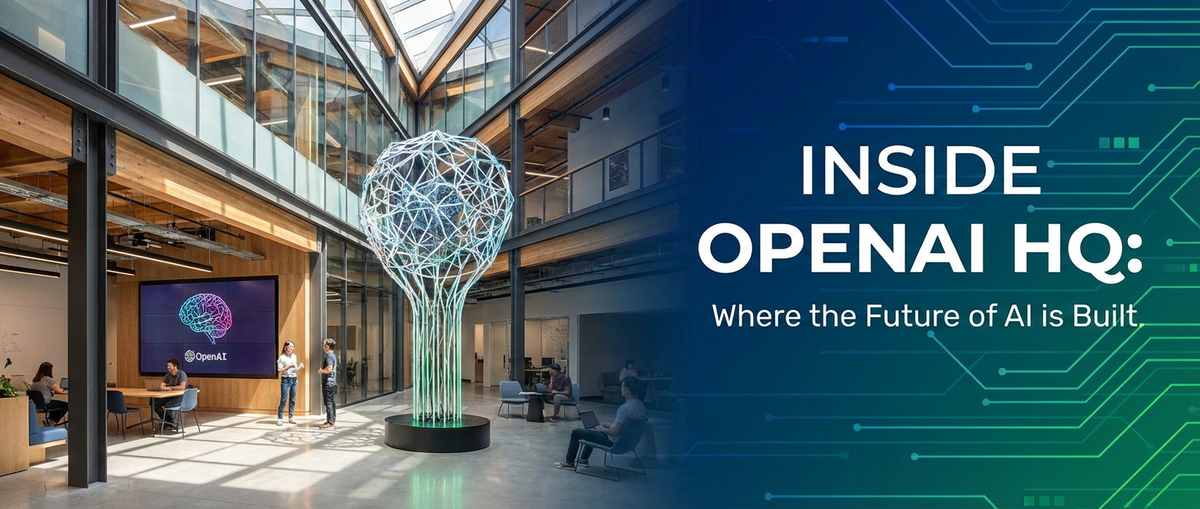
Inside OpenAI HQ: Where the Future of AI is Built


In the heart of San Francisco, amidst the bustling tech landscape, lies a building that has become synonymous with the future of artificial intelligence. It is the unassuming yet profoundly significant headquarters of OpenAI, an organization that has captivated the world's attention with its audacious mission: to ensure that artificial general intelligence (AGI) benefits all of humanity. Stepping inside OpenAI HQ is not merely entering an office space; it is crossing a threshold into a vibrant crucible where the raw, untamed potential of AI is meticulously shaped, refined, and directed. This article embarks on an extensive journey deep into the core of OpenAI, exploring its genesis, its physical and intellectual environment, the groundbreaking research conducted within its walls, the challenges it confronts, and its ambitious vision for a world transformed by advanced AI. We will uncover how this remarkable institution is not just building algorithms, but actively constructing the very architecture of tomorrow's intelligence.
The Genesis of a Grand Vision: Founding Principles and Pioneering Spirit
The story of OpenAI begins not with a eureka moment in a lab, but with a profound and urgent philosophical debate among some of the brightest minds in technology. Founded in December 2015 by a consortium of prominent figures including Elon Musk, Sam Altman, Ilya Sutskever, Greg Brockman, and others, OpenAI was born out of a shared concern about the trajectory of artificial intelligence. The fear was palpable: if AI, particularly powerful AGI, were developed by a select few, or worse, by entities driven solely by profit or power, the consequences for humanity could be catastrophic. The initial premise was revolutionary: create a non-profit research company dedicated to developing friendly AI in a way that is open and transparent, sharing knowledge and discoveries to prevent any single entity from monopolizing this transformative technology.
This founding principle, encapsulated in its name "OpenAI," underscored a commitment to transparency, collaboration, and the broad distribution of AI's benefits. The early days were marked by an idealistic zeal, a fervent belief that humanity’s greatest challenge – and opportunity – lay in responsibly navigating the advent of superintelligence. Researchers and engineers, drawn by this compelling mission, flocked to the nascent organization, eager to contribute to a cause larger than themselves. They embarked on fundamental research, exploring novel neural network architectures, reinforcement learning algorithms, and the theoretical underpinnings of intelligence itself. This period was characterized by intense intellectual ferment, rapid experimentation, and a relentless pursuit of groundbreaking insights, laying the groundwork for the monumental breakthroughs that would later redefine the field. The unwavering dedication to its founding principles, particularly the emphasis on safety and beneficial AGI, continues to permeate every aspect of OpenAI’s work, shaping its research agenda, its internal culture, and its interactions with the wider world.
Architecting the Future: Inside the Physical Sanctum of Innovation
The physical embodiment of OpenAI's mission is its headquarters, a testament to its philosophy of fostering intense collaboration while providing spaces for deep, uninterrupted focus. Located in a modern, multi-story building, the HQ is designed not with ostentatious displays of wealth, but with practicality and a minimalist aesthetic that prioritizes function and the free flow of ideas. Upon entering, visitors might notice an atmosphere of quiet intensity, a low hum of intellectual activity that is both palpable and inspiring. The layout encourages serendipitous encounters, with open-plan sections featuring adjustable desks, whiteboards liberally scattered for spontaneous ideation, and comfortable common areas adorned with ergonomic furniture. These collaborative zones are specifically engineered to facilitate cross-pollination of ideas between researchers working on diverse projects, from language models to robotics to safety alignment.
Yet, recognizing the profound cognitive demands of AI research, the headquarters also provides ample spaces for individual deep work. There are quiet rooms, private offices, and even sound-dampened booths where researchers can retreat to concentrate on complex algorithms, code development, or theoretical derivations without distraction. Natural light is maximized throughout the building, creating an invigorating and calming environment, while healthy snacks and beverages are readily available, ensuring that the brilliant minds working within remain fueled and focused. The walls often feature diagrams, equations, and printouts of research papers, serving as a constant visual reminder of the intellectual journey underway. Security measures are robust but unobtrusive, reflecting the sensitive nature of their work while maintaining an inviting atmosphere. The overall ambiance is one of focused energy, a hive of innovation where curiosity is celebrated, intellectual rigor is paramount, and the collective pursuit of AGI transcends individual egos, all under the roof of a facility meticulously crafted to support the monumental task at hand.
The Engine Room: Cutting-Edge Research and Development at the Frontier
At the very heart of OpenAI lies its research and development engine, a dynamic powerhouse constantly pushing the boundaries of what AI can achieve. The labs are buzzing with activity, not with the cacophony of traditional manufacturing, but with the quiet intensity of minds wrestling with some of humanity's most complex computational and philosophical challenges. One of the most prominent areas of research revolves around Large Language Models (LLMs), exemplified by the groundbreaking GPT series. Researchers here continuously explore novel architectures, scale up model sizes, refine training methodologies with unprecedented datasets, and develop sophisticated fine-tuning techniques to unlock ever-greater capabilities in natural language understanding and generation. The evolution from early generative models to the nuanced, context-aware, and even creative outputs of current LLMs represents years of tireless effort, pushing the limits of what deep learning can accomplish.
Beyond language, OpenAI is also at the forefront of vision models, with projects like DALL-E and Sora showcasing the astonishing ability of AI to generate high-quality, diverse images and videos from textual prompts. These endeavors blend computer vision with generative AI, demonstrating a profound understanding of visual concepts and their underlying structures. While robotics research may not be as publicly visible as their generative AI work, it remains a foundational area, exploring how AI can perceive and interact with the physical world through reinforcement learning and embodied intelligence.
Crucially, interwoven with every research thread is a deep and unwavering commitment to AI safety and alignment. This isn't a peripheral department; it's a core pillar of the entire organization. Teams are dedicated to understanding and mitigating potential risks associated with increasingly powerful AI systems. This includes research into interpretability – making AI models explainable rather than black boxes – as well as red teaming, where adversarial techniques are used to probe for vulnerabilities and undesirable behaviors. Alignment research focuses on ensuring that AI systems act in accordance with human values and intentions, a monumental challenge given the complexity and subjectivity of human ethics. The methodologies employed across all these domains are characterized by a relentless pursuit of empirical evidence, massive computational power (often leveraging supercomputing clusters), and a culture of iterative development where hypotheses are tested, models are refined, and new frontiers are constantly explored, all contributing to the rapid, yet considered, advancement of AI capabilities.
A Day in the Life: The Minds Behind the Machines
Life inside OpenAI HQ is a unique blend of intense intellectual pursuit, collaborative problem-solving, and the shared excitement of being at the cutting edge of technological advancement. A typical day for a researcher or engineer is rarely monotonous. It might begin with a stand-up meeting, where teams discuss progress, roadblocks, and plans for the day. These brief but crucial check-ins ensure alignment and provide opportunities for immediate feedback and brainstorming. The bulk of the day is often spent deep in code, refining neural network architectures, optimizing training pipelines, analyzing experimental results, or delving into complex mathematical proofs. The problems are often unprecedented, requiring not just technical expertise but also a significant degree of creativity and theoretical insight.
Collaboration is not just encouraged; it's embedded in the DNA of the organization. Researchers from different disciplines – computer science, neuroscience, philosophy, mathematics – frequently cross-pollinate ideas. A machine learning engineer might collaborate closely with an ethicist to understand the societal implications of a new model, or a natural language processing expert might consult with a reinforcement learning specialist on a novel approach to model control. Whiteboard sessions are a common sight, filled with equations, diagrams, and spirited debates, as colleagues collectively unravel intricate challenges. The intellectual environment is incredibly stimulating, demanding rigorous thinking and a willingness to challenge assumptions.
However, it's not all heads-down coding. There are regular internal seminars, paper readings, and informal discussions where new research is presented and dissected. The challenges are immense – debugging models with billions of parameters, grappling with the ethical dilemmas of powerful generative AI, or simply finding a bug in a complex distributed system. Yet, the rewards are equally profound: the thrill of a breakthrough, the satisfaction of seeing a model perform a task thought impossible just months ago, and the profound sense of contributing to a mission that could fundamentally reshape humanity's future. The commitment to impact, paired with an unwavering dedication to scientific rigor, defines the daily rhythm for the exceptional individuals who form the backbone of OpenAI’s pioneering efforts.
Scaling AI: Infrastructure, Operational Excellence, and the Role of Gateways
The development and deployment of cutting-edge AI models, particularly those of the scale and complexity pioneered by OpenAI, demand an infrastructure of colossal proportions and an unwavering commitment to operational excellence. It's not just about brilliant algorithms; it's about the sheer computational muscle required to train them. OpenAI leverages immense supercomputing clusters, often comprising tens of thousands of GPUs, running around the clock. This necessitates sophisticated energy management systems, advanced cooling solutions, and a robust network architecture capable of handling petabytes of data traffic daily. Their reliance on cloud infrastructure partners further complicates this, requiring seamless integration and efficient resource allocation to manage sprawling computational tasks that can span multiple data centers.
Data management is another critical component. Training foundational models like GPT-4 involves curating, cleaning, and processing truly gargantuan datasets, encompassing vast swathes of text, images, and other modalities from the internet and proprietary sources. Ethical sourcing of this data, ensuring privacy, and mitigating biases are paramount challenges that require continuous diligence. Beyond training, the deployment pipelines for making these models accessible to researchers, developers, and eventually the public are equally complex. They involve rigorous testing, version control, security audits, and continuous monitoring to ensure stability, performance, and responsible usage.
As more powerful models emerge from the labs and are integrated into diverse applications across various industries, the need for sophisticated management tools becomes paramount. This is where platforms like an AI Gateway prove invaluable. An AI Gateway acts as a centralized control point for managing, securing, and optimizing access to a multitude of AI models, whether they are OpenAI's proprietary models or other open-source alternatives. For instance, enterprises building applications that integrate several AI services – perhaps a language model for content generation, a vision model for image analysis, and a custom-trained model for specific business logic – face a significant integration challenge. An effective AI Gateway simplifies this by offering unified authentication, rate limiting, logging, and even cost tracking across various models.
This is precisely the domain where APIPark, an open-source AI gateway and API management platform, excels. It's designed to help developers and enterprises manage, integrate, and deploy both AI and REST services with remarkable ease. With features like quick integration of over 100 AI models and a unified API format for AI invocation, APIPark ensures that changes in underlying AI models or prompts do not disrupt application microservices, thereby simplifying AI usage and significantly reducing maintenance costs. Furthermore, for those specifically working with large language models, the concept of an LLM Gateway becomes even more specialized, providing tailored features for prompt management, model versioning, and ensuring the secure and efficient interaction with complex generative AI systems. The ability to abstract away the complexities of different AI providers and their API specifics, and instead offer a single, standardized interface, transforms the operational landscape, making advanced AI truly accessible and manageable at scale.
APIPark is a high-performance AI gateway that allows you to securely access the most comprehensive LLM APIs globally on the APIPark platform, including OpenAI, Anthropic, Mistral, Llama2, Google Gemini, and more.Try APIPark now! 👇👇👇
Bridging the Gap: From Lab to World through an Open Platform Ecosystem
OpenAI's impact extends far beyond its research labs, reaching millions globally through strategic deployment and the cultivation of a robust ecosystem. The organization has made a conscious effort to transition its powerful models from academic curiosities to practical tools accessible to developers and businesses. This is primarily achieved through well-documented APIs, which allow external parties to integrate OpenAI’s advanced capabilities into their own applications and services. This approach fosters innovation, enabling a diverse range of use cases from content creation and customer service to scientific research and educational tools. By exposing these models through a programmatic interface, OpenAI effectively transforms them into building blocks for a new generation of intelligent applications.
The philosophical underpinning of this strategy is the concept of an Open Platform. While OpenAI itself has evolved from a purely non-profit "open-source" model to a "capped-profit" entity with proprietary elements, the spirit of enabling widespread access and fostering an ecosystem of innovation remains central. An Open Platform approach ensures that the power of cutting-edge AI is not confined to a single organization but can be leveraged by a global community of developers. This involves providing clear documentation, developer tools, and community support, empowering others to experiment, build, and deploy AI-powered solutions. The challenges of democratizing such powerful technology are immense, encompassing concerns about misuse, ensuring fair access, and managing the sheer volume of demand.
Furthermore, the complexities of interacting with diverse AI models, each with its unique API specifications, authentication methods, and rate limits, can quickly become overwhelming for developers. This is where the utility of an LLM Gateway becomes evident. As discussed earlier, an LLM Gateway provides a unified interface for interacting with various Large Language Models, abstracting away underlying differences and simplifying the developer experience. It allows for consistent prompt engineering, model switching, and robust error handling, dramatically reducing the friction of building AI-powered applications. Such a gateway not only streamlines integration but also offers centralized management for critical aspects like security, usage monitoring, and cost optimization, which are vital for any enterprise operating at scale.
For instance, an organization utilizing OpenAI's models might also integrate other specialized LLMs or even their own fine-tuned models. Without a centralized LLM Gateway, managing these different endpoints, authenticating requests, and tracking usage across them would be a fragmented and inefficient process. Solutions like APIPark step in to fill this critical need, offering not just AI Gateway capabilities but specifically streamlining the invocation of LLMs with a unified API format and prompt encapsulation. By transforming complex AI models into easily consumable REST APIs, APIPark makes it significantly easier for developers to build sophisticated AI applications, accelerating the transition of laboratory breakthroughs into real-world impact and solidifying the vision of a truly Open Platform for AI innovation.
The Ethical Imperative: Safety, Alignment, and Responsible AI
Amidst the dizzying pace of AI advancement, OpenAI maintains an unwavering focus on the ethical imperative that guides its mission: to ensure that artificial general intelligence benefits all of humanity. This is not a secondary concern but a foundational pillar, deeply integrated into every research project and deployment strategy. The organization invests heavily in AI safety and alignment research, acknowledging the profound and potentially disruptive power of the technologies they are creating. One critical area is "red teaming," where researchers deliberately try to find flaws, biases, and potential for misuse in AI models before they are released. This involves probing models with adversarial prompts, attempting to elicit harmful content, or discovering ways the AI could generate misinformation, thereby stress-testing its robustness and safety guardrails.
Interpretability is another key area, aiming to peel back the layers of complex neural networks to understand how they arrive at their decisions. Moving beyond opaque "black box" models is crucial for building trust, debugging unexpected behaviors, and ensuring accountability. Researchers work on techniques to visualize internal model states, identify influential features, and understand the logic (or lack thereof) behind an AI's output. This is particularly challenging for large, multimodal models that integrate vast amounts of data.
Alignment research, arguably the most complex and philosophically charged aspect, seeks to ensure that advanced AI systems act in accordance with human values and intentions. This involves grappling with the inherent complexities and subjectivity of human ethics, developing methods to instill principles like fairness, truthfulness, and beneficence into AI, and creating feedback loops where human preferences can continuously shape AI behavior. This can range from training models with human feedback (Reinforcement Learning from Human Feedback - RLHF) to developing sophisticated constitutional AI approaches. The long-term vision of AGI necessitates proactive research into how to manage and control superintelligent systems, addressing concerns about unintended consequences, runaway behaviors, and the existential risks associated with systems far surpassing human cognitive abilities.
OpenAI actively engages in public discourse and policy discussions, recognizing that the societal implications of AI extend far beyond technical challenges. They collaborate with governments, academic institutions, and other industry leaders to shape responsible AI policies, develop ethical guidelines, and promote public understanding of AI's capabilities and limitations. The ongoing debate around topics like job displacement, deepfakes, privacy, and bias in AI is taken seriously, with the organization striving to contribute solutions and foster a collective approach to navigating these complex societal shifts. This multifaceted commitment to safety, alignment, and responsible development underscores OpenAI's profound understanding that building the future of AI is as much an ethical and societal endeavor as it is a technological one.
The Future Unfolding: OpenAI's Vision Beyond Today
OpenAI's gaze is firmly fixed on a future that transcends today's impressive, yet still nascent, AI capabilities. Their ultimate, audacious goal remains the development of Artificial General Intelligence (AGI) – a hypothetical AI that can understand, learn, and apply intelligence across a wide range of tasks at or beyond human levels. This vision is not merely about creating faster calculators or more efficient language models; it's about unlocking a fundamental shift in humanity's capacity to solve problems, innovate, and thrive. They envision AGI as a powerful tool, a co-pilot for humanity, capable of accelerating scientific discovery, tackling global challenges like climate change and disease, and unlocking new forms of creativity and prosperity.
The journey toward AGI is seen as a multi-stage process, with each breakthrough building upon the last. Researchers are constantly exploring pathways to enhance AI's reasoning capabilities, its ability to generalize knowledge across different domains, and its capacity for long-term planning and problem-solving. This includes advancements in multimodal AI, where models can seamlessly integrate and understand information from text, images, audio, and video, mirroring human perception. Speculation abounds about future breakthroughs: AI systems that can independently design and execute complex scientific experiments, rapidly synthesize vast bodies of knowledge to derive novel theories, or even autonomously develop new software and hardware. The next generation of models might exhibit a deeper understanding of causality, human emotions, and abstract concepts, moving closer to genuine cognitive intelligence rather than sophisticated pattern matching.
OpenAI also recognizes that the landscape of AI will continue to evolve at an accelerating pace, shaped not only by their own innovations but by the contributions of a global research community. They anticipate a future where AI becomes an even more ubiquitous and indispensable part of daily life, transforming industries from healthcare and education to entertainment and manufacturing. However, this future also necessitates continuous adaptation and foresight. The ethical frameworks, safety protocols, and governance structures that are being developed today will need to be flexible enough to contend with AI systems of vastly greater power and autonomy. The organization remains committed to an iterative approach, releasing increasingly capable models while simultaneously dedicating resources to understanding and mitigating their risks. The vision is clear: to build AGI, not as an end in itself, but as a means to empower humanity to achieve unprecedented levels of progress and address its most pressing challenges, all while navigating the profound responsibilities that come with wielding such transformative power.
OpenAI's Key Offerings and Their Applications
OpenAI offers a suite of powerful AI models and tools designed to empower developers and businesses. These offerings represent the culmination of years of research and provide a foundation for building innovative AI-powered applications.
Here's a breakdown of some of their primary products and their typical use cases:
| Product Family | Description | Typical Use Cases | Key Capabilities |
|---|---|---|---|
| GPT Series | A family of Large Language Models (LLMs) renowned for natural language understanding and generation. Includes models like GPT-3.5, GPT-4, and their fine-tuned versions. | Content creation (blog posts, articles, marketing copy), chatbots and conversational AI, code generation, summarization, translation, data analysis, educational tools (tutoring, learning assistants), creative writing (poetry, scripts), customer support automation. | Advanced natural language understanding, text generation, summarization, translation, reasoning, code interpretation, multi-turn dialogue management. |
| DALL-E | A text-to-image generative AI model capable of creating highly realistic and imaginative images from textual descriptions. | Graphic design, illustration, advertising visuals, prototyping creative concepts, generating unique art, visualizing product ideas, creating game assets, producing diverse stock photography, interior design visualization. | Image generation from text prompts, image editing (inpainting, outpainting), style transfer, creating variations of existing images. |
| Sora | A text-to-video generative AI model that can create realistic and imaginative videos from text instructions. (Currently in limited research preview) | Film production (pre-visualization, storyboard creation), advertising (short commercial spots), social media content, educational animations, virtual reality environments, creating synthetic data for training other AI models, generating dynamic visualizations of concepts. | Video generation from text prompts, generating complex scenes with multiple characters and specific motions, maintaining visual consistency. |
| Whisper | A robust speech-to-text model trained on a vast dataset of multilingual audio and text. | Transcription services, voice assistants, meeting notes automation, captioning videos, voice command interfaces, multilingual audio processing, creating datasets for language research, accessibility tools. | High accuracy speech recognition, multilingual support, handling various accents and background noise, language identification. |
| Embeddings | Models that convert text into numerical vector representations, capturing semantic meaning. These vectors are crucial for many NLP tasks. | Semantic search, recommendation systems, text classification, clustering, anomaly detection, topic modeling, plagiarism detection, building knowledge graphs, sentiment analysis, creating intelligent information retrieval systems. | High-dimensional vector representation of text, semantic similarity calculations, efficient information retrieval. |
| API Access | A developer-friendly interface that allows external applications to programmatically interact with OpenAI's models. | Integration into custom software, building proprietary AI solutions, creating new products and services leveraging OpenAI's capabilities, automating workflows, data processing, creating interactive AI experiences for users. | Programmatic access to models, scalable inference, developer documentation, playground environment, fine-tuning capabilities. |
| Fine-tuning | The ability to adapt OpenAI's base models to specific tasks or datasets using additional, custom training data. | Tailoring language models for specific industry jargon, improving performance on niche tasks, enhancing brand voice consistency, creating highly specialized chatbots, improving accuracy for specific document types, personalization for unique user bases. | Custom model training, improved task performance, domain adaptation, reduced inference costs for specific use cases. |
This diverse portfolio underscores OpenAI's commitment to democratizing access to advanced AI, empowering a broad spectrum of users, from individual developers to large enterprises, to build the next generation of intelligent applications.
Conclusion: The Unfolding Legacy of a Visionary Frontier
OpenAI HQ is more than just an office; it is a nexus where human ingenuity confronts the profound mysteries of intelligence, shaping the very fabric of our future. From its visionary genesis rooted in the ethical imperative to benefit all humanity, to the meticulously designed physical spaces that foster both intense focus and dynamic collaboration, every aspect of OpenAI is geared towards its monumental mission. We have explored the vibrant engine room of its cutting-edge research, witnessing the relentless pursuit of breakthroughs in Large Language Models, generative vision, and the foundational quest for AI safety and alignment. We've peered into the daily lives of the brilliant minds who dedicate themselves to this frontier, navigating immense computational demands and complex ethical dilemmas.
Crucially, the journey from lab to world is facilitated by sophisticated infrastructure and the strategic embrace of an Open Platform philosophy, where tools like a robust AI Gateway and specialized LLM Gateway become indispensable for democratizing access and managing the intricate ecosystem of modern AI. APIPark, as an example, exemplifies how such platforms can streamline the integration and management of diverse AI services, bridging the gap between raw computational power and practical application.
The ethical imperative remains at the core, with dedicated efforts to ensure responsible development, anticipate risks, and align AI with human values. As OpenAI continues its ambitious trajectory towards Artificial General Intelligence, its legacy will not only be defined by the technological marvels it creates but by the profound care and foresight with which it approaches the most transformative technology in human history. The future of AI is not merely being discovered within these walls; it is being consciously, carefully, and courageously built, brick by ethical brick, code by conscientious code, for the benefit of generations to come.
5 FAQs about OpenAI HQ and its Mission
1. What is OpenAI's primary mission, and how has it evolved since its founding? OpenAI's primary mission, established at its founding in 2015, is to ensure that artificial general intelligence (AGI) benefits all of humanity. Initially, this was pursued as a purely non-profit research endeavor with a strong emphasis on open-sourcing its research. While the core mission remains unchanged, the organization evolved into a "capped-profit" entity in 2019 to attract the massive capital and talent required for advanced AI research and compute, while maintaining its beneficial mission and governance structure. This shift allowed them to accelerate progress toward safe AGI while still prioritizing safety and broad distribution of benefits over pure profit.
2. What kind of research does OpenAI primarily conduct within its headquarters? OpenAI conducts a wide range of cutting-edge AI research, primarily focused on developing and understanding highly capable AI systems. Key areas include: * Large Language Models (LLMs): Developing models like the GPT series for natural language understanding, generation, and reasoning. * Generative AI for Vision: Creating models like DALL-E and Sora for generating images and videos from text. * AI Safety and Alignment: Extensive research into understanding and mitigating risks associated with powerful AI, ensuring AI systems are aligned with human values, and developing interpretability tools. * Reinforcement Learning: Fundamental research in how AI agents can learn optimal behaviors through interaction. * Multimodal AI: Integrating different data types (text, image, audio) for a more holistic understanding.
3. How does OpenAI ensure the safety and ethical development of its AI models? OpenAI integrates safety and ethical considerations throughout its development lifecycle. This includes: * Red Teaming: Employing adversarial techniques to identify and mitigate potential biases, harmful outputs, and vulnerabilities in models before release. * Alignment Research: Developing methods to ensure AI systems act in accordance with human intentions and values, often through human feedback (RLHF) and constitutional AI. * Interpretability: Researching ways to understand the internal workings and decision-making processes of complex AI models. * Policy and Public Engagement: Actively engaging with policymakers, researchers, and the public to shape responsible AI governance and foster informed discourse about AI's societal impact. * Gradual Deployment: Releasing increasingly capable models incrementally to allow for learning, feedback, and adaptation.
4. What role do "AI Gateway" and "LLM Gateway" concepts play in deploying advanced AI like OpenAI's models? "AI Gateway" and "LLM Gateway" refer to crucial infrastructure components that facilitate the deployment, management, and secure access to various AI models, including those from OpenAI. * An AI Gateway acts as a centralized access point for multiple AI services, offering unified authentication, rate limiting, logging, security, and performance optimization. It simplifies integrating diverse AI models into applications for developers and enterprises. * An LLM Gateway is a specialized form of AI Gateway focused specifically on Large Language Models. It provides a standardized interface for interacting with different LLMs, abstracting away their unique APIs, managing prompts, handling model versioning, and ensuring efficient and secure invocation of these complex generative systems. Both gateways are vital for scaling AI adoption, reducing integration complexities, and maintaining operational control over AI workloads.
5. How does OpenAI aim to make its powerful AI accessible to a wider audience? OpenAI makes its powerful AI accessible primarily through an Open Platform strategy, utilizing well-documented APIs. This allows developers, businesses, and researchers to integrate OpenAI's models (like GPT series and DALL-E) into their own applications and services. They provide developer tools, comprehensive documentation, and a "playground" environment for experimentation. While their research can be highly technical, the API access allows individuals without deep AI expertise to leverage cutting-edge models. This approach fosters an ecosystem of innovation, enabling a vast array of AI-powered products and services to be built on top of OpenAI's foundational technologies, thereby democratizing access to advanced AI capabilities.
🚀You can securely and efficiently call the OpenAI API on APIPark in just two steps:
Step 1: Deploy the APIPark AI gateway in 5 minutes.
APIPark is developed based on Golang, offering strong product performance and low development and maintenance costs. You can deploy APIPark with a single command line.
curl -sSO https://download.apipark.com/install/quick-start.sh; bash quick-start.sh

In my experience, you can see the successful deployment interface within 5 to 10 minutes. Then, you can log in to APIPark using your account.

Step 2: Call the OpenAI API.