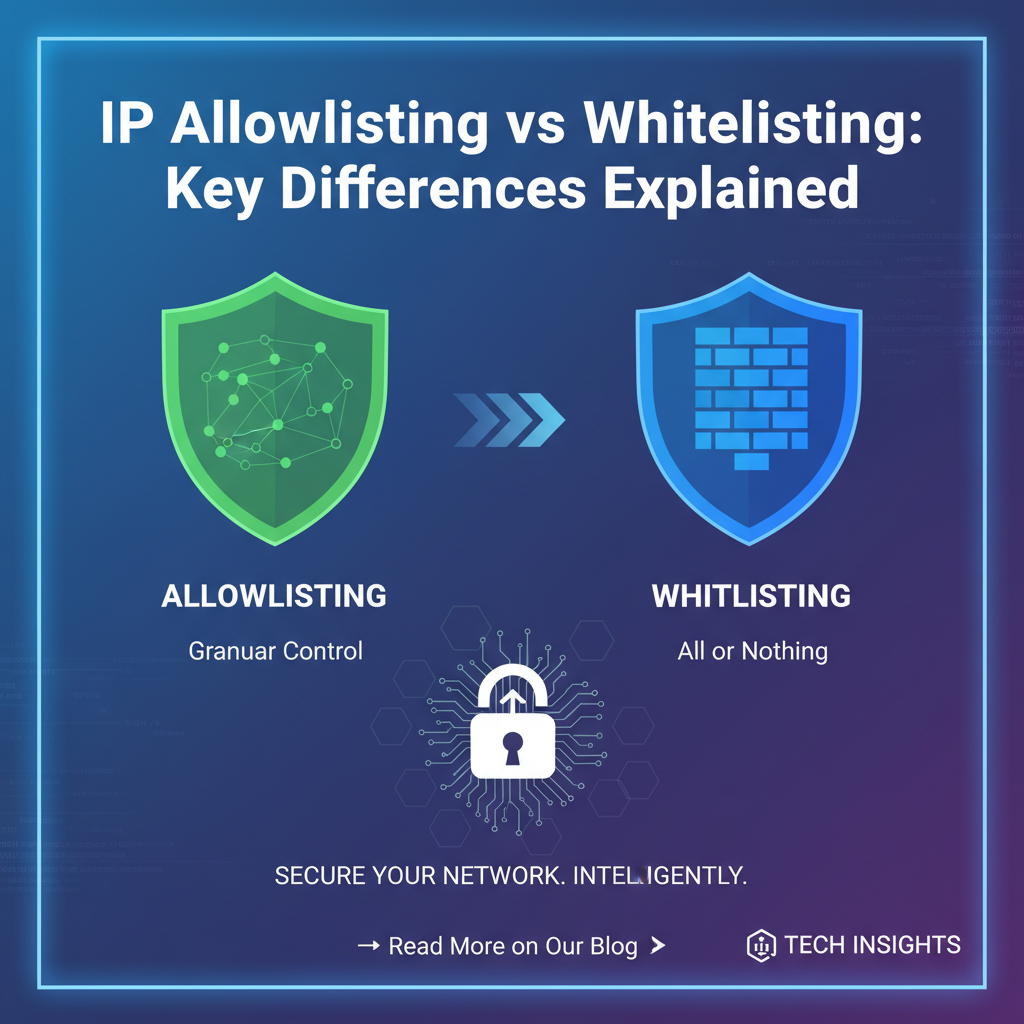
IP Allowlisting vs Whitelisting: Key Differences Explained
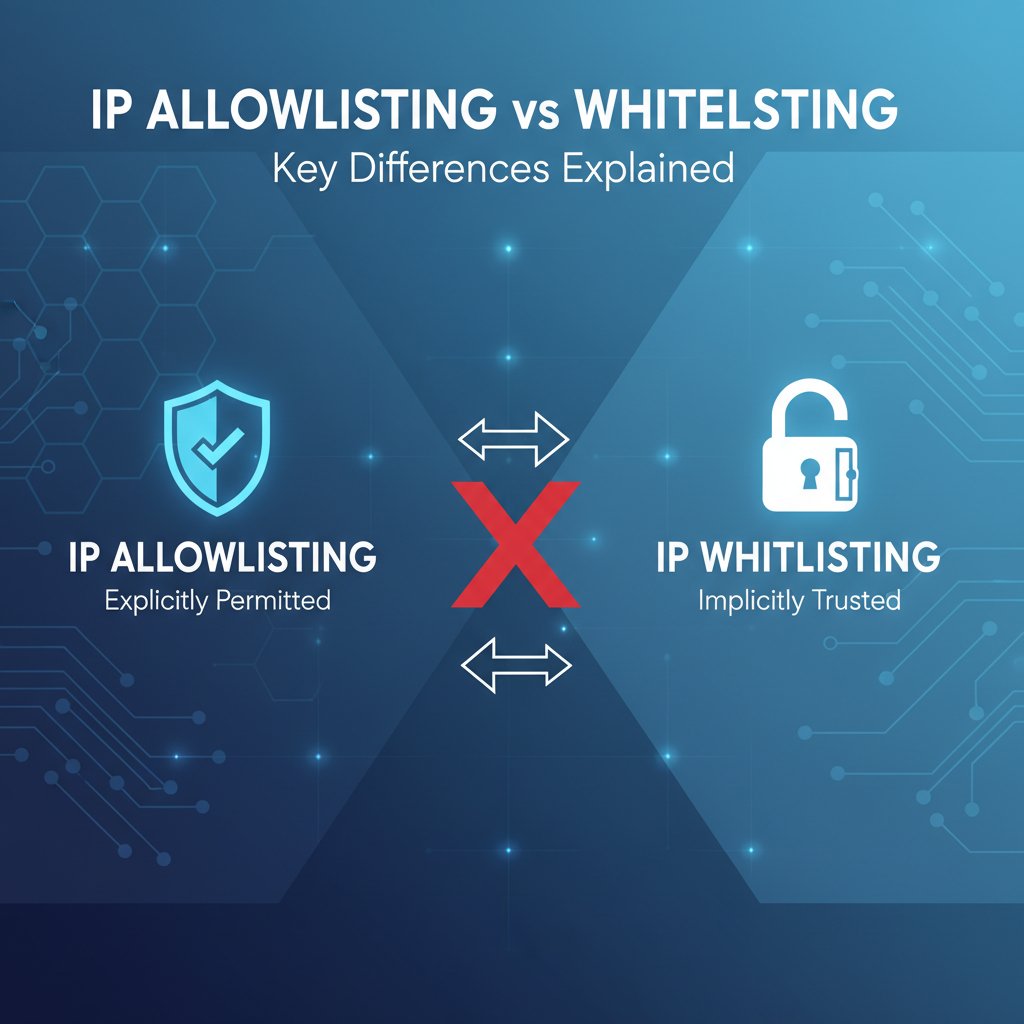


In the intricate landscape of modern cybersecurity, access control stands as a fundamental pillar, dictating who, or what, gains entry to critical digital resources. Among the various mechanisms employed to enforce this control, IP-based access restrictions have long been a cornerstone, providing a clear and often robust layer of defense. These mechanisms operate by scrutinizing the Internet Protocol (IP) address of an incoming request, comparing it against a predefined list to determine whether access should be granted or denied. For decades, the term "IP Whitelisting" dominated this domain, becoming synonymous with the practice of explicitly permitting known, trusted IP addresses while implicitly rejecting all others. However, in recent years, a significant linguistic and conceptual shift has occurred, moving towards the more neutral and descriptive term "IP Allowlisting."
This evolution in terminology is not merely a cosmetic change; it reflects a broader industry effort to embrace inclusive language, clarify technical concepts, and foster a more precise understanding of security practices. While functionally identical in their objective – to permit access only from a specified set of IP addresses – the discussion around "whitelisting" versus "allowlisting" delves into the historical context of these terms, their practical implications, and the underlying principles of secure network design. Understanding this distinction, and the reasons behind it, is crucial for anyone involved in managing digital infrastructure, from network architects and security professionals to software developers building and consuming APIs.
This comprehensive article aims to dissect the concepts of IP whitelisting and allowlisting, exploring their definitions, operational mechanisms, benefits, and challenges. We will trace the historical trajectory of IP-based access control, examine why the terminology has evolved, and provide practical insights into implementing these security measures effectively across various environments, including firewalls, load balancers, and, critically, API gateways. By the end of this exploration, readers will possess a nuanced understanding of these vital security strategies, empowering them to make informed decisions and employ precise language in their cybersecurity endeavors.
The Genesis of IP-Based Access Control: From Inception to Evolution
To fully appreciate the nuances of IP allowlisting and whitelisting, it is essential to first understand the foundational principles upon which IP-based access control is built. This journey begins with the very nature of network communication and the enduring philosophy of cybersecurity: the principle of least privilege.
Understanding the Core Concept: IP Addresses as Digital Identifiers
At the heart of all internet and network communication lies the Internet Protocol (IP) address. Much like a physical address for a building, an IP address serves as a unique numerical label assigned to every device connected to a computer network that uses the Internet Protocol for communication. These addresses enable devices to locate and communicate with each other across vast networks, from local area networks (LANs) to the global internet. There are two primary versions in use: IPv4 (e.g., 192.168.1.1) and the newer, more expansive IPv6 (e.g., 2001:0db8:85a3:0000:0000:8a2e:0370:7334).
These digital identifiers are more than just routing information; they form the basis for identifying the source and destination of network traffic. By leveraging this inherent identification, security systems can make granular decisions about whether to permit or deny connections. If a system knows the IP address of a trusted entity, it can be configured to only accept traffic originating from that specific address or a defined range of addresses, effectively creating a digital perimeter. This forms the bedrock of IP-based access control, transforming a seemingly simple network address into a powerful security attribute.
The Principle of Least Privilege: A Guiding Star in Security
Central to any robust cybersecurity strategy is the "principle of least privilege." This fundamental tenet dictates that a user, program, or process should be granted only the minimum levels of access — or permissions — necessary to perform its function. No more, no less. The rationale behind this principle is straightforward: by limiting what any single entity can access, the potential damage resulting from a compromise of that entity is significantly reduced. Should an attacker gain unauthorized access to a system operating under the principle of least privilege, their ability to move laterally, escalate permissions, or exfiltrate sensitive data will be severely curtailed.
IP-based access control, whether termed whitelisting or allowlisting, directly embodies this principle. Instead of allowing all IP addresses to access a resource and then trying to block known bad ones (a reactive approach), it proactively restricts access to only those explicitly deemed necessary and trustworthy. This creates a "default-deny" posture, where anything not explicitly permitted is implicitly rejected, dramatically shrinking the attack surface. In a world where threats constantly evolve, moving from a reactive "block everything bad" to a proactive "allow only what's good" significantly enhances an organization's security posture.
Historical Context: The Rise of Early Network Security Paradigms
The early days of the internet were characterized by an open and trusting environment, where security was often an afterthought. As networks grew and became interconnected, and as commercial and sensitive data began to traverse these networks, the need for robust security mechanisms became acutely apparent. This era saw the emergence of rudimentary firewalls, acting as the first line of defense at network perimeters. These early firewalls primarily operated by examining packet headers, including source and destination IP addresses, and port numbers, to decide whether to forward or drop traffic.
Within this context, the concept of defining explicit permission systems for network access quickly gained traction. Organizations needed a way to protect internal resources from external threats while simultaneously enabling necessary communication. This led to the widespread adoption of lists that categorized traffic as "good" or "bad." The terms "whitelisting" and "blacklisting" became colloquial and widely accepted descriptors for these access control methodologies. A "whitelist" contained approved items, while a "blacklist" contained forbidden ones. This linguistic framework, though now undergoing revision, shaped security practices for decades and laid the groundwork for the advanced access control systems we utilize today.
Deconstructing IP Whitelisting: The Traditional Term and Its Legacy
For a significant period, "IP Whitelisting" was the universally accepted term for a specific and highly effective method of network access control. Understanding its original meaning and the context of its widespread use is crucial for appreciating the ongoing shift in terminology.
Definition and Mechanism: What "Whitelisting" Historically Meant
Historically, IP whitelisting referred to the security practice of explicitly creating a list of trusted IP addresses or ranges that are permitted to access a particular network resource, service, or application. By its very definition, any IP address not present on this "whitelist" was automatically and implicitly denied access. This creates a highly restrictive security posture where the default state is denial, and access is only granted by exception.
The mechanism is straightforward: when a connection attempt is made to a protected resource, the system responsible for access control (e.g., a firewall, a router, an API gateway) inspects the source IP address of the incoming request. It then compares this IP address against its pre-configured whitelist. * If the IP address matches an entry on the whitelist: The connection is permitted, and the traffic proceeds to the target resource. * If the IP address does NOT match any entry on the whitelist: The connection is immediately dropped, and access is denied.
This approach is akin to having a highly exclusive club where only those guests whose names appear on a "VIP list" are allowed entry. Everyone else, regardless of their intent, is turned away at the door. This explicit permission-based model significantly reduces the attack surface because only a finite, known set of entities can even attempt to interact with the protected resource.
Benefits of IP Whitelisting (Historical Perspective)
The widespread adoption of IP whitelisting was driven by several compelling security advantages:
- Strong Security Posture: By default, everything is denied. This "secure by default" approach means that any unknown or unauthorized IP address attempting to connect is immediately blocked. This drastically reduces the avenues for attack, as malicious actors typically rely on probing for open ports and services from a multitude of IP addresses.
- Reduced Attack Surface: Only the specific IP addresses or networks that absolutely require access are granted it. This minimizes the potential entry points for attackers, making it much harder for them to find a vulnerability or exploit a weakness from an unexpected source. For instance, if a database only allows connections from the application servers that use it, an attacker gaining access to a separate, publicly exposed web server cannot directly connect to the database from their external IP address.
- Simplicity in Highly Controlled Environments: In environments with a static, well-defined set of trusted clients or internal systems, managing a whitelist can be relatively simple and effective. Corporate intranets, internal
APIs used exclusively by specific applications, or administrative interfaces are prime examples where the number of legitimate access points is limited and stable. - Compliance Requirements: Many regulatory frameworks and industry standards, such as PCI DSS for payment card data or HIPAA for healthcare information, mandate stringent access controls. IP whitelisting often serves as a key technical control to meet these compliance obligations by demonstrating that sensitive data and systems are only accessible from authorized sources.
- Protection Against Zero-Day Exploits: While not a silver bullet, whitelisting can provide a layer of defense against unknown vulnerabilities (zero-day exploits). If an attacker discovers a zero-day flaw in a service, they still need to reach that service. If access is restricted to a small, known set of IPs, the exploit can only be launched from those IPs, making it significantly harder to execute a widespread attack from external sources.
Drawbacks and Limitations
Despite its undeniable strengths, IP whitelisting is not without its challenges and limitations, particularly in dynamic and complex modern IT environments:
- Static Nature vs. Dynamic Environments: The rigid nature of whitelists struggles with environments where IP addresses are constantly changing. Mobile workforces, employees working from home, cloud services with dynamic IP allocations, and even certain SaaS providers can present a challenge. Managing a continuously updated list of transient IPs becomes an operational burden and a potential source of access issues.
- Maintenance Overhead: As the number of legitimate access points grows, or as infrastructure changes, the whitelist must be meticulously updated. This can lead to significant administrative overhead, requiring dedicated resources to track and manage IP addresses. Errors in this process can result in either blocking legitimate users (false positives) or, more dangerously, inadvertently opening up access to unauthorized IPs (false negatives).
- Risk of Misconfiguration: Human error is a persistent threat in cybersecurity. A single typo in an IP address, an incorrect CIDR block, or a forgotten entry can either lock out critical systems or, worse, create a gaping security hole. The "all or nothing" nature of whitelisting means that even a minor misconfiguration can have severe consequences.
- False Sense of Absolute Security: While highly effective, whitelisting is not an infallible solution. An attacker might compromise a whitelisted system and then use it as a launchpad to attack other protected resources from within the trusted network. This highlights the importance of a layered security approach, where whitelisting is just one component among many (e.g., authentication, authorization, intrusion detection, endpoint security).
- Scalability Issues: In very large, distributed organizations with numerous applications and services, each potentially requiring its own whitelist, managing these lists can become unwieldy and complex. Centralized management tools and automation become essential, but even then, the underlying complexity remains.
The Ethical and Linguistic Shift: Why "Whitelisting" Became Problematic
Beyond the technical considerations, a significant driving force behind the move away from "whitelisting" has been the growing recognition of the need for more inclusive and neutral language in technology. The term "whitelist" (and its counterpart, "blacklist") originated from a metaphorical use of color to denote "good" or "bad," "allowed" or "forbidden." However, these terms have historical associations with racial bias and discrimination, particularly the negative connotations attached to "black" and positive ones to "white."
As the technology industry grappled with issues of diversity, equity, and inclusion, a conscious effort began to identify and replace language that could be perceived as insensitive or exclusionary. Major tech companies, open-source projects, and standardization bodies started advocating for the adoption of more descriptive and neutral alternatives. "Allowlist" emerged as a clear and unambiguous replacement for "whitelist," directly conveying the action being performed without relying on potentially problematic metaphors. Similarly, "denylist" or "blocklist" replaced "blacklist."
This linguistic shift is more than just political correctness; it contributes to creating a more welcoming and professional environment within the tech community. It ensures that technical jargon is precise, descriptive, and free from unintended cultural baggage, aligning with a broader movement towards ethical computing and responsible innovation. By choosing "allowlist," the industry signals a commitment to thoughtful language that respects and includes everyone.
Embracing IP Allowlisting: A Modern and Inclusive Approach
In the wake of the linguistic evolution, "IP Allowlisting" has emerged as the preferred and increasingly standardized term for the security practice of explicitly permitting a set of trusted IP addresses. While functionally identical to its predecessor, its adoption signifies a step forward in clarity, inclusivity, and technical precision.
Definition and Mechanism: The Functionally Identical Successor
IP Allowlisting refers to the cybersecurity strategy where only a predefined set of IP addresses or network ranges are granted access to a specific resource, service, or system. All other IP addresses, by default, are denied access. The operational mechanism is precisely the same as what was historically described as whitelisting: 1. Configuration: A system administrator or security engineer configures a device (e.g., a firewall, an API gateway, a server's host-based firewall) with a list of specific IP addresses or CIDR blocks that are authorized. 2. Request Interception: When an incoming network request arrives at the protected resource, the access control mechanism intercepts it. 3. IP Verification: The source IP address of the incoming request is extracted and compared against the configured allowlist. 4. Decision: * If the source IP address is found on the allowlist, the request is permitted to proceed. * If the source IP address is not found on the allowlist, the request is blocked and dropped.
The core principle remains the "default-deny" philosophy: anything not explicitly allowed is implicitly rejected. This provides a very high level of control over who can initiate communication with a sensitive asset. The term "allowlisting" clearly and directly communicates the action taken – allowing specific entries – removing any ambiguity or historical baggage associated with older terminology.
Advantages of IP Allowlisting (Contemporary View)
The benefits associated with allowlisting remain as pertinent as ever, serving as a critical component of a robust security architecture:
- Enhanced Security through Strict Control: The primary advantage of IP allowlisting is the significant security uplift it provides. By severely limiting the number of potential entry points, organizations can drastically reduce their exposure to unauthorized access attempts, brute-force attacks, and network scanning activities. This strict control is invaluable for safeguarding critical infrastructure.
- Reduced Exposure to Malicious Traffic: Because only approved IP addresses can initiate connections, the volume of potentially malicious traffic that even reaches the application layer is minimized. This can lighten the load on intrusion detection systems and web application firewalls, allowing them to focus on more sophisticated threats originating from within the allowlisted scope.
- Crucial for Protecting Sensitive Resources and
APIEndpoints: Many systems hold highly sensitive data (e.g., databases, internal financial applications) or provide critical functionalities (e.g., managementAPIs). Restricting access to these resources exclusively to known, secure IP addresses is a non-negotiable security requirement. ForAPIs, particularly those exposed through anAPI gateway, allowlisting acts as a powerful first line of defense, ensuring that only trusted consumers can even attempt to invoke theAPI. - Compliance and Regulatory Adherence: As previously mentioned, various compliance standards (e.g., GDPR, CCPA, ISO 27001) necessitate robust access controls. Implementing IP allowlisting provides demonstrable evidence of a proactive approach to securing data and systems, aiding organizations in meeting their regulatory obligations and passing audits.
- Clarity and Inclusivity: The term "allowlisting" promotes clear communication within the technical community and contributes to a more inclusive professional environment. It avoids potentially problematic connotations, aligning with modern standards for ethical and descriptive language in technology.
Practical Applications Across the Digital Landscape
IP allowlisting finds pervasive application across various layers and types of digital infrastructure, demonstrating its versatility and importance:
- Securing Administrative Interfaces: This is perhaps one of the most common and critical use cases. Remote access to servers (via SSH or RDP), database management consoles, cloud provider dashboards, internal network device configurations, and other administrative panels are prime targets for attackers. Implementing IP allowlisting ensures that only specific IT staff or automated tools operating from designated, secure IP ranges can even attempt to log in. This significantly reduces the risk of credential stuffing, brute-force attacks, and unauthorized configuration changes.
- Protecting Internal Services and Microservices: In modern distributed architectures, applications are often composed of numerous microservices that communicate with each other. While these services might expose
APIs, they are typically not meant for public consumption. IP allowlisting can restrict communication between these services to only those within the internal network or specific subnets, preventing external entities from directly accessing individual microservices and limiting the blast radius of a potential compromise. - Enhancing
APISecurity, Especially via anAPI Gateway: APIs are the backbone of modern digital interactions, connecting applications, services, and data. ManyAPIs, while needing to be accessible, are not intended for the general public. For instance,APIs used for partner integrations, internal system-to-system communication, or mobile application backends benefit immensely from IP allowlisting. AnAPI gateway, acting as the central entry point for allAPItraffic, is an ideal place to enforce these rules. By configuring IP allowlists at thegatewaylevel, organizations ensure that only authorizedAPIconsumers, identified by their source IP address, can even reach theAPIendpoint for further authentication and authorization. This creates a powerful perimeter defense forAPIinfrastructure. - Cloud Environment Access Control: Cloud service providers offer robust, native tools for IP-based access control.
- AWS Security Groups: Act as virtual firewalls for instances, controlling inbound and outbound traffic at the instance level. You can easily specify source IP addresses (individual IPs or CIDR blocks) that are allowed to connect on specific ports.
- Azure Network Security Groups (NSGs): Similar to AWS Security Groups, NSGs filter network traffic to and from Azure resources in an Azure Virtual Network. They allow defining ingress and egress rules based on source/destination IP address, port, and protocol.
- Google Cloud Firewall Rules: These global rules allow or deny traffic to and from Virtual Machine instances based on IP address, port, and protocol, applicable across an entire Google Cloud project or specific networks. These cloud-native solutions make implementing IP allowlisting integral to cloud security strategies.
Challenges and Considerations for Modern Allowlisting
While indispensable, IP allowlisting faces particular challenges in today's dynamic IT landscape:
- Managing Dynamic IP Addresses: A significant hurdle arises when legitimate users or systems connect from dynamic IP addresses. Employees working from home often have residential ISPs that assign rotating IPs. Cloud services might use auto-scaling groups that dynamically provision new instances with different IPs.
- Solutions: This often requires organizations to rely on VPNs that terminate at a known, static IP address, allowing a single IP to be allowlisted for all remote users. Alternatively, dedicated egress IP addresses from cloud providers or proxies can be used to ensure traffic originates from a predictable source. Managing large CIDR blocks for broad access can dilute security if not carefully controlled.
- Scalability Issues with Distributed Teams: For large enterprises with thousands of employees or numerous partner organizations, maintaining an allowlist can become a logistical nightmare. Each new employee, partner, or remote office might require an update. This can lead to delays in onboarding or accidental lockouts.
- Solutions: Automation through Infrastructure as Code (IaC) tools and centralized configuration management platforms is crucial. Integration with identity and access management (IAM) systems can also help automate updates based on user roles and affiliations.
- The Human Factor in Configuration and Ongoing Management: Even with advanced tools, human error remains a critical risk. Incorrectly entering an IP address, failing to remove an IP when a user leaves the organization, or overlooking a necessary update can compromise security.
- Solutions: Implementing robust change management processes, peer review of security configurations, automated testing, and continuous monitoring for unauthorized changes are essential. Regular audits of allowlists are also vital to ensure their accuracy and relevance.
- Potential for "IP Spoofing": While IP allowlisting is a strong defense, it's not immune to sophisticated attacks like IP spoofing, where an attacker falsifies their IP address to appear as a legitimate source.
- Mitigation: IP spoofing is generally harder to achieve across the public internet but can be a concern within certain network segments. Allowlisting should always be layered with other security measures, such as strong authentication (MFA), transport layer security (TLS/SSL), and application-level authorization, to provide comprehensive protection.
APIPark is a high-performance AI gateway that allows you to securely access the most comprehensive LLM APIs globally on the APIPark platform, including OpenAI, Anthropic, Mistral, Llama2, Google Gemini, and more.Try APIPark now! 👇👇👇
Implementing IP Allowlisting: Practical Strategies and Gateway Deployment
Effective implementation of IP allowlisting requires a clear understanding of where and how these rules can be applied within a network architecture. From traditional firewalls to modern API gateways, various components offer the capability to enforce IP-based access control.
Where IP Allowlisting is Implemented
IP allowlisting can be configured at multiple points across the network and application stack, creating a defense-in-depth strategy:
- Network Firewalls: These are the traditional workhorses of network security, acting at the perimeter of an organization's network or between different network segments. A network firewall can inspect incoming packets and, based on configured rules, allow or deny traffic from specific source IP addresses to specific destination IP addresses and ports. This provides initial, broad-stroke protection, preventing unwanted traffic from ever entering the internal network. Organizations often use network firewalls to allowlist access to VPN concentrators or specific public-facing services.
- Application-Level Firewalls (WAFs): Web Application Firewalls (WAFs) operate at the application layer (Layer 7 of the OSI model), inspecting HTTP/S traffic. While their primary role is to protect against web application vulnerabilities like SQL injection and cross-site scripting, many WAFs also offer IP allowlisting capabilities. This allows for more granular control, ensuring that even if a network firewall allows general web traffic, specific
APIendpoints or application paths are only accessible from trusted IP sources. - Load Balancers: Often sitting in front of web servers or application servers, load balancers distribute incoming traffic efficiently. Many enterprise-grade load balancers also incorporate security features, including the ability to allowlist source IP addresses. This means that only traffic from approved IPs is forwarded to the backend servers, offloading some of the security enforcement from the application layer and ensuring that only legitimate requests consume backend resources.
API Gateways: The Crucial Choke Point: In modern microservices architectures, anAPI gatewayserves as the single entry point for allAPIcalls. It acts as a reverse proxy, routing requests to the appropriate backend services, and is an ideal location to enforce cross-cutting concerns like authentication, authorization, rate limiting, logging, and crucially, IP allowlisting.- What an
API gatewayis: AnAPI gatewaycentralizes the management ofAPIs, providing a unified interface for external and internal clients. It abstracts the complexity of the backend services, enabling developers to build and deployAPIs more efficiently while ensuring consistent security and performance policies. - How
API gateways enforce IP allowlisting: By implementing IP allowlisting at thegatewaylevel, organizations can ensure that only pre-approved client applications or partner systems, identified by their source IP address, can even reach the initial processing stages of theAPI. This adds a vital layer of defense before any authentication tokens are validated or application logic is executed. It prevents unauthorized parties from even attempting to interact with theAPIs, significantly reducing the attack surface. - When deploying
APIs, particularly those managing sensitive data or high-value services, the role of anAPI gatewaybecomes paramount. Platforms like ApiPark, an open-source AIgatewayandAPImanagement platform, offer robust capabilities for enforcing IP allowlisting rules directly at thegatewaylevel. APIPark enables end-to-endAPIlifecycle management, including access control, ensuring that only approved IP addresses can invoke yourAPIs. This centralized control simplifies security management and significantly enhances the security posture of yourAPIinfrastructure, streamlining the integration and deployment of both AI and REST services.
- What an
- Operating System Level (Host-based Firewalls): Most operating systems come equipped with built-in firewall capabilities (e.g.,
iptablesorufwon Linux, Windows Defender Firewall on Windows). These can be configured to allowlist specific IP addresses for access to services running on that particular host. This provides a granular, per-server layer of defense, useful for protecting individual services even if the network perimeter is less restrictive. - Cloud Provider Security Features: As discussed previously, cloud platforms like AWS, Azure, and Google Cloud offer native security mechanisms (Security Groups, Network Security Groups, Firewall Rules) that allow for precise IP allowlisting. These are crucial for securing virtual machines, containers, databases, and other cloud resources, often integrating seamlessly with other cloud services.
Step-by-Step Configuration Principles (Conceptual)
While specific commands and interfaces vary, the fundamental principles for configuring IP allowlisting remain consistent:
- Identify Trusted IP Ranges: The first and most critical step is to accurately identify all legitimate source IP addresses or network ranges that require access to the protected resource. This involves collaborating with internal teams, partners, and external service providers to gather a comprehensive and verified list. Be meticulous, as omissions will lead to access issues, and inclusions of unauthorized IPs create security holes.
- Define Policies (Allow/Deny): For each identified control point (firewall,
API gateway, etc.), define a policy that explicitly allows traffic from the trusted IP ranges. Concurrently, ensure that there is an overarching implicit or explicit "deny all" rule for any traffic not matching an allow rule. This adheres to the principle of least privilege. - Apply Policies at Relevant Control Points: Implement these policies on the chosen security devices or services. For example, add entries to a security group, configure
iptablesrules, or define access policies within yourAPI gateway. - Test and Validate: After configuration, thoroughly test the allowlist.
- Attempt access from an allowlisted IP to ensure legitimate access is granted.
- Attempt access from a non-allowlisted IP to confirm that access is denied.
- Test all specified ports and protocols.
- Monitor logs for any unexpected access attempts or denied legitimate traffic. This step is crucial to prevent operational disruptions and validate security effectiveness.
Using CIDR Notation for Efficiency
Managing individual IP addresses can quickly become cumbersome. Classless Inter-Domain Routing (CIDR) notation provides a more efficient way to represent blocks of IP addresses. Instead of listing every IP from 192.168.1.1 to 192.168.1.254, you can use 192.168.1.0/24. The /24 indicates that the first 24 bits of the IP address are fixed, meaning it encompasses all 256 addresses from 192.168.1.0 to 192.168.1.255.
- Benefits of CIDR:
- Simplification: Reduces the number of entries in an allowlist.
- Scalability: Easier to manage large networks or subnets.
- Flexibility: Allows for specifying precise network ranges, avoiding the need to list many individual IPs.
Understanding and correctly applying CIDR notation is fundamental for efficient and accurate IP allowlist management, especially in cloud environments or when dealing with complex corporate networks.
The Role of Automation in Allowlist Management
In highly dynamic and scalable environments, manual management of IP allowlists becomes impractical and error-prone. Automation plays a crucial role in maintaining the accuracy, security, and operational efficiency of allowlists:
- Infrastructure as Code (IaC) Tools: Tools like Terraform, Ansible, Puppet, and Chef allow security configurations, including IP allowlists for firewalls, security groups, and even
API gateways, to be defined as code. This means configurations are version-controlled, auditable, and repeatable. Changes can be systematically reviewed and deployed, reducing manual errors. - Dynamic Updates Based on Changes: Integrating allowlist management with other systems, such as identity and access management (IAM) solutions or network discovery tools, can enable dynamic updates. For instance, when a new branch office is established, its IP range could be automatically added to relevant allowlists based on a defined policy. When a project concludes, associated IP ranges can be automatically removed.
- API-Driven Configuration: Modern
API gateways and cloud platforms often expose APIs that allow programmatic management of access control policies. This enables developers to integrate allowlist updates directly into their CI/CD pipelines, ensuring that security configurations are deployed alongside application code. For example, a new microservice might automatically register its egress IP with a consumerAPI's allowlist. - Security Orchestration, Automation, and Response (SOAR): SOAR platforms can automate responses to security incidents, which might include dynamically updating an allowlist to block a newly identified malicious IP or temporarily allow access for incident response teams.
By embracing automation, organizations can transform allowlist management from a reactive, manual burden into a proactive, integrated, and highly reliable component of their cybersecurity strategy.
Allowlisting vs. Denylisting (Blocklisting): A Complementary Duo
While IP allowlisting is an incredibly powerful security control, it is not the only approach to IP-based access management. Its counterpart, denylisting (or blocklisting), operates on the inverse principle, and understanding both is essential for a comprehensive security strategy.
Understanding Denylisting (Blocklisting)
Denylisting, often referred to by its older, less inclusive name "blacklisting," is the security practice of explicitly identifying and blocking specific IP addresses or ranges that are known to be malicious, undesirable, or associated with suspicious activity. In contrast to allowlisting, the default posture for denylisting is allow all traffic, except for those specifically listed as forbidden.
- Mechanism: When a connection attempt is made, the system checks if the source IP address is on the denylist.
- If the IP address matches an entry on the denylist: The connection is immediately dropped, and access is denied.
- If the IP address does not match any entry on the denylist: The connection is permitted to proceed.
This approach is like having a bouncer at a public venue who only turns away individuals on a "naughty list" or a "blacklist" of known troublemakers. Everyone else, by default, is allowed to enter.
Key Differences and Use Cases
The fundamental difference lies in their default behavior and their underlying security philosophy. Allowlisting is about explicit permission ("allow only these"), while denylisting is about explicit prohibition ("deny only these"). This leads to distinct use cases and implications:
| Feature | IP Allowlisting (formerly Whitelisting) | IP Denylisting (formerly Blacklisting / Blocklisting) |
|---|---|---|
| Core Principle | Default-Deny: Allow only specified IPs, deny all others by default. | Default-Allow: Deny specified IPs, allow all others by default. |
| Security Posture | Highly restrictive, proactive, secure by default. Focus on trust. | Permissive by default, reactive to known threats. Focus on distrust. |
| Primary Goal | Restrict access to highly sensitive resources to known, trusted entities. | Block known bad actors, unwanted traffic (spam, bots, DDoS sources). |
| Use Cases | Internal applications, sensitive APIs, administrative panels, partner VPNs. |
Public-facing websites, general services, email servers, blocking botnets, known exploit sources. |
| List Size/Mgt. | Manages a list of "good" IPs; typically smaller and more stable. | Manages a list of "bad" IPs; can be very large, dynamic, and frequently updated. |
| Risk Profile | Low risk of unknown threats accessing. Higher risk of accidental lockout. | Higher risk of unknown threats accessing. Lower risk of legitimate access issues. |
| Vulnerability | Vulnerable if a trusted IP is compromised, or if the list is misconfigured. | Vulnerable to new, unknown threats or variations of known threats. |
When to Choose Which (or Both)
Deciding between allowlisting and denylisting depends heavily on the specific resource being protected, its exposure level, and the desired security posture:
- High-Security Resources: Allowlisting is Superior. For any system or
APIthat handles sensitive data, controls critical operations, or provides administrative access, IP allowlisting is the unequivocally superior choice. This includes internal databases, backend microservices, management consoles, andAPIs meant only for specific partner integrations or internal applications. The "default-deny" principle ensures that access is granted only to a verified, minimal set of entities, drastically reducing the risk of unauthorized access. - Public-Facing Services with General Access: Denylisting for Reputation Management. For publicly accessible web servers, general-purpose
APIs, or email servers where a "deny all" approach is impractical or would hinder legitimate users, denylisting is more appropriate. Here, the goal is not to restrict access to a select few but to keep out known malicious actors, spammers, and sources of common attacks (e.g., botnets, IP ranges associated with specific attack campaigns). This is often done at the network edge or via services like cloud WAFs. - Layered Approach: Utilizing Both for Comprehensive Security. In many sophisticated environments, the most effective strategy involves combining both allowlisting and denylisting. This creates a powerful, multi-layered defense:
- Allowlisting: Applied to the most critical, sensitive internal resources, administrative interfaces, and specific
APIs (e.g., internalAPIfor financial transactions). - Denylisting: Applied at the network perimeter or on public-facing services (e.g., a website's
gateway) to block known malicious IPs, reducing general noise and attacks before they can reach deeper layers of the infrastructure. For example, an organization might use denylisting on its public web servers to block IPs known for DDoS attacks, while simultaneously using allowlisting on its internalAPI gatewayto restrict access to its core microservices from specific application servers only. This layered strategy ensures both broad protection against common threats and stringent control over critical assets.
- Allowlisting: Applied to the most critical, sensitive internal resources, administrative interfaces, and specific
Advanced Considerations and the Future of Access Control
The landscape of cybersecurity is ever-evolving, and while IP allowlisting remains a fundamental control, its application is increasingly integrated into broader, more dynamic security frameworks. The future of access control is moving beyond static IP addresses to more context-aware and identity-centric models.
A. Zero Trust Architecture: "Never Trust, Always Verify"
The "Zero Trust" security model is a paradigm shift from traditional perimeter-based security. Instead of implicitly trusting anything inside the network perimeter, Zero Trust operates on the principle of "never trust, always verify." Every user, device, and application attempting to access a resource, regardless of its location (inside or outside the traditional network boundary), must be authenticated and authorized.
- How IP Allowlisting fits into a broader Zero Trust strategy: While Zero Trust goes far beyond mere IP addresses, IP allowlisting can still play a role as one factor in a multi-factor authorization decision. For example, a resource might require a user to be:
- Authenticated with strong credentials (e.g., MFA).
- Using an authorized device (checked for posture and compliance).
- Connecting from an IP address within an allowlisted range (e.g., a corporate VPN IP). In this context, the IP allowlist acts as an initial, coarse-grained filter, but it is not the sole determinant of trust. Access is granted based on the aggregation of multiple trust signals, with continuous verification throughout the session.
- Beyond IP: User Identity, Device Posture, Context: A true Zero Trust model emphasizes granular control based on user identity, the security posture of the device (e.g., updated OS, antivirus status), and contextual information (e.g., time of day, location, type of data being accessed). This moves security away from the network perimeter to individual resources, ensuring that access decisions are made dynamically and in real-time.
B. Dynamic and Context-Aware Access
Static IP allowlists, as robust as they are, inherently struggle with the fluidity of modern computing. Remote work, mobile devices, and highly distributed cloud infrastructures mean that the "trusted" IP address for a user or application can change frequently. This has spurred the development of dynamic and context-aware access solutions.
- IP Alone is Often Insufficient: Relying solely on IP addresses for access control is becoming less effective in environments where users roam and services scale dynamically. An IP address can be spoofed, shared, or dynamically assigned, reducing its reliability as a standalone trust indicator.
- Multi-Factor Authentication (MFA), Behavioral Analytics: These are critical complements to IP-based controls. MFA adds a layer of identity verification, ensuring that even if an IP is compromised, the user still needs another factor to authenticate. Behavioral analytics can detect anomalous login patterns or resource access, flagging potential compromises even from an allowlisted IP.
- Adaptive Access Policies: These policies use real-time data to make intelligent access decisions. Factors such as user risk score, device health, geographic location, and resource sensitivity are combined to grant or deny access. For instance, a user trying to access sensitive data from an unusual location or device might be prompted for additional authentication, even if their IP is technically allowlisted. This adaptive approach enhances security while maintaining user flexibility.
C. AI and Machine Learning in Access Control
The sheer volume and complexity of network traffic make manual security analysis increasingly challenging. Artificial intelligence (AI) and machine learning (ML) are emerging as powerful tools to enhance access control by automating detection, prediction, and response.
- Automated Threat Detection and IP Blocking/Allowing: AI/ML algorithms can analyze vast datasets of network logs,
APItraffic, and security events to identify patterns indicative of malicious activity (e.g., unusual login attempts from new IPs, rapid-fireAPIcalls, attempts to access unauthorized resources). They can then dynamically update denylists to block suspicious IPs or even suggest modifications to allowlists based on observed trusted behavior. This moves beyond static lists to intelligent, adaptive control. - Predictive Security: Machine learning models can be trained on historical attack data to predict potential future threats. By understanding the characteristics of past successful attacks, AI can proactively identify and block IP addresses that exhibit similar precursor behaviors, preventing attacks before they fully materialize.
- Leveraging Insights from
APITraffic Patterns for Proactive Defense:API gateways collect rich telemetry aboutAPIcalls. AI/ML can analyze this data – including source IP, call frequency, payload characteristics, and response times – to build a baseline of "normal"APIusage. Any deviations from this baseline could trigger alerts or automated actions, such as temporarily blocking an IP address that suddenly starts making a disproportionate number of error-inducingAPIcalls, even if it's generally allowlisted. This capability transformsAPI gateways into intelligent enforcement points.
The integration of AI/ML into access control marks a significant leap, enabling more sophisticated, dynamic, and proactive security measures that can adapt to the ever-changing threat landscape, augmenting rather than replacing fundamental controls like IP allowlisting.
Conclusion: Precision in Language, Robustness in Security
The journey from "IP Whitelisting" to "IP Allowlisting" is more than a mere change in nomenclature; it represents a mature evolution in the cybersecurity community's approach to technical language and its commitment to inclusivity. While functionally identical in their objective – to grant access exclusively to a predefined set of trusted IP addresses – the adoption of "allowlisting" reflects a clearer, more descriptive, and ethically sound term for a critically important security practice. It underscores a broader movement within the technology industry to remove potentially problematic terminology and foster a more welcoming and precise lexicon.
IP-based access control, whether through allowlisting or denylisting, remains an indispensable component of a robust, multi-layered security architecture. It embodies the fundamental principle of least privilege, drastically reducing the attack surface by ensuring that only authorized entities can initiate communication with sensitive resources. Its importance is particularly pronounced at critical network junctures such as firewalls and, most notably, API gateways. An API gateway serves as the frontline defender for your API infrastructure, and diligently configured IP allowlists at this gateway level act as a powerful initial filter, preventing unauthorized traffic from ever reaching your valuable API endpoints.
However, vigilance in management, adherence to best practices, and the continuous adaptation to new threats are paramount. While allowlisting provides a strong defense, it is not a standalone solution. It must be complemented by other security controls such as strong authentication, robust authorization, encryption, continuous monitoring, and intrusion detection systems. As the digital landscape continues its rapid expansion, characterized by dynamic cloud environments, remote workforces, and the pervasive use of APIs, the application of IP allowlisting will increasingly integrate with advanced security models like Zero Trust and leverage the power of AI/ML for adaptive and context-aware access decisions.
Ultimately, understanding the subtle yet significant differences in terminology and diligently applying these fundamental security practices are non-negotiable for any organization striving to protect its digital assets in today's complex threat environment. Precision in language and robustness in security are two sides of the same coin, both essential for building a resilient and secure digital future.
Frequently Asked Questions (FAQs)
1. What is the fundamental difference between IP Allowlisting and IP Whitelisting? Functionally, there is no difference. Both IP Allowlisting and IP Whitelisting refer to the practice of explicitly permitting a predefined list of trusted IP addresses to access a resource, while implicitly denying all others. The distinction is primarily linguistic and ethical: "Allowlisting" is the modern, preferred term, adopted to replace "Whitelisting" which carries potentially problematic connotations related to color-based metaphors. The shift aims for more inclusive and descriptive language in technology.
2. Why is IP Allowlisting considered a strong security measure? IP Allowlisting provides a highly restrictive "default-deny" security posture. By only allowing traffic from a very specific, known set of IP addresses, it drastically reduces the attack surface for malicious actors. Any IP address not on the allowlist is automatically blocked, preventing unauthorized access attempts, network scanning, and many common forms of cyberattacks before they can even reach the target application or API.
3. Where can IP Allowlisting be implemented within a network? IP Allowlisting can be implemented at various points across a network to create layered security. Common implementation points include: * Network Firewalls: For perimeter defense and network segmentation. * Application-Level Firewalls (WAFs): For granular control over web traffic. * Load Balancers: To filter traffic before it reaches backend servers. * API Gateways: As a critical first line of defense for API endpoints. * Operating System Level (Host-based Firewalls): For per-server or per-service protection. * Cloud Provider Security Features: Such as AWS Security Groups, Azure Network Security Groups, and Google Cloud Firewall Rules.
4. What are the main challenges when implementing IP Allowlisting? The primary challenges include: * Managing Dynamic IP Addresses: Legitimate users or services often use dynamic IPs (e.g., remote workers, cloud auto-scaling), making it hard to maintain static lists. Solutions often involve VPNs or dedicated egress IPs. * Maintenance Overhead: Keeping the allowlist updated with changing network configurations, new users, or partners requires significant administrative effort. * Risk of Misconfiguration: A single error can lead to legitimate users being locked out or, more dangerously, unauthorized access being granted. * Scalability: For large, distributed organizations, managing numerous allowlists across multiple systems can become complex. Automation is crucial for addressing this.
5. How does IP Allowlisting fit into a Zero Trust security model? In a Zero Trust model, IP Allowlisting acts as one of several factors in a dynamic access decision. While Zero Trust emphasizes "never trust, always verify" regardless of network location, an allowlisted IP address can serve as an initial, coarse-grained trust signal. However, it's combined with other verifications like strong user authentication (MFA), device posture assessment, and contextual analysis to grant or deny access, ensuring continuous authentication and authorization throughout a session.
🚀You can securely and efficiently call the OpenAI API on APIPark in just two steps:
Step 1: Deploy the APIPark AI gateway in 5 minutes.
APIPark is developed based on Golang, offering strong product performance and low development and maintenance costs. You can deploy APIPark with a single command line.
curl -sSO https://download.apipark.com/install/quick-start.sh; bash quick-start.sh

In my experience, you can see the successful deployment interface within 5 to 10 minutes. Then, you can log in to APIPark using your account.

Step 2: Call the OpenAI API.