Kuma-API-Forge: Simplify & Secure Your API Ecosystem
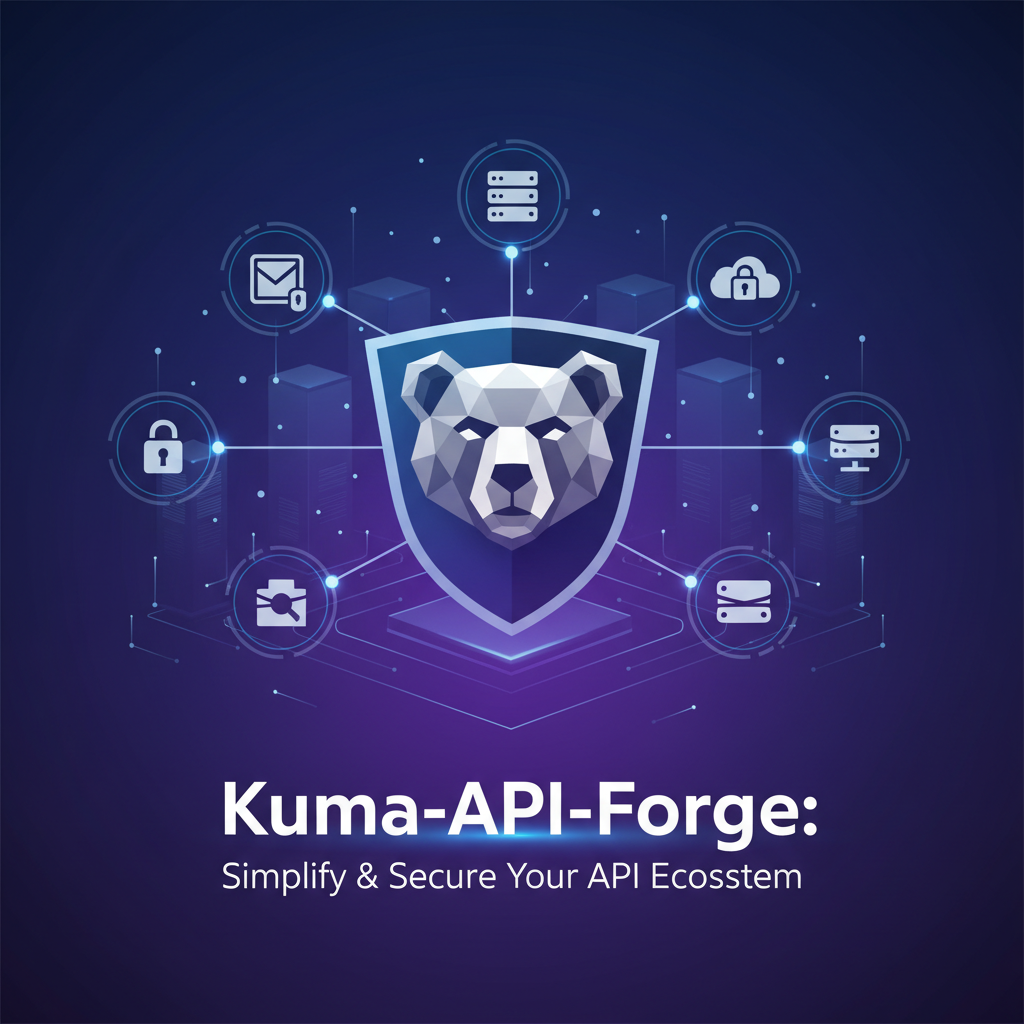


I. Introduction: The Evolving Landscape of APIs and the Need for a Forge
In the relentless march of digital transformation, Application Programming Interfaces (APIs) have emerged as the foundational connective tissue of modern software architecture. No longer mere technical endpoints, APIs are the very lifeblood that powers everything from mobile applications and cloud services to intricate microservice ecosystems and sophisticated AI platforms. They enable unprecedented levels of integration, fostering innovation at a breathtaking pace and allowing businesses to unlock new value streams by exposing their functionalities to partners, developers, and even their own internal teams. The ubiquitous nature of APIs has transformed them from a niche technical detail into a strategic business asset, underpinning the agility and scalability demanded by today's competitive landscape. Every interaction, every data exchange, every service composition often relies on a complex web of APIs working in concert, making their efficient management and unwavering security paramount to an organization's success and resilience.
However, this explosive growth in API adoption brings with it a formidable set of challenges. As the number of APIs proliferates, spanning various teams, technologies, and deployment environments—from on-premises data centers to multi-cloud setups and edge computing—the complexity of managing this intricate web escalates dramatically. Developers grapple with inconsistent documentation, fragmented discovery processes, and varying security policies. Operations teams struggle with monitoring performance, troubleshooting issues across a distributed architecture, and ensuring high availability. Meanwhile, security professionals face the daunting task of defending an ever-expanding attack surface, as each new API potentially introduces a vulnerability if not meticulously designed, implemented, and protected. Moreover, ensuring consistent governance across such a diverse ecosystem, maintaining compliance with evolving regulations, and fostering a collaborative developer experience become increasingly arduous. The sheer scale and distributed nature of modern API landscapes demand a more sophisticated, unified approach—one that can simplify the complexities while simultaneously fortifying the entire ecosystem against a spectrum of threats.
This is where the vision of Kuma-API-Forge comes into sharp focus. Kuma-API-Forge represents a conceptual framework, a strategic paradigm built upon robust, open-source foundations like the Kuma service mesh, designed to address these multifaceted challenges head-on. It envisions a holistic platform that acts as a central control plane for all API interactions, offering a powerful blend of simplification through streamlined management and unwavering security through comprehensive policy enforcement. By integrating an advanced api gateway with the granular control of a service mesh, the Kuma-API-Forge aims to transform how organizations design, deploy, manage, and secure their APIs. It's about forging a resilient, high-performing, and secure API ecosystem that not only supports current operational demands but also scales effortlessly to meet future innovations, fostering developer productivity and ensuring robust API Governance across the entire digital estate. This comprehensive approach is not just a technical solution; it's a strategic imperative for any enterprise serious about leveraging the full potential of its API assets while mitigating the inherent risks.
II. Understanding the Core Components: API Gateways and Service Mesh
The Kuma-API-Forge vision is intrinsically tied to the synergy between two critical components of modern distributed systems: the api gateway and the service mesh. While often confused or seen as overlapping, they serve distinct yet complementary roles, and their combined power forms the bedrock of a truly simplified and secure API ecosystem. Understanding each component individually and then appreciating their symbiotic relationship is fundamental to grasping the transformative potential of an integrated "Forge."
A. The Indispensable Role of an API Gateway
At its heart, an api gateway acts as a single entry point for all client requests into an API ecosystem. It's the first line of defense, the central traffic cop, and the policy enforcer for all incoming and outgoing API traffic. Imagine a bustling airport where all international flights pass through a central terminal for security checks, customs, and routing to their final gates; the api gateway plays a similar role for digital traffic. Its importance has grown exponentially with the adoption of microservices architectures, where a single client request might necessitate calls to multiple backend services. Without a gateway, clients would need to know the addresses and intricacies of each individual service, leading to increased complexity, tighter coupling, and significant operational overhead.
The functionalities of an api gateway are extensive and critical for both performance and security:
- Traffic Management (Routing, Load Balancing): One of the primary functions of an api gateway is to intelligently route incoming requests to the appropriate backend services. This involves dynamic routing rules, often based on URL paths, HTTP headers, or query parameters. Beyond simple routing, gateways are vital for load balancing, distributing incoming traffic evenly across multiple instances of a service to prevent overload and ensure high availability. Advanced gateways can employ sophisticated algorithms (e.g., round-robin, least connections, weighted least response time) and integrate with service discovery mechanisms to adapt to changing service availability and health. This ensures that users experience optimal response times and that services remain operational even under heavy loads or during partial failures.
- Security (Authentication, Authorization, Rate Limiting): The api gateway is a critical enforcement point for security policies. It can offload complex security concerns from individual backend services, centralizing capabilities like:
- Authentication: Verifying the identity of the client making the request, often through API keys, OAuth tokens, JSON Web Tokens (JWTs), or mutual TLS. By handling authentication at the edge, backend services can focus purely on business logic.
- Authorization: Determining whether an authenticated client has the necessary permissions to access a specific resource or perform a particular action. This can involve integrating with identity providers and applying granular access control policies.
- Rate Limiting and Throttling: Protecting backend services from abuse or overload by restricting the number of requests a client can make within a specified timeframe. This prevents denial-of-service (DoS) attacks and ensures fair usage for all consumers. These measures are crucial for maintaining system stability and preventing resource exhaustion.
- Policy Enforcement: Beyond security, an api gateway enforces a wide array of operational and business policies. This includes:
- Request/Response Transformation: Modifying incoming requests or outgoing responses to ensure compatibility, enforce data formats, or hide internal service details. This can involve header manipulation, payload rewriting, or data masking.
- Caching: Storing responses to frequently accessed static data to reduce the load on backend services and improve response times for clients.
- Circuit Breaking: Automatically preventing calls to failing services for a period to allow them to recover, thereby preventing cascading failures across the ecosystem.
- Quotas: Managing access based on predefined consumption limits for different client tiers, enabling monetization strategies and resource allocation.
- Observability: An api gateway serves as a vital vantage point for monitoring the health and performance of the entire API ecosystem. It can capture and emit metrics (e.g., request volume, latency, error rates), logs (detailing each request and its outcome), and traces (following a request's journey across multiple services). This centralized observability data is invaluable for identifying bottlenecks, troubleshooting issues, and understanding user behavior, providing a holistic view of the system's operational state.
- The api gateway keyword is crucial here: Indeed, the term "api gateway" itself highlights its central role. It's not just a proxy; it's a sophisticated management layer that provides a unified facade over a potentially complex, distributed backend. It simplifies client interactions, enhances security, optimizes performance, and provides invaluable insights into API usage.
B. Kuma: A Universal Service Mesh for Modern Architectures
While an api gateway manages north-south traffic (client-to-service), a service mesh primarily governs east-west traffic (service-to-service communication) within a cluster or across multiple clusters. Kuma is an open-source, universal service mesh that runs on any platform—Kubernetes, VMs, bare metal—and across any cloud. It's designed to make it easy to adopt service mesh capabilities without being tied to a specific infrastructure.
- What is a Service Mesh? A service mesh is a dedicated infrastructure layer for handling service-to-service communication. It intercepts network traffic between services and applies a range of policies and functionalities without requiring changes to the application code. This is typically achieved by deploying a "sidecar proxy" (like Envoy, which Kuma leverages) alongside each service instance. All incoming and outgoing traffic for a service is routed through its sidecar proxy. The service mesh's control plane manages and configures all these proxies, orchestrating their behavior across the entire network.
- Kuma's Architecture and Key Capabilities (Traffic, Policy, Observability): Kuma's architecture consists of a lightweight, distributed control plane and highly performant data planes (Envoy proxies).
- Traffic Management: Kuma enables advanced traffic routing capabilities, including fine-grained control over how requests are routed between services. This includes A/B testing, canary deployments, blue/green deployments, and traffic splitting, allowing organizations to roll out new features safely and iteratively. It also provides automatic retries, timeouts, and circuit breaking at the service-to-service level, significantly improving the resilience of microservices applications.
- Policy Enforcement: One of Kuma's strongest suits is its ability to enforce security and resilience policies across all services. It provides built-in mutual TLS (mTLS) encryption, ensuring that all service-to-service communication is encrypted and authenticated by default, significantly reducing the risk of eavesdropping or spoofing within the network. Kuma also supports granular access control policies, allowing administrators to define which services can communicate with each other. This is a critical layer of defense against lateral movement in case of a breach.
- Observability: Kuma automatically collects telemetry data—metrics, logs, and traces—for all service-to-service communication. This provides deep insights into the behavior of the internal network, allowing developers and operators to quickly identify performance bottlenecks, diagnose errors, and understand dependencies within complex microservices architectures. It integrates seamlessly with popular observability tools like Prometheus, Grafana, Jaeger, and Zipkin.
- How Kuma complements an api gateway: While an api gateway handles external client requests, Kuma focuses on the intricate dance between services. The api gateway secures the perimeter and routes initial requests, while Kuma ensures that once a request enters the internal network, its subsequent journey between microservices is secure, resilient, and observable.
- Enhanced Security: The gateway provides authentication and authorization for external clients, while Kuma enforces mTLS and fine-grained access policies between internal services, creating a layered security model.
- Improved Resilience: The gateway might implement circuit breakers for external calls, but Kuma provides more sophisticated resilience patterns (retries, timeouts, circuit breakers) for internal service-to-service communication, preventing internal failures from propagating.
- Unified Observability: Data from both the gateway and the service mesh can be combined to provide an end-to-end view of a request's lifecycle, from initial client call to its completion across multiple internal services.
- Decoupling: The gateway shields clients from the internal architecture, while Kuma simplifies the internal network logic for services, allowing developers to focus on business logic rather than network concerns.
C. Bridging the Gap: Kuma-API-Forge as an Integrated Approach
The Kuma-API-Forge framework leverages the strengths of both an api gateway and Kuma's service mesh capabilities to create a truly comprehensive solution. It envisions a tightly integrated system where: * The api gateway component (which could be an existing gateway integrated with Kuma, or Kuma itself configured to act as an edge proxy) handles all external interactions, applying its unique set of policies for ingress traffic. * Kuma manages all internal service communication, ensuring security, resilience, and observability across the microservices landscape. * A unified control plane, potentially built on Kuma's policy engine, extends API Governance policies seamlessly from the edge to the internal services. This means that a security policy defined at the gateway level can be consistently enforced or complemented by policies within the service mesh, creating an unbroken chain of control. * The entire system operates with a single source of truth for configuration, policies, and observability, reducing operational complexity and ensuring consistency.
This integrated approach represents a significant leap forward in managing and securing complex API ecosystems. It moves beyond siloed solutions, providing a cohesive framework that simplifies development, enhances operational efficiency, and builds an inherently more secure and resilient foundation for all digital interactions. The Kuma-API-Forge is about building a robust, adaptive, and highly controllable environment where APIs can thrive safely and efficiently, paving the way for advanced API Governance.
III. Simplifying API Management with Kuma-API-Forge
The inherent complexity of modern distributed systems, particularly those built around microservices and a vast array of APIs, can quickly become a significant impediment to innovation and agility. Developers spend excessive time deciphering obscure documentation, navigating fragmented systems, and dealing with inconsistent deployment processes. Operations teams struggle with manual configurations, siloed monitoring tools, and reactive troubleshooting. The vision of Kuma-API-Forge directly addresses these pain points by offering a powerful suite of capabilities designed to significantly simplify api management across its entire lifecycle, transforming what can be a chaotic landscape into an organized, efficient, and developer-friendly ecosystem.
A. Streamlined API Lifecycle Management
Effective api management is not just about getting an api up and running; it's about systematically handling an api from its conceptualization through its eventual retirement. Kuma-API-Forge provides a framework that streamlines this entire lifecycle, ensuring consistency, automation, and control at every stage.
- Design and Development Facilitation: The initial phases of API design are critical for ensuring consistency, usability, and maintainability. Kuma-API-Forge encourages and facilitates a "design-first" approach. This means leveraging tools and practices that allow teams to define API contracts (using standards like OpenAPI/Swagger) before writing any code. By integrating with these design tools, the Forge can automatically generate stubs, documentation, and even initial configuration for the api gateway and service mesh policies. This significantly reduces manual effort, minimizes errors, and ensures that all apis adhere to predefined organizational standards and best practices from the outset. Developers can rapidly iterate on designs, receive immediate feedback, and generate client SDKs, accelerating the development cycle and ensuring alignment across diverse teams. Furthermore, by standardizing the design process, Kuma-API-Forge helps prevent the proliferation of inconsistent apis, a common source of technical debt and integration headaches in large organizations.
- Automated Deployment and Versioning: Deploying apis in a dynamic, distributed environment can be a labyrinthine process without proper automation. Kuma-API-Forge, deeply integrated with the underlying infrastructure like Kubernetes and Kuma's service mesh, enables highly automated deployment pipelines. Once an api is developed, its deployment, including its corresponding api gateway routes and Kuma traffic policies, can be triggered automatically through CI/CD systems. This "policy as code" approach ensures that configurations are version-controlled, auditable, and repeatable. Moreover, managing multiple versions of an api simultaneously is a common requirement for backward compatibility and gradual rollouts. Kuma-API-Forge, through Kuma's advanced traffic management capabilities (like traffic splitting and canary deployments), makes api versioning seamless. New versions can be introduced alongside old ones, with traffic gradually shifted to the new version based on predefined criteria, minimizing risk and downtime. This granular control over traffic ensures that upgrades are smooth and reversible, significantly improving operational safety and resilience.
- Retirement Strategies: While often overlooked, the graceful retirement of an api is as important as its deployment. Simply deprecating an api without a clear strategy can lead to broken integrations, frustrated consumers, and lingering security risks. Kuma-API-Forge provides tools to manage the deprecation process effectively. Through its centralized control plane, administrators can mark apis as deprecated, communicate this status to consumers via integrated developer portals (which we'll discuss shortly), and gradually phase out traffic to the old api endpoint. It can enforce policies that redirect calls from deprecated apis to newer versions or respond with clear deprecation notices. This structured approach ensures that consumers have ample time to migrate, prevents unexpected service disruptions, and allows for the clean removal of obsolete components, reducing maintenance burden and security exposure over time.
B. Enhanced Developer Experience
A truly successful api ecosystem thrives on a positive developer experience (DX). If developers struggle to find, understand, and integrate with apis, adoption will suffer, and the pace of innovation will slow. Kuma-API-Forge places DX at its core, aiming to make api consumption as intuitive and efficient as possible.
- Self-Service Portals (mentioning APIPark as a potential solution for developer portals and API management): A critical component of a great DX is a centralized, self-service api developer portal. This portal acts as a single pane of glass where internal and external developers can discover available apis, access comprehensive documentation, register applications, obtain credentials (like API keys or OAuth tokens), and monitor their usage. The Kuma-API-Forge framework emphasizes integration with such portals. For organizations seeking an open-source solution that streamlines API management, including the integration of AI models and end-to-end lifecycle management, platforms such as APIPark offer comprehensive capabilities as an AI gateway and API developer portal. APIPark enables teams to centralize API services, manage access permissions, and ensure robust API Governance, making it an excellent fit for the developer portal aspect of the Kuma-API-Forge vision. A well-designed portal, powered by the data and policies from the Kuma-API-Forge, transforms api consumers from passive recipients into active participants, fostering a vibrant developer community and accelerating integration cycles.
- Consistent API Documentation: Inconsistent or outdated documentation is a perennial headache for developers. Kuma-API-Forge addresses this by promoting "living documentation" – documentation that is automatically generated or continuously synchronized with the api's definition. By leveraging OpenAPI specifications, the Forge can ensure that the documentation available in the developer portal is always up-to-date with the deployed api version. This consistency removes ambiguity, reduces integration errors, and empowers developers to quickly understand how to consume and interact with each api, significantly reducing the "time to first call." Furthermore, documentation can include examples, usage guidelines, and even interactive testing environments, further enhancing the developer journey.
- SDK Generation: To further simplify api consumption, Kuma-API-Forge can integrate with tools that automatically generate client SDKs (Software Development Kits) in various programming languages directly from the api's OpenAPI specification. These SDKs abstract away the low-level HTTP details, allowing developers to interact with apis using familiar programming language constructs. This dramatically reduces the effort required for integration, minimizes the potential for human error, and ensures that clients interact with the api correctly according to its defined contract. By providing ready-to-use libraries, the Forge empowers developers to focus on building their applications rather than wrestling with api boilerplate code.
C. Operational Efficiency and Automation
Beyond developer experience, Kuma-API-Forge significantly boosts operational efficiency by automating many routine tasks and centralizing control. This reduces manual overhead, minimizes human error, and frees up operations teams to focus on strategic initiatives rather than repetitive configuration management.
- Policy as Code: A cornerstone of Kuma-API-Forge's operational efficiency is the "policy as code" paradigm. Instead of manually configuring firewall rules, routing policies, or access controls through disparate UIs, all policies related to the api gateway and Kuma service mesh are defined in declarative configuration files (e.g., YAML). These files are then stored in version control systems (like Git), treated just like application code. This approach offers numerous advantages:
- Version Control: Every change to a policy is tracked, auditable, and easily reversible.
- Automation: Policies can be automatically deployed and updated via CI/CD pipelines, ensuring consistency across environments.
- Collaboration: Teams can collaborate on policies using familiar development workflows, including pull requests and code reviews.
- Reproducibility: Environments can be recreated identically based on the policy code, improving reliability and disaster recovery. This centralized, version-controlled approach to policy management dramatically reduces configuration drift and operational errors.
- GitOps Integration: Kuma-API-Forge is perfectly aligned with GitOps principles. GitOps extends the "policy as code" concept by using Git as the single source of truth for declarative infrastructure and application configurations. Changes to the desired state (e.g., new api deployments, updated routing rules, modified security policies) are committed to Git. An automated operator (like Flux or Argo CD) then continuously observes the Git repository and automatically reconciles the actual state of the cluster with the desired state defined in Git. This ensures that the production environment always reflects what's in version control, providing an auditable, verifiable, and automated deployment pipeline for all api-related configurations and policies. This significantly enhances operational reliability, security, and velocity.
- Reducing Manual Overhead: By automating deployment, versioning, policy enforcement, and documentation, Kuma-API-Forge drastically reduces the need for manual intervention in managing apis. This not only saves countless hours for operations teams but also minimizes the potential for human error, which is often the root cause of outages and security incidents. From initial api exposure through the api gateway to intricate service-to-service communication managed by Kuma, the entire ecosystem operates with a higher degree of automation and predictability. This allows operations personnel to shift their focus from reactive firefighting to proactive system optimization, security posture enhancement, and strategic infrastructure planning, ultimately leading to a more stable, secure, and efficient digital infrastructure.
IV. Fortifying API Security with Kuma-API-Forge
In an era where data breaches are becoming increasingly common and costly, API security is no longer an afterthought; it is a fundamental pillar of any robust digital strategy. APIs, by their very nature, expose business logic and data, making them prime targets for malicious actors. A single compromised api can lead to significant financial losses, reputational damage, and regulatory penalties. Kuma-API-Forge is meticulously designed to provide a multi-layered, comprehensive security posture for the entire api ecosystem, combining the perimeter defense of an api gateway with the granular, internal controls of a service mesh. This integrated approach ensures that security is baked in from the edge to the deepest internal service, rather than being bolted on as an afterthought.
A. Comprehensive Authentication and Authorization Mechanisms
The first line of defense in API security is ensuring that only legitimate and authorized entities can access resources. Kuma-API-Forge centralizes and strengthens these critical functions.
- OAuth 2.0, OpenID Connect: At the api gateway layer, Kuma-API-Forge supports and facilitates the implementation of industry-standard authentication and authorization protocols like OAuth 2.0 and OpenID Connect (OIDC). These protocols are essential for securing public and partner-facing apis, enabling secure delegated access without sharing user credentials. The api gateway can act as an OAuth/OIDC client, validating access tokens issued by an external Identity Provider (IdP) before forwarding requests to backend services. This offloads the complexity of token validation and identity management from individual services, centralizing security policy enforcement at the perimeter. This ensures that only authenticated and authorized applications can initiate requests, providing a robust first layer of defense.
- Mutual TLS (mTLS) through Kuma: Beyond external client authentication, Kuma-API-Forge leverages Kuma's powerful capabilities to enforce mutual TLS (mTLS) for all internal service-to-service communication. With mTLS, both the client service and the server service must present and validate cryptographic certificates before any communication can occur. This means that:
- Encryption: All traffic between services is encrypted by default, preventing eavesdropping and man-in-the-middle attacks.
- Authentication: Each service explicitly authenticates the identity of the other service it's communicating with, ensuring that only trusted services can talk to each other. Kuma automates the certificate issuance, rotation, and management for all services within the mesh, making mTLS incredibly easy to deploy and maintain, even in large, dynamic environments. This creates a highly secure, "zero-trust" network where every internal interaction is authenticated and encrypted, drastically limiting the impact of a potential breach at the perimeter.
- Role-Based Access Control (RBAC): Kuma-API-Forge implements granular Role-Based Access Control (RBAC) across the entire api ecosystem. At the api gateway level, RBAC can be enforced based on the roles and permissions associated with the authenticated client (e.g., an application or user). For internal service-to-service communication, Kuma extends RBAC, allowing administrators to define fine-grained policies that dictate which services are allowed to call other services based on their identity and designated roles. For example, a "payment service" might only be authorized to call a "fraud detection service" but not a "user management service" directly. This layered RBAC ensures that unauthorized lateral movement within the network is prevented, minimizing the blast radius of any compromised service and enforcing the principle of least privilege at every interaction point.
B. Threat Protection and Vulnerability Mitigation
A comprehensive security strategy must also actively protect against common API-specific attack vectors and mitigate vulnerabilities before they can be exploited. Kuma-API-Forge offers several mechanisms to achieve this.
- Rate Limiting and Throttling: As discussed, the api gateway component of the Forge is instrumental in implementing robust rate limiting and throttling. This protects backend services from being overwhelmed by excessive requests, which could be part of a Denial-of-Service (DoS) attack, brute-force credential stuffing, or simply abusive client behavior. Policies can be configured based on client IP, authenticated user, API key, or other request attributes, ensuring fair usage and preventing resource exhaustion. By intelligently managing the flow of traffic, Kuma-API-Forge ensures the stability and availability of critical apis.
- Web Application Firewall (WAF) Integration (conceptual for API-Forge): While not inherently a WAF, the api gateway component within the Kuma-API-Forge framework can either integrate with dedicated WAF solutions or implement WAF-like functionalities. This provides an additional layer of defense against common web vulnerabilities identified by organizations like OWASP. This includes protection against SQL injection, cross-site scripting (XSS), XML External Entities (XXE), and other application-layer attacks. By inspecting and filtering incoming request payloads and headers, the WAF functionality can block malicious inputs before they ever reach the backend services, significantly enhancing the security posture of the exposed apis.
- Input Validation and Schema Enforcement: Kuma-API-Forge promotes strict input validation and schema enforcement at the api gateway. By leveraging api definitions (like OpenAPI schemas), the gateway can validate incoming request bodies, query parameters, and headers against the defined contract. Any requests that do not conform to the expected schema—for instance, containing malformed data types, missing required fields, or exceeding length limits—can be immediately rejected. This prevents a wide array of attacks that rely on sending unexpected or malicious data to backend services, such as buffer overflows or data injection attempts. Enforcing schemas at the edge significantly reduces the attack surface and simplifies the security burden on individual backend services.
- Protection against common API attacks (DDoS, injection): The combined capabilities of the api gateway and Kuma service mesh provide robust protection against a wide range of common api attacks:
- DDoS (Distributed Denial-of-Service): Rate limiting and intelligent traffic management at the api gateway prevent individual clients or botnets from overwhelming services.
- Injection Attacks (SQL, Command, XSS): Input validation and potential WAF integration filter out malicious payloads at the edge.
- Broken Authentication/Authorization: Centralized OAuth/OIDC validation, mTLS, and RBAC ensure that only authenticated and authorized users/services can access resources.
- Mass Assignment: Schema enforcement prevents clients from sending extra data fields that could bypass authorization or manipulate internal object states.
- Security Misconfigurations: "Policy as Code" and GitOps integration reduce human error in configuration, leading to a more consistent and secure setup.
C. Data Privacy and Compliance
Beyond preventing attacks, modern API security also encompasses stringent requirements for data privacy and regulatory compliance. Kuma-API-Forge provides tools and methodologies to help organizations meet these critical obligations.
- Data Encryption in Transit and at Rest: Kuma-API-Forge ensures data encryption throughout its lifecycle.
- In Transit: As previously mentioned, mTLS enforced by Kuma encrypts all service-to-service communication. Additionally, external traffic to the api gateway is secured using standard TLS (HTTPS). This ensures that sensitive data is protected from interception as it moves across networks.
- At Rest: While Kuma-API-Forge primarily focuses on the runtime aspect of API interactions, it integrates seamlessly with underlying infrastructure (databases, storage systems) that implement encryption at rest. The robust security policies enforced by the Forge help to ensure that only authorized services can access these encrypted data stores, maintaining an end-to-end security chain.
- Compliance with Regulations (GDPR, CCPA): Compliance with data privacy regulations like GDPR (General Data Protection Regulation) and CCPA (California Consumer Privacy Act) requires meticulous control over how personal data is processed, accessed, and retained. Kuma-API-Forge aids compliance by:
- Access Control: Granular RBAC and mTLS ensure that only authorized services and applications can access data, supporting the principle of least privilege.
- Auditing: Detailed logging of all api calls (both at the api gateway and within the service mesh) provides an immutable record of data access, essential for compliance audits and forensic analysis.
- Data Masking/Transformation: The api gateway can be configured to mask or redact sensitive data fields in API responses before they are sent to clients, ensuring that only necessary information is exposed.
- Policy Enforcement: The ability to define and enforce security and data handling policies as code ensures consistent application across the ecosystem, simplifying compliance management.
- Auditing and Logging (Kuma's observability features are key): Kuma-API-Forge, powered by Kuma's robust observability capabilities, provides comprehensive logging and auditing for all api interactions. Every request passing through the api gateway and every interaction between services within the mesh generates detailed logs, including request/response headers, payloads, timings, and outcomes. These logs are crucial for:
- Security Audits: Proving compliance with regulations and internal security policies.
- Incident Response: Rapidly identifying the source and scope of security incidents or data breaches.
- Forensic Analysis: Reconstructing events after an incident to understand attack vectors and vulnerabilities. These logs can be streamed to centralized logging platforms (e.g., ELK stack, Splunk) for long-term storage, analysis, and alerting, forming an indispensable component of an organization's security and compliance framework.
By combining the external defense capabilities of an api gateway with the internal, zero-trust security of Kuma's service mesh, Kuma-API-Forge constructs an impenetrable fortress around the api ecosystem. It provides layered security that addresses threats from both outside and within, ensuring that sensitive data is protected, regulations are met, and the integrity of the digital infrastructure remains uncompromised.
APIPark is a high-performance AI gateway that allows you to securely access the most comprehensive LLM APIs globally on the APIPark platform, including OpenAI, Anthropic, Mistral, Llama2, Google Gemini, and more.Try APIPark now! 👇👇👇
V. Achieving Robust API Governance with Kuma-API-Forge
The concept of API Governance extends beyond mere security and management; it encompasses the strategic planning, design, and enforcement of policies and standards that guide the entire lifecycle of APIs within an organization. In a rapidly expanding and increasingly interconnected digital landscape, effective API Governance is crucial for maintaining consistency, quality, security, and compliance across a diverse portfolio of APIs. Without it, even the most technically advanced API infrastructure can devolve into a chaotic collection of inconsistent, insecure, and ultimately unusable endpoints. Kuma-API-Forge is fundamentally designed to provide the tools and framework necessary to establish and maintain robust API Governance, transforming a potential source of disorder into a well-orchestrated, strategic asset.
A. Defining API Governance in a Modern Context
Before delving into how Kuma-API-Forge facilitates API Governance, it's essential to clarify what API Governance entails in today's complex, distributed environments.
- Why Governance is More Than Just Security: While API security is a critical component of API Governance, it's not the entirety of it. API Governance encompasses a broader spectrum of concerns, including:
- Standardization: Ensuring that APIs adhere to consistent naming conventions, data formats, authentication mechanisms, and error handling patterns. This improves developer experience and reduces integration friction.
- Quality: Defining and enforcing standards for API reliability, performance, and documentation.
- Lifecycle Management: Establishing processes for API design, development, testing, deployment, versioning, deprecation, and retirement.
- Compliance: Ensuring APIs meet legal, regulatory, and internal policy requirements (e.g., data privacy, industry-specific standards).
- Discoverability: Making APIs easy for authorized developers to find, understand, and use.
- Performance: Setting and monitoring performance SLAs for APIs.
- Cost Management: Tracking and optimizing resource consumption related to API usage. API Governance is about bringing order, predictability, and strategic alignment to the entire API landscape, ensuring that APIs effectively serve business objectives while managing risks.
- Pillars of Effective API Governance: Effective API Governance rests on several foundational pillars:
- Centralized Policy Management: A single, consistent way to define, store, and apply policies across the entire API estate.
- Automation: Automating policy enforcement, deployment, and monitoring to reduce manual effort and human error.
- Visibility and Observability: Comprehensive monitoring and logging to understand API usage, performance, and compliance.
- Collaboration and Communication: Fostering clear communication channels between API providers, consumers, and governance teams.
- Design-First Approach: Emphasizing API contract design before implementation to ensure consistency and quality.
- Auditing and Reporting: The ability to track changes, access logs, and generate reports for compliance and accountability. Kuma-API-Forge directly contributes to each of these pillars, providing a robust technical foundation for a strong governance framework.
B. Policy Enforcement Across the Ecosystem
One of the most significant strengths of Kuma-API-Forge in enabling robust API Governance is its ability to enforce policies consistently across both the external api gateway and the internal service mesh. This unified enforcement mechanism ensures that governance standards are not merely suggestions but are actively applied at every point of interaction.
- Centralized Policy Management: Kuma-API-Forge achieves centralized policy management through its "policy as code" approach, leveraging Kuma's control plane. All governance policies—whether they pertain to authentication, authorization, rate limiting, traffic routing, data transformation, or observability—are defined in declarative configuration files. These files are stored in a central Git repository, serving as the single source of truth for all operational and governance rules. This centralization eliminates policy fragmentation, ensures consistency across different environments (development, staging, production), and simplifies the auditing process. Governance teams can review and approve policies as they would any other code, fostering collaboration and accountability. This unified approach prevents the "shadow API" problem, where undocumented or ungoverned APIs proliferate, creating security holes and management nightmares.
- Granular Control over API Access and Usage: With Kuma-API-Forge, organizations gain unparalleled granular control over who can access which API, under what conditions, and with what usage patterns.
- External Access: At the api gateway layer, policies can specify which external applications or users are allowed to access particular API endpoints, based on their credentials, IP addresses, or subscription tiers. Rate limits and quotas can be applied per consumer, ensuring fair usage and preventing abuse.
- Internal Access: Within the service mesh, Kuma's capabilities enable precise control over service-to-service communication. RBAC policies can restrict interactions between specific microservices, ensuring that a service can only call other services it is explicitly authorized to interact with. For example, a data processing service might be allowed to call a storage service but blocked from calling a user authentication service. This fine-grained control is a critical component of a "zero-trust" architecture, significantly reducing the impact of a compromised internal service by limiting its ability to move laterally and access unauthorized resources. This level of control is essential for complex enterprises managing hundreds or thousands of apis, allowing them to define intricate access patterns that align with their business logic and security requirements.
- Ensuring Consistency and Standardization: A key objective of API Governance is to ensure that all APIs within an organization adhere to consistent standards, from their design principles to their operational behavior. Kuma-API-Forge supports this through:
- Standardized API Definitions: By promoting OpenAPI as the standard for API contracts, the Forge ensures that documentation, validation rules, and client SDKs are consistent.
- Uniform Policy Application: Policies defined centrally are uniformly applied by the api gateway and Kuma across all relevant APIs and services. This means that, for instance, all APIs might be required to use OAuth 2.0 for authentication, or all internal services must communicate via mTLS. This consistency greatly simplifies development, integration, and troubleshooting for consumers and providers alike.
- Error Handling Standardization: The api gateway can enforce standardized error response formats, ensuring that clients receive predictable and actionable error messages, regardless of the underlying backend service that generated the error. This improves the developer experience and makes debugging much more efficient. By automating the enforcement of these standards, Kuma-API-Forge removes the burden from individual development teams, ensuring that governance is consistently maintained without sacrificing developer velocity.
C. Observability and Monitoring for Governance
Effective API Governance is impossible without deep visibility into how APIs are being used, how they are performing, and whether they are complying with defined policies. Kuma-API-Forge, with its robust observability features, provides the necessary insights.
- Real-time Monitoring and Alerting: Kuma-API-Forge continuously monitors the health, performance, and traffic patterns of all APIs, both at the api gateway and within the service mesh. Metrics such as request rates, latency, error rates, and resource utilization are collected in real-time. These metrics can be visualized in dashboards (e.g., Grafana) and integrated with alerting systems. This allows operations teams and governance stakeholders to proactively detect anomalies, identify performance bottlenecks, and respond swiftly to potential security incidents or policy violations. Real-time alerting ensures that deviations from governance standards are immediately flagged, enabling prompt corrective action.
- Performance Metrics and Analytics: Beyond basic monitoring, Kuma-API-Forge collects rich performance metrics that can be used for deep analytics. This includes detailed data on API usage patterns, peak loads, geographic distribution of requests, and response times for different API endpoints or client types. This data is invaluable for:
- Capacity Planning: Understanding usage trends to appropriately scale infrastructure.
- API Optimization: Identifying underperforming APIs or bottlenecks to improve user experience.
- Business Intelligence: Gaining insights into which APIs are most popular, which partners are heavy users, and how API consumption aligns with business objectives.
- SLA Compliance: Verifying that APIs are consistently meeting their defined Service Level Agreements. This data-driven approach allows organizations to make informed decisions about API evolution and resource allocation. For organizations leveraging AI within their API ecosystem, platforms like APIPark further enhance this capability by offering powerful data analysis tools that display long-term trends and performance changes for AI API calls, aiding in preventive maintenance and strategic planning.
- Auditing and Compliance Reporting: Kuma-API-Forge provides comprehensive logging of every API interaction, both at the api gateway and between internal services. These detailed logs are essential for auditing and demonstrating compliance with internal policies and external regulations (e.g., GDPR, HIPAA, PCI DSS). The logs capture critical information such as:
- Caller identity
- Timestamp
- API endpoint accessed
- Request/response details
- Policy enforcement outcomes (e.g., rate limit triggered, access denied) This immutable trail of evidence is vital for forensic investigations in the event of a security incident and for generating comprehensive reports for regulatory bodies. By providing clear evidence of policy enforcement and access control, Kuma-API-Forge significantly simplifies the burden of compliance, allowing organizations to confidently attest to their API Governance posture.
- Data-driven decision making for API evolution: The rich tapestry of metrics, logs, and traces collected by Kuma-API-Forge provides an unparalleled view into the operational and business effectiveness of APIs. This data allows governance teams to move beyond subjective opinions and make data-driven decisions about:
- API prioritization: Identifying which APIs are most critical or most heavily used for future investment.
- Refinement of policies: Adjusting rate limits, caching strategies, or security rules based on real-world usage patterns.
- Deprecation planning: Making informed decisions about retiring underutilized or problematic APIs.
- Resource allocation: Optimizing infrastructure spend by understanding where resources are truly needed. This continuous feedback loop ensures that API Governance is not a static set of rules but an adaptive, intelligent process that constantly optimizes the API ecosystem for performance, security, and business value.
VI. Implementing Kuma-API-Forge: Best Practices and Architectural Considerations
Implementing a sophisticated framework like Kuma-API-Forge requires careful planning, adherence to best practices, and a clear understanding of architectural implications. It's not merely a matter of deploying software; it's about integrating powerful technologies into an existing ecosystem, aligning them with organizational goals, and fostering a culture that embraces the principles of API Governance and security. The success of Kuma-API-Forge lies in its ability to be seamlessly woven into the fabric of an enterprise's digital infrastructure, providing immediate value while laying the groundwork for future scalability and resilience.
A. Design Principles for a Scalable and Resilient API Ecosystem
Building an api ecosystem capable of handling high traffic, resisting failures, and adapting to change requires a foundation built on robust design principles. Kuma-API-Forge inherently supports and reinforces these principles.
- Microservices Architecture Integration: Kuma-API-Forge is an ideal fit for organizations embracing or already using a microservices architecture. In such architectures, applications are broken down into small, independent services, each running in its own process and communicating via lightweight mechanisms, typically APIs. Kuma, as a service mesh, is specifically designed to manage the complexities of service-to-service communication within these environments. It provides out-of-the-box solutions for traffic management, resilience patterns (like retries and circuit breakers), and security (mTLS) that would otherwise need to be implemented in each microservice, leading to code duplication and operational overhead. The api gateway component then provides the unified entry point for external consumers, shielding them from the internal microservice sprawl. This synergy means microservices developers can focus purely on business logic, confident that networking, security, and observability concerns are handled by the Forge. This significantly accelerates development velocity and improves the overall robustness of the microservices landscape.
- Hybrid and Multi-Cloud Deployments: Modern enterprises often operate across diverse environments, including on-premises data centers, private clouds, and multiple public cloud providers. Managing APIs and services consistently across such a hybrid or multi-cloud footprint is a significant challenge. Kuma-API-Forge addresses this with Kuma's "universal" design. Kuma can run on any underlying infrastructure (Kubernetes, VMs, bare metal) and extends its service mesh capabilities seamlessly across different clusters and geographical regions. This allows organizations to establish a unified control plane and consistent API Governance policies that span their entire distributed environment. Whether an api is hosted in AWS, Azure, GCP, or a private data center, Kuma-API-Forge ensures that it benefits from the same security, traffic management, and observability features. This flexibility is crucial for organizations seeking to avoid vendor lock-in, optimize costs, and meet specific data residency requirements while maintaining a cohesive api ecosystem.
- Disaster Recovery and High Availability: Ensuring that APIs remain accessible and operational even in the face of failures is paramount. Kuma-API-Forge builds in mechanisms for disaster recovery (DR) and high availability (HA).
- High Availability: Both the api gateway and Kuma's control plane can be deployed in highly available configurations, often leveraging multiple instances across different availability zones. The api gateway can utilize active-active or active-passive setups with robust load balancing. Kuma's control plane can be deployed in a redundant fashion, ensuring that even if one instance fails, another takes over seamlessly.
- Disaster Recovery: Kuma's multi-zone and multi-cluster capabilities enable the design of disaster recovery strategies where services can fail over to a geographically distinct region. Traffic management policies can be configured to automatically redirect traffic to healthy clusters in case of a regional outage. The "policy as code" approach ensures that DR configurations are version-controlled and can be rapidly deployed, minimizing recovery time objectives (RTO) and recovery point objectives (RPO). This layered approach to HA and DR provides confidence that critical APIs will remain operational, protecting business continuity and customer trust.
B. Integration with Existing Infrastructure
A key to successful implementation is how well Kuma-API-Forge integrates with an organization's existing toolchain and infrastructure. It should enhance, not disrupt, current workflows.
- CI/CD Pipelines: Kuma-API-Forge is designed for deep integration with Continuous Integration/Continuous Delivery (CI/CD) pipelines. As discussed with "policy as code" and GitOps, all configurations—for the api gateway, Kuma's service mesh policies, and even API definitions—are treated as code and managed in version control. This means that:
- Changes to API definitions or policies trigger automated tests, ensuring quality and compliance.
- Approved changes are automatically deployed to relevant environments (development, staging, production) via the CI/CD pipeline.
- This automation ensures consistency, reduces manual error, and accelerates the release cycle for new API features or policy updates. The pipeline acts as the orchestrator, taking declarative configurations from Git and applying them to the running Kuma-API-Forge infrastructure, ensuring that the desired state is continuously maintained.
- Identity and Access Management (IAM) Systems: Kuma-API-Forge does not aim to replace an organization's primary Identity and Access Management (IAM) system (e.g., Okta, Auth0, Azure AD, AWS IAM). Instead, it seamlessly integrates with them.
- API Gateway: The api gateway offloads authentication to the existing IAM system, validating tokens (OAuth, JWT) issued by the IdP. It acts as a policy enforcement point based on the claims received from the IAM.
- Kuma: Kuma itself can integrate with external identity providers for its own control plane access or leverage identities provisioned by an organization's PKI for mTLS. This integration ensures that a unified identity store and consistent access control policies are applied across the entire enterprise, extending from user logins to api access and internal service communication. It leverages existing security investments and streamlines the management of digital identities.
- Monitoring and Logging Stacks: While Kuma-API-Forge provides extensive built-in observability, it is designed to integrate effortlessly with an organization's existing monitoring and logging stacks.
- Metrics: Kuma's Envoy proxies automatically emit Prometheus-compatible metrics, which can be scraped by an existing Prometheus server and visualized in Grafana dashboards.
- Logs: All api gateway and Kuma service mesh logs can be streamed to centralized logging platforms like Elasticsearch, Splunk, Datadog, or Sumo Logic. This allows operations teams to correlate API logs with application logs and infrastructure logs, providing a holistic view for troubleshooting and security analysis.
- Tracing: Kuma automatically generates distributed traces (e.g., Jaeger, Zipkin compatible) for requests traversing multiple services. These traces can be sent to an existing distributed tracing system, enabling end-to-end visibility into request flows and performance bottlenecks. This integration ensures that Kuma-API-Forge's rich observability data feeds into existing operational workflows and tools, providing a unified view of the entire digital infrastructure without requiring a complete overhaul of the monitoring ecosystem.
C. Building a Culture of API Governance and Security
Technology alone is insufficient. The success of Kuma-API-Forge ultimately hinges on cultivating an organizational culture that prioritizes API Governance and security. This involves educating teams, fostering collaboration, and embracing continuous improvement.
- Education and Training: Implementing Kuma-API-Forge represents a shift in how APIs are managed and secured. Comprehensive education and training are crucial for all stakeholders:
- Developers: Need to understand how to design APIs that conform to governance standards, interact with the api gateway, and how their services benefit from (and operate within) the service mesh.
- Operations/SRE Teams: Require deep knowledge of Kuma-API-Forge's configuration, deployment, monitoring, and troubleshooting.
- Security Teams: Need to understand how to define and enforce security policies within the framework and leverage its auditing capabilities.
- Business Stakeholders: Should grasp the business value of robust API Governance and security. Ongoing training, workshops, and comprehensive internal documentation will ensure that teams are equipped with the knowledge and skills to effectively leverage the Forge.
- Cross-functional Collaboration: Effective API Governance is inherently a cross-functional endeavor. It requires close collaboration between:
- API Providers (Development Teams): Responsible for designing, building, and maintaining APIs.
- API Consumers (Application Teams): Responsible for integrating with and utilizing APIs.
- API Governance Team: Defines standards, policies, and best practices.
- Security Team: Ensures adherence to security policies and mitigates risks.
- Operations/SRE Team: Manages the infrastructure and ensures API reliability. Kuma-API-Forge facilitates this collaboration by providing a common language (declarative policies, API definitions) and a central platform for enforcement and observability. Regular feedback loops, shared responsibilities, and clear communication channels are vital to ensure that the Forge evolves to meet the needs of all stakeholders.
- Continuous Improvement: The digital landscape, threat vectors, and business requirements are constantly evolving. Therefore, API Governance and security must also be subjects of continuous improvement.
- Regular Audits: Periodically review API designs, security policies, and implementation details.
- Threat Modeling: Proactively identify potential vulnerabilities in new APIs or features.
- Feedback Loops: Collect feedback from developers, operators, and security teams to refine policies and processes.
- Learning from Incidents: Analyze security incidents or operational issues to identify weaknesses and implement preventative measures. Kuma-API-Forge provides the data (metrics, logs, traces) and the flexibility (policy as code, GitOps) to support this iterative process, ensuring that the api ecosystem remains secure, efficient, and aligned with strategic objectives over the long term.
VII. The Future of APIs: AI, Automation, and the API-Forge Vision
The journey of APIs is far from over. As technology continues its relentless advancement, particularly in the realms of Artificial Intelligence and hyperautomation, the demands placed on API ecosystems will only grow in complexity and criticality. The Kuma-API-Forge, by design, is not just a solution for today's challenges but a robust foundation that anticipates and embraces the innovations of tomorrow. Its emphasis on intelligent traffic management, policy-driven security, and comprehensive observability positions it perfectly to adapt to and facilitate these next-generation API paradigms, particularly the integration of AI.
A. The Rise of AI-Powered APIs and Gateways
The integration of Artificial Intelligence (AI) into applications and services is no longer a futuristic concept; it's a present reality. From natural language processing and image recognition to predictive analytics and recommendation engines, AI models are becoming central components of many software solutions. As these AI capabilities are increasingly exposed as APIs, the need for specialized management and security becomes paramount.
- Intelligent Traffic Routing: The Kuma-API-Forge's underlying architecture, particularly Kuma's advanced traffic management capabilities, is well-suited for AI-driven intelligent traffic routing. Imagine a scenario where an api gateway needs to route requests for a sentiment analysis api to different AI models based on the language detected in the input text, the source of the request, or even the historical performance of different models. AI algorithms could analyze real-time metrics (latency, error rates, cost) from various AI service providers or internal models and dynamically adjust traffic splitting rules within Kuma to ensure optimal performance, cost-efficiency, or accuracy. This allows for seamless A/B testing of AI models, canary deployments of new AI algorithms, and automatic failover to the best-performing model, all orchestrated by intelligent, data-driven policies enforced by the Forge.
- Anomaly Detection for Security: One of the most promising applications of AI in API security is anomaly detection. The vast amount of telemetry data collected by Kuma-API-Forge—including request rates, IP addresses, user agents, API keys, request payloads, and response times—provides a rich dataset for AI-powered security analytics. Machine learning models can be trained to identify deviations from normal API usage patterns that might indicate a security threat, such as:
- DDoS attacks: Sudden spikes in traffic from unusual sources.
- Brute-force attempts: Repeated failed authentication attempts.
- Data exfiltration: Unusually large data transfers or access patterns.
- Account takeovers: Changes in user behavior or access locations. The Kuma-API-Forge, through its integration with security information and event management (SIEM) systems and its ability to enforce policies, can trigger automated responses like blocking suspicious IPs, revoking API keys, or alerting security teams upon detecting such anomalies, moving security from reactive to proactive.
- Predictive Analytics for Performance: AI can also play a significant role in predicting API performance issues before they impact users. By analyzing historical performance metrics and correlating them with factors like time of day, day of week, seasonal trends, and upcoming events, AI models can forecast potential bottlenecks or resource exhaustion. The Kuma-API-Forge's monitoring capabilities provide the necessary data for these models. Based on these predictions, the Forge could proactively scale backend services, adjust rate limits, or reconfigure caching strategies through its policy engine, ensuring continuous optimal performance and preventing downtime. This transforms API operations from reactive troubleshooting to proactive, intelligent management.
- Mentioning APIPark as an AI gateway: For organizations specifically focused on integrating AI capabilities into their digital ecosystem, an AI gateway like APIPark can be invaluable. APIPark offers quick integration of numerous AI models, standardizes API formats for AI invocation, and allows users to encapsulate custom prompts into REST APIs. Within the Kuma-API-Forge vision, APIPark can serve as the specialized AI-facing component, providing the dedicated features required to manage, secure, and monitor AI service consumption, while integrating seamlessly with Kuma for internal AI service mesh governance and broader API management requirements. This combination allows enterprises to rapidly deploy and manage a diverse portfolio of AI services with the same robustness and security applied to traditional REST APIs.
B. Hyperautomation of API Workflows
Hyperautomation refers to the end-to-end automation of processes using a combination of technologies, including Robotic Process Automation (RPA), AI, machine learning, and advanced analytics. APIs are fundamental to hyperautomation, acting as the conduits that connect disparate systems and enable automated workflows. Kuma-API-Forge significantly advances this vision for API-related processes.
By leveraging "policy as code" and GitOps, Kuma-API-Forge already automates many aspects of API deployment and management. Extending this to hyperautomation means: * Self-healing APIs: AI-driven monitoring detects a service degradation, which automatically triggers Kuma to shift traffic, and then initiates an automated remediation workflow (e.g., restarting a pod, scaling a service) through CI/CD pipelines. * Automated API provisioning: A new project requiring specific API access triggers an automated workflow that provisions API keys, configures appropriate rate limits, and updates access control policies in the api gateway and Kuma, all without manual intervention. * Intelligent deprecation: Based on analytics from Kuma-API-Forge showing low usage and high error rates for an old API version, an automated workflow could initiate a deprecation process, informing developers via the API portal, gradually reducing traffic, and eventually retiring the API. The Forge provides the programmable interfaces and the underlying intelligence to make these highly automated, resilient, and adaptive API workflows a reality, leading to unprecedented operational efficiency and reduced human error.
C. Kuma-API-Forge as an Enabler for Next-Generation Digital Experiences
Ultimately, the Kuma-API-Forge is designed to be an enabler—a powerful infrastructure layer that allows organizations to build and deliver next-generation digital experiences. * Personalized Experiences: By providing robust, high-performing APIs, the Forge allows applications to dynamically adapt to user preferences and context, powered by AI models. * Real-time Interactions: The low-latency and resilient nature of APIs managed by the Forge supports real-time data streaming and interactive experiences. * Scalable Innovations: Developers can rapidly build and deploy new features and services, knowing that the underlying API infrastructure can scale and secure their innovations. * Data-Driven Products: The rich observability data captured by the Forge fuels analytics, allowing businesses to create more intelligent, data-driven products and services.
As the digital world becomes increasingly interconnected and intelligent, the underlying API infrastructure must evolve to keep pace. Kuma-API-Forge, by unifying and intelligently managing both north-south and east-west API traffic, stands ready to meet these future demands. It ensures that businesses can confidently leverage AI, embrace hyperautomation, and deliver groundbreaking digital experiences, all built upon a foundation of simplicity, security, and robust API Governance.
VIII. Conclusion: Embracing the Kuma-API-Forge Paradigm
The journey through the complexities of modern api ecosystems reveals a clear truth: the traditional, fragmented approaches to managing and securing APIs are no longer sufficient. The relentless pace of digital transformation, the proliferation of microservices, and the growing integration of AI models demand a more unified, intelligent, and resilient framework. The Kuma-API-Forge paradigm emerges not just as a collection of technologies, but as a strategic imperative for organizations aiming to thrive in this intricate digital landscape. It represents a commitment to building a future-proof api infrastructure that is both powerfully effective and remarkably simplified.
A. Recap of Benefits: Simplification, Security, Governance
The Kuma-API-Forge framework delivers a transformative trifecta of benefits: * Simplification: By centralizing api management, automating deployment and versioning, and fostering a stellar developer experience through tools like developer portals and consistent documentation, the Forge drastically reduces operational overhead and integration friction. It allows developers to focus on innovation rather than infrastructure complexities, and operations teams to manage a cohesive system rather than disparate components. * Security: With a multi-layered security approach, combining the perimeter defense of an api gateway with the robust, zero-trust internal controls of Kuma's service mesh, the Forge ensures comprehensive protection. From strong authentication and authorization (OAuth, mTLS, RBAC) to proactive threat mitigation (rate limiting, input validation, anomaly detection), it creates a fortified environment where sensitive data and business logic are continuously safeguarded against evolving threats. * Governance: The Forge elevates API Governance from an aspiration to an enforced reality. Through "policy as code," centralized management, and unparalleled observability, it ensures consistency, standardization, and compliance across the entire api lifecycle. It provides the tools for granular control over access and usage, robust auditing, and data-driven decision-making, enabling organizations to systematically manage their api assets as strategic business capabilities.
B. The Strategic Imperative for Modern Enterprises
For any modern enterprise leveraging APIs as a core engine of its digital strategy, adopting a framework like Kuma-API-Forge is not just a technical upgrade—it's a strategic imperative. In today's competitive environment, the ability to rapidly innovate, securely expose services, and efficiently manage a complex array of integrations directly translates into market advantage, customer satisfaction, and operational resilience. Neglecting API Governance and security leads to increased risks, slower development cycles, and higher operational costs. Kuma-API-Forge provides the architectural blueprint to overcome these challenges, enabling organizations to unlock new revenue streams, foster partner ecosystems, and accelerate their digital journey with confidence.
C. A Call to Action for a More Resilient api Ecosystem
The vision of Kuma-API-Forge is a call to action for organizations to re-evaluate their approach to apis. It urges a move away from fragmented tools and reactive security measures towards a proactive, integrated, and intelligently managed api ecosystem. By embracing this paradigm, leveraging powerful open-source technologies like Kuma, and integrating with advanced solutions such as APIPark for enhanced AI and developer portal capabilities, enterprises can forge a resilient, high-performing, and secure foundation for all their digital interactions. The future of digital business belongs to those who can master their APIs, and Kuma-API-Forge offers the path to that mastery, simplifying complexities and fortifying the enterprise against the evolving demands of the digital age.
IX. Frequently Asked Questions (FAQs)
1. What is Kuma-API-Forge and how does it differ from a traditional API Gateway? Kuma-API-Forge is a conceptual framework that integrates the capabilities of an advanced api gateway with the granular control of the Kuma service mesh. While a traditional api gateway primarily manages north-south traffic (client-to-service) at the perimeter, Kuma-API-Forge extends this control to east-west traffic (service-to-service communication) within the internal network using Kuma. This provides end-to-end simplification, security, and API Governance across the entire distributed API ecosystem, from external consumers to internal microservices, offering a more comprehensive and robust solution.
2. How does Kuma-API-Forge enhance API security? Kuma-API-Forge fortifies API security through a multi-layered approach. At the api gateway level, it enforces strong authentication (e.g., OAuth 2.0, OpenID Connect), granular authorization, rate limiting, and input validation to protect against external threats. Internally, leveraging Kuma, it enforces mutual TLS (mTLS) for all service-to-service communication, ensuring encryption and authentication between services, and applies Role-Based Access Control (RBAC) to prevent unauthorized lateral movement. It also supports anomaly detection and integrates with existing IAM systems for comprehensive identity management.
3. What role does "Policy as Code" play in Kuma-API-Forge? "Policy as Code" is a cornerstone of Kuma-API-Forge, meaning all API-related configurations and governance policies (e.g., routing rules, security policies, rate limits) are defined in declarative configuration files (e.g., YAML). These files are stored in version control (like Git), allowing for automated deployment via CI/CD pipelines, collaboration, auditing, and consistent application across all environments. This approach reduces manual errors, enhances operational efficiency, and ensures that the API ecosystem's state is always synchronized with its defined policies.
4. Can Kuma-API-Forge support AI-powered APIs and integrations? Yes, Kuma-API-Forge is well-positioned to support and enhance AI-powered APIs. Its intelligent traffic routing capabilities can dynamically direct requests to optimal AI models based on real-time data. The robust observability features provide crucial data for AI-driven anomaly detection for security and predictive analytics for performance. Furthermore, specialized platforms like APIPark, an AI gateway, can seamlessly integrate with the Kuma-API-Forge framework to offer quick integration of numerous AI models and standardized AI invocation formats, providing a comprehensive solution for managing both traditional and AI-driven APIs.
5. How does Kuma-API-Forge facilitate API Governance across hybrid and multi-cloud environments? Kuma-API-Forge achieves robust API Governance in hybrid and multi-cloud scenarios through Kuma's "universal" design. Kuma can run on any platform (Kubernetes, VMs, bare metal) and extends its service mesh capabilities across different clusters and geographical regions, allowing for a unified control plane. This enables organizations to define and enforce consistent API Governance policies—from traffic management to security and observability—across their entire distributed footprint, irrespective of where the APIs or services are deployed. This ensures uniformity, reduces complexity, and aids in compliance across diverse infrastructure landscapes.
🚀You can securely and efficiently call the OpenAI API on APIPark in just two steps:
Step 1: Deploy the APIPark AI gateway in 5 minutes.
APIPark is developed based on Golang, offering strong product performance and low development and maintenance costs. You can deploy APIPark with a single command line.
curl -sSO https://download.apipark.com/install/quick-start.sh; bash quick-start.sh

In my experience, you can see the successful deployment interface within 5 to 10 minutes. Then, you can log in to APIPark using your account.

Step 2: Call the OpenAI API.