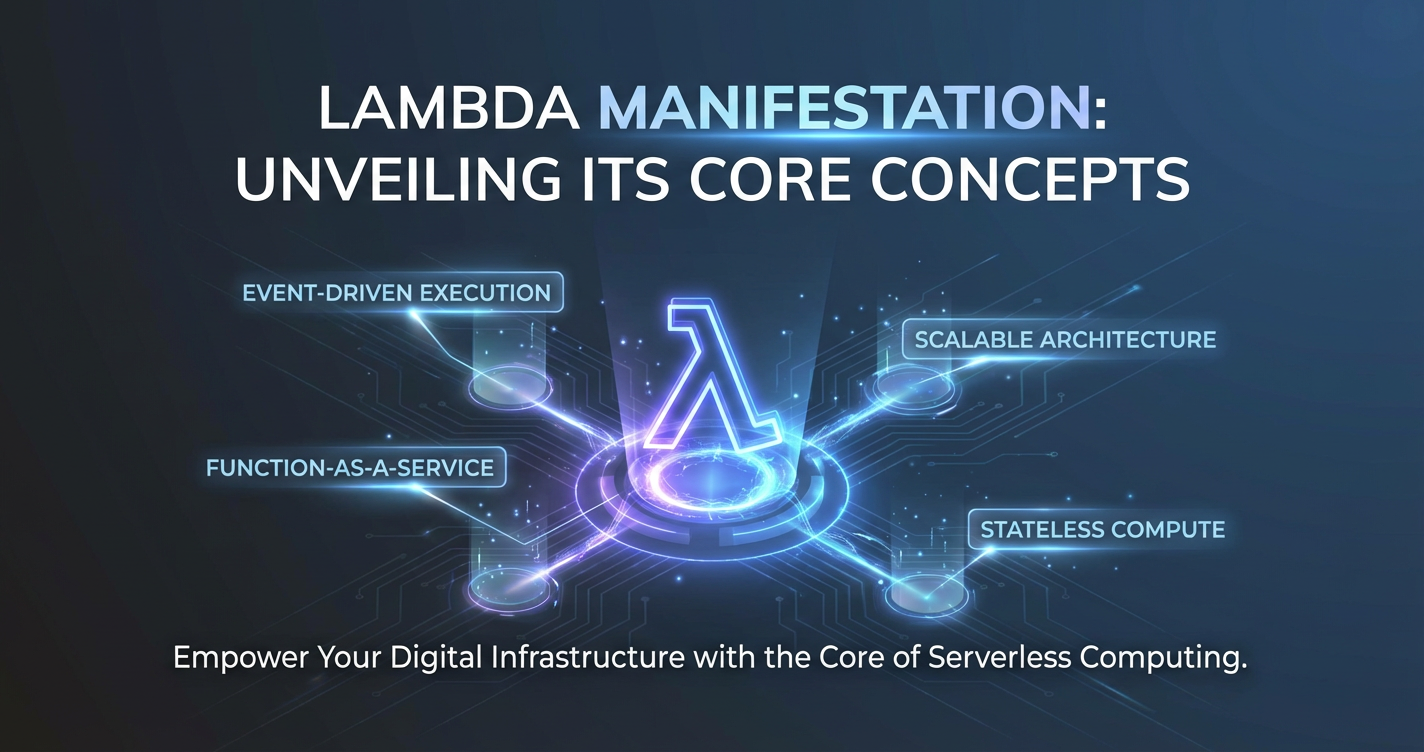
Lambda Manisfestation: Unveiling Its Core Concepts


The digital tapestry of our modern world is woven with threads of abstraction and computation, where complex operations are distilled into elegant, self-contained units. Among these, the concept of "Lambda" stands as a profoundly influential idea, a cornerstone across mathematics, computer science, and increasingly, artificial intelligence. Far from being a mere technical term, "Lambda Manifestation" encapsulates the myriad ways this fundamental principle comes to life, shaping the very architecture of how we build and deploy intelligent systems. It is an exploration into how ephemeral, stateless functions can, through sophisticated orchestration and context management, coalesce into persistent and intelligent behaviors.
This journey will delve into the core concepts underpinning Lambda Manifestation, tracing its lineage from theoretical computer science to its ubiquitous presence in cloud-native and AI-driven applications. We will dissect the essence of serverless computing, where Lambda functions are the stars of the show, and then navigate the critical challenges of maintaining state and coherence in such distributed, event-driven environments. A significant focus will be placed on the burgeoning field of context management, particularly through the lens of the Model Context Protocol (MCP), a framework vital for ensuring intelligent and consistent interactions with sophisticated AI models, including the specific considerations introduced by the Claude Model Context Protocol. By understanding these interconnected concepts, we can truly unveil the power and potential of Lambda in shaping the future of scalable, intelligent, and responsive digital ecosystems.
Chapter 1: The Genesis of Lambda: From Pure Functions to Abstract Entities
The journey to understanding "Lambda Manifestation" begins not in the silicon valleys of the present, but in the abstract realms of early 20th-century mathematics. The concept of "Lambda" as a computational unit has a rich and foundational history, influencing generations of thought leaders and shaping the very paradigms through which we express and execute logic. From its theoretical origins as a powerful mathematical formalism to its practical embodiment in modern programming languages and cloud infrastructure, Lambda represents a fundamental shift towards elegant abstraction and composable units of computation.
1.1 The Mathematical and Philosophical Roots: Alonzo Church's Lambda Calculus
At the heart of Lambda's origin lies Alonzo Church's Lambda Calculus, a formal system developed in the 1930s. At a time when mathematicians were grappling with the foundations of computation, Church introduced this system as a means to express computation based on function abstraction and application. Unlike Alan Turing's concurrent work on the Turing Machine, which modeled computation through a physical tape and head, Church's Lambda Calculus offered a purely symbolic and abstract representation. It posited that any computable function could be expressed through anonymous functions (lambdas) and their application to arguments.
The elegance of Lambda Calculus lies in its simplicity. It has only three basic elements: variables, function abstraction (defining a function), and function application (calling a function). For instance, an anonymous function that adds 1 to its input x would be represented as λx.x+1. This seemingly simple formalism proved to be remarkably powerful, demonstrating that it was Turing-complete, meaning it could compute anything that a Turing machine could compute. This equivalence established Lambda Calculus as a foundational model for computation, underpinning much of theoretical computer science. Philosophically, it championed the idea that computation could be understood purely through the manipulation of functions, emphasizing declarative logic over imperative steps. This early conceptualization sowed the seeds for later paradigms that would prioritize statelessness, immutability, and the composition of pure functions.
1.2 Lambda in Functional Programming: The Paradigm Shift
The profound influence of Lambda Calculus transcended theoretical mathematics, finding its most direct and significant application in the realm of computer programming. The functional programming paradigm, in particular, adopted the core principles of Lambda Calculus as its bedrock. Languages like Lisp, developed in the late 1950s, were among the first to bring lambda functions into practical coding, allowing programmers to treat functions as first-class citizens – assign them to variables, pass them as arguments, and return them from other functions.
In functional programming, "lambda functions" (often called anonymous functions or lambda expressions) are small, unnamed functions designed for specific, often transient, tasks. They embody the principles of immutability (data does not change after creation) and pure functions (functions that, given the same input, always return the same output and have no side effects). This approach enhances code readability, testability, and concurrency by reducing the complexity associated with managing mutable state. Languages such as Haskell, Scheme, Scala, and increasingly, mainstream languages like Python (with its lambda keyword), Java, C#, and JavaScript (with arrow functions), have embraced lambda expressions. They enable powerful constructs like higher-order functions (functions that take other functions as arguments or return functions) and map, filter, and reduce operations, which allow for concise and expressive data transformations. The adoption of lambda in functional programming marked a paradigm shift, moving developers towards thinking about computation as a series of function applications rather than sequential state manipulations, laying crucial groundwork for highly scalable and concurrent systems.
1.3 Lambda as an Event-Driven Paradigm: The Cloud Revolution
While functional programming brought Lambda to the programmer's editor, the advent of cloud computing propelled "Lambda" into an entirely new dimension: the event-driven, serverless paradigm. AWS Lambda, introduced by Amazon Web Services in 2014, popularized the term "Lambda function" to describe small, ephemeral units of code that execute in response to specific events. This marked a monumental shift in how applications are architected and deployed. Instead of provisioning and managing servers, developers could now simply upload their code, and the cloud provider would handle all the underlying infrastructure concerns—scaling, patching, and maintenance.
This "serverless" model perfectly encapsulates the concept of Lambda as an abstract, on-demand compute unit. A Lambda function doesn't "exist" as a continuously running process; it "manifests" only when triggered by an event. These events can range from an HTTP request arriving at an API Gateway, a new file being uploaded to an S3 bucket, a message appearing in a queue like SQS, or a scheduled timer. Each trigger causes a discrete execution of the function, which performs its task and then terminates. This event-driven, "functions-as-a-service" (FaaS) model has revolutionized how developers build scalable, cost-effective applications, pushing the boundaries of abstraction even further. The allure of paying only for compute time consumed, combined with automatic scaling, made Lambda functions a cornerstone of modern cloud architecture, enabling reactive, highly distributed systems that are resilient to varying loads and demands.
1.4 Abstraction and Encapsulation: The Core of Lambda's Power
At its very core, the enduring power and appeal of Lambda, across its various manifestations, stem from its profound commitment to abstraction and encapsulation. In Lambda Calculus, functions abstract away the internal mechanics of computation, presenting only an input-output relationship. In functional programming, lambda expressions encapsulate specific pieces of logic, allowing them to be treated as self-contained units that can be passed around and composed. In serverless computing, Lambda functions achieve the ultimate encapsulation, abstracting away not just the logic, but the entire server infrastructure, operating system, and runtime environment.
This relentless pursuit of abstraction means that developers can focus purely on the business logic, without getting bogged down in infrastructure concerns or the intricate details of how and where the code executes. Each Lambda manifestation, from a mathematical expression to a cloud function, embodies the principle of a "black box" – you provide an input, and it reliably produces an output, without needing to know the complex mechanisms within. This level of encapsulation promotes modularity, reusability, and maintainability. It simplifies complex systems by breaking them down into manageable, independent components, fostering a design philosophy where smaller, focused units of computation work together to achieve grander objectives. This capability to abstract and encapsulate complexity is arguably the most significant contribution of the Lambda concept, driving efficiency, scalability, and innovation in the digital age.
Chapter 2: Lambda in Modern Computing: Serverless and Beyond
The theoretical elegance and programming utility of Lambda reached its zenith with the advent of serverless computing, transforming how applications are designed, deployed, and scaled in the cloud era. Lambda functions, in their serverless guise, represent a powerful manifestation of event-driven architecture, enabling developers to build highly scalable and cost-efficient systems without the burden of infrastructure management. This chapter explores the nuances of serverless, its practical applications, and its symbiotic relationship with microservices, solidifying Lambda's role as a cornerstone of modern computing.
2.1 Serverless Computing Explained: Benefits and Challenges
Serverless computing is a cloud execution model where the cloud provider dynamically manages the allocation and provisioning of servers. Developers write and deploy code in the form of functions, and the cloud provider takes care of everything else: provisioning compute resources, scaling capacity up or down in response to demand, managing underlying operating systems and runtime environments, and handling patching and security updates. The most prominent example of this model is Functions-as-a-Service (FaaS), epitomized by AWS Lambda, Azure Functions, and Google Cloud Functions.
Benefits of Serverless Computing:
- Reduced Operational Overhead: This is perhaps the most significant advantage. Developers are freed from managing servers, operating systems, and runtime environments. This dramatically reduces the time and effort spent on infrastructure concerns, allowing teams to focus on delivering business value.
- Automatic Scaling: Serverless functions scale automatically and almost infinitely in response to demand. If a function receives a sudden surge of events, the cloud provider will spin up new instances to handle the load concurrently, eliminating the need for manual scaling configurations or over-provisioning.
- Cost Efficiency: With serverless, you only pay for the compute time consumed by your functions. There are no idle server costs; if your function isn't running, you're not paying for compute. This can lead to substantial cost savings, especially for applications with sporadic or unpredictable traffic patterns.
- Faster Time to Market: The simplified deployment model and reduced operational burden accelerate the development lifecycle. Developers can iterate quickly, deploy new features, and respond to market demands with greater agility.
- Enhanced Developer Experience: By abstracting away infrastructure, serverless encourages a focus on discrete, well-defined business logic, often leading to more modular and maintainable codebases.
Challenges of Serverless Computing:
- Cold Starts: When a serverless function hasn't been invoked for a while, the underlying container or execution environment might be de-provisioned. The first invocation after this period, known as a "cold start," involves spinning up a new container, downloading the code, and initializing the runtime, which can introduce latency.
- Vendor Lock-in: Migrating serverless functions between different cloud providers can be challenging due to proprietary APIs, event models, and SDKs. While open-source frameworks like Serverless Framework aim to mitigate this, some degree of lock-in is often unavoidable.
- Debugging and Monitoring: The distributed and ephemeral nature of serverless functions can make debugging and monitoring complex. Tracing requests across multiple functions and services requires sophisticated observability tools.
- Resource Limits: Serverless functions typically have limits on execution duration, memory, and disk space. While these limits are often generous for typical use cases, they can be restrictive for long-running processes or computationally intensive tasks.
- State Management: By design, serverless functions are stateless. Managing persistent state across invocations or between different functions requires integrating with external data stores (databases, queues, object storage), adding architectural complexity.
Despite these challenges, the benefits of serverless computing, particularly its immense scalability and cost-effectiveness, have driven its widespread adoption across industries.
2.2 Use Cases for Lambda Functions: Practical Applications
Lambda functions, by manifesting as event-driven compute units, are incredibly versatile and find application across a wide spectrum of scenarios. Their ability to respond to diverse triggers makes them ideal for building reactive and scalable systems.
- Data Processing and ETL (Extract, Transform, Load): Lambda functions are excellent for processing data streams or batches. For instance, when a new file is uploaded to an S3 bucket (e.g., CSV, JSON logs), a Lambda function can be triggered to parse the data, transform it, and load it into a database like DynamoDB or a data warehouse like Redshift. This is highly efficient for real-time analytics or batch processing pipelines.
- Real-time File Processing: Beyond general data processing, specific file types like images or videos can be automatically processed. An image upload might trigger a Lambda function to create thumbnails, resize images for different devices, or apply watermarks. Video uploads could initiate encoding or transcription processes.
- Webhooks and API Backends: Lambda functions can serve as the backend for RESTful APIs, often integrated with API Gateway. An incoming HTTP request triggers a Lambda function that processes the request, interacts with other services or databases, and returns a response. This is a common pattern for building microservices or entire serverless web applications.
- IoT Backends: For Internet of Things (IoT) devices, Lambda functions can process sensor data in real-time. Device telemetry can be sent to an IoT core service, which then triggers a Lambda to ingest, filter, and analyze the data, perhaps storing it or triggering alerts.
- Chatbots and Conversational AI: The stateless nature of Lambda functions makes them suitable for handling individual turns in a conversation. User input to a chatbot can trigger a Lambda to interpret the intent, interact with an AI model, and formulate a response. While the conversation's state needs to be managed externally, each turn's processing is a perfect fit for a short-lived function.
- Scheduled Tasks and Cron Jobs: Lambda functions can be scheduled to run at regular intervals (e.g., daily, hourly) to perform maintenance tasks, generate reports, send notifications, or perform backups, effectively replacing traditional cron jobs on servers.
- Backend for Mobile and Web Applications: Many modern mobile and single-page web applications leverage Lambda functions for their backend logic, handling user authentication, data retrieval, business logic, and interactions with various cloud services.
These examples illustrate the pervasive reach of Lambda functions, acting as nimble, powerful components that can glue together various cloud services and respond intelligently to a multitude of events.
2.3 Event Sources and Triggers: The Catalysts for Lambda Execution
The defining characteristic of serverless Lambda functions is their event-driven nature. They do not run continuously but are activated by specific "events" originating from various cloud services. These event sources act as triggers, initiating the execution of a Lambda function. Understanding the diverse range of these triggers is crucial for designing robust serverless architectures.
Here's a breakdown of common event sources that can manifest a Lambda function:
- API Gateway: This is one of the most common triggers for web-based applications. An HTTP request (GET, POST, PUT, DELETE) arriving at an API Gateway endpoint can directly invoke a Lambda function, making it an ideal backend for RESTful APIs.
- Amazon S3 (Simple Storage Service): Events related to object storage, such as an object being created, deleted, or modified in an S3 bucket, can trigger a Lambda function. This is fundamental for image processing, data ingestion, and file-based workflows.
- Amazon DynamoDB: Changes in a DynamoDB table, such as item insertions, updates, or deletions, can be captured by DynamoDB Streams, which in turn can invoke a Lambda function for real-time data replication, analytics, or auditing.
- Amazon SQS (Simple Queue Service): Messages added to an SQS queue can trigger a Lambda function to process them. This is a classic pattern for asynchronous processing, decoupling components, and handling large volumes of messages reliably.
- Amazon SNS (Simple Notification Service): When a message is published to an SNS topic, it can trigger a Lambda function, which might then send notifications to users, log the event, or initiate further processing.
- Amazon Kinesis: Data streams from Kinesis (Data Streams or Firehose) can invoke Lambda functions to process streaming data in real-time, such as clickstream analysis, application logs, or IoT sensor data.
- CloudWatch Events/EventBridge: These services allow for scheduled invocations (like cron jobs) or can trigger Lambda functions based on events from other AWS services, custom application events, or SaaS partners. This enables complex event-driven workflows and automation.
- Amazon Cognito: User pool events in Cognito, such as pre-sign-up, post-confirmation, or pre-authentication, can trigger Lambda functions to customize user authentication and authorization flows.
- AWS IoT Core: Messages published to AWS IoT Core topics from connected devices can invoke Lambda functions for processing IoT data and interacting with device shadows.
- Database Triggers (e.g., Aurora Serverless Data API): While less direct than DynamoDB Streams, newer database offerings allow serverless functions to interact with and even be triggered by changes in relational databases.
This extensive list highlights the flexibility of Lambda functions, making them the reactive core of many cloud-native applications. Each event acts as a signal, a cue for a specific piece of logic to manifest and execute, contributing to a dynamic and responsive system.
2.4 The Microservices Connection: Lambda and Architectural Decompositions
The rise of Lambda functions aligns perfectly with, and in many ways accelerates, the adoption of microservices architecture. Microservices advocate for building applications as a suite of small, independently deployable services, each running in its own process and communicating through lightweight mechanisms. Lambda functions embody this philosophy at an even finer grain of granularity, often representing a single, highly focused microservice or a component within one.
How Lambda Functions Complement Microservices:
- Fine-grained Decomposition: Lambda allows for an even more granular decomposition than traditional microservices. A single microservice might encompass several Lambda functions, or a complex application could be composed of hundreds of individual Lambda functions, each responsible for a very specific task (e.g.,
createUser,processOrderPayment,sendEmailNotification). This promotes extreme modularity. - Independent Deployment: Each Lambda function can be deployed and updated independently without affecting other parts of the application. This significantly reduces the risk of deploying new features and enables continuous delivery pipelines.
- Isolation and Resilience: If one Lambda function fails, it typically does not impact other functions, enhancing the overall resilience of the system. The runtime environment is isolated, preventing cascading failures.
- Language and Technology Heterogeneity: Different Lambda functions can be written in different programming languages (Node.js, Python, Java, Go, C#), allowing teams to choose the best tool for each specific job, without imposing a monolithic technology stack.
- Scalability at the Component Level: With traditional microservices, you might scale an entire service. With Lambda, you scale individual functions independently. If only one specific function experiences high demand, only that function's instances are scaled up, optimizing resource utilization and cost.
- API-Driven Communication: Lambda functions typically expose their functionality through APIs (often via API Gateway) or react to events, which aligns perfectly with the API-centric communication patterns encouraged in microservices.
In this context, Lambda functions become the atomic units of computation within a microservices ecosystem. They enable true "serverless microservices," where the infrastructure burden for each tiny service component is completely offloaded to the cloud provider. This synergy fosters architectures that are not only highly scalable and resilient but also incredibly flexible and agile, allowing organizations to build complex applications out of composable, event-driven building blocks, making Lambda Manifestation a core strategy for modern cloud development.
Chapter 3: The Intricate Dance of Context: Model Context Protocol and Lambda Manifestation
While Lambda functions excel at executing discrete tasks in an event-driven, stateless manner, the real-world applications they power often demand a coherent understanding of past interactions, environmental conditions, and user intent. This is where the concept of "context" becomes paramount, especially when Lambda manifestations interact with sophisticated AI models. To manage this intricate dance of information, a robust framework is required—a Model Context Protocol (MCP)—which becomes indispensable for maintaining consistency and intelligence across distributed systems, particularly for advanced AI interactions like those involving the Claude Model Context Protocol.
3.1 Understanding Context in Complex Systems
Before diving into protocols, it's crucial to define what "context" signifies in the realm of computing and AI. Fundamentally, context refers to the set of relevant background information that influences or provides meaning to a specific action, event, or interaction. In complex, distributed systems, especially those involving ephemeral Lambda functions and intelligent models, context can encompass a wide array of data points:
- Execution Environment: Variables, configuration settings, runtime parameters, and the identity of the invoking service or user.
- Interaction History: For conversational AI, this includes all previous turns in a dialogue, user queries, AI responses, and any intermediate thoughts or tool outputs.
- User State: User preferences, authenticated identity, session information, and any personalized data relevant to the current interaction.
- Domain-Specific Knowledge: Relevant facts, entities, and relationships specific to the problem domain that the AI model or Lambda function is operating within.
- Sensor Data or Real-time Observations: For IoT or real-time analytics, current readings, environmental conditions, or recent events that inform subsequent actions.
- System State: The current status of various components, database entries, or external service responses at a given moment.
- Implicit Information: Data that isn't explicitly passed but is inferred from the sequence of operations or the surrounding environment.
The challenge arises because Lambda functions are inherently stateless. Each invocation is an isolated event. If a sequence of Lambda functions or interactions with an AI model needs to maintain a coherent "memory" or understanding beyond a single execution, this context must be explicitly captured, managed, and propagated. Without proper context management, interactions become disjointed, AI models lose their ability to maintain a coherent conversation, and distributed processes struggle to coordinate effectively. This necessity for consistent and meaningful information flow across ephemeral components gives rise to the need for structured context protocols.
3.2 The Emergence of Model Context Protocol (MCP)
The growing complexity of modern applications, particularly those leveraging AI and serverless architectures, has spurred the emergence of specialized protocols for managing context. The Model Context Protocol (MCP) is not a single, universally defined standard but rather a conceptual framework or a set of principles designed to address the challenges of context management in systems interacting with intelligent models. Its core purpose is to define how contextual information is structured, exchanged, and maintained across different components, ensuring that AI models receive the complete and relevant background they need to perform effectively, and that the outcomes of AI interactions can inform subsequent actions in a coherent manner.
Why is an MCP Needed?
- Statelessness of AI Models (API Calls): While AI models themselves often have internal memory mechanisms, typical interactions with them via APIs are stateless from the perspective of the application. Each API call is a fresh request. To maintain continuity (e.g., in a conversation), the application must re-supply the history or relevant context with each new query.
- Distributed Architectures: In microservices and serverless environments, an interaction might involve multiple Lambda functions, external services, and then an AI model. Without a clear protocol, propagating the necessary context through this chain becomes an arduous, error-prone task.
- Consistency and Coherence: For an AI model to provide intelligent and consistent responses, it needs a coherent "view" of the world as it pertains to the current interaction. This includes all prior turns in a conversation, relevant user data, and system prompts. MCP ensures this coherence.
- Reproducibility and Debugging: A well-defined MCP facilitates debugging and reproducibility. If you can reliably capture and replay the context that led to a specific AI output, troubleshooting becomes significantly easier.
- Managing Large Context Windows: Modern large language models (LLMs) have "context windows" that can accommodate vast amounts of text. An MCP helps structure and prioritize what information goes into this window, optimizing for relevance and avoiding truncation of critical data.
The essence of MCP lies in standardizing the packaging and exchange of this contextual data, allowing Lambda functions and AI models to "speak the same language" regarding the state of an ongoing interaction. It moves beyond simple input parameters to encompass a holistic understanding of the operational environment.
3.3 Deeper Dive into MCP: Architecture and Principles
A robust Model Context Protocol (MCP), whether implicit or explicitly defined, adheres to several architectural principles and incorporates specific mechanisms to effectively manage context. It's not just about dumping all available data into a single blob, but about intelligently structuring and managing information lifecycle.
Core Principles and Mechanisms of an MCP:
- Structured Context Representation: An MCP typically defines a standardized schema or data structure for context. This might involve nested objects, arrays, or specific fields for different types of information (e.g.,
user_id,session_id,conversation_history,system_prompt,tool_outputs,retrieved_documents). Standardization ensures all interacting components understand and correctly parse the context. - Context Lifecycle Management: Context isn't static; it evolves. An MCP considers how context is:
- Initialized: When an interaction begins (e.g., first user query).
- Updated: With each turn, new user input, AI response, or system action is appended or modified.
- Propagated: Passed from one component to another (e.g., from a Lambda function to an AI model, or between sequential Lambda functions). This might involve serialization (e.g., JSON) for transmission across network boundaries.
- Stored: Persisted in a temporary or long-term store (e.g., Redis, database) for sessions that span multiple discrete invocations.
- Retired: When an interaction concludes, or context becomes irrelevant.
- Context Scoping and Granularity: An MCP defines the scope of context. Is it global to an application, per-user, per-session, or even per-request? It also addresses granularity—what level of detail is necessary for a given component? Over-sending context can be inefficient, while under-sending can lead to incoherent behavior.
- Versioning and Compatibility: As systems and AI models evolve, so too might the context required. A well-designed MCP accounts for versioning of its context schema to maintain backward compatibility during updates.
- Error Handling and Validation: Mechanisms for validating the integrity and completeness of contextual data, and for gracefully handling missing or malformed context, are essential.
- Contextualization of Prompts and Inputs: For AI models, the MCP directly influences how prompts are constructed. It ensures that the model receives not just the user's latest query, but also the system's instructions, relevant historical dialogue, and any external information retrieved through tool calls or RAG (Retrieval Augmented Generation).
Where MCP Might Be Implemented:
- API Gateways: Can enforce a standard for incoming context headers or body parameters.
- Orchestration Layers: Services (potentially Lambda functions) that sit between user interfaces and AI models, responsible for assembling, sending, and disassembling context.
- SDKs/Libraries: Client-side libraries or AI model wrappers that abstract away the complexity of context management for developers.
- Backend Databases/Caches: For persisting conversational state or session context across multiple, stateless Lambda invocations.
The implementation of an MCP shifts the burden of managing context from individual, ad-hoc solutions to a standardized, systemic approach, which is critical for scaling intelligent, distributed applications.
3.4 The Role of Claude Model Context Protocol
When we specifically refer to the Claude Model Context Protocol, we are talking about an application of the general MCP principles tailored for interaction with large language models (LLMs) developed by Anthropic, such as Claude. These models are designed for sophisticated conversational AI, content generation, and complex reasoning, and their effectiveness heavily relies on precisely managed context. The "Claude Model Context Protocol" therefore describes the specific structure and methodology for packaging information for optimal interaction with Claude's API, especially concerning the intricacies of maintaining long-form conversations and complex reasoning chains.
Key Aspects of the Claude Model Context Protocol:
- Conversational History Management: Claude models are designed to be highly conversational. The protocol dictates how the back-and-forth dialogue history (user turns, AI assistant turns) is structured and passed with each API call. This is usually an ordered list of "messages," each with a "role" (e.g., "user", "assistant") and "content". This allows Claude to understand the flow and memory of the conversation.
- System Prompt/Instruction: The protocol includes a designated mechanism for providing a "system prompt" (or "system message"). This is a crucial, high-level instruction that sets the tone, persona, constraints, and overall objective for the AI assistant, guiding its behavior throughout the interaction without being part of the user's immediate query. For example, "You are a helpful assistant who always answers questions concisely and positively." This often remains stable across a session.
- Tool Use/Function Calling Context: Modern LLMs like Claude can interface with external tools (e.g., search engines, databases, calculators). The Claude Model Context Protocol defines how tool definitions are provided to the model, how the model's "tool_use" requests are presented to the application, and importantly, how the results of those tool calls are fed back into the model's context. This allows Claude to leverage external capabilities and incorporate their outputs into its reasoning.
- Knowledge Retrieval (RAG) Integration: For applications employing Retrieval Augmented Generation (RAG), the protocol outlines how retrieved documents or knowledge snippets from external databases are injected into the context window. These snippets provide the model with up-to-date or domain-specific information beyond its training data, enhancing accuracy and relevance.
- Context Window Management: Claude, like other LLMs, has a finite context window (the maximum length of input it can process). The Claude Model Context Protocol implicitly guides strategies for managing this window, such as summarizing older conversation turns, prioritizing recent information, or intelligently selecting relevant historical data to ensure critical context isn't truncated.
- Turn-by-Turn State Propagation: When a Lambda function is acting as an intermediary for a Claude interaction, the Claude Model Context Protocol ensures that with each user input, the Lambda function properly reconstructs the entire context (system prompt, full conversation history, tool results) and sends it to the Claude API, and then correctly processes Claude's response to update the context for the next turn.
The significance of the Claude Model Context Protocol lies in its ability to transform stateless API calls into a continuous, intelligent interaction. It empowers developers building applications with Claude to orchestrate complex dialogues, leverage external functionalities, and ensure that the AI maintains a consistent and deep understanding of the ongoing interaction, even when the underlying processing involves ephemeral Lambda functions managing each step. This sophisticated context management is what enables truly advanced and natural conversational AI experiences.
3.5 Bridging Lambda Manifestation with MCP
The true power of Model Context Protocol (MCP), including specific instantiations like the Claude Model Context Protocol, comes into sharp focus when considering its intersection with Lambda Manifestation. Lambda functions, by their very design, are stateless and ephemeral. They spin up to execute a piece of code in response to an event, perform their task, and then shut down. This statelessness is a core benefit for scalability and cost efficiency, but it poses a fundamental challenge when dealing with applications that require memory, coherence, or continuity—precisely what intelligent AI interactions demand.
MCP as the Coherence Layer for Lambda-AI Workflows:
- Maintaining Conversational State: Imagine a chatbot built using AWS Lambda. Each user utterance triggers a new Lambda invocation. Without MCP, the Lambda function would have no memory of previous turns. MCP dictates that the full conversation history (along with system prompts and other relevant data, as specified by, for example, the Claude Model Context Protocol) must be passed with each user query to the AI model. The Lambda function acts as an orchestrator, retrieving this history from a persistent store (e.g., DynamoDB, Redis), packaging it according to the MCP, sending it to the AI, and then storing the updated history for the next turn.
- Orchestrating Complex AI Flows: Consider a workflow where a user request first triggers a Lambda function for authentication, then another Lambda for data retrieval from a database, and finally a third Lambda that sends this aggregated data to an AI model for analysis. MCP provides the blueprint for how the "context"—user ID, retrieved data, initial query, intermediate results—is propagated consistently across these successive Lambda invocations, ensuring that the AI model receives a holistic and accurate view of the situation.
- Tool Use and RAG Integration: When an AI model (like Claude) decides to use a tool (e.g., query a database via another Lambda function) or retrieve information (via a RAG Lambda), the MCP defines how these tool calls and their results are woven back into the context. A Lambda function might be triggered by the AI's tool request, execute the tool (perhaps calling another external service or Lambda), and then its output is formatted according to MCP and passed back to the main AI interaction Lambda, which then feeds it back to the AI model.
- Abstracting AI Complexity: From the perspective of a simple Lambda function handling an event, interacting with a complex AI model could be daunting. MCP provides a standardized interface for this interaction, abstracting away the internal complexities of the AI model and presenting a clear, consistent method for passing relevant information. This simplifies development and reduces coupling.
- Ensuring Consistent AI Behavior: By meticulously controlling the context presented to an AI model, MCP helps ensure that the AI behaves consistently and predictably across multiple, independently executing Lambda functions. It prevents situations where fragmented context leads to nonsensical or irrelevant AI responses.
In essence, Lambda functions provide the dynamic, scalable compute units, while MCP provides the "memory" and "understanding" that connect these ephemeral units into a coherent, intelligent system. Without a well-defined MCP, the true potential of sophisticated AI models integrated into serverless architectures would remain largely untapped, making it a critical bridge in the manifestation of intelligent, distributed applications.
APIPark is a high-performance AI gateway that allows you to securely access the most comprehensive LLM APIs globally on the APIPark platform, including OpenAI, Anthropic, Mistral, Llama2, Google Gemini, and more.Try APIPark now! 👇👇👇
Chapter 4: Orchestrating Lambda Manifestations with Advanced Protocols
The combination of ephemeral Lambda functions and intelligent AI models presents both immense opportunities and significant architectural challenges. Chief among these is the inherent statelessness of Lambda functions clashing with the often stateful or context-dependent nature of AI interactions. This chapter delves into how advanced protocols like the Model Context Protocol (MCP) provide the necessary orchestration, addressing issues of state management, security, and performance to enable sophisticated Lambda manifestations.
4.1 The Challenge of State and History in Serverless
The stateless nature of serverless Lambda functions is a double-edged sword. While it enables unparalleled scalability, resilience, and cost efficiency by allowing functions to be rapidly spun up and down without persistent memory, it simultaneously creates a significant hurdle for applications that require "memory" or "state." In a serverless environment, each Lambda invocation is typically isolated; it has no inherent knowledge of previous invocations, even from the same user or session.
The State Management Conundrum:
- Conversational Memory: For chatbots or virtual assistants, maintaining a coherent conversation requires remembering previous turns, user preferences, and intermediate decisions. A stateless Lambda would treat each user message as a brand new interaction, leading to disjointed and frustrating experiences.
- Workflow Continuity: Many business processes involve a sequence of steps, where the output of one step informs the input of the next. If each step is handled by a different Lambda function, how do they pass along the necessary context and maintain the overall progress of the workflow?
- User Personalization: Applications often need to remember user-specific data, settings, or authentication status across multiple interactions. Without state, every Lambda invocation would need to re-authenticate or re-fetch this information.
- Idempotency and Retries: In distributed systems, retries are common. If a function is retried, how do you ensure the operation is idempotent (produces the same result regardless of how many times it's executed) if it might inadvertently re-process already processed state?
Traditional approaches to state management, such as in-memory session variables or sticky sessions on load balancers, are antithetical to the serverless paradigm. Serverless functions can execute on any available instance, and those instances are transient. Therefore, managing state in serverless architectures necessitates external, persistent storage solutions. This is where the Model Context Protocol (MCP) becomes not just useful, but indispensable. MCP doesn't solve the statelessness problem directly within the Lambda function itself, but it provides the standardized methodology for consistently externalizing, storing, retrieving, and re-injecting the necessary state (context) into each ephemeral Lambda invocation, ensuring that the system as a whole behaves as if it has a continuous memory.
4.2 MCP in Action: A Practical Scenario
To illustrate the critical role of Model Context Protocol (MCP), let's walk through a practical, complex scenario: an AI-powered customer support system that uses a combination of serverless functions and an advanced LLM like Claude to handle customer inquiries.
Scenario: AI-Driven Customer Support Ticket Resolution
- Initial User Query (Event Source): A customer types a question into a web widget (e.g., "My order #12345 hasn't arrived. What's the status?"). This triggers an API Gateway, which invokes an initial Lambda Function (L1).
- L1: Context Initialization & Authentication:
- L1 receives the raw user query.
- It checks for an existing session ID. If none, it initializes a new Model Context Protocol (MCP) object, populating it with a unique
session_id,user_id(after authentication), and the initialuser_message. It might also include asystem_prompt(e.g., "You are a customer support agent. Be polite and helpful.") and a placeholder forconversation_history. - The MCP object is then serialized (e.g., JSON) and stored in a persistent store like DynamoDB (keyed by
session_id). - L1 then triggers a second Lambda Function (L2) for intent recognition, passing the
session_id.
- L2: Intent Recognition and Tool Selection (AI Interaction):
- L2 retrieves the full MCP object from DynamoDB using the
session_id. - It packages the user's latest query, the
system_prompt, and theconversation_history(empty in the first turn) into a format compliant with the Claude Model Context Protocol. - L2 sends this context to the Claude AI model, asking it to identify the user's intent and potentially suggest tools (e.g., "get_order_status" tool).
- Claude responds, identifying the intent as "order_status_inquiry" and recommending the "get_order_status" tool with
order_id="12345". - L2 updates the MCP object in DynamoDB, appending Claude's response (tool recommendation) to
conversation_history. - L2 then triggers a third Lambda Function (L3), passing the
session_idand theorder_id.
- L2 retrieves the full MCP object from DynamoDB using the
- L3: Tool Execution (Data Retrieval):
- L3 retrieves the MCP object from DynamoDB.
- It uses the
order_id="12345"to query an external order database. - The database returns the order status: "shipped on 2023-10-26, estimated delivery 2023-11-02."
- L3 updates the MCP object, appending the tool's output to the
conversation_historyin a structured way (e.g., as atool_resultmessage type, as defined by Claude Model Context Protocol). - L3 then triggers a fourth Lambda Function (L4), passing the
session_id.
- L4: Response Generation (Final AI Interaction):
- L4 retrieves the entire, updated MCP object from DynamoDB. This object now contains the initial user query, the system prompt, Claude's intent recognition, the executed tool call, and the order status result.
- L4 sends this comprehensive context, again formatted according to the Claude Model Context Protocol, back to the Claude AI model, asking it to formulate a natural language response to the customer.
- Claude generates: "Thank you for reaching out! Your order #12345 was shipped on October 26, 2023, and is estimated to arrive by November 2, 2023. Is there anything else I can help you with?"
- L4 updates the MCP object in DynamoDB with Claude's final response.
- L4 sends this response back to the customer via API Gateway.
- Subsequent Turns: If the user asks a follow-up question ("Can I change the delivery address?"), the entire cycle repeats. L1 initializes, L2 retrieves the full, now longer
conversation_historyfrom the MCP object, sends it to Claude, Claude suggests a "change_address" tool, L3 executes, L4 generates, always ensuring the AI has the full context from the MCP.
In this scenario, the MCP acts as the single source of truth for the entire interaction's state. It ensures that despite multiple, stateless Lambda functions orchestrating the workflow, the Claude AI model always receives a complete and coherent understanding of the ongoing dialogue, tool calls, and their results, enabling intelligent and continuous interaction. Without such a protocol, managing this complex, multi-step, AI-driven process with ephemeral Lambda functions would be nearly impossible.
4.3 Security and Governance in Context Management
The management of context, especially within sophisticated systems employing a Model Context Protocol (MCP), extends beyond mere technical coherence; it deeply intertwines with critical aspects of security and governance. Contextual data often includes sensitive personal information, proprietary business details, or internal system states, making its protection and proper handling paramount.
Key Security and Governance Considerations for MCP:
- Access Control: Not all components or users should have access to the entirety of the context. An MCP should ideally integrate with robust access control mechanisms. For instance, a Lambda function responsible for user authentication might add
user_idto the context, but only specific, authorized Lambda functions (e.g., for billing) should be able to access sensitive payment details that might be part of an extended context. - Data Encryption: Contextual data, especially when persisted in external stores (like databases or caches) or transmitted across networks between Lambda functions and AI models, must be encrypted both at rest and in transit. Standard encryption protocols (TLS for transit, AES-256 for rest) are non-negotiable.
- Data Minimization: The MCP design should encourage data minimization – only include the absolutely necessary information in the context for a given interaction. Reducing the surface area of sensitive data minimizes the risk in case of a breach. Over-sending context unnecessarily increases exposure.
- Data Anonymization/Masking: For certain use cases, particularly in analytics or logging, sensitive fields within the context might need to be anonymized or masked before storage or transmission to less secure components.
- Data Retention Policies: Contextual data, especially conversational history, can grow large. An MCP should consider how long context is retained, aligning with regulatory requirements (e.g., GDPR, CCPA) and business needs. Mechanisms for automatic deletion or archiving of old context are crucial.
- Auditing and Logging: Comprehensive logging of context creation, modification, and access is vital for security auditing and compliance. If a suspicious AI response or data leak occurs, detailed logs of the context that fed into the AI can help trace the root cause. This includes logging adherence to the Claude Model Context Protocol for interactions with specific LLMs.
- Input/Output Validation: While MCP defines the structure, robust validation should be applied to both incoming context (from users/events) and outgoing context (to AI models or other services) to prevent injection attacks or malformed data leading to system vulnerabilities.
- API Security: The APIs that Lambda functions use to store, retrieve, or transmit context must be secured with strong authentication and authorization (e.g., IAM roles, OAuth tokens).
Integrating these security and governance principles into the design and implementation of an MCP ensures that while complexity is managed, the integrity and confidentiality of sensitive information are never compromised. This holistic approach builds trust and ensures compliance in increasingly complex, AI-driven serverless landscapes.
4.4 Performance Considerations in Context Management
While the Model Context Protocol (MCP) significantly enhances the coherence and intelligence of Lambda manifestations, its implementation is not without performance implications. The very act of managing, serializing, transmitting, and deserializing context adds overhead, which can impact latency and resource utilization in a distributed, serverless environment. Careful design and optimization are essential to mitigate these effects.
Key Performance Factors and Optimization Strategies:
- Latency from Context Retrieval/Persistence:
- Issue: Each Lambda invocation needing context must typically retrieve it from an external, persistent store (e.g., DynamoDB, Redis) at the beginning of its execution and often persist updates at the end. This network round-trip and database operation add latency.
- Optimization:
- Fast Data Stores: Use low-latency, high-throughput data stores like Amazon DynamoDB (with provisioned capacity or on-demand mode for unpredictable loads) or Redis/ElastiCache.
- Caching: Implement in-memory caching within the Lambda execution environment for frequently accessed, non-changing parts of the context, or leverage external, shared caches for cross-invocation caching.
- Batching: If multiple pieces of context are needed, try to retrieve or update them in a single batch operation where possible.
- Asynchronous Updates: For non-critical context updates, consider asynchronous updates (e.g., sending an event to an SQS queue which another Lambda processes later) to avoid blocking the main execution path.
- Size of Context Data:
- Issue: As conversations grow longer or more external data is retrieved (especially with RAG for Claude Model Context Protocol), the context object can become very large. This increases serialization/deserialization time, network transfer size, and storage costs.
- Optimization:
- Context Summarization: Implement intelligent summarization techniques for older conversation turns. Instead of sending the full history, send a concise summary of past interactions, preserving key information while reducing data size.
- Relevance Filtering: For RAG, only include the most relevant retrieved documents in the context window, pruning less important information.
- Selective Context: Only retrieve and pass the portions of the context that are strictly necessary for the current Lambda function's task.
- Efficient Serialization: Use efficient serialization formats (e.g., Protocol Buffers, Avro) if JSON's overhead becomes a bottleneck, though JSON is often preferred for readability and interoperability.
- Network Bandwidth and Throughput:
- Issue: Large context objects repeatedly transferred between Lambda functions, data stores, and AI models consume network bandwidth and can hit throughput limits.
- Optimization: This ties into context size reduction and efficient data transfer. Ensure Lambda functions are deployed in the same region as their data stores and AI endpoints to minimize cross-region latency.
- Lambda Cold Starts:
- Issue: Cold starts already add latency. If the context management logic (e.g., database clients, serialization libraries) is heavy, it can exacerbate cold start times.
- Optimization:
- Keep Lambdas Warm: Implement strategies to keep critical Lambda functions warm (e.g., scheduled pings).
- Minimalistic Dependencies: Optimize the Lambda package size and minimize external dependencies to speed up initialization.
- Layered Dependencies: Use Lambda layers for common dependencies to reduce package size.
- AI Model Latency:
- Issue: The AI model itself (e.g., Claude) has its own processing latency, which is often the dominant factor in overall response time.
- Optimization: While outside direct MCP control, a well-designed MCP ensures the AI receives the most optimal context, potentially leading to faster and more accurate AI responses by avoiding unnecessary reprocessing or clarification turns.
Effectively managing performance with MCP requires a holistic view of the system. It's a balance between providing sufficient context for intelligent behavior and minimizing the overhead associated with its lifecycle. By strategically applying these optimization techniques, developers can harness the power of Lambda functions and AI models without sacrificing the responsiveness and efficiency that modern applications demand.
Chapter 5: Future Directions and Synergies
The convergence of Lambda Manifestation, advanced AI models, and sophisticated context management through protocols like Model Context Protocol (MCP) is charting a fascinating course for the future of application development. As these technologies continue to mature, we can anticipate even deeper integrations and novel architectural patterns that push the boundaries of what's possible in scalable, intelligent, and responsive systems.
5.1 Event-Driven Architectures and Beyond
Lambda functions are the poster child for event-driven architectures, reacting dynamically to signals from a vast ecosystem of services. The future promises an even richer landscape of event sources and more sophisticated event patterns. We're moving beyond simple triggers to complex event streams, where Model Context Protocol (MCP) will play an increasingly vital role in maintaining the narrative across these streams.
Imagine an event mesh, where thousands of microservices and Lambda functions communicate purely through events. As these events flow, an embedded MCP could automatically enrich or transform the event payload with relevant context, ensuring that downstream consumers (including AI models) always receive a holistic view. This could involve context versioning within the event stream itself, allowing different consumers to interpret events based on their own context requirements. Furthermore, the evolution of serverless orchestrators (like AWS Step Functions or Azure Durable Functions) will become more powerful, making it easier to define long-running, multi-Lambda workflows where MCP seamlessly propagates state between steps, even in the face of failures or retries. The goal is to move towards "context-aware" eventing, where the system itself inherently understands and manages the informational continuity required for intelligent operations.
5.2 AI Integration and the Edge
The proliferation of AI is driving a fundamental shift towards bringing intelligence closer to the data source, particularly at the edge. Edge computing involves deploying compute capabilities closer to where data is generated (e.g., IoT devices, local gateways, smart factories) to reduce latency, conserve bandwidth, and improve data privacy. Lambda functions are already making inroads here, with offerings like AWS Lambda@Edge and containerized serverless functions running on Kubernetes clusters at the edge.
The synergy between Lambda and AI at the edge, facilitated by Model Context Protocol (MCP), is profound. Imagine an industrial sensor generating a stream of operational data. A local Lambda@Edge function could be triggered, apply some initial pre-processing, and then use a small, edge-optimized AI model to detect anomalies. The MCP would ensure that the historical context of sensor readings or previous anomaly alerts is consistently fed to the edge AI model, allowing it to make more informed decisions locally. Only critical alerts or aggregated insights, along with their relevant context, would then be sent back to the cloud for further analysis by more powerful AI models (like Claude, leveraging the Claude Model Context Protocol for deep reasoning). This distributed intelligence, with MCP ensuring contextual coherence, will unlock new levels of real-time responsiveness and efficiency in environments where latency and connectivity are critical constraints.
5.3 Observability and Debugging with Context
One of the persistent challenges in highly distributed serverless architectures is observability and debugging. Tracing a request through dozens or hundreds of ephemeral Lambda functions and external services can be daunting. A well-implemented Model Context Protocol (MCP) can significantly enhance these capabilities.
By standardizing how context is passed, MCP provides a consistent trace_id or correlation_id within the context object that can be propagated across all Lambda invocations and AI interactions. This allows for end-to-end tracing, where monitoring tools can reconstruct the entire flow of an interaction, even if it spans multiple functions, services, and AI calls. Furthermore, logging key changes or states of the MCP object at different points in the workflow provides invaluable debugging information. If an AI model produces an unexpected output, the logs can immediately point to the exact context that was fed into it, identifying whether the issue lies in the context construction, the AI model's interpretation, or an earlier data processing step. The future of observability will likely see deep integration with MCP, enabling not just system health monitoring, but also "contextual debugging" that understands the informational flow underpinning complex AI-driven serverless applications.
5.4 The API Management Perspective and APIPark Integration
Managing the sheer volume of Lambda functions, their myriad integrations, the diverse array of AI models, and especially the intricate flow of contextual information, often necessitates a robust API management platform. For enterprises grappling with a multitude of AI models and custom APIs built on top of serverless functions, platforms like APIPark offer comprehensive solutions that streamline these complexities.
APIPark, as an open-source AI gateway and API management platform, plays a crucial role in enabling efficient and secure Lambda Manifestations. It simplifies the integration of diverse AI models, unifying their invocation format and allowing developers to encapsulate custom prompts and AI models into reusable REST APIs. This is particularly valuable when various Lambda functions need to interact with AI via Model Context Protocol (MCP)-managed contexts. APIPark can standardize how those context-rich API calls are made, ensuring consistency across different Lambda functions and AI services. Moreover, APIPark's end-to-end API lifecycle management capabilities, including traffic forwarding, load balancing, and versioning, are essential for governing the APIs exposed by Lambda functions. It also facilitates API service sharing within teams and enforces independent access permissions, ensuring that context-aware APIs are consumed securely and efficiently. By providing a unified platform to manage and secure the APIs that orchestrate Lambda functions and their interactions with AI models (including those adhering to the Claude Model Context Protocol), APIPark helps enterprises unlock the full potential of their serverless and AI investments, enhancing efficiency, security, and data optimization across their developer, operations, and business manager teams. Its ability to quickly integrate over 100 AI models and standardize their invocation format directly addresses challenges associated with complex AI-driven Lambda architectures, making it easier to build and deploy sophisticated, context-aware applications.
Conclusion
The concept of Lambda, from its abstract mathematical origins to its concrete manifestations in modern serverless computing, represents a continuous evolution towards modularity, scalability, and efficiency. Lambda functions, as ephemeral and event-driven units of computation, have revolutionized how we build and deploy applications in the cloud, offering unprecedented agility and cost-effectiveness. However, the inherent statelessness of these functions presented a significant architectural challenge for applications demanding continuity, memory, and intelligent interaction, particularly with the advent of sophisticated AI models.
This is where the Model Context Protocol (MCP) emerges as a critical architectural linchpin. By providing a standardized, robust framework for structuring, propagating, and managing contextual information, MCP bridges the gap between the stateless nature of Lambda manifestations and the stateful requirements of intelligent systems. Specific instantiations, such as the Claude Model Context Protocol, further refine this capability, tailoring context management for the nuanced demands of large language models in conversational AI and complex reasoning tasks.
Through this exploration, we've seen how MCP orchestrates the intricate dance of information across distributed Lambda functions, ensuring coherence in multi-step workflows, enabling sophisticated AI interactions, and paving the way for advanced capabilities like tool use and knowledge retrieval. We've also highlighted the crucial intersections with security, governance, and performance, emphasizing that a well-designed context protocol is not merely a technical detail but a fundamental pillar supporting the reliability and integrity of intelligent serverless applications.
Looking ahead, the synergy between Lambda, AI, and advanced context protocols will only deepen. From event-driven architectures and edge computing to enhanced observability and robust API management solutions like APIPark, the future promises an ever more interconnected and intelligent digital landscape. By embracing these core concepts—Lambda for dynamic computation, and MCP for contextual intelligence—developers and enterprises are empowered to unlock the full potential of cloud-native AI, building systems that are not only highly scalable and resilient but also genuinely smart and responsive to the evolving demands of our world.
Frequently Asked Questions (FAQ)
1. What is "Lambda Manifestation" in simple terms? "Lambda Manifestation" refers to the various ways the fundamental concept of a "Lambda" (a small, anonymous function or unit of computation) appears and is utilized in different fields. It started as a mathematical concept (Lambda Calculus), evolved into anonymous functions in programming languages (functional programming), and now most notably refers to "serverless functions" (like AWS Lambda) in cloud computing, which are ephemeral pieces of code that execute in response to events. Essentially, it's about how this core idea of a self-contained, event-driven compute unit comes to life.
2. Why is a Model Context Protocol (MCP) necessary for Lambda functions interacting with AI? Lambda functions are inherently stateless, meaning each invocation is independent and has no memory of previous interactions. AI models, especially large language models (LLMs) used in chatbots or complex reasoning, often require a continuous understanding of conversation history, user preferences, and prior actions to provide coherent and intelligent responses. An MCP provides a standardized way to package, propagate, and manage this essential "context" across different Lambda invocations and AI calls, effectively giving a "memory" to the overall system and enabling the AI to behave intelligently and consistently.
3. How does the Claude Model Context Protocol differ from a general Model Context Protocol? While a general Model Context Protocol (MCP) is a conceptual framework for context management, the "Claude Model Context Protocol" refers to the specific implementation and structure for managing context when interacting with Anthropic's Claude AI models. It defines the precise format for sending conversational history (user and assistant turns), system prompts (high-level instructions), tool definitions, and tool outputs to Claude's API. This specific protocol ensures optimal interaction with Claude's capabilities, helping it maintain long-form conversations and perform complex reasoning based on all relevant information.
4. What are the main challenges when managing state in serverless architectures? The primary challenge is the inherent statelessness of serverless functions. Since functions are ephemeral and can be spun up or down at any time, they cannot reliably store state in their local memory across invocations. This makes it difficult to maintain conversational history, track user sessions, or ensure continuity in multi-step workflows. Solutions typically involve externalizing state to persistent data stores (like databases or caches) and using a well-defined protocol like MCP to consistently retrieve and update this state with each function invocation.
5. How does APIPark contribute to managing Lambda Manifestations and AI integrations? APIPark acts as an open-source AI gateway and API management platform that significantly simplifies the complexities of managing Lambda functions and their AI integrations. It provides a unified system for: * Integrating diverse AI models: Standardizing how various AI models, including those used by Lambda functions, are invoked. * Encapsulating prompts into REST APIs: Allowing developers to easily create reusable APIs from AI models and custom prompts, which Lambda functions can then consume. * API lifecycle management: Governing the APIs exposed by Lambda functions, including versioning, traffic management, and security. * Context standardization: Helping ensure that API calls made to AI models by Lambda functions adhere to necessary context protocols (like MCP), promoting consistency and coherence across the system. This centralized management enhances efficiency, security, and developer experience in complex serverless and AI ecosystems.
🚀You can securely and efficiently call the OpenAI API on APIPark in just two steps:
Step 1: Deploy the APIPark AI gateway in 5 minutes.
APIPark is developed based on Golang, offering strong product performance and low development and maintenance costs. You can deploy APIPark with a single command line.
curl -sSO https://download.apipark.com/install/quick-start.sh; bash quick-start.sh

In my experience, you can see the successful deployment interface within 5 to 10 minutes. Then, you can log in to APIPark using your account.

Step 2: Call the OpenAI API.