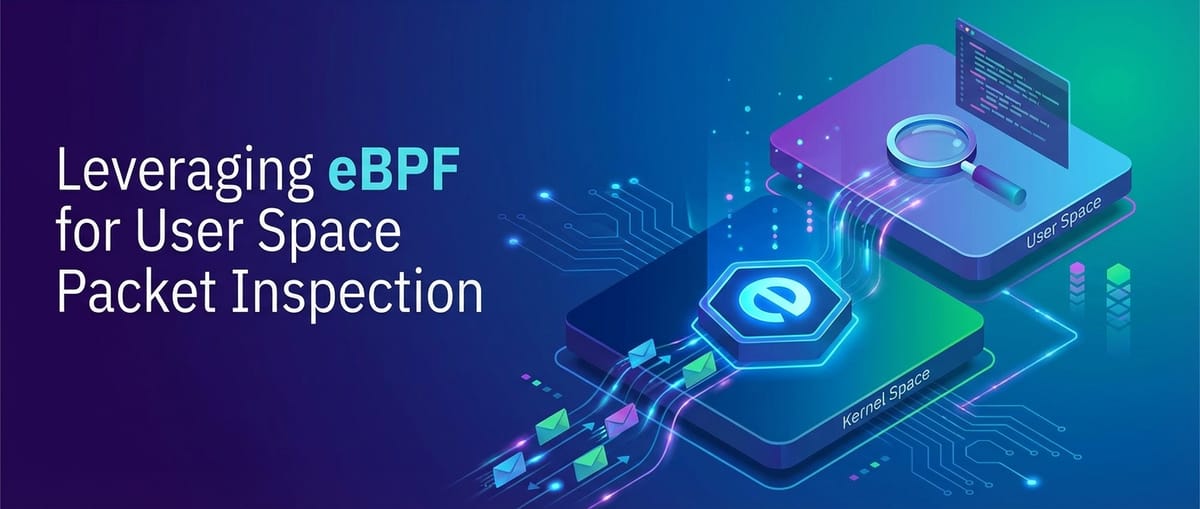
Leveraging eBPF for User Space Packet Inspection


Introduction: The Ever-Evolving Landscape of Network Inspection
In the intricate tapestry of modern computing, where distributed systems, microservices, and cloud-native applications form the backbone of virtually every digital service, the ability to deeply understand and control network traffic is no longer a luxury but an absolute necessity. Traditional methods of network packet inspection, often relying on kernel modules, user-space proxies, or complex, intrusive instrumentation, have long grappled with the inherent trade-offs between performance, flexibility, and security. These challenges are amplified by the relentless demand for higher throughput, lower latency, and comprehensive visibility across diverse networking environments. Enterprises and developers alike seek elegant solutions that can peer into the very essence of network communication without compromising the delicate balance of system resources or introducing unacceptable levels of complexity.
Enter eBPF (extended Berkeley Packet Filter), a revolutionary in-kernel virtual machine that allows developers to run sandboxed programs within the Linux kernel, without requiring changes to kernel source code or loading kernel modules. Initially conceived for filtering network packets, eBPF has transcended its origins, evolving into a versatile and immensely powerful technology capable of programmable control over a vast array of kernel subsystems, including networking, tracing, security, and monitoring. Its unique position, operating at the privileged kernel level while offering a safe and secure execution environment, has fundamentally reshaped how we approach system observability, security, and performance optimization. The beauty of eBPF lies in its capacity to provide granular insights and control precisely where the action happens – within the kernel itself – offering an unparalleled vantage point into the system's operational dynamics.
While eBPF’s prowess in the kernel is undeniable, there remains a compelling and often critical need for advanced packet inspection and processing within user space. User-space applications typically possess richer context, access to higher-level application logic, and the flexibility to integrate with complex business rules, existing software stacks, and diverse programming paradigms that are impractical or impossible to implement directly within the kernel. The challenge then becomes: how can we harness the efficiency and low-overhead capabilities of eBPF in the kernel to significantly enhance and optimize packet inspection performed in user space, rather than replacing it entirely? This article will embark on a comprehensive exploration of this intricate synergy, delving into the architectural paradigms, technical mechanisms, and practical implications of leveraging eBPF to revolutionize user-space packet inspection, ensuring both profound insights and exceptional performance in today’s demanding network environments. We will uncover how eBPF acts as a powerful orchestrator, pre-processing, filtering, and enriching network data at its source, thus enabling user-space applications to perform their specialized analyses with unprecedented efficiency and contextual awareness.
The Paradigm Shift: eBPF's Kernel Superpowers and Their Transformative Impact
The emergence of eBPF represents a seismic shift in how we interact with and extend the operating system kernel. Before eBPF, extending kernel functionality typically involved writing loadable kernel modules (LKMs), a process fraught with peril. LKMs require specific kernel versions, are notoriously difficult to debug, and a single bug can lead to a kernel panic, crashing the entire system. This high barrier to entry and the inherent instability severely limited innovation and agility in kernel-level programming. Consequently, many complex tasks that ideally belonged closer to the hardware, such as sophisticated network filtering, deep system tracing, or fine-grained security policy enforcement, were often pushed into user space, incurring significant performance penalties due to context switching, data copying, and the inherent latency of crossing the kernel/user boundary.
eBPF addresses these fundamental limitations by providing a safe, sandboxed, and highly performant execution environment for custom programs within the kernel. At its core, eBPF is a virtual machine embedded directly into the Linux kernel. Developers write programs in a restricted C-like language, which are then compiled into eBPF bytecode. Before being loaded into the kernel, these programs undergo a rigorous verification process by the eBPF verifier. This verifier ensures memory safety, termination guarantees (no infinite loops), and that the program will not crash the kernel or access unauthorized memory locations. This crucial step is what makes eBPF incredibly powerful yet simultaneously secure and stable, a stark contrast to traditional kernel modules. Once verified, the bytecode is then Just-In-Time (JIT) compiled into native machine code for the specific architecture, allowing it to run with near-native performance, indistinguishable from natively compiled kernel code. This combination of safety, security, and speed is what truly sets eBPF apart as a revolutionary technology.
The capabilities of eBPF extend far beyond its initial networking focus. It can be attached to a multitude of hook points within the kernel, including:
- Network Events: Packet ingress/egress, socket operations (connect, accept, send, receive),
XDP(eXpress Data Path) for ultra-high-performance packet processing at the earliest possible point in the network stack. - System Calls: Monitoring and intercepting system calls made by user-space applications.
- Kernel Tracepoints: Observing specific, well-defined events within the kernel.
- Kprobes/Uprobes: Dynamically attaching to any instruction in kernel or user-space functions, offering unparalleled introspection.
- Security Hooks: Enforcing custom security policies.
- Cgroup Hooks: Applying rules based on process groups.
This extensive range of attachment points means that eBPF programs can observe, filter, modify, and even redirect data and events at virtually any critical juncture within the operating system. For network packet inspection, XDP is particularly noteworthy. It allows eBPF programs to process packets directly off the Network Interface Card (NIC) driver, even before they enter the traditional Linux network stack. This "early bird" advantage enables extremely efficient packet dropping, forwarding, or redirection, significantly reducing CPU cycles and memory bandwidth consumption compared to processing packets higher up the stack. Furthermore, eBPF programs can store state in kernel-managed data structures called "maps." These maps can be shared between different eBPF programs and also between eBPF programs and user-space applications, providing a robust mechanism for communication and data exchange, laying the groundwork for sophisticated cooperative kernel-user solutions. The paradigm shift brought about by eBPF is not just about performance; it’s about democratizing kernel programmability, making it accessible, safe, and robust for a wide array of innovative applications across observability, security, and networking domains.
Why User Space Still Matters for Packet Inspection
Given eBPF’s extraordinary capabilities within the kernel, one might naturally question the continued relevance of performing packet inspection in user space. Indeed, for many tasks requiring high-performance filtering, basic security enforcement, or network telemetry, eBPF programs running directly in the kernel's fast path are often the most efficient choice. However, the kernel, by its very nature, is a highly constrained environment. It prioritizes stability, security, and raw performance above all else. This inherently limits the complexity and type of logic that can be safely and effectively executed within an eBPF program. Understanding these limitations is crucial to appreciating why user-space packet inspection remains an indispensable component of a holistic network monitoring and control strategy.
Firstly, eBPF programs, while powerful, operate under strict resource constraints. They have limited stack size, cannot perform arbitrary memory allocations, and are intentionally restricted in their ability to interact with the broader kernel environment. The eBPF verifier enforces these rules rigorously to prevent kernel panics and security vulnerabilities. This means that highly complex parsing, stateful analysis spanning multiple packets over extended periods, or computations requiring significant memory or CPU resources are simply not feasible within an eBPF program. For instance, fully reassembling TCP streams, decoding intricate application-layer protocols like HTTP/2, gRPC, or parsing cryptographic handshake messages (e.g., TLS), often necessitates sophisticated libraries, extensive state management, and algorithmic complexity that far exceed the kernel's permissible limits for eBPF. These tasks are inherently better suited for the rich execution environment of user space, where applications have access to gigabytes of memory, powerful multi-core processors, and a vast ecosystem of programming languages and libraries.
Secondly, user-space applications benefit from a wealth of existing tools, libraries, and frameworks that have been meticulously developed and optimized over decades. Think of protocol parsers (like those in Wireshark or Scapy), machine learning libraries for anomaly detection, large-scale data storage and analytics systems, or user interfaces for visualization and alerting. Integrating such complex, feature-rich components directly into a kernel eBPF program would be an insurmountable task, if not outright impossible. User-space programs can leverage high-level languages like Python, Go, Java, or Rust, which offer abstractions, concurrency models, and development efficiencies that are simply not available when programming in a C-like restricted eBPF context. This allows developers to focus on the application-specific logic of packet inspection rather than low-level kernel programming details.
Furthermore, user-space applications are inherently more flexible and easier to debug, deploy, and upgrade. A bug in a user-space application might cause it to crash, but it rarely destabilizes the entire operating system. Debugging tools are abundant and mature. Deploying new versions or changing application logic is a relatively straightforward process. In contrast, even with eBPF's safety guarantees, kernel-level development requires a more cautious approach, and while eBPF provides powerful introspection tools, debugging complex interactions can still be challenging. The sandboxed nature of eBPF programs, while a security boon, also means they cannot directly perform certain actions like writing to arbitrary files, interacting with network sockets in a general way, or calling complex system APIs, tasks that are routine for user-space programs.
Finally, user-space is the natural home for business logic, policy enforcement, and integration with other enterprise systems. A comprehensive api gateway, for example, performs deep application-layer inspection, applies rate limiting, authentication, authorization, and potentially transforms requests or responses. An AI Gateway might route requests based on content, perform sentiment analysis, or implement prompt injection detection for Large Language Models. These are inherently high-level functions that require access to configuration databases, user management systems, and often external services. While eBPF can provide the raw network data or critical metadata, the actual enforcement and decision-making for such complex scenarios must reside in user space, where the full context of the application, user, and business policy is available. Therefore, the goal is not to eliminate user-space inspection, but to optimize and empower it by using eBPF as an intelligent, high-performance kernel-level assistant.
Bridging the Divide: eBPF as a Catalyst for User-Space Inspection
The true power of modern network observability and control emerges when eBPF's kernel-level efficiency is synergistically combined with user-space's contextual richness and processing flexibility. eBPF acts as an intelligent intermediary, transforming the deluge of raw network traffic into a streamlined, enriched, and highly relevant data stream for user-space applications. This integration fundamentally redefines the traditional approach to packet inspection, moving beyond the simplistic dichotomy of kernel vs. user space to embrace a collaborative, multi-layered architecture. By carefully designing the interaction between eBPF programs and user-space components, developers can achieve previously unattainable levels of performance, granular control, and insightful analysis. Let's delve into the key mechanisms through which eBPF acts as a catalyst for superior user-space packet inspection.
eBPF for Efficient Data Filtering and Offloading
One of the most significant advantages eBPF brings to user-space packet inspection is its ability to perform highly efficient data filtering and offloading directly within the kernel. Traditionally, if a user-space application needed to inspect network traffic, it would typically use mechanisms like libpcap to capture all packets, or a significant portion thereof, and then copy them from the kernel's network buffers into user space for processing. This "copy-everything" approach is incredibly inefficient, consuming substantial CPU cycles for context switching and memory bandwidth for data copying, even for packets that are ultimately irrelevant to the user-space application. As network speeds increase to 10Gbps, 25Gbps, 100Gbps, and beyond, this overhead quickly becomes the dominant bottleneck, severely limiting the throughput and scalability of user-space network monitoring tools.
eBPF radically alters this dynamic. An eBPF program, particularly one attached at an XDP (eXpress Data Path) hook point, can inspect packets at the very earliest possible stage in the network stack, directly after they are received by the Network Interface Card (NIC) driver. At this juncture, the eBPF program can apply sophisticated filtering rules based on various packet attributes—MAC addresses, IP addresses, port numbers, protocol types, specific byte patterns, or even rudimentary parsing of inner headers (e.g., VXLAN, Geneve). The decision to filter can be made with minimal latency and computational cost. If a packet does not match the criteria for user-space inspection, the eBPF program can simply drop it (XDP_DROP), forward it to another interface (XDP_TX), or pass it up the normal kernel network stack (XDP_PASS) if it’s destined for local processing but not for the specific user-space inspector.
For packets that do require user-space inspection, eBPF doesn't just pass them up the stack for libpcap to capture. Instead, it can intelligently steer these packets. A common pattern involves using an eBPF map, specifically a BPF_MAP_TYPE_PERF_EVENT_ARRAY or a BPF_MAP_TYPE_RINGBUF. The eBPF program can selectively copy relevant parts of the packet (e.g., headers, a fixed-size payload snippet, or the entire packet if necessary) into this shared kernel memory buffer. User-space applications can then poll or read from this buffer, receiving only the data they need, already pre-filtered and efficiently transferred. This mechanism drastically reduces the volume of data crossing the kernel-user boundary, freeing up CPU and memory resources for the user-space application to focus on its high-value analysis rather than rudimentary filtering. The impact on performance for high-traffic environments is profound, allowing user-space tools to handle traffic volumes that would be impossible with traditional methods, transforming the feasibility of deep packet inspection at scale.
Contextual Enrichment for Deeper Insights
Beyond mere data filtering, eBPF's ability to operate deep within the kernel allows it to provide user-space applications with invaluable contextual information that is often difficult or impossible to obtain reliably through conventional means. Network packets, in isolation, tell only part of the story. To truly understand the significance of a network event, user-space applications often need to know which process generated or received the packet, which container it belongs to, what security group is associated with the communication, or even which specific system call triggered the network activity. This rich, kernel-level context elevates raw packet data into actionable intelligence.
An eBPF program can be attached to various kernel hook points to gather this contextual metadata. For instance, when a packet is processed by an XDP program, that program can query eBPF maps or use built-in eBPF helpers to determine the associated cgroup ID, the PID (Process ID) of the process that owns the socket, the UID/GID (User ID/Group ID) of that process, or even specific attributes of the network namespace. This information, along with standard packet headers, can then be appended to the data structure that is pushed to user space via a perf_event_array or ringbuf map.
Consider a scenario where a user-space intrusion detection system (IDS) is monitoring for suspicious network activity. Receiving a packet with an anomalous payload is certainly interesting, but knowing that the packet originated from a specific process (e.g., nginx), running within a particular Kubernetes pod, belonging to a distinct application service, provides a vastly more granular and actionable insight than just the packet data itself. The IDS can then correlate this network event with process-level behavior, system call activity, or even application logs, enabling a much more accurate and robust detection of threats or performance issues. This contextual enrichment is particularly critical in dynamic, containerized environments where IP addresses alone are often insufficient to identify the communicating entities. By offloading the context gathering to eBPF, user-space applications are relieved of the complex and privileged task of kernel-level introspection, receiving a pre-packaged, high-fidelity data stream ready for immediate analysis. This paradigm shift empowers user-space applications to make more informed decisions, enhancing the precision and efficacy of their network inspection capabilities.
The Fast Path/Slow Path Architecture: Optimizing Complex Workflows
The judicious combination of eBPF and user-space packet inspection often manifests in a highly effective "fast path/slow path" architecture. This design pattern capitalizes on eBPF's kernel-side speed for common, simple operations (the fast path) while reserving user-space processing for more complex, less frequent, or application-specific analyses (the slow path). This hybrid approach maximizes overall system efficiency and performance without sacrificing the deep inspection capabilities required for sophisticated use cases.
In this model, an eBPF program, often attached at XDP or a traffic control (TC) hook point, serves as the initial gatekeeper and decision-maker. It rapidly processes every incoming or outgoing packet. For the vast majority of "normal" or easily identifiable packets that conform to expected patterns, the eBPF program can perform basic actions such as:
- Fast Path Security: Blocking known malicious IP addresses or port scans, dropping malformed packets, or enforcing simple firewall rules.
- Fast Path Routing/Load Balancing: Directing traffic to specific backend services based on IP/port, potentially even performing DSR (Direct Server Return) or other advanced routing techniques.
- Fast Path Telemetry: Incrementing counters for basic network statistics (packet count, byte count per flow) without passing the actual packets to user space.
These fast path operations are executed entirely within the kernel with minimal overhead, allowing the system to handle enormous traffic volumes efficiently. Only when a packet requires deeper inspection—because it matches a specific complex pattern, triggers a security alert that requires further scrutiny, necessitates application-layer parsing, or needs to be routed based on dynamic application context—is it directed to the "slow path" in user space.
When a packet is identified for slow path processing, the eBPF program uses mechanisms like perf_event_array or ringbuf maps to push the relevant packet data and its associated kernel context to a waiting user-space application. This user-space component can then perform its specialized, computationally intensive tasks:
- Application-Layer Protocol Parsing: Decoding HTTP/2 frames, gRPC messages, or database queries.
- Intrusion Detection/Prevention: Applying advanced signature matching, heuristic analysis, or machine learning models to identify sophisticated threats.
- Policy Enforcement: Implementing complex
api gatewayrules, rate limiting, authentication, or authorization logic that depends on rich application state. - Traffic Shaping/Quality of Service (QoS): Dynamically adjusting bandwidth or priority based on real-time application load or user context.
- Log Generation and Analytics: Enriching packet data with application-specific metadata before storing it in a database or sending it to an analytics platform.
This architectural pattern is particularly valuable for network devices such as load balancers, firewalls, and crucially, gateway solutions like an api gateway or an AI Gateway. For instance, a basic gateway might use eBPF for extremely high-performance Layer 3/4 forwarding and initial DDoS mitigation in the kernel, only passing application-layer traffic to its user-space proxy for HTTP parsing, SSL termination, and advanced routing. This separation of concerns allows each layer to operate at its optimal performance point, ensuring that routine traffic is handled with minimal latency, while complex or exceptional cases receive the thorough attention they require without becoming a bottleneck for the entire system. The fast path/slow path model, empowered by eBPF, thus delivers both extreme performance and profound analytical depth, making it a cornerstone of modern network solutions.
Zero-Copy and Shared Memory Techniques for Optimal Data Transfer
A recurring theme in optimizing kernel-user space interactions for network data is the minimization of data copying. Each time data is copied from kernel memory to user-space memory, it consumes CPU cycles, memory bandwidth, and introduces latency. For high-volume packet inspection, these copy operations can quickly become the primary bottleneck. eBPF, through its sophisticated map mechanisms and integration with kernel features, provides several approaches to achieve near zero-copy or highly efficient data transfer, significantly reducing overhead and enhancing throughput for user-space packet inspection.
The perf_event_array and ringbuf eBPF maps are instrumental in facilitating efficient data exchange. While they technically involve a copy from kernel space to a user-space accessible buffer, this copy is highly optimized. A perf_event_array allows eBPF programs to generate events that user-space applications can consume using the perf_event_open system call. The user-space application typically mmap's a buffer to receive these events. The kernel efficiently appends data from eBPF programs to this shared buffer. The BPF_MAP_TYPE_RINGBUF is a more recent and often preferred alternative, offering a robust, highly optimized ring buffer structure designed specifically for high-throughput, producer-consumer patterns between eBPF programs and user-space applications. It provides mechanisms for atomic production (eBPF writes) and consumption (user-space reads), minimizing contention and maximizing efficiency. Crucially, user-space applications mmap this ring buffer directly, and eBPF programs write into it, reducing the overhead compared to traditional system call based data transfer.
Beyond these event-based buffers, more advanced techniques aim for true zero-copy. One prominent example is the XDP_REDIRECT action in eBPF. Instead of copying a packet to user space, XDP_REDIRECT can steer a packet directly to another network interface or even to a AF_XDP (Address Family eXpress Data Path) socket. An AF_XDP socket is a special type of socket that allows a user-space application to directly access packet buffers owned by the NIC driver, bypassing the entire Linux network stack and avoiding any kernel-to-user memory copies. When an eBPF program redirects a packet to an AF_XDP socket, the user-space application can directly consume the packet from the NIC's receive ring in shared memory. This is the epitome of zero-copy packet processing, offering unparalleled performance and minimal latency. The user-space application takes ownership of the packet buffer, processes it, and then returns it to the driver for reuse. This mechanism is particularly beneficial for applications requiring extreme throughput, such as high-performance load balancers, network firewalls, or specialized packet processors that need to operate at line rate.
While AF_XDP provides the ultimate in zero-copy performance for raw packet data, the perf_event_array and ringbuf still offer significant advantages for transferring filtered and enriched metadata along with packet snippets. The choice between these methods depends on the specific requirements: if the user-space application needs the entire raw packet at line rate with minimal overhead, AF_XDP is the ideal choice. If the application needs pre-filtered data, specific headers, or kernel context associated with various network events, ringbuf maps provide a flexible and efficient channel. By intelligently combining these eBPF-enabled shared memory and zero-copy techniques, developers can construct network inspection pipelines that achieve unprecedented levels of efficiency, making deep packet analysis economically viable even in the most demanding high-throughput environments. This careful management of data transfer is a hallmark of truly optimized eBPF-driven user-space solutions.
APIPark is a high-performance AI gateway that allows you to securely access the most comprehensive LLM APIs globally on the APIPark platform, including OpenAI, Anthropic, Mistral, Llama2, Google Gemini, and more.Try APIPark now! 👇👇👇
Practical Applications and Use Cases
The synergistic combination of eBPF and user-space packet inspection opens up a vast array of practical applications across various domains, revolutionizing how we approach network monitoring, security, and performance optimization. From highly efficient network visibility tools to advanced security enforcement and sophisticated application management platforms, the capabilities enabled by this architecture are transformative.
Network Monitoring and Observability Tools
One of the most immediate and impactful applications of eBPF for user-space packet inspection is in the realm of network monitoring and observability. Traditional tools often struggle with the sheer volume and velocity of traffic in modern data centers. eBPF can fundamentally enhance these tools by providing granular, high-fidelity network telemetry without the prohibitive overhead of full packet capture.
Consider a distributed tracing system. An eBPF program can be attached to socket system calls (connect, accept, sendmsg, recvmsg) to gather information about network connections, latency, and throughput at the kernel level. This data, enriched with process IDs, container IDs, and even service names (if mapped via user-space configuration), can be efficiently streamed to a user-space agent. This agent can then correlate network events with application-level traces, providing a comprehensive view of requests as they traverse multiple services and network hops. For example, by observing sendmsg and recvmsg calls, eBPF can accurately measure the time spent in network transit between services, a critical metric for understanding distributed application performance. This kernel-level insight eliminates the need for injecting costly libraries into application code or relying on less precise proxy-based measurements.
Furthermore, eBPF can power next-generation flow monitoring solutions. Instead of exporting entire NetFlow/IPFIX records, eBPF programs can aggregate flow statistics (byte counts, packet counts, connection duration) directly in kernel maps. User-space applications periodically poll these maps, receiving aggregated data rather than individual flow records. This significantly reduces the data volume to be processed and stored, while still providing detailed visibility into network traffic patterns, enabling anomaly detection, capacity planning, and billing. Tools like Cilium's Hubble leverage eBPF in this manner to provide real-time network visibility and debugging for Kubernetes clusters, demonstrating the power of kernel-level event streaming to user-space dashboards.
Advanced Security Solutions (Intrusion Detection/Prevention)
Security is another domain where eBPF's capabilities for user-space packet inspection are truly game-changing. Intrusion Detection Systems (IDS) and Intrusion Prevention Systems (IPS) traditionally operate in user space, often using libpcap to capture traffic. While effective, this approach can be slow and resource-intensive, making it difficult to operate at line rate on high-speed networks.
With eBPF, an IDS/IPS can adopt a powerful hybrid architecture. eBPF programs, particularly those at XDP hook points, can serve as a highly efficient first line of defense. They can:
- Pre-filter malicious traffic: Immediately drop packets from known malicious IPs, block port scans, or filter out packets with obvious malformed headers. This offloads a significant burden from the user-space IDS, allowing it to focus on more sophisticated threats.
- Extract security-relevant metadata: Rather than passing entire packets, eBPF can extract specific headers, checksums, or short payload snippets that are relevant for security analysis (e.g., DNS query names, HTTP method/path, TLS handshake parameters). This data, along with kernel context (PID, UID, cgroup), is then streamed to the user-space IDS.
- Implement immediate prevention: For high-confidence threats, eBPF programs can proactively drop traffic (
XDP_DROP) or redirect it to a honeypot (XDP_REDIRECT) before it even reaches the main network stack or the target application.
The user-space IDS component then receives a much smaller, pre-filtered, and contextually rich data stream. This allows it to perform computationally intensive deep packet inspection, apply complex signature matching, execute machine learning models for behavioral anomaly detection, or interact with threat intelligence databases without being overwhelmed by raw traffic. The fast path/slow path model is particularly crucial here, enabling the IDS to detect and prevent known threats at wire speed while devoting user-space resources to uncovering zero-day exploits or highly sophisticated attacks. This layered approach significantly improves both the performance and the efficacy of modern security solutions, providing robust protection in high-stakes environments.
Application Performance Monitoring (APM)
Monitoring application performance often relies on tracing and metrics gathered from within the application itself. However, network issues frequently masquerade as application problems, and gaining visibility into the "network weather" affecting an application is critical. eBPF provides a non-intrusive way to link network behavior directly to application performance.
eBPF programs can monitor TCP connection states, measure round-trip times (RTTs) for specific application flows, track retransmissions, and identify slow connections at the kernel level. For database connections, eBPF can observe socket activity related to database clients and servers, providing metrics on query latency and throughput without requiring agents within the database application itself. This data, enriched with process and container context, can be streamed to user-space APM agents. These agents can then correlate the network-level metrics with application logs, method timings, and resource utilization, painting a complete picture of application health.
For example, if an application experiences a slowdown, an APM system using eBPF can quickly ascertain if the bottleneck is due to high network latency, excessive TCP retransmissions, or slow database responses, all derived from kernel-level observations without any application code modification. This "black-box" monitoring capability is incredibly valuable for troubleshooting and optimizing complex microservices architectures where traditional instrumentation might be difficult to deploy or maintain. The granular, low-overhead data provided by eBPF allows APM solutions to offer deeper insights into the network's impact on application performance, accelerating root cause analysis and enabling proactive optimization.
Enhancing Gateway Functionalities: API Gateway, AI Gateway, and Beyond
Perhaps one of the most compelling areas where eBPF can significantly enhance user-space packet inspection is within gateway architectures. A gateway acts as an entry point for traffic, typically providing functionalities like routing, load balancing, authentication, authorization, rate limiting, and traffic management. Both a general gateway and specialized solutions like an api gateway or an AI Gateway inherently perform various forms of packet and payload inspection. While the core logic of these gateways resides in user space, where complex application-layer parsing and policy enforcement occur, eBPF can act as a powerful underlying infrastructure to optimize their performance, bolster their security, and enrich their observability.
Let's consider an api gateway. Its primary role is to manage and secure API traffic. This involves parsing HTTP headers, inspecting request bodies (often JSON or XML), applying security policies (e.g., JWT validation, OAuth2 checks), and routing requests to appropriate backend microservices. These are typically high-level, application-layer tasks performed by user-space proxy servers (like Nginx, Envoy, or specialized api gateway software). However, eBPF can enhance this in several ways:
- Load Balancing and Routing Optimization: For extremely high-throughput
api gatewaydeployments, eBPF can handle initial Layer 3/4 load balancing and routing decisions at theXDPlayer, effectively acting as a fast-path distributor. This can steer traffic to specific user-spaceapi gatewayinstances based on IP hashing, port, or even basic TCP flags, significantly offloading the user-space proxy from initial connection establishment overhead. For instance, eBPF can implement Direct Server Return (DSR) or Maglev-style load balancing directly in the kernel, ensuring traffic bypasses theapi gatewayfor return paths, improving efficiency. - DDoS and Basic Security Mitigation: An eBPF program can quickly identify and drop common DDoS attack patterns (e.g., SYN floods, UDP floods) before they even reach the user-space
api gateway. This prevents saturation of the gateway's resources, allowing it to focus on legitimate API traffic. It can also enforce basic firewall rules for ingress/egress, adding an extra layer of defense at the kernel level. - Traffic Telemetry and Anomaly Detection: eBPF can provide the
api gatewaywith granular metrics on connection rates, byte transfer, and active connections per backend service, without requiring theapi gatewayitself to calculate these. This real-time data can be streamed to the user-spaceapi gatewaycomponents for dynamic scaling, health checks, or early detection of anomalies that might indicate an attack or performance degradation. - Contextual Metadata for Policy Enforcement: When a packet is passed to the user-space
api gateway, eBPF can attach kernel-level context such as the source process (if the gateway itself is forwarding internally), network namespace, or cgroup ID. While theapi gatewayhandles application-layer authorization, this underlying kernel context can provide valuable supplementary information for auditing or fine-tuning security policies.
This is where a sophisticated platform like APIPark, an open-source AI gateway and API management platform, could theoretically benefit from the underlying infrastructure enhancements offered by eBPF. While APIPark's core strength lies in its comprehensive feature set for AI gateway and API management, including quick integration of 100+ AI models, unified API formats, prompt encapsulation into REST APIs, and end-to-end API lifecycle management, the efficient handling of underlying network traffic is paramount for its performance. APIPark, designed to rival Nginx in performance with over 20,000 TPS on modest hardware, operates at the application layer, managing diverse AI and REST services. Although APIPark's direct implementation is in user space, the principles of eBPF-enhanced network traffic management discussed above could provide a more robust and optimized foundation for such high-performance gateway solutions. For instance, eBPF could ensure that only traffic requiring deep application-layer inspection reaches APIPark's user-space components, while bulk traffic or known malicious patterns are handled at the kernel level, thereby freeing up APIPark's resources to focus on its specialized AI invocation, security, and management functionalities. The ability to offload initial filtering and provide rich network context via eBPF could further enhance the overall efficiency, security monitoring, and intelligent traffic handling capabilities of an AI Gateway like APIPark, which is critical for managing and integrating various AI and REST services seamlessly.
This table summarizes the types of inspection suitable for eBPF and user-space, and how they complement each other in a gateway context:
| Inspection Aspect | Optimal for eBPF (Kernel Space) | Optimal for User Space (Gateway/APIPark) | Synergy/Benefit |
|---|---|---|---|
| Layer 2/3/4 Filtering | MAC, IP, Port, Protocol, TCP flags, basic DDoS mitigation (SYN floods) | Complex stateful firewall rules (e.g., application session-aware) | eBPF provides rapid initial filtering, reducing traffic for user-space firewalls. |
| Load Balancing/Routing | DSR, Maglev, IP hash, simple L4 health checks | L7 application-aware routing, complex health checks, sticky sessions | eBPF offloads initial high-volume routing, allowing user-space for L7 logic. |
| Protocol Parsing | Basic header parsing (IPv4/6, TCP, UDP, ICMP) | Full HTTP/2, gRPC, WebSocket, GraphQL, TLS, JSON/XML payload parsing | eBPF delivers relevant packets/metadata; user space decodes complex application protocols. |
| Security Enforcement | Known malicious IPs/ports, basic packet validation, rate limiting | Authentication (JWT, OAuth), Authorization, API Key, WAF, Bot detection, Prompt injection for AI Gateway |
eBPF provides first line of defense; user space applies deep, context-aware security. |
| Telemetry/Observability | Connection rates, RTTs, retransmissions, byte/packet counts, flow statistics | End-to-end trace correlation, business metrics, application logs, request latency | eBPF provides granular kernel-level network data; user space correlates with application events. |
| Complex Business Logic | N/A (highly constrained environment) | Rate limiting policies, quota management, request/response transformation, AI Gateway model selection, AI prompt processing |
eBPF delivers filtered, contextualized data; user space executes rich business logic. |
| Resource Utilization | Low CPU, minimal memory, operates at wire speed | Higher CPU/memory usage for complex tasks, leverages high-level libraries | Optimal resource allocation: kernel for speed, user space for intelligence. |
In essence, eBPF allows gateway solutions to offload computationally expensive, low-level network tasks to the kernel, operating with extreme efficiency. This frees up the user-space gateway processes to focus on their core value propositions: deep application-layer processing, complex policy enforcement, and integration with external systems. Whether it's a general gateway, an api gateway securing and managing microservices, or an AI Gateway orchestrating sophisticated AI models, the intelligent application of eBPF provides a robust, high-performance, and observable foundation for their critical operations.
Implementing eBPF for User-Space Inspection: A Developer's Perspective
Developing eBPF programs for enhancing user-space packet inspection requires a solid understanding of both eBPF programming constructs and the Linux kernel's networking stack. The workflow typically involves several distinct steps, each with its own set of tools and considerations.
The primary language for writing eBPF programs is a restricted C, often compiled with LLVM/Clang. Developers write their eBPF "probes" or "hooks" that attach to specific kernel events. For network packet inspection, common attachment points include:
- XDP (eXpress Data Path): For high-performance, early-stage packet processing directly from the NIC driver. An XDP program is ideal for filtering, dropping, or redirecting packets with minimal overhead before they even enter the Linux network stack. This is where most raw packet data preprocessing would occur.
- TC (Traffic Control): For more flexible, later-stage packet processing within the kernel's egress or ingress queue disciplines. TC eBPF programs can interact with the standard network stack more closely than XDP and are suitable for actions like more complex routing, QoS, or traffic shaping.
- Socket Filter (
SO_ATTACH_BPF): For filtering packets associated with a specific socket, similar to classic BPF but with eBPF's extended capabilities. - Socket Map (
BPF_MAP_TYPE_SOCKMAP/SOCKHASH): For redirecting TCP connections to specific sockets or even other processes, enabling sophisticated load balancing or proxying at the kernel level. - Kprobes/Tracepoints: While not directly for packet processing, these can be used to monitor kernel functions related to networking (e.g.,
tcp_sendmsg,ip_rcv) to gather additional context or telemetry that complements packet inspection.
An eBPF program, written in C, will typically perform operations such as: * Accessing packet data (e.g., struct ethhdr, struct iphdr, struct tcphdr). * Reading/writing to eBPF maps for state management or communication. * Calling eBPF helper functions (e.g., bpf_map_lookup_elem, bpf_perf_event_output, bpf_ringbuf_output). * Returning an action code (e.g., XDP_DROP, XDP_PASS, TC_ACT_OK).
After writing the eBPF C code, it's compiled into eBPF bytecode using clang with specific flags (e.g., -target bpf, -O2). The output is an ELF file containing the eBPF program and definitions for its associated maps.
The user-space component is responsible for loading and managing the eBPF programs, creating and interacting with eBPF maps, and consuming data streamed from the kernel. Modern eBPF development often leverages libraries like libbpf (a C/C++ library) or higher-level frameworks built on top of libbpf, such as BCC (BPF Compiler Collection) or Go-eBPF.
libbpf: This library provides robust APIs for loading eBPF programs, managing maps, and interacting with the kernel. It simplifies the process of attaching programs to hook points and setting up communication channels.libbpfalso supportsBPF CO-RE (Compile Once – Run Everywhere), which allows eBPF programs to be compiled once and run on different kernel versions, solving a major compatibility challenge.BCC: A Python framework (with C++ backend) that makes eBPF development significantly easier, especially for tracing and simple network filtering. It handles much of the compilation and loading boilerplate, allowing developers to write eBPF programs directly embedded in Python scripts. While powerful for rapid prototyping and observability tools,libbpfis often preferred for more robust, production-grade applications due to its lower overhead and C-native compilation.Go-eBPFand similar language bindings: Provide idiomatic eBPF development in languages like Go, making it easier to integrate eBPF into modern cloud-native applications.
A typical user-space program would: 1. Load the eBPF ELF object: Use libbpf or a similar library to load the compiled eBPF program into the kernel. 2. Attach the program: Attach the eBPF program to the desired hook point (e.g., XDP on eth0, TC ingress). 3. Create/Open Maps: Initialize or open references to the eBPF maps defined in the eBPF program. 4. Consume data from maps: For perf_event_array or ringbuf maps, the user-space application would mmap the shared memory region and set up a polling loop or use event-driven mechanisms to read data as it's produced by the eBPF program. For other map types, it might perform bpf_map_lookup_elem or bpf_map_update_elem operations. 5. Process data: Parse the received packet data and context, apply application-specific logic, and perform actions like logging, alerting, or further routing.
Challenges in implementation include: * eBPF verifier limitations: Writing programs that satisfy the verifier's strict rules can be challenging. * Kernel version compatibility: While BPF CO-RE helps, understanding specific kernel features and helpers available on target systems is important. * Debugging: Debugging eBPF programs can be complex, often relying on bpf_printk (for simple logging) or specialized eBPF debuggers. * Performance tuning: Optimizing eBPF programs and the kernel-user space communication to achieve maximum throughput.
Despite these complexities, the powerful tools and frameworks emerging around eBPF are making this cutting-edge technology increasingly accessible, empowering developers to build highly performant and deeply insightful network solutions.
Performance Considerations and Best Practices
Achieving optimal performance when leveraging eBPF for user-space packet inspection is paramount, especially in high-throughput network environments. The inherent power of eBPF lies in its kernel-level execution speed, but poorly designed eBPF programs or inefficient kernel-user space communication can negate these advantages. Adhering to best practices and understanding key performance considerations is crucial for maximizing efficiency and scalability.
- Minimize Work in eBPF Programs: The golden rule of eBPF programming is to do as little as possible within the eBPF program itself. Each instruction executed in the kernel consumes CPU cycles, and while eBPF is fast, complex logic can still add up. eBPF programs should be primarily responsible for rapid filtering, extracting essential metadata, and steering packets. Heavy-lifting tasks like deep protocol parsing, complex stateful analysis, or integration with external systems should always be offloaded to user space. This adheres to the fast path/slow path philosophy, ensuring the kernel remains agile.
- Efficient Use of eBPF Maps: Maps are the backbone of eBPF state management and communication.
- Choose the Right Map Type:
BPF_MAP_TYPE_RINGBUFis generally preferred overperf_event_arrayfor high-throughput event streaming from kernel to user space due to its more efficient design and better handling of backpressure.LRU (Least Recently Used)maps are excellent for caching frequently accessed data. - Minimize Map Lookups/Updates: Each map operation has a cost. Design your maps efficiently to retrieve necessary information with minimal operations.
- Batching Map Operations: Where possible, especially for user-space polling, consider batching reads or writes to maps to reduce system call overhead, though this is more applicable to user-space interactions with maps than eBPF programs themselves.
- Choose the Right Map Type:
- Optimize Data Transfer to User Space:
- Filter Aggressively: Only send data to user space that is strictly necessary. If a full packet is not needed, send only headers or a specific payload snippet.
- Utilize
ringbuffor Events: As mentioned,ringbufis highly efficient for streaming events and data to user space. Ensure user space consumes data promptly to avoid buffer overflows. - Consider
AF_XDPfor Zero-Copy: For applications that require direct access to raw packet buffers at line rate (e.g., custom high-performance load balancers, firewalls),AF_XDPprovides true zero-copy packet transfer, bypassing the kernel network stack and offering unparalleled throughput. This is the most performant method but also requires the most specialized user-space integration. - Batching User-Space Consumption: User-space applications should read from eBPF maps in batches (e.g., consume multiple events from
ringbufat once) rather than one event at a time, to amortize the cost of system calls and context switches.
- Leverage
XDPfor Earliest Possible Processing: Attaching eBPF programs at theXDPhook point provides the earliest access to packets, before they are fully processed by the kernel's network stack. This is ideal for high-volume filtering, dropping, or redirection tasks, as it minimizes the work done by the kernel for irrelevant packets.XDPcan significantly reduce CPU utilization and improve overall system throughput. - Minimize Context Switching: Every transition between kernel and user space (e.g., system calls, interrupts, context switches) incurs a performance penalty. By intelligently pushing work into eBPF and optimizing data transfer, the number of context switches can be significantly reduced, leading to better overall performance.
- Profile and Benchmark: Do not assume. Always profile your eBPF programs and user-space components using tools like
perf,bpftool, and specific eBPF debuggers. Measure CPU utilization, memory bandwidth, and latency under realistic traffic loads. Benchmark different approaches (eBPF vs. traditional, different eBPF map types) to identify bottlenecks and optimize accordingly. - Resource Allocation: Ensure sufficient CPU cores and memory are allocated for both the kernel's eBPF execution and the user-space processing applications. For
AF_XDPapplications, dedicating CPU cores and usinghugepagescan further enhance performance by reducing cache misses and TLB pressure.
By meticulously applying these best practices, developers can unlock the full potential of eBPF, building highly efficient, scalable, and deeply insightful network monitoring, security, and control solutions that seamlessly integrate kernel-level performance with user-space intelligence. This disciplined approach ensures that the transformative power of eBPF is harnessed to its fullest, delivering robust solutions for the most demanding network environments.
Future Trends and Evolution of eBPF in Networking
The trajectory of eBPF since its inception has been one of relentless innovation and expansion. What started as a niche packet filtering mechanism has blossomed into a foundational technology underpinning advanced observability, security, and networking solutions across the industry. Looking ahead, several key trends and evolutionary paths are set to further solidify eBPF's role, particularly in enhancing user-space packet inspection and the broader network ecosystem.
- Ubiquitous Adoption in Cloud-Native Environments: eBPF is rapidly becoming the de facto standard for networking and security in Kubernetes and other cloud-native platforms. Solutions like Cilium, which leverage eBPF for networking, load balancing, and security policies, demonstrate its power. Future developments will see eBPF not just managing pod networking but also providing deeper, service-mesh-like observability and control at the kernel level, complementing and even offloading parts of user-space service meshes. This will lead to more intelligent
gatewayandapi gatewaysolutions that have deep kernel context about application flows within a cluster. - Hardware Offloading and SmartNICs: The quest for higher network throughput and lower latency is pushing eBPF capabilities beyond the CPU into specialized hardware. SmartNICs (Network Interface Cards with embedded processors) are increasingly capable of running eBPF programs directly on the hardware. This "NIC-offloading" allows
XDPeBPF programs to execute even closer to the wire, freeing up host CPU cycles and enabling line-rate processing for even 400Gbps+ networks. This trend will make zero-copy user-space inspection viaAF_XDPeven more performant and critical for extreme-scale applications, fundamentally changing how network appliances are built. - Advanced Protocol Parsing and Stateful Inspection: While eBPF programs have limitations in complexity, ongoing advancements in the eBPF instruction set, verifier capabilities, and helper functions are gradually expanding what's possible directly in the kernel. This could lead to more sophisticated, yet still performant, in-kernel parsing of certain application-layer protocols or more advanced stateful inspection for security purposes, pre-filtering even more intelligently before data hits user space. Tools might emerge that automatically generate eBPF programs from high-level protocol definitions.
- Integration with AI/ML Workloads: As AI and Machine Learning models become integral to network operations (e.g., anomaly detection, predictive analytics), eBPF will play a crucial role as a high-fidelity data source. eBPF programs can efficiently extract and preprocess network features (flow statistics, latency, specific byte patterns) from the kernel, feeding them directly to user-space AI/ML pipelines for real-time inference. This is especially relevant for
AI Gatewaysolutions that need to make intelligent routing or security decisions based on network and application traffic characteristics. eBPF could provide the raw, low-latency features that power these AI engines without overwhelming the user-space processing. - Standardization and Ecosystem Maturity: The eBPF ecosystem is maturing rapidly, with increased standardization efforts, better tooling, and a growing community. This will lead to more stable APIs, easier development, and a wider array of off-the-shelf eBPF-powered solutions. As
libbpfandBPF CO-REcontinue to improve, the barrier to entry for eBPF development will lower, making it more accessible for developers to build custom user-space packet inspection tools without deep kernel expertise. - Enhanced Security Features: eBPF's security capabilities are continuously evolving. Future developments will likely see more fine-grained sandboxing, advanced security policy enforcement at various kernel layers, and integration with security frameworks to provide end-to-end trust and integrity for network communications. This will naturally benefit
gatewayandapi gatewaysolutions by providing an even stronger, more observable, and programmable security posture from the ground up.
In conclusion, eBPF is not just a passing trend; it is a fundamental transformation in how we design, build, and operate networked systems. Its continued evolution promises even greater levels of performance, flexibility, and insight, cementing its role as an indispensable technology for modern network engineers, security professionals, and application developers seeking to unlock the full potential of user-space packet inspection. The synergy between eBPF's kernel superpowers and user-space's contextual intelligence will continue to drive innovation, enabling solutions that were once considered impossible.
Conclusion: The Symbiotic Future of Network Inspection
The journey through the intricate world of eBPF and its profound impact on user-space packet inspection reveals a landscape irrevocably altered by this powerful in-kernel virtual machine. We have delved into the historical limitations of traditional network monitoring and control, highlighting the inherent trade-offs between performance and flexibility that once plagued developers and network administrators. The arrival of eBPF has elegantly resolved many of these challenges, offering an unprecedented opportunity to execute custom, sandboxed programs directly within the Linux kernel, close to the source of all system activity. Its ability to provide granular insights and control with near-native performance, all while maintaining kernel stability and security, marks a true paradigm shift.
However, the narrative is not one of replacement but rather of enhancement and synergy. While eBPF’s kernel-side capabilities are formidable, the enduring importance of user-space processing cannot be overstated. User-space applications bring indispensable advantages: a rich ecosystem of libraries and tools, access to vast computational resources, flexibility for complex application-layer logic, and ease of development and deployment. The true genius lies in the symbiotic relationship between these two domains. eBPF acts as an intelligent, high-performance scout, pre-processing, filtering, and enriching network data at the kernel level, meticulously curating a stream of highly relevant information for its user-space counterparts.
We have meticulously explored the architectural mechanisms that enable this powerful collaboration: * Efficient Data Filtering and Offloading: eBPF programs, particularly at XDP hook points, can dramatically reduce the volume of data copied to user space by dropping irrelevant packets and sending only essential information, thereby alleviating CPU and memory bottlenecks. * Contextual Enrichment: By injecting kernel-level metadata—such as process IDs, container information, or cgroup associations—into the data stream, eBPF transforms raw network events into actionable intelligence, empowering user-space applications to make more informed decisions. * The Fast Path/Slow Path Architecture: This design pattern strategically leverages eBPF for rapid, high-volume processing of routine tasks in the kernel (fast path), reserving user-space resources for computationally intensive, application-specific analyses (slow path), optimizing overall system performance. * Zero-Copy and Shared Memory Techniques: Through mechanisms like ringbuf maps and AF_XDP sockets, eBPF facilitates highly efficient, near zero-copy data transfer, minimizing the overhead of crossing the kernel-user boundary and maximizing throughput.
The practical applications stemming from this synergy are transformative, spanning critical domains such as sophisticated network monitoring and observability, advanced security solutions (including robust Intrusion Detection/Prevention Systems), and precise Application Performance Monitoring. Crucially, this architecture fundamentally strengthens the capabilities of gateway solutions, including both general network gateways and specialized platforms like an api gateway or an AI Gateway. By offloading low-level packet processing and providing contextual data, eBPF empowers these user-space gateways to focus on their core functions of complex application-layer routing, authentication, authorization, and intelligent traffic management. Platforms such as APIPark, an open-source AI gateway and API management platform, while operating at the application layer, exemplify the kind of high-performance, feature-rich solutions that indirectly benefit from underlying infrastructure that can efficiently handle and prepare network traffic, ensuring peak performance and security for managing diverse AI and REST services.
As the digital landscape continues its rapid evolution, driven by cloud-native architectures, serverless computing, and the pervasive integration of AI, the demands on network infrastructure will only intensify. eBPF stands ready to meet these challenges, with ongoing advancements in hardware offloading, deeper protocol understanding, and a continually maturing ecosystem. Its symbiotic relationship with user-space packet inspection will continue to drive innovation, enabling developers and enterprises to build more performant, more secure, and more observable systems. The future of network inspection is not confined to one layer but thrives on the intelligent cooperation between the kernel’s raw power and user space’s contextual intelligence, with eBPF serving as the indispensable bridge.
Frequently Asked Questions (FAQs)
1. What is eBPF and how does it differ from traditional kernel modules for network inspection? eBPF (extended Berkeley Packet Filter) is an in-kernel virtual machine in the Linux kernel that allows developers to run custom, sandboxed programs without modifying kernel source code or loading kernel modules. Unlike traditional kernel modules, eBPF programs undergo strict verification to ensure safety and stability, preventing kernel crashes. They are also Just-In-Time (JIT) compiled to native machine code for near-native performance. For network inspection, eBPF can attach to various points (like XDP, TC) to filter, modify, or analyze packets with significantly less overhead and higher security than traditional methods, which often involve complex kernel module development or inefficient user-space copying.
2. Why is user-space packet inspection still necessary if eBPF is so powerful in the kernel? While eBPF excels at high-performance, low-level tasks in the kernel, user-space packet inspection remains crucial for several reasons. eBPF programs have resource limitations (stack size, memory) and cannot execute complex logic like full TCP stream reassembly, deep application-layer protocol parsing (e.g., HTTP/2, gRPC, TLS), or integration with extensive libraries for machine learning, data storage, and complex business logic. User-space applications offer greater flexibility, access to a rich ecosystem of tools and libraries, and are easier to debug and deploy. The ideal approach combines eBPF for efficient kernel-level filtering and context enrichment, with user space for sophisticated, application-aware analysis.
3. How does eBPF help optimize the performance of a Gateway, API Gateway, or AI Gateway? eBPF significantly optimizes gateways by offloading computationally expensive, low-level network tasks to the kernel. For instance, eBPF can perform ultra-fast Layer 3/4 load balancing, initial DDoS mitigation (e.g., dropping SYN floods), and aggressive packet filtering at the XDP layer. This reduces the traffic volume and processing burden on the user-space gateway (be it a general gateway, api gateway, or AI Gateway), allowing it to dedicate its resources to higher-value, application-layer functions like API authentication, authorization, routing based on payload content, prompt processing for AI models, or complex traffic shaping. It ensures that the gateway operates more efficiently and can handle higher throughput.
4. What are "zero-copy" techniques in the context of eBPF and user-space packet inspection? "Zero-copy" techniques refer to methods that minimize or eliminate the copying of data between kernel memory and user-space memory, which is a major source of overhead for high-volume network traffic. eBPF facilitates this through mechanisms like BPF_MAP_TYPE_RINGBUF (an optimized shared memory ring buffer for events) and, most notably, AF_XDP sockets. AF_XDP allows user-space applications to directly access packet buffers owned by the NIC driver in shared memory, completely bypassing the traditional Linux network stack and kernel-to-user copies. This enables user-space applications to process raw network packets at extremely high line rates with minimal CPU utilization.
5. What is the role of eBPF in enhancing network observability for user-space tools? eBPF revolutionizes network observability by providing unprecedented, granular, and low-overhead insights into kernel-level network activities. It can capture detailed metrics on connections, latency, throughput, retransmissions, and flow statistics directly from the network stack or even the NIC driver. Crucially, eBPF can enrich this network data with critical kernel context, such as associated process IDs (PIDs), container IDs, and cgroup information. This pre-filtered and contextually rich data is then efficiently streamed to user-space observability tools, allowing them to correlate network events with application behavior, rapidly diagnose performance bottlenecks, identify security threats, and provide a comprehensive, end-to-end view of distributed systems without intrusive instrumentation.
🚀You can securely and efficiently call the OpenAI API on APIPark in just two steps:
Step 1: Deploy the APIPark AI gateway in 5 minutes.
APIPark is developed based on Golang, offering strong product performance and low development and maintenance costs. You can deploy APIPark with a single command line.
curl -sSO https://download.apipark.com/install/quick-start.sh; bash quick-start.sh

In my experience, you can see the successful deployment interface within 5 to 10 minutes. Then, you can log in to APIPark using your account.

Step 2: Call the OpenAI API.