LLM Gateway Open Source: Streamline Your AI Development
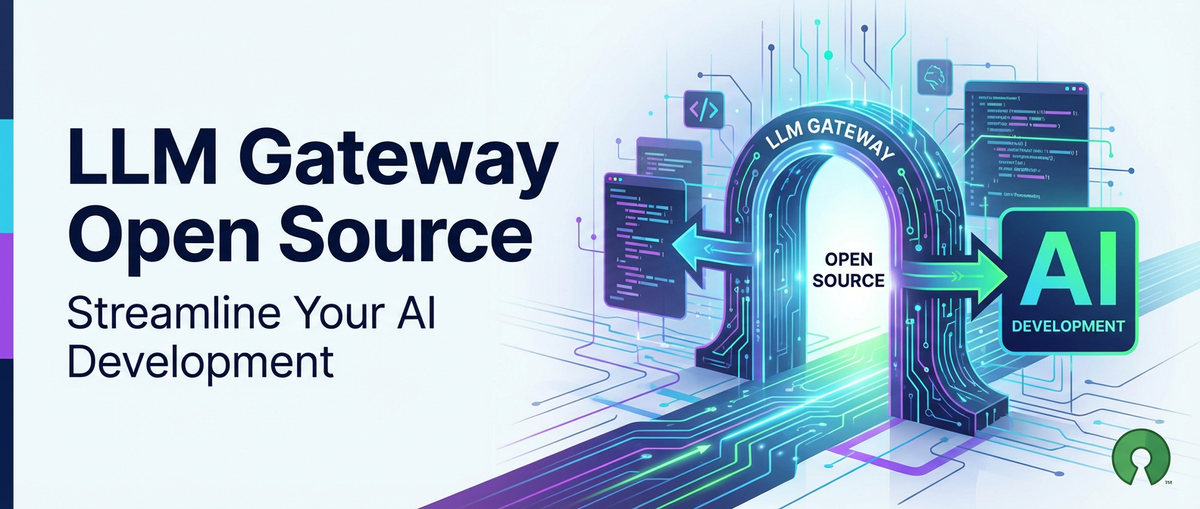


The dawn of artificial intelligence has ushered in an era of unprecedented innovation, transforming industries and reshaping the way we interact with technology. At the forefront of this revolution are Large Language Models (LLMs), sophisticated AI systems capable of understanding, generating, and manipulating human language with remarkable fluency and insight. From powering conversational agents and automating content creation to assisting in complex data analysis and driving groundbreaking research, LLMs have quickly become indispensable tools for businesses and developers alike. However, as the ecosystem of LLMs expands and diversifies, integrating, managing, and optimizing these powerful models presents a growing set of challenges that can quickly overwhelm even the most experienced development teams. This is where the concept of an LLM Gateway – often referred to more broadly as an AI Gateway – emerges as a critical architectural component, designed to streamline the complexities inherent in leveraging advanced AI.
The core promise of an LLM Gateway is to provide a unified, intelligent layer that abstracts away the intricacies of interacting with multiple LLM providers, offering a consistent interface for developers and a robust control plane for operations. While proprietary solutions exist, the true power and flexibility often lie within an LLM Gateway open source framework. Open-source solutions empower organizations with transparency, customization, and community-driven innovation, allowing them to build an AI infrastructure that is not only robust and scalable but also truly aligned with their unique strategic objectives and ethical considerations. This comprehensive exploration delves into the foundational role of LLM Gateways, the compelling advantages of embracing an open-source approach, and how such a system can profoundly streamline the entire AI development lifecycle, from initial concept to large-scale deployment.
The AI Landscape: A Tapestry of Innovation and Inherent Complexity
The past few years have witnessed an explosive proliferation of Large Language Models, fundamentally altering the landscape of software development and business operations. What began with a few pioneering models has rapidly expanded into a vibrant, diverse ecosystem featuring an array of powerful options, each with unique strengths, architectural nuances, and deployment considerations. This rich tapestry includes foundational models like OpenAI’s GPT series, Anthropic’s Claude, Google’s Gemini, and a burgeoning collection of open-source alternatives such as Meta’s Llama family, Mistral AI’s models, and various specialized models fine-tuned for specific tasks or domains.
The very richness of this ecosystem, while offering unparalleled opportunities for innovation, simultaneously introduces significant complexity for developers and organizations. Choosing the right LLM for a specific application involves a nuanced evaluation of factors such as performance, cost, latency, token limits, ethical considerations, and the specific domain knowledge embedded within the model. A customer service application might prioritize a model with high factual accuracy and quick response times, while a creative content generation tool might favor a model adept at generating highly imaginative and varied outputs. The imperative to select, integrate, and manage these diverse models without being locked into a single provider has become a paramount concern for any forward-thinking enterprise.
Navigating the Labyrinth: Core Challenges in AI Development and Integration
Integrating and managing LLMs within enterprise applications is far from a straightforward task. Developers and IT operations teams face a multifaceted set of challenges that can significantly impede progress, escalate costs, and introduce vulnerabilities if not addressed systematically. Understanding these pain points is crucial to appreciating the transformative value of an AI Gateway and, specifically, an LLM Gateway open source solution.
1. API Sprawl and Inconsistency: The Babel of AI Endpoints
Each LLM provider, and sometimes even different versions of the same model from a single provider, presents a unique Application Programming Interface (API) for interaction. These APIs often differ significantly in their data formats (JSON payloads, request parameters), authentication mechanisms (API keys, OAuth tokens), rate limits, error handling conventions, and even the terminology used for similar concepts. For an application that needs to interact with, say, OpenAI, Anthropic, and a locally hosted Llama model, developers are forced to write bespoke integration code for each endpoint. This "API sprawl" leads to:
- Increased Development Effort: Every new model or provider requires custom wrapper code and extensive testing.
- Maintenance Headaches: Updates to a provider's API necessitate changes across all dependent applications, creating a continuous maintenance burden.
- Inconsistent Error Handling: Debugging issues across disparate error codes and messages becomes a tedious and time-consuming process.
- Developer Fatigue: Engineers spend more time on plumbing than on core application logic or innovative AI features.
The lack of a unified interface not only slows down development but also makes it exceptionally difficult to experiment with different models or switch providers, directly leading to vendor lock-in.
2. Cost Management and Optimization: The Unseen Expenses of AI
While LLMs offer immense value, their usage comes with a price tag, typically based on token consumption (input and output) and sometimes compute time. Managing these costs effectively across multiple models and various application instances is a complex undertaking. Without a centralized mechanism, organizations struggle with:
- Lack of Visibility: Difficulty in tracking granular usage data per application, team, or user, making cost allocation and budgeting a nightmare.
- Inefficient Spending: Unoptimized prompt designs, redundant calls, or over-reliance on expensive models when cheaper alternatives suffice can lead to significant overspending.
- Unpredictable Bills: Sudden spikes in usage due to unforeseen demand or inefficient coding practices can result in budget overruns.
- No Cost-Based Routing: Inability to automatically route requests to the most cost-effective model based on real-time pricing and performance data.
Optimizing AI expenditure requires continuous monitoring and intelligent routing strategies, capabilities often absent in direct integrations.
3. Performance, Latency, and Scalability: Ensuring Responsiveness at Scale
The user experience of AI-powered applications is heavily dependent on the responsiveness of the underlying LLMs. High latency, slow processing, or an inability to handle concurrent requests can quickly degrade user satisfaction. Challenges include:
- Variable Latency: Different LLMs and providers exhibit varying response times, which can be further impacted by network conditions and server load.
- Rate Limit Management: Each API imposes limits on the number of requests per minute or hour. Exceeding these limits leads to rejected requests and application failures. Manually implementing retry logic and back-off strategies across multiple APIs is complex.
- Load Balancing: Distributing requests efficiently across different model instances or even different providers to prevent bottlenecks and ensure high availability.
- Caching Inefficiency: Repeated identical or similar requests often trigger new, expensive LLM inferences when a cached response would suffice, wasting resources and adding latency.
Ensuring consistent performance and scalability requires sophisticated traffic management, which individual applications are ill-equipped to handle.
4. Security and Compliance: Guarding Against Risks
Interacting with external AI services inherently introduces security and compliance risks. Transmitting sensitive data, managing API keys, and preventing malicious use are critical concerns:
- API Key Management: Directly embedding API keys in application code or environment variables can expose them to unauthorized access. Secure rotation and management of these credentials is vital.
- Data Privacy and Governance: Ensuring that data transmitted to LLMs complies with regulations like GDPR, CCPA, or industry-specific standards. Understanding how providers handle data, including for training purposes, is crucial.
- Prompt Injection Attacks: Malicious inputs designed to bypass security measures or manipulate the LLM into unintended behaviors (e.g., revealing confidential information, generating harmful content).
- Access Control: Granular control over who can access which LLMs, with what permissions, and under what usage limits.
- Observability for Security: Lack of detailed logging of AI interactions makes it difficult to detect and investigate security incidents.
Without a centralized security layer, organizations are vulnerable to data breaches, compliance failures, and misuse of AI resources.
5. Prompt Engineering and Versioning: The Evolving Art of Conversation
Effective interaction with LLMs relies heavily on "prompt engineering" – crafting precise and effective instructions to elicit desired responses. As applications evolve, so do their prompts. Managing this evolution poses challenges:
- Lack of Centralized Prompt Management: Prompts are often hardcoded within applications, making it difficult to update, test, or standardize them across different services.
- Version Control: Tracking changes to prompts, A/B testing different versions, and rolling back to previous iterations becomes cumbersome.
- Consistency Across Teams: Ensuring that different development teams use consistent prompting strategies for similar tasks.
- Dynamic Prompting: The need to dynamically modify prompts based on user context or external data, which adds complexity to the integration layer.
Poor prompt management leads to inconsistent AI behavior, difficulties in optimization, and slows down the iterative development process for AI features.
6. Observability and Monitoring: The Black Box Problem
Understanding the behavior of AI applications and troubleshooting issues requires robust observability. Without it, LLM interactions can feel like a "black box":
- Insufficient Logging: Native LLM provider logs often lack the detail required for comprehensive debugging, performance analysis, or security audits (e.g., full request/response payloads, latency metrics, specific error conditions).
- Fragmented Monitoring: Metrics are scattered across different provider dashboards, making a holistic view of AI application health challenging.
- Alerting Deficiencies: Difficulty in setting up intelligent alerts for performance degradation, cost overruns, or security anomalies specific to AI interactions.
- Root Cause Analysis: Pinpointing the exact cause of an AI-related issue (e.g., bad prompt, model bug, network latency) becomes a complex forensic exercise.
Robust logging, monitoring, and tracing are essential for maintaining the health and reliability of AI-powered systems.
7. Vendor Lock-in: The Peril of Single Dependencies
Relying exclusively on a single LLM provider, while simplifying initial integration, presents a significant strategic risk. Over time, an organization becomes deeply entangled with that provider's ecosystem, making it difficult to switch if:
- Pricing Changes: The provider increases costs significantly.
- Performance Degrades: The model no longer meets performance requirements.
- Feature Set Stagnates: A competitor offers superior capabilities.
- Ethical Concerns Emerge: The provider's policies or practices become misaligned with organizational values.
- Service Outages: A single point of failure can bring down critical applications.
The effort and cost associated with re-architecting applications to switch providers can be prohibitive, leaving organizations vulnerable to the provider's terms.
Introducing the LLM Gateway / AI Gateway Concept: Your Central AI Control Tower
Given these pervasive challenges, the need for a dedicated architectural layer to manage interactions with LLMs becomes abundantly clear. This is precisely the role of an LLM Gateway, often referred to more broadly as an AI Gateway. Conceptually, an AI Gateway functions much like a traditional API Gateway, but specifically tailored to the unique demands of AI models and their diverse APIs. It acts as a central proxy, sitting between your applications and the various LLM providers, abstracting away the underlying complexity and providing a unified control plane.
At its core, an AI Gateway (or LLM Gateway) is a sophisticated middleware that funnels all requests to LLMs through a single, intelligent entry point. This central point enables a rich set of capabilities that transform the way AI is integrated and managed within an enterprise:
- Unified API Abstraction: It normalizes disparate LLM APIs into a single, consistent interface, allowing applications to interact with any model using the same request format. This dramatically simplifies development and makes model switching seamless.
- Intelligent Routing: Based on configurable rules (e.g., cost, latency, model capability, load), the gateway can intelligently direct requests to the most appropriate LLM provider or instance.
- Caching: It stores responses for identical or similar requests, serving them directly without re-invoking the LLM, reducing latency and costs.
- Security & Access Control: It enforces authentication, authorization, rate limiting, and other security policies, protecting your AI assets and data.
- Cost Monitoring & Optimization: It tracks detailed usage data, provides real-time analytics, and can enforce budget limits across different teams or projects.
- Prompt Management: It centralizes the storage, versioning, and dynamic modification of prompts, decoupling them from application code.
- Observability: It logs every interaction, captures performance metrics, and provides comprehensive visibility into AI usage and behavior.
- Load Balancing & High Availability: It distributes traffic across multiple model instances or providers, ensuring resilience and consistent performance.
By centralizing these critical functions, an LLM Gateway transforms the chaotic landscape of AI integration into a well-ordered, efficient, and secure environment. It allows developers to focus on building innovative AI features rather than wrestling with integration complexities, while giving operations teams the control and visibility needed to manage AI infrastructure effectively.
The Transformative Power of Open Source LLM Gateways
While the benefits of an LLM Gateway are compelling, the choice between a proprietary solution and an LLM Gateway open source framework is a strategic one with profound implications. The open-source paradigm, with its emphasis on transparency, community collaboration, and flexibility, offers a distinct set of advantages that are particularly well-suited to the rapidly evolving and often experimental nature of AI development. Opting for an open-source solution means more than just saving on licensing fees; it means gaining control, fostering innovation, and building an AI infrastructure that is resilient and future-proof.
Why Embrace Open Source for Your AI Gateway?
The decision to adopt an LLM Gateway open source project is driven by several fundamental principles that resonate deeply within the tech community and increasingly with enterprise decision-makers. These principles address many of the challenges outlined earlier, providing solutions that proprietary software often cannot match.
1. Transparency and Trust: Peering Inside the Black Box
One of the most significant advantages of open source is its inherent transparency. The entire codebase is publicly viewable, inspectable, and auditable. For critical infrastructure components like an AI Gateway that handle sensitive data and orchestrate interactions with powerful AI models, this level of transparency is invaluable. Organizations can:
- Verify Security: Independently audit the code for vulnerabilities, ensuring that no hidden backdoors or insecure practices are present. This is particularly important for regulatory compliance and data privacy concerns.
- Understand Functionality: Fully comprehend how the gateway operates, how it handles data, and what logic it applies to routing, caching, and security. This eliminates the "black box" concern often associated with proprietary software.
- Build Confidence: Trust that the solution is designed with community best practices in mind, rather than being driven by a single vendor's commercial interests.
This transparency fosters a level of trust that is difficult for proprietary, closed-source alternatives to replicate, especially in sensitive AI applications.
2. Flexibility and Customization: Tailoring to Your Unique Needs
Every organization has unique architectural requirements, integration landscapes, and operational workflows. Proprietary solutions, by their nature, are designed to be "one-size-fits-all," often leading to compromises or the inability to address specific niche needs. An LLM Gateway open source framework, however, offers unparalleled flexibility:
- Adaptability: The ability to modify, extend, and integrate the gateway with existing internal systems (e.g., identity providers, monitoring stacks, legacy APIs) in ways that perfectly align with your enterprise architecture.
- Feature Development: If a specific feature is missing, your development team can build it themselves or contribute to the community to add it. This ensures the gateway evolves precisely with your business requirements.
- Specialized Use Cases: Tailor the routing logic, caching policies, or prompt transformation rules to highly specialized AI applications that off-the-shelf products might not support.
This customization capability ensures that your AI Gateway is a perfect fit, rather than a forced compromise, maximizing its utility and longevity within your infrastructure.
3. Community Support and Innovation: A Collective Brainpower
Open-source projects thrive on community collaboration. A vibrant community provides a powerful engine for innovation, problem-solving, and continuous improvement. This collective intelligence translates into tangible benefits for users of an AI Gateway open source solution:
- Faster Bug Fixes: Bugs are often identified and patched rapidly by a distributed network of contributors, frequently much quicker than relying on a single vendor's support team.
- Diverse Contributions: Developers from various backgrounds and organizations contribute new features, performance enhancements, and integrations, enriching the project's capabilities.
- Knowledge Sharing: Forums, documentation, and online communities provide a rich resource for troubleshooting, learning best practices, and exchanging insights.
- Rapid Evolution: In the fast-paced world of AI, an open-source gateway can adapt more quickly to new LLMs, API changes, and emerging techniques, benefiting from collective efforts to keep it cutting-edge.
Leveraging the wisdom of a global community ensures that your LLM Gateway remains robust, secure, and always at the forefront of AI infrastructure innovation.
4. Cost-Effectiveness: Beyond Licensing Fees
While the primary cost benefit of open source is often seen as the absence of licensing fees, the true cost-effectiveness extends much further. Although internal development and maintenance costs will exist, open-source reduces other long-term expenditures:
- Reduced Vendor Lock-in Costs: By avoiding reliance on a single vendor, organizations mitigate the risk of punitive price increases or forced migration costs associated with switching providers.
- Optimized Resource Utilization: Open-source solutions often provide finer-grained control over resource allocation and deployment, allowing for more efficient infrastructure utilization.
- Lower Opportunity Cost: Faster development cycles and reduced integration complexities mean that development teams can allocate more time to value-generating AI applications rather than infrastructure plumbing.
The overall Total Cost of Ownership (TCO) for an open-source solution, when factoring in flexibility, innovation, and reduced vendor dependence, can be significantly lower in the long run.
5. True Independence and Control: Your Infrastructure, Your Rules
Perhaps the most strategic advantage of an LLM Gateway open source is the unparalleled level of independence and control it grants. Organizations are no longer beholden to a vendor's roadmap, pricing, or terms of service. This means:
- Ownership: You own the software; you can run it anywhere, modify it in any way, and integrate it with anything without proprietary restrictions.
- Strategic Agility: The ability to quickly pivot to new LLMs or adjust AI strategies without being constrained by an external vendor's offerings or limitations.
- Long-Term Viability: The project's longevity is not tied to the financial health or strategic shifts of a single company, as the community can sustain it.
This level of control is paramount for enterprises building mission-critical AI applications, ensuring their AI infrastructure is truly their own.
6. Accessibility: Lowering the Barrier to Entry
For startups, academic institutions, and smaller development teams, the cost and complexity of proprietary AI Gateway solutions can be prohibitive. Open-source alternatives democratize access to sophisticated AI infrastructure:
- No Upfront Investment: Teams can begin experimenting and building with powerful gateway features without significant initial capital expenditure.
- Learning Opportunity: The open codebase serves as an excellent learning resource for developers keen to understand advanced API management and AI integration patterns.
- Rapid Prototyping: Accelerate the development and deployment of AI-powered prototypes and Minimum Viable Products (MVPs).
This accessibility fosters innovation across a broader spectrum of organizations and individuals, driving collective progress in the AI space.
Key Features and Benefits of an LLM Gateway Open Source Solution
An LLM Gateway open source solution centralizes the management of AI interactions, providing a robust suite of features that address the previously identified challenges. Each feature not only solves a specific technical problem but also delivers significant business value, enhancing efficiency, security, and strategic agility.
1. Unified API Abstraction: Speaking One Language to Many Models
The most foundational capability of an LLM Gateway is its ability to provide a unified API abstraction layer. Instead of direct integrations with OpenAI, Anthropic, Google, and local open-source models, applications interact solely with the gateway. The gateway then translates these standardized requests into the specific formats required by each underlying LLM provider.
- Detailed Explanation: Imagine having a single
POST /v1/chat/completionsendpoint on your gateway. Your application sends a request to this endpoint with a standardized payload, specifying the desired model (e.g.,model: "gpt-4",model: "claude-3-opus", ormodel: "llama-2-70b"). The gateway intercepts this, dynamically adjusts the request body, headers, and authentication tokens to match the target provider's API, and forwards it. The response from the LLM is then normalized back into a consistent format before being returned to your application. This includes harmonizing data structures for messages, roles, token counts, and error messages. - Benefit: This drastically reduces development effort, as engineers write integration code once, regardless of how many LLMs they use. It virtually eliminates vendor lock-in by making model switching a configuration change rather than a code rewrite. This future-proofs applications, allowing them to leverage the best available models without extensive re-engineering, thereby accelerating time-to-market for new AI features.
2. Intelligent Routing and Load Balancing: The Smart Traffic Controller
An effective LLM Gateway open source solution goes beyond simple proxying; it intelligently routes requests based on a sophisticated set of criteria, optimizing for performance, cost, and reliability.
- Detailed Explanation: Intelligent routing rules can be configured based on various factors:
- Cost-based routing: Send non-critical requests to cheaper models or providers, while premium requests go to high-performance, potentially more expensive models.
- Latency-based routing: Direct requests to the LLM instance or provider with the lowest current latency.
- Capability-based routing: Route specific types of requests (e.g., code generation) to models known to excel in those areas, even if they come from different providers.
- Load balancing: Distribute traffic evenly across multiple instances of the same model (e.g., across different regions of an API, or across multiple locally deployed models) to prevent overload and ensure high availability.
- Fallback mechanisms: Automatically switch to a backup LLM provider or a cheaper, less powerful model if the primary one is unavailable or exceeds its rate limits.
- Benefit: This ensures optimal resource utilization, minimizes operational costs by intelligently selecting models, and significantly improves the reliability and responsiveness of AI-powered applications. It mitigates the impact of single-provider outages, offering a robust and resilient AI infrastructure.
3. Caching Mechanisms: Reducing Redundancy, Boosting Speed
Many LLM requests, particularly during development or for common queries, can be repetitive. An AI Gateway with robust caching capabilities can store and serve these responses, avoiding redundant calls to the LLM provider.
- Detailed Explanation: The gateway can implement various caching strategies:
- Exact match caching: If an identical request (same prompt, same model, same parameters) is received, the cached response is served immediately.
- Semantic caching: More advanced gateways might use vector embeddings or similarity algorithms to identify semantically similar prompts and return relevant cached responses, even if the prompt isn't an exact match.
- Time-to-Live (TTL): Configurable expiration policies ensure that cached data remains fresh.
- Invalidation strategies: Mechanisms to manually or automatically invalidate cached entries when underlying data or model behavior changes.
- Benefit: Caching dramatically reduces latency for frequently accessed queries, leading to a snappier user experience. Crucially, it also significantly cuts down on API costs, as fewer tokens are consumed from LLM providers. This optimization becomes increasingly vital as AI usage scales.
4. Advanced Security and Access Control: Guarding Your AI Perimeter
Security is paramount when dealing with external AI services, especially given the potential for data exposure and misuse. An LLM Gateway open source solution acts as a hardened perimeter for your AI interactions.
- Detailed Explanation:
- API Key Management: Centralized and secure storage of LLM provider API keys, decoupling them from individual applications. The gateway can manage key rotation and ensure keys are never directly exposed to client-side code.
- Authentication and Authorization: Integrate with existing identity providers (e.g., OAuth, JWT) to authenticate internal users and services, applying fine-grained role-based access control (RBAC) to specific LLMs or endpoints. For example, only certain teams might have access to expensive or experimental models.
- Rate Limiting: Protect both your applications and the upstream LLM providers from abuse by enforcing configurable rate limits (e.g., requests per second, tokens per minute) at the gateway level.
- IP Whitelisting/Blacklisting: Restrict access to the gateway or specific LLMs based on source IP addresses.
- Prompt Injection Mitigation: Implement sanitization, validation, and potentially AI-driven detection mechanisms for malicious prompts to prevent prompt injection attacks.
- Data Masking/Redaction: Prior to forwarding sensitive data to an LLM, the gateway can redact or mask personally identifiable information (PII) or other confidential data, enhancing data privacy and compliance.
- Benefit: This comprehensive security posture protects sensitive data, prevents unauthorized access and abuse, helps maintain compliance with data privacy regulations, and safeguards against various AI-specific attack vectors. It gives organizations confidence in the security of their AI deployments.
5. Cost Management and Analytics: Illuminating Your AI Expenditure
Understanding and controlling the costs associated with LLM usage is a major concern. An AI Gateway provides the necessary visibility and control mechanisms.
- Detailed Explanation: The gateway meticulously tracks every interaction: which model was called, by whom, at what time, the number of input/output tokens consumed, and the associated cost. This granular data is then aggregated and presented through dashboards.
- Real-time Usage Tracking: Monitor token consumption, request counts, and estimated costs in real-time across different models, applications, and teams.
- Detailed Billing Reports: Generate comprehensive reports for internal chargebacks or cost allocation to specific departments or projects.
- Budget Alerts: Set up automated alerts when usage approaches predefined budget thresholds for specific models or teams.
- Cost Optimization Suggestions: Potentially leverage AI to analyze usage patterns and suggest cheaper alternative models for certain types of requests.
- Benefit: This financial transparency empowers organizations to accurately attribute costs, identify areas of overspending, optimize their LLM usage strategies, and maintain strict control over their AI budget. It transforms opaque LLM billing into a clear, manageable expense.
6. Prompt Management and Versioning: The Library of Conversations
The quality of LLM output is heavily dependent on the quality of the input prompt. Centralizing prompt management within the gateway is a game-changer for consistency and iteration.
- Detailed Explanation:
- Centralized Prompt Store: Store all prompts (system prompts, user prompts, few-shot examples) in a dedicated, version-controlled repository within the gateway.
- Prompt Templating: Allow developers to define dynamic prompts with placeholders that the gateway populates with context-specific data before forwarding to the LLM.
- Version Control: Manage different versions of prompts, enabling A/B testing of prompt variations to determine which yields the best results. Roll back to previous versions if a new prompt degrades performance.
- Prompt Chaining/Orchestration: Orchestrate sequences of prompts or combine outputs from multiple LLM calls to achieve complex tasks.
- Environment-Specific Prompts: Configure different prompts for development, staging, and production environments.
- Benefit: This decouples prompt logic from application code, making prompts easier to manage, update, test, and optimize. It ensures consistency across applications, accelerates prompt engineering cycles, and allows for rapid experimentation to improve LLM responses without deploying new application code.
7. Observability: Logging, Monitoring, and Tracing: Shedding Light on AI Interactions
Debugging and maintaining reliable AI applications require deep visibility into every LLM interaction. An LLM Gateway provides a unified observability layer.
- Detailed Explanation:
- Comprehensive Logging: The gateway captures detailed logs for every request and response, including full payloads, headers, latency metrics, and any errors encountered. This includes the transformed prompt sent to the LLM and the raw response received.
- Performance Monitoring: Collect and expose metrics such as request rates, response times, error rates, and cache hit ratios for various LLMs and routes. Integrate with existing monitoring tools (e.g., Prometheus, Grafana, Datadog) for centralized dashboards.
- Distributed Tracing: Generate unique trace IDs for each end-to-end transaction, allowing developers to follow a request through the gateway, to the LLM provider, and back, providing invaluable context for debugging complex issues.
- Error Reporting: Centralized capture and reporting of errors from upstream LLMs or gateway processing, allowing for proactive alerting and faster resolution.
- Benefit: Enhanced observability translates into faster debugging, proactive issue resolution, and deeper insights into AI application performance and behavior. It ensures the operational stability of AI systems and helps identify performance bottlenecks or cost inefficiencies before they impact users.
8. Extensibility and Plugin Architecture: Building Beyond the Core
A truly powerful LLM Gateway open source solution is designed with extensibility in mind, allowing users to augment its capabilities through a plugin architecture or custom code.
- Detailed Explanation: This means the core gateway provides well-defined hooks or interfaces where developers can inject custom logic. Examples include:
- Custom Authentication: Integrate with proprietary identity systems.
- Data Transformation: Implement specific data scrubbing or enrichment before/after LLM calls.
- New LLM Connectors: Develop connectors for new or niche LLM providers not supported out-of-the-box.
- Custom Analytics/Reporting: Export metrics to specialized internal data warehouses.
- AI Firewall Rules: Implement advanced, AI-driven filtering or moderation logic for prompts and responses.
- Benefit: Extensibility ensures that the gateway can adapt to unforeseen requirements and integrate seamlessly into highly specialized or evolving enterprise environments. It prevents the limitations of a pre-built solution from stifling innovation, allowing organizations to tailor the gateway to their exact needs.
9. Multitenancy Support: Scalable Management for Large Organizations
For larger enterprises with multiple teams, departments, or even external clients utilizing AI, multitenancy within the gateway is a critical feature.
- Detailed Explanation: A multitenant AI Gateway allows for the creation of isolated environments (tenants), where each tenant has its own:
- Applications and API Keys: Independent sets of consumer applications and API keys for accessing the gateway.
- Configuration: Separate routing rules, rate limits, prompt configurations, and security policies.
- Usage Data and Analytics: Isolated reporting on LLM usage and costs, facilitating internal chargebacks.
- Access Permissions: Role-based access control specific to each tenant, ensuring that teams only see and manage their own resources.
- Shared Infrastructure: Despite the isolation, these tenants share the underlying gateway infrastructure, optimizing resource utilization and reducing operational overhead compared to deploying separate gateways for each team.
- Benefit: Multitenancy simplifies management for large organizations, providing secure isolation between different projects or business units while still leveraging a shared, efficient infrastructure. It enhances security, streamlines resource allocation, and reduces overall operational costs for widespread AI adoption.
APIPark: An Illustrative Example of an Open Source AI Gateway
As we delve into the comprehensive features and benefits of an LLM Gateway open source solution, it's beneficial to look at concrete examples that embody these principles. One such powerful example is ApiPark. APIPark is an open-source AI Gateway and API management platform, released under the Apache 2.0 license, specifically designed to help developers and enterprises manage, integrate, and deploy AI and REST services with remarkable ease. It encapsulates many of the core features discussed, serving as a robust foundation for streamlining AI development.
APIPark offers a compelling set of capabilities that directly address the challenges of managing diverse AI models:
- Quick Integration of 100+ AI Models: APIPark provides the capability to integrate a vast array of AI models from different providers with a unified management system, simplifying authentication and cost tracking across the board. This directly tackles the "API Sprawl and Inconsistency" problem by offering a single point of integration.
- Unified API Format for AI Invocation: A cornerstone feature, APIPark standardizes the request data format across all integrated AI models. This ensures that any changes to underlying AI models or prompts do not ripple through and affect the application or microservices layer. This significantly reduces maintenance costs and simplifies the operational use of AI, aligning perfectly with the "Unified API Abstraction" benefit.
- Prompt Encapsulation into REST API: APIPark allows users to quickly combine AI models with custom prompts to create new, specialized APIs. For instance, one can define an API for sentiment analysis, translation, or data summarization by simply pairing a model with a predefined prompt. This aligns with the "Prompt Management and Versioning" feature, making prompts reusable and decoupled from core application logic.
- End-to-End API Lifecycle Management: Beyond just AI, APIPark assists with managing the entire lifecycle of APIs—from design and publication to invocation and decommissioning. It helps regulate API management processes, manage traffic forwarding, load balancing, and versioning of published APIs. This broadens its utility as a holistic AI Gateway and API management platform.
- API Service Sharing within Teams & Independent API/Access Permissions for Each Tenant: APIPark enables centralized display of all API services for easy discovery and use across different departments and teams. Furthermore, it supports multitenancy, allowing the creation of multiple teams (tenants) with independent applications, data, user configurations, and security policies, all while sharing the underlying infrastructure to improve resource utilization and reduce operational costs. This directly addresses the need for "Multitenancy Support" and granular access control.
- API Resource Access Requires Approval: Enhancing security, APIPark can activate subscription approval features, requiring callers to subscribe to an API and await administrator approval before invocation. This prevents unauthorized API calls and potential data breaches, tying into the "Advanced Security and Access Control" aspect.
- Performance Rivaling Nginx & Cluster Deployment: APIPark is engineered for high performance, capable of achieving over 20,000 TPS with modest hardware (8-core CPU, 8GB memory), and supports cluster deployment for large-scale traffic handling. This addresses the "Performance, Latency, and Scalability" challenge directly.
- Detailed API Call Logging & Powerful Data Analysis: APIPark provides comprehensive logging for every API call, essential for tracing, troubleshooting, and ensuring system stability and data security. It also analyzes historical call data to display long-term trends and performance changes, facilitating preventive maintenance—key components of "Observability."
APIPark offers a quick deployment process, achievable in just 5 minutes with a single command line, making it highly accessible for teams eager to streamline their AI infrastructure. For enterprises seeking advanced features and professional technical support, a commercial version is also available, building on the robust open-source foundation. As an open-source project from Eolink, a leader in API lifecycle governance, APIPark brings significant expertise and community backing to the LLM Gateway open source landscape.
Implementing an LLM Gateway Open Source Solution: A Strategic Journey
Adopting an LLM Gateway open source solution is a strategic endeavor that requires careful planning, execution, and ongoing management. It's not merely a technical implementation but a shift in how an organization approaches AI integration and governance. A well-executed implementation ensures that the gateway delivers its full promise of efficiency, security, and flexibility.
1. Planning and Assessment: Laying the Groundwork
Before diving into deployment, a thorough planning and assessment phase is critical. This involves understanding your current AI landscape, identifying future needs, and defining clear objectives for the gateway.
- Identify Current and Future LLM Usage: Document all existing LLM integrations (both direct and indirect). Which models are used? For what purposes? What are the key performance indicators (KPIs) for these applications (e.g., latency, throughput, error rates)? Anticipate future LLM needs, including new models, providers, or application types.
- Define Requirements and Use Cases:
- Which LLMs will be managed? (e.g., OpenAI, Anthropic, local Llama instances, custom fine-tuned models)
- What applications will consume LLMs via the gateway? (e.g., chatbots, content generators, internal tools)
- What are the specific security needs? (e.g., data masking, stringent access control, compliance requirements like HIPAA or GDPR)
- What traffic volumes are anticipated? (e.g., requests per second, peak usage)
- What monitoring and alerting capabilities are essential? (e.g., integration with existing observability stacks)
- Are multitenancy or team isolation features required?
- What are the cost optimization goals? (e.g., target cost per transaction)
- Evaluate Existing Infrastructure: Assess your current cloud environment, containerization strategy (Docker, Kubernetes), identity management systems, and monitoring tools. The gateway should integrate seamlessly into this existing ecosystem.
- Resource Allocation: Identify the team members who will be responsible for deployment, configuration, development of custom plugins (if needed), and ongoing maintenance. Ensure they have the necessary skills in infrastructure, networking, and potentially Go, Python, or JavaScript, depending on the chosen gateway's technology stack.
- Set Clear Objectives and KPIs: What does success look like? (e.g., 20% reduction in AI API costs, 50% faster onboarding for new AI applications, 99.9% uptime for LLM services).
2. Selection Criteria for an Open Source LLM Gateway: Choosing Wisely
With requirements clearly defined, the next step is to evaluate available LLM Gateway open source projects. This is a critical decision, as the right choice will serve as a foundational piece of your AI infrastructure.
- Community Activity and Support:
- Active Development: Check commit history, release frequency, and the number of active contributors. A project with consistent updates is more likely to be well-maintained and adapt to new AI developments.
- Vibrant Community: Look for active forums, Discord/Slack channels, or GitHub discussions. A strong community indicates good support, shared knowledge, and a faster path to solutions.
- Responsive Maintainers: How quickly do project maintainers respond to issues and pull requests?
- Documentation Quality: Comprehensive, clear, and up-to-date documentation is paramount for successful adoption, deployment, and troubleshooting. Look for detailed installation guides, configuration examples, API references, and conceptual explanations.
- Feature Set Alignment: Does the gateway offer core features like unified API abstraction, intelligent routing, caching, security, cost management, prompt management, and observability out-of-the-box? Or does it provide a robust framework for building these?
- Scalability and Performance:
- Benchmarking: Look for published benchmarks or conduct your own tests to ensure the gateway can handle your anticipated traffic volumes without becoming a bottleneck.
- Architecture: Understand its underlying architecture (e.g., Go-based, event-driven, microservices) and how it supports horizontal scaling.
- Resource Footprint: Evaluate its memory and CPU requirements.
- Ease of Deployment and Configuration:
- Containerization Support: Is it easily deployable via Docker and Kubernetes?
- Configuration Management: How are configurations managed (e.g., YAML files, environment variables, UI)? Is it straightforward and version-controllable?
- Quick Start: Does it offer a quick-start guide or script (like APIPark's single-command deployment) to get a basic instance up and running quickly?
- Licensing: Ensure the open-source license (e.g., Apache 2.0, MIT, GPL) aligns with your organization's legal and usage policies. Apache 2.0, for instance, is highly permissive and generally suitable for commercial use.
- Extensibility: If custom features are anticipated, assess how easily the gateway can be extended through plugins, hooks, or custom code without forking the entire project.
3. Deployment Strategies: Bringing Your Gateway to Life
Once an AI Gateway open source solution is selected, the deployment phase involves setting up the infrastructure and configuring the gateway for your environment.
- Environment Setup:
- On-premises vs. Cloud: Decide where the gateway will run. Cloud deployment (AWS, Azure, GCP) offers scalability and managed services, while on-premises provides maximum control over data and infrastructure, especially for highly sensitive applications or specific compliance needs.
- Containerization: Deploying the gateway using Docker containers and orchestrating them with Kubernetes is highly recommended. This provides portability, scalability, resilience, and consistent environments across development, staging, and production.
- High Availability and Disaster Recovery:
- Redundancy: Deploy multiple instances of the gateway across different availability zones or regions to ensure continuous operation even if one instance or zone fails.
- Load Balancers: Use external load balancers to distribute incoming application requests across the gateway instances.
- Database Redundancy: If the gateway relies on a database for configuration, logging, or caching, ensure that the database is also highly available and backed up.
- Backup and Restore: Implement robust backup and restore procedures for all gateway configurations and persistent data.
- Networking and Security Configuration:
- Network Segmentation: Deploy the gateway in a secure network segment, isolated from the public internet except for necessary inbound traffic.
- Firewall Rules: Configure firewall rules to restrict traffic to only necessary ports and protocols.
- TLS/SSL: Ensure all traffic to and from the gateway uses Transport Layer Security (TLS/SSL) for encryption.
- Secrets Management: Use a secure secrets management solution (e.g., HashiCorp Vault, AWS Secrets Manager, Kubernetes Secrets) for storing API keys and other sensitive credentials used by the gateway.
4. Integration Best Practices: Making the Gateway an Integral Part
Successfully integrating the gateway into your development workflow and existing systems is crucial for maximizing its value.
- Start Small, Iterate, and Scale: Begin by integrating one or two non-critical applications with the gateway. Gather feedback, refine configurations, and gradually onboard more applications. Avoid a "big bang" approach.
- Thorough Testing:
- Unit and Integration Tests: Ensure all custom configurations, plugins, and routing rules are thoroughly tested.
- Performance Testing: Conduct load testing to validate the gateway's performance under various traffic conditions and identify bottlenecks.
- Security Audits: Perform regular security audits and penetration tests on the deployed gateway.
- Comprehensive Monitoring and Alerting Setup:
- Dashboards: Create dashboards using your preferred monitoring tools (Grafana, Datadog) to visualize key metrics from the gateway (request rates, latency, error rates, cache hit ratios, token usage).
- Alerts: Configure alerts for critical events such as gateway errors, LLM provider outages, rate limit breaches, or unexpected cost spikes.
- Developer Training and Documentation:
- Internal Documentation: Provide clear internal documentation for developers on how to interact with the AI Gateway, including API specifications, authentication methods, prompt management guidelines, and troubleshooting tips.
- Training Sessions: Conduct training sessions for development teams to familiarize them with the new AI integration workflow.
- Feedback Loop: Establish a feedback mechanism for developers to report issues or suggest improvements to the gateway team.
- Version Control for Configurations: Treat gateway configurations (routing rules, security policies, prompt templates) as code. Store them in a version control system (Git) and manage changes through a CI/CD pipeline, enabling traceability and rollbacks.
By following these strategic steps, organizations can successfully implement an LLM Gateway open source solution that becomes a cornerstone of their efficient, secure, and adaptable AI development ecosystem.
APIPark is a high-performance AI gateway that allows you to securely access the most comprehensive LLM APIs globally on the APIPark platform, including OpenAI, Anthropic, Mistral, Llama2, Google Gemini, and more.Try APIPark now! 👇👇👇
Real-World Use Cases and Transformative Impact
The implementation of an LLM Gateway open source solution is not merely a technical exercise; it profoundly impacts various real-world applications and roles within an organization. By abstracting complexity and centralizing control, the gateway enables new possibilities and dramatically enhances existing AI initiatives.
Enterprise AI Applications Reimagined
The versatility of an AI Gateway makes it indispensable across a wide spectrum of enterprise AI applications, from customer-facing services to internal productivity tools.
1. Customer Service Chatbots and Virtual Assistants
- Use Case: Large enterprises often deploy sophisticated chatbots and virtual assistants to handle customer inquiries, provide support, and guide users through complex processes. These systems need to be intelligent, responsive, and reliable.
- Impact of Gateway:
- Intelligent Model Selection: The gateway can dynamically route customer queries to the most appropriate LLM. For instance, simple FAQs might go to a cheaper, faster model, while complex troubleshooting or empathetic responses are directed to a more advanced (and potentially more expensive) model like Claude or GPT-4, optimizing both cost and quality.
- Fallback Mechanism: If a primary LLM service experiences an outage or performance degradation, the gateway can automatically failover to a secondary model, ensuring uninterrupted service for customers.
- Consistent Persona: Centralized prompt management ensures that the chatbot maintains a consistent brand voice and persona across all interactions, regardless of the underlying LLM processing the request.
- Real-time Cost Monitoring: Operations teams can monitor token usage and costs in real-time, identifying unexpected spikes and optimizing spending without impacting service quality.
2. Content Generation Platforms and Marketing Automation
- Use Case: Marketing teams, content agencies, and media companies increasingly use LLMs for generating marketing copy, articles, social media updates, and even code snippets.
- Impact of Gateway:
- Optimized Model for Task: Different content types might benefit from different LLMs. A gateway can route requests for short, punchy ad copy to one model and requests for long-form analytical articles to another. This ensures optimal output quality for specific creative tasks.
- Prompt Templating: Marketing teams can use centralized prompt templates to ensure brand consistency and adherence to style guides across all generated content, even when multiple content creators are involved.
- A/B Testing Prompts: The gateway facilitates A/B testing different prompt variations for marketing campaigns, allowing teams to quickly identify which prompts generate the most engaging or effective content.
- Cost Control for Campaigns: Track AI usage per marketing campaign or project, enabling precise cost attribution and budget management for content generation efforts.
3. Data Analysis, Business Intelligence, and Research Tools
- Use Case: Data scientists and business analysts leverage LLMs for natural language querying of databases, summarizing research papers, extracting insights from unstructured text data, and generating reports.
- Impact of Gateway:
- Unified Access to Multiple Models: Researchers can experiment with different LLMs for specific analytical tasks (e.g., one model for entity extraction, another for sentiment analysis, a third for summarization) through a single interface, accelerating their workflow.
- Data Masking for Sensitive Data: The gateway can redact or mask sensitive financial, customer, or proprietary data before sending it to external LLMs for analysis, ensuring data privacy and compliance.
- Controlled Access: Grant different levels of access to LLMs based on data sensitivity or the user's role, preventing unauthorized use of powerful models or access to certain data types.
- Auditable Interactions: Detailed logs of every query and response provide an audit trail for compliance and ensure transparency in data analysis processes.
4. Developer Tools and Code Assistants
- Use Case: Integrating LLMs into IDEs, code review tools, or internal developer platforms for code generation, bug fixing suggestions, documentation creation, or natural language to code translation.
- Impact of Gateway:
- Seamless Integration: Developers can easily integrate AI capabilities into their tools using a standardized API from the gateway, regardless of the underlying LLM.
- Rate Limit Management: Prevent developers from accidentally hitting API rate limits of external LLMs, ensuring consistent access to AI features.
- Cost Visibility per Developer/Team: Track LLM usage and costs per developer or development team, allowing for fair resource allocation and budget management.
- Prompt Versioning for Code Gen: Manage and A/B test different prompts for code generation or refactoring, ensuring the generated code is high-quality and adheres to coding standards.
Benefits Across Different Organizational Roles
The positive impact of an LLM Gateway open source solution extends beyond technical implementation, significantly benefiting various stakeholders within an organization.
1. For Developers: Simplified Innovation
- Focus on Core Logic: Developers are freed from the burden of managing disparate LLM APIs, authentication methods, rate limits, and error handling. They can concentrate their efforts on building innovative AI features and business logic, rather than on plumbing.
- Faster Iteration: With unified APIs and centralized prompt management, developers can rapidly experiment with different LLMs, A/B test prompts, and deploy new AI capabilities much faster. Model switching becomes a configuration change, not a re-architecture.
- Reduced Complexity: The gateway abstracts away many low-level concerns, making AI integration simpler and more accessible, even for developers new to the LLM space.
- Consistency: Standardized interactions and prompt libraries ensure that different parts of an application or different teams are interacting with AI models consistently.
2. For Operations Teams: Enhanced Stability and Control
- Centralized Monitoring: A single point for monitoring all AI traffic, performance metrics, and error rates simplifies troubleshooting and provides a holistic view of AI infrastructure health.
- Improved Stability and Resilience: Intelligent routing, load balancing, and fallback mechanisms ensure that AI services remain available and performant even during upstream LLM outages or peak loads.
- Easier Troubleshooting: Comprehensive logging and tracing capabilities mean operations teams can quickly pinpoint the root cause of issues, whether it's an application error, a gateway misconfiguration, or an upstream LLM problem.
- Proactive Management: Detailed analytics enable proactive identification of performance bottlenecks, cost overruns, or security anomalies before they escalate into major problems.
- Streamlined Security: Centralized API key management, access control, and rate limiting simplify the enforcement of security policies and reduce the attack surface for AI interactions.
3. For Business Leaders and Product Managers: Strategic Advantage and Cost Efficiency
- Faster Time-to-Market: The ability to rapidly integrate and experiment with new LLMs means AI-powered products and features can be brought to market much quicker, gaining a competitive edge.
- Cost Control and Optimization: Granular cost tracking and intelligent routing ensure that AI spending is optimized and aligned with business value, preventing budget overruns. Leaders gain clear visibility into AI expenditures.
- Reduced Vendor Risk: By providing a layer of abstraction, the gateway reduces reliance on a single LLM provider, mitigating the risks associated with vendor lock-in, price increases, or service changes.
- Enhanced Security and Compliance: Assurance that AI interactions are secure, compliant with regulations, and protected from misuse, safeguarding brand reputation and customer trust.
- Data-Driven Decisions: Access to comprehensive AI usage analytics enables product managers to make informed decisions about model selection, feature prioritization, and resource allocation based on actual performance and cost data.
In essence, an LLM Gateway open source solution empowers an organization to move faster, operate more securely, and spend more efficiently in its pursuit of AI-driven innovation. It transforms a complex, fragmented AI landscape into a cohesive, manageable, and highly effective ecosystem.
Future Trends in LLM Gateways and AI Infrastructure
The field of AI is characterized by its relentless pace of innovation, and the tools and infrastructure supporting it must evolve in tandem. LLM Gateway solutions, particularly those built on an open source foundation, are uniquely positioned to adapt and lead in this dynamic environment. Several key trends are shaping the future of AI Gateways, promising even more sophisticated and integrated capabilities.
1. Hybrid AI Architectures: Blending Cloud and On-Premise
As enterprises become more sophisticated in their AI adoption, the distinction between purely cloud-based and purely on-premise LLMs is blurring. Future AI Gateways will increasingly support hybrid architectures:
- Orchestration of Diverse Deployments: Seamlessly managing a mix of public cloud LLM APIs (e.g., OpenAI, Anthropic), private cloud instances (e.g., Azure OpenAI Service, Google Vertex AI), and self-hosted open-source models (e.g., Llama 3, Mistral deployed on Kubernetes clusters).
- Data Locality and Compliance: Intelligently routing sensitive data to on-premise or private cloud models while less sensitive data can leverage public cloud APIs, ensuring stringent data residency and compliance requirements are met.
- Edge AI Integration: Extending gateway capabilities to the edge, allowing some LLM inference to occur closer to the data source (e.g., on IoT devices, local servers) for ultra-low latency applications, with the central gateway orchestrating model updates and monitoring.
2. Enhanced Security Features and AI Governance
With the growing power of LLMs come heightened security concerns and ethical considerations. Future LLM Gateways will embed more advanced security and governance capabilities:
- Advanced Prompt Injection Defense: Moving beyond basic sanitization to incorporate AI-powered anomaly detection and semantic analysis to identify and neutralize sophisticated prompt injection attacks in real-time.
- Responsible AI Guardrails: Implementing configurable policies within the gateway to filter out or flag harmful, biased, or non-compliant LLM outputs, aligning with ethical AI principles.
- Data Provenance and Lineage: Providing tools to track the origin and transformation of data as it passes through the gateway and interacts with LLMs, crucial for auditing and compliance.
- Zero-Trust AI Access: Implementing stricter zero-trust principles, where every request, even from internal systems, is authenticated, authorized, and continuously verified.
3. Serverless LLM Gateways: Scalability and Reduced Operations
The serverless paradigm, offering automatic scaling and pay-per-use billing, is a natural fit for the bursty nature of AI workloads.
- Auto-Scaling on Demand: Serverless AI Gateways will automatically scale up or down based on traffic, eliminating the need for manual capacity planning and reducing operational overhead.
- Cost Efficiency: Organizations will only pay for the compute time consumed by requests, making it highly cost-effective for variable AI workloads.
- Simplified Deployment: Further streamlining deployment and management, allowing developers to focus purely on configuring routes and policies without worrying about server infrastructure.
4. Deeper Integration with MLOps Platforms
The lifecycle of an LLM extends from data preparation and training to deployment and monitoring. Future LLM Gateways will integrate more seamlessly into broader MLOps (Machine Learning Operations) platforms:
- Automated Model Deployment: Directly consuming newly trained or fine-tuned LLM models from an MLOps pipeline and automatically configuring routing rules and endpoints within the gateway.
- Feedback Loops for Model Improvement: Feeding performance metrics, user feedback, and error logs captured by the gateway back into the MLOps pipeline to inform model retraining and improvement.
- Experimentation Management: Tightly integrating with MLOps tools to manage A/B testing of different LLM versions or prompt strategies orchestrated by the gateway.
5. AI-Native Observability and Explainability
Traditional monitoring tools often fall short when analyzing the nuances of AI model behavior. Future LLM Gateways will offer more AI-native observability:
- Semantic Logging: Beyond just raw request/response, logs will include embeddings or summaries of the prompt/response, enabling semantic search and analysis of AI interactions.
- Anomaly Detection in AI Outputs: Leveraging AI within the gateway itself to detect unusual or unexpected LLM outputs (e.g., hallucinations, toxic content) and trigger alerts.
- Cost Prediction and Optimization: Using predictive analytics on historical usage data to forecast future LLM costs and suggest real-time optimization strategies.
- Explainability Insights: Potentially providing insights into why a particular request was routed to a specific model or how a prompt was interpreted, enhancing transparency in AI decision-making.
These trends highlight a future where LLM Gateways, especially those built on the principles of open source, will become even more intelligent, robust, and central to the efficient and responsible development of AI applications, continually streamlining the complexities of integrating and managing advanced machine learning models.
Conclusion
The transformative power of Large Language Models is undeniable, ushering in an era of unprecedented innovation across every sector. However, the true potential of these advanced AI systems can only be fully realized when the inherent complexities of their integration and management are effectively addressed. This is precisely where the LLM Gateway – or more broadly, the AI Gateway – emerges as an indispensable architectural component, serving as the central nervous system for your AI operations.
By providing a unified abstraction layer, intelligent routing, robust security, granular cost control, and comprehensive observability, an AI Gateway transforms a fragmented landscape of diverse LLM APIs into a cohesive, manageable, and highly efficient ecosystem. Furthermore, the decision to embrace an LLM Gateway open source solution amplifies these benefits exponentially. Open source offers unparalleled transparency, flexibility for customization, the rapid innovation cycle of community collaboration, and the strategic independence necessary to avoid vendor lock-in. It empowers organizations with true ownership and control over their AI infrastructure, ensuring it can evolve seamlessly with the ever-changing demands of the AI frontier.
From streamlining developer workflows and enhancing operational stability to optimizing costs and accelerating time-to-market for AI-powered products, an LLM Gateway open source framework is not merely a convenience; it is a strategic imperative for any enterprise serious about leveraging artificial intelligence effectively and responsibly. As we look to the future, these gateways will continue to evolve, integrating deeper with MLOps, embracing hybrid architectures, and embedding even more sophisticated AI governance, further solidifying their role as the cornerstone for truly streamlined AI development. By strategically implementing an open-source AI Gateway, businesses can unlock the full potential of LLMs, build resilient and innovative AI applications, and confidently navigate the exciting, complex future of artificial intelligence.
Comparative Table: Key Features of an Ideal LLM Gateway
| Feature Category | Key Feature | Description | Benefits |
|---|---|---|---|
| API Abstraction | Unified API Endpoint | Provides a single, consistent API interface for applications to interact with any LLM provider, regardless of their native API differences. | Simplifies development, reduces integration effort, enables seamless model switching, mitigates vendor lock-in. |
| Model Normalization | Standardizes request/response formats across diverse LLMs, ensuring consistent data structures (e.g., message roles, token counts, error formats) for the consuming application. | Enhances developer experience, reduces code complexity, makes applications more robust to upstream API changes. | |
| Traffic Management | Intelligent Routing | Routes requests to specific LLMs based on criteria such as cost, latency, model capabilities, load, or custom business logic. Includes fallback mechanisms. | Optimizes performance and cost, improves reliability, ensures high availability, allows for strategic use of specialized models. |
| Load Balancing | Distributes traffic evenly across multiple instances of the same model or across different providers to prevent bottlenecks and ensure high availability. | Enhances scalability, improves resilience against single points of failure, ensures consistent user experience under high traffic. | |
| Performance & Cost | Caching Mechanisms | Stores responses for identical or semantically similar requests, serving them directly without re-invoking the LLM provider. | Significantly reduces latency (faster responses), lowers API costs by minimizing token consumption, improves application responsiveness. |
| Rate Limiting & Throttling | Enforces configurable limits on the number of requests or tokens per period, protecting both applications from overuse and upstream providers from abuse. | Prevents unexpected cost spikes, maintains service stability, protects against DDoS-like scenarios, ensures fair resource distribution. | |
| Security & Control | Centralized API Key Management | Securely stores and manages LLM provider API keys, decoupling them from individual applications and supporting rotation. | Enhances security posture, reduces risk of API key exposure, simplifies credential management for operations teams. |
| Authentication & Authorization (RBAC) | Authenticates internal users/services and applies fine-grained, role-based access control to specific LLMs or gateway endpoints. | Ensures only authorized entities access AI resources, supports multitenancy with isolated access, prevents misuse. | |
| Data Masking/Redaction | Automatically identifies and redacts/masks sensitive data (e.g., PII) in prompts before forwarding to external LLMs. | Ensures data privacy, helps maintain compliance with regulations (GDPR, HIPAA), reduces data exposure risks. | |
| Prompt Management | Centralized Prompt Store | Provides a repository for storing, versioning, and dynamically managing all prompts, decoupled from application code. | Ensures consistent AI interactions, simplifies prompt updates/optimization, enables A/B testing of prompts, reduces development friction. |
| Prompt Templating | Allows defining dynamic prompts with placeholders that the gateway populates with context-specific data before LLM invocation. | Enhances flexibility, promotes reuse, enables personalization of AI responses without code changes. | |
| Observability | Comprehensive Logging | Captures detailed logs of every request and response, including full payloads, latency, and errors, for auditing and debugging. | Enables quick troubleshooting, provides an audit trail for compliance, offers deep insights into AI usage patterns. |
| Performance Monitoring & Metrics | Collects and exposes key performance indicators (e.g., request rates, latency, error rates, token usage) for different LLMs and routes. | Facilitates proactive issue detection, optimizes resource allocation, enables data-driven decision-making for AI strategy. | |
| Cost Analytics & Reporting | Provides real-time usage tracking, estimated costs, and detailed reports for internal chargebacks and budget management. | Ensures financial transparency, allows for cost optimization, helps manage AI budgets effectively across departments. | |
| Extensibility | Plugin Architecture | Supports custom plugins or hooks for extending functionality, such as integrating new LLMs, custom authentication, or data transformations. | Allows for tailored solutions to specific enterprise needs, ensures adaptability to evolving AI landscape, fosters community contributions for open-source solutions. |
| Deployment | Containerization (Docker/K8s) | Optimized for deployment in containerized environments, leveraging orchestration tools like Kubernetes for scalability and management. | Simplifies deployment, ensures portability, provides high availability and fault tolerance, integrates seamlessly with modern cloud-native infrastructures. |
| Quick Start / Easy Deployment | Offers straightforward installation and configuration processes, often via simple commands or clear documentation. | Lowers barrier to entry, enables rapid prototyping and faster initial setup, reduces operational overhead for initial deployment. |
Five Frequently Asked Questions (FAQs)
Q1: What exactly is an LLM Gateway, and how is it different from a regular API Gateway?
A1: An LLM Gateway, often referred to as an AI Gateway, is a specialized type of API Gateway specifically designed to manage and orchestrate interactions with Large Language Models (LLMs) and other AI services. While a regular API Gateway typically handles standard HTTP/REST API traffic for microservices, an LLM Gateway extends these capabilities to address the unique complexities of AI: 1. Unified AI API: It normalizes disparate LLM APIs (e.g., OpenAI, Anthropic, Google, open-source models) into a single, consistent interface, abstracting away differences in request/response formats and authentication. 2. Intelligent AI Routing: It can route requests based on AI-specific criteria like model cost, performance, capability, or content of the prompt, rather than just service endpoints. 3. AI-Specific Security: It offers features like prompt injection mitigation, data masking for sensitive information sent to LLMs, and fine-grained access control to specific AI models. 4. Cost Optimization: It provides granular tracking of token usage and costs across various LLMs, enabling budget management and intelligent cost-based routing. 5. Prompt Management: It centralizes the storage, versioning, and dynamic templating of prompts, which is crucial for consistent and optimized LLM interactions. In essence, while both act as a central proxy, an LLM Gateway is deeply aware of the semantics and operational nuances of AI models, making it an intelligent control plane for your entire AI infrastructure.
Q2: Why should my organization consider an open-source LLM Gateway over a proprietary solution?
A2: Opting for an LLM Gateway open source solution offers several compelling advantages, particularly for organizations seeking flexibility, control, and long-term viability in their AI strategy: 1. Transparency and Trust: The open codebase allows for security audits and full understanding of its operations, eliminating "black box" concerns inherent in proprietary solutions. 2. Flexibility and Customization: You can modify, extend, and integrate the gateway with your specific internal systems (e.g., identity providers, monitoring tools) without vendor restrictions. This ensures the solution perfectly fits your unique needs. 3. Community-Driven Innovation: Benefit from faster bug fixes, diverse contributions, and rapid adaptation to new LLM developments by a global community of developers. 4. Reduced Vendor Lock-in: You gain true independence, avoiding reliance on a single vendor's roadmap, pricing, or terms of service, which protects against future cost increases or feature limitations. 5. Cost-Effectiveness: While not entirely free (there are deployment and maintenance costs), open source eliminates licensing fees and often provides more efficient resource utilization, leading to a lower Total Cost of Ownership in the long run. These benefits are critical for building a resilient, adaptable, and cost-efficient AI infrastructure in a rapidly evolving technological landscape.
Q3: How does an LLM Gateway help with managing AI costs and improving performance?
A3: An LLM Gateway provides robust mechanisms to significantly manage AI costs and enhance performance: * Cost Management: * Intelligent Routing: It can direct requests to the most cost-effective LLM based on real-time pricing and the complexity of the query, rather than always using the most expensive model. * Detailed Analytics: It tracks token consumption, request counts, and estimated costs across different models, applications, and teams, providing granular visibility for budgeting and chargebacks. * Budget Alerts: You can set up alerts to notify you when usage approaches predefined cost thresholds, preventing unexpected overspending. * Performance Improvement: * Caching: By storing responses for identical or similar requests, the gateway can serve cached data instantly, dramatically reducing latency and avoiding redundant LLM calls. * Load Balancing: It distributes requests efficiently across multiple LLM instances or providers, preventing bottlenecks and ensuring high availability and consistent response times. * Rate Limit Management: The gateway intelligently manages rate limits for upstream LLM providers, implementing retry and back-off strategies to prevent rejected requests and maintain service continuity. Together, these features ensure that your AI applications are both cost-efficient and highly responsive, delivering an optimal user experience.
Q4: Can an LLM Gateway help with security and compliance for AI applications?
A4: Absolutely. Security and compliance are critical functions of an LLM Gateway, acting as a hardened perimeter for your AI interactions: * API Key Management: It centralizes the secure storage and rotation of LLM provider API keys, removing them from application code and reducing exposure risks. * Authentication and Authorization: The gateway can integrate with your existing identity systems to enforce role-based access control (RBAC), ensuring only authorized users or services can access specific LLMs. * Data Masking/Redaction: For highly sensitive applications, the gateway can be configured to automatically identify and mask or redact Personally Identifiable Information (PII) or other confidential data in prompts before they are sent to external LLMs, ensuring compliance with regulations like GDPR or HIPAA. * Prompt Injection Mitigation: It can implement filtering and validation rules to detect and prevent malicious prompt injection attacks, safeguarding the LLM's behavior and protecting sensitive data. * Auditable Logs: Comprehensive logging of all AI interactions provides a detailed audit trail, essential for compliance reporting and forensic analysis in case of a security incident. By centralizing these security controls, an LLM Gateway significantly reduces the attack surface, enhances data privacy, and helps maintain regulatory compliance for your AI-powered systems.
Q5: How difficult is it to deploy and integrate an LLM Gateway into an existing infrastructure?
A5: The difficulty of deployment and integration largely depends on the specific LLM Gateway open source solution chosen and your existing infrastructure. However, many modern open-source gateways are designed for ease of use: * Containerization: Most contemporary LLM Gateways are built for containerized environments (Docker, Kubernetes), which greatly simplifies deployment, scalability, and integration into cloud-native architectures. Projects often provide Docker images and Kubernetes manifests. * Quick Start Options: Many solutions offer quick-start guides or single-command installation scripts (like APIPark's quick-start.sh) that allow you to get a basic instance up and running in minutes for evaluation or development. * Configuration: Configurations are typically managed via YAML files, environment variables, or sometimes a web UI, making them transparent and easy to version control. * Integration Points: Effective gateways provide clear integration points for connecting with existing monitoring systems (Prometheus, Grafana), logging platforms (ELK stack, Splunk), and identity providers. While initial setup for a production-grade, highly available, and secure deployment requires careful planning of networking, secrets management, and database integration, the fundamental steps are generally well-documented and follow established DevOps practices. The long-term benefit of simplified AI management far outweighs the initial setup effort.
🚀You can securely and efficiently call the OpenAI API on APIPark in just two steps:
Step 1: Deploy the APIPark AI gateway in 5 minutes.
APIPark is developed based on Golang, offering strong product performance and low development and maintenance costs. You can deploy APIPark with a single command line.
curl -sSO https://download.apipark.com/install/quick-start.sh; bash quick-start.sh

In my experience, you can see the successful deployment interface within 5 to 10 minutes. Then, you can log in to APIPark using your account.

Step 2: Call the OpenAI API.