LLM Proxy: Streamline & Secure Your AI Deployments


The advent of Large Language Models (LLMs) has marked a pivotal transformation in the landscape of artificial intelligence. These sophisticated algorithms, capable of understanding, generating, and processing human language with unprecedented nuance, are rapidly becoming the cornerstone of innovation across virtually every industry. From enhancing customer service through intelligent chatbots and automating content creation to revolutionizing data analysis and powering sophisticated decision-making tools, LLMs promise a future brimming with efficiency and untapped potential. However, integrating these powerful AI capabilities into existing enterprise architectures is far from a trivial undertaking. Organizations venturing into LLM deployment often encounter a labyrinth of complexities, encompassing disparate API interfaces, burgeoning operational costs, stringent security requirements, and the sheer challenge of managing an evolving ecosystem of models.
The initial enthusiasm for directly integrating LLMs can quickly give way to frustration as developers grapple with inconsistent APIs from multiple providers, the absence of centralized monitoring tools, and the looming threat of security vulnerabilities inherent in transmitting sensitive data to external services. Without a strategic intermediary, the agility that LLMs promise can be hampered by technical debt, security loopholes, and escalating expenses. This is precisely where the concept of an LLM Proxy – often synonymous with an LLM Gateway or broadly categorized under an AI Gateway – emerges as an indispensable architectural pattern. It stands as a sophisticated bulwark, designed not merely to forward requests but to intelligently mediate, secure, and optimize every interaction between your applications and the underlying LLM infrastructure. This comprehensive article will delve deeply into the multifaceted role of an LLM Proxy, illuminating how it acts as the linchpin for streamlining AI deployments and fortifying their security posture, ultimately enabling businesses to harness the full, transformative power of large language models responsibly and effectively.
Decoding the LLM Proxy: The Intelligent Orchestrator for AI Interactions
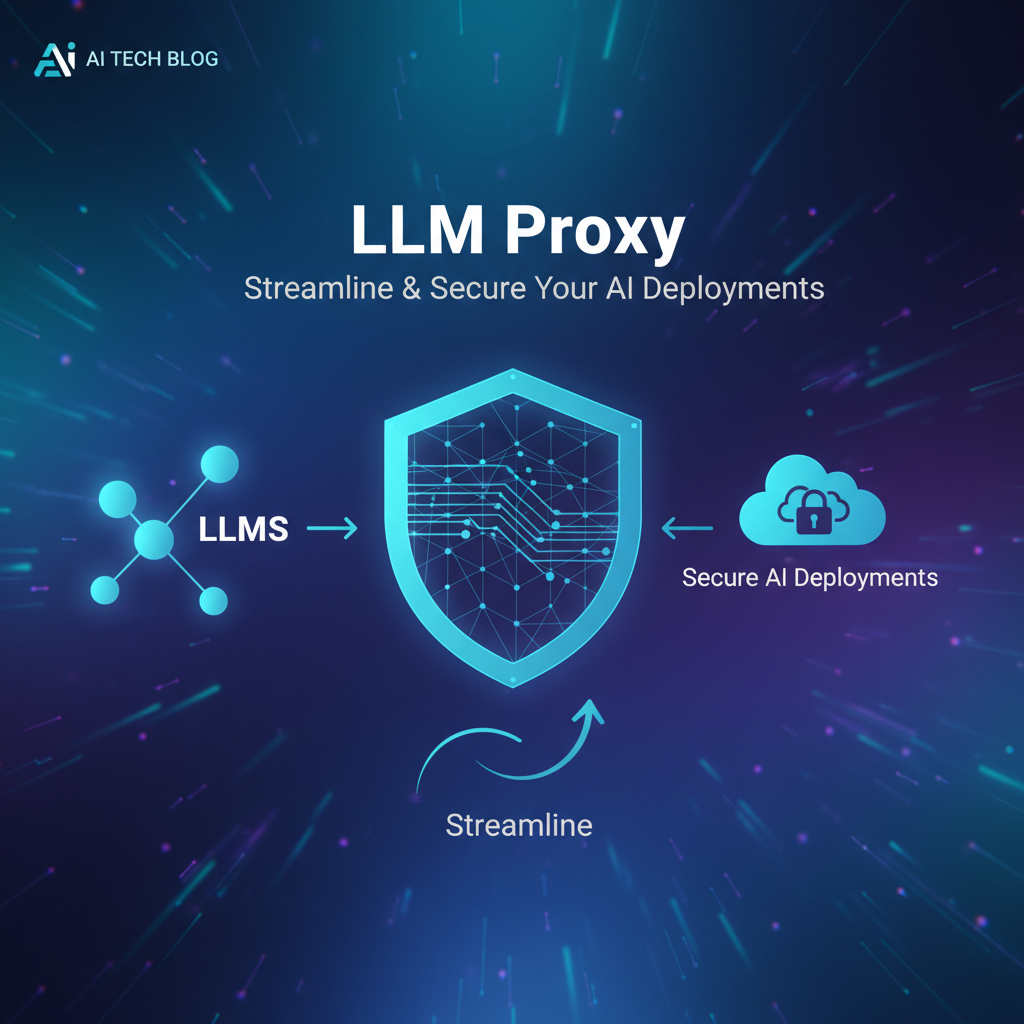
At its core, an LLM Proxy is an intelligent intermediary layer positioned between your applications and one or more Large Language Model providers. Think of it as a specialized application programming interface (API) gateway, specifically engineered to understand and manage the unique nuances and demands of AI model interactions. While traditional API gateways focus on RESTful services, an LLM Proxy extends this concept to the realm of generative AI, offering a rich suite of functionalities that transcend simple request forwarding. The terms LLM Proxy, LLM Gateway, and AI Gateway are frequently used interchangeably, reflecting their shared objective: to provide a centralized, robust, and feature-rich control point for all AI-related traffic. The subtle differences typically lie in scope; an LLM Proxy might specifically focus on language models, while an AI Gateway could encompass a broader spectrum of AI services, including vision models, speech-to-text, and more. Regardless of the nomenclature, their fundamental value proposition remains constant: to abstract away complexity, enhance control, and inject critical capabilities into your AI pipelines.
The necessity for such an intermediary stems directly from the inherent challenges of direct LLM integration. Imagine an enterprise attempting to leverage multiple LLMs from different vendors – perhaps OpenAI for general text generation, Anthropic for safety-critical applications, and a proprietary fine-tuned model hosted internally for specific domain expertise. Each of these models possesses its own unique API endpoints, data formats, authentication mechanisms, and rate limits. Without an LLM Gateway, developers would be forced to write custom integration code for each model, leading to fragmented logic, increased maintenance overhead, and a significant barrier to switching or augmenting models. The LLM Proxy resolves this by presenting a unified interface, acting as a single point of entry for all AI-related requests, regardless of the underlying model's origin or specific API contract. It's not just a pass-through; it's an active, intelligent orchestrator that adds immense value at every stage of the AI deployment lifecycle, from development and deployment to ongoing operations and security. Its pivotal role is to transform a chaotic, multi-point integration challenge into a streamlined, secure, and highly manageable system, thereby unlocking the true potential of AI at scale.
The Streamlining Imperative: Enhancing Developer Experience and Operational Efficiency
One of the most immediate and profound benefits of implementing an LLM Proxy is its ability to dramatically streamline the development and operational workflows associated with AI deployments. By abstracting away much of the underlying complexity, it empowers developers to focus on application logic rather than intricate API integrations, while simultaneously providing operations teams with the tools necessary to manage AI services with unprecedented efficiency. This streamlining manifests across several critical dimensions, each contributing to faster time-to-market, reduced costs, and a more robust AI ecosystem.
Unified API Interface: Bridging the Divide Between Disparate Models
The fragmented nature of the LLM ecosystem presents a significant hurdle for developers. While powerful, models from different providers—be it OpenAI, Google's Gemini, Anthropic's Claude, or various open-source models like Llama 2—each come with their own distinct API specifications, request formats, response structures, and authentication protocols. Directly integrating with a diverse array of these models means writing bespoke code for each, leading to a substantial increase in development time, potential for errors, and significant maintenance burden. Imagine a scenario where an application needs to dynamically switch between models based on performance, cost, or specific task requirements; without a unified interface, this becomes an architectural nightmare.
An LLM Proxy elegantly resolves this by normalizing and standardizing the communication layer. It acts as a universal translator, presenting a consistent API endpoint to your applications irrespective of the underlying LLM provider. This means developers can write their application code once, targeting the proxy's unified API. The proxy then intelligently translates these standardized requests into the specific format required by the chosen backend LLM and translates the LLM's response back into a consistent format for your application. This unification dramatically reduces development complexity, accelerates iteration cycles, and fosters greater architectural flexibility. Organizations can seamlessly swap out one LLM provider for another, integrate new models, or leverage a blend of models without requiring significant code changes in their core applications. This AI Gateway approach effectively future-proofs your applications against the rapidly evolving LLM landscape, ensuring adaptability and reducing long-term maintenance costs. For instance, APIPark offers a powerful capability in this regard, providing a unified management system for authenticating and tracking costs across 100+ integrated AI models, all while standardizing the request data format. This ensures that modifications to AI models or prompts have no ripple effect on the consuming applications or microservices, significantly simplifying AI usage and driving down maintenance expenses.
Intelligent Caching: Optimizing Performance and Minimizing Costs
One of the most compelling features an LLM Proxy brings to the table is intelligent caching. LLM inference, especially for complex prompts, can be computationally intensive and thus expensive, not to mention introducing noticeable latency. Redundant calls to LLMs for identical or semantically similar prompts are a significant source of wasted resources and unnecessary costs. Consider a common application where users frequently ask the same or similar questions, or where a background process repeatedly queries an LLM with identical inputs. Without caching, each of these requests incurs a fresh call to the LLM API, consuming tokens and adding to the response time.
An LLM Gateway can implement sophisticated caching strategies. When a request comes in, the proxy first checks its cache. If a similar request has been made recently and its response is stored, the proxy can immediately return the cached result, bypassing the need to interact with the external LLM. This delivers immediate, tangible benefits: * Reduced Latency: Responses from the cache are near-instantaneous, dramatically improving user experience. * Cost Savings: Avoiding redundant LLM calls can lead to substantial reductions in API costs, especially for high-volume applications. * Reduced Load: It alleviates the load on the backend LLM providers, potentially improving your overall service reliability with them.
Caching mechanisms can range from simple exact-match caching for identical prompts to more advanced semantic caching that uses embedding similarity to identify and serve responses for semantically equivalent queries. The proxy can also manage cache invalidation policies, time-to-live (TTL) settings, and storage mechanisms, ensuring the cached data remains relevant and fresh. This intelligent management of previous interactions transforms potential bottlenecks and cost centers into engines of efficiency and responsiveness.
Rate Limiting and Throttling: Ensuring Stability and Fair Usage
Uncontrolled access to LLMs can quickly lead to service degradation, unexpected billing spikes, or even temporary bans from providers due to excessive usage. Imagine a sudden surge in user activity, or a poorly optimized application making a barrage of requests. Without protective measures, the system could buckle under the pressure.
An LLM Proxy provides robust mechanisms for rate limiting and throttling. This allows organizations to define granular rules for how many requests can be made to LLMs within a specific timeframe, typically per user, per application, or per API key. These policies prevent individual users or applications from monopolizing resources, ensuring fair access for everyone and protecting the backend LLM services from being overwhelmed. * Preventing Abuse: Malicious actors or unintentional misconfigurations can lead to excessive API calls. Rate limits act as a critical safeguard. * Cost Control: By setting limits, organizations can prevent unexpected budget overruns due to uncontrolled LLM consumption. * Service Stability: Throttling ensures that the downstream LLM providers, as well as your own infrastructure, are not overloaded, maintaining a stable and reliable service.
The proxy can respond to throttled requests with appropriate HTTP status codes (e.g., 429 Too Many Requests), allowing client applications to implement retry logic or notify users. This proactive management of traffic flow is essential for maintaining the health and financial viability of any large-scale LLM deployment.
Load Balancing and Intelligent Routing: Enhancing Resilience and Optimizing Resources
In complex AI architectures, organizations often need to leverage multiple instances of an LLM, perhaps for high availability, performance optimization, or to segment traffic for different use cases. Furthermore, as the market matures, having the flexibility to route requests to different LLM providers based on real-time factors like cost, latency, or specific model capabilities becomes paramount.
An LLM Gateway acts as an intelligent router, capable of distributing incoming requests across multiple backend LLM endpoints. This could involve: * Horizontal Scaling: Distributing requests across multiple instances of the same model (e.g., several fine-tuned Llama instances) to handle high traffic volumes and improve throughput. * Multi-Provider Strategy: Routing requests to different LLM providers based on predefined rules. For instance, simpler, high-volume requests might go to a cheaper, faster model, while complex, sensitive requests are directed to a more capable or secure provider. * A/B Testing: Directing a percentage of traffic to a new model or a new version of a prompt for live testing and performance comparison. * Fallback Mechanisms: Automatically rerouting requests to a secondary LLM provider if the primary one experiences an outage or performance degradation, ensuring high availability and resilience.
Intelligent routing can leverage various criteria: current load on each endpoint, geographical proximity, cost per token, latency metrics, or even semantic content of the prompt. This dynamic management ensures optimal resource utilization, minimizes operational costs, maximizes system uptime, and offers unparalleled flexibility in adapting to changing business needs and market conditions.
Observability and Monitoring: Gaining Insight into AI Operations
Operating complex AI systems without adequate visibility is akin to flying blind. Understanding how LLMs are being used, their performance characteristics, and where errors are occurring is critical for effective management, debugging, and continuous improvement. Direct integration with LLM providers often provides only basic usage metrics, leaving significant gaps in observability.
An LLM Proxy fundamentally transforms this landscape by centralizing the collection of comprehensive metrics, logs, and traces for every LLM interaction. It can record: * Request Details: Full prompts, associated metadata (user ID, application ID, timestamp). * Response Details: Full LLM responses, generated tokens, and associated metadata. * Performance Metrics: Latency (time to first token, total response time), throughput. * Error Rates: Specific error codes and messages from LLM providers. * Cost Metrics: Estimated token usage and cost per request.
This rich telemetry data is invaluable for: * Troubleshooting: Rapidly identifying the root cause of issues, whether they stem from the application, the proxy, or the LLM itself. * Performance Optimization: Pinpointing bottlenecks, optimizing prompts, and fine-tuning model choices based on real-world performance data. * Capacity Planning: Understanding usage patterns to anticipate future needs and scale infrastructure accordingly. * Anomaly Detection: Identifying unusual usage patterns that might indicate security breaches or inefficient application behavior. * Audit and Compliance: Providing a comprehensive record of all interactions for regulatory purposes.
APIPark exemplifies this, offering comprehensive logging capabilities that meticulously record every detail of each API call. This feature is crucial for businesses to swiftly trace and diagnose issues within API calls, thereby guaranteeing system stability and bolstering data security. Furthermore, its powerful data analysis capabilities process historical call data to unveil long-term trends and performance shifts, enabling businesses to implement proactive maintenance strategies before issues can escalate.
Prompt Management and Versioning: The Evolution of AI Directives
Effective prompt engineering is central to extracting valuable outputs from LLMs. As applications evolve, so too do the prompts required to achieve desired results. Managing these prompts – especially across multiple applications, different LLM versions, and various development stages – can quickly become unwieldy. Without a centralized system, consistency becomes a challenge, and experimenting with new prompt designs is difficult to track and roll back.
An LLM Proxy can serve as a centralized repository for prompt management and versioning. Instead of embedding prompts directly into application code, developers can define and store them within the proxy. This enables: * Centralized Control: All prompts for an organization or specific projects can be managed in one place. * Version Control: Prompts can be versioned, allowing for easy experimentation, A/B testing, and rollback to previous, well-performing versions. * Prompt Templating: Dynamic variables can be inserted into prompts, allowing applications to pass specific data without needing to construct the entire prompt string. * A/B Testing of Prompts: The proxy can route a percentage of requests to different prompt versions, allowing for live performance comparison and optimization without altering application code. * Prompt Encapsulation: Complex prompt logic can be encapsulated within the proxy, exposing it as a simple API endpoint.
This feature transforms prompt engineering from a haphazard, code-embedded activity into a structured, version-controlled, and optimizable process. APIPark explicitly supports this by allowing users to quickly combine AI models with custom prompts to create new APIs, effectively encapsulating complex prompt logic into simple REST API endpoints, such as those for sentiment analysis, translation, or data analysis. This significantly simplifies the management and deployment of prompt-driven AI functionalities.
The Security Imperative: Fortifying Your AI Deployments Against Threats
While streamlining operations is a significant advantage, the security aspects of LLM deployments are paramount and often overlooked until a breach occurs. Integrating external AI models, especially with sensitive data, introduces a new attack surface and compliance challenges. An LLM Proxy or AI Gateway is not just about convenience; it's a critical security control point, essential for protecting proprietary data, preventing abuse, and ensuring regulatory compliance.
Authentication and Authorization: Guarding the Gates to Your AI Models
Directly embedding LLM API keys into application code, configuration files, or even environment variables is a common but dangerous practice. If these keys are compromised, an attacker gains unfettered access to your LLM accounts, potentially leading to massive unauthorized charges, data exfiltration, or service disruption. Moreover, organizations need fine-grained control over who can access which LLMs and under what conditions.
An LLM Proxy provides a robust, centralized mechanism for authentication and authorization. * Centralized API Key Management: Instead of distributing LLM provider keys widely, only the proxy needs direct access. Applications authenticate with the proxy using their own credentials (e.g., separate API keys, OAuth tokens, JWTs). The proxy then handles the secure transmission of the appropriate LLM provider key to the backend. This significantly reduces the blast radius in case of a credential compromise. * Granular Access Control: The LLM Gateway can enforce policies that dictate which users, teams, or applications are authorized to access specific LLMs or perform certain types of requests. For example, a development team might have access to a specific set of models for testing, while a production application has access to a different, more restricted set. * Multi-tenancy Support: For organizations serving multiple internal teams or external clients, the proxy can segment access, ensuring that each tenant has independent applications, data, user configurations, and security policies, while still sharing underlying infrastructure for efficiency. APIPark excels in this area, enabling the creation of multiple teams (tenants) each with independent applications, data, user configurations, and security policies, all while sharing underlying applications and infrastructure to improve resource utilization and reduce operational costs. * Subscription Approval Workflow: For critical APIs or services, the AI Gateway can implement approval workflows. This means callers must subscribe to an API and await administrator approval before they can invoke it, preventing unauthorized API calls and potential data breaches. APIPark offers this crucial feature, allowing for the activation of subscription approval to ensure controlled API access.
By acting as the sole point of authentication for LLM access, the proxy creates a fortified perimeter around your AI assets, dramatically enhancing security posture and simplifying identity management.
Data Masking and Redaction: Protecting Sensitive Information
Many enterprise AI applications involve processing sensitive or personally identifiable information (PII), protected health information (PHI), or other confidential data. Sending this data directly to third-party LLM providers raises significant privacy and compliance concerns, especially under regulations like GDPR, HIPAA, or CCPA. Even if LLM providers claim not to use data for training, the mere transmission of sensitive information presents a risk.
An LLM Proxy can implement intelligent data masking and redaction capabilities. Before a prompt is forwarded to an external LLM, the proxy can: * Identify Sensitive Data: Using pattern matching, named entity recognition (NER), or AI-driven classification, the proxy can detect PII (names, addresses, phone numbers, credit card numbers), PHI, or other defined sensitive data patterns within the input prompt. * Mask or Redact Information: Once identified, this sensitive data can be automatically masked (e.g., replacing "John Doe" with "[NAME]") or entirely redacted before the prompt leaves your secure environment. * Contextual Redaction: In some advanced scenarios, the proxy might understand the context to only redact information that is not essential for the LLM's task, minimizing impact on model performance. * Output Sanitization: Similarly, the proxy can inspect LLM responses for any inadvertently generated sensitive data before it reaches your application, adding another layer of protection.
This capability is a game-changer for data privacy and compliance. It allows organizations to leverage the power of LLMs even with sensitive workloads, safe in the knowledge that crucial information is being protected at the network edge, never fully exposed to external AI services.
Input/Output Validation and Sanitization: Mitigating Prompt Injection and Data Exfiltration
The open-ended nature of LLMs, while powerful, also introduces new security vulnerabilities, most notably prompt injection attacks. A malicious user might craft a prompt designed to override the LLM's system instructions, extract sensitive data it shouldn't have access to, or manipulate its behavior in unintended ways. Conversely, LLMs might generate unexpected or even harmful content.
An LLM Gateway can serve as a critical defense against these threats by performing robust input and output validation and sanitization: * Prompt Injection Detection: The proxy can analyze incoming prompts for patterns indicative of prompt injection attacks (e.g., unusual instructions, attempts to break context, hidden commands). It can then block, quarantine, or modify these prompts before they reach the LLM. * Harmful Content Filtering: Input prompts can be scanned for offensive, malicious, or otherwise inappropriate content, preventing their processing. * Output Validation: After receiving a response from the LLM, the proxy can inspect the generated text for malicious code, sensitive data leaks (e.g., if an LLM accidentally hallucinates or extracts internal information), or adherence to expected format constraints. * Content Policy Enforcement: Organizations can define their own content policies, and the proxy can enforce these, blocking responses that violate ethical guidelines or company standards. * Token Limit Enforcement: Beyond rate limiting, the proxy can enforce strict token limits on both input prompts and expected outputs, preventing resource exhaustion or excessively verbose responses that could incur higher costs.
By scrutinizing both ends of the LLM interaction, the AI Gateway acts as an intelligent firewall, mitigating novel AI-specific threats and ensuring the integrity and safety of both inputs and outputs.
Audit Trails and Compliance: The Imperative for Accountability
In regulated industries, or for any organization that prioritizes accountability and transparency, maintaining comprehensive audit trails of all LLM interactions is not optional—it's a necessity. This includes logging every prompt, every response, who made the request, and when, along with any transformations applied by the proxy.
An LLM Proxy inherently provides a centralized logging point for all LLM traffic, making it an ideal candidate for building robust audit trails. * Immutable Logs: All interactions can be logged in a tamper-proof manner, providing a forensic record. * Detailed Records: Logs include not only the prompt and response but also metadata such as user ID, application ID, timestamp, LLM provider, model version, cost implications, and any security actions taken by the proxy (e.g., redaction, blocking). * Compliance Reporting: These comprehensive logs are invaluable for demonstrating adherence to regulatory requirements (e.g., GDPR's right to audit, HIPAA's security rules) and internal governance policies. * Post-Incident Analysis: In the event of a security incident or an operational issue, detailed logs enable rapid investigation and root cause analysis.
This capability transforms opaque LLM interactions into fully auditable transactions, providing the transparency and accountability crucial for compliance and robust security governance.
Cost Management and Budgeting: Taming the Unpredictable AI Sprawl
The usage-based billing models of LLMs, while flexible, can lead to unpredictable and rapidly escalating costs if not properly managed. A runaway application, an inefficient prompt, or a sudden surge in usage can quickly deplete budgets. Tracking costs across multiple models, departments, and projects becomes a significant administrative burden.
An LLM Proxy provides a centralized vantage point for cost management and optimization: * Unified Cost Tracking: It can track token usage and estimated costs for every request, regardless of the underlying LLM provider, providing a consolidated view of spending. * Budgeting and Alerts: Administrators can set predefined budgets for different projects, teams, or applications. The proxy can then issue alerts when usage approaches or exceeds these limits, preventing unexpected bills. * Cost Optimization through Routing: As discussed, intelligent routing can direct traffic to the most cost-effective models for specific tasks, optimizing spending without sacrificing performance. * Cost Attribution: The proxy can tag requests with metadata (e.g., project ID, department), allowing for accurate cost attribution and chargeback within an organization. * Cashing Impact: The cost savings derived from intelligent caching are directly visible through the proxy's reporting features, demonstrating a clear return on investment.
By centralizing cost data and providing proactive controls, the AI Gateway empowers organizations to gain full financial oversight and control over their LLM expenditures, transforming a potentially unpredictable expense into a manageable, transparent operational cost.
Key Features of a Robust LLM Proxy/Gateway
Having explored the critical streamlining and security benefits, it's clear that a comprehensive LLM Proxy or AI Gateway is far more than a simple passthrough. It is a sophisticated infrastructure component characterized by a suite of advanced features designed to maximize the value and minimize the risks associated with LLM deployments.
| Feature Category | Key Capabilities | Benefit |
|---|---|---|
| Connectivity & Unification | Unified endpoint for multiple LLM providers | Simplified integration, future-proofing, developer efficiency |
| Model abstraction and format standardization | Decoupling application logic from specific LLM APIs | |
| Performance & Efficiency | Intelligent caching (semantic, time-based) | Reduced latency, significant cost savings, lower load on providers |
| Rate limiting & throttling | Service stability, cost control, abuse prevention | |
| Load balancing & intelligent routing | High availability, performance optimization, cost-effective model utilization | |
| Security & Compliance | Centralized Authentication & Authorization | Secure API key management, granular access control, multi-tenancy support |
| Data masking & redaction | PII/PHI protection, compliance with data privacy regulations | |
| Input/Output validation & sanitization | Mitigation of prompt injection, prevention of malicious outputs, content safety | |
| Comprehensive audit trails | Accountability, regulatory compliance, forensic capabilities | |
| Management & Operations | Prompt management & versioning | Consistent prompt usage, A/B testing, easy rollbacks, prompt encapsulation |
| Detailed logging & monitoring | Faster debugging, performance insights, capacity planning | |
| Cost tracking & budgeting | Financial control, cost attribution, prevention of budget overruns | |
| Extensibility (plugins, custom logic) | Adaptability to specific business needs, integration with existing tools | |
| Scalability & High Availability | Handling large traffic volumes, ensuring continuous service |
This table underscores the comprehensive nature of a modern LLM Gateway. Each feature builds upon the others, collectively creating a resilient, efficient, and secure environment for AI operations. The ability to integrate with over 100 AI models, unify API formats, encapsulate prompts into REST APIs, and manage the full API lifecycle, as offered by a platform like APIPark, directly addresses these core feature requirements, making it an exemplary solution for organizations seeking robust AI governance.
APIPark is a high-performance AI gateway that allows you to securely access the most comprehensive LLM APIs globally on the APIPark platform, including OpenAI, Anthropic, Mistral, Llama2, Google Gemini, and more.Try APIPark now! 👇👇👇
Use Cases and Applications: Where LLM Proxies Shine
The versatility and power of an LLM Proxy extend across a broad spectrum of use cases, making it an indispensable component for almost any organization leveraging LLMs at scale.
Enterprise AI Applications: The Backbone of Intelligent Systems
For large-scale enterprise applications, such as customer support chatbots, internal knowledge assistants, content generation platforms, or data summarization tools, the LLM Proxy provides the critical infrastructure. It ensures that these applications can reliably and securely access LLM capabilities, manage costs associated with high usage, and scale seamlessly to meet demand. The ability to switch between models, apply specific security policies, and monitor performance in real-time is crucial for maintaining the stability and effectiveness of these business-critical systems. For example, a customer service chatbot might use a proxy to route simple FAQs to a cached response, complex queries to a general-purpose LLM, and highly sensitive customer data requests to a specialized, internally fine-tuned model with strict redaction policies, all transparently to the end-user and the application itself.
Multi-Model Strategies: Harnessing Diverse AI Strengths
The "one size fits all" approach rarely works for complex AI tasks. Different LLMs excel at different functions: one might be superior for creative writing, another for factual summarization, and yet another for code generation. Organizations increasingly adopt multi-model strategies to leverage the specific strengths of various models. An LLM Gateway is the enabler for this. It allows developers to define rules for routing requests to the optimal model based on the nature of the query, cost efficiency, or performance requirements. This dynamic routing ensures that the right tool is always used for the job, maximizing both the quality of outputs and cost-effectiveness. The proxy becomes the intelligent switchboard, orchestrating calls to the best-fit model in real-time.
Hybrid AI Architectures: Blending Cloud and On-Premise LLMs
Many enterprises operate in hybrid cloud environments, with some data and applications residing on-premise for security or regulatory reasons, while others leverage the scalability of public clouds. This extends to LLMs, where organizations might use cloud-hosted models for general tasks and deploy sensitive, proprietary, or fine-tuned models on-premise. An LLM Proxy provides the unified management layer for these hybrid deployments. It can securely bridge the gap between cloud and on-premise models, ensuring consistent access, applying uniform security policies, and providing centralized monitoring across the entire distributed AI landscape. This allows businesses to maintain control over their most sensitive data while still benefiting from the vast capabilities of cloud-based LLMs.
API as a Service for LLM Capabilities: Democratizing AI Access
Beyond internal application integration, an AI Gateway empowers organizations to expose LLM capabilities as managed API services to internal teams, partners, or even external developers. Imagine creating a "sentiment analysis API" that, behind the scenes, invokes an LLM with a specific prompt template, ensuring consistent output and applying necessary security. Or an "AI summarization API" that takes long texts and returns concise summaries. The LLM Proxy facilitates this by encapsulating complex LLM interactions, prompt engineering, and security policies into simple, consumable REST APIs. APIPark provides a prime example of this by enabling users to combine AI models with custom prompts to quickly create new, encapsulated REST APIs, such as those for sentiment analysis, translation, or data analysis. This approach democratizes access to sophisticated AI functions, accelerating innovation across the organization and potentially creating new revenue streams by offering AI services to others.
Implementing an LLM Proxy/Gateway: Strategic Considerations
The decision to implement an LLM Proxy or AI Gateway is a strategic one, involving careful consideration of various factors, from deployment strategy to long-term operational needs. Organizations typically face a fundamental "build vs. buy" dilemma, alongside other critical choices that will shape their AI infrastructure.
Build vs. Buy (or Adopt Open Source)
This is often the first and most significant question. * Building Your Own: Developing a custom LLM Proxy from scratch offers maximum control and customization. You can tailor every feature precisely to your organization's unique requirements, integrate deeply with existing internal systems, and maintain full ownership of the codebase. However, this path comes with substantial overhead: significant development time and resources, ongoing maintenance, security patching, and the need for a dedicated team to manage and evolve the proxy. It's a heavy investment that might only be justifiable for organizations with highly specialized, non-standard needs and ample engineering resources. * Buying a Commercial Solution: Commercial LLM Gateway products offer a faster time-to-market, robust features, professional support, and often enterprise-grade security and scalability out-of-the-box. These solutions abstract away much of the operational complexity, allowing organizations to focus on leveraging AI rather than managing infrastructure. The trade-off is often cost, potential vendor lock-in, and less flexibility for deep customization. However, for most enterprises seeking a reliable and feature-rich solution without the burden of internal development, commercial options are highly attractive. * Adopting Open-Source Solutions: A compelling middle-ground is the adoption of open-source AI Gateway platforms. These solutions provide many of the benefits of commercial products – pre-built features, community support, and rapid deployment – often with greater flexibility for customization than proprietary solutions. They typically come with lower direct licensing costs, though they may still require internal resources for deployment, configuration, and maintenance. For many organizations, this offers an ideal balance of features, cost-effectiveness, and control. For instance, for those considering the open-source route, platforms like ApiPark offer a compelling solution. As an open-source AI gateway and API management platform under the Apache 2.0 license, APIPark is designed for quick deployment—often in just 5 minutes with a single command line. It provides essential features like quick integration of 100+ AI models, a unified API format for AI invocation, prompt encapsulation into REST APIs, and end-to-end API lifecycle management. Its performance rivals that of Nginx, supporting over 20,000 TPS on modest hardware, making it highly scalable for demanding enterprise environments. While the open-source product meets the basic API resource needs of startups, APIPark also offers a commercial version with advanced features and professional technical support for leading enterprises, demonstrating a flexible pathway for growth and specialized needs.
Scalability Requirements
Any LLM Proxy implementation must be designed with scalability in mind. LLM usage can fluctuate dramatically, from low initial testing volumes to massive production loads. The gateway needs to be capable of horizontally scaling to handle thousands or even millions of requests per second without introducing latency or becoming a bottleneck. This involves considerations for load balancing the proxy instances themselves, efficient resource utilization, and robust connection management to backend LLMs.
Security Posture and Compliance
As previously emphasized, security is paramount. The chosen LLM Gateway solution must meet the highest security standards, incorporating strong authentication and authorization, data encryption (in transit and at rest), vulnerability management, and audit logging. Crucially, it must support any relevant industry or geographical compliance requirements (e.g., GDPR, HIPAA, PCI DSS). A thorough security assessment of any selected product or custom-built solution is non-negotiable.
Integration with Existing Infrastructure
The LLM Proxy should seamlessly integrate with your organization's existing identity and access management (IAM) systems, monitoring and alerting tools, and CI/CD pipelines. A solution that requires extensive re-engineering of your current infrastructure will introduce unnecessary friction and complexity. Look for flexibility in authentication methods, API compatibility, and observable output formats.
Vendor Lock-in Concerns
For commercial LLM Gateway solutions, assess the potential for vendor lock-in. While convenience is a benefit, ensure that the architecture allows for reasonable portability should you need to switch providers in the future. Open standards and comprehensive API documentation can mitigate this risk. Open-source solutions naturally offer more flexibility in this regard, as you have direct access to the codebase.
Cost Implications
Beyond initial setup, consider the ongoing operational costs. This includes infrastructure costs (for hosting the proxy), maintenance and support fees (for commercial products), or internal engineering time (for open-source or custom-built solutions). Evaluate the total cost of ownership (TCO) over several years, weighing it against the benefits of streamlining and security. The cost savings gained from intelligent caching and efficient routing via the proxy itself should also be factored into this equation.
The Future of LLM Proxies and AI Gateways
The rapid evolution of AI, particularly in the LLM domain, ensures that the role and capabilities of LLM Proxies and AI Gateways will continue to expand and deepen. These intermediaries are not static components but dynamic platforms that will adapt to meet emerging challenges and harness new opportunities in the AI landscape.
One key area of future development is more intelligent routing mechanisms. Beyond current cost and latency metrics, future proxies might incorporate semantic routing, where requests are directed based on their meaning or intent to the most semantically appropriate model. This could involve using smaller, specialized models for specific tasks, and only escalating to larger, more expensive general-purpose LLMs when truly necessary. Self-optimizing routing, leveraging machine learning to continuously learn and improve routing decisions based on real-time feedback, is also on the horizon.
Enhanced security features will become even more sophisticated. As prompt engineering advances, so will the methods of prompt injection and other AI-specific attacks. Future AI Gateways will likely integrate more advanced AI-driven threat detection capabilities, employing models to analyze incoming prompts and outgoing responses for anomalous behavior or subtle adversarial patterns that traditional rule-based systems might miss. Integration with explainable AI (XAI) techniques could also help clarify why certain prompts were flagged or responses redacted.
The integration of LLM Proxies with MLOps pipelines will become tighter and more seamless. As models are continuously trained, deployed, and monitored, the gateway will play a crucial role in managing different model versions, facilitating A/B testing in production, and feeding performance data back into the MLOps loop. This will enable truly continuous integration and continuous delivery (CI/CD) for AI applications, making model updates and prompt optimizations a routine, automated process.
There will be a greater emphasis on ethical AI governance and compliance. As regulatory scrutiny around AI intensifies globally, LLM Gateways will evolve to offer more granular controls for content moderation, bias detection, and adherence to ethical guidelines. Features for transparent logging of model decisions and the rationale behind them will become standard, providing the necessary auditability for ethical AI deployment.
Finally, the role of open-source solutions in driving innovation within the AI Gateway space cannot be overstated. Projects like APIPark demonstrate how community-driven development can provide powerful, flexible, and rapidly evolving platforms that empower organizations to build and manage their AI infrastructure without prohibitive costs or vendor lock-in. The collaborative nature of open-source development will continue to foster rapid iteration and the integration of cutting-edge features, making advanced LLM Proxy capabilities accessible to a wider audience. The future of LLM Gateways is one of increasing intelligence, stronger security, deeper integration, and greater accessibility, ensuring they remain at the forefront of responsible AI deployment.
Conclusion: The Indispensable Role of the LLM Proxy
The integration of Large Language Models into enterprise applications is not merely a technical challenge; it is a strategic imperative that redefines how businesses operate, innovate, and engage with their customers. However, realizing the full transformative potential of LLMs requires more than just direct API calls; it demands a sophisticated, intelligent, and secure intermediary. The LLM Proxy, interchangeably known as an LLM Gateway or broadly as an AI Gateway, fulfills this critical role with unparalleled efficacy.
This comprehensive exploration has illuminated how an LLM Proxy acts as the linchpin for both streamlining and securing your AI deployments. From unifying disparate API interfaces, enabling intelligent caching, and orchestrating complex routing to fortifying against security threats through robust authentication, data masking, and prompt injection mitigation, its benefits are profound and far-reaching. It empowers developers with a simplified, consistent interface, freeing them to innovate rather than grapple with low-level integration complexities. It provides operations teams with unprecedented visibility and control, optimizing performance and costs. Most critically, it establishes a fortified perimeter around your sensitive data and valuable AI assets, ensuring compliance and mitigating the inherent risks of external model interaction.
In an increasingly complex and rapidly evolving AI landscape, the decision to implement a robust LLM Gateway is no longer a luxury but a fundamental necessity. Whether choosing to build a bespoke solution, leverage a commercial product, or adopt a powerful open-source platform like ApiPark, this intermediary layer is the architectural cornerstone for scalable, secure, and cost-effective AI integration. By strategically deploying an LLM Proxy, organizations can confidently navigate the intricacies of the AI frontier, harness the full power of large language models responsibly, and unlock new avenues for innovation and growth. It is the intelligent orchestrator that transforms the promise of AI into tangible, secure, and streamlined reality.
5 Frequently Asked Questions (FAQs)
1. What is the primary difference between an LLM Proxy, LLM Gateway, and AI Gateway? While often used interchangeably, the terms can have subtle distinctions in scope. An LLM Proxy or LLM Gateway specifically refers to an intermediary layer designed to manage interactions with Large Language Models, focusing on features like unified APIs, caching, and security relevant to text-based AI. An AI Gateway, on the other hand, is a broader term that encompasses managing access and interactions not just with LLMs but potentially with a wider array of AI services, including vision models, speech-to-text, natural language understanding (NLU) services, and more. The core functionalities (security, streamlining, observability) are similar, but the AI Gateway implies a more comprehensive management platform for diverse AI services.
2. How does an LLM Proxy help reduce costs associated with LLM usage? An LLM Proxy reduces costs primarily through intelligent caching and optimized routing. Caching stores responses to frequently asked or semantically similar prompts, preventing redundant calls to expensive LLM APIs and saving token usage. Optimized routing allows the proxy to direct requests to the most cost-effective LLM provider or model for a given task, potentially switching between cheaper, faster models for simple queries and more expensive, powerful models for complex ones. Additionally, features like rate limiting and budgeting help prevent uncontrolled usage spikes that could lead to unexpected bills.
3. Can an LLM Proxy protect against prompt injection attacks? Yes, a robust LLM Proxy can significantly mitigate prompt injection attacks. It does this by acting as an intelligent firewall that inspects incoming prompts for suspicious patterns, keywords, or instructions that indicate an attempt to override the LLM's system instructions or extract sensitive information. The proxy can then block, modify, or sanitize these malicious prompts before they reach the LLM, thereby protecting the model's integrity and preventing data exfiltration or unintended behavior.
4. Is an LLM Proxy suitable for small businesses or primarily for large enterprises? While LLM Proxies offer immense benefits for large enterprises dealing with complex, multi-model deployments and strict security/compliance requirements, they are increasingly becoming valuable for small businesses and startups as well. Even a small team can quickly accumulate significant technical debt and cost if they directly integrate with multiple LLM providers. An AI Gateway simplifies development, manages costs, and provides essential security features that are beneficial at any scale. Open-source solutions, like APIPark, make these advanced capabilities accessible even with limited budgets, offering a quick and efficient way to streamline and secure AI operations from the outset.
5. How does an LLM Proxy integrate with existing security and monitoring tools? A well-designed LLM Proxy is built for seamless integration with existing enterprise security and monitoring infrastructure. For security, it typically supports standard authentication protocols (e.g., OAuth, JWT, API keys) that can tie into your existing Identity and Access Management (IAM) systems. For monitoring, it provides comprehensive logs, metrics, and tracing data in formats compatible with common observability platforms (e.g., Prometheus, Grafana, ELK stack, Splunk, Datadog). This allows organizations to centralize security event monitoring and performance analytics for LLM interactions within their established operational dashboards and security information and event management (SIEM) systems.
🚀You can securely and efficiently call the OpenAI API on APIPark in just two steps:
Step 1: Deploy the APIPark AI gateway in 5 minutes.
APIPark is developed based on Golang, offering strong product performance and low development and maintenance costs. You can deploy APIPark with a single command line.
curl -sSO https://download.apipark.com/install/quick-start.sh; bash quick-start.sh

In my experience, you can see the successful deployment interface within 5 to 10 minutes. Then, you can log in to APIPark using your account.

Step 2: Call the OpenAI API.