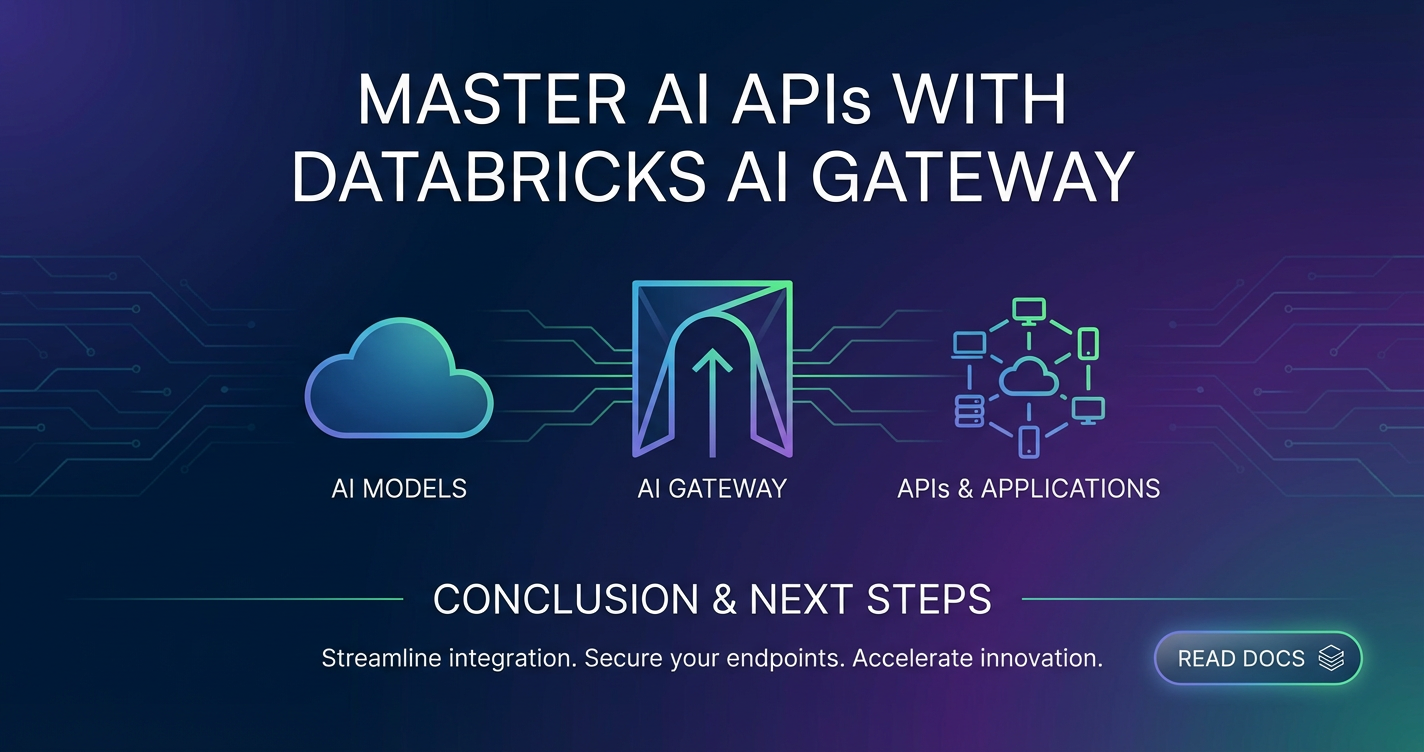
Master AI APIs with Databricks AI Gateway


The digital landscape is undergoing a profound transformation, propelled by the relentless march of Artificial Intelligence. From sophisticated language models capable of generating human-like text to advanced computer vision systems discerning patterns in complex imagery, AI is no longer a futuristic concept but a tangible, integrated component of modern applications and enterprise infrastructure. This paradigm shift, however, brings with it a new set of challenges, primarily centered around the seamless, secure, and scalable integration of these intelligent capabilities into existing systems. At the heart of this integration lies the critical role of Application Programming Interfaces (APIs), the very conduits through which applications communicate and leverage external services. As AI capabilities increasingly manifest as callable services, the need for a specialized management layer – an AI Gateway – has become undeniably apparent.
In this rapidly evolving ecosystem, Databricks, a company synonymous with data and AI innovation, has stepped forward with its own robust solution: the Databricks AI Gateway. This powerful component is designed to democratize access to AI models, both proprietary and open-source, and streamline their consumption within the Lakehouse Platform and beyond. It represents a strategic response to the complexities of managing diverse AI APIs, offering a unified, secure, and performant approach to integrating intelligence into every facet of an organization's operations. This article delves into the intricate world of AI Gateways, explores the unparalleled capabilities of the Databricks AI Gateway, and illuminates how it empowers enterprises to truly master the potential of AI APIs, transforming raw data into actionable insights and innovative user experiences. We will uncover its core functionalities, examine its strategic advantages, and understand how it serves as the linchpin for building future-proof, AI-driven applications, ultimately ensuring that organizations can confidently navigate the exciting, yet challenging, frontier of artificial intelligence integration.
The AI API Revolution: Reshaping Application Development and Enterprise Strategy
The past decade has witnessed an explosive growth in the sophistication and accessibility of Artificial Intelligence, moving AI from the realm of academic research into practical, enterprise-grade applications. This revolution is largely driven by the commoditization of AI capabilities through Application Programming Interfaces (APIs). Instead of undertaking the arduous and resource-intensive task of training their own models from scratch, developers and enterprises can now readily consume state-of-the-art AI services as black boxes, invoking them through simple, standardized api calls. This shift has dramatically lowered the barrier to entry for integrating intelligence into products and services, accelerating innovation across industries.
Consider the sheer breadth of AI models now available: large language models (LLMs) like GPT-4 and Llama, capable of generating coherent text, summarizing documents, and translating languages; computer vision models that can detect objects, classify images, and analyze video streams; speech-to-text and text-to-speech services for natural language interaction; and recommendation engines that personalize user experiences. Each of these models, whether hosted by a public cloud provider, an AI startup, or developed internally, typically exposes its functionality via a distinct API endpoint. While this democratization is undeniably powerful, it simultaneously introduces significant operational complexities.
Developers leveraging multiple AI services might find themselves grappling with a cacophony of differing API specifications, authentication mechanisms, rate limits, data formats, and error handling protocols. Integrating a sentiment analysis model from one vendor, a translation service from another, and an internally deployed text summarizer could entail a substantial amount of boilerplate code and configuration for each individual integration. Moreover, the landscape of AI models is incredibly dynamic; models are frequently updated, deprecated, or replaced by newer, more capable versions. Without a centralized management layer, such changes can propagate through an application's codebase, leading to costly refactoring, increased maintenance overhead, and potential service disruptions. The rapid pace of AI innovation, while exciting, necessitates a robust and adaptable infrastructure to truly harness its power effectively. The traditional approach to API management, while foundational, often lacks the specialized capabilities required to address the unique challenges posed by the ephemeral, evolving, and often resource-intensive nature of AI APIs, paving the way for the emergence of dedicated AI Gateways.
Demystifying the AI Gateway: More Than Just a Traditional API Gateway
At its core, an api gateway serves as a single entry point for a multitude of backend services. It acts as a reverse proxy, routing client requests to the appropriate microservices, and often handles cross-cutting concerns such as authentication, authorization, rate limiting, and logging. This architectural pattern is well-established in the world of microservices, providing a crucial layer of abstraction and management for complex distributed systems. However, the advent of Artificial Intelligence and its integration into enterprise applications has introduced unique requirements that push the boundaries of what a traditional API Gateway can offer. This is where the specialized concept of an AI Gateway emerges, building upon the foundational principles of its predecessor but adding intelligence-specific capabilities.
An AI Gateway is specifically engineered to manage and orchestrate access to a diverse ecosystem of AI models and services. While it retains all the essential functionalities of a conventional API Gateway – robust routing, effective load balancing, stringent security policies, and comprehensive observability – it extends these capabilities to address the nuances of AI workloads. One of its primary distinctions lies in its ability to abstract away the underlying complexities of different AI models. Instead of forcing developers to interact with disparate APIs, each with its unique request/response formats, input parameters, and output schemas, an AI Gateway can standardize these interactions. It acts as a translator, unifying the api calls across various models, whether they are hosted on a public cloud, a private cluster, or are bespoke internal deployments. This unification significantly simplifies the developer experience, allowing them to switch between models or integrate new ones with minimal code changes, effectively future-proofing their applications against model evolution.
Beyond mere standardization, an AI Gateway often incorporates advanced features tailored for AI. This includes intelligent request routing based on model performance, cost, or availability, allowing for optimal resource utilization. It can manage prompt engineering, potentially storing and versioning prompts, and injecting them into requests before forwarding to the actual AI model. This becomes particularly vital for Large Language Models (LLMs), where the crafting of effective prompts is crucial for desired outputs. Furthermore, AI Gateways are instrumental in cost tracking and optimization, providing granular insights into model usage and expenditure across different teams or applications. They can enforce budget limits, implement caching strategies for frequently requested inferences, and intelligently retry failed AI calls. Security is also elevated, with specialized attention to data privacy for sensitive AI inputs and outputs, ensuring compliance with regulations, and providing fine-grained access control to specific models or model versions. In essence, an AI Gateway is not just a traffic cop for APIs; it's an intelligent orchestrator designed to maximize the efficiency, security, and developer-friendliness of AI model consumption, making AI integration a streamlined and manageable endeavor rather than a labyrinthine challenge.
Databricks AI Gateway: A Game-Changer in the Lakehouse Ecosystem
Databricks has firmly established itself as a cornerstone in the world of data and AI, pioneering the Lakehouse Platform – an architecture that unifies data warehousing and data lakes to accelerate data engineering, machine learning, and business intelligence. Within this comprehensive ecosystem, the seamless and governed consumption of AI models is paramount. Recognizing the growing demand for accessible and scalable AI capabilities, Databricks has introduced its AI Gateway, a strategic component designed to bring order and efficiency to the chaotic landscape of AI API consumption. This gateway isn't just an add-on; it's an intrinsic part of the Databricks Lakehouse, leveraging the platform's inherent strengths in data governance, security, and unified analytics.
The rationale behind Databricks developing its own AI Gateway is multifaceted. Firstly, the Lakehouse Platform is a hub for both data ingestion and model deployment. Data scientists and machine learning engineers frequently train and deploy custom models within Databricks, using tools like MLflow. These models, once deployed, need to be exposed as performant and secure api endpoints for consumption by downstream applications. The Databricks AI Gateway provides a native, integrated mechanism to do precisely this, ensuring that models developed and managed within the Lakehouse can be easily invoked by external services or internal applications, without needing to stand up separate infrastructure.
Secondly, organizations operating on Databricks often interact with a multitude of external, third-party AI services, such as those from OpenAI, Anthropic, or Hugging Face. Managing direct integrations with each of these services can be cumbersome, leading to fragmented authentication strategies, inconsistent logging, and disparate cost tracking. The Databricks AI Gateway acts as a centralized proxy for these external services as well, abstracting away their individual complexities and presenting a unified api interface to consumers. This means developers can access a diverse range of AI models, whether they reside within Databricks or outside, through a single, consistent entry point.
Moreover, the Databricks AI Gateway deeply integrates with the platform's robust security and governance frameworks. It inherits Databricks' identity and access management (IAM) capabilities, allowing organizations to enforce fine-grained control over who can access which AI models and under what conditions. This is critical for data privacy and compliance, especially when dealing with sensitive information processed by AI models. Logging and monitoring capabilities are also unified within the Databricks environment, providing a single pane of glass for observing AI API usage, performance, and costs. By embedding the AI Gateway within its Lakehouse architecture, Databricks empowers its users to not only build and deploy cutting-edge AI models but also to consume, manage, and scale them with unprecedented ease, security, and observability, solidifying its position as a holistic platform for the entire AI lifecycle.
Deep Dive into Databricks AI Gateway Features and Capabilities
The Databricks AI Gateway is engineered to provide a comprehensive solution for managing AI APIs, offering a suite of features that address the critical needs of developers, data scientists, and operations teams. Its capabilities extend far beyond basic routing, touching upon every aspect of AI model consumption from security to cost optimization.
Unified API Endpoint and Model Abstraction
One of the most compelling features of the Databricks AI Gateway is its ability to present a unified api endpoint for a multitude of AI models. Imagine an application that needs to perform sentiment analysis, summarization, and translation. Without an AI Gateway, the application would have to integrate with three separate AI service APIs, each potentially from a different vendor, with distinct authentication methods, request formats, and response structures. The Databricks AI Gateway abstracts this complexity. It allows you to configure routes for various models – whether they are Databricks-hosted MLflow models, proprietary models from providers like OpenAI or Anthropic, or open-source models deployed on Databricks endpoints – all accessible through a consistent RESTful api. This abstraction means that if you decide to switch from one LLM to another for summarization, the consuming application's code often requires minimal, if any, changes, as it continues to interact with the same gateway endpoint and a standardized request format. This capability dramatically reduces integration overhead and future-proofs applications against the rapid evolution of the AI model landscape.
Robust Authentication and Authorization
Security is paramount when dealing with AI services, especially given the sensitive nature of data often processed by these models. The Databricks AI Gateway provides centralized control over who can access which AI models, integrating seamlessly with Databricks' native Identity and Access Management (IAM) system. This means you can leverage existing Databricks user, group, and service principal configurations to define granular access policies. For instance, a particular team might only be authorized to use a specific set of internal generative AI models, while another team might have access to both internal models and external LLMs for specific use cases. The gateway handles token validation, API key management, and other authentication mechanisms, ensuring that only authorized requests reach the underlying AI models. This centralized approach simplifies security management, reduces the risk of unauthorized access, and helps maintain compliance with data governance policies.
Intelligent Rate Limiting and Throttling
AI models, especially large language models, can be computationally intensive and costly to run. Uncontrolled access can lead to exorbitant expenses or resource exhaustion. The Databricks AI Gateway offers sophisticated rate limiting and throttling capabilities to manage the consumption of AI services effectively. Administrators can define precise rate limits based on various criteria, such as the calling application, user, api endpoint, or time window. For example, a development environment might have a lower rate limit than a production environment, or a specific user might be restricted to a certain number of calls per minute to prevent abuse or unexpected cost spikes. When limits are exceeded, the gateway can automatically queue requests, return error messages, or provide instructions for callers to slow down, ensuring fair usage and protecting the underlying AI infrastructure from overload.
Comprehensive Observability and Monitoring
Understanding how AI models are being used, their performance characteristics, and associated costs is crucial for operational efficiency and strategic decision-making. The Databricks AI Gateway provides extensive observability features, including detailed logging, tracing, and performance metrics. Every api call passing through the gateway can be logged, capturing information such as the caller identity, the requested model, input parameters (often masked for privacy), response times, and success/failure status. These logs are often integrated with Databricks' monitoring tools or external observability platforms, allowing teams to: * Troubleshoot issues: Quickly identify and diagnose problems with specific AI API calls. * Monitor performance: Track latency, error rates, and throughput to ensure service level agreements (SLAs) are met. * Analyze usage patterns: Understand which models are most popular, when peak usage occurs, and by whom. * Track costs: Obtain granular insights into the expenditure associated with different AI models and applications, facilitating accurate cost allocation and budget management. This rich telemetry data empowers organizations to maintain the health and efficiency of their AI-powered applications.
Enhanced Security and Compliance
Beyond authentication and authorization, the Databricks AI Gateway contributes significantly to the overall security posture and compliance efforts. It can enforce data masking or anonymization policies on sensitive input and output data before it reaches or leaves the AI model, helping organizations adhere to regulations like GDPR or HIPAA. For internally hosted models, the gateway ensures that api traffic remains within the secure boundaries of the Databricks environment, leveraging the platform's robust network security features. It also provides an audit trail of all AI api interactions, which is invaluable for compliance audits and forensic analysis. This comprehensive approach to security ensures that AI integration doesn't compromise an enterprise's commitment to data protection and regulatory adherence.
Prompt Engineering and Management (for LLMs)
For Large Language Models (LLMs), the quality of the output is highly dependent on the input prompt. Effective prompt engineering is a specialized skill, and managing a multitude of prompts across different applications can become a logistical challenge. While specific features for prompt versioning are evolving, an AI Gateway can serve as a critical component in a prompt management strategy. It can be configured to dynamically inject or transform prompts based on predefined rules or parameters from the incoming request. This means developers don't have to hardcode prompts into their applications; instead, they can refer to prompt templates or IDs managed centrally by the gateway or an associated system. This enables rapid experimentation with different prompts, easier A/B testing, and centralized control over the 'personality' or 'instruction set' of AI models, ensuring consistency and improving model performance across various use cases.
Intelligent Caching for Performance and Cost Optimization
Many AI model inferences, especially for common queries or scenarios, can produce identical or very similar results. Continuously sending these requests to the underlying AI model can be redundant, incurring unnecessary costs and increasing latency. The Databricks AI Gateway can incorporate intelligent caching mechanisms. By storing responses to frequent api calls, the gateway can serve subsequent identical requests directly from its cache, bypassing the need to invoke the actual AI model. This dramatically improves response times for cached inferences, enhances the user experience, and significantly reduces operational costs by minimizing the number of expensive model calls. Configurable cache invalidation policies ensure that responses remain fresh and accurate.
Transformation and Orchestration Capabilities
In real-world scenarios, the input required by an AI model might not perfectly match the data format provided by a client application, or the output from an AI model might need post-processing before being sent back. The Databricks AI Gateway can act as a powerful transformation engine. It can modify request payloads (e.g., adding metadata, reformatting JSON structures, or enriching data from other sources) before forwarding them to the AI model. Similarly, it can transform model responses (e.g., extracting specific fields, converting formats, or integrating with other services) before returning them to the client. This capability minimizes the burden on client applications and simplifies the integration process, allowing developers to focus on application logic rather than data wrangling for AI models.
These detailed capabilities illustrate how the Databricks AI Gateway transcends the role of a mere proxy, evolving into a sophisticated control plane for mastering the complexities inherent in the modern AI landscape. By centralizing management, enforcing governance, and optimizing performance, it empowers enterprises to fully unlock the transformative potential of artificial intelligence.
Building and Consuming AI Services with Databricks AI Gateway
The true value of the Databricks AI Gateway becomes apparent when examining how different roles within an organization leverage its capabilities to build, deploy, and consume AI services. It simplifies workflows for developers, provides powerful control for data scientists and ML engineers, and ensures robust governance for IT and operations teams.
For Developers: Streamlined AI Integration and Faster Development Cycles
For application developers, the Databricks AI Gateway is a boon for efficiency and consistency. Instead of learning and implementing distinct api integration patterns for every AI model they wish to use, developers interact with a single, well-defined gateway api. This significantly reduces the cognitive load and boilerplate code required for AI integration.
How it works in practice: A developer building a customer service chatbot might need to use an LLM for natural language understanding (NLU) and response generation, a sentiment analysis model to gauge customer emotion, and a translation model for multilingual support. 1. Configuration: An administrator or ML engineer configures the Databricks AI Gateway to expose these three AI models (e.g., an internal MLflow LLM, an external sentiment api, and a cloud-provider translation api) under unified gateway endpoints, perhaps /ai/nlu, /ai/sentiment, and /ai/translate. 2. Consumption: The developer's chatbot application makes standard HTTP POST requests to these gateway endpoints. The request body might contain a simple JSON payload with the text to be processed. ```python import requests import json
# Assuming gateway_url is configured correctly
gateway_url = "https://your-databricks-workspace/gateway"
api_key = "your_secure_api_key" # Obtained from Databricks

headers = {
    "Authorization": f"Bearer {api_key}",
    "Content-Type": "application/json"
}

# Calling NLU
nlu_payload = {"text": "What is the status of my order?"}
nlu_response = requests.post(f"{gateway_url}/ai/nlu", headers=headers, data=json.dumps(nlu_payload))
print(f"NLU Result: {nlu_response.json()}")

# Calling Sentiment Analysis
sentiment_payload = {"text": "I am very disappointed with the service."}
sentiment_response = requests.post(f"{gateway_url}/ai/sentiment", headers=headers, data=json.dumps(sentiment_payload))
print(f"Sentiment Result: {sentiment_response.json()}")
```
Benefits: * Reduced Complexity: Developers don't need to worry about different vendor-specific authentication headers, diverse input schemas, or varying response formats. The gateway normalizes these interactions. * Accelerated Development: With a standardized interface, developers can integrate AI capabilities much faster, focusing on application logic rather than low-level AI api plumbing. * Increased Agility: If a better sentiment analysis model becomes available, the underlying model can be swapped out in the gateway configuration without requiring any code changes in the chatbot application.
For Data Scientists and ML Engineers: Secure Deployment and Version Control
For data scientists and ML engineers, the Databricks AI Gateway provides a robust mechanism to expose their trained models as production-ready services, while also managing different model versions and ensuring secure access.
How it works in practice: A data science team trains a custom fraud detection model using MLflow in Databricks. Once satisfied, they want to expose this model as an api for the transaction processing system. 1. Model Deployment: The MLflow model is registered and deployed as a serving endpoint within Databricks. 2. Gateway Configuration: The ML engineer then configures the Databricks AI Gateway to create a secure endpoint for this fraud detection model, e.g., /ai/fraud-detector. This configuration specifies the underlying MLflow serving endpoint as the target. 3. Version Management: As new versions of the fraud detection model are developed and deployed, the gateway can be configured to route traffic to specific versions, or even perform canary rollouts, directing a small percentage of traffic to a new version for testing before a full cutover. This ensures smooth transitions and minimizes risk. Benefits: * Simplified Deployment: Exposing custom models as secure api endpoints becomes straightforward, avoiding the need for complex infrastructure setup. * Version Control: The gateway facilitates robust model version management, allowing for easy A/B testing, rollbacks, and phased deployments. * Enhanced Security: Data scientists can be confident that their models are only accessible to authorized systems and applications, with all traffic flowing through the governed gateway. * Observability: They gain insights into how their models are being consumed, their inference latency, and error rates, which are crucial for model monitoring and MLOps.
For IT and Operations: Centralized Governance, Performance, and Security
IT and operations teams are responsible for the overall health, security, and cost-effectiveness of an enterprise's technical infrastructure. The Databricks AI Gateway provides them with a powerful control plane for AI services.
How it works in practice: The operations team needs to ensure that AI service consumption adheres to budget constraints, remains highly available, and is secure across all departments. 1. Centralized Policy Enforcement: Operations configures rate limits per team or per api, sets up IP whitelisting, and defines custom security policies directly within the gateway. 2. Monitoring and Alerting: They leverage the gateway's comprehensive logging and metrics, integrating them into their existing monitoring dashboards. Automated alerts are set up for performance degradation, error spikes, or unusual usage patterns. 3. Cost Allocation: By tracking AI api calls through the gateway, IT can accurately attribute costs to specific teams, projects, or applications, facilitating chargebacks and budget management. Benefits: * Unified Governance: All AI api traffic flows through a single point, allowing for consistent application of security, compliance, and operational policies. * Improved Reliability and Scalability: The gateway provides features like load balancing across multiple model instances, automatic retries, and circuit breakers, enhancing the reliability and scalability of AI services. * Cost Optimization: Through features like intelligent caching, rate limiting, and detailed cost tracking, operations can optimize expenditures on AI model inference. * Simplified Troubleshooting: Centralized logs and metrics make it easier to pinpoint the source of issues, whether it's a client misconfiguration, a gateway problem, or an underlying AI model issue.
By catering to the specific needs of each stakeholder, the Databricks AI Gateway transforms the complex undertaking of AI integration into a manageable, secure, and highly efficient process, driving innovation and delivering tangible business value.
APIPark is a high-performance AI gateway that allows you to securely access the most comprehensive LLM APIs globally on the APIPark platform, including OpenAI, Anthropic, Mistral, Llama2, Google Gemini, and more.Try APIPark now! 👇👇👇
Real-World Use Cases and Scenarios for Databricks AI Gateway
The versatility of the Databricks AI Gateway makes it applicable across a wide array of industries and use cases, fundamentally transforming how organizations leverage AI. Its ability to unify, secure, and optimize access to diverse AI models opens up new possibilities for innovation and operational efficiency.
1. Generative AI Applications and Intelligent Chatbots
Scenario: A large e-commerce company wants to build a sophisticated customer service chatbot that can answer complex queries, provide personalized recommendations, and even draft follow-up emails. This requires leveraging multiple LLMs for different tasks: one for understanding user intent, another for generating natural language responses, and potentially a third for dynamic content creation. Gateway Role: The Databricks AI Gateway serves as the single entry point for the chatbot application to access these various generative AI models. It abstracts away the individual apis of each LLM (e.g., an internal fine-tuned LLM on Databricks, an external OpenAI model, and an Anthropic Claude model). The gateway can handle prompt templating, dynamically injecting context (like customer history or product details) into the prompts before forwarding them. It ensures secure authentication for each LLM and manages rate limits to prevent over-expenditure or service disruptions. If the company decides to switch from one LLM provider to another, the chatbot application's code remains largely unchanged, making the AI backend highly adaptable.
2. Intelligent Document Processing and Automation
Scenario: A financial institution receives thousands of documents daily, including invoices, loan applications, and customer agreements. They need to extract key information (e.g., names, dates, amounts), classify document types, and identify potential fraud risks, automating a process traditionally handled manually. This involves OCR services, custom entity recognition models, and a fraud detection model. Gateway Role: The AI Gateway orchestrates the calls to various AI services. A document processing workflow sends scanned documents to the gateway. The gateway first routes the document to an OCR api (e.g., a cloud vision AI service). The extracted text is then passed to an internally developed MLflow model (deployed on Databricks) for document classification, and concurrently to another custom model for entity extraction. Finally, specific extracted entities might be fed into a fraud detection model, also exposed via the gateway. The gateway ensures that all these api calls are secure, logged, and properly throttled. Its transformation capabilities can standardize the data formats between different AI outputs, simplifying downstream processing.
3. Personalized Recommendation Engines
Scenario: A media streaming platform aims to provide highly personalized content recommendations to its millions of users. This requires a recommendation engine that dynamically combines collaborative filtering, content-based filtering, and real-time user behavior analysis, potentially leveraging several different ML models. Gateway Role: The recommendation engine itself, deployed as an MLflow model on Databricks, is exposed through the AI Gateway. User requests for recommendations hit the gateway's /ai/recommendation endpoint. The gateway ensures low-latency access, potentially caching common recommendation sets, and handles the load balancing across multiple instances of the recommendation model to manage peak traffic. It also ensures that only authenticated user requests can trigger personalized recommendations, protecting user data and intellectual property. The detailed logging from the gateway provides insights into recommendation model usage and performance, which is crucial for A/B testing and model improvements.
4. Enhancing Business Intelligence with Natural Language Querying
Scenario: A large retail chain wants its business analysts to query complex sales data using natural language, rather than having to write SQL queries. This involves a natural language to SQL (NL2SQL) model that translates English phrases into database queries. Gateway Role: The Databricks AI Gateway exposes the NL2SQL model, which is likely a fine-tuned LLM or a specialized semantic parsing model deployed within Databricks. Business analysts or BI tools make api calls to the gateway, sending their natural language questions. The gateway forwards these to the NL2SQL model, receives the generated SQL query, and potentially validates it before returning it to the client for execution against the data warehouse. The gateway's security features ensure that the NL2SQL model can only generate queries within predefined boundaries and that the api is only accessible to authorized BI tools or users. This streamlines data access and empowers non-technical users to gain insights faster.
5. Enterprise Integration with Legacy Systems
Scenario: A manufacturing company wants to integrate its legacy ERP system, which runs on an older technology stack, with modern AI capabilities like predictive maintenance or supply chain optimization. The ERP system cannot directly interact with modern AI services. Gateway Role: The Databricks AI Gateway acts as an intermediary layer. Custom microservices or adapters are built to translate the legacy ERP system's data formats into the standardized input format expected by the AI Gateway. The gateway then routes these requests to the appropriate AI models (e.g., a predictive maintenance model predicting equipment failure, or a supply chain optimization model for inventory management), which are deployed on Databricks. The gateway handles the security, logging, and performance aspects, bridging the gap between old and new technologies and allowing the legacy system to leverage cutting-edge AI without extensive re-engineering.
These diverse use cases underscore the transformative potential of the Databricks AI Gateway, demonstrating its capacity to simplify AI integration, accelerate development, and drive strategic business outcomes across various organizational functions.
The Strategic Advantage: Why Your Enterprise Needs an AI Gateway like Databricks AI Gateway
In the contemporary business landscape, where data is the new oil and AI is the refinery, gaining a competitive edge often hinges on an organization's ability to effectively harness artificial intelligence. However, the path to AI adoption is fraught with technical complexities, security concerns, and operational challenges. This is precisely where a sophisticated AI Gateway, such as the one offered by Databricks, emerges not just as a convenience but as a strategic imperative, offering compelling advantages that drive innovation, bolster security, and optimize costs.
Accelerated Innovation and Developer Empowerment
The primary strategic advantage of an AI Gateway is its ability to significantly accelerate innovation. By abstracting away the myriad complexities of integrating with diverse AI models, the gateway empowers developers to focus on building innovative applications rather than wrestling with low-level api details, authentication schemas, and data transformations for each individual AI service. With a unified, standardized interface, developers can quickly experiment with different AI models, swap out underlying models with minimal code changes, and rapidly prototype new AI-powered features. This agile development environment fosters creativity and allows organizations to bring AI-driven products and services to market faster, staying ahead of competitors in a rapidly evolving technological landscape.
Enhanced Security and Robust Governance
Security and governance are non-negotiable in the enterprise, particularly when dealing with sensitive data processed by AI models. An AI Gateway provides a centralized control point for all AI api traffic, enabling consistent enforcement of security policies. This includes: * Centralized Authentication and Authorization: Integrating with existing IAM systems to ensure only authorized users and applications can access specific AI models. * Data Protection: Implementing data masking, anonymization, and encryption for inputs and outputs, helping organizations comply with stringent data privacy regulations (e.g., GDPR, HIPAA). * Threat Protection: Acting as a first line of defense against malicious attacks, API abuse, and denial-of-service attempts through rate limiting, IP whitelisting, and other security measures. * Audit Trails: Providing comprehensive logging of all AI api calls, crucial for compliance audits, forensic analysis, and ensuring accountability. By centralizing security, enterprises can achieve a stronger, more consistent security posture for their entire AI ecosystem, significantly reducing risks associated with distributed AI model consumption.
Cost Optimization and Resource Efficiency
AI model inference, especially with large language models, can be expensive. Without proper management, costs can quickly spiral out of control. An AI Gateway offers several mechanisms for cost optimization: * Intelligent Caching: Reducing the number of expensive model invocations by serving frequent requests from a cache, thereby lowering operational costs and improving response times. * Rate Limiting and Throttling: Preventing excessive usage and unexpected cost spikes by controlling the volume of api calls. * Cost Tracking and Allocation: Providing granular insights into AI model usage across different teams, projects, and applications, allowing for accurate cost allocation, budgeting, and identifying areas for optimization. * Intelligent Routing: Potentially routing requests to the most cost-effective or performant model available for a given task, based on predefined policies. These capabilities ensure that AI resources are utilized efficiently, delivering maximum value for the investment.
Improved Reliability, Scalability, and Performance
AI-powered applications need to be highly available and scalable to meet demand. An AI Gateway contributes significantly to this by: * Load Balancing: Distributing incoming api traffic across multiple instances of an AI model, ensuring high availability and optimal performance, especially during peak loads. * Circuit Breakers and Retries: Implementing resiliency patterns to handle transient failures in underlying AI services, gracefully degrading performance or retrying requests to minimize impact on client applications. * Performance Monitoring: Providing real-time metrics on latency, error rates, and throughput, allowing operations teams to proactively identify and address performance bottlenecks. * Geographical Routing: For distributed deployments, routing requests to the nearest or most optimal AI model instance, reducing latency and improving user experience. The gateway acts as a robust and reliable front-end for AI services, ensuring that applications remain responsive and performant even under heavy load or unforeseen circumstances.
Future-Proofing and Vendor Agnosticism
The AI landscape is characterized by rapid change. New models emerge, existing models are updated, and providers evolve their offerings. An AI Gateway acts as an invaluable abstraction layer, shielding client applications from these underlying changes. If an organization decides to switch from one LLM provider to another, or deploy a new, more performant internal model, the changes can often be made at the gateway level without requiring modifications to the consuming applications. This level of vendor agnosticism and architectural flexibility future-proofs an enterprise's AI investments, ensuring that their applications can adapt and evolve without costly refactoring efforts.
Streamlined Governance and Compliance
For highly regulated industries, the ability to govern and audit AI model usage is crucial. The AI Gateway centralizes these functions, making it easier to demonstrate compliance with internal policies and external regulations. By controlling access, logging interactions, and potentially enforcing data provenance, the gateway helps organizations build trust and transparency into their AI systems.
In conclusion, adopting an AI Gateway like the Databricks AI Gateway is a strategic move for any enterprise serious about leveraging AI at scale. It transforms the complexities of AI integration into a manageable, secure, and highly efficient process, unlocking innovation, protecting assets, and optimizing resources, ultimately positioning the organization for sustained success in the AI era.
Beyond Databricks: The Broader Landscape of API Management and AI Gateways
While the Databricks AI Gateway offers an integrated and powerful solution within its Lakehouse ecosystem, it's essential to recognize that the need for robust api gateway solutions extends across the entire technological landscape. The fundamental principles of managing, securing, and scaling APIs are universal, and various platforms and approaches exist to address these requirements, each with its own strengths and target audience. Understanding this broader context helps organizations make informed decisions tailored to their specific infrastructure, operational preferences, and strategic goals.
Traditional api gateway solutions have long served as the backbone for microservices architectures, handling routing, authentication, rate limiting, and other cross-cutting concerns for RESTful services. These gateways are essential for bringing order to complex distributed systems, providing a unified access point for external consumers and internal applications alike. However, as discussed, the unique demands of AI models – their dynamic nature, diverse inference patterns, and specialized requirements for prompt management and cost tracking – necessitate a more specialized approach. This has led to the emergence of dedicated AI Gateways, whether as extensions of existing api gateway products or as standalone solutions designed from the ground up for AI.
In this expansive landscape of API management and AI integration, a notable open-source contender is APIPark - Open Source AI Gateway & API Management Platform. APIPark provides an all-in-one solution that addresses many of the challenges discussed, offering a powerful alternative or complement depending on an organization's specific needs and architectural choices.
Introducing APIPark: An Open-Source AI Gateway and API Management Platform
APIPark is an open-source AI gateway and API developer portal available under the Apache 2.0 license. It is meticulously designed to simplify the management, integration, and deployment of both AI and traditional REST services, providing a comprehensive toolkit for developers and enterprises alike. You can explore its capabilities further at its Official Website.
Key Features of APIPark that align with the broader AI Gateway concept:
- Quick Integration of 100+ AI Models: APIPark offers the capability to integrate a vast array of AI models with a unified management system. This includes centralized authentication and, crucially, comprehensive cost tracking, a feature vital for managing diverse AI expenditures.
- Unified API Format for AI Invocation: A cornerstone of any effective AI Gateway, APIPark standardizes the request data format across all integrated AI models. This means that changes in underlying AI models or specific prompts do not necessitate alterations in the consuming application or microservices, significantly simplifying AI usage and reducing maintenance overhead.
- Prompt Encapsulation into REST API: This powerful feature allows users to quickly combine various AI models with custom prompts, effectively encapsulating complex AI logic into simple, callable REST APIs. Imagine creating a dedicated sentiment analysis, translation, or data analysis api tailored to specific business needs, all managed through APIPark.
- End-to-End API Lifecycle Management: Beyond just AI, APIPark assists with managing the entire lifecycle of any api, from design and publication to invocation and eventual decommission. It helps standardize API management processes, offering capabilities for traffic forwarding, intelligent load balancing, and meticulous versioning of published APIs.
- API Service Sharing within Teams: The platform fosters collaboration by providing a centralized display of all API services, making it effortlessly easy for different departments and teams to discover and utilize the required api services, enhancing internal developer experience.
- Independent API and Access Permissions for Each Tenant: For larger organizations or those needing multi-tenancy, APIPark enables the creation of multiple teams (tenants), each operating with independent applications, data, user configurations, and security policies. This is achieved while sharing underlying applications and infrastructure, improving resource utilization and reducing operational costs.
- API Resource Access Requires Approval: To enhance security and control, APIPark allows for the activation of subscription approval features. This ensures that callers must subscribe to an api and await administrator approval before they can invoke it, acting as a critical safeguard against unauthorized api calls and potential data breaches.
- Performance Rivaling Nginx: Performance is critical for any gateway. APIPark boasts impressive figures, capable of achieving over 20,000 Transactions Per Second (TPS) with just an 8-core CPU and 8GB of memory. It also supports cluster deployment for handling large-scale traffic, demonstrating its enterprise-readiness.
- Detailed API Call Logging: Comprehensive logging is vital for debugging and operational insights. APIPark provides robust logging capabilities, meticulously recording every detail of each api call. This feature is invaluable for businesses to quickly trace and troubleshoot issues, ensuring system stability and data security.
- Powerful Data Analysis: Beyond raw logs, APIPark analyzes historical call data to display long-term trends and performance changes. This predictive analytics helps businesses with preventive maintenance, identifying potential issues before they impact service quality.
APIPark can be quickly deployed in just 5 minutes with a single command line, making it highly accessible for teams looking for an agile setup. While its open-source product meets the basic API resource needs of startups and individual developers, APIPark also offers a commercial version with advanced features and professional technical support tailored for leading enterprises. It is launched by Eolink, a prominent Chinese company in API lifecycle governance, serving a vast global developer community.
The existence of platforms like APIPark highlights that organizations have choices when it comes to implementing an AI Gateway and api gateway strategy. While integrated solutions like Databricks AI Gateway offer deep synergy within their proprietary ecosystems, open-source alternatives provide flexibility, control, and often a community-driven development model. The choice depends on factors such as existing infrastructure, budget, in-house expertise, and the desired level of customization and control over the gateway's operation. Regardless of the specific product, the underlying necessity for a robust, intelligent management layer for AI APIs remains a critical component for successful AI adoption.
Challenges and Considerations in Adopting an AI Gateway
While the benefits of an AI Gateway are compelling, their adoption and effective implementation are not without challenges. Enterprises embarking on this journey must consider several factors to ensure a successful integration and maximize the return on their investment. Proactive awareness and planning for these considerations are key to unlocking the full potential of AI APIs.
1. Complexity of Setup and Configuration
Even with managed services or user-friendly platforms, the initial setup and configuration of an AI Gateway can be complex, especially in environments with numerous AI models, diverse security requirements, and intricate routing logic. Defining appropriate routes, configuring authentication methods for each backend AI service, setting granular rate limits, and implementing data transformations requires a deep understanding of both the gateway's capabilities and the specific characteristics of the AI models it manages. This complexity can be amplified when integrating with existing enterprise IAM systems or configuring advanced features like intelligent caching and prompt management. Organizations may need to invest in training their teams or bringing in specialized expertise to navigate the initial deployment phase effectively.
2. Potential for Performance Overhead
While api gateway solutions are designed for high performance, any additional layer in the request path inherently introduces a degree of latency. For extremely latency-sensitive AI applications, this overhead, however minimal, could be a consideration. The gateway itself consumes resources (CPU, memory, network bandwidth) and requires careful sizing and scaling to prevent it from becoming a bottleneck. Although features like intelligent caching can significantly mitigate latency for repeated requests, the initial api calls to AI models through the gateway will always incur a slight additional processing time. Teams must rigorously benchmark and monitor the gateway's performance to ensure it meets the application's and user's latency requirements.
3. Vendor Lock-in (for Managed Solutions)
When opting for a proprietary AI Gateway solution integrated deeply within a specific cloud provider's ecosystem, such as the Databricks AI Gateway, there's a potential for vendor lock-in. While these integrated solutions offer unparalleled synergy and ease of use within their respective platforms, migrating to a different cloud provider or a different AI platform might entail re-architecting the api gateway layer and reconfiguring all AI api integrations. Organizations must weigh the benefits of deep integration against the desire for multi-cloud flexibility and architectural independence. Open-source alternatives like APIPark can offer more flexibility in deployment environments, but come with the responsibility of managing and maintaining the infrastructure yourself.
4. Continuous Security Vigilance
An AI Gateway becomes a critical control point, and thus, a prime target for security threats. While the gateway itself offers robust security features, its configuration and ongoing management require continuous vigilance. Misconfigurations can inadvertently expose AI services or sensitive data. Organizations must adhere to strict security best practices, including regular security audits, penetration testing, and prompt patching of any vulnerabilities. Furthermore, as AI models themselves can introduce new attack vectors (e.g., prompt injection attacks for LLMs), the gateway's role in filtering, validating, and sanitizing inputs becomes even more crucial, demanding continuous adaptation to the evolving threat landscape.
5. Managing AI Model Evolution and Prompt Changes
The AI landscape is incredibly dynamic. Models are constantly being updated, new versions are released, and prompt engineering best practices evolve. While an AI Gateway helps abstract away some of these changes, managing the lifecycle of AI models and their corresponding prompts still requires effort. For instance, ensuring that a new model version provides consistent or improved outputs compared to its predecessor, or that a revised prompt doesn't negatively impact downstream applications, involves rigorous testing and version management. The gateway can facilitate A/B testing or canary rollouts for new models or prompts, but the responsibility for validating these changes ultimately lies with the data science and application teams.
6. Cost Management Beyond the Gateway
While an AI Gateway provides tools for cost tracking and optimization (e.g., caching, rate limiting), it does not eliminate the fundamental cost of invoking expensive AI models. Organizations must still budget for the actual inference costs charged by cloud providers or for the computational resources consumed by internally hosted models. The gateway offers transparency and control over these costs, but the underlying expense remains. Effective cost management requires a holistic approach, combining gateway-level controls with strategic decisions about model selection, optimal model usage, and resource allocation.
Addressing these challenges requires a combination of robust technological solutions, skilled personnel, well-defined processes, and a forward-thinking strategic vision. By acknowledging these considerations upfront, enterprises can implement an AI Gateway strategy that is not only effective but also resilient, scalable, and secure, laying a solid foundation for their AI-driven future.
Conclusion
The era of Artificial Intelligence is no longer on the horizon; it is here, deeply embedded in the fabric of modern enterprise applications and operational workflows. As organizations increasingly leverage the power of external and internal AI models through apis, the complexities of managing these intelligent services can quickly become overwhelming. Disparate authentication methods, varied data formats, inconsistent rate limits, and the rapid evolution of AI models pose significant challenges to security, scalability, and developer productivity.
The AI Gateway has emerged as the quintessential solution to these intricate problems, providing a unified, secure, and intelligent control plane for all AI api interactions. Platforms like the Databricks AI Gateway, deeply integrated within a comprehensive Lakehouse ecosystem, represent a paradigm shift in how enterprises can truly master the potential of AI. By offering a single entry point, abstracting away model complexities, centralizing security and governance, optimizing performance through caching and load balancing, and providing granular observability, the Databricks AI Gateway empowers organizations to accelerate innovation, reduce operational overhead, and confidently scale their AI initiatives. It transforms the daunting task of AI integration into a streamlined, manageable process, allowing developers to focus on building intelligent features rather than wrestling with API plumbing.
Moreover, the broader landscape of api gateway and AI Gateway solutions, including powerful open-source platforms like APIPark, underscores the universal need for such an architectural component. Whether choosing an integrated, proprietary solution or a flexible, open-source alternative, the core value proposition remains the same: bringing order, security, and efficiency to the often-chaotic world of AI API consumption.
In a world where AI capabilities are continually advancing and becoming more accessible, the strategic adoption of an AI Gateway is not merely a technical choice but a foundational business decision. It is the key to future-proofing your applications, ensuring data security and compliance, optimizing operational costs, and ultimately, unlocking the full, transformative power of artificial intelligence across your enterprise. By embracing the capabilities of an AI Gateway, organizations are not just adopting technology; they are investing in a future where intelligence is seamlessly integrated, securely managed, and infinitely scalable, paving the way for unprecedented innovation and competitive advantage.
Frequently Asked Questions (FAQs)
1. What is the fundamental difference between a traditional API Gateway and an AI Gateway? A traditional api gateway primarily focuses on managing RESTful services, handling routing, authentication, rate limiting, and monitoring for general microservices. An AI Gateway builds upon these core functionalities but adds specialized capabilities tailored for Artificial Intelligence models. These include model abstraction (unifying diverse AI model APIs), prompt management for LLMs, intelligent routing based on model performance or cost, and enhanced cost tracking specific to AI inference, all designed to address the unique complexities of integrating and scaling AI capabilities.
2. How does the Databricks AI Gateway improve security for AI models? The Databricks AI Gateway significantly enhances security by providing a centralized control point for all AI api traffic. It integrates seamlessly with Databricks' native Identity and Access Management (IAM) to enforce granular authentication and authorization policies, ensuring only authorized users and applications can access specific AI models. It also enables features like data masking for sensitive inputs/outputs, rate limiting to prevent abuse, and comprehensive audit logging for compliance and threat detection, all within the secure boundaries of the Databricks Lakehouse Platform.
3. Can the Databricks AI Gateway manage both internal and external AI models? Yes, absolutely. One of the core strengths of the Databricks AI Gateway is its ability to provide a unified api endpoint for a wide range of AI models. This includes custom models developed and deployed within Databricks (e.g., MLflow models served on Databricks endpoints) as well as external, third-party AI services from providers like OpenAI, Anthropic, or Hugging Face. This versatility simplifies integration for developers and centralizes management for operations teams, regardless of where the AI model is hosted.
4. What role does an AI Gateway play in managing costs associated with AI model usage? An AI Gateway is crucial for cost optimization. It helps manage costs through several mechanisms: intelligent caching reduces expensive model invocations by serving repeated requests from a cache; rate limiting and throttling prevent uncontrolled usage and unexpected cost spikes; and detailed cost tracking provides granular insights into which models are being used by whom and for what purpose, facilitating accurate cost allocation and budget management. This transparency empowers organizations to optimize their AI expenditures effectively.
5. How does the Databricks AI Gateway support prompt engineering for Large Language Models (LLMs)? While prompt engineering is an evolving field, the Databricks AI Gateway can play a vital role in its management. It can be configured to dynamically inject, modify, or transform prompts before forwarding requests to underlying LLMs. This allows for centralized management of prompt templates, versioning of prompts, and A/B testing of different prompts without requiring changes in client application code. By acting as a layer between the application and the LLM, the gateway helps ensure consistent, effective, and easily updatable prompt strategies.
🚀You can securely and efficiently call the OpenAI API on APIPark in just two steps:
Step 1: Deploy the APIPark AI gateway in 5 minutes.
APIPark is developed based on Golang, offering strong product performance and low development and maintenance costs. You can deploy APIPark with a single command line.
curl -sSO https://download.apipark.com/install/quick-start.sh; bash quick-start.sh

In my experience, you can see the successful deployment interface within 5 to 10 minutes. Then, you can log in to APIPark using your account.

Step 2: Call the OpenAI API.