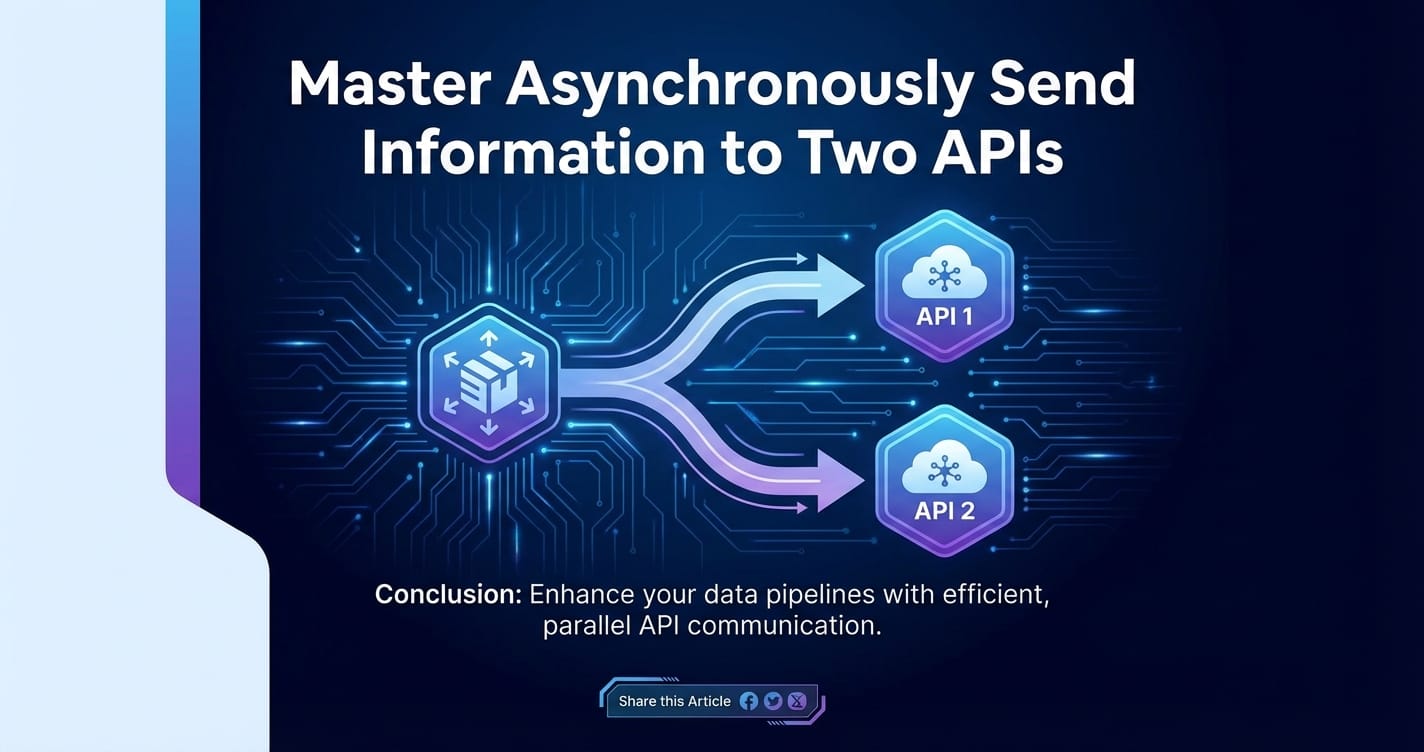
Master Asynchronously Send Information to Two APIs
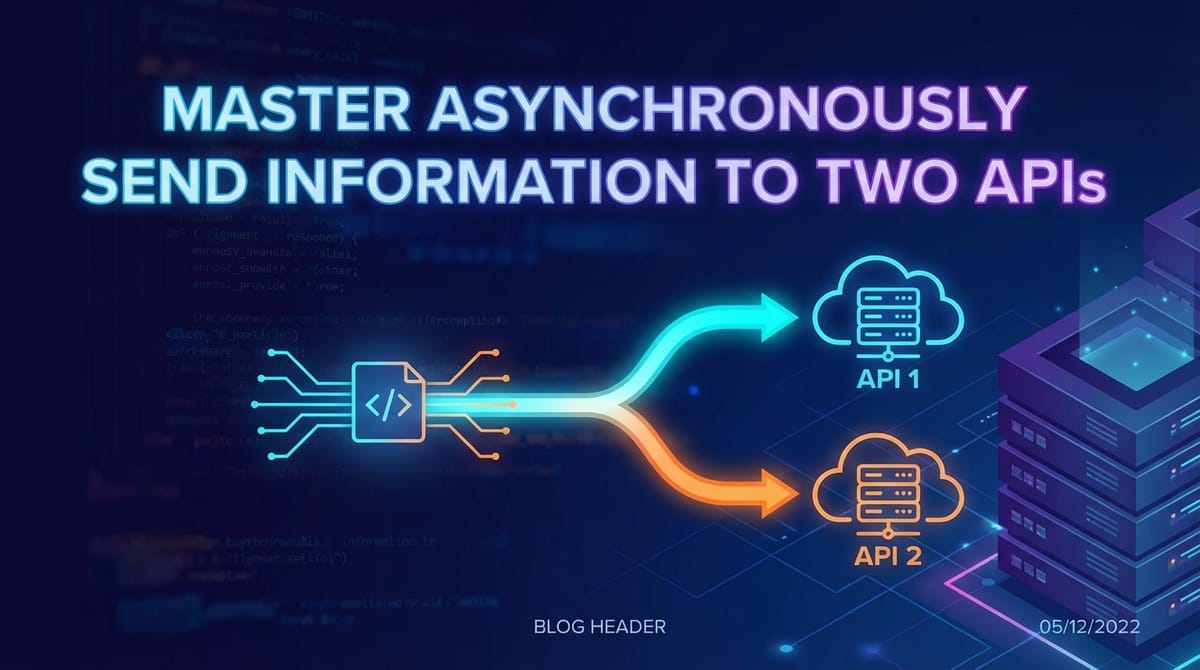


In the intricate tapestry of modern distributed systems, the ability to seamlessly and efficiently exchange information between disparate services stands as a cornerstone of successful software architecture. As applications evolve from monolithic giants into agile microservices, and as businesses increasingly rely on external partners and third-party functionalities, the need to interact with multiple Application Programming Interfaces (APIs) becomes not just common, but a fundamental requirement. However, simply making calls to external services is one thing; mastering the art of asynchronously sending information to two, or even more, APIs in a robust, scalable, and resilient manner presents a distinct set of challenges and opportunities.
Imagine a scenario where a user action within your application triggers a cascade of necessary updates across different external systems. Perhaps an e-commerce order needs to simultaneously update an inventory management system (API A) and initiate a payment processing service (API B). Or a new user registration requires creating an account in an internal user database (API A) and also provisioning services in a third-party CRM (API B). In such situations, blocking the user interface or delaying critical processes while waiting for sequential API responses is simply untenable. Synchronous, sequential calls introduce significant latency, create bottlenecks, and drastically reduce the overall responsiveness and availability of your application. Moreover, if one API fails, the entire operation can grind to a halt, leaving your system in an inconsistent state and frustrating end-users.
This is where the power of asynchronous communication truly shines. By decoupling the act of sending information from the immediate receipt of a response, and by enabling operations to proceed independently, we can build systems that are inherently more resilient, performant, and scalable. The journey to mastering this involves understanding fundamental communication paradigms, embracing advanced architectural patterns like message queues and event-driven approaches, and crucially, leveraging the capabilities of sophisticated API gateway solutions. These gateways act as intelligent intermediaries, orchestrating complex interactions, enforcing policies, and providing a unified façade over a multitude of backend services, whether internal or external.
This comprehensive guide will delve deep into the methodologies, best practices, and architectural considerations essential for achieving mastery in asynchronously sending data to two API endpoints. We will explore various patterns, from direct application-level asynchronous programming to the strategic deployment of message brokers and the transformative role of an API gateway. Our exploration will emphasize not just the mechanics of sending data, but also the critical aspects of error handling, idempotency, monitoring, and security that underpin any successful distributed system. By the end, you will possess a holistic understanding of how to build systems that not only efficiently communicate with multiple external services but also gracefully handle failures, scale effortlessly, and maintain optimal performance under diverse operational loads.
Chapter 1: The Foundations of Asynchronous Communication in Distributed Systems
To truly master the act of sending information to multiple APIs, it's imperative to first grasp the fundamental differences between synchronous and asynchronous communication paradigms. These two approaches dictate how operations interact, how resources are utilized, and ultimately, how resilient and performant a system can be.
1.1 Synchronous vs. Asynchronous Communication: A Core Distinction
In the realm of software, operations can largely be categorized by how they handle waiting.
Synchronous Communication: When an operation is performed synchronously, the initiating process (the client) sends a request and then waits for a response from the receiving process (the server) before it can proceed with its next task. It's a blocking operation. Think of it like a phone call: you dial, you wait for the other person to answer, you converse, and only when the call ends can you move on to another task.
- Characteristics:
- Blocking: The client is blocked, consuming resources (like a thread) while it waits.
- Sequential: Operations often occur in a strict order.
- Immediate Feedback: The client receives an immediate response (or an error) directly related to its request.
- Simplicity (for single operations): For very simple, direct interactions, synchronous calls can be straightforward to implement and reason about.
- Advantages:
- Easier to understand the flow of control and debugging in a simple, linear fashion.
- Immediate consistency: Once a response is received, the client can be sure the operation has completed (or failed) at that moment.
- Disadvantages:
- Latency: The total time taken for a series of synchronous calls accumulates, directly impacting perceived performance.
- Resource Inefficiency: While waiting, the client's resources (CPU, memory, network connections) may be tied up, doing nothing productive.
- Fragility: A single slow or failing upstream service can block the entire call chain, leading to cascading failures and reduced system availability.
- Scalability Bottlenecks: As the number of concurrent requests increases, the system can quickly exhaust its available resources, leading to degraded performance or crashes.
Asynchronous Communication: In contrast, asynchronous communication involves the initiating process sending a request and then immediately continuing with other tasks without waiting for a direct response. It delegates the responsibility of handling the response (or potential failures) to a separate mechanism. This is more akin to sending an email or a text message: you send it, and you don't necessarily stop what you're doing to wait for an immediate reply. You might get a notification later, or you might check back periodically.
- Characteristics:
- Non-blocking: The client is not blocked and can perform other work.
- Parallel or Concurrent: Operations can run in parallel or appear to run simultaneously, improving throughput.
- Delayed Feedback: The client might receive feedback through callbacks, promises, events, or by polling for status updates.
- Complexity (initial setup): Often requires more sophisticated error handling, state management, and orchestration.
- Advantages:
- Improved Responsiveness: The initiating system remains highly responsive, as it doesn't wait for external dependencies.
- Enhanced Throughput and Scalability: Resources are used more efficiently, allowing the system to handle a higher volume of concurrent requests.
- Increased Fault Tolerance: Failures in one external service are less likely to directly block or bring down the entire system. Operations can be retried or compensated for independently.
- Decoupling: Services become less dependent on the immediate availability of other services, leading to more resilient and modular architectures.
- Better Resource Utilization: CPU cycles, threads, and network connections are not idly waiting, but are actively engaged in processing other tasks.
- Disadvantages:
- Increased Complexity: Designing, implementing, and debugging asynchronous flows, especially across multiple services, can be more challenging.
- Eventual Consistency: Data might not be immediately consistent across all systems, requiring careful consideration of consistency models.
- Monitoring and Tracing: Tracking the lifecycle of a request across multiple asynchronous hops can be harder without proper tooling (e.g., distributed tracing).
- Error Handling: Failures are not immediately obvious to the caller, requiring robust retry mechanisms, dead-letter queues, and compensation logic.
1.2 Why Asynchronous is Crucial for Multiple APIs
When the requirement is to interact with two or more distinct external APIs, the advantages of asynchronous communication are amplified, making it not just a preference, but often a necessity for building high-performance, resilient, and scalable systems.
- Preventing Latency Accumulation: If you have two APIs, API A and API B, and each takes 200ms to respond, a synchronous sequential call would take at least 400ms. If these calls are made asynchronously and in parallel, the total time could be reduced to approximately 200ms (the duration of the slower call plus minimal overhead). This reduction in response time is critical for user experience and system throughput.
- Mitigating Cascading Failures: In a synchronous model, if API A is slow or unavailable, the call to API B will never even be initiated, or the entire process stalls. Asynchronously, if API A fails, the call to API B can still proceed independently. Your system can then manage the failure of API A separately, perhaps by retrying, logging, or notifying administrators, without impacting the ability to communicate with API B. This isolation of failures is a cornerstone of fault-tolerant design.
- Enhancing System Responsiveness: For user-facing applications, keeping the UI responsive is paramount. By offloading API calls to an asynchronous background process, the main application thread or the request-response cycle is freed up almost immediately. This allows the application to acknowledge the user's request, perform other immediate tasks, or return a preliminary response, significantly improving the perceived speed and fluidity of the user experience.
- Optimizing Resource Utilization: In a server environment, each synchronous request often ties up a thread or a process while it waits for an external API response. When dealing with multiple APIs, this problem is compounded. Asynchronous I/O (Input/Output) allows a single thread to initiate multiple API calls and then switch to other tasks while waiting for network responses. When a response arrives, the thread is notified and can resume processing. This non-blocking nature means fewer threads or processes are needed to handle the same workload, leading to more efficient use of CPU and memory, and enabling the server to handle a much higher volume of concurrent requests.
- Facilitating Decoupling and Modularity: Asynchronous patterns, especially those involving message queues or event buses, fundamentally decouple the caller from the callees. The application merely publishes its intent (e.g., "order placed" or "user registered") without needing to know the specific details of which APIs need to be called or how. This allows for greater flexibility: new APIs can be added or existing ones changed without modifying the core application logic, as long as they subscribe to the relevant events or messages. This modularity is vital for evolving microservices architectures.
- Enabling Advanced Patterns (Retries, Dead-Letter Queues, Compensation): Asynchronous communication naturally lends itself to implementing sophisticated reliability patterns. If an API call fails, it can be retried automatically (perhaps with exponential backoff) without blocking the original request. If repeated retries fail, the message can be moved to a Dead Letter Queue (DLQ) for manual inspection or alternative processing, preventing message loss. Furthermore, in complex distributed transactions, asynchronous operations facilitate the implementation of sagas and compensation logic to maintain data consistency even in the face of partial failures.
In essence, while synchronous communication might suffice for simple, internal, and highly reliable point-to-point interactions, the moment you venture into the realm of external API integrations, particularly with multiple endpoints, asynchronous approaches become indispensable. They lay the groundwork for building robust, scalable, and highly available systems that can navigate the inherent unpredictability and latency of network-bound operations.
Chapter 2: Core Concepts and Design Patterns for Asynchronous API Interactions
Building a system that reliably sends information to two APIs asynchronously requires more than just understanding the 'why'; it demands a grasp of the 'how' through established design patterns and architectural components. This chapter explores the foundational tools and concepts that empower developers to orchestrate complex, non-blocking interactions with multiple external services.
2.1 Message Queues: The Backbone of Decoupling
One of the most powerful and widely adopted patterns for asynchronous communication is the use of message queues (also known as message brokers or message buses). Systems like Apache Kafka, RabbitMQ, Amazon SQS, or Azure Service Bus provide a robust intermediary layer for applications to exchange messages without direct knowledge of each other's existence or immediate availability.
How They Work: At its core, a message queue operates on a producer-consumer model. * Producers: An application that wants to send information (the "message") publishes this message to a designated queue or topic within the message broker. The producer doesn't wait for the message to be processed; it simply "drops it off" and continues its own operations. * Consumers: Other applications or services that are interested in processing specific types of messages "subscribe" to these queues or topics. When a new message arrives, the consumer retrieves it, processes it (e.g., by calling an external API), and then acknowledges its successful processing.
Benefits for Dual API Calls: When you need to send information to two APIs, a message queue offers profound advantages:
- Decoupling: The original application (producer) is completely decoupled from the two API-calling services (consumers). It only needs to know how to publish a message to the queue. It doesn't care if API A is down, or if API B is slow.
- Buffering and Load Leveling: If API A or API B becomes overwhelmed with requests, the message queue acts as a buffer. Messages accumulate in the queue, allowing the API-calling services to process them at their own pace, preventing direct pressure on the external APIs and protecting your system from upstream overload.
- Guaranteed Delivery and Retries: Most message queues offer features for guaranteed message delivery (at-least-once or exactly-once semantics), ensuring that messages aren't lost even if consumers fail. They also facilitate robust retry mechanisms, where failed messages can be automatically re-queued for another attempt after a delay, crucial for handling transient API errors.
- Scalability: You can easily scale out your consumer services independently. If the volume of messages increases, you can add more instances of the service responsible for calling API A, or API B, without affecting the producer or the other API-calling service.
- Asynchronous by Nature: The very design of a message queue inherently promotes asynchronous processing, making it an ideal choice for non-blocking operations.
Use Case Example: Your e-commerce application processes an order. Instead of directly calling the inventory API and then the payment API, it publishes an "OrderPlaced" message to a Kafka topic. * A separate "Inventory Service" consumes "OrderPlaced" messages and calls API A (inventory update). * Another separate "Payment Orchestration Service" consumes "OrderPlaced" messages and calls API B (payment initiation). If API A is temporarily unavailable, the "Inventory Service" might fail to process the message and it will be retried later. Meanwhile, the "Payment Orchestration Service" can successfully call API B without interruption.
2.2 Event-Driven Architecture: Reacting to Change
Event-driven architecture (EDA) is a design paradigm where the communication between services revolves around events. An event is a significant occurrence or change of state within a system. Services (producers) emit events, and other services (consumers) react to these events. Message queues often serve as the infrastructure for an EDA.
Concepts: * Events: Immutable facts that something happened (e.g., OrderCreated, UserRegistered, ProductUpdated). Events typically contain just enough information for consumers to know what happened and decide if they need to act. * Producers/Publishers: Services that generate and publish events. * Consumers/Subscribers: Services that listen for specific events and perform actions in response.
How it Applies to Dual API Calls: In an EDA, instead of explicitly telling two services to call two APIs, your system simply emits an event representing a state change. For example, when a user registers, your UserService might emit a UserRegistered event. * A NotificationService might subscribe to UserRegistered events and call a third-party email API to send a welcome email. * A CRMService might also subscribe to UserRegistered events and call a different external API to create a new lead in your CRM system.
This approach offers maximum decoupling, scalability, and flexibility. New functionalities (like calling a third API for analytics) can be added simply by introducing a new consumer for an existing event, without modifying any of the existing services.
2.3 Webhooks: Inverted Asynchronous Communication
While message queues and event-driven architectures typically involve a client publishing and a server consuming, webhooks represent a form of inverted asynchronous communication. Instead of polling an API for updates, you provide a callback URL to a third-party service, and that service sends an HTTP POST request to your URL whenever a specific event occurs on their side.
How They Work: 1. Your system (the consumer of the webhook) registers a URL with a third-party service (the producer of the webhook). 2. When a predefined event happens in the third-party service, it makes an HTTP POST request to your registered URL, sending event data in the request body. 3. Your endpoint receives this request and processes the data asynchronously.
When to Use for Dual API Calls: Webhooks are less about your system sending data to two external APIs, and more about an external system triggering actions in your system, which might then, in turn, trigger calls to two other APIs. * Example: A payment gateway (e.g., Stripe) uses webhooks to notify your system when a payment status changes (e.g., payment.succeeded). Your webhook endpoint could then: 1. Call your internal order fulfillment API (API A) to mark the order as paid. 2. Call a third-party shipping API (API B) to create a new shipment request.
Security Considerations: Webhooks require careful security measures, as you are exposing an endpoint to an external party: * Signature Verification: Most webhook providers send a cryptographic signature with their requests. You should verify this signature to ensure the request truly came from the expected source and hasn't been tampered with. * HTTPS: Always use HTTPS for your webhook endpoints to encrypt data in transit. * Idempotency: Design your webhook handlers to be idempotent, so processing the same event multiple times (which can happen with retries) doesn't lead to duplicate actions. * Validation: Rigorously validate the incoming payload against expected schemas.
2.4 Async/Await in Programming Languages: Application-Level Concurrency
Beyond architectural patterns, most modern programming languages provide built-in constructs to facilitate asynchronous operations directly within application code. Keywords like async and await (in JavaScript, Python, C#, Kotlin) or features like CompletableFuture (Java) and Go's goroutines enable non-blocking I/O at the language level.
How They Work: These constructs allow a function to be marked as async, indicating that it can perform operations that might take time (like network calls) without blocking the thread it's running on. The await keyword is then used to pause the execution of the async function until an asynchronous operation completes, but crucially, it releases the underlying thread to do other work during the waiting period. When the awaited operation finishes, the async function resumes execution from where it left off.
Orchestrating Multiple Independent API Calls: This is particularly useful when you need to make two (or more) independent API calls from within a single application component.
Example (Python with asyncio):
import asyncio
import httpx # An async HTTP client

async def call_api_a(data):
    print(f"Calling API A with {data}...")
    # Simulate network latency
    await asyncio.sleep(2)
    response = await httpx.post("https://api.example.com/a", json=data)
    print(f"API A response: {response.status_code}")
    return response.json()

async def call_api_b(data):
    print(f"Calling API B with {data}...")
    await asyncio.sleep(1)
    response = await httpx.post("https://api.example.com/b", json=data)
    print(f"API B response: {response.status_code}")
    return response.json()

async def send_to_two_apis_async(payload):
    print("Initiating calls to API A and API B...")
    # Use asyncio.gather to run both API calls concurrently
    # This will wait for BOTH to complete, but they run in parallel.
    try:
        results_a, results_b = await asyncio.gather(
            call_api_a(payload["data_for_a"]),
            call_api_b(payload["data_for_b"])
        )
        print("Both API calls completed.")
        return {"api_a_results": results_a, "api_b_results": results_b}
    except Exception as e:
        print(f"An error occurred during async calls: {e}")
        # Handle errors appropriately
        return {"error": str(e)}

async def main():
    payload = {
        "data_for_a": {"user_id": 123, "action": "register"},
        "data_for_b": {"customer_id": "abc", "event": "onboarding"}
    }
    await send_to_two_apis_async(payload)

if __name__ == "__main__":
    asyncio.run(main())
Advantages: * Direct Control: You have granular control over the asynchronous flow within your application. * Low Overhead (compared to message queues): No external infrastructure (like a message broker) is immediately required. * Reduced Latency (for parallel calls): When calls are truly independent, this method can significantly reduce the overall execution time compared to sequential synchronous calls.
Disadvantages: * Application-Level Responsibility: All error handling, retries, and state management (e.g., what if one call succeeds and the other fails?) become the sole responsibility of your application code. * Tight Coupling: The calling code is directly coupled to the logic of initiating both API calls. * Not a Decoupling Mechanism: While it offers concurrency, it doesn't provide the same level of decoupling and buffering as a message queue, meaning transient failures in external APIs can still directly impact your application's request processing. * Resource Management: While async/await is non-blocking at the I/O level, it still consumes application memory and potentially limits concurrent requests if not managed properly within the wider server context.
Choosing the right pattern (or combination of patterns) depends on the scale, reliability requirements, and architectural complexity of your system. For high-volume, mission-critical operations needing ultimate decoupling and resilience, message queues are often preferred. For simpler, less critical parallel operations within a single service, async/await can be highly effective. The next chapter introduces another powerful component that can tie these strategies together: the API Gateway.
Chapter 3: The Indispensable Role of an API Gateway
While individual services can implement asynchronous communication patterns, managing a multitude of API interactions, especially with external services, quickly becomes unwieldy. This is where an API gateway emerges as an indispensable architectural component. It acts as a single, intelligent entry point for all API requests, providing a robust layer of abstraction, control, and efficiency.
3.1 What is an API Gateway?
An API gateway is essentially a server that sits between client applications and a collection of backend services. It acts as a reverse proxy, routing client requests to the appropriate microservices, external APIs, or other backend systems. But its role extends far beyond simple routing; it serves as a powerful facade, centralizing many cross-cutting concerns that would otherwise need to be implemented in each individual service.
Key Functionalities of an API Gateway:
- Routing: The most fundamental function. It maps external client requests to the correct internal or external backend services based on defined rules (e.g., URL paths, headers).
- Authentication and Authorization: Centralizes security. It can verify API keys, JWTs, OAuth tokens, and apply access control policies before requests ever reach backend services, offloading this burden from individual microservices.
- Rate Limiting and Throttling: Protects backend services from being overwhelmed by too many requests, preventing abuse and ensuring fair usage.
- Load Balancing: Distributes incoming traffic across multiple instances of backend services to ensure optimal resource utilization and high availability.
- Caching: Can cache responses from backend services to reduce latency and load on those services for frequently accessed data.
- Request/Response Transformation: Modifies request headers, body, or parameters before forwarding them to backend services, and similarly transforms responses before sending them back to clients. This is crucial for adapting to different API schemas or versions.
- Logging and Monitoring: Collects detailed logs, metrics, and traces for all API traffic, providing a central point for observability, troubleshooting, and performance analysis.
- Circuit Breaking: Implements resilience patterns to prevent cascading failures. If a backend service is unresponsive, the gateway can quickly fail requests or return cached data instead of waiting indefinitely.
- API Versioning: Manages multiple versions of APIs, allowing clients to use older versions while newer versions are developed or rolled out.
- Protocol Translation: Can convert between different communication protocols (e.g., HTTP to gRPC, REST to SOAP).
In essence, an API gateway acts as a traffic cop, a security guard, a translator, and a data collector, all rolled into one. It simplifies client interaction, enhances security, improves performance, and increases the overall resilience of a system by externalizing common concerns.
3.2 How an API Gateway Facilitates Dual API Calls
When the challenge is to send information to two distinct APIs, an API gateway provides a powerful and elegant solution, particularly through patterns like fan-out and request aggregation.
- Fan-out Pattern: This is perhaps the most direct application of a gateway for sending data to multiple APIs. A client makes a single request to the API gateway. The gateway, based on its configuration, then internally dispatches this request (or transformed versions of it) to multiple backend services concurrently and asynchronously.
- Mechanism: Upon receiving a client request, the gateway identifies that this specific endpoint requires interaction with both API A and API B. It then creates two separate, independent requests (potentially with different payloads or authentication credentials) and sends them simultaneously to API A and API B.
- Asynchronous Nature: The gateway itself handles these internal calls asynchronously, meaning it doesn't wait for API A to respond before calling API B. It initiates both calls and manages their individual lifecycles.
- Benefits:
- Simplified Client: The client application only needs to know about and interact with a single gateway endpoint, reducing client-side complexity.
- Centralized Orchestration: The logic for calling multiple APIs is encapsulated within the gateway configuration, rather than being spread across client applications or multiple microservices.
- Consistent Policies: All calls, regardless of which backend API they eventually target, can pass through the same security, rate limiting, and logging policies enforced by the gateway.
- Resilience: The gateway can implement its own retry logic, circuit breakers, and timeouts for each backend API call, insulating the client from individual API failures.
- Request Aggregation: While often paired with fan-out, request aggregation is about combining responses. After fanning out requests to multiple APIs, the API gateway can wait for some or all of the responses, aggregate them, and then compose a single, unified response to send back to the original client. This might involve merging data, filtering results, or even performing light data transformations.
- Transformation and Protocol Adaptation: Often, the two APIs you need to call might have different request formats, authentication mechanisms, or even communication protocols. An API gateway can be configured to perform these transformations on the fly.
- A single incoming client request might be transformed into one payload for API A (e.g., XML) and a different payload for API B (e.g., JSON), each with its own authentication headers. This adaptability significantly reduces the integration burden on your client services.
- Centralized Policy Enforcement and Observability: When using an API gateway, all traffic to your external APIs (or internal ones that need similar treatment) flows through a single point. This enables:
- Unified Authentication/Authorization: You configure authentication once at the gateway for specific routes, rather than implementing it in every service that makes an external call.
- Comprehensive Logging and Metrics: Every outgoing API call, its latency, success rate, and error details are logged and monitored centrally. This provides an unparalleled level of insight into the health and performance of your external integrations.
- Rate Limiting of Outgoing Calls: Beyond protecting your own backend, an API gateway can rate limit outgoing calls to external APIs, ensuring you don't exceed their quotas and incur extra costs or trigger their abuse prevention mechanisms.
3.3 APIPark: An Example of a Powerful API Gateway for Modern Needs
In the landscape of API gateway solutions, some platforms are specifically designed to address the complexities of modern integrations, particularly those involving AI models and diverse backend services. APIPark is an excellent example of such an advanced API gateway and API management platform, open-sourced under the Apache 2.0 license. It offers a comprehensive suite of features that directly address the challenges of asynchronously sending information to multiple APIs, especially when those APIs include a mix of traditional REST services and emerging AI models.
APIPark's capabilities make it highly suitable for scenarios where you need robust, scalable, and intelligent orchestration of calls to multiple distinct endpoints:
- Unified API Format for AI Invocation: A standout feature for handling diverse APIs, including AI models. APIPark standardizes the request data format across various AI models. This means your application sends a single, consistent request to APIPark, and the gateway intelligently transforms it into the appropriate format for different AI models (which could be seen as two distinct APIs, e.g., one for sentiment analysis and another for translation). This significantly simplifies your client-side logic and reduces maintenance when underlying AI models or their specific API contracts change. For example, if you need to send text to two different NLP services for parallel analysis, APIPark can handle the individual API formatting.
- Prompt Encapsulation into REST API: This feature allows users to combine AI models with custom prompts to create new APIs. If you have a workflow that needs to invoke two separate custom AI-driven functions (e.g., one for summarizing text and another for extracting entities), APIPark can encapsulate these into distinct, manageable REST APIs, which can then be invoked by your system.
- End-to-End API Lifecycle Management: APIPark assists with managing the entire lifecycle of APIs, from design to publication, invocation, and decommission. This is crucial when you're integrating with two external APIs, as it helps regulate traffic forwarding, load balancing, and versioning of these published interfaces, ensuring that your dual API calls are always directed to the correct, healthy endpoints.
- Performance Rivaling Nginx: With the ability to achieve over 20,000 TPS on modest hardware, APIPark provides the necessary backbone for high-volume asynchronous operations. When fanning out requests to two APIs, performance is paramount. A high-performance gateway ensures that the overhead introduced by the intermediate layer is minimal, allowing your system to handle large-scale traffic efficiently. This raw performance is critical for scenarios where latency must be minimized even with parallel calls.
- Detailed API Call Logging: Asynchronous interactions, especially with multiple APIs, can be complex to debug. APIPark provides comprehensive logging capabilities, recording every detail of each API call. This feature is invaluable for quickly tracing and troubleshooting issues in dual API calls, providing visibility into which API (A or B) might have failed, what the request and response payloads were, and the precise timing of each interaction. This robust observability ensures system stability and data security.
- Powerful Data Analysis: Beyond raw logs, APIPark analyzes historical call data to display long-term trends and performance changes. For dual API integrations, this means you can track the performance of calls to API A versus API B over time, identify bottlenecks, and proactively perform maintenance before issues impact your services.
By centralizing the management, security, and orchestration of your API interactions, a sophisticated API gateway like APIPark simplifies the complexity of asynchronously sending information to two or more APIs. It shifts the burden of managing individual API contracts, handling failures, and enforcing policies from your application code to a dedicated, high-performance infrastructure layer, allowing your development teams to focus on core business logic.
Chapter 4: Strategies for Asynchronously Sending Data to Two APIs
With a firm understanding of asynchronous principles and the role of an API gateway, we can now explore concrete strategies for implementing dual API communication. Each approach has its trade-offs in terms of complexity, coupling, and resilience.
4.1 Direct Asynchronous Calls from Application Logic
This strategy involves using the built-in asynchronous programming features of your chosen language (e.g., async/await in Python, JavaScript, C#; CompletableFuture in Java; Goroutines in Go) to make parallel calls to two distinct API endpoints directly from your application service.
Mechanism: Your service receives a request, extracts the necessary data, and then initiates two separate, non-blocking HTTP requests to API A and API B. The language's asynchronous runtime manages the concurrency, ensuring that the calling thread is not blocked while waiting for network I/O. The application code then awaits the completion of both calls and processes their respective responses.
Example (Conceptual in pseudo-code):
function process_request(data):
    # Prepare data for API A and API B
    payload_a = transform_for_api_a(data)
    payload_b = transform_for_api_b(data)

    # Initiate API calls concurrently
    response_promise_a = async_http_post(api_a_endpoint, payload_a, headers_a)
    response_promise_b = async_http_post(api_b_endpoint, payload_b, headers_b)

    # Await both results (this part is non-blocking to the underlying thread)
    result_a = await response_promise_a
    result_b = await response_promise_b

    # Process results, handle errors, etc.
    if result_a.success and result_b.success:
        return success_response(result_a, result_b)
    else:
        # Complex error handling: what if one succeeded and the other failed?
        return error_response(result_a, result_b)
Pros: * Simplicity for Small Scale: For straightforward applications with limited concurrency requirements and where the two API calls are truly independent and non-critical, this is the quickest to implement. * Low Infrastructure Overhead: Doesn't require setting up and maintaining additional services like message queues or API gateways. * Direct Control: Developers have full control over the specific timing and handling of each API call within their code.
Cons: * Application Responsibility for Everything: Error handling, retries (with exponential backoff), timeouts, and circuit breaking become the sole responsibility of your application code. This can lead to significant boilerplate and increased complexity as the number of integrations grows. * Tight Coupling: The business logic is directly coupled to the specifics of calling two external APIs. Changes in API A or API B (e.g., endpoint changes, authentication changes) require modifications and redeployment of your application service. * No Buffering/Load Leveling: If API A or API B becomes slow or unavailable, requests directly hit your application service, potentially leading to timeouts, resource exhaustion, and cascading failures in your own service. There's no intermediary to absorb spikes or provide backpressure. * Consistency Challenges: If one API call succeeds and the other fails, your system might be left in an inconsistent state. Implementing compensation logic directly in application code can be tricky. * Limited Observability: Monitoring and tracing these specific dual calls require dedicated implementation within your application, making it harder to get a holistic view across an entire system.
Best Use Cases: Suitable for low-volume, non-critical scenarios where the external APIs are highly reliable, and where immediate failure is acceptable. Not recommended for mission-critical processes or environments requiring high scalability and resilience.
4.2 Using a Message Queue for Decoupling
This strategy introduces a message queue as an intermediary to completely decouple the initial application request from the actual calls to API A and API B.
Mechanism: 1. Your application service receives a request (e.g., "process order"). 2. Instead of directly calling APIs, it constructs a message describing the event (e.g., "OrderCreated" with order details). 3. It then publishes this message to a designated topic or queue in a message broker (e.g., Kafka, RabbitMQ, SQS). 4. Separate, dedicated worker services (or microservices) are configured to consume messages from this queue. 5. One worker service (e.g., InventoryUpdater) consumes the message and calls API A (e.g., to update inventory). 6. Another worker service (e.g., PaymentProcessor) consumes the same message (or a relevant subset) and calls API B (e.g., to initiate payment). These consumers operate independently and asynchronously.
Pros: * Robust Decoupling: The initial application is completely unaware of the details of API A and API B. It just publishes an event. This dramatically reduces coupling and increases modularity. * High Resilience: Message queues provide persistence, guaranteed delivery, and often automatic retry mechanisms for messages that fail to be processed by consumers. If an external API is down, the message remains in the queue and can be retried later, without impacting the original application. * Scalability: Consumer services can be scaled independently. If the workload for API A increases, you can add more instances of the InventoryUpdater service. * Buffering and Load Leveling: The queue absorbs spikes in traffic, protecting downstream APIs and services from overload. * Auditability: Messages in a queue can provide a clear audit trail of events flowing through the system. * Distributed Transactions (Saga Pattern): Message queues are foundational for implementing the Saga pattern, which helps maintain data consistency in complex distributed transactions where compensation is needed for partial failures.
Cons: * Increased Infrastructure Complexity: Requires setting up and managing a message broker, which adds an operational overhead. * Eventual Consistency: Since operations are decoupled and asynchronous, there might be a delay between the original event and the completion of both API calls. Clients need to be designed to handle eventual consistency. * Monitoring Complexity: Tracing a request that spans multiple services and a message queue can be challenging without proper distributed tracing tools.
Best Use Cases: Ideal for high-volume, mission-critical operations where reliability, scalability, and resilience are paramount. Perfect for core business processes like order fulfillment, user provisioning, or data synchronization across multiple systems where strict decoupling is desired.
4.3 Leveraging an API Gateway for Fan-out
This strategy utilizes the capabilities of an API gateway to orchestrate the asynchronous fan-out to two APIs. The client interacts solely with the gateway, which then takes responsibility for dispatching requests to the backend.
Mechanism: 1. A client application sends a single request to a specific endpoint on the API gateway. 2. The API gateway is configured with a routing rule that, upon receiving this request, initiates two internal, asynchronous requests: one to API A and one to API B. 3. The gateway can transform the incoming client request's payload into appropriate formats for API A and API B, apply specific authentication for each, and then dispatch them concurrently. 4. The gateway can either: * Return an immediate 202 Accepted response to the client, indicating that the request has been received and processing has begun asynchronously (often with a link to check status). This is truly fire-and-forget from the client's perspective. * Wait for both API A and API B to respond (or at least one, depending on configuration), aggregate their responses, and then return a single, composite response to the client. This offers a synchronous-like facade over asynchronous backend operations.
Table 4.1: Comparison of Asynchronous Strategies for Dual API Calls
| Feature/Strategy | Direct Async (App-level) | Message Queue | API Gateway (Fan-out) |
|---|---|---|---|
| Decoupling | Low (client service coupled to both APIs) | High (client decoupled from API calls via queue) | Moderate (client decoupled from APIs via gateway) |
| Resilience/Retries | Application-managed, complex | High (queue handles persistence, consumer retries) | High (gateway can implement retries, circuit breakers) |
| Scalability | Limited (tied to app service instances) | High (independent scaling of consumers) | High (gateway and backend services scale independently) |
| Latency (Client-side) | Low (direct parallel calls) | Very Low (immediate message publish) | Low (immediate gateway response or aggregated wait) |
| Infrastructure | Minimal additional | Message broker required | API Gateway platform required |
| Error Handling | Complex application logic for partial failures | Consumer handles errors, DLQs for failures | Gateway manages errors, can return specific error to client |
| Observability | Requires in-app instrumentation | Requires tracing across producer, queue, and consumers | Centralized logging/monitoring at gateway level |
| Complexity | Moderate for reliable implementation | High (setup & operational management of queue, consumers) | Moderate (gateway configuration & policy management) |
| Use Case | Simple, non-critical, low-volume parallel calls | High-volume, critical, durable, decoupled operations | Centralized control, policy enforcement, fan-out to diverse backends |
Pros: * Simplified Client: As with message queues, the client is simplified, interacting with a single, stable gateway endpoint. * Centralized Policy Enforcement: The API gateway enforces authentication, authorization, rate limiting, and logging uniformly across all outgoing calls to API A and API B, ensuring consistency and simplifying security management. * Request/Response Transformation: The gateway can handle the complexities of different API contracts, transforming payloads and headers as needed for each backend. * Improved Observability: As discussed in Chapter 3, a gateway provides a central point for monitoring and logging all interactions, making it easier to trace requests and debug issues, especially important when dealing with multiple external dependencies. * Resilience via Gateway Features: The gateway can apply circuit breakers, timeouts, and retry logic to calls to API A and API B independently, isolating client from backend failures. * Vendor Lock-in Reduction: The gateway can abstract away vendor-specific API details, making it easier to swap out backend APIs without impacting client code.
Cons: * Single Point of Failure (Potentially): If the API gateway itself goes down (without proper high-availability setup), all API traffic is affected. This requires robust deployment of the gateway itself. * Gateway Configuration Complexity: Setting up and managing sophisticated routing, transformation, and policy rules within the gateway can be complex. * Latency Overhead: While the gateway introduces a hop, its performance (as exemplified by products like APIPark which boasts Nginx-like speed) ensures this overhead is minimal for asynchronous fan-out.
Best Use Cases: Excellent for scenarios where you need centralized control over external API integrations, consistent application of cross-cutting concerns (security, rate limiting), and a simplified client experience. It's particularly powerful when integrating with diverse external APIs that might have different contracts or when you need to provide a single, unified interface for complex backend operations.
4.4 Orchestration Service/Microservice
This strategy involves creating a dedicated microservice whose sole responsibility is to orchestrate the calls to API A and API B. This service acts as an intermediary layer between your main application and the external APIs.
Mechanism: 1. Your primary application sends a request to your dedicated OrchestrationService. 2. The OrchestrationService then internally makes the asynchronous calls to API A and API B, potentially using async/await patterns or even by publishing messages to an internal queue if more resilience is needed. 3. The OrchestrationService handles all the complexities: data transformation, authentication for each API, error handling, retries, and merging responses. 4. It then returns a consolidated response to your primary application or acknowledges the operation has been initiated.
Pros: * Clear Separation of Concerns: The responsibility for interacting with API A and API B is encapsulated within a single service, making your main application cleaner and focused on its core business logic. * High Flexibility: The OrchestrationService can implement complex business logic, custom retry policies, saga patterns, or advanced error compensation specific to the dual API interaction. * Independent Deployment and Scaling: The OrchestrationService can be developed, deployed, and scaled independently of your main application and the external APIs. * Testability: The logic for calling and managing API A and API B is isolated, making it easier to test thoroughly.
Cons: * Added Service Overhead: Introduces another service to manage, deploy, and monitor. This increases operational complexity. * Potential for Chained Calls: If not designed carefully, this can lead to a long chain of service calls, which can impact latency and make tracing difficult. * Distributed Transaction Management: While flexible, managing state and ensuring consistency across multiple external APIs and the orchestration service itself still requires careful design (e.g., using the Saga pattern).
Best Use Cases: Suitable for complex business workflows that involve multiple external APIs where specific business logic, state management, or compensation transactions are required. It's an excellent choice when you need a high degree of control and customization over the interaction flow between your system and external dependencies, without burdening the API gateway with complex business logic or forcing it into the main application.
Choosing the right strategy depends heavily on your specific requirements regarding performance, resilience, scalability, development speed, and operational overhead. Often, a combination of these strategies (e.g., an API gateway for initial fan-out and security, backed by an orchestration service for complex business logic, or using message queues for ultimate decoupling) yields the most robust and scalable solutions.
APIPark is a high-performance AI gateway that allows you to securely access the most comprehensive LLM APIs globally on the APIPark platform, including OpenAI, Anthropic, Mistral, Llama2, Google Gemini, and more.Try APIPark now! 👇👇👇
Chapter 5: Implementing Robustness and Reliability in Asynchronous Dual API Interactions
Asynchronous communication introduces a layer of complexity, particularly when dealing with potential failures and ensuring data consistency across multiple external systems. Building a truly resilient system requires proactive strategies for error handling, monitoring, and maintaining data integrity.
5.1 Error Handling and Retries: Navigating the Unpredictable Network
External APIs are inherently unreliable. Network issues, service outages, rate limits, and transient errors are commonplace. Robust systems anticipate these problems and implement intelligent strategies to recover gracefully.
- Idempotency: A crucial concept for any retry mechanism is idempotency. An operation is idempotent if executing it multiple times produces the same result as executing it once.
- Why it matters: When an asynchronous call to API A fails (e.g., due to a timeout), you might not know if the operation actually completed on API A's side but the response was lost, or if it failed entirely. If you retry, and the operation wasn't idempotent, you could create duplicate entries or unintended side effects (e.g., charging a customer twice).
- Implementation: Design your API calls and external services to be idempotent. This often involves:
- Using unique request IDs (correlation IDs or idempotency keys) that the external API can use to detect and de-duplicate requests.
- Ensuring that 'create' operations are effectively 'upsert' operations where possible (e.g., create a resource only if it doesn't already exist with a given ID).
- Making 'update' or 'delete' operations based on unique identifiers rather than relative changes.
- Retry Mechanisms: For transient errors (network glitches, temporary service unavailability), retries are essential.
- Fixed Delay Retries: Retrying after a constant interval. Simple but can overwhelm a struggling service.
- Exponential Backoff: The gold standard. Retry attempts occur with progressively longer delays (e.g., 1s, 2s, 4s, 8s). This gives the struggling service time to recover and prevents your system from exacerbating its problems. It's often combined with a small random jitter to prevent "thundering herd" scenarios where many retries hit the service simultaneously.
- Max Retries and Timeouts: Define a maximum number of retries or a cumulative timeout beyond which an operation is considered a hard failure. This prevents indefinite retries from consuming resources.
- Selective Retries: Not all errors are retryable. HTTP 4xx client errors (e.g., 400 Bad Request, 401 Unauthorized) indicate a problem with the request itself and should not be retried. HTTP 5xx server errors (e.g., 500 Internal Server Error, 503 Service Unavailable) are generally retryable.
- Circuit Breaker Pattern: Inspired by electrical circuit breakers, this pattern prevents a system from repeatedly trying to access a failing service, thus preventing cascading failures and giving the failing service time to recover.
- States:
- Closed: Normal operation. Requests pass through to the target service. If errors exceed a threshold, it transitions to Open.
- Open: Requests are immediately rejected without attempting to call the target service. After a configurable timeout, it transitions to Half-Open.
- Half-Open: A limited number of test requests are allowed through to the target service. If these succeed, the breaker transitions back to Closed; otherwise, it returns to Open.
- Benefits: Reduces load on the failing service, provides faster failure responses to the client, and allows the system to remain partially functional. This is a crucial feature that can be implemented within an API gateway (e.g., APIPark can manage such resilience policies) or within your client libraries.
- States:
- Dead Letter Queues (DLQ): When messages in a message queue fail to be processed after multiple retries (e.g., due to persistent API errors, invalid message format), they can be moved to a Dead Letter Queue.
- Purpose: Prevents problematic messages from blocking the main processing queue. Messages in a DLQ can be manually inspected, debugged, fixed, and then potentially re-queued, ensuring no data loss and providing insights into systemic issues.
5.2 Monitoring and Alerting: The Eyes and Ears of Your System
In asynchronous, distributed systems, especially when communicating with multiple external APIs, what you can't see, you can't fix. Robust monitoring and alerting are non-negotiable.
- Metrics: Collect and visualize key performance indicators (KPIs) for each API interaction:
- Latency: Average, p95, p99 latency for calls to API A and API B.
- Success Rate: Percentage of successful calls.
- Error Rate: Percentage of calls resulting in errors (distinguish between client 4xx and server 5xx errors).
- Throughput: Number of requests per second to each API.
- Queue Depth: For message queue-based systems, monitoring the number of messages in the queue (and DLQ) provides insight into backlogs or processing delays.
- Distributed Tracing: When a single logical request spans multiple services and potentially multiple API calls (especially in asynchronous workflows), tracing its full journey is critical. Tools like OpenTelemetry, Jaeger, or Zipkin allow you to generate unique trace IDs that follow a request across services, providing a visual timeline of each step and its latency. This is invaluable for pinpointing bottlenecks and identifying which of the two APIs is causing delays or failures.
- Logs: Comprehensive logging provides the fine-grained detail needed for debugging.
- Contextual Logging: Ensure logs contain enough context (e.g., correlation IDs, user IDs, request payloads) to reconstruct the state of a request at any point.
- Structured Logging: Log in JSON or a similar structured format to enable easier parsing and querying by logging aggregation tools (e.g., ELK stack, Splunk, Datadog).
- Logging API Responses: Log the full responses (or at least status codes and error messages) from API A and API B, being mindful of sensitive data.
- APIPark's Detailed API Call Logging: As mentioned, APIPark provides comprehensive logging capabilities, recording every detail of each API call. This is a direct benefit for troubleshooting dual API interactions, as it offers a centralized, granular view of all requests and responses passing through the gateway, simplifying the debugging process immensely.
- Alerting: Define thresholds for critical metrics and configure alerts to notify operations teams when these thresholds are breached.
- Examples: High error rates to API A, increased latency for API B, rapidly growing message queue depth, sustained open circuit breakers.
- Actionable Alerts: Alerts should be specific, routed to the correct teams, and provide enough context for immediate action.
5.3 Idempotency and Deduplication: Ensuring Uniqueness
Beyond general error handling, ensuring that actions are performed only once, even if the underlying messages or requests are sent multiple times, is paramount for asynchronous operations.
- Idempotency Keys: This is the most common and effective method. When making a request to an external API, include a unique, client-generated
Idempotency-Keyheader (often a UUID). The external API is expected to use this key to detect and ignore duplicate requests within a certain time window. - Database Constraints: For internal systems, using unique constraints on database tables can prevent duplicate entries (e.g., a unique constraint on
order_idfor an inventory update). - State Tracking: Maintain state in your system about which operations have already been successfully initiated or completed for a given request. Before attempting an action, check this state.
5.4 Consistency Models: Understanding Eventual Consistency
When sending information to two APIs asynchronously, it's highly likely that your system will operate under an "eventual consistency" model.
- What it means: After an update, the data might not be immediately consistent across all systems. It will eventually become consistent, but there might be a delay. For example, your system might immediately acknowledge a payment, but it might take a few seconds for the inventory system (API A) and the shipping system (API B) to reflect that update.
- Designing for Eventual Consistency:
- User Expectations: Manage user expectations by providing feedback like "Your order is being processed" rather than "Your order has shipped."
- Read-Your-Writes: If a user makes an update, ensure that subsequent reads by that same user reflect their own update, even if other systems aren't yet consistent.
- Compensation Logic (Sagas): For complex distributed transactions, if one part of an operation fails (e.g., payment fails after inventory is reserved), you need to "compensate" by rolling back or correcting the already completed parts (e.g., un-reserve inventory). This is often implemented using the Saga pattern, orchestrating a series of local transactions with compensating actions for failures.
Implementing these robustness and reliability patterns is not an afterthought; it must be an integral part of the design and implementation process for any system communicating asynchronously with multiple external APIs. They transform a brittle, point-to-point integration into a resilient, self-healing component of your overall architecture.
Chapter 6: Performance, Scalability, and Optimization for Dual API Interactions
Achieving mastery in asynchronously sending information to two APIs isn't just about making it work; it's about making it work well—efficiently, rapidly, and under heavy load. Performance and scalability are paramount, and they require a dedicated focus on optimization techniques.
6.1 Parallelism vs. Concurrency: Understanding the Distinction
While often used interchangeably, parallelism and concurrency have distinct meanings and implications for optimizing dual API calls:
- Concurrency: Deals with managing multiple tasks at the same time, often by interleaving their execution on a single CPU core. A single thread can handle multiple I/O-bound tasks concurrently by switching between them when one task is waiting for a response (e.g.,
async/awaitin Python). The tasks make progress seemingly simultaneously, but not literally at the exact same instant. - Parallelism: Deals with executing multiple tasks simultaneously at the exact same instant, typically on multiple CPU cores or separate machines. This is true simultaneous execution.
For dual API calls, the goal is often to achieve concurrency for I/O-bound operations (network calls are inherently I/O-bound). If your application needs to handle many simultaneous requests from clients, and each client request triggers two API calls, then your system also needs to achieve parallelism by scaling out to multiple instances of your service or using an API gateway to distribute load across multiple backend services.
How to Achieve for API Calls: * Concurrency: Primarily achieved through non-blocking I/O operations provided by modern language runtimes (e.g., async/await mechanisms), where a single thread can manage multiple pending network requests. This is effective for making two API calls from one application instance. * Parallelism: Achieved by running multiple instances of your application service or API gateway behind a load balancer, or by using thread pools/goroutines to truly execute distinct parts of a task on different cores. For high-throughput scenarios, you'll need both. An API gateway like APIPark, designed for high performance and cluster deployment, directly facilitates parallelism by routing incoming client requests to various backend services or even different instances of the same service.
6.2 Resource Management: Efficiently Handling Connections
Network operations are resource-intensive. Poor resource management can quickly lead to bottlenecks and degraded performance.
- Connection Pooling: Opening a new TCP connection for every HTTP request is expensive in terms of time and system resources. Connection pooling keeps a set of open, reusable connections to frequently accessed endpoints.
- Benefits: Reduces the overhead of TCP handshake and TLS negotiation, leading to lower latency and higher throughput for subsequent requests to the same API.
- Implementation: Most modern HTTP client libraries (e.g.,
httpxin Python,HttpClientin C#,OkHttpin Java) provide connection pooling capabilities. Ensure your configuration leverages these for calls to both API A and API B.
- Thread Management (for threaded models): If your language or framework uses a traditional thread-per-request model (e.g., older Java Servlet containers), managing the number of threads efficiently is crucial.
- Avoid Excessive Threads: Too many threads can lead to high context-switching overhead, consuming more memory and CPU.
- Thread Pools: Use fixed-size thread pools to limit the number of concurrent operations. This helps manage resource consumption and prevents resource exhaustion under heavy load. However, for I/O-bound tasks, non-blocking I/O (async/await) is generally preferred as it avoids blocking threads entirely.
6.3 Batching Requests: Consolidating Operations
When interacting with external APIs, especially if you need to send multiple pieces of information of the same type, batching can significantly reduce network overhead and improve efficiency.
- Mechanism: Instead of making
Nindividual API calls, you combineNoperations into a single request. This is only possible if the target API explicitly supports batching (e.g., a/batchendpoint or an API that accepts an array of objects for creation). - Benefits:
- Reduced Network Latency: Fewer round trips mean less network latency.
- Reduced Overhead: Fewer TCP connections, fewer HTTP headers sent.
- Higher Throughput: More work done per request.
- Considerations for Dual APIs: If both API A and API B support batching, and your workflow allows it, you might batch operations for API A and send them, and separately batch operations for API B and send those. This still aligns with the asynchronous dual-call paradigm, just at a higher transaction volume per call.
6.4 Caching: Reducing Redundant Calls
Caching is a powerful technique to avoid redundant computations or network calls for data that doesn't change frequently or can tolerate slight staleness.
- Mechanism: Store the results of API calls in a local cache (in-memory, Redis, Memcached) for a defined period (TTL - Time To Live). Before making an API call, check the cache. If the data is present and fresh, use the cached version.
- Types of Data Suitable for Caching:
- Configuration data from an external API.
- Reference data (e.g., product categories, currency exchange rates).
- Infrequently changing user profiles or account details.
- Considerations for Dual APIs: If API A provides static reference data that API B also needs, cache the response from API A. This prevents your system from repeatedly querying API A for the same information, even if API B needs to be called frequently. An API gateway can also implement caching at a global level for all API calls passing through it.
6.5 Rate Limiting: Protecting Yourself and Others
Rate limiting is crucial for preventing abuse, managing load, and respecting the quotas imposed by external API providers.
- Outgoing Rate Limiting (Client-side):
- Purpose: Ensures your system doesn't exceed the rate limits of external APIs (API A and API B). Exceeding limits can lead to temporary blocks or extra charges.
- Implementation: Use libraries or an API gateway (which is ideal for this) to manage outgoing requests per unit of time. If a limit is hit, requests can be queued, delayed, or fail fast.
- APIPark: As an API gateway, APIPark can be configured to enforce rate limits on outgoing calls to specific backend services or external APIs, providing a centralized mechanism to respect third-party quotas.
- Incoming Rate Limiting (Server-side):
- Purpose: Protects your own services (including the API gateway and any orchestration services) from being overwhelmed by too many client requests.
- Implementation: Implemented at the API gateway or load balancer level, it limits the number of requests a client or IP address can make in a given timeframe.
By diligently applying these performance, scalability, and optimization techniques, you can ensure that your asynchronous communication with two APIs is not just functional, but also robust, efficient, and capable of handling the demands of production environments. These strategies are particularly effective when implemented at a centralized layer, such as an API gateway, which can apply them consistently across all managed integrations.
Chapter 7: Security Considerations for Dual API Interactions
Integrating with external APIs, particularly when asynchronously sending sensitive information to two distinct endpoints, significantly expands your system's attack surface. Security cannot be an afterthought; it must be ingrained in every aspect of design and implementation. A robust API gateway plays a critical role in centralizing and enforcing these security measures.
7.1 Authentication and Authorization: Who Can Do What?
Controlling access to your system and to the external APIs is paramount.
- Authentication to External APIs (API A and API B):
- API Keys: Simplest form, often passed in headers or query parameters. Less secure for sensitive operations.
- OAuth 2.0 / OpenID Connect: The industry standard for delegated authorization. Your system obtains an access token on behalf of a user (or itself) and uses it to call external APIs. Requires careful management of client IDs, secrets, and refresh tokens.
- JWT (JSON Web Tokens): Often used in conjunction with OAuth2.0. The token itself contains claims about the authenticated entity and its permissions.
- Secure Credential Management: Never hardcode API keys or secrets in your application code. Use secure secrets management services (e.g., AWS Secrets Manager, HashiCorp Vault, Azure Key Vault) to store and retrieve credentials at runtime.
- Least Privilege: Ensure that the credentials used to call API A and API B only have the minimum necessary permissions required for their respective operations.
- Authentication and Authorization for Your System:
- Your own API gateway (or application) must authenticate incoming client requests before they can trigger calls to API A and API B. This often involves similar mechanisms (API keys, OAuth2.0, JWTs).
- Granular Permissions: Implement fine-grained authorization to ensure that different users or client applications can only trigger the dual API calls for which they have explicit permission.
- APIPark's Role: APIPark offers robust features for API resource access requiring approval and independent API/access permissions for each tenant. This means that before a caller can invoke your managed API (which might then fan out to two external APIs), they must subscribe to it and await administrator approval, preventing unauthorized calls and potential data breaches. Its centralized management allows for consistent security policies across all managed APIs.
7.2 Data Encryption in Transit and at Rest
Protecting data from eavesdropping and unauthorized access is fundamental.
- Encryption in Transit (HTTPS/TLS):
- All communication with external APIs (API A, API B) and all incoming requests to your API gateway or services must use HTTPS (TLS encryption). This encrypts data as it travels across networks, preventing man-in-the-middle attacks.
- Ensure your HTTP client libraries are configured to validate TLS certificates from the servers they connect to.
- Encryption at Rest:
- If your system temporarily stores any data that will be sent to API A or API B (e.g., in a message queue, logs, or databases), ensure this data is encrypted at rest. Most cloud providers offer encryption for storage and databases.
- Be extra cautious with sensitive information (PII, financial data). Consider tokenization or anonymization before transmitting to external services if the full data isn't strictly required.
7.3 Input Validation and Sanitization: Preventing Malicious Data
Never trust incoming data, whether from your own clients or from external sources (e.g., webhook payloads).
- Strict Input Validation:
- Validate all incoming data against expected schemas, data types, lengths, and formats. Reject malformed requests early.
- This prevents common vulnerabilities like SQL injection, cross-site scripting (XSS), and buffer overflows that could arise if malicious data is passed to external APIs.
- Implement validation both at the API gateway level (if it supports schema validation) and within your application services before interacting with API A and API B.
- Data Sanitization:
- Remove or escape potentially harmful characters from any data that will be displayed to users or inserted into databases, even if it originated from external APIs.
- For data sent to external APIs, ensure it conforms to the API's expected format and does not contain unexpected characters that could cause issues or be interpreted maliciously.
7.4 Security Auditing and Logging: The Paper Trail
A comprehensive audit trail is essential for detecting, investigating, and responding to security incidents.
- Comprehensive Logging:
- Log all significant security events: authentication attempts (success/failure), authorization decisions, data access, and any anomalous behavior.
- Crucially, log details of all calls made to API A and API B: target endpoint, status code, request duration, and (carefully, without sensitive data) key identifiers.
- APIPark's Detailed API Call Logging: Again, APIPark excels here by providing comprehensive logging of every detail of each API call. This centralized, granular logging is invaluable for security auditing of dual API interactions, allowing you to quickly trace who called which API, with what parameters, and what the outcome was, aiding in incident response and compliance.
- Centralized Log Management:
- Aggregate logs from all services (including your API gateway, application services, and message queues) into a centralized logging system (e.g., SIEM, ELK stack).
- Implement log retention policies to meet compliance requirements.
- Regular Security Audits and Penetration Testing:
- Periodically review your security configurations, access controls, and code for vulnerabilities.
- Conduct penetration tests to identify weaknesses in your integration points with API A and API B.
7.5 API Key Rotation and Lifecycle Management
API keys, like passwords, should not live forever.
- Regular Rotation: Implement a process for regularly rotating API keys or client secrets used for authenticating with external APIs. This minimizes the window of exposure if a key is compromised.
- Revocation: Have a clear process for immediately revoking compromised API keys.
- APIPark's API Lifecycle Management: Platforms like APIPark assist with end-to-end API lifecycle management, which includes managing credentials and security policies, simplifying the process of key rotation and ensuring that outdated or compromised keys can be swiftly decommissioned.
By diligently addressing these security considerations, leveraging the capabilities of a robust API gateway, and employing best practices throughout your development and operations, you can build a system that not only efficiently sends information to two APIs asynchronously but also protects that information and your system from evolving threats.
Chapter 8: Real-World Scenarios and Use Cases for Dual API Interactions
The ability to asynchronously send information to two APIs is not just a theoretical concept; it's a practical necessity that underpins countless modern applications and business processes. Here are several real-world scenarios where this mastery proves invaluable, demonstrating the versatility and power of the patterns discussed.
8.1 E-commerce: Order Fulfillment and Beyond
The e-commerce sector is a prime example of where concurrent API interactions are fundamental. When a customer places an order, multiple systems often need to be updated almost simultaneously.
- Order Placement to Inventory and Payment:
- Scenario: A customer clicks "Place Order" on an e-commerce website.
- Dual API Interaction: Your order processing service needs to:
- Call API A (Inventory Management System): Update inventory, reserving the purchased items.
- Call API B (Payment Gateway): Initiate the payment transaction for the order amount.
- Why Asynchronous: If these calls were synchronous, the customer would experience significant delays, potentially leading to abandoned carts. More critically, if the payment gateway is slow, inventory might be held up unnecessarily. Asynchronous processing (e.g., via a message queue or an API gateway fan-out) allows the order acknowledgment to be sent to the customer immediately, while the inventory and payment operations proceed in the background. If payment fails, compensation logic can un-reserve inventory.
- APIPark Relevance: An API gateway like APIPark could front these interactions, standardizing calls to various payment or inventory systems, applying rate limits, and providing comprehensive logging for audit trails.
8.2 Social Media: Cross-Posting and Analytics
Social media platforms, or applications integrating with them, frequently need to update multiple external services.
- User Post to Multiple Platforms/Analytics:
- Scenario: A user publishes a new status update or photo.
- Dual API Interaction: Your publishing service needs to:
- Call API A (External Social Network - e.g., Twitter/Facebook API): Post the content to the user's connected social media accounts.
- Call API B (Internal Analytics/Data Warehouse API): Send the post data for real-time analytics, trend tracking, and historical storage.
- Why Asynchronous: Waiting for multiple external social media APIs to respond would be too slow for the user. Additionally, if one social media API is temporarily down, it shouldn't prevent posting to another or delay analytics processing. Asynchronous calls ensure the user gets immediate feedback, and the system gracefully handles individual API latencies or failures.
8.3 Financial Services: Transaction Processing and Fraud Detection
In finance, speed, accuracy, and resilience are paramount. Dual API interactions are common in critical workflows.
- Fund Transfer to Ledger and Fraud Detection:
- Scenario: A customer initiates a fund transfer.
- Dual API Interaction: Your transaction processing system needs to:
- Call API A (Ledger/Core Banking API): Record the debit from the sender's account and the credit to the recipient's account.
- Call API B (Fraud Detection API): Send transaction details for real-time risk assessment.
- Why Asynchronous: While the ledger update often needs to be highly consistent, the fraud detection can often run in parallel. A synchronous approach could introduce unacceptable delays in transaction finalization. An asynchronous approach, potentially using an orchestration service or message queue, ensures the ledger is updated quickly, and fraud checks run concurrently. If a fraud alert is triggered, subsequent actions can be taken.
- APIPark Relevance: For financial institutions dealing with vast amounts of data and strict compliance, APIPark's performance and detailed logging capabilities would be invaluable for auditing and ensuring regulatory adherence across all API interactions.
8.4 User Management: Identity Provisioning and CRM Updates
When a new user signs up for a service, or an existing user's profile changes, multiple internal and external systems often need to be updated.
- New User Registration to Identity Provider and CRM:
- Scenario: A new user registers for your application.
- Dual API Interaction: Your user management service needs to:
- Call API A (Internal Identity Provider API - e.g., Okta, Auth0): Create the user's identity, manage authentication credentials.
- Call API B (External CRM System API - e.g., Salesforce, HubSpot): Create a new lead or contact record for the user.
- Why Asynchronous: The user should gain immediate access to your application upon registration. Waiting for the CRM update to complete synchronously would be a poor user experience. Asynchronous calls allow the user to log in instantly while the CRM update happens in the background. Failure to update the CRM should not prevent the user from accessing the core application.
- APIPark Relevance: Managing a diverse set of internal (Identity Provider) and external (CRM) APIs is a core strength of an API gateway. APIPark could streamline this by providing a unified interface, abstracting the specifics of each API, and handling authentication for each backend.
8.5 Data Synchronization: Replicating Information Across Systems
Maintaining consistent data across various systems, especially when they are managed by different teams or external entities, often requires dual API interactions.
- Database Record Update to Search Index and Data Lake:
- Scenario: A record in your primary database is updated (e.g., product details, customer information).
- Dual API Interaction: Your data synchronization service needs to:
- Call API A (Search Indexing Service API - e.g., Elasticsearch, Algolia): Update the relevant search index to reflect the changes, ensuring data is discoverable.
- Call API B (Data Lake/Warehouse Ingestion API): Send the updated record to your data lake for long-term storage, analytics, and business intelligence.
- Why Asynchronous: The primary database update should be fast. Synchronously updating the search index and data lake would add significant latency to database transactions. An asynchronous event-driven approach (e.g., database triggers publishing to a message queue, consumed by separate services for indexing and data lake ingestion) ensures eventual consistency without impacting the performance of the core database.
These examples highlight that mastering asynchronous communication with two APIs is not a niche skill but a foundational capability for building scalable, resilient, and responsive applications in today's interconnected digital landscape. Whether through direct async programming, message queues, or the powerful orchestration of an API gateway, the principles remain the same: decouple, anticipate failure, and optimize for performance.
Conclusion
The journey to mastering the art of asynchronously sending information to two APIs is a nuanced one, traversing the realms of fundamental communication paradigms, sophisticated architectural patterns, and rigorous operational practices. We have dissected the inherent advantages of asynchronous communication over its synchronous counterpart, revealing how non-blocking operations are pivotal for achieving superior responsiveness, unparalleled fault tolerance, and elastic scalability in modern distributed systems.
From the foundational concepts of message queues that decouple producers from consumers, to the event-driven architectures that allow services to react dynamically to changes, and the language-level async/await constructs that facilitate concurrent I/O, each pattern offers a distinct approach to orchestrating dual API interactions. The choice among these often hinges on a delicate balance between desired decoupling, infrastructure complexity, and the criticality of the data being transmitted.
Crucially, we've illuminated the indispensable role of the API gateway as a central nervous system for managing these complex interactions. An API gateway transcends mere routing; it acts as an intelligent intermediary capable of fan-out, request transformation, centralized policy enforcement (authentication, authorization, rate limiting), and comprehensive observability. Platforms like APIPark exemplify this, providing robust capabilities to unify disparate APIs, manage their lifecycle, and ensure high performance, particularly critical when bridging traditional services with the dynamic landscape of AI models. By offloading cross-cutting concerns to a dedicated gateway, organizations can streamline client interactions, bolster security, and enhance system resilience without burdening individual application services.
Furthermore, our exploration delved deep into the critical aspects of building robust and reliable integrations. We emphasized the necessity of implementing intelligent retry mechanisms with exponential backoff, embracing idempotency to prevent unintended side effects, and deploying circuit breakers to gracefully handle service failures. The importance of meticulous monitoring, comprehensive logging (a feature prominently offered by APIPark), and distributed tracing was underscored as the "eyes and ears" necessary to navigate the complexities of asynchronous workflows and diagnose issues swiftly. We also acknowledged the implications of eventual consistency, guiding the design of systems that can gracefully handle temporary data discrepancies.
Finally, we tackled the imperatives of performance, scalability, and security. From efficient resource management through connection pooling and intelligent thread handling, to the optimization benefits of batching and caching, every detail contributes to a performant system. Concurrently, rigorous security measures—encompassing robust authentication and authorization, end-to-end data encryption, stringent input validation, and comprehensive security auditing—were presented as non-negotiable foundations for protecting sensitive data and maintaining system integrity in an increasingly interconnected world.
In an era defined by microservices, cloud computing, and a proliferation of third-party API integrations, the ability to orchestrate asynchronous communication with multiple endpoints is no longer an advanced niche skill but a core competency for any architect or developer. By embracing the methodologies, patterns, and tools outlined in this guide, particularly by strategically leveraging an API gateway, you are not just sending information to two APIs; you are architecting resilient, scalable, and secure systems that are poised to thrive in the dynamic digital landscape of today and tomorrow.
Frequently Asked Questions (FAQs)
1. Why is asynchronous communication generally preferred over synchronous when sending information to two external APIs? Asynchronous communication is preferred because it significantly improves system responsiveness, fault tolerance, and scalability. Synchronous calls block the requesting application while waiting for each API's response, leading to increased latency, potential bottlenecks, and cascading failures if one API is slow or unavailable. Asynchronous methods allow operations to proceed independently, enabling parallel execution, better resource utilization, and graceful handling of individual API failures without blocking the entire process.
2. What are the main strategies for asynchronously sending data to two APIs, and when should each be used? The main strategies include: * Direct Asynchronous Calls from Application Logic: Using language-specific async/await features. Best for simple, low-volume, non-critical scenarios within a single service. * Using a Message Queue for Decoupling: Publishing an event to a queue, with separate consumer services calling each API. Ideal for high-volume, mission-critical operations requiring maximum resilience, scalability, and loose coupling. * Leveraging an API Gateway for Fan-out: The client sends one request to the API gateway, which then dispatches requests concurrently to both APIs. Excellent for centralized control, consistent policy enforcement (security, rate limiting), and simplifying client integration across diverse APIs. * Orchestration Service/Microservice: A dedicated service coordinates calls to both APIs, handling complex business logic and state management. Suitable for intricate workflows demanding high flexibility and specific business logic.
3. How does an API gateway contribute to the mastery of dual API interactions? An API gateway plays a crucial role by providing a centralized point for orchestrating, managing, and securing API interactions. For dual API calls, it can implement a "fan-out" pattern, where a single client request triggers concurrent calls to two backend APIs. It also centralizes critical cross-cutting concerns like authentication, authorization, rate limiting, logging, and request/response transformation, simplifying client-side logic, enhancing security, and improving observability across both API interactions. Products like APIPark exemplify these capabilities, especially for managing a mix of traditional and AI APIs.
4. What are some key robustness and reliability patterns to implement when dealing with asynchronous dual API calls? Key patterns include: * Idempotency: Ensuring that repeated execution of an operation yields the same result, critical for safe retries. * Retry Mechanisms: Implementing strategies like exponential backoff with jitter to gracefully handle transient API errors. * Circuit Breaker Pattern: Preventing cascading failures by quickly failing requests to an unresponsive service. * Dead Letter Queues (DLQ): Storing messages that repeatedly fail processing for later inspection and resolution. * Comprehensive Monitoring and Logging: Collecting metrics, distributed traces, and detailed logs (e.g., via an API gateway like APIPark) to gain visibility into the health and performance of both API interactions.
5. How can security be maintained and enhanced when asynchronously interacting with two external APIs? Security is paramount and involves several layers: * Strong Authentication & Authorization: Securely managing credentials (e.g., OAuth 2.0, API Keys from vaults) for each external API, and enforcing granular access permissions for your own system. * Data Encryption: Using HTTPS/TLS for all communication in transit and ensuring sensitive data is encrypted at rest. * Input Validation & Sanitization: Strictly validating all incoming and outgoing data to prevent injection attacks and ensure data integrity. * Security Auditing & Logging: Maintaining detailed audit trails of all API interactions and security events, often centralized by an API gateway, to aid in incident detection and response. * API Key Rotation & Lifecycle Management: Regularly rotating API keys and having processes for immediate revocation.
🚀You can securely and efficiently call the OpenAI API on APIPark in just two steps:
Step 1: Deploy the APIPark AI gateway in 5 minutes.
APIPark is developed based on Golang, offering strong product performance and low development and maintenance costs. You can deploy APIPark with a single command line.
curl -sSO https://download.apipark.com/install/quick-start.sh; bash quick-start.sh

In my experience, you can see the successful deployment interface within 5 to 10 minutes. Then, you can log in to APIPark using your account.

Step 2: Call the OpenAI API.