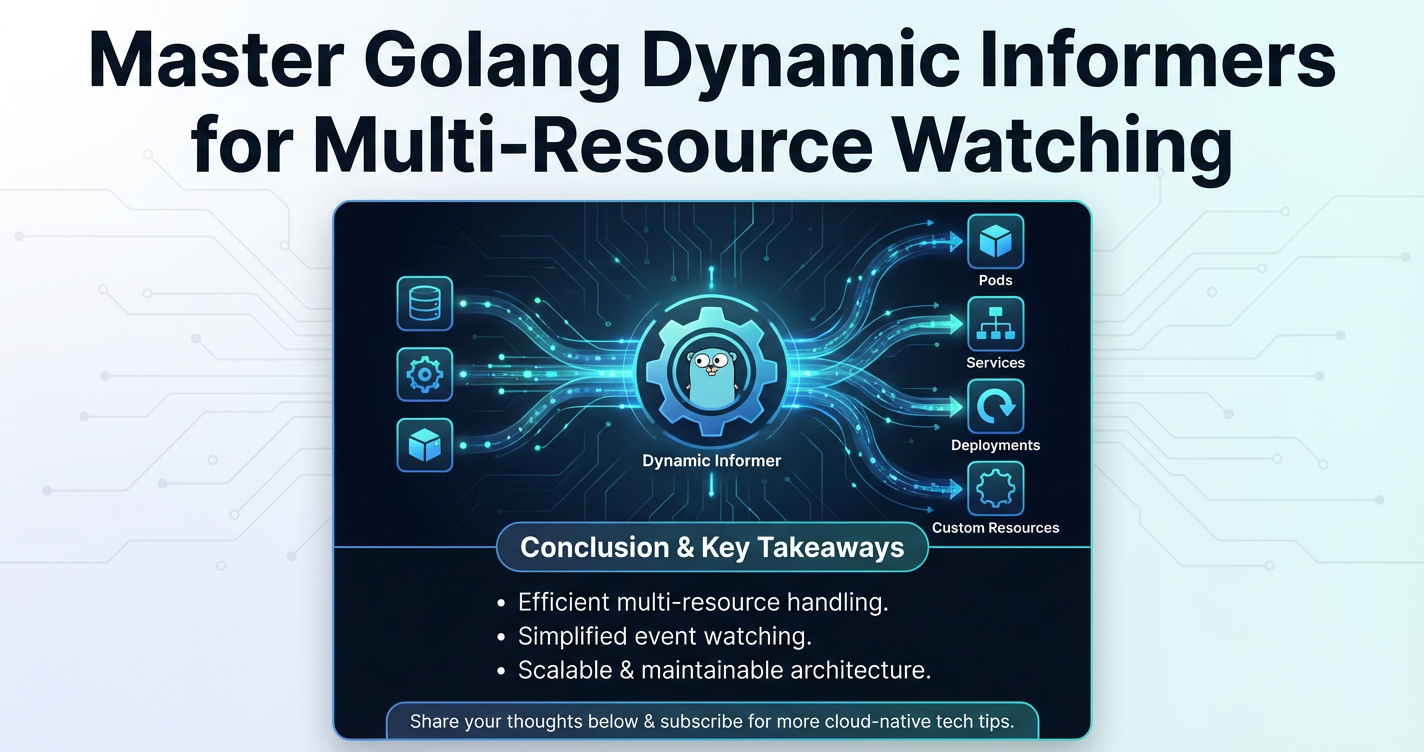
Master Golang Dynamic Informers for Multi-Resource Watching


APIPark is a high-performance AI gateway that allows you to securely access the most comprehensive LLM APIs globally on the APIPark platform, including OpenAI, Anthropic, Mistral, Llama2, Google Gemini, and more.Try APIPark now! 👇👇👇
Mastering Golang Dynamic Informers for Multi-Resource Watching in Kubernetes
In the ever-evolving landscape of cloud-native applications, Kubernetes has emerged as the de facto orchestrator for containerized workloads. At its core, Kubernetes operates on a declarative model, where users define the desired state of their applications, and the control plane works tirelessly to bring the actual state into alignment. For developers building custom controllers, operators, or extensions for Kubernetes, the ability to efficiently monitor changes to various resources is paramount. This is where Kubernetes "informers" come into play. While standard informers excel at watching a predefined set of resources, the true power for complex, adaptable systems often lies in mastering Golang dynamic informers for multi-resource watching.
This comprehensive guide delves deep into the mechanisms, motivations, and practical implementations of dynamic informers in Golang using the client-go library. We will explore how to move beyond static, hardcoded resource definitions to build highly flexible, robust, and future-proof Kubernetes controllers capable of intelligently reacting to an evolving set of resource types, including custom resources (CRDs). By the end of this journey, you will possess the knowledge to architect sophisticated Kubernetes solutions that can adapt to changing operational requirements and new Custom Resource Definitions without requiring a full redeployment.
The Foundation: Kubernetes Controllers and client-go
Before we dive into the intricacies of dynamic informers, it's essential to understand the bedrock upon which they are built: Kubernetes controllers and the client-go library. A Kubernetes controller is a control loop that continuously monitors the state of your cluster and makes changes to move the current state closer to the desired state. For instance, a Deployment controller ensures that the specified number of pod replicas are running, a Service controller ensures that load balancers are correctly configured, and so on.
Writing such controllers in Golang typically involves leveraging client-go, the official Go client library for Kubernetes APIs. client-go provides fundamental interfaces for interacting with the Kubernetes API server, allowing you to create, read, update, and delete (CRUD) Kubernetes objects. However, directly querying the API server for every piece of information or every state change can be inefficient and put undue strain on the API server. This is precisely why informers were introduced. They abstract away the complexities of watching changes, caching objects, and providing event-driven notifications, forming the backbone of almost every robust Kubernetes controller.
Understanding Informers: Caching, Events, and Shared Informers
An informer is a pattern within client-go that provides a reliable, efficient, and event-driven way to obtain and cache Kubernetes objects. Instead of making direct API calls for every operation, informers establish a watch connection to the Kubernetes API server for a specific resource type. When a change occurs (creation, update, deletion), the informer receives an event, updates its local cache, and then notifies any registered event handlers. This mechanism offers several significant advantages:
- Reduced API Server Load: By maintaining a local, consistent cache of objects, controllers can perform read operations against this cache rather than repeatedly hitting the API server. This dramatically reduces the load on the API server, especially in large clusters or for controllers monitoring many objects.
- Event-Driven Architecture: Informers transform a polling-based model (if you were to manually list objects) into an event-driven one. Controllers react to actual changes, making them more efficient and responsive.
- Consistency and Reliability: Informers handle the complexities of list-and-watch semantics, including re-listing after watch disconnections, ensuring that the local cache remains consistent with the API server's state.
- Shared State: The
SharedInformeris a crucial concept. Instead of each controller component creating its own informer for the same resource type, aSharedInformerallows multiple consumers within a single process to share the same cache and watch connection. This further optimizes resource usage and simplifies consistency management across different parts of a complex controller.
A typical informer setup involves creating an informer factory (SharedInformerFactory), then obtaining an informer for a specific resource type (e.g., PodInformer(), DeploymentInformer()), registering event handlers (AddEventHandler), and finally starting the informers. This works exceptionally well when you know exactly which resource types your controller needs to watch at compile time.
The Challenge of Multi-Resource Watching: Beyond Static Declarations
Many Kubernetes controllers, such as an Nginx Ingress Controller, might primarily focus on a few core resource types like Ingresses, Services, and Endpoints. For these scenarios, static informers generated by client-go are perfectly adequate. You define your informers for v1.Pod, v1.Deployment, v1beta1.Ingress, etc., and your controller hums along.
However, the modern Kubernetes ecosystem is characterized by its extensibility, largely due to Custom Resource Definitions (CRDs). Operators, for instance, define their own CRDs to represent application-specific configurations (e.g., a RedisCluster CRD, a KafkaTopic CRD). The challenge arises when a single controller needs to:
- Watch an evolving set of CRDs: A single operator might manage multiple types of databases, each with its own CRD. New database types might be introduced over time.
- Adapt to different API versions: As CRDs mature, their API versions (
v1alpha1,v1beta1,v1) might change, and a controller should ideally be able to adapt without redeployment. - Handle multi-tenancy or dynamic configurations: In multi-tenant environments, a controller might need to watch specific CRDs or standard resources based on tenant configurations, which could change at runtime.
- Build generic tooling: Imagine a general-purpose auditing tool that needs to watch any new CRD that gets registered in the cluster, or a policy engine that needs to enforce rules across a broad, potentially unknown, set of resources.
In these situations, relying on statically generated client-go informers becomes unwieldy or even impossible. You cannot hardcode informers for CRDs that might not exist at compile time or whose GroupVersionResource (GVR) might change. This is where the power of dynamic informers shines, offering a flexible and robust solution to the problem of multi-resource watching.
Static Informers vs. Dynamic Needs: The Limitations
To fully appreciate dynamic informers, let's briefly compare the static approach and its limitations when faced with dynamic requirements.
Static Informers (client-go typed clients and factories):
- Pros: Type-safe (compiler catches errors), excellent IDE support, straightforward to use for known resource types.
- Cons: Requires code generation for custom types, compilation-time coupling to specific GVRs, cannot adapt to new or unknown CRDs without recompiling and redeploying the controller. If you need to watch
Foo.example.com/v1alpha1and laterFoo.example.com/v1beta1, you'd typically need separate informers and logic, or generate new clients. This rigidity is a major drawback for highly adaptable systems.
Dynamic Informers (client-go dynamic client and factory):
- Pros: Highly flexible, can watch any resource type (standard or CRD) identified by its GroupVersionResource (GVR) at runtime, ideal for generic tools, operators managing evolving APIs, or multi-tenant systems.
- Cons: Less type-safe (works with
unstructured.Unstructuredobjects), requires more careful runtime type assertions and error handling, potentially less intuitive for beginners due to the loss of compile-time guarantees.
The trade-off is clear: compile-time safety and simplicity for static, known resources versus runtime flexibility and adaptability for dynamic, evolving, or unknown resources. For building truly resilient and extensible Kubernetes solutions, the latter is often the preferred path.
Dynamic Informers – The Core Concept: Unveiling the Flexibility
The magic behind dynamic informers lies in their ability to interact with the Kubernetes API server using generic interfaces, rather than type-specific ones. This is achieved through a combination of key client-go components:
DiscoveryClient: This client allows your controller to query the Kubernetes API server about the resources it exposes. It can list all available API groups, their versions, and the resources within them, including any CRDs that have been registered. This is the crucial first step for discovering what can be watched dynamically.DynamicClient: Unlike typed clients (e.g.,corev1.CoreV1Clientfor pods), theDynamicClientoperates onunstructured.Unstructuredobjects. This genericunstructuredtype allows it to represent any Kubernetes resource without compile-time knowledge of its specific fields. You interact with resources using their GroupVersionResource (GVR).GroupVersionResource (GVR): This simple struct (schema.GroupVersionResource) is the unique identifier for any resource type in Kubernetes. It combines the API Group (e.g.,apps,batch,example.com), the API Version (e.g.,v1,v1beta1), and the plural Name of the resource (e.g.,deployments,jobs,myresources). With a GVR, theDynamicClientknows how to interact with the correct endpoint.NewFilteredDynamicSharedInformerFactory: This is the dynamic counterpart toNewSharedInformerFactory. Instead of taking a typedclient-goclient, it takes aDynamicClient. Crucially, you provide it with a GVR for each resource you want to watch. The factory then createsDynamicInformerinstances that populate a cache withunstructured.Unstructuredobjects.
The workflow for dynamic informers generally involves:
- Discovering Resources: Use the
DiscoveryClientto list the GVRs of resources you intend to watch. This could be all CRDs, CRDs matching a specific label, or a predefined list of GVRs. - Initializing the Dynamic Client: Create a
DynamicClientinstance from your Kubernetesrest.Config. - Creating a Dynamic Informer Factory: Instantiate
NewFilteredDynamicSharedInformerFactoryusing theDynamicClient. - Adding Informers and Event Handlers: For each GVR you want to watch, obtain a
DynamicInformerfrom the factory and registerResourceEventHandlers. - Starting the Factory: Once all informers are configured, start the factory, which will initiate the list-and-watch cycles for all registered GVRs.
Implementation Details: A Step-by-Step Guide in Golang
Let's walk through a practical example of setting up a dynamic informer to watch multiple resource types, including a hypothetical CRD.
First, ensure you have client-go installed: go get k8s.io/client-go@v0.28.3 (or your preferred version).
package main

import (
    "context"
    "fmt"
    "os"
    "os/signal"
    "syscall"
    "time"

    metav1 "k8s.io/apimachinery/pkg/apis/meta/v1"
    "k8s.io/apimachinery/pkg/runtime/schema"
    "k8s.io/apimachinery/pkg/watch"
    "k8s.io/client-go/dynamic"
    "k8s.io/client-go/dynamic/dynamicinformer"
    "k8s.io/client-go/kubernetes"
    "k8s.io/client-go/rest"
    "k8s.io/client-go/tools/cache"
    "k8s.io/client-go/tools/clientcmd"
    "k8s.io/klog/v2"
)

// ResourceWatcher encapsulates dynamic informers for multiple resources
type ResourceWatcher struct {
    dynamicClient dynamic.Interface
    kubeClient    *kubernetes.Clientset
    informerFactory dynamicinformer.DynamicSharedInformerFactory
    ctx             context.Context
    cancel          context.CancelFunc
}

// NewResourceWatcher creates a new ResourceWatcher instance
func NewResourceWatcher(kubeconfigPath string) (*ResourceWatcher, error) {
    var config *rest.Config
    var err error

    if kubeconfigPath == "" {
        klog.Info("No kubeconfig path provided, using in-cluster config.")
        config, err = rest.InClusterConfig()
    } else {
        klog.Infof("Using kubeconfig from path: %s", kubeconfigPath)
        config, err = clientcmd.BuildConfigFromFlags("", kubeconfigPath)
    }
    if err != nil {
        return nil, fmt.Errorf("failed to create rest config: %w", err)
    }

    dynamicClient, err := dynamic.NewForConfig(config)
    if err != nil {
        return nil, fmt.Errorf("failed to create dynamic client: %w", err)
    }

    kubeClient, err := kubernetes.NewForConfig(config)
    if err != nil {
        return nil, fmt.Errorf("failed to create kubernetes client: %w", err)
    }

    ctx, cancel := context.WithCancel(context.Background())

    return &ResourceWatcher{
        dynamicClient: dynamicClient,
        kubeClient:    kubeClient,
        informerFactory: dynamicinformer.NewDynamicSharedInformerFactory(
            dynamicClient,
            10*time.Minute, // Resync period: how often the cache is re-listed
        ),
        ctx:    ctx,
        cancel: cancel,
    }, nil
}

// AddResourceToWatch registers a dynamic informer for the given GVR and namespace.
func (rw *ResourceWatcher) AddResourceToWatch(gvr schema.GroupVersionResource, namespace string) {
    klog.Infof("Adding informer for GVR: %s, Namespace: %s", gvr.String(), namespace)

    informer := rw.informerFactory.ForResource(gvr).Informer()

    informer.AddEventHandler(cache.ResourceEventHandlerFuncs{
        AddFunc: func(obj interface{}) {
            // obj is unstructured.Unstructured
            if u, ok := obj.(metav1.Object); ok {
                klog.Infof("ADD Event: %s/%s - %s", gvr.Resource, u.GetNamespace(), u.GetName())
                // Detailed processing of the added object goes here
                // For example, if it's a "Deployment", you might check its replicas.
                // If it's your custom "MyResource", you might extract specific fields.
                // Example: Extract labels
                labels := u.GetLabels()
                if len(labels) > 0 {
                    klog.Infof("  Labels: %v", labels)
                }
            }
        },
        UpdateFunc: func(oldObj, newObj interface{}) {
            if u, ok := newObj.(metav1.Object); ok {
                klog.Infof("UPDATE Event: %s/%s - %s", gvr.Resource, u.GetNamespace(), u.GetName())
                // Compare oldObj and newObj to detect specific changes
            }
        },
        DeleteFunc: func(obj interface{}) {
            // Handle deleted objects, which might be `runtime.Object` or `cache.DeletedFinalStateUnknown`
            if u, ok := obj.(metav1.Object); ok {
                klog.Infof("DELETE Event: %s/%s - %s", gvr.Resource, u.GetNamespace(), u.GetName())
            } else if tombstone, ok := obj.(cache.DeletedFinalStateUnknown); ok {
                if u, ok := tombstone.Obj.(metav1.Object); ok {
                    klog.Infof("DELETE (Tombstone) Event: %s/%s - %s", gvr.Resource, u.GetNamespace(), u.GetName())
                }
            }
        },
    })
}

// Run starts all registered informers.
func (rw *ResourceWatcher) Run() {
    klog.Info("Starting dynamic informer factory...")
    rw.informerFactory.Start(rw.ctx.Done())
    rw.informerFactory.WaitForCacheSync(rw.ctx.Done()) // Wait for all caches to be synced
    klog.Info("Dynamic informer factory started and caches synced.")

    // Keep the program running until a termination signal is received
    sigChan := make(chan os.Signal, 1)
    signal.Notify(sigChan, syscall.SIGINT, syscall.SIGTERM)
    <-sigChan

    klog.Info("Shutting down informers...")
    rw.cancel() // Signal informers to stop
    // Give a moment for graceful shutdown
    time.Sleep(2 * time.Second)
    klog.Info("Informers shut down gracefully.")
}

func main() {
    // Provide your kubeconfig path, or leave empty for in-cluster config
    kubeconfig := os.Getenv("KUBECONFIG")
    if kubeconfig == "" {
        kubeconfig = clientcmd.RecommendedHomeFile // Default kubeconfig path
    }

    watcher, err := NewResourceWatcher(kubeconfig)
    if err != nil {
        klog.Fatalf("Failed to initialize resource watcher: %v", err)
    }

    // 1. Example: Watch a standard resource (e.g., Deployments in all namespaces)
    // Group: "apps", Version: "v1", Resource: "deployments"
    watcher.AddResourceToWatch(schema.GroupVersionResource{Group: "apps", Version: "v1", Resource: "deployments"}, metav1.NamespaceAll)

    // 2. Example: Watch another standard resource (e.g., Services in the "default" namespace)
    // Group: "", Version: "v1", Resource: "services" (Core API group has an empty group name)
    watcher.AddResourceToWatch(schema.GroupVersionResource{Group: "", Version: "v1", Resource: "services"}, "default")

    // 3. Example: Watch a Custom Resource Definition (CRD)
    // Assume you have a CRD named 'myresources.example.com' with version 'v1alpha1'
    // You need to ensure this CRD exists in your cluster for the informer to work.
    // Create a CRD first:
    // apiVersion: apiextensions.k8s.io/v1
    // kind: CustomResourceDefinition
    // metadata:
    //   name: myresources.example.com
    // spec:
    //   group: example.com
    //   versions:
    //     - name: v1alpha1
    //       served: true
    //       storage: true
    //       schema:
    //         openAPIV3Schema:
    //           type: object
    //           properties:
    //             spec:
    //               type: object
    //               properties:
    //                 message:
    //                   type: string
    //   scope: Namespaced
    //   names:
    //     plural: myresources
    //     singular: myresource
    //     kind: MyResource
    //     shortNames:
    watcher.AddResourceToWatch(schema.GroupVersionResource{Group: "example.com", Version: "v1alpha1", Resource: "myresources"}, metav1.NamespaceAll)


    // You can even dynamically discover CRDs here before adding them
    // For instance, list all CRDs using rw.kubeClient.ApiextensionsV1().CustomResourceDefinitions().List()
    // Then iterate through them and add informers for each discovered CRD's GVR.
    // This would make the system truly dynamic.

    watcher.Run()
}
Explanation of the Code:
NewResourceWatcher:- Initializes
rest.Configusing eitherInClusterConfig(for running inside a pod) orclientcmd.BuildConfigFromFlags(for local development with kubeconfig). - Creates both
dynamic.NewForConfig(for dynamic operations) andkubernetes.NewForConfig(for standard client operations, useful for discovery). - Sets up a
context.Contextfor graceful shutdown. - Initializes
dynamicinformer.NewDynamicSharedInformerFactory. The10*time.Minuteresync period means that every 10 minutes, the informers will re-list all objects from the API server and reconcile their cache, even if no events were observed. This helps detect any inconsistencies that might have been missed by watch events.
- Initializes
AddResourceToWatch:- Takes a
schema.GroupVersionResource(GVR) and anamespace. The namespace can bemetav1.NamespaceAllfor cluster-wide watching. rw.informerFactory.ForResource(gvr).Informer()is the key call. It creates or retrieves aDynamicInformerfor the specified GVR.informer.AddEventHandlerregisters callback functions for Add, Update, and Delete events. The objects received by these handlers are of typeunstructured.Unstructured, which is a generic map-like structure. You must use methods likeu.GetName(),u.GetNamespace(),u.GetLabels()oru.Object["spec"].(map[string]interface{})["field"]to access their data.
- Takes a
Run:rw.informerFactory.Start(rw.ctx.Done())starts all registered informers in separate goroutines. They begin their initial list operations and then establish watch connections.rw.informerFactory.WaitForCacheSync(rw.ctx.Done())is crucial. It blocks until all informers have completed their initial list operation and their caches are populated, ensuring that your controller doesn't try to operate on an empty or incomplete cache.- The
signal.Notifyand<-sigChanblock ensure the program runs indefinitely until aSIGINT(Ctrl+C) orSIGTERMsignal is received, at which pointrw.cancel()is called to gracefully shut down the informers.
Key Point: The unstructured.Unstructured Type
When working with dynamic informers, all objects you receive will be of type *unstructured.Unstructured. This type is essentially a map[string]interface{} with convenience methods for accessing common metadata (GetName, GetNamespace, GetLabels, GetAnnotations). To access fields within the spec or status, you typically have to perform type assertions and navigate the map structure.
For example, to get a field message from spec of our MyResource CRD:
// Inside an event handler func for MyResource
if u, ok := obj.(metav1.Object); ok {
    unstructuredObj := obj.(*unstructured.Unstructured)
    if spec, ok := unstructuredObj.Object["spec"].(map[string]interface{}); ok {
        if message, ok := spec["message"].(string); ok {
            klog.Infof("MyResource %s/%s has message: %s", u.GetNamespace(), u.GetName(), message)
        }
    }
}
This loss of compile-time type safety requires more rigorous runtime checks and error handling, which is the main trade-off for the immense flexibility offered by dynamic informers.
Advanced Scenarios & Considerations
Mastering dynamic informers goes beyond basic setup. Several advanced considerations enhance their utility and robustness.
1. Dynamic Discovery of CRDs
For a truly generic operator or a policy engine, you might not even know the CRDs you need to watch at startup. The DiscoveryClient comes into its own here. You can list all CustomResourceDefinition objects (using kubeClient.ApiextensionsV1().CustomResourceDefinitions().List(ctx, metav1.ListOptions{})), extract their GVRs, and then programmatically add informers for each.
This allows your controller to automatically adapt to new CRD deployments without needing a restart or recompile. For example, a "meta-operator" could watch CustomResourceDefinition objects themselves and dynamically provision informers for any new CRDs it's configured to manage.
// Example snippet for dynamic CRD discovery
func (rw *ResourceWatcher) DiscoverAndAddCRDs() error {
    crdClient := rw.kubeClient.ApiextensionsV1().CustomResourceDefinitions()
    crdList, err := crdClient.List(rw.ctx, metav1.ListOptions{})
    if err != nil {
        return fmt.Errorf("failed to list CRDs: %w", err)
    }

    for _, crd := range crdList.Items {
        // Filter CRDs based on your criteria (e.g., specific labels, groups)
        if crd.Spec.Group == "example.com" { // Only watch CRDs from "example.com" group
            // Pick the storage version if multiple versions are available
            var targetVersion string
            for _, v := range crd.Spec.Versions {
                if v.Storage {
                    targetVersion = v.Name
                    break
                }
            }
            if targetVersion == "" && len(crd.Spec.Versions) > 0 {
                targetVersion = crd.Spec.Versions[0].Name // Fallback to first if no storage version explicitly marked
            }

            if targetVersion != "" {
                gvr := schema.GroupVersionResource{
                    Group:    crd.Spec.Group,
                    Version:  targetVersion,
                    Resource: crd.Spec.Names.Plural,
                }
                rw.AddResourceToWatch(gvr, metav1.NamespaceAll)
            }
        }
    }
    return nil
}
You would call rw.DiscoverAndAddCRDs() before rw.Run().
2. Performance Implications and Resource Management
While informers are highly efficient, watching hundreds or thousands of resource types can still consume significant memory (for the caches) and CPU (for processing events).
- Selective Watching: Only watch resources absolutely necessary. If you only care about a specific namespace, use
dynamicinformer.NewFilteredDynamicSharedInformerFactorywith aTweakListOptionsfunction to specify the namespace. - Resync Period: A longer resync period reduces the frequency of full list operations, saving API server load. However, it also means it takes longer for the cache to self-correct if a watch event was somehow missed. Choose a balance appropriate for your controller's resilience requirements.
- Event Handler Efficiency: Your event handlers should be as lean and efficient as possible. Avoid blocking operations within the handlers. Instead, push the processing work onto a work queue (e.g.,
workqueue.RateLimitingInterfacefromclient-go/util/workqueue) for asynchronous processing. This is a standard pattern for Kubernetes controllers.
3. Error Handling and Resilience
Network partitions, API server downtime, or invalid configurations can disrupt informer operations. client-go informers are built with resilience in mind, automatically attempting to re-establish watch connections. However, your controller logic should also be robust:
- Retry Mechanisms: Implement exponential backoff for API calls made within your event handlers.
- Health Checks: Expose a health endpoint for your controller that reflects the status of its informers (e.g., whether caches are synced).
- Logging and Metrics: Comprehensive logging and metrics (e.g., Prometheus) are indispensable for observing informer health, event processing rates, and any errors.
4. Contexts and Concurrency
The use of context.Context for managing the lifecycle of informers is vital. When the ctx.Done() channel is closed, all informer goroutines should gracefully shut down. For concurrent processing of events, as mentioned, a work queue is the idiomatic client-go approach, allowing you to limit concurrency and re-process failed items.
5. Real-World Use Cases: Operators and Generic Tools
Dynamic informers are the cornerstone for many advanced Kubernetes patterns:
- Generic Kubernetes Operators: An operator that can manage a class of applications, rather than a single specific application type. For example, a "database operator" that can manage different SQL databases, each represented by a similar but distinct CRD.
- Policy Engines: Tools like OPA Gatekeeper that enforce policies across various Kubernetes resources, including new or custom ones, need to dynamically discover and watch resources.
- Auditing and Compliance Tools: Applications that log or react to changes in any resource within a cluster for security or compliance purposes.
- Kubernetes-native CI/CD: A system that watches for changes in Git repositories (represented by CRDs like GitRepository) and then watches for changes in related Deployments or Pods to update status.
Consider the complexity of managing a fleet of microservices, each potentially exposing its own API, perhaps even AI-driven ones. An operator built with dynamic informers could watch for new Service or Ingress resources, dynamically recognizing and configuring these services. Once these services are discovered and managed within Kubernetes, their external exposure and consumption become critical. This is precisely where robust API management platforms like ApiPark offer immense value. While your Golang informers efficiently track internal cluster state, APIPark can act as the gateway, providing unified management for these dynamically created or updated APIs, offering features like authentication, traffic control, and analytics, ensuring external consumers interact with them securely and reliably.
Best Practices for Dynamic Informer Development
To leverage dynamic informers effectively, adhere to these best practices:
- Start with Specific GVRs, Then Abstract: When beginning, explicitly define the GVRs you want to watch. As your understanding grows and requirements solidify, introduce CRD discovery for true dynamism.
- Robust Error Handling for
unstructured.Unstructured: Always check forniland perform type assertions (if value, ok := myMap["key"].(string); ok) when working withunstructured.Unstructuredobjects. Incorrect type assertions will lead to runtime panics. - Utilize Work Queues: For any non-trivial processing in event handlers, use a work queue. This decouples event reception from event processing, allowing the informer to quickly update its cache and preventing handler delays from blocking the informer.
- Logging is Crucial: Log significant events, errors, and any unexpected object structures. This is invaluable for debugging in a distributed Kubernetes environment.
- Graceful Shutdown: Ensure your
contextis properly used to allow all goroutines, especially informers and work queue workers, to shut down cleanly when your controller exits. - Avoid Direct Cache Modification: The informer's cache is read-only for consumers. Never attempt to modify objects obtained from the cache directly. If you need to change an object, create a deep copy, modify the copy, and then use the
DynamicClientto update the object in the API server. - Watch CRDs Themselves: If your controller needs to react to the creation or deletion of CRDs, remember to add an informer for
CustomResourceDefinitionobjects (apiextensions.k8s.io/v1/customresourcedefinitions). This allows your system to dynamically adapt its watch list as new CRD schemas are deployed or removed.
Integrating with API Management: A Holistic View
While dynamic informers brilliantly solve the problem of internal cluster state observation, the services and data they manage often need to be exposed externally or consumed by other internal systems. This is where the broader ecosystem of API management becomes critical. As your Golang controllers, powered by dynamic informers, bring up and manage various services (perhaps even complex AI models exposed as services), you'll inevitably face challenges in:
- Unified Access: How do different client applications discover and consume these services?
- Security: How are these APIs authenticated, authorized, and protected from abuse?
- Monitoring and Analytics: How do you track usage, performance, and identify issues across all exposed APIs?
- Lifecycle Management: How do you version, deprecate, and retire APIs gracefully?
This is precisely the domain where an open-source AI gateway and API management platform like ApiPark excels. Imagine your dynamic informer-driven operator spinning up new AI model inference services (e.g., for sentiment analysis or image recognition), each potentially a distinct Kubernetes service. APIPark can seamlessly integrate these services:
- Quick Integration: It can quickly integrate these new services, turning them into managed APIs.
- Unified API Format: For AI models, APIPark standardizes the invocation format, abstracting away differences between various underlying models that your dynamic informers might be managing.
- Prompt Encapsulation: It can even encapsulate prompts with AI models, creating new, high-level APIs from your dynamically provisioned AI services.
- End-to-End API Lifecycle Management: From design to publication and monitoring, APIPark provides the tooling to manage these APIs, controlling traffic, load balancing, and versioning.
- Team Sharing and Permissions: It allows different teams to discover and securely use APIs exposed by your cluster, with granular access controls and approval workflows, ensuring that critical data or expensive AI models are accessed only by authorized parties.
- Performance and Observability: With high performance rivaling Nginx and detailed API call logging, APIPark ensures that your external API exposure is as robust and observable as your internal Kubernetes operations.
By combining the internal agility provided by Golang dynamic informers with the external robustness of a platform like APIPark, you can build a truly comprehensive, scalable, and manageable cloud-native application ecosystem. Your controllers handle the "what's happening inside," and APIPark handles "how the world interacts with it."
| Feature/Aspect | Static Informers | Dynamic Informers | APIPark (Complementary) |
|---|---|---|---|
| Resource Types | Known at compile-time (Pods, Deployments, specific CRDs). | Discovered at runtime (any standard or custom GVR). | Manages external access to any API service. |
| Flexibility | Low; requires recompilation for new types/versions. | High; adapts to new CRDs without redeployment. | High; flexible integration with various service types. |
| Type Safety | High; uses Go types for objects. | Low; uses unstructured.Unstructured, requires runtime assertions. |
N/A (operates on API definitions, not internal objects). |
| Primary Use Case | Building specific controllers for predefined resources. | Generic operators, policy engines, auditing tools, meta-operators. | Exposing, securing, managing, and analyzing APIs (including AI). |
| Integration | Direct client-go type-safe methods. |
DynamicClient, DiscoveryClient, GVRs. |
API endpoints, service discovery (e.g., Kubernetes services). |
| Learning Curve | Moderate. | Higher; due to unstructured and discovery logic. |
Moderate; API definitions, policies, gateway concepts. |
| Benefits | Compiler guarantees, cleaner code for known types. | Adaptability, future-proofing, powerful for extensible systems. | Centralized control, security, monetization, analytics for exposed services. |
Conclusion
The journey from static client-go informers to mastering Golang dynamic informers for multi-resource watching is a significant step forward for any developer or architect deeply involved in Kubernetes. It unlocks a new level of flexibility, allowing you to build controllers and operators that can truly adapt to the dynamic nature of a Kubernetes cluster, whether that means new CRDs being introduced, API versions evolving, or configurations shifting at runtime.
By understanding the interplay between the DiscoveryClient, DynamicClient, and DynamicSharedInformerFactory, you gain the ability to create robust, self-adapting systems. While the trade-off involves managing unstructured.Unstructured objects and diligent runtime error handling, the benefits in terms of extensibility and maintainability for complex, ever-changing environments are undeniable. As your Kubernetes-native services grow in complexity and number, remember that efficiently managing their internal state with dynamic informers is one side of the coin, and effectively exposing and governing them externally with a powerful API management solution like ApiPark is the other, equally critical side. Together, these tools empower you to build and operate a truly scalable, resilient, and intelligent cloud-native ecosystem.
FAQs
- What is the primary difference between static and dynamic informers in Golang
client-go? Static informers are designed for specific, known Kubernetes resource types (like Pods, Deployments) or custom resources for whichclient-gocode has been generated. They offer compile-time type safety. Dynamic informers, on the other hand, can watch any resource type (standard or Custom Resource) at runtime, identified by its GroupVersionResource (GVR), without needing compile-time knowledge or code generation. They operate onunstructured.Unstructuredobjects, trading type safety for immense flexibility. - When should I choose dynamic informers over static ones? Dynamic informers are best suited for scenarios where your controller needs to adapt to an evolving set of resources. This includes building generic operators that manage multiple, potentially unknown CRDs, policy engines that apply rules across all cluster resources, auditing tools, or multi-tenant systems where resource types might vary per tenant. If you're building a simple controller for a fixed set of well-defined resources, static informers are often simpler due to their type safety.
- What are the key
client-gocomponents needed to implement dynamic informers? The core components are theDiscoveryClient(to discover available API resources and their GVRs), theDynamicClient(to interact with resources using GVRs andunstructured.Unstructuredobjects), and thedynamicinformer.NewDynamicSharedInformerFactory(to create and manage the dynamic informers and their shared cache). - How do I handle the
unstructured.Unstructuredobjects returned by dynamic informers?unstructured.Unstructuredobjects are essentiallymap[string]interface{}representations of Kubernetes resources. You access their fields using map key lookups (e.g.,obj.Object["spec"]) and must perform explicit type assertions (e.g.,if val, ok := obj.Object["spec"].(map[string]interface{}); ok) to safely extract data. This requires careful runtime validation and error handling as opposed to compile-time type checking. - Can dynamic informers be used to watch Custom Resource Definitions (CRDs) themselves? Yes, absolutely. To dynamically react to the creation or deletion of CRDs within your cluster, you would set up a dynamic informer specifically for the
CustomResourceDefinitionresource type. Its GVR isschema.GroupVersionResource{Group: "apiextensions.k8s.io", Version: "v1", Resource: "customresourcedefinitions"}. By watching CRDs, your controller can then dynamically adjust its own set of informers to start or stop watching the resources defined by those CRDs.
🚀You can securely and efficiently call the OpenAI API on APIPark in just two steps:
Step 1: Deploy the APIPark AI gateway in 5 minutes.
APIPark is developed based on Golang, offering strong product performance and low development and maintenance costs. You can deploy APIPark with a single command line.
curl -sSO https://download.apipark.com/install/quick-start.sh; bash quick-start.sh

In my experience, you can see the successful deployment interface within 5 to 10 minutes. Then, you can log in to APIPark using your account.

Step 2: Call the OpenAI API.