Mastering AI Gateway Resource Policy for Secure Access
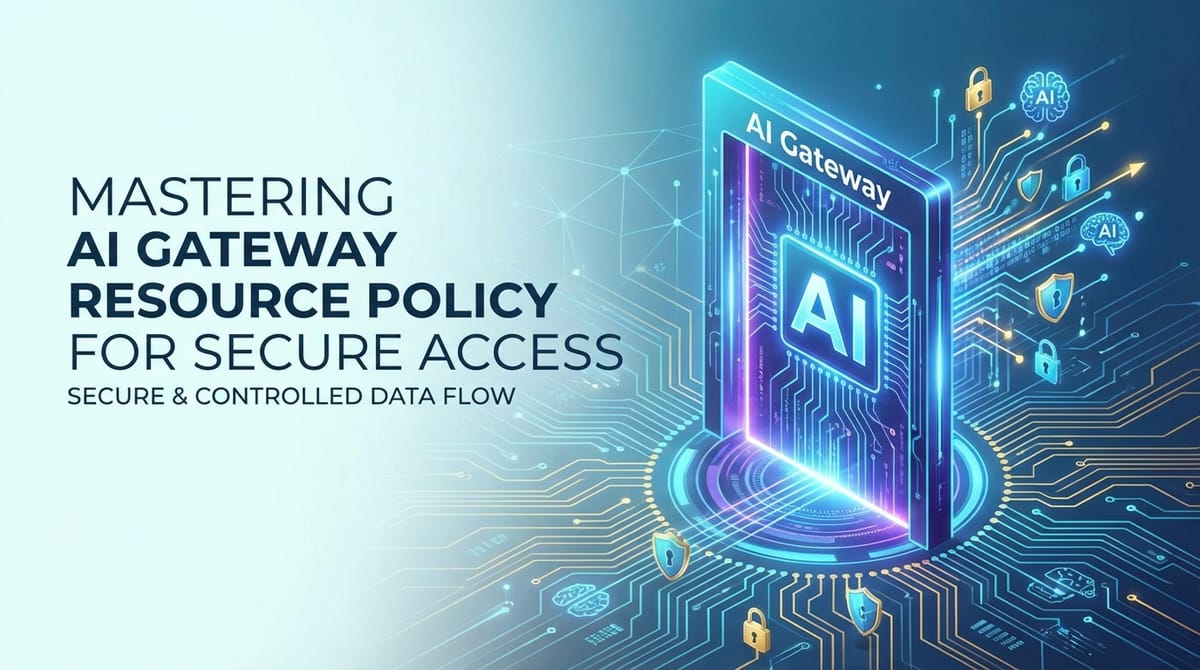


In an increasingly interconnected digital world, the rapid proliferation of Artificial Intelligence (AI) models and services has introduced unprecedented opportunities alongside complex challenges, particularly concerning security and access management. As enterprises race to integrate AI capabilities into their core operations, the need for robust, intelligent infrastructure to govern these powerful tools becomes paramount. At the heart of this infrastructure lies the AI Gateway, a sophisticated control plane designed not only to facilitate access to AI services but, crucially, to secure them. This article delves deep into the intricacies of mastering AI Gateway resource policy, exploring how meticulously crafted policies are the linchpin for ensuring secure, compliant, and efficient access to AI resources in today's dynamic technological landscape. We will unpack the critical components of these policies, examine best practices for their implementation, and understand their indispensable role within broader API Governance frameworks.
The journey into secure AI access is not merely a technical exercise; it's a strategic imperative that touches upon data privacy, regulatory compliance, operational resilience, and financial prudence. Without a clear, enforceable set of resource policies, AI implementations risk becoming vulnerabilities, exposing sensitive data, succumbing to misuse, or incurring exorbitant costs. Therefore, understanding and expertly applying resource policies within an AI Gateway is no longer optional but a fundamental requirement for any organization leveraging AI at scale.
The Confluence of AI and APIs: A New Frontier for Security
The last decade has witnessed a seismic shift in how software is developed and delivered, largely driven by the adoption of Application Programming Interfaces (APIs). APIs have become the digital glue that binds disparate systems, services, and data sources, enabling rapid innovation and ecosystem growth. Simultaneously, Artificial Intelligence has moved from the realm of academic research into practical, enterprise-grade applications, powering everything from customer service chatbots and personalized recommendations to predictive analytics and autonomous systems. The convergence of these two transformative technologies—AI services exposed and consumed via APIs—has given rise to a new paradigm, demanding specialized infrastructure for their management and security.
Traditional API Gateway solutions have long served as the frontline defense and control points for RESTful APIs, handling tasks like authentication, authorization, rate limiting, and traffic management. However, AI services present unique characteristics and challenges that extend beyond the scope of conventional API management. AI models often consume and generate vast amounts of data, much of which can be sensitive, personal, or proprietary. The computational resources required to run these models can be substantial, making cost control a significant concern. Furthermore, the very nature of AI, with its potential for bias, 'hallucinations,' and complex inference patterns, introduces new layers of ethical and operational risk that must be addressed at the access layer.
This is precisely where the AI Gateway steps in, acting as an intelligent intermediary specifically tailored to the nuances of AI workloads. While it inherits many foundational capabilities from its API Gateway predecessors, an AI Gateway adds specialized functionalities such as prompt engineering management, model versioning, output validation, and dedicated cost tracking for AI inferences. Crucially, it provides a centralized mechanism to enforce policies that are contextually aware of the AI domain, ensuring that access to these powerful capabilities is not just managed, but rigorously secured and governed.
Understanding the AI Gateway and Its Role in Resource Management
An AI Gateway serves as a single entry point for all interactions with an organization's AI models and services, regardless of where those models are hosted (on-premise, cloud, or hybrid environments). It abstracts away the complexity of integrating with various AI frameworks, model types, and inference engines, providing a unified interface for developers and applications. More importantly, it acts as the primary enforcement point for resource policies, governing who can access which AI models, under what conditions, and with what usage parameters.
Think of an AI Gateway as the vigilant gatekeeper for your intellectual property embodied in AI models and the sensitive data they process. It's not just routing requests; it's evaluating every incoming call against a sophisticated rulebook—the resource policies—before granting passage. This strategic positioning allows the AI Gateway to address a multitude of concerns:
- Unified Access Control: Centralizing authentication and authorization for all AI services, eliminating siloed security implementations.
- Security Posture Enforcement: Applying consistent security measures, such as encryption, threat detection, and data validation, across the entire AI ecosystem.
- Performance Optimization: Implementing caching, load balancing, and intelligent routing to ensure AI services are responsive and scalable.
- Cost Management: Monitoring and controlling the consumption of expensive computational resources associated with AI model inferences.
- Observability and Auditing: Providing comprehensive logging, metrics, and tracing capabilities to understand AI service usage, performance, and potential security incidents.
- Simplified Integration: Offering a standardized interface for consuming diverse AI models, streamlining application development and reducing integration overhead. This is where platforms like ApiPark excel, providing an all-in-one AI gateway and API management platform that simplifies the integration of over 100 AI models with a unified API format, making AI invocation straightforward and cost-effective.
The evolution from a generic API Gateway to a specialized AI Gateway underscores the growing recognition that AI assets are distinct and require purpose-built governance mechanisms. These mechanisms are largely expressed through the implementation of robust resource policies.
The Indispensable Role of Resource Policies in AI Gateways
Resource policies are the programmatic rules and configurations that define how an AI Gateway should behave when handling requests for AI services. They are the operational manifestation of an organization's security, compliance, performance, and cost management strategies. Without well-defined and rigorously enforced resource policies, even the most advanced AI Gateway becomes a mere proxy, incapable of delivering true secure access and effective governance.
The criticality of resource policies for AI Gateways stems from several key factors:
- Security Enhancement: Policies are the first line of defense against unauthorized access, data breaches, and malicious attacks. They ensure that only authenticated and authorized entities can interact with AI models and the data they process.
- Compliance Adherence: Many industries are subject to stringent regulations (e.g., GDPR, HIPAA, CCPA, upcoming AI Acts). Resource policies can be configured to enforce data privacy rules, consent management, data residency requirements, and audit trails, ensuring that AI usage remains compliant with legal and ethical standards.
- Cost Optimization: AI models, especially large language models (LLMs) or complex deep learning models, can be expensive to run. Policies such as rate limiting, quotas, and tiered access help control usage, prevent abuse, and manage operational costs effectively.
- Operational Resilience: By enforcing policies like circuit breakers, timeouts, and fallback mechanisms, resource policies help protect AI services from overload, cascading failures, and ensure service availability and reliability.
- Quality of Service (QoS) Management: Policies can prioritize critical applications, ensure fair usage across different tenants or users, and maintain consistent performance levels for high-priority AI workloads.
- Data Governance: AI models are data-hungry. Policies can be designed to validate, transform, mask, or filter data inputs and outputs, protecting sensitive information and ensuring data integrity throughout the AI inference lifecycle.
- Ethical AI Considerations: While not a complete solution, policies can contribute to ethical AI by enforcing model usage guidelines, preventing specific types of harmful inputs, or flagging outputs that violate predefined content standards.
Types of Resource Policies in an AI Gateway
A comprehensive AI Gateway will support a rich array of policy types, each addressing a specific dimension of security, control, or management. Here's a breakdown of common and essential resource policies:
| Policy Category | Description | Key Benefits |
|---|---|---|
| Authentication | Verifies the identity of the user or application attempting to access the AI service. | Prevents unauthorized access; establishes identity for auditing. |
| Authorization | Determines what an authenticated user/application is permitted to do with specific AI services or resources (e.g., call a specific model, access certain data fields). | Enforces least privilege principle; prevents misuse of AI capabilities. |
| Rate Limiting | Restricts the number of requests an individual client can make to an AI service within a specified time frame. | Prevents abuse (DDoS), ensures fair usage, protects backend AI services from overload, manages costs. |
| Quotas/Usage Tiers | Defines maximum allowable usage limits (e.g., number of tokens, GPU hours, inference calls) over longer periods (daily, monthly) or assigns different access levels based on subscription plans. | Manages resource consumption, facilitates monetization, ensures capacity planning. |
| Data Transformation | Modifies request or response payloads. Examples include masking sensitive data (PII), encrypting/decrypting data, normalizing input formats, or filtering output content. | Enhances data privacy and compliance, standardizes data formats for AI models, reduces data exposure. |
| Request/Response Validation | Checks incoming requests for valid parameters, data types, and structures, and outgoing responses for expected formats and content. | Protects AI models from invalid or malicious inputs (e.g., prompt injection), ensures data integrity, maintains API contract. |
| Traffic Routing | Directs incoming requests to specific AI model versions, different backend instances, or even alternative AI providers based on criteria like load, latency, user location, or A/B testing configurations. | Improves performance, enables canary deployments, facilitates A/B testing, ensures high availability. |
| Caching | Stores responses from AI services for a specified duration, serving subsequent identical requests from the cache rather than re-invoking the AI model. | Reduces latency, decreases computational costs, lightens load on backend AI services. |
| Logging & Auditing | Records comprehensive details of every API call, including request/response payloads, timestamps, client IDs, latency, and errors. | Essential for security forensics, compliance audits, troubleshooting, and understanding usage patterns. (Platforms like ApiPark offer detailed API call logging for easy tracing and troubleshooting.) |
| Threat Protection | Implements security measures such as IP whitelisting/blacklisting, bot detection, and Web Application Firewall (WAF)-like capabilities specifically tailored to AI API threats. | Defends against common web attacks and AI-specific threats. |
Key Pillars of Secure Access through AI Gateway Resource Policies
Mastering secure access through an AI Gateway requires a deep dive into the practical application of these policy types, understanding their nuances, and how they collectively form a robust security perimeter.
1. Authentication Mechanisms: Verifying Identity
Authentication is the foundational layer of secure access. Before any resource policy can determine what an entity is allowed to do, the AI Gateway must first confirm who that entity is. A strong AI Gateway supports a variety of authentication methods to cater to diverse client types and security requirements.
- API Keys: Simple tokens often used for identifying applications or specific projects. While easy to implement, API keys are typically treated as secrets and should be managed carefully, ideally rotated regularly, and secured against exposure. They are generally suitable for less sensitive AI services or as a component of a multi-factor authentication strategy.
- OAuth 2.0 and OpenID Connect (OIDC): Industry-standard protocols for delegated authorization, allowing users to grant third-party applications limited access to their resources without sharing credentials. OAuth 2.0 is ideal for securing user-centric AI services, ensuring that access is tied to a specific user's consent and identity, often managed by an Identity Provider (IdP). OIDC builds on OAuth to provide identity verification.
- JSON Web Tokens (JWT): Self-contained tokens that can be used to transmit information securely between parties. After a user authenticates with an IdP, a JWT is issued, containing claims about the user. The AI Gateway can validate the JWT's signature and expiration without needing to call back to the IdP for every request, improving performance. JWTs are highly versatile for microservices architectures and distributed AI systems.
- Mutual TLS (mTLS): Provides two-way authentication between the client and the AI Gateway, where both parties present and verify digital certificates. This offers the highest level of cryptographic assurance for identity and is particularly well-suited for machine-to-machine communication or highly sensitive AI workloads in zero-trust environments.
- SAML (Security Assertion Markup Language): Often used in enterprise environments for single sign-on (SSO), SAML allows a user to log in once to an identity provider and then access multiple service providers (including AI services via the gateway) without re-authenticating.
Choosing the appropriate authentication method depends on the sensitivity of the AI service, the nature of the client (human user, machine, another service), and the existing identity infrastructure. Best practice often involves combining methods, for instance, using OAuth with JWTs for user-facing applications and mTLS for internal service mesh communication.
2. Authorization Strategies: Defining Permissions
Once authenticated, the AI Gateway must decide if the entity is authorized to perform the requested action on the specific AI resource. Authorization policies are far more granular than authentication, dictating access levels based on roles, attributes, or contextual information.
- Role-Based Access Control (RBAC): Assigns permissions based on a user's or application's role (e.g., "Data Scientist," "Application Developer," "Guest User"). A "Data Scientist" might have access to train and fine-tune AI models, while an "Application Developer" might only be allowed to invoke production models. RBAC is straightforward to implement for well-defined roles.
- Attribute-Based Access Control (ABAC): Provides a more dynamic and fine-grained authorization model. Access is granted based on a combination of attributes of the user (e.g., department, security clearance), the resource (e.g., sensitivity level of the AI model, data classification), and the environment (e.g., time of day, IP address). ABAC is powerful for complex scenarios but requires a robust attribute management system.
- Policy-as-Code: Treats authorization policies as code, allowing them to be versioned, tested, and deployed alongside the AI services themselves. This approach brings the benefits of DevOps to security, ensuring consistency and auditability. Frameworks like OPA (Open Policy Agent) enable externalized policy enforcement.
- Granular Resource-Level Permissions: Authorization policies should ideally allow for permissions to be defined at the level of specific AI models, versions, or even particular endpoints within an AI service. For example, a user might be authorized to use a "sentiment analysis" model but not a "facial recognition" model.
The principle of "least privilege" is paramount here: grant only the minimum necessary permissions for a user or application to perform its function. Regular review of authorization policies is crucial to prevent privilege creep.
3. Rate Limiting and Throttling: Managing Consumption and Preventing Abuse
AI models can be computationally intensive, and uncontrolled access can lead to service degradation, denial of service, or escalating costs. Rate limiting and throttling policies are essential for managing the flow of requests.
- Rate Limiting: Sets a hard limit on the number of requests a client can make within a specified time window (e.g., 100 requests per minute per API key). Once the limit is reached, subsequent requests are rejected until the window resets. This protects the backend AI service from being overwhelmed by a single client, whether maliciously or accidentally.
- Throttling: A more sophisticated approach that might allow requests to queue or process them at a slower pace rather than outright rejecting them. This can be implemented to ensure a baseline quality of service for all users while gracefully degrading performance for heavy users.
- Burst Limits: Allows for temporary spikes in traffic above the average rate limit, providing flexibility for applications with variable usage patterns without impacting overall stability.
- Concurrent Request Limits: Restricts the number of simultaneous active requests a client can have, preventing resource exhaustion on the AI model instances.
These policies are critical for: * DDoS Protection: Mitigating distributed denial-of-service attacks that aim to overload AI services. * Cost Control: Directly impacting billing for usage-based AI services by capping consumption. * Fair Usage: Ensuring that one heavy user doesn't degrade service for others. * Resource Protection: Safeguarding the backend AI infrastructure from being overutilized.
4. Quotas and Usage Tiers: Monetization and Capacity Planning
Beyond real-time rate limits, quotas define cumulative usage allowances over longer periods (e.g., monthly token usage for an LLM). These are particularly relevant for AI services offered on a subscription or pay-per-use model.
- Hard Quotas: Once reached, no further requests are permitted until the quota resets or is increased.
- Soft Quotas: Warn users when approaching their limit, allowing them to upgrade their plan or adjust usage before a hard stop.
- Tiered Access: Different subscription plans (e.g., "Basic," "Premium," "Enterprise") can be linked to varying rate limits, quotas, and access to specific, more powerful AI models or features. This allows organizations to segment their user base and monetize AI services effectively.
Integrating quotas with billing systems and providing clear usage dashboards to users enhances transparency and helps manage expectations.
5. Data Governance and Transformation: Protecting Sensitive Information
AI models often handle vast amounts of data, much of which can be sensitive (Personal Identifiable Information - PII, financial data, health records). Data governance policies within the AI Gateway are crucial for compliance and privacy.
- Data Masking/Redaction: Automatically identifies and redacts sensitive information in requests before they reach the AI model, or in responses before they are sent back to the client. This could involve blurring faces in images, masking credit card numbers, or removing specific PII from text.
- Encryption/Decryption: Enforcing encryption for data in transit (mTLS, HTTPS) and at rest, and potentially handling payload encryption/decryption at the gateway level for specific sensitive fields.
- Input/Output Validation: Ensures that data conforms to expected formats and schemas, preventing malformed inputs that could crash models or lead to unexpected outputs, and validating outputs for adherence to data contracts.
- Content Filtering: For generative AI models, policies can filter out prompts that request harmful content or filter responses that contain inappropriate or biased information, acting as a guardrail against misuse and ensuring ethical AI deployment.
- Data Residency Policies: For global deployments, policies can route requests to AI models deployed in specific geographic regions to comply with data residency laws.
These policies are critical for maintaining regulatory compliance (e.g., GDPR's right to privacy), protecting user data, and upholding the ethical use of AI.
6. Auditing and Logging: Visibility, Compliance, and Forensics
Comprehensive logging is not just a debugging tool; it's a critical security and compliance feature. Every interaction with an AI Gateway should be meticulously recorded.
- Detailed Call Logs: Recording full details of each API call, including request/response payloads (with sensitive data masked), timestamps, client identifiers, latency, errors, and the specific AI model and version invoked. This level of detail is invaluable for troubleshooting, performance analysis, and post-incident forensics.
- Audit Trails: Tracking who accessed what, when, and what actions were taken. This is crucial for demonstrating compliance with regulatory requirements and for identifying unauthorized access attempts or suspicious activity.
- Centralized Logging: Aggregating logs from multiple AI Gateway instances and AI services into a centralized logging platform for easier analysis, correlation, and long-term storage.
Platforms like ApiPark provide powerful data analysis capabilities on top of detailed API call logging, allowing businesses to analyze historical call data, visualize long-term trends, and identify performance changes or potential issues before they escalate. This proactive monitoring is key to maintaining system stability and data security.
7. Threat Protection and Validation: Active Defense
Beyond passive logging, an AI Gateway can actively defend against various threats.
- Schema Validation: Ensuring that all incoming requests adhere to a predefined OpenAPI/Swagger schema, rejecting non-compliant requests upfront.
- Input Sanitation: Removing or encoding potentially malicious characters or scripts from user inputs to prevent injection attacks (e.g., prompt injection in LLMs, SQL injection in database interactions through AI).
- IP Whitelisting/Blacklisting: Allowing access only from trusted IP addresses or blocking known malicious ones.
- Bot Detection: Identifying and mitigating automated bot traffic that might be scraping data, attempting brute-force attacks, or overloading services.
- Anomaly Detection: Monitoring request patterns for unusual behavior (e.g., sudden spikes in error rates, unusual request volumes from a single source) that could indicate an attack or system anomaly.
Implementing these proactive defense mechanisms at the gateway significantly reduces the attack surface for backend AI models and services.
APIPark is a high-performance AI gateway that allows you to securely access the most comprehensive LLM APIs globally on the APIPark platform, including OpenAI, Anthropic, Mistral, Llama2, Google Gemini, and more.Try APIPark now! 👇👇👇
Implementing Effective AI Gateway Resource Policies: A Strategic Approach
Deploying resource policies is not a one-time task; it's a continuous process that requires strategic planning, thoughtful execution, and ongoing iteration.
Design Principles
- Least Privilege: Grant only the bare minimum permissions required for a user or application to perform its function. This minimizes the impact of a compromised account.
- Defense in Depth: Employ multiple layers of security policies. Even if one layer is bypassed, others remain to provide protection. For example, API key authentication, followed by RBAC authorization, followed by input validation, and finally rate limiting.
- Zero Trust: Assume no user or service, whether inside or outside the network perimeter, is inherently trustworthy. Verify every request, continuously monitor, and enforce policies based on context.
- Policy-as-Code: Treat policies like any other software artifact. Define them in machine-readable formats, store them in version control systems, and automate their deployment and testing. This ensures consistency, auditability, and faster iteration.
Centralized Management and Orchestration
Effective policy management requires a centralized platform where policies can be defined, configured, and applied across multiple AI Gateways and AI services. This eliminates configuration drift, reduces human error, and ensures consistent security posture. Such platforms often offer:
- Unified Policy Editor: A graphical interface or declarative configuration language for defining all types of policies.
- Policy Templating: Reusable policy templates for common scenarios, accelerating deployment and ensuring best practices.
- Policy Versioning: Tracking changes to policies over time, allowing for rollbacks if issues arise.
- Policy Deployment Automation: Integrating with CI/CD pipelines to automatically deploy policy updates.
ApiPark, as an open-source AI gateway and API management platform, excels in providing end-to-end API lifecycle management. This includes regulating API management processes, managing traffic forwarding, load balancing, and versioning of published APIs, all under a unified governance framework. It also allows for the creation of multiple teams (tenants) with independent applications, data, user configurations, and security policies, sharing underlying infrastructure to improve resource utilization and reduce operational costs. This tenant-specific independent policy management is critical for large enterprises.
Continuous Monitoring and Iteration
Policies are not static. The threat landscape evolves, AI models are updated, and business requirements change.
- Real-time Monitoring: Continuously monitor AI Gateway logs and metrics for suspicious activity, policy violations, performance bottlenecks, and unusual usage patterns. Set up alerts for critical events.
- Regular Policy Reviews: Periodically review and update policies to ensure they remain relevant, effective, and aligned with current security standards and business needs. This includes auditing access permissions to revoke privileges for users who no longer require them.
- Security Audits and Penetration Testing: Conduct regular security audits and penetration tests on the AI Gateway and its associated policies to identify vulnerabilities and gaps in enforcement.
Integration with Identity Providers and Security Ecosystem
An AI Gateway should not operate in isolation. It needs to seamlessly integrate with:
- Identity Providers (IdP): Such as Okta, Auth0, Azure AD, or AWS Cognito, to leverage existing user directories and authentication mechanisms.
- Security Information and Event Management (SIEM) Systems: To feed logs and alerts into a broader security monitoring and incident response framework.
- Cloud Security Posture Management (CSPM) Tools: To ensure that the underlying infrastructure supporting the AI Gateway is also securely configured.
The Broader Context: API Governance for AI Services
Resource policies are a fundamental building block of API Governance. While policies define the "how" of secure access, API Governance provides the overarching framework for managing the entire API lifecycle—from design and development to deployment, consumption, and deprecation. For AI services, API Governance extends this framework to encompass the unique aspects of AI models.
What is API Governance?
API Governance refers to the set of rules, processes, and tools that ensure APIs (including AI APIs) are designed, developed, deployed, and managed consistently, securely, and in alignment with organizational standards and regulatory requirements. It ensures that APIs are discoverable, usable, reliable, and contribute to business objectives without introducing undue risk.
How API Governance Applies to AI APIs
For AI APIs, governance takes on additional layers of complexity:
- Model Lifecycle Management: Policies for versioning AI models, managing model drift, and ensuring model reproducibility.
- Prompt Governance: Standards and policies for prompt design, prompt injection prevention, and prompt templating.
- Bias and Fairness Policies: Although challenging to enforce purely at the gateway, governance can include policies for mandatory model audits for bias, ethical review processes, and logging model version usage to trace back potential issues.
- Responsible AI Principles: Embedding ethical AI principles into the API design and policy framework, ensuring transparency, accountability, and fairness in AI interactions.
- Documentation and Discoverability: Ensuring AI APIs are well-documented, making it easy for developers to understand their capabilities, limitations, and how to use them securely.
- Service Sharing and Collaboration: Facilitating the secure sharing of AI services within and between teams. APIPark, for instance, allows for the centralized display of all API services, making it easy for different departments and teams to find and use the required API services while also allowing independent API and access permissions for each tenant.
Effective API Governance for AI means that every AI service, from its inception to its retirement, adheres to a consistent set of standards, including security, performance, data handling, and ethical considerations. The resource policies enforced by the AI Gateway are the primary technical mechanism by which many of these governance rules are practically applied.
Compliance and Regulatory Considerations
The landscape of AI regulation is rapidly evolving, with initiatives like the EU AI Act setting precedents for how AI systems must be designed, developed, and deployed. Resource policies within an AI Gateway play a critical role in addressing these compliance requirements:
- Data Privacy (GDPR, CCPA): Policies for data masking, consent management, and data residency help ensure adherence to privacy regulations when AI models process personal data.
- Industry-Specific Regulations (HIPAA, PCI DSS): Tailored policies for handling sensitive health information or payment card data, including robust encryption, access controls, and audit trails.
- AI-Specific Regulations: As AI regulations mature, resource policies will need to adapt to enforce requirements around explainability, transparency, bias mitigation, and human oversight. The AI Gateway can act as an enforcement point for these technical requirements.
By centralizing policy enforcement, organizations can more easily demonstrate compliance and respond to regulatory audits.
Best Practices for AI Gateway Resource Policy Management
To truly master AI Gateway resource policies for secure access, consider these best practices:
- Start with a Security-First Mindset: Assume breach. Design policies to minimize damage even if initial defenses are compromised. Implement multi-layered security.
- Automate Everything: From policy creation and testing to deployment and monitoring, automation reduces human error, increases efficiency, and ensures consistency. Use CI/CD pipelines for policy changes.
- Use Declarative Policies: Define policies in a human-readable, machine-enforceable format (e.g., YAML, JSON) that describes the desired state, rather than imperative step-by-step instructions. This makes policies easier to manage and reason about.
- Implement Granular Control: Avoid broad, all-encompassing policies. Strive for fine-grained control over individual AI models, specific endpoints, and even particular data fields where possible.
- Educate and Collaborate: Ensure developers, security teams, and business stakeholders understand the importance of resource policies and their role in maintaining security and compliance. Foster collaboration between these teams.
- Maintain Comprehensive Documentation: Clearly document all policies, their purpose, their scope, and their impact. This is vital for onboarding new team members, auditing, and troubleshooting.
- Test Policies Thoroughly: Treat policies like code. Write automated tests to verify that policies function as expected and do not introduce unintended side effects or access gaps. Include unit tests, integration tests, and performance tests.
- Regularly Review and Update: The threat landscape, AI models, and business needs are constantly evolving. Schedule regular reviews (e.g., quarterly or semi-annually) of all policies to ensure they remain effective and relevant.
- Implement Robust Alerting and Incident Response: Configure the AI Gateway to generate alerts for policy violations, suspicious activities, or performance anomalies. Have a clear incident response plan in place to address these alerts swiftly.
- Leverage an Integrated Platform: Utilize an integrated AI Gateway and API management platform, such as ApiPark, that offers end-to-end lifecycle management, comprehensive logging, powerful data analysis, and multi-tenant capabilities. Such platforms streamline deployment (often in minutes with a single command), offer performance rivaling high-end web servers (e.g., over 20,000 TPS on modest hardware), and provide the tools necessary for mature API and AI governance. For enterprises with advanced needs, commercial versions often include additional features and professional technical support.
Challenges and Future Trends in AI Gateway Resource Policy
While current AI Gateway capabilities are robust, the rapid evolution of AI technology continues to introduce new challenges and opportunities for resource policy management.
Emerging Challenges
- Dynamic Policy Enforcement for Adaptive AI: AI models are increasingly dynamic, learning and adapting over time. Policies might need to be similarly adaptive, adjusting access or behavior based on the model's current state, performance, or even ethical guardrails.
- Edge AI and Distributed Policies: As AI moves to the edge (e.g., IoT devices, local compute), centralized gateway enforcement becomes more complex. Policies will need to be distributed and enforced closer to the data source while maintaining a cohesive governance framework.
- Prompt Injection and Model-Specific Threats: Traditional security policies are good for web attacks, but AI introduces new attack vectors like prompt injection. Policies need to evolve to detect and mitigate these AI-specific threats, potentially requiring more advanced NLP-driven validation at the gateway.
- AI-Powered Policy Enforcement: Conversely, AI itself can be leveraged to enhance policy enforcement. Machine learning models could analyze traffic patterns, detect anomalies, and even suggest dynamic policy adjustments to counter emerging threats or optimize resource usage.
Future Trends
- Greater Policy Granularity: Expect even finer-grained control, potentially allowing policies to govern access to specific parameters within an AI model or specific outputs based on their content.
- Semantic Policy Definitions: Moving beyond explicit rules to policies that understand the meaning and intent of requests, enabling more intelligent and context-aware enforcement.
- Standardization of AI Governance Frameworks: As AI regulations mature, there will be a greater push for standardized policy frameworks and interoperability between different AI Gateway and governance solutions.
- Integration with Confidential Computing: For highly sensitive AI workloads, policies enforced within confidential computing environments could become standard, ensuring that even the gateway operator cannot access the plain text data or model weights during inference.
The future of AI Gateway resource policy is one of increasing sophistication, adaptability, and integration, continuously striving to keep pace with the innovation and inherent complexities of artificial intelligence.
Conclusion
Mastering AI Gateway resource policy is no longer an optional endeavor but a critical cornerstone for any organization that seeks to leverage the transformative power of Artificial Intelligence securely, compliantly, and efficiently. As AI models become more ubiquitous and their applications more diverse, the role of a robust AI Gateway as the central control point for access and governance becomes indispensable. Through meticulously crafted policies encompassing authentication, authorization, rate limiting, data transformation, logging, and threat protection, organizations can establish a formidable defense perimeter around their valuable AI assets.
These resource policies are not isolated technical configurations; they are the operational embodiment of an organization's broader API Governance strategy, ensuring that AI services are not just functional but also responsible, ethical, and aligned with legal requirements. By embracing best practices such as automation, continuous monitoring, least privilege, and leveraging integrated platforms like ApiPark, enterprises can navigate the complexities of AI deployment with confidence. The journey of mastering AI Gateway resource policy is continuous, demanding vigilance, adaptability, and a proactive approach to security in an ever-evolving digital landscape. Ultimately, it’s about empowering innovation while simultaneously safeguarding the integrity, privacy, and reliability of AI for a secure and prosperous future.
Frequently Asked Questions (FAQs)
1. What is the primary difference between an AI Gateway and a traditional API Gateway? While both act as proxies and control points for APIs, an AI Gateway is specifically designed to manage the unique characteristics of AI models and services. It extends traditional API Gateway functionalities with AI-specific features like prompt engineering management, model versioning, output validation, and dedicated cost tracking for AI inferences, in addition to standard authentication, authorization, and rate limiting policies.
2. Why are resource policies so critical for AI Gateways? Resource policies are crucial for AI Gateways because they enforce security, ensure compliance with regulations (like GDPR, HIPAA, or upcoming AI Acts), control operational costs for computationally intensive AI models, optimize performance through traffic management, and protect sensitive data that AI models process. Without them, AI services are vulnerable to unauthorized access, misuse, and potential data breaches.
3. How does an AI Gateway help with API Governance for AI services? An AI Gateway is a key enabler of API Governance for AI services by providing a centralized point for policy enforcement across the entire AI API lifecycle. It ensures consistent application of rules for authentication, authorization, data handling, rate limiting, and auditing, thereby helping organizations maintain standards, manage risks, ensure compliance, and streamline the publication and consumption of AI-driven APIs.
4. What are some common types of resource policies implemented in an AI Gateway? Common resource policies in an AI Gateway include: * Authentication policies: Verifying the identity of users/applications (e.g., API keys, OAuth, JWT). * Authorization policies: Defining what authenticated entities are allowed to do (e.g., RBAC, ABAC). * Rate Limiting and Quotas: Controlling the frequency and volume of requests to prevent abuse and manage costs. * Data Transformation policies: Masking sensitive data, encryption, or formatting inputs/outputs for compliance. * Logging and Auditing policies: Recording detailed information about API calls for security, compliance, and troubleshooting.
5. How can platforms like APIPark enhance AI Gateway resource policy management? Platforms like ApiPark offer an integrated, open-source solution that simplifies AI Gateway and API management. They enhance resource policy management by providing: unified control for 100+ AI models, end-to-end API lifecycle management, detailed API call logging for forensics and analysis, multi-tenant capabilities for independent policy configurations, and robust performance, enabling businesses to efficiently define, enforce, and monitor policies for secure AI access.
🚀You can securely and efficiently call the OpenAI API on APIPark in just two steps:
Step 1: Deploy the APIPark AI gateway in 5 minutes.
APIPark is developed based on Golang, offering strong product performance and low development and maintenance costs. You can deploy APIPark with a single command line.
curl -sSO https://download.apipark.com/install/quick-start.sh; bash quick-start.sh

In my experience, you can see the successful deployment interface within 5 to 10 minutes. Then, you can log in to APIPark using your account.

Step 2: Call the OpenAI API.