Mastering AI Gateway: Secure & Scalable AI Integration
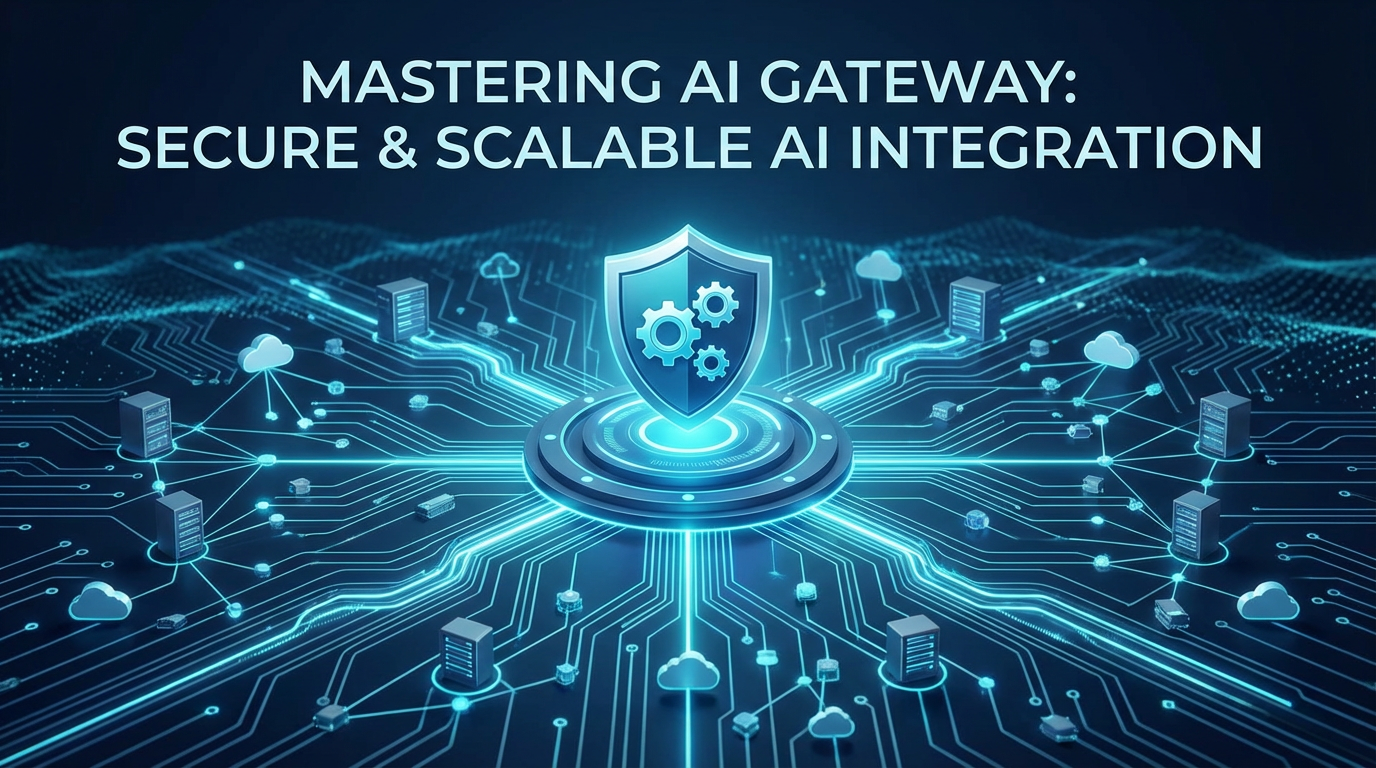


The landscape of modern application development has been irrevocably transformed by the rapid ascent of Artificial Intelligence, particularly the groundbreaking capabilities of Large Language Models (LLMs). From powering sophisticated chatbots and content generation engines to driving complex data analysis and decision-making systems, AI is no longer a niche technology but a foundational layer for innovation across industries. However, the true potential of AI can only be fully realized when these advanced models are seamlessly and securely integrated into existing enterprise architectures and new applications. This integration, far from being a trivial task, presents a myriad of challenges that can quickly overwhelm development teams, compromise security, and hinder scalability. Directly connecting applications to a diverse array of AI service providers, each with its unique API specifications, authentication mechanisms, rate limits, and pricing models, introduces layers of complexity that can impede progress and inflate operational costs.
Imagine a scenario where a single application needs to leverage an LLM for natural language understanding, a computer vision model for image processing, and a specialized AI for predictive analytics. Each of these models might reside on a different cloud platform or be offered by a distinct vendor, requiring separate API keys, custom client libraries, and individual monitoring solutions. This fragmented approach not only complicates development and maintenance but also creates significant vulnerabilities. Without a centralized control point, managing access, enforcing security policies, monitoring performance, and optimizing costs across such a distributed AI ecosystem becomes an arduous, if not impossible, undertaking. Data privacy concerns, compliance regulations, and the ever-present threat of cyberattacks further exacerbate these challenges, demanding a robust and intelligent solution.
This is precisely where the concept of an AI Gateway emerges as an indispensable architectural component. Building upon the foundational principles of traditional api gateway technologies, an AI Gateway is specifically engineered to address the unique demands of AI model integration. It acts as a sophisticated intermediary, a single entry point for all AI-related traffic, abstracting away the underlying complexities of diverse AI services. By centralizing management, an AI Gateway empowers organizations to securely govern access, meticulously track usage, dynamically route requests, and effortlessly scale their AI infrastructure. For applications heavily reliant on generative AI, a specialized LLM Gateway takes these capabilities further, offering features tailored to the nuances of large language models, such as prompt versioning, content moderation, and token usage optimization. This comprehensive guide will delve deep into the transformative power of AI Gateways, exploring their core functionalities, the profound benefits they offer in terms of security and scalability, best practices for their implementation, and the exciting future trends that promise to further revolutionize AI integration. Our aim is to illustrate how mastering the AI Gateway can pave the way for a more secure, efficient, and innovative AI-driven future.
1. Understanding the Landscape of AI Integration: Challenges and the Need for a Unified Approach
The current era is defined by an unprecedented proliferation of Artificial Intelligence models, ranging from general-purpose foundation models like large language models (LLMs) and sophisticated image generators to highly specialized AI services designed for specific tasks such as fraud detection, medical diagnostics, or supply chain optimization. These models are developed and hosted by a diverse ecosystem of providers, including tech giants like OpenAI, Google, Amazon, and Microsoft, as well as a burgeoning community of open-source initiatives and specialized startups. Each provider often offers unique advantages in terms of performance, cost, specific capabilities, or data governance, leading organizations to strategically integrate multiple AI services into their applications to leverage the best of breed for different requirements. This rich tapestry of AI capabilities, while incredibly powerful, simultaneously introduces a complex web of integration challenges that demand a sophisticated and centralized management strategy.
The Proliferation of AI Models and Their Diverse Ecosystem
The sheer variety of AI models available today is staggering. We have witnessed the rapid evolution of LLMs, which are capable of understanding, generating, and summarizing human language with remarkable fluency, making them invaluable for tasks like customer support, content creation, and code generation. Alongside these, vision models excel at tasks such as object recognition, facial detection, and image segmentation; speech models facilitate transcription and voice synthesis; and tabular data models empower predictive analytics and anomaly detection. Furthermore, the deployment models vary widely: some AI services are consumed through cloud APIs, others might be hosted on-premises, and a growing number are available as open-source models that can be fine-tuned and deployed on custom infrastructure. This fragmented landscape means that an organization might be interacting with OpenAI's GPT models, Google's Gemini, Anthropic's Claude, a proprietary model from a specialized vendor, and an internally developed open-source model like Llama 3, all within a single application stack. Each interaction point, if managed individually, represents a potential bottleneck and a source of considerable overhead.
The Inherent Challenges of Direct AI Integration
Attempting to directly integrate and manage multiple AI models without an intermediary layer quickly exposes a host of significant challenges that can derail projects, compromise data, and escalate operational costs.
1. Security Risks and Authentication Complexity
One of the foremost concerns in any integration scenario, especially with sensitive data, is security. Each AI service typically requires its own set of API keys, tokens, or authentication mechanisms. Directly embedding these credentials within application code or configuration files scattered across various microservices vastly increases the attack surface. If one service is compromised, all associated AI integrations could be at risk. Managing the lifecycle of these credentials – rotation, revocation, and secure storage – becomes a nightmare without a centralized system. Furthermore, ensuring that only authorized applications or users can invoke specific AI models, and that data transmitted to these models adheres to strict privacy policies, requires granular access control that is difficult to implement at the application level for every AI endpoint. Without a unified security policy enforcement point, maintaining a robust security posture across diverse AI integrations is virtually impossible.
2. Scalability Issues and Performance Bottlenecks
As applications grow in popularity and AI usage increases, direct integration approaches often hit scalability walls. Individual AI providers might impose strict rate limits on their APIs, dictating how many requests can be made within a given timeframe. Bypassing these limits, or failing to properly manage them, can lead to service disruptions, throttled requests, and degraded user experiences. Load balancing requests across multiple instances of an AI model, or even across different providers to handle peak loads or achieve redundancy, is complex to orchestrate directly from client applications. Caching frequently requested AI responses, a critical technique for improving performance and reducing costs, also requires careful implementation that is often beyond the scope of individual service integrations. Without an intelligent layer to manage traffic, optimize resource utilization, and ensure high availability, the performance and reliability of AI-powered features can suffer significantly under load.
3. Complexity of Multiple APIs and Development Overhead
The lack of standardization across AI service APIs is a major pain point for developers. Each AI provider might have distinct request and response formats, unique endpoint structures, and varying error handling mechanisms. This forces developers to write custom code for every AI model they integrate, leading to redundant efforts, increased development time, and a steeper learning curve for new team members. Maintaining these disparate integrations as AI models evolve, or as new models are introduced, becomes an ongoing burden. Debugging issues across multiple, non-standardized APIs is also notoriously difficult. The cognitive load on developers increases exponentially with each new AI service, shifting focus away from core business logic to the complexities of AI plumbing.
4. Cost Management and Optimization
AI services, especially LLMs, can incur significant costs, often billed per token, per request, or based on compute usage. Without a centralized mechanism to track, monitor, and manage these costs, organizations can quickly find themselves with unexpectedly high bills. Direct integration offers little visibility into granular usage patterns, making it challenging to identify inefficient calls, optimize model choices based on cost-effectiveness, or allocate costs back to specific teams or projects. Implementing intelligent routing strategies, such as sending cheaper, less complex requests to a more affordable model while reserving premium models for critical tasks, is nearly impossible without an intermediary layer. Cost optimization is not just about reducing expenses, but about making informed decisions on where and how AI resources are consumed to maximize business value.
5. Observability, Monitoring, and Troubleshooting
Understanding the health, performance, and usage patterns of AI integrations is crucial for operational stability. Direct integration often means relying on disparate logging and monitoring solutions from each AI provider, making it difficult to gain a holistic view of the entire AI ecosystem. Without centralized logging, real-time metrics, and alert mechanisms, identifying and troubleshooting issues—whether they stem from an application error, an AI model failure, or a network problem—becomes a protracted and complex process. Proactive problem detection, performance tuning, and capacity planning are severely hampered without a unified observability framework.
6. Governance and Compliance
As AI becomes more deeply embedded in business processes, adherence to data governance policies and regulatory compliance (e.g., GDPR, HIPAA, CCPA) becomes paramount. Directly integrating AI models can make it challenging to ensure data residency requirements are met, sensitive information is properly handled and masked, and audit trails are meticulously maintained. Enforcing organizational policies regarding AI model usage, data ingress/egress, and acceptable output content is extremely difficult without a central policy enforcement point. Without proper governance, organizations face legal risks, reputational damage, and potential fines.
The Role of a Centralized Control Point: From API Gateways to AI Gateways
Historically, the concept of an api gateway emerged to address similar challenges for traditional RESTful services. An api gateway acts as a single entry point for microservices, handling concerns like authentication, rate limiting, and routing. This architectural pattern provided a much-needed layer of abstraction and control. However, the unique characteristics of AI models—such as token-based billing, streaming responses, prompt engineering, and the specific security concerns around model input/output—necessitate a more specialized solution. This evolution has given rise to the AI Gateway, a sophisticated extension of the api gateway concept, specifically tailored to the nuances of AI integration. It is designed not just to manage HTTP traffic, but to intelligently orchestrate interactions with advanced AI services, transforming fragmentation into a unified, secure, and scalable AI ecosystem.
2. What is an AI Gateway? Core Concepts and Evolution
At its heart, an AI Gateway is a specialized type of api gateway meticulously designed to manage, secure, and scale access to Artificial Intelligence models and services. It acts as a robust intermediary layer between your client applications (front-ends, back-end services, mobile apps) and the diverse array of AI models you consume, whether they are hosted by third-party providers (like OpenAI, Google AI, Anthropic) or deployed within your own infrastructure. Far from being a simple proxy, an AI Gateway is an intelligent orchestration layer that centralizes critical functions, abstracting away the inherent complexities and disparate interfaces of various AI services. For applications specifically relying on large language models, the term LLM Gateway is often used, emphasizing its tailored capabilities for generative AI, such as managing prompts and tracking token usage.
Defining an AI Gateway: More Than Just a Proxy
An AI Gateway can be thought of as the control tower for all your AI interactions. Instead of applications directly calling individual AI model APIs, they send all their requests to the AI Gateway. The gateway then intelligently routes these requests to the appropriate AI model, applies security policies, enforces rate limits, manages costs, and performs various transformations, before forwarding the AI model's response back to the client application. This centralized approach significantly simplifies application development, enhances security, improves observability, and optimizes performance and costs. It's a fundamental shift from point-to-point integrations to a governed, scalable, and resilient AI infrastructure.
Evolution from Traditional API Gateways to Specialized AI Gateways
The concept of an api gateway is not new. It has been a cornerstone of modern microservices architectures for years, primarily addressing concerns like:
- Request Routing: Directing incoming requests to the correct backend service.
- Authentication and Authorization: Verifying client identity and permissions.
- Rate Limiting: Protecting backend services from overload.
- Response Transformation: Modifying service responses before sending them back to the client.
- Centralized Logging and Monitoring: Providing a single point for operational insights.
Traditional api gateways excel at these tasks for standard RESTful APIs. However, the emergence of advanced AI models, particularly LLMs, introduced a new set of challenges and requirements that necessitated a specialized evolution:
- Diverse API Formats and Protocols: While traditional APIs often conform to REST, AI models might use gRPC, custom protobufs, or have streaming capabilities that require specialized handling beyond basic HTTP proxies.
- Model-Specific Metaparameters: AI models, especially LLMs, involve nuanced parameters (e.g., temperature, top-p, max tokens) that need to be managed, and often, prompt engineering techniques require dynamic manipulation of inputs.
- Token-Based Billing: LLMs are typically billed per token, requiring precise tracking and cost attribution that traditional gateways don't inherently provide.
- Content Moderation: Inputs and outputs of generative AI models can carry risks (toxicity, bias), demanding an active filtering and moderation layer.
- Model Versioning and Fallbacks: AI models are constantly evolving. An AI Gateway needs to facilitate seamless transitions between versions and offer fallback mechanisms to alternative models if a primary one fails or becomes too expensive.
- Real-time Streaming: Many modern AI applications, especially those built with LLMs, rely on streaming responses for a more interactive user experience. This requires the gateway to handle persistent connections and chunked data transfer efficiently.
These unique complexities highlight why a generic api gateway, while useful, is insufficient for a robust AI integration strategy. The AI Gateway fills this void, offering a tailored solution that understands and intelligently manages the specific nuances of AI model interactions.
Key Functions of an AI Gateway
A comprehensive AI Gateway implements a suite of functionalities designed to address the challenges outlined above. These functions transform raw AI model APIs into a resilient, manageable, and secure service layer.
1. Unified API Endpoint and Abstraction Layer
Perhaps the most fundamental function is to provide a single, unified API endpoint for all integrated AI models. This abstracts away the disparate APIs, SDKs, and authentication mechanisms of individual providers. Developers interact with a consistent interface, regardless of which underlying AI model is being invoked. This significantly reduces development complexity and accelerates time to market for AI-powered features. For instance, whether an application uses OpenAI, Anthropic, or a local Llama model for text generation, the call to the application looks identical, simplifying code and reducing maintenance. APIPark, for example, is designed to offer a unified API format for AI invocation, ensuring that changes in AI models or prompts do not affect the application or microservices, thereby simplifying AI usage and maintenance costs. It also boasts the capability to integrate a variety of AI models with a unified management system for authentication and cost tracking.
2. Advanced Authentication and Authorization
The AI Gateway acts as the central security enforcement point. It handles various authentication schemes (API keys, OAuth 2.0, JWTs, mutual TLS) for incoming client requests and securely manages the credentials required to access downstream AI models. It provides granular authorization controls, allowing administrators to define who can access which models, with what permissions, and under what conditions. This centralized approach dramatically reduces the risk of credential compromise and ensures compliance with security policies.
3. Intelligent Rate Limiting and Throttling
To prevent abuse, manage costs, and ensure fair usage, the gateway enforces sophisticated rate limits. These can be applied per user, per application, per IP address, or per model, preventing a single client from overwhelming an AI service or exceeding budget allocations. Throttling mechanisms can gracefully degrade service for high-volume users rather than outright rejecting requests, maintaining a better user experience.
4. Dynamic Load Balancing and Routing
The gateway can intelligently distribute requests across multiple instances of an AI model, across different cloud regions, or even across different AI providers. This is crucial for high availability, disaster recovery, and performance optimization. Routing decisions can be based on various factors: model availability, latency, cost, current load, or even specific request parameters. For example, less critical requests might be routed to a cheaper, slightly slower model, while high-priority requests go to a premium, low-latency service.
5. Caching for Performance and Cost Reduction
For repetitive or idempotent AI requests, the gateway can cache responses. This significantly improves response times for subsequent identical requests and reduces the number of calls to the expensive AI models, leading to substantial cost savings. Cache invalidation strategies are essential to ensure data freshness.
6. Comprehensive Observability: Logging, Monitoring, and Analytics
A robust AI Gateway provides extensive logging of every API call, including request details, response payloads, latency, errors, and associated metadata (e.g., user ID, application ID, model used). This centralized logging is invaluable for auditing, debugging, and security analysis. Real-time monitoring dashboards display key metrics like request volume, error rates, latency, and resource utilization. Powerful analytics capabilities offer insights into usage patterns, cost trends, and model performance, enabling data-driven optimization. APIPark offers detailed API call logging, recording every detail of each API call, enabling businesses to quickly trace and troubleshoot issues. Its powerful data analysis features analyze historical call data to display long-term trends and performance changes.
7. Security Policies and Threat Protection
Beyond authentication, the AI Gateway can implement advanced security measures, including Web Application Firewall (WAF) capabilities to protect against common web exploits, DDoS protection, and data masking to redact sensitive information (like PII) from inputs or outputs before they reach the AI model or the client application.
8. Request and Response Transformation & Orchestration
The gateway can modify request payloads before forwarding them to the AI model and transform responses before sending them back to the client. This is particularly useful for: * Prompt Engineering: Injecting standard prompts, adding context, or translating prompts into model-specific formats. * Data Normalization: Ensuring consistent data formats across different AI models. * Content Moderation: Filtering out inappropriate or malicious content from user inputs or AI-generated outputs.
9. Cost Management and Attribution
By tracking every token or request for each AI model, the gateway provides granular cost visibility. This allows organizations to attribute costs to specific teams, projects, or users, fostering accountability and enabling precise budget management. It also facilitates cost-aware routing strategies.
Specifics for LLM Gateways
For scenarios dominated by generative AI, the LLM Gateway emphasizes additional specialized functionalities:
- Prompt Versioning and Management: Storing, versioning, and A/B testing different prompts to optimize AI model behavior without changing application code.
- Token Usage Tracking and Optimization: Precise measurement of input and output tokens for cost control and billing, and potentially optimizing prompts to reduce token count.
- Content Moderation for Generative AI: Specialized filters for detecting and blocking harmful, toxic, or biased content in both user prompts and model responses.
- Streaming Response Handling: Efficiently managing and forwarding partial, real-time responses from LLMs to client applications for a more dynamic user experience.
- Intelligent Fallbacks: If a primary LLM service experiences high latency, errors, or rate limits, the gateway can automatically switch to a pre-configured alternative LLM, ensuring service continuity.
By centralizing these functions, an AI Gateway (or LLM Gateway) transforms the complex, fragmented world of AI integration into a streamlined, secure, and highly manageable ecosystem, empowering organizations to harness the full power of AI with confidence and control.
3. Deep Dive into Key Benefits of AI Gateways
The adoption of an AI Gateway fundamentally redefines how organizations interact with and deploy Artificial Intelligence. Beyond merely simplifying technical integration, it unlocks a cascade of strategic benefits that touch upon every aspect of AI operations – from enhancing security and ensuring robust scalability to streamlining development workflows, optimizing costs, and providing unparalleled visibility. This comprehensive set of advantages makes the AI Gateway an indispensable component for any enterprise serious about leveraging AI effectively and responsibly.
1. Enhanced Security Posture
Security remains paramount in an era of sophisticated cyber threats and stringent data privacy regulations. An AI Gateway acts as the primary security perimeter for your AI interactions, significantly bolstering your overall security posture compared to direct integration methods.
Centralized Authentication and Authorization
The gateway consolidates all authentication and authorization logic into a single, managed layer. Instead of distributing API keys or complex OAuth flows across multiple client applications, these concerns are handled centrally. This means: * Reduced Attack Surface: AI model credentials (e.g., API keys for OpenAI, Google AI) are securely stored and managed only by the gateway, never exposed directly to client applications. This minimizes the risk of compromise. * Uniform Access Control: The gateway can enforce consistent security policies across all AI models, ensuring that only authorized users or applications can invoke specific services. Granular permissions can be set based on roles, teams, or even individual requests. For instance, a junior developer might only have access to a sandbox LLM, while a production application can access a premium, high-performance model. * Dynamic Credential Management: The gateway can handle secure rotation of AI provider credentials, simplifying a traditionally complex operational task and enhancing security hygiene.
Data Privacy and Masking Sensitive Information
Many AI applications involve processing sensitive data. The AI Gateway provides a crucial opportunity to implement data privacy measures before information ever reaches a third-party AI model: * Data Redaction/Masking: It can automatically detect and redact (e.g., replace credit card numbers, social security numbers, PII) sensitive information from request payloads before forwarding them to the AI model. This is vital for compliance with regulations like GDPR, HIPAA, or CCPA. * Compliance Adherence: By centralizing data handling and access policies, the gateway makes it easier to demonstrate compliance with various regulatory requirements, ensuring that data residency rules are followed and audit trails are meticulously maintained.
Threat Protection and Abuse Prevention
The gateway is your first line of defense against malicious actors or accidental misuse: * Web Application Firewall (WAF) Capabilities: Many advanced AI Gateways integrate WAF-like functionalities to detect and block common web attacks (e.g., SQL injection, cross-site scripting) that might target the gateway itself or attempt to exploit vulnerabilities in upstream services. * DDoS and Brute-Force Protection: Intelligent rate limiting and throttling mechanisms prevent denial-of-service attacks by automatically blocking or challenging suspicious traffic patterns. It can also detect and mitigate brute-force attacks on authentication endpoints. * Content Moderation: Especially critical for LLM Gateways, it can apply filters to both user inputs and AI-generated outputs, blocking harmful, toxic, or inappropriate content, thereby safeguarding your brand and ensuring responsible AI usage.
2. Unparalleled Scalability and Reliability
In dynamic environments where AI usage can fluctuate wildly, an AI Gateway is instrumental in ensuring that your applications remain responsive, highly available, and capable of handling significant loads without degradation.
Load Balancing Across Multiple Providers/Instances
The gateway intelligently distributes incoming AI requests across multiple backend AI services or instances. This is vital for: * High Availability: If one AI service becomes unavailable or experiences performance issues, the gateway can automatically route traffic to a healthy alternative, ensuring continuous service. This includes routing to different regions or even different providers. * Performance Optimization: Requests can be distributed to the least loaded or geographically closest AI instance, minimizing latency and maximizing throughput. * Vendor Redundancy: Mitigates vendor lock-in and reduces reliance on a single AI provider by enabling seamless failover or distribution of traffic across multiple vendors.
Automatic Failover and Resilience
Beyond simple load balancing, the AI Gateway can implement sophisticated failover strategies. If a primary AI model or provider fails to respond within a specified timeout, or returns an error, the gateway can automatically retry the request with a different model or provider. This significantly enhances the resilience of AI-powered applications, preventing service disruptions and ensuring a robust user experience.
Caching Frequently Accessed Responses
For AI queries that are either idempotent or produce results that don't change frequently, the gateway can cache responses. Subsequent identical requests can then be served directly from the cache, leading to: * Improved Response Times: Drastically reduces latency by eliminating the need to re-compute AI responses. * Reduced Costs: For usage-based billing models (like per-token LLMs), caching directly translates to fewer calls to the expensive AI service, leading to significant cost savings. * Decreased Load on AI Models: Reduces the strain on backend AI infrastructure, allowing it to handle more unique or complex requests.
Efficient Resource Utilization
By centralizing control, the gateway can optimize how AI resources are consumed. It can prioritize requests, queue non-critical tasks, and intelligently route based on current model load or even GPU availability for on-premises deployments. This ensures that expensive AI resources are utilized as efficiently as possible. For real-time applications, the gateway must handle streaming responses efficiently, maintaining open connections and forwarding data chunks as they become available from the AI model, ensuring a smooth, interactive user experience typical of many LLM-powered applications.
3. Simplified Integration and Development
One of the most immediate and tangible benefits for development teams is the dramatic simplification of integrating AI capabilities into applications.
Unified API Interface for All Models
The AI Gateway presents a single, consistent API interface to developers, regardless of the underlying AI models being used. This means: * Reduced Developer Friction: Developers no longer need to learn the unique API specifications, SDKs, and authentication methods for each individual AI provider. They interact with one standard interface defined by the gateway. * Standardized Request/Response Formats: The gateway can normalize data formats, translating application requests into model-specific inputs and then transforming model outputs into a consistent format for the application. This eliminates complex data mapping logic from client code. * Faster Development Cycles: With a simplified and standardized integration process, developers can integrate new AI models or switch between existing ones much more quickly, accelerating feature delivery.
Rapid Prototyping and Experimentation
The abstraction layer provided by the gateway makes it incredibly easy to experiment with different AI models. Developers can swap out one LLM for another (e.g., GPT-4 for Claude 3) by simply changing a configuration in the gateway, without touching application code. This fosters rapid innovation and allows for A/B testing of various models to find the optimal solution for a given task.
Versioning and Lifecycle Management of AI APIs
Just like traditional APIs, AI services evolve. The gateway allows for robust versioning of AI API endpoints, ensuring backward compatibility for existing applications while enabling new features for updated versions. It facilitates the entire API lifecycle management, from design and publication to deprecation and decommission, ensuring a controlled and orderly evolution of AI capabilities. This is where a comprehensive platform truly shines. For instance, APIPark assists with managing the entire lifecycle of APIs, including design, publication, invocation, and decommission. It helps regulate API management processes, manage traffic forwarding, load balancing, and versioning of published APIs. Its capability for quick integration of over 100 AI models combined with a unified API format greatly simplifies AI usage and maintenance costs, truly embodying a developer-centric approach. ApiPark is an excellent example of an open-source AI gateway designed to streamline such processes.
4. Optimized Performance and Cost Efficiency
The intelligent orchestration capabilities of an AI Gateway translate directly into tangible performance improvements and significant cost savings, making AI adoption more economically viable for organizations of all sizes.
Intelligent Routing Based on Cost, Latency, or Model Capabilities
The gateway can make real-time decisions on which AI model to use based on predefined policies: * Cost Optimization: Route non-critical or simpler requests to cheaper AI models, while reserving premium, more expensive models for high-value or complex tasks. * Latency-Based Routing: Automatically select the AI model or instance that offers the lowest latency, crucial for real-time applications. * Capability-Based Routing: Direct requests to specific models known to excel at particular tasks (e.g., one LLM for creative writing, another for structured data extraction).
Caching to Reduce Redundant Calls
As mentioned earlier, caching is a direct mechanism to reduce the number of calls to AI models. This directly impacts usage-based billing, leading to substantial cost reductions, particularly for frequently accessed AI endpoints.
Detailed Cost Tracking and Analytics
By meticulously logging every AI interaction, the gateway provides granular visibility into AI consumption patterns. This enables: * Accurate Cost Attribution: Allocate AI costs back to specific departments, projects, or even individual users, fostering financial accountability. * Budget Enforcement: Set spending limits for different teams or applications and receive alerts when thresholds are approached, preventing unexpected cost overruns. * Optimization Insights: Analyze usage data to identify patterns, detect inefficiencies, and make data-driven decisions on model selection and usage strategies.
Rate Limiting to Prevent Overspending
Beyond protecting against abuse, rate limiting can also be used as a proactive cost control measure. By setting limits on the number of requests or tokens that can be consumed within a given period, organizations can effectively cap their AI spending for specific applications or users, preventing accidental spikes in usage that could lead to exorbitant bills.
5. Improved Observability and Governance
Visibility into your AI ecosystem and the ability to govern its usage are crucial for operational stability, compliance, and strategic decision-making. An AI Gateway provides this comprehensive oversight.
Comprehensive Logging for Auditing and Debugging
Every request and response passing through the gateway is logged with rich metadata. This provides an invaluable audit trail for: * Troubleshooting: Quickly diagnose issues by examining the exact requests sent to AI models and their corresponding responses, as well as any transformations applied by the gateway. * Security Audits: Track who accessed which models, when, and with what data, crucial for compliance and security investigations. * Compliance: Maintain records for regulatory requirements, demonstrating proper handling of data and AI interactions. APIPark provides comprehensive logging capabilities, recording every detail of each API call, enabling businesses to quickly trace and troubleshoot issues in API calls, ensuring system stability and data security.
Real-time Monitoring of Model Performance and Availability
The gateway provides real-time metrics on AI model performance, including: * Latency: Average and percentile response times for each model. * Error Rates: Identify models or integrations that are experiencing issues. * Throughput: Request volume per second/minute. * Availability: Track the uptime of integrated AI services. These metrics enable proactive monitoring, alert generation, and rapid response to any performance degradation or outages, ensuring the stability of AI-powered features.
Analytics for Usage Patterns, Error Rates, and Cost Trends
Beyond real-time monitoring, the aggregated data collected by the gateway fuels powerful analytics tools. These tools can identify: * Usage Trends: Which models are most popular? When are peak usage times? * Cost Trends: How are AI costs evolving over time? Which applications are driving the highest expenses? * Error Hotspots: Pinpoint specific requests or models that are consistently failing. This analytical insight is critical for long-term planning, capacity management, and continuous optimization of your AI strategy. APIPark offers powerful data analysis capabilities, analyzing historical call data to display long-term trends and performance changes, helping businesses with preventive maintenance before issues occur.
Policy Enforcement and Access Control for Different Teams/Tenants
The AI Gateway facilitates robust governance by allowing organizations to define and enforce policies across different teams or "tenants" within the enterprise. This includes: * Tenant-Specific Configurations: Each team can have its own set of AI models, rate limits, and security policies, all managed centrally. * Subscription Approval: APIs can require approval before callers can invoke them, preventing unauthorized access and potential data breaches. APIPark exemplifies this, allowing for the activation of subscription approval features, ensuring callers must subscribe to an API and await administrator approval. * API Service Sharing: The platform allows for the centralized display of all API services, making it easy for different departments and teams to find and use the required API services, fostering collaboration while maintaining control. APIPark enables independent API and access permissions for each tenant, allowing for the creation of multiple teams, each with independent applications, data, user configurations, and security policies, while sharing underlying applications and infrastructure to improve resource utilization and reduce operational costs.
In summary, an AI Gateway is not just a technical component; it's a strategic investment that underpins a secure, scalable, efficient, and well-governed AI infrastructure. It transforms the complexity of disparate AI models into a unified, manageable, and highly optimized service layer, enabling organizations to fully harness the revolutionary power of Artificial Intelligence.
APIPark is a high-performance AI gateway that allows you to securely access the most comprehensive LLM APIs globally on the APIPark platform, including OpenAI, Anthropic, Mistral, Llama2, Google Gemini, and more.Try APIPark now! 👇👇👇
4. Implementing and Managing an AI Gateway
Successfully implementing and managing an AI Gateway requires careful consideration of various architectural choices, feature requirements, and operational best practices. The decision process involves weighing factors like deployment environment, open-source versus commercial solutions, and integration with existing infrastructure. Once deployed, ongoing management, monitoring, and security are crucial to ensure its effectiveness as the central nervous system for your AI ecosystem.
Design Considerations: Tailoring the Gateway to Your Needs
The initial design phase for an AI Gateway is critical, as it lays the foundation for its scalability, security, and maintainability.
On-premises vs. Cloud-based Solutions
This is a fundamental choice with significant implications:
- On-premises Deployment:
- Pros: Offers maximum control over data residency, security, and hardware resources. Can be ideal for highly sensitive data, strict compliance requirements, or scenarios where proprietary AI models are hosted internally.
- Cons: Requires significant operational overhead for infrastructure provisioning, maintenance, scaling, and security patching. Capital expenditure for hardware can be substantial. Updates and upgrades might be slower.
- Cloud-based Deployment (SaaS or IaaS):
- Pros: Lower operational overhead, as the cloud provider or SaaS vendor manages the underlying infrastructure. Highly scalable and flexible, allowing for rapid provisioning and de-provisioning of resources. Often integrates well with other cloud services.
- Cons: Less control over the underlying infrastructure, potential vendor lock-in, and may raise concerns about data residency or security for extremely sensitive workloads, although many cloud providers offer robust compliance certifications. Costs can escalate if not managed carefully.
- Hybrid Approach: A common solution where a gateway is deployed in the cloud but integrates with on-premises AI models or vice-versa, offering a balance of control and flexibility.
Open-source vs. Commercial Offerings
The market offers a range of AI Gateway solutions, each with its own advantages:
- Open-source Solutions:
- Pros: Cost-effective (no direct licensing fees), high degree of customization, community support, transparency in code. Ideal for organizations with strong internal engineering capabilities and specific customization needs.
- Cons: Requires significant internal resources for deployment, maintenance, and support. Lack of guaranteed support or SLAs might be a concern for mission-critical applications.
- Natural mention of APIPark: APIPark is an excellent example of an open-source AI Gateway and API management platform, available under the Apache 2.0 license. It provides a robust, customizable foundation for managing AI and REST services, particularly appealing to startups and enterprises looking for flexibility. While the open-source product meets basic needs, APIPark also offers a commercial version with advanced features and professional technical support for leading enterprises. This hybrid model allows organizations to start with an open-source base and scale to commercial support as their needs evolve.
- Commercial Products:
- Pros: Professional support, often includes a richer set of out-of-the-box features, managed services, regular updates, and clear SLAs. Can accelerate deployment and reduce operational burden for teams without deep gateway expertise.
- Cons: Can be expensive (licensing fees, subscription costs), potential vendor lock-in, less flexibility for deep customization.
Integration with Existing Infrastructure
The AI Gateway should not operate in a vacuum. It needs to seamlessly integrate with your existing:
- CI/CD Pipelines: Automate the deployment and configuration of gateway policies and AI service integrations.
- Monitoring and Alerting Tools: Forward logs and metrics to your centralized observability platforms (e.g., Prometheus, Grafana, ELK stack) for a unified view of system health.
- Identity and Access Management (IAM) Systems: Integrate with existing corporate directories (e.g., Active Directory, Okta, Auth0) for user authentication and authorization.
- Networking Infrastructure: Work within existing VPCs, firewalls, and load balancers.
Scalability Requirements and Anticipated Traffic
Design the gateway to handle your anticipated peak loads. Consider:
- Horizontal Scaling: Can the gateway be easily deployed across multiple instances to distribute load?
- High Concurrency: How many simultaneous connections and requests can it handle?
- Throughput: What is the maximum number of requests per second it needs to process?
- Latency: What are the acceptable latency targets for AI requests?
Key Features to Look For in an AI Gateway
When evaluating different AI Gateway solutions, a specific set of features are crucial for robust and efficient AI integration:
- Broad AI Model and Provider Support: The gateway should ideally support a wide range of AI models (LLMs, vision, speech) and popular providers (OpenAI, Google AI, Anthropic, open-source models). Look for extensibility to add new models as they emerge. APIPark excels here with its capability to quickly integrate 100+ AI models.
- Robust Security Features: Centralized authentication (OAuth, JWT, API keys), authorization (RBAC), data masking/redaction, WAF capabilities, and threat detection are non-negotiable. API resource access requiring approval, as seen in APIPark, is a critical security feature.
- Advanced Routing and Load Balancing: Intelligent routing based on latency, cost, model capability, and A/B testing support. Comprehensive load balancing across multiple instances and providers.
- Detailed Analytics and Cost Management: Granular logging of AI usage, real-time monitoring dashboards, cost attribution per user/team/model, and budgeting controls. APIPark provides both detailed API call logging and powerful data analysis capabilities for historical trends.
- Developer Portal/Management UI: An intuitive web interface for configuring the gateway, managing APIs, viewing analytics, and providing a self-service portal for developers to discover and subscribe to AI services. APIPark functions as an all-in-one AI gateway and API developer portal.
- Prompt Management and Versioning: For LLM Gateways, the ability to store, version, and manage prompts centrally is vital for consistent AI behavior and experimentation.
- High Performance and Low Latency: The gateway itself should not introduce significant overhead. Look for solutions optimized for high throughput. APIPark boasts performance rivaling Nginx, achieving over 20,000 TPS with just an 8-core CPU and 8GB of memory, and supporting cluster deployment for large-scale traffic.
- Ease of Deployment and Management: A solution that can be quickly deployed and easily configured reduces time to value. APIPark can be quickly deployed in just 5 minutes with a single command line, which is a significant advantage:
curl -sSO https://download.apipark.com/install/quick-start.sh; bash quick-start.sh.
Deployment Strategies
Modern AI Gateway solutions leverage containerization and cloud-native patterns for flexible and scalable deployment.
- Containerization (Docker, Kubernetes): Deploying the gateway as a Docker container or within a Kubernetes cluster is a highly recommended approach. This offers:
- Portability: Run the gateway consistently across different environments (local, dev, production, cloud, on-prem).
- Scalability: Kubernetes can automatically scale gateway instances based on traffic load.
- Resilience: Self-healing capabilities of Kubernetes ensure the gateway remains available.
- Serverless Deployments: For some specific AI Gateway functions (e.g., simple routing, minor transformations), serverless functions (AWS Lambda, Azure Functions, Google Cloud Functions) can be used, offering cost efficiency for intermittent or event-driven workloads, though typically less suited for high-throughput, constant traffic.
- Hybrid Approaches: A combination, where core gateway logic runs in containers, while certain specific, lightweight tasks are handled by serverless functions.
Operational Best Practices for AI Gateway Management
Once the AI Gateway is deployed, ongoing operational excellence is key to its long-term success.
- Regular Security Audits: Periodically audit gateway configurations, access policies, and underlying infrastructure for vulnerabilities. Implement penetration testing.
- Continuous Monitoring and Alerting: Establish comprehensive monitoring for key metrics (latency, error rates, throughput, resource utilization) and set up alerts for any anomalies. Integrate with your existing incident management systems.
- Version Control for Gateway Configurations and Prompts: Treat gateway configurations (routing rules, rate limits, security policies) and prompt templates as code. Store them in a version control system (Git) and manage changes through CI/CD pipelines.
- Disaster Recovery Planning: Develop and regularly test a disaster recovery plan for your AI Gateway. This includes backups of configurations and data, and strategies for failing over to secondary instances or regions.
- Performance Testing: Conduct regular load testing and performance benchmarking to ensure the gateway can handle anticipated traffic spikes and maintain acceptable latency.
- Comprehensive Documentation for Developers: Provide clear and accessible documentation for developers on how to interact with the AI Gateway, including API specifications, authentication methods, rate limits, and best practices. A strong developer portal (like that provided by APIPark) is invaluable here.
- API Service Sharing and Tenant Management: Leverage features like those in APIPark to enable centralized display of all API services and independent API/access permissions for different teams or tenants. This fosters efficient collaboration while maintaining governance.
By meticulously planning, implementing with robust features, and maintaining with diligent operational practices, an AI Gateway becomes a powerful, secure, and scalable foundation for integrating Artificial Intelligence across your entire organization, driving innovation and efficiency.
5. Advanced AI Gateway Capabilities and Future Trends
The AI Gateway is not a static technology; it's a rapidly evolving field that continues to integrate more sophisticated capabilities, especially as AI models themselves become more complex and ubiquitous. Beyond the foundational features of security, scalability, and centralized management, the future of AI Gateways promises even greater intelligence, automation, and deeper integration into the broader AI lifecycle. These advanced capabilities will be crucial for organizations to stay competitive, maintain responsible AI practices, and unlock new forms of innovation.
Prompt Engineering as a Service
With the rise of Large Language Models (LLMs), prompt engineering has become a critical discipline for eliciting desired behaviors from AI. An advanced LLM Gateway will evolve into a "Prompt Engineering as a Service" platform, offering centralized management and optimization of prompts.
- Centralized Prompt Repository: Store, organize, and categorize all prompts used across an organization in a single, version-controlled repository. This ensures consistency, reusability, and prevents "prompt drift."
- Prompt Versioning and A/B Testing: Easily create and manage different versions of a prompt, allowing for A/B testing to determine which prompt yields the best results (e.g., higher accuracy, lower hallucination, better user engagement) for a specific task. The gateway can intelligently route a percentage of traffic to different prompt versions.
- Dynamic Prompt Injection and Context Management: The gateway can dynamically inject context, user-specific data, or system instructions into a prompt based on the incoming request, enhancing the relevance and personalization of AI responses without modifying application code.
- Prompt Optimization Tools: Integrate tools for analyzing prompt effectiveness, suggesting improvements, or even automatically optimizing prompts for token efficiency and cost reduction.
AI Model Orchestration and Chaining
Complex AI applications often require more than a single model inference. They might involve a sequence of AI calls, where the output of one model becomes the input for another. Advanced AI Gateways are moving towards facilitating this orchestration.
- Multi-Model Workflows: Define and execute workflows that involve chaining multiple AI models together. For example, a request might first go to a speech-to-text model, then its output to an LLM Gateway for summarization, and finally to a translation model before returning to the client.
- Conditional Routing: Route requests to different models based on the characteristics of the input or the output of a preceding model. For instance, if an LLM Gateway detects a high-risk query, it might route it to a human review system or a specialized safety model.
- Micro-orchestration: Enable the composition of AI services into more complex "AI microservices," where the gateway manages the inter-model communication and state.
Responsible AI and Ethics: Implementing Guardrails
As AI becomes more powerful and pervasive, ensuring responsible, ethical, and fair usage is paramount. The AI Gateway is ideally positioned to enforce these principles at the point of interaction.
- Content Moderation and Safety Filters: Implement real-time filtering of both user inputs and AI model outputs to detect and block harmful, biased, toxic, or illegal content. This can leverage specialized moderation AI models integrated into the gateway.
- Bias Detection and Mitigation: Integrate mechanisms to detect potential biases in AI responses or inputs, and, where possible, apply mitigation strategies (e.g., re-phrasing, re-routing to a less biased model).
- Transparency and Explainability (XAI): While full explainability for complex AI models remains a challenge, the gateway can capture and log metadata about model choices, confidence scores, and applied transformations, providing a partial audit trail that contributes to greater transparency.
- Policy Enforcement for Ethical AI: Enforce organizational policies regarding data usage, consent, and the ethical use of AI-generated content.
Edge AI Gateways
The growing demand for real-time AI inference in scenarios with limited connectivity or ultra-low latency requirements (e.g., IoT devices, autonomous vehicles, industrial automation) is driving the development of Edge AI Gateways.
- Local AI Inference: Deploying lightweight AI Gateways closer to the data source, often on edge devices, to perform inference locally. This reduces reliance on cloud connectivity, minimizes latency, and enhances data privacy.
- Hybrid Cloud-Edge Orchestration: Manage a distributed fleet of edge gateways from a central cloud gateway, synchronizing models, policies, and collecting aggregated telemetry.
- Optimized Resource Usage: Edge gateways are designed to operate efficiently on constrained hardware, dynamically allocating resources for local AI tasks.
Adaptive Learning Gateways
Future AI Gateways will become more intelligent and autonomous, capable of learning and adapting their behavior based on real-time data.
- Dynamic Routing Optimization: The gateway can learn optimal routing strategies based on observed latency, cost, and success rates of various AI models, continuously fine-tuning its decisions.
- Predictive Caching: Intelligently predict which AI responses are likely to be requested again and proactively cache them, further improving performance and reducing costs.
- Anomaly Detection: Use machine learning within the gateway itself to detect unusual usage patterns or performance degradations, triggering alerts or automatic mitigation actions.
Integration with MLOps Pipelines
The AI Gateway is a critical component in a mature MLOps (Machine Learning Operations) ecosystem. Deeper integration will become standard.
- Automated Deployment of AI Services: Seamlessly integrate with MLOps pipelines to automatically publish new versions of AI models or prompts to the gateway.
- Model Monitoring and Feedback Loops: Provide data to MLOps platforms on model performance in production (drift, bias, error rates), closing the loop for continuous model improvement.
- Feature Store Integration: Connect with feature stores to enrich AI requests with relevant, pre-computed features before sending them to the models.
The LLM Gateway Specialization: A Growing Imperative
While the general AI Gateway handles a broad spectrum of AI models, the specific challenges and immense potential of generative AI, particularly LLMs, mean that the LLM Gateway will continue to grow in specialization and importance. Features like advanced prompt management, nuanced content moderation, precise token usage analytics, and intelligent model selection based on generative task requirements will become standard. The LLM Gateway will be the cornerstone for managing the explosion of creative, conversational, and analytical applications powered by large language models.
In conclusion, the evolution of the AI Gateway mirrors the rapid advancements in Artificial Intelligence itself. From its foundational role as a secure and scalable intermediary, it is transforming into an intelligent orchestration layer capable of managing complex AI workflows, enforcing ethical guidelines, and continuously optimizing performance and cost. Mastering these advanced capabilities will be essential for organizations aiming to truly unlock the full, transformative power of AI in the years to come.
Conclusion
The journey through the intricate world of Artificial Intelligence integration reveals a fundamental truth: the promise of AI can only be fully realized when it is managed, secured, and scaled with deliberate architectural foresight. Direct integration, while seemingly straightforward at first glance, quickly descends into a labyrinth of security vulnerabilities, scalability bottlenecks, spiraling costs, and insurmountable operational complexities. This fragmented approach not only stifles innovation but also exposes organizations to significant risks and inefficiencies in an increasingly AI-driven landscape.
This is precisely why the AI Gateway has emerged as an indispensable cornerstone of modern, AI-powered architectures. Building upon the robust foundations of the traditional api gateway, it introduces a specialized layer of intelligence tailored to the unique demands of AI models, particularly the nuances of Large Language Models, giving rise to the specialized LLM Gateway. By serving as a unified control plane, the AI Gateway transforms chaos into order, offering a secure, scalable, and manageable interface for all AI interactions.
We have explored how AI Gateways deliver profound benefits across multiple dimensions: * Enhanced Security: Centralizing authentication, enforcing granular authorization, redacting sensitive data, and providing robust threat protection shields your AI ecosystem from sophisticated attacks and ensures regulatory compliance. * Unparalleled Scalability and Reliability: Intelligent load balancing, automatic failover, and strategic caching ensure that your AI applications remain highly available and responsive, seamlessly handling fluctuating demands and diverse model requirements. * Simplified Integration and Development: Providing a unified API interface, standardizing data formats, and streamlining prompt management significantly reduces developer friction, accelerates time-to-market, and fosters rapid experimentation. * Optimized Performance and Cost Efficiency: Dynamic routing based on cost and latency, coupled with granular cost tracking and proactive rate limiting, ensures that AI resources are utilized optimally, preventing budget overruns and maximizing ROI. * Improved Observability and Governance: Comprehensive logging, real-time monitoring, and powerful analytics offer deep insights into AI usage, performance, and cost trends, enabling proactive problem resolution and informed decision-making. Moreover, features like independent tenant permissions and API subscription approvals, as demonstrated by platforms like APIPark (available at ApiPark), underscore the robust governance capabilities inherent in these solutions.
As AI continues its relentless evolution, the AI Gateway will evolve with it, incorporating advanced capabilities such as "Prompt Engineering as a Service," sophisticated multi-model orchestration, integrated responsible AI guardrails, and even edge deployment for low-latency scenarios. These future trends solidify its position as not just a current necessity but a future-proofing strategy for any organization embracing the transformative power of Artificial Intelligence.
In essence, mastering the AI Gateway is not merely a technical choice; it is a strategic imperative. It empowers developers to build faster, enables operations teams to manage with greater confidence, and provides business leaders with the control and insights needed to derive maximum value from their AI investments. By creating a secure, scalable, and highly manageable bridge to the vast capabilities of Artificial Intelligence, the AI Gateway paves the way for innovation that is both powerful and responsible.
Frequently Asked Questions (FAQ)
1. What is the fundamental difference between a traditional API Gateway and an AI Gateway (or LLM Gateway)? While an API Gateway provides a unified entry point for microservices, handling general concerns like authentication, routing, and rate limiting for standard RESTful APIs, an AI Gateway is a specialized extension designed for the unique characteristics of AI models. It adds specific features like model-aware routing (based on cost, latency, capability), prompt management and versioning (for LLMs), token usage tracking for cost attribution, content moderation, and specialized handling of streaming responses. An LLM Gateway further specializes in managing Large Language Models, focusing on prompt optimization, sophisticated fallbacks, and content safety filters specific to generative AI.
2. How does an AI Gateway enhance security for AI integrations? An AI Gateway significantly enhances security by centralizing critical functions. It acts as the single security enforcement point for all AI traffic, managing API keys securely, providing granular access control (who can access which model), enforcing authentication and authorization policies, and offering data masking/redaction capabilities to protect sensitive information before it reaches third-party AI models. It also includes threat protection features like rate limiting against DDoS attacks and WAF capabilities. This centralized approach drastically reduces the attack surface and simplifies compliance.
3. Can an AI Gateway help in managing costs associated with AI model usage? Absolutely. Cost management is one of the primary benefits. An AI Gateway meticulously tracks every request and token consumed by each AI model, providing granular visibility into usage patterns. This enables accurate cost attribution to specific teams or projects. Furthermore, it facilitates intelligent routing, sending simpler requests to more cost-effective models, and implements rate limits to prevent overspending. Caching frequently requested AI responses also directly reduces the number of expensive model calls, leading to substantial cost savings.
4. Is an AI Gateway suitable for both cloud-based and on-premises AI models? Yes, a robust AI Gateway is designed for flexibility in deployment and integration. It can act as a unified interface for AI models hosted on various cloud platforms (e.g., OpenAI, Google AI, Azure AI), as well as for proprietary or open-source AI models deployed within an organization's on-premises data centers or private clouds. This hybrid capability allows organizations to leverage a diverse AI ecosystem while maintaining a single point of control and management. Solutions like APIPark offer deployment flexibility and integrate a wide range of AI models regardless of their underlying infrastructure.
5. What role does "Prompt Engineering as a Service" play in an LLM Gateway? "Prompt Engineering as a Service" transforms an LLM Gateway into a central hub for managing and optimizing interactions with Large Language Models. It allows organizations to store, version, and manage all their prompts in a centralized repository, ensuring consistency and reusability. Developers can easily A/B test different prompt versions to find the most effective ones, and the gateway can dynamically inject context or apply transformations to prompts before sending them to the LLM. This significantly reduces the overhead of managing prompts directly in application code, accelerating experimentation and ensuring optimal AI behavior across various applications.
🚀You can securely and efficiently call the OpenAI API on APIPark in just two steps:
Step 1: Deploy the APIPark AI gateway in 5 minutes.
APIPark is developed based on Golang, offering strong product performance and low development and maintenance costs. You can deploy APIPark with a single command line.
curl -sSO https://download.apipark.com/install/quick-start.sh; bash quick-start.sh

In my experience, you can see the successful deployment interface within 5 to 10 minutes. Then, you can log in to APIPark using your account.

Step 2: Call the OpenAI API.