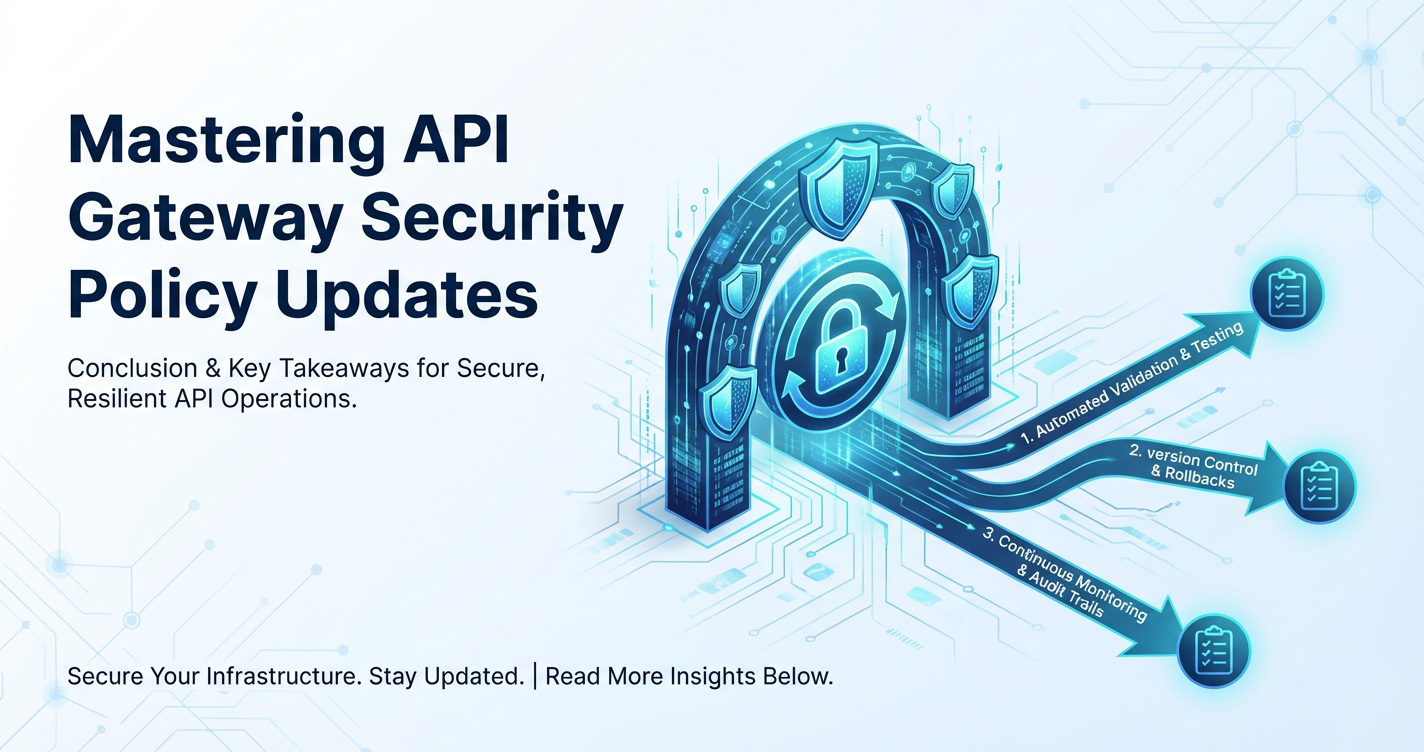
Mastering API Gateway Security Policy Updates


In the intricate tapestry of modern digital infrastructure, Application Programming Interfaces (APIs) serve as the fundamental threads connecting disparate systems, services, and applications. From mobile banking to real-time analytics, virtually every digital interaction relies on the seamless and secure exchange of data facilitated by APIs. As the digital landscape continues its rapid expansion, the volume, velocity, and criticality of API traffic have skyrocketed, transforming APIs from mere technical conduits into strategic business assets. This elevation in status, however, comes with a corresponding increase in exposure to cyber threats, making robust API security an paramount concern for organizations across all sectors.
At the vanguard of this security posture stands the API gateway. Acting as the primary enforcement point, the API gateway is the crucial layer that mediates all inbound and outbound API traffic, enforcing a myriad of policies before requests reach backend services. These policies span authentication, authorization, rate limiting, data validation, and threat protection, forming the bedrock of an organization's API security strategy. While establishing these policies initially is vital, the true mastery of API security lies not in static configurations, but in the agile and continuous process of updating them. The digital world is a perpetually shifting battleground, characterized by evolving threat landscapes, dynamic business requirements, and rapid technological advancements. Consequently, API security policies cannot remain dormant; they must be living, breathing entities, meticulously crafted and regularly refined to counter emerging risks and align with changing operational mandates.
The challenge of maintaining such dynamism without introducing operational friction or security gaps is formidable. It demands a sophisticated approach, underpinned by strong API Governance principles, robust tooling, and a culture of continuous improvement. This comprehensive guide delves deep into the critical domain of API gateway security policy updates, exploring why they are indispensable, the strategies and best practices for implementing them effectively, the common hurdles encountered, and the future trends shaping this vital discipline. Our journey will illuminate the path for organizations to not only protect their invaluable API assets but also to leverage their gateway as a powerful tool for strategic growth and innovation.
The Fundamental Role of API Gateways in Security
Before we dissect the nuances of policy updates, it's essential to first firmly grasp the foundational role of the API gateway in an organization's security architecture. Often described as the "front door" or "traffic cop" for APIs, a gateway is much more than a simple reverse proxy. It serves as a single, centralized entry point for all API requests, orchestrating complex interactions between clients and backend services. This strategic choke point makes it the ideal location to enforce security policies universally and consistently, acting as a critical defensive perimeter.
An API gateway provides a crucial layer of abstraction, decoupling clients from the complexities and vulnerabilities of backend microservices or legacy systems. Without a gateway, each individual service would be responsible for implementing its own security mechanisms—a distributed, often inconsistent, and difficult-to-manage approach. By centralizing security enforcement at the gateway, organizations gain immense control, reduce the surface area for attacks, and streamline the application of consistent security standards across their entire API ecosystem.
The core security functions performed by an API gateway are diverse and indispensable:
- Authentication: This is the process of verifying the identity of the client making an API request. The gateway can enforce various authentication schemes, including API keys, OAuth 2.0 tokens (JWTs), mTLS (mutual Transport Layer Security), and OpenID Connect. By offloading authentication from backend services, the gateway ensures that only legitimate, verified clients can even attempt to access protected resources, significantly reducing the load and attack surface on internal systems. It verifies credentials, validates tokens, and establishes the identity of the caller for subsequent authorization decisions.
- Authorization: Once authenticated, the gateway determines what specific resources or operations the authenticated client is permitted to access. This involves enforcing granular access control policies based on roles (Role-Based Access Control - RBAC), attributes (Attribute-Based Access Control - ABAC), or even specific permissions tied to the authenticated identity. The gateway checks if the client possesses the necessary scopes or roles before forwarding the request, preventing unauthorized data access or manipulation. This ensures that even if an attacker bypasses authentication, they cannot arbitrarily access all internal resources.
- Rate Limiting and Throttling: These policies are critical for protecting APIs from abuse, denial-of-service (DoS) attacks, and ensuring fair usage among consumers. Rate limiting restricts the number of requests a client can make within a specified timeframe (e.g., 100 requests per minute). Throttling involves delaying or dropping requests once a certain threshold is met, preventing a single client from monopolizing resources. The gateway enforces these limits, returning appropriate error messages (e.g., HTTP 429 Too Many Requests) before the flood of requests can overwhelm backend services, thereby maintaining service availability and stability.
- Input Validation and Payload Inspection: A significant vector for attacks like SQL injection, cross-site scripting (XSS), and XML external entity (XXE) attacks is malicious input. The gateway can rigorously validate incoming request parameters, headers, and body payloads against defined schemas (e.g., OpenAPI specifications) or custom rules. This deep packet inspection ensures that only well-formed, safe data is passed to backend services. Furthermore, some gateways incorporate Web Application Firewall (WAF)-like capabilities to detect and block common attack patterns, effectively sanitizing inputs and protecting against known vulnerabilities at the perimeter.
- Traffic Management and Routing: While not strictly security policies, intelligent traffic management policies indirectly enhance security. The gateway can route requests based on various criteria, including load balancing, geographic location, or even security posture of the client. This allows for segregation of traffic, isolation of potentially risky clients, or routing to specialized security services. It also ensures resilience, distributing load and preventing single points of failure that attackers might exploit.
- Data Transformation and Masking: In scenarios where sensitive data might be exposed or needs to be presented in a different format for different consumers, the gateway can apply data transformation or masking policies. This ensures that personal identifiable information (PII) or other sensitive data is redacted or encrypted before it leaves the security boundary, adhering to compliance regulations and data privacy standards.
- Auditing and Logging: Every interaction passing through the gateway generates valuable security telemetry. Policies dictate what information is logged (e.g., client IP, request time, status code, authentication details, policy enforcement decisions) and where it is stored. This detailed logging is indispensable for security auditing, forensic analysis in the event of a breach, identifying suspicious patterns, and fulfilling compliance requirements. The gateway acts as a centralized point for capturing this critical security intelligence.
By consolidating these functions, the API gateway becomes an indispensable component of a layered security strategy. It acts as the first line of defense, reducing complexity for developers, enhancing performance by offloading security tasks from backend services, and most importantly, providing a consistent and robust security posture that is crucial for modern applications. The integrity and effectiveness of this perimeter, however, are entirely dependent on the currency and correctness of the security policies it enforces.
Understanding API Security Policies
API security policies are the explicit rules and configurations that dictate how an API gateway processes and secures API requests. They are the granular directives that translate an organization's overarching security strategy into executable actions at the network edge. A comprehensive understanding of these policies, their types, granularity, and lifecycle, is fundamental to mastering their effective management and, critically, their updates.
Types of API Security Policies
The spectrum of policies an API gateway can enforce is broad, addressing various facets of security and operational control. Here's a deeper look into the primary categories:
- Authentication Policies: These policies govern how clients prove their identity.
- API Keys: Simple tokens typically included in headers or query parameters. Policies validate the key against an internal store, often associating it with a specific consumer or application for tracking and authorization.
- OAuth 2.0/OpenID Connect (OIDC): Widely used for delegated authorization. The gateway validates JWT (JSON Web Tokens) or opaque tokens issued by an identity provider, ensuring their authenticity, expiry, and correct signature, and extracting scopes and claims for subsequent authorization decisions.
- mTLS (Mutual Transport Layer Security): Requires both the client and server to present and validate certificates, establishing a highly secure, mutually authenticated channel. Policies configure certificate trust stores and enforce certificate validation rules.
- Basic Authentication: Username and password sent Base64 encoded. Policies validate these against a directory or database.
- SAML/SSO Integration: Policies to integrate with enterprise Single Sign-On solutions, enabling seamless access for internal users.
- Authorization Policies: These determine what an authenticated client is allowed to do.
- Role-Based Access Control (RBAC): Assigns permissions based on a user's or application's role (e.g.,
admin,user,guest). Policies check the authenticated client's role against the required role for a specific API or endpoint. - Attribute-Based Access Control (ABAC): More dynamic, permissions are based on a set of attributes associated with the user, resource, and environment (e.g., "users in department X can access resource Y during business hours"). This offers fine-grained control but can be complex to manage.
- Scope Validation: For OAuth 2.0, policies ensure the client's token possesses the necessary "scopes" (permissions) required by the requested API operation.
- Role-Based Access Control (RBAC): Assigns permissions based on a user's or application's role (e.g.,
- Rate Limiting & Throttling Policies: Designed to manage API consumption and prevent abuse.
- Global Limits: Applied to all API requests on the gateway (e.g., total requests per second).
- Per-Consumer/Per-Application Limits: Specific limits for individual API keys, OAuth clients, or users.
- Burst Limits: Allow temporary spikes in traffic above the average rate, useful for accommodating uneven usage patterns.
- Quota Limits: Define a maximum number of requests over a longer period (e.g., per month), often used for monetization or tiered access.
- IP Whitelisting/Blacklisting Policies: Control access based on source IP addresses.
- Whitelisting: Only allow requests from a predefined set of trusted IP addresses or ranges, ideal for internal APIs or partner integrations.
- Blacklisting: Block requests from known malicious IP addresses or ranges.
- Input Validation & Payload Inspection Policies: Protect against malformed or malicious data.
- Schema Validation: Enforce that request payloads (JSON, XML) conform to predefined OpenAPI/Swagger schemas.
- Parameter Validation: Validate specific query, header, or path parameters for type, format, length, and content.
- Regex-based Filtering: Use regular expressions to detect and block suspicious patterns in request bodies or parameters (e.g., SQL injection keywords).
- Sensitive Data Filters: Policies to identify and redact or reject requests containing sensitive information that shouldn't be exposed.
- Encryption & Transport Security Policies: Ensure data confidentiality and integrity in transit.
- TLS/SSL Enforcement: Mandate the use of HTTPS, redirecting HTTP requests to HTTPS, and enforcing minimum TLS versions and strong cipher suites.
- Certificate Pinning: Policies to ensure clients connect only to servers with specific SSL certificates, preventing man-in-the-middle attacks.
- CORS (Cross-Origin Resource Sharing) Policies: Govern which web origins are permitted to access APIs.
- Policies define allowed origins, HTTP methods, and headers to prevent unauthorized cross-origin requests from web browsers.
- Auditing and Logging Policies: Determine what information is captured for monitoring and analysis.
- Specify logging levels (e.g., debug, info, warning, error), what data points to include (request headers, body snippets, latency, policy enforcement outcomes), and destination of logs (e.g., SIEM systems, cloud logging services).
- These policies are critical for establishing a feedback loop on the effectiveness of other security policies. A robust platform like APIPark can provide detailed API call logging and powerful data analysis, which is crucial for identifying anomalies and refining policies based on real-world traffic patterns.
- Traffic Routing and Transformation Policies: While often seen as operational, these can have security implications.
- Policies that route traffic to different backend services based on factors like client identity, request content, or security context.
- Policies that transform payloads (e.g., add security headers, remove sensitive fields) before forwarding to backend services or returning to clients.
Policy Granularity
The effectiveness of security policies often hinges on their granularity—the level at which they are applied:
- Global Policies: Apply to all APIs managed by the gateway. Examples include default rate limits, overall TLS enforcement, or baseline authentication requirements. These provide a common security baseline.
- API-Specific Policies: Apply to all endpoints within a particular API. For instance, all endpoints of the
/usersAPI might require auser-readscope. - Endpoint-Specific Policies: Apply to a single, specific endpoint (e.g.,
/users/{id}/profilemight require higher authorization than/users). - Consumer-Specific Policies: Tailored policies for individual applications, partners, or users. For example, a premium partner might have higher rate limits than a standard consumer.
Mixing and matching these granularities allows for highly flexible and precise security enforcement, enabling organizations to balance security with business needs.
Policy Lifecycle
Just like software, API security policies have a lifecycle:
- Design: Identifying security requirements, potential threats, and regulatory compliance needs. This involves collaboration between security architects, API developers, and business stakeholders.
- Implementation: Translating design into concrete configurations on the API gateway. This often involves writing configuration files, scripts, or using a GUI.
- Testing: Rigorously verifying that policies function as intended, do not block legitimate traffic, and effectively mitigate identified threats. This includes unit tests, integration tests, and security tests.
- Deployment: Rolling out new or updated policies to production environments, ideally through automated CI/CD pipelines.
- Monitoring: Continuously observing the effectiveness of policies in production, looking for anomalies, policy violations, and performance impacts.
- Updating/Refinement: Based on new threats, business changes, or monitoring feedback, policies are revisited and updated, restarting the cycle.
This cyclical process underscores that policy management is not a one-off task but an ongoing commitment. Effective API Governance provides the overarching framework for managing this entire lifecycle, ensuring consistency, accountability, and adaptability.
| Policy Type | Description | Common Use Cases | Potential for Updates APIPark, the leading open-source AI gateway & API management platform, offers a comprehensive suite of features that directly address these needs, allowing businesses to adapt quickly to both security demands and evolving integration patterns.
The Imperative for Frequent Policy Updates
The digital realm is in constant flux, characterized by rapidly evolving technologies, shifting threat landscapes, and dynamic business requirements. In such an environment, the notion of static API security policies is not merely outdated; it is fundamentally perilous. Organizations that treat their API gateway security policies as fixed configurations risk creating critical vulnerabilities, impeding innovation, and failing to meet regulatory obligations. The imperative for frequent policy updates is driven by several interconnected factors:
1. Evolving Threat Landscape
The cybersecurity domain is a continuous arms race. Attackers are relentlessly developing new tactics, techniques, and procedures (TTPs) to exploit vulnerabilities. What was considered secure yesterday may be vulnerable today.
- New Vulnerabilities and Attack Vectors: The OWASP API Security Top 10, for example, is updated periodically to reflect the most critical API security risks. New research and real-world incidents reveal novel ways to bypass existing controls, such as sophisticated authentication bypasses, novel injection techniques, or attacks exploiting API business logic. Each new vulnerability discovery necessitates a review and potential update of policies to protect against it.
- Sophisticated Attack Patterns: Attackers are becoming more adept at mimicking legitimate traffic, distributing attacks across many sources (e.g., distributed botnets), and performing low-and-slow attacks that evade simple rate limiting. Policies must evolve to incorporate advanced anomaly detection, behavioral analysis, and more intricate rate-limiting logic that considers historical context.
- Zero-Day Exploits: These are vulnerabilities unknown to vendors and for which no patch exists. While hard to preemptively block, having flexible and rapidly deployable gateway policies can offer a crucial layer of defense, allowing organizations to implement temporary mitigations quickly when a zero-day exploit becomes public, buying time for permanent fixes.
2. Dynamic Business Requirements
APIs are integral to business operations, and as businesses pivot, expand, or introduce new services, their API security needs naturally change.
- New Features and Services: When new APIs are launched or existing ones are enhanced with new endpoints, corresponding security policies must be defined and deployed. These might include new authorization scopes, specific input validations for new data types, or tailored rate limits.
- New Partnerships and Integrations: Onboarding new partners, customers, or third-party developers often requires creating specific access policies (e.g., dedicated API keys, modified rate limits, or IP whitelisting for partner systems). These policies need to be implemented quickly and accurately to enable business velocity while maintaining security.
- Monetization Models: APIs are increasingly monetized. Tiered access models (e.g., free, premium, enterprise) demand granular rate-limiting and quota policies that can be updated as pricing models or customer entitlements change. This requires a robust API Governance framework to manage these access tiers effectively.
- Scaling and Performance Needs: As API usage grows, existing policies (e.g., default rate limits) might need adjustment to prevent bottlenecks or ensure fair resource allocation. Policies might also be optimized to reduce processing overhead on the gateway itself.
3. Regulatory Compliance and Legal Obligations
The regulatory landscape around data privacy and security is constantly evolving and becoming more stringent. Non-compliance can lead to severe penalties, reputational damage, and loss of trust.
- Data Privacy Regulations (GDPR, CCPA, HIPAA): New or updated regulations frequently impose stricter requirements on how sensitive data is handled, stored, and transmitted via APIs. Policies might need to be updated for data masking, stricter access controls for PII, enhanced logging of data access, or geographical access restrictions.
- Industry Standards (PCI DSS, SOC 2): Specific industries have their own compliance frameworks. Regular audits against these standards may reveal gaps in existing gateway policies that need to be addressed promptly. For example, PCI DSS requires strong encryption and access control for payment card data, necessitating robust TLS and authorization policies.
- Security Best Practices Updates: Industry bodies and cybersecurity frameworks (e.g., NIST, ISO 27001) regularly publish updated best practices. Adhering to these often translates into modifying gateway policies.
4. Operational Efficiency and Optimization
Policy updates aren't solely reactive; they can also be proactive measures to enhance operational efficiency and improve the overall API experience.
- Reducing False Positives/Negatives: Initial policies might be too broad, blocking legitimate traffic (false positives), or too narrow, allowing malicious traffic (false negatives). Continuous monitoring and analysis of API traffic and policy enforcement logs provide feedback loops to fine-tune policies, improving accuracy and reducing operational overhead from support tickets.
- Streamlining Access: Policies can be optimized to simplify access for legitimate users while maintaining security, for example, by integrating with new identity providers or implementing more user-friendly authentication flows.
- Improving Performance: Complex or inefficient policies can introduce latency. Refinement might involve optimizing policy evaluation order, offloading certain checks, or leveraging caching mechanisms within the gateway.
5. Technological Advancements
The underlying technologies supporting APIs and gateways are always evolving, creating new opportunities and necessities for policy updates.
- Cloud-Native Architectures and Microservices: The shift to containerized, serverless, and microservices architectures means that APIs are more distributed. API gateway policies must adapt to secure dynamic deployments, often integrating with service meshes and cloud provider-specific security services.
- New Authentication Standards: The adoption of new authentication protocols or improvements to existing ones (e.g., FIDO2, enhanced JWT security) will require gateway policy updates to support these more secure methods.
- AI and Machine Learning Integration: Future gateway policies will increasingly leverage AI/ML for adaptive threat detection and automated policy adjustments, necessitating updates to integrate with these intelligent systems.
In essence, API security policies are not static; they are living documents and configurations that must continuously adapt to maintain efficacy. Neglecting this continuous adaptation is akin to building a fortress and then never upgrading its defenses as siege technology advances. The core idea is that strong API Governance is not just about defining policies, but about defining a process for their continuous evolution and improvement, ensuring that the gateway remains a robust and intelligent guardian of the organization's digital assets.
APIPark is a high-performance AI gateway that allows you to securely access the most comprehensive LLM APIs globally on the APIPark platform, including OpenAI, Anthropic, Mistral, Llama2, Google Gemini, and more.Try APIPark now! 👇👇👇
Strategies and Best Practices for Updating API Gateway Security Policies
Given the critical importance and dynamic nature of API security policy updates, organizations must adopt robust strategies and adhere to best practices to ensure these changes are implemented securely, efficiently, and without disrupting vital services. This involves a blend of process, technology, and cultural shifts.
1. Treat Policies as Code (Policy-as-Code) and Implement CI/CD
One of the most impactful strategies is to adopt "Policy-as-Code" principles and integrate policy updates into a Continuous Integration/Continuous Deployment (CI/CD) pipeline. This mirrors modern software development practices and brings significant benefits to API Governance.
- Version Control (Git): All API gateway policy configurations (e.g., YAML, JSON files, or declarative configurations) should be stored in a version control system like Git. This provides a complete audit trail of who made what changes, when, and why. It enables easy rollback to previous stable versions if an issue arises.
- Automated Testing:
- Unit Tests: Verify individual policy components (e.g., a specific rate limit rule, an authorization check) function as expected in isolation.
- Integration Tests: Ensure that multiple policies interact correctly and that changes to one policy don't negatively impact others or backend services.
- Regression Tests: Run a suite of tests against existing functionalities to ensure new policy deployments haven't introduced regressions or unexpected behavior.
- Security Tests: Include negative testing, fuzzing, and vulnerability scanning against the gateway with the new policies to confirm their effectiveness in blocking malicious traffic.
- Staging Environments: Always test policy updates in environments that closely mirror production (e.g., development, staging, pre-production). This helps catch issues before they impact live users.
- Automated Deployment: Use CI/CD tools (e.g., Jenkins, GitLab CI, GitHub Actions, Azure DevOps) to automate the deployment of validated policies. This eliminates manual errors, speeds up deployment, and ensures consistency across environments.
- Blue/Green Deployments or Canary Releases: For highly critical production environments, consider advanced deployment strategies.
- Blue/Green: Maintain two identical production environments (Blue and Green). Deploy new policies to one (Green), test it, then switch all traffic to Green. If issues arise, traffic can be instantly switched back to Blue.
- Canary: Gradually roll out new policies to a small subset of users or traffic. Monitor closely for issues. If stable, gradually increase the traffic routed to the new policy version until it's fully deployed. This minimizes the blast radius of potential problems.
2. Establish a Clear API Governance Framework
Effective policy updates require a robust and well-defined API Governance framework that dictates processes, roles, and responsibilities.
- Defined Roles and Responsibilities: Clearly delineate who is responsible for policy design (security architects, API owners), implementation (operations, SREs), testing (QA, security teams), and approval (security steering committees, compliance officers). This avoids ambiguity and ensures accountability.
- Policy Review Process: Implement a formal review process for all policy changes. This might involve peer reviews, security team sign-offs, and compliance checks. Documentation of these reviews is critical for auditing purposes.
- Documentation Standards: Maintain comprehensive documentation for all policies, including their purpose, configuration details, dependencies, expected behavior, and potential impact. This is invaluable for troubleshooting and onboarding new team members.
- Change Management Protocols: Integrate policy updates into the organization's broader change management system. This ensures proper communication, risk assessment, and scheduling of changes, minimizing disruption.
- Regular Security Audits and Penetration Testing: Periodically audit gateway configurations and policies, and conduct external penetration tests. These exercises can reveal weaknesses or outdated policies that need updating.
3. Implement Robust Monitoring and Alerting
You cannot secure what you cannot see. Comprehensive monitoring is essential for understanding the impact of policy updates and for identifying new threats that necessitate further changes.
- Real-time Logging and Metrics: The API gateway should generate detailed logs of all requests, responses, and policy enforcement decisions (e.g., authentication failures, rate limit hits, blocked requests). Capture key metrics like latency, error rates, and traffic volume.
- Centralized Logging Platform: Aggregate gateway logs into a centralized logging system (e.g., ELK Stack, Splunk, cloud-native logging services). This enables correlation of events, faster troubleshooting, and pattern detection.
- Custom Dashboards: Create dashboards that visualize key security metrics and policy enforcement outcomes, providing immediate insights into the health and security posture of APIs.
- Configurable Alerts: Set up alerts for critical events, such as a sudden spike in unauthorized access attempts, unusual traffic patterns, repeated policy violations, or performance degradation after a policy update.
- Feedback Loop for Policy Refinement: Use monitoring data to inform policy updates. If a policy generates too many false positives, it needs refinement. If new attack patterns are observed, new policies are required. This continuous feedback loop ensures policies remain effective and efficient. This is where platforms like APIPark excel, offering comprehensive logging capabilities that record every detail of each API call and powerful data analysis tools that analyze historical call data to display long-term trends and performance changes, helping businesses with preventive maintenance and real-time insights into policy effectiveness.
4. Centralized Management and Unified Control Plane
For organizations managing a large number of APIs or multiple gateway instances across different environments, centralized management is paramount.
- Single Pane of Glass: Utilize an API management platform that offers a unified control plane for managing all API gateway configurations and policies. This reduces complexity, ensures consistency, and prevents configuration drift.
- Policy Templating and Reusability: Develop reusable policy templates for common security requirements. This speeds up the implementation of new APIs and ensures consistency across the ecosystem.
- Independent API and Access Permissions for Each Tenant: For larger enterprises or SaaS providers, the ability to create multiple teams (tenants) with independent applications, data, user configurations, and security policies, while sharing underlying infrastructure, is key. APIPark supports this, allowing for granular, multi-tenant policy management.
5. Foster Collaboration and Cross-Functional Teams
API security is not solely the responsibility of the security team; it requires input and collaboration from various stakeholders.
- "Shift Left" Security: Involve security teams early in the API design phase. This ensures security is "built-in" rather than "bolted on," making policy design more proactive.
- DevSecOps Culture: Integrate security practices into the entire DevOps pipeline. Encourage developers to understand security implications and contribute to policy design and testing.
- Regular Communication: Establish regular communication channels between API owners, developers, operations, and security teams to discuss policy needs, potential impacts, and upcoming changes.
6. Granular Control and Contextual Policies
Avoid a one-size-fits-all approach. Policies should be applied with precision.
- Contextual Enforcement: Leverage context (e.g., client type, time of day, request origin, user attributes) to enforce adaptive policies. For instance, a user accessing an API from a recognized corporate network might face fewer restrictions than one from an unknown external IP.
- API Resource Access Requires Approval: Implementing a subscription approval feature, such as that offered by APIPark, ensures that callers must subscribe to an API and await administrator approval before invocation. This prevents unauthorized calls and potential data breaches, adding another layer of granular access control.
7. Impact Analysis and Rollback Plans
Before deploying any significant policy update, carefully assess its potential impact and prepare for contingencies.
- Impact Assessment: Understand how the new policy might affect legitimate traffic, downstream services, and performance. Tools that can simulate traffic or provide dry runs are invaluable.
- Rollback Procedures: Always have a clear, tested rollback plan. In case an update causes unforeseen issues in production, you must be able to revert to the previous stable configuration quickly and safely. This is where version control and automated deployments shine.
By diligently implementing these strategies and best practices, organizations can transform the complex task of API gateway security policy updates into a smooth, automated, and continuously improving process. This not only enhances security but also supports agile development and business innovation by providing a reliable and adaptive API infrastructure.
Challenges in API Gateway Security Policy Updates
Despite the clear imperative for dynamic API security policies, the process of updating them is rarely straightforward. Organizations frequently encounter a range of challenges that can impede agility, introduce risks, or create operational inefficiencies. Recognizing these hurdles is the first step toward overcoming them.
1. Complexity of API Ecosystems
Modern enterprises often manage hundreds, if not thousands, of APIs, each with unique functionalities, consumer bases, and security requirements. This sheer scale introduces immense complexity.
- Diverse API Landscape: APIs can range from public-facing REST APIs to internal gRPC microservices or legacy SOAP endpoints. Each type may demand different security policies, making a unified update strategy difficult.
- Intricate Policy Interactions: Policies often don't operate in isolation. A change to an authentication policy might affect authorization, rate limiting, or even data transformation. Understanding these cascading effects in a complex web of APIs can be daunting.
- Dependency Management: APIs are rarely standalone; they often depend on other internal or external services. An updated policy on one gateway might inadvertently block or alter expected behavior for a dependent service, leading to system-wide failures.
- Granularity vs. Manageability: While granular policies offer precise control, managing thousands of endpoint-specific or consumer-specific policies manually quickly becomes unmanageable and error-prone. Striking the right balance between necessary granularity and operational simplicity is a constant challenge.
2. Fear of Breaking Production
The most significant psychological barrier to frequent policy updates is the deep-seated fear of introducing unintended side effects that could disrupt critical production services. The adage "if it ain't broke, don't fix it" often dictates behavior, leading to stagnation.
- High Stakes: API gateways sit in the critical path of all API traffic. Any misconfiguration can lead to outages, data breaches, or loss of revenue, making teams highly cautious.
- Lack of Confidence in Testing: If testing environments don't accurately mirror production or test suites are incomplete, teams lack the confidence to deploy changes, leading to delays and infrequent updates.
- Rollback Difficulties: Without automated, reliable rollback mechanisms, the fear of an irreversible change can paralyze decision-making, encouraging infrequent, large-batch updates that carry even greater risk.
3. Lack of Automation and Manual Processes
Many organizations, especially those with legacy infrastructure or nascent API Governance practices, still rely heavily on manual processes for policy configuration and deployment.
- Manual Configuration: Manually updating policies via a GUI or editing configuration files is slow, error-prone, and inconsistent, especially across multiple gateway instances or environments. It doesn't scale.
- Absence of CI/CD: Without a fully integrated CI/CD pipeline for policies, the lead time for deploying updates can be extensive, making it difficult to respond quickly to new threats or business needs.
- Inconsistent Environments: Manual deployments often lead to "configuration drift," where different environments (dev, staging, prod) have subtly different policy sets, making troubleshooting and reliable testing impossible.
4. Skills Gap and Organizational Silos
Effective API gateway security policy management requires a diverse set of skills that are often spread across different teams, or simply lacking.
- Specialized Expertise: Configuring and tuning an API gateway for optimal security and performance requires expertise in networking, security protocols, API design, and specific gateway technologies. Such skills are in high demand and often scarce.
- Lack of Security Awareness among Developers/Operations: Developers might prioritize functionality over security, while operations teams might lack deep security knowledge, leading to policies that are either insufficient or overly restrictive.
- Siloed Teams: Security, development, and operations teams often operate in isolation, with differing priorities and communication gaps. Security teams might design policies that are difficult for operations to implement or for developers to integrate with, leading to friction and delayed updates. Lack of a unified approach to API Governance exacerbates this.
5. Visibility and Impact Analysis Issues
Understanding the full scope and impact of a policy change before deployment is notoriously difficult without advanced tooling.
- "Black Box" Effect: It can be challenging to predict how a new rate-limiting policy might affect a specific customer segment or how an updated authorization rule might impact a legacy application.
- Insufficient Monitoring: Without comprehensive logging, metrics, and data analysis, it's difficult to gauge the real-world effectiveness of current policies or to identify where updates are truly needed. Poor visibility prevents an informed feedback loop.
- Lack of Simulation Tools: Many API gateway platforms lack robust simulation or "what-if" analysis tools that allow administrators to test policy changes against simulated traffic or historical data without impacting live systems.
6. Performance Overhead
Poorly designed or excessively complex security policies can introduce measurable performance overhead, impacting API latency and throughput.
- Policy Evaluation Costs: Each policy enforcement step (e.g., JWT validation, schema validation, multiple authorization checks) adds processing time to a request. Too many complex policies can degrade gateway performance.
- Resource Consumption: Resource-intensive policies (e.g., deep content inspection) can consume significant CPU and memory resources on the gateway, requiring more powerful hardware or scaling out, which incurs additional cost and complexity.
- Balancing Security and Performance: Finding the optimal balance between stringent security and acceptable performance is a continuous challenge. Updates need to consider both aspects. Notably, platforms like APIPark are engineered for high performance, rivaling Nginx with capabilities to achieve over 20,000 TPS on modest hardware, demonstrating that robust security doesn't necessarily have to compromise speed.
7. Tooling Limitations
The capabilities of the API gateway itself and the surrounding ecosystem can present limitations.
- Proprietary Configurations: Some commercial gateways use proprietary configuration languages or UIs that are difficult to integrate into standard CI/CD pipelines or version control systems.
- Limited API for Automation: Gateways with insufficient APIs for programmatic configuration make automation challenging, forcing reliance on manual methods.
- Lack of Advanced Features: Not all gateways offer advanced features like AI/ML-driven anomaly detection, adaptive policies, or fine-grained multi-tenancy controls, which are increasingly important for dynamic security.
Addressing these challenges requires a strategic, holistic approach that combines technological solutions (automation, advanced tooling), process improvements (robust API Governance, CI/CD), and cultural shifts (DevSecOps, cross-functional collaboration). Only then can organizations truly master the art of dynamic API gateway security policy updates.
Advanced Topics and Future Trends in API Gateway Security Policy Management
As the API economy matures and digital transformation accelerates, API gateway security policy management is also evolving. Beyond the foundational best practices, several advanced topics and emerging trends are shaping the future of how organizations secure their APIs. These innovations promise to make policy updates more intelligent, automated, and adaptive.
1. AI/ML for Anomaly Detection and Adaptive Policies
The sheer volume and complexity of API traffic make manual threat detection and policy refinement increasingly untenable. Artificial Intelligence and Machine Learning are poised to revolutionize this space.
- Behavioral Anomaly Detection: AI/ML models can establish baselines of normal API usage patterns (e.g., typical request rates, common sequences of calls, user agent strings, geographical origins). Deviations from these baselines can automatically trigger alerts or even dynamic policy adjustments (e.g., temporarily rate-limiting an anomalous client, requiring step-up authentication).
- Automated Threat Response: Beyond detection, AI can enable adaptive policies. For instance, if an ML model detects a sophisticated bot attack targeting a specific endpoint, the API gateway could automatically deploy a temporary WAF rule, introduce a CAPTCHA challenge, or block traffic from the identified malicious source IP, without human intervention.
- Self-Optimizing Policies: Over time, ML algorithms could analyze policy enforcement logs and API performance data to suggest optimizations. For example, they might recommend adjusting rate limits for specific consumer segments based on observed usage patterns and backend service load, or identify redundant policies that introduce unnecessary latency.
- Predictive Security: By analyzing historical attack data and threat intelligence, AI could potentially predict future attack vectors and proactively recommend or deploy preventative policies before attacks even materialize.
2. Service Mesh Integration for East-West Security
While the API gateway primarily secures "North-South" traffic (client to API), the rise of microservices architectures has brought "East-West" traffic (service-to-service communication) into sharp focus. Service meshes (e.g., Istio, Linkerd) are designed to manage and secure this internal traffic.
- Complementary Roles: The API gateway and service mesh are not mutually exclusive; they are complementary. The gateway handles external client requests, authentication, and high-level routing, while the service mesh enforces granular security policies (mTLS, authorization) between internal services.
- Unified Policy Management: A key trend is the integration of gateway and service mesh policy management. Organizations are seeking a unified control plane where security policies can be defined once and applied consistently across both the external edge (gateway) and the internal mesh. This simplifies API Governance and ensures end-to-end security.
- Contextual Security: Policies could be designed to leverage context from both the gateway (external client identity, request metadata) and the service mesh (internal service identity, runtime attributes) to make even more intelligent and adaptive authorization decisions.
3. Zero Trust Architecture (ZTA) and API Gateways
The Zero Trust security model, predicated on the principle of "never trust, always verify," is profoundly influencing API gateway policy design.
- Micro-Perimeter Enforcement: In a ZTA, the API gateway acts as a critical enforcement point for micro-perimeters. Every API request, even from internal clients, is treated as untrusted until explicitly verified and authorized.
- Continuous Authentication and Authorization: Policies move beyond one-time authentication to continuous verification. This might involve re-evaluating authorization based on changing user context, device posture, or environmental factors throughout an API session.
- Least Privilege Access: Policies are designed to grant only the minimum necessary permissions for each API call, rather than broad access. This involves fine-grained RBAC/ABAC and potentially dynamic scope adjustments based on real-time context.
- Strong Identity as the Perimeter: With ZTA, identity (of users, services, applications) becomes the new security perimeter. API gateway policies are heavily reliant on robust identity verification and propagation mechanisms.
4. API Security Platforms and End-to-End API Governance
The increasing complexity of API ecosystems is driving demand for comprehensive API security platforms that go beyond basic gateway functions to offer end-to-end API Governance and lifecycle management.
- Unified Control Plane for Gateways: These platforms provide a single "pane of glass" to manage policies across multiple API gateway instances, cloud environments, and potentially even different gateway vendors. This is crucial for consistency and scalability.
- Full API Lifecycle Management: Beyond just runtime enforcement, these platforms assist with the entire API lifecycle: design, publication, invocation, and decommissioning. This ensures security is considered at every stage.
- Integrated Security Features: They often bundle various security capabilities, including advanced authentication, authorization, threat protection, vulnerability scanning, and compliance reporting, all managed from a central interface.
- Developer Portals with Security Context: An integrated developer portal provides API consumers with clear documentation, SDKs, and visibility into API usage and security policies, promoting secure adoption.
- Open Source and Commercial Offerings: Such platforms are emerging in both open-source and commercial flavors. For instance, APIPark stands out as an open-source AI gateway & API management platform, designed to simplify the management, integration, and deployment of AI and REST services. It offers a comprehensive suite for end-to-end API lifecycle management, regulating processes, managing traffic forwarding, load balancing, and versioning. Crucially, it empowers businesses with features like independent API and access permissions for each tenant and API resource access requiring approval, directly enhancing security policy enforcement. Furthermore, its detailed API call logging and powerful data analysis capabilities provide the essential feedback loop for continuous policy refinement, making it a powerful tool for modern API Governance. Its ability to quickly integrate 100+ AI models with a unified management system for authentication and cost tracking highlights its forward-looking approach, preparing organizations for the AI-driven future of APIs.
5. OpenAPI Specification (OAS) / OpenAPI for Policy Definition
Leveraging standard API definitions to drive and automate security policy creation is gaining traction.
- Schema-Driven Validation: OAS definitions (formerly Swagger) precisely describe API endpoints, expected request/response schemas, and security requirements. API gateways can ingest these definitions to automatically generate input validation, output sanitization, and basic authorization policies.
- Policy-as-Definition: The concept extends to defining security policies directly within the OAS specification (e.g., custom security extensions). This allows policies to be versioned alongside the API definition, ensuring consistency.
- Automated Policy Generation: Tools can parse OAS files to generate API gateway configuration snippets, drastically reducing manual effort and the potential for human error in policy implementation. This contributes significantly to a "Policy-as-Code" approach.
6. Edge Computing and Distributed Gateways
As applications move closer to the data source and users (edge computing), API gateway functionality, and thus policy enforcement, will become more distributed.
- Edge Gateways: Deploying lightweight gateways at the network edge or in CDN points of presence allows for policy enforcement closer to the client, reducing latency and potentially offloading central gateways.
- Consistent Policy Sync: The challenge here is maintaining consistent security policies across a highly distributed fleet of edge gateways. Centralized policy management platforms will be crucial for synchronizing policies and ensuring uniformity.
These advanced topics and future trends illustrate a clear trajectory towards more intelligent, automated, and integrated API gateway security policy management. The goal is to create an adaptive and resilient API ecosystem that can proactively defend against threats while seamlessly supporting dynamic business requirements. Organizations that embrace these innovations will be best positioned to thrive in the evolving digital landscape.
Conclusion
The journey to mastering API gateway security policy updates is a continuous one, demanding vigilance, adaptability, and a commitment to perpetual improvement. In a world where APIs form the backbone of virtually every digital interaction, the API gateway stands as the indispensable guardian, enforcing the critical security policies that protect invaluable data and services. However, merely deploying an API gateway with an initial set of policies is insufficient. The dynamic nature of cyber threats, the rapid evolution of business needs, and the constant march of technological progress necessitate an agile and proactive approach to policy management.
We've explored the foundational role of the API gateway in providing a centralized security perimeter, offloading critical functions like authentication, authorization, and threat protection. A deep dive into various policy types, from granular rate limiting to sophisticated input validation, underscored the breadth of control available. The imperative for frequent updates, driven by evolving threats, business requirements, and regulatory pressures, highlighted that security policies are not static artifacts but living configurations requiring constant attention and refinement.
To navigate this complexity, organizations must embrace robust strategies. Treating policies as code, integrating them into CI/CD pipelines, and adopting rigorous automated testing are no longer optional but essential. A well-defined API Governance framework, complete with clear roles, review processes, and comprehensive documentation, provides the organizational structure for effective management. Crucially, robust monitoring, logging, and data analysis — areas where platforms like APIPark excel — create the feedback loop necessary for continuous policy refinement, ensuring that changes are data-driven and impactful.
While challenges such as complexity, fear of breaking production, lack of automation, and skill gaps are significant, they are not insurmountable. By fostering a culture of collaboration, adopting centralized management platforms, and investing in advanced tooling, organizations can transform these hurdles into opportunities for stronger security and greater operational agility. Looking ahead, the integration of AI/ML for adaptive policies, the synergy with service meshes for end-to-end security, and the adoption of Zero Trust principles promise an even more intelligent and resilient future for API security.
Ultimately, mastering API gateway security policy updates is about building a secure foundation that empowers innovation rather than impeding it. It’s about cultivating an adaptive defense mechanism that can evolve at the pace of the digital world, ensuring that API-driven enterprises remain secure, compliant, and competitive. The path forward lies in continuous learning, relentless automation, and a strategic vision for API Governance that prioritizes security as an integral component of business success.
Frequently Asked Questions (FAQs)
1. What is the primary purpose of an API Gateway in terms of security?
The primary purpose of an API gateway in security is to act as a centralized enforcement point for all API traffic, serving as the first line of defense against various threats. It offloads common security tasks from backend services, such as authentication, authorization, rate limiting, and input validation. By doing so, it ensures consistent security policies are applied across all APIs, simplifies security management, reduces the attack surface on backend services, and provides a crucial perimeter defense for the entire API ecosystem.
2. Why is it crucial to regularly update API Gateway security policies?
Regularly updating API gateway security policies is crucial due to the dynamic nature of the digital landscape. Key reasons include: * Evolving Threat Landscape: New vulnerabilities, attack vectors, and sophisticated attack patterns emerge constantly. * Changing Business Requirements: New features, partnerships, or monetization models necessitate adjusted access controls and usage policies. * Regulatory Compliance: New data privacy laws and industry standards require updates to data handling, access, and logging policies. * Operational Efficiency: Refining policies based on monitoring data can reduce false positives, improve performance, and streamline API access. Neglecting updates leaves APIs vulnerable to new threats and can hinder business agility.
3. What are some best practices for managing API Gateway policy updates efficiently?
Efficiently managing API gateway policy updates involves several best practices: 1. Policy-as-Code: Treat policies as code, storing them in version control (e.g., Git) for traceability and easy rollbacks. 2. CI/CD Integration: Automate testing (unit, integration, security) and deployment of policies through CI/CD pipelines. 3. Staging Environments: Always test policy changes in environments that mirror production before live deployment. 4. Robust Monitoring & Alerting: Implement comprehensive logging and real-time alerts to detect issues or new threats and inform policy refinements. 5. Strong API Governance: Establish clear roles, responsibilities, and formal review processes for all policy changes. 6. Centralized Management: Use a unified platform (like APIPark) to manage policies across multiple gateways and environments for consistency.
4. How can API Governance help in the process of security policy updates?
API Governance provides the overarching framework for managing the entire API lifecycle, including security policy updates. It defines: * Standardized Processes: Ensures consistent policy design, implementation, testing, and deployment. * Clear Roles & Responsibilities: Assigns accountability for security decisions and policy management across teams. * Compliance & Audit Trails: Guarantees policies meet regulatory requirements and provides documentation for audits. * Collaboration: Fosters communication between security, development, and operations teams, ensuring policies are effective and practical. * Feedback Loops: Integrates monitoring data and threat intelligence to drive continuous improvement and timely policy adjustments.
5. What role does AI and Machine Learning play in the future of API Gateway security policies?
AI and Machine Learning are expected to revolutionize API gateway security policies by enabling more intelligent and adaptive defenses. Future roles include: * Behavioral Anomaly Detection: Automatically identifying unusual API usage patterns that indicate potential attacks, beyond simple rule-based detection. * Automated Threat Response: Dynamically adjusting policies (e.g., rate limiting, blocking IPs) in real-time based on AI-detected threats without human intervention. * Self-Optimizing Policies: Using ML to analyze performance and security data to recommend or automatically implement policy refinements, such as adjusting rate limits or optimizing policy evaluation order. * Predictive Security: Leveraging AI to anticipate future attack vectors and proactively deploy preventative policies. Platforms that integrate AI features, such as APIPark with its quick integration of 100+ AI models, are already paving the way for these advanced capabilities.
🚀You can securely and efficiently call the OpenAI API on APIPark in just two steps:
Step 1: Deploy the APIPark AI gateway in 5 minutes.
APIPark is developed based on Golang, offering strong product performance and low development and maintenance costs. You can deploy APIPark with a single command line.
curl -sSO https://download.apipark.com/install/quick-start.sh; bash quick-start.sh

In my experience, you can see the successful deployment interface within 5 to 10 minutes. Then, you can log in to APIPark using your account.

Step 2: Call the OpenAI API.