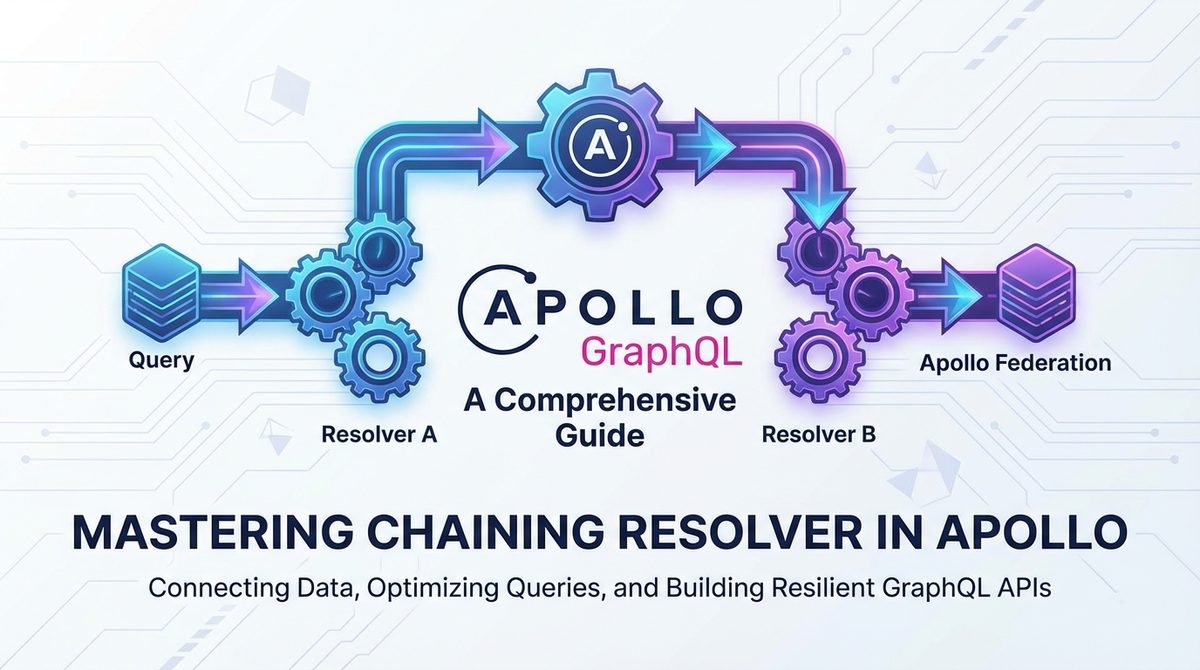
Mastering Chaining Resolver in Apollo: A Comprehensive Guide


In the dynamic landscape of modern application development, data orchestration and retrieval stand as paramount challenges. As applications grow in complexity, relying on diverse data sources, microservices, and external APIs, the need for a sophisticated and efficient data fetching mechanism becomes undeniable. GraphQL, with its declarative data fetching paradigm, has emerged as a powerful solution, allowing clients to request precisely the data they need, nothing more, nothing less. At the heart of any GraphQL server, particularly one built with Apollo Server, lies the concept of the "resolver" – the functions responsible for fetching the data corresponding to a field in your schema. While simple resolvers suffice for straightforward data retrieval, the real power and complexity often unfold when these resolvers need to interact, cooperate, and build upon each other, a process commonly known as "resolver chaining."
This comprehensive guide delves deep into the art and science of mastering chaining resolvers within the Apollo ecosystem. We will journey from the fundamental principles of what a resolver is, through the myriad reasons why chaining becomes an indispensable technique, to exploring various patterns, advanced strategies, and best practices. Our aim is to equip you with the knowledge and tools to architect robust, performant, and maintainable GraphQL APIs capable of handling the most intricate data requirements, leveraging the full potential of Apollo's resolver capabilities. By the end of this exploration, you will understand not just how to chain resolvers, but when and why, transforming your approach to data fetching and aggregation.
The Fundamentals of Apollo Resolvers
Before we can effectively chain resolvers, it's crucial to solidify our understanding of what a resolver is and how it functions within the Apollo Server environment. Resolvers are the core logic that connects your GraphQL schema's fields to your actual data sources. They are the "how-to" guides for fetching data for each field, ensuring that when a client requests specific data, your server knows exactly where to find it and how to return it.
What is a Resolver?
In Apollo Server, a resolver is essentially a function that tells the GraphQL server how to fetch data for a particular field in your schema. Every field in your schema, whether it's a scalar like String or a complex object like User, eventually needs a resolver to determine its value. If you don't explicitly define a resolver for a field, Apollo Server (and GraphQL in general) provides a default resolver. This default resolver simply looks for a property with the same name on the parent object, which is the result of the parent field's resolver. This seemingly simple mechanism is foundational to understanding resolver chaining, as we will soon discover.
Consider a basic GraphQL schema:
type Query {
  hello: String
  user(id: ID!): User
}

type User {
  id: ID!
  name: String!
  email: String
}
For this schema, you would define resolvers in an object that mirrors the schema's structure:
const resolvers = {
  Query: {
    hello: () => 'World!',
    user: (parent, args, context, info) => {
      // Logic to fetch a user from a database or API
      return { id: args.id, name: 'John Doe', email: 'john.doe@example.com' };
    },
  },
  User: {
    // These would typically be handled by default resolvers if the parent user object
    // already contains id, name, and email fields.
    // However, you could define them explicitly if transformation or additional logic is needed.
    id: (parent) => parent.id,
    name: (parent) => parent.name,
    email: (parent) => parent.email,
  },
};
In this example, the user resolver on the Query type is responsible for fetching a User object. Once that User object is returned, the resolvers for the User type's fields (id, name, email) are invoked, with the returned User object passed as their parent argument.
How Resolvers Map to Schema Fields
The mapping between resolvers and schema fields is precise and hierarchical. For every field declared in your GraphQL schema, there is a corresponding entry in your resolvers object. This object structure directly reflects the types and fields defined in your Schema Definition Language (SDL).
- Root Types: The
Query,Mutation, andSubscriptiontypes are special root types. Resolvers for fields defined on these types are the entry points for fetching or modifying data. For example,Query.useris the resolver for theuserfield under theQuerytype. - Object Types: For custom object types like
User, resolvers are defined for each field within that type. These resolvers receive the resolved value of their parent field as their first argument (parentorroot).
This hierarchical mapping is fundamental to GraphQL's execution model. When a query comes in, the GraphQL engine starts by calling resolvers for fields on the root Query type. As these resolvers return objects, the engine then proceeds to call resolvers for the fields nested within those objects, passing the parent object's result down the chain. This natural flow is where the concept of chaining begins to take shape implicitly.
Basic Resolver Structure (parent, args, context, info)
Every resolver function in Apollo Server (and GraphQL.js) receives four standard arguments:
parent(orroot): This is the result of the parent field's resolver. For a field on theQueryorMutationtype,parentis typicallyundefinedor an empty object, as there's no parent resolver before them. For nested fields,parentholds the data returned by the resolver of the containing type. This argument is absolutely crucial for resolver chaining, as it allows child resolvers to access data fetched by their parents.args: An object containing all the arguments passed to the field in the GraphQL query. For instance, inuser(id: ID!),argswould be{ id: "some-id" }. Resolvers use these arguments to filter or specify the data they need to fetch.context: An object that is shared across all resolvers during a single GraphQL operation. Thecontextobject is an incredibly powerful mechanism for sharing state, database connections, authenticated user information, or service instances throughout the entire resolver chain. It's often used to provide access to data sources or other utilities that resolvers might need, effectively enabling a form of explicit chaining or shared resource access.info: Contains information about the execution state of the query, including the schema, the field's AST (Abstract Syntax Tree), and parts of the query plan. While less frequently used for basic data fetching, it can be valuable for advanced scenarios like optimizing queries (e.g., partial fetching based on requested fields) or debugging.
Understanding these four arguments is foundational. The parent and context arguments, in particular, are the workhorses that enable sophisticated resolver chaining patterns, allowing data and capabilities to flow seamlessly through your GraphQL graph. Without a clear grasp of these fundamentals, the more advanced techniques of chaining resolvers would remain elusive, limiting the potential of your GraphQL API to efficiently aggregate and manage complex data landscapes.
Why Chaining Resolvers? The Necessity and Use Cases
The concept of resolver chaining isn't merely an advanced technique; it's often a necessity driven by the inherent complexities of modern application architectures. As systems evolve from monolithic structures to distributed microservices, and as data sources proliferate across various databases, REST APIs, and external services, a single resolver can rarely fulfill all data requirements in isolation. Chaining resolvers provides a structured and efficient way to aggregate, transform, and secure data from these disparate origins, ultimately constructing a coherent and powerful GraphQL api layer.
Data Aggregation: Combining Disparate Sources
Perhaps the most common and compelling reason for chaining resolvers is the need to aggregate data from multiple, distinct sources. Imagine a scenario where a User object's basic profile information (like ID, name, email) resides in one database, their transaction history in another, and their social media posts are fetched from an external api. A single GraphQL query requesting all this information would necessitate a coordinated effort from multiple resolvers.
- Example: A
Usertype might have apostsfield that needs to fetch data from a blogging service, and anordersfield that pulls from an e-commerce microservice. TheUserresolver (typically onQuery) fetches the user's basic data. Then, theUser.postsresolver takes theparentuser object (specifically, itsid) and uses it to query the blogging service for posts by that user. Similarly,User.orderswould use theuser.idto query the e-commerce service. This is a classic example of implicit chaining facilitated by theparentargument. - Microservices Orchestration: In a microservices architecture, GraphQL often acts as an API
gatewayor an "API composition layer." Here, chained resolvers are indispensable for stitching together data fragments provided by various independent services. A query forProductdetails might require fetching base product information from aProductservice, inventory levels from anInventoryservice, and reviews from aReviewservice. Each of these fetches can be handled by a dedicated resolver, which then intelligently combines the results. This approach greatly simplifies the client-side experience by presenting a unified graph, abstracting away the underlying service complexity. For organizations managing a complex mesh of microservices, especially those involving AI models, a robust platform like APIPark can significantly streamline the APIgatewaylayer. APIPark acts as an open-source AI gateway and API management platform, simplifying the integration and management of diverse AI and REST services. This means that the various backend services (e.g., the blogging service, e-commerce microservice, product service) that our GraphQL resolvers interact with can be more efficiently managed, authenticated, and monitored through a unifiedgateway, abstracting much of the infrastructure complexity away from the GraphQL resolvers themselves.
Authorization and Authentication: Pre-Checking Permissions
Security is paramount for any api, and GraphQL is no exception. Chaining resolvers offers an elegant mechanism to implement authorization and authentication checks at various levels of your data graph. Instead of duplicating permission logic in every resolver, you can create higher-order resolvers or utilize directives that wrap or precede the actual data fetching logic.
- Pre-Resolver Checks: A common pattern involves an authentication resolver that verifies a user's identity before allowing subsequent resolvers to execute. For instance, a
Query.meresolver (which fetches the currently authenticated user) might first check thecontextfor an authenticated user object. If none is found, it throws an error, preventing any further (potentially sensitive) resolvers from being called. - Field-Level Authorization: You might have a
User.salaryfield that should only be accessible to users with an 'admin' role. A resolver forsalarycould checkcontext.user.rolebefore returning the salary data. If the user isn't an admin, it could returnnullor throw anApolloError. This ensures fine-grained control over data access, enforcing security policies deep within the graph.
Data Transformation and Enrichment: Modifying and Enhancing Data
Raw data from backend services is often not in the exact format required by the GraphQL schema or client application. Chaining resolvers allows for seamless transformation and enrichment of data as it flows through the graph.
- Format Conversion: Dates fetched as Unix timestamps from a database might need to be converted to ISO 8601 strings for the client. A resolver for a
createdAtfield can take the raw timestamp from theparentobject and format it appropriately. - Derived Data: A
Userobject might havefirstNameandlastNamefields, but the schema defines afullNamefield. TheUser.fullNameresolver can simply concatenateparent.firstNameandparent.lastName. This encapsulates derived logic within the GraphQL layer, keeping the backend services focused on raw data. - Adding Related Data: After fetching a list of
Products, aProduct.discountedPriceresolver might calculate a price based on real-time promotions or user-specific loyalty programs, enriching the basic product data before it's sent to the client.
Performance Optimization: Caching, Batching, and Pre-fetching
Inefficient data fetching can cripple a GraphQL api's performance. Chaining resolvers, especially when combined with tools like DataLoader, provides powerful mechanisms for optimizing data retrieval.
- N+1 Problem Mitigation: The infamous N+1 problem occurs when fetching a list of items (N) and then, for each item, performing an additional query to fetch related data (+1). For example, fetching 100 posts and then making 100 separate queries to fetch the author of each post. DataLoader, which is often integrated within resolvers, batches these individual queries into a single, optimized database call, dramatically reducing the number of round trips. Chained resolvers can intelligently utilize DataLoader by placing the batching logic in the appropriate resolver that deals with many-to-one or one-to-many relationships.
- Caching: Resolvers can implement caching strategies. A
Query.userresolver might first check an in-memory cache or Redis for the user data before hitting the database. If the data is found, it's returned immediately; otherwise, the database is queried, and the result is cached for future requests. This improves response times for frequently requested data. - Pre-fetching: In some cases, a resolver might anticipate future data needs. For instance, if fetching a
Bookfrequently leads to subsequent requests for itsAuthor, theBookresolver could pre-fetch theAuthordata and store it in thecontextor directly attach it to theparentobject, making theBook.authorresolver's job faster.
Complex Business Logic: Encapsulating Intricate Operations
Chaining resolvers helps manage and encapsulate complex business logic that spans multiple data points or requires sequential operations. Rather than having monolithic resolvers, you can break down complexity into smaller, manageable, and composable units.
- Workflow Orchestration: Consider a mutation
createOrderthat requires several steps: validating user input, checking inventory, calculating shipping costs, creating a new order record, and then sending a confirmation email. Each of these steps could conceptually be handled by a distinct "logical resolver" (though perhaps implemented as service calls within a single mutation resolver), where the output of one step becomes the input for the next. This makes the overall process more readable, testable, and maintainable. - Stateful Operations: For operations that require maintaining some state across multiple fetches or transformations, the
contextobject, often populated by higher-level resolvers or middleware, becomes invaluable. This state can then be accessed by subsequent resolvers in the chain, enabling complex, multi-stage operations.
Error Handling and Resilience: Implementing Fallbacks and Retries
Robust apis must gracefully handle errors and unexpected failures. Chaining resolvers provides opportunities to build resilience into your data fetching logic.
- Fallback Mechanisms: If a primary data source fails to respond, a resolver could be designed to query a secondary, cached, or fallback source.
- Retries: For transient network errors, a resolver could implement a retry mechanism before declaring a permanent failure. While often handled at a lower service layer, the GraphQL resolver can orchestrate or trigger such patterns.
- Centralized Error Handling: By utilizing Apollo Server's plugin system or custom middleware, you can intercept errors that occur anywhere in the resolver chain, log them, transform them into user-friendly messages, or even prevent sensitive error details from reaching the client.
Modularity and Reusability: Breaking Down Large Resolvers
Finally, chaining resolvers significantly contributes to the modularity and reusability of your GraphQL code. Instead of writing one colossal resolver that does everything, you can compose smaller, focused resolvers, each responsible for a specific piece of data or logic.
- Single Responsibility Principle: Each resolver can adhere more closely to the Single Responsibility Principle, making it easier to understand, test, and debug. A
User.postsresolver focuses solely on fetching posts for a given user, without needing to know how the user object itself was initially fetched. - Code Reusability: Helper functions, utility resolvers, or custom directives designed to perform common tasks (e.g., authorization checks, data formatting) can be reused across multiple resolvers and types, leading to cleaner and more maintainable codebase.
In summary, resolver chaining is not merely a technical detail; it's a fundamental design pattern for building scalable, secure, and performant GraphQL APIs that can efficiently integrate and manage data from the myriad sources prevalent in today's complex software ecosystems. Understanding these motivations is the first step toward effectively employing the various chaining techniques we will explore next.
Core Patterns and Techniques for Chaining Resolvers
The art of chaining resolvers manifests in several distinct patterns, each suited to different scenarios and offering unique advantages. While the underlying principle remains the same – passing data or control from one resolver to the next – the mechanisms employed can vary significantly. Mastering these core patterns is essential for building flexible and robust GraphQL APIs.
Resolver Composition (Direct Chaining): Calling Resolvers from Within Others
One of the most intuitive ways to chain resolvers is to directly call the logic of one resolver from within another. This pattern often involves abstracting the data fetching logic into separate functions that can then be invoked by multiple resolvers. This isn't about calling the resolver function itself as defined in the resolvers map (which would bypass GraphQL's execution engine and potential optimizations like DataLoader), but rather calling the underlying data fetching or business logic functions that a resolver would typically use.
- Mechanism: Instead of having a single monolithic resolver, you break down the data fetching into smaller, focused service functions. A higher-level resolver then orchestrates calls to these functions, often passing arguments derived from its
parentorargsto the subsequent functions. - Example:
User.postsResolver Calling aPostServiceFunction Consider a scenario where ourUsertype has apostsfield, and the posts are managed by aPostService.```javascript // services/postService.js const posts = [ { id: 'p1', title: 'First Post', userId: 'u1' }, { id: 'p2', title: 'Second Post', userId: 'u1' }, { id: 'p3', title: 'Third Post', userId: 'u2' }, ];const PostService = { getPostsByUserId: async (userId) => { // Simulate an async database/API call return new Promise(resolve => setTimeout(() => resolve(posts.filter(post => post.userId === userId)), 50)); }, getPostById: async (postId) => { / ... / } };// resolvers.js const resolvers = { Query: { user: async (parent, { id }, context, info) => { // Assume context.userService is available return context.userService.getUserById(id); }, }, User: { posts: async (parent, args, context, info) => { // 'parent' here is the User object resolved by Query.user // We directly call PostService's method using the parent's ID return context.postService.getPostsByUserId(parent.id); }, }, };`` In this example,User.postsis explicitly chained to theQuery.userresolver because it relies on theUserobject (parent) returned byQuery.userto fetch its own data. It does this by calling a dedicatedgetPostsByUserId` function, which might encapsulate its own data fetching logic. - Pros:
- Modularity: Promotes breaking down complex logic into smaller, reusable functions.
- Readability: Easier to understand what each part of the data fetching chain does.
- Testability: Individual service functions can be unit-tested in isolation.
- Cons:
- N+1 Problem Risk: Without careful implementation (e.g., using DataLoader), direct calls to service functions can lead to the N+1 problem if a parent returns a list of items and each item then triggers a separate call in its child resolver.
- Explicit Dependency Management: Requires resolvers to explicitly know about and call service functions, potentially increasing coupling.
Context-Based Chaining: Passing Data and Services via the context Object
The context object is a powerful, globally accessible (per-request) store that can be used to share any data or utility across all resolvers in a single GraphQL operation. This makes it an ideal candidate for facilitating resolver chaining, particularly for sharing shared resources, authenticated user information, or intermediate computation results.
- Mechanism: The
contextobject is typically built in the Apollo Server initialization phase (e.g., in thecontextfunction property ofApolloServer). You can populate it with database connections, service instances, an authenticated user object, or even memoized results from expensive computations. Resolvers then access these shared resources directly from thecontextargument. - Pros:
- Global Accessibility (per request): Any resolver can access shared data or services, reducing boilerplate.
- Dependency Injection: A clean way to inject dependencies (like services or data sources) into resolvers.
- Authentication/Authorization: Ideal for sharing authenticated user details or roles across the entire request.
- Performance: Can be used for memoization or caching within a single request context.
- Cons:
- Potential for Overuse: If too much state is dumped into the context, it can become a "god object" and difficult to reason about.
- Implicit Dependencies: Resolvers rely on specific properties being present in the context, which might not be immediately obvious without consulting the context creation logic.
Example: Authenticated User Information Let's say you want to ensure all resolvers have access to the currently authenticated user.```javascript // server.js import { ApolloServer } from 'apollo-server'; import { UserService } from './services/userService'; // Assume a service to fetch user by tokenconst server = new ApolloServer({ typeDefs, resolvers, context: async ({ req }) => { // Get the authentication token from the headers const token = req.headers.authorization || '';
let user = null;
if (token) {
  // In a real app, verify the token and fetch user details
  user = await UserService.getUserFromToken(token); // e.g., decode JWT, fetch user from DB
}

// Return the context object, making user available to all resolvers
return { user, userService: UserService };
}, });// resolvers.js const resolvers = { Query: { me: (parent, args, { user }) => { // Resolver directly uses 'user' from context if (!user) throw new Error('Not authenticated'); return user; }, user: (parent, { id }, { userService }) => { // Resolver directly uses 'userService' from context return userService.getUserById(id); }, }, // ... other resolvers }; `` Here, theuseranduserServiceobjects are established once per request in thecontext` function. Any resolver can then access them, effectively "chaining" into shared resources without explicit arguments being passed down a resolver hierarchy.
Schema-Level Chaining (Delegation): Stitching or Extending Remote Schemas
For larger, distributed GraphQL architectures, particularly those involving microservices that each expose their own GraphQL API, "schema-level chaining" or "delegation" becomes crucial. This pattern involves combining multiple independent GraphQL schemas into a single, unified gateway schema, allowing clients to query across these services as if they were one. graphql-tools's delegateToSchema function is the primary mechanism for this.
- Mechanism: Instead of resolving fields locally, a resolver can "delegate" a query or mutation to a field on another (remote) GraphQL schema. The gateway schema acts as an orchestrator, forwarding parts of the client's query to the appropriate backend GraphQL service and then stitching the results back together. This is a powerful form of chaining where entire subgraphs are resolved by external GraphQL services.
- Pros:
- Distributed Development: Allows different teams to own and evolve their own GraphQL schemas independently.
- Scalability: Distributes the data fetching load across multiple services.
- Unified API: Provides a single, cohesive API for clients, abstracting underlying microservices.
- Strong Type Safety: Benefits from GraphQL's type system across services.
- Cons:
- Increased Complexity: Setting up schema stitching or federation is more complex than a single monolithic GraphQL server.
- Performance Overhead: Network hops between the gateway and remote services can introduce latency if not managed carefully (e.g., with query batching at the gateway level).
- Tooling Dependence: Relies heavily on tools like
graphql-toolsor Apollo Federation.
Example: Extending a User Schema with Post Data from Another Service Imagine a User service providing user data and a Post service providing blog posts, each with its own GraphQL API. We want to combine them under a single gateway.```javascript // gateway.js import { ApolloServer, gql } from 'apollo-server'; import { makeExecutableSchema } from '@graphql-tools/schema'; import { wrapSchema, introspectSchema, delegateToSchema } from '@graphql-tools/wrap'; import { fetch } from 'cross-fetch'; import { print } from 'graphql';// A simple executor for remote schemas const createRemoteExecutor = (uri) => async ({ document, variables, operationName, context }) => { const query = print(document); const fetchResult = await fetch(uri, { method: 'POST', headers: { 'Content-Type': 'application/json' }, body: JSON.stringify({ query, variables, operationName }), }); return fetchResult.json(); };async function startGateway() { // Assume user and post services are running on different ports const userServiceExecutor = createRemoteExecutor('http://localhost:4001/graphql'); const postServiceExecutor = createRemoteExecutor('http://localhost:4002/graphql');
// Introspect remote schemas to get their definitions
const userSchema = await introspectSchema(userServiceExecutor);
const postSchema = await introspectSchema(postServiceExecutor);

// Wrap them for easier delegation
const wrappedUserSchema = wrapSchema({ schema: userSchema, executor: userServiceExecutor });
const wrappedPostSchema = wrapSchema({ schema: postSchema, executor: postServiceExecutor });

// Define our gateway schema's extensions
const gatewayTypeDefs = gql`
    extend type User {
        posts: [Post!]!
    }
    extend type Query {
        _user(id: ID!): User # Internal field to fetch user from user service
    }
`;

const gatewayResolvers = {
    Query: {
        // A root query field to get user data from the user service via delegation
        // This might be exposed as 'user' to clients, or used internally.
        user: (parent, args, context, info) => {
            return delegateToSchema({
                schema: wrappedUserSchema,
                operation: 'query',
                fieldName: 'user', // Corresponds to the user field in the remote user schema
                args: args,
                context,
                info,
            });
        },
    },
    User: {
        // The 'posts' field on the User type is resolved by delegating to the post service
        // It needs the 'id' of the parent User object
        posts: (parent, args, context, info) => {
            return delegateToSchema({
                schema: wrappedPostSchema,
                operation: 'query',
                fieldName: 'postsByUser', // Assuming post service has a query like postsByUser(userId: ID!)
                args: { userId: parent.id }, // Pass the parent's ID as an arg to the remote field
                context,
                info,
            });
        },
    },
};

const gatewaySchema = makeExecutableSchema({
    typeDefs: [gatewayTypeDefs, userSchema, postSchema], // Combine all type definitions
    resolvers: gatewayResolvers,
});

const server = new ApolloServer({ schema: gatewaySchema });
await server.listen(4000);
console.log(`🚀 Gateway ready at http://localhost:4000/graphql`);
}// Call startGateway() `` In this advanced scenario, theUser.postsresolver doesn't fetch data itself. Instead, it delegates the query to thepostsByUserfield of thewrappedPostSchema, passing theparent.id(which is the user ID from theUser` service) as an argument. This is a powerful form of chaining that operates at the schema level, ideal for GraphQL Federation or schema stitching architectures.
Parent-Based Chaining (Default Behavior): The Implicit Power of parent
The most fundamental form of resolver chaining is also the most implicit: the default resolver behavior driven by the parent argument. This is not a technique you "implement" as much as it is the natural way GraphQL executes nested fields.
- Mechanism: When a resolver for a parent field returns an object, GraphQL automatically passes that object as the
parentargument to the resolvers of its child fields. If a child field's resolver is not explicitly defined, the default resolver looks for a property on theparentobject with the same name as the child field. If found, that property's value is used. - Example:
Book.authorUsingparent.authorIdConsider a schema forBookandAuthor:```graphql type Book { id: ID! title: String! author: Author! # The Author object itself authorId: ID! # The ID of the author, often available on the book object }type Author { id: ID! name: String! }type Query { book(id: ID!): Book } ``` And the resolvers:```javascript // services/authorService.js const authors = [ { id: 'a1', name: 'Author One' }, { id: 'a2', name: 'Author Two' }, ]; const AuthorService = { getAuthorById: async (authorId) => { return new Promise(resolve => setTimeout(() => resolve(authors.find(a => a.id === authorId)), 50)); } };// services/bookService.js const books = [ { id: 'b1', title: 'The Great Book', authorId: 'a1' }, { id: 'b2', title: 'Another Tale', authorId: 'a2' }, ]; const BookService = { getBookById: async (bookId) => { return new Promise(resolve => setTimeout(() => resolve(books.find(b => b.id === bookId)), 50)); } };// resolvers.js const resolvers = { Query: { book: async (parent, { id }, context) => { return context.bookService.getBookById(id); }, }, Book: { // This resolver takes the 'parent' Book object (returned by Query.book) // and uses its authorId to fetch the Author object. author: async (parent, args, context) => { // 'parent' here is { id: 'b1', title: 'The Great Book', authorId: 'a1' } return context.authorService.getAuthorById(parent.authorId); }, // For fields like 'id' and 'title' on Book, if not explicitly defined, // the default resolver would simply return parent.id and parent.title respectively. }, };`` When a query forbook { title author { name } }arrives,Query.bookresolves theBookobject. ThisBookobject then becomes theparentforBook.author. TheBook.authorresolver usesparent.authorIdto fetch the completeAuthor` object. This is "parent-based chaining" in action, leveraging the natural flow of data down the GraphQL query tree. - Pros:
- Simplicity: The most straightforward and natural way to fetch nested data.
- Automatic Resolution: GraphQL handles the flow automatically.
- Efficiency (with care): Can be very efficient if the parent object already contains all necessary IDs or data.
- Cons:
- N+1 Problem Prone: If
Book.authoris invoked for many books, andgetAuthorByIdmakes a separate database call for each, it leads to the N+1 problem. This is where DataLoader (discussed next) becomes indispensable. - Lack of Control: Less explicit control over the full data fetching process compared to direct calls or context manipulation.
- N+1 Problem Prone: If
By understanding these core patterns, you can strategically choose the most appropriate method for chaining resolvers based on the complexity of your data sources, the structure of your services, and the performance requirements of your API. The ability to fluidly navigate between direct composition, context sharing, schema delegation, and leveraging implicit parent-based resolution is a hallmark of a master GraphQL developer.
APIPark is a high-performance AI gateway that allows you to securely access the most comprehensive LLM APIs globally on the APIPark platform, including OpenAI, Anthropic, Mistral, Llama2, Google Gemini, and more.Try APIPark now! 👇👇👇
Advanced Strategies for Chaining Resolvers
Beyond the core patterns, several advanced strategies elevate resolver chaining to an even more sophisticated level, addressing performance bottlenecks, cross-cutting concerns, and real-time data needs. These techniques empower you to build highly optimized, secure, and maintainable GraphQL APIs.
DataLoader for Batching and Caching: Solving N+1 Problems
The N+1 problem is a notorious performance bottleneck in GraphQL, where fetching a list of parent items leads to N additional queries for their related child items. For instance, if you fetch 100 User objects and then, for each user, fetch their posts, you'd end up with 1 (for users) + 100 (for posts) = 101 database queries. DataLoader, a generic utility created by Facebook, is the canonical solution to this problem, offering both batching and caching capabilities.
- Mechanism: DataLoader sits between your resolvers and your data sources. It collects all individual load calls for a given type of data over a short period (typically within a single tick of the event loop) and then dispatches them in a single batch query to your data source. It also caches the results of these batched queries, so subsequent requests for the same item within the same request lifecycle hit the cache instead of the database.
- How DataLoader Fits into Resolver Chaining: DataLoader instances are typically created and attached to the
contextobject at the beginning of each GraphQL request. Resolvers then access these DataLoader instances from thecontextand use them to fetch related data. - Implementing and Integrating DataLoader:
- Create a batch function: This function takes an array of keys (e.g.,
userIds) and returns a Promise that resolves to an array of values (e.g.,Userobjects) in the same order as the keys.```javascript // dataLoaders/userLoader.js import DataLoader from 'dataloader'; import { UserService } from '../services/userService'; // Your actual service// Batch function for loading users by ID const batchUsers = async (ids) => { // In a real app, this would be a single database query like SELECT * FROM users WHERE id IN (...) console.log(DataLoader: Fetching users with IDs: ${ids.join(', ')}); const users = await UserService.getUsersByIds(ids); // Assumes a batch function in UserService // DataLoader requires that the returned array matches the order of the keys return ids.map(id => users.find(user => user.id === id) || null); };export const createUserLoader = () => new DataLoader(batchUsers); ``` - Attach DataLoader to
context:```javascript // server.js import { ApolloServer } from 'apollo-server'; import { createUserLoader } from './dataLoaders/userLoader'; // ... other importsconst server = new ApolloServer({ typeDefs, resolvers, context: ({ req }) => ({ // Create a new DataLoader instance for each request userLoader: createUserLoader(), // ... other context properties like auth, services }), }); ``` - Use DataLoader in resolvers:
javascript // resolvers.js const resolvers = { Query: { // No DataLoader needed here if it's a single user fetch user: async (parent, { id }, { userLoader }) => { return userLoader.load(id); // Even for single fetch, DataLoader provides caching }, }, Post: { // Assume a Post object has a 'userId' field author: async (parent, args, { userLoader }) => { // 'parent' here is the Post object, e.g., { id: 'p1', title: 'Post', userId: 'u1' } return userLoader.load(parent.userId); // DataLoader batches these calls }, }, // ... };WhenQuery.useris called withid: 'u1',userLoader.load('u1')is invoked. If a query requests multiple posts, and each post needs its author (Post.authorresolver), multipleuserLoader.load(parent.userId)calls will be made. DataLoader observes all these calls within the event loop, batches the uniqueuserIds, makes a singlegetUsersByIdscall to theUserService, and then returns the correct user to eachPost.authorresolver.
- Create a batch function: This function takes an array of keys (e.g.,
- Pros:
- Solves N+1 problem: Drastically reduces the number of data source calls.
- Automatic Caching: Prevents redundant fetches for the same ID within a request.
- Simplifies Resolvers: Resolvers can call
loader.load()without worrying about batching logic.
- Cons:
- Setup Overhead: Requires careful implementation of batch functions.
- Debugging Complexity: Can be harder to debug if batch functions have issues.
- Not a Silver Bullet: Only effective for one-to-many or many-to-one relationships where multiple child resolvers need to fetch the same type of parent.
Custom Directives for Cross-Cutting Concerns
GraphQL directives (@) are powerful tools that can attach metadata to schema definitions. Apollo Server allows you to implement custom directive logic that can wrap or modify resolver behavior, making them ideal for handling cross-cutting concerns like authorization, caching, formatting, or logging. Directives offer a declarative way to chain behavior to fields or types.
- Mechanism: A custom directive is defined in the schema (e.g.,
@auth(roles: [Role!])). You then create a Transformer that applies this directive's logic to the relevant fields' resolvers. The directive essentially wraps the original resolver, executing its logic before or after the original resolver, effectively creating a chain of execution. - Example: Implementing an
@authDirective This directive ensures a user has a specific role before allowing access to a field.```javascript // directives/authDirective.js import { mapSchema, get '); } // If all good, call the original resolver return resolve(source, args, context, info); } }); };// server.js (excerpt) import { makeExecutableSchema } from '@graphql-tools/schema'; import { authDirectiveTransformer } from './directives/authDirective'; // ...let schema = makeExecutableSchema({ typeDefs, resolvers }); schema = authDirectiveTransformer(schema, 'auth'); // Apply the directive transformerconst server = new ApolloServer({ schema, context });And in your schema:graphql enum Role { ADMIN EDITOR VIEWER }directive @auth(roles: [Role!]!) on FIELD_DEFINITIONtype Query { users: [User!]! @auth(roles: [ADMIN]) myProfile: User @auth(roles: [ADMIN, EDITOR, VIEWER]) }`` WhenQuery.usersis called, theauthDirectiveTransformerwraps its resolver. Before the actualusersresolver runs, the@authdirective's logic checks ifcontext.userexists and if their role isADMIN. If not, it throws anAuthenticationErrororForbiddenError`. - Pros:
- Declarative: Logic is applied directly in the schema, making intentions clear.
- Reusable: A single directive can be applied across many fields/types.
- Separation of Concerns: Keeps cross-cutting concerns out of resolver business logic.
- Cleaner Resolvers: Resolvers focus solely on data fetching, not authorization.
- Cons:
- Increased Learning Curve: Understanding how to implement custom directives can be complex.
- Debugging: Can be harder to trace execution flow if many directives are chained.
- Over-abstraction: Can obscure logic if directives become too complex.
Middleware and Plugins: Global Lifecycle Hooks
Apollo Server provides robust mechanisms for extending its functionality through plugins and custom middleware. These allow you to hook into various stages of the GraphQL request lifecycle, effectively chaining global behaviors before or after resolver execution, or even around entire operations.
- Apollo Server Plugins: Plugins are objects with lifecycle event hooks (e.g.,
requestDidStart,parsingDidStart,validationDidStart,willResolveField,didResolveField,didEncounterErrors). They offer a powerful way to implement global logging, performance monitoring, error reporting, or even request-specific context setup.``javascript // plugins/requestLoggerPlugin.js const requestLoggerPlugin = { async requestDidStart(requestContext) { console.log(Request started for query: ${requestContext.request.operationName}); return { async willResolveField({ source, args, context, info }) { const startTime = Date.now(); return (result) => { const endTime = Date.now(); console.log(Field '${info.parentType.name}.${info.fieldName}' resolved in ${endTime - startTime}ms`); }; }, async didEncounterErrors(requestContext) { console.error('An error occurred:', requestContext.errors); }, }; }, };// server.js const server = new ApolloServer({ typeDefs, resolvers, plugins: [requestLoggerPlugin], // Register the plugin // ... }); ``` This plugin effectively "chains" logging and timing logic around every single field resolver without modifying resolver code.willResolveFieldHook: This hook is particularly relevant for chaining, as it allows you to wrap the execution of every field resolver. You can use it to add logging, timing, or even modify thesourceorargsbefore the resolver runs.
- Custom Middleware (Express/Koa): If you're using Apollo Server with an HTTP framework like Express or Koa, you can leverage their middleware systems to perform actions before the GraphQL request even reaches Apollo Server. This is useful for tasks like CORS, rate limiting, initial authentication, or setting up database connections in the
reqobject that can then be used to construct the Apollocontext. - Pros:
- Global Scope: Affects all resolvers or the entire request lifecycle without code repetition.
- Clean Separation: Keeps cross-cutting concerns entirely separate from resolver logic.
- Powerful Extensibility: Provides deep hooks into Apollo Server's internal processes.
- Cons:
- Complexity: Plugins can be complex to write and debug due to their asynchronous nature and internal lifecycle.
- Order Dependence: The order of plugins and middleware can matter.
Combining Chaining with Subscriptions: Real-time Data
GraphQL Subscriptions enable real-time data push from the server to the client. Chaining resolvers in a subscription context is critical for complex real-time data flows, especially when event payloads need enrichment or transformation before being broadcast.
- Mechanism: A subscription resolver typically returns an
AsyncIterator(e.g., frompubsub.asyncIterator). The "resolve" part of the subscription (the second function in asubscribe/resolvepair) is where the value from the iterator is processed. Here, you can apply resolver chaining techniques just as you would for queries and mutations. - Example: Enriching a
CommentAddedSubscription Event ```javascript // pubsub.js (using apollo-server-pubsub for simplicity) import { PubSub } from 'apollo-server'; export const pubsub = new PubSub(); export const COMMENT_ADDED = 'COMMENT_ADDED';// resolvers.js const resolvers = { Subscription: { commentAdded: { // 'subscribe' returns an AsyncIterator for events subscribe: () => pubsub.asyncIterator([COMMENT_ADDED]), // 'resolve' is called for each event, allowing enrichment/transformation resolve: async (payload, args, { userLoader }) => { // payload example: { commentAdded: { id: 'c1', text: 'Hey!', authorId: 'u1' } } const comment = payload.commentAdded; // Chain to userLoader to fetch the author's details const author = await userLoader.load(comment.authorId); return { ...comment, author, // Add the full author object to the comment timestamp: new Date().toISOString(), // Add a derived field }; }, }, }, // Other resolvers for Query, Mutation, and types like Comment, User... Comment: { // If 'author' is already resolved in the subscription's 'resolve', this might not even be called. // If it's not resolved, this would kick in, potentially causing N+1 if not using DataLoader. author: (parent, args, { userLoader }) => userLoader.load(parent.authorId), } };`` In this scenario, theresolvefunction forcommentAddedacts as a crucial point for chaining. It takes the rawcommentAddedpayload (which only hasauthorId) and chains touserLoader.load(comment.authorId)to fetch the completeAuthorobject. This ensures that clients receive a fully enrichedComment` object in real-time, leveraging the same DataLoader instance for efficient fetching as queries and mutations. - Pros:
- Consistent Data: Ensures real-time data is enriched and formatted consistently with queried data.
- Leverage Existing Logic: Reuses existing data fetching logic (like DataLoader) from queries/mutations.
- Complex Event Processing: Allows for sophisticated transformation of event payloads before delivery.
- Cons:
- Complexity: Combining subscriptions,
AsyncIterators, and resolver logic can be challenging. - Performance: Event processing in
resolvemust be efficient to avoid delaying real-time updates.
- Complexity: Combining subscriptions,
By integrating these advanced strategies, particularly DataLoader, custom directives, and plugins, you can build GraphQL APIs that are not only powerful in their data aggregation capabilities but also optimized for performance, robust in their security, and elegant in their design. The strategic application of resolver chaining, enhanced by these techniques, is what truly sets apart a basic GraphQL implementation from a production-ready, enterprise-grade solution.
Best Practices and Pitfalls
Mastering resolver chaining is not just about understanding the techniques, but also about applying them judiciously, adhering to best practices, and avoiding common pitfalls. A well-architected GraphQL API, built with thoughtful resolver chaining, can significantly enhance performance, maintainability, and security.
Best Practices
- Modularity: Keep Resolvers Focused and Single-Responsibility
- Principle: Each resolver should primarily be responsible for fetching or computing the value of its own field. Avoid "god resolvers" that attempt to fetch data for many unrelated fields or perform excessive business logic.
- Implementation: Delegate complex logic to service layers, utility functions, or DataLoader. A
Query.userresolver should primarily concern itself with fetching theUserobject, leavingUser.poststo its own resolver. - Benefit: Improves readability, testability, and makes refactoring easier.
- Clarity: Document Complex Chains
- Principle: When resolvers are chained across multiple services, contexts, or custom directives, the flow can become intricate.
- Implementation: Use code comments, architecture diagrams, or even
READMEfiles to explain how data flows through different resolvers, what dependencies they have, and which services they interact with. - Benefit: Reduces the cognitive load for new developers and simplifies debugging.
- Performance: Utilize DataLoader and Caching Strategically
- Principle: Prevent the N+1 problem and reduce redundant data fetches.
- Implementation:
- DataLoader: Employ DataLoader extensively for relationships where a parent returns a list of items and each item needs to fetch related data (e.g.,
[Post].author). - Caching: Implement caching at various levels – in-memory, Redis, or HTTP caching – for frequently accessed data or expensive computations. Consider caching results of expensive batch functions in DataLoader.
- Memoization: For computations within a single request that might be called multiple times, memoize the results, often by storing them in the
contextobject.
- DataLoader: Employ DataLoader extensively for relationships where a parent returns a list of items and each item needs to fetch related data (e.g.,
- Benefit: Drastically improves API response times and reduces load on backend data sources.
- Error Handling: Graceful and Informative
- Principle: Anticipate failures from upstream services or data sources and handle them gracefully, providing clear and secure error messages to clients.
- Implementation:
- Try-Catch Blocks: Wrap asynchronous data fetching logic in
try-catchblocks. - Custom Errors: Throw custom Apollo errors (
AuthenticationError,ForbiddenError,UserInputError,ApolloError) to categorize and standardize error responses. - Global Error Handling: Use Apollo Server plugins (
didEncounterErrors) to log errors, mask sensitive details, and format error responses consistently. - Nullability: Design your schema with appropriate nullability. If a field can legitimately fail to resolve without breaking the entire query, make it nullable.
- Try-Catch Blocks: Wrap asynchronous data fetching logic in
- Benefit: Improves the developer experience for clients and helps maintain system stability.
- Security: Implement Robust Authorization
- Principle: Ensure that users can only access data and perform actions they are authorized for.
- Implementation:
- Context-Based Checks: Pass authenticated user information (roles, permissions) in the
contextand perform checks in resolvers. - Custom Directives: Use
@authdirectives to declaratively apply authorization logic to fields and types. - Service Layer Authorization: Push authorization checks down to the service layer where the data is actually accessed, providing a layered defense.
- Input Validation: Always validate input arguments (
args) to prevent malicious data.
- Context-Based Checks: Pass authenticated user information (roles, permissions) in the
- Benefit: Protects sensitive data and prevents unauthorized operations.
- Testing: Comprehensive Unit and Integration Tests
- Principle: Chained resolvers can be complex; thorough testing is crucial.
- Implementation:
- Unit Tests: Test individual resolvers and service functions in isolation, mocking dependencies (
parent,args,context,info). - Integration Tests: Write tests that send actual GraphQL queries to your server and assert the full response, ensuring the entire resolver chain works as expected.
- Unit Tests: Test individual resolvers and service functions in isolation, mocking dependencies (
- Benefit: Ensures correctness, prevents regressions, and builds confidence in your API.
- Observability: Logging and Monitoring
- Principle: Understand how your resolvers are performing in production.
- Implementation:
- Logging: Use structured logging within resolvers and plugins (
willResolveField) to record execution times, arguments, and outcomes. - Monitoring: Integrate with APM tools (e.g., DataDog, New Relic) or GraphQL-specific monitoring (e.g., Apollo Studio) to track query performance, error rates, and resolver latencies.
- Tracing: Implement distributed tracing to visualize the flow of requests across multiple services in a chained resolver scenario.
- Logging: Use structured logging within resolvers and plugins (
- Benefit: Enables proactive problem identification, performance tuning, and capacity planning.
Pitfalls to Avoid
- N+1 Problem (without DataLoader):
- Description: Repeated individual data source calls for related items.
- Avoidance: Always use DataLoader for one-to-many relationships where children need to fetch data based on parent IDs. Proactively identify potential N+1 scenarios during schema design.
- Over-fetching/Under-fetching at the Service Layer:
- Description: Resolvers asking a service for more data than needed (over-fetching) or making multiple calls because individual calls fetch too little (under-fetching).
- Avoidance: Design your service layer APIs to support partial fetching based on requested fields (using
infoobject or query builders), and ensure services can efficiently fetch related data in batches where appropriate.
- Circular Dependencies:
- Description: Two resolvers (or services they call) inadvertently calling each other in a loop, leading to infinite recursion or stack overflows.
- Avoidance: Careful design of your data graph and service interactions. Thorough testing, especially integration tests, can help uncover these.
- Complexity Sprawl: Overly Large or Hard-to-Reason-About Resolvers:
- Description: Resolvers that become too long, handle too many responsibilities, or contain convoluted business logic.
- Avoidance: Adhere to the Single Responsibility Principle. Refactor complex logic into dedicated service classes, utility functions, or compose with custom directives. Use
contextfor shared dependencies rather than passing them through many function arguments.
- Security Gaps: Insufficient Authorization Checks:
- Description: Forgetting to apply authorization to sensitive fields or mutations, leading to data exposure or unauthorized actions.
- Avoidance: Treat authorization as a first-class concern. Implement a consistent authorization strategy (directives, context checks) and apply it rigorously. Conduct security audits and penetration testing.
- Performance Bottlenecks: Unoptimized Data Access:
- Description: Slow database queries, inefficient external
apicalls, or lack of indexing that manifest as slow GraphQL responses. - Avoidance: Profile your data sources. Optimize database queries, use appropriate indexes, and ensure external
apicalls are made efficiently (e.g., with timeouts, retries, and rate limiting). Monitorapigatewayperformance using tools like APIPark, which is an open-source AI gateway and API management platform. APIPark offers performance rivaling Nginx, supporting over 20,000 TPS on modest hardware, and provides detailed API call logging and powerful data analysis features to help identify and prevent performance issues in your underlying microservices andapis before they impact your GraphQL layer. Its unified API format for AI invocation also ensures consistent performance when integrating various AI models that might feed into your GraphQL resolvers.
- Description: Slow database queries, inefficient external
- Over-reliance on
context:- Description: The
contextobject becoming a "god object" with too many responsibilities, making it opaque and hard to manage. - Avoidance: Use
contextprimarily for request-scoped shared resources (authenticated user, data loaders, transaction managers). Avoid putting business logic directly intocontextcreation; instead, put services intocontextthat encapsulate business logic.
- Description: The
By diligently following these best practices and remaining vigilant against common pitfalls, you can leverage resolver chaining to build highly performant, secure, and maintainable GraphQL APIs that gracefully handle the complexities of modern data landscapes.
Real-World Scenarios and Architectures
Understanding resolver chaining in isolation is one thing; seeing how it fits into broader architectural patterns in real-world applications is another. Chaining resolvers plays a pivotal role in scenarios ranging from integrating diverse microservices to supporting federated GraphQL architectures, acting as the glue that binds disparate data sources into a cohesive API.
Microservices Integration: GraphQL as an API Gateway
One of the most compelling use cases for GraphQL, and consequently for resolver chaining, is its role as an API Gateway or API Composition Layer in a microservices architecture. In such environments, different functionalities are encapsulated within independent services, each potentially exposing its own api (REST, gRPC, or even its own GraphQL endpoint). Clients, however, demand a single, unified entry point to access data across these services. GraphQL, particularly with Apollo Server, is ideally suited for this.
- The Challenge:
- A user profile might be handled by a
UserProfileService. - Their orders by an
OrderService. - Their payment methods by a
PaymentService. - Each service has its own data model and
apiinterface. - A client needing a "dashboard" view would have to make multiple calls to different services, then manually stitch the data together, leading to complex client-side logic, increased latency, and potential versioning headaches.
- A user profile might be handled by a
- GraphQL's Solution via Chaining: The GraphQL server sits in front of these microservices, acting as the intelligent
apigateway. Resolvers within this gateway are responsible for calling the appropriate microservice(s), fetching the necessary data, and then composing it into the GraphQL response requested by the client.- Example Flow:
- Client Query:
query { user(id: "u1") { id name orders { id total status } paymentMethods { type last4 } } } Query.userResolver: Calls theUserProfileService(e.g., a RESTapicall or gRPC) to get basic user data (id,name).User.ordersResolver: Takes theidfrom theparentUserobject, calls theOrderService(e.g., a REST endpoint/users/{id}/orders), and returns a list of order objects. This is a classic parent-based chaining with direct service calls.User.paymentMethodsResolver: Similarly, takes theidfrom theparentUserobject, calls thePaymentService, and returns payment method objects.- DataLoader Integration: If the client requests a list of users and their orders, the
User.ordersresolver would use a DataLoader configured forOrderServiceto batch all requests for orders byuserIdinto a single call to theOrderService, dramatically improving performance.
- Client Query:
- Underlying API Management: When orchestrating calls to numerous microservices and external
apis, the performance, security, and reliability of these underlying interactions become critical. This is where platforms like APIPark become invaluable. APIPark, as an open-source AI gateway and API management platform, can sit between your GraphQLapigatewayand your individual microservices. It provides:- Unified API Management: It can manage authentication, rate limiting, and traffic routing for all your microservices' APIs.
- Performance: With its high TPS capability, it ensures that your GraphQL resolvers' calls to backend services are not bottlenecked at the gateway level.
- Monitoring & Analytics: APIPark offers detailed API call logging and powerful data analysis, allowing you to quickly diagnose issues or performance regressions in the microservices that your GraphQL resolvers depend on.
- AI Integration: For applications integrating AI capabilities (e.g., a microservice that performs sentiment analysis or translation), APIPark offers quick integration of 100+ AI models and a unified API format for AI invocation, simplifying the complexity for your GraphQL resolvers if they need to fetch data processed by AI services. This means your GraphQL layer can focus purely on data composition, while APIPark handles the robust and performant management of your diverse backend services, including AI and REST.
- Example Flow:
Federated GraphQL: Scaling with Subgraphs
For very large organizations with many independent teams, each responsible for a specific domain (e.g., Products, Users, Reviews), a single monolithic GraphQL api gateway can become a bottleneck. GraphQL Federation, pioneered by Apollo, addresses this by allowing multiple independent GraphQL services (called "subgraphs") to collectively form a single, unified "supergraph."
- The Challenge: How do you allow each team to build and deploy their own GraphQL service while still presenting a unified graph to clients? How do you compose types across services without each service needing to know about the others directly?
- Federation's Solution via Chaining (Delegation):
- Each team implements its own GraphQL subgraph, defining types and resolvers for its domain.
- A special "Apollo Gateway" service acts as the entry point for clients.
- The Gateway dynamically stitches together the schemas of all subgraphs.
- When a client query arrives, the Gateway intelligently breaks it down, sends parts of the query to the relevant subgraphs (using techniques akin to schema delegation), and then stitches the results back.
@keyDirective: Subgraphs define@keydirectives on types to indicate how they can be referenced by other subgraphs (e.g.,User @key(fields: "id")). This is crucial for the Gateway to understand how to "chain" data from one subgraph to another._resolveReferenceResolver: Each subgraph implementing a type marked with@keymust provide a_resolveReferenceresolver. This special resolver is invoked by the Gateway to fetch an entity from that subgraph, given its key fields. This is an explicit form of resolver chaining orchestrated by the Federation Gateway.
- Example Flow:
- Client Query:
query { me { id username reviews { id text product { name } } } } - User Subgraph: Provides the
Usertype andmefield. - Review Subgraph: Provides the
Reviewtype andreviewsfield onUser. It uses theUser'sidas an external reference. - Apollo Gateway:
- Receives the query.
- Sends the
me { id username }part to the User subgraph. - Receives the User object from the User subgraph.
- Identifies that the
reviewsfield is owned by the Review subgraph and needs theUser'sid. - Sends a query to the Review subgraph, effectively doing
query { _entities(representations: [{ __typename: "User", id: "u1" }]) { ... on User { reviews { id text product { name } } } }] }. - The Review subgraph's
_resolveReferenceresolver receives theUserentity, fetches its reviews, and returns them. - The Gateway then combines the results from both subgraphs into a single response. This entire process involves sophisticated resolver chaining at the Gateway level, transparently delegating parts of the query to appropriate subgraphs based on their schema definitions and
@keydirectives.
- Client Query:
Hybrid Architectures: Combining GraphQL with REST APIs
It's rare for an application to be purely GraphQL from day one. Many systems evolve into hybrid architectures, where GraphQL coexists with existing REST APIs or other data access patterns. Resolver chaining is essential for bridging these disparate api styles.
- The Challenge: How do you introduce GraphQL into an existing application without rewriting all backend services? How do you fetch data from both REST and GraphQL sources within a single query?
- Chaining's Role: GraphQL resolvers can seamlessly fetch data from traditional REST APIs. This means you can incrementally adopt GraphQL, exposing new features through GraphQL while still leveraging your existing REST services.
- Example: Migrating to GraphQL Gradually
- A new feature (e.g., user profiles with enhanced social data) is developed using GraphQL resolvers that fetch data from new microservices.
- Existing features (e.g., product catalog, order history) are still served by a legacy REST API.
- The GraphQL server acts as a facade.
Query.productresolvers might make an HTTP call to a REST endpoint (GET /products/{id}) and transform the JSON response into the GraphQLProducttype. Product.reviewsmight then be resolved by another resolver that calls a different RESTapi(GET /products/{id}/reviews) or even a dedicated GraphQL service for reviews.- The critical aspect is that the GraphQL layer performs the necessary data mapping and transformation, making the underlying REST services appear as native parts of the GraphQL graph to the client. This allows for a graceful transition and ensures that resolvers are chained effectively, regardless of whether their data source is a database, another GraphQL service, or a REST endpoint.
- Example: Migrating to GraphQL Gradually
These real-world scenarios highlight that resolver chaining is not merely a theoretical concept but a practical necessity for building robust, scalable, and maintainable GraphQL APIs in complex, distributed environments. Whether integrating microservices, embracing federation, or bridging with existing REST APIs, mastering resolver chaining empowers developers to create powerful and flexible data access layers that truly meet the demands of modern applications.
Conclusion
The journey through mastering chaining resolvers in Apollo Server reveals a landscape of immense power and flexibility, crucial for navigating the complexities of modern data architectures. We've traversed from the fundamental definition of a resolver and its core arguments, through the compelling reasons necessitating chaining – such as data aggregation, authorization, performance optimization, and modularity – to exploring the diverse patterns that bring this concept to life. From direct resolver composition and context-based sharing to the advanced techniques of DataLoader for batching, custom directives for cross-cutting concerns, and the strategic use of plugins, each method offers a unique approach to orchestrating data flow within your GraphQL graph.
We have seen that resolver chaining is not a singular technique but a collection of interconnected strategies, each with its own advantages and best-fit scenarios. The implicit chaining offered by the parent argument forms the backbone of GraphQL's execution model, while explicit techniques like DataLoader proactively combat the N+1 problem, transforming a potentially chatty API into an optimized powerhouse. Custom directives allow for elegant, declarative enforcement of policies, and Apollo Server plugins provide global control over the request lifecycle, ensuring consistency and observability across your entire API. Furthermore, integrating these patterns within real-world architectures, from unifying disparate microservices behind a GraphQL API gateway to scaling with federated subgraphs and bridging with existing REST APIs, underscores the indispensable role of resolver chaining in building adaptable and resilient systems. The intelligent API management and AI gateway capabilities of platforms like APIPark further illustrate how a robust underlying api infrastructure can complement and enhance the performance and manageability of a complex GraphQL layer that relies on chaining resolvers to aggregate data from various sources, including diverse AI models.
Ultimately, mastering resolver chaining is about cultivating a deep understanding of GraphQL's execution model and leveraging its inherent capabilities to build APIs that are not only performant and secure but also elegant in their design and maintainable over time. It requires a thoughtful approach to balancing complexity with efficiency, always striving for clarity and modularity. By embracing these techniques and adhering to the outlined best practices, you empower your applications to fetch precisely the data they need, efficiently and reliably, unlocking the full potential of GraphQL to serve as the sophisticated data orchestration layer your modern applications demand. The path to mastery is ongoing, but with these insights, you are well-equipped to architect robust and scalable GraphQL APIs that stand the test of time and evolving requirements.
FAQ
1. What is the N+1 problem in GraphQL and how do chained resolvers help solve it? The N+1 problem occurs when fetching a list of parent items (N) and then making an additional database or api call for each of those N items to fetch their related child data (+1). For example, fetching 100 posts and then 100 separate queries to get the author for each post. Chained resolvers, particularly when integrated with a utility like DataLoader, solve this by batching all the individual requests for related items that occur within a single request's execution into a single, optimized data source call. DataLoader collects the IDs of all authors needed, makes one query to fetch all authors, and then distributes the results back to the respective Post.author resolvers, converting N+1 queries into just 2.
2. How does the context object facilitate resolver chaining in Apollo Server? The context object is a shared, request-scoped object passed to every resolver in a GraphQL operation. It facilitates chaining by providing a common conduit for sharing data and services across resolvers. For instance, an authentication middleware might populate context.user with the authenticated user's details, allowing any subsequent resolver to access this user object for authorization checks or to fetch user-specific data without re-authenticating. Similarly, DataLoader instances or database connections can be added to the context, enabling efficient and centralized resource management for all resolvers.
3. When should I use custom directives versus traditional resolver logic for cross-cutting concerns? Custom directives (@auth, @cache, @log) are ideal for applying cross-cutting concerns declaratively in your schema. They are best when you want to repeatedly apply the same logic to many fields or types, or when the logic is truly orthogonal to the field's primary data fetching responsibility (e.g., authorization, formatting). Resolver logic, on the other hand, is best for the specific data fetching or computation unique to a particular field. While you can implement authorization directly in a resolver, using a directive makes your schema self-documenting about security policies and keeps your resolvers cleaner and more focused on their core task.
4. Can I use resolver chaining with different types of backend services (e.g., REST, databases, other GraphQL APIs)? Absolutely. Resolver chaining is designed to be agnostic to the underlying data source. A resolver can make an HTTP call to a REST api, query a SQL or NoSQL database, invoke a gRPC service, or even delegate to another GraphQL api (as in schema stitching or federation). The power of chaining lies in its ability to combine data from any number of these disparate sources into a single, cohesive GraphQL response. The resolver simply needs to know how to interact with its specific data source, and the chaining mechanism ensures the correct data is passed down or across the graph.
5. How does Apollo Federation relate to resolver chaining? Apollo Federation is an advanced architecture for building a unified GraphQL "supergraph" from multiple independent GraphQL "subgraphs" owned by different teams. It heavily relies on a specialized form of resolver chaining called "delegation" or "entity resolution." When the Apollo Gateway (the client-facing entry point) receives a query, it determines which subgraph owns which part of the data. It then delegates sub-queries to the relevant subgraphs, often passing entity @key fields (like a User's id) to a subgraph's _resolveReference resolver to fetch the specific entity. This is an explicit, schema-level chaining mechanism orchestrated by the Gateway, allowing different services to collaboratively resolve a single GraphQL query across a distributed system.
🚀You can securely and efficiently call the OpenAI API on APIPark in just two steps:
Step 1: Deploy the APIPark AI gateway in 5 minutes.
APIPark is developed based on Golang, offering strong product performance and low development and maintenance costs. You can deploy APIPark with a single command line.
curl -sSO https://download.apipark.com/install/quick-start.sh; bash quick-start.sh

In my experience, you can see the successful deployment interface within 5 to 10 minutes. Then, you can log in to APIPark using your account.

Step 2: Call the OpenAI API.