Mastering Dynamic Routing Table Management with eBPF
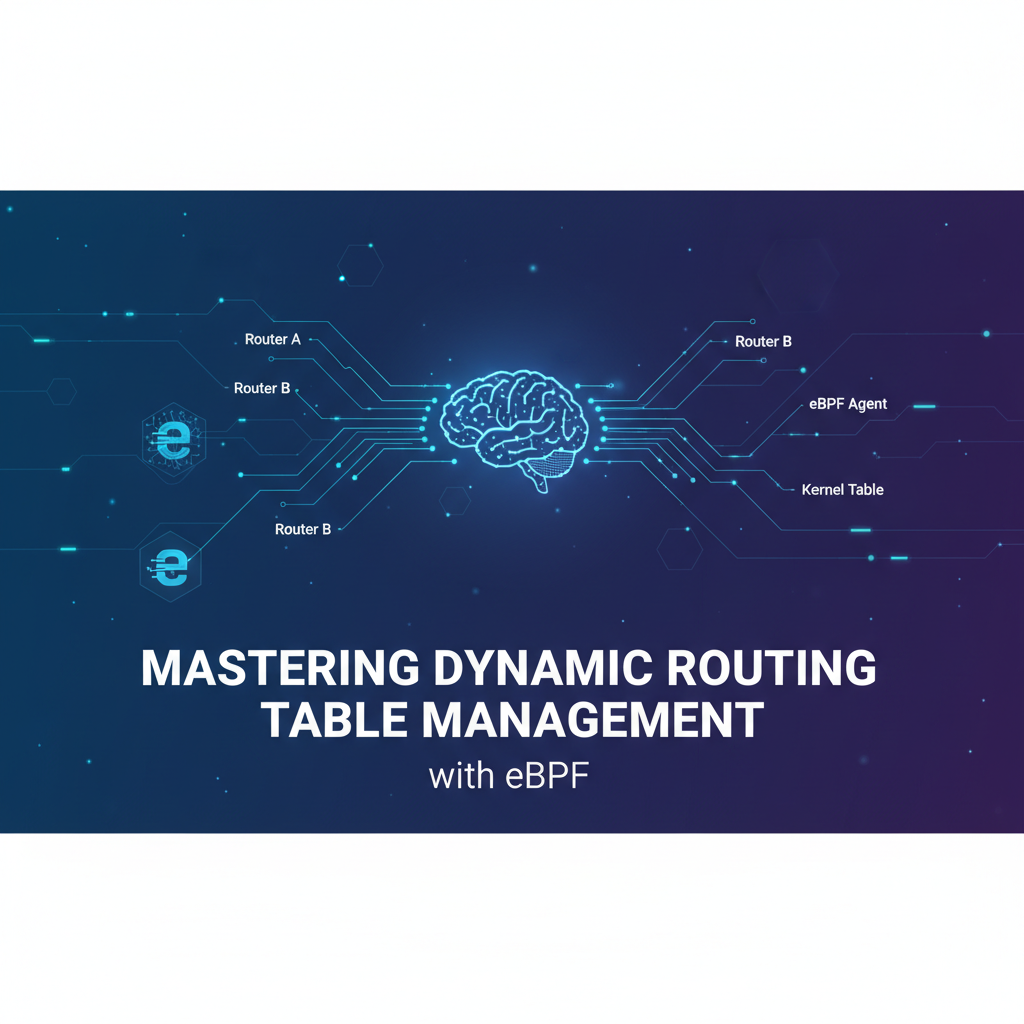


The intricate web of modern digital infrastructure, spanning from on-premises data centers to vast public cloud environments and the burgeoning edge, is fundamentally reliant on efficient and intelligent network communication. At the heart of this communication lies routing – the process by which network packets find their way from a source to a destination. While static routing served simpler, more predictable architectures of the past, today’s dynamic, distributed, and highly scalable systems demand an equally dynamic approach to route management. This necessity has pushed the boundaries of traditional routing protocols, revealing their limitations in the face of unprecedented agility requirements, real-time traffic engineering, and granular control over network flows.
As organizations increasingly adopt microservices architectures, containerization, and serverless functions, the network topology itself becomes a fluid, ever-changing entity. Endpoints appear and disappear with remarkable speed, services scale up and down in response to demand, and traffic patterns shift dynamically. Managing routing tables in such an environment through conventional means – relying solely on established protocols like BGP (Border Gateway Protocol) or OSPF (Open Shortest Path First) – often leads to latency, suboptimal path selection, configuration complexity, and a lack of the fine-grained control necessary for modern application performance and security requirements. The very fabric of these interconnected systems often relies on various forms of gateways, which act as critical traffic aggregation and distribution points, making their underlying routing mechanisms paramount to overall system health and responsiveness. These gateways are not merely simple forwarding devices; they are often intelligent entities performing load balancing, security inspections, and protocol translation, all of which are deeply influenced by how dynamically their routing tables can be managed and manipulated.
This is where Extended Berkeley Packet Filter (eBPF) emerges as a transformative technology. eBPF, a powerful, safe, and programmable kernel-space execution environment, offers an unparalleled ability to extend the Linux kernel's capabilities without requiring kernel module loading or recompilation. It allows developers to write programs that run directly within the kernel, hooking into various points in the network stack, system calls, and other kernel events. This revolutionary capability opens up entirely new avenues for managing network infrastructure, particularly for orchestrating dynamic routing tables with a level of precision, performance, and programmability previously unattainable. By leveraging eBPF, network engineers and developers can transcend the limitations of fixed kernel logic, implementing bespoke routing strategies that are finely tuned to application needs, real-time network conditions, and evolving security policies. The promise of eBPF lies in its capacity to transform the kernel from a black-box operating system into a highly programmable, observable, and adaptive network engine, paving the way for truly intelligent and dynamic routing table management. This comprehensive exploration will delve into the challenges of modern dynamic routing, the foundational principles of eBPF, and the innovative ways it can be harnessed to build highly efficient, resilient, and programmable network infrastructures, addressing the dynamic needs of even the most sophisticated systems that rely on robust API gateway solutions for managing diverse service traffic.
The Evolving Landscape of Dynamic Routing and Its Challenges in Modern Networks
The journey of network routing has been one of continuous adaptation, spurred by the relentless evolution of computing paradigms. From the early days of static routes manually configured on a handful of routers, we have progressed through hierarchical routing protocols designed for enterprise networks, to the global scale of BGP that underpins the entire internet. Each stage has introduced more sophistication in how network paths are discovered, maintained, and optimized. However, the current era of cloud-native applications, microservices, serverless computing, and massive data pipelines presents a unique set of challenges that stretch the capabilities of traditional dynamic routing protocols to their limits.
One of the most significant shifts has been the move towards highly ephemeral and dynamic network endpoints. In a traditional enterprise network, servers might have fixed IP addresses, and their locations remain stable for extended periods. Modern applications, however, are deployed as containers or virtual machines that are constantly spun up, moved, scaled, and torn down across a distributed cluster or even multiple cloud regions. A single application might consist of dozens or hundreds of microservices, each running in its own container, with its IP address potentially changing upon redeployment or scaling events. Traditional routing protocols, designed for slower-changing topologies, struggle to keep up with this rapid churn. The convergence times of protocols like OSPF or BGP, while optimized for large-scale stability, can introduce noticeable delays when service endpoints are appearing and disappearing every few seconds or minutes. This delay directly impacts application availability and responsiveness, leading to connection resets or traffic black holes during service migrations or scaling operations.
Furthermore, the very nature of application traffic has become more complex. It's no longer sufficient to simply route packets based on destination IP address. Modern applications often require sophisticated traffic engineering based on application-level context, service identity, user attributes, or real-time performance metrics like latency and throughput. For instance, a financial application might need to route high-priority transactions through a dedicated low-latency path, while analytical queries can use a best-effort route. Or, traffic for a specific user segment might need to be directed to a particular version of a service for A/B testing, irrespective of the service's underlying IP address. Traditional routing protocols primarily operate at Layer 3 (IP layer) and lack the inherent mechanisms to interpret or act upon such rich Layer 4 (TCP/UDP) or Layer 7 (HTTP) context without significant overlays or proxies. The existing API gateway solutions, while adept at managing higher-level application API traffic, often sit above the raw network routing decisions, inheriting the underlying network's limitations.
The proliferation of hybrid and multi-cloud environments further exacerbates these challenges. Organizations often operate workloads across their on-premises data centers and one or more public cloud providers. Establishing seamless, secure, and performant connectivity between these disparate environments requires sophisticated routing strategies that can adapt to varying network characteristics, security policies, and cost considerations. Managing complex routing policies across multiple administrative domains, each with its own network constructs and operational models, becomes a monumental task. The need to ensure consistent connectivity and policy enforcement for diverse applications, including those exposed via a central gateway or specific API gateway, becomes a critical concern. These gateways are often the first point of contact for external consumers, and their ability to dynamically route requests based on a myriad of factors is paramount.
Debugging and observability also become significantly more complex. When an application experiences connectivity issues in a highly dynamic environment, pinpointing the exact cause – whether it's a misconfigured route, a flapping network interface, a resource constraint, or an issue within the application itself – can be incredibly difficult. Traditional network monitoring tools provide aggregate statistics, but often lack the granular, real-time visibility into individual packet paths and routing decisions at the kernel level that is necessary for rapid problem diagnosis in dynamic systems. The opaque nature of kernel routing decisions, especially when coupled with complex firewall rules and network address translation (NAT), further obscures the true flow of traffic.
The increasing demand for fine-grained network security policies also places a strain on traditional routing. Micro-segmentation, where network access is restricted between individual workloads or services, is a critical security practice. Implementing this effectively requires routing and forwarding decisions to be intimately tied to security contexts, dynamically adapting as workloads change or threats emerge. Relying on static firewall rules or broad network segmentation becomes inadequate in such environments. The agility required to dynamically steer traffic based on identity, threat intelligence, or application behavior necessitates a more programmable and extensible approach than what is typically offered by fixed-function network hardware or static kernel logic.
In summary, modern network architectures demand: * Rapid Convergence: Ability to adapt to network topology changes almost instantaneously. * Application-Awareness: Routing decisions based on application context, not just IP addresses. * Fine-Grained Control: Programmable control over packet paths and forwarding logic. * Enhanced Observability: Deep, real-time insights into network flows and routing decisions. * Seamless Hybrid/Multi-Cloud Integration: Consistent routing policies across diverse environments. * Dynamic Security Enforcement: Routing integrated with evolving security postures.
These requirements push beyond the capabilities of even the most advanced traditional routing protocols and network devices, highlighting a critical gap that a technology like eBPF is uniquely positioned to fill, promising a paradigm shift in how we approach dynamic routing table management. The efficiency and flexibility of such low-level routing directly impacts the performance and reliability of higher-level services, including those exposed through an API gateway, which in turn manage the complex interactions of numerous API calls.
Understanding eBPF: A Paradigm Shift in Kernel Programmability
Extended Berkeley Packet Filter (eBPF) represents one of the most significant advancements in Linux kernel technology in recent years, fundamentally transforming how we interact with and extend the operating system's capabilities. Originating from the classic BPF (Berkeley Packet Filter) designed for efficient packet filtering in user space, eBPF has evolved into a versatile, high-performance, and safe mechanism for executing custom programs directly within the kernel. This shift from a specialized packet filter to a general-purpose execution engine unlocks unprecedented programmability, observability, and extensibility for the kernel, without the risks and complexities associated with traditional kernel module development.
At its core, eBPF allows developers to write small, sandboxed programs that run in a virtual machine environment within the Linux kernel. These programs can be attached to various "hook points" throughout the kernel, such as network device drivers (XDP), traffic control egress/ingress (TC), system calls, kernel function calls (kprobes), user-space function calls (uprobes), tracepoints, and more. When an event occurs at one of these hook points (e.g., a packet arrives, a system call is made), the attached eBPF program is executed. This in-kernel execution provides several distinct advantages:
- Safety and Stability: Unlike traditional kernel modules, which can crash the entire system if they contain bugs, eBPF programs are subject to a strict in-kernel verifier. Before any eBPF program is loaded, the verifier performs a static analysis to ensure it meets several critical safety criteria:
- Termination: The program must always terminate and not contain infinite loops.
- Memory Access: It must not access arbitrary kernel memory or perform out-of-bounds memory accesses.
- Resource Limits: It must adhere to maximum instruction limits and stack size.
- Privilege: It must not perform operations that could compromise system security (e.g., accessing uninitialized memory, dereferencing null pointers). This rigorous verification process ensures that eBPF programs, even if buggy, cannot crash or destabilize the kernel, making them incredibly safe for production environments.
- Performance: eBPF programs are compiled into native machine code (JIT – Just-In-Time compilation) before execution. This means they run at near-native speed, achieving performance comparable to, and often surpassing, traditional kernel logic or user-space daemon processing. By executing logic directly in the kernel, eBPF programs can avoid costly context switches between user space and kernel space, leading to significant performance gains, especially in high-throughput network scenarios.
- Programmability and Flexibility: eBPF provides a rich instruction set and a powerful set of helper functions (e.g.,
bpf_map_lookup_elem,bpf_trace_printk) that allow developers to implement complex logic. Programs can interact with "eBPF maps," which are versatile key-value data structures residing in kernel space, shared between eBPF programs and user-space applications. These maps enable dynamic state management, allowing eBPF programs to store and retrieve data, synchronize information with user space, or share state between different eBPF programs. This dynamic interaction is crucial for building adaptive systems, including dynamic routing solutions. - Observability: eBPF is a cornerstone of modern Linux observability. By hooking into various kernel events, eBPF programs can collect highly granular data about system calls, network events, CPU usage, disk I/O, and more, all with minimal overhead. This data can then be exported to user space for analysis, visualization, and alerting. This deep introspection is invaluable for understanding complex system behavior, debugging performance issues, and gaining real-time insights into traffic flows and routing decisions. The ability to observe and modify network behavior at the kernel level provides an unprecedented API into the kernel's inner workings.
- Extensibility without Kernel Modification: Traditionally, extending kernel functionality required writing and compiling kernel modules, which often tied to specific kernel versions and carried the risk of system instability. eBPF eliminates this hurdle, allowing developers to extend and customize kernel behavior dynamically, without modifying the kernel source code or rebooting the system. This agility accelerates innovation and simplifies maintenance.
Key Components of the eBPF Ecosystem:
- eBPF Programs: The actual code written (often in a C-like language, then compiled to eBPF bytecode using LLVM/Clang). These programs are event-driven and execute at specific hook points.
- eBPF Maps: Kernel-resident data structures (hash maps, arrays, LPM tries, ring buffers, etc.) that enable eBPF programs to store state, share data, and communicate with user-space applications. These maps are critical for dynamic configuration and data exchange.
- eBPF Verifier: The in-kernel component that performs static analysis on eBPF bytecode to ensure safety and termination before loading the program.
- JIT Compiler: Compiles validated eBPF bytecode into native machine code for the host CPU architecture, ensuring optimal performance.
- Helper Functions: A set of kernel-provided functions that eBPF programs can call to perform specific tasks, such as looking up elements in maps, getting current time, generating random numbers, or printing debug messages.
- Userspace Tools and Libraries: Tools like
bpftool,libbpf, and higher-level frameworks like Cilium and BCC (BPF Compiler Collection) simplify eBPF program development, loading, and interaction.
The power of eBPF lies in its ability to marry high performance with unparalleled flexibility and safety. It allows developers to effectively "reprogram" the kernel's behavior dynamically, tailoring it precisely to the needs of modern applications and infrastructure. This fundamental shift from static, fixed-function kernel logic to dynamic, programmable kernel logic is what makes eBPF such a game-changer, especially for intricate tasks like dynamic routing table management, where real-time adaptability and granular control are paramount. The sophisticated control it offers over the network stack also enhances the effectiveness of higher-level services like an api gateway, ensuring that the underlying network infrastructure can support complex traffic management requirements.
eBPF for Dynamic Routing Table Management: Core Concepts and Mechanisms
The capability of eBPF to execute custom logic within the kernel's network stack presents an extraordinary opportunity to fundamentally redefine how dynamic routing tables are managed. Rather than being confined to the fixed algorithms of traditional routing protocols or the rigid rule sets of iptables, eBPF enables the injection of highly programmable, application-aware intelligence directly into the packet forwarding path. This section explores the core concepts and mechanisms by which eBPF revolutionizes dynamic routing.
1. Packet Processing at XDP and TC Layers for Intelligent Routing
eBPF programs can be attached at various points within the Linux kernel's networking stack, each offering unique advantages for routing decisions:
- XDP (eXpress Data Path): This is the earliest possible hook point for an eBPF program in the network stack, processing packets directly after they arrive from the network interface card (NIC) driver, even before the kernel allocates a full socket buffer (
skb). XDP programs are exceptionally fast and efficient because they operate with minimal overhead. For dynamic routing, XDP can be used to:- Early Packet Classification: Rapidly identify specific traffic flows based on L2/L3/L4 headers or even early L7 patterns (if present in the first few bytes).
- Custom Forwarding Decisions: Based on classification, an XDP program can make immediate routing decisions, directing packets to different interfaces, dropping them, or even performing sophisticated load balancing, entirely bypassing the slower main kernel routing table lookup for specific flows. This is crucial for high-throughput, low-latency applications where every microsecond counts.
- Traffic Steering: For instance, an XDP program could identify packets destined for a particular service, look up the active backend endpoints in an eBPF map, and then directly forward the packet to the appropriate interface or encapsulation tunnel, effectively implementing a highly performant gateway function at the kernel's edge.
- TC (Traffic Control): eBPF programs can also be attached to the ingress and egress points of network interfaces via the Linux Traffic Control subsystem. TC eBPF programs operate later in the stack than XDP, with access to the full
skbstructure, allowing for more comprehensive packet manipulation and access to kernel metadata. This makes them suitable for:- More Complex Routing Logic: Leveraging richer context, TC eBPF programs can implement intricate routing policies based on a wider array of packet attributes, including connection state, security marks, or even details extracted from user-space control plane agents.
- Policy Enforcement: Combining routing decisions with quality of service (QoS), rate limiting, and sophisticated firewalling directly at the packet level, ensuring that traffic adheres to specific network policies before being routed.
- Load Balancing and Service Chaining: Distributing traffic among multiple backend services, potentially based on real-time load, health checks, or even chaining services together (e.g., sending traffic through a monitoring agent before the final destination).
2. Custom Route Decision Logic: Beyond Longest-Prefix Match
Traditional routing primarily relies on the longest-prefix match (LPM) principle, selecting the most specific route based on the destination IP address. While effective, this is often too simplistic for modern needs. eBPF empowers developers to implement entirely custom route decision logic:
- Service-Aware Routing: Instead of routing to an IP address, eBPF programs can route to a "service." A user-space controller can populate an eBPF map with
(service_name -> list_of_backend_IPs)mappings. When a packet arrives, an eBPF program can identify the target service (e.g., from a DNS query, HTTP host header, or custom metadata) and then look up the appropriate backend IP from the map, dynamically forwarding the packet. This decouples service identity from network location, providing immense flexibility. - Latency- and Performance-Aware Routing: eBPF programs can be combined with real-time network telemetry. A user-space agent might constantly monitor network latency or link saturation for different paths and update eBPF maps with this information. The eBPF routing program can then consult these maps to choose the lowest-latency or least-congested path for specific traffic flows, providing truly dynamic traffic engineering.
- Policy-Driven Routing: Routing decisions can be tied to granular security or business policies. For example, traffic from a specific tenant or application might be required to traverse a dedicated security appliance or a particular network segment. eBPF can enforce these policies at the kernel level, ensuring compliance and enhancing security. This is particularly relevant for environments with multiple virtual networks or isolated tenants managed by a single API gateway infrastructure.
- Advanced Load Balancing: While existing solutions like IPVS or service meshes offer load balancing, eBPF can implement highly customized algorithms directly in the kernel, potentially even leveraging application-layer information (e.g., hashing based on HTTP headers or session identifiers) to ensure sticky sessions or distribute load more intelligently than simple round-robin or least-connections.
3. Interacting with Kernel Routing Tables and eBPF Maps
eBPF programs don't operate in a vacuum; they can interact with the existing kernel routing infrastructure.
bpf_fib_lookupHelper: This eBPF helper function allows an eBPF program to perform a standard Forwarding Information Base (FIB) lookup, essentially querying the kernel's main routing table. This is incredibly powerful as it allows eBPF programs to either augment or override default kernel routing decisions. An eBPF program could, for example, first try a custom lookup in an eBPF map for a specific service. If no custom route is found, it can then fall back tobpf_fib_lookupto use the kernel's default route. This provides a clean way to integrate eBPF-based routing with existing infrastructure.- eBPF Maps as Dynamic State Stores: The most critical component for dynamic routing with eBPF is the use of eBPF maps. These versatile kernel-space data structures act as shared memory between eBPF programs and user-space applications.
- Storing Routes: Maps can store custom routing entries (e.g.,
(destination_prefix -> next_hop_IP, interface_index, metadata)). - Service Endpoints:
(service_ID -> list_of_backend_endpoints). - Policy Rules:
(source_IP, destination_port -> routing_policy_ID). - Health Status:
(backend_IP -> healthy_status). User-space control plane agents (e.g., a service orchestrator, a custom routing daemon) are responsible for populating and updating these maps in real-time. For instance, when a new container starts, the orchestrator detects its API endpoint, updates the eBPF map with its IP and service ID, and immediately the eBPF routing program can start directing traffic to it. When a container dies, its entry is removed, and traffic is automatically rerouted.
- Storing Routes: Maps can store custom routing entries (e.g.,
4. Control Plane Integration and the Role of APIs
The true power of eBPF for dynamic routing lies in its integration with a sophisticated user-space control plane. While eBPF programs handle the data plane forwarding decisions, the control plane is responsible for gathering network intelligence, applying policy, and updating the eBPF maps.
This control plane can be: * Orchestration Platforms: Kubernetes, Nomad, etc., which manage container lifecycle and service discovery. * Custom Routing Daemons: Software that monitors network conditions, service health, and policy engines. * SDN Controllers: Centralized systems that program network devices.
The communication between the control plane and the eBPF programs is facilitated by the eBPF maps. The control plane uses the API exposed by the bpf syscall to manage and update these maps. This effectively creates a programmable interface for the kernel's network stack. Consider a scenario where an organization deploys a complex microservices architecture. Each service exposes several APIs, managed by an intelligent API gateway. For the API gateway to function efficiently, it needs the underlying network to route traffic to the correct service instances based on real-time availability and load. A custom control plane agent can monitor the health and scaling events of these microservices. When a new instance of Service A comes online, the control plane updates an eBPF map (e.g., an LPM map storing (Service A IP -> Instance X IP)). The eBPF program attached to the network interface then uses this map to route incoming requests for Service A directly to Instance X, potentially even performing NAT or load balancing. This dynamic, kernel-level routing directly supports the high-performance requirements of modern API ecosystems.
For instance, managing a large number of diverse APIs, particularly those related to AI models, requires not only robust routing but also efficient API management. This is where a product like APIPark comes into play. While eBPF handles the low-level, high-performance packet routing in the kernel, a platform like APIPark provides the higher-level AI gateway and API management capabilities. It helps integrate over 100 AI models, offers a unified API format for AI invocation, and encapsulates prompts into REST APIs, managing the entire lifecycle of various APIs. APIPark ensures that even if the underlying network topology is dynamically managed by eBPF-powered solutions, the exposure and consumption of these services via well-defined APIs remain streamlined and secure. The efficient kernel-level routing enabled by eBPF creates a strong foundation for the rapid, secure, and flexible traffic management features provided by an API gateway like APIPark.
The combination of eBPF and intelligent user-space control planes creates a truly software-defined network (SDN) at the kernel level. This allows for unparalleled agility in adapting routing decisions to real-time conditions, application requirements, and security policies, pushing the boundaries of what's possible in dynamic network infrastructure management.
Comparing Traditional Routing with eBPF-Based Approaches
To highlight the transformative potential of eBPF in dynamic routing table management, let's compare its characteristics with traditional routing mechanisms across several key dimensions:
| Feature/Dimension | Traditional Dynamic Routing (e.g., BGP, OSPF) | eBPF-Based Dynamic Routing |
|---|---|---|
| Decision Logic Basis | Primarily IP prefixes, link state, path vectors. Fixed algorithms. | Highly customizable logic based on any packet attribute (L2-L7), service identity, application context, real-time metrics. Programmatic. |
| Convergence Speed | Seconds to minutes (depending on protocol, network size, and configuration). | Milliseconds to microseconds. Updates to eBPF maps are immediate, and kernel-level execution is extremely fast, leading to near-instantaneous route changes. |
| Granularity of Control | Network-wide, per-subnet, or per-interface policies. Less fine-grained. | Per-packet, per-flow, or per-service control. Allows for micro-segmentation, application-specific routing, and highly granular traffic engineering. |
| Performance | High, but involves multiple kernel layers and potentially user-space interaction. | Near-native kernel performance due to JIT compilation and early processing (XDP). Avoids context switches and often bypasses significant parts of the kernel stack for optimized flows. |
| Observability | SNMP, NetFlow, traditional tcpdump, ip route commands. Aggregate views. |
Deep, real-time, per-packet visibility. Can trace specific packet paths, observe routing decisions, and export detailed telemetry directly from the kernel with minimal overhead. |
| Programmability | Configuration of protocol parameters and static routes. Limited scripting. | Full programmability via C-like eBPF programs. Integration with user-space control planes for dynamic map updates, enabling software-defined routing at the kernel level. |
| Deployment & Updates | Requires configuration changes on routers/hosts, potentially disruptive. | Programs loaded dynamically at runtime without kernel recompilation or reboots. Updates to routing policies (via maps) are immediate. |
| Application Awareness | Primarily unaware of application context beyond port numbers. | Inherently application-aware. Can use service IDs, HTTP headers, or other application-layer data to inform routing decisions when combined with a user-space control plane. |
| Security Integration | Firewall rules (ACLs) are separate from routing. | Can integrate security policies directly into routing decisions, enabling dynamic micro-segmentation and threat-aware traffic steering at the earliest possible point in the network stack. |
| Hybrid/Multi-Cloud | Complex overlay networks, VPNs, and manual route propagation across domains. | Simplifies dynamic routing across disparate environments by abstracting underlying network complexities, allowing custom policies to manage traffic between on-prem, cloud, and edge gateways with unified kernel logic. |
| Key Use Cases | Internet routing, large enterprise networks, stable topologies. | Cloud-native networking (Kubernetes, service mesh), high-performance load balancing, custom traffic engineering, network security enforcement, advanced observability, highly dynamic environments, specialized API Gateway traffic management. |
| Risk of Misconfig. | Can lead to network outages, slow convergence. | Program safety verified by kernel; incorrect logic won't crash kernel, but can lead to incorrect packet forwarding. Development requires expertise. |
This table clearly illustrates that while traditional routing protocols remain essential for their designed domains (especially internet-scale routing and stable enterprise backbones), eBPF offers a superior, more flexible, and higher-performance solution for the dynamic, application-centric, and highly observable networking needs of modern, cloud-native infrastructures. It provides the architectural flexibility to implement an intelligent gateway capable of adapting to almost any network condition or application requirement.
APIPark is a high-performance AI gateway that allows you to securely access the most comprehensive LLM APIs globally on the APIPark platform, including OpenAI, Anthropic, Mistral, Llama2, Google Gemini, and more.Try APIPark now! 👇👇👇
Practical Applications and Use Cases of eBPF in Dynamic Routing
The theoretical capabilities of eBPF translate into a myriad of practical applications that address the shortcomings of traditional routing in dynamic environments. From container orchestration to advanced traffic engineering, eBPF is proving to be a cornerstone technology for building next-generation network infrastructures.
1. Container Networking and Service Meshes
One of the most impactful areas for eBPF in dynamic routing is within container networking, especially in platforms like Kubernetes and within service mesh implementations. Traditional Kubernetes networking often relies heavily on iptables for service load balancing and network policy enforcement. While functional, iptables can become a significant performance bottleneck and management headache in large clusters due to its sequential rule processing and stateful nature.
- Replacing
iptableswith eBPF: Projects like Cilium have pioneered the use of eBPF to replaceiptablesentirely for kube-proxy's functions and network policy enforcement. eBPF programs can directly implement service load balancing (e.g., ECMP, DSR) and network policies (e.g., allowing specific pod-to-pod communication) at the XDP or TC layer. This results in dramatically improved performance, lower latency, and higher throughput for inter-container communication, as packet processing can be optimized and executed much earlier in the stack. - Service-Aware Routing in Kubernetes: eBPF maps can store service endpoint information, updated in real-time by the Kubernetes control plane. When a packet needs to reach a service (e.g.,
my-service.default.svc.cluster.local), an eBPF program can intercept the DNS resolution or identify the service IP, look up the active backend pods in an eBPF map, and directly forward the packet to a healthy instance. This enables true service-aware routing without relying on NAT or complex proxy chains. - Optimizing Service Meshes: Service meshes like Istio or Linkerd traditionally inject sidecar proxies (e.g., Envoy) into every pod to handle traffic interception, policy enforcement, and telemetry. While powerful, sidecars introduce overhead (resource consumption, latency). eBPF offers a compelling alternative by moving some of these data plane functions (like traffic redirection, load balancing, and policy enforcement) into the kernel. This "sidecar-less" or "proxyless" service mesh approach, exemplified by solutions built on Cilium, significantly reduces overhead, improves performance, and simplifies debugging by operating directly in the kernel, making the routing and policy decisions transparent to the application. This is particularly relevant for the efficient operation of an API gateway that acts as the ingress for external traffic into a microservices environment.
2. Advanced Load Balancing and Traffic Engineering
eBPF's ability to precisely manipulate packet flows at high speeds makes it ideal for sophisticated load balancing and traffic engineering scenarios.
- Direct Server Return (DSR) Load Balancing: For high-throughput services, eBPF can implement DSR load balancing where incoming requests are directed to backend servers, but responses return directly to the client, bypassing the load balancer. This significantly reduces the load balancer's bandwidth requirements and latency. An XDP program can implement the initial request steering based on service ID lookup in an eBPF map.
- Multi-Path Routing and Link Aggregation: eBPF can dynamically distribute traffic across multiple network paths or aggregated links based on real-time metrics such as latency, jitter, or available bandwidth. A user-space daemon could continuously monitor these metrics and update eBPF maps with optimal path choices, allowing the eBPF program to make intelligent per-packet routing decisions to optimize application performance or ensure resilience.
- Application-Specific Traffic Shaping: For instances where an API gateway manages different types of API calls, eBPF can enforce traffic shaping or prioritization policies based on the type of application traffic. For example, critical transaction APIs could be given higher priority and routed through low-latency paths, while bulk data transfer APIs might use alternative paths. This granular control at the kernel level is far more powerful than traditional QoS mechanisms.
3. Multi-Cloud/Hybrid Cloud Routing and Connectivity
Managing network connectivity and routing policies across heterogeneous environments (on-premises data centers, private clouds, public clouds) is a notorious challenge. eBPF can simplify and enhance this complexity.
- Seamless Inter-Cloud Connectivity: eBPF can implement custom tunneling and encapsulation (e.g., VXLAN, Geneve) logic directly in the kernel, enabling efficient overlay networks that span different cloud providers. User-space control planes can dynamically provision these tunnels and update eBPF maps with routing information for workloads moving between clouds, ensuring consistent connectivity and low-latency paths.
- Dynamic Border Gateway Functions: For a hybrid cloud setup, the on-premises network often acts as a gateway to the public cloud. eBPF can run on the gateway servers to implement intelligent routing decisions, steering traffic to the optimal cloud region based on load, cost, or regulatory requirements. It can dynamically learn and update routes to cloud-based services and enforce egress policies before traffic leaves the on-premises network.
- Tenant-Specific Routing: In multi-tenant environments, each tenant might have specific routing requirements or preferred paths. eBPF can identify tenant traffic (e.g., via VLAN tags, source IP, or security context) and route it according to tailored policies stored in eBPF maps, providing isolation and customized network experiences.
4. Security-Driven Routing and Micro-Segmentation
eBPF’s ability to intercept and modify packets at various kernel hook points makes it a powerful tool for implementing dynamic security policies and micro-segmentation, integrating security directly into the routing decision-making process.
- Dynamic Firewalling and Micro-segmentation: Instead of relying solely on
iptablesrules that can become cumbersome, eBPF programs can enforce granular network policies based on service identity, pod labels, or other context. Traffic between specific microservices can be permitted or denied directly in the kernel, with rules dynamically updated from a central policy engine. This allows for true micro-segmentation where network access is restricted to only what is necessary, significantly reducing the attack surface. - Threat-Aware Traffic Steering: In conjunction with intrusion detection systems (IDS) or security orchestration platforms, eBPF can dynamically reroute suspicious or malicious traffic. If an IDS identifies a compromised workload or a potential attack signature, a user-space agent can update an eBPF map, causing all traffic to or from the suspect entity to be steered to a "honeypot," a scrubbing appliance, or simply dropped, all at line rate. This real-time response capability is crucial for advanced threat mitigation.
- Network Access Control (NAC) Integration: eBPF can dynamically enforce network access policies based on user authentication, device posture, or other context from an NAC system. For example, a newly connected device might initially be routed to a quarantine network until its security posture is verified, then dynamically routed to its intended network segment by an eBPF program updating routing tables.
5. Network Observability and Debugging
While not strictly routing management, eBPF’s unparalleled observability capabilities are indispensable for understanding and debugging dynamic routing behavior.
- Deep Packet Tracing: eBPF programs can non-intrusively trace individual packets as they traverse the kernel network stack, logging every decision point, modification, and path taken, including routing lookups. This provides an unprecedented level of detail for diagnosing routing anomalies, performance bottlenecks, or policy violations.
- Real-time Flow Monitoring: Instead of sampling, eBPF can capture and export metadata for every network flow (source/destination IP/port, protocols, service ID) directly from the kernel. This granular data empowers network operators to understand traffic patterns, identify unexpected flows, and verify that dynamic routing policies are working as intended.
- Performance Bottleneck Identification: By measuring latency at different points in the kernel (e.g., before and after an eBPF routing decision, or before and after a specific network stack layer), eBPF can pinpoint exactly where delays are introduced, helping to optimize custom routing logic or identify underlying network issues.
In each of these use cases, eBPF transforms the network from a static, rigid infrastructure into a highly adaptive, programmable, and observable entity. This is particularly beneficial for complex, distributed systems that rely on sophisticated application traffic management, such as those employing an API gateway to handle various API requests, including those for AI models. The underlying network agility provided by eBPF ensures that these API services, even those consuming significant resources, can be routed and managed with optimal performance and reliability.
Challenges and Considerations in eBPF-Based Dynamic Routing
While eBPF offers revolutionary capabilities for dynamic routing table management, its adoption and implementation come with certain challenges and considerations that organizations must carefully address. It is a powerful tool, but like any advanced technology, it demands a deep understanding and careful handling.
- Complexity of eBPF Program Development and Debugging: Writing eBPF programs requires a specialized skill set. Developers need to understand kernel internals, the eBPF instruction set, helper functions, and map types. The development workflow typically involves writing C code, compiling it to eBPF bytecode using LLVM/Clang, loading it into the kernel, and then debugging its behavior. Debugging can be particularly challenging because programs run in kernel space, and traditional debugging tools are not directly applicable. While tools like
bpftoolandlibbpfsimplify some aspects, the learning curve remains steep. The risk of logical errors, though prevented from crashing the kernel by the verifier, can still lead to incorrect routing decisions, which are difficult to trace without proper observability tools. - Security Implications and the eBPF Verifier: The eBPF verifier is a critical component that ensures the safety of eBPF programs by preventing them from crashing the kernel or accessing unauthorized memory. However, while the verifier guarantees kernel stability, it does not guarantee program correctness or security policy enforcement beyond the kernel's integrity. A maliciously crafted or buggy eBPF program, even if it passes verification, could still intentionally or unintentionally leak sensitive information, create routing loops, or misdirect traffic, leading to denial of service or data breaches. Therefore, careful auditing of eBPF programs and limiting the capabilities of programs that can be loaded (e.g., requiring root privileges, using
CAP_BPFandCAP_PERFMONcapabilities) are essential security practices. Organizations must establish robust processes for vetting and deploying eBPF code. - Tooling and Ecosystem Maturity: The eBPF ecosystem, while rapidly maturing, is still evolving. While fundamental tools like
bpftoolandlibbpfprovide low-level control, higher-level frameworks and development environments are continuously being improved. This means that organizations might need to invest in building custom tooling or adapting existing solutions to fully leverage eBPF. The learning curve for adopting eBPF-based solutions can be significant, and finding experienced engineers might be challenging. However, the growth of projects like Cilium, which provide opinionated, production-ready eBPF-based networking solutions, is helping to lower the barrier to entry. - Integration with Existing Network Management Systems: Implementing eBPF for dynamic routing often means replacing or augmenting parts of the traditional network stack. This can create integration challenges with existing network monitoring, management, and orchestration systems. Tools that expect to interact with
iptablesor traditional routing protocols might not immediately understand or be able to manage eBPF-based configurations. Developing or adapting control plane components that can effectively translate higher-level network policies into eBPF map updates and interpret eBPF-generated telemetry is crucial for seamless integration. For example, ensuring that an API gateway can reliably interpret the underlying eBPF-driven network behavior might require custom integrations. - Kernel Version Dependencies and Portability: eBPF capabilities and available helper functions can vary between different Linux kernel versions. While efforts are made to ensure backward compatibility and introduce new features incrementally, developing eBPF programs that work across a wide range of kernel versions can be complex. Organizations need to carefully manage their kernel versions or use frameworks that abstract away these differences. This can impact portability and requires diligent testing across target environments.
- Resource Consumption: While eBPF programs are highly efficient, they still consume CPU and memory resources in the kernel. Improperly designed or overly complex eBPF programs, especially those that process a large volume of packets or perform extensive calculations, can introduce performance overheads. Monitoring the resource utilization of eBPF programs and optimizing their logic is crucial to maintain system performance.
- Transition and Migration Strategy: Migrating from traditional routing solutions to eBPF-based ones is not a trivial task. It requires careful planning, phased deployment, and rigorous testing. Organizations might need to run hybrid environments for a period, where both traditional and eBPF-based solutions coexist, to ensure a smooth transition and minimize disruption to critical services, especially those exposed through a central API gateway.
Despite these challenges, the benefits of eBPF – including unparalleled performance, flexibility, and observability for dynamic routing – often outweigh the complexities, particularly for organizations pushing the boundaries of cloud-native and high-performance networking. Addressing these considerations requires a strategic approach, investment in expertise, and leveraging the growing open-source ecosystem around eBPF.
Conclusion
The journey through the intricate world of modern network infrastructure reveals a fundamental truth: static solutions are no longer sufficient for dynamic problems. As applications become more distributed, ephemeral, and demanding, the underlying network must evolve to match this agility. Traditional dynamic routing protocols, while foundational, exhibit limitations in terms of convergence speed, fine-grained control, and application awareness, struggling to keep pace with the rapid changes inherent in cloud-native and hybrid environments.
Extended Berkeley Packet Filter (eBPF) has emerged as a truly transformative technology, offering a paradigm shift in how we manage and orchestrate network routing. By enabling the safe, performant, and programmable execution of custom logic directly within the Linux kernel, eBPF allows network engineers to transcend the constraints of fixed kernel functions. We've explored how eBPF, through its strategic placement at points like XDP and TC, coupled with dynamic eBPF maps and intelligent user-space control planes, can empower unprecedented levels of control over routing decisions. This empowers the implementation of bespoke routing policies based on application identity, real-time performance metrics, and granular security contexts, moving far beyond the simplistic longest-prefix match.
From optimizing container networking in Kubernetes to building high-performance load balancers, enabling seamless multi-cloud connectivity, and enforcing sophisticated security-driven routing and micro-segmentation, eBPF’s practical applications are vast and growing. It fundamentally enhances network observability, providing deep, real-time insights into packet flows and routing decisions that are crucial for rapid troubleshooting and performance tuning. The ability to dynamically "reprogram" the kernel's network stack turns it into an adaptive, intelligent engine, capable of responding to the fluid demands of modern applications and infrastructure.
While the adoption of eBPF for dynamic routing comes with challenges, including the complexity of development, security considerations, and integration with existing systems, the accelerating maturity of its ecosystem and the burgeoning open-source community are steadily lowering these barriers. The strategic investment in eBPF expertise and tooling is not merely an upgrade; it is an imperative for organizations striving to build resilient, high-performance, and truly programmable network infrastructures capable of supporting the most demanding workloads, including those facilitated by advanced API gateway solutions like APIPark.
The future of network routing is undoubtedly programmable, observable, and deeply integrated with application logic. eBPF stands at the forefront of this evolution, empowering a new generation of network architects and engineers to master the complexities of dynamic routing table management, paving the way for network infrastructures that are as intelligent and adaptable as the applications they serve.
Frequently Asked Questions (FAQs)
- What is the primary advantage of using eBPF for dynamic routing over traditional protocols? The primary advantage of eBPF lies in its unparalleled programmability, performance, and granular control at the kernel level. Traditional protocols (like BGP, OSPF) are built on fixed algorithms and operate at the network layer, which can lead to slow convergence and a lack of application awareness. eBPF allows for custom routing logic based on any packet attribute (L2-L7), service identity, or real-time metrics, executing at near-native speed and making changes almost instantaneously. This enables highly dynamic, application-aware routing that traditional methods cannot match.
- How does eBPF ensure the safety of custom routing programs running in the kernel? eBPF ensures safety through a strict in-kernel verifier. Before any eBPF program is loaded, the verifier statically analyzes the bytecode to guarantee that it will always terminate, not access unauthorized memory, and adhere to resource limits. This prevents buggy or malicious eBPF programs from crashing or destabilizing the entire Linux kernel, a significant improvement over traditional kernel modules.
- Can eBPF entirely replace traditional routing protocols like BGP or OSPF? Not entirely, at least not in all contexts. Traditional routing protocols are indispensable for large-scale, internet-wide routing (BGP) and stable enterprise network backbones (OSPF) where their robust, distributed convergence mechanisms are crucial. eBPF excels at fine-grained, dynamic routing within individual hosts, clusters (like Kubernetes), or specific network gateways, often augmenting or optimizing the data plane decisions within an existing routing infrastructure. It provides a flexible layer on top of or alongside traditional protocols, not necessarily a wholesale replacement for all routing scenarios.
- How does eBPF integrate with existing network management and orchestration tools? Integration typically involves a user-space control plane that bridges the gap between existing network management tools and eBPF programs. This control plane monitors network events, service states, and policies from orchestration systems (e.g., Kubernetes, SDN controllers), then dynamically updates eBPF maps in the kernel. These maps then inform the eBPF programs' routing decisions. While some integration might require custom development, projects like Cilium provide higher-level abstractions that integrate seamlessly with platforms like Kubernetes, simplifying the management of eBPF-based networking.
- What role does an API Gateway play in an eBPF-enabled dynamic routing environment? An API Gateway (like APIPark) operates at a higher level of the network stack, primarily managing application-level API traffic, handling authentication, authorization, rate limiting, and routing requests to various backend services. In an eBPF-enabled environment, the API Gateway benefits from the underlying network's enhanced performance and flexibility. eBPF ensures that packets are routed to the correct, healthy backend instances with minimal latency and high throughput, allowing the API Gateway to focus on its application-specific functions more efficiently. The dynamic routing provided by eBPF forms a robust and agile foundation for the API Gateway's traffic management decisions, ensuring seamless and performant API invocation.
🚀You can securely and efficiently call the OpenAI API on APIPark in just two steps:
Step 1: Deploy the APIPark AI gateway in 5 minutes.
APIPark is developed based on Golang, offering strong product performance and low development and maintenance costs. You can deploy APIPark with a single command line.
curl -sSO https://download.apipark.com/install/quick-start.sh; bash quick-start.sh

In my experience, you can see the successful deployment interface within 5 to 10 minutes. Then, you can log in to APIPark using your account.

Step 2: Call the OpenAI API.