Mastering GQL Type Into Fragment
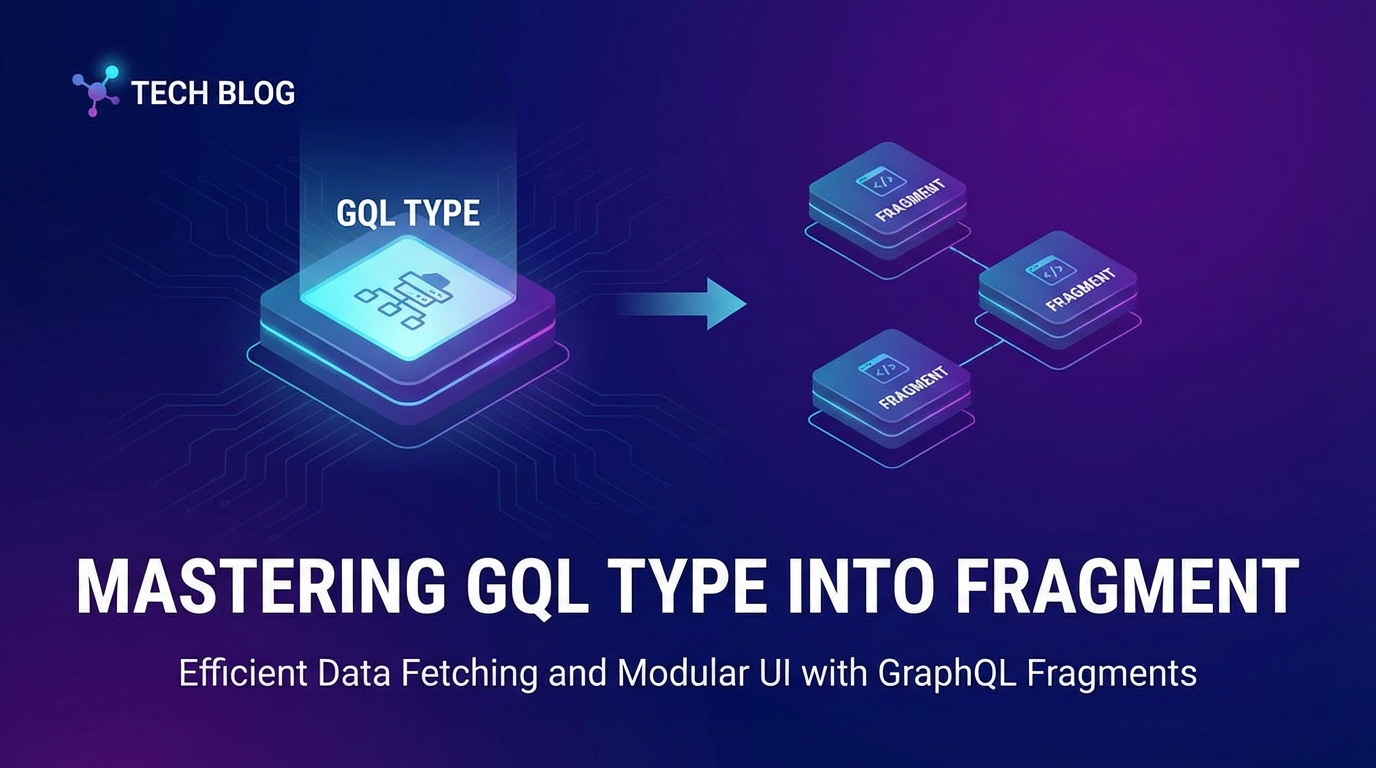


In the sprawling landscape of modern web development, where data moves with unprecedented velocity and applications demand ever-increasing responsiveness, the efficiency and precision of data fetching mechanisms have become paramount. For many years, RESTful APIs served as the dominant paradigm, offering a robust and understandable way to structure communication between clients and servers. However, as applications grew more complex, often requiring data from multiple endpoints in varying shapes, REST began to reveal its inherent limitations: over-fetching unnecessary data, under-fetching requiring multiple round trips, and the rigidity of predefined resource structures.
Enter GraphQL (GQL), a revolutionary query language for APIs and a runtime for fulfilling those queries with your existing data. Conceived by Facebook in 2012 and open-sourced in 2015, GraphQL offers a paradigm shift, empowering clients to declare precisely what data they need, and nothing more. This fundamental capability transforms how applications interact with their backends, leading to leaner network payloads, faster load times, and a significantly improved developer experience. At the heart of GraphQL's power lie two intertwined concepts: its robust Type System and the elegant efficiency of Fragments. Mastering these two elements is not merely about understanding syntax; it's about unlocking a deeper level of control, reusability, and architectural elegance in your data fetching strategies.
This comprehensive guide will embark on an in-depth journey to dissect the intricacies of GraphQL types and fragments. We will begin by laying a solid foundation, exploring the foundational type system that dictates the very structure of a GraphQL API. From there, we will transition into a meticulous examination of fragments—their purpose, syntax, and myriad applications in building highly efficient and maintainable GraphQL queries. Our exploration will culminate in understanding how these two powerful concepts synergize to allow developers to craft precise, performant, and future-proof data requests, ultimately elevating the entire GraphQL development experience. Whether you are a seasoned GraphQL practitioner looking to refine your techniques or a newcomer eager to grasp its core principles, this article aims to provide the insights necessary to truly master GQL Type Into Fragment.
I. The Foundational Pillars: Understanding GraphQL Types
Before one can truly master the art of fragments, a profound understanding of GraphQL's type system is indispensable. The type system is the very backbone of any GraphQL API, serving as a contract between the client and the server. It rigorously defines what data can be queried, what mutations can be performed, and the exact shape of the data that will be returned. This strong typing is one of GraphQL's most compelling advantages, providing inherent documentation, validation, and a bedrock for powerful tooling.
A. The GraphQL Schema: The Contract of the API
At the very core of the GraphQL type system lies the Schema. Defined using the Schema Definition Language (SDL), the schema is a collection of types that specify the API's capabilities. It's akin to a blueprint, detailing every available field, its type, and any arguments it accepts. Every GraphQL service must define a Query type and can optionally define Mutation and Subscription types, which serve as the entry points for all client interactions. Without a well-defined schema, clients wouldn't know what data to ask for or how to structure their requests. This explicit contract enables powerful client-side tooling, such as auto-completion in IDEs, compile-time validation of queries, and automatic generation of client-side code, drastically improving developer productivity and reducing errors.
The schema acts as the single source of truth for the API, ensuring that both client and server operate under the same understanding of the data landscape. Any changes to the API's data structure must be reflected in the schema, making it a critical artifact in the API's lifecycle management. This upfront definition eliminates much of the guesswork associated with consuming APIs, a common pain point with less structured alternatives.
B. Core Type System Components: Building Blocks of Data
GraphQL's type system is composed of several fundamental building blocks, each serving a specific purpose in defining the structure and behavior of your data.
1. Scalar Types: The Primitives
Scalar types represent the atomic units of data that can be returned by a GraphQL query. They are the leaves of the query tree, incapable of having sub-fields. GraphQL comes with a set of built-in scalar types:
String: A UTF-8 character sequence, often used for text, names, or descriptions.Int: A signed 32-bit integer, suitable for whole numbers like counts or IDs.Float: A signed double-precision floating-point value, for decimal numbers like prices or measurements.Boolean: Atrueorfalsevalue, commonly used for flags or status indicators.ID: A unique identifier, typically represented as aString. While often a string,IDis a distinct type in GraphQL to signify its unique purpose, allowing clients to treat it specially, for instance, in caching mechanisms.
Developers can also define Custom Scalar Types for more complex or domain-specific primitives, such as DateTime, URL, or JSON. These custom scalars provide a way to enforce specific formats or validation rules at the schema level, ensuring data consistency even for types not natively supported by GraphQL. For example, a DateTime scalar might be implemented to parse and serialize dates in ISO 8601 format, guaranteeing uniformity across all date fields in the API.
2. Object Types: The Structured Data Containers
Object Types are the most fundamental building blocks for defining the domain model of your GraphQL API. They represent a group of related fields, each with its own type. An Object Type is essentially a named collection of fields, and each field can either resolve to a scalar type, another object type, or a list of types.
For instance, a User object type might have fields like id (ID!), name (String), email (String!), and posts ([Post!]), where Post itself is another object type. The exclamation mark ! denotes a Non-Null Type, signifying that the field is guaranteed to return a value and cannot be null. This strong typing provides clarity and helps client applications anticipate data presence, reducing the need for extensive null checks.
Object types form a hierarchical structure, allowing for complex data relationships to be modeled intuitively. When a client queries an object type, it must specify which fields it wants to receive, promoting efficiency by preventing over-fetching. This selective data fetching is one of GraphQL's most celebrated features, directly addressing a common inefficiency in traditional REST APIs.
3. List Types: Handling Collections
When a field is expected to return a collection of items, GraphQL uses List Types, denoted by square brackets []. For example, [Post!] signifies a list where each element is a non-nullable Post object. It's crucial to understand the distinction between [Post!] (a list of non-nullable posts, but the list itself can be null), [Post]! (a non-nullable list that can contain null posts), and [Post!]! (a non-nullable list where each element is also non-nullable). This precise control over nullability at both the list and item level provides significant flexibility and safety in API design.
List types are fundamental for representing relationships where one entity can have multiple related entities, such as a user having many posts, or a blog post having multiple comments.
C. Advanced Type System Constructs for Flexibility and Polymorphism
While scalar and object types form the bedrock, GraphQL's advanced type constructs provide the necessary flexibility to model complex, polymorphic data structures, allowing for greater expressibility and adaptability in schema design.
1. Interface Types: Defining Shared Contracts
Interface Types in GraphQL are powerful tools for defining a set of fields that multiple object types must include. Similar to interfaces in object-oriented programming, a GraphQL interface specifies a contract that any implementing object type must adhere to. This means that if an object type implements an interface, it must have all the fields defined by that interface, with compatible return types.
Consider an Animal interface with fields name: String! and species: String!. Both a Dog object type and a Cat object type could implement Animal. This allows a query to ask for name and species on a field that returns an Animal interface, without knowing the concrete type (Dog or Cat) beforehand. The true power of interfaces shines in scenarios where different entities share common characteristics, but also have their unique fields. It enables querying for common data across different types, and later using fragments to fetch type-specific fields, which we will explore in detail. Interfaces are crucial for achieving polymorphism in GraphQL, allowing for more generic and flexible queries.
2. Union Types: Returning One of Several Possible Object Types
Union Types are another mechanism for handling polymorphism, but they differ significantly from interfaces. A union type can return any one of a specified set of object types, but it does not enforce any shared fields among them. Whereas an interface defines a common set of fields, a union simply states that a field will return one of these types.
For example, a SearchResult union type might be defined as union SearchResult = User | Post | Comment. When a client queries a field that returns SearchResult, it could receive a User object, a Post object, or a Comment object. Since union members don't share common fields (though they might by coincidence), clients must use inline fragments (discussed later) to conditionally select fields based on the concrete type returned. This makes unions ideal for fields that can yield truly heterogeneous results, such as a search function returning different kinds of items.
3. Enum Types: Constraining to a Set of Values
Enum Types (enumerated types) are special scalar types that restrict a field's value to a predefined, finite set of options. They are particularly useful for representing status codes, categories, or specific choices where the possible values are known and limited.
For instance, an OrderStatus enum could be defined as enum OrderStatus { PENDING, PROCESSING, SHIPPED, DELIVERED, CANCELLED }. Using enums provides several benefits: it ensures data integrity by preventing invalid values, improves readability for both developers and API consumers by making the intent explicit, and allows for better tooling support (e.g., dropdowns in graphical clients).
4. Input Object Types: Structuring Complex Arguments
While Object Types define the shape of data returned by a query, Input Object Types define the shape of complex input data that can be passed as arguments to fields, particularly mutations. They allow clients to send structured data, such as a CreateUserInput object containing name and email fields, instead of requiring multiple individual arguments for a mutation.
input CreateUserInput { name: String! email: String! age: Int }
Input objects can contain other input objects, scalars, or enums, enabling the creation of deeply nested and well-organized input structures. This significantly cleans up mutation signatures, making them more manageable and readable, especially for operations that require a large number of parameters.
Understanding these foundational and advanced GraphQL types is the prerequisite for effectively leveraging fragments. Each type plays a critical role in shaping the data contract, and fragments operate within the boundaries and possibilities defined by this robust type system, particularly when dealing with the complexities introduced by interfaces and unions.
II. The Architect's Tool: Deep Dive into GraphQL Fragments
With a solid grasp of GraphQL's type system, we are now poised to explore one of its most powerful and elegant features: Fragments. Fragments are not merely a syntactic sugar; they are a fundamental construct that revolutionizes how developers compose and manage complex data requirements, promoting reusability, improving readability, and enabling sophisticated client-side data management.
A. What are Fragments? The Essence of Reusability
At its core, a GraphQL fragment is a reusable selection set of fields. Imagine you have multiple queries or components in your application that need to fetch the exact same subset of fields for a particular type. Without fragments, you would have to duplicate that selection set in every single query, leading to verbose, repetitive, and difficult-to-maintain code. Fragments address this directly by allowing you to define a selection of fields once and then "spread" (include) that selection wherever it's needed.
The primary purposes of fragments are:
- Reusability: Avoid repeating common field selections across multiple queries or even within different parts of the same query. This is invaluable when dealing with frequently accessed data patterns, such as user profiles, product details, or address blocks.
- Modularity: Break down large, complex queries into smaller, more manageable, and logically grouped units. This enhances the organization of your query definitions, making them easier to understand, debug, and refactor.
- Readability: By abstracting common field selections into named fragments, queries become significantly cleaner and more focused on their primary purpose, rather than being cluttered with repetitive field declarations.
- Colocation: Fragments, especially in modern client frameworks, enable the "fragment colocation principle," where the data requirements of a UI component are defined directly alongside the component itself. This strengthens the coupling between component and data, making development more intuitive and resilient to schema changes.
It's important to clarify that fragments are a client-side construct for organizing queries. While the GraphQL server processes the complete query after fragments have been "inlined" or expanded, fragments themselves do not introduce any server-side overhead or separate network requests. They are merely a mechanism to structure your client-side GraphQL query documents efficiently.
B. The Syntax of Fragments: Defining and Spreading
The syntax for defining and using fragments is straightforward yet powerful.
1. Defining a Named Fragment
A fragment is defined using the fragment keyword, followed by a name, the on keyword, and the type it applies to, and finally, the selection set enclosed in curly braces.
fragment UserDetails on User {
  id
  name
  email
  address {
    street
    city
    zipCode
  }
}
In this example: * UserDetails is the name of the fragment. * on User specifies that this fragment can only be applied to fields that return a User type (or a type that implements User, if User were an interface). This is called the Type Condition of the fragment. * The { ... } block contains the fields that this fragment will select.
2. Spreading a Fragment
Once defined, a fragment can be included in any query, mutation, or even another fragment using the "spread" operator ....
query GetMyProfile {
  me {
    ...UserDetails
    createdAt
  }
}

query GetTeamMembers {
  teamMembers {
    ...UserDetails
    role
  }
}
Here, ...UserDetails tells the GraphQL parser to insert all the fields defined in the UserDetails fragment into the me and teamMembers selection sets. This instantly makes the queries more concise and highlights the shared data requirements.
The type condition (on User) is crucial. A fragment can only be spread where its type condition is compatible with the parent field's return type. If teamMembers returned [Employee] and Employee did not implement or extend User, attempting to spread ...UserDetails would result in a validation error. This type safety is a significant benefit, catching potential mismatches early in the development cycle.
C. Types of Fragments and Their Applications
While the core concept remains the same, GraphQL offers two primary ways to define and utilize fragments: named fragments and inline fragments. Understanding when to use each is key to mastering fragment usage.
1. Named Fragments: The Standard for Reusability
Named fragments are the most common and versatile form of fragments, as demonstrated above. They are explicitly declared with a name and can be reused across multiple queries and components.
Examples of Named Fragment Applications:
- User Information: ```graphql fragment UserInfo on User { id name avatarUrl }query GetUserProfile { user(id: "123") { ...UserInfo email bio } }query GetAuthorDetails { post(id: "456") { title author { ...UserInfo } } }
`` Here,UserInfoensuresid,name, andavatarUrlare consistently fetched for anyUser` object, whether it's the main profile or an author of a post. - Product Card Data: ```graphql fragment ProductCard on Product { id name price imageUrl rating }query GetCategoryProducts { products(category: "electronics") { ...ProductCard brand } }query GetFeaturedProducts { featuredProducts { ...ProductCard } }
`` TheProductCard` fragment defines all the essential data needed to display a product in a list or grid, ensuring consistency wherever product cards are rendered.
Benefits of Named Fragments:
- Modularity and Maintenance: Changes to common data requirements only need to be made in one place (the fragment definition), reducing the risk of inconsistencies and simplifying updates.
- Readability: Queries become significantly cleaner, as the intent of fetching specific data subsets is abstracted into meaningful fragment names.
- Consistency: Ensures that different parts of an application displaying the same type of data always fetch the same fields, preventing subtle UI discrepancies.
2. Inline Fragments (... on TypeName { ... }): Conditional Field Selection
Unlike named fragments, inline fragments are defined directly within a selection set, without a separate name. Their primary use case is to select fields that are specific to a particular concrete type when querying a field that returns an Interface or a Union type (i.e., polymorphic data).
The syntax is ... on TypeName { fields }.
When to use Inline Fragments:
Imagine you have a SearchResult union type that can return either a Book or a Movie. Both might have a title field, but Book has author and isbn, while Movie has director and runtime. You cannot ask for author directly on SearchResult because it's not guaranteed to exist on Movie. This is where inline fragments come in.
query SearchItems {
  search(query: "GraphQL") {
    __typename # Always useful for polymorphic types
    ... on Book {
      title
      author
      isbn
    }
    ... on Movie {
      title
      director
      runtime
    }
  }
}
In this query: * We use __typename to determine the concrete type of the returned object on the client side. * The first inline fragment ... on Book { ... } specifies that if the search field returns a Book object, then fetch its title, author, and isbn. * The second inline fragment ... on Movie { ... } does the same for a Movie object, fetching its specific fields.
The server will only include the fields from the inline fragment that matches the actual type of the object being returned. This allows for precise data fetching for polymorphic fields without over-fetching irrelevant data.
Distinction from Named Fragments:
- Purpose: Named fragments are for reusing common field sets on a known type. Inline fragments are for conditionally selecting fields based on the actual concrete type when dealing with polymorphic fields (Interfaces or Unions).
- Naming: Named fragments have a distinct name; inline fragments do not.
- Declaration: Named fragments are defined separately; inline fragments are part of the selection set.
D. Fragment Composition and Nesting
Fragments are not isolated entities; they can be composed and nested, allowing for the construction of incredibly complex yet modular data structures. A fragment can spread another fragment within its own selection set, creating a hierarchy of reusable data requirements.
Consider our UserDetails fragment, and then an ExtendedUserDetails fragment that builds upon it:
fragment UserAddress on Address {
  street
  city
  zipCode
  country
}

fragment UserDetails on User {
  id
  name
  email
  address {
    ...UserAddress # UserDetails fragment uses UserAddress fragment
  }
}

fragment ExtendedUserDetails on User {
  ...UserDetails # ExtendedUserDetails uses UserDetails
  phone
  bio
  skills
}

query GetFullUserProfile {
  user(id: "456") {
    ...ExtendedUserDetails
    createdAt
    updatedAt
  }
}
In this example: 1. UserAddress defines the fields for an Address object. 2. UserDetails includes UserAddress for the address field. 3. ExtendedUserDetails includes UserDetails and adds more user-specific fields. 4. GetFullUserProfile then uses ExtendedUserDetails to fetch a comprehensive set of user data.
This hierarchical composition dramatically improves code organization. Developers can build up intricate data requirements from smaller, focused, and independently testable fragment units. If the structure of an address changes, only UserAddress needs to be updated. If the basic user details change, UserDetails is the single point of modification. This approach embodies the principles of modular design, leading to highly maintainable and adaptable GraphQL clients.
The power of fragment composition is particularly evident in large applications with many UI components. Each component can declare its data needs via fragments, and a parent component can compose these fragments to build a complete query for its aggregated data requirements. This pattern, often referred to as the "Fragment Colocation Principle," is a cornerstone of advanced GraphQL client development.
III. Mastering the Synergy: GQL Types and Fragments in Practice
The true power of GraphQL types and fragments emerges when they are used in conjunction. Fragments provide the mechanism for reusability and modularity, but it's the robust type system that dictates where and how those fragments can be applied, especially in scenarios involving polymorphism. Mastering this synergy is key to writing efficient, safe, and maintainable GraphQL queries.
A. Fragments with Object Types: The Foundation of Reusability
As we've seen, the most straightforward application of fragments is with concrete Object Types. When a field in your schema consistently returns an Object Type, named fragments are invaluable for simplifying common data selections.
Consider a blog application where Post and Comment are Object Types. Both might have fields related to their author:
fragment AuthorSnippet on User {
  id
  name
  profilePictureUrl
}

fragment PostFields on Post {
  id
  title
  content
  createdAt
  author {
    ...AuthorSnippet
  }
}

fragment CommentFields on Comment {
  id
  text
  createdAt
  author {
    ...AuthorSnippet
  }
}

query GetFullArticle {
  article(slug: "mastering-fragments") {
    ...PostFields
    tags
    comments {
      ...CommentFields
    }
  }
}
In this setup: * AuthorSnippet encapsulates the common fields for a User when displayed as an author. * PostFields and CommentFields define the core data for posts and comments, respectively, and both utilize AuthorSnippet. * The GetFullArticle query then becomes highly readable, composing these fragments to fetch all necessary data for a complex article view.
This approach significantly reduces query verbosity. If profilePictureUrl needs to be replaced with avatarUrl, the change only occurs in AuthorSnippet, and all queries leveraging it are automatically updated. This consistency across the application drastically simplifies development and maintenance.
B. Fragments with Interface Types: Embracing Polymorphism with Precision
Interface types introduce a layer of abstraction, allowing different Object Types to share a common contract. When querying a field that returns an Interface type, fragments become indispensable for precisely fetching both the common fields and the type-specific fields.
Let's imagine an InteractiveElement interface in a UI library:
interface InteractiveElement {
  id: ID!
  label: String!
  onClick: String # Represents a client-side callback key
}

type Button implements InteractiveElement {
  id: ID!
  label: String!
  onClick: String
  variant: ButtonVariant! # e.g., PRIMARY, SECONDARY
  icon: String
}

type Link implements InteractiveElement {
  id: ID!
  label: String!
  onClick: String
  url: String!
  target: String # e.g., _blank
}

enum ButtonVariant {
  PRIMARY
  SECONDARY
  DANGER
}
Now, if we have a field that returns [InteractiveElement]!, how do we query it?
query GetPageElements {
  pageElements {
    id
    label
    onClick
    __typename # Always helpful for client-side type checking
    ... on Button {
      variant
      icon
    }
    ... on Link {
      url
      target
    }
  }
}
Here: * id, label, and onClick are directly selected because they are part of the InteractiveElement interface, guaranteed to be present on any implementing type. * __typename is included to allow the client to determine the concrete type (Button or Link) at runtime. * We use inline fragments (... on Button { ... } and ... on Link { ... }) to conditionally fetch fields (variant, icon for Button; url, target for Link) that are specific to each concrete implementing type. The server will only return these fields if the element is indeed a Button or a Link, respectively.
This pattern is a cornerstone for working with polymorphic data. It ensures that queries are always valid against the schema (by only asking for fields defined on the interface directly) while allowing for the precise retrieval of specialized data using inline fragments. Without inline fragments, handling interfaces would either lead to over-fetching (if you tried to guess fields) or requiring multiple separate queries for different types, which would be highly inefficient.
C. Fragments with Union Types: Handling Diverse Data Shapes Safely
Union types, as discussed, represent fields that can return one of several distinct Object Types with no guaranteed shared fields. Consequently, when querying a field that returns a Union type, the use of inline fragments is mandatory for fetching any fields. You cannot select fields directly on a union type itself because there's no guarantee that any specific field exists on all its potential members.
Consider a NotificationPayload union that could be a NewMessage, a FriendRequest, or a SystemAlert:
type NewMessage {
  id: ID!
  sender: User!
  content: String!
}

type FriendRequest {
  id: ID!
  requester: User!
}

type SystemAlert {
  id: ID!
  severity: AlertSeverity!
  message: String!
}

union NotificationPayload = NewMessage | FriendRequest | SystemAlert

enum AlertSeverity { INFO, WARNING, CRITICAL }
A query for notifications would look like this:
query GetMyNotifications {
  myNotifications {
    id
    createdAt
    payload {
      __typename
      ... on NewMessage {
        sender {
          id
          name
        }
        content
      }
      ... on FriendRequest {
        requester {
          id
          name
        }
      }
      ... on SystemAlert {
        severity
        message
      }
    }
  }
}
In this example: * We can select id and createdAt directly on myNotifications (assuming Notification is an Object Type containing a payload field). * For the payload field, which returns NotificationPayload (a union), we must use __typename to identify the specific type. * Then, three distinct inline fragments are used: one for NewMessage to fetch sender and content, one for FriendRequest to fetch requester, and one for SystemAlert to fetch severity and message.
The server will evaluate the actual type of payload at runtime and return only the fields specified in the matching inline fragment. This ensures type safety and prevents errors, as the client explicitly declares its data requirements for each possible union member. Without inline fragments, it would be impossible to query the specific fields of the union's constituent types.
D. The Fragment Colocation Principle: A Key Best Practice
One of the most impactful best practices derived from fragments, especially within modern client-side GraphQL frameworks like Apollo Client or Relay, is the Fragment Colocation Principle. This principle dictates that a GraphQL fragment defining a component's data requirements should be placed directly alongside the UI component itself.
What it is: Instead of having a monolithic queries.graphql file or injecting fragments from a central location, each React component (or similar UI unit) that needs specific data declares its own data dependencies as a fragment in the same file or directory.
For example, a UserProfileCard component might look like this:
// components/UserProfileCard.jsx
import React from 'react';
import { useFragment } from '@apollo/client';
import { graphql } from 'relay-runtime'; // Or similar for Apollo/Urql

const USER_PROFILE_CARD_FRAGMENT = graphql`
  fragment UserProfileCardFragment on User {
    id
    name
    email
    profilePictureUrl
  }
`;

function UserProfileCard({ userRef }) {
  const user = useFragment(USER_PROFILE_CARD_FRAGMENT, userRef);

  if (!user) return null;

  return (
    <div className="user-card">
      <img src={user.profilePictureUrl} alt={user.name} />
      <h3>{user.name}</h3>
      <p>{user.email}</p>
    </div>
  );
}

export default UserProfileCard;
Benefits of Colocation:
- Cohesion: The component's UI and its data requirements are tightly coupled. When you look at
UserProfileCard, you immediately see what data it expects. - Improved Developer Experience: When building a component, you don't need to hunt for its data dependencies in separate files. Everything relevant is together.
- Easier Refactoring and Deletion: If you delete
UserProfileCard, you delete its data fragment too. There's no risk of leaving orphaned fragments or breaking other parts of the application that might have implicitly relied on it. - Resilience to Schema Changes: If a field like
profilePictureUrlchanges toavatarUrl, you only need to update the fragment inUserProfileCardFragmentand potentially its UI usage. - Preventing Over-fetching: Each component requests only what it needs, and parent queries compose these fragments, leading to optimal data fetching.
Modern GraphQL client libraries provide specific APIs (like Apollo's useFragment or Relay's useFragment) that facilitate this pattern, ensuring that components only re-render when their specific fragment data changes, even if the larger query data includes more. This makes development highly modular and performant.
E. Designing Fragment-Driven APIs and Clients
The advantages of fragments extend beyond just client-side query composition; they can subtly influence the entire API design philosophy. When designing a GraphQL API, thinking in terms of reusable data blocks from the outset can lead to a more consistent and client-friendly schema.
On the client side, adopting a fragment-driven approach means: * Prioritizing Reusability: Identifying common data patterns early and encapsulating them in named fragments. * Modular Component Development: Building UI components to explicitly declare their data needs via fragments. * Leveraging Client-Side Caching: Fragments provide clear boundaries for data normalization in the client-side cache. When data fetched by a fragment is updated, only the components relying on that fragment's data need to be re-rendered. * Type Safety with Code Generation: Tools like GraphQL Code Generator can automatically generate TypeScript types (or other languages) directly from your fragments. This ensures that the data shape your component receives perfectly matches the data shape you declared in your fragment, providing end-to-end type safety from schema to UI.
By adopting this mindset, developers move away from thinking about specific queries to thinking about the data needs of individual application parts, then elegantly composing these needs into efficient data fetches.
APIPark is a high-performance AI gateway that allows you to securely access the most comprehensive LLM APIs globally on the APIPark platform, including OpenAI, Anthropic, Mistral, Llama2, Google Gemini, and more.Try APIPark now! 👇👇👇
IV. Advanced Techniques and Considerations for Fragment Mastery
Achieving true mastery of GraphQL types and fragments involves understanding not just their basic application but also their implications for performance, tooling, and the broader API landscape. Advanced techniques allow for even greater control and efficiency in complex scenarios.
A. Avoiding Over-Fetching and Under-Fetching with Fragments
One of GraphQL's primary promises is to eliminate over-fetching (receiving more data than needed) and under-fetching (needing multiple requests to get all required data). Fragments are central to delivering on this promise.
- Preventing Over-fetching: By allowing components to declare precisely the fields they require via fragments, and then composing these fragments into a single query, GraphQL ensures that the server only sends back the exact data requested. This is in stark contrast to REST, where an endpoint might return a fixed, often large, payload regardless of the client's specific needs.
- Preventing Under-fetching: Instead of making multiple round trips to different REST endpoints (e.g., one for user details, another for their posts, another for their comments), a single GraphQL query leveraging fragments can fetch all related data in one go. The hierarchical nature of GraphQL queries, combined with fragment composition, allows clients to request deeply nested and interconnected data with a single network request.
The challenge lies in finding the right granularity for your fragments. Too coarse, and you might still over-fetch within a fragment. Too fine-grained, and you might end up with an explosion of tiny fragments that become difficult to manage, potentially increasing query parsing overhead slightly on the server (though modern GraphQL engines are highly optimized for this). The ideal balance involves creating fragments that map logically to distinct UI components or distinct conceptual data blocks, ensuring they are cohesive and reusable without being overly broad.
B. Performance Implications of Fragments
While fragments are a client-side organizational tool, their judicious use has tangible impacts on overall application performance.
- Server-Side: From the server's perspective, fragments are "inlined" or expanded into the full query tree before execution. This means fragments themselves don't add overhead. In fact, by making queries more concise and reducing redundancy, they can indirectly make query parsing slightly more efficient. The primary server-side performance considerations remain with the efficiency of resolvers and database queries, not the fragment structure itself.
- Client-Side:
- Network Efficiency: As discussed, fragments contribute to precise data fetching, reducing payload sizes and minimizing network round trips, which are critical for performance, especially on mobile networks or high-latency environments.
- Caching and Normalization: Modern GraphQL clients (like Apollo Client) use a normalized cache. Fragments play a crucial role here. When data is returned, the client's cache stores individual objects (e.g.,
User:123,Post:456). Fragments help define what parts of an object are being requested. If multiple components request different fragments for the sameUser, the cache can efficiently serve these requests, and updates to theUserobject (e.g., via a mutation) will automatically propagate to all components that have subscribed to relevant fragments of that user. This significantly improves UI responsiveness and reduces the need for manual state management. - Bundle Size (Minor): While fragment definitions add to the client-side bundle size, the benefits of maintainability and performance typically far outweigh this minimal increase. Build tools can often optimize and minify these query strings.
In essence, fragments don't magically make your backend faster, but they empower the client to interact with the backend in the most efficient way possible, leading to a perceptibly faster and smoother user experience.
C. Tooling and Ecosystem Support
The GraphQL ecosystem has matured significantly, offering extensive tooling that enhances the developer experience when working with fragments.
- GraphQL Clients (Apollo Client, Relay, Urql): These libraries are built around the concept of fragments. They provide Hooks or higher-order components that allow UI components to easily declare their data dependencies using fragments (e.g.,
useFragmentin Apollo Client 3.x, orcreateFragmentContainerin Relay). They handle the composition of fragments into full queries, fetching, caching, and updating component state. - Code Generation: Tools like
graphql-codegenare indispensable. They can read your GraphQL schema and your client-side query/fragment documents to automatically generate strongly-typed code (TypeScript, Flow, etc.). This means:- Type Safety: Your client-side code will have types derived directly from your schema and fragments, catching type mismatches at compile time rather than runtime.
- IntelliSense/Auto-completion: Your IDE will provide excellent auto-completion for fields and arguments based on your generated types.
- Reduced Boilerplate: Automatically generated types eliminate the need for manual type definitions, saving time and reducing human error.
- Editor Support: Most modern IDEs (VS Code, IntelliJ IDEA) have excellent GraphQL extensions that provide:
- Syntax highlighting for
.graphqlfiles and template literals. - Validation of queries and fragments against the schema.
- Auto-completion for fields and arguments.
- Go-to-definition for types and fields, navigating directly to the schema definition.
- Syntax highlighting for
This robust tooling significantly lowers the barrier to entry and boosts productivity, making the management of complex fragment-heavy applications much more manageable.
D. Versioning and Evolving Fragments
As your API and application evolve, so too will your data requirements. Managing changes to fragments and the underlying schema is a practical consideration.
- Schema Evolution: GraphQL's extensible nature, combined with deprecation directives (
@deprecated), makes schema evolution relatively smooth. When a field used in a fragment is deprecated, clients can be warned. When the field is eventually removed, the client-side fragment will cause a validation error, prompting developers to update their data requirements. - Fragment Versioning (Implicit): Fragments themselves don't have explicit version numbers. Changes to a fragment (e.g., adding or removing a field) directly impact all queries that spread it. This is why careful design and the fragment colocation principle are important: when a fragment is co-located with its component, changes are localized and easier to manage.
- Backward Compatibility: When making breaking changes to fragments, especially those widely used, it's often best to introduce a new fragment (e.g.,
UserDetailsV2) and deprecate the old one, allowing clients to migrate gradually. Alternatively, ensure that changes are additive (adding new fields) rather than subtractive (removing existing fields), which inherently preserves backward compatibility for existing consumers.
Careful planning and communication, alongside the structural benefits of GraphQL, help navigate the complexities of evolving an API and its associated client-side data fetching logic.
V. The Broader API Landscape: Where GQL Fits and How it's Managed
While GraphQL provides unparalleled control over data fetching and schema definition, it operates within a larger ecosystem of API management and infrastructure. Understanding this broader context is crucial for deploying robust, scalable, and secure applications.
A. GraphQL in a Microservices World
Modern architectures frequently leverage microservices, where an application is decomposed into smaller, independent services, each responsible for a specific business capability. While this approach offers flexibility and scalability, it can introduce complexity on the client side, as data for a single UI view might need to be aggregated from numerous backend services.
This is where GraphQL shines as an API Gateway or Federation Layer. A single GraphQL server can sit in front of multiple microservices, acting as a facade that aggregates data from disparate sources. A client makes a single GraphQL query to this gateway, and the gateway's resolvers intelligently fetch data from the appropriate microservices, stitch it together, and return a unified response. This pattern significantly simplifies client-side development by abstracting away the microservices architecture, providing a coherent and consistent API experience.
Furthermore, with advanced concepts like GraphQL Federation (e.g., Apollo Federation), multiple independent GraphQL services (subgraphs) can be composed into a single, unified GraphQL supergraph. This allows teams to develop and deploy their GraphQL services autonomously while maintaining a cohesive client-facing API. Fragments are essential in this federated environment, allowing clients to precisely define what data they need from this aggregated supergraph, irrespective of which subgraph ultimately provides the data.
B. Beyond GraphQL: The Need for Holistic API Management
Despite GraphQL's inherent advantages in data fetching precision and schema definition, it addresses primarily the data access layer of API management. The broader challenges of API Governance persist, regardless of whether your API is REST, GraphQL, or something else entirely. These challenges include:
- Authentication and Authorization: Securing access to your API, ensuring only authorized users or applications can make requests and access specific data.
- Rate Limiting and Throttling: Protecting your backend services from abuse or overload by limiting the number of requests clients can make within a given time frame.
- Traffic Management: Routing requests, load balancing across multiple instances, and handling API versioning.
- Monitoring and Logging: Tracking API usage, performance, errors, and security events to ensure operational stability and enable rapid troubleshooting.
- Caching: Implementing caching strategies beyond the client-side to reduce latency and backend load.
- Developer Portal: Providing comprehensive documentation, SDKs, and a self-service portal for API consumers.
While a GraphQL server can implement some of these functionalities (e.g., basic authorization in resolvers), a dedicated API Gateway or API Management Platform is often necessary to provide a comprehensive, centralized solution for all these cross-cutting concerns, especially in enterprise-grade environments with a diverse portfolio of APIs.
In complex enterprise environments, managing a diverse portfolio of APIs—ranging from traditional REST to sophisticated GraphQL endpoints and emerging AI models—becomes a critical challenge. Platforms like APIPark, an open-source AI gateway and API management platform, offer comprehensive solutions to centralize the governance, security, and lifecycle management of all API services. By providing a unified system for authentication, traffic forwarding, monitoring, and even quick integration of AI models, APIPark complements the precision of GraphQL by ensuring the overall reliability, security, and scalability of the entire API ecosystem. A well-designed GraphQL API using fragments offers a superior client experience for data fetching, and an API management solution like APIPark ensures that this experience is delivered securely, reliably, and efficiently within the broader enterprise infrastructure. It offers a critical layer of control and visibility, regardless of the underlying API technology, making it an invaluable asset for organizations managing a multitude of interconnected services.
C. The Future of API Interactions: Convergence and Specialization
The API landscape is constantly evolving. We are witnessing a convergence of different API paradigms, where GraphQL, REST, gRPC, and event-driven architectures coexist and are often integrated. GraphQL is particularly well-suited for building flexible client-facing APIs, while other protocols might be preferred for internal service-to-service communication.
The rise of AI and Large Language Models (LLMs) also introduces new categories of APIs. These AI APIs often have unique requirements for context management, prompt engineering, and model versioning. Specialized AI Gateways are emerging to manage these complexities. However, the fundamental principles of precise data fetching (where GraphQL excels) and robust API governance (where platforms like APIPark shine) remain universally important, adapting to new technologies while upholding core architectural best practices. GraphQL's strong type system and fragments provide a resilient foundation for adapting to these future challenges, ensuring that applications can continue to interact with complex data sources efficiently and precisely.
VI. Best Practices for Fragment Mastery
To truly master GraphQL types and fragments, it's essential to internalize a set of best practices that guide their effective implementation. These practices ensure maintainability, scalability, and an optimal developer experience.
- Start Small, Compose Large: Begin by defining small, focused fragments that represent the data needs of individual, atomic UI components or distinct conceptual entities (e.g.,
UserAvatarFragment,AddressDisplayFragment). Then, compose these smaller fragments into larger ones to meet the data requirements of more complex components or views. This bottom-up approach promotes reusability and makes your query definitions highly modular. It's much easier to reason about a single fragment that fetches just a user's ID and avatar URL than a giant query trying to grab everything. - Name Fragments Descriptively and Consistently: Choose clear, concise, and descriptive names for your fragments. The name should immediately convey the fragment's purpose and the type it applies to. For instance,
UserProfileCardFragment on UserorProductListItemFragment on Productare good examples. Avoid generic names likeDetailsorItem. Consistent naming conventions (e.g.,[Component/Context]Fragment on [Type]) across your codebase improve readability and discoverability, making it easier for new team members to understand the existing fragment landscape and contribute effectively. - Prioritize Fragment Colocation: Whenever possible, place a fragment definition directly within or alongside the UI component that consumes it. This tight coupling between data requirements and rendering logic is a cornerstone of modern GraphQL client development, especially with libraries like Apollo Client or Relay. It drastically improves maintainability, as changes to a component's data needs are localized to its file, and deleting a component automatically cleans up its associated fragment, preventing dead code. This practice is vital for scaling large applications with numerous components.
- Understand When to Use Named vs. Inline Fragments:
- Use Named Fragments for reusable selections on concrete
Object Typesor when you want to explicitly define a named data block that can be spread multiple times. They are for reusability where the target type is known. - Use Inline Fragments exclusively for handling polymorphic data returned by
Interface TypesorUnion Types. They allow you to conditionally fetch fields specific to the concrete type resolved at runtime. Never use an inline fragment when a named fragment would suffice for reusability on a known type, as it adds unnecessary verbosity without the benefit of a name.
- Use Named Fragments for reusable selections on concrete
- Include
__typenamefor Polymorphic Types: When querying fields that returnInterfaceorUniontypes, always include the__typenamemeta-field in your selection set, especially at the level where the polymorphism occurs. This field, provided by GraphQL, tells the client the exact concrete type of the object that was returned, which is invaluable for client-side logic to correctly interpret and render the data, particularly when using inline fragments. It's your runtime guide to the data's true form. - Avoid Deeply Nested Fragments (When Unnecessary): While fragment composition is powerful, resist the urge to create excessively deep fragment nesting if the underlying components don't truly require it. Sometimes, a simpler, slightly larger fragment might be more readable than a chain of five tiny fragments. The goal is modularity, not micro-fragmentation for its own sake. Find the balance where fragments logically encapsulate data needed by a distinct part of your UI or domain model.
- Test Fragments Thoroughly (with Code Generation): Leverage GraphQL code generation tools to generate types from your fragments. This ensures that your client-side data structures perfectly match what the fragment requests from the server. Integrate these generated types into your unit and integration tests for your components. Testing fragments ensures that your data fetching logic is robust and that any schema changes that break your fragments are caught early in the development cycle, long before they reach production.
By adhering to these best practices, developers can harness the full potential of GraphQL types and fragments, building applications that are not only performant and efficient but also maintainable, scalable, and a joy to develop.
VII. Conclusion: Elevating Your GraphQL Development
The journey through GraphQL's type system and fragments reveals a sophisticated and powerful approach to API interaction. We began by establishing the foundational role of the GraphQL Schema and its diverse Type System, from fundamental Scalars and Objects to the advanced constructs of Interfaces, Unions, and Enums. This robust type system provides the bedrock of predictability, validation, and inherent documentation that sets GraphQL apart.
Building upon this foundation, we delved into the transformative power of Fragments. We explored their core purpose as reusable selection sets, a mechanism that directly combats the redundancy, verbosity, and maintenance overhead often associated with traditional data fetching. From the clear syntax of named fragments, enabling modularity and readability, to the precision of inline fragments, indispensable for navigating the complexities of polymorphic data structures, fragments emerge as the architect's tool for crafting elegant and efficient data requirements. We saw how fragments can be composed and nested to build intricate data structures from smaller, manageable units, and how the Fragment Colocation Principle elevates developer experience by tightly coupling UI components with their data needs.
Our exploration extended into advanced considerations, examining how fragments contribute to optimal data fetching by mitigating over-fetching and under-fetching, their nuanced impact on client-side performance through caching and normalization, and the invaluable support provided by a mature GraphQL tooling ecosystem for code generation and editor integration. We also placed GraphQL within the broader API landscape, noting its pivotal role in microservices architectures and highlighting how complementary solutions like APIPark provide essential API management capabilities—such as security, monitoring, and traffic control—that ensure even the most precisely queried GraphQL APIs operate reliably and securely within complex enterprise environments.
Mastering GQL Type Into Fragment is not merely about understanding syntax; it's about embracing a mindset of precision, reusability, and modularity in your data fetching strategies. It's about empowering your client applications to request exactly what they need, fostering a clean and maintainable codebase, and ultimately delivering a faster, more responsive user experience. By diligently applying the best practices outlined in this guide, developers can transcend basic GraphQL usage and unlock a new level of efficiency, scalability, and elegance in their API interactions. The journey from understanding to mastery is an ongoing one, but with a firm grasp of types and fragments, you are exceptionally well-equipped to navigate the evolving world of modern application development.
Frequently Asked Questions (FAQs)
1. What is the fundamental difference between GraphQL Types and Fragments?
GraphQL Types define the structure and capabilities of your API on the server-side. They specify what kinds of data can be queried (e.g., User object, String scalar, Animal interface) and their relationships. They are the schema's blueprint. Fragments, on the other hand, are a client-side mechanism for organizing and reusing specific selections of fields from those defined types within your queries. They don't define new data structures but rather provide a way to efficiently request parts of existing ones. Think of types as the available building blocks, and fragments as reusable pre-assembled kits of those blocks.
2. When should I use a Named Fragment versus an Inline Fragment?
You should use a Named Fragment when you want to define a reusable selection of fields that applies to a specific Object Type and you intend to spread this selection multiple times across different queries or components. They are ideal for promoting reusability and modularity for known data shapes (e.g., UserDetailsFragment on User). You should use an Inline Fragment exclusively when querying a field that returns an Interface Type or a Union Type (i.e., polymorphic data). Inline fragments allow you to conditionally select fields that are specific to a particular concrete type returned by the polymorphic field, ensuring you only ask for fields that exist on the actual object at runtime (e.g., ... on Book { author }).
3. Do fragments affect GraphQL query performance on the server-side?
Fragments primarily serve as a client-side organizational tool. On the server-side, before query execution, fragments are "inlined" or expanded into the full, complete query document. Therefore, fragments themselves do not introduce any significant performance overhead on the server. The server processes the fully expanded query. However, by promoting precise data fetching, fragments help clients avoid over-fetching, which indirectly benefits server performance by reducing the amount of data that needs to be retrieved and transmitted over the network. The main performance considerations on the server remain with efficient resolver implementations and database queries.
4. How does the "Fragment Colocation Principle" improve developer experience?
The Fragment Colocation Principle suggests defining a GraphQL fragment directly alongside the UI component that uses it. This improves developer experience by: * Enhancing Cohesion: Tightly coupling a component's rendering logic with its data requirements. * Simplifying Maintenance: All necessary information for a component (UI, logic, and data needs) is in one place, making updates and debugging easier. * Preventing Errors: If a component is deleted, its co-located fragment is also deleted, avoiding orphaned code. If the schema changes, the impact is localized to the component's file. * Improving Readability: Queries composed from co-located fragments clearly indicate the data needs of each part of the UI.
5. Can fragments be used in GraphQL Mutations?
Yes, fragments can absolutely be used in GraphQL Mutations. Just like queries, mutations can often involve returning complex object types, and you might want to reuse a specific selection of fields for the mutation's response payload. For example, if a createUser mutation returns the newly created User object, you can use a UserDetailsFragment to specify which fields of that User you want to receive back after the mutation is successful, promoting consistency with how user data is fetched elsewhere in your application.
🚀You can securely and efficiently call the OpenAI API on APIPark in just two steps:
Step 1: Deploy the APIPark AI gateway in 5 minutes.
APIPark is developed based on Golang, offering strong product performance and low development and maintenance costs. You can deploy APIPark with a single command line.
curl -sSO https://download.apipark.com/install/quick-start.sh; bash quick-start.sh

In my experience, you can see the successful deployment interface within 5 to 10 minutes. Then, you can log in to APIPark using your account.

Step 2: Call the OpenAI API.