Mastering GQL Type Into Fragment: Essential Guide
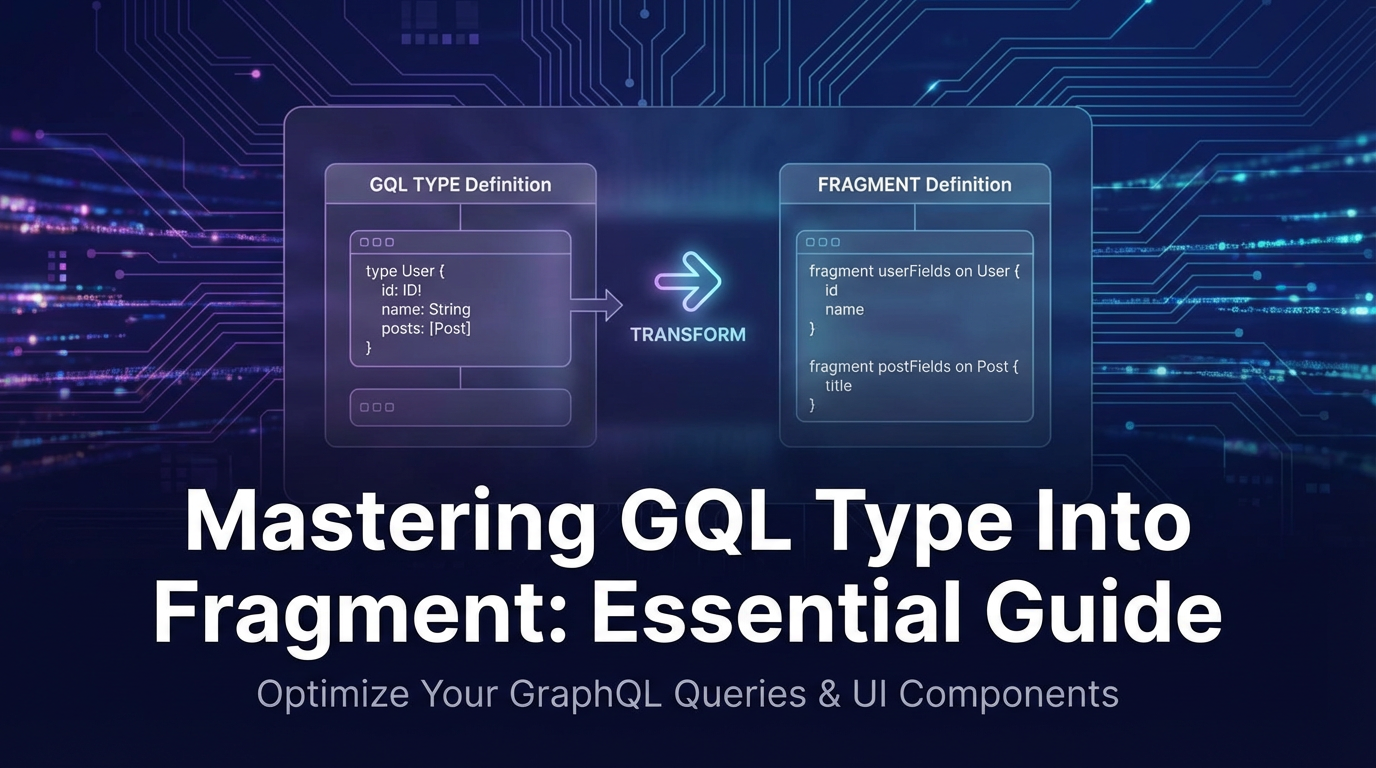


GraphQL has revolutionized how we interact with data, offering a powerful, flexible, and efficient alternative to traditional REST APIs. Its ability to enable clients to declare precisely what data they need, and nothing more, has made it an indispensable tool for modern application development. However, as applications grow in complexity, so does the nature of the data they handle. Oftentimes, data is not uniform; it's polymorphic, meaning it can take on various forms or types. This is where the concept of "Type-Conditioned Fragments" in GraphQL becomes not just useful, but absolutely essential for any developer looking to truly master the intricacies of GraphQL query design.
This comprehensive guide delves deep into the world of GQL Type Into Fragment, exploring its fundamental principles, practical applications, and advanced techniques. We will unravel how this powerful feature allows developers to gracefully handle polymorphic data, ensuring that your GraphQL queries are both robust and highly efficient, capable of fetching diverse data structures with unparalleled precision. Whether you are building an e-commerce platform with varying product types, a social media feed displaying different content formats, or a sophisticated data dashboard, understanding type-conditioned fragments is key to unlocking GraphQL's full potential and building a resilient, scalable api.
The Foundation: A Brief Recap of GraphQL and Fragments
Before we plunge into the specifics of type-conditioned fragments, let's briefly revisit the core concepts of GraphQL and the role of standard fragments. This will ensure we have a solid bedrock of understanding for the more advanced topics ahead.
What is GraphQL?
At its heart, GraphQL is a query language for apis and a runtime for fulfilling those queries with your existing data. It's not a database technology; rather, it's a layer that sits between your client applications and your various data sources. Unlike REST, where clients typically hit multiple endpoints to gather related data, GraphQL allows clients to request all the necessary data in a single round trip, specifying the exact structure and fields they require. This dramatically reduces over-fetching (getting more data than you need) and under-fetching (needing to make multiple requests for related data), leading to more efficient data transfer and faster application performance. The server-side component of GraphQL defines a strongly typed schema, which acts as a contract between the client and the server, outlining all available data types and operations. This schema-driven approach provides robust type safety and excellent introspection capabilities, making it easier for developers to understand and interact with the api.
The schema is composed of various types: * Object Types: The most common type, representing a specific kind of object you can fetch from your API (e.g., User, Product). They have fields, which are functions that return a value of a specific type. * Scalar Types: Primitive data types like String, Int, Boolean, Float, and ID. * Enum Types: Special scalar types that are restricted to a particular set of allowed values. * Input Types: Used for arguments to mutations, allowing you to pass complex objects. * Interface Types: Abstract types that define a set of fields that implementing object types must include. * Union Types: Abstract types that declare a union of multiple object types, where a field can return any one of the specified types.
The Power of Fragments
Fragments in GraphQL are a mechanism for reusing parts of queries. Imagine you have multiple queries or components in your application that need to fetch the exact same set of fields for a particular type. Instead of duplicating those fields in every query, you can define a fragment, which is a reusable unit of fields.
Consider a simple example where you frequently need to fetch a User's id, name, and email.
fragment UserDetails on User {
  id
  name
  email
}
Now, you can use this UserDetails fragment in any query that fetches a User object:
query GetCurrentUser {
  currentUser {
    ...UserDetails
  }
}

query GetUserById($id: ID!) {
  user(id: $id) {
    ...UserDetails
  }
}
This approach offers several benefits: * Reusability: Reduces redundancy and makes your queries more DRY (Don't Repeat Yourself). * Maintainability: If you need to add or remove a field from UserDetails, you only change it in one place, and all queries using that fragment are updated automatically. * Readability: Breaks down complex queries into smaller, more manageable parts, making them easier to understand. * Collocation: In client-side frameworks like React, fragments allow you to collocate data requirements with the UI components that render them, improving modularity.
While standard fragments are incredibly powerful for consistent data fetching on known types, they hit a limitation when dealing with data that isn't always of a single, fixed type. This is precisely the problem that type-conditioned fragments are designed to solve, propelling your GraphQL querying capabilities to the next level.
The Challenge: Handling Polymorphic Data in GraphQL
In real-world applications, data rarely fits neatly into single, homogenous types. Instead, you often encounter situations where a field might return one of several possible types, or where objects share a common interface but have distinct, type-specific fields. This is known as polymorphic data, and it presents a significant challenge for fetching precise information without the right GraphQL tools.
When Does Polymorphism Arise?
Polymorphic data typically manifests in GraphQL through two key schema constructs: 1. Interface Types: An interface defines a set of fields that any object type implementing that interface must include. However, different implementing types can also have their own unique fields. For instance, an Animal interface might define name and species, but Dog (implementing Animal) might have breed, while Bird (also implementing Animal) might have wingSpan. 2. Union Types: A union type represents a value that can be one of several object types, but without any shared fields. For example, a SearchResult union might return either a Book, an Author, or a Movie. These types may not share any common fields, but they are all valid results of a search operation.
Why Standard Fragments Fall Short
Let's illustrate why a standard fragment isn't sufficient for these scenarios. Imagine you have an Animal interface:
interface Animal {
  id: ID!
  name: String!
}

type Dog implements Animal {
  id: ID!
  name: String!
  breed: String
}

type Cat implements Animal {
  id: ID!
  name: String!
  temperament: String
}
Now, suppose you want to query a list of animals and for each animal, you want its id and name. That's straightforward with a basic fragment:
fragment BasicAnimalFields on Animal {
  id
  name
}

query GetAnimals {
  animals {
    ...BasicAnimalFields
  }
}
However, what if you also want to get the breed if the animal is a Dog, or the temperament if it's a Cat? If you simply tried to add breed or temperament to BasicAnimalFields:
# This will cause a GraphQL validation error!
fragment InvalidAnimalFields on Animal {
  id
  name
  breed # Error: Field 'breed' does not exist on type 'Animal'
  temperament # Error: Field 'temperament' does not exist on type 'Animal'
}
The GraphQL server would reject this fragment because breed and temperament are not fields defined directly on the Animal interface. They exist only on specific implementing types (Dog and Cat). The GraphQL schema is strongly typed, and it expects you to only request fields that are guaranteed to be present on the type specified in the on clause of the fragment.
This limitation means that without a way to conditionally request fields based on the actual type of the object at runtime, you'd be forced into less efficient or more cumbersome patterns: * Over-fetching: If you somehow tried to request all possible fields from all possible types in a union or interface (which isn't directly possible in GraphQL without type conditions), you would end up fetching a lot of null values and sending unnecessary data. * Multiple Queries: You might be tempted to make separate queries for Dogs and Cats, which defeats the purpose of GraphQL's single-request efficiency. * Client-Side Guesswork: Without explicit type information from the server, your client would have to guess the type, leading to brittle code.
This is precisely where type-conditioned fragments step in, providing an elegant and robust solution to this fundamental challenge of polymorphic data in GraphQL.
Introducing Type-Conditioned Fragments (...on Type)
Type-conditioned fragments are the GraphQL mechanism designed specifically to address the challenge of querying polymorphic data. They allow you to specify a block of fields that should only be included in the response if the object being queried matches a specific type. This is achieved using the ...on TypeName syntax.
Syntax and Basic Examples
The syntax for a type-conditioned fragment is an extension of the standard fragment syntax:
fragment FragmentName on ParentType {
  commonField
  # ... other common fields
  ...on SpecificTypeA {
    fieldOnlyOnTypeA
  }
  ...on SpecificTypeB {
    fieldOnlyOnTypeB
    anotherFieldOnTypeB
  }
}
Here, ParentType would be an Interface or a Union type. SpecificTypeA and SpecificTypeB would be object types that either implement ParentType (if ParentType is an Interface) or are members of ParentType (if ParentType is a Union).
Let's revisit our Animal interface example to see type-conditioned fragments in action:
query GetAnimalsWithDetails {
  animals {
    id
    name
    # Request breed if the animal is a Dog
    ...on Dog {
      breed
    }
    # Request temperament if the animal is a Cat
    ...on Cat {
      temperament
    }
  }
}
In this query: * id and name are fields that are common to all Animal types (as defined by the Animal interface). They are always requested. * ...on Dog { breed } is a type-conditioned fragment. The breed field will only be included in the response for objects that are specifically of the Dog type. For Cat objects, this field will be ignored. * ...on Cat { temperament } similarly ensures that temperament is only fetched for Cat objects.
The response from such a query might look like this:
{
  "data": {
    "animals": [
      {
        "id": "dog-1",
        "name": "Buddy",
        "breed": "Golden Retriever"
      },
      {
        "id": "cat-1",
        "name": "Whiskers",
        "temperament": "playful"
      },
      {
        "id": "dog-2",
        "name": "Lucy",
        "breed": "Labrador"
      },
      {
        "id": "cat-2",
        "name": "Mittens",
        "temperament": "reserved"
      }
    ]
  }
}
Notice how only the relevant fields are present for each object based on its concrete type. This demonstrates the precision and efficiency that type-conditioned fragments bring to your GraphQL API interactions.
Understanding __typename for Client-Side Logic
When working with polymorphic data and type-conditioned fragments, the special __typename meta-field becomes incredibly valuable for client-side applications. Every GraphQL object type automatically includes a __typename field, which returns a string representing the name of that object's type.
You can request __typename alongside your other fields:
query GetAnimalsWithDetails {
  animals {
    __typename # Request the type name
    id
    name
    ...on Dog {
      breed
    }
    ...on Cat {
      temperament
    }
  }
}
The response would then include:
{
  "data": {
    "animals": [
      {
        "__typename": "Dog",
        "id": "dog-1",
        "name": "Buddy",
        "breed": "Golden Retriever"
      },
      {
        "__typename": "Cat",
        "id": "cat-1",
        "name": "Whiskers",
        "temperament": "playful"
      }
    ]
  }
}
Why is __typename so important? * Client-Side Type Discrimination: It allows your client-side code (e.g., a React component) to easily determine the concrete type of an object received from the GraphQL API. This is crucial for rendering different UI elements or applying different logic based on the object's type. For example, a Card component could use item.__typename === 'Dog' to decide whether to display item.breed. * Cache Normalization: GraphQL clients like Apollo Client use __typename (along with id) to normalize their caches. This ensures that data updates are correctly propagated across all parts of your application that reference the same object, regardless of where it was fetched. * Debugging: It provides immediate insight into the actual type of an object, which can be invaluable during development and debugging.
By combining type-conditioned fragments for efficient data fetching with __typename for robust client-side type handling, you gain a powerful pattern for managing complex and polymorphic data structures within your GraphQL applications.
Deep Dive into Interface Types with Type-Conditioned Fragments
Interface types are a cornerstone of building flexible and extensible GraphQL schemas. They define a contract that multiple object types can fulfill, allowing you to query for a set of common fields while also selectively requesting type-specific data using type-conditioned fragments.
Definition and Purpose of Interfaces
In GraphQL, an interface is an abstract type that specifies a set of fields that any object type implementing that interface must include. It's akin to interfaces in object-oriented programming languages. The primary purposes of interfaces are: * Polymorphism: To enable a field in your schema to return a value that could be any one of several concrete object types, all of which share certain characteristics defined by the interface. * Reusability of Schema Definitions: To avoid duplicating common field definitions across multiple types. * Encouraging Consistent Design: To enforce a minimum set of fields and arguments for related objects, promoting a more consistent API design.
Let's refine our Character example to demonstrate this more thoroughly.
# The Interface
interface Character {
  id: ID!
  name: String!
  appearsIn: [Episode!]!
}

# Object Type implementing Character
type Human implements Character {
  id: ID!
  name: String!
  appearsIn: [Episode!]!
  homePlanet: String
  starshipCount: Int
}

# Object Type implementing Character
type Droid implements Character {
  id: ID!
  name: String!
  appearsIn: [Episode!]!
  primaryFunction: String
  model: String
}

# An auxiliary type
enum Episode {
  NEWHOPE
  EMPIRE
  JEDI
}
In this schema: * Character is an interface that declares id, name, and appearsIn. * Human and Droid are concrete object types that both implement Character. This means they must have id, name, and appearsIn. * Human adds its own unique fields: homePlanet and starshipCount. * Droid adds its own unique fields: primaryFunction and model.
Applying Type-Conditioned Fragments to Query Interfaces
Now, imagine a query where you need to fetch a list of characters, and for each character, you want its common fields, but also the specific details if it's a Human or a Droid.
query GetCharactersDetails {
  characters {
    id
    name
    appearsIn
    __typename # Always useful for client-side type discrimination

    # Conditionally request Human-specific fields
    ...on Human {
      homePlanet
      starshipCount
    }

    # Conditionally request Droid-specific fields
    ...on Droid {
      primaryFunction
      model
    }
  }
}
Let's break down the execution and response: 1. The characters field returns a list where each item is of type Character. 2. For each item, id, name, appearsIn, and __typename are fetched because they are either part of the Character interface or universally available (__typename). 3. When the server resolves an item and determines its concrete type (e.g., Human), the ...on Human fragment condition becomes true. The homePlanet and starshipCount fields are then fetched for that specific Human object. 4. If the next item is a Droid, the ...on Droid fragment condition is met, and primaryFunction and model are fetched. The ...on Human fragment is ignored for this Droid object.
A sample response might look like this:
{
  "data": {
    "characters": [
      {
        "__typename": "Human",
        "id": "luke",
        "name": "Luke Skywalker",
        "appearsIn": ["NEWHOPE", "EMPIRE", "JEDI"],
        "homePlanet": "Tatooine",
        "starshipCount": 2
      },
      {
        "__typename": "Droid",
        "id": "r2d2",
        "name": "R2-D2",
        "appearsIn": ["NEWHOPE", "EMPIRE", "JEDI"],
        "primaryFunction": "Astromech",
        "model": "R2 series"
      },
      {
        "__typename": "Human",
        "id": "leia",
        "name": "Leia Organa",
        "appearsIn": ["NEWHOPE", "EMPIRE", "JEDI"],
        "homePlanet": "Alderaan",
        "starshipCount": 1
      },
      {
        "__typename": "Droid",
        "id": "c3po",
        "name": "C-3PO",
        "appearsIn": ["NEWHOPE", "EMPIRE", "JEDI"],
        "primaryFunction": "Protocol",
        "model": "3PO series"
      }
    ]
  }
}
This clearly illustrates how type-conditioned fragments allow you to elegantly fetch type-specific data from an interface-typed field, ensuring that your queries are precise and only retrieve the data relevant to the concrete type of each object.
Use Cases for Interfaces
Interfaces are incredibly useful in various scenarios: * Search Results: An interface SearchResultItem could be implemented by Product, User, BlogEntry, etc. * Content Blocks: A ContentBlock interface for a CMS, implemented by TextBlock, ImageBlock, VideoBlock, each with specific fields. * Activity Feed: An Activity interface implemented by PostCreated, CommentAdded, UserLiked, each with unique fields but sharing common timestamp and actor fields. * Auditable Entities: An Auditable interface could add createdAt and updatedAt fields to various domain objects.
By leveraging interfaces with type-conditioned fragments, you can build incredibly flexible and scalable GraphQL APIs that adapt to diverse data structures without sacrificing efficiency or type safety.
Deep Dive into Union Types with Type-Conditioned Fragments
While interfaces are excellent for polymorphic types that share a common set of fields, union types address a different but equally important aspect of polymorphism: when a field can return one of several distinct types that don't necessarily share any common fields.
Definition and Purpose of Union Types
In GraphQL, a union type represents a value that can be any one of a specified set of object types. Unlike interfaces, union types do not declare any fields themselves; they simply list the possible object types that can be returned. The member types of a union do not need to share any common fields or implement any common interface.
Consider a search feature where the results could be a book, an author, or a movie. These are distinct entities with very different sets of fields.
# The Union Type
union SearchResult = Book | Author | Movie

# Member Object Types
type Book {
  title: String!
  authorName: String!
  isbn: String
  pages: Int
}

type Author {
  name: String!
  nationality: String
  born: String
}

type Movie {
  title: String!
  director: String!
  releaseYear: Int
  durationMinutes: Int
}
In this schema: * SearchResult is a union that can return either a Book, an Author, or a Movie. * Each of Book, Author, and Movie has its own unique set of fields, with no overlap necessarily required.
Applying Type-Conditioned Fragments to Query Union Types
When querying a field that returns a union type, you must use type-conditioned fragments to specify which fields you want to fetch for each possible member type. You cannot directly query fields on a union type itself because, by definition, union types have no fields of their own.
Let's construct a query for our search field which returns a SearchResult union:
query PerformSearch($query: String!) {
  search(query: $query) {
    __typename # Essential for unions, as there are no common fields

    # Conditionally request Book-specific fields
    ...on Book {
      title
      authorName
      isbn
      pages
    }

    # Conditionally request Author-specific fields
    ...on Author {
      name
      nationality
      born
    }

    # Conditionally request Movie-specific fields
    ...on Movie {
      title
      director
      releaseYear
      durationMinutes
    }
  }
}
Explanation of the query: 1. The search field returns a list of SearchResult items. 2. For each item, __typename is fetched first. This is critically important for union types because it's often the only common piece of information you can fetch directly without a type condition. It allows the client to identify the concrete type. 3. The type-conditioned fragments ...on Book, ...on Author, and ...on Movie then ensure that the respective fields are only fetched when the resolved item matches that specific type. If an item is a Book, only the Book fragment's fields are requested; Author and Movie fragments are ignored.
A hypothetical response for a search query like "GraphQL" might look like this:
{
  "data": {
    "search": [
      {
        "__typename": "Book",
        "title": "GraphQL in Action",
        "authorName": "John Doe",
        "isbn": "123-4567890123",
        "pages": 450
      },
      {
        "__typename": "Author",
        "name": "Jane Smith",
        "nationality": "American",
        "born": "1975-03-15"
      },
      {
        "__typename": "Movie",
        "title": "The Graph",
        "director": "Alice Wonderland",
        "releaseYear": 2022,
        "durationMinutes": 120
      }
    ]
  }
}
This example clearly shows how union types, combined with type-conditioned fragments, provide a robust way to handle heterogeneous data where the types are completely distinct but logically grouped.
Distinguishing Unions from Interfaces
It's common for newcomers to GraphQL to confuse interfaces and unions. While both handle polymorphism, their design philosophies and use cases are distinct:
| Feature | Interface Types | Union Types |
|---|---|---|
| Purpose | Define a contract of common fields that implementing types must adhere to. | Declare a set of distinct object types, any one of which can be returned. |
| Common Fields | Yes, explicitly defined on the interface. | No, union types have no fields of their own. |
| Syntax | interface Name { field: Type } |
union Name = TypeA | TypeB |
| Implementation | Object types implement an interface. |
Object types are simply members of a union. |
| Querying | Can query common fields directly; type-conditioned fragments for type-specific fields. | Must use type-conditioned fragments for all fields (except __typename). |
| Use Case Example | Character (Human/Droid share name, id). |
SearchResult (Book/Author/Movie are distinct). |
Understanding this distinction is crucial for designing a semantically correct and efficient GraphQL schema. Interfaces are for "is a type of" relationships with shared attributes, while unions are for "is one of these types" relationships without necessarily shared attributes. Both are powerful, and type-conditioned fragments are the key to interacting with both effectively.
APIPark is a high-performance AI gateway that allows you to securely access the most comprehensive LLM APIs globally on the APIPark platform, including OpenAI, Anthropic, Mistral, Llama2, Google Gemini, and more.Try APIPark now! 👇👇👇
Advanced Techniques and Best Practices
Mastering type-conditioned fragments goes beyond just knowing the syntax. It involves understanding how to compose them, when to use them effectively, and how they integrate into a broader GraphQL development workflow.
Nested Type Conditions
Just as you can nest standard fragments, you can also nest type-conditioned fragments. This becomes particularly useful when you have deeply nested polymorphic data. For example, if a User has a profile which is an Avatar interface, and Avatar itself has implementations like ImageAvatar or TextAvatar, you might need nested conditions.
query GetUserProfileData {
  currentUser {
    id
    name
    profile {
      __typename
      ...on ImageAvatar {
        imageUrl
        thumbnailUrl
        # Further nested condition if ImageAvatar has polymorphic fields
        # ...on HighResImage { highResUrl }
      }
      ...on TextAvatar {
        initials
        backgroundColor
      }
    }
  }
}
This demonstrates that type-conditioned fragments can be applied at any level of your query, enabling granular control over data fetching throughout complex object graphs.
Inline Fragments vs. Named Fragments for Type Conditions
Type-conditioned fragments can be defined either inline within the query or as named, reusable fragments.
- Inline Fragments: These are placed directly where the polymorphic field is queried, using the
...on TypeName { ...fields }syntax. They are convenient for one-off conditional field selections.graphql query MyQuery { somePolymorphicField { __typename ...on TypeA { fieldA1 } ...on TypeB { fieldB1 } } } - Named Fragments: These are defined separately and then spread into the query using
...FragmentName. They promote reusability and modularity, especially when the same set of conditional fields is needed in multiple places.```graphql fragment TypeAFields on TypeA { fieldA1 fieldA2 }fragment TypeBFields on TypeB { fieldB1 fieldB2 }query MyQuery { somePolymorphicField { __typename ...TypeAFields ...TypeBFields } } ```
When to use which: * Inline fragments: Ideal for simple, isolated type conditions that are specific to a single query or component. They keep the query definition concise. * Named fragments: Preferred for complex sets of conditional fields that are reused across different parts of your application, or when adhering to a component-driven architecture (fragment collocation). They improve readability and maintainability.
Fragment Collocation
A popular pattern, especially with clients like Apollo and Relay, is fragment collocation. This involves defining GraphQL fragments alongside the UI components that are responsible for rendering the data fetched by those fragments. For type-conditioned fragments, this means a component that renders polymorphic data can define specific fragments for each possible type it handles.
For example, a FeedItem component might render different sub-components based on __typename. Each sub-component (e.g., PostCard, AdCard) would define its own type-conditioned fragment:
// FeedItem.js (parent component)
import React from 'react';
import { useQuery, gql } from '@apollo/client';
import PostCard from './PostCard';
import AdCard from './AdCard';

const GET_FEED_ITEMS = gql`
  query GetFeedItems {
    feed {
      __typename
      # ...PostCard.fragment (spread PostCard's fragment)
      # ...AdCard.fragment (spread AdCard's fragment)
      ...on Post {
        ...PostCardFields
      }
      ...on Ad {
        ...AdCardFields
      }
    }
  }
  ${PostCard.fragment}
  ${AdCard.fragment}
`;

function FeedItemRenderer({ item }) {
  if (item.__typename === 'Post') {
    return <PostCard post={item} />;
  }
  if (item.__typename === 'Ad') {
    return <AdCard ad={item} />;
  }
  return null;
}

function Feed() {
  const { loading, error, data } = useQuery(GET_FEED_ITEMS);

  if (loading) return <p>Loading...</p>;
  if (error) return <p>Error: {error.message}</p>;

  return (
    <div>
      {data.feed.map(item => (
        <FeedItemRenderer key={item.id} item={item} />
      ))}
    </div>
  );
}

// PostCard.js
import React from 'react';
import { gql } from '@apollo/client';

function PostCard({ post }) {
  return (
    <div className="post-card">
      <h3>{post.title}</h3>
      <p>{post.content}</p>
      <p>By: {post.author.name}</p>
    </div>
  );
}

PostCard.fragment = gql`
  fragment PostCardFields on Post {
    id
    title
    content
    author {
      name
    }
  }
`;

// AdCard.js
import React from 'react';
import { gql } from '@apollo/client';

function AdCard({ ad }) {
  return (
    <div className="ad-card">
      <h4>Sponsored: {ad.campaignName}</h4>
      <img src={ad.imageUrl} alt={ad.title} />
      <p>{ad.description}</p>
    </div>
  );
}

AdCard.fragment = gql`
  fragment AdCardFields on Ad {
    id
    campaignName
    imageUrl
    description
  }
`;
This pattern, leveraging type-conditioned fragments, makes data requirements explicit and local to the components that need them, greatly enhancing modularity and component reusability.
Fragment Composition
Fragments can be composed, meaning one fragment can include another fragment, even type-conditioned ones. This allows for building highly complex queries from smaller, well-defined, and reusable blocks. For example, a MediaDetails fragment could conditionally include fields for Video or Image types, and then this MediaDetails fragment could be used within a Post fragment. This hierarchical composition is a powerful way to manage large and intricate data models.
Handling Nullability and Error Handling
When working with type-conditioned fragments, it's important to understand how nullability affects your data. If you request a field (even within a type-conditioned fragment) that is non-nullable in the schema, but the server cannot provide a value for it, GraphQL will "null out" the parent field. If the parent field is also non-nullable, this nulling cascades up the query until it hits a nullable field or the root.
For example, if breed on Dog was non-nullable, and a Dog object came back without a breed, the entire Dog object would become null. This behavior needs to be considered in your client-side error handling and data validation logic. Always design your schema with appropriate nullability constraints, and your client with robust checks for potentially null data.
Performance Considerations
While type-conditioned fragments are highly efficient in terms of data transfer (fetching only what's needed), there are server-side performance implications to consider: * Resolver Complexity: The server still needs to determine the concrete type of each polymorphic object. This might involve additional database lookups or logic within your resolvers, especially for large lists of polymorphic items. * Query Complexity Analysis: When designing an api gateway or exposing your GraphQL api publicly, it's good practice to implement query complexity analysis. Type-conditioned fragments can contribute to overall query complexity. Tools often calculate complexity by summing up field costs, and conditional fields might add to this if all possible branches are considered or if there's significant computation to determine the branch. * Caching: Effective client-side caching (e.g., normalized cache in Apollo) relies heavily on __typename and id to uniquely identify objects, ensuring that even polymorphic data is updated consistently across the UI.
Tooling and Ecosystem Support
Modern GraphQL tooling provides excellent support for type-conditioned fragments: * GraphQL Clients (Apollo, Relay): These clients are built to handle polymorphic data gracefully, using __typename for cache normalization and type discrimination. * IDE Support: Most GraphQL IDEs and editor plugins (e.g., VS Code extensions for GraphQL) offer syntax highlighting, auto-completion, and validation for type-conditioned fragments, making development smoother. * Code Generation: Tools like GraphQL Code Generator can automatically generate TypeScript types or other language bindings from your GraphQL schema and queries, including accurate types for polymorphic data, which can greatly enhance type safety on the client side.
By leveraging these advanced techniques and tools, you can build highly performant, maintainable, and robust GraphQL applications that expertly manage polymorphic data with type-conditioned fragments.
Real-World Scenarios and Practical Applications
The power of type-conditioned fragments truly shines in real-world applications where data heterogeneity is the norm. Let's explore a few compelling scenarios where this GraphQL feature proves indispensable.
E-commerce: Product Variations and Search Results
Imagine an e-commerce platform. You have a Product interface, but different types of products (e.g., Book, ClothingItem, Electronics) have vastly different attributes. * A Book has isbn, author, publisher. * A ClothingItem has size, color, material. * Electronics has brand, modelNumber, warrantyPeriod.
When a user views a product detail page, or a search result list, you need to fetch the specific details for each product type.
query GetProductDetails($productId: ID!) {
  product(id: $productId) {
    id
    name
    price
    description
    imageUrl
    __typename

    ...on Book {
      author
      isbn
      pages
    }
    ...on ClothingItem {
      sizesAvailable
      colorsAvailable
      material
    }
    ...on Electronics {
      brand
      modelNumber
      warrantyMonths
      technicalSpecs
    }
  }
}
This single query efficiently retrieves all necessary common and type-specific information, allowing the frontend to render appropriate UI components for each product type without over-fetching irrelevant data. Similarly, search results often return a mix of Product, Category, Brand, or Article types, making a SearchResult union with type-conditioned fragments the ideal solution.
Social Media: Dynamic Feed Items
A social media feed is a quintessential example of polymorphic data. A feed typically displays a chronological stream of items, which could be: * A Post (with text, images, comments) * A Share (repost of another user's content) * An Ad (sponsored content) * A FriendRequestNotification * An EventInvitation
Each of these FeedItem types will have common fields (like timestamp, actor) but also highly specific fields.
query GetUserFeed {
  feed(limit: 20) {
    id
    timestamp
    actor {
      id
      username
      profilePictureUrl
    }
    __typename

    ...on Post {
      content
      likesCount
      commentsCount
      mediaUrl # Could be a nested polymorphic field itself
    }
    ...on Share {
      originalPostId
      shareText
    }
    ...on Ad {
      campaignId
      advertiserName
      callToActionLink
    }
    ...on EventInvitation {
      eventId
      eventName
      eventDate
      location
    }
  }
}
This allows a single feed component to gracefully render diverse content types, dynamically adjusting its layout and functionality based on the __typename and the fetched conditional fields.
Content Management Systems (CMS): Flexible Content Blocks
In a modern CMS, content is often composed of a series of flexible blocks. A Page might have a list of ContentBlocks, each of which could be: * A TextBlock (with heading, bodyHtml) * An ImageBlock (with imageUrl, caption, altText) * A VideoBlock (with videoUrl, thumbnailUrl, duration) * A CallToActionBlock (with buttonText, linkUrl)
An ArticleContent field could return a list of ContentBlock union members.
query GetArticleContent($articleId: ID!) {
  article(id: $articleId) {
    title
    author
    publishDate
    contentBlocks {
      __typename
      ...on TextBlock {
        heading
        bodyHtml
      }
      ...on ImageBlock {
        imageUrl
        caption
        width
        height
      }
      ...on VideoBlock {
        videoUrl
        provider # YouTube, Vimeo, etc.
        durationSeconds
      }
      ...on CallToActionBlock {
        buttonLabel
        destinationUrl
        backgroundColor
      }
    }
  }
}
This pattern provides immense flexibility for content editors to compose pages without developers needing to write entirely new queries for every possible content structure.
Data Dashboards: Heterogeneous Data Points
In a data analytics dashboard, you might have a widget displaying various types of AnalyticsEvents: * PageViewEvent (with url, referrer) * ClickEvent (with elementId, coords) * PurchaseEvent (with productId, amount, currency)
A DashboardActivityFeed might then fetch a list of AnalyticsEvent interface types.
The Role of API Gateways in Managing Such Complex APIs
As GraphQL APIs grow in complexity, integrating diverse data sources and supporting intricate polymorphic queries, the need for robust API management solutions becomes paramount. This is especially true when organizations begin to leverage AI services, microservices architectures, and need to ensure security, performance, and scalability.
This is where a powerful API gateway like ApiPark comes into play. APIPark, an open-source AI gateway and API management platform, is designed to help developers and enterprises manage, integrate, and deploy AI and REST services with ease. For GraphQL APIs handling type-conditioned fragments, a gateway like APIPark can provide significant advantages: * Unified API Management: It centralizes the management of all your APIs, including complex GraphQL endpoints, offering features like design, publication, invocation, and decommission. * Security and Access Control: For polymorphic APIs, granular control over who can access which types or fields can be crucial. APIPark allows for subscription approval features and independent access permissions for different teams (tenants), preventing unauthorized API calls and potential data breaches. * Performance and Scalability: APIPark's high-performance gateway can handle large-scale traffic, ensuring that even data-intensive GraphQL queries with many type conditions are processed efficiently. Its cluster deployment support and performance rivaling Nginx mean your complex APIs remain responsive. * Observability and Analytics: Detailed API call logging and powerful data analysis features help you monitor the performance of your GraphQL queries, trace issues, and understand long-term trends, which is critical for optimizing complex polymorphic data fetching. * AI Integration: In scenarios where your GraphQL resolvers might integrate with AI models (e.g., fetching product recommendations from an AI service), APIPark’s capability to quickly integrate 100+ AI models and standardize AI invocation formats makes it an ideal complement. It can encapsulate prompts into REST APIs, which your GraphQL resolvers can then consume, simplifying the entire AI integration lifecycle behind your unified GraphQL API.
By providing a comprehensive management layer, an API gateway ensures that even the most intricate GraphQL APIs, powered by type-conditioned fragments and potentially integrating AI, are deployed, secured, and operated with enterprise-grade reliability and efficiency. This allows developers to focus on building powerful data experiences, knowing that the underlying API infrastructure is robustly managed.
Comparisons and Alternatives (Briefly)
It's useful to briefly consider how GraphQL's approach to polymorphic data, facilitated by type-conditioned fragments, compares to other API paradigms.
GraphQL vs. REST for Polymorphic Data
In a traditional REST API, handling polymorphic data often becomes cumbersome: * Multiple Endpoints: You might have separate endpoints for /dogs/{id} and /cats/{id}. If you have a list of mixed animals, you'd likely fetch a list of IDs from one endpoint (e.g., /animals), then iterate and make N separate requests to specific endpoints to get full details. This leads to the N+1 problem and increased network overhead. * Client-Side Filtering/Parsing: A single /animals endpoint might return a mixed list where each object has a type field, and the client then has to manually parse and conditionally access fields, leading to less type-safe and more error-prone code. * Over-fetching: A generalized Animal endpoint might try to return all possible fields (even those that are null for certain types), leading to over-fetching.
GraphQL's type-conditioned fragments elegantly solve these issues by allowing a single, strongly typed query to fetch all necessary data in one round trip, precisely defining which fields are needed for each concrete type. This inherent type safety and efficiency are major advantages over traditional REST approaches for complex, polymorphic data.
Building a Robust GraphQL API with Type-Conditioned Fragments
Designing and implementing a GraphQL API that effectively uses type-conditioned fragments requires careful consideration of schema design, testing, and evolution.
Schema Design Principles
- When to Use Interfaces: Opt for interfaces when you have multiple object types that share a common set of fields and represent a conceptual "is a" relationship (e.g.,
Bookis aProduct). Interfaces enforce a contract and promote consistent schema design. - When to Use Unions: Choose unions when you have a field that can return one of several completely distinct object types, without requiring any common fields, representing an "is one of these" relationship (e.g.,
SearchResultis aBookor anAuthoror aMovie). - Clear Naming Conventions: Use descriptive names for your interfaces, unions, and their member types to make the schema easy to understand for consumers.
- Appropriate Nullability: Carefully consider which fields should be nullable (
String) versus non-nullable (String!). This impacts how errors are handled and how clients interpret missing data.
Testing Fragments
Thoroughly testing your GraphQL queries, especially those with type-conditioned fragments, is critical. * Unit Tests for Resolvers: Ensure your server-side resolvers correctly identify the concrete type of an object and provide the appropriate data for each type. * Integration Tests for Queries: Write tests that execute your full GraphQL queries, including complex ones with nested type-conditioned fragments, and assert that the returned data structure matches your expectations for all possible polymorphic combinations. * Client-Side Component Tests: If you're using fragment collocation, ensure that your UI components correctly consume and render data based on the __typename and type-specific fields.
Versioning and Evolution
Evolving a GraphQL API with polymorphic types requires careful planning: * Adding New Implementations/Members: Adding a new type to an existing interface or union is generally a non-breaking change, as clients that don't query for the new type will continue to work. Clients that want the new type's data can simply add a new ...on NewType fragment. * Removing Types/Fields: This is a breaking change and should be handled with deprecation warnings and clear communication to API consumers. * Schema Registry: Using a schema registry can help track schema changes and alert you to potential breaking changes, making it easier to manage the evolution of your polymorphic types.
Conclusion
Mastering GQL Type Into Fragment is not merely about understanding a specific syntax; it's about unlocking a fundamental capability of GraphQL that allows you to interact with complex, polymorphic data structures with unparalleled efficiency, precision, and type safety. Whether you're dealing with diverse product types in e-commerce, heterogeneous content blocks in a CMS, or dynamic items in a social media feed, type-conditioned fragments provide the elegant solution to fetch exactly what you need, only when you need it.
From the foundational concepts of interfaces and unions to advanced techniques like nested fragments and collocation, this guide has traversed the landscape of polymorphic data in GraphQL. We've seen how ...on TypeName constructs, coupled with the ubiquitous __typename meta-field, empower developers to build robust and adaptable client applications. Furthermore, we've highlighted how comprehensive API management platforms and API gateway solutions, such as ApiPark, become indispensable tools for governing, securing, and scaling these sophisticated GraphQL APIs, especially in an era increasingly driven by AI integrations.
By embracing type-conditioned fragments, you empower your GraphQL APIs to reflect the true complexity of real-world data, leading to more maintainable codebases, faster application performance, and a superior developer experience. This is an essential skill for anyone looking to move beyond the basics and truly leverage the full expressive power that GraphQL offers.
Frequently Asked Questions (FAQ)
1. What is a type-conditioned fragment in GraphQL? A type-conditioned fragment in GraphQL is a specific block of fields prefixed with ...on TypeName { ... }. It allows you to specify fields that should only be included in the query's response if the object being queried matches the TypeName condition. This is essential for handling polymorphic data, where a field might return one of several different object types, each with its own unique fields.
2. When should I use an Interface type versus a Union type in GraphQL? Use an Interface type when you have multiple object types that share a common set of fields and represent a conceptual "is a" relationship (e.g., Dog is an Animal). The interface defines these common fields, and implementing types provide their unique fields. Use a Union type when a field can return one of several completely distinct object types that do not necessarily share any common fields, representing an "is one of these" relationship (e.g., SearchResult is a Book or an Author). Union types themselves declare no fields; they only list their possible member types.
3. Is __typename mandatory when working with type-conditioned fragments? While not strictly mandatory for GraphQL queries to execute, __typename is highly recommended and almost essential when working with polymorphic data and type-conditioned fragments. It provides the client-side application with explicit information about the concrete type of each object received. This is crucial for correctly rendering UI components, implementing conditional logic, and enabling efficient client-side caching mechanisms in libraries like Apollo Client.
4. How do type-conditioned fragments impact API performance or complexity? Type-conditioned fragments generally improve API performance by preventing over-fetching, as they ensure only the necessary fields for a given type are retrieved. On the server side, resolvers for polymorphic fields still need to determine the concrete type of each object, which might involve some computational cost. From a query complexity standpoint, while they fetch less data, the overall logical complexity of the query might be considered higher by some API gateway analytics if it accounts for all possible branches. Efficient API gateways like ApiPark can help manage and monitor the performance of such complex GraphQL queries.
5. Can I nest type-conditioned fragments, or use them within named fragments? Yes, absolutely. Type-conditioned fragments can be nested within other fragments (both standard and type-conditioned) to handle deeply polymorphic data structures. You can also define type-conditioned logic within a reusable named fragment, and then spread that named fragment into your queries. This allows for powerful fragment composition, enhancing modularity and reusability across your GraphQL codebase.
🚀You can securely and efficiently call the OpenAI API on APIPark in just two steps:
Step 1: Deploy the APIPark AI gateway in 5 minutes.
APIPark is developed based on Golang, offering strong product performance and low development and maintenance costs. You can deploy APIPark with a single command line.
curl -sSO https://download.apipark.com/install/quick-start.sh; bash quick-start.sh

In my experience, you can see the successful deployment interface within 5 to 10 minutes. Then, you can log in to APIPark using your account.

Step 2: Call the OpenAI API.