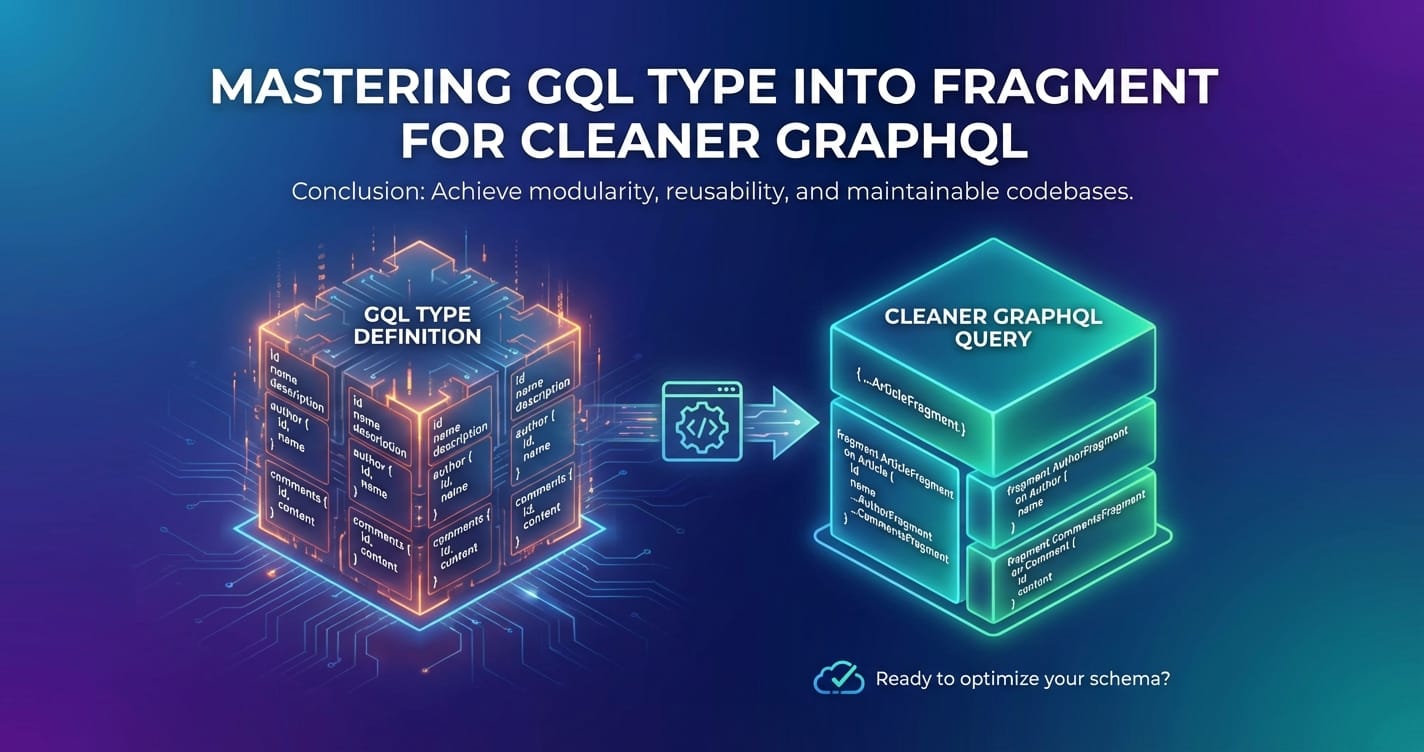
Mastering GQL Type Into Fragment for Cleaner GraphQL
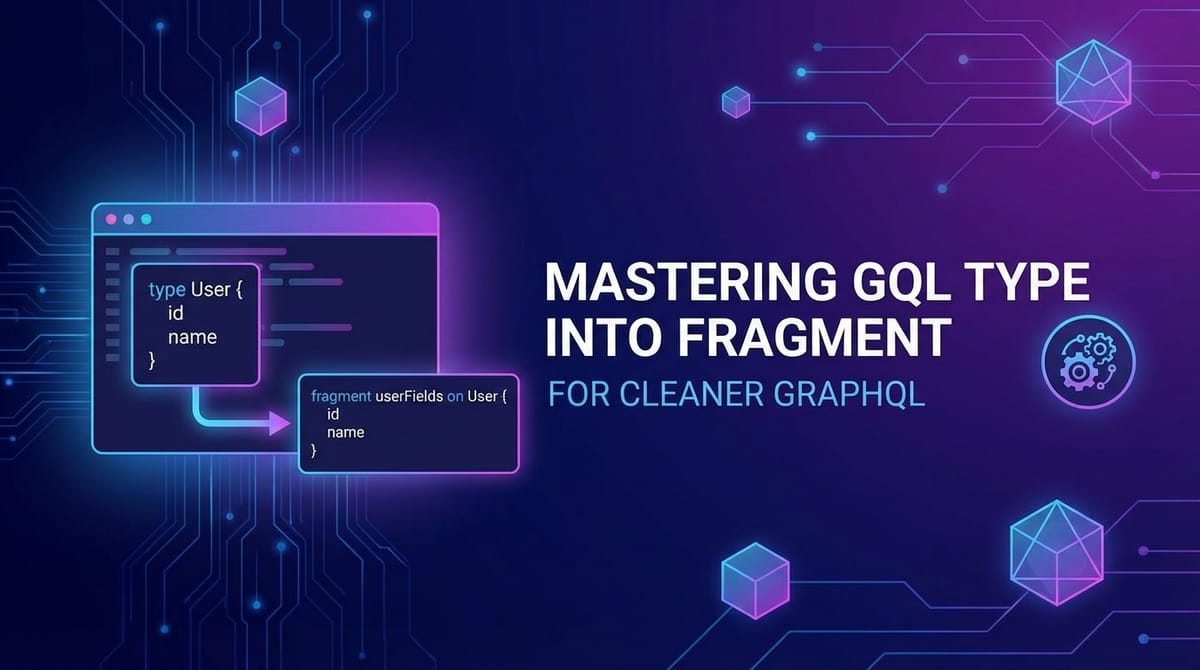


In the ever-evolving landscape of modern web development, GraphQL has emerged as a transformative technology, offering a more efficient, powerful, and flexible alternative to traditional REST APIs. Its declarative nature empowers clients to request precisely the data they need, eliminating the notorious problems of over-fetching and under-fetching that often plague conventional API interactions. However, as applications grow in complexity and data models become more intricate, even GraphQL queries can become verbose, repetitive, and challenging to manage. This is where the true power of GraphQL fragments, particularly those augmented with type conditions, shines through, elevating the craft of data fetching to an art form.
This comprehensive guide will take you on a deep dive into the sophisticated world of GraphQL fragments, focusing specifically on how "type into fragment" unlocks unparalleled levels of cleanliness, reusability, and maintainability in your GraphQL queries. We will dissect the underlying principles, explore practical implementations with rich examples, and uncover advanced strategies that will not only streamline your development workflow but also significantly enhance the robustness and clarity of your API consumption logic. By the end of this journey, you will possess the knowledge and practical insights to transform your complex, unwieldy queries into elegant, modular, and future-proof GraphQL masterpieces.
The Foundational Pillars of GraphQL: A Brief Recalibration
Before we embark on our exploration of advanced fragment techniques, it's prudent to establish a firm understanding of GraphQL's core tenets. At its heart, GraphQL is not merely a query language but a powerful runtime for fulfilling those queries with your existing data. It provides a complete and understandable description of the data in your API, allowing clients to ask for exactly what they need and nothing more.
The GraphQL ecosystem revolves around a few fundamental concepts:
- Schema Definition Language (SDL): This language is used to define the structure of your data. It declares types (object types, scalar types, enum types, input types), fields within those types, and the arguments those fields can accept. For instance, you might define a
Usertype with fields likeid,name, andemail. The schema acts as a contract between the client and the server, meticulously outlining all possible data interactions through the API. - Types:
- Object Types: The most basic components of a GraphQL schema, representing a kind of object you can fetch from your service, with fields that return a specific type.
- Scalar Types: Primitive types like
String,Int,Float,Boolean, andID. - Interfaces: Abstract types that define a set of fields that an object type must include. If a type implements an interface, it guarantees it will have all the fields defined by that interface. This is crucial for polymorphic data.
- Unions: Abstract types that declare a set of object types that might be returned for a particular field. Unlike interfaces, union types don't share any common fields; they just indicate that the result could be one of several distinct types. This is another key mechanism for polymorphism.
- Input Types: Special object types used as arguments for mutations.
- Queries, Mutations, and Subscriptions:
- Queries: Operations used to read data from the server. They are analogous to
GETrequests in REST. - Mutations: Operations used to modify data on the server. Similar to
POST,PUT,PATCH,DELETEin REST. - Subscriptions: Operations used to receive real-time updates from the server, often via WebSockets.
- Queries: Operations used to read data from the server. They are analogous to
A basic GraphQL query involves selecting fields on an object. For example, to fetch a user's ID and name, a client would send:
query GetUser {
  user(id: "123") {
    id
    name
  }
}
This declarative approach significantly improves upon the rigid endpoints of REST APIs, where clients often receive more data than needed (over-fetching) or have to make multiple requests to gather all necessary data (under-fetching). GraphQL consolidates these interactions into a single, efficient API call. However, even with this inherent power, complex applications often find their GraphQL queries becoming repetitive and difficult to manage without further modularization – a challenge that fragments are perfectly designed to address, especially when dealing with the intricate tapestry of polymorphic data.
The Inevitable Complexity: When Queries Become Bloated and Repetitive
While GraphQL's ability to fetch exact data is revolutionary, the path to cleaner queries is not automatic. As applications scale and their data requirements become more granular and diverse, a common pitfall is the proliferation of verbose and repetitive query structures. This redundancy, if left unchecked, can quickly negate many of GraphQL's initial advantages, leading to maintenance headaches and diminished developer experience.
Consider a typical application that interacts with various user-related data. You might need to display a user's basic profile in a header, their full contact details on a profile page, and a condensed version in a user list. Without proper modularization, your GraphQL document could quickly become a sprawling collection of nearly identical field selections.
Scenario 1: Simple Repetition
Imagine you have a User type in your GraphQL schema with fields like id, firstName, lastName, email, avatarUrl, createdAt. In one part of your application, you might need a user's id, firstName, lastName, and avatarUrl for a user card component. In another, you might need the same set of fields for a comment author display.
Your queries might look like this:
# Query for a User Card
query GetUserCardDetails {
  user(id: "user123") {
    id
    firstName
    lastName
    avatarUrl
  }
}

# Query for a Comment Author Display
query GetCommentAuthor {
  comment(id: "comment456") {
    id
    text
    author {
      id
      firstName
      lastName
      avatarUrl
    }
  }
}

# Yet another query...
query GetPostAuthor {
  post(id: "post789") {
    id
    title
    author {
      id
      firstName
      lastName
      avatarUrl
    }
    # ... other post fields
  }
}
Notice the repeated id, firstName, lastName, avatarUrl selection block. While manageable for small applications, imagine this pattern repeating across dozens or hundreds of components and queries. Any change to the User type's common fields (e.g., renaming avatarUrl to profilePicture) would necessitate searching and replacing in every single one of these query blocks – a tedious, error-prone, and time-consuming task. This directly impacts the maintainability of your api client code and introduces significant friction into the development process.
Scenario 2: Polymorphic Data Complexity
The problem becomes even more pronounced when dealing with polymorphic data structures – data that can take on various forms. GraphQL handles this elegantly through interfaces and unions, but querying them effectively without fragments can quickly lead to deeply nested, complex, and difficult-to-read queries.
Consider an api that allows you to search across different types of content, such as Books and Articles. Your schema might define a SearchResult union:
union SearchResult = Book | Article

type Book {
  id: ID!
  title: String!
  author: String!
  isbn: String
}

type Article {
  id: ID!
  headline: String!
  source: String!
  publishDate: String
}

type Query {
  search(query: String!): [SearchResult!]!
}
To fetch specific fields for each type within a search result, a query might look like this:
query GlobalSearch($query: String!) {
  search(query: $query) {
    __typename # Essential for client-side type checking
    ... on Book {
      id
      title
      author
    }
    ... on Article {
      id
      headline
      source
    }
  }
}
This specific query uses inline fragments (... on TypeName { ... }), which are already a step towards clarity. However, if the field selections for Book or Article were much larger, or if these specific field sets were needed in multiple different search contexts or other parts of the api, then duplicating these inline fragments repeatedly would suffer from the same issues as Scenario 1. The query would become verbose, hard to trace, and less adaptable to schema changes, making the api interaction less intuitive and more error-prone for consumers.
The pain points are clear: * Increased Cognitive Load: Developers struggle to parse verbose queries, especially when navigating large files or multiple teams. * Higher Risk of Inconsistencies: Manual duplication means a higher chance of typos or missing fields when a schema changes, leading to unexpected api behavior. * Maintenance Nightmares: Updating a data requirement means modifying it in countless places, slowing down development and increasing the risk of regressions. * Diminished Clarity: The intent of the data fetch becomes obscured by boilerplate, making it harder to understand the overall api contract and its usage patterns.
These challenges highlight an urgent need for a mechanism to encapsulate and reuse query logic effectively, paving the way for fragments to revolutionize how we interact with GraphQL APIs.
Fragments Unveiled: The Building Blocks of Modular GraphQL
Enter GraphQL fragments – the elegant solution to query redundancy and complexity. At their core, fragments are reusable selections of fields. They allow you to define a set of fields once, give it a name, and then include that named set in any query, mutation, or even other fragments where those fields are relevant. Think of them as sub-queries or component-level data requirements that can be plugged into larger operations.
The primary goal of fragments is to enable modularity in your GraphQL queries, making them more readable, maintainable, and DRY (Don't Repeat Yourself). By centralizing common field selections, fragments transform sprawling query documents into organized, logical structures.
What are Fragments and How Do They Work?
A fragment is declared using the fragment keyword, followed by the fragment's name, the on keyword, and the type it applies to. The type specified after on is crucial: it dictates which fields are available within that fragment and ensures type safety.
Basic Fragment Syntax:
Let's revisit our User example from Scenario 1. Instead of repeating id, firstName, lastName, and avatarUrl multiple times, we can define a fragment for these common User fields:
# Fragment Definition
fragment UserCardDetails on User {
  id
  firstName
  lastName
  avatarUrl
}
In this definition: * fragment UserCardDetails: Declares a fragment named UserCardDetails. * on User: Specifies that this fragment applies to the User type. This means all fields selected within UserCardDetails must be valid fields of the User type. * { id, firstName, lastName, avatarUrl }: The actual selection set of fields that this fragment encapsulates.
Using a Fragment:
Once defined, a fragment can be included in any query, mutation, or even another fragment by using the spread syntax ...FragmentName.
# Query for a User Card, using the fragment
query GetUserCard {
  user(id: "user123") {
    ...UserCardDetails # Spreading the fragment here
  }
}

# Query for a Comment Author Display, reusing the same fragment
query GetCommentAuthorDetails {
  comment(id: "comment456") {
    id
    text
    author {
      ...UserCardDetails # Reusing the fragment
    }
  }
}

# Yet another query, demonstrating reuse across different parts of the API
query GetPostDetails {
  post(id: "post789") {
    id
    title
    author {
      ...UserCardDetails # And again!
    }
    # ... other post fields
  }
}
The Immediate Benefits of Basic Fragments
Even with this fundamental understanding, the advantages of using fragments become immediately apparent:
- Reduced Boilerplate: The most obvious benefit is the elimination of repeated field selections. Your GraphQL documents become significantly shorter and less cluttered.
- Centralized Definition: All common data requirements for a specific type (or a subset of its fields) are defined in one place. This makes it easier to understand what data is consistently needed for certain representations of a type across your application's
apiinteractions. - Improved Readability: Queries become more focused on their unique data requirements, delegating common field selections to clearly named fragments. This improves the overall
apicontract's clarity for human readers. - Enhanced Maintainability: If the schema for the
Usertype changes (e.g.,firstNamebecomesgivenName), you only need to update theUserCardDetailsfragment in one location. All queries that use this fragment will automatically inherit the change, drastically reducing the effort and risk associated withapievolution. This is a game-changer for long-term API management.
While basic fragments are powerful for simple repetition, they don't fully address the complexities of polymorphic data structures, where the exact fields needed depend on the runtime type of an object. This leads us to the indispensable technique of mastering type conditions within fragments, which truly unlocks the potential for cleaner and more robust GraphQL API interactions.
The Core Revelation: Mastering Type Conditions in Fragments
The real sophistication of GraphQL fragments emerges when they are combined with type conditions. This mechanism is absolutely vital for querying polymorphic data structures effectively, which include interfaces and unions. Without type conditions, handling data that can take on different shapes would be cumbersome, leading to fragmented logic and an inferior developer experience when interacting with complex APIs.
The Problem Polymorphism Poses in GraphQL
GraphQL schemas are powerful because they can model rich relationships and varying data types. Two primary constructs enable polymorphism:
- Interfaces: An interface defines a set of fields that an object type must include if it implements that interface. For example, you might have an
interface Content { id: ID!, title: String! }. Then,BookandMovietypes could bothimplement Content, guaranteeing they both haveidandtitlefields, but also allowing them to have their own unique fields (e.g.,Bookhasauthor,Moviehasdirector). When you query a field that returns an interface type (e.g.,Content), you can always request the interface's common fields (id,title). However, to access fields specific toBookorMovie, GraphQL needs a way to know which concrete type the resolved object actually is. - Unions: A union type declares that a field can return one of several distinct object types. For instance,
union SearchResult = Book | Author. If a field returnsSearchResult, it could be either aBookobject or anAuthorobject. Unlike interfaces, union types don't mandate any common fields among their members. To query fields specific toBookorAuthorfrom aSearchResult, you explicitly need to tell GraphQL which fields to fetch for each possible member type.
The challenge is this: when you query a field whose type is an interface or a union, the GraphQL server doesn't know the exact concrete type of the object until runtime. Therefore, you cannot simply request fields specific to a Book when querying a generic Content interface or a SearchResult union directly. This is precisely where type conditions (... on TypeName { ... }) become indispensable.
Why ... on TypeName { ... } is Essential
Type conditions, often referred to as "inline fragments" when used directly in a query, allow you to specify a selection set of fields that should only be included if the object being queried is of a particular concrete type. When used within a named fragment, they bring modularity to these type-specific selections.
The syntax ... on ConcreteType { fieldsSpecificToConcreteType } tells the GraphQL execution engine: "If the object at this point in the query path is of ConcreteType, then include these fields."
Let's illustrate with detailed examples.
Detailed Examples with Code Snippets
Example 1: Interfaces
Consider an api that manages a cast of characters for a game or story. Some characters are Heros, others are Villains, but all share some common attributes defined by a Character interface.
Schema Definition:
interface Character {
  id: ID!
  name: String!
  avatarUrl: String
}

type Hero implements Character {
  id: ID!
  name: String!
  avatarUrl: String
  primarySkill: String!
  sidekick: String
}

type Villain implements Character {
  id: ID!
  name: String!
  avatarUrl: String
  archenemy: String!
  lairLocation: String
}

type Query {
  characters: [Character!]!
  character(id: ID!): Character
}
Now, let's define fragments for these specific types, incorporating type conditions:
# Fragment for common Character fields
fragment BasicCharacterFields on Character {
  id
  name
  avatarUrl
}

# Fragment for Hero-specific fields, using a type condition
fragment HeroDetails on Hero {
  primarySkill
  sidekick
}

# Fragment for Villain-specific fields, using a type condition
fragment VillainDetails on Villain {
  archenemy
  lairLocation
}
To query a list of characters, retrieving common fields for all, but specific details for Heroes and Villains, we can combine these fragments:
query GetFullCharacterList {
  characters {
    ...BasicCharacterFields # Always fetch common fields
    ... on Hero {          # If it's a Hero, get these fields
      ...HeroDetails
    }
    ... on Villain {       # If it's a Villain, get these fields
      ...VillainDetails
    }
  }
}
Explanation: 1. characters { ... }: We query the characters field, which returns a list of Character interface types. 2. ...BasicCharacterFields: This fragment ensures that id, name, and avatarUrl are always fetched for every character, regardless of whether they are a Hero or a Villain, because these fields are defined on the Character interface itself. 3. ... on Hero { ...HeroDetails }: This is the type condition. It says: "If the current object being processed is actually a Hero (a concrete type that implements Character), then also include the fields defined in HeroDetails (i.e., primarySkill and sidekick)." 4. ... on Villain { ...VillainDetails }: Similarly, "If the current object is a Villain, then include archenemy and lairLocation."
This approach allows us to define separate, reusable fragments for specific type details, and then compose them conditionally within a larger query. The result is a highly modular and readable query that accurately reflects the polymorphic nature of the data.
Example 2: Unions
Unions are even more flexible as they don't require common fields. Let's revisit our SearchResult union.
Schema Definition:
union SearchResult = Book | Author | Article

type Book {
  id: ID!
  title: String!
  author: String!
  isbn: String
}

type Author {
  id: ID!
  name: String!
  bio: String
  bestSellerCount: Int
}

type Article {
  id: ID!
  headline: String!
  source: String!
  publishDate: String
}

type Query {
  search(query: String!): [SearchResult!]!
}
Now, define fragments for each possible type within the SearchResult union:
# Fragment for Book-specific fields
fragment BookResultDetails on Book {
  id
  title
  author
  isbn
}

# Fragment for Author-specific fields
fragment AuthorResultDetails on Author {
  id
  name
  bio
  bestSellerCount
}

# Fragment for Article-specific fields
fragment ArticleResultDetails on Article {
  id
  headline
  source
  publishDate
}
To query the search results and get specific details for each type:
query GlobalSearch($query: String!) {
  search(query: $query) {
    __typename # Crucial for client-side type identification
    ... on Book {
      ...BookResultDetails
    }
    ... on Author {
      ...AuthorResultDetails
    }
    ... on Article {
      ...ArticleResultDetails
    }
  }
}
Explanation: 1. search(query: $query) { ... }: We query the search field, which returns a list of SearchResult union types. 2. __typename: This meta-field is invaluable. It tells the client the exact concrete type of the object at runtime (e.g., "Book", "Author", "Article"). While not strictly part of the fragment definition, it's almost always included when querying interfaces or unions to help client-side logic differentiate between the resolved types. 3. ... on Book { ...BookResultDetails }: "If this search result is a Book, fetch its specific details." 4. ... on Author { ...AuthorResultDetails }: "If it's an Author, fetch their details." 5. ... on Article { ...ArticleResultDetails }: "If it's an Article, fetch its details."
This pattern ensures that only the fields relevant to the actual type of the search result are fetched, avoiding over-fetching and keeping the query clean and focused.
Example 3: Nested Type Conditions/Fragments
Fragments with type conditions can also be nested, allowing for complex hierarchical data fetching. Imagine a Company type that has a CEO who is a Person interface, and Person can be either an Employee or an ExternalConsultant.
interface Person {
  id: ID!
  name: String!
}

type Employee implements Person {
  id: ID!
  name: String!
  employeeId: String!
  department: String
}

type ExternalConsultant implements Person {
  id: ID!
  name: String!
  contractId: String!
  companyName: String
}

type Company {
  id: ID!
  name: String!
  ceo: Person
}

type Query {
  company(id: ID!): Company
}
Now, let's create nested fragments:
fragment BasicPersonFields on Person {
  id
  name
}

fragment EmployeeDetails on Employee {
  employeeId
  department
}

fragment ConsultantDetails on ExternalConsultant {
  contractId
  companyName
}

fragment CeoInfo on Person {
  ...BasicPersonFields
  ... on Employee {
    ...EmployeeDetails
  }
  ... on ExternalConsultant {
    ...ConsultantDetails
  }
}

query GetCompanyCeoInfo($companyId: ID!) {
  company(id: $companyId) {
    id
    name
    ceo {
      __typename
      ...CeoInfo
    }
  }
}
Here, CeoInfo is a fragment that itself uses type conditions and spreads other fragments. This demonstrates how you can build up complex data requirements from smaller, modular pieces, maintaining clarity and reusability even in deeply nested polymorphic scenarios. This approach drastically improves the readability of your overall api interactions.
Example 4: Handling Nullable Fields within Type Conditions
Type conditions primarily deal with the presence of fields based on type, not their nullability. If a field within a type-conditioned fragment is nullable in the schema, it will still be nullable in the response.
type Book {
  id: ID!
  title: String!
  author: String!
  isbn: String # Nullable field
}

fragment BookResultDetails on Book {
  id
  title
  author
  isbn
}

query GetSpecificBook {
  book(id: "book123") {
    ...BookResultDetails
  }
}
If the book with id: "book123" exists but isbn is null, the response will correctly reflect that:
{
  "data": {
    "book": {
      "id": "book123",
      "title": "The GraphQL Handbook",
      "author": "John Doe",
      "isbn": null
    }
  }
}
This behavior is consistent with GraphQL's type system; fragments simply define what fields to fetch, and the server's resolution logic determines their values, including nulls. The type condition ensures that the isbn field is only considered if the object is indeed a Book.
By mastering type conditions in fragments, you gain the power to precisely sculpt your data requests, ensuring that your GraphQL queries are not just functional, but also incredibly clean, robust, and easy to evolve alongside your application's api requirements.
APIPark is a high-performance AI gateway that allows you to securely access the most comprehensive LLM APIs globally on the APIPark platform, including OpenAI, Anthropic, Mistral, Llama2, Google Gemini, and more.Try APIPark now! 👇👇👇
The Profound Benefits: How Typed Fragments Forge Cleaner GraphQL
The integration of type conditions into GraphQL fragments elevates the query language from a mere data-fetching tool to a sophisticated mechanism for building highly modular, maintainable, and understandable data layers. The benefits extend far beyond simple code deduplication, fundamentally transforming how developers interact with and reason about their APIs.
Unprecedented Reusability
Typed fragments are the epitome of the DRY principle in GraphQL. They allow you to:
- Define Data Requirements Once, Use Everywhere: A specific set of fields for a
UserCard, aBookDetailsview, or aSearchResultItemcan be encapsulated in a single fragment. This fragment can then be spread into any query, regardless of its operational context (e.g., fetching a single user, a list of users, or an author of a comment). This dramatically reducesapiclient-side boilerplate, ensuring consistency across your application. - Encapsulate Polymorphic Logic: For interfaces and unions, typed fragments provide a structured way to define how different concrete types should be queried. This means the logic for "if it's a
Hero, getprimarySkill; if it's aVillain, getarchenemy" is written once and reused, making theapiinteraction highly predictable and reducing error surface. - Think of Them as Micro-APIs: Each well-defined fragment acts like a small, self-contained
apifor a specific data representation. This modularity makes it easier to compose complex data requests without having to worry about the underlying field selections repeatedly.
Elevated Maintainability
The single most significant long-term advantage of typed fragments is the drastic improvement in maintainability.
- Single Source of Truth: Changes to a type's fields (e.g., renaming
avatarUrltoprofileImageUrl) only require updating the relevant fragment definition. All queries, mutations, or other fragments that depend on this fragment will automatically reflect the change. This centralized control simplifies schema evolution and its cascading impact onapiconsumers. - Reduced Risk of Inconsistencies: By removing repeated field selections, the chance of manual errors or inconsistencies when making updates is almost eliminated. This directly contributes to a more robust and reliable
apisurface from the client's perspective. - Easier Debugging: When an
apiresponse contains unexpected data, or a field is missing, you know exactly where to look: the fragment defining that data. This streamlines the debugging process for yourapiintegration.
Augmented Readability and Understandability
Well-structured fragments make your GraphQL queries tell a story, rather than just listing fields.
- Self-Documenting Queries: A query that includes
...UserCardDetailsor...SearchResultDetailsimmediately conveys its intent. Developers can grasp the data fetching logic faster, as they don't have to scan through pages of field selections to understand what's being requested. - Clearer API Contract: Fragments serve as a form of client-side documentation, clearly delineating what data is expected for various UI components or data models. This clarity improves communication within development teams and accelerates onboarding for new team members, making the overall
apicontract more transparent. - Focused Logic: Each fragment has a specific purpose. This separation of concerns means queries are not cluttered with type-specific details that are better handled by modular fragments.
Streamlined Collaboration
In team environments, where multiple developers or even multiple teams work on different parts of an application consuming the same GraphQL api, fragments are invaluable.
- Shared Data Definitions: Teams can agree on and share common fragment definitions for core types or common UI patterns. This consistency ensures that everyone is fetching data in the same, optimal way.
- Reduced Conflicts: By using shared fragments, developers avoid writing conflicting or redundant data fetching logic, minimizing merge conflicts and fostering a more cohesive codebase.
- API-First Thinking: Fragments encourage an
api-first mindset on the client side, as data requirements are treated as modular components that interact with the broaderapischema.
Enhanced Developer Experience
Ultimately, all these benefits converge to create a superior developer experience.
- Faster Development Cycles: Less boilerplate means less typing and more focus on application logic. Developers can build new features more quickly and confidently.
- More Confident API Consumption: With predictable and well-defined fragments, developers can trust that their
apicalls will yield the expected data structure, reducing guesswork and errors. - Higher Quality Applications: A robust data layer, built on clean and maintainable GraphQL queries, translates directly into more stable, performant, and feature-rich applications.
Indirect Performance Gains
While fragments themselves are client-side constructs and don't directly reduce the network payload in the same way query optimization does on the server, they contribute to performance indirectly:
- Precise Query Construction: By making it easier to define exactly what fields are needed (especially with type conditions for polymorphic data), fragments help developers avoid unintentionally over-fetching data. This leads to leaner requests that are faster to process by both the
apiclient and theapiserver. - Client-Side Processing: With clearly typed and structured data, client-side data processing and state management become more efficient. Libraries like Apollo Client heavily leverage fragments for their normalized caching mechanisms, improving application responsiveness by allowing quicker access to cached data.
In essence, mastering typed fragments is not merely an optimization technique; it is a fundamental shift towards building more resilient, adaptable, and elegant GraphQL-powered applications. It solidifies the api interaction, making it a source of strength rather than a point of vulnerability in complex software systems.
Advanced Strategies and Best Practices for Fragment Mastery
To truly master GraphQL fragments, particularly those with type conditions, one must move beyond basic usage and embrace advanced strategies and best practices. These techniques ensure that fragments serve as powerful tools for modularity, scalability, and maintainability, especially in large-scale applications interacting with complex APIs.
Fragment Composition: Building Blocks from Blocks
One of the most powerful features of fragments is their ability to compose. This means a fragment can itself include other fragments, allowing you to build complex data structures from smaller, logical units. This hierarchical approach mirrors component-based UI architectures and is instrumental in defining intricate data requirements for your api calls.
Example: Imagine a User type that includes an Address object, which in turn might have different fields based on whether it's a ShippingAddress or a BillingAddress (an interface).
interface Address {
  street: String!
  city: String!
  zipCode: String!
}

type ShippingAddress implements Address {
  street: String!
  city: String!
  zipCode: String!
  recipientName: String
  deliveryInstructions: String
}

type BillingAddress implements Address {
  street: String!
  city: String!
  zipCode: String!
  cardNumberLast4: String
  cardType: String
}

type User {
  id: ID!
  name: String!
  email: String
  primaryAddress: Address
  billingAddress: BillingAddress
}
Now, let's compose fragments:
# Basic Address Fields
fragment BasicAddress on Address {
  street
  city
  zipCode
}

# Shipping Address specific fields
fragment ShippingAddressDetails on ShippingAddress {
  recipientName
  deliveryInstructions
}

# Billing Address specific fields
fragment BillingAddressDetails on BillingAddress {
  cardNumberLast4
  cardType
}

# Composed fragment for any Address, handling polymorphism
fragment FullAddressInfo on Address {
  ...BasicAddress
  __typename
  ... on ShippingAddress {
    ...ShippingAddressDetails
  }
  ... on BillingAddress {
    ...BillingAddressDetails
  }
}

# User fragment that includes address fragments
fragment UserFullDetails on User {
  id
  name
  email
  primaryAddress {
    ...FullAddressInfo
  }
  billingAddress { # Note: billingAddress is directly BillingAddress type, so no 'on' needed at this level
    ...BasicAddress # Can reuse common fields for billing as well
    ...BillingAddressDetails
  }
}

query GetUserProfile($userId: ID!) {
  user(id: $userId) {
    ...UserFullDetails
  }
}
In this example, FullAddressInfo composes BasicAddress and then uses type conditions to conditionally include ShippingAddressDetails or BillingAddressDetails. UserFullDetails then includes FullAddressInfo for the primaryAddress field. This layered approach creates highly granular and reusable data fetching logic, making even complex api interactions manageable.
Fragment Co-location: Aligning Data with UI
The concept of fragment co-location is a best practice, especially prevalent in component-based UI frameworks like React, Vue, or Angular. It advocates for defining a component's data requirements (via a fragment) right alongside the component itself, rather than in a centralized, monolithic GraphQL file.
Benefits in Component-Based Architectures:
- Clarity and Self-Containment: Each component declares exactly what data it needs to render. When you look at a component's file, you immediately see its
apidata dependencies, improving modularity and reducing cognitive load. - Easier Refactoring: If a component is moved, deleted, or refactored, its associated fragment moves with it. There's no need to hunt through separate
apifiles to find and update its data requirements. - Improved Collaboration: Different teams or developers can work on separate components without stepping on each other's toes regarding data fetching logic.
- Stronger Type Guarantees: When fragments are co-located and combined with code generation tools, the data passed to a component can be precisely typed based on the fragment's definition, leading to fewer runtime errors and a more robust
apiclient.
Example (Conceptual React Component):
// src/components/UserCard/UserCard.jsx
import React from 'react';
import { graphql } from 'react-apollo'; // or similar client library

// Co-located fragment for the UserCard component's data needs
const USER_CARD_FRAGMENT = graphql`
  fragment UserCard_user on User {
    id
    name
    avatarUrl
    ... on Hero { # If the user is a Hero, get their primary skill
      primarySkill
    }
  }
`;

function UserCard({ user }) {
  if (!user) return null;
  return (
    <div className="user-card">
      <img src={user.avatarUrl} alt={user.name} />
      <h3>{user.name}</h3>
      {user.primarySkill && <p>Skill: {user.primarySkill}</p>}
      {/* ... other rendering logic */}
    </div>
  );
}

export default graphql(USER_CARD_FRAGMENT)(UserCard); // Attaching fragment to component
Later, in a parent component or page:
// src/pages/Dashboard/DashboardPage.jsx
import React from 'react';
import { useQuery, gql } from '@apollo/client';
import UserCard from '../../components/UserCard/UserCard';

const GET_DASHBOARD_DATA = gql`
  query GetDashboardData {
    currentUser {
      ...UserCard_user # Spreading the co-located fragment
    }
    # ... other dashboard data
  }
  ${UserCard.fragments.user} # Importing the fragment definition
`;

function DashboardPage() {
  const { loading, error, data } = useQuery(GET_DASHBOARD_DATA);

  if (loading) return <p>Loading...</p>;
  if (error) return <p>Error: {error.message}</p>;

  return (
    <div>
      <h1>Welcome, {data.currentUser.name}!</h1>
      <UserCard user={data.currentUser} />
      {/* ... render other dashboard content */}
    </div>
  );
}
This pattern makes the api contract of the UserCard component explicitly clear and keeps its data requirements tightly coupled with its rendering logic.
Tools and Frameworks Leveraging Fragments
Modern GraphQL client libraries are built with fragments in mind, offering robust support that simplifies their usage and maximizes their benefits.
- Apollo Client: One of the most popular GraphQL clients, Apollo Client has excellent support for fragments. It leverages them for its normalized caching mechanism. When you fetch data with a query that uses fragments, Apollo's cache understands the types and fields specified in those fragments, allowing it to efficiently store and retrieve data. Functions like
readFragmentandcache.updateFragmentdepend heavily on fragment definitions for granular cache interactions. Itsgqltag in React context automatically handles fragment composition and ensures correct query parsing. - Relay: Facebook's Relay takes fragments to another level, making them absolutely central to its architecture. Relay uses a "fragment container" pattern, where each UI component declares its data dependencies exclusively through fragments. It also employs "data masking," ensuring that a component only receives the data it explicitly asked for in its fragment, preventing components from inadvertently accessing more data than they need. While Relay has a steeper learning curve, its rigorous fragment-first approach provides unparalleled performance and data consistency.
- GraphQL Code Generator: This powerful tool generates TypeScript types, React hooks, and other artifacts directly from your GraphQL schema and operations (including fragments). By running code generation, you get robust type safety across your entire
apiclient, ensuring that your fragment definitions precisely match your application's data types, catching errors at compile time rather than runtime. This is crucial for maintaining a high-qualityapiintegration.
Naming Conventions for Clarity
Consistent naming conventions are paramount for maintaining readability and navigability in a large codebase using fragments.
[TypeName]Fields(e.g.,UserFields): For fragments that define a common set of fields for a specific type, often used as a base.[TypeName][Purpose]Fragment(e.g.,UserCardFragment,ProductDetailsFragment): For fragments tied to a specific UI representation or data purpose.[ComponentName]_[TypeName](e.g.,UserCard_user): For co-located fragments, following Relay's convention, indicating the component that owns the fragment and the type it applies to.- Consistency is Key: Whatever convention you choose, stick to it rigorously across your entire project. This improves the overall
apiclient's maintainability and makes it easier for new developers to understand the project structure.
Inline Fragments vs. Named Fragments
Both inline fragments (... on TypeName { ... } used directly in a selection set) and named fragments (fragment MyFragment on Type { ... }) incorporate type conditions, but they serve different purposes. Understanding their distinct use cases is a crucial best practice.
- Inline Fragments:
- Use Case: Ideal for one-off polymorphic field selections that are specific to a particular query and unlikely to be reused. They are concise and keep the query self-contained.
- Example: If you only need a specific field from an
Articleonce within a singleSearchResultquery, an inline fragment is appropriate. - Advantages: Less ceremony, keeps type-specific logic contained locally.
- Disadvantages: Not reusable, can lead to redundancy if the same type-specific selection is needed elsewhere.
- Named Fragments:
- Use Case: Essential for reusable sets of fields, especially when dealing with complex polymorphic types (interfaces or unions) that appear in multiple queries or components. They promote modularity and maintainability.
- Example: The
HeroDetailsorBookResultDetailsfragments discussed earlier are perfect candidates for named fragments because their field selections are likely to be used in various contexts. - Advantages: Highly reusable, improves maintainability, enhances readability, supports fragment composition.
- Disadvantages: Requires a separate definition, can lead to "over-fragmentation" if every tiny field selection becomes a named fragment.
The following table summarizes their differences:
| Feature | Inline Fragments | Named Fragments |
|---|---|---|
| Syntax | ... on TypeName { fields } |
fragment FragmentName on TypeName { fields } |
| Reusability | Low (one-off use) | High (can be used in multiple queries/fragments) |
| Scope | Local to the query/fragment they are in | Global within the document |
| Maintainability | Less maintainable for repeated patterns | Highly maintainable for shared logic |
| Readability | Good for simple, immediate type-specifics | Excellent for structuring complex data patterns |
| Use Case | Simple polymorphic selection, quick additions | Complex, shared data requirements, modularity |
| Best Practice | When the specific selection is truly unique | For any reusable set of fields, especially polymorphic |
Managing Fragments in Large-Scale Applications
For substantial projects, a scattered approach to fragments can quickly become unwieldy.
- Fragment File Organization: Keep fragments organized, perhaps in a
fragments/directory, grouped by the type they apply to or the feature they support. For co-located fragments, they reside next to their components. - GraphQL Code Generation: As mentioned, tools like GraphQL Code Generator are indispensable. They automate the creation of TypeScript types and client-side artifacts, providing robust type safety and reducing manual work in managing your
apiclient. - CI/CD Integration: Integrate GraphQL schema validation and fragment linting into your Continuous Integration/Continuous Deployment (CI/CD) pipeline. This ensures that any schema changes don't break existing fragments and that new fragments adhere to best practices, maintaining the integrity of your
apiinteraction layer.
By diligently applying these advanced strategies and best practices, developers can harness the full potential of typed fragments, transforming complex api data fetching into a clean, efficient, and enjoyable development experience.
Navigating the Treacherous Waters: Common Pitfalls and Mitigation
While GraphQL fragments, especially with type conditions, are powerful tools for building cleaner and more maintainable api clients, they are not without their potential pitfalls. Awareness of these common challenges and strategies for mitigation is crucial for any developer aiming for true fragment mastery.
Over-fragmentation
Just as too little modularity can lead to verbose code, excessive modularity can also introduce unnecessary complexity. Over-fragmentation occurs when developers break down every conceivable field selection into its own named fragment, even for very small or highly specific use cases that are unlikely to be reused.
Pitfall: * Increased File Count: A project might end up with hundreds of tiny fragment files, making it difficult to navigate and find the relevant data definitions. * Cognitive Overhead: Developers might spend more time trying to figure out which fragment to use or whether a new one is needed, rather than simply writing the necessary fields. * Fragment Chasing: Understanding a query's full data requirements might involve "chasing" through several nested fragment definitions, paradoxically reducing readability.
Mitigation: * Balance Reusability with Specificity: Create named fragments for truly reusable sets of fields or for encapsulating polymorphic logic that is used across multiple components or queries. * Prefer Inline Fragments for One-Offs: If a type-specific selection is unique to a single query and won't be reused, an inline fragment (... on TypeName { ... }) is often clearer and less overhead than creating a new named fragment. * Review and Refactor: Regularly review your fragment definitions. If a fragment is only used once or twice and doesn't offer significant clarity benefits, consider inlining it. If several small fragments are always used together, consider composing them into a larger, more semantic fragment.
Incorrect Type Conditions
Mistakes in defining or applying type conditions can lead to subtle bugs or unexpected data fetching behavior, impacting the reliability of your api client.
Pitfall: * Applying to Non-Polymorphic Fields: Trying to use ... on TypeName on a field that returns a concrete object type (not an interface or union) will result in a GraphQL validation error. * Missing __typename: Forgetting to include the __typename meta-field when querying interfaces or unions makes it harder for client-side logic (especially caching libraries like Apollo Client) to correctly identify and normalize the received data. * Incorrect Type Name: A typo in the TypeName within the on clause (... on TypoName) will prevent that fragment from being applied, leading to missing data without an obvious error if not properly validated.
Mitigation: * Understand Your Schema: Be intimately familiar with your GraphQL schema's interfaces, unions, and object types. Use a GraphQL IDE (like GraphiQL or Apollo Studio) to explore the schema and understand type relationships. * Always Include __typename: Make it a habit to include __typename whenever you query an interface or a union. This provides crucial context for client-side data handling. * Leverage Schema Validation and Code Generation: Tools like GraphQL CLI, ESLint plugins for GraphQL, and GraphQL Code Generator can validate your queries and fragments against your schema at build time. This catches incorrect type conditions and other syntax errors before they reach production, ensuring your api interactions are always valid.
Performance Misconceptions
It's a common misconception that client-side fragments directly improve GraphQL server performance or reduce network payloads. While they contribute indirectly, their primary impact is on client-side code organization.
Pitfall: * Believing Fragments Reduce Network Payload: Fragments are ultimately flattened into a single query sent to the GraphQL server. The server still processes all the requested fields. Fragments don't inherently reduce the amount of data transferred over the network compared to writing the same query without fragments. * Over-optimizing with Fragments for Server Performance: Focusing too much on fragment structure for server performance might distract from actual server-side optimizations (e.g., N+1 query problems, efficient data loaders, caching at the server level).
Mitigation: * Understand Fragment Execution: Remember that fragments are a client-side organizational tool. The GraphQL server doesn't "see" the fragments; it sees the flattened selection set. * Focus on Client-Side Benefits: Appreciate fragments for what they are: powerful tools for reusability, maintainability, and readability of your client-side api requests. * Server-Side Optimization: For true performance gains, focus on optimizing your GraphQL server's resolvers, database queries, and data fetching logic. Fragments make it easier to construct precise queries that avoid unintentional over-fetching, which can indirectly lead to better server performance by reducing unnecessary work, but they are not a silver bullet for server-side bottlenecks.
Schema Changes and Fragment Impact
GraphQL schemas evolve, and these changes can inevitably impact existing fragments, potentially leading to broken api clients if not managed carefully.
Pitfall: * Renaming Fields: Changing a field name in the schema breaks any fragment that directly selects that field. * Removing Fields or Types: Deleting a field or an entire type used in a fragment will cause query validation errors. * Changing Type Relationships: If a field previously returned a concrete type but is changed to return an interface or union, fragments that directly queried its specific fields will break.
Mitigation: * Version Your API (Carefully): For major schema changes, consider versioning your GraphQL api or using schema stitching to provide a stable public api while internal schemas evolve. * Automated Validation in CI/CD: This is perhaps the most critical mitigation. Set up your CI/CD pipeline to validate all GraphQL queries and fragments against the current schema during every build. Tools like graphql-cli validate or specific linter rules can catch these breaking changes early. * Code Generation: As mentioned, tools like GraphQL Code Generator can regenerate your client-side types and query documents whenever the schema changes, immediately highlighting any breaking changes in your fragments. * Deprecation Directives: Use the @deprecated directive in your schema to warn api consumers about fields or types that will be removed in future versions, giving them time to update their fragments. * Thorough Testing: Implement comprehensive integration tests for your api client that cover key data fetching scenarios involving fragments.
By proactively addressing these common pitfalls, developers can ensure that their journey to mastering GQL type into fragment is smooth and leads to a robust, reliable, and truly cleaner GraphQL api interaction layer.
Fragments in the Grand API Ecosystem: Beyond Client-Side Queries
While fragments are fundamentally client-side constructs designed to organize data fetching logic, their widespread adoption and the sophisticated queries they enable have a profound impact on the broader API ecosystem. A well-designed GraphQL API anticipates fragment usage, and its management benefits significantly from robust API gateway solutions, even as clients become more intelligent in their data requests.
Impact on API Design
The prevalence of client-side fragments influences how GraphQL APIs are designed and evolved.
- Schema Anticipation: Architects designing a GraphQL schema should anticipate the need for polymorphic queries. By thoughtfully implementing interfaces and unions where appropriate, they enable clients to leverage typed fragments for highly modular and maintainable data fetching. A schema that naturally supports polymorphic types will lead to a more elegant client-side
apiexperience. - Consistency is Key: Fragments thrive on consistent data structures. A well-designed schema provides clear, predictable types and fields, making it easier for clients to define reusable fragments that span various parts of the application.
- Focus on the Consumer: The power of fragments puts the focus squarely on the
apiconsumer's needs. This encourages server-side developers to design schemas that are intuitive and flexible, allowing clients maximum control over their data requirements without sacrificing performance or clarity.
API Management and Gateways for GraphQL
Even with sophisticated client-side fragment usage, the underlying GraphQL endpoint still requires robust management, security, and monitoring. As client-side GraphQL queries become increasingly sophisticated through the use of fragments, the foundational API infrastructure must also keep pace. Managing a GraphQL API, whether it serves hundreds or millions of requests, requires robust tools for security, performance, and lifecycle management. This is where an advanced API management platform becomes indispensable.
For instance, APIPark, an open-source AI gateway and API management platform, excels at helping developers and enterprises manage, integrate, and deploy AI and REST services. While fragments refine the client's request, APIPark ensures that the underlying API services, including your GraphQL endpoints, are secure, scalable, and observable. It offers features like end-to-end API lifecycle management, detailed API call logging, and powerful data analysis, all of which are crucial for maintaining a high-performing and secure API ecosystem, even as your client applications leverage advanced GraphQL features like typed fragments to optimize their data fetching. An API gateway like APIPark acts as a centralized control point, providing a crucial layer of governance and operational intelligence for all api traffic, regardless of the client's internal query structure.
Monitoring and Analytics
Fragments help define what data is needed, but an api gateway monitors what data is actually requested and delivered. This distinction is important for operational insights.
- Traffic Visibility: An API gateway provides a unified view of all
apitraffic, including GraphQL queries. It can log every request, measure response times, and identify peak usage patterns. - Performance Tracking: Even if fragments lead to perfectly crafted client queries, the
apigateway can track the actual end-to-end latency, helping to identify bottlenecks at the network, gateway, or backend service level. APIPark, for example, offers powerful data analysis capabilities that analyze historical call data to display long-term trends and performance changes, helping businesses with preventive maintenance before issues occur. This granular insight intoapicall logging (as provided by APIPark) is invaluable for troubleshooting and optimization. - Usage Patterns: Understanding which queries (and implicitly, which fragments leading to those queries) are most frequently used can inform future
apidesign decisions and resource allocation.
Security
Fragments define what a client requests, but the api gateway enforces what it can access. This separation of concerns is fundamental for api security.
- Authentication and Authorization: An API gateway handles authentication (verifying client identity) and authorization (determining what resources a client can access). This happens before the GraphQL query even reaches the backend service, providing a critical security perimeter. APIPark, for instance, allows for independent API and access permissions for each tenant and supports subscription approval features to prevent unauthorized API calls.
- Rate Limiting and Throttling: To prevent abuse and ensure fair usage, an
apigateway can enforce rate limits on GraphQL queries, protecting the backend from being overwhelmed. - Denial-of-Service (DoS) Protection: Gateways can identify and mitigate various DoS attacks by filtering malicious traffic before it impacts your GraphQL server.
- Schema Introspection Control: While GraphQL's introspection is powerful, a gateway can restrict access to it in production environments to prevent schema harvesting by unauthorized parties, enhancing overall
apisecurity.
In essence, while mastering GQL type into fragment empowers client-side developers to build highly efficient and organized data fetching layers, a robust API management platform like APIPark ensures that the entire api ecosystem—from the secure delivery of GraphQL data to its insightful monitoring—operates flawlessly. The synergy between intelligent client-side query construction and comprehensive API governance creates a powerful and resilient foundation for modern applications.
Conclusion: The Path to Masterful GraphQL Development
Our journey through the intricacies of GraphQL fragments, particularly the nuanced application of type conditions, reveals a powerful paradigm shift in how we approach data fetching. We began by acknowledging the initial elegance of GraphQL and the subsequent challenges of query verbosity and redundancy that emerge in complex applications. We then introduced fragments as GraphQL's answer to modularity, evolving into a deeper exploration of how ... on TypeName { ... } unlocks unprecedented levels of cleanliness and maintainability for polymorphic data.
The profound benefits are undeniable: * Unprecedented Reusability: Fragments allow you to define data requirements once and reuse them across your entire application, significantly reducing boilerplate and ensuring consistency in your api interactions. * Elevated Maintainability: Changes to your GraphQL schema propagate seamlessly through fragments, drastically cutting down on maintenance overhead and reducing the risk of inconsistencies. * Augmented Readability: Queries become clearer, more self-documenting, and easier for developers to understand, fostering better collaboration and a more intuitive api contract. * Enhanced Developer Experience: Ultimately, these advantages converge to accelerate development cycles, boost confidence in api consumption, and lead to the creation of higher-quality applications.
We've delved into advanced strategies like fragment composition and co-location, illustrating how fragments integrate seamlessly into modern component-based architectures. We've also armed ourselves with knowledge of common pitfalls, from over-fragmentation to performance misconceptions, and outlined practical mitigation strategies to ensure a smooth development process. Finally, we placed fragments within the grand api ecosystem, highlighting how they influence api design and underscore the indispensable role of robust API management platforms like APIPark in securing, scaling, and monitoring your GraphQL endpoints.
Mastering fragments, especially those with type conditions, is more than just learning a new syntax; it is about adopting a mindset of precision, modularity, and elegance in data fetching. It empowers you to sculpt your GraphQL queries into highly efficient and understandable statements of data intent, transforming complex data landscapes into navigable, well-structured pathways. This mastery is a crucial step towards building more resilient, adaptable, and truly elegant GraphQL-powered applications and APIs that stand the test of time and evolving business requirements. Embrace these techniques, and you will unlock the full potential of GraphQL, crafting a data layer that is as powerful as it is pristine.
Frequently Asked Questions (FAQs)
1. What is a GraphQL Fragment, and why should I use it?
A GraphQL Fragment is a reusable selection of fields that you can define once and then include in multiple queries, mutations, or even other fragments. You should use fragments to reduce query redundancy, improve readability, enhance maintainability (as schema changes only require updating one fragment definition), and facilitate better team collaboration by creating consistent data fetching patterns across your application's API interactions.
2. What is a "Type Condition" in a GraphQL Fragment, and when is it necessary?
A type condition, denoted by ... on TypeName { ... }, specifies a selection set of fields that should only be included if the object being queried is of a particular concrete type. It is absolutely necessary when querying polymorphic fields, which are fields that can return either an interface type or a union type. Without type conditions, you wouldn't be able to fetch fields specific to the concrete types (e.g., primarySkill for a Hero when querying a generic Character interface).
3. What's the difference between an inline fragment and a named fragment with a type condition?
- An inline fragment (
... on TypeName { fields }) is used directly within a query's selection set without a separatefragmentdefinition. It's suitable for one-off polymorphic field selections that are specific to that query and unlikely to be reused. - A named fragment (
fragment MyFragment on Type { fields }) is defined separately and then "spread" (...MyFragment) into queries or other fragments. When a named fragment applies to an interface or union type, it will implicitly use type conditions for its fields. Named fragments are ideal for reusable sets of fields, especially for complex polymorphic types, promoting modularity and maintainability across your API client.
4. Do fragments improve GraphQL API performance on the server side?
Fragments themselves are client-side constructs for organizing your query logic and do not directly change how the GraphQL server processes data or the network payload size. The server ultimately receives a flattened selection set. However, fragments indirectly contribute to performance by making it easier for client-side developers to construct precise queries, thereby avoiding unintentional over-fetching. This can lead to more efficient server-side processing as less irrelevant data needs to be retrieved. For actual server-side API performance improvements, focus on optimizing resolvers, database queries, and using techniques like data loaders.
5. How do fragments impact API management and security?
Fragments primarily improve the client-side experience of interacting with a GraphQL API. While they enhance how clients request data, the underlying GraphQL endpoint still requires robust API management and security. Platforms like APIPark play a crucial role by providing an API gateway that handles authentication, authorization, rate limiting, and detailed logging for all API traffic, including GraphQL queries. This ensures that even with sophisticated client-side fragment usage, the API remains secure, scalable, and observable, offering end-to-end lifecycle management regardless of the client's internal query structure.
🚀You can securely and efficiently call the OpenAI API on APIPark in just two steps:
Step 1: Deploy the APIPark AI gateway in 5 minutes.
APIPark is developed based on Golang, offering strong product performance and low development and maintenance costs. You can deploy APIPark with a single command line.
curl -sSO https://download.apipark.com/install/quick-start.sh; bash quick-start.sh

In my experience, you can see the successful deployment interface within 5 to 10 minutes. Then, you can log in to APIPark using your account.

Step 2: Call the OpenAI API.