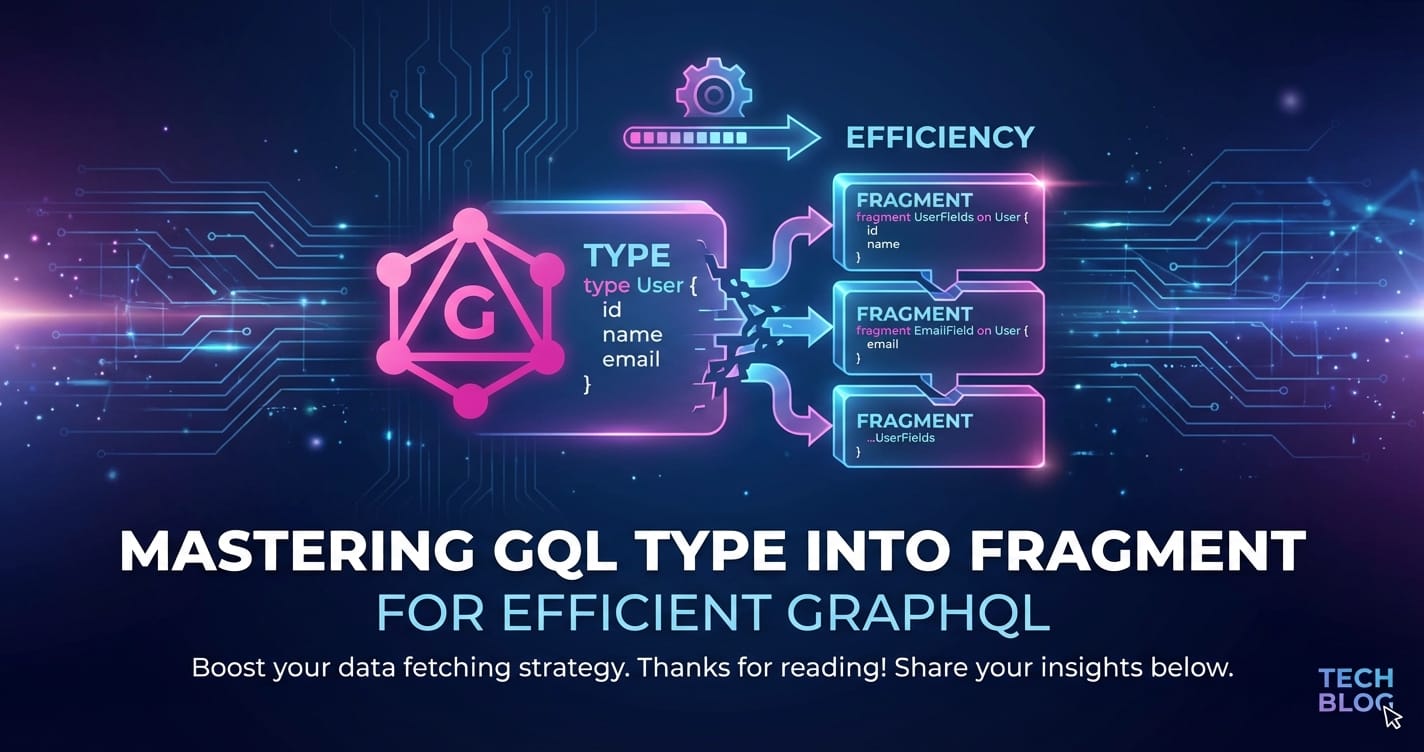
Mastering GQL Type Into Fragment for Efficient GraphQL



In the intricate landscape of modern web development, data management stands as a cornerstone, influencing everything from user experience to system scalability. As applications grow in complexity, the methods by which they fetch and interact with data become critical. Traditional RESTful APIs, while widely adopted, often present challenges such as over-fetching (receiving more data than needed) or under-fetching (requiring multiple requests for related data), leading to inefficient network utilization and increased client-side processing. Enter GraphQL, a powerful query language for APIs and a runtime for fulfilling those queries with your existing data. GraphQL offers a refreshing paradigm shift, allowing clients to precisely define the data they need, thereby mitigating the inherent inefficiencies of its predecessors.
However, the journey to truly optimized GraphQL operations extends beyond merely adopting the technology. Even with GraphQL's inherent advantages, naive or poorly structured queries can quickly become verbose, repetitive, and difficult to manage, particularly when dealing with intricate object types or shared data structures across different parts of an application. Imagine a scenario where multiple UI components, perhaps a user profile, a comment section, and an article author box, all need to display similar information about a User type – their ID, name, and profile picture. Without a structured approach, each component might independently define and fetch these fields, leading to redundant code, increased query length, and a higher probability of inconsistencies.
This is precisely where the elegance and power of GraphQL fragments come into play. Fragments are a fundamental feature designed to address these challenges, offering a mechanism to encapsulate reusable sets of fields. While fragments are valuable in their basic form, their true mastery lies in understanding and applying them in a type-specific manner – what we refer to as "GQL Type Into Fragment." This approach involves associating a fragment with a particular GraphQL type, ensuring that the encapsulated fields are consistently applied and valid within the context of that type. This not only dramatically improves query efficiency and readability but also significantly enhances the maintainability and scalability of your GraphQL client-side codebase. It transforms verbose, scattered data requests into clean, modular, and robust data components, laying the groundwork for more resilient and performant applications.
This comprehensive guide will embark on an in-depth exploration of GraphQL fragments, meticulously focusing on how they can be strategically designed and applied to specific types. We will uncover their syntax, delve into their sophisticated applications with interfaces and unions, and illuminate the myriad benefits they bring to the developer experience, code maintainability, and overall application performance. Furthermore, we will contextualize these advanced GraphQL techniques within the broader ecosystem of API management, discussing how a robust api gateway plays an indispensable role in securing, optimizing, and orchestrating the very APIs that leverage these efficient GraphQL queries. By the end of this journey, you will possess a profound understanding of how to wield type-specific fragments as a cornerstone for building highly efficient, scalable, and maintainable GraphQL-powered applications.
Understanding GraphQL Fundamentals: The Bedrock of Data Fetching
Before we delve into the intricacies of fragments, it's essential to solidify our understanding of GraphQL's foundational principles. GraphQL is not a database technology; rather, it's a query language for your API, offering a powerful and flexible way for clients to request data. At its core, GraphQL revolves around a strong type system that defines the capabilities of your API. This schema acts as a contract between the client and the server, outlining all available data and operations.
The GraphQL Schema: Your API's Blueprint
Every GraphQL API is built upon a schema, which is defined using the GraphQL Schema Definition Language (SDL). This schema dictates the types of data that can be queried, mutated, or subscribed to. Key components of the schema include:
- Object Types: These are the most fundamental building blocks of a GraphQL schema. They represent a kind of object you can fetch from your service, and they have a set of fields. For instance, a
Usertype might have fields likeid,name,email, andposts. - Scalar Types: These are the atomic units of data. GraphQL comes with built-in scalars like
Int,Float,String,Boolean, andID. Custom scalars can also be defined (e.g.,Date,JSON). - Enums: Enumerated types are special scalar types that are restricted to a particular set of allowed values. For example, a
UserRoleenum might haveADMIN,EDITOR,VIEWER. - Lists: Fields can return a list of a certain type, denoted by square brackets
[]. E.g.,[Post!]!means a non-nullable list of non-nullablePostobjects. - Non-Nullability: An exclamation mark
!denotes that a field or a list item cannot be null. - Interfaces: Interfaces are abstract types that define a set of fields that implementing object types must include. This is crucial for polymorphism, allowing you to query for shared fields across different types that implement the same interface. For example, a
Nodeinterface might have anidfield, and bothUserandProducttypes could implementNode. - Union Types: Union types are similar to interfaces but do not specify any common fields. Instead, they declare a set of object types that a field might return. For instance, a
SearchResultunion might return either aUseror aProduct. - Input Types: These are special object types used as arguments for mutations. They allow you to pass complex objects as input to your API.
Querying Data: Precision and Power
With the schema in place, clients can construct queries to fetch precisely the data they require. A basic GraphQL query specifies the root query type, followed by the fields the client wishes to retrieve. For example:
query GetUser {
  user(id: "123") {
    id
    name
    email
  }
}
This query asks for the user with a specific id and, from that user, only requests the id, name, and email fields. This granular control is a significant departure from traditional REST, where hitting a /users/123 endpoint might return a fixed, often extensive, set of user data, regardless of client needs.
Why Efficiency Matters: Beyond the Basics
The appeal of GraphQL lies in its ability to eliminate over-fetching and reduce the number of requests needed to compose a complete view of data. This directly translates to:
- Reduced Network Overhead: Less data traveling across the network means faster load times, especially for mobile users or those with limited bandwidth.
- Improved Client-Side Performance: Clients don't have to filter out unwanted data, simplifying their processing logic and potentially speeding up rendering.
- Lower Server Load: While clients specify the fields, the server still needs to resolve them. Efficient queries often lead to more straightforward server-side resolution, indirectly reducing server processing.
- Better Developer Experience: Developers can easily see what data is available and request exactly what they need, leading to more predictable data structures and fewer unexpected changes.
However, even with these inherent advantages, raw GraphQL queries can still become unwieldy. As applications grow, the same sets of fields might be requested repeatedly across various queries or even within different parts of a single complex query. This is where fragments become not just a convenience, but a necessity for truly mastering GraphQL and achieving peak efficiency and maintainability. It’s a crucial aspect of crafting a robust api experience, regardless of whether that api is consumed by a web client, a mobile app, or another backend service.
The Genesis of Fragments: Why We Need Them
To truly appreciate the utility of GraphQL fragments, it's insightful to first understand the challenges they solve. Imagine developing a complex application that displays information about various entities, such as users, products, and blog posts. Each of these entities might have common attributes that are displayed in multiple contexts – a user's name and avatar might appear in a profile page, a comment, and a list of authors. Without fragments, your GraphQL queries could quickly descend into a repetitive and unmanageable state.
Let's illustrate these pain points with a concrete example. Consider a User type in your GraphQL schema defined as follows:
type User {
  id: ID!
  username: String!
  email: String
  firstName: String
  lastName: String
  profilePictureUrl: String
  bio: String
  createdAt: String!
}
Now, imagine your application has three different components that display user information:
- User Card Component: Needs
id,username,profilePictureUrl. - Comment Author Component: Needs
id,username,profilePictureUrl. - User Profile Page: Needs
id,username,firstName,lastName,email,profilePictureUrl,bio.
Without fragments, your queries might look something like this:
Query 1 (for a list of users, perhaps for a follower list, using User Card Component):
query GetFollowers {
  followers {
    id
    username
    profilePictureUrl # Repeated fields
  }
}
Query 2 (for an article, fetching author details for Comment Author Component):
query GetArticle {
  article(id: "abc") {
    title
    content
    author {
      id
      username
      profilePictureUrl # Repeated fields
    }
  }
}
Query 3 (for the main user profile page):
query GetUserProfile {
  user(id: "xyz") {
    id
    username
    firstName
    lastName
    email
    profilePictureUrl
    bio
  }
}
Analyzing these queries reveals several glaring issues:
- Repetition and Verbosity: The fields
id,username, andprofilePictureUrlare duplicated acrossGetFollowersandGetArticlequeries. If you have many more components displaying similar user data, this repetition would proliferate, making queries excessively long and harder to read. This isn't just an aesthetic concern; verbose queries are more prone to errors and make it harder to discern the actual data requirements at a glance. - Maintainability Nightmares: What if your design team decides to change the
profilePictureUrlfield toavatarUrl? Or perhaps they want to add adisplayNamefield that combinesfirstNameandlastName? In the current setup, you would have to manually find and update every single query that fetches these user details. This process is tedious, error-prone, and scales poorly as your application and API evolve. Any small change could introduce inconsistencies or break parts of your UI, leading to significant development overhead and potential bugs. - Lack of Cohesion and Consistency: Related fields for a particular type, like the common fields for a
Userin a "card view," are scattered across different query definitions. This makes it difficult to have a single, canonical definition for a specific representation of a type. Consequently, different parts of your application might inadvertently fetch slightly different sets of fields for what is conceptually the "same" user information, leading to inconsistent UI states or increased data fetching due to over-fetching in some cases. - Developer Experience Degradation: Writing and managing such queries becomes a tedious chore. Developers spend more time copying and pasting field selections than focusing on the unique data requirements of their components. Debugging also becomes more challenging as the source of a particular field selection is not immediately clear.
These pain points collectively highlight a fundamental problem: GraphQL, while powerful, needs a mechanism to abstract and reuse field selections, especially for common data structures. This is precisely the problem that fragments are designed to solve.
Introducing Fragments: Reusable Query Components
Fragments are essentially reusable selections of fields. Think of them as partial queries or reusable components within your GraphQL query language. They allow you to define a set of fields once and then include that set wherever you need it. This dramatically reduces repetition, improves readability, and centralizes the definition of common data shapes.
The basic syntax for a fragment involves defining it outside of a specific operation (query, mutation, subscription) and associating it with a specific GraphQL type using the on keyword. This on TypeName clause is pivotal, as it ensures type safety and defines the context in which the fragment's fields are valid.
Let's revisit our User example and apply fragments:
First, we define a fragment for the common user fields needed for a "user card" view:
fragment UserCardFields on User {
  id
  username
  profilePictureUrl
}
Now, our previous queries can be drastically simplified by using this fragment:
Query 1 (for a list of users):
query GetFollowers {
  followers {
    ...UserCardFields # Reusing the fragment
  }
}
Query 2 (for an article's author):
query GetArticle {
  article(id: "abc") {
    title
    content
    author {
      ...UserCardFields # Reusing the fragment
    }
  }
}
Query 3 (for the main user profile page): We can even create a more comprehensive fragment for the user profile:
fragment UserProfileFields on User {
  id
  username
  firstName
  lastName
  email
  profilePictureUrl
  bio
}
And then use it:
query GetUserProfile {
  user(id: "xyz") {
    ...UserProfileFields
  }
}
In this simplified example, the benefits are already clear:
- Readability: Queries are much cleaner and more concise, clearly indicating that they are requesting "user card fields" or "user profile fields" rather than listing every individual field.
- Reusability: The
UserCardFieldsfragment is defined once and used twice, eliminating redundancy. If another component needs these fields, it simply includes the fragment. - Maintainability: If the definition of
UserCardFieldschanges (e.g., adding adisplayName), you only need to update the fragment definition in one place. All queries that use it will automatically reflect the change. This centralizes knowledge and reduces the risk of errors during modifications. - Consistency: By reusing fragments, you ensure that different parts of your application fetch a consistent set of fields for a particular concept, leading to more predictable data and UI behavior.
This introductory glimpse into fragments merely scratches the surface. The true power of "GQL Type Into Fragment" emerges when we combine these reusable field selections with GraphQL's advanced type features, such as interfaces and union types. This deeper integration allows for highly sophisticated and adaptable data fetching patterns, which are essential for building robust and scalable applications that interact with complex api ecosystems, often orchestrated by a powerful api gateway.
Deep Dive into GQL Type Into Fragment: Precision and Polymorphism
The concept of "GQL Type Into Fragment" is not merely about defining a fragment; it's about explicitly associating a fragment with a specific GraphQL type, leveraging the on TypeName clause. This association is what grants fragments their immense power in ensuring type safety, enabling polymorphism, and enhancing the overall clarity and maintainability of your GraphQL operations. It allows you to define exactly what data you expect when a certain type is encountered in your query's response.
Defining "Type Into Fragment"
At its core, "Type Into Fragment" means crafting a fragment whose field selection is specifically valid for a given GraphQL type. The syntax fragment FragmentName on TypeName { ...fields } is key here. The on TypeName part declares that this fragment can only be applied to objects of TypeName or any type that implements TypeName (if TypeName is an interface).
Why on TypeName is Crucial:
- Type Safety and Validation: The GraphQL server and client-side tools (like Apollo Client or Relay) use this
onclause to validate your queries. If you try to apply aUserFragmentto aProducttype, the client or server will immediately flag a validation error because the fields defined inUserFragmentare not valid for aProducttype. This prevents fetching incorrect or non-existent fields and ensures your queries align with your schema. - Introspection and Tooling: GraphQL's introspection capabilities allow development tools to understand the schema, including where fragments are applicable. This enables smart autocompletion, error checking, and better code generation experiences.
- Enabling Polymorphism: This is arguably the most powerful aspect. For fields that can return multiple possible types (interfaces or unions),
on TypeNameallows you to specify type-specific field selections, fetching different data based on the concrete type received at runtime.
Simple Type Fragments: The Foundation
Let's start with a straightforward example of a fragment defined for a concrete object type, Product.
# Schema snippet
type Product {
  id: ID!
  name: String!
  price: Float!
  description: String
  imageUrl: String
  category: Category
}

type Category {
  id: ID!
  name: String!
}
Now, a fragment for commonly displayed product information:
# product.fragment.js (or .graphql)
fragment ProductCardFields on Product {
  id
  name
  price
  imageUrl
}
Reusing in Queries:
query GetProductsForHomepage {
  products(limit: 10) {
    ...ProductCardFields
  }
}

query GetRecommendedProduct {
  recommendedProduct(userId: "u123") {
    ...ProductCardFields
  }
}
This simple application already demonstrates improved readability and maintainability. Any change to what constitutes a "product card" only needs to be made within ProductCardFields.
Reusing Fragments in Other Fragments:
Fragments can also compose other fragments, allowing for even more granular and modular data fetching. For example, if ProductCardFields also needed category information, and you had a CategoryFields fragment:
fragment CategoryFields on Category {
  id
  name
}

fragment ProductDetailFields on Product {
  ...ProductCardFields # Reusing a fragment
  description
  category {
    ...CategoryFields # Reusing another fragment
  }
}
Then, you could fetch product details including category:
query GetProductDetails(id: ID!) {
  product(id: $id) {
    ...ProductDetailFields
  }
}
This hierarchical composition of fragments creates a robust and highly organized way to manage complex data requirements, reflecting the component structure of your application.
Advanced Concepts: Inline Fragments and Polymorphic Types
The true power of "Type Into Fragment" becomes evident when dealing with GraphQL's polymorphic types: interfaces and union types. These types allow a field to return different concrete object types, and fragments provide the mechanism to conditionally select fields based on the actual type returned.
Inline Fragments: Conditional Field Selection
Sometimes, you need to conditionally select fields for a specific type directly within a query, without defining a separate, named fragment. This is where inline fragments come in. They follow a similar on TypeName syntax but are embedded directly within the selection set.
A common use case for inline fragments is to inspect the __typename field (a special GraphQL field that returns the name of the object's type) and fetch type-specific fields.
Example: Consider a SearchResult union type that can return either a User or a Post.
# Schema snippet
union SearchResult = User | Post

type User {
  id: ID!
  username: String!
  profilePictureUrl: String
}

type Post {
  id: ID!
  title: String!
  contentSnippet: String
}
To query a list of search results and fetch different fields based on whether an item is a User or a Post:
query GlobalSearch(query: String!) {
  search(query: $query) {
    __typename # Always useful to fetch __typename for polymorphic fields
    ... on User { # Inline fragment for User type
      id
      username
      profilePictureUrl
    }
    ... on Post { # Inline fragment for Post type
      id
      title
      contentSnippet
    }
  }
}
Here, ... on User and ... on Post are inline fragments. They instruct the GraphQL execution engine to include the specified fields only if the returned object is of the User or Post type, respectively. This allows for incredibly flexible and precise data fetching for polymorphic data structures.
Fragments on Interfaces and Union Types: The Heart of Polymorphism
This is where "GQL Type Into Fragment" truly shines. When you have a field that returns an interface or a union, you don't know the exact concrete type until runtime. Fragments provide a structured way to handle this uncertainty by allowing you to define different field sets for each possible concrete type.
Fragments on Interfaces: An interface defines a set of fields that any implementing type must include. For example, a Node interface might define an id field.
# Schema snippet
interface Node {
  id: ID!
}

type User implements Node {
  id: ID!
  username: String!
  email: String
}

type Product implements Node {
  id: ID!
  name: String!
  price: Float!
}
Now, you can define fragments that target the interface's common fields and then use inline fragments or separate named fragments to fetch type-specific fields.
fragment NodeId on Node {
  id
}

query GetSomeNodes {
  nodes { # 'nodes' could return a list of User or Product
    ...NodeId # Always fetch id, as it's common to all Nodes
    __typename # Important for client-side distinction
    ... on User { # Specific fields for User type
      username
      email
    }
    ... on Product { # Specific fields for Product type
      name
      price
    }
  }
}
Alternatively, you could define named fragments for the concrete types and then spread them:
fragment UserDetails on User {
  username
  email
}

fragment ProductDetails on Product {
  name
  price
}

query GetSomeNodesWithNamedFragments {
  nodes {
    id
    __typename
    ...UserDetails
    ...ProductDetails
  }
}
In this scenario, UserDetails and ProductDetails will only apply if the returned object is indeed a User or Product, respectively. GraphQL handles this conditional application seamlessly.
Fragments on Union Types: Union types declare that a field can return one of several distinct types, but unlike interfaces, they don't necessarily share common fields. The approach is similar to interfaces: use inline fragments or named fragments on the concrete types.
Let's reconsider the SearchResult union:
fragment UserSearchResultFields on User {
  id
  username
  profilePictureUrl
}

fragment PostSearchResultFields on Post {
  id
  title
  contentSnippet
}

query GlobalSearchWithNamedFragments(query: String!) {
  search(query: $query) {
    __typename
    ...UserSearchResultFields
    ...PostSearchResultFields
  }
}
This pattern is highly effective for building user interfaces where different components are responsible for rendering different types of data, all originating from a single polymorphic API field. The api gateway or gateway responsible for routing these GraphQL requests will simply pass the complete query to the GraphQL service, which then resolves the polymorphic types and their specific fields according to the fragment definitions.
Best Practices for Type-Specific Fragments
To maximize the benefits of "GQL Type Into Fragment," adhere to these best practices:
- Granularity and Cohesion:
- Small, Reusable Fragments: Create fragments that represent logical "units" of data often displayed together (e.g.,
UserAvatarFields,PostHeaderFields). These are highly reusable. - Contextual Fragments: Sometimes, a fragment might be slightly larger, encompassing all fields needed for a specific UI component (e.g.,
ProductDetailsPageFragment). These are less reusable but highly cohesive to a component's needs. - Avoid fragments that are too large (fetching unnecessary data) or too small (fragments for just one field, unless that field is complex and often reused).
- Small, Reusable Fragments: Create fragments that represent logical "units" of data often displayed together (e.g.,
- Naming Conventions:
- Use clear, descriptive names that indicate the type and purpose of the fragment.
- Examples:
UserCoreFields,ProductCardFragment,MediaItemThumbnailFragment,OrderLineItemFields. - Prefixing with the type (
User...,Product...) is a common and helpful practice. - In client-side frameworks like React with Apollo Client or Relay, it's a strong best practice to co-locate fragments with the UI components that use them.
- Instead of dumping all fragments into a single file, define a component's required data directly within (or alongside) its definition. This makes components self-contained, easy to understand, and simplifies maintenance. When a component moves or is deleted, its data requirements (fragments) move or are deleted with it.
- Avoiding Circular Dependencies: While fragments can compose other fragments, be mindful of circular dependencies (Fragment A includes B, B includes C, C includes A). Modern GraphQL clients and servers are usually smart enough to detect and handle these, but it can lead to confusion or unintended infinite recursion during development. Structure your fragments hierarchically to avoid such issues.
- Understanding Fragment Collocation vs. Global Fragments: For common utility fragments (e.g., a
PaginationFieldsfragment for any paginated list), a central fragments file might be acceptable. However, for most application-specific data, co-location is preferred. The balance depends on project size and team conventions.
Co-location in Client Applications:Example (React with Apollo Client): ```jsx // components/UserCard.js import React from 'react'; import { gql } from '@apollo/client';function UserCard({ user }) { return (
{user.username}
{user.bio}); }// Fragment co-located with the component that uses it UserCard.fragments = { user: gqlfragment UserCardFields on User { id username profilePictureUrl bio }, };export default UserCard; Then, in a parent component or query, you can spread this fragment:jsx // pages/HomePage.js import { useQuery, gql } from '@apollo/client'; import UserCard from '../components/UserCard';const GET_USERS = gqlquery GetHomePageUsers { users { ...UserCardFields } } ${UserCard.fragments.user} # Important: include the fragment definition;function HomePage() { const { loading, error, data } = useQuery(GET_USERS);if (loading) returnLoading...; if (error) returnError :(;return ({data.users.map(user => ())} ); }export default HomePage; ``` This pattern ensures that each component clearly declares its data dependencies, leading to a highly modular and maintainable codebase.
Mastering "GQL Type Into Fragment" empowers developers to write more expressive, robust, and efficient GraphQL queries. It moves beyond simply fetching data to intelligently describing the data shape required by various parts of an application, leading to a superior development experience and a more resilient application architecture. This capability is paramount when building systems that rely on complex api interactions, where clarity and efficiency directly impact performance and scalability, especially when these APIs are managed and exposed through a sophisticated api gateway.
APIPark is a high-performance AI gateway that allows you to securely access the most comprehensive LLM APIs globally on the APIPark platform, including OpenAI, Anthropic, Mistral, Llama2, Google Gemini, and more.Try APIPark now! 👇👇👇
Practical Applications and Benefits: Beyond the Syntax
The theoretical understanding of GQL fragments, particularly their type-specific application, truly comes to life when we examine their practical implications and the tangible benefits they deliver. Fragments are not just an elegant syntax; they are a strategic tool that profoundly impacts developer experience, code maintainability, and client-side performance. Moreover, their judicious use within GraphQL operations contributes to a more efficient overall API ecosystem, indirectly benefiting the infrastructure that manages these APIs, such as an api gateway.
Enhanced Developer Experience
- Readability and Conciseness: By abstracting repetitive field selections into named fragments, GraphQL queries become significantly shorter and easier to read. Instead of scanning a long list of fields, developers see meaningful fragment names (e.g.,
...UserCardFields), immediately grasping the intent of the data fetch. This clarity reduces cognitive load and makes it faster to understand what a query is doing. - Reduced Boilerplate: Developers spend less time writing identical field selections over and over again. This boilerplate reduction translates directly to more productive coding sessions, allowing focus to shift from mechanical repetition to solving unique application challenges.
- Faster Development Cycles: With a library of well-defined, reusable fragments, assembling new queries or adapting existing ones becomes a much quicker process. Components can easily declare their data dependencies by spreading existing fragments, accelerating the development of new features and iterative improvements. The ability to quickly integrate and manage these API calls is further enhanced by robust
apimanagement platforms.
Improved Maintainability
- Single Source of Truth (SSOT): Fragments enforce the Single Source of Truth principle for common data shapes. If the definition of a "user card" changes (e.g., adding a new field or renaming an existing one), you only need to update the
UserCardFieldsfragment in one location. All queries and components that use this fragment will automatically reflect the change, drastically reducing the risk of inconsistencies and errors. - Easier Refactoring: When components or data models evolve, refactoring becomes less daunting. Changes are localized within the fragment definition, minimizing the surface area for bugs and simplifying the testing process. This modularity is a cornerstone of scalable software development.
- Encourages Modularity: Fragments naturally lead to a more modular codebase. They encourage developers to think about data requirements in terms of reusable blocks, aligning well with component-based UI architectures. This modularity extends beyond just the query definition, often influencing how data models are thought about across the entire application.
Optimized Performance (Client-Side)
While fragments are primarily a client-side query structuring tool, they offer significant benefits that impact performance, especially when integrated with sophisticated GraphQL client libraries like Apollo Client or Relay.
- Efficient Client-Side Caching: Modern GraphQL clients leverage fragments heavily for their caching and normalization strategies. When a query fetches data that includes fragments, the client can use these fragments to identify and store data for specific entities in its normalized cache. For example, if
UserCardFieldsis used in multiple places, the client's cache understands that any data matchingUserCardFieldspertains to aUserentity, allowing it to efficiently update or retrieve that data without refetching.- Data Consistency: By ensuring that all parts of the UI consuming the same fragment get data from the same normalized cache entry, fragments help maintain data consistency across the application. If a user's
profilePictureUrlchanges, all components usingUserCardFieldswill automatically reflect the update without needing explicit refresh logic. - Reduced Network Requests (Intelligent Refetches): With a well-normalized cache powered by fragments, the client can often determine if it already has all the necessary data for a query. This can lead to fewer unnecessary network requests, especially for components that share common data.
- Data Consistency: By ensuring that all parts of the UI consuming the same fragment get data from the same normalized cache entry, fragments help maintain data consistency across the application. If a user's
Integration with API Gateway and API Ecosystems
The efficiency gained from mastering GQL Type Into Fragment at the query level is a crucial ingredient for building high-performing applications. However, these applications don't exist in a vacuum. They operate within a broader api ecosystem, where services interact, data flows, and security is paramount. This is where an api gateway becomes an indispensable component, acting as the single entry point for all API requests, including those powered by GraphQL.
A robust api gateway serves multiple critical functions:
- Security Enforcement: It acts as the first line of defense, handling authentication, authorization, and rate limiting for all incoming
apirequests. This offloads security concerns from individual services, allowing them to focus on business logic. - Traffic Management: An
api gatewaymanages traffic routing, load balancing across multiple service instances, and API versioning. It ensures that requests are efficiently directed to the correct backend service, even in complex microservices architectures. - Observability: Gateways provide centralized logging, monitoring, and analytics for all API traffic. This is vital for understanding
apiusage, identifying performance bottlenecks, and troubleshooting issues. - Protocol Translation: While GraphQL offers a unified query language, many organizations still operate a mix of REST and GraphQL APIs. An advanced
api gatewaycan facilitate the management and exposure of both, providing a consistent interface to consumers.
Consider a platform like APIPark. As an open-source AI gateway and API management platform, APIPark plays a pivotal role in harmonizing the exposure and consumption of various api services, including those built with GraphQL. It provides a unified management system for authentication and cost tracking across a diverse set of APIs. For developers building applications that leverage the efficiency of GQL fragments, APIPark ensures that these optimized GraphQL queries are delivered through a secure, performant, and well-managed channel.
Specifically, APIPark’s capabilities complement the benefits of efficient GraphQL queries:
- Unified API Management: Whether you're integrating GraphQL APIs for complex data fetching or REST APIs for traditional resource management, APIPark provides a central
gatewayfor their lifecycle management. This means designing, publishing, invoking, and decommissioning APIs are all regulated through one platform. This is especially valuable in environments where GraphQL services might coexist with otherapitypes, ensuring a consistent governance model. - Performance at Scale: With its high-performance architecture, APIPark can handle substantial API traffic, achieving over 20,000 TPS on modest hardware. This ensures that even highly optimized GraphQL queries, which might be numerous and varied, are processed and routed efficiently without becoming a bottleneck at the
gatewaylevel. - Detailed Logging and Analytics: APIPark offers comprehensive logging and data analysis for every
apicall. This is invaluable for understanding how GraphQL queries are being used, identifying frequently accessed fragments, and detecting any performance degradation, providing insights that can inform further optimization efforts at both the client-side (fragment optimization) and server-side (resolver optimization) of your GraphQL API. - Seamless Integration: By standardizing API invocation and offering features like prompt encapsulation into REST API for AI models, APIPark makes it easier to integrate GraphQL services alongside other sophisticated services. This contributes to a cohesive
apilandscape where different technologies are managed under a single, powerfulgateway.
The synergy between mastering GQL Type Into Fragment and utilizing a robust api gateway like APIPark is clear. Efficient GraphQL queries ensure that clients request only what they need, reducing internal GraphQL service load, while the api gateway ensures that these client requests are securely and performantly delivered to the backend, and that the api lifecycle is managed end-to-end. This holistic approach is essential for building scalable, secure, and maintainable applications in today's data-intensive environment.
Here's a comparison illustrating the impact of fragments on query development:
| Feature/Aspect | GraphQL Query Without Fragments | GraphQL Query With Fragments (Type-Specific) |
|---|---|---|
| Readability | Low, especially for complex types; repetitive field lists. | High; clear, concise, and semantically grouped data requirements. |
| Maintainability | Poor; changes require updates in multiple query locations. | Excellent; single source of truth for field selections. |
| Reusability | None; field selections must be re-written or copied. | High; fragments are reusable building blocks across operations. |
| Type Safety | Implicit; manual checks for field validity. | Explicit; on TypeName provides compile-time validation. |
| Polymorphic Handling | Complex; requires verbose inline field checks (e.g., using __typename for conditional selection). |
Elegant; on TypeName and inline fragments naturally handle conditional data fetching for interfaces/unions. |
| Client Caching (e.g., Apollo) | Less efficient; potential for redundant data in cache or inconsistencies. | Highly efficient; normalized cache based on fragment definitions, leading to better consistency. |
| Development Speed | Slower; more copy-pasting, higher risk of errors. | Faster; quicker assembly of queries, less repetitive work. |
| Code Footprint | Larger due to repetition. | Smaller, more modular due to reuse. |
This table clearly highlights why integrating fragments, particularly in a type-specific manner, is not just a stylistic choice but a critical architectural decision for any serious GraphQL implementation.
Common Pitfalls and How to Avoid Them
While GQL fragments offer immense power and elegance, their misuse or misunderstanding can lead to new forms of complexity. Being aware of common pitfalls and knowing how to navigate them is key to truly mastering fragments and leveraging them for efficient GraphQL api operations.
1. Over-fragmentation: The "Too Many Small Pieces" Problem
Pitfall: Creating fragments for every single field or extremely small groups of fields can sometimes introduce more overhead than benefit. If a fragment is only ever used once, or if it consists of just one or two basic fields, its abstraction might not be worthwhile, making the query harder to follow by forcing navigation between many tiny fragments.
How to Avoid: * Balance Reusability with Simplicity: Strive for fragments that represent a logical, reusable chunk of data, typically aligning with a UI component's data needs (e.g., a user's avatar and name, or a product's price and availability status). * "Rule of Three" (or similar heuristic): If you find yourself writing the same set of fields three or more times, it's a strong candidate for a fragment. If it's only once or twice, an inline selection might be clearer. * Consider Context: Sometimes a fragment is useful even if only used once, especially if it encapsulates a complex, nested selection that might otherwise clutter a query.
2. Fragment Sprawl: The Unruly Fragment Collection
Pitfall: Defining fragments globally in a single, monolithic file (e.g., all_fragments.graphql) can lead to "fragment sprawl." As your application grows, this file becomes unwieldy, making it difficult to find, understand, and manage fragments. It also makes it hard to identify which fragments are still in use and which are obsolete, leading to unnecessary bundle size increases if unused fragments are still included.
How to Avoid: * Co-location (as discussed): This is the most effective strategy. Place fragments directly alongside the UI components that consume them. This makes components self-contained and improves discoverability and maintainability. When a component is removed, its associated fragment is removed with it. * Feature-Based Grouping: For fragments that are shared across multiple components within a specific feature area, group them logically within that feature's directory (e.g., features/users/fragments.graphql). * Dedicated Utility Fragment Files (Sparsely): Reserve a centralized fragments file only for truly generic, application-wide utility fragments that have no direct component association (e.g., a common NodeFields fragment for an interface, or PaginationMetadataFields).
3. Ignoring __typename for Polymorphic Fields
Pitfall: When querying fields that can return an interface or a union type, neglecting to include the __typename field within your selection set (especially within inline fragments) can lead to difficulties on the client side. Without __typename, the client-side code won't easily know which concrete type was returned, making it challenging to correctly render the type-specific data.
How to Avoid: * Always Fetch __typename: For any field that returns an interface or a union, make it a habit to include __typename in your selection. This allows client-side logic to correctly discriminate between types and apply appropriate rendering or data processing. * Client Library Guidance: Modern GraphQL client libraries like Apollo Client and Relay often rely heavily on __typename for their caching and normalization mechanisms. Not including it can disrupt these crucial features.
4. Misunderstanding on TypeName
Pitfall: Attempting to apply a fragment to a type for which its fields are not valid. For example, applying ProductFields to a User object. While GraphQL validation will catch this at compile time (or at least before execution), it indicates a fundamental misunderstanding of fragment type context.
How to Avoid: * Always Be Explicit: Clearly understand the type (TypeName) specified in fragment FragmentName on TypeName { ... }. The fields within the fragment must be valid fields of that TypeName. * Leverage Schema Tools: Use GraphQL schema explorers, IDE extensions, or client-side type generation tools. These tools provide autocompletion and validation based on your schema, making it much harder to make such mistakes. * Think Top-Down: When defining a fragment, consider its intended use. What specific type is it enhancing or abstracting data for?
5. Performance Considerations with Deeply Nested Fragments
Pitfall: While fragments improve query structure, they don't fundamentally change the underlying query's depth or complexity. A client query that uses many fragments and ends up requesting a deeply nested graph of data can still lead to performance issues on the server side, as resolvers might trigger many database calls or expensive computations.
How to Avoid: * Fragments are Client-Side Tools: Remember that fragments primarily optimize the client-side declaration and consumption of data. They don't magically make server-side resolution faster. * Monitor Server-Side Performance: Use api gateway monitoring tools (like APIPark's detailed call logging and data analysis) and server-side GraphQL tracing/monitoring to identify slow resolvers or overly complex data fetches. * Limit Query Depth: Encourage best practices for limiting query depth in your schema or through api gateway policies if necessary. * Batching and Caching on Server: Implement data loader patterns, query batching, and server-side caching mechanisms to optimize resolver performance, irrespective of client-side fragment usage. * Educate Teams: Ensure all developers understand the server-side implications of client-side data requests.
By being mindful of these common pitfalls and actively implementing the recommended strategies, you can harness the full potential of GQL Type Into Fragment, building not just aesthetically pleasing but also robust, performant, and maintainable GraphQL applications. This vigilance, combined with a powerful api gateway for overall api lifecycle management, forms a comprehensive strategy for efficient and reliable data interactions in any modern software ecosystem.
Conclusion
The journey through the landscape of GQL Type Into Fragment reveals a powerful and indispensable feature for anyone building scalable and maintainable GraphQL applications. We've seen how fragments move beyond mere syntactic sugar, becoming a cornerstone of efficient data fetching by addressing the inherent challenges of repetition, verbosity, and maintainability in complex queries. By explicitly associating fragments with specific GraphQL types using the on TypeName clause, developers gain unparalleled control over type safety, enabling sophisticated polymorphic data selection and ensuring consistency across their applications.
Mastering fragments, particularly in their type-specific application, translates directly into tangible benefits across the entire development lifecycle:
- Elevated Developer Experience: Queries become intuitive, readable, and concise, freeing developers to focus on application logic rather than repetitive data declarations.
- Unrivaled Maintainability: The Single Source of Truth principle, enforced by fragments, drastically reduces the effort and risk associated with evolving data models, making refactoring a streamlined process.
- Optimized Client-Side Performance: Through intelligent caching and data normalization facilitated by modern GraphQL clients, fragments contribute to faster load times, reduced network traffic, and consistent UI states.
Furthermore, we've emphasized that the efficiency gained at the GraphQL query layer is most effective when integrated into a robust api ecosystem. The role of an api gateway is paramount in this regard, acting as the critical orchestration layer for all api traffic. Platforms like APIPark exemplify how a sophisticated api gateway can complement efficient GraphQL queries by providing essential security, performance management, traffic control, and end-to-end API lifecycle governance. By combining a finely tuned GraphQL client-server interaction with a high-performance gateway, organizations can achieve a holistic solution for managing, securing, and optimizing their entire api portfolio.
In essence, mastering GQL Type Into Fragment is not merely about understanding a syntax; it's about adopting a mindset of modularity, precision, and efficiency in your data interactions. It’s a key step towards building resilient, high-performing applications that can gracefully handle the ever-increasing complexity of modern data landscapes. By embracing these techniques and integrating them within a well-managed api gateway environment, you empower your teams to construct truly scalable and future-proof digital experiences.
Frequently Asked Questions (FAQ)
1. What is a GraphQL fragment?
A GraphQL fragment is a reusable selection of fields that can be included in multiple queries, mutations, or other fragments. It allows you to define a common set of fields for a specific type once and then spread (...FragmentName) that selection wherever it's needed, reducing repetition and improving query readability and maintainability.
2. How do fragments improve GraphQL query performance?
Fragments primarily improve performance indirectly by enhancing client-side caching and reducing network overhead through precise data fetching. By defining consistent data shapes for types, fragments help GraphQL client libraries (like Apollo Client) normalize their cache, leading to fewer redundant network requests, faster data retrieval from the cache, and consistent data across your UI components. They don't inherently make the server-side resolution faster but enable clients to make more efficient requests.
3. What is the difference between an inline fragment and a named fragment?
- Named Fragments: Are defined separately with a
fragment FragmentName on TypeName { ...fields }syntax and can be reused by spreading them in multiple operations or other fragments. They are ideal for commonly used, reusable sets of fields. - Inline Fragments: Are defined directly within a query or selection set using
... on TypeName { ...fields }. They are typically used for conditional field selection when dealing with interfaces or union types, allowing you to fetch specific fields only if the returned object matches a certain type, without needing to declare a separate named fragment.
4. Can fragments be used with interfaces and union types?
Yes, and this is one of their most powerful applications! When a field can return an interface or a union type (meaning it can be one of several possible concrete types), fragments, especially inline fragments (... on TypeName { ... }), allow you to specify type-specific field selections. You can fetch common fields for the interface/union and then include additional, specific fields for each potential concrete type that might be returned. It is also good practice to always request __typename for polymorphic fields to help clients differentiate between the returned types.
5. Why is an API Gateway important when using GraphQL APIs?
An api gateway serves as a crucial single entry point for all API requests, including those for GraphQL APIs. It provides essential infrastructure services that enhance the security, performance, and management of your API ecosystem. For GraphQL, an api gateway can handle authentication, authorization, rate limiting, traffic routing, load balancing, and comprehensive logging/analytics. This offloads these cross-cutting concerns from your GraphQL services, allowing them to focus purely on data resolution, while ensuring that your efficient GraphQL queries are securely and reliably delivered and managed end-to-end. Platforms like APIPark offer comprehensive api gateway and management features that are highly beneficial for integrating and operating GraphQL services alongside other API types.
🚀You can securely and efficiently call the OpenAI API on APIPark in just two steps:
Step 1: Deploy the APIPark AI gateway in 5 minutes.
APIPark is developed based on Golang, offering strong product performance and low development and maintenance costs. You can deploy APIPark with a single command line.
curl -sSO https://download.apipark.com/install/quick-start.sh; bash quick-start.sh

In my experience, you can see the successful deployment interface within 5 to 10 minutes. Then, you can log in to APIPark using your account.

Step 2: Call the OpenAI API.