Mastering GQL Type into Fragment for Efficient GraphQL
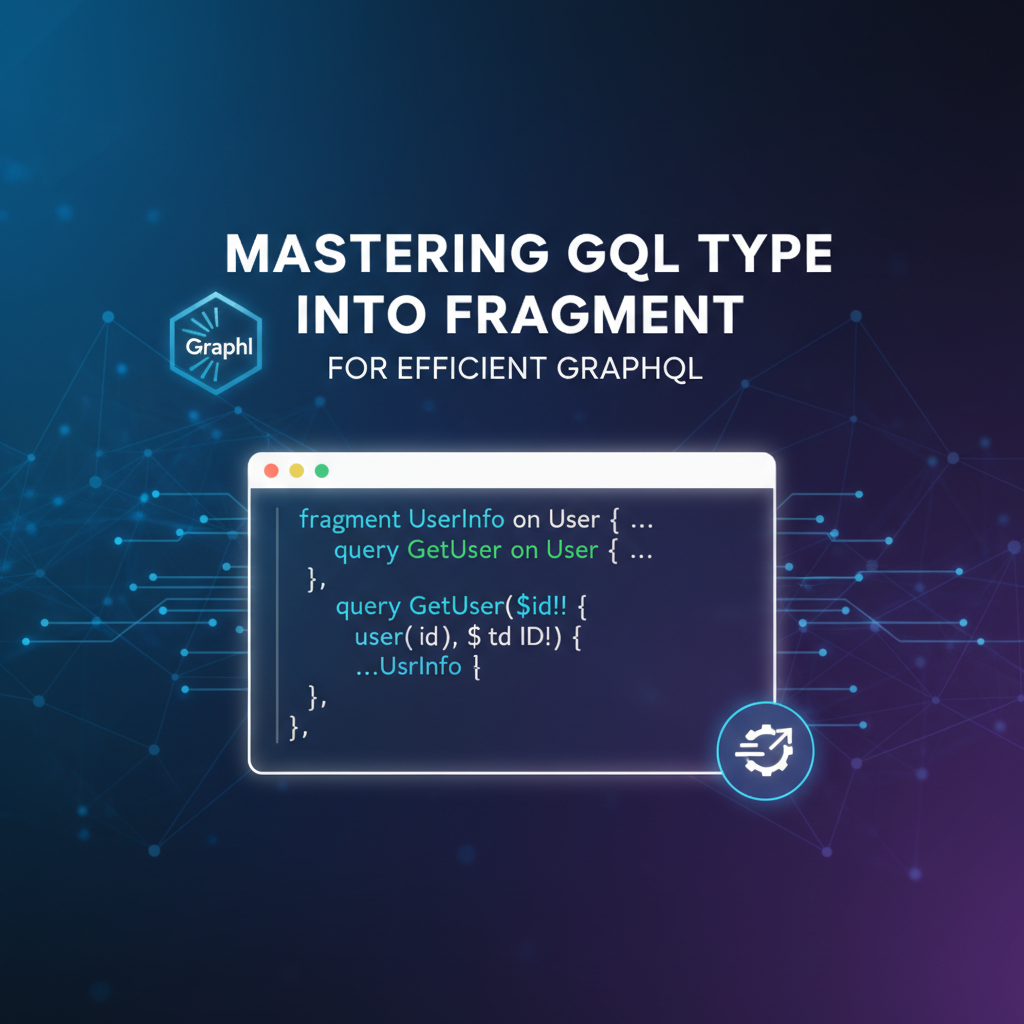


In the rapidly evolving landscape of modern web development, the efficiency with which applications fetch and consume data stands as a paramount concern. From optimizing user experience to minimizing server load and bandwidth usage, every byte transferred and every query executed contributes to the overall performance and cost-effectiveness of a system. For years, traditional REST APIs served as the backbone of data interaction, but their inherent limitations—such as over-fetching (receiving more data than needed) and under-fetching (requiring multiple requests for related data)—often introduced inefficiencies and complexity. These challenges became particularly pronounced as applications grew in scale and their data requirements became increasingly intricate and dynamic.
Enter GraphQL, a revolutionary query language for APIs, offering a powerful paradigm shift by empowering clients to explicitly define the precise data they need. Unlike REST, where the server dictates the shape of the response, GraphQL puts the client in the driver's seat, enabling a single, flexible endpoint to serve diverse data requirements. This fundamental shift not only streamlines data fetching but also significantly enhances the developer experience by providing a strongly typed schema that acts as a contract between client and server. However, merely adopting GraphQL is not a silver bullet; its true power is unlocked through the masterful application of its core features, particularly GQL Types and Fragments.
This comprehensive article embarks on a deep dive into mastering the symbiotic relationship between GQL Types and Fragments. We will explore how these foundational concepts, when artfully combined, can transform your GraphQL queries from merely functional to exceptionally efficient, maintainable, and scalable. From understanding the nuances of different GQL Types that define the very fabric of your data graph to harnessing the reusability and clarity offered by Fragments, we will illuminate the path to constructing highly optimized data requests. Furthermore, we will contextualize this GraphQL-specific efficiency within the broader enterprise api ecosystem, discussing how robust api gateway solutions complement and enhance the performance gains achieved at the query level, ensuring an end-to-end optimized api management strategy. By the end of this exploration, you will possess a profound understanding of how to leverage GQL Types and Fragments to build high-performance GraphQL applications that meet the demands of today's complex digital world.
Understanding GraphQL Fundamentals: The Blueprint for Modern Data Interaction
Before delving into the intricate dance between GQL Types and Fragments, it's crucial to establish a solid understanding of GraphQL's foundational principles. GraphQL is more than just a query language; it's a server-side runtime for executing queries using a type system you define for your data. This architecture fundamentally alters the way client applications interact with backend services, moving away from a rigid, resource-centric approach to a flexible, data-centric model.
At its core, GraphQL operates on a single HTTP endpoint, typically /graphql. Instead of clients making requests to various distinct endpoints for different resources (e.g., /users, /products/123), all data requests are routed through this single endpoint. The client then sends a query document—a string describing the data requirements—to the server. The server, armed with its predefined schema, processes this query, fetches the requested data from underlying data sources (databases, microservices, external apis, etc.), and returns a JSON response that precisely mirrors the structure of the client's query. This precise data fetching capability is one of GraphQL's most compelling advantages, eliminating the need for over-fetching or multiple round-trips often associated with REST.
The central pillar of any GraphQL service is its Schema. The schema acts as a contract between the client and the server, meticulously defining all the data that a client can request and all the operations (queries, mutations, subscriptions) that can be performed. It is written using GraphQL's Schema Definition Language (SDL), a human-readable and language-agnostic syntax. This schema is critical not only for guiding data fetching but also for enabling powerful tooling, such as auto-completion, validation, and client-side code generation, significantly enhancing developer productivity and reducing errors.
Within the schema, every piece of data and every operation is defined by a Type. GraphQL is a strongly typed system, meaning that every field on a type must have a well-defined type. This strong typing provides a robust guarantee about the shape of the data, which is immensely beneficial for both client-side and server-side development. Clients know exactly what to expect, and servers can ensure that data adheres to the defined structure. This foundational understanding of GraphQL's schema and its type system is the bedrock upon which we can build highly efficient and maintainable applications using fragments. Without a clear and well-structured schema defined by robust GQL Types, fragments would lack the precise context they need to deliver their full potential.
Deep Dive into GQL Types: The Structural Foundation of Your Data Graph
The robustness and flexibility of a GraphQL API are directly proportional to the clarity and expressiveness of its GQL Types. These types are the fundamental building blocks that dictate the shape, relationships, and behavior of the data your api exposes. Understanding each type category is paramount to designing an efficient and intuitive GraphQL schema that perfectly aligns with your application's data needs.
Scalar Types
At the most granular level, GraphQL provides a set of Scalar Types that represent primitive data values. These are the leaves of your data graph, incapable of having sub-fields. GraphQL's built-in scalars are:
Int: A signed 32-bit integer. Ideal for quantities, identifiers, and counts where whole numbers are sufficient.Float: A signed double-precision floating-point value. Used for numbers requiring decimal points, such as prices, temperatures, or geographic coordinates.String: A UTF-8 character sequence. The most versatile scalar, used for names, descriptions, URLs, and any textual data.Boolean:trueorfalse. Essential for flags, toggles, and binary states.ID: A unique identifier, often serialized as aString. While functionally aString,IDsignals to clients and tools that this field represents a unique object identifier, which can be optimized for caching or lookup operations.
Beyond these intrinsic types, GraphQL allows for Custom Scalar Types, enabling developers to define their own scalar behaviors, such as Date, DateTime, Email, or JSON. These custom scalars provide a powerful mechanism to enforce specific data formats and behaviors at the schema level, enhancing data integrity and self-documentation. For instance, a Date scalar could ensure that all date values are consistently formatted, regardless of the underlying database storage.
Object Types
Object Types are the most common and fundamental type in a GraphQL schema, representing a collection of fields. They are the core building blocks that define the types of objects you can fetch from your service and what data they contain. Each field on an object type has a name and a type, which can be another object type, a scalar, an interface, or a union.
Consider a simple User object type:
type User {
  id: ID!
  name: String!
  email: String
  posts: [Post!]!
}
Here: * User is an object type. * id, name, email, and posts are its fields. * ID!, String!, String, and [Post!]! are the types of these fields. The ! suffix denotes a non-nullable field, meaning it must always return a value. If a field is not marked with !, it is nullable, and the server might return null for it. * [Post!]! indicates a non-nullable list of non-nullable Post objects, signifying that a user always has a list of posts, and each post in that list will always be a valid Post object.
Object types are crucial for modeling real-world entities and establishing relationships between them, forming the nodes in your data graph. A well-designed object type clearly communicates the available data attributes and their relationships, laying the groundwork for precise data fetching by the client.
Interface Types
Interface Types in GraphQL provide a powerful mechanism for polymorphism, allowing different object types to share a common set of fields. An interface defines a contract: any object type that implements an interface must include all the fields defined by that interface, with compatible types.
For example, imagine an Animal interface:
interface Animal {
  name: String!
  species: String!
}

type Dog implements Animal {
  name: String!
  species: String!
  breed: String
}

type Cat implements Animal {
  name: String!
  species: String!
  livesLeft: Int
}
Here, both Dog and Cat implement Animal, guaranteeing they both have name and species fields. When you query for an Animal, you can request name and species directly. If you need fields specific to Dog or Cat, you would use inline fragments (which we will discuss shortly) to conditionally select those fields. Interfaces are invaluable when you need to query for objects that might be of different concrete types but share common characteristics, providing a flexible and type-safe way to handle such scenarios.
Union Types
Similar to interfaces, Union Types also enable polymorphism, but with a key distinction: they allow a field to return one of several object types without requiring those types to share any common fields. A union specifies a set of object types it might represent.
Consider a SearchResult union:
union SearchResult = Book | Author | Article

type Book {
  title: String!
  isbn: String!
}

type Author {
  name: String!
  bio: String
}

type Article {
  headline: String!
  url: String!
}
A field of type SearchResult could return a Book, an Author, or an Article. When querying a union type, you must use inline fragments to specify which fields to fetch for each possible concrete type, as there are no guaranteed common fields. Union types are particularly useful for scenarios like search results, where a single query might yield various distinct data structures that don't logically share fields but are grouped semantically.
Input Object Types
Input Object Types are special object types used exclusively as arguments for fields, most commonly in mutations. They allow you to define complex, structured data that a client can send to the server as input. This is immensely valuable for mutations that require multiple pieces of data to create or update an entity, providing a clear, type-safe, and self-documenting way to structure input arguments.
Instead of passing many individual scalar arguments to a mutation, an input object encapsulates related data:
input CreateUserInput {
  name: String!
  email: String!
  password: String!
}

type Mutation {
  createUser(input: CreateUserInput!): User!
}
Using CreateUserInput makes the createUser mutation's signature cleaner, easier to understand, and prevents an explosion of arguments. It also allows for easier validation and extensibility of input data.
Enum Types
Enum Types (enumerations) are a special kind of scalar that restricts a field's possible values to a predefined, finite set of choices. They provide a type-safe way to represent specific sets of allowed values, making your schema more self-documenting and preventing invalid input.
For example:
enum UserRole {
  ADMIN
  EDITOR
  VIEWER
}

type User {
  id: ID!
  name: String!
  role: UserRole!
}
Here, the role field on a User can only be ADMIN, EDITOR, or VIEWER. This ensures data consistency and improves readability for both clients and server implementers.
By carefully selecting and designing these GQL Types, developers lay down the robust structural foundation of their GraphQL api. This foundation is not merely about defining data; it's about establishing clear contracts, enabling powerful tooling, and, crucially, setting the stage for the unparalleled efficiency gains that can be achieved through the intelligent use of Fragments.
The Power of Fragments in GraphQL: Reusability and Precision
While GQL Types establish the structure and contract of your data, Fragments are the indispensable tools that allow you to interact with that structure in an efficient, maintainable, and highly reusable manner. Fragments address the critical need to define sets of fields once and reuse them across multiple queries or even within different parts of a single complex query. They are the epitome of the "Don't Repeat Yourself" (DRY) principle in GraphQL, transforming repetitive, verbose queries into lean, modular, and easy-to-manage data requests.
What are Fragments?
In essence, a GraphQL Fragment is a reusable unit of selection logic. It allows you to specify a collection of fields that you want to fetch for a particular type, encapsulate them, and then "spread" them into any query or mutation that operates on that type.
The syntax for defining a fragment is straightforward:
fragment UserDetails on User {
  id
  name
  email
  avatarUrl
}
Here, UserDetails is the name of the fragment, and on User specifies that this fragment applies to the User object type. Inside the curly braces, we define the specific fields we want to select (id, name, email, avatarUrl).
To use this fragment within a query, you simply use the spread operator (...):
query GetUserProfile($userId: ID!) {
  user(id: $userId) {
    ...UserDetails
    createdAt
    updatedAt
  }
}

query GetTeamMembers {
  teamMembers {
    ...UserDetails
    role
  }
}
In these examples, the ...UserDetails syntax tells the GraphQL engine to "spread" all the fields defined in the UserDetails fragment onto the user or teamMembers field, which are both of type User (or a list of Users). This effectively inserts id, name, email, and avatarUrl into both queries, ensuring consistency and reducing redundancy.
Why Use Fragments? The Benefits Unveiled
The strategic adoption of fragments yields a multitude of benefits that profoundly impact the development, performance, and maintenance of GraphQL applications:
- DRY (Don't Repeat Yourself): This is the most immediate and perhaps most impactful benefit. Instead of copying and pasting the same set of fields across numerous queries, you define them once in a fragment. This dramatically reduces boilerplate code and prevents errors that arise from inconsistent field selections.
- Enhanced Maintainability: When the data shape of a GQL Type changes (e.g., adding a new field or renaming an existing one), you only need to update the fragment definition in one place. All queries that spread that fragment automatically inherit the changes, simplifying refactoring and minimizing the risk of breaking client applications.
- Improved Readability and Organization: Complex queries can quickly become unwieldy with many nested fields. Fragments allow you to break down large queries into smaller, more semantic, and manageable units. This modularity makes queries easier to read, understand, and debug, improving overall code clarity.
- Consistency Across the Application: Fragments enforce a consistent data fetching strategy for specific components or entities. If your
UserProfileCardcomponent always needs the sameid,name,email, andavatarUrl, defining a fragment for this ensures that every instance of that component, regardless of where it's used in the application, fetches precisely that data. This is crucial for predictableapiconsumption and client-side caching. - Co-location of Data Requirements: Fragments facilitate a powerful pattern known as fragment collocation. This involves defining a fragment alongside the UI component that consumes its data. For example, a React component
UserProfileCardwould have aUserProfileCard_userfragment defined right next to it. This makes the component's data dependencies explicit and self-contained, greatly improving modularity and reusability. - Optimized Client-Side Caching: GraphQL clients like Apollo Client and Relay extensively leverage fragments for their normalized caching mechanisms. By consistently fetching data shapes defined by fragments, the cache can more effectively identify, store, and update data, leading to fewer network requests and faster UI updates.
Inline Fragments: Handling Polymorphic Data
While standard fragments are ideal for reusing fields on a single, known type, Inline Fragments are specifically designed to handle polymorphic data returned by Interface Types and Union Types. As discussed in the GQL Types section, when a field can return one of several possible object types (e.g., a SearchResult union can be a Book, Author, or Article), you need a way to conditionally request fields that are specific to each concrete type.
The syntax for an inline fragment is similar to a regular fragment but is embedded directly within a query selection set and begins with ... on TypeName:
query GetSearchResults($query: String!) {
  search(query: $query) {
    __typename # Always good to request __typename with polymorphic types
    ... on Book {
      title
      isbn
      author {
        name
      }
    }
    ... on Author {
      name
      bio
      booksWritten {
        title
      }
    }
    ... on Article {
      headline
      url
      publishedDate
    }
  }
}
In this example, the search field returns a SearchResult union. * The __typename field (a special GraphQL introspection field) tells the client the actual concrete type of the object returned at runtime (e.g., "Book", "Author", "Article"). * ... on Book { ... } specifies that if the search result is a Book, then fetch its title, isbn, and the name of its author. * Similarly for Author and Article, specific fields are requested only if the returned object matches that particular type.
Inline fragments are indispensable for building flexible UIs that can render different components or display different data based on the dynamic type of the object received. They allow for precise data fetching even when the exact type is unknown until runtime, perfectly marrying the power of GQL polymorphic types with efficient data selection.
By embracing fragments, developers move beyond simply querying for data; they begin to architect their data fetching logic in a modular, robust, and highly efficient manner, paving the way for scalable and maintainable GraphQL applications.
Mastering "GQL Type into Fragment" for Unparalleled Efficiency
The true mastery of GraphQL's efficiency lies not in understanding GQL Types and Fragments in isolation, but in recognizing and harnessing their synergistic relationship. "GQL Type into Fragment" represents the strategic approach where the well-defined contracts provided by your schema's types directly inform and enable the creation of highly efficient, reusable, and self-documenting fragments. This powerful combination is the cornerstone of building scalable and performant GraphQL applications.
The Symbiotic Relationship: Types as the Canvas, Fragments as the Brushstrokes
Think of your GraphQL schema, composed of various GQL Types, as the comprehensive blueprint or the entire canvas of your data graph. It meticulously defines every possible piece of data and its relationships. Fragments, then, become the precise brushstrokes that selectively paint portions of this canvas, always respecting the underlying structure and constraints imposed by the types.
A fragment is inherently tied to a GQL Type; it declares on TypeName, signifying that it is designed to select fields belonging to that specific type. This explicit linkage ensures that fragments are type-safe and only request fields that genuinely exist on the target type, preventing runtime errors and making your data requests predictable.
Let's explore several scenarios where this symbiosis drives significant efficiency and architectural benefits:
Scenario 1: Reusing UI Components with Co-located Fragments
One of the most powerful applications of "GQL Type into Fragment" is in supporting reusable UI components. Modern frontend frameworks thrive on component-based architectures, and each component often has a specific data requirement.
Imagine an application with various places where user information is displayed: a UserProfileCard on a dashboard, a CommentAuthorBadge next to a comment, and a FriendListItem in a social feed. Each of these components might need a slightly different, but often overlapping, set of user-related fields.
Instead of writing a custom query for each instance, we define a fragment based on the User GQL Type that encapsulates the data needs of a particular component:
# UserProfileCard.graphql (or in the same file as UserProfileCard component)
fragment UserProfileCard_user on User {
  id
  name
  avatarUrl
  bio
  followersCount
}

# CommentAuthorBadge.graphql
fragment CommentAuthorBadge_author on User {
  id
  name
  avatarUrl
}
Now, any query that needs to render a UserProfileCard or a CommentAuthorBadge simply spreads the relevant fragment:
query GetDashboardData {
  currentUser {
    ...UserProfileCard_user
  }
  recentComments {
    id
    text
    author {
      ...CommentAuthorBadge_author
    }
  }
}
Efficiency Gains: * Reduced Over-fetching: Each component requests only the data it specifically needs, directly from the User type's definition. The CommentAuthorBadge doesn't fetch the bio or followersCount if it doesn't need them. * Consistent Data Shapes: The application always fetches the same data shape for a given component's requirements, simplifying client-side state management and caching. * Faster Development: Developers can reason about data requirements at the component level, creating a clear contract between the UI and the data layer.
Scenario 2: Handling Polymorphic Data with Precision (Interfaces & Unions)
This is where inline fragments, driven by GQL Interface and Union Types, truly shine. As discussed, these types allow a field to return one of several possible object types. "GQL Type into Fragment" ensures that you fetch exactly the right data for each specific type.
Consider a Notification feed that can contain NewMessageNotification, FriendRequestNotification, or PostLikeNotification, all implementing a Notification interface or belonging to a NotificationPayload union.
# NotificationItem.graphql
fragment NotificationItem_notification on NotificationPayload {
  id
  timestamp
  __typename # Crucial for client-side type checking
  ... on NewMessageNotification {
    messagePreview
    sender {
      id
      name
    }
  }
  ... on FriendRequestNotification {
    requester {
      id
      name
    }
  }
  ... on PostLikeNotification {
    post {
      id
      title
    }
    liker {
      id
      name
    }
  }
}
Then, in your query:
query GetMyNotifications {
  notifications(first: 10) {
    edges {
      node {
        ...NotificationItem_notification
      }
    }
  }
}
Efficiency Gains: * Targeted Data Fetching: Only fields relevant to the actual type of notification are fetched. If a notification is a NewMessageNotification, fields for FriendRequestNotification or PostLikeNotification are not unnecessarily included in the payload. * Dynamic UI Rendering: The client can use the __typename field (often explicitly requested in the fragment) to dynamically render the correct UI component for each notification type, without needing to make additional requests for type-specific data. * Reduced Network Payload: By not fetching irrelevant fields for each possible type, the overall size of the data payload is minimized, leading to faster transfer times.
Scenario 3: Streamlining Pagination and List Management
When dealing with lists of items, such as products in an e-commerce catalog or articles in a blog, fragments are invaluable for maintaining consistency and efficiency across list items.
# ProductListItem.graphql
fragment ProductListItem_product on Product {
  id
  name
  price {
    amount
    currency
  }
  thumbnailUrl
}

query GetProductsPage($first: Int!, $after: String) {
  products(first: $first, after: $after) {
    pageInfo {
      hasNextPage
      endCursor
    }
    edges {
      node {
        ...ProductListItem_product
        # Add any other fields specific to the list context if needed
      }
    }
  }
}
Efficiency Gains: * Uniformity: Every Product object in the paginated list will consistently fetch the exact same id, name, price, and thumbnailUrl, which is crucial for displaying coherent list views. * Simplicity: The query remains concise, and if the data requirements for a product list item change, only the ProductListItem_product fragment needs modification.
Overarching Efficiency Gains from GQL Type into Fragment Composition:
- Reduced Network Payload: By explicitly defining what data is needed for a specific component or context via fragments, and letting GraphQL's type system validate these requests, you ensure that only the absolutely necessary data is transferred over the network. This eliminates over-fetching, a common performance bottleneck in traditional APIs.
- Improved Client-Side Caching: GraphQL clients that implement normalized caching (like Apollo Client or Relay) thrive on consistent data shapes. Fragments, by guaranteeing that a specific type always fetches the same core fields for a particular usage, allow the cache to more intelligently store, retrieve, and update data, significantly reducing subsequent network requests for the same data.
- Faster Development Cycles and Enhanced Collaboration: Developers can build UI components with clear, encapsulated data dependencies. A frontend developer can define a fragment alongside their component, knowing exactly what data the component requires from the
api, without needing deep knowledge of the entire backend schema or risking breaking other parts of the application. This fosters better collaboration between frontend and backend teams. - Architectural Decoupling: Fragments help decouple UI components from top-level queries. Components become more reusable because their data requirements are self-contained within their fragments, rather than being hardcoded into specific queries that might be used elsewhere. This makes the application more modular and resilient to change.
Best Practices for Fragment Usage:
- Co-locate Fragments with Components: For UI-driven applications, define fragments in the same file or directory as the component that uses them. This keeps data dependencies clear and makes refactoring easier.
- Name Fragments Descriptively: Use a clear naming convention, often
ComponentName_dataType(e.g.,UserProfileCard_user,ProductListItem_product). This makes it immediately obvious what the fragment is for and which type it applies to. - Avoid Excessive Nesting and Over-fragmentation: While fragments are powerful, creating too many tiny, deeply nested fragments can sometimes make queries harder to read or traverse. Find a balance that enhances clarity without becoming overly granular.
- Leverage
__typenamewith Polymorphic Types: Always request__typenamewhen using inline fragments on interfaces or unions. It's crucial for client-side logic to determine the concrete type of an object and render accordingly. - Consider Tools for Type Generation: Tools like GraphQL Code Generator can automatically generate TypeScript or Flow types directly from your GraphQL schema and fragments. This provides end-to-end type safety, from your
apischema all the way to your client-side components.
By diligently applying these principles and understanding the intricate relationship between GQL Types and Fragments, developers can construct GraphQL api consumers that are not only highly efficient in their data fetching but also supremely maintainable and scalable, forming the bedrock of robust modern applications.
APIPark is a high-performance AI gateway that allows you to securely access the most comprehensive LLM APIs globally on the APIPark platform, including OpenAI, Anthropic, Mistral, Llama2, Google Gemini, and more.Try APIPark now! 👇👇👇
The Broader Context: API Management and Efficiency in the Enterprise Landscape
While mastering GQL Types into Fragments profoundly enhances efficiency at the individual query level, the overall performance, security, and scalability of a GraphQL service within an enterprise environment extend beyond the query itself. A critical component in achieving holistic api efficiency and robust management is the API Gateway. Even the most elegantly structured and efficient GraphQL queries still need a secure, reliable, and performant infrastructure to be delivered to clients and managed across their lifecycle. This is where an api gateway becomes indispensable.
An api gateway acts as a single entry point for all client requests, effectively sitting in front of your various backend services, including your GraphQL server. It serves as a central hub that handles a multitude of cross-cutting concerns, abstracting away the complexities of your microservices or backend architecture from the consuming clients. This strategic placement allows the gateway to enforce policies, manage traffic, and provide vital insights, complementing the granular control offered by GraphQL.
How API Gateways Complement GraphQL Efficiency
The api gateway significantly augments the efficiency and operational excellence of your GraphQL services in several key areas:
- Centralized Security and Authentication: Before any GraphQL query even reaches your backend service, the
api gatewaycan handle client authentication and authorization. It can validate API keys, OAuth tokens, or JWTs, ensuring that only legitimate and authorized requests proceed. This offloads a significant security burden from your GraphQL server, allowing it to focus solely on data resolution. By failing unauthorized requests at thegateway, you save valuable server resources that would otherwise be consumed processing illegitimate queries. - Rate Limiting and Throttling: Complex GraphQL queries, especially those with deep nesting or large list fetches (even with fragments), can be resource-intensive. An
api gatewaycan implement robust rate-limiting and throttling policies, preventing abuse, ensuring fair usage, and protecting your backend services from being overwhelmed by a flood of requests. This maintains the stability and performance of your GraphQLapifor all users. - Caching: While GraphQL clients perform sophisticated data caching, an
api gatewaycan implement gateway-level caching for responses to frequently requested, less volatile GraphQL queries. This can reduce the load on your GraphQL server by serving cached data directly, further improving response times for common data patterns. - Monitoring, Logging, and Analytics: The
api gatewayprovides a single point for comprehensive monitoring and logging of allapitraffic. It can capture request and response details, latency metrics, and error rates for every GraphQL query. This rich data is invaluable for gaining deep operational insights into your GraphQL service's performance, identifying bottlenecks, troubleshooting issues, and understanding usage patterns, which is critical for continuous optimization. - Load Balancing: For high-traffic GraphQL services, an
api gatewaycan distribute incoming client requests across multiple instances of your GraphQL server. This ensures high availability, prevents single points of failure, and allows yourapito scale horizontally to handle large volumes of concurrent queries without performance degradation. - API Versioning and Transformation: As your GraphQL schema evolves, managing different
apiversions becomes crucial. Anapi gatewaycan facilitateapiversioning strategies, routing requests to different backend GraphQL services or even transforming older query formats to newer ones. This ensures backward compatibility while allowing for iterative development of yourapi.
Introducing APIPark: Enhancing API Management for GraphQL and Beyond
For organizations looking to further optimize their api infrastructure, encompassing both traditional REST and modern GraphQL endpoints, an advanced api gateway solution becomes indispensable. Products like APIPark, an open-source AI gateway and API management platform, offer a comprehensive suite of features that can augment the efficiency gained from mastering GraphQL concepts.
APIPark stands out as an all-in-one AI gateway and API developer portal, open-sourced under the Apache 2.0 license. While it specializes in the quick integration and unified management of 100+ AI models, its robust gateway capabilities are equally beneficial for managing any api, including your meticulously crafted GraphQL endpoints.
Here’s how APIPark's features complement and enhance the efficiency of your GraphQL api strategy:
- End-to-End API Lifecycle Management: APIPark assists with managing the entire lifecycle of APIs, from design to publication, invocation, and decommissioning. This capability is directly relevant to GraphQL, helping regulate
apimanagement processes, manage traffic forwarding, load balancing, and versioning of published GraphQL APIs. It ensures that your efficient GraphQL services are professionally managed throughout their existence. - Performance Rivaling Nginx: With impressive benchmarks (over 20,000 TPS on an 8-core CPU and 8GB memory, supporting cluster deployment), APIPark ensures that even high volumes of efficient GraphQL queries are handled without bottlenecks at the
gatewaylevel. This means the performance gains from your optimized GraphQL queries are not negated by a slow or inefficientgateway. - Detailed API Call Logging and Powerful Data Analysis: APIPark provides comprehensive logging, recording every detail of each
apicall. This is invaluable for GraphQL services, allowing businesses to quickly trace and troubleshoot issues in GraphQL queries, understand their performance, and ensure system stability. Its powerful data analysis capabilities then turn this historical call data into actionable insights, displaying long-term trends and performance changes, helping with preventive maintenance for your GraphQL services. - API Service Sharing within Teams: APIPark's platform allows for the centralized display of all
apiservices, making it easy for different departments and teams to find and use the requiredapiservices. This is particularly beneficial for large organizations with multiple GraphQL services, promoting discovery and efficient utilization across the enterprise. - Independent API and Access Permissions for Each Tenant: APIPark enables the creation of multiple teams (tenants) with independent applications and security policies. This means different teams consuming your GraphQL
apis can have tailored access and management, improving resource utilization and security for diversifiedapiconsumers. - API Resource Access Requires Approval: For critical GraphQL APIs, activating subscription approval features in APIPark ensures that callers must subscribe to an
apiand await administrator approval before invocation. This prevents unauthorized GraphQLapicalls and potential data breaches, adding an essential layer of security.
In essence, while fragments make GraphQL queries inherently efficient, a robust api gateway like APIPark ensures that the delivery, security, and operational management of those GraphQL services are also efficient, secure, and scalable. It's about optimizing the entire api landscape, ensuring that the performance gains achieved at the query execution level are not undermined by deficiencies in the broader api infrastructure. This holistic approach is fundamental to building enterprise-grade applications that are both powerful and resilient.
Advanced Techniques and Considerations for Fragment Optimization
Moving beyond the foundational understanding of GQL Types and Fragments, several advanced techniques and considerations can further elevate your GraphQL api's efficiency, maintainability, and developer experience. These practices often involve integrating fragments more deeply into your development workflow and leveraging supporting tooling.
Fragment Collocation with UI Components: The Relay Paradigm
One of the most impactful advanced techniques, particularly for frontend development, is the strict collocation of fragments with UI components. This pattern, pioneered and heavily enforced by frameworks like Relay, dictates that a UI component should declare its exact data requirements in a fragment right alongside its definition. The component is then "fragment-aware," meaning it expects to receive data that conforms to its declared fragment.
For instance, a UserAvatar React component would look something like this:
// components/UserAvatar.jsx
import React from 'react';
import { graphql, useFragment } from 'react-relay';

function UserAvatar({ user }) {
  const data = useFragment(
    graphql`
      fragment UserAvatar_user on User {
        avatarUrl
        name # for alt text
      }
    `,
    user
  );

  return <img src={data.avatarUrl} alt={data.name + "'s avatar"} />;
}

export default UserAvatar;
Benefits of Strict Collocation: * Strong Component Encapsulation: Components explicitly state their data needs, making them truly self-contained and reusable. They don't rely on parent components to arbitrarily fetch data for them. * Preventing Over-fetching at Component Level: A component only receives the data specified in its fragment, ensuring that parent components don't accidentally fetch more data than the child needs. This is sometimes called "fragment masking." * Enhanced Maintainability and Refactoring: When a component's data requirements change, you only modify its co-located fragment. This reduces the cognitive load and potential for errors during updates. * Optimized Data Consumption: Frameworks like Relay use these fragments to build highly optimized queries and manage a granular client-side cache, leading to superior performance.
Generating Types from Fragments: Enhancing Developer Experience
For applications built with TypeScript or Flow, manually defining types for every possible data shape returned by your GraphQL queries and fragments can be tedious and error-prone. This is where GraphQL Code Generators become invaluable. Tools like GraphQL Code Generator can automatically generate client-side TypeScript (or other language) types directly from your GraphQL schema and your .graphql query/fragment files.
By using such a generator, your fragments (.graphql files) serve as the single source of truth for your data types. The generator processes these files and produces corresponding TypeScript interfaces or types that precisely match the structure defined by your fragments.
# userDetails.graphql
fragment UserDetails on User {
  id
  name
  email
}
This fragment could generate a TypeScript interface like:
// generated/graphql.ts
export type UserDetails_user = {
  readonly id: string;
  readonly name: string;
  readonly email: string | null;
};
Benefits of Type Generation: * End-to-End Type Safety: Guarantees that the data consumed by your frontend components strictly adheres to the schema and fragment definitions, catching type mismatches at compile time rather than runtime. * Improved Developer Productivity: Eliminates the need for manual type declarations, reducing boilerplate and potential for human error. * Better IDE Experience: Provides auto-completion, type checking, and refactoring support within your IDE for your GraphQL data. * Self-Documenting Code: The generated types serve as excellent documentation for the data shape expected by your components.
Fragment Masking (Relay Specific)
While we mentioned it briefly, fragment masking is a concept predominantly found in Relay. It's a powerful mechanism that ensures components only receive the data they explicitly declare via their fragments, even if a parent component fetches more data. If a component is given data that includes fields not specified in its fragment, those fields are "masked" or made unavailable to the component.
This strict enforcement prevents components from accidentally relying on data that a parent happens to fetch, thereby maintaining true encapsulation and ensuring that components remain independent and reusable. It's a strong architectural pattern for enforcing data discipline in large-scale applications.
Considerations for Nested Fragments and Depth
While fragments promote modularity, it's possible to nest fragments within other fragments. For example:
fragment UserPostList_post on Post {
  id
  title
  ...PostAuthorSummary_author # Fragment for the author of the post
}

fragment PostAuthorSummary_author on User {
  id
  name
  profilePicUrl
}
This can be very useful for composing complex data structures. However, excessively deep nesting or creating too many tiny fragments can sometimes make the overall query structure harder to trace. The key is to find a balance where fragments logically group related fields that are reused together, without over-engineering the fragmentation. A good heuristic is to create a fragment when a set of fields is used by at least two different components or contexts.
GraphQL Aliases within Fragments
Sometimes, you might need to fetch the same field multiple times within a query or fragment, but under different names. Aliases allow you to rename the result of a field in the response. This is particularly useful within fragments when you need to fetch, for example, two different versions of an image (e.g., thumbnail and largeImage) from the same underlying imageUrl field, potentially with different arguments or resolvers.
fragment ProductImages on Product {
  thumbnail: imageUrl(size: THUMBNAIL)
  largeImage: imageUrl(size: LARGE)
  name
}
This would return thumbnail and largeImage in the JSON response, preventing field name collisions and allowing for more flexible data retrieval within the fragment's scope.
These advanced techniques, when applied thoughtfully, extend the benefits of "GQL Type into Fragment" beyond basic reusability, leading to more robust, maintainable, and ultimately more efficient GraphQL applications. They represent a deeper understanding of the GraphQL ecosystem and its capabilities for managing complex data interactions.
Challenges and Pitfalls in Fragment Usage
While fragments offer immense benefits for efficiency and maintainability, their improper or undisciplined use can introduce new complexities and challenges. Being aware of these potential pitfalls is crucial for effectively mastering fragment utilization.
- Over-fragmentation: The enthusiasm for fragments can sometimes lead to creating too many small, granular fragments. While modularity is good, an excessive number of tiny fragments can make the overall query structure less intuitive to read and harder to mentally parse. Developers might spend more time jumping between fragment definitions than understanding the query's intent. The goal is a balance: fragments should encapsulate a meaningful, reusable unit of data, not just every single field.
- Fragment Naming Conventions: Without a consistent and clear naming convention, fragments can become difficult to find, understand, and manage, especially in larger codebases. As mentioned,
ComponentName_dataType(e.g.,UserProfileCard_user) is a widely adopted and recommended pattern. Inconsistent naming can lead to confusion, accidental duplication, or incorrect fragment usage. - Client-Side Tooling Complexity: While modern GraphQL clients like Apollo Client and Relay provide excellent support for fragments, integrating them can sometimes add a layer of complexity to the client-side setup. Relay, in particular, has a steeper learning curve due to its opinionated approach to fragment usage and data management, including concepts like fragment masking and compiler requirements. Developers need to understand how their chosen client-side library interacts with and leverages fragments.
- Understanding Fragment Scope and Runtime Behavior: Fragments are essentially static "textual inclusions" that happen at query construction time. They are not dynamic functions or separate data fetches. A fragment
on TypeNamewill only spread its fields if the field it's spread into is ofTypeNameor a type that can resolve toTypeName. Misunderstanding this can lead to unexpected null values or errors if the type contract isn't honored. Inline fragments help address runtime polymorphism, but even they rely on the underlying schema's type definitions. - Performance Overheads (Minor): In some very specific edge cases, a highly fragmented query might introduce a minuscule overhead on the server-side during query parsing and validation, as the GraphQL engine needs to resolve and combine all fragments. However, for 99.9% of applications, the performance benefits of reduced network payloads and improved caching far outweigh this negligible overhead. It's rarely a practical concern compared to the architectural and maintainability gains.
- Managing Fragment Dependencies: In larger projects, a fragment might depend on other fragments. While this allows for powerful composition, managing these interdependencies, especially across different team boundaries or feature modules, can become challenging. Proper module organization and clear documentation become vital.
- Version Control Conflicts: As fragments are often shared across many queries, changes to a popular fragment can lead to merge conflicts in version control if multiple developers are simultaneously working on related features. Good team communication and automated tooling for resolving or managing conflicts can mitigate this.
By acknowledging these potential challenges, development teams can proactively establish best practices, leverage appropriate tooling, and foster a clear understanding of fragment mechanics to maximize their benefits while minimizing the associated risks. The goal is to wield fragments as powerful instruments for efficiency and maintainability, not as sources of new complexity.
Conclusion
In the relentless pursuit of efficient and scalable application development, GraphQL has emerged as a transformative technology, empowering clients with unprecedented control over data fetching. At the heart of this paradigm shift lies the masterful interplay between GQL Types and Fragments. Throughout this extensive exploration, we have dissected how GQL Types lay the foundational blueprint of your data graph, establishing precise contracts and relationships, while Fragments act as the dynamic brushstrokes, enabling modular, reusable, and highly optimized data selections.
We've illuminated how the symbiotic relationship of "GQL Type into Fragment" is not merely an academic concept but a practical strategy for achieving unparalleled efficiency. From reducing redundant code and enhancing readability to enabling sophisticated polymorphic data handling and optimizing client-side caching, fragments, guided by well-defined types, are the cornerstone of lean, performant, and maintainable GraphQL applications. By embracing best practices such as fragment co-location, descriptive naming, and leveraging type generation tools, developers can elevate their GraphQL projects to new heights of productivity and reliability.
Furthermore, we expanded our perspective beyond the confines of individual queries to the broader enterprise api landscape. We underscored the indispensable role of an api gateway in complementing GraphQL's intrinsic efficiency. While fragments ensure your queries are precise, a robust gateway ensures the secure, scalable, and observable delivery of those queries. Solutions like APIPark, an open-source AI gateway and API management platform, exemplify how advanced gateway features—including end-to-end lifecycle management, Nginx-level performance, and comprehensive logging and analytics—can augment the efficiency gains from GraphQL, ensuring an optimized and resilient api infrastructure across your entire ecosystem.
Ultimately, mastering GQL Types and Fragments is about more than just writing concise queries; it's about architecting a data layer that is inherently efficient, adaptable, and a joy to work with. It's about empowering developers to build sophisticated applications that deliver exceptional user experiences while maintaining optimal resource utilization. As your applications grow in complexity and data demands, the strategic application of "GQL Type into Fragment" will prove to be an invaluable asset, driving innovation and sustainable growth in the ever-evolving world of modern software development.
Frequently Asked Questions (FAQs)
1. What is the primary difference between a GraphQL Type and a Fragment? A GraphQL Type (e.g., Object, Scalar, Interface, Union) defines the structure and contract of the data available in your API's schema. It tells you what kind of data exists and how it's shaped. A Fragment, on the other hand, is a reusable selection of fields that applies to a specific Type. It's a way to specify which parts of a Type's defined structure you want to fetch, and then reuse that selection across multiple queries or components, promoting efficiency and consistency.
2. Why are Fragments considered crucial for efficient GraphQL queries? Fragments are crucial for efficiency because they facilitate the "Don't Repeat Yourself" (DRY) principle, reducing redundant field declarations across queries. This leads to smaller, more readable query documents and ensures consistent data fetching for specific UI components. By clearly defining what data a component needs (collocation), fragments help prevent over-fetching, optimize client-side caching, and simplify code maintenance when data shapes evolve.
3. When should I use Inline Fragments instead of regular Fragments? You should use Inline Fragments when querying fields that return an Interface Type or a Union Type. These types can represent one of several different concrete object types at runtime. Inline Fragments allow you to conditionally select fields that are specific to each possible concrete type (e.g., ... on Book { title } vs ... on Author { name }), ensuring you fetch precisely what's needed for the actual object type returned by the server.
4. How does an API Gateway like APIPark enhance GraphQL efficiency, even with optimized queries? While optimized GraphQL queries (using types and fragments) make data fetching efficient at the query level, an api gateway like APIPark enhances the overall api efficiency by handling cross-cutting concerns for your GraphQL services. This includes centralized security (authentication, authorization), rate limiting to prevent abuse, caching common responses, comprehensive monitoring and logging for operational insights, load balancing for scalability, and api lifecycle management. The gateway ensures that even the most efficient queries are delivered securely, reliably, and at scale, preventing infrastructure bottlenecks.
5. Can Fragments help with client-side state management and caching? Absolutely. GraphQL clients like Apollo Client and Relay extensively leverage fragments to enable sophisticated client-side state management and normalized caching. By consistently fetching data shapes defined by fragments, the client-side cache can more effectively identify, store, and update data for entities. This consistency reduces the number of network requests and simplifies cache invalidation, leading to faster UI updates and a more responsive application experience.
🚀You can securely and efficiently call the OpenAI API on APIPark in just two steps:
Step 1: Deploy the APIPark AI gateway in 5 minutes.
APIPark is developed based on Golang, offering strong product performance and low development and maintenance costs. You can deploy APIPark with a single command line.
curl -sSO https://download.apipark.com/install/quick-start.sh; bash quick-start.sh

In my experience, you can see the successful deployment interface within 5 to 10 minutes. Then, you can log in to APIPark using your account.

Step 2: Call the OpenAI API.