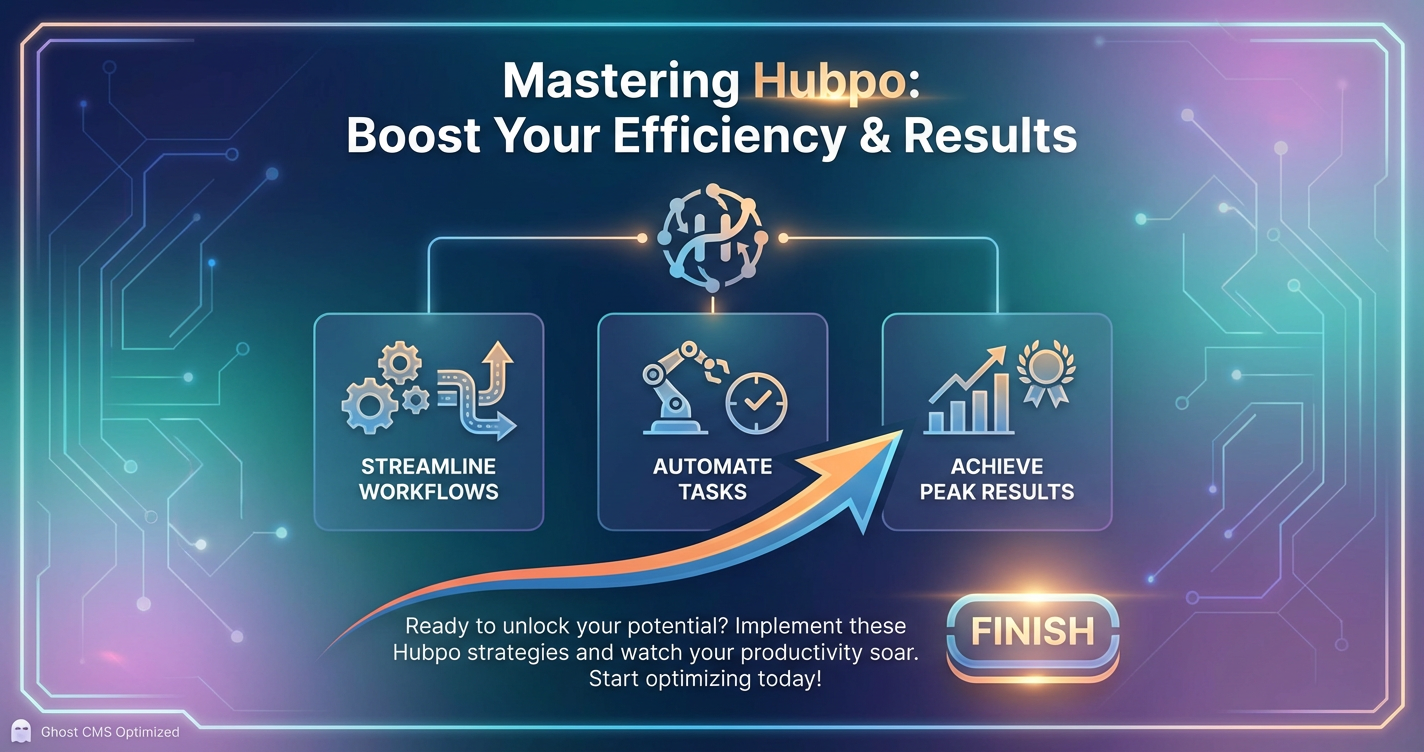
Mastering Hubpo: Boost Your Efficiency & Results


In the relentless tide of digital transformation, businesses often find themselves navigating a complex labyrinth of disparate tools, siloed data, and fragmented workflows. The promise of technological advancement frequently collides with the reality of operational inefficiency, leading to missed opportunities, escalating costs, and a constant struggle to keep pace with evolving market demands. This intricate landscape underscores a fundamental truth: true progress isn't merely about adopting new technologies, but about intelligently integrating them into a cohesive, optimized ecosystem. This is where the concept of "Hubpo" emerges—not as a singular product, but as a guiding philosophy and an aspirational architecture for an integrated, intelligent, and highly efficient operational platform. Mastering Hubpo means transc unlocking unparalleled levels of productivity, precision, and strategic agility, transforming operational bottlenecks into conduits for innovation and growth. It's about building a central nervous system for your enterprise, where every function, every piece of data, and every strategic decision is interconnected and empowered by advanced capabilities.
The modern enterprise is a symphony of moving parts, each contributing to the overall performance, yet often playing from different scores. Sales, marketing, customer service, operations, finance, and product development—all are critical, but their isolated efforts can lead to disharmony and wasted potential. The sheer volume of data generated daily, coupled with an ever-expanding toolkit of specialized software, has inadvertently created a new layer of complexity. Instead of streamlining operations, businesses frequently find themselves managing an intricate web of integrations, manual data transfers, and redundant processes. This fragmentation stifles innovation, slows decision-making, and creates a significant drag on resources, preventing organizations from achieving their full potential. The inherent challenge lies in harmonizing these diverse elements, making them work in concert towards shared strategic objectives, rather than operating as independent, often conflicting, entities.
This pervasive challenge highlights an urgent, universal need for a unifying framework—a "Hubpo" if you will—that can seamlessly stitch together the disparate threads of an organization's digital fabric. Such a framework is designed to not only automate repetitive tasks but also to foster intelligent interaction between systems, allowing data to flow freely and insights to emerge organically. It transcends the traditional approach of simply bolting on new applications; instead, it advocates for a holistic architectural shift where every component is designed to contribute to a greater, interconnected whole. By embracing the principles of Hubpo, businesses can move beyond reactive problem-solving, instead building a proactive, adaptive, and highly responsive operational model that can anticipate challenges and capitalize on opportunities with unprecedented speed and precision. The journey to mastering Hubpo is a strategic imperative for any organization aiming to thrive in the complex, data-driven economy of today and tomorrow.
The Modern Digital Landscape: A Tapestry of Complexity and Opportunity
The current digital landscape is an intricate tapestry woven from threads of rapid technological advancement, evolving consumer expectations, and an ever-increasing deluge of data. Organizations today face a multifaceted challenge: how to harness the immense potential of new tools and information without succumbing to the complexity they often introduce. We are in an era defined by the proliferation of SaaS applications, microservices architectures, and distributed systems, each promising to solve a specific pain point, yet collectively contributing to an often-unmanageable ecosystem. This fragmented operational environment is characterized by information silos, where critical data resides in isolated databases, preventing a holistic view of business performance. Decisions are often made based on incomplete pictures, leading to suboptimal outcomes and missed opportunities for strategic leverage. The very tools meant to enhance productivity can, paradoxically, become sources of inefficiency if not properly integrated and managed.
Beyond mere technical complexity, the modern business environment is also shaped by dynamic market forces. Consumer behaviors are shifting rapidly, driven by personalized experiences offered by digital leaders. Competitors are leveraging advanced analytics and AI to gain an edge, setting new benchmarks for speed and service quality. Regulatory landscapes are becoming more stringent, demanding robust data governance and compliance measures. In this high-stakes arena, the ability to adapt, innovate, and execute with precision is paramount. Businesses that fail to address the underlying fragmentation of their digital infrastructure risk being left behind, struggling to respond to market shifts, personalize customer interactions, or gain a competitive advantage through data-driven insights. The challenge isn't just about having the right tools; it's about making those tools work together harmoniously, creating a synergistic effect that amplifies their individual capabilities.
The opportunity, however, is equally immense. For organizations willing to confront the complexity head-on and invest in a strategic approach to integration, the rewards are substantial. A unified digital ecosystem allows for unprecedented visibility into operations, enabling predictive analytics, proactive problem-solving, and highly targeted interventions. It empowers employees with the right information at the right time, fostering collaboration and accelerating decision-making. Moreover, it lays the groundwork for leveraging truly transformative technologies like artificial intelligence and machine learning, which thrive on vast, interconnected datasets. The vision of Hubpo addresses this dichotomy directly: it seeks to transform the chaotic tapestry of modern digital operations into a streamlined, intelligent, and highly responsive engine for growth. By systematically breaking down silos and building bridges between disparate systems, Hubpo promises to unlock dormant potential, enabling businesses to not just survive but to flourish in an increasingly competitive and data-rich world.
Core Principles of "Hubpo": The Foundation of Efficiency and Innovation
At its heart, "Hubpo" is built upon a set of foundational principles that collectively create a robust framework for operational excellence. These are not merely technical specifications but strategic imperatives that guide the design and implementation of an integrated enterprise system, ensuring that every component contributes to a larger vision of efficiency, agility, and informed decision-making. Understanding these core tenets is the first step towards truly mastering the transformative power that Hubpo offers. Each principle acts as a pillar, supporting the overarching goal of creating a seamless, intelligent, and responsive operational environment that can adapt to the ever-evolving demands of the digital economy.
1. Seamless Integration and Interoperability
The cornerstone of Hubpo is its unwavering commitment to seamless integration and interoperability. In an age where businesses rely on a diverse portfolio of applications—from CRM and ERP systems to marketing automation platforms and specialized analytics tools—the ability for these systems to communicate effortlessly is paramount. Hubpo champions an architecture where data flows freely and securely between different platforms, eliminating manual data entry, reducing human error, and ensuring that all stakeholders operate with the most current and accurate information. This means moving beyond rudimentary point-to-point integrations that often break or require constant maintenance. Instead, Hubpo advocates for robust API-driven (Application Programming Interface) connections and event-driven architectures that allow systems to react dynamically to changes in other parts of the ecosystem. For instance, a customer support interaction recorded in the CRM should immediately update a customer's profile in the marketing platform, influencing future communication strategies. This level of intrinsic connectivity not only streamlines existing processes but also unlocks new possibilities for automated workflows that span multiple departments, creating a truly unified operational flow that minimizes friction and maximizes collaboration across the enterprise.
2. Intelligent Automation and Workflow Orchestration
Automation is a powerful lever for efficiency, but Hubpo elevates it beyond simple task execution to intelligent workflow orchestration. This principle involves identifying repetitive, rule-based tasks across the organization and automating them, thereby freeing up human capital to focus on higher-value, more creative, and strategic endeavors. However, Hubpo's approach to automation goes further, incorporating elements of artificial intelligence and machine learning to make processes not just automatic, but also adaptive and intelligent. Imagine workflows that can self-optimize based on performance data, or systems that can trigger proactive actions based on predictive analytics. For example, an automated inventory management system could not only reorder supplies when thresholds are met but also use historical sales data and external factors like weather forecasts to predict demand, preventing both stockouts and overstocking. This intelligent automation extends to areas like lead nurturing, customer service interactions, financial reporting, and even HR onboarding, transforming manual, time-consuming processes into streamlined, self-correcting operations that significantly boost overall productivity and reduce operational overhead.
3. Centralized Data Management and Single Source of Truth
Data is the lifeblood of the modern enterprise, yet its value is often diminished by fragmentation and inconsistency. Hubpo addresses this critical challenge by establishing a centralized data management strategy, creating a "single source of truth" for all essential business information. This principle ensures that regardless of where data originates—be it from a sales transaction, a customer service interaction, a website visit, or an operational sensor—it is consolidated, cleaned, and standardized in a central repository. This eliminates discrepancies, reduces conflicting reports, and provides a unified, comprehensive view of the business across all functions. A centralized data approach empowers better decision-making by providing accurate, real-time insights accessible to all authorized users. It underpins advanced analytics, machine learning initiatives, and regulatory compliance efforts, as data lineage and quality can be consistently maintained. By treating data as a strategic asset and managing it centrally, Hubpo transforms raw information into actionable intelligence, enabling businesses to gain deeper insights into customer behavior, market trends, and operational performance, thereby fostering a data-driven culture that permeates every level of the organization.
4. User-Centric Design and Intuitive Experience
The most technologically advanced platform is only as effective as its adoption rate among its users. Hubpo places a strong emphasis on user-centric design, ensuring that the platform is not only powerful but also intuitive, accessible, and enjoyable to use. This principle involves developing interfaces and workflows that are tailored to the needs and roles of different user groups, minimizing training requirements and maximizing productivity. A user-friendly experience fosters greater engagement, reduces resistance to change, and encourages widespread adoption across the enterprise. It means designing dashboards that provide relevant information at a glance, creating workflows that mimic natural human thought processes, and offering personalized experiences that cater to individual preferences. For instance, a sales representative should have a dashboard that prioritizes leads and customer interactions, while a finance manager might see real-time budget performance and expense approvals. By prioritizing the human element in system design, Hubpo ensures that its sophisticated capabilities are readily accessible and seamlessly integrated into the daily routines of employees, transforming complex operations into intuitive, empowering experiences that enhance job satisfaction and overall organizational effectiveness.
5. Scalability and Future-Proof Architecture
The business landscape is in a constant state of flux, and a truly effective platform must be capable of evolving alongside it. Hubpo is designed with scalability and a future-proof architecture in mind, ensuring that it can grow and adapt to accommodate increasing data volumes, expanding user bases, and emerging technological advancements without requiring a complete overhaul. This principle involves utilizing modular components, flexible infrastructure, and open standards that allow for easy expansion and integration of new functionalities. It means designing systems that can handle peak loads without performance degradation and can seamlessly incorporate new tools or AI models as they become available. A future-proof architecture also anticipates changes in regulatory requirements and security threats, building in resilience and adaptability from the ground up. This forward-looking approach protects initial technology investments, reduces the total cost of ownership over time, and positions the organization to readily embrace future innovations. By building a scalable and adaptable foundation, Hubpo ensures that the enterprise remains agile, competitive, and prepared for whatever the future may hold, transforming potential disruptions into opportunities for sustained growth and innovation.
Leveraging AI and Advanced Technologies within "Hubpo": The Intelligent Core
The true power of Hubpo in today's landscape is inextricably linked to its ability to seamlessly integrate and orchestrate advanced artificial intelligence technologies. AI is no longer a futuristic concept but a present-day imperative, driving innovation and efficiency across every sector. Within the Hubpo framework, AI acts as the intelligent core, transforming raw data into actionable insights, automating complex decision-making, and enhancing human capabilities. This integration isn't about simply adding AI tools; it's about embedding intelligence into the very fabric of operational workflows, making systems smarter, more predictive, and ultimately, more effective. The capabilities of Large Language Models (LLMs) are particularly revolutionary, and managing their access and context within an enterprise setting requires specialized tools like the LLM Gateway, Model Context Protocol, and a comprehensive AI Gateway.
The Transformative Potential of AI within Hubpo
AI's transformative potential within Hubpo is vast. From automating mundane tasks to providing sophisticated predictive analytics, AI can revolutionize how businesses operate. Imagine customer service interactions where AI instantly provides relevant information based on past history, or marketing campaigns that dynamically adjust content based on real-time user engagement. In manufacturing, AI can predict machinery failures before they occur, reducing downtime and maintenance costs. In finance, it can detect fraudulent transactions with remarkable accuracy. However, harnessing this power requires a thoughtful approach to integration, ensuring that AI models are not only accessible but also perform optimally, securely, and in a way that aligns with business objectives. Hubpo provides the architectural backbone for this, enabling the intelligent orchestration of various AI services to create highly responsive and adaptive business processes that learn and improve over time.
LLM Gateway: Orchestrating Conversational Intelligence
The advent of Large Language Models (LLMs) has opened up unprecedented possibilities for automating text-based tasks, generating creative content, summarizing information, and facilitating natural language interactions. However, managing multiple LLMs from different providers, ensuring consistent performance, optimizing costs, and applying enterprise-grade security can be a significant challenge. This is where an LLM Gateway becomes an indispensable component within the Hubpo architecture. An LLM Gateway acts as a centralized interface for accessing and managing various LLM providers (e.g., OpenAI, Google, Anthropic, etc.). It abstracts away the complexities of different APIs, offering a unified entry point for applications.
For instance, within Hubpo, an LLM Gateway could enable: * Intelligent Routing: Automatically directing user queries to the most suitable or cost-effective LLM based on task type, model capabilities, or current load. * Cost Optimization: Implementing policies to prioritize cheaper models for less critical tasks or manage token usage across different models to stay within budget. * API Standardization: Providing a consistent API for developers, so they don't have to rewrite code when switching between LLMs or integrating new ones. * Rate Limiting and Load Balancing: Ensuring fair access and preventing any single LLM endpoint from being overwhelmed, maintaining application responsiveness. * Security and Access Control: Centralizing authentication and authorization for LLM access, ensuring only authorized applications and users can interact with these powerful models.
Consider a Hubpo-powered customer service center: an LLM Gateway would allow the system to seamlessly switch between different LLMs for tasks like generating initial draft responses (e.g., using a general-purpose LLM), summarizing long conversation transcripts (e.g., using an LLM specialized in summarization), or translating customer queries into different languages (e.g., using a translation-focused LLM). This orchestration, managed by the LLM Gateway, ensures optimal performance, cost-efficiency, and flexibility in leveraging the diverse capabilities of large language models across the enterprise.
Model Context Protocol: Maintaining Coherence in AI Interactions
One of the persistent challenges in developing sophisticated AI applications, especially those involving sequential interactions or complex reasoning, is maintaining context. AI models often lack "memory" beyond the immediate input, leading to disjointed conversations, redundant information requests, or illogical responses in multi-turn interactions. This is particularly true for LLMs. The Model Context Protocol is a crucial element within Hubpo that addresses this by establishing standardized methods for managing, storing, and retrieving conversational or operational context across AI interactions. It's about ensuring that the AI "remembers" previous interactions, user preferences, and relevant data points, allowing for more natural, coherent, and effective engagements.
Within Hubpo, a robust Model Context Protocol would facilitate: * Session Management: Storing the history of an interaction, including previous questions, answers, user intents, and extracted entities. * User Profile Integration: Automatically injecting relevant user data (e.g., subscription level, purchase history, past issues) into AI prompts to personalize responses. * Domain-Specific Knowledge Injection: Providing the AI with access to an up-to-date knowledge base, documentation, or internal data specific to the query's domain. * Contextual Reasoning: Enabling AI models to build upon prior information, follow complex logic, and avoid contradictions across multiple turns of interaction.
For example, a marketing automation system within Hubpo, powered by AI, could use a Model Context Protocol to track a customer's journey across various touchpoints. If a customer browses a product, then adds it to their cart, then abandons the cart, the AI can "remember" these steps. When that customer later interacts with a chatbot, the Model Context Protocol ensures the chatbot is aware of the abandoned cart, allowing it to offer a targeted discount or follow-up question, rather than starting the conversation from scratch. This level of contextual awareness drastically improves the quality and relevance of AI interactions, making them more human-like and effective.
AI Gateway: The Unified Entry Point for All AI Services
While the LLM Gateway focuses specifically on large language models and the Model Context Protocol on maintaining interaction state, the broader concept of an AI Gateway is fundamental to Hubpo's comprehensive AI strategy. An AI Gateway serves as the centralized orchestration and management layer for all AI services within an organization, much like an API Gateway for traditional REST APIs. It provides a unified, secure, and performant entry point for applications to consume various AI models, whether they are hosted internally or externally.
An AI Gateway within Hubpo is critical for: * Unified API Access: Standardizing the way applications interact with different AI models (e.g., computer vision, natural language processing, predictive analytics), regardless of the underlying vendor or technology. This simplifies development and reduces integration complexity. * Security and Authentication: Enforcing strict access controls, authenticating incoming requests, and masking internal AI service endpoints from public exposure. * Rate Limiting and Quota Management: Controlling the volume of requests to prevent abuse, manage resource consumption, and enforce usage policies for different teams or applications. * Monitoring and Analytics: Providing a centralized view of AI service performance, usage patterns, errors, and costs, enabling proactive management and optimization. * Load Balancing and High Availability: Distributing requests across multiple instances of AI models to ensure reliability, performance, and scalability. * Version Management: Allowing for seamless deployment of new AI model versions without disrupting existing applications.
To bring this concept into a tangible example, consider the innovative capabilities offered by platforms like ApiPark. APIPark, an open-source AI Gateway and API management platform, perfectly embodies these principles. It allows for the quick integration of over 100 AI models, providing a unified management system for authentication and cost tracking. Its ability to standardize the request data format across all AI models ensures that changes in underlying AI models or prompts do not affect the application or microservices consuming them, thereby simplifying AI usage and significantly reducing maintenance costs. Furthermore, APIPark enables users to quickly combine AI models with custom prompts to create new APIs, such as sentiment analysis or translation APIs, encapsulating complex AI logic into simple RESTful endpoints. This kind of robust AI Gateway is an indispensable component of a Hubpo architecture, offering end-to-end API lifecycle management, performance rivaling high-throughput proxies, and detailed logging and data analysis. It provides a solid, secure, and scalable foundation for any enterprise looking to fully leverage AI within their integrated operations.
By strategically implementing an LLM Gateway, a Model Context Protocol, and a comprehensive AI Gateway as integral parts of Hubpo, organizations can unlock the full potential of artificial intelligence. These technologies transform AI from disparate, challenging-to-manage tools into a cohesive, intelligent core that enhances every aspect of business operations, driving unprecedented levels of efficiency, innovation, and strategic advantage.
Strategic Implementation of "Hubpo" for Diverse Business Functions
The true strength of mastering Hubpo lies in its pervasive impact across every functional area of an organization. It's not a departmental tool but an enterprise-wide paradigm shift, enhancing efficiency, intelligence, and collaboration from the executive suite to the front lines. By integrating advanced AI capabilities, automation, and centralized data, Hubpo transforms traditional workflows into dynamic, data-driven processes that yield superior results. Let's explore how Hubpo strategically revitalizes diverse business functions.
1. Marketing & Sales: Hyper-Personalization and Accelerated Growth
In the fiercely competitive arenas of marketing and sales, Hubpo becomes a formidable engine for growth. It moves beyond generic campaigns and fragmented lead management to enable hyper-personalization and highly efficient sales cycles. * Personalized Customer Journeys: Hubpo integrates data from CRM, marketing automation, web analytics, and customer support systems into a single view. An AI Gateway facilitates the use of LLMs to analyze this vast dataset, identify customer segments with extreme precision, and dynamically generate personalized content, product recommendations, and messaging across email, social media, and website interactions. The Model Context Protocol ensures that marketing automation sequences are tailored, remembering previous interactions and preferences, creating a truly one-to-one communication experience that resonates deeply with each individual prospect. * Intelligent Lead Scoring and Prioritization: By leveraging predictive analytics and machine learning algorithms, Hubpo can automatically score leads based on their engagement patterns, demographic data, and historical conversions. An LLM Gateway can process unstructured data from customer inquiries or social media mentions to provide deeper insights into lead intent. Sales teams receive highly qualified leads, prioritized by their likelihood to convert, enabling them to focus their efforts on the most promising opportunities and drastically improve conversion rates. * Automated Content Creation and Optimization: Content generation, a time-consuming but crucial marketing activity, is significantly streamlined. With an LLM Gateway integrated into Hubpo, marketers can rapidly generate variations of ad copy, social media posts, blog drafts, and email subject lines, all tailored to specific target audiences and campaign objectives. AI-driven testing and optimization tools then analyze performance data to recommend further refinements, ensuring that content consistently achieves maximum impact. * Seamless Sales Enablement: Sales representatives gain access to comprehensive customer profiles, real-time product information, and AI-generated conversation prompts or objection handling scripts. Hubpo automates the generation of proposals and contracts, reduces administrative burdens, and provides insights into optimal pricing strategies, empowering sales teams to close deals faster and more effectively.
2. Customer Service: Proactive Support and Enhanced Satisfaction
Customer service is transformed from a reactive cost center into a proactive value driver through the strategic application of Hubpo. * Intelligent Chatbots and Virtual Assistants: Hubpo integrates advanced AI-powered chatbots and virtual assistants, facilitated by an LLM Gateway and the Model Context Protocol. These bots can handle a vast majority of routine inquiries, providing instant, accurate responses by drawing upon a centralized knowledge base. The Model Context Protocol allows chatbots to maintain conversational flow, remember past interactions, and escalate complex issues to human agents with all necessary context, ensuring seamless transitions. * Sentiment Analysis and Proactive Engagement: An AI Gateway can process incoming customer communications (emails, social media posts, call transcripts) to perform real-time sentiment analysis. Hubpo identifies customers expressing frustration or dissatisfaction, allowing service teams to proactively intervene before a minor issue escalates into a major complaint. This preventative approach significantly boosts customer satisfaction and loyalty. * Automated Ticket Routing and Resolution: Hubpo automates the categorization and routing of support tickets to the most appropriate agent or department, based on the nature of the inquiry and agent expertise. AI can even suggest resolution steps or knowledge base articles to agents, accelerating problem-solving and reducing resolution times. * Personalized Self-Service Options: By integrating customer data and AI, Hubpo empowers customers with highly personalized self-service portals, offering relevant FAQs, troubleshooting guides, and video tutorials based on their specific product usage or issue history. This reduces the load on support agents while providing customers with instant gratification.
3. Operations & IT: Streamlined Workflows and Predictive Maintenance
For operations and IT, Hubpo delivers unprecedented levels of efficiency, reliability, and security, transforming reactive management into proactive strategic oversight. * Workflow Automation and Orchestration: Beyond simple task automation, Hubpo orchestrates complex operational workflows across multiple systems and departments. From supply chain logistics and inventory management to project planning and resource allocation, Hubpo integrates data, triggers automated actions, and monitors performance, ensuring smooth, uninterrupted operations. * Predictive Maintenance and Anomaly Detection: In industries reliant on physical assets, Hubpo integrates with IoT sensors and operational data, utilizing an AI Gateway to run advanced machine learning models. These models analyze real-time data to predict equipment failures before they occur, allowing for proactive maintenance scheduling and significantly reducing downtime, operational costs, and safety risks. Anomaly detection algorithms identify unusual patterns in system behavior, signaling potential security threats or operational issues. * Automated Incident Response: For IT operations, Hubpo can automate large portions of incident response. When an anomaly or system alert is detected, the platform can automatically trigger diagnostic tools, notify relevant personnel, and even initiate remediation steps, drastically reducing mean time to recovery (MTTR). * Resource Optimization: Hubpo provides a unified view of resource utilization across IT infrastructure, cloud services, and human capital. AI-driven analytics help optimize resource allocation, identify bottlenecks, and recommend adjustments to ensure maximum efficiency and cost-effectiveness.
4. Product Development: Faster Iterations and User-Centric Design
Hubpo accelerates the product development lifecycle, enabling faster iterations, more data-driven decisions, and products that truly resonate with users. * Automated Feedback Analysis: An LLM Gateway can process vast amounts of unstructured feedback from customer reviews, support tickets, social media, and usability tests. Hubpo uses AI to identify common themes, pain points, and feature requests, providing product managers with actionable insights to guide development priorities. * Accelerated Prototyping and Testing: AI tools integrated within Hubpo can assist in generating design mockups, suggesting UI/UX improvements based on best practices and user data, and even automating portions of code generation for repetitive tasks. Automated testing frameworks, orchestrated by Hubpo, ensure faster, more comprehensive quality assurance, catching bugs earlier in the development cycle. * Feature Prioritization with Data: By correlating feature usage data, customer feedback, and business objectives, Hubpo provides AI-driven recommendations for feature prioritization, ensuring that development efforts are focused on delivering maximum value to users and the business. * Personalized Product Experiences: Leveraging the Model Context Protocol and an AI Gateway, product teams can design and deploy personalized user experiences within their applications, adapting interfaces or functionalities based on individual user behavior, preferences, and journey.
5. Human Resources: Streamlined Processes and Enhanced Employee Experience
Even in human resources, Hubpo brings significant enhancements, automating administrative tasks and improving the overall employee experience. * Automated Onboarding and Offboarding: Hubpo streamlines the entire employee lifecycle, from automated contract generation and system access provisioning (onboarding) to asset retrieval and system deactivation (offboarding), ensuring compliance and efficiency. * Intelligent HR Chatbots: An LLM Gateway powers HR chatbots that can answer common employee questions about policies, benefits, and payroll, reducing the workload on HR staff and providing instant support. The Model Context Protocol allows these bots to maintain a helpful, personalized dialogue. * Performance Management and Feedback: Hubpo can integrate performance data, feedback systems, and goal-setting tools, providing a holistic view of employee performance. AI-driven insights can help identify high-potential employees, flag areas for development, and suggest personalized training recommendations. * Recruitment and Talent Acquisition: AI can assist in screening resumes, identifying qualified candidates, and even conducting initial virtual interviews, significantly speeding up the recruitment process and improving hiring accuracy.
By applying Hubpo's principles and leveraging its intelligent core across these diverse functions, organizations can move beyond fragmented operations to achieve a truly synergistic, efficient, and intelligent enterprise. The integrated nature of Hubpo ensures that improvements in one area ripple across the entire organization, creating a virtuous cycle of continuous optimization and innovation.
APIPark is a high-performance AI gateway that allows you to securely access the most comprehensive LLM APIs globally on the APIPark platform, including OpenAI, Anthropic, Mistral, Llama2, Google Gemini, and more.Try APIPark now! 👇👇👇
Measuring Success & Optimizing "Hubpo" Initiatives
Implementing Hubpo is a significant undertaking, and its true value is realized not just through deployment, but through continuous measurement, analysis, and optimization. Without a robust framework for assessing performance and identifying areas for improvement, even the most sophisticated integrated platform risks becoming stagnant. Mastering Hubpo involves establishing clear metrics, leveraging its inherent data analytics capabilities, and fostering a culture of iterative enhancement.
Defining Key Performance Indicators (KPIs)
Before embarking on any Hubpo initiative, it's crucial to define specific, measurable, achievable, relevant, and time-bound (SMART) Key Performance Indicators (KPIs). These KPIs should align directly with the strategic objectives of the Hubpo implementation across different business functions.
Here’s a comparative table illustrating potential KPIs for traditional vs. Hubpo-enhanced workflows:
| Business Function | Traditional Workflow KPIs | Hubpo-Enhanced Workflow KPIs (Focus on Efficiency & Results) |
|---|---|---|
| Marketing | Website Traffic, Ad Clicks, Conversion Rate | Lead-to-Opportunity Conversion Rate, Cost Per Qualified Lead (CPQL), Marketing ROI, Time to Market for Campaigns |
| Sales | Number of Calls, Number of Demos, Closed Deals | Sales Cycle Length, Win Rate, Average Deal Size, Sales Rep Productivity (Deals/Rep) |
| Customer Service | Number of Tickets, Average Handle Time, First Call Resolution | Customer Satisfaction Score (CSAT), Net Promoter Score (NPS), First Contact Resolution (FCR) Rate, Average Resolution Time (ART) |
| Operations | Production Output, Inventory Turnover, Error Rate | Operational Cost Reduction, Process Cycle Time, On-Time Delivery Rate, Downtime/Outage Frequency |
| IT | Uptime Percentage, Number of Incidents | Mean Time to Recovery (MTTR), System Performance Benchmarks, Security Incident Response Time, Automated Task Completion Rate |
| HR | Time to Hire, Employee Turnover Rate | Employee Engagement Score, Onboarding Completion Rate, Training Effectiveness, HR Self-Service Adoption |
These KPIs provide a tangible way to track the impact of Hubpo, allowing organizations to quantify improvements in efficiency, customer satisfaction, revenue generation, and cost reduction. They serve as the compass guiding all optimization efforts.
Data Analytics and Reporting within Hubpo
One of the inherent strengths of Hubpo, particularly due to its centralized data management and integrated AI Gateway components, is its ability to generate rich, actionable data analytics and reporting. Every interaction, every automated task, every AI-driven insight, and every user journey generates valuable data points. * Integrated Dashboards: Hubpo provides comprehensive, real-time dashboards that offer a holistic view of performance across all integrated functions. These dashboards can be customized for different roles—a CEO might see high-level ROI metrics, while a marketing manager sees campaign performance and lead conversion rates. * Predictive Analytics: Beyond historical reporting, Hubpo leverages its AI core to provide predictive analytics. For instance, it can forecast sales trends, predict potential customer churn, or anticipate operational bottlenecks, enabling proactive strategic adjustments rather than reactive problem-solving. * Root Cause Analysis: When KPIs fall short, Hubpo's detailed logging and interconnected data points allow for deep-dive root cause analysis. This helps identify precisely where a process broke down, which integration failed, or which AI model might need recalibration. For example, the detailed API call logging provided by platforms like APIPark can be invaluable here, recording every detail of each API call and allowing businesses to quickly trace and troubleshoot issues, ensuring system stability. * Automated Reporting: Hubpo can automate the generation and distribution of regular performance reports, ensuring that relevant stakeholders receive timely updates without manual effort. This frees up valuable time for analysis and strategic planning.
Continuous Improvement Cycles (Plan-Do-Check-Act)
Mastering Hubpo is an ongoing journey, not a destination. It thrives on a culture of continuous improvement, following an iterative Plan-Do-Check-Act (PDCA) cycle: 1. Plan: Based on insights from Hubpo's analytics, identify specific areas for improvement. This could be optimizing a particular workflow, fine-tuning an LLM prompt, or refining a data integration. Set clear objectives for the next iteration. 2. Do: Implement the planned changes. This might involve adjusting automation rules, reconfiguring an LLM Gateway for better cost efficiency, modifying a Model Context Protocol to enhance AI coherence, or rolling out a new feature within the Hubpo ecosystem. 3. Check: Monitor the impact of the changes using Hubpo's analytics and KPIs. Did the changes achieve the desired outcome? Are there any unintended side effects? Utilize A/B testing capabilities to compare different approaches. 4. Act: Based on the results, standardize the successful changes, or if the changes were not effective, learn from the experience and start the cycle again with a revised plan. This constant feedback loop ensures that Hubpo evolves and adapts, perpetually enhancing its efficiency and impact.
Feedback Mechanisms and Experimentation
Beyond formal reporting, Hubpo fosters an environment of active feedback and experimentation: * User Feedback Loops: Integrate mechanisms within Hubpo for employees to provide feedback on workflows, tools, and AI interactions. This ensures that the platform remains user-centric and truly addresses their needs. * A/B Testing and Controlled Experiments: Leveraging its integrated nature, Hubpo allows for sophisticated A/B testing across various elements—from different marketing messages generated by LLMs to alternative workflow automation paths. This data-driven experimentation is crucial for optimizing performance without guesswork. * AI Model Re-training and Fine-tuning: As new data becomes available or business needs evolve, Hubpo facilitates the re-training and fine-tuning of its integrated AI models. This ensures that the intelligence embedded within the platform remains current, accurate, and highly relevant.
By diligently measuring success, leveraging robust analytics, and committing to continuous improvement, organizations can truly master Hubpo. This disciplined approach ensures that the platform not only delivers immediate benefits but also serves as a dynamic, evolving engine for sustained efficiency, innovation, and superior results in the long term.
Challenges and Considerations in Mastering "Hubpo"
While the benefits of mastering Hubpo are profound, the journey is not without its challenges. Implementing and optimizing an integrated, AI-driven enterprise platform requires careful planning, strategic foresight, and a proactive approach to potential roadblocks. Addressing these considerations head-on is crucial for successful adoption and long-term value realization.
1. Change Management and Organizational Resistance
One of the most significant hurdles in any large-scale digital transformation is human resistance to change. Hubpo fundamentally alters existing workflows, job roles, and communication patterns, which can trigger anxiety, skepticism, and even active opposition from employees accustomed to traditional methods. * Challenge: Employees may fear job displacement, feel overwhelmed by new technologies, or be reluctant to abandon familiar tools, regardless of their inefficiency. * Consideration: Effective change management is paramount. This includes clear communication of the vision and benefits of Hubpo, early and continuous involvement of stakeholders at all levels, dedicated training programs that focus on new skill development, and visible leadership support. Demonstrating quick wins and providing a safe space for feedback can help build buy-in and transition employees into advocates. The focus should be on how Hubpo empowers employees, automating drudgery so they can focus on more strategic, fulfilling work.
2. Data Quality and Governance
The adage "garbage in, garbage out" is particularly pertinent to Hubpo, given its reliance on integrated data and AI. Poor data quality can undermine the accuracy of AI models, lead to flawed analytics, and compromise the integrity of automated processes. * Challenge: Inconsistent data formats, duplicate records, outdated information, and incomplete datasets can propagate across integrated systems, rendering Hubpo's intelligence unreliable. * Consideration: Robust data governance policies are essential. This involves establishing clear standards for data input, validation, storage, and lifecycle management. Implementing automated data cleaning tools, establishing data ownership, and conducting regular data audits are critical. Furthermore, ensuring data privacy and compliance with regulations like GDPR or CCPA must be built into Hubpo's architecture from the outset, particularly when sensitive information is processed by an LLM Gateway or AI Gateway.
3. Security and Compliance
Integrating numerous systems and leveraging advanced AI, especially through an AI Gateway that acts as a central access point, introduces heightened security risks. Managing access to sensitive data and protecting against cyber threats becomes more complex. * Challenge: A centralized platform like Hubpo can become a single point of failure if not adequately secured. Misconfigurations, vulnerabilities in integrated third-party tools, or breaches in any part of the ecosystem can have widespread repercussions. * Consideration: Security must be architected into Hubpo from its foundation. This includes multi-factor authentication, granular role-based access control, end-to-end encryption, regular security audits, and penetration testing. When using an LLM Gateway or AI Gateway, ensuring that sensitive data is not inadvertently exposed or used for model training without explicit consent is crucial. Compliance with industry-specific regulations and data protection laws requires continuous monitoring and adaptation. Platforms like APIPark, which offer robust security features like access approval and detailed logging, are crucial components in mitigating these risks.
4. Vendor Management and Lock-in
Hubpo often integrates various proprietary and open-source solutions, leading to complex vendor relationships and the potential for vendor lock-in. * Challenge: Relying too heavily on a single vendor for core components can limit flexibility, hinder future innovation, and lead to inflated costs. Managing multiple vendor contracts, support agreements, and integration dependencies can also be cumbersome. * Consideration: A strategic approach to vendor selection is vital. Prioritize solutions that adhere to open standards, offer robust APIs, and have strong community support or transparent roadmaps. Hubpo's architecture should be modular enough to allow for swapping out components if a vendor relationship sours or a better alternative emerges. Leveraging open-source platforms, such as ApiPark for API and AI Gateway needs, can significantly mitigate vendor lock-in risks, providing flexibility and control over the infrastructure.
5. Training and Skill Development
The introduction of Hubpo and its AI-driven capabilities necessitates new skills and competencies across the workforce. * Challenge: Existing employees may lack the technical proficiency to effectively utilize Hubpo's advanced features, interpret AI-driven insights, or manage complex automated workflows. A skills gap can limit the platform's adoption and impact. * Consideration: Invest in comprehensive training and continuous learning programs. This might involve internal workshops, online courses, and certifications in areas like data analytics, AI literacy, and platform-specific usage. Fostering a culture of continuous learning and providing resources for upskilling and reskilling employees ensures that the workforce evolves alongside the technology, maximizing the return on investment in Hubpo. This empowers employees to become active participants in leveraging Hubpo's full potential rather than passive users.
By proactively addressing these challenges, organizations can navigate the complexities of implementing Hubpo, transforming potential obstacles into stepping stones towards a more efficient, intelligent, and resilient enterprise. Strategic planning, clear communication, robust governance, and a commitment to continuous learning are the cornerstones of truly mastering Hubpo and unlocking its full transformative power.
The Future of Work with "Hubpo" at the Helm
The mastery of Hubpo isn't just about optimizing current operations; it's about fundamentally reshaping the future of work itself. As organizations increasingly embrace integrated platforms powered by AI, the landscape of business processes, human roles, and strategic decision-making will undergo a profound transformation. Hubpo positions enterprises not merely to adapt to this future, but to actively define it, fostering an environment of unparalleled agility, hyper-personalization, and intelligent autonomy.
Predictive Analytics and Hyper-Personalization: Anticipating Needs
With Hubpo at its core, the future of work is deeply predictive and intensely personal. The platform's integrated data fabric, combined with an advanced AI Gateway and LLM Gateway, enables a level of foresight previously unattainable. Businesses will move beyond reactive responses to proactive anticipation of market shifts, customer needs, and operational challenges. * Predictive Operations: Supply chains will become self-optimizing, predicting demand fluctuations with remarkable accuracy and adjusting logistics autonomously. Manufacturing processes will leverage AI to anticipate equipment failures, initiating preventative maintenance long before an outage can occur. IT systems will foresee potential security threats, deploying countermeasures before any breach can materialize. * Hyper-Personalized Everything: Customer experiences will evolve to an unprecedented degree of personalization. Hubpo will allow businesses to not only understand individual customer preferences but also to predict their next desired interaction, offering tailor-made products, services, and content in real-time. This extends internally as well, with employee experiences, training paths, and even career development personalized based on individual aptitudes and organizational needs. The Model Context Protocol will be crucial here, ensuring AI models can maintain a deep, longitudinal understanding of each individual's journey.
Autonomous Operations: The Era of Intelligent Systems
Hubpo paves the way for increasingly autonomous operations, where many routine and complex processes are executed by intelligent systems without human intervention. This doesn't imply a fully automated, human-less enterprise, but rather one where human intelligence is amplified and freed from the burden of repetitive execution. * Self-Managing Workflows: Automated workflows within Hubpo will evolve to become self-managing, capable of adapting to unforeseen circumstances, making real-time decisions, and even learning from their own execution. For instance, a marketing campaign might autonomously adjust its budget allocation across channels based on real-time performance data and market conditions, or a financial reporting system might flag discrepancies and initiate correction protocols without human oversight. * AI-Driven Decision Support: For strategic decisions, Hubpo will act as an unparalleled intelligent co-pilot. By integrating vast datasets, running complex simulations, and leveraging the reasoning capabilities of LLMs via the LLM Gateway, Hubpo can present executives with highly nuanced insights, risk assessments, and optimal strategy recommendations, significantly enhancing the speed and quality of high-level decision-making.
The Evolving Role of Human Workers: Strategic Thinking and Creativity
Perhaps the most profound impact of Hubpo on the future of work is the redefinition of human roles. As Hubpo handles more of the transactional and analytical heavy lifting, human workers will transition to roles that emphasize uniquely human capabilities: * Focus on Strategic Thinking: Employees will be liberated from mundane tasks, allowing them to dedicate more time to strategic planning, innovation, and complex problem-solving that requires nuanced judgment and creativity. * Enhanced Creativity and Innovation: With Hubpo automating repetitive content generation and data analysis, human creativity will be unleashed. Marketers can focus on breakthrough campaign concepts, product developers on truly innovative features, and strategists on pioneering new market opportunities. * Human-Centric Roles: Roles focused on empathy, interpersonal relationships, ethical considerations, and complex emotional intelligence will become even more critical. Customer service professionals will handle only the most sensitive and unique cases, providing a deeply human touch where it matters most. HR will focus on fostering culture, talent development, and employee well-being. * Skill Development in AI Oversight: New roles will emerge, focused on "teaching" and overseeing AI systems. These "AI trainers" or "prompt engineers" will ensure that the LLM Gateway and other AI components within Hubpo are continuously learning, aligned with ethical guidelines, and performing optimally, guaranteeing the responsible and effective deployment of AI.
Adaptability and Resilience in a Dynamic Market
Ultimately, mastering Hubpo equips organizations with unparalleled adaptability and resilience. In a world characterized by constant change, geopolitical shifts, and technological disruptions, the ability to pivot quickly and effectively is a supreme competitive advantage. * Agile Response to Disruption: Hubpo's modular, integrated architecture, supported by flexible AI Gateways like APIPark, allows businesses to rapidly integrate new technologies, adapt to regulatory changes, and respond to unforeseen market shifts with remarkable agility. * Sustained Innovation: By fostering a data-driven culture and freeing up human capital for creative pursuits, Hubpo creates a continuous engine for innovation, ensuring the organization remains at the forefront of its industry. * Enhanced Decision-Making Under Uncertainty: With real-time insights and predictive capabilities, leaders can make more informed decisions, even in highly ambiguous or rapidly evolving circumstances, reducing risk and maximizing opportunities.
The future of work with Hubpo at the helm is not a dystopia of automation replacing humans, but a synergy where human ingenuity is augmented and elevated by intelligent systems. It's a future where efficiency is a given, creativity thrives, and organizations are inherently designed for success in an increasingly complex and dynamic world. Mastering Hubpo is, therefore, not just an operational upgrade, but a strategic investment in the very fabric of an organization's future.
Conclusion: Embracing the Future with Hubpo
In an era defined by relentless digital acceleration and an ever-increasing demand for efficiency, the concept of "Hubpo" emerges as the definitive strategic framework for enterprise transformation. We have delved into its foundational principles, illuminating how seamless integration, intelligent automation, centralized data, user-centric design, and scalable architecture collectively forge a platform of unparalleled operational excellence. The journey to mastering Hubpo is not merely about adopting a new suite of tools; it is about embracing a holistic philosophy that redefines how organizations interact with data, leverage technology, and empower their human capital.
The transformative power of Hubpo is undeniably amplified by its intelligent core, where advanced AI technologies are not just integrated but orchestrated with precision. The role of an LLM Gateway in managing diverse language models, optimizing costs, and ensuring consistent access is critical for leveraging conversational intelligence across the enterprise. Furthermore, the Model Context Protocol is an indispensable component, guaranteeing that AI interactions are coherent, personalized, and deeply informed by historical context. Complementing these, the overarching AI Gateway serves as the unified, secure, and performant entry point for all AI services, streamlining development and ensuring the robust management of every AI model within the system. Platforms like ApiPark stand as prime examples of how a powerful AI Gateway can provide the foundational infrastructure for this intelligent orchestration, simplifying the integration and management of complex AI landscapes.
The pervasive impact of Hubpo extends across every conceivable business function, from revolutionizing marketing and sales through hyper-personalization and intelligent lead scoring, to transforming customer service into a proactive and deeply satisfying experience. In operations and IT, it ushers in an era of streamlined workflows, predictive maintenance, and enhanced security, while in product development, it accelerates innovation and fosters user-centric design. Even in human resources, Hubpo streamlines processes and enriches the employee experience, ensuring that every facet of the organization operates at peak efficiency and intelligence.
However, the path to mastering Hubpo is one that requires deliberate navigation through challenges such as organizational change management, ensuring data quality and governance, fortifying against security threats, mitigating vendor lock-in, and investing in continuous skill development. By proactively addressing these considerations and committing to iterative improvement cycles, organizations can unlock Hubpo's full potential, measuring success not just in raw numbers, but in tangible improvements to efficiency, customer satisfaction, and strategic agility.
Looking ahead, Hubpo is poised to reshape the very future of work, ushering in an era of predictive analytics, hyper-personalization, and increasingly autonomous operations. It will empower human workers to shift their focus from repetitive tasks to strategic thinking, creative innovation, and human-centric problem-solving, fostering a synergistic relationship between human ingenuity and artificial intelligence. The ability of Hubpo to instill adaptability and resilience in a dynamic market is not just a competitive advantage; it is a fundamental requirement for sustained success.
In essence, mastering Hubpo is more than a technological upgrade; it is a strategic imperative for any enterprise aspiring to thrive in the complexities of the 21st century. It is an invitation to embrace a future where operations are not just efficient, but intelligent, interconnected, and infinitely adaptable. By embracing the principles of Hubpo and leveraging its powerful AI-driven core, businesses can unlock unparalleled growth, achieve extraordinary results, and confidently chart their course towards an innovative and prosperous future.
Frequently Asked Questions (FAQs)
Q1: What exactly is "Hubpo" and how does it differ from traditional enterprise software?
A1: "Hubpo" is presented as a conceptual, aspirational architecture and philosophy for an integrated, intelligent, and highly efficient operational platform, rather than a single off-the-shelf product. It differs from traditional enterprise software by emphasizing seamless, enterprise-wide integration of disparate systems, intelligent automation driven by AI (including LLMs), centralized data as a "single source of truth," and a user-centric design approach. Unlike traditional software which often solves specific departmental needs in silos, Hubpo focuses on creating a unified digital ecosystem where all functions, data, and decisions are interconnected and work synergistically, significantly boosting efficiency and results across the entire organization.
Q2: How do LLM Gateway, Model Context Protocol, and AI Gateway contribute to Hubpo's capabilities?
A2: These three components are crucial for Hubpo's intelligent core. * LLM Gateway: Manages access to various Large Language Models (LLMs) from different providers, offering a unified API, intelligent routing, cost optimization, and security for text-based AI tasks like content generation or intelligent customer service. * Model Context Protocol: Ensures that AI interactions maintain coherence and "memory" by standardizing how conversational or operational context is stored and retrieved. This allows AI to build upon previous interactions, user preferences, and relevant data, leading to more natural and effective engagements. * AI Gateway: Serves as the overarching, unified entry point for all AI services within Hubpo (including LLMs, computer vision, etc.). It provides centralized management for security, authentication, rate limiting, monitoring, and versioning of AI models, simplifying integration and ensuring robust performance across all AI-driven applications. An example like ApiPark demonstrates how such a gateway unifies AI model access and management.
Q3: Can Hubpo really be applied to all business functions, from marketing to HR?
A3: Yes, the principles of Hubpo are designed to be universally applicable across an entire enterprise. By focusing on integration, automation, centralized data, and AI-driven intelligence, Hubpo can transform virtually any business function. In marketing, it enables hyper-personalization; in sales, it accelerates deal cycles; in customer service, it offers proactive support; in operations, it drives predictive maintenance; in product development, it speeds up iterations; and in HR, it streamlines onboarding and enhances employee experience. The cross-functional nature ensures that improvements in one area create positive ripple effects throughout the organization.
Q4: What are the main challenges in implementing a Hubpo-like system, and how can they be overcome?
A4: Key challenges include: 1. Change Management: Overcome with clear communication, stakeholder involvement, dedicated training, and visible leadership support. 2. Data Quality & Governance: Address by establishing robust data standards, implementing automated cleaning tools, and enforcing data ownership and compliance. 3. Security & Compliance: Mitigate through architecting security from the ground up, granular access controls, encryption, regular audits, and utilizing secure platforms like APIPark. 4. Vendor Management & Lock-in: Manage by prioritizing open standards, robust APIs, and modular architectures, and considering open-source solutions where appropriate. 5. Training & Skill Development: Overcome with continuous learning programs, upskilling initiatives, and fostering a culture that embraces new technologies and AI literacy.
Q5: How does Hubpo impact the future roles of human employees, and will it lead to job displacement?
A5: Hubpo aims to redefine, rather than displace, human roles. By automating mundane, repetitive, and data-intensive tasks, it frees employees from drudgery, allowing them to focus on higher-value activities. The future of work with Hubpo emphasizes uniquely human capabilities such as strategic thinking, creativity, innovation, empathy, and complex problem-solving. New roles focused on AI oversight, training, and ethical governance will also emerge. Ultimately, Hubpo seeks to augment human intelligence and potential, transforming jobs into more fulfilling and impactful endeavors, leading to a synergistic relationship between humans and intelligent systems.
🚀You can securely and efficiently call the OpenAI API on APIPark in just two steps:
Step 1: Deploy the APIPark AI gateway in 5 minutes.
APIPark is developed based on Golang, offering strong product performance and low development and maintenance costs. You can deploy APIPark with a single command line.
curl -sSO https://download.apipark.com/install/quick-start.sh; bash quick-start.sh

In my experience, you can see the successful deployment interface within 5 to 10 minutes. Then, you can log in to APIPark using your account.

Step 2: Call the OpenAI API.