Mastering JWT IO: Decode & Verify Your JSON Web Tokens


The Digital Handshake: Unlocking the Power and Pitfalls of JSON Web Tokens
In the sprawling, interconnected landscape of modern web applications and microservices, the seamless and secure exchange of information is paramount. Every interaction, from a simple login to a complex API call, hinges on trust and verifiable identity. Enter JSON Web Tokens (JWTs) – a compact, URL-safe means of representing claims to be transferred between two parties. More than just an opaque string, a JWT is a carefully constructed digital artifact, a self-contained information capsule that has fundamentally reshaped how authentication and authorization are handled across the web.
The journey of a digital identity, from a user logging in to accessing a protected resource, often involves these tokens as a crucial intermediary. They are the digital passports of the web, allowing servers to verify a user's identity and permissions without needing to consult a database for every single request. This efficiency is a cornerstone of scalable architectures, especially in distributed systems where numerous services might need to make authorization decisions independently. However, with great power comes great responsibility. The very design that makes JWTs so powerful—their self-contained nature—also introduces complexities and potential vulnerabilities if not handled with meticulous care. Misunderstanding their structure, failing to properly decode their contents, or, most critically, neglecting their robust verification mechanisms can open doors to security breaches, data corruption, and unauthorized access.
This comprehensive guide is meticulously crafted to demystify JWTs, taking you on a deep dive into their architecture, purpose, and the critical processes of decoding and verification. We will dissect the token, piece by piece, to understand how information is encapsulated and secured. We will explore the "why" behind decoding – often an initial step for inspection and debugging – and then pivot to the paramount "how" of verification, which is the cornerstone of trust and security. Whether you are a seasoned developer grappling with microservices, a security professional auditing an API, or an aspiring architect designing secure systems, mastering JWTs is an indispensable skill. By the end of this journey, you will not only comprehend the intricate mechanics of these digital tokens but also possess the practical knowledge to implement them securely and confidently in your own projects, ensuring that your digital handshakes are always firm, clear, and secure.
What Exactly Are JSON Web Tokens (JWTs)? Understanding Their Core Purpose and Advantages
Before we embark on the technical intricacies of decoding and verification, it's essential to firmly grasp what JSON Web Tokens (JWTs) are at their core and why they've become an indispensable tool in modern web development. A JWT is an open standard (RFC 7519) that defines a compact and self-contained way for securely transmitting information between parties as a JSON object. This information can be verified and trusted because it is digitally signed. In essence, it's a signed JSON object that asserts claims, acting as a verifiable credential for various digital interactions.
Imagine a traditional web application where a user logs in. Typically, a session ID is generated on the server, stored in a database, and then sent to the client as a cookie. For every subsequent request, the server fetches the session ID from the cookie, queries the database to retrieve user information, and then authorizes the request. This approach, while functional, introduces a dependency on server-side storage and database lookups for every authenticated request. In a distributed system, this can become a significant bottleneck and a source of complexity, as session state needs to be shared or replicated across multiple server instances.
JWTs offer an elegant alternative, primarily by shifting the responsibility of storing session state from the server to the token itself, which resides on the client side. When a user authenticates, the server creates a JWT containing relevant user information (claims) and signs it with a secret key. This token is then sent back to the client, usually stored in local storage or a cookie. For all subsequent requests, the client includes this JWT in the Authorization header. The server, upon receiving the token, verifies its signature using the same secret key (or a public key in an asymmetric setup). If the signature is valid, the server trusts the claims within the token without needing to consult a database. This stateless nature is a powerful advantage, especially for scalable applications and microservices architectures.
The "self-contained" aspect of JWTs is particularly significant. It means that all the necessary information about the user or the authorization context is embedded directly within the token. This eliminates the need for the server to perform a database query to retrieve user details, dramatically reducing latency and improving the responsiveness of applications. For microservices, where multiple independent services might need to make authorization decisions based on a user's identity, a JWT can be passed seamlessly between services, each capable of validating the token independently using a shared secret or a publicly available key. This decentralizes authorization, making the system more resilient and easier to scale.
Furthermore, JWTs are compact, which means they can be sent through URL parameters, POST body, or inside an HTTP header. Their small size makes them efficient for transmission, especially over mobile networks or in scenarios where bandwidth is a concern. The "URL-safe" characteristic ensures they can be easily transmitted as part of a URL without needing special encoding, making them versatile for various transmission mechanisms.
While primarily used for authentication and authorization, JWTs find utility in several other scenarios:
- Information Exchange: Securely transmit information between parties. For instance, an API could send a JWT to a client to assert that the client is authorized to perform certain actions.
- Single Sign-On (SSO): A JWT can be issued by an identity provider and then used across multiple distinct applications to authenticate the user without requiring repeated logins.
- Client Credentials Grant: In OAuth 2.0, JWTs can be used to authenticate clients accessing protected resources.
However, the power of JWTs comes with a caveat: they are not encrypted by default, only signed. This means that while the integrity and authenticity of the token's contents are guaranteed (i.e., you know who created it and that it hasn't been tampered with), the information within the token's payload is base64url encoded, not encrypted. Anyone who intercepts the token can read its contents. Therefore, sensitive information should never be stored directly in a JWT's payload. This fundamental design choice underscores the distinction between privacy (encryption) and integrity/authenticity (signing), and highlights why a thorough understanding of JWT mechanics is crucial for secure implementation.
In summary, JWTs provide a robust, stateless, and efficient mechanism for handling identity and authorization in modern web applications. Their compact, self-contained, and verifiable nature makes them ideally suited for scalable architectures, particularly those built around apis and microservices, where seamless and secure api gateway interactions are paramount. Understanding these foundational principles is the first step toward mastering their secure and effective deployment.
The Anatomy of a JWT: Header, Payload, and Signature Explained
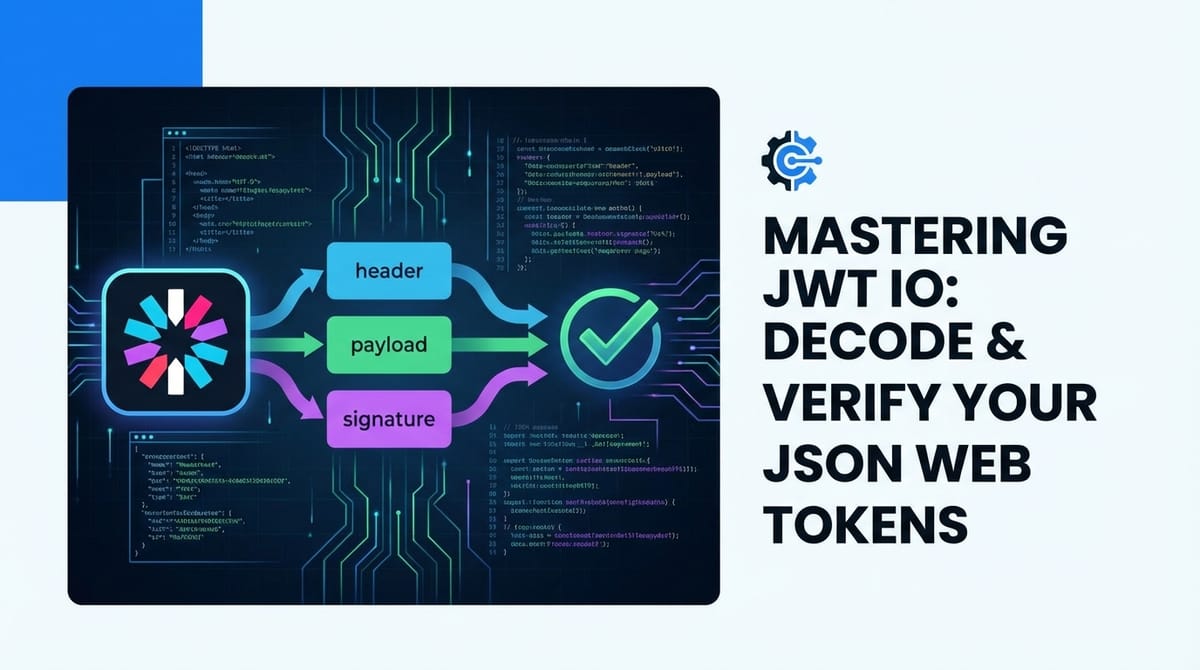
A JSON Web Token (JWT) is not a monolithic block of encrypted data, but rather a string composed of three distinct, concatenated parts, each serving a specific purpose. These parts are separated by dots (.) and are referred to as the Header, the Payload, and the Signature. Each segment is individually base64url encoded before being joined to form the complete token string. Understanding the function and content of each part is fundamental to grasping how JWTs operate and how they should be handled, decoded, and most importantly, verified.
1. The Header (Header.Payload.Signature)
The header, often referred to as the JWS Header (JSON Web Signature Header), is the first part of a JWT. It is a JSON object that typically contains two crucial pieces of information:
alg(Algorithm): This claim specifies the cryptographic algorithm used for signing the JWT. Common algorithms includeHS256(HMAC using SHA-256),RS256(RSA Signature with PKCS#1 v1.5 padding using SHA-256), andES256(ECDSA using P-256 and SHA-256). The choice of algorithm dictates the type of key required for verification (e.g., a shared secret for HMAC, or a public/private key pair for RSA/ECDSA). It's critical that thealgclaim is explicitly defined and that the verifier does not default tonone, which would render the token unsigned and easily forgeable.typ(Type): This claim specifies the type of the token, which is usually "JWT". This helps applications differentiate between various types of tokens they might encounter.
Here's an example of a header, before base64url encoding:
{
  "alg": "HS256",
  "typ": "JWT"
}
This JSON object is then base64url encoded to form the first segment of the JWT string. The base64url encoding scheme is a variation of base64 that is URL-safe, meaning it uses characters that can safely be transmitted within a URL without needing further encoding.
2. The Payload (Header.Payload.Signature)
The payload, also known as the JWS Payload or JWT Claims Set, is the second part of the JWT. It is another JSON object that contains the "claims" – assertions about an entity (typically the user) and additional data. Claims are essentially key-value pairs that convey information. There are three types of claims:
- Registered Claims: These are a set of predefined, non-mandatory claims that provide a set of useful, interoperable claims. While not mandatory, it's recommended to use them to ensure broad compatibility.
iss(Issuer): Identifies the principal that issued the JWT. (e.g.,https://example.com)sub(Subject): Identifies the principal that is the subject of the JWT. (e.g., a user ID)aud(Audience): Identifies the recipients that the JWT is intended for. Each principal intended to process the JWT MUST identify itself with a value in the audience claim.exp(Expiration Time): Identifies the expiration time on or after which the JWT MUST NOT be accepted for processing. This is a numeric date (Unix epoch time).nbf(Not Before): Identifies the time before which the JWT MUST NOT be accepted for processing. Also a numeric date.iat(Issued At): Identifies the time at which the JWT was issued. Also a numeric date.jti(JWT ID): Provides a unique identifier for the JWT. This can be used to prevent replay attacks.
- Public Claims: These are claims defined by those who use JWTs, but to avoid collisions, they should be registered in the IANA JSON Web Token Claims Registry or be defined as a URI that contains a collision-resistant namespace. Essentially, they are custom claims that you expect others to understand.
- Private Claims: These are custom claims created to share information between parties that agree upon their meaning. They are not registered or publicly defined and are used for application-specific data. Examples might include
userId,role, ortenantId.
Crucially, because the payload is only base64url encoded (not encrypted), sensitive information should never be stored in the payload. Anyone with access to the token can easily decode it and read its contents. The security of the JWT relies on the signature to ensure its integrity, not its confidentiality.
Here's an example of a payload:
{
  "sub": "1234567890",
  "name": "John Doe",
  "iat": 1516239022,
  "exp": 1516242622,
  "isAdmin": true
}
This JSON object is also base64url encoded to form the second segment of the JWT.
3. The Signature (Header.Payload.Signature)
The signature is the third and most critical part of a JWT from a security perspective. It is created by taking the base64url encoded header, the base64url encoded payload, and a secret (or a private key), and then applying the cryptographic algorithm specified in the header.
The signature essentially proves two things:
- Integrity: That the token has not been tampered with since it was issued. If even a single character in the header or payload is changed, the signature verification will fail.
- Authenticity: That the token was indeed created by the expected issuer, who holds the secret key (or private key) used to sign it.
The process of creating the signature typically involves these steps:
- Take the base64url encoded Header.
- Take the base64url encoded Payload.
- Concatenate them with a dot:
base64url(Header) + "." + base64url(Payload). - Apply the cryptographic algorithm (specified in
algin the header) using the appropriate secret or private key to this concatenated string. - Base64url encode the resulting cryptographic hash/signature.
For an HS256 algorithm, for example, the signature is computed as: HMACSHA256( base64url(Header) + "." + base64url(Payload), secret )
For RS256 or ES256, a private key is used for signing, and the corresponding public key is used for verification. This asymmetric approach is particularly useful in scenarios where multiple services need to verify tokens issued by a central authority, but only the central authority possesses the private key for signing.
The resulting base64url encoded signature forms the third segment of the JWT.
Putting It All Together
When you see a complete JWT, it looks something like this:
eyJhbGciOiJIUzI1NiIsInR5cCI6IkpXVCJ9.eyJzdWIiOiIxMjM0NTY3ODkwIiwibmFtZSI6IkpvaG4gRG9lIiwiaWF0IjoxNTE2MjM5MDIyLCJleHAiOjE1MTYyNDI2MjIsImlzQWRtaW4iOnRydWV9.SflKxwRJSMeKKF2QT4fwpMeJf36POk6yJV_adQssw5c
Here, each segment is separated by a dot:
eyJhbGciOiJIUzI1NiIsInR5cCI6IkpXVCJ9(Base64url encoded Header)eyJzdWIiOiIxMjM0NTY3ODkwIiwibmFtZSI6IkpvaG4gRG9lIiwiaWF0IjoxNTE2MjM5MDIyLCJleHAiOjE1MTYyNDI2MjIsImlzQWRtaW4iOnRydWV9(Base64url encoded Payload)SflKxwRJSMeKKF2QT4fwpMeJf36POk6yJV_adQssw5c(Base64url encoded Signature)
Understanding this tripartite structure is the gateway to effectively working with JWTs. It highlights that while the header and payload contain human-readable (after decoding) information, it is the signature that truly imbues the token with its security properties, guaranteeing its integrity and authenticity. Without a valid signature, the claims within a JWT are mere assertions, devoid of trust.
Decoding a JWT: Unveiling the Information Within
Decoding a JWT is often the first step when working with these tokens, whether you're debugging an application, inspecting a token received from an identity provider, or simply trying to understand its contents. It's crucial to understand that decoding is fundamentally different from verification. Decoding merely converts the base64url encoded segments of the token back into their original JSON (or binary) format, revealing the header and payload in a human-readable form. It does not check the validity of the signature, nor does it guarantee that the token hasn't been tampered with. It's like reading the text written on a passport without checking if the passport itself is authentic or expired.
Why Decode? Practical Use Cases
There are several compelling reasons why you might need to decode a JWT:
- Inspection and Debugging: This is perhaps the most common reason. Developers frequently decode JWTs to confirm that the correct claims (user ID, roles, permissions, expiration time) are being issued and transmitted. If an application is behaving unexpectedly, decoding the JWT can quickly reveal if the token itself contains incorrect or missing information.
- Understanding Token Flow: In complex authentication flows involving multiple services or an
api gateway, decoding tokens at various stages can help trace how claims evolve or are propagated, ensuring the system behaves as intended. - Client-Side Display (with caution): Sometimes, non-sensitive information from the JWT payload (e.g., a user's display name or avatar URL) might be used directly by the client-side application for UI purposes. In such cases, the client-side code might decode the token to extract this information. However, this should only be done for information that is not security-critical, as client-side decoding offers no guarantee of authenticity. Any security-sensitive decisions must always be made based on a fully verified token on the server side.
- Before Verification (for header information): In some verification scenarios, especially when dealing with asymmetric algorithms (like RS256), the verifier might need to inspect the header to determine which public key (e.g., from a JWKS endpoint) should be used to verify the signature. Decoding the header is a prerequisite for this.
How to Decode: Methods and Tools
Decoding a JWT is a straightforward process because it only involves base64url decoding. You don't need a secret key or a public key to perform this operation.
1. Online Decoders
The easiest and quickest way to decode a JWT for inspection is to use one of the many online tools available. Popular choices include:
- jwt.io: This is the official tool and a widely used resource. You simply paste your JWT into the encoded section, and it will instantly display the decoded header and payload, along with the calculated signature (though it won't verify it without the key).
- Other online JWT debuggers: Many other websites offer similar functionality.
While convenient for quick checks, exercise extreme caution when pasting sensitive or production JWTs into public online tools, as the data is transmitted to a third-party server. For highly sensitive tokens, consider offline methods.
2. Programmatic Decoding (Using Libraries)
In a real-world application, you'll typically use a JWT library available for your programming language. These libraries abstract away the base64url decoding and JSON parsing, providing convenient methods to access the header and payload.
Here's a conceptual example using pseudo-code:
// Assuming 'jwtString' is your JWT, e.g., "eyJhbGciOiJIUzI1NiIsInR5cCI6IkpXVCJ9.eyJzdWIiOiIxMjM0NTY3ODkwIiwibmFtZSI6IkpvaG4gRG9lIiwiaWF0IjoxNTE2MjM5MDIyLCJleHAiOjE1MTYyNDI2MjIsImlzQWRtaW4iOnRydWV9.SflKxwRJSMeKKF2QT4fwpMeJf36POk6yJV_adQssw5c"

function decodeJwt(jwtString):
  parts = jwtString.split('.')
  if parts.length != 3:
    throw Error("Invalid JWT format: expected 3 parts")

  encodedHeader = parts[0]
  encodedPayload = parts[1]

  decodedHeader = base64urlDecode(encodedHeader)
  decodedPayload = base64urlDecode(encodedPayload)

  headerObject = parseJson(decodedHeader)
  payloadObject = parseJson(decodedPayload)

  return { header: headerObject, payload: payloadObject }

// Example usage:
tokenInfo = decodeJwt(jwtString)
print("Decoded Header:", tokenInfo.header)
print("Decoded Payload:", tokenInfo.payload)
Most robust JWT libraries will offer a method like decode(tokenString, { complete: true }) that returns both the header and payload as parsed JSON objects.
3. Manual Decoding (Conceptual)
For educational purposes, it's useful to understand the manual steps:
- Split the token: Separate the JWT string into its three parts at the
.characters.part1 = encodedHeaderpart2 = encodedPayloadpart3 = encodedSignature
- Base64url Decode: For
part1andpart2, use a base64url decoder. Many programming languages have built-in functions for this (e.g., Python'sbase64.urlsafe_b64decode, Node.jsBuffer.from(str, 'base64url')). - Parse JSON: The result of the base64url decoding for
part1andpart2will be a JSON string. Parse these strings into their respective JSON objects.
It is paramount to reiterate: decoding alone provides no security guarantee. The information revealed by decoding should never be blindly trusted for making authorization decisions or any security-sensitive logic. Its primary role is for inspection and debugging. Trust comes only after successful verification.
Verifying a JWT: The Crucial Security Step
Verification is the bedrock of JWT security. Unlike decoding, which merely reveals the token's contents, verification is a comprehensive process that validates the token's authenticity, integrity, and adherence to specific rules. It ensures that the token genuinely originated from a trusted source, hasn't been tampered with, and is still valid for use. Any system that relies on JWTs for authorization or authentication MUST perform robust verification. Skipping this step is akin to accepting a handwritten note without checking the signature or the sender's identity – a recipe for disaster.
Why Verification is Non-Negotiable
The importance of JWT verification cannot be overstated. It addresses fundamental security concerns:
- Integrity: Verification confirms that the token's header and payload have not been altered in transit or by a malicious actor. If even a single character in the base64url encoded header or payload is changed, the signature will no longer match, and verification will fail. This prevents attackers from manipulating claims (e.g., changing
isAdmin: falsetoisAdmin: true). - Authenticity: It proves that the token was signed by the legitimate issuer, who possesses the secret key (for symmetric algorithms) or the private key (for asymmetric algorithms). This prevents unauthorized parties from forging tokens and impersonating legitimate users or services.
- Validity of Claims: Beyond the cryptographic signature, verification involves checking the registered claims within the payload to ensure the token is currently usable:
exp(Expiration Time): The token must not have expired.nbf(Not Before Time): The token must be used on or after the specified time.iss(Issuer): The token must have been issued by a trusted entity.aud(Audience): The token must be intended for the specific service or application that is verifying it.iat(Issued At Time): Optionally checked for age or freshness, though not typically a strict failure condition.jti(JWT ID): Can be used to prevent replay attacks or to implement single-use tokens.
Without thorough verification, an attacker could craft a token with arbitrary claims, sign it with a fake key (or no key if the alg claim is ignored), and gain unauthorized access to resources. This is why every api gateway or backend service that accepts JWTs must have a robust verification mechanism in place.
The Verification Process: Step-by-Step
JWT verification involves a series of checks, typically performed in a specific order:
- Structure Validation:
- Ensure the token string consists of exactly three dot-separated parts.
- Attempt to base64url decode each of the first two parts (header and payload). If decoding fails, the token is malformed.
- Parse the decoded header and payload as JSON.
- Header Validation:
- Check the
alg(algorithm) claim. It must be present and correspond to an allowed algorithm. Crucially, never trust thealgvalue blindly. The verifier must independently decide which algorithm it expects, or mapalgto a known, secure key. An attacker might try to setalg: "none"to bypass signature verification. Libraries typically handle this by requiring you to specify the expected algorithm. - Check the
typ(type) claim (if present and expected to be "JWT").
- Check the
- Signature Verification: This is the most critical cryptographic step.
- Recompute the Signature: Using the base64url encoded header, the base64url encoded payload, and the expected secret (for symmetric algorithms) or the public key (for asymmetric algorithms), recompute the signature using the algorithm specified in the header.
- Compare Signatures: Compare the recomputed signature with the signature provided in the third part of the JWT. If they do not match, the token has been tampered with or was signed by an unknown entity. The token MUST be rejected immediately.
- Key Management:
- Symmetric Algorithms (e.g., HS256): Both the issuer and the verifier use the same secret key. This key must be kept confidential and securely shared.
- Asymmetric Algorithms (e.g., RS256, ES256): The issuer uses a private key to sign the token, and the verifier uses the corresponding public key to verify. Public keys are designed to be shared openly, often via a JSON Web Key Set (JWKS) endpoint. A JWKS is a set of keys containing the public keys used by the issuer. The verifier can fetch the JWKS, identify the correct key using the
kid(key ID) claim in the JWT header, and then use it for verification. This approach significantly simplifies key rotation and management in distributed systems.
- Claim Validation (Payload Validation): Once the signature is verified, the claims in the payload can be trusted for integrity and authenticity. Now, their validity for the current context is checked:
exp(Expiration Time): Check if the current time is before theexptime. Most libraries allow for a "leeway" or "clock skew" tolerance (e.g., a few minutes) to account for minor time differences between systems.nbf(Not Before Time): Check if the current time is on or after thenbftime.iss(Issuer): Verify that theissclaim matches the expected issuer (e.g.,https://auth.example.com). This ensures the token came from a trusted identity provider.aud(Audience): Verify that theaudclaim contains a value that identifies the current service or application as an intended recipient. A token might be valid but not intended for this particularapi.- Other Custom Claims: Validate any application-specific private claims as necessary. For example, if a
roleclaim is present, ensure it's a valid role recognized by the system.
Example of Verification (Conceptual using a library)
import jwt
from jwt import PyJWTError

secret_key = "your-very-secret-key" # For HS256

# Or for RS256, you'd load a public key:
# public_key = open("public.pem", "r").read()

jwt_token = "eyJhbGciOiJIUzI1NiIsInR5cCI6IkpXVCJ9.eyJzdWIiOiIxMjM0NTY3ODkwIiwibmFtZSI6IkpvaG4gRG9lIiwiaWF0IjoxNTE2MjM5MDIyLCJleHAiOjE1MTYyNDI2MjIsImlzQWRtaW4iOnRydWV9.SflKxwRJSMeKKF2QT4fwpMeJf36POk6yJV_adQssw5c"

try:
    # Verify the token
    # For HS256:
    decoded_payload = jwt.decode(jwt_token, secret_key, algorithms=["HS256"], audience="your-api-service", issuer="https://your-auth-server.com")

    # For RS256:
    # decoded_payload = jwt.decode(jwt_token, public_key, algorithms=["RS256"], audience="your-api-service", issuer="https://your-auth-server.com")

    print("JWT Verified Successfully!")
    print("Decoded Payload:", decoded_payload)

    # Now you can trust the claims in decoded_payload
    user_id = decoded_payload.get("sub")
    is_admin = decoded_payload.get("isAdmin")
    print(f"User ID: {user_id}, Admin Status: {is_admin}")

except PyJWTError as e:
    print(f"JWT Verification Failed: {e}")
    # Handle specific errors like ExpiredSignatureError, InvalidAudienceError, InvalidIssuerError etc.
    # In a real application, this would typically result in a 401 Unauthorized response.
In this example, the jwt.decode function (from a Python library) handles all the underlying steps: splitting, base64url decoding, JSON parsing, signature recomputation and comparison, and claims validation (exp, aud, iss). If any of these checks fail, an exception is raised, and the token is rejected.
Proper JWT verification is not just a best practice; it is a fundamental security requirement for any system that utilizes these tokens. It is the gatekeeper that separates legitimate access from potential threats, reinforcing the integrity and trustworthiness of your digital interactions.
Comparing Decoding and Verification: A Clear Distinction
To solidify your understanding, it's crucial to highlight the fundamental differences between decoding and verifying a JWT. While both processes involve interacting with a JWT, their purposes, methods, and security implications are vastly distinct.
| Feature | JWT Decoding | JWT Verification |
|---|---|---|
| Primary Purpose | To read the contents (header & payload) of the token. | To confirm the token's authenticity, integrity, and validity. |
| Inputs Required | The JWT string itself. | The JWT string, the expected signing key (secret/public key), and often expected claims like audience, issuer. |
| Security Impact | None. Reveals information, but does not guarantee its trustworthiness. No security decisions should be based on a decoded-only token. | Crucial for security. Forms the basis for trusting the token's claims and making authorization decisions. |
| Confidentiality | Reveals information that was never encrypted (only base64url encoded). | Does not encrypt or decrypt the payload. Primarily concerned with integrity and authenticity. |
| Integrity Check | No. Does not detect if the token has been altered. | Yes. Cryptographically checks if the token (header & payload) has been tampered with. |
| Authenticity Check | No. Does not confirm who issued the token. | Yes. Cryptographically confirms the token was issued by the expected entity. |
| Claim Validation | No. Does not check exp, nbf, iss, aud, etc. |
Yes. Checks exp, nbf, iss, aud, and other claims for validity and context. |
| Error Handling | May fail if the token is malformed (e.g., not properly base64url encoded). | Can fail due to malformed token, invalid signature, expired token, incorrect issuer, wrong audience, etc. |
| Typical Use Cases | Debugging, inspection, displaying non-sensitive info on client side, initial parsing to get kid for key lookup. |
Authentication, authorization, securing api endpoints, ensuring data integrity in cross-service communication. |
| Implementation | Simple base64url decoding and JSON parsing, often done client-side or during initial server-side parsing. | Requires cryptographic libraries, key management, and robust error handling, exclusively done on the server-side (api gateway, backend service). |
In essence, decoding is about "reading" what's written on the token, while verification is about "trusting" what's written and "who" wrote it. For any security-critical application, verification is always the indispensable step, while decoding often serves as a preparatory or diagnostic measure. Never confuse the two, as doing so can lead to significant security vulnerabilities.
APIPark is a high-performance AI gateway that allows you to securely access the most comprehensive LLM APIs globally on the APIPark platform, including OpenAI, Anthropic, Mistral, Llama2, Google Gemini, and more.Try APIPark now! 👇👇👇
Common Use Cases for JWTs in Modern Applications
JSON Web Tokens have become a cornerstone in many modern application architectures, particularly those built around apis and microservices. Their stateless nature, compactness, and verifiable security properties make them an ideal choice for a variety of scenarios. Understanding these common use cases helps contextualize their importance and proper implementation.
1. Authentication and Authorization
This is by far the most prevalent use case for JWTs. In a typical web or mobile application, when a user successfully logs in, the authentication server (or identity provider) generates a JWT. This token, containing claims about the user (e.g., user ID, roles, permissions), is then returned to the client.
- Authentication: For subsequent requests, the client includes this JWT, usually in the
Authorization: Bearer <token>header. The receiving server (orapi gateway) verifies the token's signature and claims. If valid, the user is considered authenticated without needing to hit a database for session lookup, making the process highly efficient and scalable. - Authorization: Once authenticated, the claims within the JWT (e.g.,
isAdmin: true,permissions: ["read:data", "write:reports"]) are used to make fine-grained authorization decisions. Theapiendpoint can check these claims directly to determine if the authenticated user has the necessary privileges to access a particular resource or perform a specific action. This decouples authorization logic from the central authentication server, allowing individual microservices orapis to enforce their own access control policies based on trusted token data.
This model is particularly powerful for microservices architectures. Instead of each service needing to maintain session state or query a central authentication service for every request, they can simply verify the JWT independently using a shared secret or a public key. This stateless design greatly simplifies horizontal scaling and enhances resilience.
2. Single Sign-On (SSO)
JWTs are an excellent candidate for implementing Single Sign-On (SSO) solutions. In an SSO system, a user logs in once to a central identity provider (IdP) and is then automatically authenticated across multiple related applications without needing to re-enter their credentials.
When a user authenticates with the IdP, the IdP issues a JWT. This token can then be used by the user's browser or application to access various other services or applications within the same ecosystem. Each service verifies the JWT against the IdP's public key (if asymmetric signing is used) or shared secret. Since the token is issued by a trusted central authority and contains verifiable identity information, each application can grant access confidently. This provides a seamless user experience and simplifies identity management across a suite of interconnected applications.
3. Secure Information Exchange
Beyond user authentication, JWTs can be used to securely transmit any kind of information between two parties. The key here is "securely" in terms of integrity and authenticity. For example:
- API-to-API Communication: When one
apiservice needs to call anotherapiservice, it can generate a JWT with specific claims about itself (e.g., its service ID, authorized scopes) and sign it. The receiving service can then verify this JWT to authenticate the calling service and authorize its request. This is particularly useful in complex microservice environments where services need to interact securely without direct user involvement. - Proof of Data Integrity: A system might generate a JWT containing important data (e.g., an order ID, a transaction status) and sign it. This token can then be passed around to various components, each verifying the signature to ensure the data hasn't been altered since it was originally asserted by the issuer. This is not for confidentiality (as the payload is readable), but for guaranteeing that the data is authentic and intact.
4. Client Credentials and OAuth 2.0 Flows
In the context of OAuth 2.0, JWTs play a crucial role, especially in certain grant types:
- Client Credentials Grant: Instead of traditional client ID and secret, a client can authenticate with an authorization server using a signed JWT. This JWT asserts the client's identity and is signed using a private key known only to the client and verifiable by the authorization server with the corresponding public key. This provides a more robust and secure authentication mechanism for client applications.
- Authorization Code Flow with PKCE (Proof Key for Code Exchange): While not directly the JWT itself, JWTs are often issued as access tokens and ID tokens during this flow. The ID token (an OpenID Connect specific JWT) contains claims about the authenticated user and is meant for the client application to consume, while the access token (also often a JWT) is used to access protected resources on behalf of the user.
5. API Key Alternatives for Gateways and Services
Some systems utilize JWTs as a more secure and feature-rich alternative to traditional static api keys. Instead of a long-lived, unchangeable string, a client can be issued a JWT that acts as its api key. This JWT can include:
- Expiration: Automatically revokes access after a set time.
- Scopes/Permissions: Specifies exactly what the API key holder is allowed to do.
- Usage Limits: Can contain claims that
api gateways use to enforce rate limits or quotas.
This approach significantly enhances the security and manageability of api access, allowing for granular control and automated revocation, making it a powerful feature for any api management platform or api gateway like APIPark. APIPark, as an open-source AI gateway and API management platform, excels in managing, integrating, and deploying AI and REST services. Its capability to handle end-to-end API lifecycle management, including traffic forwarding and load balancing, perfectly aligns with the advanced security and authorization needs that JWTs fulfill. In such an environment, an API Gateway like APIPark would be the prime location for JWT verification and potentially for issuing new tokens or refreshing existing ones, acting as a crucial enforcement point for secure api interactions.
These diverse applications underscore the versatility and importance of JWTs in modern software development. Their ability to encapsulate verifiable claims and facilitate stateless authentication makes them an invaluable asset for building scalable, secure, and efficient systems, especially in the context of interconnected services managed by robust api gateway solutions.
Security Considerations and Best Practices for JWT Implementation
While JWTs offer significant advantages for stateless authentication and secure information exchange, their power comes with inherent security challenges. Improper implementation can lead to severe vulnerabilities. Adhering to best practices is not optional; it's fundamental to leveraging JWTs securely.
1. Always Verify the Signature – Never Trust Unsigned Tokens
This is the golden rule of JWT security. As discussed, decoding reveals information, but verification proves its integrity and authenticity. * Explicitly specify algorithms: When verifying, always explicitly declare the cryptographic algorithm(s) you expect (e.g., HS256, RS256). Never rely on the alg claim in the header to dictate which algorithm to use, as an attacker could manipulate this claim (e.g., set it to none) to bypass signature checks. * Strong, unique secrets: For symmetric algorithms (HS256), use strong, cryptographically random, long, and unique secrets. These secrets must be kept confidential, never hardcoded, and rotated regularly. * Secure key management: For asymmetric algorithms (RS256, ES256), manage private keys with utmost care. They should be stored in secure environments (e.g., hardware security modules, vault services) and never exposed. Public keys can be distributed more openly, ideally via JWKS endpoints.
2. Never Put Sensitive Data in the Payload
The payload of a JWT is only base64url encoded, not encrypted. Anyone with the token can easily decode it and read its contents. Therefore: * No PII (Personally Identifiable Information): Avoid including sensitive user data like passwords, credit card numbers, or full addresses. * Minimize claims: Only include essential, non-sensitive claims required for authentication and authorization decisions. Less data means less exposure. * Consider JWE for Confidentiality: If you must transmit sensitive data within a token, use JSON Web Encryption (JWE) instead of (or in conjunction with) JWS. JWE provides confidentiality, but adds significant complexity.
3. Implement Short Expiry Times (exp Claim)
Short-lived tokens reduce the window of opportunity for attackers to exploit a compromised token. * Balance security and UX: Choose an expiration time that balances security needs with user experience (e.g., 15-60 minutes for access tokens). * Use Refresh Tokens: For longer sessions, pair short-lived access tokens with longer-lived refresh tokens. Refresh tokens are typically single-use, stored securely, and used to obtain new access tokens when the old ones expire. They should have their own robust security measures, including revocation.
4. Implement Robust Revocation Strategies (for compromised tokens)
JWTs are stateless by design, making revocation a challenge since servers don't store token state. However, mechanisms exist to mitigate this: * Short expiry + Refresh Tokens: As mentioned, this is the primary strategy. Revoke refresh tokens immediately if a user logs out or a compromise is suspected. * Blacklisting/Denylisting: For immediate revocation of an access token, maintaining a server-side blacklist of compromised or invalidated JWTs (using the jti claim) is an option. However, this reintroduces state and can impact performance, especially in distributed systems. It's often viable only for small-scale blacklists or when an api gateway centrally manages this. * Changing Signing Keys: If a signing key is compromised, rotate it immediately and invalidate all tokens signed with the old key. This is a disruptive, last-resort measure.
5. Validate All Relevant Claims (iss, aud, nbf, jti)
Beyond signature verification, proper claim validation is essential. * iss (Issuer): Always verify that the token was issued by your trusted identity provider. * aud (Audience): Ensure the token is intended for your specific service or application. This prevents tokens meant for one service from being used to access another. * nbf (Not Before): Check that the token is not being used prematurely. * jti (JWT ID): If using jti for uniqueness or replay prevention, store a record of used jtis and reject tokens with duplicate jtis. * Custom Claims: Validate any custom claims for expected values or types.
6. Secure Token Storage on the Client-Side
How clients store JWTs directly impacts security. * HTTP-only cookies: For browser-based applications, storing JWTs (especially refresh tokens) in HTTP-only cookies can protect against XSS (Cross-Site Scripting) attacks, as JavaScript cannot access them. * Local Storage/Session Storage (with caution): Access tokens are often stored here, but they are vulnerable to XSS. If using local storage, ensure your application has strong XSS prevention measures in place. * Memory/Secure Storage: For mobile apps, storing tokens in memory or platform-specific secure storage (e.g., iOS Keychain, Android Keystore) is generally preferred.
7. Protect Against Common Attacks
- Signature Stripping: Ensure your verifier explicitly checks for the
algclaim and rejectsalg: "none". - Algorithm Confusion: If your application supports multiple algorithms, ensure the key used for verification matches the
algclaim and the expected key type. An attacker might try to use a public key meant for RS256 as a symmetric key for HS256. - Cross-Site Request Forgery (CSRF): While JWTs themselves don't inherently prevent CSRF, if they are stored in cookies, you must implement CSRF protection (e.g., CSRF tokens, SameSite cookies).
- Replay Attacks: If tokens don't expire quickly enough and
jtiis not used, an attacker could replay a valid token. Short expiry andjtiwith blacklisting/denylisting are key mitigations.
By diligently applying these best practices, developers can harness the efficiency and scalability of JWTs while building resilient and secure authentication and authorization systems. A strong api gateway or api management platform can greatly assist in enforcing many of these security measures centrally, acting as the first line of defense for your apis.
JWTs in a Modern API Landscape: The Role of API Gateways
In today's distributed application landscape, especially those embracing microservices and public apis, the concept of an api gateway has become central to managing traffic, security, and developer experience. JWTs and api gateways form a symbiotic relationship, with the gateway often acting as the primary enforcement point for JWT-based authentication and authorization. Understanding this interplay is crucial for designing robust and secure api ecosystems.
An api gateway acts as a single entry point for all client requests, routing them to the appropriate backend services. It sits between the client and the collection of api services, performing various cross-cutting concerns that would otherwise need to be implemented in each individual service. This includes routing, load balancing, caching, request and response aggregation, and crucially, security.
How API Gateways Handle JWTs
The api gateway plays a pivotal role in the lifecycle of a JWT, particularly during the verification phase:
- Centralized JWT Verification:
- One of the primary responsibilities of an
api gatewayis to perform initial authentication and authorization checks. When a client sends a request with a JWT in theAuthorizationheader, thegatewayis the first component to receive it. - Instead of each backend microservice needing to implement its own JWT verification logic, the
gatewaycan handle this centrally. It verifies the token's signature (using the appropriate secret or public key) and validates critical claims likeexp,iss, andaud. This reduces boilerplate code in individual services and ensures consistent security policies across allapis. - If the JWT is invalid (e.g., expired, tampered, wrong issuer), the
gatewaycan immediately reject the request with a401 Unauthorizedor403 Forbiddenresponse, preventing unauthorized traffic from ever reaching backend services.
- One of the primary responsibilities of an
- Claim Enrichment and Transformation:
- Upon successful verification, the
api gatewaycan extract claims from the JWT payload. These claims can then be used to enrich the request before forwarding it to the downstream service. For example, it might add aX-User-IDheader with thesubclaim orX-User-Roleswith role information. - This allows backend services to receive already validated and transformed user context, simplifying their own logic and focusing solely on business operations, rather than repetitive authentication checks.
- Upon successful verification, the
- Role-Based Access Control (RBAC) and Policy Enforcement:
- Many
api gateways offer robust policy engines that can make authorization decisions based on JWT claims. For instance, agatewaycan be configured to only allow requests with arole: "admin"claim to access certainapiendpoints. - This provides a powerful layer of coarse-grained authorization at the perimeter, protecting services from unauthorized access even before they process the request.
- Many
- Rate Limiting and Quotas:
- JWT claims can also be used by the
api gatewayto enforce rate limits or quotas specific to a user or client application. For example, atier: "premium"claim could grant higher request limits than atier: "basic"claim.
- JWT claims can also be used by the
- Key Management Integration (JWKS):
- For
api gateways dealing with asymmetric JWTs (RS256, ES256) issued by an external identity provider, thegatewaycan be configured to dynamically fetch and cache public keys from the issuer's JWKS endpoint. This automates key rotation and simplifies the management of trust relationships.
- For
APIPark: An AI Gateway for Modern API Management
This is where a solution like APIPark comes into play, exemplifying how an AI gateway and API management platform can integrate seamlessly with JWTs. APIPark, as an open-source platform, is designed to be a comprehensive gateway solution, not just for traditional REST apis but also for the rapidly evolving landscape of AI services.
APIPark’s capabilities directly support and enhance JWT-based security:
- Unified API Format and Authentication: By standardizing request formats and providing unified management for authentication, APIPark can act as the central point for JWT validation for all integrated services, including 100+ AI models. This means whether it's a traditional REST endpoint or a sophisticated LLM inference
api, the same JWT security policies can be consistently applied and enforced at thegatewaylevel. - End-to-End API Lifecycle Management: As a full-featured
api management platform, APIPark helps manage the entire lifecycle ofapis, from design to publication and invocation. Within this lifecycle, thegatewaycan enforce subscription approval features, ensuring thatapiaccess requires explicit authorization, often mediated by valid JWTs. - Performance and Scalability: With its high-performance architecture (rivaling Nginx), APIPark can handle thousands of transactions per second, making it an ideal candidate to bear the load of JWT verification for high-traffic
apis. This ensures that the security overhead of JWT processing doesn't become a bottleneck. - Detailed Logging and Analysis: APIPark's comprehensive logging capabilities record every detail of
apicalls. This is invaluable for auditing JWT usage, troubleshooting authentication issues, and detecting potential security anomalies related to token access. Powerful data analysis tools can track long-term trends inapiusage and security events. - Tenant and Permissions Management: APIPark supports creating multiple teams (tenants) with independent applications and security policies. This maps directly to JWT claims like
tenantIdoraud, allowing thegatewayto route and authorize requests based on the tenant context embedded within the JWT.
In essence, an api gateway like APIPark elevates JWT implementation from a per-service concern to a centralized, managed capability. It acts as an intelligent traffic cop, security guard, and policy enforcer, ensuring that only authenticated and authorized requests, carrying valid and verified JWTs, ever reach the valuable backend services and AI models. This strategic placement of the gateway significantly simplifies api security, enhances operational efficiency, and provides a robust foundation for scalable api ecosystems.
Deep Dive: A Conceptual Walkthrough of Decoding and Verification in Action
To tie together the theoretical concepts with a practical understanding, let's walk through a conceptual example of a JWT's journey from issuance to verification within a typical web api scenario. Imagine a user interacting with an e-commerce platform that uses microservices and an api gateway.
Scenario: User Authentication and Product Listing API Access
- User Logs In:
- A user visits
shop.example.comand enters their credentials. - The browser sends these credentials to the Authentication Service (let's say
auth.example.com). - The Authentication Service verifies the credentials against its user database.
- A user visits
- JWT Issuance (Authentication Service):
- Upon successful login, the Authentication Service (the
issuer) generates a JWT. - Header:
{"alg": "HS256", "typ": "JWT"}(Using a symmetric algorithm for simplicity). - Payload (Claims):
json { "sub": "user-123", // Subject: User ID "name": "Alice Wonderland", // Custom claim: User's name "roles": ["customer"], // Custom claim: User roles "iss": "https://auth.example.com", // Issuer "aud": "https://api.example.com", // Audience: The API Gateway "exp": 1678886400, // Expiration Time (e.g., 1 hour from now) "iat": 1678882800, // Issued At Time ""jti": "unique-token-id-xyz" // JWT ID for potential blacklisting } - The Authentication Service uses its secret key (
AUTH_SECRET_KEY) to sign the token. - The complete JWT (
eyJhbGciOiJIUzI1NiIsInR5cCI6IkpXVCJ9.eyJzdWIiOiJ1c2VyLTEyMyIsIm5hbWUiOiJBbGljZSBXb25kZXJsYW5kIiwicm9sZXMiOlsiY3VzdG9tZXIiXSwiaXNzIjoiaHR0cHM6Ly9hdXRoLmV4YW1wbGUuY29tIiwiYXVkIjoiaHR0cHM6Ly9hcGkuZXhhbXBsZS5jb20iLCJleHAiOjE2Nzg4ODY0MDAsImlhdCI6MTY3ODg4MjgwMCwiandiIjoiZWE5NDIyMTc1NjAwNDYwNTk4NjcyZTEwMjUxMTczZGUifQ.b5W0pWqY0N5j1oH9iY8f4L-c2tG3eS7rD7P5Q1V_kE0) is sent back to the user's browser. - The browser stores this token (e.g., in local storage).
- Upon successful login, the Authentication Service (the
- User Accesses Product Listing (Client-Side):
- The user navigates to the "Products" page.
- The browser needs to fetch product data from the
api. It makes an HTTP GET request tohttps://api.example.com/products. - It includes the JWT in the
Authorizationheader:Authorization: Bearer <JWT_STRING>.
- API Gateway: Initial JWT Verification:
- The request first hits the APIPark API Gateway (
api.example.com). - Step A: Decoding (Internal & Pre-check):
- APIPark immediately attempts to decode the JWT string. It splits it into three parts and base64url decodes the header and payload.
- Result:
- Decoded Header:
{"alg": "HS256", "typ": "JWT"} - Decoded Payload:
{ "sub": "user-123", "name": "Alice Wonderland", "roles": ["customer"], "iss": "https://auth.example.com", "aud": "https://api.example.com", "exp": 1678886400, "iat": 1678882800, "jti": "unique-token-id-xyz" }
- Decoded Header:
- Purpose: This initial decoding allows the
gatewayto quickly inspect thealgandaudclaims, which are essential for the subsequent verification steps. It also allows thegatewayto extract thejtiif it maintains a blacklist.
- Step B: Verification (Crucial Security Check):
- APIPark uses its pre-configured
AUTH_SECRET_KEY(which it shares with the Authentication Service) and thealg: HS256from the decoded header. - It recomputes the signature using the original encoded header, encoded payload, and
AUTH_SECRET_KEY. - It compares the recomputed signature with the signature provided in the JWT.
- If Signatures Don't Match: The token is rejected immediately (e.g.,
401 Unauthorized). This prevents tampering. - If Signatures Match: The
gatewayproceeds to validate claims:expcheck: Isexp(1678886400) in the future? (Yes, if current time is before then). If expired, reject (401 Unauthorized).isscheck: Doesiss(https://auth.example.com) match the expected issuer? (Yes). If not, reject.audcheck: Doesaud(https://api.example.com) match thegateway's own identifier or the intended downstreamapi? (Yes). If not, reject.jticheck (optional): Is "unique-token-id-xyz" on a blacklist of revoked tokens? (No, assume it's valid). If yes, reject.
- If All Checks Pass: The JWT is deemed valid and trusted.
- APIPark uses its pre-configured
- The request first hits the APIPark API Gateway (
- API Gateway: Request Enrichment and Forwarding:
- APIPark extracts relevant claims from the validated payload, such as
sub: "user-123"androles: ["customer"]. - It adds these as custom HTTP headers to the request it will forward:
X-User-ID: user-123,X-User-Roles: customer. - It then routes the request to the appropriate backend Product Microservice. The original JWT may or may not be forwarded, depending on the architecture (often, the
gatewayconsuming and replacing it with derived headers is preferred for simplicity in microservices).
- APIPark extracts relevant claims from the validated payload, such as
- Product Microservice: Authorization Decision:
- The Product Microservice receives the request with
X-User-ID: user-123andX-User-Roles: customer. - It trusts these headers because they came from the verified
APIPark API Gateway. - The microservice checks if a user with the role "customer" is allowed to view product listings. (Yes, typically).
- It fetches the product data and returns it to the
gateway.
- The Product Microservice receives the request with
- Response to Client:
- APIPark receives the response from the Product Microservice and forwards it back to the user's browser.
This conceptual walkthrough highlights that while decoding is an initial step, it's the comprehensive verification performed by the api gateway (or the initial service endpoint) that establishes trust and allows for secure authorization decisions throughout the api ecosystem. APIPark, acting as a central gateway, consolidates this critical security function, streamlining development and bolstering overall system security.
Advanced Topics: Beyond Basic Decoding and Verification
While mastering the core concepts of JWT decoding and verification is paramount, the world of JSON Web Tokens extends into more specialized and complex areas designed to address specific security and operational challenges. A brief overview of these advanced topics can help you understand the full spectrum of JWT capabilities.
1. JSON Web Encryption (JWE): Adding Confidentiality
As repeatedly emphasized, standard JWTs (JWS) provide integrity and authenticity through digital signatures, but they do not provide confidentiality. The payload is readable by anyone who obtains the token. This is often perfectly acceptable if only non-sensitive claims are included. However, there are scenarios where the information within a token must be kept secret from unauthorized parties. This is where JSON Web Encryption (JWE) comes in.
JWE is a complementary standard (RFC 7516) that defines a compact, URL-safe means of representing encrypted content. A JWE token looks similar to a JWS token but contains an encrypted payload. The structure includes:
- JOSE Header (JWE Header): Specifies the encryption algorithm (
enc) and the key management algorithm (alg) used. - Encrypted Key: The encrypted content encryption key (CEK).
- Initialization Vector (IV): Used in conjunction with the CEK for symmetric encryption.
- Ciphertext: The actual encrypted payload.
- Authentication Tag: Provides integrity protection for the ciphertext.
Using JWE adds a significant layer of complexity, as it involves managing encryption keys, chosen encryption algorithms, and handling the decryption process. It's typically reserved for situations where sensitive data absolutely must be transmitted within the token itself, but generally, it's advised to avoid putting sensitive data in tokens if possible, or use other secure communication channels for such information.
2. JWT Revocation: Addressing the Stateless Challenge
The stateless nature of JWTs is a core advantage, but it presents a challenge for revocation. Once a JWT is issued and signed, it remains valid until its expiration time, even if the user logs out or their permissions change. This is a crucial area for advanced consideration:
- Short-Lived Access Tokens with Refresh Tokens: This is the most common and recommended strategy. Access tokens are kept very short-lived (e.g., 5-15 minutes). When an access token expires, a longer-lived refresh token is used to obtain a new access token. If a user logs out, the refresh token is immediately revoked (e.g., blacklisted or deleted from a database). This limits the exposure window of a compromised access token.
- Centralized Blacklisting/Denylisting: For immediate revocation of access tokens, a service (often the
api gateway) can maintain a blacklist ofjti(JWT ID) claims of tokens that have been explicitly revoked. Every incoming token'sjtiis checked against this list. This reintroduces state and can impact performance, especially at scale. - Distributed Session Management with
api gateways: Advancedapi gatewaysolutions, like APIPark, can offer more sophisticated session management features that bridge the gap between stateless tokens and the need for revocation, often by abstracting the complexities of token lifecycle within thegatewayitself.
3. JSON Web Key Set (JWKS) Endpoints: Dynamic Key Management
For systems using asymmetric cryptographic algorithms (like RS256 or ES256) where a central identity provider (IdP) issues tokens and multiple services need to verify them, managing public keys can be cumbersome. This is especially true when keys need to be rotated.
JWKS endpoints solve this problem. An IdP exposes a standard /.well-known/jwks.json endpoint (or similar) that returns a JSON object containing an array of its public keys. Verifying services (e.g., api gateways, microservices) can:
- Read the
kid(Key ID) claim from the incoming JWT's header. - Fetch the JWKS from the IdP's endpoint (or retrieve from a cache).
- Locate the public key in the JWKS that matches the
kidfrom the JWT. - Use this specific public key to verify the JWT's signature.
This dynamic key discovery and rotation mechanism is essential for scalable, secure, and resilient identity ecosystems, as it removes the need for manual public key distribution and configuration. API Gateways are often configured to consume and utilize JWKS endpoints seamlessly.
4. Nested JWTs: Combining JWS and JWE
It's possible to combine JWS and JWE to create a "nested JWT." This involves encrypting a signed JWT. For example:
- A JWT is created and signed (JWS).
- This entire signed JWT string is then used as the payload for a new JWE token, which is then encrypted.
The result is a token that is both confidential (encrypted) and has verifiable integrity (signed). This is used in very specific scenarios where both properties are crucial, but it adds another layer of complexity to both issuance and processing.
5. OpenID Connect (OIDC) and ID Tokens: Identity Layer on OAuth 2.0
While not strictly a JWT topic, OpenID Connect (OIDC) heavily relies on JWTs. OIDC is an authentication layer built on top of the OAuth 2.0 authorization framework. It allows clients to verify the identity of the end-user based on the authentication performed by an authorization server, as well as to obtain basic profile information about the end-user.
The core of OIDC is the ID Token, which is a JWT. This ID Token contains claims about the authenticated user (e.g., sub, name, email, picture) and is specifically designed for the client application to consume to understand the user's identity. Unlike access tokens (which are for resource access), ID tokens are primarily for identity verification by the client. OIDC also defines well-known endpoints and discovery mechanisms that simplify integration with identity providers.
These advanced topics illustrate that while the foundational principles of JWTs are simple, their application in real-world, complex, and high-security environments often involves sophisticated architectural patterns and adherence to additional standards. A comprehensive understanding of JWTs means not only knowing how to decode and verify but also understanding when and how to apply these advanced techniques to build truly resilient systems.
Conclusion: The Indispensable Art of Mastering JWTs
The journey through the intricate world of JSON Web Tokens reveals them as powerful, versatile, and indeed, indispensable components of modern web security architecture. From their compact, self-contained structure to their cryptographic signatures, JWTs facilitate stateless authentication and secure information exchange, underpinning the scalability and efficiency of countless applications, particularly those leveraging microservices and apis.
We have meticulously dissected the anatomy of a JWT, understanding how its header, payload, and signature collaboratively encode verifiable claims. We distinguished the act of mere decoding – a diagnostic step unveiling information – from the critical process of verification, which is the ultimate arbiter of a token's authenticity and integrity. This distinction, often overlooked, is the bedrock upon which secure systems are built. Without robust verification, a JWT is merely a string of data, devoid of trust and ripe for exploitation.
Furthermore, we explored the myriad of scenarios where JWTs shine, from core authentication and authorization flows to complex Single Sign-On implementations and secure inter-service communication. We also delved into the crucial role of api gateways, such as APIPark, which stand as the frontline enforcers of JWT policies, centralizing verification, enriching requests, and bolstering the overall security posture of an api ecosystem. Their ability to manage and secure AI and REST services, performing high-performance JWT validation, highlights their importance in modern application deployment.
However, the power of JWTs is inextricably linked to the discipline of secure implementation. We outlined a comprehensive suite of best practices, emphasizing the critical importance of always verifying signatures, never embedding sensitive data in payloads, utilizing short expiration times, and implementing proactive revocation strategies. These guidelines are not mere suggestions but mandatory safeguards against the array of vulnerabilities that can arise from lax JWT handling.
Finally, our foray into advanced topics like JWE for confidentiality, sophisticated revocation patterns, and dynamic key management via JWKS endpoints demonstrated that while the basics are crucial, the JWT ecosystem offers sophisticated solutions for complex security requirements.
Mastering JWTs is more than just knowing how to use a library function; it's about understanding the underlying cryptographic principles, the security implications of each design choice, and the architectural patterns that ensure their effective and safe deployment. By embracing the art of decoding and the science of verification, developers, architects, and security professionals can confidently build resilient, scalable, and secure applications that thrive in the interconnected digital landscape. The digital handshake, when secured by a well-understood and properly verified JWT, is indeed a handshake of trust.
Frequently Asked Questions (FAQs)
1. What is the fundamental difference between decoding a JWT and verifying a JWT?
The fundamental difference lies in their purpose and security implications. Decoding a JWT (e.g., using an online tool or a programmatic base64url decode) simply converts the base64url encoded header and payload segments back into human-readable JSON objects. It allows you to inspect the token's contents but provides no security guarantee whatsoever. It does not check if the token has been tampered with or who issued it.
Verifying a JWT, on the other hand, is a comprehensive security process. It cryptographically checks the token's signature to ensure its integrity (that the header and payload haven't been altered) and authenticity (that it was signed by the expected issuer). Additionally, it validates critical claims within the payload, such as expiration time (exp), issuer (iss), and audience (aud). Verification is the only way to trust the information contained within a JWT.
2. Is it safe to store sensitive user data in a JWT's payload?
No, it is generally not safe to store sensitive user data (like passwords, credit card numbers, or personally identifiable information) directly in a JWT's payload. The payload is only base64url encoded, which is easily reversible and not an encryption method. Anyone who obtains the JWT can easily decode it and read its contents. While the signature ensures the integrity of the data (meaning it hasn't been tampered with), it does not provide confidentiality. If sensitive data must be transmitted securely within a token, consider using JSON Web Encryption (JWE), which encrypts the payload, but this adds significant complexity. As a best practice, minimize the claims in your JWTs to only the non-sensitive information necessary for authentication and authorization.
3. How do API Gateways, like APIPark, interact with JWTs?
API Gateways play a crucial role in managing JWTs, acting as a central enforcement point for API security. When a client sends a request with a JWT to an API Gateway (such as APIPark), the gateway typically performs several key functions: * Centralized Verification: It verifies the JWT's signature and validates its claims (e.g., expiration, issuer, audience) before the request reaches any backend services. This ensures consistent security policies and offloads verification logic from individual microservices. * Claim Extraction & Enrichment: Upon successful verification, the gateway can extract relevant claims from the JWT payload (e.g., user ID, roles) and inject them into the request as custom HTTP headers or context variables before forwarding the request to the downstream API service. * Policy Enforcement: The gateway can use JWT claims to enforce fine-grained access control, rate limits, or other API management policies at the perimeter. * Key Management: For asymmetric JWTs, API Gateways can often dynamically fetch and cache public keys from JWKS endpoints to simplify key rotation and management.
APIPark, being an AI gateway and API management platform, would leverage these capabilities to secure both traditional REST APIs and AI services, providing a unified and high-performance security layer.
4. What are refresh tokens, and how do they relate to JWT security?
Refresh tokens are a security mechanism used in conjunction with short-lived JWTs (access tokens) to improve security and user experience. Access tokens are designed to have short expiration times (e.g., 5-15 minutes) to minimize the window of opportunity for attackers to exploit a compromised token. When an access token expires, instead of forcing the user to re-authenticate, a longer-lived refresh token is sent to the authentication server to obtain a new, valid access token.
The relationship to security is critical: * Reduced Exposure: If a short-lived access token is compromised, its utility is limited by its rapid expiration. * Improved Revocation: Refresh tokens are typically single-use and can be easily revoked (e.g., blacklisted in a database) if a user logs out or a compromise is detected. This allows for immediate invalidation of access to an application. * Better UX: Users don't need to re-enter credentials frequently, as refresh tokens handle the silent renewal of access tokens.
5. Why is the "alg": "none" attack a significant vulnerability, and how can it be prevented?
The "alg": "none" attack (or signature stripping attack) is a severe vulnerability that can allow an attacker to bypass JWT signature verification entirely. In this attack, a malicious actor alters the JWT header to set the alg (algorithm) claim to "none". If the server-side verification library or code is poorly implemented and trusts this alg claim, it might attempt to verify the token with "no algorithm" (i.e., it skips the signature check), thus accepting any arbitrary payload. This allows an attacker to forge JWTs with any desired claims.
To prevent this attack: * Never trust the alg claim from the token's header. * Always explicitly specify the expected algorithm(s) in your verification logic. Your JWT library should be configured to only accept tokens signed with a predefined set of secure algorithms (e.g., HS256, RS256). If the alg in the token's header does not match one of these allowed algorithms, or if it is "none", the verification process should immediately fail and reject the token. Most robust JWT libraries handle this correctly by requiring the expected algorithms as a parameter during verification.
🚀You can securely and efficiently call the OpenAI API on APIPark in just two steps:
Step 1: Deploy the APIPark AI gateway in 5 minutes.
APIPark is developed based on Golang, offering strong product performance and low development and maintenance costs. You can deploy APIPark with a single command line.
curl -sSO https://download.apipark.com/install/quick-start.sh; bash quick-start.sh

In my experience, you can see the successful deployment interface within 5 to 10 minutes. Then, you can log in to APIPark using your account.

Step 2: Call the OpenAI API.