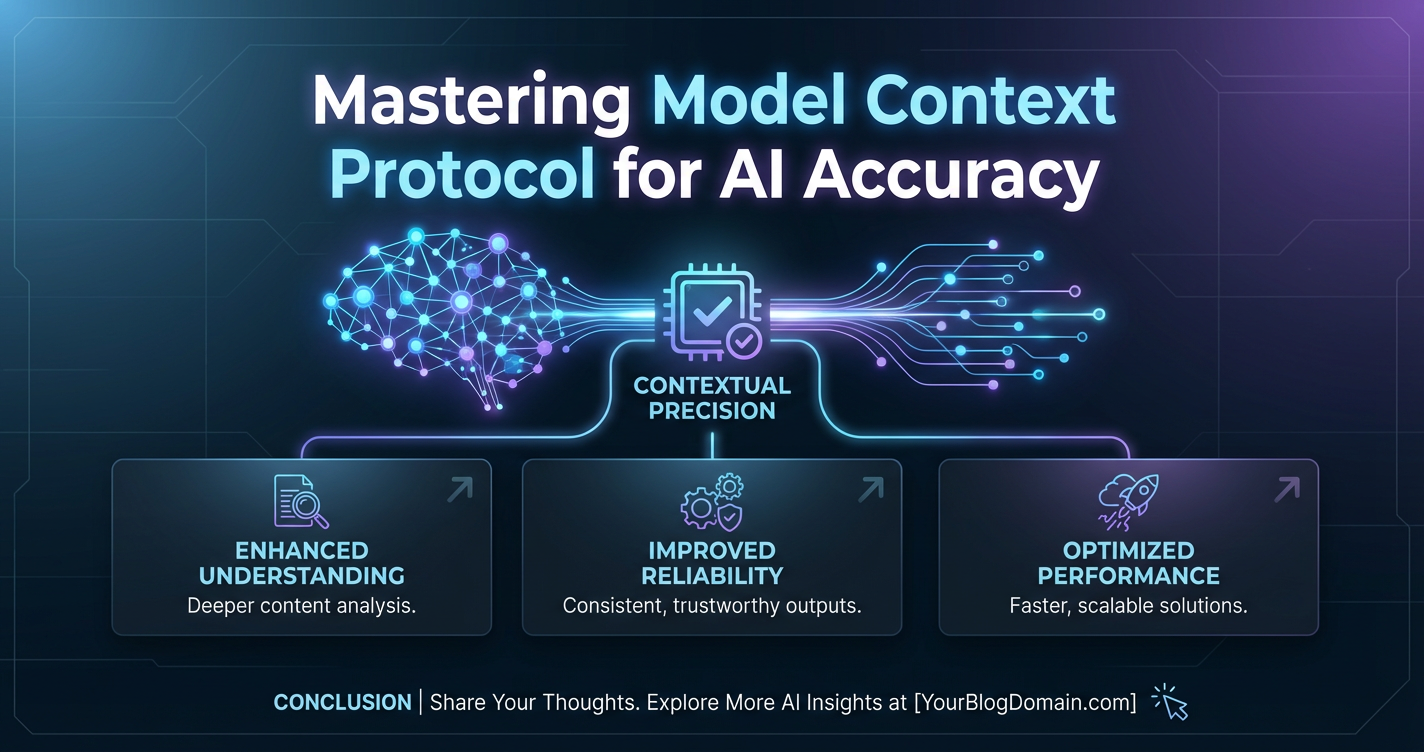
Mastering Model Context Protocol for AI Accuracy


In an era increasingly defined by artificial intelligence, the pursuit of accuracy is not merely an academic exercise but a critical determinant of success, safety, and trustworthiness across virtually every domain. From the nuanced diagnostics of healthcare AI to the precision required in autonomous navigation, the reliability of AI systems hinges on their ability to interpret, understand, and act upon information with profound exactness. However, the world is not a static collection of isolated data points; it is a tapestry woven with intricate relationships, dynamic circumstances, and implicit understandings—in essence, context. Without a robust mechanism to manage and leverage this contextual fabric, AI systems often falter, delivering outputs that are either irrelevant, misleading, or outright incorrect. This is precisely where the Model Context Protocol (MCP) emerges as a transformative framework, offering a systematic approach to imbue AI with the comprehensive understanding it needs to achieve unparalleled accuracy.
At its core, MCP provides a structured methodology for defining, capturing, storing, and utilizing contextual information that is pertinent to an AI model's operation. It addresses the fundamental limitation of many AI systems: their inherent "short-term memory" and their tendency to process information in isolation, devoid of the broader situational awareness that is second nature to human intelligence. By establishing a clear protocol for context management, MCP enables AI models to transcend simplistic pattern recognition, moving towards genuine comprehension and more intelligent decision-making. The efficacy of this protocol is intrinsically linked to the underlying context model—the specific representation or structure chosen to encapsulate this dynamic information, guiding the AI on how to interpret new data through the lens of accumulated knowledge.
This comprehensive article will embark on a deep exploration of the Model Context Protocol. We will unravel its foundational principles, dissect its architectural components, and illuminate its pivotal role in elevating AI accuracy across a myriad of applications. Furthermore, we will delve into the technical intricacies of its implementation, confronting the inherent challenges and proposing pragmatic solutions. By examining real-world applications and outlining best practices, we aim to provide a definitive guide for developers, researchers, and enterprises striving to harness the full potential of AI by mastering the art and science of context. Through this journey, it will become evident that the strategic adoption of MCP is not just an optimization; it is a fundamental shift towards building more reliable, intelligent, and human-centric AI systems.
1. The Foundations of AI Accuracy and the Context Problem
The quest for accuracy stands as the bedrock of artificial intelligence development, dictating not only the performance metrics of an AI system but also its societal impact and commercial viability. In a world increasingly reliant on automated decision-making, the consequences of inaccuracies can range from minor inconveniences to catastrophic failures, underscoring the profound importance of developing AI systems that are consistently precise and reliable. However, achieving this level of accuracy is a multifaceted challenge, often hampered by the AI's inherent inability to fully grasp the surrounding circumstances—the very context that gives meaning to data.
1.1 The Imperative of Accuracy in Modern AI
The modern landscape of AI applications is vast and varied, touching nearly every facet of human endeavor. In many of these domains, accuracy is not merely desirable; it is an absolute necessity, a non-negotiable prerequisite for deployment. Consider the field of healthcare, where AI systems are increasingly employed for diagnostics, drug discovery, and personalized treatment plans. A misdiagnosis or an incorrect dosage recommendation, even if rare, can have life-threatening consequences. Financial institutions leverage AI for fraud detection, algorithmic trading, and credit risk assessment; here, errors can lead to massive financial losses, systemic instability, or unjust penalization of innocent individuals. The burgeoning field of autonomous driving presents perhaps the most striking example, where split-second decisions based on imperfect sensory data can mean the difference between safe passage and fatal accidents. In these high-stakes environments, the margin for error is virtually non-existent, making the pursuit of AI accuracy an ethical, legal, and operational imperative.
Beyond these critical sectors, even in less life-threatening applications like customer service chatbots or personalized content recommendations, accuracy profoundly impacts user satisfaction and trust. A chatbot that consistently misunderstands user intent or a recommendation system that offers irrelevant suggestions quickly erodes user confidence, leading to frustration and abandonment. The ripple effects of AI inaccuracies can thus undermine the very purpose of deploying AI, negating potential benefits and incurring significant reputational and financial costs. Therefore, the drive to enhance AI accuracy is a universal goal, pushing the boundaries of research and development towards more sophisticated and context-aware systems.
1.2 Understanding Context in AI
Before delving into solutions, it is crucial to establish a precise understanding of what "context" signifies within the realm of AI and machine learning. In the broadest sense, context refers to the circumstances, conditions, and background information that surround a particular event, statement, or data point, influencing its meaning and interpretation. For AI, context is the ancillary information that helps the model disambiguate, specialize, or generalize its understanding of primary input data. It provides the "why" and "how" behind the "what," enabling the AI to make more informed and intelligent decisions.
Let's illustrate with practical examples. In Natural Language Processing (NLP), the word "bank" can refer to a financial institution or the side of a river. Without context, an AI model cannot definitively determine its meaning. However, if the preceding sentence was "I need to withdraw money," the context clearly indicates the financial institution. Similarly, in computer vision, identifying an object like a "cup" is one thing, but understanding its context—is it on a table for drinking, in a sink for washing, or in a cupboard for storage?—provides richer, actionable insights. This contextual understanding helps an AI differentiate between a cup that needs to be cleaned and one ready for use.
Context in AI can be broadly categorized into two types:
- Explicit Context: This refers to information that is directly provided to the AI system, often in a structured or semi-structured format. Examples include user profiles, system configurations, timestamps, geographic locations, specific query parameters, or clearly defined conversational histories. For instance, in a smart home system, the explicit context might be "It is 8 PM" and "The user is in the living room."
- Implicit Context: This is information that is not directly stated but can be inferred or derived from other explicit data or observations. It often requires a higher level of reasoning or pattern recognition. For example, if the explicit context is "It is 8 PM" and "The user is in the living room" and "The lights are off," the implicit context might be "The user is likely relaxing or preparing for sleep." Implicit context often involves understanding user preferences, typical behaviors, cultural norms, or real-world knowledge that is not directly encoded but is essential for truly intelligent interaction.
The challenge for AI systems lies in effectively recognizing, acquiring, representing, and utilizing both explicit and implicit context. Without a robust mechanism to do so, AI models often operate in a semantic vacuum, leading to interpretations that are superficial, narrow, and ultimately, inaccurate.
1.3 Limitations of Traditional AI Models Without Robust Context Handling
Historically, many AI and machine learning models, particularly those designed for specific, isolated tasks, have struggled with effective context handling. Their architectures were often optimized for processing individual data points or short sequences, making it difficult to maintain and integrate a broader understanding of the surrounding environment or ongoing interaction. This limitation manifests in several critical ways:
- Short-Term Memory Issues in Conversational AI: Early chatbots and voice assistants famously suffered from a lack of "memory." Each turn in a conversation was treated as a new, independent interaction, leading to frustrating experiences where the AI would forget previous statements, user preferences, or the core topic of discussion. For example, if a user asked "What's the weather like?" and then immediately followed with "And what about tomorrow?", a system without proper context handling might treat the second query as entirely new, requiring the user to re-specify "weather" and "location," rather than inferring these from the preceding turn. This fragmented understanding severely limits the AI's ability to engage in natural, coherent dialogues.
- Ambiguity and Misinterpretation in General AI Tasks: As explored earlier, many words, phrases, images, and data patterns are inherently ambiguous without sufficient context. Traditional AI models, especially those operating without a sophisticated context model, often struggle to resolve these ambiguities. This can lead to:
- Semantic Errors: Misunderstanding the meaning of words or phrases, as in the "bank" example.
- Referential Errors: Inability to correctly link pronouns or referring expressions to their antecedents (e.g., "The cat chased the mouse. It ran away." – Did the cat or the mouse run away? Context is key).
- Situational Misinterpretations: Failing to grasp the overarching scenario, leading to inappropriate actions or responses. For instance, an image recognition system might identify individual objects in a scene (a person, a car, a road) but fail to understand the context that a person is crossing the road and a car is approaching, leading to a potential hazard if this system were part of an autonomous vehicle.
- Lack of Personalization: Without access to user-specific context—such as historical preferences, past interactions, demographics, or current mood—AI systems cannot offer truly personalized experiences. Recommendation engines might provide generic suggestions instead of items tailored to an individual's evolving tastes. Customer service agents might offer boilerplate responses instead of solutions that consider a user's specific history with the company. This impersonal interaction significantly diminishes the value proposition of AI, as personalization is a key driver of engagement and satisfaction in many modern applications.
- Inability to Adapt to Dynamic Environments: The real world is constantly changing. Traditional AI models often require retraining or significant manual adjustments to adapt to new information or shifting circumstances. Without a robust mechanism like Model Context Protocol to dynamically acquire, update, and integrate context, these models remain static, quickly becoming obsolete or inaccurate in rapidly evolving environments. This lack of adaptability is a major impediment to deploying AI in complex, real-time scenarios.
The limitations highlighted above underscore a fundamental truth: for AI to truly achieve and sustain high levels of accuracy, it must move beyond isolated data processing and embrace a holistic understanding of context. This paradigm shift forms the very essence and purpose of the Model Context Protocol.
2. Decoding Model Context Protocol (MCP)
The Model Context Protocol (MCP) represents a pivotal advancement in the quest for highly accurate and adaptable AI systems. It is not merely a collection of techniques but a structured, systematic approach designed to elevate an AI model's comprehension by providing it with a rich, relevant, and consistently managed stream of contextual information. Understanding MCP requires dissecting its core definition, its architectural components, and the foundational role played by the context model within its framework.
2.1 What is Model Context Protocol (MCP)?
The Model Context Protocol (MCP) can be formally defined as a standardized framework or a set of established guidelines and procedures for the acquisition, representation, storage, retrieval, and utilization of contextual information by artificial intelligence models. Its primary objective is to ensure that AI systems operate with an enriched understanding of their operational environment, historical interactions, user states, and real-world dynamics, thereby significantly enhancing their accuracy, relevance, and interpretative capabilities.
In essence, MCP acts as an intelligent intermediary between raw data inputs and the core AI model. Instead of feeding isolated data directly into the model, MCP first processes, organizes, and enriches this data with pertinent contextual layers. This proactive approach addresses the inherent limitations of models that process information without broader situational awareness. By establishing a "protocol," MCP ensures consistency in how context is handled, regardless of the specific AI model or application. This standardization is crucial for complex AI ecosystems where multiple models might interact, each requiring access to a coherent and updated contextual understanding.
The role of MCP is multifaceted:
- Facilitating Consistent Information Flow: It ensures that relevant background knowledge, user history, environmental conditions, and task-specific parameters are consistently and predictably available to the AI model at the precise moment they are needed.
- Enhancing Model Interpretation: By providing a richer semantic landscape, MCP helps AI models disambiguate ambiguous inputs, resolve references, and infer implicit meanings, leading to more accurate interpretations.
- Enabling Adaptive Behavior: With dynamic context management, AI models can adapt their responses and actions based on evolving situations, user preferences, or environmental changes, moving beyond static, pre-programmed behaviors.
- Improving User Experience: For end-users, MCP translates into more personalized, coherent, and intelligent interactions, as the AI appears to "remember" past conversations and understand current needs with greater sophistication.
Ultimately, MCP acts as the intelligent infrastructure that empowers AI models to move from mere pattern matching to a more profound form of understanding, making their outputs not just statistically probable but also contextually appropriate and, crucially, accurate.
2.2 Core Components and Architecture of MCP
The effective implementation of the Model Context Protocol necessitates a robust architecture comprising several interconnected components, each playing a vital role in the lifecycle of contextual information. These components work in concert to ensure that relevant context is continuously gathered, maintained, and delivered to the AI model.
2.2.1 Contextual Data Ingestion
This is the initial phase where raw contextual information is collected from various sources. The breadth and variety of these sources are critical for building a rich and comprehensive context model.
- User Input: Direct textual or voice input from users, including queries, commands, and conversational turns.
- Historical Data: Past interactions, user preferences, purchase history, browsing patterns, and previous system states. This includes long-term memory for conversational agents.
- Sensor Data: Information from physical sensors, such as location (GPS), time of day, device type, environmental conditions (temperature, light), and biometric data.
- External APIs and Knowledge Bases: Accessing real-world information through external services (e.g., weather APIs, stock market data, news feeds) or structured knowledge graphs (e.g., DBPedia, Wikidata).
- System State: Internal parameters of the AI system itself, current task status, active modules, or ongoing processes.
- Domain-Specific Ontologies: Structured representations of knowledge within a particular domain, defining concepts, properties, and relationships.
The ingestion process often involves data cleaning, normalization, and initial feature extraction to convert raw data into a format suitable for contextual representation.
2.2.2 Contextual State Management
Once ingested, contextual data needs to be stored, updated, and organized in a way that allows for efficient retrieval and utilization. This component is responsible for maintaining the integrity and coherence of the evolving context.
- Contextual Memory Store: A persistent or temporary storage mechanism (e.g., a database, a cache, a vector store) that holds all active and relevant contextual information. This could be structured databases, graph databases for relational context, or specialized vector databases for semantic context.
- Context Update Mechanisms: Processes that continually update the contextual state based on new inputs, events, or changes in the environment. This might involve event-driven updates, scheduled refreshes, or real-time data streaming.
- Contextual Scope Definition: Defining the boundaries of context—what information is relevant for the current interaction or task, and for how long. This prevents the context model from becoming overwhelmed by irrelevant or stale data.
- Version Control and Rollback: For critical applications, maintaining versions of contextual states allows for auditing, debugging, and rolling back to previous states if issues arise.
Efficient state management is crucial to avoid contextual drift, where the context becomes outdated or loses relevance over time, leading to inaccuracies.
2.2.3 Contextual Reasoning and Pruning
Not all ingested context is equally important, and an overwhelming amount of information can lead to computational inefficiency and potentially dilute the relevance of crucial details. This component intelligently processes and filters the stored context.
- Relevance Scoring: Algorithms that assess the pertinence of different pieces of contextual information to the current AI task or query. This often involves techniques like attention mechanisms, TF-IDF weighting, or semantic similarity.
- Contextual Pruning/Summarization: Methods to reduce the volume of context while retaining its essential meaning. This could involve removing redundant information, summarizing long conversational histories, or discarding context that has fallen outside the defined scope.
- Inference Engines: Systems that can infer new contextual information from existing data. For example, if a user is in a "meeting" context and it's "lunchtime," the system might infer "user is busy and may prefer quiet interactions."
- Conflict Resolution: Mechanisms to handle contradictory contextual information, ensuring the context model remains consistent and reliable.
This stage is vital for optimizing performance and ensuring that the AI model receives only the most salient and actionable context.
2.2.4 Contextual Integration with AI Models
The final and arguably most crucial step is making the managed context accessible and usable by the target AI model.
- Contextual Embeddings/Representations: Transforming the processed context into a format that the AI model can readily consume, often as numerical vectors (embeddings) that capture semantic meaning.
- API/Interface for Context Access: Defining clear interfaces through which the AI model can query, retrieve, and potentially update contextual information from the state management component. This allows for modularity and loose coupling between the context layer and the core AI model.
- Context-Aware Model Architectures: Designing AI models (e.g., neural networks with attention mechanisms, transformer models) that are specifically built to integrate and leverage contextual inputs alongside primary data.
- Dynamic Prompt Engineering: For large language models, the context might be dynamically injected into the prompt itself, framing the query with relevant background information to steer the model's output.
Effective integration ensures that the effort invested in context management translates directly into improved model performance and accuracy.
2.3 The Role of the Context Model
Within the overarching framework of the Model Context Protocol, the context model stands as the conceptual and structural backbone. It is not merely a component but the specific representation or the data structure chosen to encapsulate, organize, and make accessible all the dynamic and static information relevant to an AI's operation. While MCP is the "how-to" guide for managing context, the context model is the actual "what"—the explicit schema and content that defines the current state of understanding for the AI.
The design of the context model is paramount because it directly influences:
- The richness of information available to the AI: A well-designed context model can capture intricate relationships and nuances.
- The efficiency of context retrieval: How quickly and easily the AI can access pertinent information.
- The model's ability to reason with context: How effectively the AI can use the context to inform its decisions.
- Scalability and maintainability: How easily the context can grow and evolve over time without breaking the system.
There is no single "universal" context model; its optimal design often depends on the specific AI application, the nature of the data, and the complexity of the required contextual understanding. However, several common types and approaches exist:
- Token-Based Context Models: Predominantly used in NLP, these models represent context as a sequence of tokens (words, subwords) directly preceding the current input. Transformer models, for example, leverage attention mechanisms over a fixed-size window of previous tokens to build contextual representations for each word. While simple and effective for local context, they can struggle with very long-term dependencies.
- Graph-Based Context Models: These models represent entities (users, objects, locations, concepts) as nodes and their relationships as edges in a graph structure. This allows for a rich, semantic representation of context, enabling complex reasoning about relationships. Knowledge graphs are a prime example, where contextual information is stored as triples (subject-predicate-object). Graph-based models excel at capturing intricate, multi-hop contextual relationships but can be computationally intensive to build and query.
- Semantic Context Models (Vector Embeddings): This approach represents context as dense numerical vectors (embeddings) in a high-dimensional space, where similar contexts are located closer together. These embeddings are often learned from large datasets and can capture subtle semantic nuances. Vector databases are increasingly used to store and query these contextual embeddings efficiently, allowing for similarity searches and dynamic context retrieval based on semantic relevance rather than exact keyword matches.
- Structured Data Context Models: For applications dealing with well-defined data, context can be stored in traditional relational databases, key-value stores, or JSON documents. This provides clear, queryable structures for explicit contextual attributes like user profiles, session variables, or environmental parameters.
- Hybrid Context Models: Many sophisticated MCP implementations combine elements of multiple approaches. For instance, a conversational AI might use a token-based model for immediate dialogue context, a graph-based knowledge base for long-term facts, and structured data for user preferences, all coordinated by the MCP.
Regardless of the specific type, the context model ensures that the information managed by the MCP is not just a pile of data, but a structured, coherent, and readily interpretable source of truth for the AI. It provides the necessary frame of reference for the AI model to perform its tasks with enhanced accuracy, transforming raw input into meaningful insights and actions. The continuous refinement of the context model is an ongoing process, crucial for the long-term robustness and intelligence of any AI system leveraging the Model Context Protocol.
3. Practical Applications and Benefits of Implementing MCP
The implementation of the Model Context Protocol (MCP) is not a theoretical exercise but a practical necessity for pushing the boundaries of AI capabilities. By providing AI models with a sophisticated understanding of their operational environment and historical interactions, MCP unlocks a plethora of benefits across diverse applications, transforming basic functionalities into intelligent, responsive, and highly accurate systems. The tangible advantages of integrating a robust context model into AI architectures are evident in numerous real-world scenarios.
3.1 Enhancing Conversational AI and Chatbots
Perhaps one of the most immediate and impactful applications of MCP is in the realm of conversational AI, including chatbots, virtual assistants, and dialogue systems. The ability to maintain context is the bedrock of natural, human-like conversation.
- Maintaining Long-Term Memory: Traditional chatbots often struggle with memory, treating each query as an isolated event. MCP, through its contextual state management, allows the AI to "remember" previous turns in a conversation, user preferences expressed earlier, or even information from past sessions. This capability is critical for complex tasks like booking a multi-leg trip, resolving a multi-step customer service issue, or engaging in extended personal dialogues. For example, if a user asks "What's the best Italian restaurant nearby?" and then "And what about its opening hours?", MCP ensures the AI understands "its" refers to the previously mentioned restaurant, providing a seamless experience.
- Personalized Interactions: With access to a rich context model containing user profiles, interaction history, stated preferences, and implicit behavioral patterns, conversational AI can tailor its responses and recommendations. A customer service bot can address a user by name, recall their past purchases, and offer solutions directly relevant to their specific issues, rather than generic troubleshooting steps. This personalization significantly improves user satisfaction and reduces interaction friction.
- Resolving Anaphora and Ambiguity: Human conversations are replete with pronouns (he, she, it, they), demonstratives (this, that), and ambiguous phrases. Without context, AI struggles to resolve these references correctly. MCP provides the necessary antecedent information (e.g., linking "it" to the "Italian restaurant" or "she" to the "customer") allowing the AI to maintain coherence and avoid misinterpretations, thus boosting the accuracy of its understanding and generation.
3.2 Improving Recommendation Systems
Recommendation engines are ubiquitous, influencing everything from online shopping to streaming entertainment. MCP significantly enhances their effectiveness by moving beyond static profiles to dynamic, real-time contextual awareness.
- Real-Time Context: A user's preferences are not static. Their current location, time of day, device being used, or even their current emotional state can influence what they might be interested in. MCP allows recommendation systems to incorporate these real-time contextual cues. For example, a music streaming service might recommend upbeat music during a morning commute but suggest relaxing tracks late at night, or offer local event recommendations based on the user's current city.
- Dynamic Recommendations Based on Evolving User Preferences: Beyond real-time data, MCP can track short-term behavioral context within a single session. If a user starts browsing hiking gear, the system can dynamically shift its recommendations from general outdoor equipment to specific items related to hiking, even if hiking isn't a primary interest in their long-term profile. This contextual adaptiveness leads to more relevant and timely suggestions, improving conversion rates and user engagement by reflecting immediate interests.
- Addressing Cold Start Problems: For new users or new items, where historical data is scarce, MCP can leverage broader contextual information (e.g., current trends, demographics, similarity to existing popular items) to provide initial, sensible recommendations, thereby mitigating the "cold start" challenge that often plagues traditional recommendation algorithms.
3.3 Boosting Accuracy in Natural Language Understanding (NLU) and Generation (NLG)
NLU and NLG are foundational to many AI applications. MCP is critical for moving beyond superficial linguistic processing to deep semantic comprehension and contextually appropriate language generation.
- Disambiguation of Polysemous Words: As discussed, words like "bank" have multiple meanings. NLU models equipped with MCP can utilize the surrounding linguistic context, domain-specific knowledge, or even broader real-world context to correctly identify the intended meaning, significantly improving parsing accuracy and semantic interpretation.
- Contextually Appropriate Response Generation: In NLG, simply generating grammatically correct sentences is insufficient. The generated text must also be appropriate to the situation, audience, and overall tone. MCP ensures that generated responses align with the conversational history, user's emotional state, and the specific task at hand. For instance, an AI writing assistant can adjust its tone from formal to informal based on the communicative context and target audience defined in its context model.
- Improved Machine Translation: Context is vital for accurate translation. MCP can provide information about the domain, subject matter, and even the speaker's intent, helping translation models choose the correct nuances and idiomatic expressions that might otherwise be missed by word-for-word translation.
3.4 Streamlining Data Analysis and Insights
AI's role in data analysis is evolving from mere computation to intelligent interpretation. MCP helps AI provide more meaningful and actionable insights by contextualizing the data.
- Providing Relevant Background for Data Interpretation: When an AI system analyzes complex datasets, raw numbers often lack inherent meaning. MCP can provide the necessary business context, historical trends, market conditions, or regulatory frameworks to help the AI interpret anomalies, identify root causes, and draw conclusions that are relevant to human decision-makers. For example, an AI analyzing sales figures might use MCP to understand that a dip in sales was due to a seasonal holiday, not a performance issue.
- Identifying Hidden Correlations Based on External Context: Sometimes, crucial correlations in data are only apparent when external factors are considered. MCP can integrate external contextual data (e.g., weather patterns, social media sentiment, competitor activities) with internal business data, allowing the AI to uncover relationships that would be invisible in a siloed analysis. This leads to more comprehensive and accurate predictive models.
- Automated Report Generation: When an AI generates reports or summaries of data, MCP ensures that these outputs are not just factually correct but also framed within the appropriate narrative and context, making them more understandable and actionable for the intended audience.
3.5 Criticality in Specialized Domains (e.g., Healthcare, Legal)
In highly specialized, high-stakes domains, the need for context-aware AI is paramount, as even minor inaccuracies can have severe repercussions.
- Ensuring Patient History Context in Medical Diagnoses: In healthcare, diagnostic AI systems must consider a patient's complete medical history, current medications, allergies, family history, and lifestyle choices. A robust MCP provides a comprehensive context model of the patient, allowing the AI to avoid misdiagnoses, flag potential drug interactions, and suggest treatment plans that are truly personalized and safe. For example, a cough symptom might indicate a simple cold in one patient but be a warning sign of a severe underlying condition in another with a specific medical history, a distinction only possible with deep contextual understanding.
- Legal Document Analysis Requiring Specific Case Context: Legal AI often involves analyzing vast quantities of documents, contracts, and case precedents. The interpretation of legal text is highly context-dependent, relying on specific jurisdictions, dates, involved parties, and previous rulings. MCP allows legal AI to maintain a detailed context model for each case, ensuring that document analysis, legal research, and predictive analytics are conducted with the full understanding of the legal situation, reducing the risk of erroneous advice or misinterpretations that could lead to legal liabilities.
- Enhanced Regulatory Compliance: In regulated industries, AI systems often need to adhere to complex rules and policies. MCP can encapsulate these regulatory contexts, allowing the AI to automatically check for compliance, identify potential violations, and ensure that all operations conform to legal and ethical standards, thereby significantly reducing compliance risks and ensuring accurate operations.
The pervasive utility of the Model Context Protocol across these diverse applications underscores its transformative potential. By systematically addressing the challenge of context, MCP empowers AI systems to achieve unprecedented levels of accuracy, relevance, and intelligence, moving them closer to emulating the sophisticated understanding characteristic of human cognition.
4. Technical Deep Dive: Implementation Strategies and Challenges
Implementing a robust Model Context Protocol (MCP) involves navigating a complex landscape of technical considerations, from data sourcing and representation to memory management and system integration. While the benefits of MCP are compelling, the journey to its effective deployment is fraught with challenges that require careful architectural planning and innovative problem-solving. Understanding these technical intricacies is crucial for any organization aiming to build accurate and intelligent AI systems.
4.1 Data Sources for Contextual Information
The efficacy of any MCP system is directly proportional to the quality and breadth of its contextual data sources. A comprehensive context model draws from a diverse array of information streams, ensuring that the AI has a holistic view of its operational environment and user interactions.
- User Input: This is perhaps the most direct source of explicit context. For conversational AI, every utterance, command, or query from the user contributes to the current dialogue context. For other applications, user-defined preferences, search queries, or data entries constitute critical contextual inputs.
- Historical Data: Leveraging past interactions is fundamental for personalization and long-term memory. This includes:
- Interaction Logs: Records of previous conversations, transactions, or system events.
- User Profiles: Demographic information, declared preferences, skills, and roles.
- Behavioral Data: Browsing history, clickstream data, purchase history, application usage patterns, and implicit feedback.
- Sensor Data: For AI operating in physical environments, sensor data provides invaluable real-time context:
- Location Services (GPS, Wi-Fi, Bluetooth): Providing geographical context.
- Time and Date: Essential for temporal context (e.g., day of week, time of day, season).
- Device Information: Type of device, operating system, network connectivity, battery level.
- Environmental Sensors: Temperature, humidity, light levels, sound, motion detectors.
- Biometric Data: Heart rate, activity levels (for health-related AI).
- External APIs and Knowledge Graphs: Expanding the context beyond internal data requires integration with external information sources:
- Web Services: Weather forecasts, news feeds, stock market data, traffic updates.
- Domain-Specific APIs: Healthcare databases, legal precedents, product catalogs.
- Knowledge Graphs: Structured repositories of real-world facts and relationships (e.g., DBPedia, Wikidata, enterprise knowledge graphs). These are powerful for semantic context and inferential reasoning.
- Knowledge Bases and Ontologies: Curated repositories of domain-specific knowledge, rules, and relationships. Ontologies, in particular, provide a formal framework for representing concepts and their interconnections, allowing for more structured and precise contextual reasoning.
- System State: The internal context of the AI system itself, including the current task, active modules, processing status, available resources, and security parameters.
The aggregation and integration of these diverse data sources require robust data pipelines, often involving real-time streaming, batch processing, and complex data fusion techniques to create a unified and coherent contextual picture.
4.2 Contextual Representation Techniques
Once collected, contextual information must be represented in a format that AI models can efficiently process and interpret. The choice of representation technique significantly impacts the AI's ability to leverage context effectively.
- Vector Embeddings: This is a dominant technique, especially with the rise of deep learning. Text, images, audio, and even structured data can be transformed into dense numerical vectors in a high-dimensional space. The key principle is that semantically similar items are represented by vectors that are close to each other in this space.
- Pros: Captures rich semantic relationships, continuous representation allows for gradient-based learning, highly scalable for similarity searches using vector databases.
- Cons: Interpretability can be challenging, requires large datasets for effective training, computation can be intensive.
- Semantic Networks and Ontologies: These represent context as a graph structure where nodes are concepts or entities, and edges represent relationships between them. Ontologies add formal semantics, defining classes, properties, and constraints.
- Pros: Highly interpretable, supports complex inferential reasoning, excellent for domain-specific knowledge.
- Cons: Manual creation can be labor-intensive, less adaptable to rapidly changing or ambiguous contexts, query complexity can increase with graph size.
- Structured Data: Traditional tabular formats (relational databases), key-value stores, or JSON documents are effective for representing explicit, well-defined contextual attributes (e.g., user ID, timestamp, location coordinates, specific preferences).
- Pros: Highly efficient for exact match queries, easy to manage and update, strong consistency models.
- Cons: Lacks inherent semantic understanding, difficult to represent complex, fuzzy relationships, less flexible for novel contextual patterns.
- Temporal Sequences: For context that evolves over time (e.g., conversational turns, sensor readings), representing it as ordered sequences is crucial. Recurrent Neural Networks (RNNs) and Transformer architectures are designed to process such sequential data, often leveraging attention mechanisms to focus on relevant parts of the history.
- Pros: Excellent for capturing dependencies over time, core to many dynamic AI applications.
- Cons: Long sequences can be computationally expensive (vanishing/exploding gradients in older RNNs, quadratic attention complexity in Transformers), managing variable sequence lengths.
Often, a hybrid approach combining these techniques proves most effective, leveraging structured data for explicit attributes, vector embeddings for semantic similarity, and graph structures for complex relationships, all orchestrated by the MCP.
4.3 Strategies for Contextual Memory Management
The ability to efficiently manage the contextual "memory" of an AI system is paramount. This involves deciding what context to retain, what to discard, and how to access it in real-time.
- Sliding Windows: A common approach where only the most recent N interactions or data points are kept as context. For conversational AI, this means keeping the last X turns of dialogue.
- Pros: Simplicity, fixed memory footprint.
- Cons: Arbitrary cutoff can discard vital long-term context, can lead to sudden loss of understanding.
- Attention Mechanisms: Integral to Transformer models, attention allows the AI to dynamically weight the importance of different parts of the context, focusing on the most relevant information for a given task. Instead of discarding context, it learns to prioritize.
- Pros: Highly effective for capturing dynamic relevance, flexible.
- Cons: Computationally intensive (especially for long sequences), interpretability of attention weights can be complex.
- Hierarchical Memory: This involves organizing context into different layers of abstraction and retention.
- Short-term memory: For immediate, highly relevant context (e.g., current sentence, last few dialogue turns). Often stored in RAM or a fast cache.
- Long-term memory: For persistent information (e.g., user profile, learned knowledge). Stored in a database or knowledge graph.
- Episodic memory: For specific past events or experiences.
- Pros: Mimics human memory structure, efficient for different retrieval speeds, allows for robust context aging.
- Cons: More complex to design and implement, requires sophisticated routing mechanisms.
- Contextual Pruning and Summarization: Algorithms can be employed to actively remove redundant or less relevant context over time, or to summarize long pieces of context into a concise representation, reducing the overall memory footprint without losing crucial information. This is particularly important for managing large dialogue histories or extensive document analysis.
- Caching Strategies: Frequently accessed contextual information can be stored in high-speed caches to minimize latency during retrieval. This is crucial for real-time AI applications.
Effective memory management ensures that the AI's context model remains lean, relevant, and accessible, optimizing both performance and accuracy.
4.4 Challenges in MCP Implementation
Despite its profound benefits, implementing the Model Context Protocol is not without significant hurdles that demand meticulous planning and innovative solutions.
- Scalability: As AI systems grow and interact with millions of users or vast data streams, the sheer volume of contextual data can become astronomical. Storing, processing, and retrieving this context in real-time while maintaining performance is a major challenge. Distributed context stores, efficient indexing, and scalable architecture design are essential.
- Latency: For real-time applications (e.g., conversational AI, autonomous driving), the time taken to acquire, process, and deliver context to the AI model must be minimal. Any significant delay can degrade user experience or, in critical systems, lead to dangerous outcomes. Optimizing data pipelines, leveraging in-memory databases, and designing low-latency retrieval mechanisms are crucial.
- Privacy and Security: Contextual information often contains sensitive personal data, proprietary business information, or critical operational details. Ensuring the privacy, confidentiality, and security of this data is paramount. This involves robust encryption, access control mechanisms, anonymization techniques, and strict adherence to data protection regulations (e.g., GDPR, CCPA).
- Dynamic Context: The real world is constantly changing. Contextual information can become stale or irrelevant very quickly. Developing systems that can dynamically update, adapt, and reason with rapidly evolving context is a complex task. This requires sophisticated event-driven architectures and continuous learning mechanisms.
- Contextual Drift: Over extended interactions or long periods, the core topic or user intent might subtly shift, leading the AI to operate on an outdated understanding. Detecting and correcting this "contextual drift" to maintain relevance is a significant challenge, often requiring sophisticated monitoring and re-evaluation strategies for the context model.
- Computational Overhead: Implementing sophisticated contextual reasoning, embedding generation, and memory management can be computationally intensive, requiring significant processing power and memory resources. Balancing the richness of context with the available computational budget is a critical design consideration.
- Heterogeneity of Context: Context comes in many forms—text, images, sensor readings, structured data. Integrating these disparate data types into a coherent context model that can be consumed by AI models is a non-trivial task, often requiring complex data fusion and normalization techniques.
- Interpretability and Debugging: When an AI system makes an incorrect decision due to faulty context, tracing the error through complex context management layers can be extremely challenging. Tools and methodologies for visualizing and debugging the contextual state are vital.
Addressing these challenges requires a combination of robust system architecture, advanced algorithms, and a keen understanding of both AI principles and practical engineering constraints.
4.5 Tools and Frameworks Supporting MCP
To overcome the complexities of MCP implementation, developers can leverage various tools and frameworks that streamline different aspects of context management and AI integration. These range from specialized libraries to comprehensive API management platforms.
For the development of complex context models and their integration into AI applications, frameworks like LangChain, LlamaIndex, or even custom-built microservices can provide the necessary abstractions for connecting language models to external data sources and managing conversational memory. Vector databases (e.g., Pinecone, Weaviate, Milvus, Chroma) are becoming indispensable for storing and querying high-dimensional semantic context embeddings, enabling fast similarity searches and dynamic context retrieval. Knowledge graph databases (e.g., Neo4j, ArangoDB) are excellent for representing and reasoning over highly interconnected contextual relationships.
However, the proliferation of AI models, each with its unique API, data format, and contextual requirements, introduces another layer of complexity. Managing the flow of data, ensuring consistent authentication, and standardizing interactions across a heterogeneous AI landscape can quickly become a significant operational burden. This is precisely where an AI gateway and API management platform like APIPark offers a strategic advantage.
APIPark, as an open-source AI gateway and API management platform, is specifically designed to simplify the integration, management, and deployment of diverse AI and REST services. It offers a unified API format for AI invocation, which means that developers don't have to wrestle with the varying context handling mechanisms of individual models. Instead, they can pass their carefully curated context (managed by their MCP) through a standardized interface, knowing that APIPark will handle the underlying translation and routing to the appropriate AI model. This standardization is critical for scalable MCP implementations, as it ensures that changes in AI models or prompts do not disrupt the application's ability to supply context, thereby significantly reducing maintenance costs and simplifying AI usage.
Furthermore, APIPark's quick integration of 100+ AI models allows organizations to experiment with different models or switch between them without re-engineering their context delivery pipeline. Its end-to-end API lifecycle management capabilities ensure that the API services providing contextual information or consuming context-aware AI outputs are secure, performant, and well-governed. This is particularly valuable for systems leveraging sophisticated context models, as it guarantees robust traffic forwarding, load balancing, and versioning of published APIs. APIPark's ability to encapsulate prompts into REST APIs means that common contextual queries or transformations can be pre-packaged as reusable services, further streamlining the MCP implementation. Its robust performance, rivaling Nginx, ensures that context-rich AI applications can handle large-scale traffic without compromising latency, which is a critical factor for real-time MCP operations. By abstracting away the operational complexities of AI model management, APIPark empowers developers to focus their efforts on refining their Model Context Protocol and building truly accurate and intelligent AI solutions, knowing that the underlying API infrastructure is robust and reliable.
APIPark is a high-performance AI gateway that allows you to securely access the most comprehensive LLM APIs globally on the APIPark platform, including OpenAI, Anthropic, Mistral, Llama2, Google Gemini, and more.Try APIPark now! 👇👇👇
5. Best Practices for Developing and Deploying Effective MCP Systems
Developing and deploying effective Model Context Protocol (MCP) systems requires more than just technical proficiency; it demands a strategic mindset focused on clarity, efficiency, ethics, and continuous improvement. Adhering to best practices ensures that the investment in MCP yields truly accurate, reliable, and responsible AI systems. The robust implementation of a context model within the MCP framework is central to these practices.
5.1 Define Clear Context Boundaries
One of the most critical initial steps in designing an MCP system is to precisely define what constitutes relevant context for a given AI task or interaction. An overly broad context can lead to information overload, computational inefficiency, and potential dilution of crucial details, while an overly narrow context can result in missed insights and inaccuracies.
- Task-Specific Context: For each AI model or task, identify the minimum set of contextual information absolutely necessary for accurate performance. For a weather bot, the user's location and current time are critical; their favorite color is likely irrelevant.
- Temporal Scope: Determine how far back in time context should be retained. Should it be just the current session, the last 24 hours, or the entire user history? This will vary greatly depending on the application (e.g., customer service requiring long-term history vs. a search query needing only immediate context).
- Domain Specificity: Context can be highly domain-specific. A healthcare AI needs medical context, while a financial AI needs market data. Clearly delineating these boundaries prevents the mixing of irrelevant information.
- User Personas and Use Cases: Understand different user types and their common use cases. This helps in anticipating the kind of context that will be most useful and how it should be presented or leveraged by the AI.
By establishing clear context boundaries, developers can design a leaner, more focused context model that optimizes for both relevance and performance, preventing the system from becoming bogged down by extraneous data.
5.2 Prioritize Contextual Information
Not all pieces of context are created equal. Some information is inherently more critical or timely than others. Effective MCP systems incorporate mechanisms to prioritize contextual data, ensuring that the AI focuses its attention on the most salient details.
- Recency Bias: More recent contextual information often holds greater relevance, especially in dynamic interactions. Implement decay functions or time-based weighting to give more emphasis to newer data.
- Explicit User Intent: Context directly provided by the user (e.g., "I need information about X") should typically take precedence over inferred or historical context.
- Source Reliability: Context from highly reliable, verified sources (e.g., internal databases, official APIs) should be given higher priority than potentially less reliable sources (e.g., unverified crowd-sourced data).
- Task Relevance Scoring: Develop algorithms (e.g., using machine learning models or heuristic rules) that dynamically score the relevance of each piece of context to the current query or task. This allows the AI to "attend" to the most pertinent information, a concept heavily utilized in transformer architectures.
- Hierarchical Prioritization: Design a layered context model where different levels of context (e.g., immediate dialogue, session history, user profile, global knowledge) have pre-defined priority levels.
Prioritization helps in filtering out noise and ensures that the AI's limited processing capacity is directed towards the most impactful contextual signals, leading to more accurate and efficient decision-making.
5.3 Implement Robust Contextual Data Validation
The old adage "garbage in, garbage out" applies emphatically to context. Inaccurate, inconsistent, or corrupted contextual data can profoundly mislead AI models, leading to erroneous outputs. Robust validation is therefore a non-negotiable aspect of MCP.
- Schema Validation: Ensure all ingested contextual data conforms to the predefined schema of the context model. This prevents malformed data from entering the system.
- Data Type and Range Checks: Validate that data types are correct (e.g., numbers are numbers, dates are dates) and that values fall within expected ranges.
- Consistency Checks: Implement rules to ensure logical consistency across different pieces of context. For example, a user's stated age should be consistent with their stated birth year.
- Source Verification: For context from external APIs or knowledge bases, implement checks to verify the source's authenticity and reliability.
- Error Handling and Alerting: Establish clear protocols for handling invalid or missing context. This includes logging errors, notifying administrators, and potentially using fallback mechanisms or default context when valid information is unavailable.
- Anomaly Detection: Employ AI-driven anomaly detection techniques to identify unusual patterns or outliers in contextual data that might indicate errors or malicious activity.
Thorough data validation at the ingestion and update stages acts as a crucial quality gate, safeguarding the integrity of the context model and, by extension, the accuracy of the AI system.
5.4 Design for Scalability and Performance
As AI systems scale, the volume of contextual data and the frequency of access can grow exponentially. MCP systems must be designed from the ground up with scalability and performance in mind to avoid becoming bottlenecks.
- Distributed Architecture: Utilize distributed databases, key-value stores, or vector databases for storing the context model, allowing for horizontal scaling to handle large data volumes and high query loads.
- Caching Mechanisms: Implement multi-level caching (e.g., in-memory caches, CDN edge caches) for frequently accessed or static contextual information to reduce database load and minimize retrieval latency.
- Asynchronous Processing: Use asynchronous patterns for context ingestion and updates to avoid blocking the main AI inference pipeline. Event-driven architectures are often beneficial here.
- Efficient Indexing and Querying: Design context models with optimized indexing strategies to enable rapid retrieval of relevant information. For vector embeddings, this means using approximate nearest neighbor (ANN) algorithms.
- Microservices Approach: Decompose the MCP into modular microservices (e.g., context ingestion service, context reasoning service, context store service) to allow for independent scaling and development.
- Hardware Optimization: Leverage specialized hardware (e.g., GPUs for embedding generation, NVMe SSDs for fast storage) where performance is critical.
A scalable and performant MCP ensures that the AI can always access the necessary context in a timely manner, even under peak loads, which is vital for maintaining accuracy in real-time applications.
5.5 Emphasize Ethical AI and Privacy
Contextual information, by its very nature, can be deeply personal and sensitive. Developing MCP systems necessitates a strong commitment to ethical AI principles, particularly regarding privacy, fairness, and transparency.
- Data Minimization: Collect only the contextual data that is absolutely necessary for the AI's function. Avoid collecting superfluous information that could pose privacy risks.
- Anonymization and Pseudonymization: Whenever possible, anonymize or pseudonymize sensitive contextual data to protect user identities. Implement differential privacy techniques where appropriate.
- Consent Management: Obtain explicit and informed consent from users for the collection and use of their contextual data, especially for highly personal information. Provide clear opt-out mechanisms.
- Access Control: Implement robust role-based access control (RBAC) to ensure that only authorized personnel and systems can access sensitive contextual data.
- Secure Storage and Transmission: Encrypt contextual data both at rest and in transit. Use secure protocols and infrastructure to prevent unauthorized access or breaches.
- Transparency and Explainability: Be transparent about what contextual data is being collected, how it's used, and how it influences AI decisions. This can aid in debugging and building user trust.
- Bias Detection and Mitigation: Contextual data, especially historical data, can carry biases present in the real world. Actively work to detect and mitigate these biases in the context model to prevent the AI from perpetuating or amplifying unfair outcomes.
Ethical considerations are not an afterthought but an integral part of designing a responsible MCP, ensuring that the pursuit of accuracy does not come at the expense of user trust and fundamental rights.
5.6 Iterative Development and Continuous Monitoring
The world, and thus context, is dynamic. An MCP system, and its underlying context model, cannot be a static entity. It requires an iterative approach to development and continuous monitoring to adapt to new information, user behaviors, and evolving requirements.
- A/B Testing and Experimentation: Continuously experiment with different context representation techniques, memory management strategies, and prioritization rules to identify what works best for specific use cases.
- User Feedback Integration: Actively solicit and integrate user feedback regarding the AI's contextual understanding. If users frequently complain about the AI forgetting past information or misunderstanding their intent, it's a clear signal for MCP refinement.
- Performance Metrics: Monitor key performance indicators (KPIs) related to context management, such as context retrieval latency, hit rates for cached context, and the impact of context on AI model accuracy (e.g., comparing accuracy with and without specific contextual inputs).
- Contextual Drift Detection: Implement systems to monitor for contextual drift, where the AI's understanding becomes outdated. This might involve periodic retraining of context-aware components or automated alerts when context validity degrades.
- Model Retraining and Fine-tuning: As the context model evolves and new patterns emerge, AI models consuming this context may need to be periodically retrained or fine-tuned to fully leverage the updated contextual understanding.
- Auditing and Logging: Maintain detailed logs of context changes, access patterns, and how context was used by AI models. This is invaluable for debugging, auditing, and ensuring compliance.
By embracing an iterative development cycle and comprehensive monitoring, organizations can ensure their MCP systems remain adaptive, performant, and consistently accurate over time, delivering sustained value.
5.7 Leverage Unified API Management Platforms
As the complexity of AI ecosystems grows, particularly with multiple models, diverse data sources, and intricate context management protocols, the operational burden of integrating and governing these components can become immense. This is where unified API management platforms become invaluable.
Reiterating the earlier point, platforms like APIPark play a crucial role in streamlining the integration and management of AI services that rely on complex MCPs. They offer a centralized control plane for all API services, including those providing contextual data to AI models and those exposing context-aware AI functionalities.
- Standardized Access: API management platforms enforce a unified interface for all AI services, abstracting away the idiosyncrasies of individual AI models. This means your MCP can interact with different AI models through a consistent API, simplifying the context delivery mechanism and making your system more robust to changes in the underlying AI landscape.
- Security and Governance: With features like API key management, authentication, authorization, and subscription approval (as offered by APIPark), these platforms ensure that access to contextual data and context-aware AI models is secure and well-governed, preventing unauthorized calls and potential data breaches, which is especially critical given the sensitive nature of much contextual information.
- Performance and Scalability: API gateways provide essential features like load balancing, traffic shaping, and caching, ensuring that context flows efficiently and AI models respond performantly, even under high demand. APIPark's reported performance, capable of handling over 20,000 TPS, underscores its ability to support large-scale, context-rich AI deployments.
- Monitoring and Analytics: Comprehensive logging and powerful data analysis features, such as those in APIPark, allow for deep insights into API call patterns, performance trends, and error rates. This is vital for monitoring the health of the MCP, identifying bottlenecks in context delivery, and proactively addressing issues before they impact AI accuracy.
- Developer Portal and Sharing: A centralized developer portal (like APIPark's) makes it easy for different teams or even external partners to discover and integrate with context-providing or context-consuming AI APIs, fostering collaboration and efficient reuse of services across the enterprise.
By leveraging a powerful API management solution, organizations can ensure that their sophisticated MCP systems are not only technically sound but also operationally efficient, secure, and scalable, translating their investment in context into tangible business value and enhanced AI accuracy.
6. The Future Landscape of Model Context Protocol
The Model Context Protocol (MCP) is not a static concept but an evolving field, continually adapting to advancements in AI and the ever-increasing demands for more intelligent and accurate systems. The future promises even more sophisticated approaches to context management, pushing the boundaries of what AI can understand and achieve. As AI models become more powerful and ubiquitous, the role of MCP will only grow in importance, influencing everything from dynamic learning to ethical considerations.
6.1 Towards More Dynamic and Adaptive Context Models
Current MCP implementations, while effective, often rely on predefined rules, fixed windows, or static hierarchies for context management. The future will see a significant shift towards context models that are inherently more dynamic, adaptive, and even proactive.
- Self-Learning Context Models: Instead of explicit programming, future context models will increasingly learn what context is relevant, how to represent it, and when to update it, directly from interaction data and feedback. This could involve meta-learning approaches where the AI learns how to learn relevant context for new tasks with minimal human intervention.
- Proactive Context Acquisition: Rather than passively waiting for information, future MCP systems might actively seek out and acquire context they anticipate will be needed. For example, an AI assistant might proactively check traffic conditions or news updates relevant to a user's upcoming calendar events. This involves sophisticated predictive modeling and active information retrieval strategies.
- Multi-Modal Context Fusion: As AI integrates more sensory data (vision, audio, haptics), future context models will seamlessly fuse information from multiple modalities into a coherent, unified representation. This will enable AIs to understand scenarios far more comprehensively, mimicking human perception. For instance, understanding a user's sentiment might involve analyzing their speech tone, facial expressions (from video), and textual input, all integrated into a dynamic context model.
- Evolving Contextual Ontologies: Knowledge graphs and ontologies will become more dynamic, capable of automatically updating and expanding their structures based on new information and evolving domain understanding, rather than requiring manual curation.
These advancements will allow AI systems to possess a far more nuanced and human-like understanding of their environment, leading to unprecedented levels of adaptability and accuracy.
6.2 Interoperability and Standardization
Currently, MCP implementations often vary significantly between different AI platforms, frameworks, and applications. This lack of standardization creates silos, hindering the ability to share context or integrate multiple context-aware AI systems seamlessly. The future will necessitate a move towards greater interoperability.
- Common MCP Standards: There will be a growing demand for industry-wide or domain-specific standards for how context is represented, stored, and exchanged. This could involve standardized APIs, data formats (e.g., extensions to existing formats like JSON-LD or specific ontological languages), and protocols for context negotiation between different AI agents.
- Context as a Service (CaaS): The concept of "Context as a Service" might emerge, where specialized services are dedicated to managing and providing contextual information to various AI models and applications, standardizing access and reducing redundant context management efforts. This would promote modularity and reusability within large-scale AI ecosystems.
- Federated Context Management: For privacy-sensitive or distributed AI systems, federated learning approaches could be extended to context management, allowing different entities to contribute to a shared, evolving context model without centralizing sensitive raw data.
Standardization will unlock new possibilities for collaborative AI, making it easier to build complex, multi-agent systems that share a common, evolving understanding of their world.
6.3 Explainable AI and Context
As AI systems become more complex and context-aware, the need for explainability—understanding why an AI made a particular decision—becomes critical. MCP can play a vital role in making AI decisions more transparent.
- Contextual Explanations: Future MCP systems will be designed not only to provide context to the AI but also to articulate which pieces of context were most influential in a given decision. For example, a diagnostic AI could explain its conclusion by highlighting specific patient history records, recent lab results, and current environmental factors that led to its recommendation.
- Auditability of Context: Enhanced logging and versioning within the MCP will enable detailed audits of the contextual state at the time of any AI decision, providing a clear trail of the information that informed the output. This is crucial for compliance and debugging.
- Interactive Contextual Debugging: Developers and users will have more sophisticated tools to interactively explore the AI's context model, understanding how changes to specific contextual elements might alter the AI's behavior or output. This improves trust and facilitates model refinement.
By integrating explainability directly into the context management process, MCP will help demystify AI decisions, fostering greater trust and enabling more responsible deployment of advanced AI.
6.4 Personalized and Empathetic AI
The ultimate frontier for MCP is to enable AI that is not just accurate but also deeply personalized and even empathetic, mirroring the nuanced understanding of human interaction.
- Emotional and Affective Context: Future context models will increasingly incorporate understanding of user emotions, sentiment, and cognitive state, derived from linguistic cues, voice patterns, or even physiological data. This "affective context" will allow AIs to respond with greater empathy and emotional intelligence.
- Social and Cultural Context: AI systems will gain a more sophisticated understanding of social norms, cultural nuances, and interpersonal dynamics, allowing them to tailor their interactions to be more socially appropriate and effective across diverse populations.
- Proactive Personalization: Building on proactive context acquisition, future AIs will not just react to user needs but anticipate them, offering truly hyper-personalized experiences that align with evolving preferences, goals, and emotional states, all informed by a continuously enriched and dynamic context model.
- Contextual Memory for Human-AI Teaming: In collaborative human-AI teams, MCP will be essential for the AI to understand the human's long-term goals, preferences, communication style, and even mental state, enabling more effective and seamless collaboration.
The evolution of the Model Context Protocol is thus central to unlocking the next generation of AI: systems that are not just intelligent, but truly intuitive, trustworthy, and deeply integrated into the human experience. The journey towards mastering context is a journey towards mastering AI itself.
Conclusion
The journey through the intricate landscape of the Model Context Protocol (MCP) unequivocally underscores its indispensable role in the pursuit of genuine AI accuracy. We have explored how, in an increasingly AI-driven world, where decisions impact healthcare, finance, transportation, and daily life, the precision of artificial intelligence is not merely a technical metric but a critical foundation for trust, safety, and operational excellence. The inherent limitations of traditional AI models, which often operate in a semantic vacuum, highlight the urgent need for a systematic approach to contextual understanding.
MCP emerges as the intelligent framework that addresses this fundamental challenge. By orchestrating the sophisticated acquisition, representation, storage, retrieval, and utilization of contextual information, it empowers AI models to transcend superficial pattern recognition and achieve a profound, human-like comprehension of their environment. The context model, whether token-based, graph-based, or semantic, serves as the very heart of this protocol, providing the structured memory and nuanced understanding that allows AI to interpret ambiguity, maintain coherence across interactions, and deliver truly personalized experiences.
From revolutionizing conversational AI with long-term memory and personalized dialogues to enhancing recommendation systems with real-time adaptive suggestions, and from boosting the accuracy of natural language understanding to streamlining data analysis in specialized domains like healthcare and legal, the practical applications of MCP are vast and transformative. Its implementation, while technically challenging, is a worthwhile endeavor, demanding robust strategies for data sourcing, representation, memory management, and an unwavering commitment to scalability, performance, and ethical considerations. In navigating these complexities, tools like APIPark prove invaluable, standardizing AI invocation and managing the lifecycle of AI services that rely on intricate MCPs, thereby allowing developers to focus on the core intelligence of context.
Looking ahead, the evolution of MCP promises even more dynamic, self-learning, and multi-modal context models, alongside crucial advancements in interoperability, explainability, and the capacity for truly empathetic AI. The vision of AI that can not only process information but genuinely understand, adapt, and interact with the world in a meaningful way is inextricably linked to our mastery of context.
In sum, the Model Context Protocol is not an optional add-on but a foundational imperative for anyone building the next generation of intelligent systems. It represents a paradigm shift, moving us closer to an era where AI is not just smart, but truly wise—capable of making decisions that are not only statistically sound but also contextually appropriate, relevant, and accurate, thus fulfilling the immense promise of artificial intelligence in service to humanity.
Comparison of Context Representation Techniques
| Feature | Vector Embeddings | Semantic Networks / Ontologies | Structured Data (e.g., JSON, Relational DB) | Temporal Sequences |
|---|---|---|---|---|
| Data Type Suitability | Text, images, audio, structured data, mixed modalities | Knowledge graphs, domain-specific facts, hierarchical concepts | User profiles, session variables, explicit parameters, tabular data | Conversational turns, sensor streams, time-series data |
| Complexity of Context | Captures subtle semantic nuances, implicit relationships | Explicitly models complex relationships, inferential reasoning | Simple, explicit attributes | Order and dependencies over time |
| Primary Strength | Semantic similarity, generalization, machine learning | Interpretability, strong inference, domain knowledge | Efficiency for exact matches, clear structure | Capturing dynamic evolution, chronological order |
| Primary Weakness | Interpretability can be challenging, resource-intensive | Manual construction, scalability with very large graphs | Lacks inherent semantics, poor for complex relations | Long-term dependencies can be challenging |
| Storage Mechanism | Vector databases, specialized indices | Graph databases | Relational databases, key-value stores | Sequence databases, time-series databases |
| Query Mechanism | Similarity search (nearest neighbors), vector algebra | Graph traversal, SPARQL queries | SQL queries, key-lookups | Windowing, pattern matching, sequence models |
| Ease of Update | Requires re-embedding or incremental updates | Can be complex to update graph schema or relationships | Generally easy to update individual records | Appending new data, re-processing sequences |
| Example Use Case | Semantic search, recommendation, contextual retrieval | Medical knowledge bases, legal reasoning, supply chain context | User settings, current location, device type | Dialogue history, anomaly detection in sensor data |
5 FAQs about Model Context Protocol (MCP)
1. What exactly is Model Context Protocol (MCP) and why is it important for AI? The Model Context Protocol (MCP) is a standardized framework for managing and utilizing contextual information within AI systems. It defines how AI models acquire, represent, store, retrieve, and use auxiliary information (context) that surrounds primary data inputs. MCP is crucial because traditional AI models often struggle with "memory" and understanding the broader situation, leading to inaccuracies. By providing AI with relevant context—like user history, environmental conditions, or ongoing dialogue—MCP enables more accurate, relevant, and intelligent decision-making, moving AI beyond isolated data processing to genuine comprehension.
2. How does the "context model" relate to the Model Context Protocol (MCP)? The context model is the specific data structure or representation used by the MCP to store and organize contextual information. While MCP is the overarching protocol or set of rules for managing context, the context model is the actual "container" or schema for that context. It can take various forms, such as vector embeddings for semantic similarity, graph structures for relationships, or structured data for explicit attributes. The design of an effective context model is fundamental to how well the MCP can supply relevant and usable information to the AI.
3. What are some real-world examples where MCP significantly improves AI accuracy? MCP dramatically enhances accuracy in several areas: * Conversational AI: It allows chatbots to remember past interactions and user preferences, making conversations coherent and personalized, resolving ambiguities like pronouns (e.g., "What about its opening hours?" referring to a previously mentioned restaurant). * Recommendation Systems: By incorporating real-time context (like current location, time of day, or immediate browsing behavior), MCP enables recommendations that are far more dynamic and relevant than those based on static user profiles. * Healthcare AI: MCP ensures diagnostic AI considers a patient's full medical history, allergies, and lifestyle, leading to more accurate diagnoses and safer treatment plans. * Legal AI: It helps in analyzing legal documents by providing specific case context, jurisdiction, and precedents, preventing misinterpretations of legal text.
4. What are the main challenges in implementing a robust Model Context Protocol? Implementing MCP presents several significant challenges: * Scalability & Latency: Managing vast amounts of dynamic contextual data and retrieving it in real-time without introducing delays. * Privacy & Security: Handling sensitive contextual information ethically, ensuring data minimization, encryption, and strict access controls. * Dynamic Context & Contextual Drift: Adapting to rapidly changing environments and preventing the context from becoming outdated or irrelevant over time. * Computational Overhead: The resource demands of sophisticated contextual reasoning and embedding generation. * Heterogeneity of Data: Integrating diverse types of contextual information (text, images, sensor data) into a coherent context model.
5. How can organizations simplify the management of AI models and their context handling when implementing MCP? Organizations can significantly simplify this process by leveraging unified AI gateway and API management platforms. Products like APIPark offer solutions that standardize the invocation of diverse AI models, abstracting away their individual API formats and contextual requirements. This allows developers to focus on building robust MCPs, knowing that the underlying API infrastructure will consistently and securely deliver the managed context to the AI models. Such platforms provide features like quick AI model integration, unified API formats, prompt encapsulation, end-to-end API lifecycle management, performance optimization, and detailed logging, all of which are crucial for the efficient and scalable deployment of context-aware AI systems.
🚀You can securely and efficiently call the OpenAI API on APIPark in just two steps:
Step 1: Deploy the APIPark AI gateway in 5 minutes.
APIPark is developed based on Golang, offering strong product performance and low development and maintenance costs. You can deploy APIPark with a single command line.
curl -sSO https://download.apipark.com/install/quick-start.sh; bash quick-start.sh

In my experience, you can see the successful deployment interface within 5 to 10 minutes. Then, you can log in to APIPark using your account.

Step 2: Call the OpenAI API.