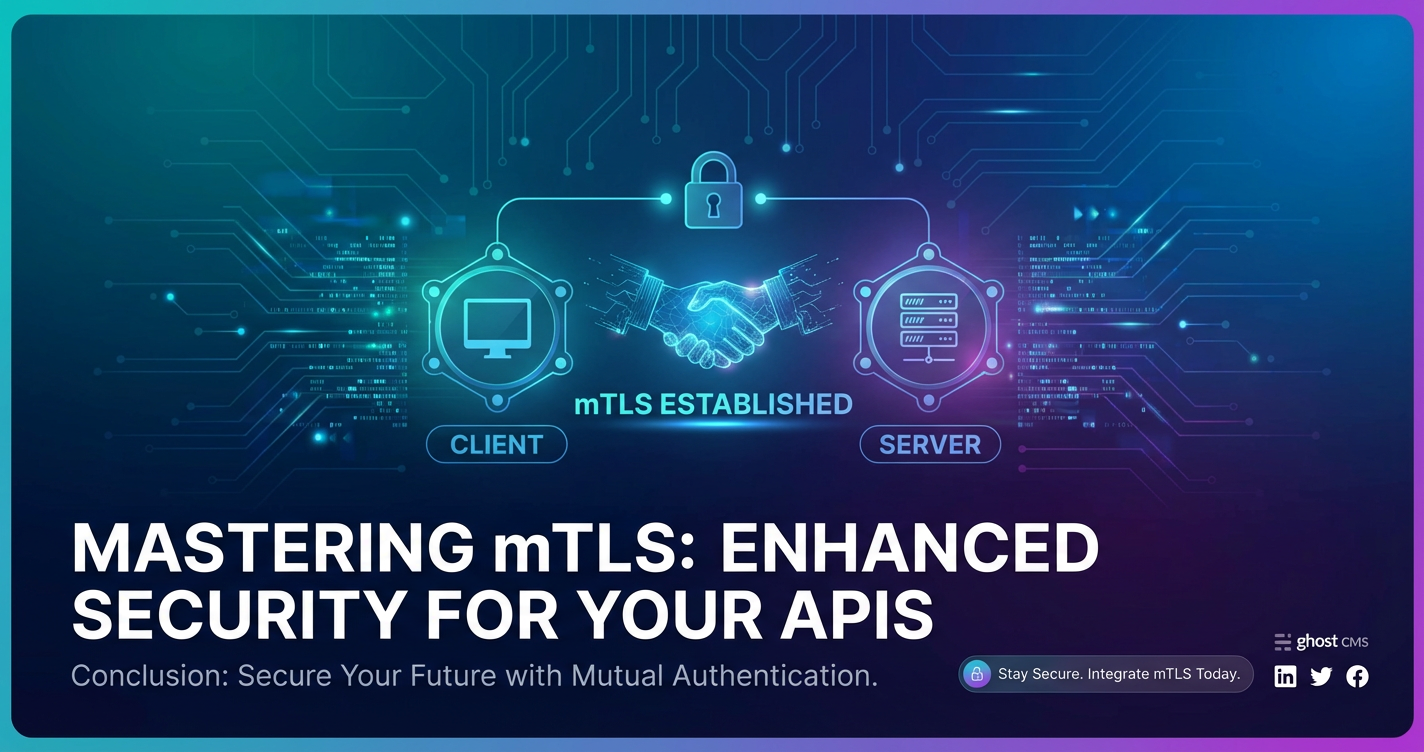
Mastering mtls: Enhanced Security for Your APIs


In the contemporary digital landscape, the intricate web of interconnected services, driven largely by Application Programming Interfaces (APIs), forms the backbone of modern applications and enterprise ecosystems. From mobile apps interacting with cloud backends to microservices communicating within a distributed architecture, APIs are the omnipresent conduits of data and functionality. However, this omnipresence also ushers in a heightened security imperative. The proliferation of api endpoints has dramatically expanded the attack surface, making robust security measures not merely an option but an absolute necessity. While Transport Layer Security (TLS) has long been the cornerstone of secure internet communication, providing encryption and server authentication, its inherent unidirectional nature often falls short in the intricate world of API-to-API interactions. This is where Mutual TLS (mTLS) emerges as a superior, indispensable mechanism, offering a fortified layer of security by authenticating both the client and the server at the transport layer, thereby establishing a trust foundation far more resilient than traditional methods. This comprehensive guide will delve deep into the intricacies of mTLS, its profound benefits, practical implementation strategies, and its pivotal role in establishing robust API Governance frameworks for your organization.
1. The Evolving Landscape of API Security Threats
The relentless pace of digital transformation has propelled APIs from esoteric technical constructs to the central nervous system of virtually every modern application. They are the conduits through which sensitive data flows, business logic is executed, and critical services are consumed. This pivotal role, however, also makes them prime targets for malicious actors. The threat landscape surrounding apis is complex, multifaceted, and constantly evolving, necessitating a proactive and layered security posture.
One of the most authoritative references for common API vulnerabilities is the OWASP API Security Top 10, which meticulously outlines the most critical security risks facing APIs today. These risks range from Broken Object Level Authorization, where users can access resources they shouldn't, to Security Misconfiguration, where default settings or incorrect configurations expose vulnerabilities. Insufficient Logging & Monitoring, for instance, can allow attackers to perform actions unnoticed, making incident response a reactive scramble rather than a proactive defense. Beyond these well-documented vulnerabilities, the architectural shift towards microservices and distributed systems, while offering immense benefits in scalability and agility, inherently amplifies the attack surface. Each new service, each new api endpoint, represents another potential entry point for attackers, another configuration to manage, and another layer of interaction to secure. The sheer volume and velocity of API calls in a distributed environment make traditional perimeter-based security increasingly ineffective. Relying solely on perimeter firewalls or even basic api gateway authentication mechanisms like API keys or simple token validation at the application layer leaves significant gaps. Attackers can potentially spoof client identities if credentials are leaked, intercept communications if encryption is weak, or exploit logical flaws if authorization is not rigorously enforced. The critical need for strong, cryptographically verifiable authentication and authorization, extending beyond application-layer mechanisms down to the transport layer, has never been more pressing. Without such robust foundational security, organizations face increased risks of data breaches, service disruptions, reputational damage, and severe regulatory penalties.
2. Understanding TLS and Its Limitations in API Ecosystems
Before we embark on a detailed exploration of Mutual TLS, it's essential to firmly grasp the fundamentals of standard Transport Layer Security (TLS) and, more importantly, to understand why it, in isolation, often proves insufficient for the stringent security demands of modern api ecosystems. TLS, the successor to SSL, is the cryptographic protocol designed to provide communication security over a computer network. When you see a padlock icon in your browser's address bar, you're observing TLS in action, securing the connection between your browser (client) and the website's server.
2.1 What is TLS?
At its core, TLS orchestrates a secure communication channel through a multi-step process known as the TLS handshake. When a client initiates a connection to a server, the handshake begins. The client sends a "Client Hello" message, specifying its supported TLS versions and cipher suites. The server responds with a "Server Hello," selecting the best common TLS version and cipher suite, and crucially, presents its digital certificate. This server certificate, issued by a trusted Certificate Authority (CA), contains the server's public key and verifies its identity. The client then validates this certificate by checking its issuer against a list of trusted CAs, ensuring it hasn't expired, and verifying the domain name matches the server it's trying to connect to. If the certificate is valid, the client generates a pre-master secret, encrypts it with the server's public key (from the certificate), and sends it to the server. Both client and server then use this pre-master secret, along with other handshake parameters, to derive symmetric session keys. Finally, all subsequent communication is encrypted and integrity-protected using these session keys, safeguarding data confidentiality and preventing tampering. This intricate dance ensures that data exchanged between the client and server remains private and unaltered, and that the client is confident it's communicating with the legitimate server, preventing man-in-the-middle attacks where an impostor might try to intercept or alter communications.
2.2 Why TLS Alone Isn't Enough for APIs:
Despite its undeniable strengths in establishing secure communication channels, traditional TLS exhibits a fundamental limitation that becomes particularly pronounced in environments dominated by api interactions: its unidirectional authentication model. In a standard TLS handshake, only the server is required to authenticate itself to the client using its digital certificate. The client's identity, at the transport layer, remains largely unverified. The server trusts that the client presenting itself is indeed the client it expects, primarily based on the establishment of the secure channel itself and then delegates further authentication to higher layers, typically the application layer.
This reliance on application-layer mechanisms for client identity verification, such as API keys, OAuth tokens, or session cookies, introduces several vulnerabilities for apis. If an API key is stolen or an OAuth token is compromised, a malicious actor can impersonate a legitimate client and gain unauthorized access to an API, even if the underlying TLS connection is secure. The TLS layer itself provides no intrinsic mechanism to prevent such impersonation because it does not authenticate the client. For instance, a compromised mobile application might inadvertently leak its api key, which an attacker could then use to interact directly with backend services, bypassing any frontend-specific protections. Moreover, in api-centric architectures, especially microservices, service-to-service communication is pervasive. A backend service often acts as a client to another backend service. In such scenarios, if only server-side TLS is used, the receiving service cannot cryptographically verify the identity of the calling service at the network layer. It has to rely on application-level identifiers or internal network segmentation, which might not offer the same level of cryptographic assurance. This makes the system vulnerable to malicious client attacks, where an unauthorized or compromised internal service could attempt to interact with other services as if it were a legitimate peer. Therefore, while TLS guarantees confidentiality and integrity and authenticates the server, it leaves a significant gap in client identity verification at the transport layer, a gap that Mutual TLS is meticulously designed to fill, providing a more robust and complete security posture for api ecosystems.
3. Deep Dive into Mutual TLS (mTLS) for API Security
Having established the limitations of standard TLS in validating client identities, we now turn our attention to Mutual TLS (mTLS), a powerful cryptographic protocol that addresses these shortcomings by extending the trust model to encompass bidirectional authentication. mTLS isn't just an incremental improvement; it represents a paradigm shift in how trust is established and maintained between communicating parties, particularly critical for securing modern api interactions.
3.1 What is mTLS?
Mutual TLS, as its name suggests, establishes a "mutual" or two-way authentication process during the TLS handshake. In addition to the server authenticating itself to the client (as in standard TLS), the client is also required to authenticate itself to the server. This reciprocal validation is achieved by both parties presenting their respective X.509 digital certificates to each other. The server, upon receiving the client's certificate, performs the same rigorous validation checks that the client performs on the server's certificate: verifying the issuer's signature against its trusted Certificate Authorities (CAs), checking the certificate's expiry, and ensuring its revocation status. Only if both certificates are valid and trusted does the secure TLS channel get established. This means that a client must possess a valid, trusted certificate to initiate a connection, making it significantly harder for unauthorized entities to establish a connection, even if they somehow possess valid application-layer credentials. The critical advantage of mTLS is that it binds identity verification directly to the network transport layer. This foundational level of authentication serves as a robust barrier, ensuring that only trusted and authenticated clients can even begin to communicate with a server's api endpoints. This significantly reduces the attack surface and fortifies the entire communication chain against various forms of impersonation and unauthorized access.
3.2 The mTLS Handshake Process (Detailed Steps):
The mTLS handshake is an extension of the standard TLS handshake, incorporating additional steps for client authentication. Understanding these steps is crucial for appreciating the depth of security mTLS provides:
- Client Hello: The client initiates the connection, sending a "Client Hello" message, which includes its supported TLS versions, cipher suites, and a random byte string.
- Server Hello, Certificate, Server Key Exchange, Certificate Request, Server Hello Done:
- Server Hello: The server responds, selecting the optimal TLS version and cipher suite from the client's preferences and sending its own random byte string.
- Certificate: The server sends its digital certificate to the client. The client verifies this certificate against its trusted CA list.
- Server Key Exchange (Optional): If using certain cipher suites (e.g., Diffie-Hellman), the server sends parameters for key exchange.
- Certificate Request: This is the pivotal additional step for mTLS. The server explicitly requests the client to send its digital certificate. It also specifies the types of certificates it can accept and the list of trusted CAs it recognizes for client certificates.
- Server Hello Done: The server signals that it has completed its part of the handshake.
- Client Certificate, Client Key Exchange, Certificate Verify, Change Cipher Spec, Encrypted Handshake Message:
- Client Certificate: The client, in response to the "Certificate Request," sends its digital certificate to the server.
- Client Key Exchange: The client generates a pre-master secret, encrypts it using the server's public key (from the server's certificate), and sends it to the server.
- Certificate Verify: The client digitally signs a hash of all the handshake messages exchanged so far, using its private key, and sends this signature to the server. The server verifies this signature using the client's public key (from the client's certificate). This step proves that the client possesses the private key corresponding to the certificate it presented, thereby authenticating the client.
- Change Cipher Spec: Both client and server then send a "Change Cipher Spec" message, indicating that all subsequent communication will be encrypted using the newly negotiated symmetric session keys derived from the pre-master secret.
- Encrypted Handshake Message: Both parties send a final "Encrypted Handshake Message" (Finished message), which is encrypted with the new keys, allowing each side to verify that the key exchange and authentication process were successful and that they correctly derived the same session keys.
Once these steps are completed successfully, a secure, mutually authenticated, and encrypted channel is established. Both the client and the server have cryptographically verified each other's identities at the transport layer, providing an extraordinarily strong foundation of trust for subsequent api interactions.
3.3 Key Components of mTLS:
Effective implementation and management of mTLS hinge on understanding its foundational components:
- Public Key Infrastructure (PKI): At the heart of mTLS lies PKI, a set of roles, policies, and procedures needed to create, manage, distribute, use, store, and revoke digital certificates. PKI provides the framework for issuing and managing the digital identities (certificates) required for both clients and servers.
- Client Certificates (X.509 standard): These are digital documents that bind a public key to an entity's identity (in this case, the client application or service). They follow the X.509 standard and are issued by a Certificate Authority. For mTLS, each client that needs to authenticate itself must possess a unique, valid client certificate and its corresponding private key. The private key is used to sign data (for
Certificate Verify) and decrypt the pre-master secret, while the public key is embedded in the certificate and used by the server for verification. - Certificate Authorities (CAs): A CA is a trusted third party that issues digital certificates. CAs vouch for the authenticity of the public keys owned by the certificate subjects. In mTLS, organizations can use either:
- External CAs: Publicly trusted CAs (e.g., DigiCert, Sectigo) are often used for server certificates facing public internet. While they can issue client certificates, managing them for a large number of internal
apiclients can be costly and operationally complex. - Internal CAs: For internal
apicommunications, many organizations operate their own private CAs. This provides greater control over certificate issuance, revocation, and management, often at a lower cost. However, it requires careful management of the internal CA's root certificate, which must be securely distributed and trusted by all participating clients and servers.
- External CAs: Publicly trusted CAs (e.g., DigiCert, Sectigo) are often used for server certificates facing public internet. While they can issue client certificates, managing them for a large number of internal
- Trust Stores and Keystores:
- Trust Store (Trust Anchor): This is a collection of trusted root and intermediate CA certificates. Clients use their trust store to verify the server's certificate, and servers use their trust store to verify the client's certificate. If a certificate is not issued by a CA present in the trust store (or chained up to one), it is considered untrusted.
- Keystore: This is a repository for an entity's own private keys and their corresponding digital certificates. Clients store their private key and client certificate in a keystore. Servers store their private key and server certificate in a keystore. These are highly sensitive assets and must be protected with the utmost security.
By meticulously managing these components, organizations can establish a robust, cryptographically enforced trust framework that significantly elevates the security posture of their api landscape.
4. Benefits of Implementing mTLS for API Security
The adoption of Mutual TLS for securing apis is not merely a technical choice but a strategic imperative that delivers a multitude of tangible benefits, significantly enhancing an organization's overall security posture and operational resilience. Its two-way authentication mechanism addresses fundamental security gaps, providing a robust defense against a spectrum of modern threats.
4.1 Enhanced Authentication and Authorization:
One of the most profound benefits of mTLS is the elevated standard of authentication it provides. By requiring both client and server to present and validate cryptographic certificates, mTLS establishes a strong, verifiable identity at the very inception of the communication session – the network transport layer. This is fundamentally different from and superior to relying solely on application-layer tokens (like OAuth tokens or JWTs) or api keys. While these application-layer credentials are vital for defining what a client is authorized to do, they don't inherently prove who the client is at the network level. A compromised application-layer credential can be used by any actor. With mTLS, even if an application-layer token is somehow stolen, the attacker still cannot establish a connection unless they also possess a valid, trusted client certificate and its corresponding private key, which are typically much harder to compromise due to their cryptographic nature and secure storage requirements. This strong identity verification at the network layer provides a foundational layer of trust. Furthermore, the information contained within client certificates (e.g., organization units, specific service identifiers) can be extracted by an api gateway or backend service and used to inform granular authorization decisions, binding network-layer identity directly to application-layer access control policies. This means that access can be granted not just based on "who" is authenticated but also on "what" specific client identity has been cryptographically verified.
4.2 Protection Against Common Attacks:
mTLS is a formidable weapon against several pervasive cyber threats:
- Man-in-the-Middle (MITM) Attacks: In a standard TLS connection, an attacker can sometimes trick a client into connecting to a malicious server if the server's certificate validation is weak or if the client blindly trusts untrusted certificates. With mTLS, both parties authenticate each other. An MITM attacker would need to present valid, trusted certificates for both the client and the server ends of the connection they are trying to intercept, which is incredibly difficult if not impossible for properly managed PKI systems. Any attempt to introduce an untrusted certificate on either side would immediately cause the handshake to fail, preventing the establishment of the secure channel.
- Unauthorized Access/Impersonation: As discussed, mTLS significantly curtails the ability of unauthorized entities to impersonate legitimate clients. Even if an attacker gains access to application-level credentials (e.g., an
apikey), they cannot establish a connection if they lack the required client certificate and its private key. This drastically reduces the risk of credential stuffing, brute-force attacks, and token replay attacks that rely solely on application-layer authentication. - Replay Attacks (when combined with other measures): While mTLS primarily authenticates and encrypts, the secure channel it establishes makes it harder for replay attacks to succeed, especially if unique session keys are generated per connection. When combined with application-layer nonces or timestamp checks, mTLS forms a robust defense against such attacks by ensuring that the underlying communication channel itself is legitimate and untampered.
4.3 Compliance and Regulatory Requirements:
In an era of stringent data privacy and security regulations, mTLS plays a crucial role in helping organizations meet compliance obligations. Industries such as finance (e.g., PSD2, FAPI), healthcare (e.g., HIPAA), and government often mandate highly secure communication channels and robust identity verification for data exchange. mTLS, by providing cryptographically verifiable mutual authentication and encrypted communication, satisfies many of these requirements for secure data transmission between systems. It demonstrates a proactive and strong security posture, which is increasingly scrutinized by auditors and regulators. Implementing mTLS can be a key differentiator in proving due diligence and adherence to complex industry standards, thereby mitigating the risk of non-compliance penalties and fostering trust with partners and customers.
4.4 Granular Access Control:
Beyond simply allowing or denying connections, the information embedded within client certificates can be leveraged for highly granular access control policies. Client certificates typically include attributes such as:
- Subject Name: Identifying the specific client application, service, or department.
- Organizational Unit (OU): Indicating the team or organizational subdivision the client belongs to.
- Extended Key Usage (EKU): Defining the specific purposes for which the certificate can be used.
An api gateway or a backend service can parse these certificate attributes after a successful mTLS handshake. This extracted identity information can then be used to enforce fine-grained authorization rules. For example, an api might allow clients from OU=Finance to access sensitive financial data endpoints, while clients from OU=Marketing might only access promotional apis, even if both possess valid client certificates. This capability enables policies to be enforced based on cryptographically verified identities rather than easily spoofed application-layer metadata, making authorization much more robust and auditable. It significantly enhances API Governance by providing a powerful, verifiable identity context for every api call.
In essence, mTLS transforms api security from a series of disjointed checks into a unified, cryptographically strong defense system. It hardens the communication channel, frustrates attackers, and provides the foundational trust necessary for building resilient and compliant api ecosystems.
APIPark is a high-performance AI gateway that allows you to securely access the most comprehensive LLM APIs globally on the APIPark platform, including OpenAI, Anthropic, Mistral, Llama2, Google Gemini, and more.Try APIPark now! 👇👇👇
5. Implementing mTLS with API Gateways
The concept of Mutual TLS is powerful, but its practical implementation, especially across a sprawling api landscape, demands a strategic approach. This is where an api gateway emerges as an indispensable component, acting as the central enforcement point for mTLS and streamlining its integration into complex architectures.
5.1 The Role of an API Gateway in mTLS:
An api gateway sits at the edge of your network, serving as a single entry point for all api requests, directing them to the appropriate backend services. In the context of mTLS, its role is pivotal and multi-faceted:
- Centralized Enforcement Point: The
api gatewaycan be configured to enforce mTLS for specificapis or all incoming traffic. This centralization means that backend services do not individually need to implement and manage mTLS, reducing development overhead and ensuring consistent security policy application. All clients attempting to access protectedapis must first establish an mTLS connection with theapi gateway. - Offloading mTLS Termination: Handling cryptographic operations like certificate validation and key exchange can be resource-intensive. By terminating mTLS connections at the
api gateway, backend services are relieved of this computational burden. Theapi gatewayestablishes the secure mTLS connection with the client, authenticates it, and then can forward the request to the upstream service over a trusted internal connection (often a standard TLS connection or even plain HTTP within a secured private network, though TLS internally is always recommended for defense-in-depth). This offloading frees backend services to focus purely on business logic, improving performance and scalability. - Policy Enforcement and Traffic Management: Beyond authentication, an
api gatewaycan leverage the client's mTLS certificate information to enforce sophisticatedAPI Governancepolicies. It can inspect certificate attributes (e.g., common name, organization unit, serial number) to apply fine-grained authorization rules, rate limiting, and routing decisions. For instance, only clients with a specific certificate issuer might be allowed to access certain sensitiveapis, or clients with expired certificates can be automatically denied access. - Logging and Monitoring:
api gateways provide centralized logging ofapicalls, including details about mTLS handshake successes or failures. This rich telemetry is invaluable for auditing, troubleshooting, and detecting suspicious activity, contributing to a robust security monitoring strategy.
5.2 Configuration Steps on an API Gateway:
Implementing mTLS on an api gateway typically involves several key configuration steps:
- Enable Client Certificate Validation: The first step is to instruct the
api gatewayto request and validate client certificates for incoming connections on the desiredapiroutes. This setting transforms the standard TLS handshake into an mTLS handshake. - Manage Trust Anchors (Client CA Certificates): The
api gatewayneeds to know which Certificate Authorities it trusts to issue client certificates. This is configured by loading the root and/or intermediate CA certificates into theapi gateway's trust store. When a client presents its certificate, theapi gatewaywill verify its signature against these trusted CAs. If the client certificate is not signed by a trusted CA, the connection will be rejected. - Configure Server Certificate: Just like standard TLS, the
api gatewayitself needs a server certificate (and its private key) to authenticate itself to the client. This certificate is typically issued by a publicly trusted CA if theapi gatewayis publicly accessible, or an internal CA if it's for internal-onlyapis. - Propagate Client Identity to Upstream Services: After successfully validating the client's certificate, the
api gatewaycan extract relevant information from the certificate (e.g., client's common name, organization unit, serial number) and pass it along to the backend services. This is often done by injecting custom HTTP headers (e.g.,X-Client-Cert-CN,X-Client-Cert-OU) into the forwarded request. This allows backend services to perform further authorization checks based on the cryptographically verified client identity, without needing to handle mTLS themselves. - Define Access Control Policies: Based on the client certificate attributes, policies can be configured on the
api gatewayto allow, deny, or restrict access to specificapis. This could involve whitelisting or blacklisting certificate common names, organizational units, or even specific certificate serial numbers.
5.3 Integrating mTLS with Existing Infrastructure:
Integrating mTLS goes beyond just the api gateway; it often involves broader architectural considerations:
- Microservices Architectures: In a microservices environment, mTLS can be applied both at the
api gateway(for external clients) and internally for service-to-service communication. For internal communication, a service mesh (like Istio or Linkerd) often provides native mTLS capabilities, automatically encrypting and authenticating traffic between services without developers needing to modify application code. - Service Meshes (Istio, Linkerd) and their mTLS Capabilities: Service meshes are designed to manage, secure, and monitor inter-service communication. They typically offer automatic, transparent mTLS for all traffic within the mesh. This is achieved by injecting sidecar proxies (e.g., Envoy proxies in Istio) next to each service, which handle the mTLS handshake, certificate rotation, and policy enforcement. This makes internal mTLS deployment significantly simpler and more robust, establishing a strong "zero trust" environment.
- Hybrid Cloud Environments: In hybrid cloud setups, mTLS is critical for securing communication between on-premises data centers and cloud services, or between different cloud providers. The
api gatewaycan act as the secure bridge, or dedicated mTLS proxies can be deployed at the network boundaries to ensure that all cross-environmentapicalls are mutually authenticated and encrypted.
For organizations looking for a robust and flexible solution to manage their apis and enforce security policies, including mTLS, platforms like APIPark offer comprehensive API lifecycle management, traffic forwarding, load balancing, and powerful data analysis, making it an excellent choice for enhancing security and governance. APIPark, as an open-source AI gateway and API management platform, provides end-to-end API lifecycle management, including design, publication, invocation, and decommissioning. It helps regulate API management processes, manage traffic forwarding, load balancing, and versioning of published APIs. Its features such as independent API and access permissions for each tenant and API resource access requiring approval directly support stringent security requirements. By integrating with such a platform, organizations can centralize the enforcement of mTLS, manage client certificates, and gain valuable insights into API traffic and security events, further bolstering their API Governance framework.
6. Practical Considerations and Best Practices for mTLS Deployment
While the benefits of mTLS are clear, its successful deployment requires careful planning, meticulous execution, and ongoing management. Organizations must navigate several practical considerations and adhere to best practices to fully realize mTLS's security advantages without introducing undue operational complexity.
6.1 Certificate Management Lifecycle:
The cornerstone of mTLS is the digital certificate, and managing its entire lifecycle is paramount. This includes:
- Issuance: Certificates must be issued by a trusted Certificate Authority (CA). For internal
apis, operating a private CA offers control but demands rigorous security for the CA's root keys. Automated systems for certificate issuance can streamline this process, especially in dynamic microservices environments where new services orapiclients might frequently come online. Manual issuance is prone to errors and scalability issues. - Revocation: Certificates can become compromised or obsolete. A robust Certificate Revocation List (CRL) or Online Certificate Status Protocol (OCSP) mechanism must be in place to promptly revoke and invalidate compromised certificates.
Api gateways and backend services must regularly check the revocation status of client certificates during the mTLS handshake. A failure to perform timely revocation can negate the security benefits of mTLS, as an attacker might exploit a compromised but unrevoked certificate. - Renewal: Certificates have an expiry date. Proactive renewal processes are critical to prevent service outages caused by expired certificates. This typically involves generating new key pairs and obtaining new certificates before the old ones expire. Automated certificate rotation tools, often integrated with service meshes or Kubernetes, can significantly simplify this task, minimizing manual intervention and the risk of human error. Neglecting renewal can lead to unexpected downtime, making automation a key best practice.
- Secure CA Key Management: The private key of your CA is the ultimate trust anchor. If compromised, an attacker could issue fraudulent certificates, completely undermining your mTLS security. CA keys must be stored in highly secure hardware security modules (HSMs) or other tamper-resistant environments, with strict access controls and audit trails.
- Automated Certificate Management Tools: Tools like HashiCorp Vault's PKI secrets engine, cert-manager for Kubernetes, or integrated capabilities within service meshes (e.g., Istio's Citadel/Keycloak integration) can automate many aspects of the certificate lifecycle, from issuance and rotation to revocation, significantly reducing operational burden and enhancing security.
6.2 Performance Implications:
Implementing mTLS adds cryptographic operations to every connection handshake, which can introduce performance overhead. While modern hardware and optimized cryptographic libraries have minimized this impact, it's still a factor to consider:
- Overhead of Additional Cryptographic Operations: The client's certificate validation and signature verification add computational steps to the handshake. For high-volume
apis, this cumulative overhead can impact latency and throughput if not properly managed. - Optimizations and Hardware Acceleration:
- TLS Session Resumption:
Api gateways and servers can be configured to support TLS session resumption, allowing clients that have recently connected to re-establish a secure session without a full handshake, thus saving computational resources. - Hardware Security Modules (HSMs) or Cryptographic Accelerators: For extremely high-performance scenarios, dedicated hardware (HSMs or cryptographic cards) can offload cryptographic computations, significantly boosting TLS/mTLS performance.
- Efficient Cipher Suites: Using modern, efficient cipher suites that offer good security with lower computational cost is also important.
- Load Balancing and Scaling: Deploying
api gateways in a load-balanced, clustered configuration allows traffic to be distributed, mitigating performance bottlenecks associated with mTLS termination.
- TLS Session Resumption:
6.3 Operational Challenges and Troubleshooting:
Managing mTLS in a production environment can present unique operational challenges:
- Debugging Certificate Mismatches: Issues often arise from misconfigured certificates, incorrect private keys, untrusted CAs, or expired certificates. Debugging these requires deep knowledge of PKI and TLS handshake processes. Tools like OpenSSL's
s_clientands_servercommands are invaluable for diagnosing mTLS connection failures. Clear, detailed error messages from theapi gatewayor application logs are crucial for quick resolution. - Logging and Monitoring mTLS Handshakes: Comprehensive logging of mTLS handshake events (successes, failures, reasons for failure) on the
api gatewayis essential. This data allows operators to quickly identify connectivity issues, detect potential attacks, and ensureAPI Governancepolicies are being correctly enforced. Monitoring tools should alert on an unusual volume of mTLS handshake failures. - Maintaining Trust Stores Across Distributed Systems: In a microservices environment, ensuring that all services (or their sidecar proxies) have up-to-date and consistent trust stores (containing trusted client and server CA certificates) can be challenging. Centralized configuration management and automated deployment pipelines are critical for maintaining consistency and preventing trust relationship breakdowns.
6.4 Hybrid Approaches:
mTLS provides strong transport-layer authentication, but it's often best used in conjunction with other security mechanisms for comprehensive api security:
- Combining mTLS with API Keys/OAuth for Application-Level Authorization: While mTLS verifies the identity of the client (e.g., "Service X is indeed Service X"), application-level tokens (like JWTs from OAuth) are essential for defining the permissions of that client (e.g., "Service X is authorized to read user data but not write it"). mTLS ensures that only authorized clients can initiate a connection, while OAuth tokens within the
apirequest ensure that the authenticated client has the right privileges for the requested action. This layered approach offers defense-in-depth. - Contextual Security Based on API Sensitivity: Not all
apis require the same level of security. Organizations might choose to enforce mTLS strictly for highly sensitiveapis (e.g., financial transactions, personal health information) but use simpler authentication for public, read-onlyapis. Anapi gatewaycan be configured to apply mTLS conditionally based on theapipath or resource being accessed, ensuring optimal balance between security and performance.
6.5 Table: Comparison of TLS vs. mTLS for API Security
To further illustrate the distinct advantages of mTLS, let's compare its characteristics with those of standard TLS for api security:
| Feature | Standard TLS (Unidirectional) | Mutual TLS (Bidirectional) |
|---|---|---|
| Authentication | Server authenticates to Client (Client verifies Server's identity) | Server authenticates to Client AND Client authenticates to Server (Both verify each other's identity) |
| Client Identity | Not verified at transport layer; relies on application layer (API keys, OAuth) | Cryptographically verified at transport layer using client certificates |
| Key Exchange | Encrypted using server's public key | Encrypted using server's public key; client also proves possession of its private key |
| Protection Against MITM | Protects against server impersonation | Stronger protection; protects against both server and client impersonation |
| Unauthorized Access | Vulnerable if application-layer credentials are compromised | Significantly harder for unauthorized access, even with compromised app-layer credentials |
| Complexity | Lower setup and management overhead | Higher setup and ongoing certificate management overhead |
| Trust Model | Client trusts Server | Client trusts Server, and Server trusts Client |
| Use Case | General web browsing, public-facing apis where client identity isn't strictly transport-layer verified |
Critical apis, microservices communication, B2B apis, financial services, healthcare, Zero Trust architectures |
| Compliance | Basic compliance for secure communication | Higher compliance standard, often mandatory for strict regulatory environments |
| API Governance Impact | Less control over client identity at the network edge | Provides a strong, verifiable identity for granular policy enforcement and audit trails |
This comparison clearly highlights why mTLS is the preferred choice for environments demanding the highest levels of api security and API Governance.
7. mTLS in the Context of Comprehensive API Governance
The successful implementation of mTLS extends beyond technical configuration; it is an integral component of a holistic API Governance strategy. API Governance encompasses the policies, processes, and tools that ensure the secure, compliant, and efficient management of apis throughout their entire lifecycle. mTLS, with its strong authentication capabilities, forms a foundational pillar within this broader framework, driving security, trust, and control.
7.1 mTLS as a Pillar of API Governance:
API Governance aims to bring order and control to the often chaotic world of api development and deployment. Integrating mTLS into this framework provides several crucial advantages:
- Enforcing Security Policies and Standards: By mandating mTLS for critical
apis, organizations establish a baseline security standard that allapiclients must adhere to. This policy can be centrally defined within theAPI Governanceframework, ensuring consistent application across diverse teams and services. It dictates howapiclients are identified and authenticated at the transport layer, eliminating ad-hoc or weaker authentication methods for sensitive interactions. - Ensuring Compliance with Internal and External Regulations: As discussed, mTLS helps satisfy stringent regulatory requirements by providing cryptographically verifiable identities and secure communication channels. From a
API Governanceperspective, this means that compliance checks can include verifying the proper implementation and enforcement of mTLS for relevantapis, simplifying audits and demonstrating adherence to industry best practices. The governance framework can define whichapicategories require mTLS, the acceptable CA roots, and certificate validity periods. - Building a Foundation for Zero Trust Architectures:
API Governanceoften involves moving towards a Zero Trust security model, where no entity, inside or outside the network, is implicitly trusted. mTLS is a cornerstone of Zero Trust forapis. By mutually authenticating everyapiclient and server at the network layer, mTLS ensures that trust is never assumed but always explicitly verified, irrespective of network location. This aligns perfectly with the Zero Trust principle of "never trust, always verify." - Enhancing Auditability and Traceability: With mTLS, every
apicall from an mTLS-enabled client is tied to a cryptographically verified identity. This significantly enhances audit trails, allowing security teams to precisely track which specific client application or service initiated a call, when, and with what authentication. This level of traceability is invaluable for forensic analysis, incident response, and demonstrating accountability within theAPI Governanceframework.
7.2 Automating Governance with APIs:
Modern API Governance platforms often leverage apis themselves to automate the enforcement and monitoring of policies, including those related to mTLS.
- Programmatic Certificate Management: An
API Governanceplatform can integrate with internal PKI systems or third-party certificate management tools. This allows for the programmatic issuance, revocation, and renewal of client certificates needed for mTLS. For example, a new microservice instance spun up in a Kubernetes cluster could automatically request and receive a client certificate via anapi, ensuring it's mTLS-ready without manual intervention. - Automated Policy Deployment to API Gateways: Policies related to mTLS (e.g., "all
apis in the 'finance' domain must use mTLS with certificates issued by 'Internal Finance CA'") can be defined in a centralAPI Governanceconsole and then automatically pushed toapi gateways. This ensures consistent policy enforcement across allapi gatewayinstances and environments, preventing misconfigurations. - Monitoring and Alerting:
API Governancetools can consume mTLS-related logs and metrics fromapi gateways and service meshes. Automated alerts can be triggered for events such as a high rate of mTLS handshake failures, attempts to connect with untrusted certificates, or an upcoming certificate expiry. This proactive monitoring is crucial for maintaining the integrity of the mTLS implementation and ensuring continuousapisecurity.
7.3 Future Trends in API Security:
The landscape of api security is continuously evolving, and mTLS is well-positioned to integrate with emerging trends:
- Zero Trust Architectures: As mentioned, mTLS is a fundamental enabler of Zero Trust for
apis. The future will see more pervasive deployment of mTLS, extending beyond just externalapis to every service-to-service interaction within an organization's boundaries. - Behavioral Analytics for Anomaly Detection: Combining the strong identity provided by mTLS with behavioral analytics will allow for even more sophisticated threat detection. If a client application, despite presenting a valid mTLS certificate, suddenly starts making
apicalls inconsistent with its historical behavior (e.g., accessing unusual endpoints, making calls at odd hours, or requesting an abnormal volume of data), behavioral analytics can flag this as suspicious, indicating a potentially compromised but authenticated client. - AI-Driven Threat Intelligence: AI and machine learning will play an increasingly significant role in correlating mTLS logs with other security telemetry to identify sophisticated attacks more rapidly. AI can help in predicting certificate expiration issues, identifying rogue certificate issuance, or detecting patterns in mTLS handshake failures that indicate a targeted attack rather than a simple misconfiguration.
- Standardization and Interoperability: As mTLS becomes more widespread, there will be continued efforts to standardize its implementation across different platforms, cloud providers, and
api gatewaysolutions, improving interoperability and ease of deployment.
In conclusion, API Governance provides the overarching framework for managing apis responsibly, and mTLS furnishes a critical technical mechanism within that framework. By integrating mTLS thoughtfully into API Governance strategies, organizations can not only enhance the security of their apis but also streamline compliance, improve operational efficiency, and build a resilient, trustworthy digital ecosystem ready for future challenges.
Conclusion
In an era defined by ubiquitous connectivity and complex digital ecosystems, the security of Application Programming Interfaces (apis) has ascended to an unparalleled level of criticality. As the conduits for data, logic, and service interaction, apis are under constant siege from an ever-evolving array of threats. While traditional TLS provides a vital layer of encryption and server authentication, its unidirectional nature leaves a significant vulnerability in client identity verification at the transport layer, a gap that malicious actors are increasingly eager to exploit.
Mutual TLS (mTLS) emerges not just as an enhancement, but as an indispensable paradigm shift in api security. By demanding cryptographic authentication from both the client and the server, mTLS establishes a foundation of bidirectional trust that significantly elevates the security posture of api interactions. It fortifies communication channels against impersonation, man-in-the-middle attacks, and unauthorized access, even in the face of compromised application-layer credentials. The strategic implementation of mTLS, particularly through api gateways, centralizes enforcement, offloads computational burden from backend services, and provides granular control over who can access what api. Moreover, mTLS is a cornerstone of robust API Governance, enabling organizations to meet stringent regulatory compliance, enforce consistent security policies, and lay the groundwork for a resilient Zero Trust architecture.
While the deployment of mTLS introduces considerations around certificate lifecycle management, potential performance overhead, and operational challenges, these are effectively addressed through automated tools, best practices, and a clear understanding of PKI principles. The proactive adoption of mTLS is not merely a technical undertaking but a strategic imperative for any organization committed to building secure, compliant, and resilient api ecosystems in the face of growing digital threats. By mastering mTLS, enterprises can ensure that their apis remain trusted, secure, and fully capable of driving innovation in the digital age.
FAQs
1. What is the fundamental difference between TLS and mTLS for API security? The fundamental difference lies in authentication. Standard TLS authenticates only the server to the client, ensuring the client connects to the legitimate server. mTLS, on the other hand, performs mutual authentication: both the server authenticates to the client, and the client authenticates to the server. This means both parties cryptographically verify each other's identities using digital certificates at the transport layer, providing a much stronger trust foundation for api interactions.
2. Why is mTLS considered more secure than using only API keys or OAuth tokens for API authentication? API keys and OAuth tokens provide authentication at the application layer. While they verify a client's permissions or session, they don't inherently verify the client's identity at the network transport layer. If an API key or token is compromised, an attacker can use it to impersonate the legitimate client. mTLS authenticates the client cryptographically at the network layer using a digital certificate. Even if application-layer credentials are stolen, an attacker cannot establish a connection without also possessing the corresponding private key and valid client certificate, making unauthorized access significantly harder.
3. What role does an API Gateway play in implementing mTLS? An api gateway is crucial for mTLS implementation as it acts as a centralized enforcement point. It can terminate mTLS connections, offloading the cryptographic processing from backend services. The api gateway validates client certificates against its trusted CAs and can then forward client identity information (extracted from the certificate) to upstream services via headers. This simplifies mTLS deployment, ensures consistent security policies, and enhances API Governance across your api landscape.
4. What are the key challenges in deploying and managing mTLS, and how can they be mitigated? Key challenges include complex certificate lifecycle management (issuance, revocation, renewal), potential performance overhead due to additional cryptographic operations, and operational complexity in debugging certificate mismatches or maintaining trust stores across distributed systems. Mitigation strategies include using automated certificate management tools (e.g., Vault PKI, cert-manager), configuring TLS session resumption and hardware acceleration for performance, and robust logging, monitoring, and centralized configuration management for operational efficiency.
5. How does mTLS contribute to a Zero Trust architecture for APIs? mTLS is a cornerstone of Zero Trust for apis because it enforces the "never trust, always verify" principle at the network transport layer. In a Zero Trust model, no entity, whether inside or outside the network perimeter, is implicitly trusted. By requiring mutual authentication for every api call, mTLS ensures that the identity of both the client and the server is cryptographically verified before any data exchange occurs, regardless of their network location. This continuous, explicit verification builds a highly secure and resilient api ecosystem.
🚀You can securely and efficiently call the OpenAI API on APIPark in just two steps:
Step 1: Deploy the APIPark AI gateway in 5 minutes.
APIPark is developed based on Golang, offering strong product performance and low development and maintenance costs. You can deploy APIPark with a single command line.
curl -sSO https://download.apipark.com/install/quick-start.sh; bash quick-start.sh

In my experience, you can see the successful deployment interface within 5 to 10 minutes. Then, you can log in to APIPark using your account.

Step 2: Call the OpenAI API.