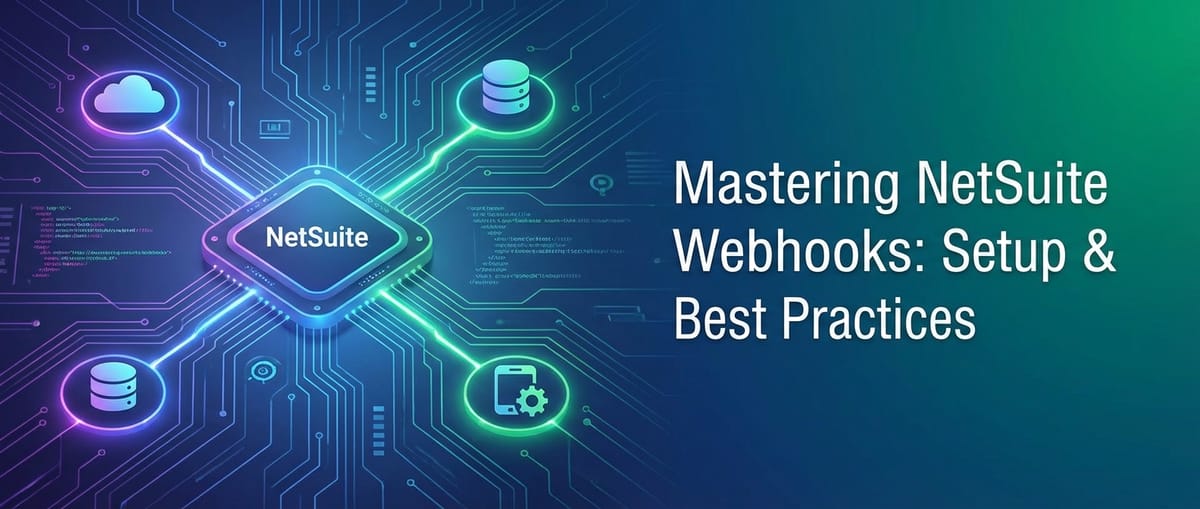
Mastering NetSuite Webhooks: Setup & Best Practices


In the intricate tapestry of modern enterprise operations, the ability to move data swiftly and accurately between disparate systems is not merely an advantage; it's a fundamental necessity. Businesses today thrive on real-time insights, automated workflows, and agile responses to ever-changing conditions. Traditional methods of data synchronization, often reliant on batch processes or scheduled polling, are increasingly falling short in meeting these demands, leading to data latency, operational bottlenecks, and missed opportunities. This is where the power of event-driven architectures, particularly through webhooks, emerges as a transformative force.
NetSuite, as a leading cloud-based ERP solution, sits at the heart of countless organizations, managing critical financial, operational, and customer data. While NetSuite offers a robust suite of integration tools, its webhook capabilities provide a uniquely powerful mechanism for achieving real-time data flow. Imagine a scenario where every customer order placed in NetSuite instantly triggers an update in your fulfillment system, or every new client record automatically provisions an account in your marketing automation platform. This level of immediate, responsive integration is precisely what NetSuite webhooks facilitate, moving beyond the reactive nature of periodic checks to a proactive, event-driven paradigm.
This comprehensive guide is designed for NetSuite administrators, developers, and solution architects who seek to unlock the full potential of NetSuite webhooks. We will embark on a detailed exploration, from the foundational understanding of what webhooks are and how they operate within the NetSuite ecosystem, to a step-by-step setup process that demystifies configuration complexities. Beyond the mechanics, we will delve into advanced strategies, security considerations, and critical best practices that ensure your webhook implementations are not only functional but also robust, scalable, and secure. Furthermore, we will examine the pivotal role of an api gateway in orchestrating and enhancing your webhook ecosystem, transforming raw data feeds into polished, secure, and manageable api services. By the end of this journey, you will possess the knowledge and confidence to master NetSuite webhooks, driving efficiency, enhancing data accuracy, and fostering seamless, real-time integration across your entire technology stack.
1. Understanding NetSuite Webhooks - The Foundation of Event-Driven Integration
To truly master NetSuite webhooks, we must first establish a solid understanding of what they are, how they function, and where they fit into the broader landscape of enterprise integration. This foundational knowledge is crucial for designing effective, reliable, and scalable solutions.
1.1 What Exactly is a Webhook? Moving Beyond the Pull Model
At its core, a webhook is a user-defined HTTP callback that is triggered by specific events. It's a simple yet incredibly powerful concept that fundamentally shifts the paradigm of data communication from a "pull" model to a "push" model. In a traditional "pull" scenario, an external system repeatedly checks NetSuite for new or updated information. This involves frequent api calls, consuming resources, and introducing latency between the event occurring in NetSuite and its detection by the external system. This constant polling can be inefficient, especially when events are sporadic or when the external system needs to react immediately.
Webhooks, on the other hand, operate on an "event-driven" architecture. Instead of continuously asking "Has anything happened yet?", NetSuite effectively says "I will tell you when something happens." When a predefined event occurs within NetSuite – be it a new sales order, an updated customer record, or a deleted item – NetSuite automatically makes an HTTP POST request to a specified URL, carrying relevant data about that event. This designated URL is often referred to as the "callback URL" or "target endpoint," and it belongs to the external system or an intermediate gateway designed to receive and process the webhook payload.
Think of it like a doorbell. In a polling model, you'd constantly knock on the door to see if someone is home. With a webhook, someone rings your doorbell when they arrive. This push notification mechanism ensures that the external system receives information instantaneously, drastically reducing latency and resource consumption associated with constant querying. The data pushed by the webhook is typically structured, commonly in JSON or XML format, and contains details about the event that just transpired. This immediate notification and data delivery make webhooks an indispensable tool for real-time synchronization and automation.
1.2 How NetSuite Webhooks Work Under the Hood
Within NetSuite, webhooks are configured to listen for specific events on designated record types. When an event matches the webhook's criteria, NetSuite acts as the sender, constructing a data payload and dispatching it to the configured target URL.
- Event Trigger: The process begins with an event occurring within NetSuite. This could be a record being created, updated, or deleted. For instance, a new sales order is submitted, an existing customer's address is modified, or an inventory item is removed.
- Webhook Activation: The NetSuite webhook, which has been pre-configured to monitor that specific record type and event type (e.g., "Sales Order" on "Create"), detects the change.
- Payload Generation: NetSuite then compiles a data payload, which is essentially a structured message containing information about the event and the affected record. The content of this payload can be customized to include specific fields from the record or the entire record itself. It is most commonly formatted as JSON (JavaScript Object Notation), which is a lightweight and widely adopted data interchange format, though XML is also supported.
- HTTP Request: NetSuite sends an HTTP POST request to the target URL that was specified during the webhook setup. This request includes the generated data payload in its body and may also contain authentication headers or parameters to ensure the receiving system can verify the request's origin and validity.
- Recipient Processing: The external system at the target URL receives the HTTP POST request. It then processes the incoming payload, parses the data, and takes appropriate action. This action could range from updating a corresponding record in a CRM, triggering a workflow in an external application, logging the event, or even initiating a subsequent api call to another service.
- Acknowledgement: Ideally, the receiving system should respond with an HTTP status code, typically a
200 OK, to acknowledge successful receipt and processing of the webhook. NetSuite interprets this response as a successful delivery. If NetSuite does not receive a200 OK(e.g., receives a5xxserver error or no response at all), it may implement a retry mechanism for a limited period, attempting to redeliver the payload. This mechanism, while helpful, underscores the importance of a robust and highly available receiving endpoint.
The entire cycle from event occurrence to payload processing can happen within milliseconds, facilitating truly real-time data synchronization. This inherent speed and efficiency make NetSuite webhooks an invaluable component in modern, integrated business environments.
1.3 Key Benefits of Using NetSuite Webhooks
Leveraging NetSuite webhooks offers a multitude of benefits that directly translate into improved operational efficiency, better data management, and enhanced business agility.
- Real-time Data Synchronization: This is perhaps the most significant advantage. Webhooks eliminate the lag associated with batch processes or polling. Data created or updated in NetSuite is instantly pushed to connected systems, ensuring all applications operate with the most current information. This is critical for scenarios like inventory management (preventing overselling), customer service (providing agents with up-to-date customer profiles), and financial reporting.
- Reduced API Call Overhead and Resource Consumption: Instead of an external system constantly making
GETrequests to NetSuite's api to check for changes, NetSuite only initiates a connection when an actual event occurs. This drastically reduces the number of inbound api calls to NetSuite, freeing up valuable api limits and reducing the load on NetSuite's servers. For the receiving system, it also means less computational effort spent on redundant checks. - Enhanced Automation Capabilities: Webhooks are perfect triggers for automated workflows. A new lead in NetSuite can instantly create a task in a project management tool, or a completed sales order can trigger an invoice generation in a separate billing system. This seamless flow of information removes manual intervention, reduces human error, and accelerates business processes.
- Improved Data Accuracy and Consistency: By synchronizing data in real-time, webhooks help maintain a consistent view of critical business information across all connected applications. This minimizes discrepancies, reduces the likelihood of working with stale data, and improves the overall integrity of your enterprise data landscape.
- Scalability for Integration Needs: As your business grows and your integration requirements become more complex, webhooks provide a scalable foundation. You can add more recipient systems without significantly increasing the load on NetSuite, as each webhook is an independent trigger. The overhead on NetSuite remains relatively constant per event, regardless of how many external systems consume that event's data (if you manage multiple consumers via a single webhook to a central gateway).
- Simplified Integration Architecture: For specific event-driven scenarios, webhooks can be simpler to implement and manage than more complex api integrations that require managing request/response cycles, pagination, and error handling for continuous data fetching. They focus on the "what happened" and "who needs to know" without the burden of constant state checking.
By harnessing these benefits, organizations can build more responsive, efficient, and interconnected business ecosystems around their NetSuite instance, transforming how data flows and operations are executed.
1.4 Differentiating Webhooks from NetSuite Integrations (e.g., SuiteTalk, RESTlets)
NetSuite provides a rich array of integration tools, and it's essential to understand when to use webhooks versus other popular methods like SuiteTalk (SOAP API) or RESTlets (custom RESTful services). Each serves distinct purposes and excels in different scenarios.
NetSuite Webhooks: * Paradigm: Push / Event-driven / Asynchronous. * Use Case: Real-time notifications and data synchronization when specific events occur in NetSuite. Ideal for informing external systems about changes without requiring them to poll. Examples: Notify a fulfillment system of a new order, update a CRM when a customer record changes, trigger an external workflow when a transaction is approved. * Data Flow: Unidirectional (NetSuite -> External System). NetSuite pushes a payload; it generally doesn't expect a complex response beyond an acknowledgement. * Complexity: Generally simpler to configure for basic event notification. Customization is primarily focused on the payload content and target URL. * Performance: Highly efficient for real-time notifications, as NetSuite only sends data when an event happens, reducing load on both sides. * Key Advantage: Instantaneous, resource-efficient event propagation.
SuiteTalk (SOAP API): * Paradigm: Pull / Request-Response / Synchronous. * Use Case: Comprehensive data manipulation (Create, Read, Update, Delete) for virtually any record type in NetSuite. Ideal for complex integrations where an external system needs to initiate data operations or retrieve large datasets. Examples: Importing historical data, synchronizing master data bi-directionally, building custom applications that interact deeply with NetSuite. * Data Flow: Bi-directional (External System <-> NetSuite). The external system sends a request and expects a detailed response. * Complexity: Can be more complex due to WSDL parsing, SOAP envelope structure, and the need to manage sessions and error handling robustly. Requires more coding on the external system side. * Performance: Excellent for transactional data operations and bulk data transfers initiated by the external system. Can be slower than webhooks for real-time notifications due to constant polling if misused for that purpose. * Key Advantage: Full CRUD capabilities, enterprise-grade reliability, and broad coverage of NetSuite functionality.
RESTlets: * Paradigm: Pull / Request-Response / Synchronous (can be made asynchronous with SuiteScript). * Use Case: Custom, lightweight RESTful web services built within NetSuite using SuiteScript. Ideal for exposing specific NetSuite data or business logic in a highly controlled and customized manner, or for complex custom interactions that SuiteTalk might not easily support. Examples: Providing a simplified api for a mobile app, exposing a custom calculation, integrating with systems that prefer RESTful apis over SOAP. * Data Flow: Bi-directional (External System <-> NetSuite). The external system sends an HTTP request (GET, POST, PUT, DELETE) and receives a custom response. * Complexity: Requires SuiteScript development expertise to build the custom api endpoints. Offers maximum flexibility but also requires more effort. * Performance: Can be highly performant if optimized in SuiteScript. Offers granular control over what data is exposed and how it's processed. * Key Advantage: Maximum customization and flexibility for exposing NetSuite functionality as a RESTful api, tailored to specific integration needs.
When to Choose Which:
- Webhooks: Use when you need to react to events happening in NetSuite in real-time, pushing data out to other systems.
- SuiteTalk: Use when an external system needs to control or query NetSuite data extensively, performing a wide range of CRUD operations, especially for high-volume or complex transactional integrations.
- RESTlets: Use when you need to expose custom NetSuite logic or data as a tailored RESTful api endpoint, giving external systems a specific, simplified way to interact with NetSuite beyond standard SuiteTalk operations.
Often, a robust integration architecture will utilize a combination of these tools. For instance, a new sales order (webhook) might trigger an update in a CRM, while the CRM might use a RESTlet or SuiteTalk to push back a customer's updated contact information to NetSuite. Understanding these distinctions is paramount for designing an efficient, maintainable, and appropriate integration strategy for your NetSuite environment.
2. Setting Up NetSuite Webhooks - A Step-by-Step Guide
Configuring NetSuite webhooks, while powerful, requires careful attention to detail. This section will walk you through the entire setup process, from prerequisites to testing, ensuring you lay a solid groundwork for reliable event-driven integrations.
2.1 Prerequisites and Permissions: Laying the Groundwork
Before you begin configuring webhooks in NetSuite, ensure you have the necessary access and that your NetSuite environment is prepared. Overlooking these initial steps can lead to frustrating roadblocks later on.
- Administrator Access or Appropriate Roles: To create and manage webhooks, your NetSuite user role must have the "Webhook Setup" permission. Typically, users with "Administrator" access will have this by default. If you are using a custom role, ensure this permission is granted under
Setup > Users/Roles > Manage Roles > [Your Role] > Permissions > Setup. Add "Webhook Setup" with at least "Edit" or "Full" level. - Enabling Features: Webhooks rely on the SuiteCloud platform. Ensure that "SuiteCloud Web Services" and "SuiteScript" features are enabled in your NetSuite account. Navigate to
Setup > Company > Enable Features. Under the "SuiteCloud" tab, verify that both "SuiteCloud Web Services" and "SuiteScript" are checked. While webhooks don't directly use SuiteScript in their core configuration, many advanced webhook use cases or recipient systems might leverage SuiteScript for pre-processing or other api interactions. - Target Endpoint Readiness: Perhaps the most crucial prerequisite is having a ready-to-receive target endpoint. This is the URL where NetSuite will send the webhook payloads. This endpoint must be:
- Publicly Accessible: NetSuite needs to be able to reach it over the internet.
- HTTPS Enabled: For security, NetSuite requires the target URL to use HTTPS. An unsecured HTTP endpoint will not work.
- Capable of Receiving POST Requests: Webhooks typically send data via HTTP POST requests. Your endpoint must be designed to accept and process these.
- Designed to Parse Payloads: The endpoint should be able to parse JSON or XML data from the request body.
- Configured for Authentication (if applicable): If your endpoint requires authentication (which is highly recommended), you'll need to know the method (e.g., API key in a header, OAuth 2.0 client credentials) and the credentials to configure in NetSuite.
- Prepared for Quick Response: The endpoint should ideally respond with a
200 OKstatus code quickly to NetSuite, even if the actual data processing takes longer (which can be handled asynchronously on the receiving side). - Consider an API Gateway: For managing this target endpoint, especially if it's a backend service, using an api gateway is often a best practice. An api gateway can handle security, routing, load balancing, and logging for your incoming webhook calls, shielding your internal services and providing a robust façade.
Ensure these foundational elements are in place before proceeding to the actual webhook configuration within NetSuite.
2.2 Identifying Your Use Case and Target System: Defining the Integration's Purpose
Before diving into the configuration screens, take a step back and clearly define the "why" and "where." A well-defined use case will guide your webhook setup and prevent unnecessary complexity.
- What Data Needs to be Sent?
- Identify the Core Event: What specific action in NetSuite should trigger the webhook? (e.g., a new customer, an updated inventory item, a sales order changing status).
- Determine the Record Type: Which NetSuite record holds the relevant data? (e.g., Customer, Inventory Item, Sales Order, Purchase Order, Invoice).
- Pinpoint Essential Fields: What specific pieces of information from that record are absolutely necessary for the receiving system? Avoid sending the entire record if only a few fields are needed, as this optimizes payload size and processing. For example, if updating a CRM with a customer's primary contact, you might only need the customer ID, first name, last name, and email, not their full financial history.
- Consider Calculated or Related Data: Does the receiving system need data that isn't directly on the record but can be derived or fetched from a related record? If so, think about how this might be handled – either by a custom RESTlet/SuiteScript (less ideal for webhooks) or by the receiving system performing a subsequent api call to NetSuite using the ID provided in the webhook payload.
- Where is the Data Going? (The Target System)
- Name the External Application: Is it a CRM (e.g., Salesforce, HubSpot), a marketing automation platform (e.g., Marketo, Mailchimp), an internal custom application, a data warehouse, a logistics system, or a business intelligence tool?
- Understand Its API Requirements: Does the target system have an existing api endpoint designed to receive this specific type of data? What data format does it expect (JSON schema, XML structure)? Are there specific headers or query parameters it requires for authentication or routing?
- Authentication Mechanisms: What authentication method does the target system's api endpoint use? (e.g., API Key, OAuth 2.0). You will need these details for NetSuite's webhook configuration.
- Response Expectations: What kind of response does the target system provide? (A simple
200 OKis usually sufficient for NetSuite, but understanding any specific response bodies can be helpful for debugging).
- Designing the Recipient Endpoint (API):
- If the target system doesn't have a pre-built api for your specific needs, you might need to develop a custom endpoint. This could be a serverless function (AWS Lambda, Azure Functions, Google Cloud Functions), a microservice, or a dedicated endpoint within your application.
- This custom endpoint's primary responsibility is to:
- Listen for HTTP POST requests.
- Parse the incoming NetSuite webhook payload.
- Validate the payload (e.g., check for required fields, potentially verify a signature if implemented for security).
- Process the data according to your business logic (e.g., create/update a record, trigger an internal event).
- Send an appropriate HTTP response back to NetSuite (
200 OKfor success).
- The Role of an API Gateway: For advanced scenarios where you need to manage a multitude of APIs, potentially integrating with various AI models or standardizing data formats, an open-source solution like APIPark can act as a powerful api gateway and developer portal. It simplifies the orchestration of incoming webhook data, allowing for transformations, routing, and secure exposure of your services, ensuring that the NetSuite webhook's payload is processed efficiently and reliably. APIPark can stand in front of your internal services, providing a unified endpoint for NetSuite, and then internally manage the complexity of integrating with various backends, including those that might require prompt encapsulation for AI invocation or specific REST API formats.
By clearly defining these aspects, you establish a blueprint for your webhook, making the configuration process within NetSuite much more straightforward and purposeful.
2.3 Navigating NetSuite for Webhook Creation: A Detailed Walkthrough
Once your prerequisites are met and your use case is clear, you can proceed to create the webhook within NetSuite. Follow these steps meticulously:
- Access the Webhooks Section:
- In NetSuite, navigate to
Setup > Integration > Webhooks. - This page displays a list of existing webhooks. To create a new one, click the New Webhook button.
- In NetSuite, navigate to
- General Information:
- Name: Provide a clear and descriptive name for your webhook. This should indicate its purpose and the record type it's associated with (e.g., "Customer_Created_To_CRM", "SalesOrder_Status_Update_To_Fulfillment").
- Description: Add a more detailed explanation of what the webhook does, which system it integrates with, and its primary purpose. This is vital for future maintenance and understanding.
- Status: Set to
Activeto enable the webhook. You can set it toInactiveif you need to temporarily disable it without deleting the configuration.
- Target Information:
- URL: This is the most critical field. Enter the full HTTPS URL of your target endpoint where NetSuite will send the webhook payload. Crucially, it must be HTTPS. For example,
https://your.apigateway.com/webhook-receiver. - HTTP Method: For NetSuite webhooks, this will almost always be
POST. Webhooks are designed to send data, not retrieve it, which aligns with the POST method's purpose. - Authentication Type: Select the authentication method your target endpoint requires.
- None: Only use for publicly accessible endpoints that require no authentication (generally NOT recommended for production data).
- HTTP Header: Most common. Allows you to specify a header name (e.g.,
Authorization,X-API-Key) and its corresponding value. The value can be a static API key, a bearer token, or a secret. - Query Parameter: Less common but useful if the target endpoint expects authentication via a URL query parameter (e.g.,
?api_key=YOUR_KEY). You specify the parameter name and value. - OAuth 2.0 Client Credentials: This is the most secure and recommended method for robust integrations. If your target endpoint is an api gateway or a service that supports OAuth 2.0, this provides a more dynamic and secure authentication flow.
- You'll need to specify:
- Token URL: The endpoint where NetSuite will request an access token.
- Client ID: Your unique identifier for NetSuite as a client.
- Client Secret: The confidential secret associated with your client ID.
- Scope (optional): The permissions NetSuite is requesting.
- NetSuite will then handle the token acquisition and include it in the
Authorizationheader as a bearer token.
- You'll need to specify:
- URL: This is the most critical field. Enter the full HTTPS URL of your target endpoint where NetSuite will send the webhook payload. Crucially, it must be HTTPS. For example,
- Event Information:
- Record Type: Select the NetSuite record type that this webhook should monitor (e.g., "Customer," "Sales Order," "Item Fulfillment").
- Trigger On: Choose the specific event(s) that will activate the webhook:
Create: When a new record of the selected type is saved.Update: When an existing record of the selected type is modified and saved.Delete: When a record of the selected type is deleted.- You can select one, two, or all three options depending on your use case.
- Advanced Triggering (Saved Search): For more complex or conditional triggering, you can link a Saved Search to your webhook.
- Instead of
Record TypeandTrigger On, you would selectSaved Searchand then choose a specific Saved Search. - The webhook will trigger when the results of the saved search change (new rows appear, existing rows change, or rows are removed) between scheduled executions of the search. This is powerful for monitoring aggregated data or specific criteria.
- You'll also specify a
Search Frequency(e.g., "Every Hour," "Every Day"). NetSuite will run the search at this frequency and trigger the webhook if changes are detected.
- Instead of
- Payload Information:
- Payload Type: Select the format for the data sent in the webhook:
JSON: The most common and recommended format.XML: If your receiving system specifically requires XML.Custom: Allows you to define a custom text payload (rarely used for structured data).
- Include All Fields: If checked, NetSuite will send all fields from the triggered record in the payload. While simple, this can result in very large payloads, especially for complex records.
- Specific Fields: RECOMMENDED. Uncheck "Include All Fields" and then use the "Add Fields" button to select only the necessary fields. This significantly reduces payload size, improves performance, and minimizes data exposure. You can add fields from the main record and also from subrecords if applicable (e.g., line items of a sales order).
- Include Old Values for Updated Fields: If you select
Updateas a trigger, checking this option will include both the new and old values for any fields that were changed in the payload, which can be useful for auditing or specific reconciliation logic in the receiving system. - Custom Payload: If
Customis selected for Payload Type, you can define a free-form text payload. This is generally less flexible than JSON/XML for structured data.
- Payload Type: Select the format for the data sent in the webhook:
- Filters (Optional):
- This section allows you to define conditions under which the webhook should fire. For example, you might only want a webhook to trigger for Sales Orders where the
Statusis "Pending Fulfillment," or for Customers in a specificCategory. - Click "Add Filter" and specify the field, operator, and value. This prevents unnecessary webhook calls and ensures only relevant data is pushed to your external systems.
- This section allows you to define conditions under which the webhook should fire. For example, you might only want a webhook to trigger for Sales Orders where the
- Save the Webhook:
- Once all fields are configured, click Save.
- NetSuite will validate the configuration. If there are any errors (e.g., invalid URL format), you will be prompted to correct them.
This detailed configuration process ensures that your NetSuite webhook is precisely tuned to your integration requirements, sending the right data, at the right time, to the right place.
2.4 Configuring the Target Endpoint: Preparing to Receive
Setting up the NetSuite side is only half the battle; the receiving endpoint must be equally robust and well-configured. This endpoint is an api that listens for and processes the incoming webhook payloads.
- Choosing Your Endpoint Technology:
- Serverless Functions (AWS Lambda, Azure Functions, Google Cloud Functions): Excellent for webhooks due to their scalability, cost-effectiveness (pay-per-execution), and ease of deployment. They automatically scale to handle varying loads of webhook calls.
- Custom Application/Microservice: If you have an existing application or a dedicated microservice, you can add an api endpoint to it. This provides maximum control but requires more infrastructure management.
- Integration Platforms (iPaaS): Solutions like Zapier, Integromat, Workato, or Dell Boomi often provide "webhook listener" modules that can act as your endpoint, simplifying the connection to various third-party apis without coding.
- API Gateway: As mentioned, an api gateway can sit in front of any of these, providing a unified, secure, and manageable entry point.
- The core of your endpoint is code that performs the following:
- Key Considerations for Endpoint Configuration:
- HTTPS: As reiterated, your endpoint must be accessible via HTTPS. Obtain an SSL certificate if you're hosting it directly, or rely on services that provide it (e.g., Load Balancers, CloudFront, api gateway services).
- Payload Parsing: Ensure your chosen technology can correctly parse the
application/json(orapplication/xml) content type from the incoming request body. - Security (Authentication & Authorization):
- NetSuite's Authentication: If you configured "HTTP Header" or "Query Parameter" in NetSuite, your endpoint must check for these values. For OAuth 2.0, your endpoint needs to validate the bearer token.
- Webhook Signature Verification (Advanced): For even higher security, some systems send a cryptographically signed header (e.g.,
X-NetSuite-Signature). Your endpoint would use a shared secret to re-calculate the signature and compare it, verifying both the sender's authenticity and the payload's integrity. NetSuite doesn't natively provide this feature for generic webhooks, but you could implement it via a custom RESTlet or an intermediate api gateway that adds such a signature. - IP Whitelisting: If possible and practical, restrict incoming traffic to only NetSuite's known IP addresses. This adds another layer of security at your firewall or gateway level.
- Error Handling and Robustness:
- Graceful Degradation: Your endpoint should not crash on malformed payloads.
- Retry Logic: Be aware that NetSuite has a limited retry mechanism. Your endpoint should be resilient to duplicate deliveries (idempotent operations) to prevent data inconsistencies if a webhook is resent.
- Logging: Implement comprehensive logging of incoming webhook calls, payloads, and processing results. This is invaluable for debugging and auditing.
- Monitoring and Alerting: Set up monitoring for endpoint availability, response times, and error rates. You need to know if your webhook receiver goes down or starts failing.
- Asynchronous Processing: For long-running tasks, process the webhook payload asynchronously. The endpoint should quickly respond with
200 OKto NetSuite, then pass the data to a message queue (e.g., Kafka, RabbitMQ, AWS SQS) or another background processing service. This prevents NetSuite from retrying the webhook due to timeout and improves overall system responsiveness.
Developing the Endpoint Logic (Example Concept - Node.js/Express):```javascript // Example: A simplified Node.js Express endpoint for a webhook const express = require('express'); const bodyParser = require('body-parser'); // To parse JSON payloads const app = express(); const port = process.env.PORT || 3000;// Middleware to parse JSON bodies app.use(bodyParser.json());// Middleware for simple authentication (e.g., checking an API Key header) const authenticateWebhook = (req, res, next) => { const apiKey = req.headers['x-api-key']; // The header name NetSuite sends if (!apiKey || apiKey !== process.env.NETSUITE_WEBHOOK_API_KEY) { console.warn('Unauthorized webhook call received.'); return res.status(401).send('Unauthorized'); } next(); // Proceed to the next middleware/route handler };// The webhook receiving endpoint app.post('/netsuite-webhook', authenticateWebhook, (req, res) => { console.log('Webhook received from NetSuite!'); console.log('Headers:', req.headers); console.log('Payload:', JSON.stringify(req.body, null, 2));
// --- Your Business Logic Starts Here ---
// Example: Process the incoming customer data
const customerData = req.body;
if (customerData && customerData.id && customerData.name) {
    console.log(`Processing customer ID: ${customerData.id}, Name: ${customerData.name}`);
    // Here you would typically:
    // 1. Validate data further.
    // 2. Transform data if necessary.
    // 3. Store in a database.
    // 4. Make an API call to another system (e.g., CRM, marketing automation).
    // 5. Enqueue for asynchronous processing (e.g., to a message queue like SQS, Kafka).

    // It's often best practice to acknowledge quickly and process asynchronously
    // to avoid NetSuite retries due to long processing times.
    res.status(200).send('Webhook received and accepted for processing.');
} else {
    console.error('Invalid payload structure received.');
    res.status(400).send('Bad Request: Missing essential data in payload.');
}
// --- Your Business Logic Ends Here ---
});app.listen(port, () => { console.log(Webhook listener running on port ${port}); console.log(Endpoint: /netsuite-webhook); }); ```
By meticulously configuring your target endpoint, you ensure that the valuable data pushed by NetSuite webhooks is received, processed, and acted upon reliably, forming the critical bridge in your real-time integration strategy.
2.5 Testing Your Webhook: Verifying the Flow
No integration is complete without thorough testing. Testing your NetSuite webhook ensures that it fires correctly, the payload is structured as expected, and your target endpoint receives and processes the data without issues.
- Pre-test Checklist:
- Webhook Status: Ensure your webhook in NetSuite is set to
Active. - Target Endpoint Accessibility: Verify that your target endpoint URL is publicly accessible via HTTPS and that no firewalls are blocking NetSuite's outbound requests. You can use tools like
curlor Postman to send a dummy POST request to your endpoint to ensure it's listening. - Endpoint Logging: Have your target endpoint's logs open and ready for real-time monitoring.
- Authentication Details: Double-check that any API keys, client IDs, or secrets configured in NetSuite's webhook match those expected by your receiving endpoint.
- Webhook Status: Ensure your webhook in NetSuite is set to
- Simulating Events in NetSuite:
- Create Trigger:
- Navigate to the record type associated with your webhook (e.g.,
Lists > Customers > New Customer). - Fill in the required fields and Save a new record.
- Navigate to the record type associated with your webhook (e.g.,
- Update Trigger:
- Find an existing record of the relevant type (e.g.,
Lists > Customers > View). - Click Edit, make a minor change to a field included in your payload (e.g., update an address, change a custom field value), and then Save.
- Find an existing record of the relevant type (e.g.,
- Delete Trigger:
- Find an existing record.
- Click Edit, then click Actions > Delete. Confirm the deletion.
- Saved Search Trigger (if applicable):
- If your webhook is tied to a saved search, manually run the saved search or make a change to a record that would alter its results.
- Note that saved search-based webhooks trigger on a schedule, so you might need to wait for the next scheduled execution or manually trigger the search run if your NetSuite version allows immediate refresh.
- Create Trigger:
- Monitoring Logs at the Target Endpoint:
- Immediately after performing the action in NetSuite, switch to your target endpoint's logs.
- You should see entries indicating:
- An incoming HTTP POST request.
- The full request headers (check for authentication headers).
- The parsed webhook payload (verify its structure and content against your expectations).
- Messages from your processing logic (e.g., "Customer created in CRM," "Data saved to database").
- The HTTP response status code sent back to NetSuite.
- Troubleshooting Common Issues:
- Webhook Not Firing:
- Is the webhook
Activein NetSuite? - Is the
Record TypeandTrigger Onconfigured correctly? Did the event actually occur? - Are there any
Filterspreventing the webhook from firing? - Check NetSuite's
System Notesfor the record you modified. Sometimes there might be an indication of webhook attempts or errors.
- Is the webhook
- Endpoint Not Receiving Request:
- Is the
URLin NetSuite configured correctly (typos, HTTP vs. HTTPS)? - Is your endpoint service running and listening on the correct port?
- Are there any network firewalls, security groups, or api gateway configurations blocking incoming requests from NetSuite's IP ranges?
- Check for DNS resolution issues.
- Is the
- Authentication Errors (401 Unauthorized):
- Double-check API keys, client IDs, client secrets, and header names in both NetSuite and your endpoint.
- Ensure any OAuth 2.0 token URLs and scopes are correct.
- Bad Request / Payload Parsing Errors (400, 422):
- The payload structure NetSuite sends might not match what your endpoint expects.
- Use
console.logor a debugger at your endpoint to inspect the raw incomingreq.bodyto see exactly what NetSuite is sending. - Verify your
Payload TypeandSpecific Fieldsselection in NetSuite. - Ensure your endpoint's parser (e.g.,
body-parser.json()in Express) is correctly configured.
- Server Errors (5xx):
- Something went wrong in your endpoint's processing logic. Review your endpoint's internal logs and code for exceptions, database connection issues, or downstream api failures.
- Ensure your endpoint responds with a
200 OKpromptly. Long processing times might cause NetSuite to timeout and retry.
- Webhook Not Firing:
By systematically going through these steps and understanding common pitfalls, you can effectively test and validate your NetSuite webhook integrations, ensuring a smooth and reliable flow of data.
3. Advanced NetSuite Webhook Configuration and Use Cases
Beyond the basic setup, NetSuite webhooks offer advanced capabilities that allow for more refined control, enhanced security, and sophisticated integration patterns. Understanding these can help you build truly robust and intelligent event-driven solutions.
3.1 Customizing Webhook Payloads: Precision Data Delivery
While NetSuite's "Include All Fields" option is convenient for quick setups, it's rarely the optimal choice for production environments. Customizing webhook payloads offers significant advantages in terms of performance, security, and clarity.
- Selecting Specific Fields for Efficiency:To do this, when configuring the webhook in NetSuite under the "Payload Information" section: * Uncheck the "Include All Fields" box. * Click "Add Fields" and browse the available fields for your selected
Record Type. You can select fields from the main record and also from related subrecords (e.g., if it's a Sales Order, you can include fields from its line items). * Carefully choose only the fields that the consuming system absolutely requires.- Reduced Payload Size: Sending only the necessary data drastically reduces the size of the HTTP request. Smaller payloads mean faster transmission times, less bandwidth consumption, and quicker processing at the receiving end. This is particularly important for high-volume webhooks.
- Improved Performance: Less data to send, receive, and parse translates directly to better overall performance for both NetSuite and your target endpoint.
- Minimized Data Exposure: By explicitly selecting fields, you prevent sensitive or irrelevant data from being inadvertently pushed to external systems. This adheres to the principle of least privilege, enhancing data security.
- Clarity for the Receiver: The receiving system's api can be designed to expect a very specific data structure, making its parsing logic simpler and less prone to errors. It only needs to worry about the data it truly needs.
- Including Old Values for Updates:
- When your webhook is configured to trigger on
Update, you have the option to "Include Old Values for Updated Fields." - If checked, the JSON payload will contain separate entries for the
newValueandoldValueof any field that was modified. - Use Cases: This is incredibly useful for:
- Auditing: Tracking changes over time in an external audit log.
- Change Detection Logic: Allowing the receiving system to perform more sophisticated comparisons or conditional actions based on what specifically changed (e.g., "only re-calculate shipping if the address changed, not just the customer's preferred contact method").
- Reconciliation: Helping external systems reconcile data when a change needs to be propagated.
- When your webhook is configured to trigger on
- Using SuiteScript for More Complex Data Transformation (Advanced):
- While NetSuite's native webhook configuration is powerful, it has limitations regarding complex data transformations or fetching data from unrelated records before sending.
- For such scenarios, a common pattern is to use a User Event Script (UES) attached to the record type. The UES would trigger on
afterSubmit(orbeforeSubmitif you need to modify the record before it's saved) and then programmatically make an api call to your external system or an intermediate api gateway. - This approach gives you full SuiteScript power to:
- Perform custom calculations.
- Fetch data from other records (e.g., related item details, customer segmentation data).
- Structure a completely custom JSON/XML payload.
- Implement complex conditional logic for when to send the payload.
- Caveats: This method requires SuiteScript development expertise, manages authentication and error handling programmatically, and falls outside the native webhook UI. It also consumes SuiteScript governor limits. Native webhooks are generally preferred for simplicity and efficiency unless complex transformations are absolutely necessary. If you choose this path, an api gateway like APIPark can still be the target for your SuiteScript-initiated api calls, providing centralized management, security, and monitoring for these custom integrations.
By being meticulous about payload content, you can create more efficient, secure, and precise integrations that cater exactly to the needs of your consuming applications.
3.2 Securing Your Webhooks: Protecting Your Data
Security is paramount when integrating systems, especially when dealing with sensitive business data from NetSuite. Implementing robust security measures for your webhooks is non-negotiable.
- Always Use HTTPS:
- This is not optional; NetSuite requires it. HTTPS encrypts the data payload during transit, preventing eavesdropping and man-in-the-middle attacks. Ensure your target URL always starts with
https://.
- This is not optional; NetSuite requires it. HTTPS encrypts the data payload during transit, preventing eavesdropping and man-in-the-middle attacks. Ensure your target URL always starts with
- Authentication Methods:
- HTTP Header / Query Parameter: For simple API keys, use long, randomly generated, unique keys for each webhook. Store these securely on both NetSuite and the receiving endpoint (e.g., in environment variables, secret managers). Never hardcode them in your code.
- OAuth 2.0 Client Credentials: This is the most secure and recommended approach for more sophisticated integrations. It provides a token-based authentication mechanism where NetSuite obtains a short-lived access token to authorize its requests. This avoids sending static credentials with every request and allows for better token management and revocation.
- Never rely on obscurity: Do not assume that just because a URL is hard to guess, it's secure. Authentication is always necessary.
- IP Whitelisting (at the Receiving End):
- If your api gateway or server infrastructure supports it, configure your firewall or network security groups to only accept incoming connections on the webhook endpoint from NetSuite's known outbound IP addresses.
- NetSuite publishes its IP ranges for different data centers. Regularly check NetSuite's help documentation for the most up-to-date IP ranges for your specific account to ensure you don't inadvertently block legitimate webhook calls. This adds a powerful layer of network-level security.
- Payload Signing/Verification for Integrity and Authenticity:
- This is an advanced security measure that adds a cryptographic signature to the webhook payload. While NetSuite's native webhooks don't inherently add such a signature, you can implement this if you use an intermediate api gateway or custom SuiteScript to send the payload.
- How it works: A shared secret key is used to generate a hash (signature) of the webhook payload. This signature is sent as a custom HTTP header.
- Verification: The receiving endpoint, using the same shared secret, recalculates the hash of the received payload and compares it to the signature in the header. If they match, it confirms:
- Authenticity: The request truly came from NetSuite (or your intermediate gateway).
- Integrity: The payload has not been tampered with during transit.
- This is a highly effective way to protect against spoofed webhooks.
- Rate Limiting (at the Receiving End):
- Implement rate limiting on your target endpoint or api gateway to prevent denial-of-service attacks or accidental floods of requests. While NetSuite's webhooks don't typically flood, external malicious actors could try to overwhelm your endpoint.
- An api gateway solution can easily manage and enforce rate limits, protecting your backend services.
- Principle of Least Privilege:
- In NetSuite, ensure the role used for webhook setup (if it's not a full administrator) has only the "Webhook Setup" permission and any other permissions absolutely necessary for the webhook to function (e.g., read access to the relevant record types). Do not grant excessive permissions.
By adopting these layered security measures, you can significantly mitigate risks and ensure that your NetSuite webhook integrations are robust, trustworthy, and protect your valuable business data.
3.3 Error Handling and Resiliency: Building Robust Integrations
Even with perfect setup, integrations can fail due to network issues, service outages, or unexpected data. Robust error handling and resiliency are crucial for maintaining data consistency and operational continuity.
- NetSuite's Retry Mechanism (Limited):
- NetSuite does implement a basic retry mechanism for failed webhook deliveries. If your target endpoint returns an HTTP error status code (e.g.,
4xx,5xx) or does not respond within a certain timeout, NetSuite will attempt to resend the webhook payload a few times over a period. - Important: This retry mechanism is limited and not highly configurable. It's a "best effort" system, not a guaranteed delivery mechanism. Do not rely solely on NetSuite's retries for critical data.
- Implication: Your endpoint should always respond quickly with a
200 OKif the payload is received and accepted, even if the processing takes longer. You can queue the actual processing for later.
- NetSuite does implement a basic retry mechanism for failed webhook deliveries. If your target endpoint returns an HTTP error status code (e.g.,
- Implementing Robust Error Handling at the Receiving Endpoint:
- Immediate Acknowledgment: The first priority for your endpoint is to acknowledge receipt of the webhook with a
200 OKas quickly as possible. This prevents NetSuite from retrying. - Validation: Upon receiving the payload, validate its structure and content. If the payload is malformed or missing critical data, respond with a
400 Bad Requestafter logging the error. This tells NetSuite the problem is with the data it sent. - Logging: Implement comprehensive logging at every stage:
- Incoming request details (headers, payload).
- Processing steps.
- Any errors encountered (e.g., database write failures, downstream api errors).
- The response sent back to NetSuite.
- Centralized logging solutions (like Splunk, ELK stack, Datadog) are highly recommended.
- Dead Letter Queues (DLQ): For critical, asynchronous processing, if your internal processing fails (e.g., cannot write to DB, downstream api is down), instead of just retrying indefinitely, send the failed message to a Dead Letter Queue (DLQ).
- A DLQ is a dedicated queue for messages that could not be processed successfully after a certain number of retries.
- This prevents poison messages from blocking your main processing queue and allows for manual inspection, debugging, and eventual reprocessing of failed messages without losing data.
- Alerting: Set up alerts (email, SMS, Slack, PagerDuty) for:
- High error rates on your webhook endpoint.
- Messages accumulating in your DLQ.
- Endpoint unavailability.
- Immediate Acknowledgment: The first priority for your endpoint is to acknowledge receipt of the webhook with a
- Idempotency in Recipient Services:
- Because webhooks can be retried or delivered more than once (e.g., due to network transient errors, or a
200 OKsent but not received by NetSuite), your receiving system must be idempotent. - Idempotency means that applying the same operation multiple times produces the same result as applying it once.
- Example: If a "create customer" webhook is received twice, your system should only create the customer once. This is often achieved by:
- Including a unique identifier from NetSuite (e.g.,
NetSuite_Internal_ID) in your payload. - When processing, first check if a record with that
NetSuite_Internal_IDalready exists in your system. If it does, update it; otherwise, create it.
- Including a unique identifier from NetSuite (e.g.,
- This prevents duplicate records or inconsistent data in the event of retries.
- Because webhooks can be retried or delivered more than once (e.g., due to network transient errors, or a
By implementing these error handling and resiliency strategies, you transform your webhook integrations from fragile connections into robust, self-healing, and dependable data pipelines.
3.4 Webhooks with Saved Searches: Advanced Conditional Triggering
While record-based triggers (Create, Update, Delete) are fundamental, NetSuite's ability to trigger webhooks based on Saved Search results unlocks a powerful dimension for more complex and conditional event-driven scenarios. This feature allows you to monitor for aggregated changes or specific criteria being met, rather than just individual record actions.
- How Saved Search Webhooks Work:
- Instead of directly monitoring a record type, the webhook is linked to an existing NetSuite Saved Search.
- You define a
Search Frequency(e.g., every hour, daily, weekly). - At each scheduled interval, NetSuite runs the specified Saved Search.
- It then compares the current results of the search with the results from the previous execution.
- If any changes are detected (new rows, existing rows modified, or rows removed from the result set), the webhook is triggered.
- The payload sent will contain the fields specified in your webhook configuration, often representing the changed rows or a summary.
- Key Use Cases and Benefits:
- Threshold Monitoring: Trigger a webhook when a specific threshold is crossed. Example: An inventory item's quantity on hand falls below a reorder point, or a customer's total outstanding balance exceeds a credit limit.
- Batch Change Detection: Notify external systems about multiple changes that meet specific criteria, rather than individual record updates. Example: Send a daily digest of all sales orders that have been in "Pending Fulfillment" status for more than 48 hours.
- Complex Business Logic: Use the full power of Saved Searches (formulas, summary fields, advanced criteria) to define highly specific conditions for triggering a webhook that wouldn't be possible with simple record-based triggers. Example: Trigger when the average order value for a specific customer segment changes significantly.
- "Soft" Events: Monitor for conditions that aren't tied to a direct record creation/update/deletion but are derived from data analysis. Example: A project's estimated completion date is past its due date, even if no direct "update" happened on the project record itself.
- Reporting and Alerts: Send regular summary reports or alerts to external monitoring systems or dashboards when certain business conditions are met.
- Configuration Considerations:
- Saved Search Design: The performance and accuracy of your webhook heavily depend on the underlying Saved Search.
- Ensure the search is optimized for performance to avoid timeouts during its execution.
- The search results must contain a unique identifier (like NetSuite Internal ID) for each row so NetSuite can accurately detect changes between runs.
- The columns included in the saved search should align with the data you expect to send in the webhook payload.
- Search Frequency: Balance the need for timeliness with system load. Running complex searches too frequently can consume NetSuite resources.
- Payload Customization: You will still define the payload structure and specific fields to send, which will be drawn from the fields available in the Saved Search results.
- Idempotency: Again, ensure your receiving system can handle potential duplicate deliveries, as changes in a saved search might sometimes lead to nuanced re-triggering.
- Saved Search Design: The performance and accuracy of your webhook heavily depend on the underlying Saved Search.
Saved search-based webhooks are a sophisticated tool for extending NetSuite's event-driven capabilities to complex business scenarios, enabling proactive monitoring and intelligent automation based on dynamic data conditions.
3.5 Integrating with Third-Party Services: Expanding Your Ecosystem
The true power of NetSuite webhooks lies in their ability to connect NetSuite with virtually any other system or service, creating a cohesive and automated enterprise ecosystem.
- Direct Integration with SaaS Applications:
- Many modern SaaS applications (e.g., CRMs like HubSpot, Salesforce; Marketing Automation like Marketo, Pardot; Customer Support like Zendesk) provide their own api endpoints designed to receive webhooks.
- Example: A
CustomerrecordCreateorUpdatein NetSuite could directly push to a HubSpot api endpoint to create/update a contact, ensuring your sales and marketing teams always have the latest customer information. - Challenge: You need to ensure NetSuite's payload format matches the target system's expected api request body. If not, you might need an intermediate transformation layer (e.g., using an api gateway or an iPaaS).
- Workflow Automation Platforms (iPaaS):
- Integration Platform as a Service (iPaaS) solutions like Zapier, Integromat (Make), Workato, Tray.io, or Dell Boomi are excellent intermediaries for webhook integrations.
- How they work:
- You configure the NetSuite webhook to send its payload to a generic "webhook listener" URL provided by the iPaaS platform.
- The iPaaS platform then acts as a gateway, receiving the payload.
- Within the iPaaS, you can build low-code/no-code workflows to:
- Parse and Transform: Easily convert NetSuite's JSON/XML into the format required by the target api.
- Add Logic: Implement conditional routing, data enrichment (e.g., looking up external data based on NetSuite IDs), or error handling.
- Connect to Anything: iPaaS platforms have connectors for hundreds of popular applications, simplifying downstream api calls.
- Manage Retries: Many iPaaS platforms offer robust retry mechanisms, queuing, and error reporting, offloading this complexity from your custom endpoint.
- Benefit: They abstract away much of the coding and infrastructure management, making complex multi-step integrations much faster to build and maintain. This is particularly useful for connecting to multiple downstream services from a single NetSuite event.
- Custom Applications and Data Warehouses:
- For bespoke internal applications or analytical data warehouses, your webhook endpoint will be a custom api designed to ingest NetSuite data.
- Example: A
Sales OrderCreatewebhook sends order details to a data ingestion pipeline that feeds your data lake or data warehouse, providing near real-time data for business intelligence and analytics. - Architectural Considerations: For these custom endpoints, scalability, performance, and robustness are critical. This is where a dedicated api gateway can truly shine, providing a secure, high-performance façade for your data ingestion services.
- Integration with AI/ML Services:
- With the rise of AI, NetSuite webhooks can serve as triggers for AI workflows.
- Example: A new
Customer Support Caserecord in NetSuite could trigger a webhook to send the case details to an AI service for sentiment analysis or automated categorization. - APIPark's Role: For organizations looking to integrate NetSuite events with AI capabilities, APIPark offers a compelling solution. As an open-source AI gateway and api management platform, APIPark can receive NetSuite webhook payloads, then transform and route them to various AI models. It standardizes the api format for AI invocation and can even encapsulate prompts into REST APIs, simplifying how your NetSuite data interacts with advanced AI services for tasks like sentiment analysis, translation, or predictive analytics.
By strategically leveraging these integration patterns, NetSuite webhooks become a powerful catalyst for a highly interconnected, automated, and intelligent enterprise.
APIPark is a high-performance AI gateway that allows you to securely access the most comprehensive LLM APIs globally on the APIPark platform, including OpenAI, Anthropic, Mistral, Llama2, Google Gemini, and more.Try APIPark now! 👇👇👇
4. Best Practices for NetSuite Webhook Management
Implementing NetSuite webhooks effectively requires adherence to a set of best practices that go beyond initial setup. These practices ensure your integrations are performant, secure, maintainable, and scalable in the long run.
4.1 Design for Scalability and Performance: Building for Growth
As your business grows and the volume of events increases, your webhook integrations must be able to scale without degrading performance or reliability.
- Minimize Payload Size:
- As discussed, always select
Specific Fieldsrather than "Include All Fields" in NetSuite's webhook configuration. Only send the data that the receiving system absolutely needs. - Smaller payloads transmit faster, consume less bandwidth, and reduce processing overhead on both NetSuite and the recipient.
- As discussed, always select
- Optimize Recipient Endpoint Performance (Quick Response Times):
- Your webhook receiving endpoint should be designed to process the incoming request and send an HTTP
200 OKresponse to NetSuite as quickly as possible. Ideally, this response should be within a few hundred milliseconds. - If your processing logic is complex or involves long-running operations (e.g., database writes, calls to other external apis), defer this work to an asynchronous background process.
- Pattern: "Receive and Queue": The endpoint's primary job is to:
- Receive the webhook.
- Authenticate and validate basic payload structure.
- Log the receipt.
- Immediately place the payload into a message queue (e.g., AWS SQS, Azure Service Bus, Kafka).
- Send
200 OKto NetSuite. - A separate worker process then consumes messages from the queue and performs the heavy lifting. This insulates NetSuite from slow processing and allows your system to handle spikes in webhook volume.
- Your webhook receiving endpoint should be designed to process the incoming request and send an HTTP
- Understand NetSuite's Governor Limits:
- While NetSuite webhooks are generally efficient, they are still subject to overall NetSuite system limits.
- Excessive numbers of webhooks firing simultaneously, or highly complex webhooks linked to frequently updated records, could contribute to overall account usage limits.
- Monitor your NetSuite performance metrics and consult NetSuite's governance documentation to ensure your webhook strategy remains within acceptable limits.
- Use Efficient Database Operations at the Receiving End:
- When processing webhook data, ensure your database interactions are optimized (e.g., efficient queries, appropriate indexing, batching operations if processing multiple items from a single webhook).
- Avoid N+1 query problems.
By prioritizing efficiency and asynchronous processing, you build a webhook architecture that can gracefully handle increasing data volumes and maintain high performance under load.
4.2 Monitoring and Logging: Gaining Visibility
Visibility into the operation of your webhooks is critical for troubleshooting, auditing, and ensuring continuous reliable data flow. Comprehensive monitoring and logging are essential.
- NetSuite System Notes:
- For record-based webhooks, NetSuite's
System Notes(accessible on the individual record) can provide some insight into when a record was created or updated, which indirectly indicates a potential webhook trigger. However, they don't directly log webhook outbound success/failure.
- For record-based webhooks, NetSuite's
- Recipient System Logs:
- This is your primary source of truth. Your target endpoint must implement detailed logging:
- Request Logging: Log every incoming webhook request, including headers (especially authentication-related ones) and the raw payload. This is invaluable for debugging parsing issues.
- Processing Logs: Log the steps taken during processing, including any data transformations, calls to downstream apis, and results of those calls.
- Error Logs: Crucially, log all errors and exceptions with sufficient detail (stack traces, relevant data points).
- Centralized Logging: Aggregate logs from your webhook endpoint and any downstream services into a centralized logging platform (e.g., Splunk, Datadog, ELK Stack, Sumo Logic, AWS CloudWatch Logs, Azure Monitor). This provides a single pane of glass for monitoring your entire integration flow.
- This is your primary source of truth. Your target endpoint must implement detailed logging:
- Performance Metrics:
- Monitor key performance indicators (KPIs) of your webhook endpoint:
- Response Time: How quickly does your endpoint respond to NetSuite? High response times can indicate bottlenecks or lead to NetSuite retries.
- Error Rate: The percentage of webhook calls that result in an error (e.g., 4xx, 5xx). A sudden spike indicates a problem.
- Throughput: The number of webhooks processed per unit of time.
- Queue Length: If using message queues, monitor queue depth to detect backlogs.
- Alerting: Configure alerts for abnormal metrics (e.g., response time > X seconds, error rate > Y%, queue length > Z). Integrate these alerts with your team's notification system (Slack, PagerDuty, email).
- Monitor key performance indicators (KPIs) of your webhook endpoint:
- Dashboarding:
- Create dashboards that visualize webhook activity, error rates, and processing status. This provides real-time operational awareness.
- An api gateway solution often provides built-in monitoring and analytics dashboards, offering a centralized view of all incoming api traffic, including your webhooks. For instance, APIPark provides powerful data analysis capabilities, displaying long-term trends and performance changes, which can be invaluable for preventative maintenance of your webhook ecosystem.
Comprehensive monitoring and logging are your eyes and ears into the health and performance of your NetSuite webhook integrations, enabling proactive problem identification and rapid resolution.
4.3 Versioning and Lifecycle Management: Adapting to Change
Integrations are not static; they evolve with business requirements. Managing the lifecycle of your webhooks, including versioning strategies, is crucial for long-term maintainability and minimizing disruption.
- Version Your API Endpoints:
- The receiving endpoint for your webhooks should be versioned, just like any other api. This allows you to introduce breaking changes without impacting existing NetSuite webhooks.
- Example:
https://your.apigateway.com/webhook/v1/netsuite-orders, thenhttps://your.apigateway.com/webhook/v2/netsuite-orders. - When you need to make breaking changes to your payload structure or processing logic, you can deploy a
v2endpoint, configure new webhooks in NetSuite to point tov2, and then gradually decommissionv1once all NetSuite environments are migrated.
- Controlled Deployment Strategies:
- Development/Sandbox Environment: Always test new webhooks or changes to existing ones in a NetSuite Sandbox environment first. Your target endpoint should also have corresponding development/staging environments.
- Phased Rollouts: For critical webhooks, consider a phased rollout.
- Deploy the new target endpoint version.
- Create a new webhook in NetSuite pointing to the new version, but keep the old one active.
- Monitor both to ensure the new one works as expected.
- Once confident, deactivate the old webhook.
- Feature Flags: Use feature flags in your receiving endpoint code to enable/disable new logic for specific webhooks without full redeployment.
- Webhook Deactivation/Deletion:
- When a webhook is no longer needed, change its status to
Inactivein NetSuite. After a period of observation (to ensure no dependencies are missed), you can then safely delete it. - Ensure any corresponding configuration on your receiving endpoint or api gateway is also removed.
- When a webhook is no longer needed, change its status to
- Impact Analysis for NetSuite Changes:
- Be aware that changes in NetSuite itself (e.g., renaming fields, changing record structures, deploying new custom fields that could be included in a webhook payload) can impact your webhooks.
- When NetSuite is upgraded or new bundles are installed, review your webhook configurations to ensure they remain compatible.
- Managing Webhooks with an API Gateway:
- An api gateway simplifies webhook lifecycle management. It can handle version routing, allowing multiple NetSuite webhooks (or even different NetSuite accounts) to point to the same logical gateway endpoint, which then internally routes to different versions of your backend services.
- It also centralizes security policies and traffic management, making it easier to manage changes across multiple integrations.
By planning for evolution and implementing structured versioning and deployment practices, you ensure your NetSuite webhook integrations remain agile and adaptable to changing business and technical requirements.
4.4 Security Best Practices Revisited: Continuous Vigilance
Security is not a one-time setup; it's an ongoing process. Continuous vigilance and adherence to best practices are essential for protecting your NetSuite data.
- Regular Security Audits:
- Periodically review all your NetSuite webhooks configurations.
- Check target URLs, authentication methods, and payload contents.
- Verify that only necessary fields are included in payloads.
- Review access logs on your receiving endpoint and api gateway for any suspicious activity.
- Principle of Least Privilege for NetSuite Roles:
- Ensure the NetSuite user role responsible for setting up and managing webhooks (if not a full administrator) has only the "Webhook Setup" permission and any other minimum required permissions. Avoid granting roles with overly broad access if they are solely for webhook management.
- Secure Credential Storage and Rotation:
- Never hardcode secrets: API keys, client IDs, and client secrets should never be hardcoded in your application code or configuration files.
- Use Secret Managers: Store credentials securely using environment variables or dedicated secret management services (e.g., AWS Secrets Manager, Azure Key Vault, HashiCorp Vault).
- Regular Rotation: Implement a process for regularly rotating API keys and OAuth 2.0 client secrets. This reduces the risk window if credentials are ever compromised.
- Network Security:
- Continue to enforce IP whitelisting on your api gateway or infrastructure, restricting inbound access to NetSuite's known IP ranges.
- Regularly check for updated NetSuite IP addresses.
- Data at Rest and In Transit:
- Ensure data transferred via webhooks is always encrypted in transit (HTTPS).
- If you store webhook data at your receiving endpoint, ensure it's encrypted at rest and protected by appropriate access controls.
- Incident Response Plan:
- Have a clear incident response plan in place for potential security breaches or abnormal activity detected in your webhook monitoring (e.g., unauthorized access attempts, data tampering).
Maintaining a strong security posture for your NetSuite webhooks is a continuous effort that requires both technical implementation and ongoing operational discipline.
4.5 Documentation and Team Collaboration: Knowledge is Power
Effective webhook management relies heavily on clear documentation and seamless collaboration across development, operations, and business teams.
- Comprehensive Documentation:
- Webhook Purpose: Clearly articulate the business objective and technical purpose of each webhook.
- Configuration Details: Document all settings in NetSuite (record type, triggers, filters, authentication, URL).
- Payload Schema: Provide a precise definition of the JSON/XML payload structure, including data types and example values.
- Receiving Endpoint Specifications: Document the target endpoint's api specification, expected response codes, error handling, and any specific processing logic.
- Downstream Systems: Detail which external systems consume the webhook data and what actions they take.
- Contact Information: List the responsible teams/individuals for both NetSuite configuration and the receiving endpoint.
- Version History: Maintain a log of changes made to the webhook configuration or the receiving api.
- Centralized Knowledge Base:
- Store all webhook documentation in a centralized, easily accessible knowledge base (e.g., Confluence, Wiki, internal developer portal).
- Ensure it's kept up-to-date with any changes.
- Cross-Functional Team Collaboration:
- Developers: Need to understand NetSuite's capabilities and limitations, and design robust receiving endpoints.
- NetSuite Administrators: Responsible for configuring and managing webhooks within NetSuite.
- Operations/DevOps: Focus on deployment, monitoring, alerting, and infrastructure for the receiving endpoints and api gateway.
- Business Analysts: Provide requirements and validate the end-to-end data flow against business needs.
- Regular Communication: Establish channels for communication regarding changes, incidents, and planned enhancements. Conduct regular review meetings for critical integrations.
- Change Management:
- Implement a formal change management process for any modifications to existing webhooks or the introduction of new ones. This should include review, testing, and approval steps.
- Ensure that any changes to NetSuite records or fields that are part of a webhook payload are communicated to the teams managing the receiving endpoints.
By fostering a culture of clear documentation and collaborative teamwork, you can ensure that your NetSuite webhook integrations are well-understood, maintainable, and resilient throughout their lifecycle, minimizing technical debt and maximizing their business value.
5. The Role of an API Gateway in a Webhook Ecosystem
While NetSuite webhooks provide the core event-driven capability, an api gateway can significantly enhance their functionality, security, and manageability, transforming raw webhook notifications into robust, governable api services. For any organization serious about scaling its integrations, an api gateway becomes an indispensable component.
5.1 What is an API Gateway? The Central Traffic Controller
An api gateway acts as a single entry point for all incoming API requests (and in this context, webhook calls). It sits in front of your backend services, acting as a proxy or façade, and handles a multitude of cross-cutting concerns before requests ever reach your actual processing logic. Think of it as the air traffic controller for your api ecosystem, directing and securing all inbound and outbound flights.
Key functions of an api gateway include:
- Request Routing: Directing incoming requests to the appropriate backend service based on URL paths, headers, or other criteria.
- Authentication and Authorization: Verifying client identities and ensuring they have the necessary permissions to access specific resources.
- Rate Limiting: Protecting backend services from being overwhelmed by controlling the number of requests clients can make within a given period.
- Security: Acting as the first line of defense against common web attacks, providing WAF (Web Application Firewall) capabilities, and managing SSL/TLS termination.
- Traffic Management: Load balancing, circuit breaking, and retry mechanisms to improve resilience and reliability.
- Request/Response Transformation: Modifying the format or content of requests before forwarding them to backend services, or responses before sending them back to clients.
- Monitoring and Analytics: Centralizing logging, tracking api usage, performance metrics, and generating insightful reports.
- Developer Portal: Providing documentation, test consoles, and subscription management for external and internal api consumers.
In essence, an api gateway offloads common functionalities from individual backend services, allowing developers to focus on core business logic while ensuring consistent security, performance, and manageability across all apis.
5.2 How an API Gateway Enhances NetSuite Webhooks
Integrating an api gateway into your NetSuite webhook architecture elevates your integrations from simple point-to-point connections to a sophisticated and manageable system.
- Enhanced Security and Compliance:
- Centralized Authentication: The api gateway can enforce sophisticated authentication mechanisms (OAuth 2.0, JWT validation, API key management) even if your backend webhook receiver only expects a simpler payload. This allows for centralized security policy enforcement.
- IP Whitelisting & Blacklisting: Easily configure the gateway to only accept webhook calls from NetSuite's known IP addresses, adding a crucial network security layer.
- Threat Protection: A gateway can act as a WAF, protecting your backend services from common web vulnerabilities and malicious payloads.
- Data Encryption: Ensures HTTPS termination and re-encryption for traffic to internal services.
- Intelligent Routing and Load Balancing:
- Service Decoupling: NetSuite webhooks can always target a single, stable gateway URL. The gateway then intelligently routes these calls to multiple instances of your webhook processing service, or even to different versions (e.g.,
v1vs.v2) based on internal logic, headers, or path. - High Availability: Distribute webhook traffic across multiple redundant backend services, ensuring that even if one instance fails, the webhooks continue to be processed without interruption.
- Dynamic Routing: Route webhooks to different backend services based on content within the payload itself (e.g., route "Sales Order" webhooks to the fulfillment service, and "Customer" webhooks to the CRM integration service).
- Service Decoupling: NetSuite webhooks can always target a single, stable gateway URL. The gateway then intelligently routes these calls to multiple instances of your webhook processing service, or even to different versions (e.g.,
- Payload Transformation and Normalization:
- Standardization: If NetSuite's webhook payload doesn't exactly match the format expected by your backend service, the api gateway can transform the JSON/XML structure on the fly. This avoids complex transformation logic in every backend service and keeps NetSuite's configuration simple.
- Data Enrichment: The gateway can potentially add context or enrich the payload (e.g., adding internal correlation IDs, fetching additional data from another source) before forwarding it to the backend.
- Version Translation: Facilitate seamless api versioning by translating older payload formats to newer ones, allowing NetSuite to continue using an older webhook configuration while your backend evolves.
- Centralized Monitoring, Analytics, and Governance:
- Unified Logging: All incoming webhook traffic passes through the gateway, providing a single point for comprehensive logging, auditing, and debugging.
- Performance Metrics: Monitor webhook response times, error rates, and throughput at the gateway level, offering a holistic view of your integration health.
- Alerting: Centralize alerting configurations for all webhook-related issues.
- Rate Limiting: Easily apply and manage rate limits to prevent your backend services from being overwhelmed, either by NetSuite (unlikely, but possible during misconfigurations) or by malicious actors.
- API Lifecycle Management: The gateway enables a full lifecycle management approach for your webhook endpoints, from design and publication to deprecation.
- Developer Experience and Self-Service:
- An api gateway with a developer portal can expose your webhook receiving apis in a structured way, providing clear documentation, examples, and test interfaces for internal and external developers who might consume the NetSuite data.
- This fosters better collaboration and reduces the friction of integrating with your systems.
By acting as a sophisticated intermediary, an api gateway fortifies your NetSuite webhook integrations, making them more resilient, secure, manageable, and adaptable to future requirements.
5.3 Choosing the Right API Gateway: A Strategic Decision
Selecting an api gateway is a critical architectural decision that depends on your organization's specific needs, scale, budget, and existing infrastructure.
- Key Features to Look For:
- Scalability: Can it handle high volumes of concurrent requests and scale horizontally?
- Security Features: Robust authentication, authorization, WAF, IP whitelisting, SSL/TLS management.
- Ease of Deployment and Management: Is it easy to set up, configure, and maintain? Does it integrate with your existing DevOps pipelines?
- Traffic Management: Routing, load balancing, circuit breaking, caching, rate limiting.
- Monitoring and Analytics: Comprehensive logging, metrics, and dashboards.
- Transformation Capabilities: Can it easily modify request/response payloads?
- Extensibility: Can you extend its functionality with custom plugins or code?
- Developer Portal: For managing api consumers and documentation.
- Cost: Licensing, infrastructure, and operational costs.
- Open-Source vs. Commercial Solutions:
- Commercial Gateways: Offer comprehensive feature sets, enterprise-grade support, and often come as managed services (e.g., AWS API Gateway, Azure API Management, Google Cloud Apigee, Kong Enterprise). They reduce operational overhead but come with licensing costs.
- Open-Source Gateways: Provide flexibility, control, and no direct licensing costs (e.g., Kong Gateway (community edition), Apache APISIX, Tyk Open Source). They require more internal expertise for deployment, management, and support but can be highly cost-effective and customizable for organizations with strong technical teams.
- Considering APIPark:
- For organizations seeking a robust, open-source solution that combines an AI gateway with comprehensive api management capabilities, APIPark stands out. It provides end-to-end api lifecycle management, quick integration of AI models, unified api formats, and strong performance, making it an ideal choice for streamlining the management of webhook endpoints and any other api services.
- APIPark's specific advantages in a NetSuite webhook context include:
- Unified API Format: It can standardize the request data format across all AI models, ensuring that NetSuite webhook payloads (even if slightly varied) are consistently formatted before interacting with AI services or other internal APIs.
- Prompt Encapsulation into REST API: If your NetSuite events need to trigger AI tasks (e.g., a new customer feedback webhook triggers sentiment analysis), APIPark can receive the webhook, encapsulate the relevant data into an AI prompt, and expose it as a standard REST API for easy AI invocation.
- End-to-End API Lifecycle Management: Manage the design, publication, invocation, and decommission of your webhook receiving apis with structured governance.
- Performance Rivaling Nginx: With impressive TPS capabilities, APIPark can handle large-scale webhook traffic efficiently, supporting cluster deployment.
- Detailed API Call Logging and Data Analysis: Provides comprehensive logging and analytical insights into every webhook call, crucial for monitoring the health and performance of your NetSuite integrations.
- Team Sharing and Tenant Management: Facilitates secure sharing of api services among different teams and allows for independent access permissions, which is valuable in larger enterprises with multiple NetSuite environments or consuming systems.
- Open Source with Commercial Support: Offers the flexibility of open source (Apache 2.0 license) while providing the option for commercial support and advanced features, suitable for both startups and leading enterprises.
By strategically implementing an api gateway like APIPark, you not only enhance the reliability and security of your NetSuite webhooks but also position your entire integration landscape for greater agility, control, and future innovation, especially as you explore integrating AI into your enterprise workflows.
Conclusion
The journey through mastering NetSuite webhooks reveals them as far more than just a simple notification mechanism; they are a cornerstone of modern, agile enterprise integration. By embracing an event-driven paradigm, NetSuite webhooks empower businesses to achieve real-time data synchronization, automate critical workflows, and significantly enhance operational efficiency, moving beyond the limitations of traditional polling methods. From the meticulous step-by-step setup process to the advanced configurations that allow for precise payload control and conditional triggering via saved searches, the power and flexibility of NetSuite webhooks are undeniable.
However, power comes with responsibility. The true mastery of NetSuite webhooks lies not just in their configuration but in the diligent application of best practices. This encompasses designing for scalability by minimizing payload size and optimizing recipient endpoint performance through asynchronous processing, ensuring robust error handling and resiliency with idempotency and Dead Letter Queues, and maintaining continuous vigilance over security through HTTPS, strong authentication, and IP whitelisting. Furthermore, comprehensive monitoring and logging, coupled with thoughtful versioning and lifecycle management, are critical for the long-term health and maintainability of your integrations. Clear documentation and cross-functional team collaboration tie all these elements together, transforming technical configurations into shared knowledge and seamless operational flows.
Finally, we've explored the transformative role of an api gateway in elevating the entire webhook ecosystem. An api gateway acts as a centralized intelligence layer, bolstering security, enabling intelligent routing and payload transformation, and providing a unified point for monitoring and governance. For organizations seeking to build truly robust, scalable, and secure integration architectures around NetSuite, an api gateway is not merely an accessory but a foundational component. Solutions like APIPark, with its open-source AI gateway and comprehensive api management features, exemplify how such platforms can simplify the complexity of modern integrations, making them ready for the demands of diverse apis and emerging technologies like AI.
In an era where speed, accuracy, and agility define competitive advantage, mastering NetSuite webhooks is an investment in your organization's future. By adhering to the principles and practices outlined in this guide, you can unlock NetSuite's full potential, creating a seamlessly interconnected ecosystem that drives innovation, enhances decision-making, and sustains growth well into the future.
NetSuite Webhooks: Key Triggers and Their Use Cases
This table illustrates common NetSuite record types, the events that trigger webhooks, and practical use cases for each combination.
| NetSuite Record Type | Event Trigger (Trigger On) |
Key Fields in Payload (Example) | Common Use Case | Benefits |
|---|---|---|---|---|
| Customer | Create, Update |
id, entityid, companyname, email, phone, address |
CRM Synchronization: When a new customer is created or an existing customer's details (contact info, address) are updated in NetSuite, automatically create/update the corresponding contact/account in an external CRM (e.g., Salesforce, HubSpot). | Real-time sales/marketing data, improved customer experience, reduced manual data entry. |
| Sales Order | Create, Update |
id, tranid, entity (customer ID), trandate, status, total, item (line items with qty, price, item ID) |
Order Fulfillment Automation: Upon new sales order creation or status change (e.g., "Pending Fulfillment"), push order details to a third-party warehouse management system (WMS) or fulfillment api. | Accelerated order processing, accurate inventory management, enhanced customer satisfaction. |
| Item Fulfillment | Create, Update |
id, createdfrom (sales order ID), shipstatus, shippeddate, trackingnumbers, item (fulfilled items) |
Shipping Notifications & Inventory Sync: When an item fulfillment is created/updated (e.g., marked as shipped), send tracking information to a customer notification system or update inventory status in an external e-commerce platform. | Proactive customer communication, accurate stock levels across channels. |
| Invoice | Create, Update |
id, tranid, entity (customer ID), trandate, status, total, amountdue |
External Billing/Collections: Notify a third-party billing platform or collections system when an invoice is generated or its payment status changes. | Streamlined financial operations, timely payment follow-ups. |
| Purchase Order | Create, Update |
id, tranid, entity (vendor ID), trandate, status, item (line items) |
Vendor Collaboration/Supply Chain: Send new or updated purchase order details to a vendor portal or supply chain management system. | Improved vendor communication, better supply chain visibility, proactive inventory planning. |
| Opportunity | Create, Update |
id, title, entity (customer ID), status, probability, expectedclosedate, forecasttype |
Sales Pipeline Reporting: Push new or updated opportunity data to an external BI tool or sales dashboard for real-time analytics and forecasting. | Accurate sales forecasting, informed strategic decision-making. |
| Case | Create, Update |
id, casenumber, title, company (customer ID), status, priority, messagedate |
Customer Service Integration / AI Analysis: Send new customer support cases to an external ticketing system, or route case details to an AI service (via an api gateway like APIPark) for sentiment analysis or automated categorization. | Consolidated support, faster resolution times, AI-driven insights for service improvement. |
| Item | Create, Update |
id, itemid, displayname, isinactive, purchasprice, saleprice, stocklevel |
Product Information Management (PIM): Update product catalogs in an e-commerce platform or PIM system when item details (price, description, stock status) change in NetSuite. | Consistent product data across all sales channels, accurate pricing. |
| Saved Search | Change Detected (based on frequency) |
Configurable based on search results (e.g., customer.id, customer.balance, customer.lastorderdate) |
Proactive Alerts / Threshold Monitoring: Trigger a notification when a specific business condition is met, such as customers with overdue balances exceeding X, or inventory levels below a certain threshold. | Early warning for critical business conditions, automated compliance checks, targeted interventions. |
Frequently Asked Questions (FAQ)
1. What is the fundamental difference between NetSuite Webhooks and NetSuite RESTlets or SuiteTalk API?
The fundamental difference lies in their operational paradigm and data flow. NetSuite Webhooks operate on a "push" model; NetSuite initiates an HTTP POST request to an external system (your target endpoint) when a specific event occurs (e.g., a record is created or updated). This is ideal for real-time, event-driven notifications. In contrast, NetSuite RESTlets and SuiteTalk APIs operate on a "pull" model; an external system makes an api request to NetSuite to retrieve or manipulate data. RESTlets allow you to build custom RESTful apis within NetSuite for highly tailored interactions, while SuiteTalk is NetSuite's robust SOAP API offering comprehensive CRUD operations for nearly all record types. Webhooks are best for NetSuite informing external systems, whereas RESTlets/SuiteTalk are for external systems interacting with NetSuite.
2. How do I ensure my NetSuite webhook payloads are secure during transit and at the receiving end?
Security is paramount. Firstly, always use HTTPS for your webhook target URL; NetSuite enforces this, ensuring data encryption in transit. Secondly, implement robust authentication on your receiving endpoint, such as requiring an API key in an HTTP header (configured in NetSuite) or, preferably, using OAuth 2.0 Client Credentials for more secure token-based access. At the receiving end, consider IP whitelisting to only accept calls from NetSuite's known IP ranges. For advanced security, you can implement payload signing and verification. Finally, never hardcode credentials; use secure secret management, and ensure your receiving system's infrastructure and logs are protected with appropriate access controls. An api gateway can centralize and enhance all these security measures.
3. What happens if my webhook receiving endpoint is down or returns an error? Does NetSuite retry?
Yes, NetSuite does have a limited retry mechanism. If your target endpoint is unreachable, returns an HTTP error status code (e.g., 4xx, 5xx), or times out, NetSuite will attempt to redeliver the webhook payload a few times over a limited period. However, this retry mechanism is not highly configurable or guaranteed for all scenarios. It's crucial for your receiving endpoint to be highly available, respond quickly (ideally with 200 OK even if processing is asynchronous), and implement its own robust error handling, logging, and potentially a Dead Letter Queue (DLQ) for failed messages to ensure data is not lost and can be manually reprocessed.
4. Can I send only specific fields in a NetSuite webhook payload instead of the entire record? How does this benefit me?
Absolutely, and it's highly recommended. When configuring your webhook in NetSuite, under the "Payload Information" section, you can uncheck "Include All Fields" and then select only the Specific Fields you need from the record. This offers significant benefits: it reduces the payload size, leading to faster transmission and lower bandwidth usage; it improves performance by making processing quicker on both NetSuite and the receiving endpoint; and critically, it enhances security by minimizing data exposure, ensuring only relevant information is shared with external systems.
5. How can an API Gateway like APIPark enhance my NetSuite webhook integrations?
An api gateway significantly elevates your NetSuite webhook ecosystem by acting as an intelligent intermediary. It provides centralized security (authentication, IP whitelisting, threat protection), advanced traffic management (routing, load balancing to multiple backend services, rate limiting), and payload transformation capabilities (normalizing NetSuite's payload to fit your backend apis or even converting it for AI model invocation). For solutions like APIPark, it further offers end-to-end api lifecycle management, powerful monitoring and analytics for all webhook calls, and specialized features for integrating with AI models, making it an ideal choice for building scalable, secure, and smart NetSuite integrations.
🚀You can securely and efficiently call the OpenAI API on APIPark in just two steps:
Step 1: Deploy the APIPark AI gateway in 5 minutes.
APIPark is developed based on Golang, offering strong product performance and low development and maintenance costs. You can deploy APIPark with a single command line.
curl -sSO https://download.apipark.com/install/quick-start.sh; bash quick-start.sh

In my experience, you can see the successful deployment interface within 5 to 10 minutes. Then, you can log in to APIPark using your account.

Step 2: Call the OpenAI API.