Mastering OpenAPI: Default vs 200 Response Best Practices


In the vast and interconnected landscape of modern software development, Application Programming Interfaces (APIs) serve as the fundamental connective tissue, enabling disparate systems to communicate, share data, and orchestrate complex workflows. From mobile applications interacting with backend services to microservices communicating within a distributed architecture, the reliability, clarity, and consistency of these api interactions are paramount. As organizations increasingly rely on APIs to power their digital ecosystems, the need for robust API Governance strategies becomes ever more critical, ensuring that these digital contracts are not only functional but also understandable, maintainable, and secure.
At the heart of effective API Governance lies a well-defined and meticulously documented API. This is where the OpenAPI Specification (OAS) steps in as the industry's de facto standard for describing RESTful APIs. OpenAPI provides a language-agnostic interface description for REST APIs, allowing both humans and computers to discover and understand the capabilities of a service without access to source code or additional documentation. A properly crafted OpenAPI document acts as a definitive contract, driving everything from automated testing and client SDK generation to interactive documentation and API gateway configuration.
Within this critical contract, defining how an api responds to requests is a cornerstone of good design. Clients need to know what to expect when a request succeeds and, equally important, how to handle situations where things don't go as planned. This article delves deep into two pivotal response definitions within the OpenAPI Specification: the ubiquitous 200 OK response, signifying unequivocal success, and the versatile default response, designed to catch all other undefined outcomes. We will explore their specific use cases, best practices for their implementation, and critically compare their roles in building resilient, understandable, and governable APIs. Understanding the nuanced interplay between explicit success responses and a strategic catch-all is not merely a technical detail; it is a strategic decision that profoundly impacts developer experience, system reliability, and the overall effectiveness of your API Governance framework.
Understanding OpenAPI Specification (OAS): The Blueprint for API Interactions
The OpenAPI Specification, formerly known as Swagger Specification, has emerged as an indispensable tool in the modern api economy. It provides a standardized, machine-readable format for defining RESTful APIs. Think of an OpenAPI document as the architectural blueprint for your digital services, meticulously detailing every aspect of how a client can interact with your server. This blueprint is not just for human consumption; it's a contract that can be processed by various tools to automate significant portions of the api lifecycle.
The genesis of OpenAPI stemmed from a widespread industry challenge: the difficulty of consistently documenting and understanding complex API landscapes. Before OpenAPI, developers often relied on fragmented documentation, informal agreements, or direct code inspection to understand how an api worked. This approach was prone to errors, inconsistencies, and significantly hampered collaboration and integration efforts. OpenAPI revolutionized this by introducing a structured, declarative way to describe an API's operations, parameters, requests, and crucially, its responses.
At its core, an OpenAPI document is typically written in YAML or JSON and comprises several key components that collectively define the api. It starts with basic metadata like the API's title, version, and description. Following this, it specifies the servers that host the API, defining their URLs. The most substantial parts of the document are the paths and components. Paths define the individual endpoints (e.g., /users, /products/{id}) and the HTTP methods (GET, POST, PUT, DELETE) supported by each. For every operation, OpenAPI specifies the expected parameters (path, query, header, cookie, and request body) and the possible responses.
The components section is a powerful feature that promotes reusability and consistency. It allows you to define reusable schemas for data models, parameters, request bodies, headers, and security schemes. For instance, if you have a User object that appears in multiple API responses or requests, you can define its structure once in the components/schemas section and reference it throughout your API definition. This not only reduces redundancy but also enforces a uniform data structure across your entire api landscape, which is a cornerstone of effective API Governance.
The benefits of adopting OpenAPI are manifold. Firstly, it provides a single source of truth for your API's capabilities, eliminating ambiguity and fostering a shared understanding between API providers and consumers. This clarity directly translates into improved developer experience, as integrators can quickly understand how to interact with the API, reducing integration time and common errors. Secondly, OpenAPI fuels an ecosystem of powerful tools. From code generation (client SDKs, server stubs) and interactive documentation UIs (like Swagger UI) to automated testing tools and API gateway configurations, the machine-readability of OpenAPI unlocks significant automation possibilities. This automation not only accelerates development but also enhances consistency and reduces manual errors, thereby strengthening your API Governance framework.
Furthermore, OpenAPI plays a crucial role in enabling proactive API Governance. By having a formal contract, organizations can establish design standards, review API designs against these standards before implementation, and ensure compliance across their entire api portfolio. This upstream governance prevents inconsistent designs, security vulnerabilities, and technical debt from accumulating, leading to a more robust, secure, and maintainable api ecosystem. Without a clear, standardized description like that provided by OpenAPI, true API Governance would be a much more arduous and often reactive endeavor, making it an indispensable tool for any organization serious about managing their digital assets.
The Significance of HTTP Status Codes: Speaking the Universal Language of the Web
HTTP status codes are the universal language through which web servers communicate the outcome of a client's request. They are concise, three-digit integers, each carrying a specific meaning, designed to provide immediate feedback on whether a request was successfully understood, received, and processed, or if there was an issue. Understanding and correctly implementing these status codes is not just a matter of technical correctness; it is fundamental to building resilient, reliable, and user-friendly APIs. In the context of API Governance, consistent and accurate use of HTTP status codes is a non-negotiable standard, as it dictates how clients, proxies, and intermediate systems interpret and react to API responses.
HTTP status codes are broadly categorized into five classes, each indicating a different type of response:
- 1xx (Informational): The request was received, continuing process. These are provisional responses, rarely seen by clients in direct API interactions. Examples include
100 Continueand101 Switching Protocols. - 2xx (Success): The request was successfully received, understood, and accepted. These codes indicate that the server fulfilled the client's request as intended.
- 3xx (Redirection): Further action needs to be taken by the user agent to fulfill the request. These typically guide clients to a new resource or location. Examples include
301 Moved Permanentlyand302 Found. - 4xx (Client Error): The request contains bad syntax or cannot be fulfilled. These indicate issues stemming from the client's side, such as invalid input, missing authentication, or requesting a non-existent resource.
- 5xx (Server Error): The server failed to fulfill an apparently valid request. These codes signify problems on the server's end, such as internal server issues, service unavailability, or gateway timeouts.
The importance of using the correct status code cannot be overstated. Firstly, it provides immediate semantic communication. A 200 OK clearly states success, while a 404 Not Found immediately tells the client that the requested resource doesn't exist, and a 500 Internal Server Error indicates a problem within the server itself. This semantic clarity allows clients to implement appropriate error handling logic without needing to parse complex response bodies in every scenario. For example, a client receiving a 401 Unauthorized knows to prompt for re-authentication, whereas a 403 Forbidden suggests that even with valid credentials, access to that specific resource is denied.
Secondly, consistent use of status codes simplifies client-side development and debugging. When developers adhere to established HTTP semantics, they can build more robust and predictable client applications. Automated tools, proxies, caches, and load balancers also rely heavily on these codes to function correctly. A caching proxy, for instance, might cache 200 OK responses but not 4xx or 5xx errors. Monitoring systems utilize status codes to identify operational issues, triggering alerts when a sudden spike in 5xx errors occurs, indicating a server-side problem.
From an API Governance perspective, standardizing the use of HTTP status codes across all APIs within an organization is paramount. It ensures a consistent developer experience, reduces integration friction, and enhances the overall reliability of the API ecosystem. Developers should avoid the temptation to always return 200 OK with an error message in the payload, as this subverts the very purpose of status codes and complicates client error handling. Instead, they should strive for semantic accuracy, providing clear, actionable feedback to the client. This dedication to precision in HTTP status code usage is a hallmark of mature api design and a critical component of a robust API Governance strategy, laying the groundwork for predictable, maintainable, and highly performant integrations.
Delving into the 200 OK Response: The Epitome of Success
The 200 OK HTTP status code is arguably the most common and universally understood response code. It signifies that the client's request has been successfully received, understood, and processed by the server. When a client sees 200 OK, it expects that the operation it initiated has completed without issue and that the response body, if any, contains the requested data or the result of the operation. This code is the default assumption for successful interaction, making its correct and consistent implementation in OpenAPI definitions crucial for clarity and developer satisfaction.
The 200 OK response is typically used in a variety of scenarios:
- GET requests: This is its most frequent application. When a client performs a
GETrequest to retrieve a resource (e.g.,GET /users/123), a200 OKresponse indicates that the resource was found and its representation is included in the response body. If the resource is not found, a404 Not Foundwould be more appropriate. - Successful PUT/PATCH updates: If a client sends a
PUTorPATCHrequest to update an existing resource and the server successfully applies the changes, a200 OKcan be returned. In such cases, the response body often contains the updated representation of the resource. Alternatively,204 No Contentis also a valid and often preferred response if the client doesn't need the full updated resource back, as it saves bandwidth. - Successful POST requests: While
201 Createdis typically preferred forPOSTrequests that result in the creation of a new resource (e.g.,POST /usersto create a new user), a200 OKcan be used if thePOSToperation does not directly create a new resource but rather processes data or performs an action (e.g., a search endpoint that returns results, or an RPC-style endpoint). If aPOSTcreates a resource and returns its representation,200 OKis acceptable, though201 Createdis semantically stronger as it specifically indicates creation. - Successful DELETE requests: If a
DELETErequest successfully removes a resource, a200 OKresponse can be returned, typically with a confirmation message in the body, especially if the client needs to know what was deleted. However,204 No Contentis often a better choice forDELETEoperations if no additional information beyond the success of the deletion is needed, as it indicates successful processing without returning a response body.
Best practices for defining and utilizing 200 OK responses in OpenAPI revolve around clarity, consistency, and a strong adherence to data schemas:
- Consistent Payload Structure: For
200 OKresponses that return data, establish a consistent envelope structure across your APIs. For instance, always wrapping the actual data in a field likedataorpayload(e.g.,{ "data": { "id": 123, "name": "John Doe" } }). This predictability simplifies client-side parsing and reduces boilerplate code. In OpenAPI, this translates to defining a reusable schema incomponents/schemasfor your standard data envelope. - Clear Schema Definition for the Response Body: Every
200 OKresponse in your OpenAPI document should have a precisely defined schema for its response body. This schema dictates the data types, required fields, and overall structure of the data the client will receive. This is paramount for generating accurate client SDKs, validating responses during testing, and ensuring developers understand exactly what to expect. For example:yaml responses: '200': description: A list of users. content: application/json: schema: type: array items: $ref: '#/components/schemas/User' - Handling Empty Results for GET Requests: When a
GETrequest for a collection returns no items, it's generally best practice to return200 OKwith an empty array ([]) rather than a404 Not Found. A404implies the resource (e.g., the collection itself) doesn't exist, which is usually not the case; rather, the collection simply has no members matching the criteria. Returning an empty array signals success and allows clients to process the response consistently. - Consider Cache Implications: Responses with a
200 OKstatus code are typically cacheable by default, especially forGETrequests. Be mindful of this when designing your API. Use appropriate HTTP headers likeCache-ControlandETagto optimize caching behavior, reduce server load, and improve response times. - Avoid Misusing
200 OKfor Errors: A common anti-pattern, particularly in older api designs, is to return a200 OKstatus even when an error has occurred, embedding the error details within the response body. This practice severely degrades the semantic value of HTTP status codes, complicates error handling for clients, and makes it harder for proxies, load balancers, and monitoring systems to correctly interpret API behavior. Always use appropriate4xxor5xxstatus codes for errors. Adhering to this principle is a fundamental aspect of strong API Governance and significantly improves the robustness and clarity of your api ecosystem.
By rigorously defining 200 OK responses with precise schemas and adhering to these best practices, you empower API consumers with predictable and reliable interactions, contributing significantly to a positive developer experience and a well-governed api landscape.
Unpacking the default Response: The Safety Net of OpenAPI
While specific HTTP status codes like 200 OK, 400 Bad Request, or 500 Internal Server Error are crucial for explicit communication in an OpenAPI definition, there will inevitably be scenarios where an API might return a status code that wasn't explicitly enumerated in the specification. This is where the default response comes into play. The default response in OpenAPI acts as a catch-all, defining the response structure for any HTTP status code that is not explicitly described for a given operation. It's the ultimate fallback mechanism, ensuring that clients always have a documented schema to fall back on, even for unexpected or unhandled server responses.
The primary purpose of the default response is to enhance the robustness of your API contract and, by extension, your API Governance. It ensures that even if a server encounters an unforeseen condition or returns a status code that was overlooked during the OpenAPI definition process, the client application has a general understanding of the expected error format. This prevents clients from crashing or misinterpreting responses due to encountering an undocumented status code.
When to use the default response strategically:
- Generic Error Structures: The most common and effective use of
defaultis to define a common, overarching error structure that applies to a wide range of error conditions. Many APIs adopt a standardized error format (e.g., an object withcode,message, anddetailsfields) for all client (4xx) and server (5xx) errors. By defining this commonErrorResponseschema within thedefaultresponse, you ensure consistency across all error scenarios, whether explicitly defined or not.yaml responses: '200': description: Successful response. content: application/json: schema: $ref: '#/components/schemas/User' '404': description: User not found. content: application/json: schema: $ref: '#/components/schemas/ErrorResponse' # Specific 404 uses common error format default: description: Unexpected error. content: application/json: schema: $ref: '#/components/schemas/ErrorResponse' # Default uses common error format - Reducing Verbosity for Less Critical Errors: While it's best practice to explicitly define critical and actionable error codes (like
400 Bad Request,401 Unauthorized,403 Forbidden,404 Not Found), documenting every single possible4xxand5xxcode for every operation can sometimes lead to an overly verbose and difficult-to-maintain OpenAPI document. In scenarios where the specific nuance of a particular error code isn't strictly necessary for client-side logic beyond "it's an error," thedefaultresponse can serve as a suitable fallback. However, this should be done with caution, prioritizing developer clarity. - Future-Proofing and Evolvability: APIs evolve. New error conditions might arise, or an upstream service might introduce new failure modes. By having a
defaultresponse defined, your API contract is more resilient to these changes. If a new, unlisted status code is returned, client applications generated from the OpenAPI spec will still have a predictable structure to parse, even if the specific meaning of the status code isn't documented. This adaptability is a key consideration for long-term API Governance.
Best practices for leveraging the default response effectively:
- Always Define a Robust Error Schema: It is imperative that the
defaultresponse always points to a well-defined and comprehensive error schema. This schema should provide enough information for a client to understand that an error occurred, ideally including a unique error code, a human-readable message, and possibly a link to more detailed documentation or troubleshooting steps. This ensures that even for generic errors, clients receive actionable information. - Avoid Over-Reliance on
default: While powerful, thedefaultresponse should not be used as a substitute for explicitly defining common and important error codes. For instance,401 Unauthorizedand404 Not Foundare distinct and demand specific client handling. Burying these underdefaultdiminishes the clarity of your OpenAPI document and forces clients to infer meaning from the response body, which can be brittle. Explicit definitions enhance API Governance by making the contract clear and unambiguous. - Document the Intent of
default: In the description for yourdefaultresponse, clearly state its purpose – that it represents any status code not explicitly defined and will adhere to the specified error schema. This helps consumers understand the catch-all nature of the response. - Consider its Role in API Governance: A well-defined
defaultresponse is a powerful tool for API Governance. It allows an organization to standardize its error reporting across all APIs, enforcing a consistent error structure that clients can rely upon. This consistency reduces client development time, improves debugging, and streamlines monitoring efforts across the entire api landscape. It means that regardless of the specific service, an unexpected error will always look and feel the same, promoting a unified developer experience.
In essence, the default response in OpenAPI is not an admission of incomplete documentation, but rather a strategic safeguard. When used judiciously alongside specific response definitions, it helps construct an OpenAPI contract that is both precise for expected outcomes and resilient against the unexpected, solidifying the foundation for robust API Governance.
APIPark is a high-performance AI gateway that allows you to securely access the most comprehensive LLM APIs globally on the APIPark platform, including OpenAI, Anthropic, Mistral, Llama2, Google Gemini, and more.Try APIPark now! 👇👇👇
200 OK vs. default: A Strategic Comparison in OpenAPI Design
The decision of when to explicitly define specific HTTP responses like 200 OK and when to rely on the default catch-all is a critical design choice in OpenAPI that significantly impacts developer experience, the clarity of your API contract, and the effectiveness of your API Governance strategy. It's not a matter of one being inherently "better" than the other, but rather understanding their distinct roles and how they best complement each other to create a comprehensive and resilient api definition.
The Dilemma: Specificity vs. Generality
The core of this strategic decision lies in balancing specificity with generality.
- Specificity (e.g.,
200 OK,400,404,500): Explicitly defining a response for a particular HTTP status code provides maximum clarity and precision. When a client sees200 OKwith a defined schema, it knows exactly what successful data looks like. Similarly, a404 Not Foundexplicitly states the resource is unavailable. This specificity enables fine-grained client-side error handling, precise documentation, and clear intent for every defined interaction. For instance, an application can specifically react to a401 Unauthorizedby redirecting to a login page, which is a very different action than handling a generic4xxerror. This level of detail is crucial for building robust integrations where client logic needs to adapt to specific failure modes. - Generality (
default): Thedefaultresponse, by its nature, offers a safety net. It states, "for any status code not explicitly listed, expect this format." This can reduce verbosity in your OpenAPI definitions, especially for generic error formats that apply to many different error codes across various operations. It simplifies initial API design by providing a baseline for error handling without requiring every conceivable error to be meticulously documented upfront. While useful, an over-reliance ondefaultcan lead to ambiguity if it's not coupled with clear internal error codes or messages within its payload, forcing clients to guess the specific problem.
Impact on Developer Experience
The choice between explicit and default responses has a direct impact on the developer consuming your api.
- Explicit Codes: APIs with clearly defined
200 OKand specific4xx/5xxresponses lead to a superior developer experience. Tooling (like SDK generators, mock servers, and interactive documentation) can leverage these explicit definitions to provide highly accurate and helpful resources. Developers integrating with such an API can quickly understand expected outcomes and implement precise error handling logic, leading to faster integration times and fewer debugging headaches. The contract is unambiguous, leaving little room for misinterpretation. defaultResponse: Whiledefaultprovides a fallback, relying too heavily on it can introduce ambiguity. If a critical error like401 Unauthorizedfalls into thedefaultcategory, the client might not immediately know why the request failed without parsing additional information from thedefaulterror payload. This adds complexity for the client and can hinder efficient debugging, as the developer needs to delve deeper into the response body to understand the specific issue rather than relying on the HTTP status code itself.
Impact on API Governance and Maintenance
From an API Governance perspective, the balance is crucial for maintaining a healthy and evolving api ecosystem.
- Explicit Codes: Strong API Governance often dictates precise contracts. Explicit response definitions enforce these contracts rigidly. Any change to a successful response or a common error response requires a conscious update to the OpenAPI document, which can be part of a formal review process. This rigidity ensures consistency and prevents undocumented changes, which is vital for long-term maintainability and system stability. It makes it easier to track and manage API versioning, as changes to defined responses are clearly visible.
defaultResponse: Thedefaultresponse can offer a degree of flexibility for API Governance. It allows for the introduction of new, less common error scenarios without immediately requiring updates to everyresponsessection in the OpenAPI document. However, this flexibility comes at the cost of explicit communication. If critical error types are relegated todefault, it can weaken the governance framework by allowing less specific contracts. A well-governed API usually aims for a high degree of explicitness for common and actionable responses.
Hybrid Approach Recommendations
The most effective strategy often involves a thoughtful hybrid approach, leveraging the strengths of both explicit and default responses:
- Always Explicitly Define Success:
200 OK: For successful retrievals or operations where data is returned.201 Created: For successful creation of a new resource.204 No Content: For successful operations where no response body is needed (e.g., successful DELETE, or PUT/PATCH where the client doesn't need the updated resource back). These are the cornerstone of positive interactions and should never be left todefault.
- Explicitly Define Common, Actionable Client Errors:
400 Bad Request: For malformed requests, invalid parameters, or data validation failures.401 Unauthorized: For unauthenticated requests (missing or invalid credentials).403 Forbidden: For authenticated requests where the user lacks permission to access the resource.404 Not Found: For requests targeting a non-existent resource.409 Conflict: For requests that conflict with the current state of the resource (e.g., trying to create a resource with an ID that already exists). These errors are crucial for client-side logic and provide clear, actionable feedback. Defining them explicitly allows clients to implement specific recovery or user-facing messaging strategies.
- Use
defaultfor Generic Server Errors and Unforeseen Responses:- The
defaultresponse is best utilized as a catch-all for5xxserver errors (e.g.,500 Internal Server Error,502 Bad Gateway,503 Service Unavailable) or any other unexpected status codes that might arise. - Crucially, the
defaultresponse must always point to a well-defined, standardized error schema. This ensures that even when an unforeseen error occurs, the client receives a consistent, parsable error object with generic information like an internal error code, a generic message, and perhaps a correlation ID for support. - This approach supports strong API Governance by standardizing error reporting across the entire API ecosystem, even for unexpected scenarios.
- The
The following table summarizes the key distinctions and recommended usage:
| Feature/Aspect | 200 OK (and other specific codes like 201, 400, 404, 500) |
default Response |
|---|---|---|
| Purpose | Explicitly define expected outcomes (success, specific errors). | Catch-all for any status code not explicitly defined. |
| Clarity & Precision | High. Unambiguous contract for tooling and developers. | Lower for specific errors, but ensures a fallback. |
| Developer Experience | Excellent. Enables fine-grained error handling, better SDKs. | Good for generic fallback, but can obscure specific issues. |
| API Governance | Enforces strict contracts, easier to review and version. | Standardizes generic error structure across the API. |
| Maintenance | Requires explicit updates for any change. | More flexible for new, unforeseen error codes. |
| Primary Use Cases | Successful operations (GET, POST, PUT), common client-side errors (400, 401, 404), specific server errors (500). |
Generic error handling, any undefined or unexpected status code. |
| Schema Requirement | Always requires a precise schema definition. | Must always point to a robust, standardized error schema. |
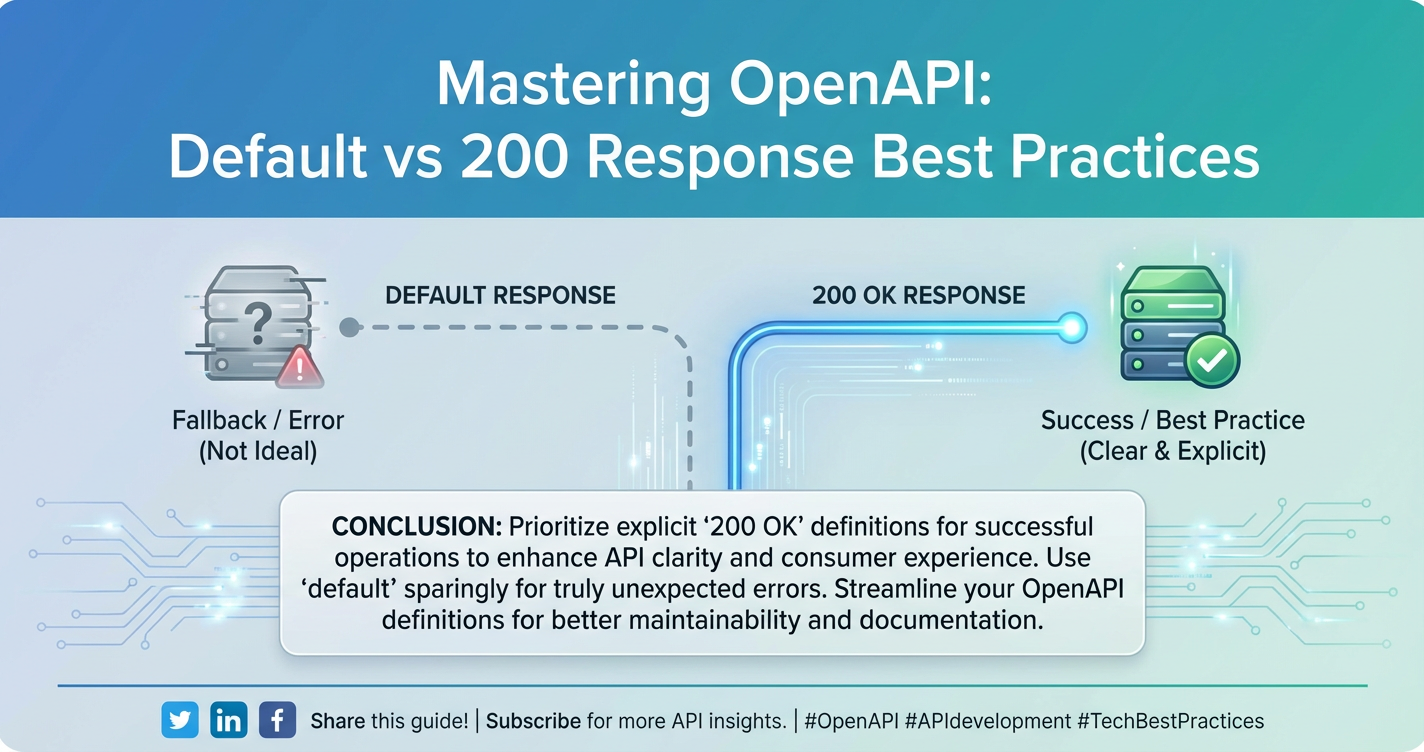
Ultimately, a mature API Governance strategy will emphasize clarity and consistency. This means prioritizing explicit definitions for all successful responses and the most common, actionable client-side errors. The default response then serves as an invaluable safeguard, ensuring that even in the face of unexpected server behavior, clients receive a predictable and parsable error structure, upholding the contract's robustness. This balanced approach creates an API that is both highly specific where it matters and broadly resilient everywhere else.
Enhancing Your OpenAPI Practice with API Management
Designing and documenting APIs meticulously with OpenAPI is a crucial first step, but it's only one part of the broader API Governance challenge. As organizations scale, the number of APIs can grow exponentially, leading to complexities in consistent design, secure deployment, reliable operation, and efficient consumption. This is where API management platforms become indispensable tools, bridging the gap between an OpenAPI definition and a fully operational, governable api ecosystem. These platforms provide the infrastructure and tooling necessary to manage the entire lifecycle of APIs, from design and publication to monitoring and decommissioning.
API management platforms help enforce the OpenAPI best practices discussed earlier by offering centralized control and automation. They can ingest OpenAPI documents to automatically configure routing, apply security policies, generate developer portals, and provide analytics. This ensures that the carefully crafted API contract defined in OpenAPI is consistently applied across all environments and remains compliant with organizational standards. Without such a platform, maintaining consistency across dozens or hundreds of APIs would be a manual, error-prone, and ultimately unsustainable endeavor.
For organizations striving for comprehensive api lifecycle management, including robust design, publication, and invocation, platforms like APIPark offer powerful solutions. APIPark, an open-source AI gateway and API management platform, excels in streamlining API integration and governance, especially for AI services. Its features, from unified API formats for AI invocation to end-to-end API lifecycle management, directly support the consistent application of OpenAPI best practices discussed here, ensuring that your API designs translate into secure, performant, and well-governed services.
APIPark, for instance, by offering End-to-End API Lifecycle Management, helps regulate API management processes, traffic forwarding, load balancing, and versioning of published APIs. This directly complements a strong OpenAPI strategy, as the specification becomes the foundational input for these managed processes. When an OpenAPI document clearly defines 200 OK responses with specific schemas, APIPark can ensure that gateways correctly validate outgoing responses against these schemas, preventing data inconsistencies. Similarly, a well-defined default error response in OpenAPI allows APIPark to standardize error reporting and logging across all APIs, providing a unified view of system health and facilitating quicker troubleshooting.
Furthermore, API management platforms often include capabilities like API Service Sharing within Teams and API Resource Access Requires Approval, which are vital for API Governance. These features ensure that even internally, API consumption is controlled and documented, adhering to security and access policies. By centralizing API catalogs and controlling access, these platforms make it easier for developers to discover and correctly use APIs, reducing the chances of misinterpretation or misuse that could arise from poorly understood response structures.
In essence, while OpenAPI provides the detailed blueprint, API management platforms like APIPark provide the construction crew, the quality control, and the ongoing maintenance infrastructure to bring that blueprint to life. They translate the static OpenAPI definition into dynamic, governable, and scalable API services, making them an indispensable component for any organization committed to building a robust and well-managed api ecosystem. The synergy between precise OpenAPI definitions and powerful API management tools is the bedrock of modern API Governance, ensuring both the technical correctness and the operational excellence of your digital assets.
Advanced Considerations and Pitfalls in OpenAPI Response Design
Beyond the fundamental choices between 200 OK and default responses, several advanced considerations and common pitfalls can significantly impact the long-term success and maintainability of your API. Adhering to these principles is crucial for building a truly robust and future-proof api ecosystem, especially under the umbrella of rigorous API Governance.
Versioning Strategies and Response Changes
API evolution is inevitable. Business requirements change, data models expand, and new features are introduced. How you manage changes to response structures, particularly to 200 OK payloads, is a critical aspect of API versioning. Modifying an existing response schema in a non-backward-compatible way (e.g., removing a field, changing a data type, or altering the core structure) will break existing clients.
Best Practice: When making backward-incompatible changes to response schemas, introduce a new API version. This provides a clear demarcation for consumers, allowing them to migrate at their own pace. For backward-compatible additions (e.g., adding a new optional field), it's generally safe to update the existing version's OpenAPI schema, but clear communication through changelogs is still essential. A robust API Governance framework dictates a clear versioning policy, ensuring that API providers proactively manage these changes and communicate them effectively to consumers, preventing unexpected breakages.
Error Payload Consistency and Standardization
While the default response helps standardize generic error formats, ensuring consistency across all error payloads, even those explicitly defined (e.g., 400, 401, 404), is paramount. An inconsistent error structure forces clients to write brittle, conditional logic to parse different error messages based on the status code, leading to increased complexity and debugging effort.
Best Practice: Define a single, reusable ErrorResponse schema in your components/schemas section. All explicit 4xx and 5xx responses, as well as the default response, should reference this common schema. This schema should typically include:
code: A machine-readable, unique error identifier (e.g.,invalid_input,resource_not_found).message: A human-readable description of the error.details: (Optional) An array of specific issues, especially for validation errors (e.g.,[{ "field": "email", "issue": "must be a valid email" }]).traceId: (Optional) A unique identifier for the request, useful for tracing and debugging in logs.moreInfo: (Optional) A URL pointing to more detailed documentation about the error.
This standardization, driven by API Governance policies, simplifies client-side error handling significantly and improves the overall developer experience.
Security Implications of Response Content
The content of your API responses, especially error responses, can have significant security implications. Leaking sensitive information in 500 Internal Server Error responses (e.g., stack traces, database connection strings, internal server details) is a common security vulnerability. Even in 4xx responses, providing overly verbose error messages could help an attacker enumerate system details or understand internal logic.
Best Practice: * For 5xx errors, return generic messages that do not expose internal server details. Log detailed error information securely on the server side, linking it to a traceId provided in the generic response. * For 4xx client errors, provide just enough information for the client to correct their request, but avoid revealing information that could aid exploitation (e.g., don't confirm which parts of a multi-factor authentication token are wrong, just that the overall token is invalid). * Ensure that 200 OK responses only contain data that the requesting user is authorized to see. This requires robust authorization checks on the server side before constructing the response payload. Effective API Governance mandates regular security audits of API responses to prevent such information leaks.
Impact on Documentation Generation and Tooling Support
The clarity and completeness of your OpenAPI response definitions directly influence the quality of generated documentation, SDKs, and other development tools.
Best Practice: * Detailed Descriptions: Provide clear, concise, and helpful description fields for every response and every schema property. These descriptions appear in generated documentation and are invaluable for developers. * Examples: Include examples or example properties within your response schemas. This gives developers concrete instances of what to expect, making it much easier to understand and integrate. * Consistent Naming: Use consistent naming conventions for fields, types, and operations across your API. This makes generated code and documentation more intuitive.
Tools that consume OpenAPI documents, such as Swagger UI, Postman, or various code generators, heavily rely on these details. A well-defined OpenAPI document with rich response definitions significantly enhances the utility of these tools, streamlining the developer workflow and reinforcing good API Governance practices.
By meticulously considering these advanced aspects, API designers can move beyond merely defining functional responses to crafting an api that is not only robust and secure but also highly usable, maintainable, and seamlessly integrated into a broader, well-governed ecosystem. Overlooking these details can lead to brittle integrations, security vulnerabilities, and a higher long-term maintenance burden, undermining the very goals of effective API Governance.
Conclusion: Crafting Resilient API Contracts with OpenAPI
The journey through the intricacies of OpenAPI response definitions, particularly the strategic interplay between 200 OK and default responses, underscores a fundamental truth in api design: precision and predictability are paramount. In an era where APIs are the backbone of digital transformation, the clarity of these digital contracts directly influences developer productivity, system reliability, and the overall success of an organization's technological initiatives. Mastering how an API communicates its success and failures is not merely a technical exercise; it is a critical component of a robust API Governance strategy, ensuring that every interaction is understood and every outcome is anticipated.
We've established that the 200 OK response serves as the clear signal of success, conveying that a request was flawlessly executed and, often, that the desired data is ready for consumption. Best practices for its implementation demand consistent payload structures, meticulous schema definitions, and a firm commitment to using it only for genuine successes, avoiding the deceptive practice of embedding errors within a 200 status. This dedication to explicit success communication builds trust and simplifies the integration process for consumers.
Conversely, the default response stands as the crucial safety net in your OpenAPI definition. It provides a standardized fallback for any response code not explicitly enumerated, ensuring that clients always have a predictable error structure to parse, even in the face of unforeseen server behavior or less common error conditions. Its power lies in its ability to enforce a consistent error reporting mechanism across the entire api landscape, a cornerstone of effective API Governance, without requiring every conceivable error to be explicitly documented for every operation. However, its effectiveness hinges on always linking to a comprehensive and well-defined error schema, ensuring that even generic errors provide actionable information.
The strategic comparison highlighted that the most effective OpenAPI designs leverage a thoughtful hybrid approach. This means prioritizing explicit definitions for all successful outcomes (200 OK, 201 Created, 204 No Content) and for all common, actionable client-side errors (400 Bad Request, 401 Unauthorized, 404 Not Found). These specific declarations provide the clarity and precision necessary for robust client-side logic and tooling. The default response then acts as an invaluable, standardized catch-all for less common errors and system-level failures, ensuring resilience without overcomplicating the primary API contract.
Furthermore, we've touched upon how this meticulous design philosophy is amplified by api management platforms like APIPark. These platforms translate the static OpenAPI blueprint into a dynamic, governable ecosystem, automating policy enforcement, access control, and monitoring. The synergy between a well-defined OpenAPI specification and a powerful management platform is what truly elevates API Governance from a set of guidelines to an operational reality, ensuring consistency, security, and scalability across your entire digital portfolio.
As developers, architects, and product managers, our commitment to thoughtful api design and rigorous API Governance is not merely about technical elegance; it's about building reliable, maintainable, and user-friendly digital assets that drive business value. By embracing the best practices for 200 OK and default responses within the OpenAPI Specification, we lay a robust foundation for an api ecosystem that is not only functional today but also adaptable and resilient for the challenges of tomorrow. Let us strive for clarity in every response, for in doing so, we master the language of the web and build connections that endure.
Frequently Asked Questions (FAQs)
1. What is the primary difference between 200 OK and default responses in OpenAPI? The 200 OK response explicitly signifies a successful operation where the request was fully processed and the expected data or outcome is returned. The default response, on the other hand, is a catch-all for any HTTP status code not explicitly defined for a given operation in the OpenAPI document. It typically describes a generic error format for unexpected or unhandled scenarios, ensuring clients always have a predictable structure to parse.
2. When should I use 204 No Content instead of 200 OK for successful operations? You should use 204 No Content when a request has been successfully processed by the server, but there is no need to return any content in the response body. This is common for successful DELETE operations, or PUT/PATCH updates where the client doesn't need the full updated resource returned, only confirmation of success. Using 204 saves bandwidth and clearly communicates that no body should be expected.
3. Is it acceptable to return 200 OK with an error message in the payload? No, this is an anti-pattern and should be avoided. Returning 200 OK for an error contradicts the semantics of HTTP status codes, making it difficult for clients, proxies, and monitoring systems to correctly interpret the API's behavior. Always use appropriate 4xx (client errors) or 5xx (server errors) status codes when an error occurs, providing clear and actionable feedback through a standardized error payload.
4. What are the benefits of defining a reusable ErrorResponse schema for default and other error responses? Defining a reusable ErrorResponse schema (e.g., in components/schemas in OpenAPI) ensures consistency across all error payloads in your API. This standardization significantly simplifies client-side error handling, as developers only need to parse one predictable structure for all error types. It also enhances API Governance by enforcing a uniform approach to error reporting, improving debugging, monitoring, and overall developer experience across your api ecosystem.
5. How does API management, like with APIPark, help enforce OpenAPI best practices for responses? API management platforms like APIPark ingest your OpenAPI definitions and use them to enforce design, security, and operational policies. They can ensure that responses conform to defined schemas, standardize error formats (leveraging your default response schema), and provide analytics on response codes. This ensures that the meticulously designed contracts in your OpenAPI document are consistently applied across all API interactions, facilitating robust API Governance and reliable api operations.
🚀You can securely and efficiently call the OpenAI API on APIPark in just two steps:
Step 1: Deploy the APIPark AI gateway in 5 minutes.
APIPark is developed based on Golang, offering strong product performance and low development and maintenance costs. You can deploy APIPark with a single command line.
curl -sSO https://download.apipark.com/install/quick-start.sh; bash quick-start.sh

In my experience, you can see the successful deployment interface within 5 to 10 minutes. Then, you can log in to APIPark using your account.

Step 2: Call the OpenAI API.