Mastering OpenAPI Responses: Default vs 200 Explained


In the intricate world of Application Programming Interfaces (APIs), clarity, consistency, and precision are not merely desirable traits; they are fundamental requirements for fostering robust communication between systems. As the digital fabric of our modern world becomes increasingly interconnected, the ability to define, document, and manage APIs effectively has emerged as a cornerstone of successful software development. At the heart of this endeavor lies the OpenAPI Specification, a powerful, language-agnostic standard for describing RESTful APIs. It enables both humans and machines to discover and understand the capabilities of a service without access to source code or additional documentation.
Within the OpenAPI framework, the definition of API responses stands out as a critical area where meticulous attention to detail can significantly impact the developer experience, system reliability, and overall maintainability of an API. Two specific response types, 200 OK and default, often lead to confusion or misuse, yet mastering their distinct purposes is paramount for crafting truly resilient and intuitive APIs. While 200 OK is universally recognized as the standard indicator of a successful operation, the default response serves a unique, often misunderstood, role as a catch-all for scenarios not explicitly defined by other HTTP status codes.
This comprehensive guide aims to unravel the nuances of 200 OK and default responses within the OpenAPI Specification. We will embark on a detailed exploration of their individual characteristics, delve into the scenarios where each is most appropriately applied, and scrutinize the best practices that ensure their effective implementation. By the end of this journey, developers, API designers, and architects will possess a profound understanding of how to leverage these two vital response types to build highly performant, predictable, and user-friendly APIs that stand the test of time and scale. Our focus will extend beyond mere definition, offering practical insights and code examples to illuminate the path toward OpenAPI response mastery.
The Foundational Bedrock: Understanding OpenAPI Specification
Before we dive deep into the specifics of 200 OK and default responses, it's essential to establish a firm understanding of the OpenAPI Specification itself. Often referred to as the lingua franca for apis, OpenAPI (formerly known as Swagger Specification) provides a standardized, machine-readable format for describing RESTful apis. It's not a programming language but a descriptive specification, typically written in YAML or JSON, that outlines the entire surface area of an api.
Why is OpenAPI Indispensable for Modern API Development?
The genesis of OpenAPI was driven by a clear need to address the pervasive challenges associated with api documentation and consumption. In the past, developers often relied on fragmented documentation, outdated wiki pages, or even trial and error to understand how to interact with an api. This cumbersome process led to significant friction, increased development cycles, and a higher propensity for integration errors. OpenAPI fundamentally changed this paradigm by offering several transformative benefits:
- Machine Readability: Unlike traditional human-readable documentation, OpenAPI definitions are structured data. This characteristic allows various tools to consume, parse, and interpret the
api's structure automatically. This capability unlocks a vast ecosystem of automation tools, from code generators to interactive documentation platforms. - Interactive Documentation: Tools like Swagger UI can take an OpenAPI definition and render stunning, interactive documentation directly in a web browser. This interface allows developers to explore
apiendpoints, understand request parameters, and even make liveapicalls directly from the browser, significantly accelerating the learning curve. - Client and Server Code Generation: With an OpenAPI definition, developers can automatically generate client SDKs (Software Development Kits) in numerous programming languages (e.g., Python, Java, JavaScript, Go) and server stubs. This automation drastically reduces boilerplate code, ensures consistency, and minimizes the potential for manual errors during integration.
- API Design-First Approach: OpenAPI encourages a "design-first" approach to
apidevelopment. Instead of writing code and then documenting it, teams first design theirapicontract using OpenAPI. This upfront design phase fosters better communication, catches design flaws early, and ensures that theapimeets business requirements before a single line of implementation code is written. - Enhanced Testing: OpenAPI definitions can be used to generate test cases, validate
apirequests and responses against the defined schema, and ensure that the implementedapiadheres to its contract. This rigorous validation improves the quality and reliability of theapi. - API Gateway Integration and Management:
apimanagement platforms, including powerful solutions like APIPark, heavily leverage OpenAPI definitions. These platforms can ingest OpenAPI files to automatically configure routing, apply security policies, enforce rate limits, and even publishapis to a developer portal.APIPark, for instance, as an open-source AI gateway andapimanagement platform, provides end-to-endapilifecycle management, helping regulate API management processes, manage traffic forwarding, load balancing, and versioning of published APIs based on their OpenAPI specifications. This ensures that the contracts defined within OpenAPI are respected and enforced at the gateway level.
Key Sections of an OpenAPI Document
An OpenAPI document is typically structured into several logical sections, each contributing to a complete description of the api:
openapi: Specifies the version of the OpenAPI Specification being used (e.g.,3.0.0).info: Provides metadata about theapi, such as its title, version, description, and contact information.servers: Lists the base URLs for theapi(e.g., production, staging, development environments).paths: This is the core of theapidefinition, detailing individual endpoints (paths) and the HTTP methods (operations) supported for each path. Each operation defines its parameters, request bodies, and, crucially, its responses.components: A reusable section where schemas, parameters, responses, headers, security schemes, and examples can be defined once and referenced across theapi. This promotes modularity, consistency, and reduces redundancy. Thecomponents/schemassection, in particular, is vital for defining the data structures of request bodies and response payloads.security: Defines the security schemes used by theapi, such as OAuth2, API Keys, or HTTP Basic authentication.tags: Allows for logical grouping of operations for better organization in documentation.
Within the paths section, under each operation (e.g., get, post, put, delete), the responses object is where the behavior of the api upon completion of a request is meticulously documented. It's here that 200 OK and default play their pivotal roles, signaling success or outlining the common error contract.
Delving into HTTP Status Codes: The Language of Web Communication
Before we isolate 200 OK and default, a brief but comprehensive refresher on HTTP status codes is in order. These three-digit numbers are the standardized language spoken by servers to inform clients about the outcome of their request. They are fundamentally crucial for building resilient apis because they provide semantic meaning to responses, allowing clients to interpret the result without needing to parse the response body in every scenario.
The Internet Engineering Task Force (IETF) and the World Wide Web Consortium (W3C) define HTTP status codes, categorizing them into five classes based on their first digit:
- 1xx - Informational Responses: These indicate that the request has been received and understood. They are provisional responses, indicating progress rather than completion. Examples include
100 Continue(the server has received the request headers, and the client should proceed to send the request body) and101 Switching Protocols. These are less common in typical RESTapiinteractions but are important for specific protocols or communication patterns. - 2xx - Success Responses: These indicate that the client's request was successfully received, understood, and accepted. This category is where
200 OKresides, signifying the gold standard of success. Other common 2xx codes include:200 OK: The standard response for successful HTTP requests. The actual response will depend on the request method (e.g., aGETrequest will return the resource,POSTmight return a status).201 Created: The request has been fulfilled, and a new resource has been created as a result. This is typically sent after aPOSTrequest.202 Accepted: The request has been accepted for processing, but the processing has not been completed. This often indicates that the request will be handled asynchronously.204 No Content: The server successfully processed the request and is not returning any content. This is often used forPUTorDELETErequests where the client does not need to navigate away from its current page.206 Partial Content: The server is delivering only part of the resource due to a range header sent by the client. Useful for large downloads or resuming interrupted ones.
- 3xx - Redirection Messages: These indicate that the client needs to take additional action to complete the request. They instruct the client to go to a different URL. Examples include:
301 Moved Permanently: The requested resource has been permanently moved to a new URL.302 Found(formerly "Moved Temporarily"): The requested resource has been temporarily moved.304 Not Modified: Used in response to a conditionalGETorHEADrequest. It tells the client that the resource has not been modified since the version specified by the request headers (e.g.,If-None-Match,If-Modified-Since).
- 4xx - Client Error Responses: These indicate that there was an error with the client's request. The server perceives that the client has made a mistake. This category is where many common API errors fall, and where the
defaultresponse often comes into play. Examples include:400 Bad Request: The server cannot process the request due to an apparent client error (e.g., malformed syntax, invalid request message framing, or deceptive request routing).401 Unauthorized: The client must authenticate itself to get the requested response. This typically means the client has not provided authentication credentials or they are invalid.403 Forbidden: The client does not have access rights to the content, i.e., it is unauthorized, so the server is refusing to give a proper response. Unlike401, re-authenticating will not make a difference.404 Not Found: The server cannot find the requested resource. This is perhaps the most famousapierror.405 Method Not Allowed: The request method (e.g.,POST) is known by the server but has been disabled or not allowed for the target resource.429 Too Many Requests: The user has sent too many requests in a given amount of time ("rate limiting").
- 5xx - Server Error Responses: These indicate that the server failed to fulfill an apparently valid request. The client made a good request, but the server encountered an unexpected condition. This category is also often covered by the
defaultresponse. Examples include:500 Internal Server Error: The server has encountered a situation it doesn't know how to handle. This is a generic catch-all server error.502 Bad Gateway: The server, while acting as a gateway or proxy, received an invalid response from an inbound server it accessed in attempting to fulfill the request.503 Service Unavailable: The server is not ready to handle the request. Common causes are a server that is down for maintenance or overloaded.504 Gateway Timeout: The server, while acting as a gateway or proxy, did not get a response in time from the upstream server.
The Importance of Semantic Meaning in API Design
Understanding and correctly applying these status codes is paramount for several reasons:
- Client Behavior: Clients rely on status codes to programmatically determine how to proceed. A
200means "continue processing the data," while a404means "abort, resource not found," and a500might trigger a retry mechanism or an alert. - Debugging: Correct status codes provide invaluable clues during debugging. A
400points to a client-side issue, while a500signals a server-side problem. - Caching: Some status codes (e.g.,
200,304) have specific caching semantics thatapigateways, CDNs, and browsers use. - Monitoring and Alerts:
apimonitoring tools often track the distribution of status codes to identify issues (e.g., a sudden spike in 5xx errors indicates a server-side problem).
Now, with a solid grasp of OpenAPI's structure and the language of HTTP, we can zoom in on the specific roles of 200 OK and default responses.
The 200 OK Response: The Pillar of Success
The 200 OK HTTP status code is arguably the most common and widely understood response in the entire web ecosystem. In the context of an api, it unequivocally signifies that the client's request was successfully received, processed, and the server is returning the requested data or confirming the action's completion. It is the hallmark of a healthy and functioning API interaction.
What it Signifies:
When an api returns a 200 OK, it communicates a clear message to the client: "Everything went as planned. Here is your data, or confirmation that your operation was successful." It's the expected outcome for the vast majority of successful api calls, whether they involve retrieving data, submitting data, or performing an action.
When to Use It:
While other 2xx status codes (like 201 Created or 204 No Content) offer more specific semantic meanings for certain successful operations, 200 OK remains a versatile and appropriate choice in many scenarios:
- Successful Data Retrieval (GET): The most common use case. When a client performs a
GETrequest to retrieve a resource (e.g.,/users,/products/{id}), a200 OKresponse indicates that the resource was found and is being returned in the response body. - Successful Update (PUT/PATCH): If a client updates an existing resource (e.g.,
/users/{id}with aPUTorPATCHrequest), and the server successfully applies the changes, a200 OKcan be returned. In this case, the response body might contain the updated resource, a confirmation message, or simply be empty if a204 No Contentis not preferred. - Successful Deletion (DELETE): When a client requests to delete a resource (e.g.,
/products/{id}with aDELETErequest), a200 OKcan confirm the successful removal. Similar to updates, the response body might be empty, or contain a success message. - Successful Creation (POST): While
201 Createdis semantically more accurate for resource creation, someapidesigns might return200 OKwith the newly created resource in the body. However,201is generally preferred forPOSToperations that result in a new resource. - Arbitrary Operations: For
apis that perform complex, non-CRUD (Create, Read, Update, Delete) operations, a200 OKindicates the successful execution of that specific function.
Detailed Structure in OpenAPI for 200 OK
In an OpenAPI definition, the 200 response is typically defined with several key properties to provide a comprehensive contract for clients. Let's break down the common elements:
paths:
  /users:
    get:
      summary: Get a list of all users
      responses:
        '200':
          description: A list of users was successfully retrieved.
          content:
            application/json:
              schema:
                type: array
                items:
                  $ref: '#/components/schemas/User'
              examples:
                successResponse:
                  summary: Example of a successful user list retrieval
                  value:
                    - id: "123"
                      name: "Alice Smith"
                      email: "alice@example.com"
                    - id: "456"
                      name: "Bob Johnson"
                      email: "bob@example.com"
          headers:
            X-Rate-Limit-Remaining:
              description: The number of allowed requests in the current period remaining.
              schema:
                type: integer
            X-Request-ID:
              description: A unique identifier for the request.
              schema:
                type: string
description(Required): This is a human-readable text explaining the meaning of the200response. It should be clear and concise, detailing what the client can expect when this status code is returned. For instance, "A list of users was successfully retrieved" or "The user profile was updated successfully."content(Optional, but highly recommended for data-returning responses): This object specifies the various media types theapimight return for this200response (e.g.,application/json,text/xml,application/octet-stream).media-type(e.g.,application/json): Under each media type, you define the structure of the payload.schema: This is the most crucial part. It defines the data model of the response body using a schema object. This schema can be defined inline or, more commonly, referenced from thecomponents/schemassection for reusability. For aGET /usersrequest, the schema might describe an array ofUserobjects. For aGET /users/{id}, it would describe a singleUserobject.examples(Optional, but highly beneficial): Provides one or more concrete examples of what a200response payload would look like for the specified media type. This significantly enhances the clarity of the documentation, allowing developers to immediately grasp the expected data structure. Each example can have asummaryand avalue.
headers(Optional): This object allows you to describe any custom headers that theapimight include in a200response. For example,X-Rate-Limit-Remainingto indicate the number of remaining requests in a rate-limiting window, orX-Request-IDfor traceability. Each header should have adescriptionand aschemadescribing its type.
Real-World Examples for 200 OK
- Retrieving a list of items: ```json GET /productsHTTP/1.1 200 OK Content-Type: application/json X-Rate-Limit-Remaining: 995[ { "id": "prod_abc", "name": "Laptop Pro", "price": 1200.00 }, { "id": "prod_xyz", "name": "Mechanical Keyboard", "price": 150.00 } ]
* **Retrieving a single item:**json GET /users/123HTTP/1.1 200 OK Content-Type: application/json{ "id": "123", "username": "johndoe", "email": "john.doe@example.com", "status": "active" }* **Updating an item (returning the updated item):**json PUT /orders/order_123HTTP/1.1 200 OK Content-Type: application/json{ "orderId": "order_123", "status": "shipped", "items": [ / ... / ] } ```
Best Practices for 200 OK Responses:
- Be Specific with Schemas: Always define a precise schema for your
200responses. Ambiguity here leads to client-side parsing errors and integration headaches. Leveragecomponents/schemasfor reusable data models. - Provide Rich Descriptions: The
descriptionfield for200should clearly state what the successful outcome implies. This is the first thing a developer reads. - Include Examples: Concrete examples are incredibly helpful. They provide immediate clarity and validate the schema you've defined. Ensure examples accurately reflect the schema.
- Consistency is Key: Strive for consistent
200response structures across yourapis, especially for similar types of operations (e.g., allGEToperations returning a single resource should follow a similar structure). - Consider Empty Collections vs.
null: ForGETrequests that return a collection (e.g.,/users), if no items are found, return an empty array ([]) instead ofnull. This simplifies client-side parsing as they don't need to check fornullbefore iterating. - Use Specific 2xx Codes When Appropriate: While
200is versatile, don't shy away from201 Createdfor resource creation or204 No Contentfor operations that yield no response body (like a successful deletion where no confirmation payload is needed). These provide even greater semantic precision. - Informative Headers: If relevant, use headers to provide additional context, such as rate limits, pagination links, or correlation IDs.
By meticulously defining 200 OK responses, you empower client developers to confidently consume your api, knowing exactly what to expect when an operation completes successfully. This clarity forms the bedrock of a positive developer experience and robust system integration.
The default Response: Catch-all for the Unexpected (and Expected Errors)
While 200 OK celebrates success, the default response in OpenAPI steps in to manage everything else. This is where many designers get confused, often mistakenly thinking default is just for server errors or a specific 500 Internal Server Error. In reality, default has a much broader, more strategic purpose: it defines a response for any HTTP status code not explicitly defined for a given operation. This makes it an incredibly powerful tool for standardizing error responses across an api, regardless of the specific HTTP status code (4xx or 5xx) that might be returned.
What it Signifies:
The default response signifies: "If the api returns any HTTP status code that is not individually listed in this operation's responses object (e.g., not 200, not 201, not 404), then this default response definition applies."
Crucially, it is not an HTTP status code itself. It is a special keyword in OpenAPI that acts as a wildcard. Its primary utility lies in defining a consistent error payload structure for various client and server-side errors, ensuring that client applications have a predictable way to parse and handle unexpected or un-specified outcomes.
When to Use It:
The default response is most effectively used as a consistent error contract for your api. Its strategic applications include:
- Unified Error Response Format: This is its most significant advantage. Instead of defining a distinct schema for
400 Bad Request,401 Unauthorized,403 Forbidden,405 Method Not Allowed,429 Too Many Requests,500 Internal Server Error,502 Bad Gateway,503 Service Unavailable, and504 Gateway Timeout, you can define one common error structure underdefault. This ensures that client applications always receive errors in a predictable format, simplifying error handling logic. - Catch-all for Various Error Scenarios: It acts as a safety net. Even if you explicitly define common errors like
4404 Not Found(if its error payload deviates) or400 Bad Request, thedefaultresponse will handle all other potential 4xx and 5xx errors that might arise but aren't specifically documented. This is particularly useful for unexpected server errors (e.g.,500) that might not be anticipated during design. - Simplifying OpenAPI Definitions: Without
default, you would need to list every single possible error status code for every operation, which can make your OpenAPI document extremely verbose and difficult to maintain.defaultstreamlines this by providing a single point of definition for generic error responses. - Guiding Client Implementation: By defining a
defaulterror structure, you are explicitly telling client developers, "When something goes wrong, and it's not one of the explicitly listed success or specific error codes, you will get an error payload structured like this. Always check the actual HTTP status code for the precise nature of the error."
Detailed Structure in OpenAPI for default
The structure for default responses mirrors that of specific status code responses, but its description and schema typically focus on a generic error format.
paths:
  /users/{userId}:
    get:
      summary: Retrieve a user by ID
      parameters:
        - in: path
          name: userId
          required: true
          schema:
            type: string
          description: The ID of the user to retrieve.
      responses:
        '200':
          description: User data retrieved successfully.
          content:
            application/json:
              schema:
                $ref: '#/components/schemas/User'
        '404':
          description: User not found. This is a specific error.
          content:
            application/json:
              schema:
                $ref: '#/components/schemas/NotFoundError' # Potentially a different schema than default
        default: # This catches any other status code, typically 4xx or 5xx
          description: Standard error response for unspecified status codes.
          content:
            application/json:
              schema:
                $ref: '#/components/schemas/ErrorResponse'
              examples:
                badRequest:
                  summary: Example for 400 Bad Request
                  value:
                    code: "400"
                    message: "Invalid input data provided."
                    details:
                      - field: "email"
                        issue: "Must be a valid email format."
                unauthorized:
                  summary: Example for 401 Unauthorized
                  value:
                    code: "401"
                    message: "Authentication required or invalid credentials."
                internalServerError:
                  summary: Example for 500 Internal Server Error
                  value:
                    code: "500"
                    message: "An unexpected server error occurred."
                    traceId: "abc-123-xyz"

components:
  schemas:
    User:
      type: object
      properties:
        id:
          type: string
        name:
          type: string
        email:
          type: string
    NotFoundError:
      type: object
      properties:
        code:
          type: string
          example: "NOT_FOUND"
        message:
          type: string
          example: "The requested resource could not be found."
    ErrorResponse:
      type: object
      properties:
        code:
          type: string
          description: A unique error code for programmatic handling (e.g., 400, USER_NOT_FOUND, INVALID_CREDENTIALS).
          example: "INVALID_INPUT"
        message:
          type: string
          description: A human-readable message explaining the error.
          example: "Validation failed for request parameters."
        details:
          type: array
          items:
            type: object
            properties:
              field:
                type: string
                description: The field that caused the error (for validation errors).
              issue:
                type: string
                description: A specific issue with the field.
      required:
        - code
        - message
description(Required): This is absolutely vital fordefault. It must clearly state that this response covers any HTTP status code not explicitly defined. For example, "Standard error response for any unspecified client or server error codes."content(Optional, but essential for error payloads): Specifies the media type for the error response.application/jsonis the de facto standard.schema: This should point to a generalized error schema defined incomponents/schemas. This schema typically includes fields like:code: A programmatic error code (could be the HTTP status code, or a more granular application-specific code).message: A human-readable error description.details: (Optional) More specific information, like validation errors (which fields failed, why).timestamp: (Optional) When the error occurred.traceId: (Optional) A correlation ID for tracing the request through logs, especially useful forAPIPark's detailed API call logging.
examples(Highly recommended): Provide several examples of thedefaulterror structure for different HTTP status codes (e.g., a400 Bad Requestexample, a401 Unauthorizedexample, a500 Internal Server Errorexample), all conforming to the sameErrorResponseschema. This clarifies how the generic error schema applies to various real-world error conditions.
headers(Optional): Define any headers that might accompany an error response, such asRetry-Afterfor429 Too Many Requestsor503 Service Unavailable.
Real-World Examples for default
Assuming the ErrorResponse schema shown above:
400 Bad Request(Client validation error): ```json POST /usersHTTP/1.1 400 Bad Request Content-Type: application/json{ "code": "VALIDATION_ERROR", "message": "One or more input fields are invalid.", "details": [ { "field": "email", "issue": "Invalid email format." }, { "field": "password", "issue": "Password must be at least 8 characters long." } ] }* **`401 Unauthorized` (Authentication failure):**json GET /secure-dataHTTP/1.1 401 Unauthorized Content-Type: application/json{ "code": "AUTHENTICATION_FAILED", "message": "Invalid or missing authentication token." }* **`500 Internal Server Error` (Unexpected server issue):**json GET /some-resourceHTTP/1.1 500 Internal Server Error Content-Type: application/json{ "code": "SERVER_ERROR", "message": "An unexpected error occurred on the server.", "traceId": "req_84a7e3d2b1f0c5a9" } ```
Best Practices for default Responses:
- Standardize Your Error Schema: This is the golden rule for
default. Define a single, consistent schema for all your error responses (e.g.,ErrorResponse). This schema should be generic enough to accommodate different types of errors (validation, authentication, server-side) while providing sufficient detail. Consider adopting a standard like Problem Details for HTTP APIs (RFC 7807). - Clear
description: Explicitly state thatdefaultcovers all unspecified status codes, usually referring to errors. - Provide Varied Examples: Show examples of how your generic error schema would look for different HTTP status codes (e.g.,
400,401,500). This helps client developers understand how to interpret thedefaultresponse in conjunction with the actual HTTP status code. - Client-Side Status Code Check: Emphasize that clients consuming your
apimust always inspect the actual HTTP status code received, even if the response matches thedefaultschema. Thedefaultresponse schema only defines the shape of the error payload; the status code (400,401,500, etc.) determines the nature of the error. - Balance Specificity: While
defaultis great for generality, if a particular error code (e.g.,404 Not Foundfor aGEToperation) has a unique response structure that deviates significantly from your genericdefaulterror, or if it's extremely common and warrants explicit, separate documentation, then define it specifically. Otherwise, letdefaulthandle it. - Avoid Leaking Sensitive Information: Ensure that your
defaulterror responses do not inadvertently expose sensitive server details (e.g., stack traces, internalapikeys, database error messages). Error messages should be informative enough for debugging but safe for public consumption.
By leveraging the default response effectively, you create a resilient error handling mechanism for your apis, significantly improving the developer experience by offering predictable error structures, even when the unexpected occurs.
Comparative Analysis: default vs. 200
Now that we've thoroughly examined 200 OK and default individually, let's juxtapose them to highlight their distinct roles, purposes, and implications for api design. Understanding this dichotomy is central to mastering OpenAPI responses.
Purpose and Intent:
200 OK: This is a definitive statement of success. It signifies that the client's request was fully understood, processed without issues, and the expected outcome (data retrieval, resource update, etc.) has occurred. Its primary intent is to convey successful completion and, typically, to deliver a meaningful payload reflecting that success.default: This is a catch-all for any outcome not explicitly defined by other status codes. While it can technically catch a200if no200is defined (highly unrecommended), its practical and most beneficial purpose is to define a standard structure for various error conditions (4xx and 5xx) that don't have their own specific OpenAPI response definition. Its intent is to provide a consistent contract for error handling, making clients more robust against unexpected server behaviors or common client-side mistakes.
Exclusivity and Specificity:
200 OK: This is an explicit and specific success code. When it's defined, it means the API is specifically designed to respond with this status and its associated payload upon successful execution. It carves out a precise contractual agreement for success.default: This is inherently non-exclusive and generic. It comes into play only if the actual HTTP status code returned by the server does not match any of the other explicitly defined response codes (e.g.,200,201,404,400). It covers the "everything else" category.
Client Expectations and Behavior:
200 OK: Clients receiving a200 OKexpect the operation to have completed successfully and will typically proceed to parse the response body, assuming it conforms to the200schema. They can confidently continue their workflow based on the received data.default: Clients receiving a response that falls underdefaultshould immediately understand that something went wrong or unexpectedly. Their primary action should be to inspect the actual HTTP status code (e.g.,400,401,500) to determine the nature of the issue, and then parse thedefaultresponse body to get specific error details that conform to the defined error schema. They cannot assume success and must adapt their logic based on the error type.
Design Philosophy and Trade-offs:
The choice between explicitly defining every possible error code vs. relying on default involves a trade-off between documentation verbosity and consistency:
- Prioritizing
200(and other specific success codes):- Pros: Offers maximum clarity and semantic precision for successful outcomes. Client developers know exactly what to expect in specific success scenarios.
- Cons: If not used in conjunction with other 2xx codes,
200might lack the granular semantic detail that201or204can provide for creation or no-content scenarios. - Decision Point: Always define
200(or201/204) for every operation that can succeed. It's the baseline for a usableapi.
- Leveraging
defaultfor Error Consistency:- Pros:
- Standardized Error Handling: Ensures a unified error payload structure across the entire
apiorapisegment, simplifying client-side error parsing and business logic. - Reduced Documentation Clutter: Avoids repetitively defining the same error structure for
400,401,403,500, etc., when their payloads are identical. - Future-Proofing: Catches unexpected error codes that might arise from server-side issues or future extensions, providing a predictable response structure even for undocumented errors.
- Standardized Error Handling: Ensures a unified error payload structure across the entire
- Cons:
- Loss of Specificity in OpenAPI: The OpenAPI definition itself won't explicitly list
400or500as individual responses, relying on thedefaultdescription. This might require additional textual explanation in thedefaultdescription. - Requires Client to Check Status Code: Clients must still check the HTTP status code, as
defaultalone doesn't convey the specific error type.
- Loss of Specificity in OpenAPI: The OpenAPI definition itself won't explicitly list
- Decision Point: Use
defaultwhenever multiple error codes share a common payload structure. Only define specific error codes (e.g.,404) if their payload is genuinely distinct or if they are so common and critical that they warrant explicit, first-class documentation beyond whatdefaultcan convey.
- Pros:
When to Use Both (and other status codes):
A well-designed OpenAPI operation will almost always include both a specific success response and a default error response.
- Always define a 2xx success code: For any operation that can complete successfully, define at least one
2xxresponse (200,201,204, etc.) with its specific schema and description. This is your primary success contract. - Almost always define a
defaultresponse: To provide a consistent error contract for your API, include adefaultresponse that references a genericErrorResponseschema. This handles all unspecified 4xx and 5xx errors. - Optionally define specific 4xx/5xx responses: If certain error codes (e.g.,
404 Not Foundfor aGETrequest, or400 Bad Requestfor specific validation failures) require a different response payload structure than yourdefaulterror schema, or if they are so fundamental to theapithat they deserve explicit mention and tailored examples, then define them alongsidedefault. Remember: If a specific status code (e.g.,404) is defined,defaultwill not apply to it.defaultonly applies to codes not explicitly listed.
This balanced approach creates an OpenAPI definition that is both precise for expected outcomes and resilient for all other scenarios, streamlining both development and consumption.
Here's a comparison table summarizing the key differences:
| Feature | 200 OK Response |
default Response |
|---|---|---|
| Purpose | Indicates explicit success of the api operation. |
Catches any HTTP status code not explicitly defined. Usually for errors. |
| Type | Specific HTTP status code (success category). | OpenAPI keyword, not an HTTP status code. Wildcard. |
| Content | Typically contains the requested resource or confirmation of success. | Typically contains a standardized error object (e.g., code, message). |
| When to Use | For successful data retrieval, updates, deletions. | For consistent error handling across 4xx and 5xx errors. |
| Client Action | Parse response body for data/confirmation. | Inspect actual HTTP status code, then parse response body for error details. |
| Semantic Value | High semantic value: "Operation successful." | High semantic value: "Something unexpected happened, check status code for details." |
| Exclusivity | Exclusive to the 200 status. |
Applies to all unspecified status codes. |
| Best Practice | Always define for successful operations. | Almost always define for comprehensive error handling. |
| Example Use Case | GET /users returns a list of users. |
POST /users fails with 400 Bad Request or 500 Internal Server Error. |
APIPark is a high-performance AI gateway that allows you to securely access the most comprehensive LLM APIs globally on the APIPark platform, including OpenAI, Anthropic, Mistral, Llama2, Google Gemini, and more.Try APIPark now! 👇👇👇
Advanced API Response Design Patterns
Beyond the fundamental 200 OK and default responses, a truly masterful api designer considers several advanced patterns to enhance resilience, usability, and developer experience.
Error Handling Strategies: Building a Robust Default
The default response's strength lies in its ability to standardize error messages. Here are patterns to make that standardization even more effective:
- Unified Error Response Format (RFC 7807 - Problem Details for HTTP APIs):
- Instead of inventing your own error format, consider adopting RFC 7807. This standard provides a machine-readable format for conveying
apierror details. - A
Problem Detailsobject typically includes:type: A URI that identifies the problem type (e.g.,https://example.com/probs/out-of-credit).title: A short, human-readable summary of the problem type.status: The HTTP status code (often redundant with the actual HTTP status but included for consistency).detail: A human-readable explanation specific to this occurrence of the problem.instance: A URI that identifies the specific occurrence of the problem.
- Integrating this into your
defaultschema provides a robust, standardized, and easily parsable error contract.
- Instead of inventing your own error format, consider adopting RFC 7807. This standard provides a machine-readable format for conveying
- Error Enrichment:
- For internal debugging and logging, error responses might include additional, non-sensitive details like
traceId(a correlation ID for the request, as mentioned inAPIPark's logging features) orerrorCode(an internal, application-specific code). - Ensure these details are only exposed to authorized consumers or in specific environments, and never leak sensitive data to external clients.
- For internal debugging and logging, error responses might include additional, non-sensitive details like
Versioning and Responses
As APIs evolve, so too do their response structures. Careful versioning is crucial to avoid breaking existing client integrations.
- Major Version Changes: If a
200response schema ordefaulterror schema undergoes a breaking change (e.g., renaming fields, changing data types, removing required fields), it warrants a new majorapiversion (e.g.,/v1/usersto/v2/users). - Minor/Patch Changes: Non-breaking changes (e.g., adding optional fields to a
200response, adding new error codes todefaultthat conform to the existing schema) can often be released under the sameapiversion. - OpenAPI-First Development: Using
OpenAPIfor a "design-first" approach helps formalize versioning. New versions mean newOpenAPIdefinitions, ensuring clients are always consuming the correct contract.
Pagination and Filtering in 200 Responses
For GET operations returning collections, 200 OK responses often need to incorporate metadata for pagination and filtering.
- Paginating
200Responses: Instead of just returning an array of items, wrap it in an object that includes pagination metadata: ```json HTTP/1.1 200 OK Content-Type: application/json{ "data": [ { "id": "1", "name": "User 1" }, { "id": "2", "name": "User 2" } ], "meta": { "total": 100, "limit": 10, "offset": 0, "next_page": "/techblog/en/users?limit=10&offset=10" } }`` The OpenAPI schema for200` would then describe this wrapper object. - Filtering Parameters: While input parameters are defined in
parameters, their impact on the200response should be documented, indicating how thedataarray reflects the applied filters.
Asynchronous APIs and 202 Accepted
For long-running operations that cannot provide an immediate 200 OK response, the 202 Accepted status code is ideal.
- A
202response signifies that the request has been accepted for processing but has not yet completed. The response body often contains a link to a status endpoint where the client can poll for the operation's completion. - Crucially, even for asynchronous
apis,defaultstill plays a role. If the initial202request fails due to client error (e.g., malformed request) or an immediate server error, theapimight return a400or500status, which would fall under thedefaulterror contract.
Security Considerations
The design of api responses has direct implications for security.
- Information Leakage in
defaultErrors: As mentioned,defaulterror responses must be carefully crafted to avoid leaking sensitive information like stack traces, internal database error messages, or configuration details. Generic, client-friendly error messages should be prioritized, while more detailed diagnostics are logged server-side (a featureAPIParkexcels at with its detailedapicall logging). - Consistent
401/403: Ensure401 Unauthorized(authentication missing/invalid) and403 Forbidden(authenticated but not authorized) are consistently applied, and theirdefaulterror messages provide enough clarity without revealing too much about internal authorization logic. - Rate Limiting: Implement
429 Too Many Requestswith aRetry-Afterheader. This can be specifically defined or covered bydefaultif the error payload is consistent.APIParkallows for regulating API management processes, which includes traffic forwarding and load balancing, implicitly supporting robust rate limiting mechanisms.
By considering these advanced patterns, api designers can build apis that are not only functional but also resilient, secure, and a pleasure to integrate with.
Practical Implementation with OpenAPI Tools
The theoretical understanding of OpenAPI responses becomes tangible when applied through OpenAPI tooling. The beauty of the OpenAPI Specification lies in its ecosystem of tools that automate various stages of the api lifecycle. Both 200 OK and default responses are central to how these tools function.
How Tools Interpret 200 and default:
- Swagger UI/Redoc (Interactive Documentation):
- When you serve an
OpenAPIdefinition to Swagger UI, it parses theresponsesobject for each operation. 200 OKwill be clearly displayed, showing its description, schema, and any provided examples. Developers can visualize the successful payload.defaultwill also be displayed, often under a section like "Other responses" or "Error responses." Its description (Standard error response...) and the generic error schema with examples will inform developers about the consistent error contract. This allows client developers to easily understand both successful and erroneousapicalls.
- When you serve an
- Code Generators (e.g., OpenAPI Generator, Swagger Codegen):
- These tools read the
OpenAPIdefinition to generate client SDKs or server stubs. - For
200 OK(or other explicit 2xx codes), the generator will create data models (classes, structs, interfaces) representing the successful response payload. In a generated client, there will be a specific type or method return for a200response. - For
default, the generator will create a class/interface for the generic error model. Client-side code will often include a mechanism to catch exceptions or check for non-2xx status codes, and then parse the response body into thisdefaulterror model. This enables robust error handling within generated clients.
- These tools read the
- Postman/Insomnia (API Testing and Development):
- These
apiclients can importOpenAPIdefinitions. They use theOpenAPIresponse definitions to:- Automatically suggest response bodies and headers during request building.
- Validate responses against the defined schemas. If a
200response or adefaulterror response deviates from its schema, the tool can flag it, helping developers ensureapiadherence to the contract.
- These
- API Gateways and Management Platforms:
- Platforms like APIPark are designed to manage, integrate, and deploy
APIand REST services with ease. They often ingestOpenAPIspecifications as the authoritative source for API configuration. - Enforcing Contracts:
APIParkcan use the definedOpenAPIschemas for request and response validation at the gateway level. This means if a server sends a200response that doesn't conform to its specified schema, or an error response (falling underdefault) that doesn't match theErrorResponseschema,APIParkcan potentially log this, alert, or even prevent the response from reaching the client (depending on configuration). This enforcement is critical for maintaining high-qualityapis. - Traffic Management and Monitoring:
APIParkprovides features like end-to-endapilifecycle management, traffic forwarding, load balancing, and detailedapicall logging. The consistency provided by well-defined200anddefaultresponses makesAPIPark's monitoring and data analysis more effective. It can correlateapicall logs with the expected response types, helping businesses quickly trace and troubleshoot issues, ensuring system stability. For example, a sudden increase indefaulterror responses (especially 5xx errors) can trigger alerts, leveragingAPIPark's analytical capabilities. - Developer Portal:
APIParkoffers anapideveloper portal whereOpenAPIdocumentation is presented, makingapis discoverable and understandable for consumers. The clear definition of200anddefaultresponses directly translates into a better experience for developers usingAPIParkto find and utilizeapiservices.
- Platforms like APIPark are designed to manage, integrate, and deploy
The Power of Validation with APIPark
For robust api development, validation against the OpenAPI specification is non-negotiable. This is where APIPark shines. By defining explicit 200 responses and a comprehensive default error contract, developers establish a clear agreement. APIPark helps in ensuring that the actual api implementation adheres to this agreement. Whether it's validating request bodies before they hit the backend, or validating response bodies before they leave the gateway, APIPark can enforce the contracts specified in your OpenAPI definitions. This includes checking that 200 responses contain the correct fields and types, and that default error responses consistently follow the defined error schema, improving both the reliability and security of your apis. APIPark's performance, rivaling Nginx, ensures that this validation does not become a bottleneck, even under high traffic loads, supporting cluster deployment to handle large-scale traffic efficiently.
Crafting Exemplary OpenAPI Definitions
Let's put theory into practice with some detailed YAML examples demonstrating 200 OK, default, and specific error codes.
Scenario 1: Simple GET Request - Retrieving a Single Resource
This example shows a GET operation to retrieve a user by ID. It defines a 200 OK for success, a specific 404 Not Found (as its payload is simple and distinct), and a default for all other potential errors (e.g., 400, 401, 500).
openapi: 3.0.0
info:
  title: User Management API
  version: 1.0.0
  description: API for managing users in the system.

servers:
  - url: https://api.example.com/v1
    description: Production server

paths:
  /users/{userId}:
    get:
      summary: Retrieve a user by ID
      operationId: getUserById
      parameters:
        - in: path
          name: userId
          required: true
          schema:
            type: string
            format: uuid # Assuming UUID format for user IDs
          description: The unique identifier of the user to retrieve.
      responses:
        '200':
          description: User data retrieved successfully.
          content:
            application/json:
              schema:
                $ref: '#/components/schemas/User'
              examples:
                userFound:
                  summary: Example of a successful user retrieval
                  value:
                    id: "a1b2c3d4-e5f6-7890-1234-567890abcdef"
                    firstName: "Alice"
                    lastName: "Smith"
                    email: "alice.smith@example.com"
                    status: "active"
                    createdAt: "2023-01-15T10:00:00Z"
                    updatedAt: "2023-01-15T10:00:00Z"
          headers:
            X-Request-ID:
              description: A unique identifier for the request, useful for tracing via platforms like APIPark.
              schema:
                type: string
                format: uuid

        '404':
          description: User not found. The provided userId does not correspond to an existing user.
          content:
            application/json:
              schema:
                $ref: '#/components/schemas/SimpleError' # A specific, simple error for 404
              examples:
                userNotFound:
                  summary: Example of a user not found error
                  value:
                    code: "USER_NOT_FOUND"
                    message: "No user found with the provided ID."

        default:
          description: Standard error response for any other unspecified status codes (e.g., 400 Bad Request, 401 Unauthorized, 500 Internal Server Error).
          content:
            application/json:
              schema:
                $ref: '#/components/schemas/StandardError' # Our comprehensive error schema
              examples:
                badRequest:
                  summary: Example for 400 Bad Request (Invalid UUID format for userId)
                  value:
                    type: "https://apipark.com/errors/bad-request" # Using Problem Details type
                    title: "Bad Request"
                    status: 400
                    detail: "The provided user ID has an invalid format. Must be a UUID."
                    instance: "/techblog/en/users/invalid-uuid"
                    traceId: "trace-id-123"
                unauthorized:
                  summary: Example for 401 Unauthorized
                  value:
                    type: "https://apipark.com/errors/unauthorized"
                    title: "Unauthorized"
                    status: 401
                    detail: "Authentication credentials are missing or invalid."
                    traceId: "trace-id-456"
                internalServerError:
                  summary: Example for 500 Internal Server Error
                  value:
                    type: "https://apipark.com/errors/internal-server-error"
                    title: "Internal Server Error"
                    status: 500
                    detail: "An unexpected error occurred on the server. Please try again later."
                    traceId: "trace-id-789"

components:
  schemas:
    User:
      type: object
      required:
        - id
        - firstName
        - lastName
        - email
      properties:
        id:
          type: string
          format: uuid
          description: The unique ID of the user.
        firstName:
          type: string
          description: The first name of the user.
          minLength: 1
          maxLength: 50
        lastName:
          type: string
          description: The last name of the user.
          minLength: 1
          maxLength: 50
        email:
          type: string
          format: email
          description: The email address of the user. Must be unique.
        status:
          type: string
          enum: [active, inactive, suspended]
          description: The current status of the user account.
        createdAt:
          type: string
          format: date-time
          description: Timestamp when the user account was created.
        updatedAt:
          type: string
          format: date-time
          description: Last timestamp when the user account was updated.

    SimpleError: # A specific, simple error schema for 404
      type: object
      required:
        - code
        - message
      properties:
        code:
          type: string
          description: A specific error code for the not found scenario.
          example: "RESOURCE_NOT_FOUND"
        message:
          type: string
          description: A human-readable message explaining the error.
          example: "The requested resource could not be found."

    StandardError: # Our comprehensive default error schema, inspired by RFC 7807 Problem Details
      type: object
      required:
        - type
        - title
        - status
        - detail
      properties:
        type:
          type: string
          format: uri
          description: A URI reference that identifies the problem type.
          example: "https://apipark.com/errors/validation-failed"
        title:
          type: string
          description: A short, human-readable summary of the problem type.
          example: "Validation Error"
        status:
          type: integer
          description: The HTTP status code (redundant with the actual HTTP status code, but included for convenience).
          example: 400
        detail:
          type: string
          description: A human-readable explanation specific to this occurrence of the problem.
          example: "Request body contains invalid fields."
        instance:
          type: string
          format: uri
          description: A URI reference that identifies the specific occurrence of the problem.
          example: "/techblog/en/users/a1b2c3d4/profile"
        traceId:
          type: string
          format: uuid
          description: A unique identifier for the request, useful for tracing across services.
          example: "87654321-abcd-ef01-2345-67890abcdef0"
        errors: # Optional: for detailed validation errors
          type: array
          items:
            type: object
            properties:
              field:
                type: string
                description: The specific field that caused the error.
              message:
                type: string
                description: The validation message for the field.
          description: Specific validation errors, if applicable.
Explanation for Scenario 1:
200: Clearly defines theUserobject that will be returned on success, including an explicit example. This ensures clients know exactly what to expect.404: Defined separately fromdefaultbecause it has a simple, distinct error payload (SimpleError) and is a very common, expected error for aGET /users/{userId}operation. It's concise and specific.default: This catches any other errors. It references aStandardErrorschema, which is more comprehensive and inspired by RFC 7807 (Problem Details). It provides examples for400(bad format foruserId),401(missing authentication), and500(internal server issue), all conforming to theStandardErrorstructure. This ensures consistency for all other unforeseen error scenarios. Notice howtraceIdis included in theStandardErrorschema, directly leveragingAPIPark's capacity for detailed logging and traceability.
Scenario 2: POST Request - Creating a New Resource
This example demonstrates a POST request to create a new product. It uses 201 Created for success (more semantically accurate than 200 for creation) and default for all error scenarios, including validation (400) and server errors (500).
openapi: 3.0.0
info:
  title: Product Management API
  version: 1.0.0
  description: API for managing products in an e-commerce system.

servers:
  - url: https://api.example.com/v1

paths:
  /products:
    post:
      summary: Create a new product
      operationId: createProduct
      requestBody:
        required: true
        content:
          application/json:
            schema:
              $ref: '#/components/schemas/NewProductRequest'
            examples:
              validProduct:
                summary: Example of a valid product creation request
                value:
                  name: "Wireless Mouse"
                  description: "Ergonomic wireless mouse with customizable buttons."
                  price: 29.99
                  currency: "USD"
                  category: "Peripherals"
                  stockQuantity: 150
              invalidProduct:
                summary: Example of an invalid product creation request
                value:
                  name: "" # Invalid name
                  description: "Short description"
                  price: -5.00 # Invalid price
                  currency: "GBP"
                  category: "Electronics"
                  stockQuantity: 10
      responses:
        '201':
          description: Product created successfully. Returns the newly created product.
          content:
            application/json:
              schema:
                $ref: '#/components/schemas/Product'
              examples:
                productCreated:
                  summary: Example of a successful product creation response
                  value:
                    id: "prod_xyz_123"
                    name: "Wireless Mouse"
                    description: "Ergonomic wireless mouse with customizable buttons."
                    price: 29.99
                    currency: "USD"
                    category: "Peripherals"
                    stockQuantity: 150
                    createdAt: "2023-11-20T14:30:00Z"
          headers:
            Location:
              description: The URI of the newly created resource.
              schema:
                type: string
                format: uri
                example: "/techblog/en/products/prod_xyz_123"

        default:
          description: Standard error response for any unspecified status codes (e.g., 400 Bad Request, 401 Unauthorized, 409 Conflict, 500 Internal Server Error).
          content:
            application/json:
              schema:
                $ref: '#/components/schemas/StandardError' # Reusing the comprehensive error schema
              examples:
                validationError:
                  summary: Example for 400 Bad Request (Validation failure)
                  value:
                    type: "https://apipark.com/errors/validation-failed"
                    title: "Validation Failed"
                    status: 400
                    detail: "One or more fields in the request body are invalid."
                    instance: "/techblog/en/products"
                    traceId: "trace-id-abc"
                    errors:
                      - field: "name"
                        message: "Product name cannot be empty."
                      - field: "price"
                        message: "Price must be a positive number."
                conflictError:
                  summary: Example for 409 Conflict (e.g., product with same name already exists)
                  value:
                    type: "https://apipark.com/errors/resource-conflict"
                    title: "Conflict"
                    status: 409
                    detail: "A product with the same name already exists."
                    traceId: "trace-id-def"
                internalError:
                  summary: Example for 500 Internal Server Error
                  value:
                    type: "https://apipark.com/errors/internal-server-error"
                    title: "Internal Server Error"
                    status: 500
                    detail: "An unexpected server condition prevented the creation of the product."
                    traceId: "trace-id-ghi"

components:
  schemas:
    NewProductRequest:
      type: object
      required:
        - name
        - price
        - currency
      properties:
        name:
          type: string
          description: The name of the product. Must be unique.
          minLength: 3
          maxLength: 100
        description:
          type: string
          description: A detailed description of the product.
          nullable: true
          maxLength: 500
        price:
          type: number
          format: float
          description: The price of the product. Must be positive.
          minimum: 0.01
        currency:
          type: string
          description: The currency of the product price (e.g., USD, EUR).
          pattern: "^[A-Z]{3}$"
        category:
          type: string
          description: The category the product belongs to.
          nullable: true
        stockQuantity:
          type: integer
          description: The number of units of the product currently in stock.
          minimum: 0
          default: 0

    Product:
      allOf:
        - $ref: '#/components/schemas/NewProductRequest'
        - type: object
          required:
            - id
            - createdAt
          properties:
            id:
              type: string
              format: uuid
              description: The unique ID of the product.
            createdAt:
              type: string
              format: date-time
              description: Timestamp when the product was created.

    StandardError: # Reusing the StandardError schema from Scenario 1
      type: object
      required:
        - type
        - title
        - status
        - detail
      properties:
        type:
          type: string
          format: uri
          description: A URI reference that identifies the problem type.
        title:
          type: string
          description: A short, human-readable summary of the problem type.
        status:
          type: integer
          description: The HTTP status code.
        detail:
          type: string
          description: A human-readable explanation specific to this occurrence of the problem.
        instance:
          type: string
          format: uri
          description: A URI reference that identifies the specific occurrence of the problem.
        traceId:
          type: string
          format: uuid
          description: A unique identifier for the request, useful for tracing across services.
        errors:
          type: array
          items:
            type: object
            properties:
              field:
                type: string
              message:
                type: string
          description: Specific validation errors, if applicable.
Explanation for Scenario 2:
201 Created: This operation explicitly defines201as the success response, which is the most semantically correct for resource creation. It returns the fullProductobject and includes aLocationheader pointing to the newly created resource.default: For thisPOSToperation, we rely entirely ondefaultfor error handling. This includes:400 Bad Request(due to validation errors in theNewProductRequestbody). TheStandardErrorschema'serrorsarray is used here to provide field-level validation messages.409 Conflict(if a product with the same name already exists).500 Internal Server Error(for any unforeseen server issues during creation). This demonstrates howdefaulteffectively standardizes various error types with a single, reusable schema, making client-side error handling straightforward.
These examples illustrate the power and flexibility of 200 OK (or other 2xx codes) and default responses. By carefully considering their roles, you can build OpenAPI definitions that are precise, consistent, and highly consumable.
The Role of API Management Platforms in Response Governance
The meticulous design of OpenAPI responses, encompassing the distinct roles of 200 OK for success and default for consistent error handling, is a critical first step. However, an API's lifecycle extends far beyond its initial design. From deployment and invocation to monitoring and eventual decommission, ensuring that the live API consistently adheres to its OpenAPI contract is paramount. This is precisely where robust API management platforms become indispensable.
Platforms like APIPark play a pivotal role in API response governance, acting as the bridge between your OpenAPI definitions and their real-world enforcement. As an open-source AI gateway and API management platform, APIPark offers a comprehensive suite of features that enhance efficiency, security, and data optimization, directly contributing to the integrity of your API responses:
- Contract Enforcement and Validation:
APIParkcan ingest yourOpenAPIdefinitions and utilize them to validate incoming requests against defined schemas (parameters, request bodies) and, crucially, outgoing responses against their respective200 OKordefaultschemas.- If a backend service returns a
200response that deviates from theOpenAPIschema (e.g., missing a required field, wrong data type),APIParkcan detect this non-compliance. This proactive validation prevents inconsistent or malformed responses from reaching client applications, averting potential integration issues and improving overall system reliability. - Similarly,
APIParkensures that error responses, which often fall under thedefaultcontract, consistently adhere to the standardized error schema. This guarantees that client applications always receive predictable error payloads, simplifying their error handling logic.
- Unified API Format and Standardization:
- For organizations integrating a multitude of
APIs, especially those incorporating AI models,APIParkstandardizes the request and response data formats. This is crucial for maintaining consistency across a diverseAPIlandscape. By enforcing theOpenAPIcontract for200anddefaultresponses,APIParkensures that allAPIs, regardless of their backend implementation, present a uniform interface to consumers. This feature ofAPIParkhelps simplifyAIusage and maintenance costs by standardizing the request data format across allAImodels.
- For organizations integrating a multitude of
- Enhanced Developer Experience:
APIParkserves as anAPIdeveloper portal, centralizing the display of allAPIservices. WhenOpenAPIdefinitions are well-structured with clear200anddefaultresponses, the documentation rendered byAPIPark(or integrated tools) is highly intuitive and actionable.- Developers consuming
APIs published throughAPIParkcan quickly understand expected successful payloads and how to handle various error scenarios, leading to faster integration times and reduced frustration. The platform's ability to facilitateAPIservice sharing within teams further streamlines this experience.
- Robust Monitoring and Logging:
APIParkprovides detailedAPIcall logging, recording every detail of eachAPIcall. This comprehensive logging is invaluable for troubleshooting and understandingAPIbehavior.- When
200anddefaultresponses are clearly defined,APIPark's logs become even more meaningful. A sudden increase indefaulterror responses (especially 5xx codes) can immediately signal a backend issue, while a consistent stream of200responses confirms healthyAPIoperation.APIPark’s powerful data analysis capabilities then process this historical call data to display long-term trends and performance changes, allowing businesses to conduct preventive maintenance before issues occur.
- Security and Access Control:
- Well-defined
defaulterror responses, especially when they follow security best practices (e.g., no sensitive information leakage), are enhanced byAPIPark's security features.APIParkallows forAPIresource access requiring approval, ensuring that callers must subscribe to anAPIand await administrator approval. This prevents unauthorizedAPIcalls and potential data breaches, which is especially critical when handling error responses that could inadvertently expose vulnerabilities. - Furthermore,
APIParkenables independentAPIand access permissions for each tenant, providing granular control over who can access whichAPIand ensuring that responses are handled securely within multi-tenant environments.
- Well-defined
- Performance and Scalability:
- With
APIPark's performance rivaling Nginx, achieving over 20,000 TPS on modest hardware and supporting cluster deployment, it can manage and enforceAPIcontracts, including response validation, without becoming a bottleneck. This high performance ensures that the benefits ofAPIgovernance and response standardization are realized even under heavy traffic loads.
- With
In essence, APIPark transforms OpenAPI definitions from static documentation into dynamic, enforced contracts. It ensures that the efforts put into meticulously defining 200 OK and default responses translate into tangible benefits: more reliable APIs, a smoother developer experience, and a more secure and observable API ecosystem. By embracing API management platforms, organizations can elevate their API governance strategy, making their APIs truly enterprise-grade.
Conclusion
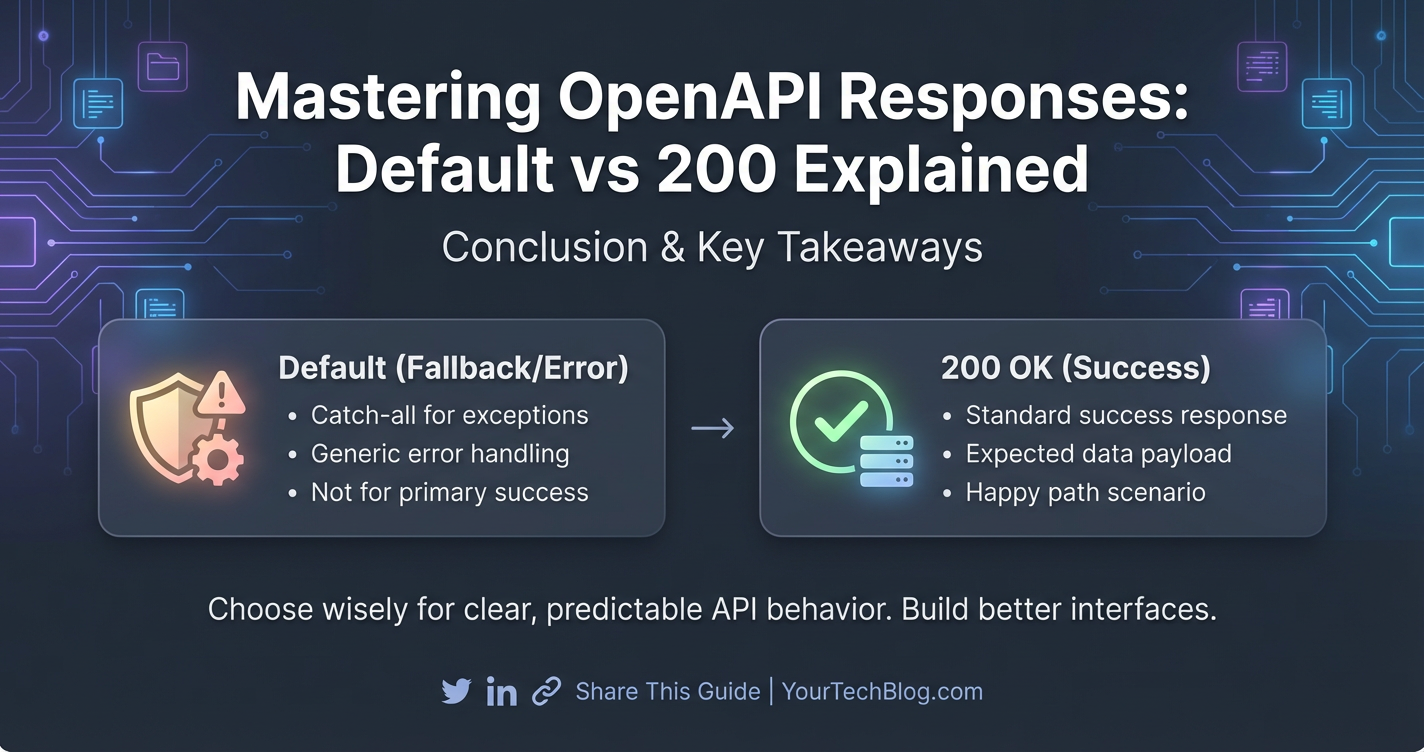
The journey through the intricacies of 200 OK and default responses within the OpenAPI Specification reveals them not as mere technical details, but as fundamental pillars of robust API design. We've seen how 200 OK serves as the unambiguous signal of success, conveying that a request has been fully processed and the expected outcome achieved. Its precise definition, complete with detailed schemas and illustrative examples, forms the bedrock of predictable client interactions, allowing consuming applications to confidently parse data and continue their operations.
In contrast, the default response emerges as a versatile and potent mechanism for standardizing error handling. By acting as a catch-all for any HTTP status code not explicitly defined, it enables API designers to establish a consistent error contract across their entire API. This strategic use of default simplifies client-side error parsing, reduces documentation clutter, and future-proofs APIs against unforeseen error scenarios. It underscores the critical distinction that while default defines the shape of an error, the actual HTTP status code dictates its nature.
Mastering these two response types requires a thoughtful balance: specificity for successful outcomes, and consistency for all other scenarios. By diligently crafting both 200 OK responses with precise schemas and default responses with comprehensive error structures (perhaps even leveraging standards like RFC 7807), APIs become more predictable, easier to integrate with, and ultimately, more reliable.
Furthermore, the integration of OpenAPI definitions with advanced API management platforms like APIPark elevates this design excellence to operational excellence. APIPark's capabilities in contract enforcement, centralized API management, detailed logging, and performance ensure that the meticulously designed API responses are not only well-documented but also consistently validated and maintained throughout the API's lifecycle. This holistic approach empowers developers and enterprises to build, deploy, and manage APIs that are not just functional, but truly exceptional.
In the ever-evolving landscape of digital connectivity, clear, consistent, and predictable API responses are the hallmarks of professionalism and efficiency. By embracing the principles outlined in this guide and leveraging the power of OpenAPI in conjunction with modern API management solutions, developers can move beyond merely building APIs to crafting truly masterful interfaces that drive innovation and foster seamless digital interactions.
Frequently Asked Questions (FAQs)
1. What is the fundamental difference between 200 OK and default in OpenAPI?
The fundamental difference lies in their purpose and scope. 200 OK is a specific HTTP status code explicitly signaling a successful operation, meaning the request was processed as intended, and the api typically returns the expected data or confirmation. default, on the other hand, is an OpenAPI keyword (not an HTTP status code) that acts as a catch-all for any HTTP status code not explicitly defined for an operation. It is predominantly used to establish a consistent, standardized error response structure for various 4xx (client errors) and 5xx (server errors) that may occur but are not individually listed in the OpenAPI definition.
2. Should every API operation have both a 200 OK and a default response defined?
Almost every api operation that can succeed should define at least one 2xx success response (like 200 OK, 201 Created, or 204 No Content) to clearly articulate the successful outcome. Additionally, it is highly recommended to always define a default response. This default response acts as a vital safety net, ensuring that clients always receive a predictable, standardized error payload for any unforeseen or unspecified error conditions, significantly improving client-side error handling and the overall resilience of your API.
3. If I define a default response, do I still need to define specific error codes like 404 Not Found or 400 Bad Request?
It depends on your api design philosophy and the specificity required. If a specific error code, like 404 Not Found, has a unique response payload structure that differs significantly from your generic default error schema, or if it is a particularly common and critical error that warrants explicit documentation and specific examples, then it's beneficial to define it separately. However, if your 404 or 400 errors can conform to the same generalized error schema defined under default, then you can simply let default handle them. Remember, if a specific status code (e.g., 404) is explicitly defined, default will not apply to it; default only covers status codes that are not otherwise listed.
4. How does APIPark contribute to managing OpenAPI responses?
APIPark, as an open-source AI gateway and API management platform, plays a crucial role in API response governance. It can ingest your OpenAPI definitions and use them to enforce response schemas at the gateway level. This means APIPark can validate that outgoing 200 OK responses adhere to their defined successful payloads and that default error responses consistently follow the standardized error format. APIPark's features like detailed API call logging and powerful data analysis also help in monitoring the health and compliance of your API responses, ensuring system stability and easier troubleshooting based on the defined OpenAPI contracts.
5. What is a good practice for the schema of a default response?
A good practice for the schema of a default response is to define a generic, consistent error object, often referenced from components/schemas. This error schema should provide essential information for clients, such as: * A programmatic code (e.g., an application-specific code or the HTTP status code). * A human-readable message explaining the error. * Optionally, a detail field for more specific context, or an errors array for validation failures (listing specific fields and their issues). * Consider adopting standards like RFC 7807 (Problem Details for HTTP APIs) for a robust and machine-readable error format. Crucially, ensure this schema avoids leaking sensitive server-side information.
🚀You can securely and efficiently call the OpenAI API on APIPark in just two steps:
Step 1: Deploy the APIPark AI gateway in 5 minutes.
APIPark is developed based on Golang, offering strong product performance and low development and maintenance costs. You can deploy APIPark with a single command line.
curl -sSO https://download.apipark.com/install/quick-start.sh; bash quick-start.sh

In my experience, you can see the successful deployment interface within 5 to 10 minutes. Then, you can log in to APIPark using your account.

Step 2: Call the OpenAI API.