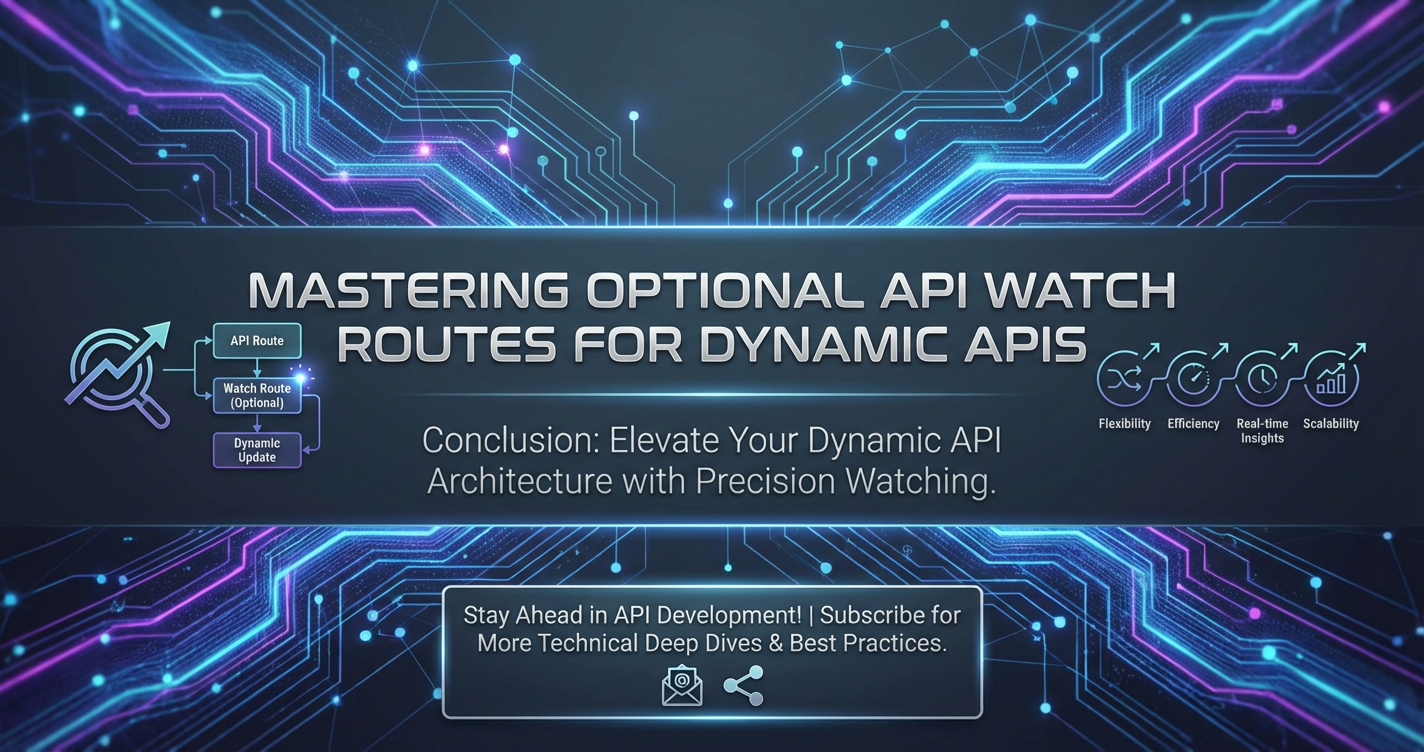
Mastering Optional API Watch Routes for Dynamic APIs


In the ever-evolving landscape of digital services, where data fluidity and instantaneous communication are not just desired but expected, the traditional model of discrete, one-off API requests often falls short. Modern applications, from real-time analytics dashboards to collaborative editing suites and sophisticated AI-driven systems, demand a more dynamic and responsive interaction with their backend services. The ability to monitor changes, react to events, and receive continuous updates is paramount to delivering a truly engaging and efficient user experience. This deep dive explores the concept of "Optional API Watch Routes," a sophisticated mechanism designed to usher APIs into a new era of dynamism, responsiveness, and efficiency. We will dissect their architecture, explore various implementation strategies, enumerate their profound benefits, and navigate the challenges inherent in their deployment, all while highlighting the critical role of an API gateway in orchestrating this intricate dance of data.
The Paradigm Shift: Understanding Dynamic APIs and the Imperative for Watch Routes
At its core, a dynamic API is one whose state, resources, or available data changes frequently and unpredictably. Unlike static content or infrequently updated data, the value of a dynamic API lies in its ability to reflect the current reality of the system it represents. Consider applications that display live stock prices, track the location of delivery vehicles, monitor IoT sensor data in real-time, or stream updates from a bustling social media feed. In each of these scenarios, merely fetching data once would immediately render it outdated, providing a stale and ultimately unhelpful snapshot. The user experience would be severely compromised if they had to manually refresh their browser or application repeatedly just to see the latest information.
The conventional request-response pattern, while foundational to the web, operates on a pull model: the client explicitly asks for data, and the server provides it. This works perfectly for static data retrieval, form submissions, or creating new resources. However, when faced with dynamic data, this pull model often degrades into inefficient and resource-intensive polling. Polling involves the client repeatedly sending requests to the server at short intervals, asking "Has anything changed?" Most of these requests often return with "No," leading to a significant waste of network bandwidth, server processing power, and client battery life. The latency introduced by polling also means that even with aggressive intervals, there's an inherent delay between an event occurring on the server and the client becoming aware of it. For critical applications requiring sub-second updates, polling is simply not a viable solution.
This is precisely where the concept of "watching" an API resource emerges as a superior paradigm. Instead of constantly asking, the client expresses an interest in a particular resource or set of events and then passively waits for the server to proactively send updates when they occur. This transforms the interaction from a laborious query-response loop into an event-driven, push-based model. Imagine subscribing to a newsletter versus constantly checking your mailbox for new issues; the latter is far more efficient and ensures you receive information as soon as it's available.
An "API Watch Route" is, therefore, a specialized endpoint or mechanism within an API designed specifically for this continuous monitoring or event streaming. It's not about fetching a single piece of data at a given moment but about establishing a persistent or semi-persistent channel through which the server can notify the client of relevant changes. This could involve an update to a database record, the completion of a long-running background process, the arrival of a new message, or a change in the status of an external service. The fundamental shift is from "request and receive" to "subscribe and be notified," enabling applications to be truly reactive and data-driven.
The "optional" aspect of these watch routes is crucial. Not every API endpoint or every client interaction necessitates real-time, push-based updates. For many standard operations, the traditional RESTful request-response model remains perfectly adequate and often simpler to implement. However, for those specific functionalities where timeliness and continuous updates are critical – think of a collaborative document editor showing multiple users typing simultaneously, or a real-time analytics dashboard reflecting immediate shifts in metrics – offering an optional watch route becomes an invaluable enhancement. It provides developers with the flexibility to choose the most appropriate communication pattern for each specific use case, optimizing both resource utilization and user experience. This strategic choice helps in architecting more resilient, efficient, and user-centric applications in a world increasingly dependent on live data.
The Architecture of Optional API Watch Routes: Orchestrating Real-time Data Flow
Implementing effective optional API watch routes demands a well-thought-out architectural design that moves beyond the simplicity of basic request-response mechanisms. This architecture typically involves several key components working in concert to ensure efficient, scalable, and reliable real-time data delivery. Understanding these components and their interactions is fundamental to mastering the development and deployment of dynamic APIs.
Core Architectural Components
- Client (The Initiator): This is the application or system that wishes to monitor a resource for changes. It could be a web browser, a mobile app, a desktop application, or even another backend service. The client initiates the "watch" by establishing a connection or registering its interest with the API.
- Backend Service (The Source of Truth): This is the original service that manages the data or resource being watched. When a change occurs within this service (e.g., a database update, a new entry in a log, a state transition), it becomes the trigger for an event that needs to be communicated to interested clients.
- API Gateway (The Central Orchestrator): This component is arguably the most critical for managing optional API watch routes, particularly in complex microservices environments. The API gateway acts as a single entry point for all client requests, including those for establishing watch routes. Its responsibilities extend far beyond simple routing:For instance, an advanced API gateway like APIPark, with its comprehensive
End-to-End API Lifecycle ManagementandPerformance Rivaling Nginxfeatures, becomes an indispensable tool. It can seamlessly handle the high throughput and persistent connections characteristic of watch routes, providing a unified management layer for both traditional RESTful APIs and real-time streaming interfaces. Its ability to manage complex routing, enforce security policies, and maintain high performance under heavy load makes it ideal for orchestrating dynamic API interactions, particularly when integrating diverse AI models that might output streaming results.- Request Routing: Directs watch requests to the appropriate backend service.
- Protocol Translation: Can translate between different client-side and backend-side real-time protocols (e.g., from WebSockets to an internal message queue).
- Authentication and Authorization: Secures watch routes, ensuring only authorized clients can subscribe to updates. This is crucial as watch routes maintain persistent connections, which can be vulnerable to abuse if not properly secured.
- Rate Limiting and Throttling: Manages the volume of concurrent watch connections and the frequency of events pushed to clients, protecting backend services from overload.
- Load Balancing: Distributes watch connections across multiple instances of backend services for scalability and resilience.
- Connection Management: Helps manage the lifecycle of persistent connections, including keep-alives, timeouts, and graceful disconnections.
- Observability: Centralizes logging and monitoring of watch route activity.
- Message Broker / Event Bus (The Decoupler and Scaler): To achieve scalability and decoupling, a message broker (e.g., Apache Kafka, RabbitMQ, Redis Pub/Sub, AWS SNS/SQS) is frequently used.
- Decoupling: The backend service doesn't need to know which specific clients are watching; it simply publishes events to a topic on the message broker.
- Scalability: Multiple instances of the watch service (which might be part of the gateway or a separate component) can subscribe to these topics and distribute the load of pushing events to clients.
- Durability and Persistence: Some brokers can store events, allowing clients to catch up on missed updates if they temporarily disconnect.
The Mechanism of a Watch Route
The typical flow for an optional API watch route unfolds as follows:
- Subscription Request: The client sends a request to the API gateway to "watch" a specific resource (e.g.,
/items/123/watch). This request might include authentication tokens, parameters specifying what kind of changes to watch for, or a starting point (e.g., a timestamp or version ID to receive events from). - Gateway Processing: The API gateway validates the client's request, authenticates them, and then forwards or translates this request to the appropriate backend service. Depending on the architecture, the gateway might directly establish a long-lived connection with the client (e.g., a WebSocket) and then subscribe on behalf of the client to an internal event stream.
- Backend Registration/Publishing: The backend service, upon receiving the watch request (or being notified by the gateway), registers the client's interest. When a relevant change occurs (e.g.,
item #123is updated), the backend service publishes an event describing this change to a specific topic on the message broker (e.g.,item-updates). The event payload typically includes the changed data or a reference to it. - Event Consumption and Push: A dedicated "watch service" (which might be integrated into the API gateway or run as a separate microservice) subscribes to the
item-updatestopic on the message broker. When it receives an event foritem #123, it identifies all active client connections that are watchingitem #123and pushes the update to them over their established real-time connection (e.g., SSE stream, WebSocket).
The "Optional" Aspect: Why and How
The term "optional" signifies that these watch routes are not mandatory for all interactions with the API. They are an enhancement, a specialized capability offered for specific use cases where real-time responsiveness is critical.
- Choice for Developers: API designers provide standard RESTful endpoints for traditional CRUD operations and separately offer watch routes for real-time needs. This allows client developers to choose the most efficient interaction pattern for their specific feature. For example, retrieving a user's profile picture might use a simple GET request, but monitoring a chat room for new messages would utilize a watch route.
- Resource Optimization: By making them optional, resources (both client and server-side) are only allocated for real-time monitoring when explicitly required. This prevents the overhead of persistent connections or event processing for features that don't need it.
- Incremental Adoption: Organizations can introduce watch routes incrementally, starting with critical, high-value dynamic data streams, without overhauling their entire API architecture. This pragmatic approach allows for focused development and minimizes disruption.
In essence, the architecture of optional API watch routes moves beyond the simplistic request-response model to embrace an event-driven, push-based paradigm. The API gateway stands as the critical control point, managing the complexity, security, and scalability of these dynamic interactions, while message brokers ensure the reliable and decoupled flow of events. This intricate setup ensures that applications can receive updates as they happen, paving the way for truly reactive and immersive user experiences.
Implementation Strategies and Technologies: Tools for Real-time Data Streaming
Bringing optional API watch routes to life requires selecting the right technologies and implementation patterns. The choice often hinges on factors such as the desired level of interactivity, the complexity of data flow, and the need for bidirectional communication. While older methods like simple polling are largely inefficient, various modern techniques offer increasingly sophisticated ways to stream data in real time.
The Evolution from Polling to Push
Before diving into advanced strategies, it's worth briefly revisiting polling, as it serves as a baseline for understanding the improvements offered by watch routes.
- Polling: The client periodically sends HTTP GET requests to the server.
- Pros: Simple to implement, compatible with any HTTP client.
- Cons: Highly inefficient (many empty responses), high latency, wastes bandwidth and server resources.
- Long Polling: The client sends an HTTP GET request, and the server holds the connection open until new data is available or a timeout occurs. Once data is sent (or timeout), the connection closes, and the client immediately opens a new one.
- Pros: Reduces empty responses, lower latency than short polling.
- Cons: Still uses request-response cycle, can be complex to manage many open connections on the server, doesn't establish a truly persistent connection.
While long polling is an improvement, it's still a workaround for true real-time push. Modern API watch routes typically leverage technologies designed for persistent, event-driven communication.
1. Server-Sent Events (SSE)
SSE is a standard that allows a web server to push data to a client over a single, long-lived HTTP connection. It's unidirectional, meaning data flows from the server to the client only.
- How it Works: The client initiates an HTTP request with an
Accept: text/event-streamheader. The server responds withContent-Type: text/event-streamand then keeps the connection open, sending event data formatted as a series of messages. - Key Characteristics:
- Unidirectional: Server-to-client only. Clients can't easily send data back on the same connection.
- HTTP-based: Uses standard HTTP protocol, making it firewall-friendly and easier to integrate with existing web infrastructure and API gateway services.
- Automatic Reconnection: Browsers inherently support automatic reconnection if the connection drops, which simplifies client-side development.
- Event Types: Supports custom event types, allowing clients to listen for specific kinds of updates.
- Use Cases: Ideal for scenarios where a client primarily needs to receive updates without needing to send frequent messages back to the server. Examples include:
- Live stock tickers and cryptocurrency price feeds.
- News feeds and social media timelines.
- Real-time dashboards for monitoring system metrics.
- Sports scores and live commentary.
- Progress updates for long-running AI model training or data processing tasks.
- Implementation: Fairly straightforward on both client (e.g.,
EventSourceAPI in browsers) and server (sendingdata:lines followed by\n\n).
2. WebSockets
WebSockets provide a full-duplex, persistent communication channel over a single TCP connection. Once the handshake is complete (upgrading from HTTP to WebSocket protocol), both the client and server can send messages to each other at any time, independently.
- How it Works: Starts with an HTTP handshake (
Upgradeheader), which then transitions to a WebSocket connection. After the upgrade, data frames (not HTTP requests/responses) are exchanged. - Key Characteristics:
- Bidirectional: Both client and server can send and receive data simultaneously.
- Persistent Connection: A single, long-lived connection significantly reduces overhead compared to multiple HTTP requests.
- Lower Overhead: After the initial handshake, message frames are lightweight, leading to lower latency and higher throughput.
- Protocol Agnostic: While it starts with HTTP, the WebSocket protocol itself is separate, offering more flexibility in message formats.
- Use Cases: Essential for applications requiring real-time, interactive, and bidirectional communication. Examples include:
- Real-time chat applications.
- Multiplayer online games.
- Collaborative document editing (e.g., Google Docs).
- Live notifications and alerts where user interaction triggers server responses.
- Complex control systems for IoT devices.
- Streaming responses from generative AI models where the client might interrupt or provide feedback.
- Implementation: Requires more sophisticated client-side (e.g.,
WebSocketAPI) and server-side libraries to manage connections, send/receive frames, and handle potential disconnections. An API gateway like APIPark can handle the WebSocket handshake and potentially route WebSocket traffic to specific backend services.
3. GraphQL Subscriptions
GraphQL is a query language for APIs that allows clients to request exactly the data they need. GraphQL Subscriptions extend this capability to real-time data streaming, typically leveraging WebSockets under the hood.
- How it Works: The client sends a subscription query to the GraphQL server. The server then establishes a persistent connection (usually a WebSocket) and pushes data to the client whenever the requested data changes.
- Key Characteristics:
- Declarative: Clients specify precisely what data they want to "subscribe" to, similar to how they query data.
- Strongly Typed: Benefits from GraphQL's type system, making data contracts clear and reducing errors.
- Event-Driven: The server pushes data in response to specific events occurring on the backend.
- Often uses WebSockets: While the GraphQL specification doesn't mandate WebSockets, it's the most common transport layer for subscriptions.
- Use Cases: Ideal for applications already using GraphQL for data fetching, where real-time updates for specific data fields are needed. Examples:
- Updates to a specific user's social media feed.
- Real-time notifications about changes in a project management tool.
- Tracking the status of an order in an e-commerce application.
- Implementation: Requires a GraphQL server that supports subscriptions (e.g., Apollo Server, Hasura) and a GraphQL client capable of handling subscription queries. The API gateway would need to be configured to route GraphQL subscription traffic (often WebSocket) appropriately.
4. Webhook Subscriptions (for server-to-server push)
While not strictly an "API watch route" in the sense of a client directly maintaining a persistent connection, webhooks represent another form of push-based communication, primarily for server-to-server interactions.
- How it Works: Instead of the client initiating a watch, the client provides a callback URL to the API provider. When an event occurs on the provider's side, it sends an HTTP POST request to the client's registered callback URL with the event payload.
- Key Characteristics:
- Asynchronous: Events are delivered asynchronously.
- Server-to-Server: Typically used for integrating different backend systems.
- Client-Hosted Endpoint: The client must expose a publicly accessible endpoint to receive webhook calls.
- Use Cases: Notifying external services of events like payment confirmations, new user registrations, code repository pushes (e.g., GitHub webhooks), or completion of a data export.
- Implementation: Requires the API provider to manage event publishing and dispatching, and the client to implement a robust endpoint to receive and process incoming webhook requests, including security measures like signature verification.
Comparison of Real-time Technologies
To help illustrate the differences and aid in selection, here's a comparison table:
| Feature/Technology | Polling | Long Polling | Server-Sent Events (SSE) | WebSockets | GraphQL Subscriptions | Webhooks |
|---|---|---|---|---|---|---|
| Communication | Unidirectional (Pull) | Unidirectional (Pull) | Unidirectional (Push) | Bidirectional (Push/Pull) | Bidirectional (Push/Pull) | Unidirectional (Push) |
| Protocol | HTTP | HTTP | HTTP (text/event-stream) |
WebSocket (upgraded HTTP) | WebSocket (typically) | HTTP (POST to callback) |
| Connection Type | Short-lived, multiple | Semi-persistent, multiple | Persistent, single | Persistent, single | Persistent, single | Short-lived, multiple |
| Efficiency | Low (many empty requests) | Medium | High (event-driven) | Very High (low overhead) | Very High (low overhead) | High (event-driven) |
| Complexity | Low | Medium | Medium | High | High (requires GraphQL stack) | Medium (client-side endpoint) |
| Browser Support | Universal | Universal | Excellent (modern browsers) | Excellent (modern browsers) | Good (client libraries) | N/A (server-to-server) |
| Auto Reconnect | N/A | N/A | Built-in | Manual (client-side logic) | Manual (client-side logic) | N/A |
| Use Cases | Simple data fetch | Infrequent updates | News feeds, live scores | Chat, gaming, collaboration | Targeted real-time data | Server-to-server notifications |
Choosing the appropriate technology depends entirely on the specific requirements of the dynamic API and its intended use. For simple one-way updates, SSE offers elegance and simplicity. For highly interactive, full-duplex communication, WebSockets are indispensable. GraphQL subscriptions provide a powerful, declarative layer on top of WebSockets for data-specific updates, especially within a GraphQL ecosystem. Understanding these distinctions is key to designing robust and performant optional API watch routes.
APIPark is a high-performance AI gateway that allows you to securely access the most comprehensive LLM APIs globally on the APIPark platform, including OpenAI, Anthropic, Mistral, Llama2, Google Gemini, and more.Try APIPark now! 👇👇👇
Benefits and Transformative Use Cases of Optional API Watch Routes
The adoption of optional API watch routes marks a significant leap forward in API design, moving beyond the static nature of traditional request-response APIs to embrace a world of real-time, event-driven interactions. This paradigm shift brings a multitude of benefits, fundamentally enhancing user experience, optimizing resource utilization, and enabling entirely new categories of applications.
Enhanced User Experience
Perhaps the most immediate and tangible benefit of API watch routes is the dramatic improvement in user experience. In today's digital landscape, users expect applications to be live, responsive, and always up-to-date. * Real-time Updates: Users no longer have to manually refresh pages or wait for periodic polling cycles to see the latest information. Changes are pushed to their devices as they happen, creating a sense of immediacy and dynamism. Imagine a financial trading platform where stock prices update instantaneously, or a sports app where scores change the moment a goal is scored. This responsiveness fosters engagement and trust. * Reduced Latency: By pushing data proactively, the delay between an event occurring on the server and the user seeing it is minimized, often to mere milliseconds. This is critical for applications where timeliness is paramount, such as collaborative tools or IoT monitoring dashboards. * Interactive Applications: Watch routes enable truly interactive experiences. Users can see other participants' actions in real-time (e.g., cursors moving in a collaborative document, chat messages appearing instantly), fostering a more connected and immersive environment. * Proactive Notifications: Instead of requiring users to check for updates, applications can proactively notify them of important events, whether it's a new message, an alarm from a sensor, or a status change in a workflow.
Resource Efficiency
Beyond user experience, API watch routes offer significant advantages in terms of resource utilization for both clients and servers, a stark contrast to the inefficiencies of polling. * Eliminates Wasteful Polling: The constant barrage of "Are we there yet?" requests inherent in polling is entirely removed. This drastically reduces the number of unnecessary requests hitting the API gateway and backend services. * Reduced Server Load: Fewer redundant requests mean less CPU cycles spent processing empty responses, less database load from repeated queries, and more efficient use of network resources on the server side. This translates to lower operational costs and the ability to serve more clients with the same infrastructure. * Optimized Client-Side Consumption: Clients no longer need to consume battery and network data constantly sending requests. They only receive data when it's actually available, leading to better battery life on mobile devices and lower data plan consumption. * Scalability: Event-driven architectures, often underpinned by message brokers and multiple consumer instances, are inherently more scalable. Services can be scaled independently, and the decoupling ensures that a surge in one area doesn't necessarily overwhelm another.
Decoupling and Architectural Flexibility
The architectural patterns employed for watch routes, particularly the use of message brokers, introduce significant decoupling benefits. * Producer-Consumer Decoupling: Backend services that generate events (producers) don't need to know anything about the clients consuming those events. They simply publish to a topic. This separation makes the system more modular, easier to maintain, and less prone to cascading failures. * Easier Integration: New consumers (clients or other services) can subscribe to existing event streams without requiring changes to the event producers. This fosters a more flexible and extensible API ecosystem. * Robustness: If a consumer temporarily goes offline, events can often be buffered by the message broker, allowing the consumer to catch up once it reconnects, improving overall system resilience.
Transformative Use Cases
The power of optional API watch routes truly shines in a variety of applications, enabling functionalities that would be inefficient or impossible with traditional APIs.
- Real-time Dashboards and Analytics:
- Description: Business intelligence platforms, infrastructure monitoring tools, and social media analytics dashboards can display live data updates, allowing decision-makers to react instantly to evolving trends or anomalies.
- Mechanism: An API gateway routes client subscriptions for specific metrics, and backend services publish updates to a message broker when data changes. The gateway or a dedicated service then pushes these updates to subscribed clients via SSE or WebSockets.
- Live Feeds and Content Streams:
- Description: Social media feeds, news aggregators, live blogs, and content recommendation engines can push new posts, comments, or articles as they are published.
- Mechanism: When new content is created in the backend, an event is triggered, pushed through the API gateway, and streamed to interested users, often using SSE for simplicity.
- Collaborative Applications:
- Description: Document editors (e.g., Google Docs), whiteboards, project management tools, and design software allow multiple users to work simultaneously and see each other's changes in real time.
- Mechanism: WebSockets are the ideal choice here, providing bidirectional communication where client actions (typing, moving elements) are instantly broadcast to other collaborators via the API gateway and backend services.
- Internet of Things (IoT) Device Monitoring and Control:
- Description: Tracking sensor data (temperature, humidity, motion), monitoring device status, and sending commands to IoT devices in real time.
- Mechanism: Devices might publish data to an MQTT broker, which then feeds into a system that pushes updates to monitoring dashboards via an API gateway using WebSockets or SSE. Conversely, control commands can be sent back to devices via WebSockets.
- Gaming and Interactive Entertainment:
- Description: Multiplayer online games, live leaderboards, and interactive quiz applications require instantaneous updates of game state, player positions, or scores.
- Mechanism: WebSockets are essential for the low-latency, bidirectional communication needed for game synchronization and player interaction.
- Financial Applications:
- Description: Stock trading platforms, cryptocurrency exchanges, and foreign exchange markets require millisecond-level updates for price changes, order book modifications, and trade executions.
- Mechanism: SSE or WebSockets deliver market data directly to traders, enabling rapid decision-making.
- AI Inference Monitoring and Streaming:
- Description: As AI models become more complex and capable of generating continuous output (e.g., large language models streaming text, real-time video analysis), optional watch routes become critical. Clients might want to watch the progress of a long-running AI training job, or receive a stream of text tokens from a generative AI model as it's being produced.
- Mechanism: An API gateway can route requests to AI services. For instance, a platform like APIPark, which specializes in quick integration of 100+ AI models and provides a
Unified API Format for AI Invocation, is perfectly positioned to manage such dynamic interactions. It can facilitate the streaming of AI inference results, allowing applications to consume these outputs in real-time. Clients could subscribe to an endpoint to receive AI-generated content incrementally, enhancing perceived performance and interactivity. This also applies to monitoring the completion of complex AI tasks, where the system pushes a notification once the AI process is complete.
In summary, optional API watch routes are not merely a technical optimization; they are a strategic capability that enables businesses to build more engaging, efficient, and innovative applications. By moving from a reactive pull model to a proactive push model, they unlock a new dimension of real-time interaction that is increasingly vital in the digital age.
Challenges and Best Practices: Navigating the Complexities of Real-time APIs
While optional API watch routes offer compelling benefits, their implementation introduces a unique set of challenges that require careful consideration and robust solutions. Mastering these routes involves not just understanding the underlying technologies but also adopting best practices to ensure scalability, reliability, security, and maintainability.
Key Challenges in Implementing Watch Routes
- Connection Management:
- High Concurrency: Watch routes, especially those using WebSockets or SSE, establish persistent connections. Managing thousands or even millions of concurrent open connections can be resource-intensive for servers and proxy layers like the API gateway.
- Connection Lifecycle: Handling connection establishment, graceful termination, unexpected disconnections (network issues, client crashes), and automatic re-establishment requires sophisticated logic.
- Resource Allocation: Each open connection consumes memory and CPU resources. Efficient resource management is crucial to prevent server overload.
- State Management:
- Client State: If a client disconnects and reconnects, how does it know what events it missed? How does the server resume pushing events from the correct point? This often involves tracking sequence numbers, timestamps, or event IDs.
- Server State: Keeping track of which clients are watching which resources and their subscription parameters can add significant state management overhead to the backend.
- Backpressure and Flow Control:
- Producer Overwhelm: Backend services might generate events much faster than clients can consume them. Without proper flow control, slower clients can cause event queues to build up, leading to memory exhaustion on the server or message broker.
- Client Overwhelm: Pushing too many events to a client too quickly can overwhelm the client application, leading to UI freezes or application crashes.
- Security:
- DDoS Attacks: Persistent connections are attractive targets for Denial-of-Service attacks. A malicious actor could open many connections and keep them alive, exhausting server resources.
- Unauthorized Access: Ensuring that only authorized clients can subscribe to specific watch routes and receive sensitive data is paramount. Traditional token-based authentication (JWT, OAuth) needs to be integrated with the real-time connection establishment.
- Data Integrity: Ensuring the integrity and confidentiality of streamed data is critical, especially for sensitive information.
- Complexity and Debugging:
- Distributed Systems: Real-time architectures often involve multiple components (client, gateway, message broker, backend services), making debugging complex. Tracing events across these layers can be challenging.
- Asynchronous Nature: The asynchronous, event-driven nature of watch routes can be harder to reason about and test compared to synchronous request-response flows.
- Protocol Nuances: Each real-time protocol (SSE, WebSockets) has its own quirks and best practices that need to be understood.
Best Practices for Mastering Optional API Watch Routes
Addressing these challenges requires a strategic approach, often leveraging the capabilities of a robust API gateway and adopting battle-tested architectural patterns.
- Leverage a Powerful API Gateway:
- Centralized Management: An API gateway is indispensable for managing watch routes. It acts as the single point of contact for clients, simplifying discovery and access.
- Security Enforcement: The gateway can handle authentication, authorization, and TLS termination for all real-time connections, ensuring a secure perimeter. This is where a sophisticated platform like APIPark truly shines. As an open-source AI gateway and API management platform, APIPark offers not only
End-to-End API Lifecycle Managementbut also robustIndependent API and Access Permissions for Each TenantandAPI Resource Access Requires Approvalfeatures. These functionalities are critical for securing watch routes, preventing unauthorized subscriptions, and managing access at scale. - Load Balancing and Scaling: Gateways can distribute watch connections across multiple backend instances, ensuring high availability and scalability.
- Protocol Bridging: Some gateways can translate between client-facing real-time protocols (e.g., WebSockets) and internal messaging systems, decoupling the client from the backend's internal implementation details.
- Rate Limiting: Protect backend services from being overwhelmed by too many connection attempts or excessive event requests.
- Implement Robust Client-Side Reconnection Logic:
- Clients should always be prepared for connection drops. Implement exponential backoff retry mechanisms to automatically re-establish connections gracefully, providing a seamless user experience.
- Upon reconnection, clients should communicate their last received event ID or timestamp to the server/gateway to retrieve any missed events and ensure data consistency.
- Use Heartbeats and Keep-alives:
- For persistent connections like WebSockets, implement periodic heartbeat messages (ping/pong frames) from both client and server. This helps detect dead connections that haven't properly closed, prevents idle connection timeouts by firewalls or proxies, and allows for timely cleanup of resources.
- Smart Event Filtering and Throttling:
- Server-Side Filtering: Allow clients to specify detailed criteria for the events they wish to receive. The server or message broker should filter events at the source to minimize unnecessary data transfer.
- Client-Side Throttling: If the client cannot keep up with the event stream, implement client-side throttling or buffering to process events at a manageable rate, preventing the client application from becoming unresponsive.
- Robust Error Handling and Observability:
- Comprehensive Logging: Implement detailed logging across all components (gateway, message broker, backend services, client) to track connection lifecycles, event flow, and errors. APIPark's
Detailed API Call Loggingprovides comprehensive records for every API call, which is invaluable for tracing and troubleshooting issues across dynamic routes. - Monitoring and Alerting: Continuously monitor connection counts, event throughput, latency, and error rates. Set up alerts for anomalies. APIPark's
Powerful Data Analysiscapabilities analyze historical call data to display long-term trends and performance changes, helping businesses with preventive maintenance before issues occur, a critical feature for managing the dynamic nature of watch routes. - Circuit Breakers and Retries: Implement these patterns for backend services that the watch routes depend on, to handle temporary failures gracefully.
- Comprehensive Logging: Implement detailed logging across all components (gateway, message broker, backend services, client) to track connection lifecycles, event flow, and errors. APIPark's
- Choose the Right Technology for the Job:
- Don't default to WebSockets for every real-time need. If bidirectional communication isn't strictly necessary, SSE might offer a simpler, more robust solution with built-in browser reconnection. Use WebSockets when true two-way, low-latency interaction is a requirement.
- Consider GraphQL Subscriptions if already within a GraphQL ecosystem and needing granular, declarative control over real-time data.
- Horizontal Scaling of Watch Services:
- Design your backend watch services to be stateless (or to manage state externally, e.g., in Redis). This allows you to easily scale them horizontally by adding more instances behind the API gateway to handle increasing numbers of concurrent connections.
By carefully planning and implementing these best practices, organizations can confidently deploy optional API watch routes, transforming their applications into highly responsive, efficient, and user-centric experiences, while ensuring the stability and security of their underlying infrastructure. The complexity is manageable with the right tools and strategies, making real-time capabilities an accessible and powerful addition to any modern API landscape.
Conclusion: Embracing the Real-time Frontier with Optional API Watch Routes
The journey through the intricacies of "Optional API Watch Routes for Dynamic APIs" reveals a profound shift in how applications interact with data. We have moved from a reactive, often inefficient, pull-based model to a proactive, highly efficient, and engaging push-based paradigm. This transformation is not merely a technical upgrade; it is a fundamental re-imagining of user experience and system efficiency in an increasingly real-time world.
Dynamic APIs, by their very nature, demand an architecture that can keep pace with constant change. Traditional polling, while simple, exacts a heavy toll in terms of latency, resource consumption, and an ultimately frustrating user experience. Optional API watch routes, leveraging technologies like Server-Sent Events, WebSockets, and GraphQL Subscriptions, offer a compelling alternative. They provide the mechanism for clients to subscribe to changes and receive updates instantly, unlocking a vast array of possibilities for interactive and data-rich applications.
The benefits are clear and multifaceted: users enjoy seamless, real-time updates that enhance engagement and satisfaction; businesses achieve significant resource efficiencies by eliminating wasteful requests and optimizing server load; and developers gain architectural flexibility through decoupled, event-driven systems that are inherently more scalable and robust. From collaborative editing and live analytics dashboards to immersive gaming experiences and the dynamic streaming of AI model inferences, watch routes are the backbone of modern, responsive digital services.
However, the power of these real-time capabilities comes with its own set of challenges. Managing thousands or millions of persistent connections, ensuring data consistency across disconnections, handling backpressure, and fortifying security against new attack vectors demand careful planning and sophisticated implementation. This is precisely where the role of a robust API gateway becomes not just beneficial, but indispensable. An API gateway serves as the critical control point, orchestrating the complex dance of real-time data flow, enforcing security policies, managing connections, and providing the necessary scalability and observability features. Products like APIPark exemplify how an advanced API gateway can simplify the management of these complex, dynamic routes, whether they're for traditional data streams or the outputs of integrated AI models, ultimately empowering enterprises to build more efficient, secure, and intelligent API ecosystems.
Mastering optional API watch routes is no longer an optional skill for API designers and developers; it is a fundamental requirement for building future-proof applications. By strategically integrating these dynamic capabilities and leveraging powerful tools like API gateways, organizations can unlock unparalleled levels of responsiveness, efficiency, and user delight, firmly positioning themselves at the forefront of the real-time web. The future of APIs is dynamic, event-driven, and intrinsically real-time, and understanding how to effectively implement watch routes is the key to navigating this exciting frontier.
Frequently Asked Questions (FAQs)
1. What is the main difference between traditional polling and an API watch route? Traditional polling involves the client repeatedly sending requests to the server to check for updates, regardless of whether there's new data. This is inefficient and causes latency. An API watch route, on the other hand, establishes a persistent (or semi-persistent) connection, allowing the server to proactively "push" data to the client only when relevant changes occur. This push model significantly reduces network traffic, server load, and latency, leading to a much more efficient and real-time experience.
2. When should I use Server-Sent Events (SSE) versus WebSockets for a watch route? Choose SSE when you need unidirectional communication (server to client only) for simple data streams, like live news feeds, stock tickers, or progress updates. SSE is simpler to implement, uses standard HTTP, and offers automatic reconnection. Opt for WebSockets when you require bidirectional (client and server can both send messages) and full-duplex communication for highly interactive applications, such as real-time chat, multiplayer games, or collaborative editing tools. WebSockets offer lower latency and higher throughput for complex, two-way interactions.
3. How does an API gateway help with API watch routes? An API gateway is crucial for managing watch routes by acting as a central orchestration point. It handles authentication and authorization for subscriptions, routes real-time traffic to appropriate backend services, manages connection lifecycles (e.g., load balancing persistent connections), provides rate limiting to protect backend services, and offers centralized logging and monitoring. For example, platforms like APIPark simplify End-to-End API Lifecycle Management and enhance security for these dynamic routes.
4. Are there specific security concerns related to API watch routes? Yes, watch routes, particularly those maintaining persistent connections, introduce specific security challenges. These include vulnerability to Denial-of-Service (DDoS) attacks (by opening many concurrent connections), unauthorized access to sensitive real-time data streams, and ensuring the integrity and confidentiality of the streamed information. Best practices involve robust authentication and authorization at the API gateway level, implementing rate limiting on connection attempts, and encrypting data in transit (TLS/SSL).
5. Can AI services benefit from optional API watch routes? Absolutely. As AI models become more complex and integrated into live applications, watch routes become increasingly valuable. For example, clients might use a watch route to monitor the progress of a long-running AI model training job, receive real-time updates from an AI-powered analytics engine, or stream incremental responses from a generative AI model (like receiving text tokens as they are produced). An API gateway like APIPark, designed for integrating and managing AI models, can play a pivotal role in facilitating these real-time interactions with AI services.
🚀You can securely and efficiently call the OpenAI API on APIPark in just two steps:
Step 1: Deploy the APIPark AI gateway in 5 minutes.
APIPark is developed based on Golang, offering strong product performance and low development and maintenance costs. You can deploy APIPark with a single command line.
curl -sSO https://download.apipark.com/install/quick-start.sh; bash quick-start.sh

In my experience, you can see the successful deployment interface within 5 to 10 minutes. Then, you can log in to APIPark using your account.

Step 2: Call the OpenAI API.