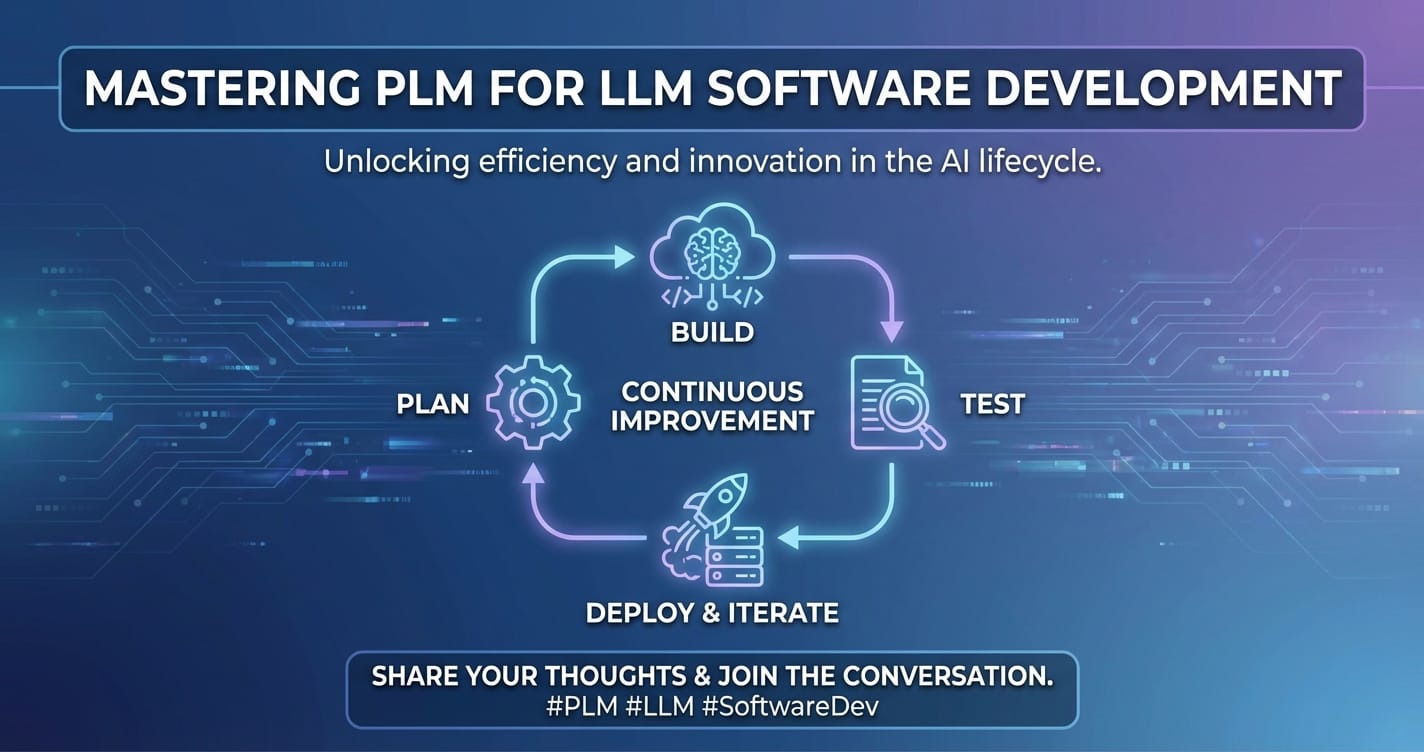
Mastering PLM for LLM Software Development


The advent of Large Language Models (LLMs) has ushered in a new epoch in software development, fundamentally altering how applications are conceived, designed, and deployed. From intelligent chatbots and sophisticated content generation tools to advanced data analysis and autonomous agents, LLMs are no longer niche research curiosities but powerful engines driving unprecedented innovation across industries. However, the unique characteristics of LLM-powered software – their probabilistic nature, reliance on vast datasets, rapid evolution, and intricate interactions with human language – introduce a novel set of challenges that traditional software development methodologies struggle to address comprehensively. The inherent complexity demands a more structured, adaptable, and robust framework for managing their entire lifecycle, from initial ideation through to retirement. This is where the principles of Product Lifecycle Management (PLM), traditionally a cornerstone of manufacturing and hardware development, offer a potent and surprisingly relevant paradigm for mastering LLM software development.
PLM provides a holistic approach to managing a product's entire journey, ensuring efficiency, quality, and traceability at every stage. When applied to the dynamic and often unpredictable realm of LLMs, PLM transforms what could be a chaotic process into a controlled, iterative, and ultimately more successful endeavor. It mandates a rigorous focus on data provenance, model versioning, prompt engineering, robust testing, ethical considerations, and continuous improvement. Critically, it emphasizes collaborative workflows and the strategic integration of specialized tools, such as an LLM Gateway for centralized model access and control, sophisticated Model Context Protocol for managing complex conversational states, and comprehensive API Governance frameworks to secure and optimize LLM interactions. This article delves deeply into adapting and applying PLM principles to the unique landscape of LLM software, demonstrating how a systematic approach can unlock their full potential, mitigate risks, and ensure long-term value creation. By embracing PLM, organizations can transition from experimental LLM dabbling to developing enterprise-grade, reliable, and scalable AI solutions that truly drive business transformation.
1. The Unique Landscape of LLM Software Development: Beyond Traditional Paradigms
The rapid proliferation and increasing sophistication of Large Language Models have undeniably reshaped the technological landscape, offering capabilities that were once confined to the realm of science fiction. Integrating these powerful models into software applications, however, is far from a trivial undertaking. It introduces a distinct set of complexities that significantly differentiate LLM software development from its traditional counterparts, necessitating a fresh perspective on how we manage the entire product lifecycle. Understanding these unique characteristics is the foundational step towards appreciating the indispensable role of PLM.
At its core, LLM software development involves more than just calling an API; it orchestrates a symphony of components including the underlying general-purpose or fine-tuned models, vast and dynamic external data sources (especially pertinent for Retrieval Augmented Generation, or RAG systems), meticulously crafted prompts, sophisticated agentic logic, and robust evaluation mechanisms. Unlike deterministic code where a given input reliably produces the same output, LLMs are inherently probabilistic. This non-determinism, while enabling remarkable flexibility and creativity, simultaneously poses significant challenges for testing, debugging, and ensuring consistent performance. Developers must contend with the possibility of "hallucinations," where models generate plausible but factually incorrect information, or "prompt injections," where malicious inputs can bypass security filters. These issues are not mere bugs in traditional software; they are intrinsic behaviors that require specific strategies for mitigation and management.
Furthermore, the data sensitivity surrounding LLM operations is unparalleled. Models are trained on colossal datasets, and the data fed into them during inference can often contain sensitive personal identifiable information (PII) or proprietary business data. Managing the provenance, security, and privacy of this data throughout its lifecycle – from collection and training to real-time inference and logging – becomes a paramount concern. The rapid pace of evolution in the LLM ecosystem also presents a unique challenge. New models emerge with startling frequency, offering improved performance, cost-efficiency, or specialized capabilities. This constant flux means that an LLM application’s underlying model might need to be swapped or upgraded regularly, necessitating an architecture that embraces modularity and abstraction rather than tight coupling.
Prompt engineering, a nascent but critical discipline, is another differentiating factor. Crafting effective prompts to elicit desired behaviors from an LLM is an iterative, often experimental process that can significantly impact the application's functionality and user experience. Prompts, in essence, act as a form of "meta-code," shaping the model's output without directly altering its weights. Managing versions of these prompts, tracking their performance, and integrating them into a coherent development workflow adds a layer of complexity not present in traditional software. Moreover, the cost implications of LLM usage are distinct. Token consumption directly translates to computational expenses, making efficient prompt design, response caching, and strategic model selection critical for economic viability.
Traditional Software Development Life Cycle (SDLC) models, while valuable for deterministic systems, often fall short when confronted with these LLM-specific nuances. They typically lack specific stages for model lifecycle management, do not account for prompt versioning as a first-class artifact, and struggle with the extensive data lineage requirements needed for tracking training data through to fine-tuned model iterations. The absence of a structured approach tailored to these unique demands often leads to disjointed development efforts, difficulties in scaling, security vulnerabilities, and an inability to reliably reproduce or debug model behaviors. Therefore, a more robust, systematic, and adaptive framework is not merely beneficial but absolutely essential for harnessing the transformative power of LLMs effectively and sustainably. This framework is precisely what an adapted PLM methodology offers.
2. Foundations of PLM in Software Engineering: A Timeless Blueprint for Modern AI
Product Lifecycle Management (PLM) originated in the manufacturing sector as a comprehensive strategy for managing a product from its initial conception, through design, engineering, manufacturing, service, and ultimately, disposal. Its core objective is to integrate people, data, processes, and business systems across an organization to manage a product's life in a streamlined, efficient, and transparent manner. While the physical products and processes involved in manufacturing are vastly different from intangible software, the underlying philosophy of PLM – meticulous planning, rigorous management of change, and a holistic view of a product’s journey – is remarkably applicable and increasingly vital for complex software, particularly LLM-driven applications.
In traditional software engineering, PLM principles have been implicitly or explicitly adopted through various methodologies such as Agile, DevOps, and even Waterfall, albeit often without the explicit "PLM" label. Here, the "product" is the software itself, and its lifecycle stages mirror those of physical goods: * Requirements Gathering and Ideation: Defining what the software should do, its features, and user needs. * Design and Architecture: Blueprinting the system, its components, data structures, and overall architecture. * Development and Implementation: Writing the code, building the features. * Testing and Quality Assurance: Verifying functionality, performance, and security. * Deployment and Release: Making the software available to users. * Maintenance and Operations: Bug fixes, performance tuning, ongoing support. * Evolution and Retirement: Adding new features, upgrading, or eventually phasing out the product.
The key pillars of PLM, regardless of the domain, provide the structural integrity for this entire process: 1. Data Management: Ensuring that all product-related data – from requirements documents and design specifications to code, test results, and deployment configurations – is centrally stored, versioned, accessible, and secure. This includes managing data lineage and ensuring data integrity. 2. Process Management: Defining, automating, and optimizing the workflows that govern the product's lifecycle. This ensures consistency, reduces errors, and facilitates cross-functional collaboration. 3. Change Management: Systematically controlling modifications to the product at any stage. This involves tracking proposed changes, evaluating their impact, approving them, and documenting their implementation, crucial for maintaining traceability and preventing unintended consequences. 4. Collaboration and Communication: Facilitating seamless information exchange and joint efforts among diverse teams and stakeholders, breaking down silos, and fostering a shared understanding of the product’s vision and status.
For LLM software, these PLM pillars are not merely beneficial; they are absolutely critical. The non-deterministic nature of LLMs means that changes in prompts, fine-tuning data, or even the underlying model version can have cascading, often subtle, effects that are difficult to trace without meticulous data and change management. The rapid pace of innovation necessitates agile process management that can adapt to new models and techniques quickly. The complex interplay between prompt engineers, data scientists, machine learning engineers, and application developers demands robust collaboration tools. Moreover, the inherent risks associated with LLMs, such as bias, hallucination, and security vulnerabilities, make disciplined change management and comprehensive data governance indispensable for responsible AI development. Without an overarching PLM framework, LLM software development risks becoming an unmanageable series of experiments, leading to unreliable, insecure, and ultimately unsustainable applications. Adopting PLM provides the necessary structure to tame this complexity and unlock the true potential of LLM technology.
3. Tailoring PLM for LLM Software: Key Stages and Considerations
Adapting Product Lifecycle Management for Large Language Model software development requires a nuanced understanding of each traditional PLM phase, reinterpreting its objectives and activities through an LLM-specific lens. This tailored approach ensures that the unique challenges and opportunities presented by LLMs are systematically addressed, leading to more robust, ethical, and performant applications.
3.1. Phase 1: Conception & Ideation – Shaping the LLM Vision
This initial phase is where the strategic direction for an LLM product is forged, moving from a broad concept to a well-defined problem statement and initial solution outline.
- Defining LLM Use Cases: The first step involves meticulously identifying real-world problems that LLMs are uniquely positioned to solve. This moves beyond generic "AI solutions" to specific applications like enhancing customer support with intelligent chatbots, automating content generation for marketing, streamlining document analysis, or creating advanced code assistants. A deep dive into business needs and user pain points is crucial here to ensure the LLM solution addresses genuine value propositions rather than merely being a technological showcase. This requires collaboration between business analysts, domain experts, and AI strategists to pinpoint high-impact areas.
- Feasibility Assessment: Once potential use cases are identified, a rigorous feasibility study is undertaken. This involves evaluating various LLM options (e.g., proprietary models like OpenAI's GPT series, Anthropic's Claude, Google's Gemini, or open-source alternatives like Llama 3, Mixtral) based on performance, cost implications, ethical considerations (e.g., potential for bias, data privacy), and resource availability (e.g., computational power, data for fine-tuning). Critical questions include: Is the necessary data available and accessible for fine-tuning or RAG? Are the computational resources sufficient for training/inference? What are the regulatory and compliance hurdles? A clear cost-benefit analysis is paramount, factoring in API costs, infrastructure, and development efforts versus the projected ROI.
- Initial Prompt Design Principles: Even at this early stage, thinking about prompt design is essential. This involves sketching out potential user interactions, defining the desired tone, style, and persona of the LLM. It's about establishing guardrails and initial guidelines for how the LLM should behave and what kind of output is expected. This isn't full-blown prompt engineering, but rather a conceptualization of the interaction model. Considerations might include: will it be question-answering, summarization, generation, or a multi-turn conversation? What constraints need to be applied to the output?
- Establishing Performance Metrics: Defining success early is vital. Unlike traditional software with clear pass/fail criteria, LLM performance is often subjective and multi-faceted. Key metrics might include:
- Accuracy/Relevance: How often does the LLM provide correct or highly relevant information?
- Hallucination Rate: The frequency of factually incorrect but confidently stated outputs.
- Latency: The speed of response, critical for real-time applications.
- Token Efficiency: Minimizing input/output tokens to control costs.
- User Satisfaction: Qualitative feedback on helpfulness, coherence, and usability.
- Safety/Bias: Detecting and mitigating harmful or biased outputs. These metrics will guide subsequent development, testing, and continuous improvement efforts.
3.2. Phase 2: Design & Architecture – Engineering the LLM Solution
With the vision established, this phase translates the conceptual blueprint into a detailed technical design, laying the groundwork for development.
- System Architecture and Data Flows: This involves designing the overall system, outlining how the LLM component integrates with existing enterprise systems, databases, user interfaces, and external APIs. A detailed data flow diagram illustrates how user inputs are processed, how data is retrieved from external sources (e.g., RAG pipelines), how it's presented to the LLM, and how the LLM's response is then delivered back to the user or other systems. This includes defining security boundaries, network configurations, and scalability requirements.
- Choosing the Right LLM Strategy: Based on the feasibility assessment, a definitive choice is made regarding the LLM. This could involve:
- Off-the-shelf proprietary APIs: Leveraging powerful models via cloud providers (e.g., OpenAI, Anthropic).
- Open-source models: Deploying and managing models like Llama 3, Mixtral, or Falcon on private infrastructure, offering greater control but higher operational overhead.
- Fine-tuning: Customizing an existing base model with proprietary data to improve performance on specific tasks or domains, requiring careful management of training data and model versions.
- Ensemble Approaches: Combining multiple LLMs or other AI techniques to leverage their respective strengths.
- Data Management for LLMs: This is a critical architectural decision point. For RAG systems, it involves selecting and configuring vector databases (e.g., Pinecone, Weaviate, Milvus, ChromaDB) to store and retrieve relevant contextual information efficiently. It also includes designing the data ingestion pipelines, indexing strategies, and refresh schedules for the knowledge base. For fine-tuning, strategies for dataset curation, annotation, versioning, and secure storage are paramount.
- Introducing Model Context Protocol: A fundamental challenge in LLM applications, especially conversational ones, is managing the "context" or memory of the interaction. The Model Context Protocol is a crucial architectural component designed to standardize how conversation history, external retrieved data (from RAG), user preferences, and system state are packaged and presented to the LLM. This protocol defines a structured format for the input payload to the LLM, ensuring consistency regardless of the underlying model or the complexity of the application logic. For instance, it might specify fields for
conversation_id,user_id,timestamp,history_messages(with roles and content),retrieved_documents(with source and content),system_instructions, andtool_outputs.- Importance: A robust Model Context Protocol ensures:
- Reproducibility: Facilitates debugging and testing by making the LLM's input context explicit.
- Scalability: Allows for efficient serialization and deserialization of context for distributed systems.
- Interoperability: Enables different application components or even different LLMs to process context in a unified manner.
- Auditability: Provides a clear record of the information presented to the LLM for compliance and ethical review.
- Complex Interaction Management: Essential for building sophisticated agents that can maintain long-term memory, reason over multiple steps, and interact with external tools based on a consistent understanding of their environment.
- Importance: A robust Model Context Protocol ensures:
- Designing for Scalability and Observability: The architecture must account for anticipated user load, specifying load balancing strategies, horizontal scaling options for application components, and efficient handling of LLM API calls. Observability is designed in from the start, identifying key metrics to monitor (latency, throughput, error rates, token usage), defining logging strategies for inputs, outputs, and intermediate steps, and selecting tracing tools to understand the flow of requests through the system.
3.3. Phase 3: Development & Iteration – Crafting the LLM Experience
This phase focuses on building and refining the LLM application, emphasizing iterative development and rigorous testing.
- Prompt Versioning and Management: Treating prompts as first-class software artifacts is non-negotiable. This involves implementing version control for prompts, similar to how code is managed in Git. Each prompt iteration, along with its associated configuration (e.g., temperature, top_p, max_tokens) and rationale for change, must be tracked. This allows for A/B testing prompt variations, rolling back to previous versions if performance degrades, and ensuring reproducibility of results. Prompt libraries or prompt management platforms become invaluable here.
- Fine-tuning Datasets and Processes: If fine-tuning is part of the strategy, this stage involves the meticulous preparation of training datasets. This includes data cleaning, annotation, validation, and ensuring diversity and representativeness to avoid bias. A robust MLOps pipeline is established to manage the fine-tuning process, including model training, evaluation, versioning of the fine-tuned models, and deployment. Data lineage tracking from raw source to final training set is crucial.
- Testing Strategies: LLM testing is multi-faceted and extends far beyond traditional unit or integration tests.
- Red-teaming: Aggressively probing the LLM for potential harms, biases, security vulnerabilities (like prompt injection), and unexpected behaviors by simulating malicious or challenging user inputs.
- Adversarial Testing: Using automated or semi-automated methods to generate inputs designed to trick the LLM, uncover weaknesses, or cause specific failures.
- Human Evaluation (Human-in-the-Loop): Essential for assessing subjective qualities like coherence, relevance, tone, and creativity, which automated metrics often miss. This involves real users or trained annotators providing feedback on LLM outputs.
- A/B Testing for Prompt Variations: Deploying different prompt versions to subsets of users to compare their real-world performance against established metrics.
- Integration Testing: Ensuring the LLM component interacts correctly with other parts of the application and external systems.
- Performance and Load Testing: Evaluating the system's ability to handle anticipated user loads and LLM API call volumes, ensuring acceptable latency and throughput.
- Integration with Existing Systems: This involves writing the code that orchestrates calls to the LLM, preprocesses inputs, post-processes outputs, and integrates with the Model Context Protocol. APIs are developed to allow other applications to interact with the LLM solution.
- Security Considerations: Beyond prompt injection, this phase addresses other critical security aspects:
- Data Leakage Prevention: Ensuring sensitive information from prompts or responses is not inadvertently stored, logged, or exposed.
- Access Control: Implementing strict authentication and authorization for who can call the LLM and what data they can access.
- Input/Output Sanitization: Filtering and validating inputs to prevent malicious code or dangerous data from reaching the LLM or being outputted.
- Encryption: Protecting data in transit and at rest.
3.4. Phase 4: Deployment & Operation – Bringing LLMs to Life
The transition from development to live operation requires robust infrastructure, monitoring, and management.
- LLM Gateway Deployment: This is a pivotal component in any scalable and secure LLM application. An LLM Gateway acts as a central proxy layer between client applications and the underlying LLM providers (whether external APIs or internally hosted models). Its deployment enables:
- Abstraction Layer: Decoupling applications from specific LLM providers, allowing seamless swapping of models (e.g., from GPT-3.5 to GPT-4, or to an open-source alternative) without changing application code.
- Request Routing & Load Balancing: Distributing requests across multiple LLM instances or different providers to optimize performance, cost, and ensure high availability.
- Caching: Storing responses to identical LLM queries to reduce latency and API costs for repetitive requests.
- Rate Limiting & Throttling: Protecting LLM APIs from abuse and managing consumption within budget limits by controlling the number of requests over a period.
- Security Policies: Enforcing API keys, authentication tokens, and authorization rules at a single point of entry, significantly enhancing the security posture.
- Observability & Logging: Centralizing all LLM interactions, including inputs, outputs, timestamps, token usage, and error codes. This unified logging is invaluable for debugging, auditing, and performance analysis.
- Cost Management: Providing detailed usage analytics to track token consumption by application, user, or project, enabling precise cost allocation and optimization.
- For example, platforms like APIPark, an Open Source AI Gateway & API Management Platform, provide robust solutions for these governance challenges, offering features like quick integration of 100+ AI models, unified API formats, and end-to-end API lifecycle management, which are crucial for effective LLM deployment.
- Monitoring and Observability: Continuous monitoring of the deployed LLM system is essential. This includes tracking application-level metrics (e.g., user engagement, session length), LLM-specific metrics (e.g., latency, throughput, error rates, token usage per request, hallucination rates), and infrastructure metrics (e.g., CPU, memory, network I/O). Alerting systems are configured to notify teams of anomalies or performance degradation. Dashboarding tools provide real-time visibility into the system's health and LLM performance. Model drift detection, where an LLM's performance degrades over time due to changes in input data distribution, is also monitored.
- Rollback Strategies: Just like traditional software deployments, robust rollback mechanisms are critical for LLM applications. This means being able to quickly revert to a previous, stable version of the LLM, a specific fine-tuned model, or a set of prompts in case of unforeseen issues or performance degradation. This is supported by careful versioning of models and prompts managed in earlier PLM phases.
- Cost Optimization: Ongoing efforts to minimize operational costs include:
- Token Management: Optimizing prompts to be concise and efficient, managing context window effectively.
- Model Selection: Dynamically routing requests to the most cost-effective LLM that meets performance requirements (e.g., using a smaller model for simpler tasks).
- Caching Strategies: Leveraging the LLM Gateway's caching to reduce redundant calls.
- Batching Requests: Where possible, combining multiple individual requests into a single, more efficient batch call.
3.5. Phase 5: Evolution & Decommissioning – Sustaining and Retiring LLM Products
The lifecycle of an LLM application doesn't end with deployment; it enters a phase of continuous learning, adaptation, and eventual retirement.
- Continuous Improvement: This involves an ongoing cycle of data collection, model retraining/fine-tuning, prompt optimization, and re-evaluation. User feedback, operational logs, and performance metrics feed into this cycle, informing decisions on how to enhance the LLM's capabilities. A/B testing remains a powerful tool for validating improvements before broad rollout.
- Managing Model Updates and Migrations: As new and improved base models become available, a structured process is needed for migrating the application to these newer versions. This involves testing compatibility, evaluating performance gains, and planning the transition with minimal disruption. The LLM Gateway plays a crucial role here by abstracting the model endpoint, simplifying the migration process.
- Deprecating Old Models/Prompts: Outdated or underperforming models and prompts need to be systematically phased out. This involves communicating changes to stakeholders, ensuring data compatibility, and eventually archiving or removing the deprecated components.
- Data Retention and Archiving: Policies are established for retaining historical data, including prompts, responses, evaluation metrics, and model versions, for auditing, compliance, and future research purposes. Secure archiving solutions are implemented to store this data while adhering to privacy regulations. The decision to decommission an LLM application is based on evolving business needs, technological obsolescence, or a shift in strategic priorities.
APIPark is a high-performance AI gateway that allows you to securely access the most comprehensive LLM APIs globally on the APIPark platform, including OpenAI, Anthropic, Mistral, Llama2, Google Gemini, and more.Try APIPark now! 👇👇👇
4. Critical Components for LLM PLM Success: Enabling Governance and Scalability
Successful implementation of PLM for LLM software hinges on several critical components that address the unique data, versioning, collaboration, and security requirements inherent in this domain. These components act as the foundational building blocks, ensuring that LLM applications are not only effective but also manageable, compliant, and continuously improvable.
4.1. Data Management: The Lifeblood of LLMs
Given that LLMs are fundamentally data-driven, robust data management is arguably the most crucial pillar of LLM PLM. It extends beyond traditional database management to encompass the specialized needs of AI.
- Data Lineage and Provenance: It is paramount to meticulously track the origin and transformation of all data used throughout the LLM lifecycle. This includes:
- Training Data: Where did the pre-training data come from? What filters or cleaning steps were applied? If fine-tuning, what was the source of the fine-tuning dataset? How was it annotated?
- RAG Data Sources: For Retrieval Augmented Generation systems, documenting the sources of knowledge bases (e.g., internal documents, external websites), their refresh cycles, and any preprocessing applied (e.g., chunking, embedding generation).
- Prompt Inputs and Model Outputs: Logging the raw user queries, the augmented prompts sent to the LLM, the LLM's raw response, and any post-processed output. This creates an audit trail essential for debugging, compliance, and future model retraining. Data lineage ensures transparency, reproducibility, and accountability, especially vital for ethical AI and regulatory compliance.
- Vector Database Management: For RAG systems, managing the vector database is as important as managing traditional databases. This involves:
- Versioning: Tracking different versions of the vector index as underlying documents are updated or embedding models change.
- Indexing Strategies: Optimizing how data is indexed for efficient retrieval, balancing recall and precision.
- Refresh Policies: Defining how frequently the vector database is updated to reflect changes in the underlying knowledge base, ensuring the LLM always has access to the most current information.
- Security and Access Control: Protecting the sensitive data within the vector database and controlling who can modify or query it.
- Prompt and Response Logging: Comprehensive logging of all LLM interactions is non-negotiable. This includes:
- Full Request/Response Payloads: Capturing the complete input prompt (including system messages, user messages, retrieved context, function calls) and the full LLM response.
- Metadata: Timestamps, user IDs, session IDs, application IDs, model version used, token counts (input, output, total), latency, and any error messages.
- Purpose: This logging serves multiple critical functions:
- Auditing and Compliance: Providing an immutable record of interactions for regulatory requirements.
- Debugging and Troubleshooting: Rapidly identifying the root cause of issues, hallucinations, or unexpected behaviors.
- Fine-tuning and Improvement: Building high-quality datasets from real-world interactions to further train or fine-tune models.
- Performance Analysis: Identifying patterns in usage, common queries, and areas for optimization.
4.2. Version Control & Reproducibility: Taming LLM Evolution
The dynamic nature of LLMs, where prompts and models evolve rapidly, makes robust version control and reproducibility mechanisms absolutely essential.
- Prompt Versioning Systems: Treating prompts as code is a cornerstone. This means:
- Git for Prompts: Storing prompts in a version control system like Git, allowing tracking of every change, who made it, and why. This applies to system prompts, few-shot examples, and chained prompts.
- Prompt Templates: Using templating engines to parameterize prompts, separating fixed instructions from dynamic variables.
- Associated Metadata: Storing prompt-specific parameters (e.g., temperature, top_p) alongside the prompt itself.
- Experiment Tracking: Linking specific prompt versions to evaluation results and A/B test outcomes.
- Model Versioning: Managing different iterations of LLMs, whether they are commercially available models (e.g., GPT-3.5 vs. GPT-4), open-source models (e.g., Llama 2 vs. Llama 3), or custom fine-tuned models. This involves:
- Unique Identifiers: Assigning distinct versions to each model variant.
- Model Registry: A centralized repository for storing model metadata, performance metrics, training data lineage, and deployment status.
- Deployment Strategies: Enabling smooth transitions between model versions (e.g., blue/green deployments, canary releases) facilitated by an LLM Gateway.
- Environment Management: Ensuring that the inference environment is consistent across development, testing, and production. This includes:
- Dependency Management: Specifying exact versions of libraries and frameworks.
- Containerization: Using Docker or Kubernetes to package the application and its dependencies, guaranteeing a consistent runtime.
- Configuration as Code: Managing all environment configurations in version-controlled files.
4.3. Collaboration & Workflow: Bridging the Silos
LLM development is inherently interdisciplinary, requiring seamless collaboration across diverse skill sets.
- Cross-functional Teams: Effective LLM PLM necessitates close collaboration between:
- Prompt Engineers: Specialists in crafting, testing, and optimizing prompts.
- ML Engineers/Data Scientists: Responsible for model selection, fine-tuning, and MLOps.
- Software Developers: Integrating LLMs into applications, building user interfaces, and backend services.
- Domain Experts: Providing crucial knowledge about the subject matter.
- Product Managers: Defining requirements and prioritizing features.
- Ethicists/Legal Counsel: Ensuring responsible and compliant AI use.
- Tools and Platforms for Collaborative Prompt Design and Evaluation: Shared platforms that allow teams to:
- Co-create and Iterate Prompts: Shared workspaces for prompt engineering.
- Run A/B Tests: Easily compare different prompt versions.
- Collect and Annotate Feedback: Streamline human evaluation processes.
- Share Best Practices: Centralize knowledge and learnings.
- Integrating PLM into CI/CD Pipelines: Embedding LLM-specific PLM activities into continuous integration and continuous deployment pipelines:
- Automated Prompt Testing: Running automated evaluations on new prompt versions.
- Model Validation: Automatically checking new model versions against predefined benchmarks.
- Automated Deployment of LLM Configurations: Pushing new prompt versions or model routing rules to the LLM Gateway.
- Monitoring Integration: Feeding CI/CD with real-time performance data from production.
4.4. Security & Compliance: Guarding Against Risks
The high stakes involved with LLMs – data privacy, potential for misuse, and intellectual property concerns – make security and compliance paramount.
- Data Privacy (GDPR, HIPAA): Implementing rigorous controls for handling Personally Identifiable Information (PII) and sensitive data:
- Data Minimization: Only processing data absolutely necessary for the task.
- Anonymization/Pseudonymization: Techniques to mask or remove sensitive identifiers.
- Data Encryption: Encrypting data at rest and in transit to LLM providers.
- Prompt Sanitization: Filtering sensitive data out of prompts before sending them to external LLMs, or ensuring internal LLMs are compliant with data handling policies.
- Output Redaction: Automatically identifying and redacting PII or sensitive info from LLM responses before displaying them to users.
- Access Control to Models and Data: Implementing fine-grained access controls:
- Role-Based Access Control (RBAC): Limiting who can interact with specific LLMs, specific datasets (for fine-tuning), or specific parts of the LLM Gateway configuration.
- API Key Management: Securely generating, distributing, rotating, and revoking API keys for LLM access.
- Network Security: Isolating LLM inference environments and restricting network access.
- Auditing and Logging for Compliance: Leveraging the comprehensive logging capabilities discussed earlier:
- Immutable Logs: Storing logs in a tamper-proof manner.
- Searchability: Ensuring logs can be easily queried for specific events or interactions.
- Regular Audits: Periodically reviewing logs to detect anomalies, unauthorized access attempts, or policy violations.
- API Governance: This is the overarching framework for managing and overseeing the entire lifecycle of APIs, which is especially critical for LLM integrations. For LLMs, API Governance addresses:
- Standardization: Ensuring consistent API designs and data formats across different LLMs or internal services.
- Security Policies: Enforcing authentication, authorization, rate limiting, and input validation at the API layer.
- Lifecycle Management: Managing API versions, deprecation, and retirement.
- Visibility and Discovery: Providing a centralized catalog of available LLM APIs for developers.
- Subscription and Approval Workflows: Controlling access to LLM APIs, requiring explicit approval before a consumer can utilize a particular API. This prevents unauthorized calls and ensures proper resource allocation. Platforms like APIPark, for instance, offer capabilities like end-to-end API lifecycle management, independent API and access permissions for each tenant, and API resource access requiring approval, directly addressing the complexities of API Governance in LLM deployments. By centralizing API management, APIPark helps enforce security policies, manage traffic, and provide detailed call logging and data analysis, which are invaluable for both operations and compliance. This not only secures LLM interactions but also optimizes their use within the enterprise, ensuring that every LLM call adheres to predefined business rules and security standards.
5. The Role of an LLM Gateway in PLM: The Central Control Point
In the complex tapestry of LLM software development and Product Lifecycle Management, an LLM Gateway emerges as a central and indispensable component. It acts as the intelligent intermediary between your applications and the multitude of Large Language Models, providing a critical abstraction layer that streamlines operations, enhances security, optimizes performance, and enforces robust API Governance. Without a well-implemented LLM Gateway, managing the dynamic nature of LLMs at scale becomes an arduous, error-prone, and economically unsustainable endeavor.
5.1. Deep Dive into LLM Gateway Functionality:
An LLM Gateway is much more than a simple proxy; it's a feature-rich platform designed specifically to address the unique demands of integrating and managing AI models.
- Abstraction Layer: This is perhaps its most fundamental function. An LLM Gateway decouples your client applications from the specifics of individual LLM providers (e.g., OpenAI, Anthropic, Hugging Face, or self-hosted models) and even different model versions. Instead of directly calling
api.openai.com/v1/chat/completions, your application callsyour-gateway.com/llm/chat. If you later decide to switch from GPT-4 to Llama 3, or route specific requests to a fine-tuned model, you only update the gateway's configuration, not every client application. This significantly reduces maintenance overhead and accelerates model experimentation. - Request Routing & Load Balancing: The gateway intelligently routes incoming requests to the most appropriate LLM endpoint. This could be based on:
- Model Type: Routing to GPT-4 for complex tasks, and a smaller, cheaper model for simpler ones.
- Cost Optimization: Preferring a less expensive provider if performance requirements allow.
- Load Distribution: Spreading requests across multiple instances of a self-hosted LLM or multiple API keys for a commercial provider to prevent bottlenecks and ensure high availability.
- Regional Latency: Directing requests to the closest geographic LLM endpoint.
- Caching: For repetitive or common queries, an LLM Gateway can store previous responses and serve them directly from its cache. This dramatically reduces latency, improves user experience, and most importantly, slashes API costs by avoiding redundant calls to expensive LLM services. Sophisticated caching mechanisms can consider prompt variations, model parameters, and context window to determine cache hits.
- Rate Limiting & Throttling: To protect your backend LLMs (especially if self-hosted) from being overwhelmed, prevent abuse of API keys, and manage costs, the gateway enforces rate limits. This means controlling the number of requests a particular user, application, or API key can make within a specified time frame. Throttling mechanisms can temporarily slow down requests rather than outright rejecting them, providing a smoother experience.
- Security Policies: The gateway acts as a crucial enforcement point for security. It can:
- Enforce API Keys & Authentication: All requests must present valid API keys or authentication tokens.
- Authorization: Implement granular controls, determining which users or applications are permitted to access specific LLMs or use particular features (e.g., fine-tuning APIs).
- Input/Output Filtering: Implement Web Application Firewall (WAF)-like functionalities to detect and block malicious inputs (e.g., prompt injections) or sensitive data in outputs.
- Data Masking: Automatically redact PII or confidential information from prompts before sending them to external LLMs and from responses before sending them back to the client.
- Observability: By centralizing all LLM traffic, the gateway becomes an invaluable source of operational data. It provides:
- Centralized Logging: Recording every detail of each LLM call – input prompt, output response, timestamp, user ID, application ID, model used, latency, token count, cost, and any errors. This unified logging is critical for debugging, auditing, and performance analysis.
- Metrics & Monitoring: Generating real-time metrics on request volume, error rates, latency, token consumption, and cost per request/user. This data feeds into monitoring dashboards, enabling proactive issue detection.
- Distributed Tracing: Integrating with tracing systems to provide end-to-end visibility of requests across the entire application stack, including the LLM interaction.
- Cost Management: With token usage directly translating to expenses, an LLM Gateway provides granular cost tracking. It can attribute token usage to specific projects, teams, or users, enabling chargebacks, budgeting, and identifying areas for cost optimization. It can also enforce hard spending limits.
5.2. How an LLM Gateway Supports PLM:
An LLM Gateway is not just an operational tool; it's a strategic enabler for effective LLM PLM, especially bolstering the Deployment & Operation and Evolution phases.
- Enables Easier Model Updates/Swaps without Application Changes: By abstracting the LLM, the gateway makes the "Evolution" phase much smoother. When a new, better-performing, or more cost-effective model becomes available (e.g., Llama 3 is released after your app used Llama 2), you can simply update the gateway's routing rules to direct traffic to the new model. Your application code remains untouched, accelerating innovation and reducing upgrade risk. This is fundamental to continuous improvement.
- Provides Central Point for API Governance: The gateway is the ideal place to enforce all API Governance policies for your LLM interactions. From authentication and authorization to rate limiting and data security, all rules are applied consistently at a single choke point. This simplifies compliance, enhances security, and ensures that all LLM usage adheres to organizational standards. For instance, requiring subscription approval for accessing specific LLM APIs can be managed and enforced directly by the gateway.
- Facilitates A/B Testing of Prompts/Models: The gateway's routing capabilities can be leveraged to conduct A/B tests. You can route a percentage of user traffic to one LLM model or one prompt version, and the rest to another, collecting performance data on both. This allows for data-driven decisions on model or prompt optimization before a full rollout. This is a powerful mechanism for the "Development & Iteration" and "Continuous Improvement" phases.
- Enhances Security and Compliance: By enforcing security policies, logging all interactions, and potentially performing data masking, the LLM Gateway significantly strengthens the security posture and simplifies compliance efforts for LLM applications. It provides the audit trail and control points necessary for demonstrating adherence to regulatory requirements and internal policies.
- Optimizes Cost and Performance: Through caching, smart routing, and detailed cost tracking, the gateway ensures that LLM resources are utilized efficiently and economically, directly supporting the "Cost Optimization" aspect of the "Deployment & Operation" phase.
- Standardizes the Model Context Protocol Implementation: While the Model Context Protocol defines the structure of the input, the LLM Gateway can ensure its consistent application. It can enforce that all requests adhere to the defined protocol, potentially even augmenting the context with additional system-level information before sending it to the LLM.
An LLM Gateway, such as the open-source APIPark, serves as this critical control point. APIPark, as an Open Source AI Gateway & API Management Platform, embodies many of these functionalities, offering quick integration of over 100 AI models, a unified API format for AI invocation, end-to-end API lifecycle management, and impressive performance rivaling traditional gateways like Nginx. Its capabilities in managing API services, independent access permissions for tenants, and detailed call logging make it an ideal solution for organizations seeking to implement robust PLM principles for their LLM software, ensuring both innovation and disciplined governance. By leveraging such a platform, enterprises can not only manage current LLM deployments effectively but also prepare for future advancements, ensuring their AI investments are secure, scalable, and sustainable.
6. Implementing Advanced PLM Concepts for LLMs: Driving Sophistication and Responsibility
Beyond the foundational stages, mastering PLM for LLM software development necessitates the integration of more advanced concepts, particularly those that address the nuanced interaction patterns and ethical implications unique to AI. These sophisticated approaches unlock higher levels of performance, maintainability, and responsible deployment.
6.1. Model Context Protocol in Depth: Orchestrating Intelligent Interactions
While previously introduced, the Model Context Protocol deserves a deeper dive due to its profound impact on building sophisticated and stateful LLM applications. It's not just about passing a few previous messages; it's about formalizing the entire informational environment an LLM operates within.
- Standardizing Context Input/Output for Complex Chains: For multi-step reasoning, agentic systems, or chained prompts, the protocol defines how information flows between different LLM calls or between the LLM and other tools. This includes:
- Conversation History: Structuring past turns with explicit roles (user, assistant, system) and optional metadata (timestamp, sentiment).
- External Data (RAG): Standardizing the format for retrieved documents, including source, confidence score, and specific passages, allowing the LLM to selectively cite or synthesize information.
- Tool Outputs: When LLMs use external tools (e.g., searching the web, calling a database), the protocol defines how the results of these tool calls are injected back into the LLM's context.
- Internal State Variables: Any application-specific variables that need to persist across turns or influence the LLM's behavior (e.g., user preferences, product catalog information).
- Managing Stateful Interactions and Long-Term Memory: LLMs are stateless by default, meaning each API call is independent. The Model Context Protocol is the mechanism by which applications inject "memory" into the interaction. For long-running conversations or agentic workflows, this protocol ensures that critical information is consistently passed. This can involve:
- Summarization Techniques: The protocol might include directives for summarizing long histories to fit within context windows, specifying how and when summarization should occur.
- External Memory Systems: For true long-term memory, the protocol defines how the LLM interacts with external databases (e.g., vector stores of past conversations) to retrieve relevant information that couldn't fit into the current context window.
- Structuring RAG Inputs and Outputs: For RAG systems, the protocol is crucial for both input and output. It dictates:
- Input: How retrieved chunks of text are embedded within the prompt to maximize their utility for the LLM. This might involve specific XML tags, JSON structures, or markdown formatting to delineate retrieved passages.
- Output: How the LLM is instructed to reference its sources, ensuring responses are grounded and verifiable.
- Enabling Interoperability between Different Components/Agents: A well-defined Model Context Protocol acts as an API for AI. It allows different LLM-powered components, or even different LLMs within an ensemble, to "speak the same language" when exchanging contextual information. This is vital for building complex AI systems composed of multiple interacting agents, where each agent might specialize in a different task but needs a shared understanding of the overall goal and progress.
6.2. Automated Testing & Evaluation: Ensuring Quality at Scale
Given the probabilistic nature of LLMs, robust and automated testing is paramount, extending traditional QA practices significantly.
- Benchmarking Models and Prompts against Specific Tasks: Moving beyond general benchmarks, this involves creating custom evaluation datasets tailored to the specific use cases of the application. For a customer service bot, this might include diverse sets of customer queries to evaluate accuracy, helpfulness, and safety. Benchmarks should track metrics like factual accuracy, coherence, conciseness, tone, and latency.
- Synthetic Data Generation for Testing: Manually creating comprehensive test cases for LLMs is often infeasible. Automated systems can generate synthetic user inputs, edge cases, and even adversarial prompts to thoroughly stress-test the LLM application. This can involve using another LLM to generate test cases or employing rule-based systems.
- Continuous Evaluation Pipelines: Integrating automated testing into CI/CD pipelines ensures that every new prompt version, model fine-tune, or code change is immediately evaluated for regressions or improvements. If performance metrics fall below a predefined threshold, the deployment can be automatically halted. This proactive approach catches issues early, preventing them from reaching production. This pipeline should also track model drift by continuously evaluating the model against real-world inputs and historical performance benchmarks.
6.3. Ethical AI & Responsible Deployment: Building Trust and Mitigating Harm
The ethical implications of LLMs are profound, and PLM must embed responsible AI practices throughout the lifecycle.
- Bias Detection and Mitigation: Implementing tools and processes to detect and quantify biases in LLM outputs, whether related to gender, race, age, or other protected characteristics. This involves:
- Bias Audits: Regularly evaluating model outputs for unfair or discriminatory patterns.
- Mitigation Strategies: Techniques like prompt debiasing, fine-tuning with diverse datasets, or post-processing outputs to reduce biased language.
- Transparency and Explainability (where possible): While LLMs are often black boxes, efforts should be made to increase transparency:
- Source Citation: For RAG systems, requiring the LLM to cite the sources of its information, allowing users to verify facts.
- Confidence Scores: Providing an indication of the LLM's confidence in its answers.
- User Feedback Mechanisms: Allowing users to easily report incorrect or problematic outputs, fostering a continuous feedback loop.
- Human-in-the-Loop Strategies: For high-stakes applications or where LLM reliability is critical, integrating human oversight. This involves:
- Review Queues: Routing LLM outputs that trigger certain flags (e.g., low confidence, sensitive topic, potential hallucination) to human reviewers before final delivery.
- Correction Workflows: Allowing human operators to correct LLM outputs, which can then feed back into fine-tuning datasets to improve future performance.
- Escalation Paths: Clearly defined processes for when an LLM cannot adequately answer a query, ensuring a human takes over.
Table: Key PLM Pillars and Their Application in LLM Development
To summarize the intricate adaptation of PLM principles, the following table illustrates how traditional PLM pillars translate into specific actions and considerations within the LLM software development lifecycle:
| PLM Pillar | Traditional Software Engineering Application | LLM Software Development Application |
|---|---|---|
| Data Management | Version control for code, database schemas, test data. Secure data storage. | Data Lineage: Tracking provenance of training data, RAG sources, prompts, and responses. Vector Database Management: Versioning, indexing, refreshing RAG knowledge bases. Comprehensive Logging: Capturing all LLM inputs/outputs, metadata (tokens, latency, cost), and user feedback for auditing, debugging, and future fine-tuning. Secure storage and retention policies for sensitive LLM interaction data. |
| Process Management | SDLC methodologies (Agile, DevOps), CI/CD pipelines, release management. | Iterative Prompt Engineering: Defined workflows for crafting, testing, and deploying prompts. MLOps for Fine-tuning: Automated pipelines for data preparation, model training, evaluation, and deployment of fine-tuned models. Continuous Evaluation: Integrating automated and human-in-the-loop testing into CI/CD for prompt and model changes. A/B Testing Frameworks: Structured processes for experimenting with different models/prompts in production. Defined processes for incident response for LLM-specific issues like hallucinations or security breaches. |
| Change Management | Version control for code, requirements, architectural designs. Bug tracking. | Prompt Versioning: Treating prompts as code, tracking changes with Git or specialized prompt management tools. Model Versioning: Managing different base models, fine-tuned versions, and associated metadata. Configuration as Code: Versioning all LLM gateway rules, routing logic, and system parameters. Controlled Rollouts: Staged deployments (canary, blue/green) for new models or prompt versions, with clear rollback strategies. Impact analysis for changes in LLM provider APIs or underlying model capabilities. |
| Collaboration | Cross-functional teams, communication tools (Slack, Jira), code reviews. | Interdisciplinary Teams: Close collaboration between prompt engineers, ML engineers, software developers, domain experts, and ethicists. Shared Prompt Playbooks/Libraries: Centralized platforms for sharing and reusing effective prompts. Human-in-the-Loop Feedback Tools: Streamlined processes for collecting, annotating, and acting on human evaluation of LLM outputs. Unified Dashboards: Providing shared visibility into LLM performance, costs, and ethical metrics across teams. |
| Security & Compliance | Access control, encryption, vulnerability scanning, data privacy laws. | Robust API Governance: Centralized management of LLM API access, authentication, authorization, rate limiting, and approval workflows (e.g., via an LLM Gateway). Data Privacy & Masking: PII detection and redaction in prompts/responses. Prompt Injection Prevention: Specific defenses against adversarial inputs. Bias Auditing & Mitigation: Regular assessments for fairness and mechanisms to address identified biases. Ethical AI Guidelines: Integrated policies for responsible LLM use, supported by auditable logs. Regulatory Compliance: Ensuring adherence to industry-specific data handling and AI ethics regulations. |
By meticulously integrating these advanced PLM concepts, organizations can move beyond merely using LLMs to truly mastering their development and deployment. This leads to not only more innovative and high-performing applications but also ensures that these powerful AI systems are built and operated responsibly, ethically, and sustainably over their entire lifecycle.
Conclusion: Orchestrating Innovation with PLM for LLM Software
The journey of developing and deploying Large Language Model-powered software is a complex expedition into uncharted territories of innovation. The inherent dynamism, probabilistic nature, and profound ethical implications of LLMs present unique challenges that render traditional software development paradigms often insufficient. This article has thoroughly demonstrated that the disciplined and holistic framework of Product Lifecycle Management (PLM), traditionally applied to physical products, is not merely adaptable but critically essential for navigating this new landscape effectively.
By re-envisioning each phase of PLM – from the initial conception and rigorous design, through iterative development and robust deployment, to continuous evolution and responsible decommissioning – organizations can transform the often-chaotic process of LLM integration into a structured, predictable, and scalable endeavor. Embracing PLM for LLM software development means establishing meticulous data governance, implementing comprehensive version control for both models and the increasingly critical prompts, fostering interdisciplinary collaboration, and embedding ethical considerations at every stage.
The successful mastery of LLM software development hinges on the strategic adoption of key technological enablers. A robust LLM Gateway stands as the central control point, abstracting model complexities, enforcing API Governance, managing traffic, optimizing costs, and bolstering security. It provides the necessary infrastructure to manage the lifecycle of numerous LLMs, allowing for seamless updates and rapid experimentation without disrupting applications. Equally vital is the Model Context Protocol, which formalizes how contextual information is managed and exchanged, enabling the development of sophisticated, stateful, and intelligent LLM agents that can reason and interact meaningfully over extended periods. Coupled with advanced automated testing, continuous evaluation, and a steadfast commitment to ethical AI principles, these components collectively form the backbone of a resilient LLM PLM strategy.
Ultimately, mastering PLM for LLM software development is about more than just managing technology; it's about orchestrating innovation with discipline, ensuring reliability with flexibility, and pursuing progress with responsibility. As LLMs become increasingly integral to enterprise software, the organizations that proactively adopt these PLM principles will be best positioned to unlock their full transformative potential, build trustworthy AI solutions, and sustain long-term value in an AI-first world. This comprehensive approach is not just a best practice; it is the definitive pathway to thriving in the era of artificial intelligence.
5 FAQs
1. What is PLM, and why is it relevant for LLM software development? PLM (Product Lifecycle Management) is a systematic approach to managing a product's entire journey from conception, design, manufacturing, service, to disposal. For LLM software, it's relevant because it provides a structured framework to manage the unique complexities of AI products, such as non-deterministic behavior, rapid model evolution, prompt engineering, data sensitivity, and ethical considerations. It ensures traceability, reproducibility, quality, and governance throughout the LLM's lifecycle, which traditional SDLC often lacks.
2. How does an LLM Gateway contribute to effective LLM PLM? An LLM Gateway acts as a crucial intermediary between your applications and LLMs. In PLM, it's vital for the deployment, operation, and evolution phases. It provides an abstraction layer to decouple applications from specific LLM providers, centralizes API Governance by enforcing security policies (authentication, authorization, rate limiting), enables smart request routing for cost and performance optimization, facilitates A/B testing of models and prompts, and offers comprehensive logging for observability and compliance. This significantly simplifies model management, updates, and overall operational efficiency within the LLM lifecycle.
3. What is the "Model Context Protocol" and why is it important for LLMs? The Model Context Protocol is a standardized architectural design for structuring and managing the contextual information (like conversation history, retrieved external data from RAG, user preferences, tool outputs, system instructions) that is passed to and from an LLM. It's crucial because LLMs are inherently stateless; this protocol injects "memory" and coherence into interactions. It ensures reproducibility, scalability, and interoperability for complex LLM applications, especially for multi-turn conversations, agentic systems, and retrieval-augmented generation, allowing for more intelligent and consistent responses.
4. What are the key challenges in LLM software development that PLM helps address? PLM helps address several key challenges: * Non-determinism and Hallucinations: PLM introduces rigorous testing, performance metrics, and human-in-the-loop strategies to mitigate these issues. * Rapid Evolution of Models & Prompts: Version control for models and prompts, alongside flexible deployment strategies facilitated by an LLM Gateway, manages this flux. * Data Sensitivity & Lineage: Strong data management practices in PLM ensure data privacy, security, and traceability from source to model output. * Cost Management: PLM frameworks integrate cost optimization strategies (e.g., token efficiency, smart routing via gateway). * Ethical AI & Bias: PLM embeds ethical considerations, bias detection, and responsible deployment practices throughout the lifecycle.
5. How does API Governance apply specifically to LLM applications? API Governance for LLMs focuses on managing the secure, efficient, and compliant interaction with LLM APIs. This includes standardizing API formats, enforcing robust authentication and authorization (e.g., API keys, role-based access control), implementing rate limiting to prevent abuse and manage costs, and establishing clear subscription and approval workflows for API access. It ensures that all LLM interactions within an enterprise adhere to security policies, regulatory requirements, and operational best practices. Platforms like APIPark exemplify how a dedicated AI Gateway can provide comprehensive API Governance features for LLM deployments.
🚀You can securely and efficiently call the OpenAI API on APIPark in just two steps:
Step 1: Deploy the APIPark AI gateway in 5 minutes.
APIPark is developed based on Golang, offering strong product performance and low development and maintenance costs. You can deploy APIPark with a single command line.
curl -sSO https://download.apipark.com/install/quick-start.sh; bash quick-start.sh

In my experience, you can see the successful deployment interface within 5 to 10 minutes. Then, you can log in to APIPark using your account.

Step 2: Call the OpenAI API.