Mastering Rate Limited: Essential Strategies for APIs


In the vast and interconnected digital landscape of today, Application Programming Interfaces (APIs) serve as the fundamental backbone, facilitating seamless communication between disparate software systems. From mobile applications querying backend services to sophisticated microservices orchestrating complex business processes, APIs are the unseen engines powering our modern digital experience. However, the immense power and utility of APIs come with inherent vulnerabilities and challenges. Uncontrolled or excessive usage can lead to a cascade of detrimental effects, including system overload, service degradation, security breaches, and ballooning infrastructure costs. It is within this critical context that rate limiting emerges not merely as a technical feature, but as an indispensable strategic imperative for any robust and sustainable API ecosystem.
This comprehensive guide delves into the intricate world of API rate limiting, exploring its fundamental principles, the diverse array of algorithms that underpin its functionality, and the strategic considerations for its effective implementation. We will navigate through the critical 'why' behind its necessity, the practical 'how' of its deployment across various layers of an architecture, and the advanced 'what next' of integrating it within a broader API Governance framework. By the end, readers will possess a profound understanding of how to leverage rate limiting as a cornerstone for building resilient, secure, and performant APIs that can withstand the rigors of the modern digital demand.
Understanding Rate Limiting: The Core Concept
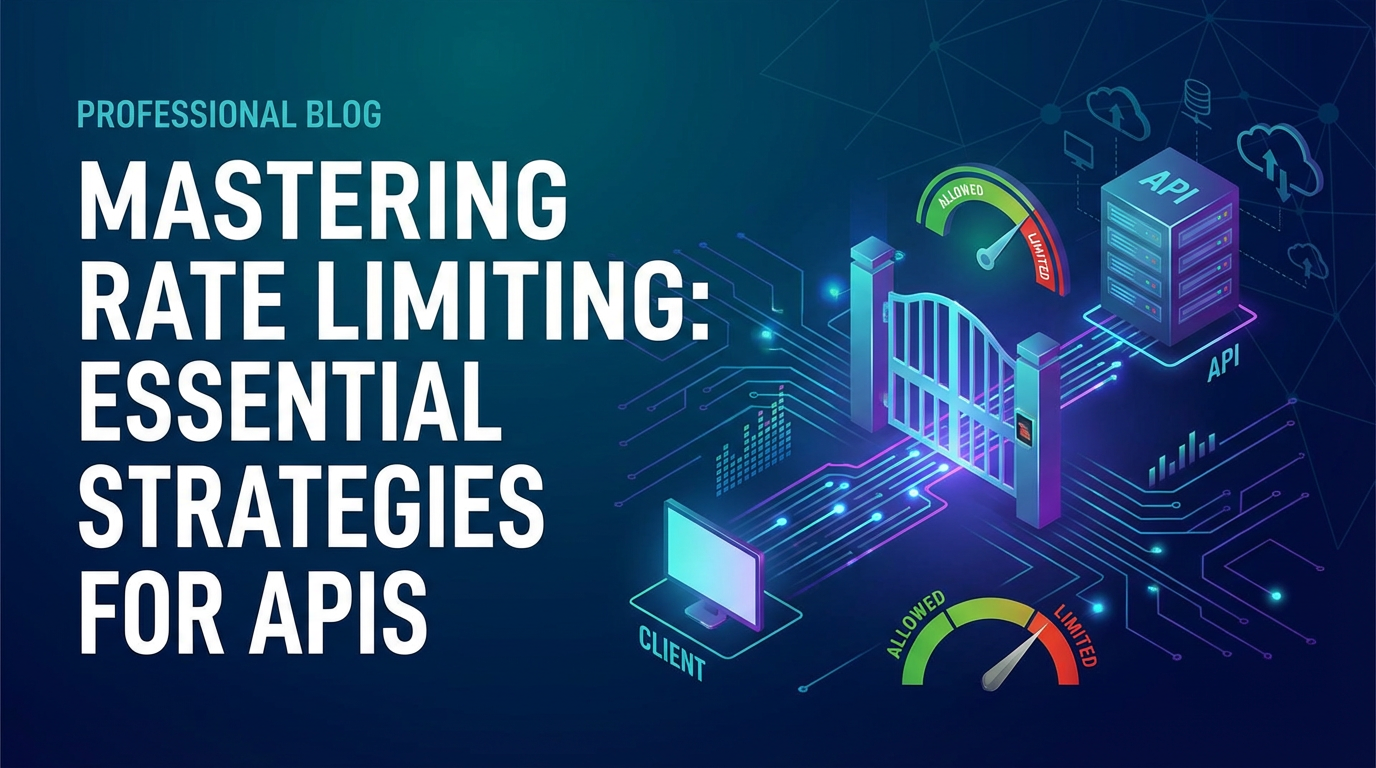
At its heart, rate limiting is a control mechanism designed to restrict the number of requests a user or client can make to an API within a given time window. Imagine an exclusive club with a bouncer at the door, carefully managing the flow of patrons to prevent overcrowding and ensure a pleasant experience for everyone inside. The bouncer isn't stopping people from entering entirely, but rather regulating the rate at which they can enter. Similarly, an API rate limiter acts as a digital bouncer, observing incoming requests and making decisions based on predefined rules.
The primary objective of this mechanism is multi-faceted. Firstly, it safeguards the API and its underlying infrastructure from malicious activities such as Denial-of-Service (DoS) or Distributed Denial-of-Service (DDoS) attacks, where an attacker attempts to overwhelm a service with a flood of requests. Secondly, it protects against brute-force attacks, commonly used to guess passwords or API keys, by slowing down the attacker's ability to make repeated attempts. Beyond security, rate limiting is crucial for maintaining the stability and availability of the API. By preventing any single client from monopolizing server resources, it ensures that all legitimate users receive a fair share of service capacity, thereby enhancing the overall user experience and preventing service degradation. Furthermore, in an era where cloud computing costs are directly tied to resource consumption, judicious rate limiting can significantly help in managing operational expenses by preventing runaway resource usage due to inefficient client behavior or accidental infinite loops.
The implementation of rate limiting policies can vary widely, ranging from simple hard limits, which strictly reject any request exceeding a predefined threshold, to more sophisticated soft limits that might introduce delays or return different quality of service, and even burst limits that permit a temporary surge in requests before enforcing stricter control. The choice of strategy often depends on the specific business requirements, the criticality of the API, and the desired user experience. Regardless of the specific approach, the underlying principle remains constant: to introduce a controlled bottleneck that ensures the longevity, reliability, and security of the API ecosystem.
Why Rate Limiting is Indispensable for Modern APIs
The proliferation of APIs across virtually every sector of industry has amplified the importance of robust management strategies. Without effective safeguards, even the most well-designed API can become a point of vulnerability or a source of unexpected costs. Rate limiting addresses several critical challenges, making it an indispensable component of any modern API strategy.
Preventing Abuse and Misuse
The internet is rife with malicious actors and inefficient scripts. Without rate limits, APIs become vulnerable targets for a variety of nefarious activities:
- Denial-of-Service (DoS) and Distributed Denial-of-Service (DDoS) Attacks: Attackers can flood an API with an overwhelming volume of requests, consuming all available server resources (CPU, memory, network bandwidth) and rendering the service unavailable for legitimate users. Rate limiting acts as a first line of defense, filtering out excessive traffic before it can cripple the backend systems.
- Brute-Force Attacks: These attacks involve systematically guessing authentication credentials (usernames, passwords, API keys) by making numerous rapid requests. A rate limit on authentication endpoints can significantly slow down these attempts, making them impractical and giving security teams more time to detect and respond to such threats.
- Data Scraping: Competitors or malicious entities might attempt to scrape large volumes of data from an API by making continuous, rapid requests. This can not only impact server performance but also compromise data intellectual property and potentially lead to competitive disadvantages. Rate limits can curb this activity, ensuring data is accessed responsibly and according to terms of service.
- Spam and Content Abuse: APIs that allow content submission (e.g., comments, forum posts) can be targeted by spammers. Rate limiting on these submission endpoints helps prevent the rapid creation of spam content, maintaining the integrity and quality of user-generated content platforms.
Ensuring System Stability and Availability
Even without malicious intent, an unthrottled API can suffer from self-inflicted wounds due to legitimate but excessively demanding clients:
- Resource Exhaustion: A single client or an application with a bug (e.g., an infinite loop making API calls) can inadvertently consume a disproportionate share of server resources, leading to high CPU utilization, memory leaks, database connection exhaustion, or network saturation. This can degrade performance for all other users or even cause the entire service to crash. Rate limiting ensures that no single entity can inadvertently take down the entire system.
- Cascading Failures: In a microservices architecture, an overloaded upstream API can cause back pressure and failures in downstream services that depend on it. This can lead to a domino effect, bringing down an entire system. Rate limiting helps isolate failures by preventing an overload in one service from propagating throughout the entire distributed system, thus improving overall system resilience.
- Predictable Performance: By controlling the request volume, API providers can ensure a more consistent and predictable performance for their services. This is crucial for service level agreements (SLAs) and for applications that rely on consistent response times.
Managing Infrastructure Costs
For organizations leveraging cloud-based infrastructure, resource consumption directly translates into financial cost. APIs, especially those with high traffic volumes, can quickly become expensive to operate if not managed judiciously:
- Reduced Server Load: By shedding excessive requests, rate limiting reduces the load on backend servers. This can translate into needing fewer server instances, lower compute costs, and less energy consumption.
- Optimized Bandwidth Usage: High request volumes often correlate with high data transfer, leading to increased bandwidth costs. Rate limiting can help curtail unnecessary data transfer, optimizing network expenses.
- Database Cost Savings: Each API request often involves database queries. Limiting the number of requests can significantly reduce the load on database servers, potentially allowing for smaller, less expensive database instances or reduced query costs in serverless database environments.
- Preventing Accidental Overspending: A developer error or an unoptimized client application could unintentionally generate a massive number of API calls, leading to unexpected and substantial cloud bills. Rate limiting acts as a crucial safety net against such financial surprises.
Enforcing Fair Usage Policies
Beyond technical stability and cost management, rate limiting plays a pivotal role in enforcing fair usage and supporting business models:
- Equitable Resource Distribution: It ensures that a few heavy users do not monopolize shared resources, allowing a larger base of users to experience consistent service quality. This fosters a sense of fairness and prevents a "noisy neighbor" problem in multi-tenant environments.
- Monetization and Tiered Services: Many API providers offer different tiers of service (e.g., free, basic, premium, enterprise), each with varying rate limits. Rate limiting is the technical mechanism that enforces these business rules, allowing providers to monetize their APIs effectively. Higher-paying customers receive higher limits, while free users operate within more constrained boundaries.
- Discouraging Inefficient Clients: Clients that make excessively frequent or poorly optimized API calls are encouraged to improve their implementation when confronted with rate limits. This nudges developers to write more efficient code, ultimately benefiting the entire API ecosystem.
In essence, rate limiting is a non-negotiable component of modern API design. It is the gatekeeper that preserves the integrity, performance, and economic viability of API services, ensuring they can sustainably support the evolving demands of the digital world.
Common Rate Limiting Algorithms and Their Mechanics
Implementing effective rate limiting requires choosing the right algorithm that aligns with the specific needs of the API, considering factors such as burst tolerance, memory footprint, and computational complexity. Each algorithm offers a distinct approach to counting and enforcing limits.
Fixed Window Counter
The Fixed Window Counter algorithm is perhaps the simplest to understand and implement. It works by dividing time into fixed-size windows (e.g., 60 seconds). For each window, a counter is maintained for each client (identified by IP address, API key, user ID, etc.). When a request arrives, the system checks if the counter for the current window has exceeded the predefined limit. If not, the request is allowed, and the counter is incremented. If the limit is reached, subsequent requests within that window are rejected. Once a new window begins, the counter is reset.
- Pros: Simplicity in implementation and low computational overhead. It's straightforward to reason about and debug.
- Cons: The "Thundering Herd" or "Burst Problem" at window edges. If the limit is 100 requests per minute, a client could make 100 requests at the very end of one minute window (e.g., at
t=59s) and then another 100 requests at the very beginning of the next minute window (e.g., att=61s). This means 200 requests within a span of just two seconds, potentially overwhelming the backend. This edge case can lead to bursts that bypass the intended limit. It also lacks flexibility for accommodating natural, short-lived spikes in traffic.
Sliding Window Log
The Sliding Window Log algorithm offers a more accurate approach by tracking timestamps of individual requests. Instead of fixed windows, it maintains a sorted log of request timestamps for each client. When a new request arrives, the algorithm removes all timestamps from the log that fall outside the current window (e.g., older than 60 seconds from the current time). It then checks if the number of remaining timestamps in the log (including the new request) exceeds the limit. If not, the new request's timestamp is added to the log, and the request is allowed.
- Pros: Highly accurate and completely avoids the "Thundering Herd" problem of the Fixed Window Counter. It provides a true "rolling" average of requests, ensuring that the limit is enforced over any arbitrary sliding time window.
- Cons: High memory consumption, as it needs to store a timestamp for every request for every client. This can become prohibitive for APIs with high traffic and numerous distinct clients. The computational cost of maintaining and pruning the log can also be higher.
Sliding Window Counter
The Sliding Window Counter algorithm attempts to strike a balance between the simplicity of the Fixed Window Counter and the accuracy of the Sliding Window Log. It combines elements of both. It typically uses fixed windows, but it approximates the sliding window by taking into account the request count from the previous window and the current window, weighted by how much of the current window has passed. For example, to calculate the rate for the current minute, it might use the count from the current minute's window plus a fraction of the count from the previous minute's window, corresponding to the portion of the previous window that still "slides" into the current one.
- Pros: Offers a good compromise between accuracy and memory efficiency. It largely mitigates the "Thundering Herd" problem without the extensive memory overhead of storing individual timestamps.
- Cons: While more accurate than Fixed Window, it's still an approximation and not perfectly precise like the Sliding Window Log. Its implementation is slightly more complex than the simple fixed window.
Token Bucket
The Token Bucket algorithm is distinct in its approach, focusing on controlling the rate at which requests can be sent while also allowing for short bursts. Imagine a bucket that has a fixed capacity for "tokens." Tokens are added to the bucket at a constant rate (e.g., 1 token per second), up to the bucket's maximum capacity. Each incoming request consumes one token. If a request arrives and there are tokens available in the bucket, the request is allowed, and a token is removed. If the bucket is empty, the request is rejected or queued.
- Pros:
- Burst Tolerance: The bucket's capacity allows for bursts of requests. If the API has been idle, the bucket fills up, allowing a rapid succession of requests until the tokens are depleted. This makes it ideal for APIs where occasional, legitimate spikes in usage are expected.
- Smooth Rate: The constant refill rate ensures that the average request rate is maintained over time.
- Fairness: It's fair to clients who are intermittently active.
- Cons: Parameter tuning (bucket size, refill rate) can be challenging and often requires iterative adjustment based on real-world traffic patterns. It's also more complex to implement compared to fixed window counters.
Leaky Bucket
The Leaky Bucket algorithm is conceptually the inverse of the Token Bucket. Instead of limiting the input rate, it smooths out the output rate. Imagine a bucket with a hole at the bottom (the "leak"). Requests (or data packets) arrive and are placed into the bucket. The bucket can only hold a certain number of requests (its capacity). Requests "leak out" of the bucket at a constant, predefined rate. If the bucket is full when a new request arrives, that request is rejected.
- Pros:
- Smooth Output Rate: Guarantees a constant output rate, which is excellent for backend systems that prefer a steady stream of requests rather than unpredictable bursts. This helps prevent server overload and maintains predictable performance.
- Effective for Traffic Shaping: Useful when the downstream service has a fixed processing capacity.
- Cons:
- Limited Burst Tolerance: Unlike the Token Bucket, it does not naturally allow for bursts. If requests arrive faster than the leak rate, the bucket will fill up quickly, and subsequent requests will be dropped. This can be problematic for applications that occasionally need to send a rapid sequence of requests.
- Queuing Delay: Requests might experience delays if the bucket fills up, even if they are eventually processed. This can impact real-time applications.
- Complexity: More complex to implement than simpler counters.
Here's a comparison table of these algorithms:
| Algorithm | Description | Pros | Cons | Use Case |
|---|---|---|---|---|
| Fixed Window Counter | Counts requests in fixed time intervals (e.g., 1 minute), resets at interval start. | Simple, low overhead. | "Thundering Herd" problem at window edges, allowing bursts. | Simple APIs, low-volume services where edge case bursts are acceptable or unlikely. |
| Sliding Window Log | Stores timestamps of all requests; purges old ones to determine current rate. | Highly accurate, no "Thundering Herd." | High memory usage (stores all timestamps), higher computational cost. | High-value APIs requiring precise rate limiting, where memory/compute costs are less critical. |
| Sliding Window Counter | Combines current window count with a weighted count from the previous window. | Good accuracy-to-memory trade-off, mitigates "Thundering Herd." | Approximation, slightly more complex than fixed window. | General-purpose APIs, good balance for most typical rate limiting scenarios. |
| Token Bucket | Tokens generated at fixed rate into a bucket; requests consume tokens. | Allows for bursts, smooth average rate. | Parameter tuning can be tricky (bucket size, refill rate). | APIs needing burst tolerance, but also a controlled average rate, e.g., third-party integrations. |
| Leaky Bucket | Requests placed into a bucket and leak out at a constant rate. | Smooth output rate, protects backend from bursts. | Limited burst tolerance (requests dropped if bucket is full), introduces queuing delay. | APIs protecting backend systems with fixed processing capacity, e.g., database writes, queue processing. |
Choosing the appropriate algorithm depends heavily on the specific traffic patterns, system resources, and business requirements of the API. Often, a combination of these strategies, or even different algorithms at different layers of the infrastructure, provides the most robust solution.
Where to Implement Rate Limiting: Strategic Placement
The effectiveness of rate limiting is not just about choosing the right algorithm, but also about strategically positioning it within your API architecture. Different layers offer distinct advantages and disadvantages, impacting granularity, performance, and ease of management.
Application Layer
Implementing rate limiting directly within your application code is the most granular approach. This involves adding logic inside your API endpoints or service methods to check request counts against defined limits.
- Pros:
- Deep Business Logic Awareness: The application layer has the most context about the specific user, their subscription tier, the particular resource being accessed, and the business implications of the request. This allows for highly sophisticated and custom rate limiting policies, such as limiting based on transaction value, number of items in a cart, or specific user roles.
- Flexibility: Developers have complete control over the implementation, allowing for complex algorithms and dynamic adjustments based on real-time application state.
- Cons:
- Resource Intensive: Every incoming request, even those destined to be rejected by rate limits, consumes application server resources (CPU, memory) to process the request, execute the rate limiting logic, and respond. This can put a significant strain on the application, especially under heavy attack or high load.
- Scalability Challenges: In a distributed application environment with multiple instances, maintaining consistent rate limit counters across all instances requires a shared, centralized store (like Redis), adding complexity.
- Duplication and Inconsistency: If not carefully managed, rate limiting logic can be duplicated across different endpoints or microservices, leading to inconsistencies and maintenance overhead.
- Early Failure: The request travels deeper into the system before being rejected, potentially wasting resources on parsing, authentication, and routing before the rate limit check.
API Gateway Layer
An API Gateway acts as a single entry point for all API requests, sitting in front of your backend services. It's a natural and highly effective place to enforce rate limiting policies. The gateway can manage rate limits based on various identifiers such as IP address, API key, user token, or even specific route paths.
- Pros:
- Centralized Management: All rate limiting policies are configured and enforced in one central location, simplifying management, ensuring consistency across all APIs, and reducing development effort within individual services.
- Decoupled from Application Logic: Rate limiting is externalized from the core application code, allowing developers to focus on business logic. This separation of concerns improves maintainability and agility.
- Efficiency: API gateways are often optimized for high performance and can shed excessive requests at an early stage, before they reach the backend services. This offloads significant processing from the application servers.
- Rich Feature Set: Modern API gateways typically come with built-in, sophisticated rate limiting capabilities, often supporting various algorithms and dynamic policies. Many also offer additional features like authentication, authorization, caching, logging, and traffic management.
- Scalability: Gateways are designed to handle high volumes of traffic and can often scale independently of the backend services.
- For example, advanced APIPark offers comprehensive API management features, including sophisticated rate limiting capabilities, unified AI invocation, and end-to-end API lifecycle management, providing a robust solution for developers and enterprises alike. APIPark, as an open-source AI gateway and API management platform, allows for centralized control over traffic, security, and access, making it an ideal candidate for enforcing rate limits efficiently and effectively.
- Cons:
- Less Business Context: While powerful, the API Gateway might not have the same deep business logic awareness as the application itself. It can rate limit based on high-level attributes (e.g., requests per minute for a specific API key) but might struggle with more nuanced, application-specific limits (e.g., number of specific report generations per hour per user where the report generation is a complex, multi-step process).
- Single Point of Failure (if not clustered): A poorly configured or single-instance API Gateway can become a bottleneck or a single point of failure. Proper clustering and high-availability setups are crucial.
Reverse Proxy/Load Balancer Layer
Even further upstream than the API Gateway, a reverse proxy or load balancer (e.g., Nginx, HAProxy) can implement basic rate limiting. This layer primarily deals with raw network traffic before any complex API processing.
- Pros:
- Extremely Efficient: These tools are highly optimized for network performance and can handle very high traffic volumes. They reject requests at the earliest possible point, minimizing resource consumption on downstream systems.
- Simple, Global Limits: Ideal for enforcing broad, global rate limits, typically based on IP address, to protect against widespread DDoS attacks.
- Low Overhead: Adding rate limiting here incurs minimal overhead on the application and API Gateway layers.
- Cons:
- Limited Granularity: Rate limiting at this layer is typically very coarse-grained, often limited to IP addresses. It cannot easily differentiate between authenticated users, API keys, or specific API endpoints. It treats all traffic from an IP equally.
- Lack of Context: It has no understanding of API structure, user roles, or business logic. It's purely network-level enforcement.
- Challenges with Shared IPs: Multiple users behind a NAT or corporate proxy will appear to come from the same IP address, potentially penalizing legitimate users due to another user's excessive activity.
Edge/CDN Layer
For APIs exposed globally, Content Delivery Networks (CDNs) or Web Application Firewalls (WAFs) at the network edge can also provide rate limiting capabilities. This is the absolute first line of defense, closest to the user.
- Pros:
- Global Distribution and Early Filtering: Filters malicious or excessive traffic geographically closer to the source, reducing network latency and preventing it from reaching your core infrastructure.
- Large-Scale DDoS Mitigation: CDNs are designed to absorb and distribute massive volumes of attack traffic, making them highly effective against large-scale DDoS attacks.
- Managed Service: Often provided as a managed service, reducing operational burden.
- Cons:
- Least Granular: Similar to reverse proxies, rate limiting here is generally very high-level and often IP-based, lacking specific API context.
- Vendor Lock-in: Relying on a CDN's specific rate limiting features might lead to vendor lock-in.
- Cost: Managed CDN/WAF services can be expensive.
Hybrid Approaches
The most robust and flexible rate limiting strategies often involve a hybrid approach, combining multiple layers of defense:
- Edge/Reverse Proxy: For initial, broad protection against DDoS and large-scale volumetric attacks (e.g., Nginx limiting requests per IP).
- API Gateway: For centralized, more granular rate limiting based on API keys, user IDs, or specific endpoints, applying business rules (e.g., using APIPark for comprehensive API management).
- Application Layer: For highly specific, fine-grained rate limits tied to complex business logic or sensitive operations, often as a fallback or complementary mechanism for critical paths.
By layering rate limits, organizations can build a resilient API defense system that is both efficient and highly adaptive, shedding unwanted traffic early while applying nuanced controls where they matter most. This layered approach ensures that resources are protected at every stage of the request lifecycle, from the network edge to the application core.
APIPark is a high-performance AI gateway that allows you to securely access the most comprehensive LLM APIs globally on the APIPark platform, including OpenAI, Anthropic, Mistral, Llama2, Google Gemini, and more.Try APIPark now! 👇👇👇
Key Considerations for Designing Effective Rate Limiting Policies
Designing an effective rate limiting policy is not a one-size-fits-all endeavor. It requires careful consideration of various factors to ensure it meets both technical stability requirements and business objectives, while also providing a positive developer experience.
Scope of Limiting
The first crucial decision is determining what entity the rate limit applies to. This defines the granularity of your control:
- Per User/Client ID: The most common and often preferred approach. Limits are applied to an authenticated user or a client application identified by an API key. This is fair, as each user/client gets their allocated share of requests.
- Per IP Address: Simple to implement at lower layers (reverse proxy, CDN) but problematic for users behind shared IPs (e.g., corporate proxies, mobile networks), where one user's excessive activity can penalize many others. Also vulnerable to IP spoofing.
- Per Endpoint/Resource: Specific limits can be applied to individual API endpoints or specific resources. For instance, a "create user" endpoint might have a much lower limit than a "read public data" endpoint due to its higher resource consumption or security implications.
- Per Organization/Tenant: In multi-tenant systems, limits might be applied across an entire organization, regardless of how many individual users within that organization are making requests. This is common in enterprise-level API subscriptions.
- Per Concurrent Connection: Limits the number of simultaneous active connections from a client, rather than the request rate. This is useful for preventing resource exhaustion from persistent connections.
The choice here significantly impacts fairness and effectiveness. A common strategy is to layer limits: broad limits per IP at the edge for basic DDoS protection, combined with more granular limits per API key/user at the API Gateway or application layer.
Granularity of Limits
Beyond the scope, the granularity of the limits themselves matters:
- Global Limits: A single, overarching limit that applies to all requests from a given entity (e.g., 1000 requests per hour for any API key). Simple but lacks nuance.
- Specific Endpoint Limits: Tailored limits for individual endpoints or groups of endpoints (e.g.,
/api/v1/usersis limited to 100 requests/minute, while/api/v1/reportsis limited to 10 requests/minute due to its heavy processing nature). This allows for fine-tuning based on resource cost and criticality.
Limits Definition
The actual values of the limits are paramount. These typically involve:
- Requests per Unit of Time: The most common form (e.g., 100 requests per minute, 5000 requests per hour).
- Bandwidth Consumption: Limiting the total data transferred (e.g., 10 GB per day).
- Concurrent Connections: Limiting simultaneous open connections.
- Payload Size: Rejecting requests with excessively large bodies to prevent resource exhaustion from large data uploads.
Defining these values requires a deep understanding of your API's usage patterns, the underlying infrastructure's capacity, and your business objectives. Start with conservative limits and adjust based on monitoring and feedback.
Response to Exceeding Limits
When a client hits a rate limit, the API needs to respond gracefully and informatively:
- HTTP Status Code 429 Too Many Requests: This is the standard HTTP status code indicating that the user has sent too many requests in a given amount of time.
Retry-AfterHeader: This crucial header should be included in a 429 response, informing the client how long they should wait before making another request (either as a number of seconds or a specific date/time). This helps clients implement exponential backoff strategies and avoids further overloading the server.- Informative Error Body: The response body should contain a clear, human-readable message explaining that the rate limit has been exceeded, what the limit is, and potentially how to get higher limits (e.g., upgrade subscription).
- Custom Headers: Many APIs include custom headers to communicate current rate limit status, such as
X-RateLimit-Limit,X-RateLimit-Remaining, andX-RateLimit-Reset(time in UTC seconds when the limit resets). This allows clients to proactively manage their request rates.
Burst Tolerance
Some APIs experience legitimate, short-lived spikes in traffic. A rigid rate limit might unnecessarily penalize these bursts.
- Algorithm Choice: As discussed, algorithms like Token Bucket inherently allow for bursts.
- Policy Design: Consider having a higher "burst limit" for a shorter duration (e.g., 100 requests per minute, but allow 20 requests in any 5-second window), which then falls back to a stricter limit over a longer period.
Dynamic vs. Static Limits
- Static Limits: Predefined and fixed limits (e.g., 100 requests/minute). Simple but might not adapt to changing system load.
- Dynamic Limits: Adjust limits in real-time based on the API's current health, CPU utilization, memory pressure, or database load. When the system is under stress, limits can be temporarily lowered, and then raised again when conditions improve. This adds resilience but increases implementation complexity.
Authentication and Authorization Integration
Rate limiting often works in conjunction with authentication and authorization:
- Pre-Authentication Limiting: Basic rate limits (e.g., per IP) might be applied even before authentication to protect against brute-force login attempts or volumetric attacks.
- Post-Authentication Limiting: More granular limits are applied after a client is authenticated and identified (e.g., per API key, per user ID). This allows for tiered service levels.
Developer Experience
Effective rate limiting should not be an arbitrary obstacle but a clear contract with developers:
- Clear Documentation: Thoroughly document your rate limiting policies, including the limits, algorithms used, how to handle 429 responses, and the meaning of any custom headers.
- SDK Support: If you provide SDKs, ensure they have built-in support for handling 429 responses with exponential backoff and retries.
- Transparency: Provide dashboards or logs where clients can view their current usage against their limits.
By carefully considering these factors, API providers can design rate limiting policies that are fair, effective, and conducive to a stable and scalable API ecosystem.
Implementing Rate Limiting in Practice
Translating theoretical understanding into a practical, resilient rate limiting system involves several key implementation decisions and ongoing operational practices.
Choosing the Right Algorithm
The selection of a rate limiting algorithm is foundational. As previously discussed, each algorithm has its trade-offs:
- For simple, high-volume public APIs where minor "bursty" behavior at window edges is acceptable, a Fixed Window Counter might suffice due to its low overhead.
- If your primary concern is to smooth out traffic and provide burst tolerance for diverse clients, the Token Bucket algorithm is an excellent choice. It’s often preferred for third-party API integrations.
- For critical APIs demanding precise and immediate enforcement of limits, and where memory is not a bottleneck, the Sliding Window Log offers the highest accuracy.
- Most general-purpose APIs find a good balance with the Sliding Window Counter, which offers reasonable accuracy without the memory footprint of the log-based approach.
- If your backend has a fixed processing capacity and you absolutely need to protect it from being overwhelmed, Leaky Bucket can be highly effective, ensuring a steady stream of requests.
Often, a combination of algorithms is used across different layers or for different types of API calls. For example, a basic fixed window might be applied globally, while specific sensitive endpoints use a token bucket.
Data Storage for Counters
Regardless of the algorithm, rate limiting requires maintaining state (counters, timestamps, tokens). The choice of storage significantly impacts performance, scalability, and consistency in distributed environments:
- In-Memory (Single Instance): Simplest for a single API server. Counters are stored in the application's memory.
- Pros: Extremely fast access.
- Cons: No persistence, lost on restart. Does not work in a distributed system where requests hit different server instances, leading to inconsistent limits and potential over-allowing requests.
- Redis: A highly popular choice for distributed rate limiting due to its speed, atomic operations, and versatile data structures (hashes, sorted sets).
- Pros: Very fast (in-memory data store), supports atomic increment/decrement, offers persistence options, and is highly scalable. Redis's commands like
INCR,EXPIRE,ZADD,ZCOUNT,ZREMRANGEBYSCOREcan directly implement various rate limiting algorithms efficiently. - Cons: Adds an external dependency, requires managing a Redis instance/cluster. Network latency to Redis can be a factor.
- Pros: Very fast (in-memory data store), supports atomic increment/decrement, offers persistence options, and is highly scalable. Redis's commands like
- Database (e.g., SQL, NoSQL): Possible but generally less performant than Redis for high-volume, real-time counting.
- Pros: Leverages existing infrastructure, strong consistency guarantees if transactions are used.
- Cons: Slower I/O compared to in-memory stores, higher latency for each count update, potential for database contention under heavy load. Best suited for very low-volume APIs or for storing long-term usage statistics rather than real-time counters.
For most production-grade, scalable APIs, Redis is the de facto standard for distributed rate limiting.
Distributed Rate Limiting Challenges
When your API is served by multiple instances (e.g., behind a load balancer), coordinating rate limits across these instances becomes crucial.
- Consistency: Each instance must have an up-to-date view of the client's current request count/state. Without a shared state, different instances would maintain their own counters, effectively multiplying the allowed request rate.
- Atomic Operations: Updates to counters must be atomic to prevent race conditions. If two requests arrive simultaneously at different instances, both attempting to increment a counter, non-atomic operations could lead to an incorrect final count. Redis's
INCRcommand is atomic, solving this issue. - Synchronization: Ensuring that all nodes correctly apply the same rate limiting logic and consult the same state store.
Properly configured Redis clusters or other distributed caching solutions are essential for handling these challenges in a scalable manner.
Handling False Positives and Whitelisting
Rate limiting, while crucial, can sometimes impact legitimate traffic:
- Internal Tools/Services: Your own internal tools, monitoring systems, or administrative panels might make frequent API calls. These should typically be whitelisted to avoid being rate-limited.
- Trusted Partners: Key business partners with high-volume legitimate needs might require higher limits or complete whitelisting.
- Elasticity: Ensure your rate limits are configured to allow for legitimate scaling needs. If your system experiences a sudden, legitimate surge in traffic, overly rigid limits could cause a denial of service to your own users.
- Monitoring and Adjustment: Continuously monitor your rate limit metrics (how often limits are hit, by whom) to identify false positives and adjust policies as needed.
Monitoring and Alerting
A rate limiting system is incomplete without robust monitoring and alerting:
- Track Rate Limit Events: Log every instance where a rate limit is hit, including the client identifier, endpoint, and the actual request rate versus the limit.
- Visualize Usage: Create dashboards to visualize current and historical API usage, showing requests per second/minute, rate limit hit rates, and
X-RateLimit-Remainingtrends. - Alerting: Set up alerts for:
- High rates of 429 responses for specific clients or endpoints (potential abuse or misbehaving client).
- High overall 429 response rates (potential attack or widespread client issue).
- Sudden drops in API traffic (could indicate a rate limit issue impacting legitimate users).
- Unexpected changes in
X-RateLimit-Remainingvalues for key clients.
- Performance Monitoring: Monitor the performance of your rate limiting system itself (e.g., Redis latency, API Gateway CPU usage related to rate limiting).
Testing Rate Limiting
Thorough testing is critical to ensure rate limits function as intended and don't introduce unintended side effects:
- Unit Tests: Test the core rate limiting logic in isolation.
- Integration Tests: Verify that the rate limit system correctly interacts with your API Gateway and backend services.
- Load/Stress Testing: Simulate high traffic volumes, including bursts and sustained exceeding of limits, to confirm that the system correctly rejects excess requests without crashing or degrading for legitimate traffic. Test different scenarios (e.g., a single client hitting the limit, multiple clients hitting the limit concurrently).
- Edge Case Testing: Specifically test the "Thundering Herd" problem if using Fixed Window counters, or scenarios where clients recover from being rate-limited.
- Client-Side Testing: Test client applications to ensure they correctly interpret
429responses andRetry-Afterheaders, implementing exponential backoff.
By focusing on these practical aspects of implementation, API providers can build a resilient, efficient, and well-managed rate limiting system that stands up to real-world demands.
Beyond Basic Rate Limiting: Advanced Strategies and API Governance
While fundamental rate limiting is crucial for API stability, the landscape of API management extends far beyond simple request counting. Modern API ecosystems often require more nuanced control mechanisms and a holistic approach encapsulated by API Governance.
Throttling
Often used interchangeably with rate limiting, throttling specifically refers to a controlled reduction in the processing rate of requests, rather than outright rejection. While rate limiting might immediately send a 429 response, throttling might queue requests, introduce artificial delays, or downgrade the quality of service (e.g., returning cached data, simpler responses) to allow the system to catch up.
- Use Cases: Ideal for non-critical background jobs, batch processing APIs, or situations where eventual processing is acceptable, but immediate execution is not mandatory. It helps absorb temporary spikes without completely denying service, ensuring higher availability for all clients over time.
- Implementation: Often involves queueing mechanisms (like message queues) or dynamic back-pressure systems that signal clients to slow down.
Circuit Breakers
Inspired by electrical circuit breakers, this pattern protects a system from cascading failures when an upstream service becomes unresponsive or exhibits high error rates. Instead of continuously sending requests to a failing service, the circuit breaker "trips," rapidly failing subsequent requests to that service without actually sending them. After a timeout period, it allows a small number of "test" requests through to check if the service has recovered.
- Integration with Rate Limiting: While distinct, circuit breakers complement rate limiting. Rate limiting protects the API from clients, while circuit breakers protect the API from its own dependencies. If a backend service protected by a circuit breaker starts failing, rate limiting might still be active, but the circuit breaker would prevent the API from even attempting to call the failing service, providing immediate feedback to the client.
- Benefits: Prevents resource exhaustion from waiting for timeouts, provides quick failure feedback, and allows the failing service time to recover without additional load.
Traffic Shaping
Traffic shaping involves prioritizing certain types of requests over others or ensuring that traffic conforms to specific patterns. This is particularly useful in scenarios where not all API requests have equal importance or urgency.
- Priority Queuing: High-priority clients or critical API endpoints can be placed in a priority queue, ensuring they are processed before lower-priority requests during peak load.
- Bandwidth Allocation: Specific API consumers or types of requests might be allocated guaranteed minimum bandwidth or maximum throughput.
- Use Cases: Enterprise clients often receive higher priority or guaranteed service levels compared to free-tier users. Critical system health checks might bypass all rate limits and throttling.
Adaptive Rate Limiting
Instead of static, predefined limits, adaptive rate limiting dynamically adjusts limits based on the real-time health and load of the backend systems.
- Mechanism: It continuously monitors metrics like CPU utilization, memory usage, database connection pools, or latency of downstream services. When resource utilization crosses certain thresholds, the rate limits are automatically tightened; conversely, when resources are plentiful, limits can be relaxed.
- Benefits: Maximizes API throughput during periods of low load while aggressively protecting resources during high stress, leading to a more resilient and efficient system.
- Complexity: Requires sophisticated monitoring infrastructure, dynamic configuration updates to the rate limiting engine, and careful tuning to prevent oscillation.
Usage-Based Billing
For APIs offered as a service, rate limiting is the technical mechanism that underpins usage-based billing models. Different subscription tiers correspond to different rate limits.
- Integration: The rate limiting system needs to integrate with a billing system to track API calls against allocated quotas for each client. When limits are exceeded, the system might block further requests, or it might allow overage and charge accordingly, depending on the business model.
- Transparency: Providing clients with real-time dashboards of their usage against their quota is essential for this model.
API Governance as a Holistic Approach
Rate limiting, throttling, and circuit breakers are powerful tools, but they are components of a larger, more comprehensive strategy: API Governance.
- Definition: API Governance encompasses the entire set of processes, policies, standards, and tools used to manage the full lifecycle of APIs, from design and development to deployment, operations, versioning, security, and retirement. Its goal is to ensure consistency, security, reliability, and reusability across an organization's API landscape.
- Rate Limiting's Role: Within API Governance, rate limiting is a critical pillar for:
- Security: Enforcing policies against abuse, brute-force attacks, and DoS.
- Reliability: Preventing resource exhaustion and ensuring predictable performance.
- Cost Control: Managing infrastructure expenditure by controlling resource consumption.
- Fairness and Monetization: Implementing tiered service models and equitable resource distribution.
- Compliance: Ensuring APIs adhere to performance SLAs and security standards.
- Broader Governance Aspects: Beyond rate limiting, API Governance also covers:
- Design Standards: Consistent API design principles (REST, GraphQL, etc.).
- Security Policies: Authentication (OAuth, API Keys), authorization (RBAC), data encryption.
- Documentation Standards: Consistent and comprehensive API documentation.
- Lifecycle Management: Processes for versioning, deprecation, and retirement.
- Monitoring and Analytics: Comprehensive tracking of API usage, performance, and errors.
- Developer Portal: A centralized hub for developers to discover, consume, and manage APIs.
Implementing robust API Governance is crucial for organizations that rely heavily on APIs for their operations and business models. It shifts the perspective from merely building APIs to strategically managing them as core digital assets. Platforms like APIPark exemplify this holistic approach, offering not just an AI gateway, but an entire API management platform that facilitates end-to-end API lifecycle management, ensuring consistency, security, and efficient governance across all API services. By adopting a strong API Governance framework, organizations can unlock the full potential of their APIs, driving innovation while maintaining control and stability.
Best Practices for Developers and API Providers
To truly master rate limiting and ensure a healthy API ecosystem, both API providers and developers consuming APIs must adhere to certain best practices.
For API Providers:
- Document Rate Limits Clearly and Comprehensively:
- Provide explicit details on your API documentation about all rate limits: what they are (e.g., 100 requests/minute), their scope (per API key, per IP), the time window, and the algorithms used if relevant.
- Explain the meaning of custom rate limit headers (
X-RateLimit-Limit,X-RateLimit-Remaining,X-RateLimit-Reset). - Crucially, detail how to handle
HTTP 429 Too Many Requestsresponses, including the importance of theRetry-Afterheader.
- Provide Meaningful Error Responses:
- When a rate limit is hit, return a
429 Too Many Requestsstatus code. - Include a
Retry-Afterheader in all429responses, indicating how long the client should wait before making another request. - The response body should be a clear, human-readable JSON or XML message explaining why the request was rejected (e.g., "Rate limit exceeded. Maximum 100 requests per minute allowed.") and possibly how to request higher limits if applicable.
- When a rate limit is hit, return a
- Offer Custom Rate Limit Headers:
- Implementing
X-RateLimit-Limit,X-RateLimit-Remaining, andX-RateLimit-Resetheaders (or similar custom headers) allows clients to proactively manage their request rates. These headers provide real-time visibility into their usage against the limit, enabling them to adjust their behavior before hitting the limit.
- Implementing
- Design for Graceful Degradation:
- Consider scenarios where clients hit rate limits. Instead of abruptly failing, can the API return cached data, partial results, or a simpler response that is less resource-intensive? This can improve the user experience even under heavy load.
- For critical internal services, implement throttling or priority queues instead of hard rejections to ensure essential functions can still proceed.
- Monitor and Iterate on Policies:
- Rate limits are not static. Continuously monitor API usage, observe when and by whom limits are being hit, and gather feedback from developers.
- Be prepared to adjust limits (up or down) based on real-world usage patterns, system performance, and evolving business needs. A limit that was appropriate six months ago might be too restrictive or too lenient today.
For Developers Consuming APIs:
- Read and Understand API Documentation on Rate Limits:
- Before integrating with any API, thoroughly review its rate limiting policies. Understanding these limits upfront is critical to building a robust client.
- Implement Exponential Backoff and Jitter for Retries:
- When an API returns a
429 Too Many Requestsresponse (or any server error like5xx), do not immediately retry the request. Implement an exponential backoff strategy: wait an increasing amount of time between retries. - Crucially, incorporate "jitter" (randomness) into the backoff delay. This prevents a "thundering herd" effect where all clients that were simultaneously rate-limited try to retry at exactly the same time, potentially creating another surge that overwhelms the API again.
- Always respect the
Retry-Afterheader if provided.
- When an API returns a
- Proactively Track Your Usage:
- If the API provides
X-RateLimit-*headers, use them! Parse these headers after each request to keep track of your remaining requests and the reset time. Adjust your request frequency to stay within the limits. - Consider adding a slight buffer (e.g., stopping when
X-RateLimit-Remainingis 10 instead of 0) to account for potential clock drift or network delays.
- If the API provides
- Batch Requests Where Possible:
- Instead of making multiple individual API calls, look for opportunities to consolidate them into a single batch request if the API supports it. This significantly reduces the total number of requests and helps stay within limits.
- Cache Responses:
- If the API data doesn't change frequently, implement client-side caching. This reduces the need to make repeated API calls for the same data, saving your rate limit quota and improving application performance. Respect caching headers like
Cache-ControlandExpires.
- If the API data doesn't change frequently, implement client-side caching. This reduces the need to make repeated API calls for the same data, saving your rate limit quota and improving application performance. Respect caching headers like
- Avoid Unnecessary Polling:
- If an API provides webhooks or push notifications for updates, prefer these mechanisms over constant polling (repeatedly asking "is there anything new?"). Polling is inefficient and quickly consumes rate limits.
- Identify Your Client Correctly:
- Ensure your API requests include a valid API key or user authentication token so the API provider can accurately track and apply limits to your specific client. Using a generic identifier or no identifier at all can lead to more restrictive limits or outright blocking.
By embracing these best practices, both API providers can build more resilient, secure, and user-friendly APIs, while developers can integrate with them more reliably and efficiently, fostering a healthier and more sustainable digital ecosystem.
Conclusion
The journey through mastering rate limiting reveals it to be far more than a mere technical implementation detail; it is a strategic cornerstone for the stability, security, and economic viability of modern APIs. From safeguarding against malicious attacks and preventing system overloads to managing infrastructure costs and enabling sophisticated business models, rate limiting plays a multifaceted and indispensable role. We have explored the diverse mechanisms, from the foundational Fixed Window Counter to the nuanced Token and Leaky Buckets, understanding the unique strengths and weaknesses of each.
The decision of where to implement rate limiting – be it at the application layer, through a robust API Gateway like APIPark, at the reverse proxy, or the network edge – is critical. A layered approach often proves most effective, providing comprehensive protection from the farthest reaches of the network to the deepest parts of the application logic. Furthermore, designing effective policies requires careful consideration of scope, granularity, response mechanisms, and the crucial balance between strict control and a positive developer experience.
Beyond basic limits, advanced strategies like throttling, circuit breakers, and adaptive rate limiting empower APIs with even greater resilience and intelligence. These components, however, are best understood and implemented within the broader framework of API Governance – a holistic approach that ensures consistency, security, and efficient management across the entire API lifecycle.
Ultimately, by adhering to best practices, API providers can build robust, transparent, and fair API ecosystems, while developers can consume these APIs responsibly and efficiently. In an increasingly API-driven world, mastering rate limiting is not just about preventing failure; it's about enabling scalable growth, fostering innovation, and ensuring the enduring health of our interconnected digital infrastructure.
5 Frequently Asked Questions (FAQs)
1. What is the primary purpose of API rate limiting? The primary purpose of API rate limiting is to control the number of requests a client can make to an API within a specific time frame. This serves multiple critical functions: protecting the API and its backend infrastructure from abuse (like DoS attacks or brute-force attempts), ensuring system stability and availability for all users by preventing resource exhaustion, managing operational costs by limiting excessive resource consumption, and enforcing fair usage policies or tiered service levels for different client subscriptions.
2. Which is the best rate limiting algorithm to use? There isn't a single "best" rate limiting algorithm; the ideal choice depends on your specific needs, traffic patterns, and resource constraints. The Fixed Window Counter is simple and efficient but vulnerable to "thundering herd" problems at window edges. The Sliding Window Log is highly accurate but memory-intensive. The Sliding Window Counter offers a good balance of accuracy and efficiency. The Token Bucket algorithm is excellent for allowing controlled bursts of traffic, while the Leaky Bucket algorithm is best for smoothing out request processing to a constant output rate. Many robust systems employ a combination of these algorithms at different layers or for different types of API calls.
3. Where is the most effective place to implement API rate limiting? The most effective approach often involves implementing rate limiting at multiple layers of your architecture for comprehensive protection. Initial, broad rate limiting (e.g., per IP address) can be done at the Reverse Proxy/Load Balancer or Edge/CDN layer to filter out volumetric attacks early. More granular and business-logic-aware rate limiting (e.g., per API key, per user, per endpoint) is best implemented at the API Gateway layer, which acts as a central control point. Solutions like APIPark provide robust API Gateway functionalities, making it an ideal location for centralized and sophisticated rate limiting. Finally, for highly sensitive or resource-intensive operations, some fine-grained rate limiting can also be implemented within the Application Layer itself.
4. How should an API client respond when it hits a rate limit? When an API client receives an HTTP 429 Too Many Requests status code, it should immediately stop sending further requests to avoid exacerbating the problem. The most crucial step is to look for the Retry-After header in the response, which tells the client exactly how long to wait before retrying. If Retry-After is not provided, the client should implement an exponential backoff strategy with jitter (randomized delays) to gradually increase the wait time between retries. This prevents all clients from retrying simultaneously and overwhelming the API again. Additionally, clients should ideally monitor rate limit headers (e.g., X-RateLimit-Remaining) to proactively slow down their request rate before hitting the limit.
5. How does rate limiting relate to API Governance? Rate limiting is a fundamental component of a broader API Governance strategy. API Governance encompasses all the processes, policies, standards, and tools used to manage the entire API lifecycle, ensuring consistency, security, reliability, and reusability. Within this framework, rate limiting specifically contributes to: enforcing security policies against abuse, ensuring the reliability and availability of services, managing operational costs by controlling resource consumption, and supporting business models through tiered access. It's a critical mechanism for maintaining the overall health, performance, and strategic value of an organization's API ecosystem.
🚀You can securely and efficiently call the OpenAI API on APIPark in just two steps:
Step 1: Deploy the APIPark AI gateway in 5 minutes.
APIPark is developed based on Golang, offering strong product performance and low development and maintenance costs. You can deploy APIPark with a single command line.
curl -sSO https://download.apipark.com/install/quick-start.sh; bash quick-start.sh

In my experience, you can see the successful deployment interface within 5 to 10 minutes. Then, you can log in to APIPark using your account.

Step 2: Call the OpenAI API.