Mastering schema.GroupVersionResource Test: Tips & Best Practices
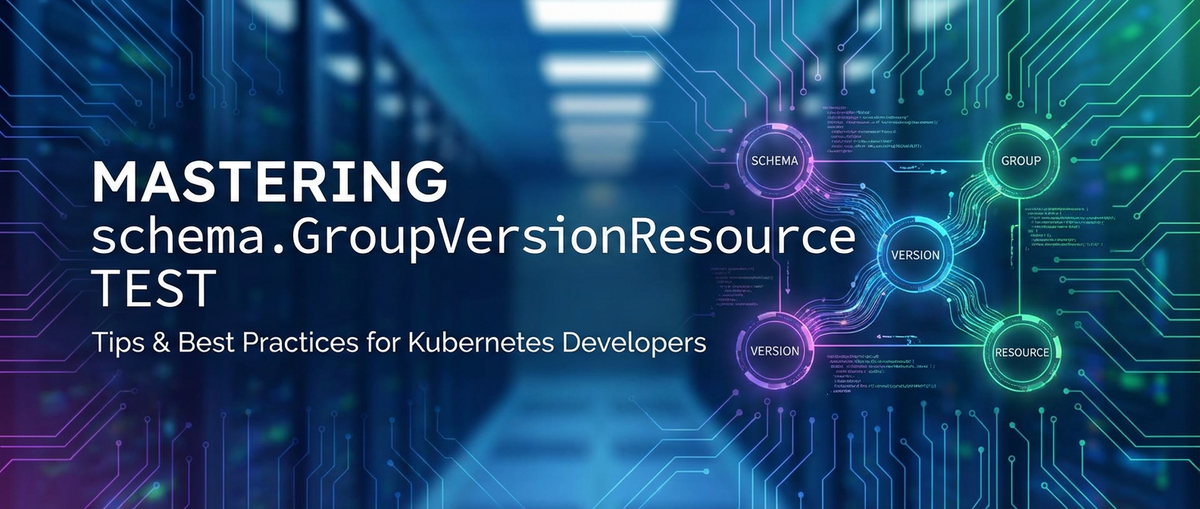


The intricate world of Kubernetes, with its declarative APIs and dynamic resource model, has revolutionized how applications are built, deployed, and managed. At the heart of this extensibility lies the concept of custom resources, defined through Custom Resource Definitions (CRDs), which allow users to extend the Kubernetes API with their own api objects. To interact with these custom resources, and indeed with any native Kubernetes resource, developers rely on the schema.GroupVersionResource identifier. This seemingly simple construct — a combination of Group, Version, and Resource — is the precise address for any api object within the Kubernetes ecosystem. However, merely defining these resources is not enough; ensuring their correctness, stability, and interoperability through rigorous testing is paramount. This comprehensive guide delves deep into the art and science of mastering schema.GroupVersionResource testing, offering invaluable tips and best practices for developers aiming to build robust, reliable, and governable Kubernetes applications.
The journey to effective schema.GroupVersionResource testing is fraught with unique challenges, stemming from the distributed nature of Kubernetes, its asynchronous operations, and the tight coupling of controllers with the api server. Without a meticulous testing strategy, custom resources can introduce subtle bugs, performance bottlenecks, or even critical security vulnerabilities, undermining the entire application's integrity. This article will explore the fundamental principles behind schema.GroupVersionResource, dissect the complexities of testing it, and provide actionable strategies, from mocking client-go to employing sophisticated integration and end-to-end testing frameworks. We will emphasize how well-structured tests contribute significantly to overall API Governance and how leveraging standards like OpenAPI can elevate the quality and maintainability of your Kubernetes custom APIs. By the end, you will be equipped with the knowledge to establish a resilient testing regime that ensures your Kubernetes-native applications stand the test of time and scale.
Understanding schema.GroupVersionResource: The Core of Kubernetes Resource Identification
To effectively test anything related to Kubernetes resources, one must first possess a profound understanding of schema.GroupVersionResource (GVR). This fundamental struct is the canonical way to refer to a specific type of resource within the Kubernetes api machinery, acting as a unique identifier for operations like listing, watching, creating, updating, and deleting. It’s more granular than a GroupVersionKind (GVK), as GVR explicitly points to the "resource" type (e.g., "pods") rather than the "kind" (e.g., "Pod") which is the developer-facing name. While GVK is often used in client-go when constructing objects or defining types, GVR is what the dynamic client and underlying API server machinery use to dispatch requests.
The schema.GroupVersionResource consists of three distinct, yet interconnected, components:
- Group: This component specifies the
apigroup to which a resource belongs. In Kubernetes, resources are logically grouped to prevent naming collisions and organize functionality. For instance, core Kubernetes resources like Pods and Namespaces belong to the "" (empty string) group, whereas Deployments and ReplicaSets fall under the "apps" group. Custom resources, created via CRDs, will typically have a custom group, such as "stable.example.com" or "mycompany.io". The group provides a namespace forapitypes, ensuring that a "Service" from one vendor doesn't conflict with a "Service" from another if they both implemented customapis. This hierarchical organization is crucial for scalableAPI Governance, allowing different teams or projects to extend Kubernetes without clashing. - Version: The version component indicates the specific
apiversion of the resource. Kubernetesapis, both native and custom, evolve over time. Versions are critical for managing compatibility and allowingapis to mature through stages likev1alpha1,v1beta1, andv1. For example, a Deployment resource might exist as "apps/v1beta2/deployments" or "apps/v1/deployments". Testing against differentapiversions is a non-trivial but vital aspect of ensuring forward and backward compatibility for client applications and controllers. The version ensures that older clients can still interact with theapiserver, or that newer features are only exposed to clients that understand them, providing a clear contract forapiconsumers. - Resource: This is the pluralized, lowercase name of the resource itself. For example, for the "Pod" kind, the resource name is "pods". For a "Deployment" kind, it's "deployments". This part of the GVR is directly used in
apipaths, such as/apis/apps/v1/deployments. It uniquely identifies the collection of objects of a particular kind within a specific group and version. It's important to differentiateResourcefromKind(e.g.,podsvsPod), asResourceis used for HTTP path segment and is always plural and lowercase, whileKindis the singular, CamelCase name of the object type.
Together, these three components form a precise and unambiguous address that the Kubernetes api server uses to route requests and manage custom resources. When a client-go library or a custom controller needs to interact with an object, it forms a GVR to tell the api server exactly what type of object it's interested in. Understanding how these components are constructed and resolved by the Kubernetes api machinery is the foundational step for designing effective and robust tests that accurately simulate real-world interactions. Without this clarity, tests might target the wrong api endpoints or misinterpret resource definitions, leading to false positives or, worse, overlooked critical bugs.
The Indispensable Role of Testing schema.GroupVersionResource in Kubernetes Development
Testing schema.GroupVersionResource (GVR) is not merely a recommended practice; it is an indispensable pillar of developing stable, secure, and maintainable Kubernetes applications, especially those that leverage Custom Resource Definitions (CRDs). In an ecosystem where extensibility and automation are key, the integrity of custom apis and the controllers that manage them directly impacts the reliability of the entire system. Without comprehensive testing, the very foundation of your Kubernetes-native applications becomes brittle and susceptible to failures.
Firstly, robust GVR testing is crucial for ensuring the correctness of Custom Resources. CRDs define the schema and validation rules for your custom api objects. Flaws in this definition can lead to malformed objects, unexpected behavior, or even system instability. Testing validates that your CRD schema, often defined using OpenAPI v3 validation, correctly enforces the desired structure, types, and constraints of your custom resources. This includes testing field validations, required fields, immutable fields, and default values. A well-tested CRD schema acts as a strong contract, guaranteeing that only valid resources can be persisted in the api server, thereby preventing data corruption and simplifying controller logic by offloading validation to the api layer.
Secondly, GVR testing is vital for validating controller logic. Controllers are the operational heart of Kubernetes-native applications; they watch for changes in GVRs and react to achieve a desired state. Their logic can be incredibly complex, involving external api calls, interactions with other Kubernetes resources, and sophisticated state reconciliation. Testing ensures that your controller correctly processes resource events (creation, updates, deletions), handles edge cases gracefully, performs retries effectively, and ultimately converges to the expected state. This includes testing scenarios where dependent resources are missing, external services are unavailable, or concurrent updates occur. Without thorough testing, a controller might enter an infinite loop, create resource leaks, or simply fail to reconcile resources as intended, leading to application downtime or data inconsistencies.
Thirdly, GVR testing directly contributes to maintaining api stability and compatibility. As your applications evolve, so too will your custom resources and their api versions. Testing different api versions (v1alpha1, v1beta1, v1) and ensuring smooth transitions between them is critical for avoiding breaking changes for users and dependent systems. It ensures that changes made in newer versions don't inadvertently break clients or controllers relying on older apis, or that deprecated fields are handled appropriately. This forward and backward compatibility testing is a cornerstone of good API Governance, allowing your apis to mature gracefully without causing ecosystem-wide disruptions.
Fourthly, comprehensive GVR testing is paramount for preventing regressions. Software systems are dynamic; new features are added, and existing code is refactored. Without an extensive suite of automated tests for your custom resources and controllers, introducing changes can inadvertently break previously working functionality. Regression tests, covering a wide array of GVR interactions and controller behaviors, act as a safety net, quickly identifying unintended side effects of code modifications. This allows developers to iterate faster and with greater confidence, knowing that their changes are not compromising the stability of existing features.
Finally, integrating GVR testing into your development workflow facilitates robust API Governance. Good API Governance is about establishing standards, practices, and tools to manage the entire lifecycle of APIs effectively, ensuring they are discoverable, secure, reliable, and compliant. For Kubernetes custom resources, this means ensuring that the definition, implementation, and consumption of your GVRs adhere to organizational policies. Testing, particularly when tied to OpenAPI specifications and CI/CD pipelines, enforces these governance rules automatically. It ensures that apis are well-documented, conform to semantic versioning, handle authentication and authorization correctly, and provide predictable behavior. This systematic approach reduces operational overhead, enhances developer experience, and builds trust in your custom Kubernetes apis as reliable components of your infrastructure.
In essence, mastering GVR testing is not just about catching bugs; it's about building confidence, ensuring reliability, and establishing a solid foundation for extensible and evolvable Kubernetes applications. It transforms custom resources from potential points of failure into robust, predictable extensions of the Kubernetes api.
Navigating the Labyrinth: Challenges in Testing schema.GroupVersionResource
While the importance of testing schema.GroupVersionResource (GVR) is undeniable, the path to achieving comprehensive test coverage is often fraught with a unique set of challenges inherent to the Kubernetes ecosystem. These complexities stem from the distributed, asynchronous, and stateful nature of Kubernetes, demanding specialized strategies and tools beyond traditional software testing paradigms. Developers must consciously address these hurdles to build an effective testing framework.
One of the primary challenges is Kubernetes environment setup. Unlike a simple library where tests can run in isolation, GVR tests, especially integration and end-to-end tests, often require a functional Kubernetes api server. Spinning up and tearing down a full-fledged Kubernetes cluster for every test run is resource-intensive, slow, and impractical for local development. Solutions like envtest (which runs only the api server and etcd) or lightweight clusters like KinD (Kubernetes in Docker) help mitigate this, but still introduce overhead and necessitate careful management of their lifecycle. The complexity increases when considering different Kubernetes versions, as apis can change, requiring tests to be run against specific cluster versions to ensure compatibility.
Dependency management poses another significant hurdle. Kubernetes controllers and operators rarely operate in isolation. They often depend on other native Kubernetes resources (e.g., Deployments, Services, ConfigMaps) or even other custom resources. Mocking these dependencies perfectly for unit tests can be incredibly difficult and lead to incomplete or unrealistic test scenarios. Integration tests, which bring up a partial api server, still need to ensure that all necessary CRDs and their underlying resources are present and correctly configured before tests can execute reliably. Managing the state of these interdependent resources across multiple tests adds a layer of complexity.
The asynchronous nature of controllers is a fundamental paradigm of Kubernetes that complicates testing. Controllers operate by watching for events and asynchronously reconciling the desired state with the actual state. Tests often need to wait for a controller to process an event and for the system to converge, which introduces non-determinism and race conditions. Simply asserting a state immediately after an action is insufficient; tests must incorporate intelligent polling or event-driven waiting mechanisms to ensure that the controller has had enough time to perform its actions. This requires careful consideration of timeouts and retry logic within the tests themselves.
State management across test runs is another critical challenge. For integration and E2E tests, it's paramount that each test starts from a clean, known state to ensure determinism and prevent test pollution. This means rigorously creating and deleting resources, CRDs, and namespaces before and after each test case. Forgetting to clean up can lead to cascading failures, where one test's artifacts interfere with subsequent tests, making debugging a nightmare. Furthermore, managing the persistence of data in etcd and ensuring its isolation between test suites or parallel test runs adds further complexity.
Version compatibility is a constant concern in the evolving Kubernetes landscape. As custom resources mature, their api versions change (e.g., from v1alpha1 to v1beta1 to v1). Testing must ensure that controllers and clients can gracefully handle different api versions, perform necessary migrations, and maintain compatibility with existing resources. This often involves creating multiple versions of custom resources within tests and verifying that the controller interacts correctly with each. Furthermore, ensuring that your custom resource definitions and controllers are compatible with different versions of the Kubernetes api server itself (e.g., Kubernetes 1.25 vs 1.28) adds another dimension to version skew testing.
Finally, resource contention and performance impact are concerns for large-scale GVR operations. While not strictly a unit test challenge, for higher-level integration and E2E tests, it's important to understand how your custom resources and controllers behave under load. Creating hundreds or thousands of custom resources simultaneously can stress the api server and etcd, revealing performance bottlenecks or race conditions that are not apparent in smaller test scenarios. These tests require careful resource provisioning and monitoring to be effective.
Navigating these challenges requires a multifaceted testing approach, combining unit tests, integration tests, and end-to-end tests, each with its own specific tools and methodologies. It demands a deep understanding of Kubernetes internals and a commitment to designing tests that are not only effective but also maintainable and efficient within a CI/CD pipeline.
Sculpting the Battlefield: Setting Up Your schema.GroupVersionResource Testing Environment
A well-architected testing environment is the bedrock upon which robust schema.GroupVersionResource (GVR) tests are built. Given the varied complexities and dependencies of Kubernetes applications, a single testing strategy is rarely sufficient. Instead, a layered approach, encompassing unit, integration, and end-to-end tests, each with its specialized setup, provides comprehensive coverage and ensures reliability at every stage of development.
Unit Tests: Isolated Logic Verification
Unit tests are the fastest and most isolated form of testing, focusing on individual functions or methods without external dependencies. For GVR-related code, this primarily involves testing business logic within your controller's reconciliation loop or utility functions that manipulate custom resources.
Setup: * Mocking Client-Go: The key to unit testing is to replace actual interactions with the Kubernetes api server with mocks. client-go/kubernetes/fake provides a fake client implementation that can be pre-populated with objects and configured to simulate api server responses. This allows you to test your controller's reactions to specific resource states without needing a running api server. * Go Testing Framework: Standard Go testing package is perfectly adequate. * Dependency Injection: Design your controller to accept client interfaces (e.g., client.Client from sigs.k8s.io/controller-runtime/pkg/client) so that you can inject fake clients during testing.
Example: Testing a specific function that processes a custom resource and returns a desired status. You would pass a mock client to this function, pre-load it with a fake Custom Resource, and assert the output.
Integration Tests: Bridging Code and api Server Interactions
Integration tests verify how different components of your application interact, particularly how your controller interacts with a minimal Kubernetes api server. These tests are slower than unit tests but offer a much higher fidelity representation of real-world behavior.
Setup: * envtest: This is the de facto standard for integration testing Kubernetes controllers. envtest (from sigs.k8s.io/controller-runtime/pkg/envtest) spins up a control plane (specifically, the api server and etcd) in-memory or as local binaries, without the need for a full Kubelet or scheduler. * CRD Installation: envtest requires you to load your CRD definitions (YAML files) into the test api server before starting your controller. This ensures the api server understands your custom resources. * Controller Manager: You'll typically run your controller's Manager (from controller-runtime) against this envtest setup, often in a separate goroutine, to simulate its continuous operation. * Client: Use the client.Client provided by the envtest setup to interact with the in-memory api server for creating, getting, updating, and deleting test resources. * Test Namespaces: Create a unique namespace for each test suite or even each test case to prevent resource conflicts and ensure isolation. This is critical for maintaining test determinism and preventing accidental contamination between tests. * Context and Cancellation: Use context.Context for managing the lifecycle of your envtest and controllers, ensuring graceful shutdown and resource cleanup.
Example: Creating a custom resource via the envtest client, then asserting that your controller correctly creates a corresponding native Kubernetes Deployment within a specified timeout.
End-to-End (E2E) Tests: Full System Validation
E2E tests validate the entire application stack, from the user's perspective, running against a real Kubernetes cluster. These are the slowest and most resource-intensive but provide the ultimate confidence in your application's deployment and operational behavior.
Setup: * Real Kubernetes Cluster: * KinD (Kubernetes in Docker): Excellent for local E2E testing. It creates a lightweight, local Kubernetes cluster inside Docker containers. * Minikube: Another popular choice for local clusters. * Cloud-based Clusters: For larger, more complex scenarios, testing against staging environments in cloud providers (GKE, EKS, AKS) might be necessary. * Deployment Mechanisms: Tests need to deploy your CRDs, controllers, and any dependent services into the cluster. This often involves kubectl apply -f ..., Helm charts, or kustomize. * Kubernetes Client: Use client-go or kubectl commands within your test scripts to interact with the cluster, verify resource states, and trigger actions. * Test Frameworks: * Ginkgo/Gomega: Popular Go-based BDD-style testing framework often used in Kubernetes projects. It provides powerful assertions and asynchronous capabilities. * Bash/Python Scripts: For simpler E2E tests, scripting languages interacting with kubectl are also common. * Cleanup: Absolutely critical for E2E tests. Ensure all deployed resources, namespaces, and CRDs are meticulously removed after each test run to maintain cluster hygiene.
Example: Deploying your operator and CRDs to a KinD cluster, creating a custom resource, verifying that the operator creates all expected child resources (Deployments, Services, etc.), and finally, asserting that a service endpoint is reachable and returns the expected data.
CI/CD Integration: Automating Your Testing Workflow
Integrating all these testing layers into your Continuous Integration/Continuous Delivery (CI/CD) pipeline is crucial for continuous quality assurance.
Setup: * Workflow Definition: Configure your CI system (e.g., GitHub Actions, GitLab CI, Jenkins) to run unit, integration, and E2E tests automatically on every pull request or commit. * Caching: Cache Go modules and envtest binaries to speed up CI runs. * Parallelization: Run tests in parallel where possible to reduce overall execution time. * Reporting: Configure test result reporting (e.g., JUnit XML format) for easy parsing and visualization within your CI system.
By strategically combining these testing environments and integrating them into an automated pipeline, you can create a robust safety net that catches issues early, ensures the reliability of your GVRs, and fosters confidence in your Kubernetes-native applications. This layered approach provides a comprehensive validation of your custom API behavior, from isolated logic to full system interactions, adhering to the highest standards of API Governance.
APIPark is a high-performance AI gateway that allows you to securely access the most comprehensive LLM APIs globally on the APIPark platform, including OpenAI, Anthropic, Mistral, Llama2, Google Gemini, and more.Try APIPark now! 👇👇👇
Key Strategies for Robust schema.GroupVersionResource Testing
Building a comprehensive testing suite for schema.GroupVersionResource (GVR) interactions requires a blend of tactical approaches, each tailored to specific aspects of your Kubernetes application. From simulating client interactions to validating complex controller logic and OpenAPI schemas, these strategies collectively ensure the resilience and correctness of your custom apis.
1. Mocking Client-Go for Unit Tests
Strategy: For unit testing individual functions or the core reconciliation logic of your controller, directly interacting with a live Kubernetes api server is impractical. Instead, you should mock the client-go client.
How: The client-go/kubernetes/fake package provides kubernetes.NewSimpleClientset() which returns a Clientset interface backed by an in-memory store. You can pre-populate this fake client with api objects to simulate an initial cluster state. Similarly, sigs.k8s.io/controller-runtime/pkg/client/fake provides NewClientBuilder().WithRuntimeObjects(...).Build() for the controller-runtime client interface.
Benefits: * Speed: Tests run extremely fast as there's no network overhead or external dependencies. * Isolation: Focuses purely on the logic under test, eliminating external factors. * Determinism: Results are predictable and repeatable, free from the non-determinism of distributed systems. * Edge Case Simulation: Easily simulate api server errors, resource not found, or specific resource states by manipulating the fake client's behavior.
Details: When mocking, ensure your test cases cover: * Resource Creation: Verify that your code correctly forms and sends create requests. * Resource Retrieval: Test how your code handles existing resources and Not Found scenarios. * Resource Update: Check that updates are applied correctly and version conflicts (e.g., resource versions) are handled. * Resource Deletion: Confirm that deletion requests are sent properly. * Watcher Events: Simulate watch events (added, modified, deleted) to test event-driven logic.
2. Utilizing envtest for Efficient Integration Tests
Strategy: When you need to test the actual interaction between your controller and a Kubernetes api server, but without the overhead of a full cluster, envtest is your go-to solution.
How: envtest downloads and runs kube-apiserver and etcd binaries locally, providing a minimal, in-memory Kubernetes control plane. You then point your controller's Manager to this api server. Crucially, you must load your CRD definitions (YAML files) into the envtest api server before starting your controller, so it knows about your custom GVRs.
Benefits: * Higher Fidelity: Tests actual api server behavior, including admission webhooks and schema validation. * Faster than E2E: No Kubelet, scheduler, or full networking setup means significantly faster execution than full E2E tests. * Realistic Interaction: Verifies client-go serialization/deserialization, watch semantics, and resource versioning more accurately than mocks.
Details: * CRD Installation: Use crd.Install() from controller-runtime/pkg/envtest/cluster to load your CRDs from YAML files. * Controller Startup: Start your controller's Manager in a separate goroutine and use a context for graceful shutdown. * Assertions: Use Eventually and Consistently assertions from Gomega to account for the asynchronous nature of controllers, waiting for resources to reach a desired state within a timeout. * Isolation: Always create temporary, unique namespaces for each test run to ensure isolation.
3. Testing Controller Reconciliation Loops
Strategy: The core logic of any Kubernetes controller resides in its reconciliation loop. Thoroughly testing this loop is paramount.
How: * Idempotency: Ensure that running the reconciliation multiple times with the same input yields the same result without unintended side effects. Create a resource, reconcile, assert state, reconcile again, and assert state remains the same. * Error Handling: Simulate transient errors (e.g., api server unavailable, external service errors) and verify that the controller retries gracefully and eventually succeeds. Test permanent errors and ensure appropriate status conditions are set. * Desired State Convergence: For a given custom resource, ensure the controller creates, updates, or deletes all necessary child resources to match the desired state. Test state changes in the custom resource and verify the controller reacts correctly. * Deletion Finalizers: If your controller uses finalizers for graceful deletion, test that resources are cleaned up correctly before the custom resource is finally removed.
Details: Use envtest for these tests. Create specific scenarios by manipulating the custom resource's status or spec and asserting the resulting state of dependent native resources (Pods, Deployments, Services).
4. Testing Webhooks: Admission Controllers (Validating/Mutating)
Strategy: If your CRDs employ validating or mutating admission webhooks, these are critical components that filter and modify resources before they are persisted. They need dedicated testing.
How: * envtest with Webhooks: envtest can be configured to run your webhook server alongside the api server. You'll need to generate TLS certificates for the webhook server (easily done with envtest utilities) and configure the ValidatingWebhookConfiguration or MutatingWebhookConfiguration pointing to your test webhook server. * Validation Logic: Send invalid custom resources to the api server and assert that the validating webhook rejects them with appropriate error messages. * Mutation Logic: Send valid custom resources and assert that the mutating webhook correctly modifies them (e.g., injecting default values, labels, or annotations).
Benefits: Ensures your API Governance rules, enforced by webhooks, are functioning as expected, preventing malformed or unauthorized resources from entering the cluster.
5. Leveraging OpenAPI for CRD Schema Validation
Strategy: OpenAPI v3 schemas embedded within your CRD definitions provide powerful, declarative validation at the api server level. Testing this schema is crucial.
How: * Direct Schema Validation: While envtest implicitly tests OpenAPI schema validation when you create resources, you can also write explicit tests that attempt to create custom resources that violate various aspects of your OpenAPI schema (e.g., incorrect type, missing required field, value out of range). Assert that the api server rejects these creations with 422 Unprocessable Entity errors. * controller-gen Integration: Ensure your controller-gen (or similar tooling) is correctly generating the OpenAPI schema from your Go struct tags. Automated tests should verify that the generated CRD YAML contains the expected validation rules. * kubectl explain compatibility: Verify that kubectl explain output for your custom resource correctly reflects its schema, aiding discoverability and usage.
Benefits: OpenAPI schema validation is a front-line defense for API Governance. It guarantees that resources conform to their defined contract, reducing the burden on controllers to perform basic input validation and significantly enhancing the reliability and predictability of your custom apis.
6. Version Skew Testing
Strategy: Kubernetes apis evolve. Testing your controller and client against different versions of your custom resources and the Kubernetes api server itself is crucial for long-term stability.
How: * CRD Versioning: Define multiple versions in your CRD spec. Write tests that create resources of v1alpha1, then v1beta1, and v1. Ensure the controller can handle resources across all supported versions, including conversion between them if necessary. * Kubernetes api Server Versions: While harder to automate in CI, occasionally run E2E tests against different Kubernetes cluster versions (e.g., 1.25, 1.26, 1.27) to ensure your client-go dependencies and api interactions remain compatible. This helps identify issues related to deprecated apis or changes in Kubernetes api behavior.
Benefits: Ensures forward and backward compatibility, a cornerstone of robust API Governance, allowing your custom apis to evolve gracefully.
7. Concurrency and Race Condition Testing
Strategy: Distributed systems are prone to race conditions. Testing how your controller behaves under concurrent updates or deletions is essential.
How: * Multiple Clients/Goroutines: Simulate multiple clients (or multiple controller instances) concurrently creating, updating, or deleting the same custom resources or their dependent native resources. * Conflict Resolution: Verify that your controller handles optimistic locking (via resource versions) and retries api operations gracefully when conflicts occur. * Event Ordering: While hard to guarantee, design tests to highlight scenarios where event processing order might lead to incorrect states.
Benefits: Uncovers subtle, hard-to-reproduce bugs that only manifest under specific timing conditions, significantly improving the robustness of your controller.
8. Performance Testing for GVR Operations
Strategy: For large-scale deployments, the performance overhead of custom resource operations can be significant.
How: * Load Generation: Use tools like kbench or custom Go scripts to rapidly create, update, and delete hundreds or thousands of your custom resources using the client-go dynamic client. * Metrics Monitoring: Observe api server metrics (e.g., request latency, etcd operations) and controller metrics (e.g., reconciliation time, work queue depth) to identify bottlenecks. * Scalability Testing: Deploy multiple instances of your controller and test how they scale horizontally to handle a large number of custom resources and events.
Benefits: Ensures your custom apis and controllers can handle the expected load without degrading cluster performance or becoming unresponsive.
By methodically applying these strategies, developers can construct an ironclad testing framework that guarantees the reliability, security, and performance of their schema.GroupVersionResource-based applications, turning potential points of failure into pillars of strength within the Kubernetes ecosystem. These robust testing practices are fundamental to effective API Governance, establishing a foundation of trust and predictability for all api consumers.
Best Practices for Robust schema.GroupVersionResource Tests
Beyond specific strategies, adopting a set of overarching best practices is crucial for creating schema.GroupVersionResource (GVR) tests that are not only effective but also maintainable, readable, and truly reflective of real-world scenarios. These principles reinforce the core tenets of API Governance, ensuring your custom Kubernetes apis are reliable and easy to evolve.
1. Define a Clear Test Scope
Every test should have a singular, well-defined purpose. Avoid monolithic tests that try to validate too many things at once. A clear scope ensures that when a test fails, you can quickly pinpoint the exact component or behavior that is broken. For GVR tests, this means distinguishing between: * Unit tests: Focus on isolated controller functions or utility logic. * Integration tests: Verify interaction between your controller and the api server (via envtest). * E2E tests: Validate the entire application stack on a real cluster. Adhering to this separation simplifies debugging and makes your test suite more organized.
2. Ensure Idempotent Tests
A good test is repeatable. Running the same test multiple times should always yield the same result, regardless of the order in which tests are executed or any previous test runs. This necessitates meticulous setup and teardown procedures: * Clean Slate: For integration and E2E tests, always start with a clean state. Create unique namespaces for each test or test suite and ensure all resources (CRDs, custom resources, dependent native resources) are purged after the test completes, even if it fails. * No Global State: Avoid relying on or modifying global variables or shared resources that could affect other tests.
3. Use Realistic Data and Scenarios
Tests are only as good as the data they use. While simple data can suffice for basic unit tests, integration and E2E tests should leverage data and scenarios that closely mimic real-world usage. * Representative CR Instances: Create custom resources that cover typical configurations, edge cases (e.g., missing optional fields, maximum length strings), and error conditions. * Complex Interactions: Simulate sequences of events (e.g., resource creation followed by multiple updates, then deletion) to test the full lifecycle. * Negative Testing: Actively try to break your controller or api schema. Attempt to create invalid resources, trigger race conditions, or cause external dependencies to fail.
4. Prioritize Error Path Testing
Many developers focus primarily on the "happy path" where everything works as expected. However, robust software spends a significant amount of time recovering from errors. * Simulate Failures: Use mocks (for unit tests) or strategically introduce failures (for integration/E2E tests) to test how your controller handles: * api server errors (e.g., 404, 500). * External service unavailability. * Resource conflicts or optimistic locking failures. * Invalid input from users. * Verify Error Handling: Assert that your controller logs errors appropriately, retries operations with backoff, sets meaningful status conditions on the custom resource, and doesn't crash or get stuck.
5. Automate Everything and Integrate with CI/CD
Manual testing of GVRs is impractical and prone to human error. Automate your entire testing pipeline. * CI/CD Integration: Embed your unit, integration, and E2E tests directly into your CI/CD system (e.g., GitHub Actions, GitLab CI, Jenkins). Ensure tests run on every code change (pull request, commit). * Fast Feedback: Design tests to run efficiently to provide quick feedback to developers. Parallelize test execution where possible. * Automated Deployment: For E2E tests, automate the deployment of your application and all its dependencies to a test cluster.
6. Document Complex Test Setups and Assertions
While code should ideally be self-documenting, complex GVR tests often involve intricate setups, mocking strategies, or asynchronous assertions that benefit from clear explanations. * Comments: Use comments to explain the "why" behind complex test logic, especially when dealing with asynchronous waits or specific error simulation. * READMEs: Maintain a README.md in your test directories, outlining how to run tests locally, common debugging techniques, and the overall testing philosophy. * Meaningful Test Names: Give your tests descriptive names that clearly indicate what they are testing (e.g., TestMyController_ReconcileCreatesDeploymentOnCRCreation).
7. Leverage OpenAPI for Inherent Schema Validation
OpenAPI schemas embedded in your CRD YAML are not just documentation; they are critical for API Governance and runtime validation. * Source of Truth: Treat your OpenAPI schema as the ultimate source of truth for your custom resource's structure. * Test Validation: Actively test that your OpenAPI schema correctly rejects invalid resources at the api server level. This offloads validation logic from your controller and makes your apis more robust. * Automated Generation: If you're using controller-gen, ensure it's configured to generate comprehensive OpenAPI schemas from your Go structs, including validation tags.
8. Focus on API Governance Through Testing
Ultimately, robust GVR testing is a cornerstone of effective API Governance. Each test contributes to ensuring that your custom apis adhere to standards, are stable, secure, and usable. * Version Compatibility: Tests for api version changes ensure graceful evolution and prevent breaking changes, a key aspect of API Governance. * Security Testing: Include tests for authorization (e.g., RBAC), ensuring only authorized users or service accounts can interact with your GVRs. * Observability: Test that your controller emits meaningful events and metrics, which are crucial for monitoring and debugging in production. * Documentation Alignment: Ensure that your tests validate behaviors described in any api documentation or specifications.
The Broader Landscape of API Management and Governance
While Kubernetes provides foundational mechanisms for defining custom APIs via schema.GroupVersionResource, the broader landscape of API Governance often involves platforms that unify management across various API types. For instance, platforms like APIPark manage the entire lifecycle of APIs, from design and publication to invocation and decommissioning. This holistic approach to API Governance ensures consistency, security, and discoverability, principles that are equally vital for custom Kubernetes resources as they are for external REST services.
APIPark offers an all-in-one AI gateway and API developer portal that is open-sourced, enabling quick integration of over 100+ AI models and prompt encapsulation into REST API. Its capabilities extend to end-to-end API lifecycle management, regulating API management processes, managing traffic forwarding, load balancing, and versioning of published APIs. This includes features like unified API format for AI invocation, API service sharing within teams, and independent API and access permissions for each tenant, ensuring a robust and secure API ecosystem. With its performance rivaling Nginx and comprehensive detailed API call logging, APIPark provides powerful data analysis tools that help businesses with preventive maintenance.
By providing robust tools for API management and security, APIPark helps organizations maintain a cohesive and well-governed API ecosystem, reducing complexity and enhancing developer experience, whether dealing with external services or internal Kubernetes apis. The principles of a well-defined API contract, thorough testing, and lifecycle management that are critical for schema.GroupVersionResource in Kubernetes are mirrored and expanded upon by platforms like APIPark for a much broader range of apis, ensuring that an organization's entire api estate is secure, efficient, and well-governed. This comprehensive approach to API Governance significantly enhances efficiency, security, and data optimization for developers, operations personnel, and business managers alike.
| Testing Level | Focus | Environment | Speed | Complexity | Key Benefits | Best Use Cases |
|---|---|---|---|---|---|---|
| Unit Tests | Individual functions, isolated logic. | In-memory, mocked client-go. |
Very Fast | Low | Fast feedback, pinpoint logic errors, high isolation. | Controller reconciliation core logic, utility functions. |
| Integration Tests | Controller interaction with api server, webhooks. |
envtest (in-memory api server + etcd). |
Medium | Medium | Verifies actual api server behavior, schema validation, webhook logic. |
Controller reconciliation loops, OpenAPI schema enforcement. |
| End-to-End (E2E) Tests | Full application stack on a real cluster. | KinD, Minikube, cloud Kubernetes cluster. | Slow | High | Highest confidence in deployment, real-world behavior, system integration. | Full operator deployment, cross-resource interactions, upgrade testing. |
By integrating these best practices into your development workflow, you can move beyond merely testing your code to confidently asserting the reliability, security, and governability of your schema.GroupVersionResource-based applications within the dynamic Kubernetes landscape.
Advanced Topics in schema.GroupVersionResource Testing
Once the foundational and best practices for testing schema.GroupVersionResource (GVR) are firmly established, the journey towards truly mastering these custom APIs can venture into more sophisticated territories. These advanced topics address complex scenarios, deeper reliability concerns, and holistic API Governance strategies that push the boundaries of testing Kubernetes-native applications.
Chaos Engineering for GVRs
Concept: Chaos engineering is the discipline of experimenting on a system in production in order to build confidence in the system's capability to withstand turbulent conditions. For Kubernetes, this translates to intentionally introducing failures to components that interact with your GVRs.
Application: * api Server Unavailability: Simulate the api server becoming unresponsive or restarting during a controller's reconciliation. Verify that your controller gracefully handles temporary disconnections and recovers without data loss or incorrect states. * Etcd Failures: Introduce latency or errors in etcd operations. Confirm that your GVRs and their associated controllers maintain consistency even when the backing store is under stress. * Controller Pod Eviction/Failure: Randomly kill controller pods. Ensure the controller can handle leader election, handoff of responsibility, and pick up reconciliation from where it left off, without duplicate operations or missed events. * Network Partitions: Simulate network issues between your controller and the api server, or between your application's components and external services it depends on.
Benefits: Uncovers latent resilience issues, highlights single points of failure, and provides deep insights into the fault tolerance of your GVR-based applications. This proactive approach significantly strengthens the overall API Governance by validating system behavior under adverse conditions.
Testing Operators Built on Kubebuilder/Operator SDK
Concept: Many GVR-based applications are built as operators using frameworks like Kubebuilder or Operator SDK. These frameworks provide scaffolding and utilities, but the operator's specific logic still requires rigorous testing.
Application: * Generated Code Validation: While controller-gen generates much of the boilerplate code (CRD definitions, client-go types), it's crucial to validate that the generated code aligns with your expectations, especially concerning OpenAPI schema and conversion webhooks. * Manager Configuration Tests: Test the manager's setup, ensuring that all controllers are registered correctly, caches are configured, and webhooks are properly enabled. * Resource Finalizer Logic: Operators often use finalizers to ensure cleanup of external resources when a custom resource is deleted. Thoroughly test the finalizer logic under various conditions, including when the operator itself is restarting or failing during deletion. * Upgrade Testing: For operators, upgrade testing is critical. This involves deploying an older version of your operator and CRDs, creating resources, then upgrading to a newer version and verifying that existing resources continue to function and new features work as expected. This also includes testing CRD conversion webhooks between api versions.
Benefits: Ensures the robust operation of complex, stateful applications that manage the lifecycle of other applications, which is a key aspect of advanced API Governance within Kubernetes.
Security Testing for GVRs
Concept: Custom resources, like any api, introduce potential security vulnerabilities. Dedicated security testing is non-negotiable.
Application: * RBAC Validation: Test your Role-Based Access Control (RBAC) rules thoroughly. Ensure that only authorized users or service accounts can create, read, update, or delete your custom resources. Test with different roles (e.g., admin, user, viewer) to verify granular access. * Input Sanitization: If your custom resource specs allow for user-provided strings, ensure they are properly sanitized to prevent injection attacks (e.g., XSS in labels, command injection if values are used in shell commands). While OpenAPI validation helps with structure, it doesn't always prevent malicious content. * Admission Control Bypass: Actively attempt to bypass your validating or mutating webhooks. For instance, try to directly update etcd (if accessible) or find ways to create invalid resources without passing through your webhook. * Information Disclosure: Ensure that custom resource statuses or event logs do not unintentionally expose sensitive information. * Supply Chain Security: For operators, ensure that the container images for your controller are scanned for vulnerabilities and pulled from trusted registries.
Benefits: Protects your Kubernetes environment and the data managed by your custom resources from unauthorized access, manipulation, and other security threats, forming a critical component of API Governance.
Leveraging Tools for API Governance and Schema Validation
Concept: Beyond testing, a proactive approach to API Governance involves specialized tools that analyze and enforce standards for your custom apis.
Application: * kube-linter / OPA Gatekeeper: Use these tools to enforce best practices and policies on your custom resources. For example, ensuring all custom resources have specific labels, annotations, or conform to certain security standards. This can be integrated into your CI/CD pipeline. * k8s-openapi-validation: Leverage community tools that can directly validate YAML files against your CRD's OpenAPI schema, even outside a running cluster, providing early feedback on invalid resource definitions. * Static Analysis: Employ static analysis tools for your Go controller code to identify potential bugs, vulnerabilities, and ensure adherence to coding standards. * API Documentation Generation: Automate the generation of OpenAPI documentation for your custom resources directly from your CRDs. This ensures your api consumers have up-to-date and accurate information about your custom apis, improving discoverability and usability.
Benefits: Establishes a systematic and automated approach to API Governance, ensuring consistency, compliance, and maintainability across your custom Kubernetes apis, from design to deployment.
These advanced strategies, while requiring a deeper understanding of Kubernetes internals and a more significant investment in tooling, provide unparalleled confidence in the reliability, security, and long-term governability of your schema.GroupVersionResource-based applications. They move beyond mere functional correctness to ensure that your custom apis are truly production-ready and can withstand the rigors of real-world operation.
Conclusion: Forging Robust Kubernetes APIs Through Masterful GVR Testing
The journey to mastering schema.GroupVersionResource (GVR) testing is a multifaceted endeavor, demanding a blend of technical acumen, strategic planning, and an unwavering commitment to quality. As Kubernetes continues to evolve as the de facto standard for cloud-native application orchestration, the ability to extend its api with custom resources, and critically, to ensure their stability and reliability, becomes an increasingly vital skill set for developers and organizations alike. This comprehensive exploration has traversed the landscape of GVR testing, from understanding its fundamental components to implementing sophisticated strategies and embracing advanced concepts, all underpinned by the overarching principles of robust API Governance.
We began by dissecting the schema.GroupVersionResource, recognizing its critical role as the precise identifier for every api object within Kubernetes. This foundational understanding is indispensable, as it dictates how interactions occur between clients, controllers, and the api server. The subsequent deep dive into the importance of testing GVRs underscored that without rigorous validation, custom resources can become sources of instability, security vulnerabilities, and operational headaches, directly undermining the efficacy of your Kubernetes-native applications.
The challenges inherent in testing GVRs—ranging from environment setup complexities and dependency management to the asynchronous nature of controllers and the need for stringent state isolation—highlighted the unique demands of this domain. To overcome these, we outlined a layered testing approach, distinguishing between rapid unit tests leveraging client-go mocks, efficient integration tests powered by envtest, and comprehensive end-to-end tests run on actual Kubernetes clusters. Each layer serves a distinct purpose, collectively building a formidable safety net that catches issues at various stages of development.
Key strategies for robust GVR testing were then unveiled, encompassing techniques like exhaustive mocking of client-go, the judicious use of envtest for higher-fidelity integration scenarios, meticulous testing of controller reconciliation loops for idempotency and error handling, and the critical validation of admission webhooks. We emphasized the indispensable role of OpenAPI schemas in CRDs, illustrating how they provide declarative, server-side validation that is a cornerstone of effective API Governance. Furthermore, we explored advanced considerations such as version skew testing, concurrency checks, and performance evaluation, all designed to harden your custom apis against the myriad stresses of production environments.
Finally, we synthesized these strategies into a set of best practices, advocating for clear test scopes, idempotent and realistic test scenarios, comprehensive error path testing, and seamless automation within CI/CD pipelines. The integration of APIPark in the discussion underscored how, while GVR testing focuses on Kubernetes-specific APIs, the broader principles of API Governance championed by platforms like APIPark are universally applicable. By ensuring APIs are well-designed, securely managed, and thoroughly tested—whether they are internal Kubernetes custom resources or external RESTful services—organizations can achieve a unified, consistent, and highly governable API ecosystem. APIPark's capabilities in managing the entire API lifecycle, from design to decommissioning, and its features for integrating AI models and ensuring API security, provide a compelling example of how comprehensive API management strengthens the overall governance framework, making all APIs, including those defined by schema.GroupVersionResource, more reliable and easier to consume.
In essence, mastering GVR testing is about cultivating a mindset that values predictability, resilience, and maintainability in the face of Kubernetes' dynamic nature. It’s about transforming the inherent complexities of custom resource development into opportunities for building stronger, more reliable, and securely governed applications that truly unlock the full potential of Kubernetes. By meticulously applying the tips and best practices discussed, developers can confidently forge the next generation of Kubernetes-native applications, ensuring they are robust, scalable, and exemplary in their API Governance.
Frequently Asked Questions (FAQs)
1. What is schema.GroupVersionResource (GVR) and why is it important for Kubernetes development?
schema.GroupVersionResource (GVR) is a fundamental identifier in Kubernetes that uniquely specifies a type of resource by its API Group, Version, and pluralized Resource name (e.g., apps/v1/deployments). It's crucial because it's the precise address used by the Kubernetes API server and clients (like client-go's dynamic client) to interact with resources. Understanding and correctly using GVRs is essential for building and testing custom resources (CRDs) and controllers, as it dictates how your application finds and manipulates API objects, directly impacting API Governance and system stability.
2. What are the main challenges when testing Kubernetes Custom Resources (CRs) based on GVRs?
Testing GVRs presents several challenges due to Kubernetes' distributed and asynchronous nature. These include: * Environment setup: Requiring a Kubernetes API server and etcd, which can be resource-intensive. * Dependency management: CRs often depend on other native or custom resources. * Asynchronous operations: Controllers reconcile states asynchronously, requiring tests to wait for convergence. * State management: Ensuring clean, isolated states for each test run. * Version compatibility: Handling different API versions of CRDs and the Kubernetes API server. These complexities necessitate a layered testing approach using specialized tools.
3. What is envtest and when should I use it for GVR testing?
envtest is a utility from sigs.k8s.io/controller-runtime/pkg/envtest that allows you to spin up a minimal, in-memory Kubernetes control plane (API server and etcd) without needing a full cluster. You should use envtest for integration tests when you need to verify how your controller interacts with an actual Kubernetes API server, including OpenAPI schema validation and webhook logic, but want faster feedback than a full end-to-end test. It strikes a balance between isolation (unit tests) and realism (E2E tests).
4. How does OpenAPI schema validation relate to GVR testing and API Governance?
OpenAPI v3 schemas embedded within your CRD definitions provide declarative, server-side validation for your custom resources. When testing GVRs, you should explicitly write tests that attempt to create invalid custom resources and assert that the Kubernetes API server rejects them based on your OpenAPI rules. This is crucial for API Governance because it ensures that your custom apis adhere to their defined contract, preventing malformed data from ever reaching your controllers, reducing bugs, and improving overall API reliability and consistency.
5. Where does a platform like APIPark fit into the broader context of API Governance for Kubernetes custom resources?
While APIPark primarily focuses on managing the lifecycle of external REST APIs and AI models, its core principles of API Governance are highly relevant to Kubernetes custom resources. APIPark provides a holistic platform for API lifecycle management, including design, publication, invocation, and decommissioning, ensuring security, consistency, and discoverability. For Kubernetes custom resources, this translates to adopting similar governance standards: ensuring your GVRs are well-defined (via OpenAPI), thoroughly tested, versioned appropriately, and their access is properly authorized. Platforms like APIPark complement Kubernetes' native extensibility by providing a unified governance framework that can encompass both external and internal APIs, fostering a cohesive and manageable API ecosystem across an organization.
🚀You can securely and efficiently call the OpenAI API on APIPark in just two steps:
Step 1: Deploy the APIPark AI gateway in 5 minutes.
APIPark is developed based on Golang, offering strong product performance and low development and maintenance costs. You can deploy APIPark with a single command line.
curl -sSO https://download.apipark.com/install/quick-start.sh; bash quick-start.sh

In my experience, you can see the successful deployment interface within 5 to 10 minutes. Then, you can log in to APIPark using your account.

Step 2: Call the OpenAI API.