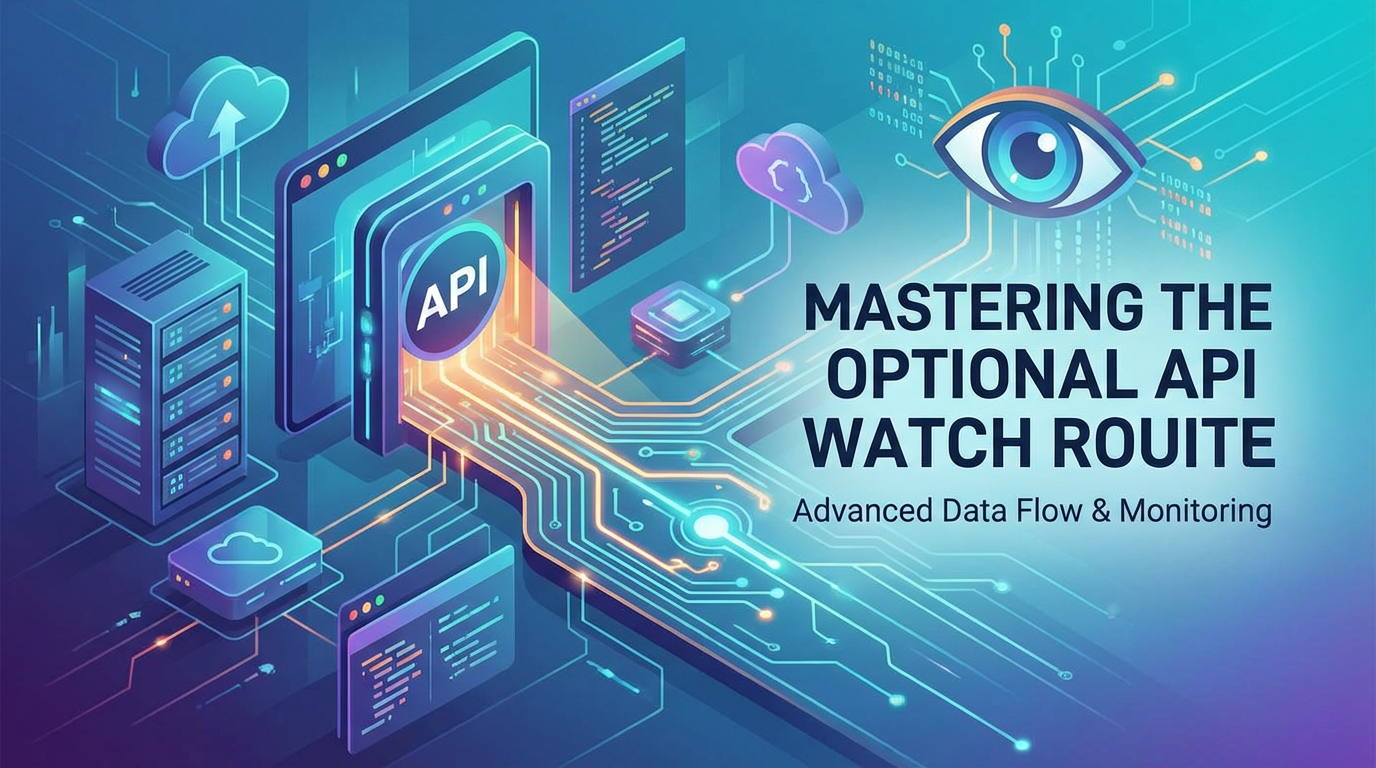
Mastering the Optional API Watch Route


In the sprawling and dynamic landscape of modern software architecture, the ability to react to changes in real-time or near real-time has transitioned from a niche feature to a fundamental expectation. Users demand instant updates, collaborative platforms thrive on immediate synchronization, and monitoring systems require continuous streams of data to maintain operational awareness. At the heart of delivering these reactive experiences lies the strategic design and implementation of application programming interfaces, or APIs. While traditional request-response APIs serve as the backbone for most interactions, scenarios demanding continuous data flow necessitate more sophisticated patterns. Among these, the concept of an "optional API watch route" emerges as a powerful and flexible solution, allowing clients to opt-in to a stream of updates rather than relentlessly polling for changes.
This article delves deep into the intricacies of mastering the optional API watch route. We will meticulously explore the foundational principles that underpin these reactive API designs, dissecting the various architectural patterns and technologies that facilitate their implementation. From understanding the critical "optional" dimension that empowers client choice and optimizes server resources, to meticulously designing OpenAPI specifications that accurately represent these dynamic interfaces, and navigating the complexities of security and scalability with an api gateway, we will cover every facet. Our journey aims to equip developers, architects, and product managers with the comprehensive knowledge required to build robust, efficient, and user-centric systems that thrive on immediate data availability, while also highlighting how platforms like ApiPark can streamline the management of such advanced API paradigms.
Understanding the Core Concept: API Watch Routes and Their "Optional" Nature
At its core, an API watch route represents a mechanism where a client can subscribe to receive updates or notifications about changes to a particular resource or data stream, rather than repeatedly querying the server. This stands in stark contrast to the conventional polling model, where a client periodically sends requests to an API endpoint, hoping to find new information. While polling is simple to implement for infrequent updates, it introduces inherent inefficiencies: unnecessary network traffic, potential for stale data between polls, and increased load on the server for redundant requests. A watch route, by contrast, establishes a more efficient and responsive channel, pushing data to the client only when relevant changes occur.
The "optional" aspect of these watch routes is crucial and represents a sophisticated design choice that prioritizes flexibility, resource optimization, and client autonomy. Instead of forcing all API consumers into a streaming model, which might be overkill for some applications or lead to resource contention, an optional watch route provides clients with the choice. A client might decide to utilize the watch route if real-time updates are critical for its functionality, such as a live dashboard or a chat application. Conversely, a less demanding client, perhaps one that only needs to refresh data every few minutes, can stick to traditional polling or one-off fetches, conserving both client and server resources. This optionality is typically implemented through specific query parameters, HTTP headers, or by offering distinct endpoints for "fetch" versus "watch" operations. This nuanced approach allows API providers to cater to a diverse range of client needs without imposing a one-size-fits-all solution, leading to more resilient and adaptable API ecosystems.
The underlying technologies that power these watch routes vary, each with its own strengths and weaknesses. Long polling mimics a real-time connection using standard HTTP by holding a request open until an event occurs or a timeout is reached. Server-Sent Events (SSE) provide a simpler, unidirectional stream of text-based updates over a single HTTP connection, ideal for server-to-client notifications. WebSockets, on the other hand, establish a full-duplex, persistent connection, enabling low-latency, bidirectional communication, making them suitable for highly interactive and data-intensive applications. The choice between these depends on factors like the directionality of data flow, the required latency, the complexity of implementation, and the nature of the data being transmitted. Regardless of the underlying protocol, the fundamental goal remains the same: to transition from a reactive model initiated by the client's constant inquiries to a proactive model where the server efficiently pushes relevant information when it becomes available, thereby enhancing the overall user experience and system efficiency.
The "Optional" Aspect: Why It Matters for Scalability, Security, and Client Autonomy
The designation of an API watch route as "optional" is far more than a mere syntactic choice; it's a strategic decision that profoundly impacts the scalability, security, and overall usability of an API ecosystem. This fundamental design principle empowers both the API provider and the consumer with greater control, leading to more robust and adaptable systems. Understanding the multifaceted implications of this optionality is paramount for any architect or developer embarking on building reactive APIs.
Client-Side Control and Resource Optimization
The primary benefit of an optional watch route lies in giving clients the autonomy to choose their preferred data consumption pattern. A client application might indicate its desire for a watch through various mechanisms. A common approach is a query parameter, such as GET /resource?watch=true. Alternatively, custom HTTP headers like X-Watch: true or Prefer: return=representation; realtime can convey this intent. For more distinct separation, some APIs might offer entirely separate endpoints, for example, /resource for a one-off fetch and /resource/stream for continuous updates. This explicit choice allows clients to align their data retrieval strategy with their actual requirements. An application displaying a critical real-time stock ticker will undoubtedly opt for the watch route, while a simple administrative panel that refreshes data every few minutes can stick to traditional polling, thereby reducing its resource footprint.
This client-side control directly translates into significant resource optimization. Maintaining persistent connections for watch routes is inherently more resource-intensive on the server side than handling ephemeral, request-response cycles. Each open connection consumes memory, file descriptors, and CPU cycles. If every client, regardless of its need for real-time data, were forced onto a watch route, the server could quickly become overwhelmed, leading to degraded performance or even system failure. By making the watch route optional, the API provider can ensure that only clients genuinely requiring real-time updates incur this overhead, allowing for more efficient allocation of server resources. This also empowers clients to manage their own resource consumption, preventing their applications from being unnecessarily burdened with continuous data streams when simpler methods suffice.
Server-Side Load Management and Scalability
The implications for server-side resource management and scalability are profound. A server implementing watch routes must be designed to efficiently manage numerous long-lived connections. This often necessitates asynchronous I/O models, event-driven architectures, and potentially specialized infrastructure components. Without the "optional" aspect, the server would always have to provision for peak real-time demand, even if only a fraction of clients truly need it. This can lead to over-provisioning and increased operational costs.
When watch routes are optional, the api gateway or the backend service can dynamically adapt its resource allocation. It might employ connection pooling strategies, intelligent load balancing, and auto-scaling mechanisms that differentiate between stateless request-response traffic and stateful, persistent watch connections. For example, an api gateway like APIPark can play a crucial role here, offering robust traffic management capabilities that can intelligently route and manage diverse API traffic, including the more demanding, long-lived connections characteristic of watch routes. Its ability to handle high TPS (Transactions Per Second) and support cluster deployment means it can effectively scale to meet the demands of a mix of traditional and real-time API consumption patterns. This allows architects to build a more granular and cost-effective scaling strategy, expanding resources for the watch functionality only as needed, rather than globally.
Security Implications and Mitigations
The introduction of long-lived connections for watch routes also introduces a new set of security considerations that must be carefully addressed. Persistent connections can be exploited in denial-of-service (DDoS) attacks, where malicious actors attempt to overwhelm the server by opening a large number of connections and holding them open, exhausting server resources. Authentication and authorization for persistent connections also require careful thought. Traditional short-lived request-response APIs can re-authenticate with each request, but for a watch route, the initial authentication must establish a long-lived session that securely authorizes subsequent pushes.
The "optional" nature indirectly contributes to security by limiting the attack surface. If fewer clients are utilizing persistent connections, the overall exposure to connection-based DDoS attacks is reduced. Furthermore, robust api gateways, such as APIPark, provide crucial security features like API access approval workflows, detailed logging, and performance monitoring. These features become indispensable for watch routes, allowing administrators to control who can subscribe to real-time updates, track connection activity, identify unusual patterns, and quickly troubleshoot any security incidents. Token expiration and refresh mechanisms for long-lived sessions also need to be carefully designed to balance security with user convenience, potentially leveraging periodic re-authentication or token refreshing without breaking the stream.
Enhanced User Experience and Developer Flexibility
Finally, offering optional watch routes significantly enhances both the end-user experience and developer flexibility. For end-users, it means applications can be designed to be truly reactive, providing immediate feedback and synchronization without perceptible delays. For developers, it means they can build more sophisticated features that rely on real-time data, knowing that the API provides a reliable and efficient mechanism for its delivery. This flexibility allows developers to choose the most appropriate API consumption pattern for their specific use case, leading to more efficient, responsive, and ultimately more successful applications. The optionality fosters an ecosystem where APIs are not just data providers, but dynamic interfaces that adapt to diverse application needs and resource constraints.
Architectural Patterns and Technologies for Watch Routes
The implementation of API watch routes is not monolithic; it leverages a variety of architectural patterns and underlying technologies, each suited for different use cases, scales, and implementation complexities. The choice of technology significantly impacts the performance, scalability, and maintainability of the real-time functionality. Understanding these options is critical for designing an effective optional watch route.
1. Long Polling
Long polling is perhaps the simplest mechanism to achieve near real-time updates using standard HTTP. It operates by having the client make a regular HTTP request, but instead of the server responding immediately with data (or an empty set), the server holds the request open until new data becomes available or a predefined timeout period elapses. Once data is available (or the timeout is reached), the server sends a response, and the client immediately initiates a new long polling request.
Mechanism: * Client sends an HTTP GET request to a specific endpoint (e.g., /resource/updates). * Server receives the request and, if no new data is available, keeps the connection open. * When new data arrives, the server responds to the pending request with the data. * Client receives the data and immediately sends another request to restart the cycle. * If a timeout occurs before data is available, the server responds with an empty payload or a specific status code, and the client re-initiates the request.
Pros: * Simple Implementation: It relies entirely on standard HTTP request/response cycles, making it compatible with virtually all existing api infrastructure and requiring minimal changes to firewalls or proxies. * Broad Compatibility: Works across all browsers and client environments without special libraries. * Leverages Existing Security: Standard HTTP authentication and authorization mechanisms apply directly.
Cons: * Latency: While better than short polling, there's still inherent latency as new requests must be initiated after each response. * Connection Overhead: Each client maintains an open HTTP connection, which can consume significant server resources if the number of concurrent clients is very high. It's not a truly persistent connection like WebSockets, but rather a sequence of long-held connections. * Complexity in State Management: Ensuring the client doesn't miss updates between requests, especially during re-connections or network glitches, requires careful client-side state management. * Bidirectional limitations: While technically the client can send data in the body of its polling request, it's primarily designed for server-to-client updates.
2. Server-Sent Events (SSE)
Server-Sent Events provide a more efficient and elegant solution for unidirectional (server-to-client) streaming of text-based event data over a single, persistent HTTP connection. It's particularly well-suited for scenarios where the server continuously pushes updates to the client, such as news feeds, stock tickers, or real-time logging.
Mechanism: * Client makes a single HTTP GET request to an SSE endpoint, typically with an Accept: text/event-stream header. * Server responds with a Content-Type: text/event-stream header and keeps the connection open. * The server then continuously sends data to the client in a specific format (lines starting with data:, event:, id:, retry:). * The client's browser or EventSource API automatically handles parsing these messages and can even manage automatic re-connection in case of network interruptions.
Pros: * Simplicity: Simpler to implement than WebSockets for server-to-client communication. The EventSource API in browsers handles much of the complexity, including re-connection logic. * Efficient Unidirectional Data: Optimal for scenarios where the server is the primary source of updates. * HTTP/2 Multiplexing: Benefits from HTTP/2's ability to multiplex multiple streams over a single TCP connection, reducing overhead. * Automatic Reconnection: The browser's EventSource API automatically attempts to reconnect if the connection is dropped.
Cons: * Unidirectional: Only allows data flow from server to client. For bidirectional communication, WebSockets are required. * Text-Based: Primarily designed for sending text data. While JSON can be sent within the data field, it's not as flexible as WebSocket frames for binary data. * Browser Support: While widely supported, older browsers or non-browser environments might require polyfills or custom implementations.
3. WebSockets
WebSockets provide a full-duplex, persistent communication channel over a single TCP connection, initiated through an HTTP handshake. They are the go-to solution for applications requiring low-latency, real-time, bidirectional data exchange, such as online gaming, chat applications, and collaborative tools.
Mechanism: * Client sends an HTTP GET request with an Upgrade: websocket header to the server. * Server acknowledges the upgrade request, and if successful, both parties switch from HTTP to the WebSocket protocol. * A persistent, full-duplex connection is established. * Both client and server can send data (frames) to each other at any time without initiating new requests, minimizing overhead.
Pros: * Full-Duplex: Allows simultaneous bidirectional communication, essential for interactive applications. * Low Latency: Once the connection is established, data frames are sent with minimal overhead, leading to very low latency. * Efficient for High-Frequency Updates: Ideal for applications requiring frequent, small data exchanges. * Supports Binary Data: Can efficiently transmit both text and binary data.
Cons: * More Complex Implementation: Requires dedicated server-side WebSocket libraries and client-side WebSocket API handling, including managing connection state, heartbeats, and graceful shutdowns. * Infrastructure Considerations: May require specific api gateway or load balancer configurations to correctly handle WebSocket persistent connections, as traditional HTTP load balancers might not be suitable. * Firewall/Proxy Challenges: While most modern firewalls and proxies support WebSockets, older ones might block the upgrade handshake or interfere with long-lived connections.
Hybrid Approaches
Often, the most robust and flexible API designs will employ a hybrid approach, combining these patterns based on specific needs. For instance: * Use WebSockets for critical, highly interactive features (e.g., collaborative editing). * Use SSE for general, less critical server-to-client notifications (e.g., system alerts). * Retain traditional polling or one-off fetches for legacy clients or very infrequent data updates.
This layered approach allows the API to cater to diverse client requirements and optimize resource usage across the spectrum of real-time needs.
Leveraging Message Queues/Event Streams
Regardless of the chosen communication protocol (long polling, SSE, or WebSockets), the backend architecture often benefits immensely from decoupling the data source from the push mechanism using message queues or event streams. Technologies like Kafka, RabbitMQ, Redis Pub/Sub, or AWS Kinesis/SQS allow services to publish events without direct knowledge of the clients consuming them.
Role in Watch Routes: * Decoupling: A service can publish a "resource updated" event to a message queue. * Event Fan-out: A separate "watch service" or "WebSocket server" subscribes to this queue. * Client Notification: When the watch service receives an event, it looks up all connected clients that are "watching" that resource and pushes the update using their chosen protocol (SSE, WebSocket, or by triggering a long poll response).
This architecture enhances scalability, resilience, and maintainability. The core business logic doesn't need to know about WebSocket connections, and the watch service can scale independently.
The Role of an API Gateway
An api gateway is indispensable in managing these diverse API patterns, especially when dealing with the complexities of watch routes. An api gateway sits between clients and backend services, providing a single entry point for all API requests.
Functions relevant to Watch Routes: * Unified Endpoint: Presents a consistent API interface to clients, abstracting away the different backend services or protocols. * Load Balancing: Distributes client connections across multiple watch service instances to ensure high availability and scalability. For stateful connections like WebSockets, sticky sessions might be required. * Authentication and Authorization: Centralizes security, ensuring that only authenticated and authorized clients can establish watch connections or receive updates. This is critical for preventing unauthorized access to real-time data streams. * Rate Limiting: Prevents abuse by limiting the number of watch connections or the frequency of updates a client can receive, even for persistent connections. * Traffic Management: Can manage protocol upgrades (e.g., HTTP to WebSocket), route traffic based on watch=true parameters, and apply policies dynamically. * Observability: Provides centralized logging, monitoring, and analytics for all API traffic, including watch routes, which is essential for troubleshooting and performance analysis. An api gateway like APIPark, with its detailed API call logging and powerful data analysis features, is particularly well-suited for managing and monitoring the intricate traffic patterns generated by watch routes. It can record every detail of API calls, track long-term trends, and help businesses with preventive maintenance, ensuring system stability and data security even with complex streaming APIs. Its performance rivalry with Nginx suggests it can handle the high demands of persistent connections efficiently.
By strategically choosing and integrating these patterns and technologies, guided by a robust api gateway, developers can effectively implement optional API watch routes that are both powerful and manageable.
Designing an OpenAPI Specification for Watch Routes
The OpenAPI Specification (OAS), formerly known as Swagger, is the de facto standard for describing, producing, consuming, and visualizing RESTful APIs. Its importance cannot be overstated: it provides a machine-readable format for API definitions, enabling automated documentation, client and server code generation, and powerful testing tools. However, documenting API watch routes, especially those involving streaming or persistent connections, presents unique challenges that require careful consideration within the OpenAPI framework. While OAS excels at describing traditional request-response APIs, its capabilities for streaming protocols have evolved, particularly with versions 3.0 and 3.1.
The Importance of OpenAPI for Reactive APIs
For watch routes, OpenAPI offers several critical benefits: 1. Clear Communication: It provides an unambiguous contract between the API producer and consumer, detailing how to initiate a watch, what parameters are available, and what kind of data to expect. This is especially vital for streaming APIs where the interaction pattern deviates from standard HTTP. 2. Discoverability: Clients can easily discover the availability of a watch route and understand its specific requirements without diving into source code or extensive manual documentation. 3. Code Generation: Tools can automatically generate client SDKs that correctly handle the event stream or WebSocket handshake, significantly accelerating development. 4. Consistency: Ensures that different parts of a large system or different teams adhere to the same API design patterns for real-time data. 5. Testing and Validation: Automated testing frameworks can leverage the OpenAPI specification to validate that the watch route behaves as expected.
Documenting Watch Endpoints in OpenAPI
The key to documenting optional watch routes effectively in OpenAPI lies in accurately representing the conditional nature of the "watch" operation and the distinct response formats associated with streaming.
1. Describing Optional Parameters for Watch Initiation
If the watch functionality is enabled via a query parameter or HTTP header on an existing endpoint, this needs to be clearly specified:
paths:
  /resources/{id}:
    get:
      summary: Retrieve or watch a specific resource
      parameters:
        - name: id
          in: path
          required: true
          schema:
            type: string
          description: Unique identifier of the resource.
        - name: watch
          in: query
          required: false
          schema:
            type: boolean
            default: false
          description: >
            Set to true to establish a watch route for real-time updates.
            If true, the response will be a continuous stream of events.
            If false or omitted, a single snapshot of the resource is returned.
        - name: If-Modified-Since
          in: header
          required: false
          schema:
            type: string
            format: date-time
          description: |
            Conditional header for standard HTTP caching. If 'watch' is false,
            the server can respond with 304 Not Modified.

      responses:
        '200':
          description: >
            Returns either a snapshot of the resource (if watch=false)
            or a continuous stream of events (if watch=true).
          content:
            application/json:
              # Schema for the single snapshot response
              schema:
                $ref: '#/components/schemas/ResourceSnapshot'
            text/event-stream: # For SSE
              # Schema for the individual events within the stream
              schema:
                type: object
                properties:
                  event:
                    type: string
                    description: The type of event (e.g., 'update', 'delete').
                  data:
                    $ref: '#/components/schemas/ResourceUpdateEvent'
                    description: The updated resource data.
                  id:
                    type: string
                    description: A unique ID for this event.
              examples:
                resourceUpdate:
                  value:
                    event: "update"
                    data:
                      id: "res123"
                      status: "processing"
                      timestamp: "2023-10-27T10:00:00Z"
            application/octet-stream: # Potentially for WebSockets if raw frames are described
              description: >
                Raw WebSocket frames. Note: OpenAPI's explicit description of WebSocket frames
                is limited; this is a placeholder. More typically, you would describe the
                message schemas exchanged over the WebSocket protocol separately.

        '400':
          description: Bad request, e.g., invalid 'watch' parameter value.
        '401':
          description: Unauthorized.
        '404':
          description: Resource not found.

components:
  schemas:
    ResourceSnapshot:
      type: object
      properties:
        id:
          type: string
        name:
          type: string
        status:
          type: string
        lastModified:
          type: string
          format: date-time
    ResourceUpdateEvent:
      type: object
      properties:
        id:
          type: string
        status:
          type: string
        # ... other fields that might change ...
        timestamp:
          type: string
          format: date-time
In this example, the watch query parameter conditionally changes the behavior of the /resources/{id} GET endpoint. The responses section uses multiple media types to describe the different possible outputs: application/json for the snapshot, and text/event-stream for Server-Sent Events.
2. Dedicated Watch Endpoints
If the watch route has a distinct endpoint, the OpenAPI definition becomes clearer:
paths:
  /resources/{id}:
    get:
      summary: Retrieve a specific resource snapshot
      parameters:
        - name: id
          in: path
          required: true
          schema: { type: string }
      responses:
        '200':
          description: A single snapshot of the resource.
          content:
            application/json:
              schema: { $ref: '#/components/schemas/ResourceSnapshot' }

  /resources/{id}/watch:
    get:
      summary: Watch real-time updates for a specific resource
      parameters:
        - name: id
          in: path
          required: true
          schema: { type: string }
      responses:
        '200':
          description: A continuous stream of resource update events.
          content:
            text/event-stream: # For SSE
              schema:
                type: object
                properties:
                  event: { type: string }
                  data: { $ref: '#/components/schemas/ResourceUpdateEvent' }
                  id: { type: string }
            # For WebSockets, this is more complex.
            # OpenAPI 3.1 introduces 'webhooks' and 'callbacks' for better event-driven descriptions.
            # For a pure WebSocket endpoint, you might describe the initial HTTP upgrade
            # and then point to an external document or section describing the WebSocket message protocol.
3. Handling WebSockets in OpenAPI
Documenting WebSockets directly within OpenAPI is more challenging than SSE or long polling because WebSockets establish an entirely different protocol after an initial HTTP handshake. OpenAPI 3.0/3.1 doesn't have a first-class citizen type for a WebSocket endpoint as it does for HTTP methods.
- Initial Handshake: You can describe the initial HTTP
GETrequest that initiates the WebSocket upgrade (withUpgradeandConnectionheaders). - External Documentation: For the actual WebSocket message exchange (the frames, their types, and schemas), it's often best to refer to external documentation, or use
OpenAPI'sdescriptionfield to provide a link or summary. webhooksandcallbacks(OpenAPI 3.1): While not precisely forAPIwatch routes in the sense of client-initiated persistent streams,OpenAPI3.1 introducedwebhooksandcallbackswhich can describe outbound messages from the server. This is more geared towards event-drivenAPIs where the server pushes events to a client-provided URL (webhooks) or as a response to an initial request (callbacks). While not a perfect fit for a client-initiated WebSocket, it highlights the specification's movement towards better support for asynchronous interactions.
paths:
  /resources/{id}/socket:
    get:
      summary: Establish a WebSocket connection for real-time resource updates
      parameters:
        - name: id
          in: path
          required: true
          schema: { type: string }
      responses:
        '101': # Switching Protocols
          description: >
            Successfully upgraded to WebSocket protocol.
            Further details on the WebSocket message protocol (incoming and outgoing frames)
            can be found in our [WebSocket Protocol Documentation](link-to-separate-docs.md).
          headers:
            Upgrade:
              schema: { type: string, enum: [websocket] }
            Connection:
              schema: { type: string, enum: [Upgrade] }
            Sec-WebSocket-Accept:
              schema: { type: string }
        '400':
          description: Bad request or upgrade failed.
The key here is to clearly state the initial HTTP part and then guide the developer to where the actual WebSocket message schema is defined.
4. Defining Streaming Media Types
OpenAPI 3.0 and later versions allow for flexible media type definitions. For SSE, text/event-stream is the standard. For long polling, it will typically be application/json, but the structure might include an array of events or a lastUpdated timestamp to help the client manage state.
Challenges and Future Directions in OpenAPI for Streaming
- Formalizing Streaming: While
OpenAPIhas improved, a truly first-class, standardized way to describe full-duplex WebSocket protocols, including message formats for both directions and connection lifecycle events, is still an area of evolution. - Asynchronous
APIs: Specifications like AsyncAPI are emerging to specifically address event-driven, message-based architectures, which often complement or underlieAPIwatch routes. In complex systems, usingOpenAPIfor the synchronousRESTful APIs and AsyncAPI for the asynchronous watch routes might be the most comprehensive approach. - Tooling Support: The effectiveness of
OpenAPIfor streamingAPIs also depends on tooling support. While manyOpenAPIgenerators can handletext/event-stream, WebSocket client generation requires more specialized capabilities.
By carefully structuring OpenAPI specifications, leveraging existing features for conditional responses and appropriate media types, and providing clear supplementary documentation where the specification is less expressive, developers can ensure their optional API watch routes are well-defined, discoverable, and easy for consumers to integrate. This meticulous documentation is a cornerstone of a well-governed API landscape, a principle that platforms like APIPark champion by offering end-to-end API lifecycle management and a centralized portal for API discovery and usage.
APIPark is a high-performance AI gateway that allows you to securely access the most comprehensive LLM APIs globally on the APIPark platform, including OpenAI, Anthropic, Mistral, Llama2, Google Gemini, and more.Try APIPark now! 👇👇👇
Implementation Best Practices and Considerations
Building a robust, scalable, and secure optional API watch route requires more than just choosing the right technology; it demands careful attention to implementation details, operational concerns, and client-side integration. Adhering to best practices in these areas ensures that the reactive capabilities deliver on their promise without introducing undue complexity or fragility into the system.
1. Error Handling and Resilience
Real-time systems, by their nature, are susceptible to network instability, server restarts, and transient failures. Robust error handling and resilience mechanisms are paramount.
- Client-Side Reconnection Strategies: Clients watching an
APIshould implement exponential backoff and jitter for reconnection attempts. This prevents a "thundering herd" problem where all disconnected clients attempt to reconnect simultaneously after a server restart or network outage. Randomizing delays (jitter) spreads out the reconnection attempts, reducing the load on the server. - Server-Side Graceful Shutdown: Watch servers must implement graceful shutdown procedures. This means allowing existing connections to complete their current data push or cleanly closing them, rather than abruptly terminating. Notifications can be sent to clients before shutdown, signaling them to reconnect.
- Heartbeats/Keepalives: For long-lived connections (especially WebSockets), both client and server should periodically send lightweight "heartbeat" messages to ensure the connection is still alive and to prevent proxies or load balancers from terminating idle connections. If a heartbeat is missed, it indicates a broken connection, prompting a reconnection attempt.
- Idempotency and Sequence IDs: For scenarios where updates must not be missed or duplicated, stream messages should include sequence IDs or version numbers. Clients can use these to detect gaps in the stream (requiring a full resync) or to filter out duplicate messages received during reconnection. The server must be able to resume a stream from a given sequence ID or timestamp.
2. Security for Persistent Connections
The extended duration of watch connections introduces distinct security challenges compared to short-lived HTTP requests.
- Authentication and Authorization:
- Initial Handshake: The initial connection (e.g., HTTP request for SSE/long poll, or WebSocket handshake) must be fully authenticated and authorized. This typically involves standard token-based authentication (JWTs) or session cookies.
- Long-Lived Tokens: For persistent connections, the authentication token needs to remain valid for the duration of the connection. Strategies include using longer-lived tokens specifically for watch routes, or implementing token refreshing mechanisms where the client can periodically renew its token without dropping the connection. An
api gatewaylike APIPark can centralize this, ensuring that all watch route attempts are subjected to the same robust authentication and authorization policies as otherAPIs. Its "API resource access requires approval" feature is particularly valuable here, ensuring only authorized callers can subscribe to streams. - Permissions Granularity: Authorization must be granular. A user might have permission to view a resource but not to receive real-time updates for sensitive sub-fields. The watch route implementation must filter data pushed to clients based on their specific permissions.
- Rate Limiting: Even for watch routes, rate limiting is essential. This can include:
- Limiting the number of concurrent watch connections per user or IP address.
- Throttling the rate at which a server pushes updates to a single client if that client is consuming excessive resources.
- Detecting and mitigating "fast reconnect" loops as a form of DDoS.
- Data Encryption (TLS/SSL): All watch routes must be secured using TLS/SSL (HTTPS for HTTP-based watch routes,
wss://for WebSockets) to prevent eavesdropping and tampering. - Origin Validation: For WebSockets and SSE, validating the
Originheader can help prevent cross-site WebSocket hijacking (CSRF-like attacks).
3. Scalability and High Availability
Designing watch routes for scale requires careful architectural choices to handle a potentially large number of concurrent, long-lived connections.
- Horizontal Scaling: Watch servers should be stateless or near-stateless where possible, allowing them to be easily scaled horizontally across multiple instances. When state is required (e.g., tracking which clients are watching which resource), this state should be externalized to a highly available, distributed data store (e.g., Redis, Cassandra).
- Load Balancing:
- For long polling and SSE, standard HTTP load balancers can work, but for WebSockets, load balancers must support the
Upgradeheader and often require "sticky sessions" to ensure a client's subsequent WebSocket frames are routed to the same server instance. - An intelligent
api gatewayis crucial here. APIPark's performance and cluster deployment capabilities make it an ideal choice for distributing load across watch servers, ensuring high availability and resilience.
- For long polling and SSE, standard HTTP load balancers can work, but for WebSockets, load balancers must support the
- Message Queues/Event Buses: As discussed, using a robust message queue (Kafka, RabbitMQ, Redis Pub/Sub) as an intermediary between the event source and the watch servers is a best practice. This decouples the event producers from the event consumers, allowing independent scaling and improving fault tolerance.
- Connection Management Libraries: Utilize established libraries for WebSocket/SSE servers (e.g.,
wsfor Node.js, Spring WebFlux for Java,websocketsfor Python) that are optimized for high concurrency and efficient I/O. - Cloud Services: Leverage managed cloud services designed for real-time communication, such as AWS AppSync (GraphQL subscriptions), Google Cloud Pub/Sub, Azure SignalR Service, or Pusher, which abstract away much of the infrastructure complexity.
4. Performance Optimization
Minimizing latency and maximizing throughput are key goals for watch routes.
- Efficient Data Serialization: While JSON is ubiquitous, consider more compact binary serialization formats like Protocol Buffers (Protobufs) or MessagePack for high-volume, low-latency streams. These can significantly reduce payload size and parsing overhead.
- Data Payload Minimization: Only send the data that has changed or is absolutely necessary. Avoid sending the entire resource if only a small part was updated. Implement "diff"ing or "patch" updates.
- Throttling and Debouncing: Prevent overwhelming clients with too many updates. Implement server-side throttling to limit the frequency of pushes or debounce rapidly occurring events into a single, consolidated update.
- Connection Pooling and Re-use: For internal server-to-server communication related to watch routes (e.g., retrieving data from microservices), efficient connection pooling can reduce overhead.
5. Client-Side Implementation
The client-side counterpart of an API watch route is equally critical for a seamless user experience.
- Browser APIs: Utilize native browser APIs like
EventSourcefor SSE andWebSocketfor WebSockets. These are optimized for performance and handle many low-level details. - Client Libraries: For more complex scenarios, consider client-side libraries that abstract away reconnection logic, message parsing, and state management (e.g.,
socket.iofor WebSockets, or custom frameworks built onEventSource). - UI Updates: Efficiently update the user interface without causing performance bottlenecks. Use virtualized lists for large datasets and ensure UI updates are batched or debounced to prevent "jank."
- State Management: Clients need robust state management to integrate real-time updates seamlessly with their existing data. This might involve Redux-like stores, GraphQL caches, or reactive programming frameworks.
By thoughtfully implementing these best practices, developers can create optional API watch routes that are not only powerful in their real-time capabilities but also resilient, secure, performant, and easy to maintain and scale. This disciplined approach is what separates a mere reactive feature from a truly masterfully engineered component of a modern API ecosystem.
APIPark: Unifying API Management for Reactive Architectures
In the complex world of APIs, particularly when venturing into advanced patterns like optional watch routes, the underlying infrastructure that manages, secures, and optimizes these interfaces becomes paramount. This is where an advanced api gateway and management platform like ApiPark truly shines, offering a comprehensive solution that simplifies the entire API lifecycle. For organizations embracing reactive architectures, APIPark serves as an indispensable tool, seamlessly integrating various API types and ensuring their efficient and secure operation.
APIPark is more than just an api gateway; it's an open-source AI gateway and API management platform designed to cater to the diverse needs of modern enterprises, from integrating hundreds of AI models to orchestrating complex REST services. When considering optional API watch routes, APIPark's capabilities directly address many of the challenges associated with their implementation and management.
Firstly, APIPark's end-to-end API lifecycle management is a critical asset. Designing watch routes involves careful planning from inception to deprecation. APIPark assists in regulating API management processes, ensuring that new watch routes are properly designed, published, invoked, and eventually decommissioned. This structured approach helps maintain consistency and prevents the proliferation of unmanaged or poorly documented real-time APIs, which can quickly become a technical debt burden.
The platform's robust traffic forwarding, load balancing, and versioning features are essential for watch routes. As discussed, long-lived connections require specialized load balancing strategies to ensure scalability and high availability. APIPark, with its performance rivaling Nginx (achieving over 20,000 TPS on modest hardware and supporting cluster deployment), can effectively manage the increased traffic and persistent connections generated by watch routes. It can intelligently distribute these connections across multiple backend watch servers, ensuring that no single server becomes a bottleneck and that service remains uninterrupted even under heavy load. Its ability to manage API versions also means that evolving watch route schemas can be introduced seamlessly, allowing for controlled rollout and backward compatibility if needed.
Security is another area where APIPark provides significant value. Watch routes, due to their persistent nature, introduce unique security vulnerabilities. APIPark's API resource access requires approval feature directly addresses this by allowing administrators to mandate subscriptions and approvals before a client can invoke an API, including establishing a watch connection. This prevents unauthorized calls and potential data breaches, which is crucial when real-time sensitive information is being streamed. Coupled with independent API and access permissions for each tenant, APIPark enables fine-grained control over who can access what data streams, crucial for multi-tenant applications or large organizations with multiple teams.
Furthermore, APIPark's detailed API call logging and powerful data analysis features are invaluable for monitoring the health and performance of watch routes. Every detail of each API call is recorded, allowing businesses to quickly trace and troubleshoot issues in real-time streams, ensuring system stability and data security. The platform's ability to analyze historical call data and display long-term trends allows for proactive maintenance, helping to identify potential bottlenecks or performance degradation in watch routes before they impact users. This level of observability is critical for maintaining the reliability and responsiveness that reactive APIs promise.
Finally, for organizations also integrating AI capabilities, APIPark’s specialization as an AI gateway, offering quick integration of 100+ AI models and a unified API format for AI invocation, provides a holistic management solution. This means that both traditional REST APIs and advanced real-time AI service APIs can be managed under a single, cohesive platform, streamlining operations and reducing complexity.
In essence, APIPark empowers developers and architects to confidently deploy and manage sophisticated API patterns like optional watch routes. By centralizing management, bolstering security, ensuring performance, and providing deep observability, it allows teams to focus on building innovative reactive features, knowing that the underlying API infrastructure is robust and well-governed.
Case Studies: Real-World Scenarios for Optional API Watch Routes
To truly appreciate the power and flexibility of optional API watch routes, let's explore a few real-world scenarios where this pattern proves indispensable, highlighting how the "optional" aspect provides critical adaptability.
Case Study 1: The High-Stakes World of Stock Trading Platforms
Scenario: Imagine a modern stock trading platform. Users need to see real-time price fluctuations, order book depth, and trade executions for thousands of financial instruments. However, not all users are high-frequency traders needing every millisecond update. Some might just want to monitor their portfolio every few minutes, while others are developing automated trading bots that require granular, low-latency data streams.
Implementation with Optional Watch Route: * Core Data: A backend service processes market data from exchanges, publishing price updates, order book changes, and trade confirmations to a Kafka topic or similar message broker. * Watch Route Endpoint: The API exposes an endpoint like /markets/{symbol}/stream that, when invoked with a WebSocket connection, streams real-time updates for a given stock symbol. * Optionality: * High-Frequency Traders/Bots: These clients would establish persistent WebSocket connections to /markets/{symbol}/stream for the specific symbols they are interested in. They benefit from low latency and continuous pushes, crucial for executing trades based on immediate market movements. * Portfolio Viewers: A user simply checking their portfolio every few minutes doesn't need a constant stream. Their client application might make a traditional GET /portfolio request every 30 seconds or even on-demand, fetching a snapshot of current values. This client doesn't incur the overhead of a persistent connection, conserving their device's battery and network bandwidth. * Charting Applications: Interactive charts might use Server-Sent Events (SSE) from /markets/{symbol}/chart-data-stream to receive periodic aggregate data (e.g., 1-second interval candles) that is sufficient for visual representation without the raw tick data volume of WebSockets.
Why "Optional" Matters Here: The optionality allows the platform to cater to a diverse user base with vastly different data consumption needs and performance requirements, all while optimizing server resources. A one-size-fits-all WebSocket stream would overwhelm casual users and consume unnecessary server bandwidth for them, while a polling-only approach would be unacceptable for professional traders.
Case Study 2: Collaborative Document Editing (e.g., Google Docs)
Scenario: A collaborative document editor allows multiple users to simultaneously edit the same document. As one user types, others must see the changes appear in real-time. This requires constant, bidirectional synchronization of document state and cursors.
Implementation with Optional Watch Route: * Core Data: Document changes (deltas), cursor positions, and presence information are managed by a real-time backend service that uses a publish/subscribe pattern internally. * Watch Route Endpoint: The API offers a WebSocket endpoint, GET /documents/{docId}/collaborate, for establishing a full-duplex communication channel. * Optionality: * Active Collaborators: Users actively editing the document will establish a WebSocket connection. They send their own changes to the server and receive changes from other collaborators (document deltas, cursor updates) in real-time. The bidirectional nature of WebSockets is critical here. * View-Only Access/History: A user who simply wants to view the document without editing, or who wants to see the version history, might make a single GET /documents/{docId} request to fetch the current state, or GET /documents/{docId}/history to retrieve past versions. They don't need a persistent stream of every keystroke. * Offline Synchronization: An offline client might periodically GET /documents/{docId}?since={timestamp} to fetch all changes since its last sync, effectively using a long-polling-like mechanism in a batch fashion, then merging changes locally.
Why "Optional" Matters Here: The optionality allows the system to support a spectrum of interactions, from intense, real-time collaboration to passive viewing or deferred synchronization, without forcing every client into a high-resource WebSocket connection. This reduces the load on the real-time collaboration service for users who don't need it, improving overall scalability and responsiveness for those who do.
Case Study 3: IoT Device Monitoring Dashboard
Scenario: A central dashboard monitors the status and sensor readings of thousands of Internet of Things (IoT) devices deployed across various locations. Fleet managers need real-time alerts for critical events (e.g., device offline, temperature spikes), while maintenance teams might periodically pull a device's historical data for diagnostics.
Implementation with Optional Watch Route: * Core Data: IoT devices send telemetry and event data to a cloud-based IoT platform (e.g., AWS IoT Core, Azure IoT Hub), which then publishes these messages to an internal event stream. * Watch Route Endpoint: The API exposes an SSE endpoint, /devices/{deviceId}/status-stream, for general status updates, and potentially a WebSocket endpoint, /devices/{deviceId}/control, for bidirectional command-and-control. * Optionality: * Alerting Dashboard: A central monitoring dashboard that displays critical alerts and high-level device status for hundreds of devices will use SSE connections. The server pushes device_offline or temperature_threshold_exceeded events to the dashboard, which immediately updates. This provides efficient server-to-client notifications. * Device Configuration: A maintenance technician configuring a specific device might use a traditional PUT /devices/{deviceId}/config API call, which is a one-time request-response action. * Historical Data Analysis: For detailed diagnostics or trend analysis, a separate application might make a GET /devices/{deviceId}/history?start={time}&end={time} request to pull a batch of historical sensor readings from a data lake, rather than watching a live stream.
Why "Optional" Matters Here: The optionality caters to different operational roles and their specific data needs. Real-time alerts are crucial for operators, while detailed historical analysis is for engineers. By making the watch route optional, the system efficiently delivers critical real-time information to those who need it most, without unnecessarily burdening other applications or the backend with continuous data streams for use cases that only require periodic or historical data.
In each of these scenarios, the ability to offer an optional API watch route provides a layered approach to data delivery, optimizing resource usage, enhancing security, and significantly improving the overall utility and user experience of the application. It underscores that mastering the optional API watch route is about building smarter, more adaptable, and ultimately more effective API ecosystems.
Conclusion: Embracing the Future of Reactive APIs
The journey through the landscape of optional API watch routes reveals a sophisticated and indispensable pattern in modern software architecture. As user expectations for instant feedback and real-time synchronization continue to grow, the ability to move beyond traditional request-response APIs and embrace proactive, event-driven data delivery becomes a critical differentiator. Mastering the optional API watch route is not merely about implementing a specific technology; it's about making deliberate design choices that prioritize flexibility, resource efficiency, scalability, and security.
We've delved into the fundamental distinction between watch routes and conventional polling, highlighting how the "optional" dimension empowers clients with choice while optimizing server resources. From the simplicity of long polling and the unidirectional efficiency of Server-Sent Events to the full-duplex power of WebSockets, each architectural pattern offers unique advantages, demanding careful consideration based on the specific requirements of latency, data volume, and bidirectionality. The strategic utilization of an api gateway, such as ApiPark, emerges as a crucial enabler, centralizing management, bolstering security, and ensuring the performance and scalability necessary to handle the complex traffic patterns of persistent connections.
Furthermore, the importance of meticulously documenting these dynamic interfaces using OpenAPI cannot be overstated. A clear, machine-readable specification ensures discoverability, facilitates code generation, and establishes an unambiguous contract between API producers and consumers, paving the way for seamless integration and robust testing. Finally, a commitment to best practices in error handling, security, scalability, performance optimization, and client-side implementation forms the bedrock of any successful real-time API initiative, transforming potential pitfalls into opportunities for resilience and reliability.
As APIs continue to evolve as the primary interface for digital interaction, the principles of reactive design, embodied by the optional API watch route, will only become more central. By thoughtfully applying the concepts and strategies outlined in this extensive guide, developers and architects are well-equipped to build the next generation of applications that are not just functional, but truly instantaneous, collaborative, and intelligent. The future of APIs is undoubtedly reactive, and mastering these advanced patterns is key to unlocking their full potential.
Comparative Overview of Real-time API Watch Route Technologies
Choosing the right technology for an API watch route is a critical decision that impacts implementation complexity, scalability, and performance. This table provides a concise comparison of the three primary patterns discussed: Long Polling, Server-Sent Events (SSE), and WebSockets, highlighting their key characteristics, advantages, and disadvantages. This overview will assist in making an informed decision based on specific project requirements, considering factors such as data flow directionality, protocol overhead, and browser compatibility.
| Feature / Technology | Long Polling | Server-Sent Events (SSE) | WebSockets |
|---|---|---|---|
| Protocol Base | HTTP (standard request/response, but connection held open) | HTTP (single, persistent HTTP connection) | WebSocket Protocol (full-duplex, persistent TCP connection after HTTP handshake) |
| Data Flow Direction | Unidirectional (server to client, client initiates requests) | Unidirectional (server to client only) | Bidirectional (full-duplex, client and server can send independently) |
| Connection Type | Series of long-held HTTP requests, then new request | Single, persistent HTTP connection | Single, persistent TCP connection |
| Data Format | Any HTTP response body (e.g., JSON, XML) | Text-based (specifically text/event-stream format) |
Text (JSON, XML) or Binary (Protobuf, MessagePack) |
| Overhead per Message | Relatively high (full HTTP request/response cycle) | Low (small event frames over persistent connection) | Very low (minimal frame overhead over persistent connection) |
| Latency | Moderate (latency due to request-response cycle and re-initiation) | Low (updates pushed immediately) | Very Low (updates pushed immediately with minimal protocol overhead) |
| Browser Support | Universal (standard HTTP) | Good (native EventSource API in modern browsers, polyfills for older ones) |
Good (native WebSocket API in modern browsers, polyfills for older ones) |
| Firewall/Proxy Compatibility | Excellent (standard HTTP traffic) | Good (standard HTTP traffic, but long-lived) | Requires WebSocket-aware proxies/gateways (most modern ones support it) |
| Automatic Reconnection | Must be implemented manually on client-side | Built-in via EventSource API |
Must be implemented manually on client-side (libraries can help) |
| Use Cases | Chat applications (older implementations), less frequent real-time updates, simple notification systems | News feeds, stock tickers, live sports scores, real-time logging, dashboards | Real-time chat, online gaming, collaborative editing, highly interactive applications, IoT command & control |
| Server Complexity | Low (standard HTTP server) | Moderate (requires streaming HTTP responses, event formatting) | High (requires dedicated WebSocket server or library, managing connection state) |
| API Gateway Implications | Standard HTTP routing, load balancing. | Standard HTTP routing, load balancing, but keep-alive settings crucial. | Requires WebSocket-aware gateway (e.g., Nginx, Envoy, APIPark) for upgrade handling, sticky sessions. |
This table provides a high-level overview. The best choice ultimately depends on the specific requirements of the application, including the volume and frequency of data, the need for bidirectional communication, and existing infrastructure constraints.
Frequently Asked Questions (FAQs)
Q1: What is an "optional API watch route," and how does it differ from traditional polling?
An "optional API watch route" is a design pattern where an API provides the capability for clients to subscribe to real-time updates for a specific resource, but also offers the option for clients to simply fetch a snapshot of the resource using traditional request-response methods. It differs from traditional polling in that instead of the client repeatedly asking the server if there are updates (which can be inefficient and latent), the server proactively "pushes" updates to the client only when relevant changes occur. The "optional" part means clients choose whether they need this real-time stream or if occasional data fetches suffice, allowing for resource optimization on both client and server sides.
Q2: When should I choose between Long Polling, Server-Sent Events (SSE), and WebSockets for my watch route?
The choice depends on your specific needs: * Long Polling: Simplest to implement, uses standard HTTP, and suitable for occasional, simple server-to-client updates where some latency is acceptable, and you want maximum compatibility with existing infrastructure. * Server-Sent Events (SSE): Best for efficient, unidirectional (server-to-client) streaming of text-based updates. It's simpler than WebSockets for this purpose, benefits from HTTP/2 multiplexing, and browsers handle reconnection automatically. Ideal for news feeds, stock tickers, or real-time dashboards. * WebSockets: The most powerful choice for full-duplex (bidirectional), low-latency, real-time communication. Essential for interactive applications like chat, online gaming, or collaborative editing where both client and server need to send data independently and frequently.
Q3: How does an API gateway like APIPark help manage API watch routes?
An api gateway such as ApiPark is crucial for managing API watch routes by centralizing several key functions: 1. Traffic Management & Load Balancing: It intelligently routes and distributes persistent connections (like WebSockets) across multiple backend services, ensuring scalability and high availability. 2. Security: It provides unified authentication and authorization, rate limiting, and access approval workflows, protecting long-lived connections from abuse and unauthorized access. 3. Observability: APIPark offers detailed API call logging and powerful data analytics, allowing monitoring of watch route performance, troubleshooting issues, and identifying trends. 4. Protocol Management: It can handle the intricacies of protocol upgrades (e.g., HTTP to WebSocket) and expose a consistent API interface to clients, abstracting backend complexities.
Q4: What are the key security considerations for implementing optional API watch routes?
Security for watch routes is critical due to their long-lived nature: * Robust Authentication/Authorization: Ensure the initial connection is fully authenticated, and the long-lived session maintains authorization. Implement token refreshing mechanisms without breaking the stream. * Granular Permissions: Filter the data pushed to clients based on their specific access permissions to prevent unauthorized data exposure. * Rate Limiting: Implement limits on concurrent connections and update frequency to prevent DDoS attacks and resource exhaustion. * TLS/SSL Encryption: Always use HTTPS (https:// or wss://) to encrypt data in transit and prevent eavesdropping and tampering. * Origin Validation: For WebSockets and SSE, validate the Origin header to mitigate cross-site hijacking attacks.
Q5: Can I document API watch routes using OpenAPI Specification? What are the limitations?
Yes, you can document API watch routes using OpenAPI Specification (OAS), but with some considerations: * Optional Parameters/Dedicated Endpoints: You can describe query parameters (e.g., ?watch=true) or dedicated endpoints (e.g., /resource/stream) that trigger watch behavior. * Media Types: For SSE, you can specify text/event-stream as a response content type. For long polling, application/json is common, often containing an array of events. * WebSockets: OAS primarily describes the initial HTTP handshake for a WebSocket connection (e.g., the Upgrade header). However, it does not natively provide a detailed way to describe the bidirectional message schemas (frames) exchanged over the WebSocket protocol itself. For this, you often refer to external documentation or consider using specialized specifications like AsyncAPI for a comprehensive event-driven description.
🚀You can securely and efficiently call the OpenAI API on APIPark in just two steps:
Step 1: Deploy the APIPark AI gateway in 5 minutes.
APIPark is developed based on Golang, offering strong product performance and low development and maintenance costs. You can deploy APIPark with a single command line.
curl -sSO https://download.apipark.com/install/quick-start.sh; bash quick-start.sh

In my experience, you can see the successful deployment interface within 5 to 10 minutes. Then, you can log in to APIPark using your account.

Step 2: Call the OpenAI API.