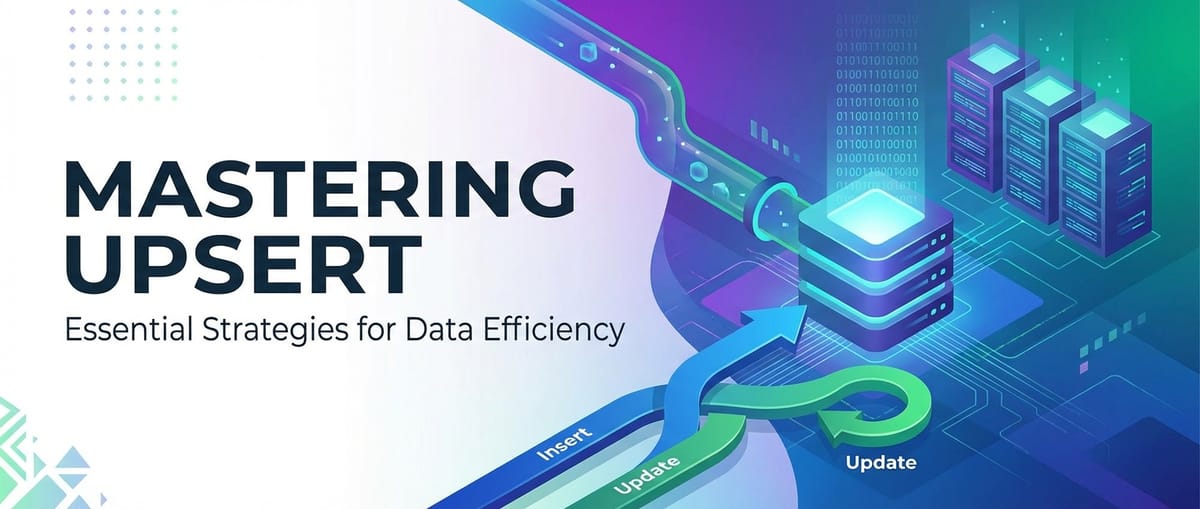
Mastering Upsert: Essential Strategies for Data Efficiency


In the intricate landscape of modern data management, where information flows ceaselessly and demands for real-time accuracy are paramount, the concept of "upsert" emerges as a cornerstone of efficiency. More than just a technical command, upsert represents a fundamental paradigm for handling data intelligently, allowing systems to either UPdate an existing record if it's found, or inSERT a new one if it isn't. This seemingly simple operation holds profound implications for data integrity, performance, and the seamless functioning of applications ranging from sophisticated enterprise resource planning (ERP) systems to dynamic real-time analytics platforms. Without a well-thought-out upsert strategy, organizations face the specter of data duplication, inconsistency, and significant performance bottlenecks, all of which erode trust and operational effectiveness.
The journey to mastering upsert begins with a deep understanding of its mechanisms at the database level, but quickly extends into the broader architectural considerations that govern how data enters and flows through an organization's ecosystem. In today's interconnected digital world, data rarely resides in isolated silos; it is frequently ingested, transformed, and propagated via Application Programming Interfaces (APIs). These APIs act as the crucial arteries of information exchange, making the interplay between upsert logic and robust API design an absolutely critical area of focus. Furthermore, with the rapid ascent of Artificial Intelligence (AI) and Large Language Models (LLMs), the sheer volume and velocity of data requiring intelligent processing and storage have exploded, placing even greater emphasis on efficient data handling techniques, including sophisticated upsert patterns, often orchestrated through specialized gateways. This comprehensive guide will delve into the multifaceted world of upsert, exploring its core principles, its integration with api-driven architectures, the pivotal role of the api gateway and LLM Gateway in facilitating efficient data operations, and the advanced strategies necessary to achieve true data mastery.
The Foundational Role of Upsert in Data Management
At its heart, upsert is a composite database operation designed to prevent redundant data entries while ensuring that information remains current. It addresses a very common problem: when you receive a new piece of data, how do you decide whether to add it as a brand new entry or to modify an existing one? Manually checking for existence and then conditionally executing an INSERT or UPDATE statement can be fraught with race conditions, performance overheads, and increased code complexity. Upsert consolidates this conditional logic into a single, atomic operation, significantly simplifying development and enhancing data integrity.
Consider a typical scenario in an e-commerce platform where customer data is constantly being updated. A customer might change their shipping address, update their payment method, or simply browse new products, generating interactions that need to be recorded. If each interaction resulted in a new customer record, the database would quickly become bloated with duplicate entries, making it impossible to get an accurate, unified view of a single customer. Conversely, if every interaction merely updated an existing record without first checking for its presence, new customers would never be added. Upsert elegantly resolves this dilemma: if a customer with a specific ID already exists, their record is updated; otherwise, a new record is created. This ensures that each customer has a single, canonical representation in the database, simplifying reporting, personalization, and operational workflows.
Different database systems implement upsert functionality in various ways, reflecting their underlying architectures and design philosophies. SQL databases, for instance, often provide MERGE statements (SQL Server, Oracle), INSERT ... ON CONFLICT DO UPDATE (PostgreSQL), or REPLACE INTO (MySQL). NoSQL databases, given their schema-less and often document-oriented nature, frequently have built-in upsert capabilities as part of their save or update operations, where a document is inserted if its primary key/ID doesn't exist, or updated if it does. MongoDB's updateOne or updateMany methods, when combined with the upsert: true option, perfectly exemplify this behavior. Understanding these database-specific implementations is crucial for developers, as the choice of database and its native upsert capabilities will significantly influence the efficiency and robustness of data operations. Without a clear grasp of these foundational mechanisms, any attempt to build efficient data pipelines through APIs will inevitably fall short, leading to inefficiencies that ripple through the entire system.
The benefits of a well-implemented upsert strategy extend beyond mere data cleanliness. It contributes directly to performance by reducing the number of round trips to the database, as a single command can replace two (a SELECT followed by an INSERT or UPDATE). It enhances atomicity, meaning the entire operation either succeeds or fails, preventing partial updates and maintaining transactional consistency. Furthermore, it simplifies application logic, as developers no longer need to write complex conditional statements to manage data existence. This reduction in complexity not only speeds up development but also minimizes the potential for bugs and errors, leading to more reliable and maintainable systems.
Bridging the Gap: APIs as Conduits for Efficient Data Operations
In today's interconnected digital ecosystem, data rarely originates and resides solely within a single system. Instead, information flows dynamically across a myriad of applications, services, and platforms, with APIs serving as the critical conduits for this exchange. Whether it's a mobile application submitting user preferences, a microservice updating inventory levels, or a third-party integration pushing marketing campaign results, APIs are the ubiquitous interfaces through which data is ingested, transformed, and ultimately persisted. This fundamental reliance on apis for data movement directly impacts how upsert operations are conceptualized and executed within an overall system architecture.
When an API endpoint receives data, it often needs to decide how to handle that data in the backend database. Should it always create a new record? Or should it update an existing one if certain criteria are met? This is precisely where the logic of upsert, previously discussed at the database level, must be translated and enforced at the API layer. Designing APIs to facilitate efficient upsert operations is not merely a matter of passing parameters; it involves careful consideration of endpoint design, payload structure, and the idempotency of operations.
An ideal API designed for upsert scenarios should provide a clear and consistent way to identify unique records. This often involves defining a primary key or a set of unique identifiers within the API request payload. For instance, an API endpoint for managing product inventory might accept a productId. If a request comes in with a productId that already exists in the system, the API logic (or the underlying database operation it triggers) should update the existing product's details. If the productId is new, a new product record should be created. This pattern ensures that the system maintains a single, authoritative record for each product, even if updates arrive from multiple sources or at different times.
Furthermore, the concept of idempotency is intrinsically linked to efficient upsert operations via APIs. An idempotent operation is one that can be called multiple times without changing the result beyond the initial call. For upsert, this means that submitting the same data payload multiple times to an API endpoint should result in the same final state of the database record. If the record already exists, it's updated repeatedly with the same data, leading to no net change. If it doesn't exist, it's created once, and subsequent identical calls simply update it with the same data. Idempotency is crucial for robust API design, especially in distributed systems where network failures or client retries are common. Without idempotent upsert logic, retries could inadvertently create duplicate records or lead to inconsistent states, undermining the very goal of data efficiency and integrity.
The API contract itself plays a pivotal role in guiding upsert behavior. Documentation should clearly specify which fields are used for unique identification, what the expected behavior is for existing versus new records, and how conflicts are resolved. Standard HTTP methods can be leveraged, such as PUT for full updates (often implying an upsert if the client specifies a full resource state and ID) or PATCH for partial updates. POST is typically used for creating new resources, but in some flexible RESTful designs, it might implicitly trigger an upsert based on payload content if the API is designed to handle this. However, explicitly defining an upsert-specific endpoint or using PUT with a clear understanding of its semantics for resource creation/replacement is often preferred for clarity and predictability. By carefully crafting API definitions and ensuring that the underlying data persistence layer supports robust upsert logic, organizations can build highly efficient, reliable, and scalable data ingestion pipelines that seamlessly integrate disparate systems and maintain impeccable data quality.
The Indispensable Role of API Gateways in Data Efficiency
As the volume and complexity of api traffic continue to escalate, driven by microservices architectures, mobile applications, and extensive third-party integrations, the need for a centralized control point becomes critical. This is precisely the role of an api gateway: a powerful piece of infrastructure that acts as a single entry point for all API calls, sitting between client applications and backend services. While often associated with security, rate limiting, and routing, the API gateway also plays an absolutely indispensable role in enhancing data efficiency, particularly when it comes to facilitating and optimizing upsert operations.
An API gateway can standardize data formats, enforce consistent authentication and authorization, and apply transformations to payloads before they reach the backend services responsible for actual upsert logic. This standardization is crucial for data efficiency. Imagine a scenario where multiple client applications or microservices send data to update customer records. Each might use slightly different field names or data types. Without an API gateway, each backend service would need to implement its own mapping and validation logic, leading to redundant code, increased maintenance overhead, and a higher probability of data inconsistencies. An API gateway, however, can centralize these transformations. It can normalize incoming data to a consistent format that the backend service expects, ensuring that the upsert operation receives clean, correctly structured data, regardless of the client's origin.
Furthermore, API gateways can implement advanced traffic management strategies that directly impact the efficiency of data operations. Load balancing, for instance, distributes API requests across multiple instances of a backend service, preventing any single instance from becoming a bottleneck and ensuring that upsert requests are processed rapidly. Rate limiting prevents abuse and ensures that backend databases are not overwhelmed by a sudden deluge of requests, which could degrade performance and hinder the speed of upsert processing. Bursting large volumes of data directly to a database without proper throttling can lead to deadlocks, timeouts, and a complete breakdown of data ingestion. An API gateway acts as a critical buffer, regulating the flow and ensuring stable, predictable performance for data-intensive operations like upserts.
Another significant contribution of API gateways to data efficiency lies in their ability to handle caching and response aggregation. While upsert operations inherently modify data and are thus less amenable to caching of the write operation itself, an API gateway can cache read operations that might precede an upsert (e.g., checking if a record exists), or cache the results of frequently accessed data post-upsert. This reduces the load on backend databases and services, indirectly freeing up resources to process upsert requests more quickly. Additionally, for complex data models, an API gateway can aggregate data from multiple backend services into a single, unified response, simplifying client-side consumption and reducing the number of API calls required to assemble a complete view of a resource, which in turn leads to more efficient data consumption overall.
For organizations looking to streamline their API infrastructure and ensure efficient data handling, robust solutions like APIPark provide comprehensive API lifecycle management. As an open-source AI gateway and API developer portal, APIPark offers capabilities like end-to-end API lifecycle management, performance rivaling Nginx, and detailed API call logging. These features directly contribute to optimizing data flow and efficiency. By centralizing API management, APIPark helps regulate API management processes, manage traffic forwarding, load balancing, and versioning of published APIs. This means that when data, potentially destined for an upsert operation, passes through a gateway like APIPark, it benefits from a highly optimized, secure, and monitored pipeline. The ability to deploy quickly and integrate 100+ AI models also highlights its relevance in modern, data-intensive environments where efficient data ingress and egress are paramount. In essence, the API gateway acts as an intelligent intermediary, transforming raw data streams into well-ordered, validated requests that the backend systems can process with maximum efficiency, making it an indispensable component for mastering upsert strategies in a distributed environment.
Advanced Upsert Strategies in API-Driven Architectures
While the fundamental concept of upsert remains consistent, its implementation within complex, api-driven architectures demands advanced strategies that go beyond simple database commands. The challenge lies in ensuring efficiency, scalability, and data consistency across distributed systems, often involving multiple services, diverse data stores, and high volumes of concurrent requests. Mastering these advanced techniques is crucial for maintaining a robust and responsive data ecosystem.
One critical advanced strategy is the careful design of idempotent APIs for upsert operations. As previously mentioned, idempotency ensures that repeated calls to an API with the same parameters yield the same result. When designing an API endpoint for upsert, developers must explicitly consider how to achieve idempotency, particularly for scenarios involving retries due to network issues or transient service unavailability. This often involves client-generated unique request IDs that the API gateway or backend service can use to detect and ignore duplicate requests. For instance, a client submitting an order might include a clientRequestId header. The backend service, upon receiving the request, first checks if an upsert operation associated with that clientRequestId has already been processed. If so, it returns the previous result without reprocessing, ensuring that the order isn't duplicated or incorrectly updated. This client-driven idempotency is a powerful pattern for guaranteeing data integrity in distributed environments.
Another strategy involves batch processing for upsert operations. While individual upsert requests are common, many real-world scenarios involve ingesting large volumes of data simultaneously, such as daily data feeds, bulk updates, or migration scripts. Sending thousands of individual API requests for each record would introduce significant overhead due to network latency, connection setup, and individual transaction management. Instead, designing an API endpoint that accepts an array of records for upserting in a single request can dramatically improve efficiency. The API gateway can aggregate these requests, and the backend service can then perform a bulk upsert operation at the database level, leveraging database-specific bulk insert/update commands which are far more efficient than individual row operations. This approach reduces network chatter, database contention, and overall processing time, making it ideal for high-throughput data ingestion pipelines.
Conflict resolution mechanisms also become more sophisticated in API-driven upsert scenarios. What happens if two concurrent API requests attempt to upsert the same record with conflicting data? Simple "last-write-wins" might be acceptable for some use cases, but others require more granular control. Advanced strategies include optimistic locking (where a version number or timestamp is checked before an update, failing if the record has been modified by another process), pessimistic locking (where a lock is acquired on the record to prevent concurrent modifications), or even application-level merge logic (where the API service intelligently merges conflicting fields based on predefined business rules). The choice of conflict resolution strategy depends heavily on the specific business requirements for data consistency and the acceptable trade-offs between concurrency and data integrity.
Furthermore, integrating upsert logic with data streaming platforms like Kafka or RabbitMQ introduces another layer of complexity and opportunity for efficiency. Instead of direct API calls to a backend service, data changes (which might implicitly trigger an upsert) can be published as events to a message queue. A dedicated consumer service then processes these events, performing the necessary upsert operations. This asynchronous pattern decouples the data producers from the data consumers, providing resilience, scalability, and enabling complex event-driven architectures. For example, a user profile update API might publish a "UserUpdated" event. A downstream service, subscribed to this event, could then upsert the user's data into a data warehouse, a search index, and a marketing automation platform, all with their respective upsert logic, ensuring consistency across disparate systems without burdening the original API caller.
Finally, the use of specialized data transformation and validation tools within the API gateway or as part of a data pipeline before the final upsert is critical. Data arriving via APIs often needs cleansing, enrichment, and validation against complex business rules. Performing these transformations upfront, rather than within the upsert logic itself, ensures that only high-quality data reaches the database. This not only improves data integrity but also simplifies the upsert logic, making it faster and less error-prone. These advanced strategies, when meticulously planned and implemented, transform upsert from a basic database command into a powerful tool for achieving superior data efficiency and reliability in complex, distributed API ecosystems.
Optimizing Upsert for AI/LLM Workloads through Specialized Gateways
The advent of Artificial Intelligence (AI) and Large Language Models (LLMs) has introduced unprecedented challenges and opportunities for data management. These sophisticated models consume and generate vast amounts of diverse data, ranging from training datasets and inference results to user interaction logs and model state information. Efficiently managing this data, particularly ensuring its freshness and consistency, requires specialized approaches, and this is where the interplay of upsert strategies with an LLM Gateway becomes particularly pertinent. An LLM Gateway, a specialized form of an api gateway, is designed to handle the unique demands of AI model invocation, including routing, load balancing, security, and data transformation for AI-specific workloads.
LLMs, for instance, often rely on extensive context windows and real-time interaction data to generate relevant responses. This context might include user conversation history, personalized preferences, or dynamic information retrieved from external databases. As users interact with an AI application, their conversation turns, preferences, and feedback need to be rapidly captured and stored, often requiring an upsert mechanism. If a user's profile is being built incrementally, each new piece of information (e.g., a new interest, a changed setting) might trigger an upsert operation to update their existing profile record in a vector database or a traditional relational/NoSQL store. The LLM Gateway sits at the forefront of these interactions, mediating the flow of prompts and responses, and critically, the associated metadata and contextual data that underpins the AI's intelligence.
One key aspect of optimizing upsert for AI workloads via an LLM Gateway is the standardization of AI invocation and data formats. AI models, especially from different providers or even different versions of the same model, can have varying input and output schema requirements. An LLM Gateway can normalize these formats, ensuring that internal applications interact with a consistent api, regardless of the underlying AI model. For upsert operations, this means that the data flowing into backend systems (e.g., user profiles, model training data logs) can also be standardized, simplifying the upsert logic and preventing schema drift. For example, if an LLM generates a summary that needs to be stored, the gateway can ensure the summary is consistently formatted before being sent to a storage service for an upsert, which might either update an existing summary for a document or insert a new one.
Furthermore, LLM Gateways are essential for managing the high-throughput, bursty nature of AI inference requests. A sudden surge in user interactions with an AI application can generate a massive volume of data that needs to be processed, logged, and potentially upserted into various data stores. The gateway's capabilities in load balancing, rate limiting, and caching (for prompt contexts or model responses) become vital. By intelligently distributing requests and preventing bottlenecks, the gateway ensures that backend services responsible for upserting user interaction logs, generated content, or model feedback are not overwhelmed, maintaining the overall responsiveness and efficiency of the AI system. Without such a mechanism, the very act of logging or storing generated data could become a performance bottleneck, hindering the real-time capabilities of the AI.
Consider the challenge of managing prompt engineering. As prompts evolve, the results they produce might also need to be tracked and versioned. An LLM Gateway could log every prompt and its corresponding response, potentially including metadata about the model version used. This logging data, especially if it includes unique identifiers for prompts or sessions, is a perfect candidate for upsert operations. If a prompt is re-submitted, the system might update its associated metrics or simply ensure the record exists; if it's a new prompt, a new record is created. This rich, historical data is then invaluable for fine-tuning models, debugging, and understanding user behavior.
Platforms like APIPark exemplify the capabilities of such specialized gateways. Its ability to quickly integrate over 100 AI models and provide a unified API format for AI invocation is directly beneficial for managing AI-related data efficiency. When AI-generated data, such as personalized recommendations or translated text, needs to be persisted and possibly upserted into user profiles or content databases, APIPark ensures that this data flows through a standardized and optimized channel. Its features like prompt encapsulation into REST API allow for the creation of new APIs (e.g., sentiment analysis, translation) where the output of the AI model needs to be reliably stored or updated. Moreover, APIPark's performance rivaling Nginx, with over 20,000 TPS on modest hardware, and its powerful data analysis capabilities are crucial for managing the scale and understanding the patterns of AI-driven data. These advanced features ensure that the underlying upsert mechanisms, whether updating user context or logging AI interactions, are supported by a robust and high-performing infrastructure, making the LLM Gateway a cornerstone for optimizing data efficiency in the AI era.
APIPark is a high-performance AI gateway that allows you to securely access the most comprehensive LLM APIs globally on the APIPark platform, including OpenAI, Anthropic, Mistral, Llama2, Google Gemini, and more.Try APIPark now! 👇👇👇
Performance, Scalability, and Idempotency in Upsert Design
The pursuit of data efficiency ultimately boils down to achieving optimal performance and scalability while maintaining unwavering data integrity. In the context of upsert operations, these three pillars are inextricably linked, and their careful consideration is paramount in designing resilient and high-throughput data systems, particularly those exposed via apis and managed by api gateways. Neglecting any one of these aspects can lead to cascading failures, data corruption, or severe degradation in system responsiveness.
Performance in upsert operations is often measured by the latency of individual requests and the overall throughput (transactions per second or records processed per second). Several factors influence this. Firstly, the database's native upsert implementation is critical. Some databases are inherently more optimized for these operations than others. For example, PostgreSQL's ON CONFLICT DO UPDATE is generally efficient as it avoids a separate SELECT statement, performing a single atomic operation. Secondly, indexing plays a crucial role. The unique key or primary key used for identifying records in an upsert operation must be properly indexed to ensure rapid lookups. A missing or inefficient index will turn a fast upsert into a slow scan, drastically impacting performance, especially as data volumes grow. Thirdly, network latency between the application (or API gateway) and the database server can contribute significantly to overall latency. Minimizing network hops and ensuring high-bandwidth connections are essential.
Scalability refers to the ability of the system to handle increasing workloads without significant degradation in performance. For upsert operations, scalability means being able to process a growing number of inserts and updates concurrently. Sharding or horizontal partitioning of databases is a common strategy to achieve this. By distributing data across multiple database instances based on a shard key, the workload for upsert operations can be parallelized. An api gateway can play a vital role here by intelligently routing requests to the correct shard based on the unique identifier in the api payload. For instance, if customer data is sharded by customerId, the gateway can parse the customerId from an incoming upsert request and forward it to the specific database shard responsible for that customer's data, ensuring that the upsert operation targets the right partition efficiently. Furthermore, database connection pooling, managed both at the application layer and potentially by the API gateway if it's performing direct database interactions (though less common for write operations), is crucial for managing concurrent connections efficiently without incurring the overhead of establishing new connections for every upsert.
Idempotency, as discussed, is not just a nice-to-have feature but a fundamental requirement for robust and scalable upsert design. In distributed systems, network issues, temporary service unavailability, or client retries are facts of life. If an upsert operation is not idempotent, a client retrying a failed request could inadvertently create duplicate records or lead to incorrect updates. Imagine a payment processing system where a deposit operation is not idempotent. A retry might double-charge a customer. For upsert, this means that applying the same data multiple times to the same record identifier should always result in the same final state. Achieving idempotency for upsert typically involves: * Unique Request Identifiers: Clients provide a unique ID (e.g., UUID) with each request. The backend service stores this ID and the result of the first successful processing. Subsequent requests with the same ID simply return the stored result without reprocessing. * Optimistic Concurrency Control: Using version numbers or timestamps. Before an upsert, the version of the record is checked. If it doesn't match the expected version (meaning another process updated it concurrently), the upsert fails, and the client can retry with the latest data. * Database-level Constraints: Leveraging unique constraints on relevant columns ensures that even if an idempotent check at the application layer fails, the database will prevent duplicate insertions and handle updates correctly based on its upsert logic.
The interaction between these concepts is paramount. A high-performance upsert strategy that is not scalable will fail under load. A scalable strategy that lacks idempotency will lead to data corruption in a distributed environment. An api gateway is instrumental in enforcing many of these aspects: it can enforce rate limits to prevent database overload (scalability), standardize request IDs for idempotency, and route requests efficiently to optimize performance. For instance, APIPark's high performance (20,000+ TPS) and support for cluster deployment directly address the need for scalable API infrastructure that can handle demanding upsert workloads without compromise. Its detailed API call logging can also be invaluable for monitoring upsert operation performance and troubleshooting any bottlenecks. By meticulously designing upsert operations with performance, scalability, and idempotency in mind, organizations can build data systems that are not only efficient but also remarkably reliable and capable of meeting the ever-growing demands of modern applications.
Ensuring Data Integrity and Security in Upsert Operations
While efficiency and performance are critical, they must never come at the expense of data integrity and security, especially when dealing with fundamental operations like upsert. Data integrity ensures that data is accurate, consistent, and reliable throughout its lifecycle, while security protects it from unauthorized access, modification, or destruction. In API-driven architectures, where data often crosses network boundaries and passes through multiple services, maintaining these pillars during upsert operations requires a multi-layered approach.
Data Integrity during upsert operations starts with robust validation at multiple levels. 1. Client-Side Validation: While not entirely trustworthy, basic client-side validation provides immediate feedback to users and reduces unnecessary API calls. 2. API Gateway Validation: An api gateway can enforce schema validation, ensuring that incoming api payloads conform to expected structures and data types before they even reach backend services. This early validation prevents malformed data from triggering potentially erroneous upsert operations. For instance, if an upsert expects a numeric price field, the gateway can reject requests where price is a string. 3. Backend Service Validation: The backend service responsible for executing the upsert should perform comprehensive business logic validation. This includes checking for referential integrity (e.g., ensuring a productId exists before updating an order item), range checks, and complex business rules (e.g., an order quantity cannot exceed available stock). 4. Database Constraints: The ultimate guardians of data integrity are database constraints. Unique constraints on natural keys (e.g., email for a user) prevent duplicate records that upsert logic might otherwise miss or that could arise from race conditions. Foreign key constraints ensure referential integrity, preventing "orphan" records. Check constraints and data type definitions also contribute significantly. The database, being the final arbiter, should always enforce these rules.
Beyond validation, transactional integrity is paramount for complex upsert operations. A single upsert might logically involve updates across multiple tables or even multiple services (in a distributed transaction context). Ensuring atomicity, where either all changes succeed or all are rolled back, is crucial. While traditional ACID transactions handle this within a single database, distributed transactions across microservices present a greater challenge, often requiring patterns like the Saga pattern or two-phase commit protocols, which add complexity but are sometimes necessary for ensuring consistency when an upsert's effects span service boundaries.
Security in upsert operations is equally vital. Given that upsert involves modifying data, it presents a prime target for malicious activity if not properly secured. 1. Authentication and Authorization (AuthN/AuthZ): Every api call that could trigger an upsert must be authenticated to verify the caller's identity and authorized to ensure they have the necessary permissions to perform the specific data modification. An api gateway is the ideal place to enforce these policies. It can integrate with identity providers (OAuth2, OpenID Connect) to validate tokens and then apply fine-grained access control rules (RBAC, ABAC) to determine if a user or service can upsert data for a particular resource. For example, a regular user might only be allowed to upsert their own profile data, while an administrator can upsert any user's data. APIPark's feature of "API Resource Access Requires Approval" exemplifies this, allowing administrators to control who can even subscribe to and invoke specific APIs, preventing unauthorized API calls and potential data breaches. 2. Input Sanitization and Validation: To prevent SQL injection, cross-site scripting (XSS), and other injection attacks, all input data destined for an upsert operation must be rigorously sanitized and validated. Parameterized queries in SQL databases are a standard defense against SQL injection. For NoSQL databases, careful validation of JSON payloads is essential. The API gateway can perform initial sanitization, but backend services must always apply final, context-specific sanitization before interacting with the database. 3. Audit Logging: Comprehensive audit logging of all upsert operations is crucial for security and compliance. Logs should capture who performed the operation, when, what data was changed (the before and after states, if feasible), and whether it was successful. This provides an indispensable trail for forensics, compliance audits, and troubleshooting. APIPark provides "Detailed API Call Logging," which records every detail of each API call, enabling businesses to quickly trace and troubleshoot issues, thereby enhancing system stability and data security. 4. Encryption: Data should be encrypted both in transit (using TLS/SSL for API communication) and at rest (database encryption). This protects sensitive information from eavesdropping during API calls and from unauthorized access if the database itself is compromised.
By combining robust validation at every layer, enforcing strict authentication and authorization policies via an api gateway, implementing secure coding practices, and maintaining thorough audit trails, organizations can confidently execute upsert operations, knowing that their data remains both efficient and secure. These measures are not optional; they are foundational requirements for building trusted and reliable data systems in the modern digital landscape.
| Feature/Concern | Description | Best Practice for Upsert | API Gateway Role |
|---|---|---|---|
| Data Validation | Ensuring incoming data conforms to expected formats, types, and business rules. | Validate at API endpoint, service layer, and database constraints. Use schema validation for consistency. | Enforces schema validation, data type checks, and basic content rules before forwarding to backend. Prevents malformed data from reaching the database. |
| Idempotency | Guaranteeing that repeated calls to an operation yield the same result, preventing duplicate inserts or unintended updates. | Implement client-generated request IDs, check for existing processing before executing upsert, and leverage database unique constraints. | Can enforce unique request ID policies (e.g., rejecting duplicate request IDs within a time window), helping backend services achieve idempotency without external state management. |
| Concurrency Control | Managing simultaneous access to data to prevent conflicts and ensure consistency. | Use optimistic locking (version numbers/timestamps) or database-level transaction isolation for concurrent upserts. Design for minimal contention. | Can help by load balancing requests to distribute load, reducing contention on individual backend instances, and managing rate limits to prevent overwhelming the database. |
| Authentication/AuthZ | Verifying user/service identity (AuthN) and their permissions to perform specific upsert operations (AuthZ). | Centralize AuthN/AuthZ at the API entry point. Implement role-based or attribute-based access control. Ensure least privilege for service accounts. | Primary enforcement point for AuthN/AuthZ. Validates API keys, tokens, and applies policies to allow or deny upsert requests based on caller identity and permissions. |
| Performance/Scalability | How quickly upserts are processed and how the system handles increasing volumes of requests. | Optimize database indexes, use bulk upsert operations for high throughput, leverage asynchronous processing for non-critical updates, and shard databases. | Load balancing, rate limiting, traffic management, and caching (for read operations that might precede an upsert) to ensure backend services are not overwhelmed and perform optimally. |
| Audit Logging | Recording details of all upsert operations for security, compliance, and debugging purposes. | Log who, what, when, and how data was changed. Capture before/after states where critical. Ensure logs are immutable and secure. | Centralized API call logging provides a detailed record of every request, including metadata useful for auditing upsert operations and tracing potential issues. |
| Error Handling | Mechanisms to gracefully manage failures during upsert operations, providing informative feedback and ensuring system stability. | Implement robust try-catch blocks, leverage database transaction rollback, return clear API error codes and messages, and have retry mechanisms for transient errors. | Can provide consistent error responses, implement circuit breakers to prevent cascading failures to backend services, and facilitate retry mechanisms for idempotent requests. |
| Input Sanitization | Cleaning and validating user inputs to remove potentially malicious characters or scripts. | Use parameterized queries for SQL, validate JSON schemas, and apply context-specific escaping before data hits the database. | Can perform initial sanitization and validation of request bodies, reducing the attack surface for backend services. |
Real-World Applications and Use Cases
The power of upsert, when effectively integrated into an api-driven architecture managed by an api gateway, extends across a vast spectrum of real-world applications, underpinning the efficiency and responsiveness of modern digital services. Its versatility makes it indispensable in scenarios where data needs to be kept fresh, accurate, and consistent across various systems.
1. Customer Relationship Management (CRM) Systems: In a CRM, customer data is constantly flowing in from multiple channels: website forms, sales calls, marketing campaigns, and support interactions. When a new lead is generated, it's typically an insert. However, if an existing customer updates their contact information through a web portal or a sales representative modifies their account details, an upsert is performed. An api might expose an endpoint /customers that accepts customer data. If the customerId is provided and exists, an update occurs; otherwise, a new customer record is created. The api gateway would manage access to this endpoint, ensuring only authorized applications can push or modify customer data, and perhaps transform incoming data formats to a standardized internal schema before it reaches the CRM backend for the upsert. This prevents duplicate customer records and ensures all interactions are tied to a single, unified customer profile, which is critical for personalized communication and effective customer service.
2. E-commerce Inventory Management: Consider an online retailer with thousands of products and various warehouses. Inventory levels are dynamic, constantly changing due to sales, returns, and new stock arrivals. When a new shipment comes in, a new product might be inserted. When existing stock is updated, an upsert is triggered. An api like /products/inventory could receive updates from warehouse management systems or supplier feeds. If a SKU (stock keeping unit) exists, the quantity and location are updated; if it's a new SKU, a new product entry is created. The api gateway would be crucial here for rate limiting incoming updates from multiple suppliers, ensuring that the inventory database isn't overwhelmed, especially during peak periods or promotional events. It also ensures that all inventory updates, regardless of their source, adhere to a consistent data structure, preventing errors in stock reconciliation.
3. User Profile Management in SaaS Applications: Many Software-as-a-Service (SaaS) applications allow users to frequently update their profiles, preferences, and settings. Each change, whether it's an updated email address, a new avatar, or a tweaked notification preference, needs to be persisted. A PUT /users/{userId} api endpoint is a classic example of an upsert pattern. If the userId corresponds to an existing user, their profile is updated. If, in a rare case, a new user is implicitly created via an external system that pushes user data, the PUT could effectively act as an upsert. The api gateway ensures that only authenticated users can modify their own profiles and that profile updates from integrated third-party services are properly authorized and formatted.
4. Real-time Analytics and Data Warehousing: In data-intensive environments, data from operational systems is often streamed to data warehouses or data lakes for analytics. When new events or records arrive, they need to be processed. For dimensions (e.g., customer, product) that change over time, a Slowly Changing Dimension (SCD) type 2 approach often involves upsert-like logic. More generally, new transactional data might be inserted, but updates to existing records (e.g., a changed status of an order) would trigger an upsert in the analytical store. With the integration of LLM Gateways, data generated by AI models (e.g., sentiment scores from customer reviews, extracted entities from unstructured text) might also need to be upserted into an analytics database, linking it back to original records. An api gateway would manage the ingestion apis for the data warehouse, potentially performing initial transformations and routing data to different ingestion pipelines based on data type, ensuring high throughput and reliable data delivery for subsequent upsert operations in the analytical backend.
5. Configuration Management for Microservices: In a microservices architecture, services often rely on externalized configurations. When a configuration parameter changes, it needs to be updated across potentially many instances. A configuration service might expose an api endpoint like /configs/{serviceName}/{key}. An upsert operation on this endpoint ensures that a specific configuration value for a service is either updated or newly created. The api gateway would secure this critical configuration api, ensuring that only authorized CI/CD pipelines or administrative tools can modify configurations, preventing accidental or malicious changes that could disrupt services.
6. AI Model State and Context Management: With LLM Gateways, managing the state and context for individual AI interactions becomes crucial. As users engage in multi-turn conversations with an LLM, the conversational history needs to be stored and retrieved to maintain context. This data is often stored in a dedicated context store (e.g., a vector database, Redis). Each new turn in the conversation might trigger an upsert operation: updating the existing conversation thread with new user inputs and LLM responses, or creating a new thread if it's the start of a new session. The LLM Gateway ensures that the context data is correctly extracted from the prompts/responses, routed to the context management service, and efficiently upserted, ensuring the LLM always has access to the most current and complete conversational history. This is vital for maintaining coherence and personalization in AI interactions.
These examples illustrate that upsert is not an isolated database command but a fundamental concept permeating data management across the entire application stack. Its effective implementation, supported by robust api design and managed through intelligent api gateways (including specialized LLM Gateways for AI workloads), is a hallmark of truly efficient, scalable, and reliable data systems.
The Future of Data Efficiency: AI, APIs, and Intelligent Upsert
The trajectory of data management is relentlessly moving towards greater automation, intelligence, and real-time responsiveness. In this evolving landscape, the role of upsert, facilitated by apis and managed by sophisticated api gateways, is set to become even more critical and nuanced. The future of data efficiency will be characterized by deeply integrated AI capabilities, enabling systems to not just perform upsert operations, but to intelligently determine the optimal upsert strategy, predict data needs, and proactively maintain data integrity.
One major trend is the increasing reliance on AI-driven data governance. Imagine a scenario where incoming data from an api doesn't just trigger a predefined upsert, but where AI algorithms analyze the data, its source, and historical patterns to infer the most appropriate action. For instance, an AI might detect that a new customer record from a specific api source often has missing critical fields, prompting an enriched upsert that first pulls complementary data from other internal systems before the final persistence. Or, it might identify potential data conflicts before they even reach the database, suggesting a specific merge strategy. This proactive, intelligent upsert will move beyond simple existence checks to contextual, semantic understanding.
The proliferation of real-time data streams will further elevate the importance of efficient upsert. As IoT devices, financial transactions, and user interactions generate data continuously, traditional batch processing for updates becomes inadequate. Event-driven architectures, orchestrated through robust messaging queues and highly performant api gateways, will be the norm. Upsert operations in these contexts will need to be extremely low-latency and highly concurrent, often leveraging in-memory databases or specialized streaming databases that are designed for continuous upserts. LLM Gateways will play a pivotal role here, not only in processing real-time prompts but also in intelligently routing and transforming the resulting data (e.g., AI-generated insights, contextual embeddings) for rapid upsert into vector stores or knowledge graphs, keeping the AI's understanding of the world continuously updated.
Furthermore, graph databases and knowledge graphs are gaining prominence, offering a flexible way to represent highly interconnected data. Upsert operations in these environments are distinct, focusing on creating or updating nodes and relationships. An api for a knowledge graph might allow an application to "upsert a relationship" between two existing entities or to "upsert an entity" itself. The complexity here lies in managing the intricate web of connections. Future api gateways might incorporate graph-aware routing or transformation logic, enabling efficient and intelligent upsert operations within these complex data structures.
The concept of "unified API formats for AI invocation," as championed by platforms like APIPark, will become even more crucial. As the landscape of AI models diversifies, ensuring that the data flowing into and out of these models is standardized greatly simplifies the subsequent upsert into various backend systems. If an LLM Gateway can ensure that all AI-generated entities (e.g., extracted names, dates, facts) adhere to a consistent JSON schema, then the downstream upsert services become much simpler to develop and maintain, regardless of whether they're writing to a relational database, a NoSQL store, or a vector database. This standardization is a foundational enabler for future intelligent upsert.
Finally, federated data management and data meshes will redefine how data is owned and shared across large enterprises. In such distributed architectures, an upsert operation might not even involve a single central database but rather a network of interconnected data products. API gateways will evolve into sophisticated data product gateways, providing unified access points to these distributed data sources. An upsert request to such a gateway might internally trigger a complex choreography of updates across multiple independent data products, with the gateway ensuring transactional consistency and data integrity across the federated landscape. The concept of "independent API and access permissions for each tenant" offered by APIPark aligns perfectly with this future, enabling distributed data ownership while maintaining central governance and efficient data flow.
In essence, the future of mastering upsert is about moving from reactive data handling to proactive, intelligent data orchestration. It's about leveraging the power of AI to make smarter decisions about data insertion and updates, ensuring that every piece of information is placed precisely where it needs to be, at the right time, and in the most efficient manner possible. This will be an ongoing journey, driven by technological advancements and the ever-increasing demand for pristine, real-time data.
Conclusion
Mastering upsert is not merely a technical accomplishment; it is a strategic imperative for any organization aiming to build data-efficient, resilient, and scalable systems in the modern digital age. From its foundational role in preventing data duplication and ensuring consistency at the database level, its significance amplifies as data flows through complex, api-driven architectures. The careful design of APIs to facilitate idempotent and batch upsert operations is critical, ensuring reliability even in the face of distributed system challenges.
The api gateway emerges as an indispensable orchestrator in this ecosystem, acting as the frontline for traffic management, security enforcement, data transformation, and load balancing. It ensures that data, whether destined for a simple update or a complex multi-record insert, arrives at backend systems in a clean, consistent, and controlled manner. With the explosion of AI and Large Language Models, specialized LLM Gateways further extend these capabilities, standardizing AI invocation, managing high-volume inference data, and enabling intelligent context management, all of which heavily rely on efficient upsert strategies in the backend. Solutions like APIPark exemplify how open-source platforms are providing powerful tools for comprehensive API lifecycle management, enabling quick AI model integration, unified API formats, and robust performance, directly supporting the intricate demands of modern data efficiency, including sophisticated upsert needs.
The journey to data mastery requires a holistic approach, integrating performance optimization, scalability considerations, strict adherence to idempotency, and unwavering commitment to data integrity and security at every layer. As we look to the future, the convergence of AI with advanced API management will usher in an era of intelligent upsert, where systems proactively manage data with unprecedented autonomy and precision. By understanding and strategically applying these essential strategies, organizations can not only avoid the pitfalls of data inefficiency but also unlock the full potential of their information assets, driving innovation and maintaining a competitive edge in an increasingly data-centric world. The mastery of upsert is, therefore, not just about updating and inserting data; it's about building a future where data works seamlessly, intelligently, and reliably for us.
5 Frequently Asked Questions (FAQs)
1. What exactly is an upsert operation, and why is it important for data efficiency? An upsert operation is a database command that either UPdates an existing record if it matches a specified unique key, or inSERTs a new record if no match is found. It's crucial for data efficiency because it prevents data duplication, maintains data consistency, and simplifies application logic by consolidating conditional SELECT, INSERT, and UPDATE statements into a single, atomic operation. This reduces database round trips, improves performance, and ensures that systems always have the most current and accurate view of a given record.
2. How do API Gateways contribute to efficient upsert operations? API Gateways play a vital role by acting as a central control point for all API traffic. They enhance upsert efficiency through several mechanisms: * Data Standardization & Transformation: Normalizing incoming data formats to ensure backend services receive consistent, clean data for upsert. * Load Balancing & Rate Limiting: Distributing upsert requests across multiple backend instances and preventing database overload, ensuring stable performance. * Security Enforcement: Authenticating and authorizing requests to ensure only legitimate users/services can perform upserts, protecting data integrity. * Centralized Logging: Providing detailed logs of all API calls, which can be invaluable for monitoring upsert performance and troubleshooting. By streamlining and securing the data ingestion pipeline, API gateways enable backend systems to process upsert requests more effectively.
3. What is idempotency, and why is it critical when implementing upsert via APIs? Idempotency means that an operation can be called multiple times without changing the result beyond the initial call. When implementing upsert via APIs, idempotency is critical for system reliability and data integrity, especially in distributed environments where network failures or client retries are common. Without idempotency, a client retrying a failed upsert request could inadvertently create duplicate records or lead to incorrect updates. By designing idempotent upsert APIs (e.g., using unique client-generated request IDs), subsequent identical calls simply result in the same final state of the database record, preventing data corruption and ensuring consistent system behavior.
4. How are LLM Gateways relevant to upsert strategies, especially for AI workloads? LLM Gateways are specialized API Gateways designed for Large Language Model (LLM) invocation. They become relevant to upsert strategies in AI workloads by: * Standardizing AI Data: Normalizing input prompts and output responses from diverse AI models, ensuring that data destined for backend upsert (e.g., user context, AI-generated insights) is consistently formatted. * Managing High-Volume Context Data: Handling the massive volume of real-time user interaction and context data that LLMs rely on. This data often requires rapid upsert into vector databases or other stores to keep the AI's understanding current. * Logging and Tracking: Logging every AI interaction, prompt, and response, with this data often being upserted into analytical systems for model improvement and debugging. By optimizing the flow and format of AI-specific data, LLM Gateways ensure that the underlying upsert operations for AI context, logs, and generated content are performed efficiently and reliably.
5. What are some advanced strategies for ensuring data integrity and security during upsert operations? Advanced strategies include: * Multi-layered Validation: Implementing data validation at client-side, API Gateway, backend service, and database levels (using constraints) to prevent malformed or malicious data from reaching the database. * Robust Authentication and Authorization: Enforcing fine-grained access control via the API Gateway to ensure only authorized entities can perform specific upsert operations, preventing unauthorized data modification. * Client-driven Idempotency: Requiring clients to send unique request IDs with each upsert, allowing the system to detect and safely ignore duplicate requests. * Comprehensive Audit Logging: Recording who, what, when, and how data was changed during every upsert operation, crucial for security audits and troubleshooting. * Transactional Consistency: Ensuring that complex upsert operations either fully succeed or fully fail, maintaining atomicity even across distributed services. These measures collectively safeguard data against corruption and unauthorized access.
🚀You can securely and efficiently call the OpenAI API on APIPark in just two steps:
Step 1: Deploy the APIPark AI gateway in 5 minutes.
APIPark is developed based on Golang, offering strong product performance and low development and maintenance costs. You can deploy APIPark with a single command line.
curl -sSO https://download.apipark.com/install/quick-start.sh; bash quick-start.sh

In my experience, you can see the successful deployment interface within 5 to 10 minutes. Then, you can log in to APIPark using your account.

Step 2: Call the OpenAI API.