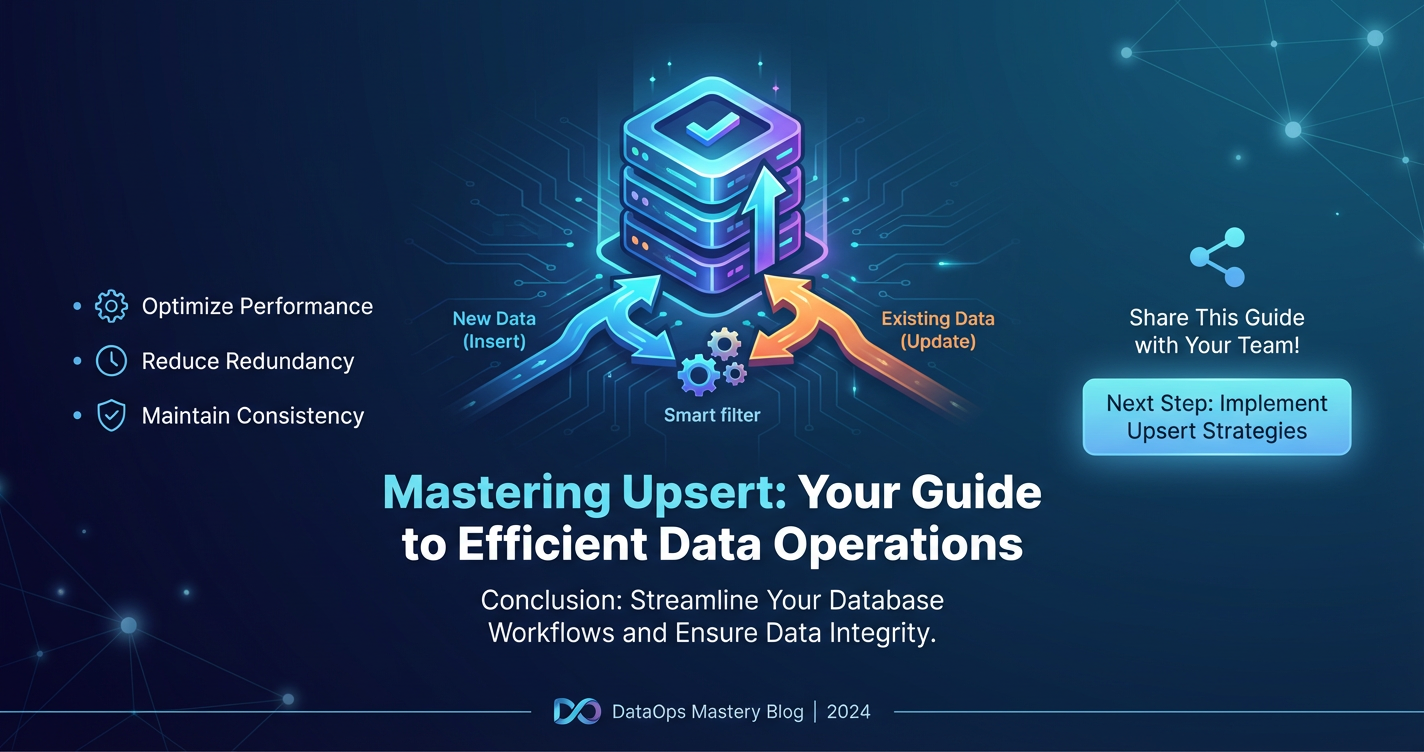
Mastering Upsert: Your Guide to Efficient Data Operations



In the intricate landscape of modern data management, where information flows ceaselessly and systems demand constant synchronization, the concept of "Upsert" stands as a foundational pillar for efficiency and integrity. It’s a term born from the fusion of "update" and "insert," representing an atomic database operation that either inserts a new record if it doesn't already exist or updates an existing record if it does. This seemingly simple operation holds profound implications for how applications interact with data stores, streamlining complex conditional logic, mitigating race conditions, and ultimately accelerating data processing workflows. For anyone navigating the complexities of database interactions, from seasoned database administrators to application developers and data engineers, a deep understanding of Upsert is not merely beneficial—it is essential.
The digital world thrives on dynamic data. User profiles are created and then modified. Inventory levels fluctuate. Transaction records accumulate and are sometimes revisited. In each of these scenarios, the challenge lies in maintaining a consistent and accurate state without incurring unnecessary overhead or introducing errors. Traditionally, this would involve a multi-step process: first, checking for the existence of a record, and then, based on the outcome, executing either an insert or an update command. This approach, while functionally correct, is prone to race conditions in concurrent environments, adds latency due to multiple database round trips, and clutters application logic with boilerplate conditional statements. Upsert, by consolidating these two distinct operations into a single, atomic command, offers an elegant solution, embodying a principle of "desired state" rather than explicit procedural steps. It allows systems to declare: "Ensure this record exists with these attributes, creating it if necessary, or modifying it if present."
This comprehensive guide delves into the multifaceted world of Upsert. We will embark on a journey starting from its fundamental definition and exploring its myriad benefits, ranging from enhanced performance and simplified codebases to improved data consistency and robust concurrency handling. We will traverse the diverse landscape of database systems, from the venerable relational databases like PostgreSQL and MySQL to the agile NoSQL counterparts such as MongoDB and Cassandra, illustrating how each implements or mimics this crucial operation. Furthermore, we will confront the challenges inherent in Upsert, dissecting performance considerations, concurrency issues, and the intricacies of schema evolution. The guide will also offer a robust set of best practices, empowering you to leverage Upsert effectively in your own applications. Finally, we will explore the broader implications of Upsert within API design and data integration strategies, touching upon its role in creating resilient, idempotent services and how platforms like API gateways can orchestrate these sophisticated data flows. By the end of this exploration, you will not only grasp the technical nuances of Upsert but also appreciate its strategic importance in architecting high-performance, fault-tolerant data solutions.
The Core Concept of Upsert: A Unified Approach to Data State
At its heart, Upsert is a declarative statement of intent: "I want this specific data entity to exist in the database with these attributes. If it's already there, just make sure its attributes match. If it's not, then create it." This conceptual simplicity masks a powerful operational efficiency. Rather than burdening the application layer with the responsibility of determining whether a record needs to be created or modified, the database system itself handles this logic internally, often with optimizations and transactional guarantees that are difficult to replicate reliably at the application level.
Consider a simple example: managing user profiles. When a user first signs up, their profile needs to be inserted. If they later update their email address or preferences, their existing profile needs to be modified. Without Upsert, the application code would typically look something like this:
- Query: Check if a user with a specific ID (or email) exists.
- Conditional Logic:
- If the user does exist: Execute an
UPDATEstatement. - If the user does not exist: Execute an
INSERTstatement.
- If the user does exist: Execute an
This "check-then-act" pattern is problematic, especially in scenarios with high concurrency. Imagine two simultaneous requests attempting to process the same new user. Both might query the database, find no existing record, and then both attempt to INSERT. This would lead to a primary key violation for one of them, or worse, duplicate records if unique constraints aren't properly enforced. Conversely, if one request inserts while another is still querying, the second request might incorrectly attempt to insert again.
Upsert elegantly bypasses these issues. By submitting a single Upsert command, the database engine takes responsibility for the entire operation atomically. It performs the existence check and the subsequent insert or update within a single, indivisible transaction. This atomic nature is crucial for data integrity, ensuring that the database always remains in a consistent state and preventing the transient inconsistencies or errors that can arise from multi-step operations. The database system, with its sophisticated locking mechanisms and transaction isolation levels, is far better equipped to manage these concurrent access patterns than an external application process.
The "key" to an Upsert operation is the criterion used to identify an existing record. This is typically a primary key or a unique index. When you perform an Upsert, you specify the data you want to store and the unique identifier. The database then uses this identifier to search for a matching record. If found, the update portion of the Upsert takes effect. If not found, the insert portion proceeds, creating a new record using the provided data and identifier. The attributes that are updated or inserted can be specified, allowing for fine-grained control over which fields are affected. This foundational understanding is the springboard for exploring its practical applications and technical implementations across diverse database ecosystems.
Why Upsert Matters: Benefits and Advantages in Modern Data Management
The adoption of Upsert is driven by a compelling suite of benefits that address critical challenges in modern data operations. From enhancing performance to fortifying data consistency, its advantages resonate across various dimensions of system architecture and development.
1. Enhanced Efficiency and Reduced Latency
The most immediate and tangible benefit of Upsert is the reduction in database round trips. As discussed, a traditional check-then-act strategy necessitates at least two distinct operations: a SELECT query to check for existence, followed by either an INSERT or an UPDATE. Each of these operations involves network latency, database connection overhead, and processing time. Upsert condenses this into a single, atomic command. In high-throughput systems, where thousands or millions of data operations occur per second, this reduction in overhead translates into significant performance gains and lower latency for individual operations. Less network chatter means faster overall processing, which is particularly critical for real-time applications, streaming data pipelines, and interactive user experiences where responsiveness is paramount.
2. Simplified Application Logic and Reduced Code Complexity
By offloading the conditional logic (IF EXISTS THEN UPDATE ELSE INSERT) from the application layer to the database, Upsert dramatically simplifies client-side code. Developers no longer need to write cumbersome SELECT statements, evaluate their results, and then conditionally branch to execute one of two different DML statements. Instead, a single, concise Upsert command suffices. This simplification leads to cleaner, more readable, and easier-to-maintain codebases. It reduces the surface area for bugs related to incorrect conditional logic or improper handling of SELECT results, allowing developers to focus on core business logic rather than database plumbing. The cognitive load on the developer is lessened, leading to faster development cycles and fewer errors.
3. Atomic Operations and Data Consistency
Atomicity is a cornerstone of reliable database transactions, and Upsert naturally embodies this principle. An Upsert operation is treated as a single, indivisible unit of work. Either the entire operation (the check and the subsequent insert or update) succeeds, or it completely fails, leaving the database state unchanged. There is no intermediate state where only a part of the operation has completed. This guarantee is vital for maintaining data consistency, especially when dealing with critical business data where partial updates could lead to corrupt or misleading information. It ensures that the database always reflects a coherent state, even in the face of system failures or concurrent access.
4. Robust Concurrency Handling and Prevention of Race Conditions
One of the most significant advantages of Upsert is its ability to elegantly handle concurrency. In highly concurrent environments, where multiple processes or threads might attempt to modify the same data concurrently, traditional multi-step operations are highly susceptible to race conditions. For example, two processes checking for a record simultaneously, both finding it absent, and then both attempting to insert it, would lead to a duplicate key error or worse. Upsert, by executing the existence check and the data modification within a single atomic transaction, often under the protection of database-level locks, inherently mitigates these race conditions. The database's transaction manager ensures that only one Upsert operation on a specific key can effectively proceed at a time, or it intelligently merges concurrent updates, guaranteeing that the final state is consistent and valid. This intrinsic concurrency control is a powerful feature, reducing the need for complex and error-prone application-level locking mechanisms.
5. Idempotence for Reliable Operations
An operation is idempotent if executing it multiple times produces the same result as executing it once. Upsert operations are inherently idempotent when applied to the same unique key. If you Upsert a record with specific data, executing that exact same Upsert command again will simply update the record to its current state, which is already the desired state. This characteristic is incredibly valuable in distributed systems and microservices architectures, particularly when dealing with message queues, retries, or unreliable network connections. If a message is processed twice, or an API request is re-sent due to a timeout, an idempotent Upsert ensures that the data state remains correct without creating duplicates or unexpected side effects. This simplifies error recovery and system resilience significantly.
6. Facilitating Data Synchronization and ETL Processes
In data integration scenarios, such as synchronizing data between disparate systems, performing Extract, Transform, Load (ETL) operations, or building data warehouses, Upsert is an indispensable tool. It allows for efficient merging of data streams, ensuring that new records are added while existing records are updated to reflect the latest state. This capability is critical for maintaining up-to-date master data records, reconciling data from various sources, and building incremental data loads without having to re-process entire datasets. It turns the complex task of data synchronization into a more manageable and performant operation.
In essence, Upsert is more than just a convenience; it is a fundamental pattern for building resilient, high-performance, and maintainable data-driven applications. Its benefits cascade through every layer of a system, from developer productivity to operational stability and data integrity.
When to Use Upsert: Common Use Cases and Strategic Applications
Understanding the "why" behind Upsert naturally leads to the "when." While its benefits are clear, identifying the specific scenarios where Upsert shines can optimize your data strategy and streamline your workflows. Upsert is particularly powerful in situations demanding efficient and consistent data manipulation in the face of dynamic changes and potential concurrency.
1. Synchronizing Data Between Systems
One of the most pervasive applications of Upsert is in data synchronization. Modern architectures often involve multiple microservices, third-party integrations, or legacy systems that need to share and update common data sets. For instance:
- Customer Relationship Management (CRM) and Marketing Automation: When a customer's contact information changes in the CRM, that update needs to be propagated to the marketing automation platform. An Upsert operation ensures that if the customer already exists in the marketing system, their record is updated; otherwise, a new contact is created.
- Inventory Management Systems: As stock levels change due to sales or new shipments, these updates need to be reflected across e-commerce platforms, warehousing systems, and supplier portals. Upsert provides an efficient way to keep all systems aligned with the latest inventory counts.
- User Profile Synchronization: In applications with multiple sub-systems (e.g., authentication service, billing service, content preferences service), a central user profile service can use Upsert to push changes to other services, ensuring a consistent view of user data across the entire ecosystem.
2. Batch Processing and ETL Operations
Extract, Transform, Load (ETL) processes, which are fundamental to data warehousing and analytics, heavily rely on the ability to efficiently merge new and changed data into target tables.
- Incremental Data Loads: Instead of performing a full reload of data, which can be resource-intensive, ETL pipelines can use Upsert to process only the changed or new records from the source system. This is far more efficient, especially for large datasets where only a small percentage of records change between processing cycles.
- Data Deduplication and Merging: When integrating data from various sources that might have overlapping records, Upsert allows you to define a unique key and consolidate these records. For example, merging customer data from an online store and a physical retail store, where customers might appear in both.
- Maintaining Historical Data (Slowly Changing Dimensions Type 1): In data warehousing, Type 1 Slowly Changing Dimensions involve overwriting existing attribute values when they change, effectively losing historical data. Upsert is the perfect mechanism for this pattern, ensuring that only the latest attribute values are stored for a given dimension member.
3. Real-time Data Streams and Event Processing
With the rise of streaming architectures and event-driven systems (e.g., Kafka, Kinesis), data often arrives in continuous, high-volume streams. Upsert is crucial for processing these events and maintaining an up-to-date view of entity states.
- IoT Sensor Data: Devices constantly send telemetry data. Instead of storing every single reading (which might be redundant), an Upsert can update a "current state" record for each device, showing its latest temperature, location, or operational status.
- Financial Trading Systems: Updating stock prices or order books in real-time. Each new quote or trade event triggers an Upsert to maintain the latest market view.
- Clickstream Analytics: Aggregating user activity. An Upsert could update a user's session record with new actions, ensuring the latest interaction details are always available without creating a new record for every click.
4. Caching Mechanisms and Materialized Views
Upsert plays a vital role in maintaining the freshness of cached data or materialized views, which are pre-computed results stored for faster access.
- Application Caches: When data in the primary database changes, an Upsert can refresh the corresponding entry in an application-level cache, ensuring users always see up-to-date information without having to re-fetch and re-process complex queries.
- Materialized Views: For complex analytical queries, materialized views can be refreshed periodically. Upsert can be used to update individual rows in these views when their underlying data changes, rather than rebuilding the entire view.
- Session Management: Storing and updating user session data (e.g., items in a shopping cart, login status). Upsert ensures that as users interact with the application, their session data is persistently updated.
5. User Profile and Configuration Management
Managing user-specific data, settings, and preferences is a classic Upsert use case.
- User Preferences: When a user changes their notification settings, theme preference, or privacy options, an Upsert ensures these changes are saved to their existing profile.
- Feature Flags: Storing user-specific feature flag overrides. If a user is manually opted into a beta feature, an Upsert sets that flag; if it's later revoked, the same operation updates it.
- Application Settings: Storing dynamic configuration settings for an application where these settings might be created initially and then frequently updated.
6. Log Aggregation and Event Stores
When collecting logs or events from various sources, Upsert can be used to consolidate or summarize data.
- Error Rate Tracking: Aggregating error counts for specific services or endpoints. An Upsert can increment a counter for an error type or service, creating the counter if it's the first error recorded.
- Activity Feeds: Building personalized activity feeds where the "last seen" status or aggregate counts of interactions are updated.
In summary, Upsert is a versatile and powerful operation that excels in any scenario requiring the efficient and reliable maintenance of data state. Its ability to simplify logic, ensure atomicity, and handle concurrency makes it a cornerstone for building robust, high-performance data-driven systems.
Implementing Upsert Across Different Database Systems
The fundamental concept of Upsert remains consistent, but its implementation varies significantly across different database systems, reflecting their underlying architectures and design philosophies. Understanding these variations is crucial for choosing the right approach and optimizing performance.
1. SQL Databases (Relational Database Management Systems - RDBMS)
Relational databases, with their strong schema enforcement and transactional guarantees, have evolved to offer robust Upsert mechanisms.
a. PostgreSQL: INSERT ... ON CONFLICT DO UPDATE
PostgreSQL, known for its advanced features and adherence to SQL standards, introduced the ON CONFLICT clause in version 9.5. This provides a highly flexible and powerful Upsert capability often referred to as "UPSERT" or "INSERT OR UPDATE."
Syntax:
INSERT INTO table_name (column1, column2, unique_column)
VALUES (value1, value2, unique_value)
ON CONFLICT (unique_column) DO UPDATE
SET column1 = EXCLUDED.column1,
    column2 = value2_new,
    last_updated = NOW();
Explanation:
ON CONFLICT (unique_column): This specifies the target for the conflict. It can be a unique column, a primary key, or a unique index. When an attempt to insert a row would violate this constraint, theON CONFLICTclause is triggered.DO UPDATE SET: If a conflict occurs, the database executes theUPDATEclause instead of inserting.EXCLUDED: This is a special table alias that refers to the row that would have been inserted had there been no conflict. This is incredibly useful as it allows you to reference the proposed new values in yourSETclause, ensuring the update logic uses the freshest data.DO NOTHING: As an alternative toDO UPDATE, you can specifyDO NOTHINGif you simply want to ignore the conflict and prevent the insert without updating anything.
Example: Imagine an articles table with a unique slug column.
INSERT INTO articles (title, content, slug, published_date)
VALUES ('My New Article', 'This is the content.', 'my-new-article', NOW())
ON CONFLICT (slug) DO UPDATE
SET title = EXCLUDED.title,
    content = EXCLUDED.content,
    published_date = NOW();
If 'my-new-article' already exists, its title, content, and published date will be updated. If not, a new article will be inserted. This is a highly efficient and transactional approach, minimizing race conditions.
b. MySQL: INSERT ... ON DUPLICATE KEY UPDATE
MySQL has long supported its own form of Upsert with the ON DUPLICATE KEY UPDATE syntax, which works when an INSERT statement would cause a duplicate value in a PRIMARY KEY or UNIQUE index.
Syntax:
INSERT INTO table_name (column1, column2, unique_column)
VALUES (value1, value2, unique_value)
ON DUPLICATE KEY UPDATE
column1 = value1,
column2 = NEW.column2; -- Or just 'value2' again
Explanation:
ON DUPLICATE KEY UPDATE: This clause is triggered if theINSERTwould result in a duplicate value for aPRIMARY KEYor anyUNIQUEindex.- The
UPDATEclause then specifies which columns to modify. Unlike PostgreSQL'sEXCLUDED, MySQL usually requires you to refer to the same values provided in theVALUESlist, or useNEW.column_namein newer versions (orVALUES(column_name)in older versions) to explicitly reference the value that would have been inserted.
Example: For a users table with a unique email column:
INSERT INTO users (username, email, last_login)
VALUES ('johndoe', 'john.doe@example.com', NOW())
ON DUPLICATE KEY UPDATE
username = 'johndoe',
last_login = NOW();
If a user with 'john.doe@example.com' exists, their username and last login will be updated. If not, a new user will be inserted.
c. SQL Server and Oracle: MERGE Statement
SQL Server (since 2008) and Oracle (since 9i) provide a powerful and flexible MERGE statement, which can perform INSERT, UPDATE, or DELETE operations on a target table based on a source table (or query result). This is often considered the most versatile Upsert-like command in the relational world, capable of handling complex scenarios.
Syntax (SQL Server Example):
MERGE target_table AS T
USING source_table AS S
ON (T.unique_column = S.unique_column)
WHEN MATCHED THEN
    UPDATE SET
        T.column1 = S.column1,
        T.column2 = S.column2
WHEN NOT MATCHED THEN
    INSERT (unique_column, column1, column2)
    VALUES (S.unique_column, S.column1, S.column2);
Explanation:
MERGE target_table AS T: Specifies the table to be modified.USING source_table AS S: Specifies the data source (can be a table, view, or subquery) containing the values to be merged.ON (T.unique_column = S.unique_column): This is the join condition that determines if a row in the target table matches a row in the source table.WHEN MATCHED THEN UPDATE: If a match is found based on theONcondition, theUPDATEclause is executed.WHEN NOT MATCHED THEN INSERT: If no match is found, theINSERTclause is executed.- You can also include
WHEN NOT MATCHED BY SOURCE THEN DELETEfor scenarios where rows in the target table that don't have a match in the source should be deleted.
Example (SQL Server): Updating product prices from a temporary staging table:
MERGE Products AS Target
USING Staging_NewPrices AS Source
ON (Target.ProductId = Source.ProductId)
WHEN MATCHED THEN
    UPDATE SET Target.Price = Source.NewPrice,
               Target.LastUpdated = GETDATE()
WHEN NOT MATCHED THEN
    INSERT (ProductId, ProductName, Price, LastUpdated)
    VALUES (Source.ProductId, Source.ProductName, Source.NewPrice, GETDATE());
This single MERGE statement efficiently updates existing product prices and inserts new products from the staging table.
d. Procedural Approaches (Fallback for Older RDBMS)
For older versions of SQL databases that do not natively support the above commands, or in scenarios with very complex logic, a procedural approach using SELECT followed by INSERT or UPDATE within a transaction is often used. This requires careful handling of locking to prevent race conditions.
BEGIN TRANSACTION;

-- Attempt to acquire a lock or use appropriate isolation level
SELECT id INTO @record_id FROM my_table WHERE unique_key = 'value' WITH (UPDLOCK, HOLDLOCK);

IF @record_id IS NOT NULL THEN
    UPDATE my_table SET column1 = 'new_value' WHERE id = @record_id;
ELSE
    INSERT INTO my_table (unique_key, column1) VALUES ('value', 'new_value');
END IF;

COMMIT TRANSACTION;
This is generally less efficient and more prone to errors than native Upsert commands but serves as a viable alternative where native support is absent.
2. NoSQL Databases
NoSQL databases often have different approaches to data modeling and consistency, which inherently influences their Upsert capabilities. Many NoSQL systems treat writes as "last write wins" or simply perform an Upsert by default when a document or key-value pair is written.
a. MongoDB: updateOne / updateMany with upsert: true
MongoDB, a popular document-oriented NoSQL database, provides explicit Upsert functionality through its update operations.
Syntax:
db.collection.updateOne(
   <filter>,
   <update>,
   { upsert: true }
);
Explanation:
<filter>: A document that specifies the selection criteria for the update. This acts as the "unique key" for the Upsert.<update>: A document that specifies the modifications to be made to the matching document(s). This uses MongoDB's update operators (e.g.,$set,$inc,$push).{ upsert: true }: This critical option, when set totrue, tells MongoDB to create a new document if no document matches the<filter>criteria. If a match is found, the document is updated according to the<update>specification.
Example: Updating a user's session data:
db.sessions.updateOne(
   { sessionId: "abc123def456" },
   { $set: { userId: "user789", lastActivity: new Date() },
     $inc: { visits: 1 }
   },
   { upsert: true }
);
If a session with sessionId: "abc123def456" exists, it updates userId, lastActivity, and increments visits. If not, a new session document is created with these fields, and visits initialized to 1.
b. Cassandra: INSERT / UPDATE Statements
Apache Cassandra, a wide-column store, handles writes in a very unique way. All writes in Cassandra are essentially Upserts by design; there's no distinct "insert" versus "update" operation in the traditional sense. When you write data to a primary key, if a row with that key exists, it's updated. If not, it's inserted. This "last write wins" philosophy is fundamental to Cassandra's eventually consistent model.
Syntax:
INSERT INTO table_name (primary_key_column, column1, column2)
VALUES (pk_value, value1, value2);

UPDATE table_name
SET column1 = value1, column2 = value2
WHERE primary_key_column = pk_value;
Explanation:
INSERT INTO: If a row withpk_valuedoes not exist, it's created. If it does exist, the specified columns are updated. Columns not specified in theINSERTstatement remain unchanged if the row already existed.UPDATE: Explicitly updates the specified columns for the given primary key. If the primary key does not exist, Cassandra will create a new row with that primary key and the specified columns, filling other columns with nulls if they are not explicitly mentioned and are not part of the primary key.
Example: Adding or modifying a user profile:
INSERT INTO user_profiles (user_id, username, email, last_login)
VALUES (UUID(), 'alice', 'alice@example.com', '2023-10-26 10:00:00');

UPDATE user_profiles
SET email = 'alice.updated@example.com', last_login = '2023-10-26 11:30:00'
WHERE user_id = '01234567-89ab-cdef-0123-456789abcdef';
The INSERT will create a new row or update an existing one. The UPDATE will modify the row for the given user_id, or implicitly create it if it doesn't exist. This inherent Upsert behavior simplifies application logic for Cassandra users.
c. Redis: SET Command
Redis, an in-memory data structure store, handles Upsert operations very naturally due to its key-value nature. The SET command automatically acts as an Upsert.
Syntax:
SET key value [EX seconds] [PX milliseconds] [NX | XX]
Explanation:
SET key value: Sets the stringvalueofkey. Ifkeyalready holds a value, it is overwritten, regardless of its type. Ifkeydoes not exist, it is created. This is the default Upsert behavior.NX: Only set the key if it does not already exist (equivalent to INSERT only).XX: Only set the key if it already exists (equivalent to UPDATE only).
Example: Storing or updating a user's session token:
SET user:123:session abcdef123456 EX 3600
This command sets the session token for user:123:session to abcdef123456 with an expiry of 3600 seconds. If user:123:session already existed, its value is overwritten. If not, it's created.
d. Elasticsearch: update API with upsert parameter
Elasticsearch, a distributed search and analytics engine, provides an update API that can perform an Upsert.
Syntax (using the _update endpoint):
POST /<index>/_update/<_id>
{
  "doc": {
    "field1": "value1",
    "field2": "value2"
  },
  "upsert": {
    "field1": "initial_value1",
    "field2": "initial_value2",
    "new_field": "some_data"
  }
}
Explanation:
_id: The unique ID of the document to be updated or inserted.doc: Contains the partial document to merge with the existing document if a match is found.upsert: Contains the full document to be inserted if no document with the given_idis found. If a document is found, thisupsertblock is ignored.
Example: Updating or creating a product record:
POST /products/_update/product_abc123
{
  "doc": {
    "price": 29.99,
    "stock_quantity": 150
  },
  "upsert": {
    "product_id": "product_abc123",
    "name": "Widget X",
    "description": "An amazing widget.",
    "price": 29.99,
    "stock_quantity": 150,
    "created_at": "2023-10-26T10:00:00Z"
  }
}
If product_abc123 exists, its price and stock_quantity are updated. If not, a new document is created with all fields defined in the upsert block.
This diverse landscape of implementations underscores the universality of the Upsert pattern while highlighting the importance of understanding the specific syntax and semantics for your chosen database technology.
Table: Upsert Syntax Comparison Across Databases
| Database System | Upsert Command/Feature | Key Differentiator/Nuance |
|---|---|---|
| PostgreSQL | INSERT ... ON CONFLICT (target) DO UPDATE SET ... |
Highly SQL-standard compliant, EXCLUDED pseudo-table for new values. |
| MySQL | INSERT ... ON DUPLICATE KEY UPDATE SET ... |
Relies on PRIMARY KEY or UNIQUE indexes. References VALUES() or NEW. for new values. |
| SQL Server | MERGE statement |
Most versatile; can INSERT, UPDATE, DELETE based on source/target match. |
| Oracle | MERGE statement |
Similar to SQL Server's MERGE, powerful for complex data synchronization. |
| MongoDB | updateOne(filter, update, { upsert: true }) |
upsert: true option in update methods. Uses filter for matching, update operators for changes. |
| Cassandra | INSERT or UPDATE (inherent behavior) |
"Last write wins" principle; all writes are effectively Upserts based on primary key. |
| Redis | SET key value (default) |
Simple key-value overwrite. NX/XX options for explicit insert/update only. |
| Elasticsearch | _update API with upsert parameter |
doc for update, upsert for initial insert if document doesn't exist. |
This table provides a concise overview, but always refer to the specific database documentation for the most accurate and up-to-date syntax and behavior.
APIPark is a high-performance AI gateway that allows you to securely access the most comprehensive LLM APIs globally on the APIPark platform, including OpenAI, Anthropic, Mistral, Llama2, Google Gemini, and more.Try APIPark now! 👇👇👇
Challenges and Considerations with Upsert
While Upsert offers significant advantages, its implementation is not without potential pitfalls and considerations. A thoughtful approach is required to harness its power effectively without introducing new problems.
1. Performance Implications
Though Upsert reduces network round trips, the underlying database operations can still be resource-intensive, particularly for relational databases.
- Index Overhead: The database needs to perform an index lookup (on the primary key or unique index) to determine if a record exists. For large tables, this lookup needs to be highly optimized with appropriate indexing. If the unique constraint isn't properly indexed, the existence check can degrade into a full table scan, severely impacting performance.
- Transaction Lock Contention: Upsert operations, by their atomic nature, often involve acquiring locks on the relevant rows or pages to ensure data integrity during the existence check and subsequent modification. In high-concurrency scenarios, especially when many Upserts target the same key space, this can lead to lock contention, reducing parallelism and throughput. While native Upsert commands are designed to minimize this, it's not entirely eliminated.
- Write Amplification: For some NoSQL databases like Cassandra, an "update" might actually be a new write internally, with older versions marked for deletion during compaction. This can lead to increased disk I/O and storage consumption (write amplification) if updates are frequent and small.
- Hot Spots: If many Upserts constantly target a small subset of records (e.g., updating a global counter or a frequently accessed status field), this can create "hot spots" in the database, leading to contention and performance bottlenecks, even with efficient Upsert mechanisms.
2. Concurrency Control and Race Conditions (Even with Upsert)
While Upsert greatly mitigates race conditions compared to a multi-step SELECT then INSERT/UPDATE, subtle issues can still arise, especially in distributed environments or with certain database configurations.
- "Lost Update" Problem: If an Upsert statement modifies a record based on its current value (e.g.,
SET count = count + 1), and two concurrent Upserts read the same initial value, compute the new value, and then one overwrites the other, an update can be "lost." This typically requires explicit locking,SELECT FOR UPDATE, or atomic increment operations supported by the database to prevent. - Phantom Reads: In some transaction isolation levels, a transaction might execute an Upsert, and then a subsequent read within the same transaction might see a different result if another transaction committed an insert or delete that affects the range being read, even though the original Upsert itself was atomic.
- Deadlocks: Although less common with single Upsert statements, complex
MERGEstatements or Upserts involving multiple tables can still lead to deadlocks if locks are acquired in different orders by concurrent transactions.
3. Schema Evolution and Data Type Changes
Upsert operations are tied to the existing schema. If your data model is frequently evolving, this can pose challenges.
- Adding New Columns: When you add new columns, your Upsert logic might need to be updated to account for them, either by explicitly including them in the
INSERTandUPDATEparts or by ensuring they have appropriate default values. - Data Type Mismatches: If the data types of the incoming data change or do not match the target column's data type, the Upsert operation will fail. This requires robust data validation and transformation upstream.
- Nullability Constraints: If a new column is added as
NOT NULLwithout a default value, an existing Upsert command might fail on theINSERTpath if it doesn't provide a value for that new column.
4. Complexity in Application Logic (if not using native support)
When database systems lack native Upsert support, developers resort to procedural workarounds, which reintroduce the very complexity Upsert aims to eliminate.
- Increased Code Footprint: Manual
SELECTfollowed byINSERTorUPDATElogic, even within a transaction, requires more lines of code and more careful error handling. - Developer Burden: Developers must be vigilant about transaction boundaries, locking mechanisms, and exception handling, diverting focus from business logic.
- Portability Issues: Procedural Upsert logic is often specific to a particular database's dialect and locking primitives, making it less portable across different database platforms.
5. Data Integrity Constraints (Beyond Uniqueness)
While Upsert handles uniqueness, other data integrity constraints need careful consideration.
- Foreign Key Constraints: If an Upsert inserts a record that violates a foreign key constraint, the operation will fail. The application needs to ensure referential integrity is maintained.
- Check Constraints: Custom business rules enforced via
CHECKconstraints on a table can also cause an Upsert to fail if the incoming data violates them. - Triggers: Upsert operations can fire database triggers. Understanding the behavior of these triggers and their potential side effects (e.g., logging, auditing, further data modifications) is crucial.
6. Idempotence Specifics
While generally idempotent, the exact outcome of repeated Upsert operations can depend on the update logic.
- If an Upsert sets a value, it's strictly idempotent (
SET column = 'new_value'). - If an Upsert modifies a value based on its current state (
SET count = count + 1), then repeating the operation will change the outcome (the count will increase again), making it not strictly idempotent in the value it produces, but idempotent in its operation - it will apply the increment regardless of how many times it's executed, assuming the same starting state. This distinction is important for system design.
Addressing these challenges requires careful design, thorough testing, and a deep understanding of both your application's requirements and the specific characteristics of your chosen database system. It's about leveraging Upsert's strengths while proactively mitigating its potential weaknesses.
Best Practices for Mastering Upsert Operations
Effectively leveraging Upsert operations goes beyond merely knowing the syntax; it involves adopting best practices that ensure performance, reliability, and maintainability. By adhering to these guidelines, you can truly master Upsert and integrate it seamlessly into your data strategies.
1. Identify and Leverage the Correct Unique Key
The cornerstone of any successful Upsert operation is the accurate identification of the unique key. This could be a primary key or any column (or combination of columns) that has a UNIQUE index.
- Primary Key First: Whenever possible, use the primary key as the Upsert identifier. It's guaranteed to be unique and typically has the most optimized indexing.
- Natural vs. Surrogate Keys: If using natural keys (e.g., email address, product SKU), ensure they are truly unique and stable. For example, if email addresses can change, they might not be the best unique key for an Upsert that aims to track a user over time. Surrogate keys (e.g., UUIDs, auto-incrementing IDs) are often more reliable for Upsert operations.
- Composite Keys: For complex entities, a combination of columns might form a unique identifier. Ensure a
UNIQUEindex exists on this composite key. - Indexing is Crucial: Regardless of whether it's a primary or unique key, ensure that the columns used in the
ON CONFLICT,ON DUPLICATE KEY, orMERGE ONclause are properly indexed. A missing or inefficient index will negate the performance benefits of Upsert, turning the existence check into a costly full table scan.
2. Understand Database-Specific Syntax and Semantics
As demonstrated, Upsert implementations vary significantly across database systems.
- Consult Documentation: Always refer to the official documentation for your specific database version. Syntactic nuances, performance characteristics, and available options (e.g.,
EXCLUDEDin PostgreSQL,NEW.in MySQL,upsert: truein MongoDB) can make a substantial difference. - Beware of Defaults: Some NoSQL databases perform Upsert by default (e.g., Cassandra writes). Understand when this implicit behavior occurs and if it aligns with your intent.
- Transaction Isolation: Be aware of how your database's transaction isolation levels might affect concurrent Upserts. Read-committed or repeatable-read might behave differently with respect to conflicts.
3. Optimize Indexes for Performance
The efficiency of the existence check is paramount.
- Dedicated Unique Indexes: Beyond primary keys, create specific
UNIQUEindexes on any candidate columns used for Upsert identification. - Index Maintenance: Regularly review and rebuild/reorganize indexes as necessary, especially on tables with high write activity, to ensure they remain efficient.
- Avoid Over-indexing: While indexes are good, too many indexes can slow down writes. Strike a balance by only indexing columns frequently used in
WHEREclauses,JOINconditions, and Upsert conflict resolution.
4. Consider Transaction Isolation Levels Carefully
Transaction isolation levels determine how concurrent transactions interact and can significantly impact the reliability of Upsert operations, particularly in avoiding issues like lost updates.
- Repeatable Read / Serializable: Higher isolation levels (like
REPEATABLE READorSERIALIZABLE) offer stronger guarantees against race conditions, but at the cost of increased locking and potential for deadlocks. - Read Committed: Often the default, it's generally sufficient for basic Upserts but might require additional application-level checks or database-specific extensions (like
SELECT FOR UPDATE) for complex "read-modify-write" scenarios where you want to ensure the value hasn't changed between your read and update if the update logic depends on the read value. - Database-Specific Locking: Some databases offer explicit locking hints (e.g.,
WITH (UPDLOCK)in SQL Server) that can be used within a transaction if you're implementing a procedural Upsert or need stronger guarantees on a specific set of rows.
5. Thorough Testing Under Load
Never deploy Upsert logic without rigorous testing, especially under simulated production loads.
- Concurrency Testing: Simulate multiple concurrent processes attempting to Upsert the same or overlapping data. Verify that no race conditions occur, no data is lost, and performance remains acceptable.
- Edge Cases: Test scenarios where records definitely exist, definitely don't exist, and where conflicts occur (e.g., two processes trying to insert the same new record simultaneously).
- Error Handling: Verify that error handling mechanisms correctly catch and manage failures, such as constraint violations or deadlocks.
- Performance Benchmarking: Measure the performance of Upsert operations under various data volumes and concurrency levels. Monitor CPU, I/O, and latency.
6. Implement Robust Logging and Error Handling
Even with best practices, errors can occur. Effective logging and error handling are crucial.
- Detailed Logging: Log successful Upserts (especially for auditing or debugging purposes) and, critically, log any failures with sufficient detail (error messages, relevant data points) to diagnose problems.
- Retry Mechanisms: For transient errors (e.g., network issues, temporary deadlocks), implement idempotent retry mechanisms with exponential backoff. Since Upsert is generally idempotent, retrying is safe.
- Alerting: Set up alerts for persistent Upsert failures, indicating potential data pipeline blockages or database issues.
7. Version Control and Schema Management
As your application and data model evolve, so too must your Upsert logic.
- Migrate Carefully: When schema changes occur (e.g., adding a new
NOT NULLcolumn without a default), ensure your Upsert statements are updated accordingly before deployment. Database migration tools can help manage these changes. - Document Logic: Clearly document the unique keys and the specific Upsert logic used for each data flow or entity.
By internalizing these best practices, you can move beyond merely using Upsert to truly mastering it, building data operations that are not only efficient but also resilient, consistent, and easy to manage in the long run.
Upsert in the Context of API Design and Data Integration
The power of Upsert extends beyond direct database interactions, playing a critical role in how applications and services communicate and integrate data. In the realm of API design and data integration, Upsert principles contribute significantly to building robust, idempotent, and scalable systems.
1. Designing Idempotent APIs with Upsert Capabilities
A fundamental principle for designing reliable APIs, especially in distributed systems, is idempotence. An idempotent API endpoint guarantees that calling it multiple times with the same parameters will produce the same result as calling it once. This property is invaluable for clients that might retry requests due to network timeouts or other transient errors, ensuring that such retries don't lead to duplicate data or unintended side effects.
Upsert is the perfect underlying mechanism for achieving idempotence in data modification APIs:
- RESTful APIs: A common pattern for
PUTrequests in REST is to be idempotent. When a client sends aPUT /resources/{id}request, it implies "replace the resource at{id}with this new representation, or create it if it doesn't exist." This maps directly to an Upsert operation in the backend. If the client sends the samePUTrequest twice, the first one might create or update the resource, and the second one will simply update it to the same state, making the operation idempotent. - Command-Query Responsibility Segregation (CQRS): In CQRS architectures, command APIs that modify data can leverage Upsert to ensure that commands are applied reliably. For example, a
CreateOrUpdateProductCommandcan map directly to an Upsert in the product catalog service, simplifying the command handler's logic and ensuring consistent state. - Event-Driven Architectures: When processing events from a message queue (e.g., "UserUpdatedEvent," "ProductQuantityChangedEvent"), the service consuming these events can use Upsert to apply the changes to its local data store. If an event is delivered multiple times (a common occurrence in "at least once" delivery systems), the Upsert ensures that the final state is correct without processing duplicates.
By designing APIs to inherently perform Upsert-like operations, developers can abstract away the underlying database complexity and provide clients with a simpler, more fault-tolerant interaction model. Clients don't need to know whether a record exists before sending a request; they just declare their desired state.
2. Data Synchronization Across Microservices
In a microservices architecture, where data is often distributed across multiple services, maintaining consistency and synchronizing data views is a continuous challenge. Upsert plays a crucial role here:
- Service-to-Service Communication: When one microservice needs to inform another about a data change, it might do so via an API call or by publishing an event. The receiving service, upon processing this information, can use an Upsert to update its own local copy of the data. For example, a
UserManagementservice updates a user's address, publishes aUserAddressUpdatedevent, and aShippingservice consumes this event, performing an Upsert on its localcustomer_addressestable to reflect the change. - Denormalization and Caching: Microservices often denormalize data for performance or autonomy. Upsert is vital for keeping these denormalized copies or caches up-to-date. If a
Productservice updates a product's description, other services that cache this information (e.g., aSearchservice, aRecommendationservice) can receive an event and Upsert their local caches.
This distributed Upsert pattern is fundamental to maintaining eventual consistency across microservices, ensuring that independent services can eventually converge on the same data state without tight coupling or complex distributed transactions.
3. The Role of API Gateways in Orchestrating Data Operations
While individual services or databases perform the actual Upsert operations, an API gateway acts as a critical intermediary, managing and orchestrating the flow of API requests, including those that ultimately lead to Upsert operations. An API gateway serves as a single entry point for various services, providing a centralized point for managing traffic, security, routing, and other cross-cutting concerns for your API ecosystem.
- Unified Access: An API gateway can provide a unified interface to multiple backend services. A client makes a single request to the API gateway, which then routes, transforms, and potentially orchestrates calls to several downstream microservices. If these downstream services expose Upsert capabilities, the gateway can ensure the client request is properly directed and processed.
- Policy Enforcement: An API gateway can enforce policies such as authentication, authorization, rate limiting, and request/response transformation before requests reach the backend services. This is crucial for securing data operations, including Upserts. For example, ensuring only authorized users can perform an Upsert on sensitive customer data.
- Load Balancing and Routing: For services that scale horizontally, an API gateway can intelligently load balance requests across multiple instances, ensuring high availability and optimal performance for Upsert operations. It can also route requests to specific service versions or environments.
- Observability: An API gateway offers a centralized point for logging, monitoring, and tracing API calls. This provides visibility into the health and performance of your data operations, including the success and failure rates of Upsert-related API calls.
- Abstraction and Evolution: The API gateway can abstract backend service details from clients. If a backend service responsible for a specific Upsert needs to be refactored or replaced, the gateway can manage this transition transparently, without impacting client applications.
For robust management of such diverse API interactions, especially in complex enterprise environments, platforms like ApiPark offer comprehensive solutions. As an open-source AI gateway and API management platform, APIPark helps developers and enterprises manage, integrate, and deploy AI and REST services, providing a unified management system for authentication, cost tracking, and end-to-end API lifecycle management. Its capabilities in handling high-volume API traffic and centralizing API governance are directly relevant to scenarios where Upsert operations are exposed and consumed via various APIs, ensuring efficient and secure data flow. APIPark's ability to quickly integrate 100+ AI models and standardize API formats further exemplifies how an API gateway can streamline complex data and service interactions, whether for AI inference or traditional RESTful data operations.
In essence, Upsert and API design are two sides of the same coin when it comes to efficient data operations. Upsert provides the atomic, idempotent mechanism for modifying data, while well-designed APIs (often facilitated by an API gateway) provide the interface for applications to leverage these powerful operations reliably and at scale.
Future Trends and Advanced Patterns in Data Operations
The landscape of data management is constantly evolving, driven by new technologies and increasing demands for real-time processing, massive scale, and intricate integration. Upsert, as a fundamental building block, continues to find relevance and new applications within these emerging trends and advanced patterns.
1. Event-Driven Architectures and Stream Processing
The shift towards event-driven architectures (EDAs) and stream processing has profoundly impacted how data changes are propagated and consumed. In these paradigms, data changes are published as events to a stream (e.g., Apache Kafka, Amazon Kinesis), and various services or applications subscribe to these streams to react to changes.
- Change Data Capture (CDC): CDC solutions extract changes (inserts, updates, deletes) from source databases and publish them as a stream of events. Consumers of these CDC streams frequently use Upsert operations to apply these changes to target systems, such as data lakes, search indexes (like Elasticsearch), or analytical databases. This enables near real-time data synchronization across an enterprise, ensuring all systems have the most current view of critical data.
- Materialized View Updates: In complex analytical systems or microservices, services might maintain their own materialized views of data (pre-aggregated or denormalized data). As upstream data changes, events are published, and subscriber services use Upsert to incrementally update their materialized views, rather than recalculating them entirely. This is essential for maintaining responsive dashboards and analytical applications.
- Stateful Stream Processing: Frameworks like Apache Flink or Kafka Streams allow for stateful processing of event streams. Here, Upsert-like operations are implicit within the stream processor's internal state management. As new events arrive, the state for a particular key is updated or created, enabling real-time aggregations, windowing, and complex event pattern detection.
2. Serverless Functions and Event-Driven ETL
Serverless computing (e.g., AWS Lambda, Azure Functions, Google Cloud Functions) has revolutionized how small, specific tasks are executed. When combined with event sources, serverless functions become powerful tools for event-driven ETL and data processing, often relying on Upsert for state management.
- Database Triggers as Event Sources: A change in a database (an insert or update) can trigger a serverless function. This function can then perform an Upsert operation in another database, a cache, or a search index. For example, a new user registration in a SQL database triggers a Lambda function that Upserts the user's profile into a NoSQL database (like DynamoDB) for faster lookup.
- API Gateway Integration: Serverless functions can be exposed via an API Gateway. An incoming API request (e.g., a
PUTrequest to update a user profile) can directly invoke a serverless function, which then executes the Upsert logic against the backend data store. This pattern allows for highly scalable and cost-effective API backends. - File Upload Processing: When a new file is uploaded to an object storage service (e.g., S3), an event can trigger a serverless function that processes the file, extracts metadata, and Upserts this metadata into a database or a search index.
3. Graph Databases and Semantic Upserts
Graph databases (e.g., Neo4j, Amazon Neptune) store data as nodes and relationships, focusing on connections. Upsert patterns in graph databases often involve creating or updating nodes and relationships based on their unique properties.
MERGEin Cypher (Neo4j): Neo4j's Cypher query language has aMERGEclause that acts as an Upsert for both nodes and relationships.MERGE (n:Label {property: 'value'})will find a node with that label and property, or create it if it doesn't exist. This is essential for building and maintaining complex graph structures incrementally without creating duplicates.- Semantic Data Integration: In semantic web applications, Upsert helps in integrating diverse data sources into a unified knowledge graph. When new facts or entities are discovered, they can be Upserted into the graph, ensuring consistency and avoiding redundant representations.
4. Machine Learning Feature Stores
In machine learning workflows, feature stores are centralized repositories for managing and serving features for training and inference. Upsert is critical for keeping these features up-to-date.
- Real-time Feature Updates: As new data streams in (e.g., user activity, sensor readings), features derived from this data need to be updated in the feature store. Upsert ensures that the latest feature values are available for models.
- Online/Offline Feature Consistency: Upsert helps maintain consistency between online feature stores (for real-time inference) and offline feature stores (for model training), ensuring that models are trained on data that accurately reflects what they will see in production.
These trends highlight that the core need for efficiently managing data state – whether creating new entries or updating existing ones – remains central across various evolving data architectures. Upsert, in its various forms, will continue to be a crucial tool in the arsenal of data professionals for building responsive, scalable, and resilient systems.
Conclusion: The Indispensable Role of Mastering Upsert
In the dynamic and data-intensive world we inhabit, where applications demand seamless interaction with ever-changing information, mastering Upsert is no longer a niche skill but a fundamental requirement for efficient data operations. This comprehensive guide has traversed the intricate landscape of Upsert, from its foundational concept as an atomic "update or insert" operation to its diverse implementations across relational and NoSQL databases, its strategic applications in API design, and its continuing relevance in emerging data trends.
We began by unraveling the core simplicity and profound impact of Upsert, illustrating how it streamlines conditional logic, minimizes network overhead, and intrinsically handles concurrency by performing existence checks and data modifications within a single, indivisible transaction. The advantages are clear: enhanced efficiency, simplified application code, robust data consistency, and the invaluable property of idempotence, which forms the bedrock of resilient distributed systems.
Our exploration then ventured into the practical realm, showcasing how different database systems—from PostgreSQL's elegant ON CONFLICT to MySQL's ON DUPLICATE KEY UPDATE, SQL Server's powerful MERGE, MongoDB's upsert: true option, Cassandra's inherent write behavior, Redis's SET command, and Elasticsearch's _update API—each provide mechanisms to achieve this crucial operation. This diversity underscores the universality of the Upsert pattern while emphasizing the critical need to understand the specific nuances of your chosen database technology.
However, the journey to mastering Upsert is not without its challenges. We delved into potential pitfalls such as performance bottlenecks due to inefficient indexing or lock contention, subtle race conditions that can still arise, complexities introduced by schema evolution, and the inherent difficulties of procedural workarounds when native support is absent. These considerations highlight that a thoughtful and informed approach is paramount.
To navigate these challenges successfully, we outlined a robust set of best practices. These include the meticulous identification and leveraging of correct unique keys, a deep understanding of database-specific syntax, proactive index optimization, careful consideration of transaction isolation levels, rigorous testing under load, and the implementation of comprehensive logging and error handling. Adhering to these principles ensures that Upsert operations are not only performant but also reliable and maintainable.
Finally, we broadened our perspective to examine Upsert's pivotal role in the larger ecosystem of API design and data integration. Its ability to underpin idempotent API endpoints is crucial for building fault-tolerant client-server interactions. In microservices architectures, Upsert facilitates seamless data synchronization, enabling independent services to converge on consistent data states. We also highlighted how an API gateway acts as a vital orchestrator for these complex data flows, providing a centralized point for management, security, and routing. Products like ApiPark exemplify how an API gateway can streamline the management of diverse API interactions, making it easier to leverage sophisticated data operations, including those that rely on Upsert, at scale. The future trends, from event-driven architectures to serverless functions and machine learning feature stores, further solidify Upsert's indispensable place as a core pattern for managing dynamic data in an increasingly complex and interconnected world.
In conclusion, mastering Upsert is about more than just a database command; it's about adopting a mindset that prioritizes data integrity, operational efficiency, and system resilience. By embracing its power and adhering to best practices, you empower your applications to interact with data in a more intelligent, robust, and performant manner, laying a solid foundation for scalable and maintainable data solutions.
Frequently Asked Questions (FAQs)
1. What is the fundamental difference between an Upsert and a simple INSERT or UPDATE? A fundamental INSERT operation attempts to add a new record, failing if a record with the same unique key already exists. A simple UPDATE operation attempts to modify an existing record, doing nothing if the record doesn't exist. An Upsert, by contrast, is an atomic operation that intelligently combines both: it inserts a new record if no matching unique key is found, and updates an existing record if a match is found. This eliminates the need for a separate SELECT check before deciding between an insert or an update.
2. Are Upsert operations always idempotent? Generally, yes, Upsert operations are designed to be idempotent when executed repeatedly with the same parameters for the same unique key. If an Upsert command sets a field to a specific value (e.g., SET status = 'active'), running it multiple times will consistently result in that field being 'active'. However, if an Upsert modifies a value based on its current state (e.g., SET counter = counter + 1), running it multiple times will change the final value (incrementing the counter each time), even though the operation itself ("add 1 to counter") is consistently applied. It's idempotent in its effect on the operation, but not strictly in the value it produces on subsequent runs if the initial value changes.
3. What are the key performance considerations when using Upsert? The main performance considerations for Upsert include: * Index Efficiency: The unique key used for the Upsert must be efficiently indexed. A missing or poorly designed index will lead to slow existence checks (e.g., full table scans). * Lock Contention: In highly concurrent environments, multiple Upserts targeting the same key space can lead to database-level lock contention, reducing throughput. * Write Amplification: Some NoSQL databases might internally perform more writes than appear on the surface (e.g., marking old versions for deletion) when updates are frequent, impacting disk I/O. Optimizing indexes and understanding your database's concurrency model are crucial.
4. Can Upsert lead to race conditions or data inconsistencies? While native Upsert commands significantly reduce the likelihood of race conditions compared to procedural SELECT then INSERT/UPDATE logic, they are not entirely immune, especially in complex scenarios. Issues like "lost updates" (where an update based on a stale read is overwritten by another concurrent update) can occur if not managed by appropriate transaction isolation levels or explicit database locking mechanisms. Careful testing and understanding of your database's concurrency model are essential.
5. How does an API Gateway relate to Upsert operations? An API Gateway acts as a crucial intermediary between client applications and backend services that perform Upsert operations. While the gateway itself doesn't execute the Upsert, it manages the API calls that trigger these operations. It can: * Route client requests (e.g., PUT /users/{id}) to the correct backend service responsible for the Upsert. * Enforce security policies (authentication, authorization) to ensure only authorized clients can perform Upsert operations. * Apply rate limiting to protect backend services from overload, including high-volume Upsert requests. * Provide centralized logging and monitoring for all API traffic, offering visibility into the success and failure of Upsert-related calls. Platforms like ApiPark exemplify how an API gateway streamlines the management of such complex data and service interactions.
🚀You can securely and efficiently call the OpenAI API on APIPark in just two steps:
Step 1: Deploy the APIPark AI gateway in 5 minutes.
APIPark is developed based on Golang, offering strong product performance and low development and maintenance costs. You can deploy APIPark with a single command line.
curl -sSO https://download.apipark.com/install/quick-start.sh; bash quick-start.sh

In my experience, you can see the successful deployment interface within 5 to 10 minutes. Then, you can log in to APIPark using your account.

Step 2: Call the OpenAI API.