Mosaic AI Gateway: Simplify Your AI Integration
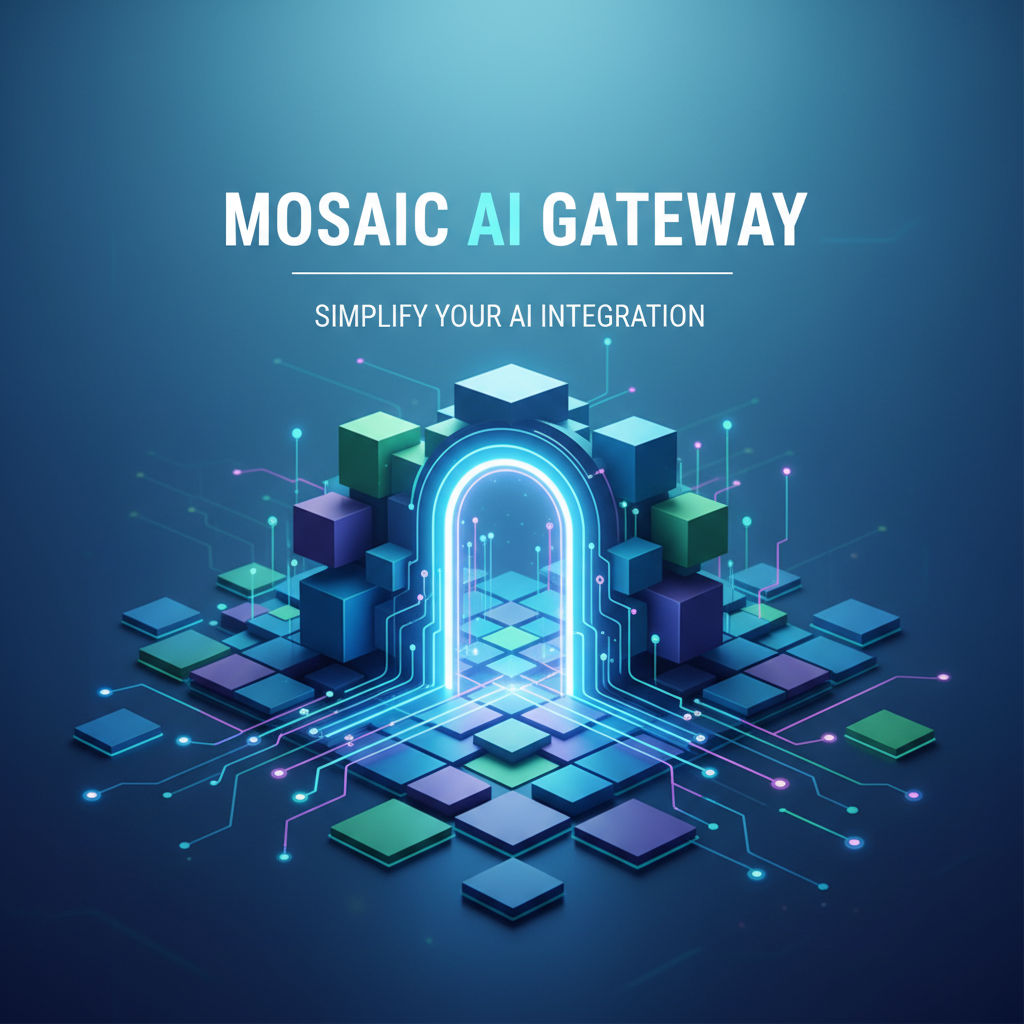


In an era increasingly defined by artificial intelligence, businesses are racing to embed AI capabilities into every facet of their operations and product offerings. From automating mundane tasks and personalizing customer experiences to extracting profound insights from vast datasets, AI promises a transformative leap forward. However, the path to seamless AI integration is often fraught with complexity, acting as a significant barrier for many organizations. The landscape of AI models is a sprawling, dynamic wilderness, characterized by a dizzying array of providers, proprietary APIs, varying performance metrics, and fluctuating cost structures. Navigating this intricate ecosystem while simultaneously ensuring robust security, optimal performance, and controlled expenditure represents a monumental challenge that can quickly overwhelm even the most sophisticated development teams.
This is precisely where the concept of an intelligent intermediary becomes not just beneficial, but absolutely indispensable. Enter the AI Gateway – a powerful architectural component designed to act as a unified control plane for all AI interactions. More than just a simple proxy, an AI Gateway intelligently abstracts away the underlying complexities of diverse AI models, presenting a standardized, secure, and highly manageable interface to applications and microservices. By centralizing access, applying consistent policies, and orchestrating interactions, an AI Gateway transforms a chaotic collection of AI endpoints into a coherent, manageable system. Our focus today is on the "Mosaic AI Gateway" – an archetype representing the pinnacle of this technology, engineered to bring order, efficiency, and profound simplicity to the often-turbulent world of AI integration. It is an architectural philosophy that embraces the diversity of AI models, bringing them together to form a beautiful, functional whole, much like individual tesserae combine to create a grand mosaic.
At its core, a Mosaic AI Gateway addresses the critical need for a streamlined approach to leveraging artificial intelligence. It serves as the intelligent traffic controller for all your AI-related requests, ensuring that the right request reaches the right AI model at the right time, under the right conditions. This strategic positioning offers a multitude of advantages, from enhancing developer productivity by providing a singular point of interaction, to bolstering security postures by centralizing authentication and authorization, and optimizing operational costs through intelligent routing and caching mechanisms. As we delve deeper into its functionalities, we will explore how this sophisticated form of API Gateway, specifically tailored for AI workloads, becomes the cornerstone of a scalable, resilient, and future-proof AI strategy, particularly in the burgeoning domain of Large Language Models (LLMs). The evolution from a generic API Gateway to a specialized AI Gateway and further to an advanced LLM Gateway reflects the escalating demands and unique characteristics of modern AI applications, promising to unlock unprecedented potential for innovation and efficiency.
The Evolution of AI Integration Challenges: A Landscape of Complexity
The journey of AI integration within enterprises has been anything but linear. A decade ago, AI adoption was largely confined to niche applications, often involving custom-built machine learning models trained on specific datasets for isolated tasks like image classification or simple recommendation engines. Integrations were bespoke, frequently point-to-point, and managed by specialized data science teams. The complexity was relatively contained, limited by the scope and number of models being deployed.
However, the rapid advancements in machine learning, particularly in deep learning and neural networks, dramatically shifted this paradigm. Suddenly, a plethora of specialized models emerged, each excelling in a particular domain – natural language processing, computer vision, predictive analytics, and more. This led to a fragmented landscape where organizations might employ dozens, if not hundreds, of different AI models, each with its own idiosyncratic API, input/output formats, and operational requirements. Integrating these disparate services became a significant engineering overhead, demanding custom wrappers, data transformations, and error handling for every single connection. The sheer volume of individual integrations created a maintenance nightmare, where a change in one model's API could ripple through countless application layers, necessitating extensive re-engineering and testing.
The advent of Large Language Models (LLMs) further amplified this complexity to an unprecedented degree, ushering in what many refer to as the "Wild West" of AI APIs. LLMs, such as those offered by OpenAI, Anthropic, Google, and a growing number of open-source initiatives, are powerful general-purpose models capable of understanding, generating, and manipulating human language with remarkable fluency. Their potential applications are vast, spanning content creation, customer service, code generation, data summarization, and complex reasoning. Yet, their integration brings a new set of formidable challenges:
- Diverse API Endpoints and Standards: While there's a growing convergence, different LLM providers still expose distinct APIs with varying request and response formats. An application interacting with OpenAI might need a different data structure and parameter set than one interacting with Anthropic or Google Gemini. This forces developers to write provider-specific code, increasing boilerplate and reducing interoperability.
- Rapid Iteration and Model Volatility: The LLM space is evolving at breakneck speed. New models are released, existing models are updated, and underlying APIs can change frequently. What works today might break tomorrow, necessitating constant vigilance and adaptation from development teams. Managing these rapid iterations without disrupting downstream applications is a continuous struggle.
- Cost Management and Optimization: LLMs are powerful, but they can also be expensive, with costs often tied to token usage. Different models have different pricing tiers, and the optimal model for a given task might not always be the cheapest. Organizations need granular control and visibility into their LLM spending, with the ability to dynamically choose models based on cost, performance, and specific requirements. Without a centralized control point, cost overruns can quickly escalate.
- Performance and Latency Requirements: Many AI applications, especially those interacting with users in real-time, demand low latency. However, LLM inference can be computationally intensive, leading to variable response times. Factors like network latency, model load, and provider-specific infrastructure can all impact performance. Ensuring consistent speed and reliability across multiple providers or instances requires intelligent traffic management.
- Data Privacy and Security Concerns: Interacting with LLMs often involves sending sensitive user data or proprietary business information as prompts. Organizations must ensure that this data is handled securely, protected from unauthorized access, and compliant with various regulations (e.g., GDPR, HIPAA). This includes redacting Personally Identifiable Information (PII), preventing data leakage, and adhering to data residency requirements, especially when using third-party AI services.
- Prompt Engineering and Management: Effective use of LLMs heavily relies on well-crafted prompts. Managing, versioning, and iterating on these prompts across different applications and teams becomes a complex task. Without a centralized system, prompts can become inconsistent, leading to varying outputs, degraded performance, and wasted effort.
- Rate Limiting and Quota Management: AI providers impose rate limits on API calls to prevent abuse and manage their infrastructure. Applications must gracefully handle these limits, implement retries, and manage quotas across multiple users or services. Distributing quota usage fairly and efficiently across an organization is a non-trivial problem.
- Observability and Troubleshooting: When an AI-powered application encounters an issue – be it a model generating incorrect output, an API call failing, or a sudden surge in latency – diagnosing the root cause can be challenging. Without comprehensive logging, monitoring, and tracing across all AI interactions, troubleshooting becomes a frustrating, time-consuming endeavor.
These burgeoning complexities collectively underscore the urgent need for a sophisticated solution that can abstract away the underlying chaos, offering a standardized, secure, and optimized pathway to harness the full potential of AI. A Mosaic AI Gateway emerges as this crucial component, designed specifically to confront and conquer these multifaceted integration challenges.
Understanding the Core Concept: What is an AI Gateway?
At its heart, an AI Gateway serves as a centralized, intelligent entry point for all interactions with artificial intelligence models and services. Imagine it as the ultimate air traffic controller for your AI operations, directing incoming requests to the most appropriate AI endpoint, applying necessary transformations, enforcing security policies, and meticulously logging every interaction. It's an architectural paradigm shift that moves beyond simple point-to-point integrations, offering a unified control plane that brings order to the otherwise fragmented landscape of AI technologies.
To truly grasp its significance, it's helpful to consider an analogy. Think of the internet's Domain Name System (DNS). Instead of remembering complex IP addresses for every website, you type in a human-readable domain name, and DNS intelligently routes your request to the correct server. An AI Gateway functions similarly for AI models. Instead of your applications needing to know the specific API endpoint, authentication method, or data format for every individual AI model from every different provider, they interact solely with the AI Gateway. The Gateway then handles all the underlying complexity, acting as a universal adapter and orchestrator.
Key Functions of an AI Gateway:
- Unified API Abstraction: Perhaps the most fundamental function is to present a single, consistent API interface to client applications, regardless of the variety of AI models or providers behind it. This means developers write code once to interact with the Gateway, and the Gateway translates those requests into the specific formats required by OpenAI, Anthropic, Google, or your custom internal models.
- Intelligent Routing and Orchestration: The Gateway can dynamically direct requests to the most suitable AI model based on a variety of criteria:
- Cost: Route to the cheapest available model that meets performance requirements.
- Performance/Latency: Choose the fastest model or provider.
- Capability: Direct requests to models specialized for specific tasks (e.g., image recognition vs. text summarization).
- Availability: Failover to an alternative model or provider if the primary one is unavailable or overloaded.
- Load Balancing: Distribute requests across multiple instances of the same model or across different providers to prevent bottlenecks.
- Authentication and Authorization: Centralize security by enforcing authentication (e.g., API keys, OAuth tokens) and authorization policies at a single choke point. This ensures that only authorized applications and users can access specific AI models or capabilities, preventing unauthorized usage and potential data breaches.
- Rate Limiting and Throttling: Protect downstream AI services from being overwhelmed by too many requests. The Gateway can enforce API rate limits at various levels (per user, per application, per model), ensuring fair usage and system stability.
- Caching: Store responses for common AI queries, especially for idempotent requests. If an identical request comes in within a specified time frame, the Gateway can return the cached response immediately, significantly reducing latency, offloading load from AI models, and saving costs.
- Logging and Monitoring: Provide comprehensive observability into all AI interactions. Every request and response can be logged, offering insights into usage patterns, error rates, latency metrics, and costs. This data is invaluable for troubleshooting, performance analysis, and cost accounting.
- Data Transformation and Masking: Modify request or response payloads to conform to required formats or to enhance security. This might involve translating data structures, redacting sensitive information (e.g., PII) from prompts before sending them to external LLMs, or enriching responses with additional context.
- Prompt Management (for LLMs): For Large Language Models, the Gateway can manage and version prompts, apply templates, and even orchestrate multi-step prompting workflows, ensuring consistency and reusability.
Distinction from Traditional API Gateway:
While the term API Gateway is often used broadly, it's crucial to understand the nuances that differentiate a general-purpose API Gateway from an AI Gateway. A traditional API Gateway is designed to manage and secure access to any backend service exposed via an API, typically REST or GraphQL. Its core functions revolve around routing, authentication, rate limiting, and analytics for a wide range of microservices and legacy systems. It's a foundational component for microservices architectures and API management strategies.
An AI Gateway, on the other hand, is a specialized form of API Gateway that extends these capabilities with features explicitly tailored to the unique characteristics and challenges of artificial intelligence models, especially Large Language Models. While it performs many of the same functions as a generic API Gateway, its intelligence and focus are much narrower and deeper:
- Model-Specific Logic: An AI Gateway understands the intricacies of different AI models. It knows that an LLM needs prompt management, token cost tracking, and perhaps specific context window handling, which are irrelevant for a traditional database API.
- Dynamic Model Selection: While a traditional API Gateway might route based on simple path matching, an AI Gateway can make highly intelligent routing decisions based on model capabilities, current performance metrics, real-time cost analysis, or even semantic understanding of the request.
- AI-Centric Security: Beyond standard API key validation, an AI Gateway can implement specific security policies like PII redaction before sending data to an external LLM, or detecting prompt injection attempts.
- Cost Optimization for AI: It tracks token usage, translates it into monetary cost across various providers, and uses this data to make routing decisions aimed at minimizing expenditure.
- Prompt Engineering Lifecycle: This is a distinct feature of an AI Gateway, allowing for the creation, versioning, A/B testing, and secure storage of prompts, which is critical for consistent LLM behavior.
In essence, an AI Gateway is not just a generic conduit for data; it's an intelligent orchestrator deeply aware of the peculiarities of AI interactions. It's the sophisticated evolution required to manage the nuanced and rapidly changing landscape of artificial intelligence, making it an indispensable component for any organization seriously committed to scalable and efficient AI adoption. The Mosaic AI Gateway represents this advanced conceptualization, bringing together disparate AI functionalities into a cohesive, manageable, and performant whole.
Deep Dive into LLM Gateway Functionality
The rise of Large Language Models (LLMs) has marked a pivotal moment in the AI revolution, making advanced natural language processing capabilities accessible to a much broader audience. However, as discussed, the integration and management of these powerful models come with a unique set of challenges that transcend those of traditional AI models. This is precisely why the concept of an LLM Gateway has emerged as a crucial specialization of the broader AI Gateway, specifically engineered to address the distinct demands of large language model interactions. An LLM Gateway acts as the intelligent arbiter for all conversational and generative AI requests, offering unparalleled control, efficiency, and security.
Specific Challenges of LLMs and How an LLM Gateway Addresses Them:
The journey from a simple text input to a coherent LLM output involves numerous intricate steps, each presenting potential hurdles. An LLM Gateway is meticulously designed to navigate these complexities:
- Diverse API Endpoints and Inconsistent Interfaces:
- Challenge: The leading LLM providers (e.g., OpenAI, Anthropic, Google, various open-source models) offer powerful yet distinct APIs. They might use different parameter names, data structures, and response formats (e.g.,
messagesvs.prompt,temperaturevs.creativity_score). This forces developers to adapt their code for each provider, complicating multi-provider strategies and increasing maintenance. - LLM Gateway Solution: An LLM Gateway provides a Unified API Interface for LLMs. It acts as a universal adapter, translating standardized requests from your applications into the specific format required by the chosen backend LLM. This means developers can write code once against the Gateway's normalized API, abstracting away the underlying provider-specific nuances. If you decide to switch LLM providers or integrate a new one, your application code remains largely unaffected, drastically reducing integration effort and increasing agility.
- Challenge: The leading LLM providers (e.g., OpenAI, Anthropic, Google, various open-source models) offer powerful yet distinct APIs. They might use different parameter names, data structures, and response formats (e.g.,
- Prompt Engineering, Management, and Versioning:
- Challenge: The quality and consistency of LLM outputs are highly dependent on the "prompt"—the input text that guides the model. Crafting effective prompts is an art and a science, and these prompts often need to be versioned, tested, and shared across teams. Hardcoding prompts within applications makes them rigid, difficult to update, and prone to inconsistency. Furthermore, protecting proprietary or sensitive prompt logic is crucial.
- LLM Gateway Solution: The Gateway offers sophisticated Prompt Templating and Version Control. It allows organizations to define, store, and manage prompts centrally, often with versioning capabilities. Developers can reference these templates by ID, ensuring consistent prompt usage across applications. The Gateway can inject variables into templates at runtime, allowing for dynamic and personalized interactions without exposing the full prompt logic within client applications. This also facilitates A/B testing of different prompts to optimize performance and guard against prompt injection vulnerabilities by sanitizing inputs.
- Token Management and Cost Optimization:
- Challenge: LLM usage is typically billed per "token"—a unit of text. Different models have varying token limits for context windows and different pricing structures. Managing these costs, especially across multiple applications and users, can be a major headache. Without oversight, expenses can quickly spiral out of control.
- LLM Gateway Solution: Provides Intelligent Routing based on Cost, Latency, and Capability. The LLM Gateway can track token usage in real-time and leverage this data, alongside other metrics, to make intelligent routing decisions. For example, it can automatically route non-critical requests to a cheaper, slightly slower model, or shift high-volume, low-cost requests to a more cost-effective provider, while reserving premium, high-performance models for critical tasks. It offers granular cost reporting, allowing organizations to attribute LLM costs to specific projects, teams, or users.
- Context Window Management and Long Conversations:
- Challenge: LLMs have a finite "context window"—the maximum amount of text (tokens) they can process in a single request, including both the prompt and the generated response. Managing long, multi-turn conversations often requires strategies like summarization or retrieval-augmented generation (RAG) to keep within these limits without losing conversational history.
- LLM Gateway Solution: While not always solely responsible for RAG, an LLM Gateway can facilitate Context Window Management. It can be configured to integrate with external summarization services or vector databases, managing the flow of information to keep conversations within limits. It can track conversation state and intelligently re-package previous turns to optimize token usage.
- Model Fallback and Load Balancing for Reliability:
- Challenge: Reliance on a single LLM provider creates a single point of failure. If an API goes down, experiences high latency, or hits its rate limits, the dependent applications will fail. Ensuring high availability and consistent performance requires distributed strategies.
- LLM Gateway Solution: Implements Model Fallback & Load Balancing. The Gateway can monitor the health and performance of multiple LLM providers or instances. If a primary provider becomes unresponsive or exceeds a predefined latency threshold, the Gateway can automatically route requests to a pre-configured fallback provider or a different instance. It can also distribute requests across multiple LLM endpoints to balance load, preventing any single service from becoming a bottleneck and ensuring continuous service availability.
- Data Privacy, Compliance, and Security for Sensitive LLM Interactions:
- Challenge: Sending sensitive data (e.g., customer PII, confidential business information) to external LLMs raises significant privacy and compliance concerns. Organizations need robust mechanisms to prevent data leakage, ensure data residency, and comply with regulations like GDPR, HIPAA, or CCPA. There's also the risk of prompt injection attacks, where malicious users try to manipulate the LLM's behavior.
- LLM Gateway Solution: Enforces Security Policies Specifically for LLM Inputs/Outputs. An LLM Gateway can perform real-time PII redaction and data masking on prompts before they are sent to an external LLM. It can also scan LLM responses for sensitive data before returning them to the application. Advanced Gateways might integrate with data loss prevention (DLP) systems and offer capabilities to detect and mitigate prompt injection attempts by sanitizing or analyzing input queries. Furthermore, it can enforce data residency rules by routing requests only to LLM providers hosted in specific geographical regions.
- Observability, Monitoring, and Auditing:
- Challenge: Troubleshooting issues with LLMs (e.g., incorrect outputs, performance bottlenecks, unexpected costs) without detailed logs and metrics is incredibly difficult. Understanding usage patterns, identifying popular prompts, and analyzing model performance requires granular data.
- LLM Gateway Solution: Provides Detailed Logging and Analytics for LLM Usage. Every LLM interaction, including prompts, responses, token counts, latency, and cost estimates, can be meticulously logged. This data feeds into comprehensive dashboards for real-time monitoring, historical analysis, and auditing. It allows organizations to quickly diagnose issues, optimize prompt effectiveness, identify cost drivers, and maintain an auditable trail for compliance purposes.
By centralizing these critical functionalities, an LLM Gateway transforms the intricate process of interacting with large language models into a manageable, secure, and highly optimized operation. It empowers developers to build sophisticated AI-powered applications with confidence, knowing that the underlying complexities of LLM management are expertly handled by a dedicated, intelligent intermediary. The Mosaic AI Gateway concept embodies this advanced functionality, weaving together the diverse threads of LLM capabilities into a robust and elegant tapestry.
The "Mosaic" Analogy: Building a Coherent AI Landscape
The choice of "Mosaic" for our exemplary AI Gateway is deliberate and deeply illustrative of its core function and value. A mosaic is an artwork created by assembling small pieces of colored glass, stone, or other materials into a unified image or pattern. Each tessera (individual piece) is distinct in its shape, color, and texture, yet when carefully placed alongside others, it contributes to a much larger, cohesive, and often breathtaking masterpiece.
In the context of AI integration, the "Mosaic AI Gateway" functions in precisely this manner. Each individual AI model – whether it's a specialized computer vision algorithm, a sentiment analysis tool, a general-purpose Large Language Model, or a custom-trained predictive model – represents a unique tessera. These models originate from diverse providers, employ varied technologies, offer different APIs, and excel in distinct domains. Left unmanaged, they remain disparate, isolated pieces, difficult to integrate and prone to creating a fragmented, inconsistent user experience. The Mosaic AI Gateway's paramount role is to gather these disparate AI pieces, carefully arrange them, and bind them together with a coherent, intelligent framework, transforming a chaotic collection into a unified, powerful, and easily consumable AI landscape for the entire organization.
Let's explore how the Mosaic AI Gateway achieves this transformative unification:
Unifying Disparate AI Models: From Chaos to Harmony
The modern enterprise AI stack is a melting pot of technologies. You might be using: * Proprietary LLMs: OpenAI's GPT series, Anthropic's Claude, Google's Gemini for generative tasks. * Specialized SaaS AI Services: Third-party APIs for voice-to-text, image moderation, fraud detection. * Open-source Models: Fine-tuned versions of Llama, Mistral, or Stable Diffusion hosted on Hugging Face or within your own infrastructure. * Legacy ML Models: Custom predictive models built in-house years ago, still serving critical functions.
Each of these is a unique "tessera." Without a Gateway, your applications need bespoke connectors for each. The Mosaic AI Gateway solves this by: * Standardizing Interfaces: It provides a single, uniform API endpoint through which applications can interact with any underlying AI model. The Gateway handles the translation of generic requests into model-specific API calls, abstracting away the idiosyncrasies of each provider. This means developers can switch out backend models or integrate new ones without significant changes to application code, fostering remarkable agility. * Bridging Technologies: It acts as a universal translator between different communication protocols, data formats (JSON, Protobuf, XML), and authentication schemes, enabling seamless interaction between models that would otherwise be incompatible. * Centralized Discovery: Instead of developers having to hunt for available AI services across documentation portals or internal wikis, the Gateway offers a centralized catalog. This simplifies discovery and encourages reuse of existing AI capabilities, much like a well-organized art gallery showcases its collection.
Consistent Security Policies: Fortifying the AI Perimeter
Security is paramount in any IT infrastructure, but it takes on added complexity when dealing with sensitive data being fed into and generated by AI models. A fragmented approach to security for each AI service is a recipe for vulnerabilities. The Mosaic AI Gateway centralizes and enforces security across all AI interactions: * Centralized Authentication and Authorization: All requests to any AI model must first pass through the Gateway, where consistent authentication mechanisms (e.g., OAuth 2.0, API keys, JWTs) are applied. This ensures that only verified users and applications can access AI services. Granular authorization policies can then define precisely which users or applications have access to which specific models or capabilities. * Data Masking and PII Redaction: Before sensitive data is sent to an external AI model (especially LLMs), the Gateway can automatically identify and redact Personally Identifiable Information (PII) or other confidential data. This is a critical feature for compliance with privacy regulations like GDPR or HIPAA, ensuring that sensitive data never leaves your control unnecessarily. * Threat Detection and Prevention: The Gateway can analyze incoming requests and outgoing responses for malicious patterns, such as prompt injection attempts aimed at manipulating LLMs or data exfiltration attempts. It can also integrate with existing security information and event management (SIEM) systems to provide a holistic security posture. * Auditing and Compliance: With all AI traffic flowing through a single point, the Gateway can generate comprehensive audit trails, logging every request, response, and policy enforcement action. This is invaluable for regulatory compliance, internal audits, and post-incident analysis.
Scalability and Reliability: Ensuring Uninterrupted AI Operations
As AI becomes more deeply embedded in critical business processes, the demand for its availability and performance skyrockets. A single point of failure or an inability to handle peak loads can have severe consequences. The Mosaic AI Gateway is engineered for high availability and robust scalability: * Intelligent Load Balancing: It can distribute incoming AI requests across multiple instances of an AI model, across different providers (e.g., splitting requests between OpenAI and Anthropic), or even across geographically dispersed deployments. This prevents any single endpoint from becoming overwhelmed and ensures optimal response times. * Circuit Breakers and Retry Mechanisms: If an upstream AI service experiences an outage or becomes unresponsive, the Gateway can implement circuit breaker patterns, preventing cascading failures by temporarily halting requests to that service. It can also automatically retry failed requests, potentially to an alternative provider or after a short delay, enhancing resilience. * Geographic Distribution and Failover: For global enterprises, the Gateway can be deployed across multiple regions, routing requests to the nearest AI model for lower latency. In the event of a regional outage, it can seamlessly fail over to an active region, maintaining continuous service. This also aids in meeting data residency requirements for different geographical jurisdictions. * Dynamic Resource Allocation: The Gateway can dynamically scale its own resources (compute, memory) based on real-time traffic load, ensuring that it can handle sudden spikes in AI demand without performance degradation.
Cost Optimization: Maximizing Value from Your AI Investments
AI models, particularly LLMs, can be expensive to run, and costs can quickly accumulate without careful management. The Mosaic AI Gateway provides powerful tools to control and optimize AI expenditures: * Intelligent Routing for Cost Efficiency: By continuously monitoring the pricing models of different AI providers and specific models, the Gateway can intelligently route requests to the most cost-effective option for a given task, while still meeting performance and quality requirements. For example, a non-critical internal summarization task might be routed to a cheaper open-source model, while customer-facing content generation goes to a premium, high-quality model. * Caching Identical Requests: For repetitive AI queries with consistent outputs, the Gateway can cache responses. This means subsequent identical requests are served directly from the cache, bypassing the costly inference step with the AI model, dramatically reducing operational costs and improving response times. * Granular Cost Tracking and Reporting: The Gateway provides detailed insights into AI consumption, breaking down costs by application, user, department, model, or even individual prompt. This granular visibility allows organizations to identify cost drivers, allocate budgets accurately, and optimize their AI spending strategies. It can integrate with existing billing systems to provide a unified view of expenditure. * Quota Management: It allows administrators to set budgets or usage quotas for specific teams, projects, or applications, preventing unexpected cost overruns by automatically throttling or denying requests once a limit is reached.
By adopting the Mosaic AI Gateway approach, organizations move beyond fragmented, inefficient, and insecure AI integrations. They instead build a coherent, robust, and optimized AI landscape where every model, no matter its origin or specialty, contributes effectively to a larger, intelligent whole. This unified strategy empowers businesses to unlock the full potential of AI, driving innovation and maintaining competitive advantage with confidence and control.
Key Features and Benefits of an Advanced AI Gateway (Mosaic-like)
An advanced AI Gateway, embodying the "Mosaic" principle, is far more than just a simple proxy; it's a sophisticated orchestration layer that deeply understands the nuances of AI interactions. Its rich feature set is designed to tackle the multifaceted challenges of modern AI integration, delivering substantial benefits across development, operations, and business strategy.
1. Unified API Abstraction Layer: The Developer's Ally
Feature: The Gateway provides a single, consistent API endpoint that abstracts away the complexities of diverse underlying AI models and providers. It standardizes request and response formats, regardless of whether you're calling OpenAI, Google Gemini, Anthropic, or an internal custom model. Benefit: * Simplified Integration: Developers no longer need to learn and implement separate SDKs or API clients for each AI model. They write code once, interacting with a standardized interface, which drastically reduces development time and effort. * Increased Agility: Swapping out an LLM provider or integrating a new specialized AI service becomes a configuration change at the Gateway level, rather than a disruptive code modification across multiple applications. This allows teams to experiment with new models, leverage competitive pricing, and respond to technological shifts with unprecedented speed. * Reduced Cognitive Load: Developers can focus on building innovative applications rather than wrestling with the idiosyncrasies of various AI APIs, leading to higher productivity and more robust solutions.
2. Advanced Routing and Orchestration: Intelligent Traffic Management
Feature: Beyond basic request forwarding, the Gateway employs intelligent routing logic. It can dynamically select the optimal AI model or provider based on real-time criteria such as cost, latency, availability, model capability, geographic location, and even A/B testing configurations. It also supports complex orchestration workflows, potentially chaining multiple AI models for multi-step tasks. Benefit: * Optimal Performance: Ensures that requests are always directed to the fastest or most responsive AI service, minimizing latency for critical applications. * Enhanced Reliability: Automatic failover mechanisms ensure business continuity. If a primary AI service becomes unavailable or starts degrading, the Gateway intelligently reroutes requests to a healthy alternative, preventing service disruptions. * Cost Efficiency: By routing requests to the most cost-effective model that meets quality and performance requirements, organizations can significantly reduce their AI expenditure. * Seamless A/B Testing: Easily test different models, prompts, or configurations in a production environment by routing a percentage of traffic to experimental setups without impacting the main application.
3. Robust Security and Access Control: Protecting AI Assets and Data
Feature: Centralized authentication (API keys, OAuth, JWT), granular authorization policies, data masking/PII redaction capabilities, and threat detection mechanisms (e.g., for prompt injection). Benefit: * Stronger Security Posture: By enforcing security policies at a single control point, the Gateway eliminates fragmented security implementations, reducing the attack surface and making it easier to manage access. * Compliance with Data Regulations: Automated PII redaction ensures that sensitive data never unnecessarily leaves your secure environment, helping meet compliance requirements like GDPR, HIPAA, or CCPA. * Prevention of Misuse: Rate limiting and authorization prevent unauthorized access and resource exhaustion, protecting your AI investments from abuse. * Auditable Trails: Comprehensive logging of all access attempts and AI interactions provides an invaluable audit trail for forensic analysis and compliance reporting.
4. Comprehensive Monitoring and Observability: Gaining Insights into AI Usage
Feature: Detailed logging of every AI request and response, including parameters, token counts, latency, error codes, and cost estimates. Integration with analytics dashboards and alerting systems. Benefit: * Rapid Troubleshooting: Pinpoint issues quickly by analyzing detailed logs and metrics. Understand precisely what inputs led to an error or unexpected output from an AI model. * Performance Optimization: Gain deep insights into model performance, identify bottlenecks, and optimize configurations for improved efficiency. * Informed Decision-Making: Understand AI usage patterns across teams, identify popular models, and evaluate the effectiveness of different prompts, guiding future AI strategy and investment. * Cost Transparency: Real-time and historical cost reporting helps manage budgets effectively and attribute costs accurately to projects or departments.
5. Cost Management and Optimization: Controlling Expenditures
Feature: Token usage tracking, dynamic cost calculations per provider, intelligent routing for cost savings, and quota management. Benefit: * Predictable Spending: Gain granular control over AI expenses with real-time cost tracking and the ability to set and enforce spending limits for different teams or applications. * Maximized ROI: Ensure that AI resources are utilized in the most cost-effective manner, preventing wasteful expenditure on expensive models when cheaper alternatives suffice. * Budget Alignment: Align AI usage with financial budgets by understanding where costs are incurred and making data-driven decisions on model selection and resource allocation.
6. Prompt Management and Versioning: Ensuring Consistency and Agility for LLMs
Feature: Centralized storage, templating, and version control for prompts used with LLMs. Ability to inject dynamic variables into prompts at runtime. Benefit: * Consistent LLM Behavior: Ensures that all applications using the same AI capability receive consistent outputs by using standardized, version-controlled prompts. * Accelerated Iteration: Rapidly A/B test different prompt variations to optimize model performance without modifying application code. * Reduced Risk of Errors: Centralized prompt management reduces the likelihood of "drift" or inconsistencies in prompt engineering across different development teams. * Security for Proprietary Prompts: Protects valuable prompt IP by keeping prompt logic within the Gateway, rather than embedding it in client applications.
7. Caching and Performance Enhancement: Speeding Up AI Applications
Feature: Ability to cache responses from AI models for identical or highly similar requests for a specified duration. Benefit: * Dramatic Latency Reduction: For frequently requested AI inferences, responses can be served instantly from the cache, significantly improving application responsiveness. * Reduced API Calls and Costs: By serving cached responses, the Gateway reduces the number of actual calls to expensive AI models, leading to substantial cost savings, especially for idempotent operations. * Decreased Load on Backend Models: Offloads processing from upstream AI services, allowing them to handle more unique requests and operate more efficiently.
8. Developer Productivity: Streamlining the Development Workflow
Feature: Simple, well-documented API for interaction, SDKs, and a developer portal. Benefit: * Faster Time-to-Market: Developers spend less time on complex integrations and more time building innovative features, accelerating product delivery. * Improved Developer Experience: A consistent and intuitive interface makes working with AI enjoyable and efficient, attracting and retaining top talent. * Reduced Technical Debt: Standardized integrations and centralized management prevent the accumulation of fragmented, difficult-to-maintain AI codebases.
9. Multi-tenancy and Team Collaboration: Supporting Complex Organizational Structures
Feature: Supports the creation of multiple isolated "tenants" or teams, each with independent applications, configurations, and access policies, while sharing underlying infrastructure. Allows for centralized display and sharing of API services within teams. Benefit: * Organized Resource Management: Enables large organizations to manage AI resources effectively across different departments or business units, each with its own specific needs and security requirements. * Enhanced Collaboration: Facilitates secure and controlled sharing of AI models and API services among authorized teams, fostering reuse and preventing redundant efforts. * Improved Governance: Enforces consistent policies and access controls across different organizational segments, simplifying compliance and auditing.
Introducing APIPark: An Open-Source Solution for AI Gateway Needs
It's important to recognize that the capabilities described for a "Mosaic AI Gateway" are not merely theoretical; they are embodied by real-world solutions designed to address these very challenges. One such platform is APIPark, an open-source AI gateway and API developer portal (licensed under Apache 2.0). APIPark is specifically designed to help developers and enterprises manage, integrate, and deploy both AI and REST services with ease, serving as a powerful example of how these features come to life. Its focus on quick integration of diverse AI models, unified API formats, prompt encapsulation, and comprehensive API lifecycle management directly aligns with the "Mosaic" philosophy of bringing order and efficiency to AI integrations. APIPark enables teams to share API services, provides independent permissions for different tenants, and offers robust logging and data analysis capabilities—all critical components of a sophisticated AI Gateway.
By leveraging a comprehensive AI Gateway solution, organizations can transform their complex, fragmented AI landscape into a coherent, secure, and highly efficient system. This strategic move not only simplifies current integrations but also lays a robust foundation for future AI expansion, ensuring that the full potential of artificial intelligence can be realized with confidence and control.
APIPark is a high-performance AI gateway that allows you to securely access the most comprehensive LLM APIs globally on the APIPark platform, including OpenAI, Anthropic, Mistral, Llama2, Google Gemini, and more.Try APIPark now! 👇👇👇
Implementing an AI Gateway: Architectural Considerations
Deploying an AI Gateway is a strategic architectural decision that impacts an organization's entire AI ecosystem. The choice of implementation strategy – encompassing deployment models, integration points, scalability, security, and the open-source versus commercial debate – requires careful consideration to ensure the Gateway effectively meets current needs and scales for future demands. The goal is to establish a robust, reliable, and secure conduit for all AI interactions, transforming a potential bottleneck into a powerful accelerant.
Deployment Models: Where Does Your AI Gateway Reside?
The physical or logical placement of your AI Gateway is a foundational decision, driven by factors like existing infrastructure, security requirements, compliance mandates, and performance needs.
- On-Premise Deployment:
- Description: The AI Gateway software is installed and managed on your organization's own servers within your data centers.
- Considerations: Offers maximum control over data residency and security, which is critical for highly regulated industries or for handling extremely sensitive data that cannot leave the corporate network. It integrates deeply with existing on-premise infrastructure and network security. However, it requires significant upfront investment in hardware, ongoing maintenance by internal IT teams, and the operational burden of scaling. This model gives you complete ownership of the infrastructure, but also full responsibility for its upkeep and scalability.
- Best For: Enterprises with stringent data governance, regulatory compliance requirements (e.g., banking, healthcare), or existing substantial on-premise infrastructure investments.
- Cloud-Hosted Deployment (Managed Service or Self-Managed VM):
- Description: The AI Gateway runs on cloud infrastructure (AWS, Azure, GCP). This can be either a fully managed service provided by a vendor or a self-managed instance deployed on cloud virtual machines (VMs) or container orchestration platforms (Kubernetes).
- Considerations: Offers high scalability, flexibility, and often reduced operational overhead compared to on-premise. Cloud providers offer robust networking, security, and monitoring tools that can be leveraged. Self-managed cloud deployments still require configuration and maintenance by your team but offload hardware management. Managed services abstract away almost all infrastructure concerns. Data residency can still be managed by selecting specific cloud regions.
- Best For: Most modern enterprises seeking agility, scalability, and reduced infrastructure management, especially those already heavily invested in cloud computing.
- Hybrid Deployment:
- Description: A combination of on-premise and cloud-hosted components. For example, a core Gateway might run in the cloud, but specific sensitive AI models or data processing might occur on-premise, with the Gateway intelligently routing between them. Or, parts of the Gateway could run on edge devices.
- Considerations: Provides the best of both worlds, offering flexibility to meet specific needs for sensitive data while leveraging cloud scalability for less critical or high-volume tasks. However, it introduces complexity in network management, security configuration, and synchronization between environments. This model is often chosen by large enterprises transitioning to the cloud or those with specific legacy systems.
- Best For: Organizations with complex IT landscapes, a mix of legacy and modern applications, or specific compliance needs that necessitate some on-premise compute.
Integration with Existing Infrastructure: Seamless Fit
An AI Gateway doesn't operate in a vacuum; it must seamlessly integrate with your existing technology stack.
- CI/CD Pipelines: The deployment and configuration of the Gateway should be automated through your Continuous Integration/Continuous Delivery (CI/CD) pipelines. This ensures consistent deployments, version control for Gateway configurations (like routing rules, prompt templates), and rapid updates. Infrastructure as Code (IaC) tools (Terraform, Ansible) are crucial here.
- Monitoring and Alerting Tools: The Gateway should integrate with your existing observability stack (e.g., Prometheus, Grafana, Datadog, Splunk). This means emitting metrics (latency, error rates, request counts, token usage, cost data) in formats your tools can ingest, and firing alerts when thresholds are breached or critical errors occur. Centralizing monitoring simplifies troubleshooting and maintains a single pane of glass for operational health.
- Security Information and Event Management (SIEM): All security-related logs from the Gateway (authentication failures, authorization denials, data redaction events, potential prompt injection attempts) should be forwarded to your SIEM for centralized security analysis, threat detection, and compliance auditing.
- Identity and Access Management (IAM): Integration with your corporate identity provider (e.g., Okta, Azure AD, LDAP) is essential for centralized user authentication and role-based access control (RBAC) to the Gateway's management interface and its controlled AI services.
Scalability Requirements: Handling the Unpredictable
The demand for AI services can fluctuate dramatically. Your AI Gateway must be designed to scale efficiently.
- Horizontal Scaling: The ability to add more instances of the Gateway to handle increased load is paramount. This typically involves containerization (Docker) and orchestration platforms (Kubernetes), allowing the Gateway to run as a stateless service that can be easily replicated.
- Elasticity: The Gateway should dynamically scale up during peak periods and scale down during off-peak times to optimize resource utilization and cost. Cloud-native solutions and auto-scaling groups are key enablers.
- Performance Benchmarking: Regular stress testing and performance benchmarking are essential to understand the Gateway's limits and ensure it can handle anticipated peak loads without becoming a bottleneck itself. It's crucial that the Gateway doesn't introduce significant latency.
Security Posture: Beyond Basic Access Control
Given the sensitive nature of data processed by AI, the Gateway's security features must be robust.
- Zero Trust Principles: Assume no internal network is inherently secure. Enforce authentication and authorization at every layer.
- Data Encryption: Ensure all data in transit (to/from AI models, within the Gateway) and at rest (logs, cached data) is encrypted using industry best practices (TLS, AES-256).
- Vulnerability Management: Regularly scan the Gateway's underlying software and dependencies for vulnerabilities and apply patches promptly.
- Secrets Management: Securely store API keys, tokens, and other credentials required by the Gateway to interact with various AI providers using secrets management solutions (e.g., HashiCorp Vault, AWS Secrets Manager).
- Input Validation and Sanitization: Implement rigorous validation of all incoming requests to prevent malformed data or malicious payloads from reaching AI models.
Open-Source vs. Commercial Solutions: The Build vs. Buy Decision
This is often the most significant decision for organizations:
- Open-Source Solutions (e.g., APIPark):
- Pros: Cost-effective (no licensing fees), greater transparency (code is auditable), community support, high degree of customization, avoids vendor lock-in. Offers significant flexibility and control. For instance, APIPark provides the core capabilities of an AI Gateway, allowing teams to quickly deploy and manage their AI and REST APIs without initial investment in proprietary licenses. Its Apache 2.0 license means it's freely available for use and modification.
- Cons: Requires significant internal expertise for deployment, maintenance, support, and feature development. The total cost of ownership (TCO) might be higher if internal teams are stretched or lack specialized skills. Community support can be less predictable than commercial SLAs.
- Best For: Organizations with strong in-house engineering capabilities, specific customization needs, or a desire for complete control over their infrastructure. Many open-source projects, like APIPark, also offer commercial support for enterprises requiring professional technical assistance and advanced features, providing a balanced approach.
- Commercial Solutions:
- Pros: Professional vendor support, often feature-rich with advanced capabilities out-of-the-box, reduced operational burden (especially for managed services), faster time-to-value.
- Cons: Higher upfront and ongoing licensing costs, potential for vendor lock-in, less transparency, limited customization options compared to open-source, features might not perfectly align with unique requirements.
- Best For: Organizations preferring to outsource operational complexities, seeking guaranteed SLAs, or needing comprehensive feature sets without extensive internal development.
The implementation of an AI Gateway is a critical architectural undertaking. By carefully considering these factors, organizations can choose and deploy a solution that not only simplifies AI integration but also establishes a resilient, secure, and cost-effective foundation for their entire AI strategy.
Case Studies/Use Cases for Mosaic AI Gateway
The versatility and power of a robust AI Gateway, like our "Mosaic" archetype, enable a wide array of transformative applications across various industries and organizational sizes. By abstracting complexity and providing a unified control plane, it unlocks new possibilities for how businesses leverage artificial intelligence. Here are several compelling use cases that illustrate its indispensable value:
1. Enterprise AI Adoption: Streamlining Access for Internal Teams
Scenario: A large enterprise, with numerous departments (marketing, customer service, product development, HR), is keen to integrate AI across its operations. Different teams might use different AI models: marketing for content generation, customer service for chatbot interactions, HR for resume analysis, and product development for embedding AI features into their applications. Managing access, ensuring compliance, tracking costs, and providing a consistent developer experience for all these disparate AI needs becomes a logistical nightmare.
How a Mosaic AI Gateway Helps: * Centralized Access and Governance: The Gateway provides a single point of entry for all internal teams to access approved AI models. HR can use a sentiment analysis model, while marketing uses a generative text model, all through the same Gateway interface. * Role-Based Access Control (RBAC): Administrators can define granular permissions, ensuring that only authorized teams and individuals can access specific AI models or capabilities, preventing misuse or unauthorized data exposure. * Cost Attribution: The Gateway tracks AI usage and costs per department or project, enabling accurate internal billing and budget management. This allows department heads to see their AI expenditure in real-time. * Standardized Developer Experience: Developers across the enterprise interact with a consistent API, regardless of the backend AI model, significantly accelerating internal AI development and reducing training overhead. * Data Security and Compliance: PII redaction and robust logging ensure that sensitive internal data is protected when interacting with external LLMs, meeting corporate governance and regulatory requirements.
2. SaaS Platforms: Integrating Diverse AI Capabilities into Products
Scenario: A software-as-a-service (SaaS) provider wants to enhance its product with advanced AI features, such as intelligent search, content summarization, customer support chatbots, or personalized recommendations. To offer best-in-class features, they need to integrate multiple AI models from different vendors (e.g., a specific LLM for summarization, a proprietary search AI, and an open-source model for image tagging). They need to ensure high availability, cost-effectiveness, and seamless scaling for their growing customer base.
How a Mosaic AI Gateway Helps: * Unified AI Backend: The Gateway consolidates all AI integrations into a single, manageable layer. The SaaS application interacts only with the Gateway, which then intelligently routes requests to the appropriate backend AI service. * Reliability and Failover: If one AI provider experiences an outage, the Gateway can automatically switch to a fallback provider, ensuring uninterrupted AI functionality for the SaaS platform's users, maintaining customer satisfaction. * Cost Optimization: The Gateway can dynamically choose the most cost-effective AI model for specific tasks based on real-time pricing and performance, allowing the SaaS provider to control operational costs and maintain competitive pricing for its services. * Rapid Feature Iteration: The ability to easily swap out or add new AI models behind the Gateway allows the SaaS provider to quickly experiment with and deploy new AI-powered features, keeping their product at the cutting edge. * Tenant-Specific Quotas: The Gateway can manage API quotas for individual SaaS customers, ensuring fair usage and preventing any single customer from monopolizing AI resources or incurring excessive costs.
3. Startups: Rapid Prototyping and Cost-Effective Scaling of AI Features
Scenario: A fast-growing startup is building an innovative product heavily reliant on AI. They need to rapidly prototype new AI features, experiment with different LLMs, and scale quickly without incurring exorbitant costs or being locked into a single provider. Their small team needs to maximize efficiency.
How a Mosaic AI Gateway Helps: * Accelerated Development: The unified API abstraction significantly speeds up the integration of AI models, allowing the startup to quickly build and iterate on AI-powered prototypes. * Cost Control and Optimization: For a budget-conscious startup, the Gateway's intelligent routing and caching mechanisms are invaluable. It ensures they always use the most cost-effective AI model for each task, and cached responses save direct API call costs. * Flexibility and Vendor Agnosticism: The Gateway allows the startup to easily switch between LLM providers (e.g., moving from an expensive premium model to a more cost-effective fine-tuned open-source model once usage patterns are understood) without refactoring their application, avoiding vendor lock-in. * Simplified Scaling: As the startup grows, the Gateway can automatically load balance requests across multiple AI services, ensuring performance remains high without manual intervention.
4. Data Science Teams: Experimenting with Multiple Models Efficiently
Scenario: A data science team is tasked with developing and evaluating various AI models for a specific business problem, such as fraud detection or personalized marketing. They need to easily compare the performance of different models (e.g., a custom-trained model vs. a pre-trained cloud AI service) and rapidly deploy successful ones into production.
How a Mosaic AI Gateway Helps: * Seamless Model Integration: The Gateway provides a consistent interface to deploy and expose various models (even different versions of the same model) for experimentation. Data scientists can focus on model development rather than integration challenges. * A/B Testing and Shadow Mode Deployment: The Gateway allows data science teams to easily route a percentage of live traffic to new models in "shadow mode" (where new model inferences are run in parallel but not used in the live application) or A/B test different models with real user data, facilitating robust evaluation and comparison without impacting production. * Centralized Prompt Management: For LLM-based experiments, the Gateway can manage and version different prompts, allowing data scientists to systematically test prompt engineering strategies and quickly deploy the most effective ones. * Performance Monitoring and Logging: Detailed logs and metrics from the Gateway provide invaluable data for comparing model performance, latency, and error rates, aiding in model selection and optimization.
In essence, a Mosaic AI Gateway acts as a universal enabler for AI across the enterprise. It removes the friction of integration, enhances security, optimizes costs, and accelerates innovation, allowing organizations of all sizes to harness the full, transformative power of artificial intelligence effectively and confidently.
The Role of APIPark in the AI Gateway Landscape
As we've explored the intricate complexities of AI integration and the profound benefits offered by an advanced AI Gateway (our "Mosaic" archetype), it becomes clear that such a solution is not just a luxury but a necessity for modern enterprises. These capabilities, while powerful in concept, are made tangible through robust platforms designed to implement them. This is where APIPark steps in, offering a compelling, open-source solution that embodies many of the "Mosaic AI Gateway" principles.
APIPark - Open Source AI Gateway & API Management Platform
APIPark stands out as an all-in-one AI gateway and API developer portal, meticulously crafted to help developers and enterprises navigate the challenging terrain of managing, integrating, and deploying both AI and traditional REST services. Operating under the permissive Apache 2.0 license, it provides a transparent, flexible, and powerful foundation for your AI integration strategy. It's a testament to the belief that robust API governance and AI orchestration should be accessible and adaptable. You can explore its capabilities further and join its community at its official website.
Let's delve into how APIPark specifically delivers on the promise of a sophisticated AI Gateway:
- Quick Integration of 100+ AI Models:
- APIPark's Approach: Moving beyond mere concept, APIPark offers the concrete capability to integrate a vast array of AI models with a unified management system. This centralized approach simplifies authentication and allows for consistent cost tracking across an ever-growing ecosystem of AI services, directly addressing the "unifying disparate AI models" aspect of a Mosaic Gateway. Imagine having all your AI tesserae neatly organized and accessible from one control panel.
- Unified API Format for AI Invocation:
- APIPark's Approach: This is a cornerstone feature that directly embodies the "Unified API Abstraction Layer" we discussed. APIPark standardizes the request data format across all integrated AI models. This crucial design choice ensures that changes in underlying AI models or prompts do not necessitate modifications to your application or microservices. It significantly simplifies AI usage and drastically reduces maintenance costs and effort, allowing your applications to remain stable even as the AI landscape evolves rapidly behind the Gateway.
- Prompt Encapsulation into REST API:
- APIPark's Approach: For organizations leveraging Large Language Models, prompt management is paramount. APIPark allows users to quickly combine AI models with custom prompts and encapsulate them into new, easily consumable REST APIs. This means you can create dedicated APIs for specific tasks like "Sentiment Analysis API," "Translation API," or "Data Analysis API," each powered by an LLM with a pre-defined prompt, ensuring consistent behavior and making prompt engineering reusable and manageable. This aligns perfectly with the "Prompt Management and Versioning" benefit of an advanced Gateway.
- End-to-End API Lifecycle Management:
- APIPark's Approach: Beyond just AI, APIPark acts as a comprehensive API Gateway managing the entire lifecycle of all APIs—from design and publication to invocation and decommissioning. It provides tools to regulate API management processes, manage traffic forwarding, implement load balancing across backend services, and handle versioning of published APIs. This holistic approach ensures that your AI APIs are treated with the same rigor and control as your traditional REST services, integrating them into your broader API governance strategy.
- API Service Sharing within Teams:
- APIPark's Approach: Collaboration is key in large organizations. APIPark facilitates this by offering a centralized display of all API services. This makes it effortless for different departments and teams to discover and utilize the required API services, fostering reuse, reducing redundant development, and promoting a more collaborative AI development environment, echoing the "Multi-tenancy and Team Collaboration" benefit.
- Independent API and Access Permissions for Each Tenant:
- APIPark's Approach: For complex organizational structures or SaaS providers building on top of AI, multi-tenancy is vital. APIPark enables the creation of multiple teams (tenants), each with independent applications, data, user configurations, and security policies. Critically, these tenants can share underlying applications and infrastructure, improving resource utilization and reducing operational costs. This ensures that different business units can operate autonomously within a secure and managed framework.
- API Resource Access Requires Approval:
- APIPark's Approach: Security and controlled access are paramount. APIPark includes features that allow for the activation of subscription approval. Callers must subscribe to an API and await administrator approval before they can invoke it. This prevents unauthorized API calls, potential data breaches, and ensures that API consumption is governed, aligning with the "Robust Security and Access Control" pillar.
- Performance Rivaling Nginx:
- APIPark's Approach: An AI Gateway must be performant. APIPark boasts impressive performance, capable of achieving over 20,000 TPS (transactions per second) with just an 8-core CPU and 8GB of memory. It supports cluster deployment, making it capable of handling large-scale traffic, ensuring that the Gateway itself does not become a bottleneck, a critical aspect of "Scalability and Reliability."
- Detailed API Call Logging:
- APIPark's Approach: Observability is non-negotiable. APIPark provides comprehensive logging capabilities, meticulously recording every detail of each API call. This feature is invaluable for businesses to quickly trace and troubleshoot issues in API calls, ensuring system stability, data security, and providing the foundation for "Comprehensive Monitoring and Observability."
- Powerful Data Analysis:
- APIPark's Approach: Beyond raw logs, APIPark analyzes historical call data to display long-term trends and performance changes. This predictive insight helps businesses with preventive maintenance before issues occur, allowing for proactive optimization and resource planning, further enhancing observability and contributing to "Cost Management and Optimization."
Deployment and Commercial Support:
APIPark is designed for ease of use, offering rapid deployment in just 5 minutes with a single command line:
curl -sSO https://download.apipark.com/install/quick-start.sh; bash quick-start.sh
While the open-source product meets the basic API resource needs of startups and individual developers, APIPark also offers a commercial version. This version provides advanced features and professional technical support tailored for leading enterprises, offering the best of both open-source flexibility and enterprise-grade reliability.
About APIPark: APIPark is developed by Eolink, one of China's leading API lifecycle governance solution companies. Eolink brings extensive experience, providing professional API development management, automated testing, monitoring, and gateway operation products to over 100,000 companies worldwide. Their active involvement in the open-source ecosystem, serving tens of millions of professional developers globally, underscores the robustness and community-driven nature of APIPark.
Value to Enterprises:
APIPark's powerful API governance solution directly translates into enhanced efficiency, heightened security, and optimized data utilization for developers, operations personnel, and business managers alike. By implementing APIPark, organizations effectively establish their own "Mosaic AI Gateway," bringing order, control, and intelligence to their entire AI and API landscape.
Table: APIPark Features vs. Generic Mosaic AI Gateway Benefits
| Mosaic AI Gateway Benefit | APIPark Feature | Description of How APIPark Delivers |
|---|---|---|
| Unified API Abstraction Layer | Quick Integration of 100+ AI Models; Unified API Format | APIPark standardizes AI invocation across diverse models, allowing applications to use one interface regardless of the backend AI provider, simplifying integration. |
| Advanced Routing & Orchestration | End-to-End API Lifecycle Management | While directly routing based on cost/latency for AI is implicit, APIPark's general API management includes traffic forwarding, load balancing, and versioning for all APIs. |
| Robust Security & Access Control | Independent Access Permissions per Tenant; Approval Flow | APIPark enables granular, tenant-specific permissions and requires subscription approval for API access, preventing unauthorized calls and enhancing security. |
| Comprehensive Monitoring & Observability | Detailed API Call Logging; Powerful Data Analysis | Every API call is logged comprehensively, and historical data is analyzed to show trends, performance, and aid troubleshooting and preventive maintenance. |
| Cost Management & Optimization | Quick Integration (with cost tracking); Data Analysis | Unified management and powerful data analysis implicitly support cost tracking and optimization across integrated AI models. |
| Prompt Management & Versioning (for LLMs) | Prompt Encapsulation into REST API | Users can combine AI models with custom prompts and expose them as new, manageable REST APIs, centralizing prompt logic and ensuring consistency. |
| Caching & Performance Enhancement | Performance Rivaling Nginx | APIPark's high TPS performance (20,000+ TPS) demonstrates its capability to handle heavy traffic and facilitate efficient operations that can include caching. |
| Developer Productivity | Quick Integration; Unified API Format; Service Sharing | Developers interact with a consistent API, reducing complexity. Centralized sharing means less redundant work and faster feature development. |
| Multi-tenancy & Team Collaboration | API Service Sharing; Independent Permissions per Tenant | Teams can easily share and discover APIs. Each tenant gets independent configurations while sharing infrastructure, boosting collaboration and resource utilization. |
The Future of AI Integration with Gateways
The current capabilities of AI Gateways, as exemplified by the "Mosaic AI Gateway" archetype and platforms like APIPark, represent a significant leap forward in managing AI complexity. However, the trajectory of artificial intelligence is one of relentless innovation, and the role of the AI Gateway is poised to evolve even further, adapting to and enabling the next generation of AI applications. The future promises an even more intelligent, autonomous, and integrated Gateway, deeply embedded within the AI infrastructure stack.
Here are some key trends and anticipated developments shaping the future of AI integration with Gateways:
1. More Sophisticated Routing Based on Semantic Understanding and Intent:
Current intelligent routing often relies on predefined rules, cost matrices, or performance metrics. The future Gateway will integrate AI itself to make routing decisions. * Semantic Routing: The Gateway could analyze the meaning or intent of a user's prompt (e.g., "summarize this document" vs. "generate a creative story") and dynamically route it to the best-suited LLM or specialized AI model, even if it's not explicitly tagged. * Context-Aware Orchestration: Beyond single requests, the Gateway could understand the broader conversational context or application workflow, orchestrating calls across multiple AI models in sequence or parallel (e.g., first extracting entities with one model, then performing sentiment analysis with another, and finally generating a response with an LLM).
2. Integration with AI Safety and Alignment Tools:
As AI becomes more powerful, ensuring its safety, ethical use, and alignment with human values becomes paramount. The Gateway will play a crucial role in enforcing these principles. * Real-time Content Moderation: Gateways will integrate advanced content moderation models to filter out harmful, biased, or inappropriate inputs (prompts) and outputs (responses) in real-time, preventing the spread of misinformation or toxic content. * Bias Detection and Mitigation: Tools for detecting and, potentially, mitigating algorithmic bias will be embedded, ensuring fairness in AI decision-making. * Explainability and Interpretability (XAI): Future Gateways might incorporate mechanisms to capture and expose explanations for AI decisions, especially from complex models, aiding in auditing, compliance, and building user trust.
3. Federated Learning Gateways:
The demand for privacy-preserving AI and leveraging decentralized data sources is growing. * Distributed AI Training/Inference: Gateways could facilitate federated learning scenarios, where AI models are trained on decentralized datasets at the edge or on client devices without centralizing raw data. The Gateway would manage model updates and aggregation securely. * Privacy-Enhancing Technologies: Integration with homomorphic encryption or secure multi-party computation could allow AI processing on encrypted data, with the Gateway managing the secure communication and computation flow.
4. Edge AI Gateways:
As AI moves closer to the data source to reduce latency and bandwidth, Gateways will extend to the edge. * Local Inference Orchestration: Gateways deployed on edge devices (e.g., industrial IoT gateways, smart cameras) will manage interactions with local, smaller AI models for real-time processing, only forwarding necessary or aggregated data to cloud-based AI. * Hybrid Cloud-Edge AI: The Gateway will intelligently decide whether to process an AI request locally at the edge or send it to a more powerful cloud-based AI, based on latency requirements, computational resources, and data sensitivity.
5. Self-Optimizing Gateways:
Leveraging AI to manage AI. * Autonomous Configuration: The Gateway could use reinforcement learning or other AI techniques to autonomously learn and optimize its routing rules, caching strategies, and load balancing configurations based on real-time traffic, cost, and performance metrics, minimizing manual intervention. * Predictive Scaling: By analyzing historical usage patterns and anticipating future demand, the Gateway could proactively scale its own resources and provision upstream AI services, ensuring readiness for peak loads.
6. The Gateway as a Core Component of the AI Infrastructure Stack:
The AI Gateway will transition from being an optional architectural enhancement to an indispensable, fundamental layer, much like network firewalls or database management systems are today. It will be seen as the essential control plane for all AI-driven operations, deeply integrated with MLOps pipelines, security frameworks, and business intelligence tools.
In conclusion, the evolution of the AI Gateway is inextricably linked to the advancements in AI itself. As models become more complex, diverse, and embedded in critical applications, the need for intelligent orchestration, robust security, and efficient management will only intensify. The future AI Gateway will not just simplify integration; it will actively enhance the intelligence, safety, and efficiency of the entire AI ecosystem, serving as the neural network that connects and orchestrates the mosaic of artificial intelligence for the benefit of humanity. Embracing and evolving with this architectural shift will be crucial for any organization aiming to remain at the forefront of the AI revolution.
Conclusion
The journey into the realm of artificial intelligence, while brimming with transformative potential, is inherently complex. The proliferation of diverse AI models, the rapid evolution of technologies like Large Language Models (LLMs), and the critical need for robust security, cost optimization, and scalable performance present formidable integration challenges that can often stifle innovation and impede progress. Without a strategic approach, organizations risk falling into a fragmented, inefficient, and insecure AI landscape.
This comprehensive exploration has illuminated the indispensable role of the AI Gateway, particularly through the lens of our "Mosaic AI Gateway" archetype. We've seen how this sophisticated architectural component transcends the capabilities of a traditional API Gateway, specifically tailoring its functions to the unique demands of AI workloads. From unifying disparate AI models and providing a Unified API Abstraction Layer to implementing advanced routing, robust security, and intelligent cost management, the AI Gateway acts as the essential orchestrator that brings order to chaos. It transforms a collection of individual AI "tesserae" into a coherent, beautiful, and highly functional mosaic, ensuring that every piece contributes effectively to the larger picture of an intelligent enterprise.
The detailed dive into LLM Gateway functionalities further emphasized how specialized features like prompt management, token cost optimization, model fallback, and stringent data privacy controls are not merely beneficial but critical for harnessing the power of generative AI responsibly and efficiently. By centralizing these complex operations, the AI Gateway simplifies the developer experience, fortifies the security posture, and provides unparalleled visibility into AI consumption, making it a cornerstone for scalable AI adoption.
Solutions like APIPark demonstrate that these advanced capabilities are not theoretical constructs but practical realities. As an open-source AI gateway and API management platform, APIPark embodies many of the "Mosaic AI Gateway" principles, offering quick integration, a unified API format, prompt encapsulation, and comprehensive lifecycle management. Its commitment to performance, security, and data analysis provides a tangible pathway for organizations to implement a robust AI integration strategy today.
Ultimately, the adoption of a sophisticated AI Gateway is a strategic imperative for any organization aiming to fully unlock the potential of artificial intelligence. It empowers developers to build innovative applications with confidence, enables operations teams to manage AI services with unprecedented control, and provides business leaders with the insights needed to optimize investments and drive digital transformation. By simplifying, securing, and optimizing AI integration, the AI Gateway clears the path for true innovation, allowing businesses to move beyond the complexities and embrace a future powered by intelligent, interconnected AI. The future of AI is not just about powerful models; it's about making them accessible, manageable, and impactful, and the AI Gateway is the key to that future.
5 FAQs about AI Gateways
Q1: What is the fundamental difference between a traditional API Gateway and an AI Gateway? A1: A traditional API Gateway is a general-purpose tool for managing, securing, and routing requests to any type of API endpoint (e.g., REST, GraphQL). While it handles basic authentication, rate limiting, and traffic management, it's largely agnostic to the content of the API. An AI Gateway, on the other hand, is a specialized type of API Gateway specifically designed for AI models. It includes AI-specific functionalities like unified API abstraction for diverse AI models (e.g., OpenAI, Anthropic), intelligent routing based on AI-specific metrics (cost per token, model capability), prompt management and versioning for LLMs, PII redaction for sensitive AI inputs, and detailed AI cost tracking. It understands the unique characteristics and challenges of interacting with artificial intelligence services.
Q2: How does an AI Gateway help with cost optimization for LLMs? A2: An AI Gateway significantly aids in LLM cost optimization through several mechanisms. Firstly, it tracks token usage across various LLM providers, allowing for real-time cost visibility. Secondly, it can implement intelligent routing rules that automatically direct requests to the most cost-effective LLM provider or model that still meets performance and quality requirements (e.g., using a cheaper model for non-critical internal tasks). Thirdly, caching repetitive LLM requests can dramatically reduce direct API calls to expensive models, as cached responses are served instantly. Lastly, granular quota management helps set spending limits for different teams or projects, preventing unexpected cost overruns.
Q3: Can an AI Gateway manage both commercial and open-source AI models? A3: Yes, absolutely. A key benefit of an advanced AI Gateway is its ability to abstract away the underlying AI model source. Whether you're using a proprietary commercial LLM from a cloud provider (like OpenAI or Google Gemini), a specialized AI SaaS service, or self-hosting open-source models (like Llama 2 or Mistral), the AI Gateway can integrate them all. It provides a unified API interface to your applications, translating requests into the specific formats required by each backend model, regardless of its origin or hosting environment. This flexibility allows organizations to leverage a diverse "mosaic" of AI technologies without vendor lock-in.
Q4: What role does an AI Gateway play in enhancing AI security and data privacy? A4: An AI Gateway serves as a critical control point for AI security and data privacy. It centralizes authentication and authorization, ensuring only legitimate users and applications access AI resources. Crucially, for data privacy, it can perform real-time Personally Identifiable Information (PII) redaction and data masking on prompts before they are sent to external AI models, helping organizations comply with regulations like GDPR or HIPAA. It also logs all AI interactions, providing an auditable trail for compliance. Additionally, some advanced Gateways can detect and mitigate prompt injection attacks, safeguarding the integrity and intended behavior of LLMs.
Q5: Is an AI Gateway suitable for both small startups and large enterprises? A5: Yes, an AI Gateway offers substantial benefits to organizations of all sizes, though the specific drivers might vary. For small startups, it provides a powerful way to rapidly prototype AI features, manage costs effectively, and maintain flexibility by avoiding vendor lock-in, all with a small team. For large enterprises, it becomes indispensable for managing the complexity of a diverse AI ecosystem, enforcing consistent security and governance across numerous departments, optimizing substantial AI expenditures, ensuring high availability, and streamlining the developer experience for a large workforce. Open-source solutions like APIPark often provide an accessible entry point for smaller teams, while commercial versions or enterprise-grade features cater to the extensive needs of larger organizations.
🚀You can securely and efficiently call the OpenAI API on APIPark in just two steps:
Step 1: Deploy the APIPark AI gateway in 5 minutes.
APIPark is developed based on Golang, offering strong product performance and low development and maintenance costs. You can deploy APIPark with a single command line.
curl -sSO https://download.apipark.com/install/quick-start.sh; bash quick-start.sh

In my experience, you can see the successful deployment interface within 5 to 10 minutes. Then, you can log in to APIPark using your account.

Step 2: Call the OpenAI API.