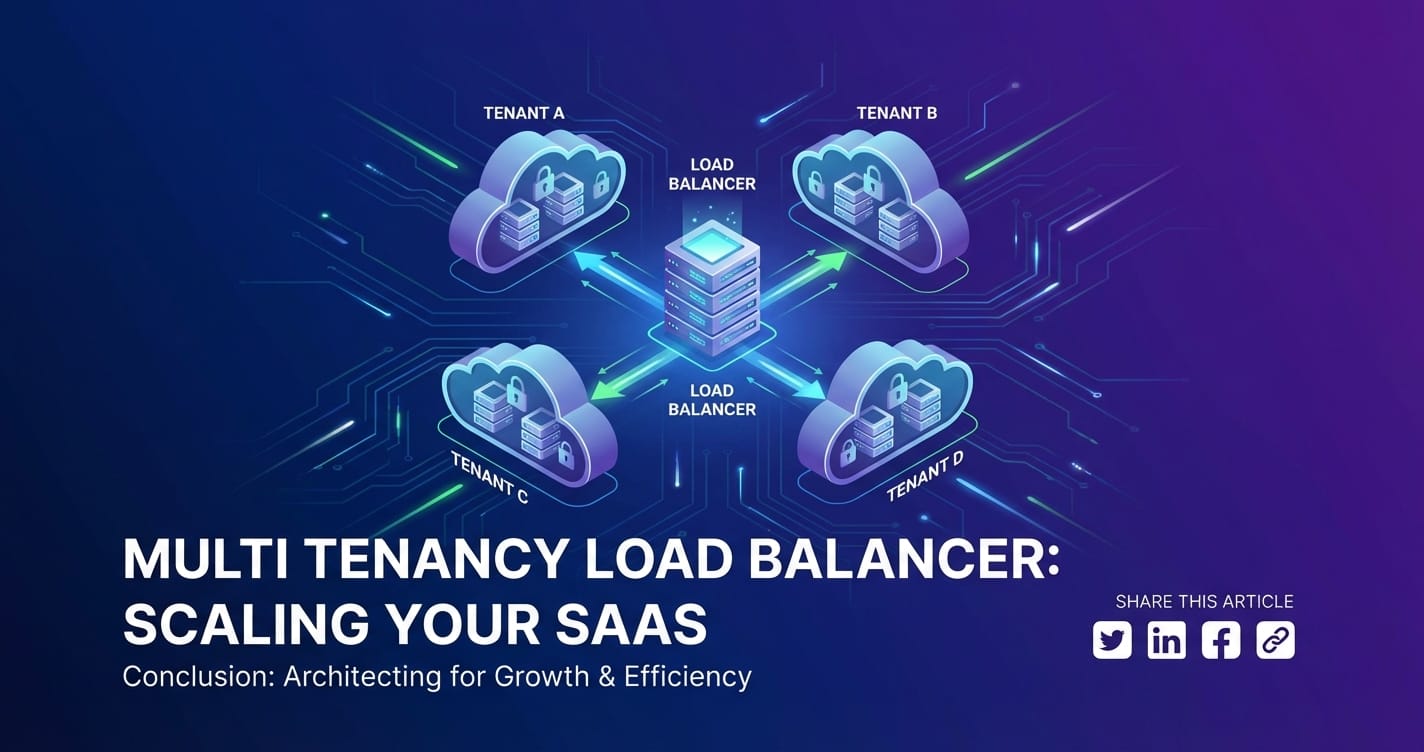
Multi Tenancy Load Balancer: Scaling Your SaaS


In the dynamic world of Software as a Service (SaaS), where innovation is constant and user expectations are ever-increasing, the ability to scale efficiently and securely stands as a paramount challenge. SaaS providers navigate a complex landscape, balancing the need for cost-effectiveness with the imperative to deliver robust, high-performance applications to a diverse customer base. At the heart of this intricate balance lies the concept of multi-tenancy – an architectural paradigm that allows a single instance of a software application to serve multiple customers (tenants). While multi-tenancy offers undeniable advantages in terms of resource optimization and streamlined management, it introduces unique complexities, particularly when it comes to ensuring equitable resource distribution and consistent performance for every tenant. This is precisely where the sophisticated mechanisms of a multi-tenancy load balancer become not just beneficial, but absolutely indispensable.
A multi-tenancy load balancer acts as the intelligent traffic controller for a SaaS application, meticulously directing incoming requests from various tenants to the appropriate backend resources. Unlike traditional load balancers that merely distribute traffic across a pool of identical servers, a multi-tenancy aware system must possess a deeper understanding of the requests it handles, discerning which tenant a request belongs to and routing it accordingly, often with tenant-specific rules, quality-of-service guarantees, and security policies. It's an orchestration challenge that demands precision, flexibility, and foresight, ensuring that the experience of one tenant does not inadvertently degrade the experience of another, a phenomenon often referred to as the "noisy neighbor" problem. As SaaS platforms increasingly rely on microservices and expose their functionalities through a myriad of Application Programming Interfaces (APIs), the role of an api gateway or gateway integrated with multi-tenancy load balancing capabilities becomes even more critical, acting as the primary entry point for all tenant interactions, enforcing policies, and providing a unified façade over complex backend systems. This comprehensive exploration will delve into the intricate world of multi-tenancy load balancing, dissecting its architectural nuances, strategic implementations, and the profound impact it has on the scalability, resilience, and operational efficiency of modern SaaS offerings.
Understanding Multi-Tenancy in SaaS: The Foundation of Scalability
Multi-tenancy is a cornerstone architectural pattern in the SaaS industry, fundamentally enabling providers to serve numerous customers from a single, shared software instance and infrastructure stack. This model contrasts sharply with the single-tenant approach, where each customer receives a dedicated instance of the application and its underlying infrastructure. The adoption of multi-tenancy is driven by a powerful confluence of economic, operational, and strategic benefits, making it the de facto standard for a vast majority of cloud-native applications. However, embracing this model brings with it a unique set of design considerations and challenges, particularly concerning data isolation, security, and resource management.
At its core, multi-tenancy aims to maximize resource utilization by pooling shared computational resources, storage, and network bandwidth across multiple customer accounts. Imagine a colossal apartment building where numerous residents (tenants) share common infrastructure like the building's foundation, electricity grid, and water supply, yet each resident enjoys their own distinct living space with personalized amenities. Similarly, in a multi-tenant SaaS application, while the underlying code, database schemas, and server infrastructure might be shared, each tenant perceives and interacts with their own isolated and customized view of the application, complete with their specific data, configurations, and user accounts. This shared resource model inherently drives down operational costs, as the provider avoids the overhead of deploying, managing, and updating separate application instances for every single customer. Updates and maintenance can be performed once, benefiting all tenants simultaneously, leading to faster feature delivery and reduced maintenance windows.
Despite these compelling advantages, the multi-tenant architecture introduces significant complexities that demand careful architectural planning and robust engineering solutions. The foremost concern is data isolation and security. Each tenant’s data must be strictly segregated from that of others, not only to prevent unauthorized access but also to meet stringent regulatory compliance requirements, such as GDPR or HIPAA. This isolation must be enforced at every layer of the application stack, from the database to the application logic and the user interface. Furthermore, the "noisy neighbor" problem poses a significant challenge: if one tenant heavily utilizes shared resources, their demanding operations could inadvertently degrade the performance experienced by other tenants. This necessitates sophisticated resource governance mechanisms, including intelligent load balancing and resource throttling, to ensure fair usage and consistent performance guarantees for all. Customization, while a desirable feature for tenants, must be carefully managed within a multi-tenant framework to avoid creating maintenance nightmares or compromising the shared codebase.
Different multi-tenancy models have emerged to address these challenges, each offering varying degrees of isolation and resource sharing:
- Shared Database, Shared Schema, Row-Level Segregation: This is the most common and resource-efficient model. All tenants share a single database and a common schema, but each table includes a
tenant_idcolumn to logically separate data. Application logic must rigorously filter all queries bytenant_idto ensure data isolation. While highly cost-effective and scalable, it requires meticulous application-level enforcement of data segregation and can be complex to manage when dealing with diverse tenant data requirements or strict compliance needs. The performance overhead of filtering can also become a consideration at extreme scale. - Shared Database, Separate Schemas: In this model, all tenants share the same physical database instance, but each tenant has its own dedicated schema within that database. This provides a stronger logical separation of data than row-level segregation, as tables are physically separated at the schema level. It simplifies data management and backup/restore operations for individual tenants, but still shares the underlying database server resources. This approach offers a good balance between isolation and resource efficiency, often preferred for its improved security posture over row-level segregation.
- Separate Databases, Shared Application Instance: Here, each tenant is assigned its own dedicated database instance (which might still run on a shared database server or a dedicated one), but all tenants share the same application code instance. This offers the highest degree of data isolation and simplified compliance, as each tenant's data is entirely separate. It mitigates the "noisy neighbor" problem at the database layer but still shares computational resources at the application server level. This model is often chosen when data privacy and compliance are paramount, or when individual tenant databases need to be managed, backed up, or restored independently.
- Separate Everything (Dedicated Instances): While not strictly multi-tenancy in the purest sense, some SaaS providers offer "private instances" for enterprise clients, where a tenant gets a completely dedicated stack – application, database, and infrastructure. This provides ultimate isolation and customization but comes with significantly higher costs and operational overhead, essentially resembling a traditional single-tenant deployment managed by the SaaS provider. This is typically reserved for premium tiers or clients with extremely stringent security or performance requirements.
The choice of multi-tenancy model profoundly influences the architecture of the application, including how load balancing is implemented. Each model presents different challenges and opportunities for optimizing resource allocation, ensuring data security, and maintaining application performance across all tenants. The intelligent design and implementation of these underlying multi-tenancy principles are the bedrock upon which highly scalable and resilient SaaS platforms are built, demanding a sophisticated api gateway or gateway solution that can gracefully handle the routing and policy enforcement for diverse tenant traffic.
The Foundation: Load Balancing Principles
Before diving into the complexities of multi-tenancy, it is crucial to establish a firm understanding of fundamental load balancing principles. Load balancing is an indispensable technique in modern distributed systems, serving as the frontline defense against service outages and a critical enabler for high availability, fault tolerance, and optimal resource utilization. At its core, a load balancer acts as a reverse proxy, sitting in front of a group of servers (often called a server farm or backend pool) and intelligently distributing incoming network traffic across them. Its primary objective is to prevent any single server from becoming a bottleneck, thereby improving overall application responsiveness and maximizing throughput.
The necessity for load balancing arises from several key operational requirements:
- Traffic Distribution: The most obvious function is to spread client requests evenly or intelligently across multiple servers. This ensures that no single server is overwhelmed, which could lead to performance degradation, slow response times, or even server crashes.
- High Availability (HA): By distributing traffic, load balancers ensure that if one server in the pool fails, traffic can be seamlessly redirected to other healthy servers. This failover mechanism is critical for maintaining continuous service availability and minimizing downtime, a non-negotiable requirement for any SaaS platform.
- Scalability: When demand increases, new servers can be added to the backend pool. The load balancer automatically incorporates these new resources into its distribution scheme, allowing applications to scale horizontally without architectural changes visible to the end-user.
- Performance Optimization: By preventing server overload, load balancing helps maintain consistent application performance and faster response times, directly contributing to a better user experience.
- Security: Load balancers can also serve as the first line of defense against certain types of attacks, by hiding backend server IP addresses, performing TLS termination, or integrating with Web Application Firewalls (WAFs).
Load balancers employ various algorithms to decide how to distribute incoming requests. The choice of algorithm can significantly impact performance, fairness, and the perception of latency for users. Some of the most common algorithms include:
- Round Robin: This is the simplest load balancing algorithm. Requests are distributed to servers sequentially. Server 1 gets the first request, Server 2 the second, and so on, until the last server, then it cycles back to Server 1. It assumes all servers are equally capable and handles requests in roughly the same amount of time. While easy to implement, it doesn't account for server load or capacity differences.
- Weighted Round Robin: An enhancement to Round Robin, where servers are assigned a "weight" based on their processing capacity or recent performance. Servers with higher weights receive a proportionally larger share of requests. This is useful in heterogeneous server environments where some servers are more powerful than others.
- Least Connections: This algorithm directs new requests to the server with the fewest active connections. It's more dynamic than Round Robin as it considers the current load on each server. This often leads to a more balanced distribution of work, especially when request processing times vary significantly.
- Weighted Least Connections: Combines the "least connections" approach with server weights. Servers with higher weights are considered capable of handling more connections and will receive new requests even if they have slightly more connections than a lower-weighted server.
- IP Hash: The source IP address of the client is used to generate a hash key, which determines which server receives the request. This ensures that a particular client consistently connects to the same server, which is crucial for applications that require session persistence (sticky sessions) without relying on application-level session management.
- Least Response Time: This algorithm directs traffic to the server that has the fastest response time and the fewest active connections. It aims to optimize for overall user experience by prioritizing speed.
Load balancers can be broadly categorized into hardware and software implementations:
- Hardware Load Balancers: These are dedicated physical appliances (e.g., F5 BIG-IP, Citrix ADC) designed for high performance and reliability. They typically offer advanced features, low latency, and specialized hardware for specific tasks like SSL offloading. However, they come with high upfront costs, can be complex to manage, and lack the flexibility of software solutions in cloud environments.
- Software Load Balancers: These run on standard servers or as virtual machines (e.g., Nginx, HAProxy, AWS Elastic Load Balancer, Google Cloud Load Balancing, Azure Load Balancer). They are highly flexible, scalable, and cost-effective, making them ideal for cloud-native architectures and microservices. They can be deployed quickly and integrated seamlessly with other cloud services. The vast majority of modern SaaS applications leverage software-defined load balancing.
Furthermore, load balancing operates at different layers of the OSI model:
- Layer 4 (L4) Load Balancing: Operates at the transport layer, primarily based on IP addresses and port numbers. It simply forwards packets to backend servers without inspecting the content of the request. L4 load balancers are fast and efficient for TCP/UDP traffic but lack application-level intelligence. Examples include AWS Network Load Balancer (NLB).
- Layer 7 (L7) Load Balancing: Operates at the application layer, allowing for deep inspection of HTTP/HTTPS traffic. This enables more intelligent routing decisions based on URL paths, HTTP headers, cookies, and even the content of the request itself. L7 load balancers can perform SSL termination, URL rewriting, content-based routing, and
api gatewayfunctionalities. While adding a bit more latency due to content inspection, the benefits of advanced routing, security, and policy enforcement are often crucial for complex web applications and RESTfulapis. Examples include AWS Application Load Balancer (ALB), Nginx, and specializedapi gatewayproducts.
For multi-tenant SaaS applications, especially those built on microservices and exposing numerous apis, L7 load balancing is often the preferred choice. It provides the necessary intelligence to inspect tenant-specific identifiers within HTTP headers or URL paths, enabling sophisticated routing to dedicated tenant resources or enforcing tenant-specific policies. This deeper level of insight is foundational for building a truly tenant-aware load balancing solution that can handle the unique demands of a multi-tenant environment, where the intelligent api gateway plays a pivotal role in enforcing these granular rules and policies.
The Intersection: Multi-Tenancy and Load Balancing Challenges
Integrating multi-tenancy with load balancing introduces a layer of complexity that goes far beyond the typical challenges of distributing traffic. While standard load balancers aim for uniform distribution across a homogenous pool of servers, a multi-tenancy environment demands intelligent, tenant-aware routing and resource management. The core issue is that not all requests are equal; each request carries an implicit (or explicit) tenant context that must influence how it is processed. This confluence of multi-tenancy and load balancing creates several unique and significant challenges that architects and engineers must meticulously address to ensure a scalable, secure, and performant SaaS platform.
One of the primary challenges is Tenant-Aware Routing. In a single-tenant or even a typical multi-service architecture, requests are often routed based on generic criteria like URL path or server health. In a multi-tenant system, however, the load balancer or api gateway needs to identify the tenant associated with an incoming request before routing. This identification can come from various sources: a subdomain (e.g., tenant1.your-saas.com), a custom HTTP header (X-Tenant-ID), a path prefix (/api/v1/tenant1/...), or even a claim within an authentication token (like a JWT). Once the tenant is identified, the load balancer might need to route the request to a specific set of backend servers dedicated to that tenant, to a particular region where the tenant's data resides for data locality, or to a pool of servers designated for a specific tenant tier (e.g., premium vs. free tier). Generic round-robin or least-connections algorithms fall short here, as they do not account for these tenant-specific requirements.
Performance Isolation is another critical concern. In a shared infrastructure model, the "noisy neighbor" problem is a constant threat. A single resource-intensive query or a sudden spike in traffic from one tenant could consume an disproportionate amount of CPU, memory, or network bandwidth, thereby degrading the performance for all other tenants sharing the same backend resources. A multi-tenancy load balancer must implement mechanisms to prevent this, such as: * Tenant-specific rate limiting: Throttling the number of requests a single tenant can make within a given time frame. * Resource quotas: Allocating dedicated slices of compute resources (CPU, memory) to different tenant groups. * Queueing and prioritization: Ensuring critical tenant requests are processed before less urgent ones, or isolating high-volume tenants into separate processing queues. These mechanisms go beyond basic load balancing and often require the intelligence of an api gateway or gateway capable of inspecting, modifying, and enforcing policies on individual api calls.
Security Considerations are magnified in a multi-tenant environment. The load balancer is the first point of contact for external traffic and must play a role in enforcing tenant separation. While data isolation is primarily handled at the application and database layers, the load balancer can contribute by: * Authenticating tenant identities: Integrating with identity providers to verify tenant credentials before forwarding requests. * Enforcing tenant-specific access policies: Ensuring that requests for one tenant's resources cannot be mistakenly or maliciously routed to another tenant's backend. * TLS termination and encryption: Managing SSL/TLS certificates for multiple tenant subdomains and ensuring secure communication from the client to the load balancer, and potentially re-encrypting for backend communication. A misconfiguration at the load balancer level could potentially expose one tenant's traffic or even data to another, making its security configuration paramount.
Scalability for individual tenants versus global scale presents a dual challenge. The load balancer needs to be able to scale horizontally to handle an ever-increasing number of overall requests from all tenants combined. However, it also needs to gracefully handle sudden, massive spikes in traffic from a single tenant without impacting the stability or performance of the entire system. This often requires dynamic scaling capabilities for backend server pools that can be triggered by tenant-specific metrics, or the ability to dynamically provision dedicated resources for high-demand tenants.
Finally, Cost Optimization is always a factor. While multi-tenancy inherently aims to reduce costs through resource sharing, the implementation of sophisticated tenant-aware load balancing features can introduce additional overhead. Architects must balance the need for granular control and isolation with the cost of running and managing these advanced load balancing solutions. Cloud-native load balancers and api gateway services often provide a cost-effective way to achieve these goals, as they manage much of the underlying infrastructure complexity. However, careful monitoring and optimization are still required to prevent spiraling cloud bills, especially as the number of tenants and their demands grow.
The synthesis of multi-tenancy requirements with fundamental load balancing principles necessitates a thoughtful architectural approach. Generic load balancing solutions are insufficient; instead, a multi-tenancy load balancer must be deeply integrated into the application's understanding of its tenants, often leveraging the policy enforcement and routing capabilities of an advanced api gateway to effectively manage the ingress traffic for a complex SaaS ecosystem.
Multi-Tenancy Load Balancer Architectures and Strategies
Designing a multi-tenancy load balancing strategy requires a careful evaluation of trade-offs between cost, isolation, performance, and operational complexity. There isn't a one-size-fits-all solution; instead, architectures are typically tailored to the specific needs of the SaaS product, its target market, and its security/compliance requirements. The key is to leverage the intelligence of L7 load balancing and api gateway functionalities to implement tenant-aware routing decisions.
1. Shared Load Balancer with Tenant-Aware Routing
This is the most common and cost-effective approach for many multi-tenant SaaS applications. A single, shared load balancer (or a cluster of load balancers for high availability) serves as the entry point for all tenants. The intelligence lies in how this load balancer identifies the tenant and routes the request accordingly to the appropriate backend service or application instance.
- How it works:
- Tenant Identification: The load balancer inspects incoming requests to extract tenant identifiers. Common methods include:
- Subdomains: Each tenant accesses the service via a unique subdomain (e.g.,
tenantA.app.com,tenantB.app.com). The load balancer uses Server Name Indication (SNI) for TLS termination and the Host header for routing. - URL Path Prefixes: Requests include a tenant identifier in the URL path (e.g.,
/api/v1/tenantA/resource,/tenantB/dashboard). - Custom HTTP Headers: Tenants send a specific header (e.g.,
X-Tenant-ID: tenantA) with each request. This is particularly common forapicalls. - JWT Claims: For authenticated requests, the JSON Web Token (JWT) often contains a
tenant_idclaim. Anapi gatewayor specialized load balancer can decode the JWT and use this information for routing and policy enforcement.
- Subdomains: Each tenant accesses the service via a unique subdomain (e.g.,
- Routing Logic: Once the tenant is identified, the load balancer applies pre-configured rules to route the request. This might involve:
- Directing all requests for a specific tenant to a particular backend server pool (e.g., premium tenant servers).
- Routing to a specific microservice instance that is configured for that tenant's data region.
- Applying tenant-specific rate limits or security policies before forwarding.
- Tenant Identification: The load balancer inspects incoming requests to extract tenant identifiers. Common methods include:
- Benefits:
- Cost Efficiency: Maximizes resource utilization by sharing the load balancer infrastructure across all tenants.
- Simplified Management: A single point of control for ingress traffic.
- Flexibility: Easily adaptable to new tenants without provisioning new infrastructure for the load balancer itself.
- Drawbacks:
- Potential for Noisy Neighbor: While routing can be tenant-aware, the load balancer itself is a shared resource, and extreme traffic from one tenant could potentially impact others if not properly managed with resource isolation and throttling.
- Configuration Complexity: Maintaining tenant-specific routing rules, SSL certificates for numerous subdomains, and policy configurations can become complex as the number of tenants grows.
- Security Concerns: A single point of failure and potential for misconfiguration, though robust design and testing mitigate this.
- Implementation Details: Cloud-native L7 load balancers (like AWS ALB, Azure Application Gateway) are excellent for this, offering host-based and path-based routing. Open-source solutions like Nginx, HAProxy, or Envoy configured with advanced routing rules can also achieve this. An
api gatewayis particularly well-suited for this strategy, as it inherently operates at L7, can parse JWTs, apply tenant-specific rate limits, and transform requests before forwarding them to backendapis. For example, anapi gatewaycan extracttenant_idfrom a JWT and add it as a header to the request before sending it to the upstream microservice.
2. Dedicated Load Balancers per Tenant Group/Tier
This strategy provides a higher degree of isolation by assigning dedicated load balancers (or smaller clusters of them) to specific groups of tenants, typically segmented by tier (e.g., enterprise, premium, standard) or by geographic region.
- How it works: Instead of a single global load balancer, there are multiple, smaller load balancer instances. Each instance is responsible for a subset of tenants. For instance,
premium.your-saas.commight point to a dedicated load balancer that then routes to a dedicated pool of high-performance servers, whilestandard.your-saas.compoints to another load balancer for standard tenants. - Benefits:
- Improved Performance Isolation: Traffic from premium tenants is completely isolated at the load balancer level, preventing noisy neighbors from impacting their experience.
- Enhanced Security: A breach or misconfiguration in one tenant's load balancer is less likely to affect others.
- Easier Compliance: Simpler to meet specific regulatory requirements for certain tenant groups by isolating their traffic paths.
- Tiered Offerings: Clearly aligns infrastructure with different service level agreements (SLAs) for various tenant tiers.
- Drawbacks:
- Higher Cost: Each dedicated load balancer instance incurs its own cost, significantly increasing infrastructure expenses compared to a shared model.
- Increased Operational Overhead: Managing multiple load balancer instances, their configurations, and their lifecycles is more complex.
- Resource Underutilization: Dedicated load balancers might be underutilized during low traffic periods, leading to wasted resources.
- When to use: This is typically reserved for high-value enterprise tenants, those with strict performance or security SLAs, or for large-scale SaaS providers who can absorb the increased cost and operational complexity.
3. Hybrid Approaches
Many large-scale SaaS providers adopt a hybrid model, combining shared and dedicated strategies. For example, a shared api gateway might handle initial routing and authentication for all tenants, but then premium tenants are routed to a dedicated load balancer that fronts their isolated backend services, while standard tenants are routed to shared backend services. This provides a balance between cost efficiency and targeted isolation.
4. Containerization and Orchestration (Kubernetes)
Modern multi-tenant SaaS applications are increasingly built using containerization and orchestrated with platforms like Kubernetes. This fundamentally changes how load balancing is managed:
- Ingress Controllers: In Kubernetes, an Ingress controller (e.g., Nginx Ingress, Traefik, Istio Ingress
gateway) acts as the L7 load balancer for traffic entering the cluster. It can be configured with tenant-aware routing rules based on hostnames, paths, or headers, directing traffic to appropriate tenant-specific services or namespaces. - Service Meshes: For inter-service communication within the cluster, a service mesh (e.g., Istio, Linkerd) provides advanced traffic management, including load balancing, circuit breaking, and policy enforcement at a very granular level. While not directly an ingress load balancer, it ensures tenant isolation and consistent performance within the microservices architecture.
- Namespace-per-Tenant: A common pattern in Kubernetes multi-tenancy is to dedicate a Kubernetes namespace to each tenant or group of tenants. This provides strong logical isolation, and the Ingress controller can route traffic directly to services within a tenant's namespace. This approach significantly streamlines the deployment and management of tenant-aware routing logic, leveraging the declarative nature of Kubernetes for configuration and scaling.
5. Serverless and FaaS
In serverless architectures (e.g., AWS Lambda, Azure Functions, Google Cloud Functions), traditional load balancers are often replaced or augmented by managed gateway services (e.g., AWS API Gateway, Azure API Management). These services are inherently multi-tenant and handle load balancing, scaling, and request routing automatically.
- Tenant Identification: These
gatewayservices can extract tenant IDs from headers, paths, or JWTs, just like traditional L7 load balancers. - Function Routing: They can then route requests to specific serverless functions or different versions of functions based on the tenant.
- Built-in Policies: They often provide built-in capabilities for rate limiting, authorization, and caching, which can be configured on a per-tenant or per-
apibasis, alleviating the need for a separate load balancer for these concerns.
The Role of APIPark: In this complex landscape of multi-tenancy load balancing, an advanced api gateway and API management platform like APIPark offers significant value. It naturally fits into the shared load balancer with tenant-aware routing strategy, enhancing it with rich API management capabilities. APIPark, as an open-source AI gateway and API developer portal, excels at providing independent API and access permissions for each tenant, allowing for the creation of multiple teams (tenants) with distinct applications, data, user configurations, and security policies. This directly supports granular tenant isolation at the api gateway layer. Its ability to manage traffic forwarding, load balancing, and versioning of published apis means it can intelligently route tenant-specific api calls. Furthermore, features like "API resource access requires approval" allow for an additional layer of tenant access control, ensuring unauthorized api calls are prevented. By centralizing the display of all api services and allowing for team sharing, APIPark streamlines api governance while maintaining tenant-specific controls, making it an ideal choice for implementing the api gateway component within a sophisticated multi-tenant load balancing architecture. Its high performance, rivaling Nginx, ensures that it can handle the scale required for large multi-tenant SaaS platforms, processing over 20,000 TPS with an 8-core CPU and 8GB of memory, and supporting cluster deployment for even larger traffic volumes.
Each of these architectural strategies offers distinct advantages and disadvantages. The ultimate decision depends on the specific requirements for tenant isolation, performance, security, and the budget available for infrastructure and operational management. The growing sophistication of L7 load balancers and api gateway solutions, often integrated into cloud providers' offerings or powerful open-source projects, provides the tools necessary to build highly scalable and resilient multi-tenant SaaS applications.
Key Features of an Effective Multi-Tenancy Load Balancer
An effective multi-tenancy load balancer transcends the capabilities of a generic load balancer by incorporating intelligence and features specifically designed to handle the unique demands of a shared application environment. It acts as a critical control point, enforcing policies and ensuring equitable service delivery across all tenants. For SaaS providers, selecting or building a solution with these key features is paramount for maintaining performance, security, and operational efficiency.
1. Tenant Identification and Routing
This is the most fundamental feature. The load balancer must be able to reliably identify the tenant associated with each incoming request. As discussed, this can be achieved through: * HTTP Host Header (Subdomains): Routing based on tenantA.your-saas.com. * URL Path Segmentation: Routing based on /tenantA/api/.... * Custom HTTP Headers: Leveraging a custom X-Tenant-ID header, particularly for api traffic. * JWT Claims: Decrypting and inspecting claims within JSON Web Tokens for a tenant_id or similar identifier. This requires an L7 load balancer or api gateway with robust authentication and authorization capabilities. Once identified, the system must dynamically route requests to the correct backend services, which might be tenant-specific instances, regional deployments, or distinct microservices designed to handle a particular tenant's logic or data. This dynamic routing capability is the bedrock of multi-tenant application delivery.
2. Dynamic Configuration
SaaS environments are constantly evolving. New tenants are onboarded, existing tenants upgrade their tiers, and some might even churn. A multi-tenancy load balancer must support dynamic configuration updates without requiring downtime or manual intervention for every change. This includes: * Adding or removing backend server pools for specific tenants. * Updating routing rules based on tenant tier changes. * Managing SSL certificates for new tenant subdomains automatically. * Adjusting rate limits and throttling policies on the fly. Integration with configuration management systems (like Terraform, Ansible) or service discovery mechanisms (like Consul, Kubernetes service discovery) is crucial for automating these updates.
3. Performance Isolation and Throttling
To mitigate the "noisy neighbor" problem, robust mechanisms for performance isolation are essential. The load balancer (or api gateway) should offer: * Tenant-Specific Rate Limiting: Limiting the number of requests a single tenant can make within a specified time window to prevent a single tenant from monopolizing resources. This can be configured at different granularities (per api, per user, per IP). * Traffic Shaping and Prioritization: For premium tenants, the load balancer might prioritize their requests or ensure they always have access to a minimum level of bandwidth/processing capacity. * Resource Quotas: While primarily enforced at the backend service layer, the load balancer can contribute by preventing excessive traffic from even reaching oversubscribed backend resources. These features are often integrated into advanced api gateway solutions, allowing for granular control over api consumption and resource usage across different tenants and their api calls.
4. Security Enhancements
The load balancer is the first line of defense for a multi-tenant application. It must offer robust security features: * TLS Termination and Management: Handling SSL/TLS encryption and decryption, offloading this compute-intensive task from backend servers. Crucially, it must support Server Name Indication (SNI) to manage multiple SSL certificates for various tenant subdomains. * DDoS Protection: Integrating with or providing native capabilities for Distributed Denial of Service (DDoS) attack mitigation. * Web Application Firewall (WAF) Integration: Filtering malicious traffic, SQL injection attempts, cross-site scripting (XSS), and other common web vulnerabilities before they reach the backend application. * Authentication and Authorization Integration: While full authorization happens at the application layer, the load balancer can perform initial authentication checks (e.g., validating API keys, checking JWT signatures) and use this information to inform routing or reject unauthorized access early in the request lifecycle. * IP Whitelisting/Blacklisting: Controlling access based on source IP addresses.
5. Observability: Logging and Monitoring per Tenant
For troubleshooting, performance analysis, and billing, granular observability is critical. The multi-tenancy load balancer should provide: * Detailed Access Logs: Logging every request, including tenant identifiers, request headers, response times, and error codes. These logs are invaluable for debugging tenant-specific issues. * Tenant-Specific Metrics: Collecting and exposing metrics such as requests per second, error rates, and latency, broken down by tenant. This allows operators to identify noisy neighbors, performance bottlenecks for specific tenants, and to generate billing reports. * Integration with Monitoring Tools: Seamless integration with popular monitoring and alerting systems (e.g., Prometheus, Datadog, Splunk) for real-time insights and proactive issue detection.
6. Scalability of the Load Balancer Itself
While the load balancer helps scale backend services, it must also be horizontally scalable to handle the ever-increasing aggregate traffic from a growing number of tenants. Cloud-native load balancers (like AWS ALB/NLB, Azure Application Gateway/Load Balancer, GCP Load Balancer) are designed for elastic scalability. For self-hosted solutions like Nginx or HAProxy, running them in a highly available cluster configuration is essential.
7. API Management Integration
For modern SaaS applications heavily reliant on apis, integrating multi-tenancy load balancing with an api gateway is a powerful strategy. An api gateway naturally extends the load balancer's capabilities by adding: * API Key Management and Validation: Managing tenant-specific api keys. * API Versioning: Routing requests to different api versions based on tenant preferences or specific client needs. * Request/Response Transformation: Modifying api requests or responses on the fly, e.g., adding tenant context to requests or filtering response data. * Caching: Caching api responses to reduce load on backend services and improve performance for frequently accessed data, potentially on a tenant-specific basis.
APIPark's Contribution to Key Features: This is where products like APIPark truly shine. As an AI gateway and API management platform, APIPark natively provides many of these key features essential for multi-tenancy load balancing. Its core functionality of "Independent API and Access Permissions for Each Tenant" directly addresses tenant identification and routing, allowing distinct apis and policies for each. Features like "End-to-End API Lifecycle Management" ensure dynamic configuration for apis, while "API Resource Access Requires Approval" enhances security by allowing administrators to control access to specific apis per tenant. Performance metrics and detailed api call logging provided by APIPark directly contribute to observability, offering "detailed API call logging" and "powerful data analysis" to monitor performance and usage per api and, by extension, per tenant utilizing those apis. The platform's performance, achieving over 20,000 TPS, demonstrates its inherent scalability, making it a robust choice for handling the demanding traffic of numerous tenants. By combining advanced api gateway functionalities with multi-tenancy awareness, APIPark helps SaaS providers build highly scalable, secure, and manageable api ecosystems.
By meticulously implementing these features, SaaS providers can leverage multi-tenancy to its full potential, achieving significant cost savings and operational efficiencies while delivering a high-quality, isolated, and secure experience to every single tenant.
Implementing Multi-Tenancy Load Balancing: Practical Considerations
The theoretical understanding of multi-tenancy load balancing principles must translate into practical, robust implementations. This involves making informed technology choices, integrating with crucial ecosystem components, and rigorously addressing operational challenges. The success of a multi-tenant SaaS platform heavily relies on how effectively these practical considerations are handled, ensuring that the architecture can scale reliably and securely as the tenant base grows.
1. Choice of Technology
The selection of the right load balancing technology is paramount. This decision typically hinges on factors such as cloud strategy, existing infrastructure, performance requirements, budget, and the need for specific L7 features.
- Cloud-Native Load Balancers: For applications hosted on major cloud providers (AWS, Azure, Google Cloud), leveraging their native load balancing services is often the most straightforward and recommended approach.
- AWS:
- Application Load Balancer (ALB): An L7 load balancer ideal for HTTP/HTTPS traffic. It supports host-based routing (for tenant subdomains), path-based routing, and can integrate with AWS WAF for security. ALB is fully managed, highly scalable, and integrates seamlessly with other AWS services, making it excellent for multi-tenant SaaS.
- Network Load Balancer (NLB): An L4 load balancer offering extreme performance and static IP addresses. While less intelligent for tenant-aware routing, it can be used in conjunction with ALBs or
api gateways for specific high-throughput, low-latency scenarios.
- Azure:
- Application Gateway: Azure's L7 load balancer, similar to AWS ALB. It supports URL-based routing, host-based routing, SSL termination, and integrated WAF. It's a strong choice for multi-tenant web applications.
- Azure Load Balancer: An L4 load balancer for high-performance TCP/UDP traffic, often used for internal traffic distribution or non-HTTP services.
- Google Cloud Load Balancing: Offers a unified global load balancing solution that can perform L7 routing, SSL termination, and WAF integration. It's highly scalable and ideal for globally distributed multi-tenant applications.
- AWS:
- Open-Source Software Load Balancers/API Gateways: For self-hosted environments or when more control and customization are required, open-source solutions are powerful alternatives.
- Nginx/Nginx Plus: A high-performance web server and reverse proxy that excels at L7 load balancing. Its configuration language allows for complex, tenant-aware routing rules based on host headers, paths, and custom variables. Nginx Plus offers additional enterprise features like
api gatewaycapabilities, advanced health checks, and a wider range of load balancing algorithms. - HAProxy: Renowned for its performance, stability, and high availability, HAProxy is an excellent choice for both L4 and L7 load balancing. It provides robust capabilities for content-based routing, SSL offloading, and sticky sessions, making it suitable for intricate multi-tenant setups.
- Envoy Proxy: A modern, high-performance L7 proxy designed for cloud-native applications and service mesh architectures. It's highly extensible and can be configured for sophisticated tenant-aware routing, traffic shadowing, and policy enforcement, often used as an
api gatewayor part of an Ingress controller in Kubernetes. - Kong/Tyk/Apigee: These are full-fledged
api gatewaysolutions built on top of proxies like Nginx or Envoy. They provide extensiveapimanagement features crucial for multi-tenancy, includingapikey management, rate limiting, authentication, authorization, and analytics on a per-tenant or per-apibasis.
- Nginx/Nginx Plus: A high-performance web server and reverse proxy that excels at L7 load balancing. Its configuration language allows for complex, tenant-aware routing rules based on host headers, paths, and custom variables. Nginx Plus offers additional enterprise features like
The selection should align with the SaaS provider's operational expertise. Managed cloud services reduce operational overhead, while self-managed open-source solutions offer maximum flexibility and control.
2. Integration with Identity and Access Management (IAM)
For a multi-tenant application, authentication and authorization are critical. The load balancer or api gateway should ideally integrate with the SaaS platform's IAM system to facilitate tenant identification and enforce initial access policies. * Authentication: The load balancer can be configured to validate authentication tokens (e.g., JWTs) or API keys before forwarding requests to backend services. This offloads authentication logic from the application servers and rejects unauthorized traffic at the edge. * Tenant Context Propagation: Once a tenant is authenticated and identified, the load balancer should inject the tenant_id into the request (e.g., as an HTTP header) before sending it to the backend. This ensures that downstream microservices receive the necessary tenant context without re-processing authentication information. * Single Sign-On (SSO): For B2B SaaS, integration with enterprise SSO solutions (like Okta, Auth0, Azure AD) is crucial. The api gateway or load balancer plays a role in redirecting authentication flows and handling token exchange.
3. Data Locality and Compliance
For globally distributed SaaS applications, data locality and compliance requirements often dictate routing decisions. * Geographic Routing: The load balancer should be able to route tenants to application instances and databases in specific geographic regions to comply with data residency laws (e.g., GDPR requires EU data to stay in the EU). This often involves using DNS-based routing (e.g., latency-based or geo-location DNS) to direct clients to the closest load balancer, which then routes to regional backend resources. * Compliance Zones: For tenants with very strict compliance needs (e.g., HIPAA for healthcare data), their traffic might need to be routed to dedicated "compliance zones" or isolated environments within the shared infrastructure, overseen by a dedicated load balancer.
4. Cost Management
While multi-tenancy aims for cost efficiency, complex load balancing strategies can introduce new costs. * Resource Sizing: Appropriately size load balancer instances and backend pools. Over-provisioning leads to wasted resources, while under-provisioning can lead to performance issues. * Monitoring and Optimization: Continuously monitor usage patterns to identify opportunities for optimization, such as consolidating load balancer instances or adjusting auto-scaling policies. * Managed Services vs. Self-Hosted: Evaluate the total cost of ownership (TCO) for managed cloud load balancers versus self-hosting open-source solutions, considering not just infrastructure costs but also operational overhead (staffing, maintenance, upgrades).
5. Testing and Validation
Rigorous testing is non-negotiable for multi-tenancy load balancing. * Functional Testing: Ensure all tenant-specific routing rules work as expected. * Performance Testing: Simulate high traffic loads from multiple tenants simultaneously and from individual tenants to identify bottlenecks and ensure performance isolation. Test for the "noisy neighbor" problem. * Security Testing: Verify tenant data isolation and access control mechanisms at the load balancer level. Conduct penetration testing to uncover potential vulnerabilities in routing or policy enforcement. * Failover Testing: Simulate load balancer and backend server failures to ensure graceful failover and minimal impact on tenants.
APIPark's Role in Practical Implementation: APIPark significantly simplifies many of these practical considerations. Its quick integration of 100+ AI models and unified API format for AI invocation reduce the complexity of integrating diverse backend services into a multi-tenant architecture. The platform's capability for end-to-end API lifecycle management directly supports dynamic configuration and versioning for tenant-specific apis. By providing independent API and access permissions for each tenant, APIPark directly addresses the critical aspects of IAM integration and tenant context propagation. Moreover, its detailed API call logging and powerful data analysis features are invaluable for cost management, performance monitoring, and troubleshooting, providing granular insights into tenant-specific usage and api performance, which are crucial for optimizing resource allocation and identifying potential noisy neighbors. With its easy deployment via a single command line and robust performance, APIPark stands as a powerful api gateway that streamlines the implementation of sophisticated multi-tenancy load balancing for modern SaaS.
By meticulously addressing these practical considerations, SaaS providers can build a multi-tenant load balancing architecture that is not only highly performant and secure but also operationally efficient and adaptable to the evolving needs of their customer base.
The Role of an API Gateway in Multi-Tenancy Load Balancing
While a load balancer efficiently distributes network traffic, an api gateway takes this concept several steps further, operating at the application layer (L7) with a deep understanding of api semantics. For multi-tenant SaaS applications, an api gateway is not merely an optional component but often a fundamental requirement, augmenting and extending the capabilities of a pure load balancer to provide sophisticated tenant-aware functionalities. It acts as the single entry point for all api requests, offering a centralized point for managing, securing, and optimizing the interaction between tenants and backend services.
Distinction Between a Pure Load Balancer and an API Gateway
Before diving into their synergistic relationship, it's helpful to clarify the primary distinctions:
- Load Balancer (Generic): Primarily focuses on network traffic distribution. It routes requests to backend servers based on network-level information (IP, port) or basic HTTP headers (Host). Its main concerns are high availability, fault tolerance, and evenly spreading load. It might do SSL termination and basic path-based routing, but its policy enforcement is typically less granular.
- API Gateway: A specialized type of L7 reverse proxy that sits in front of one or more
apis (microservices). It not only handles load balancing but also provides a comprehensive suite of API management features. It understands the "contract" of theapis, applies policies to individualapicalls, and acts as a façade that hides the complexity of backend services.
How an API Gateway Extends Load Balancing Capabilities for Multi-Tenant SaaS
For a multi-tenant SaaS environment, an api gateway significantly enhances the basic load balancing function by enabling tenant-specific policy enforcement and traffic management.
- Tenant-Specific Authentication and Authorization:
- An
api gatewaycan validateapikeys, OAuth tokens, or JWTs for each incomingapirequest. Crucially, it can extract thetenant_idfrom these tokens. - Based on the identified tenant, it can then enforce fine-grained authorization policies, ensuring a tenant can only access
apis and resources they are permitted to use. This is a critical security layer that a basic load balancer cannot provide. - It can also integrate with identity providers to perform tenant-specific authentication flows.
- An
- Rate Limiting and Throttling (per Tenant, per API):
- Beyond simple global rate limits, an
api gatewaycan apply sophisticated rate limiting policies specifically tailored to each tenant's subscription tier or usage agreement. For example, a premium tenant might have a higherapicall limit than a free-tier tenant. - It can also enforce rate limits per specific
apiendpoint for a given tenant, preventing abuse or excessive usage of particular backend resources. This is essential for preventing the "noisy neighbor" problem at theapiconsumption level.
- Beyond simple global rate limits, an
- Caching:
- An
api gatewaycan implementapiresponse caching. For multi-tenant systems, this can be tenant-specific caching, where data is cached only for a particular tenant, or shared caching for public or non-sensitive data across tenants. This reduces the load on backend services and improves response times for frequently requestedapis.
- An
- Request/Response Transformation and Protocol Translation:
- An
api gatewaycan transformapirequests and responses. For example, it can inject thetenant_id(extracted from an authentication token) into the HTTP headers of an outgoing request, ensuring that backend microservices receive the tenant context without having to re-authenticate or parse the token themselves. - It can also perform protocol translation, allowing tenants to interact with
apis using different protocols (e.g., GraphQL to REST) or adaptapiinterfaces for legacy clients.
- An
- Monitoring and Analytics:
api gateways provide comprehensive logging and analytics for everyapicall, including tenant identifiers,apiendpoint invoked, response times, and error codes.- This granular data is invaluable for understanding tenant
apiusage patterns, identifying performance bottlenecks specific to certain tenants orapis, troubleshooting issues, and generating accurate billing reports. This level of insight is crucial for operational efficiency and business intelligence in a multi-tenant environment.
- API Versioning:
- An
api gatewaysimplifiesapiversion management. It can route requests to different versions of backendapis based on tenant configurations,apikeys, or request headers. This allows different tenants to use differentapiversions simultaneously without impacting each other, facilitating smoother upgrades and backward compatibility.
- An
- Service Discovery and Routing for Microservices:
- In a microservices architecture, the
api gatewayintegrates with service discovery mechanisms to dynamically locate and route requests to the correct backend microservice instances, often taking tenant context into account for service selection (e.g., routing to a specific regional microservice instance for a particular tenant).
- In a microservices architecture, the
Introducing APIPark
This is precisely where a robust platform like APIPark becomes an invaluable asset for any multi-tenant SaaS provider. APIPark is an open-source AI gateway and API management platform that is specifically designed to tackle the complexities of managing, integrating, and deploying AI and REST services, making it perfectly suited for the demands of a multi-tenant environment.
Key Multi-Tenancy Benefits from APIPark:
- Independent API and Access Permissions for Each Tenant: APIPark's fundamental design allows for the creation of multiple teams, effectively acting as separate tenants. Each tenant can have independent applications, data, user configurations, and crucially, their own set of
apis and associated security policies. This provides a strong foundation for tenant isolation at theapi gatewaylevel, ensuring that one tenant's configurations orapiaccess doesn't bleed into another's. - API Service Sharing within Teams: While providing isolation, APIPark also facilitates controlled sharing. It allows for the centralized display of all
apiservices, making it easy for different departments or teams (tenants) to discover and use relevantapis, while still enforcing granular permissions. - API Resource Access Requires Approval: This feature adds another layer of security and control essential for multi-tenancy. Callers (or tenants) must subscribe to an
apiand await administrator approval before they can invoke it. This prevents unauthorizedapicalls and potential data breaches, offering precise control over who can access whichapiresources. - Unified API Format for AI Invocation & Prompt Encapsulation into REST API: For SaaS solutions integrating AI, APIPark standardizes
apiinvocation, simplifying the process and reducing maintenance costs, which is highly beneficial in a multi-tenant context where various tenants might leverage different AI models or prompts. - End-to-End API Lifecycle Management & Traffic Management: APIPark assists with the entire
apilifecycle, including managing traffic forwarding, load balancing, and versioning of publishedapis. This means it can intelligently distribute tenant-specificapicalls across backend services, apply policies, and manageapiversions tailored to individual tenant needs. - Performance Rivaling Nginx: With the ability to achieve over 20,000 TPS on modest hardware and support for cluster deployment, APIPark is built to handle large-scale traffic. This high performance is critical for multi-tenant SaaS platforms that need to serve a growing number of tenants simultaneously without performance degradation.
- Detailed API Call Logging & Powerful Data Analysis: APIPark provides comprehensive logging, recording every detail of each
apicall. This enables businesses to quickly trace and troubleshoot issues specific to certainapis or tenants. The powerful data analysis displays long-term trends and performance changes, which is invaluable for monitoring tenant usage, identifyingapiconsumption patterns, and proactive capacity planning in a multi-tenant setup.
By integrating APIPark into a multi-tenant SaaS architecture, providers can leverage a powerful api gateway that not only performs efficient load balancing but also provides a robust framework for tenant-aware api management, security, and observability, directly contributing to the scalability, resilience, and operational excellence of their platform. It centralizes the control and governance of api interactions, making it an indispensable tool for modern, api-driven, multi-tenant SaaS applications.
Table: Comparison of Multi-Tenancy Load Balancing Strategies
| Feature/Strategy | Shared Load Balancer, Tenant-Aware Routing | Dedicated Load Balancers per Tenant Group | Hybrid Approach | Kubernetes Ingress Controller | Serverless API Gateway (e.g., AWS API Gateway) |
|---|---|---|---|---|---|
| Cost Efficiency | High | Low (High cost per tenant group) | Medium | Medium (Kubernetes overhead) | High (Pay-per-use, managed) |
| Tenant Isolation | Logical (at L7, policy-based) | Physical (at load balancer level) | Combination of logical and physical | Logical (namespace-based, Ingress rules) | Logical (managed service, policy-based) |
| Operational Overhead | Medium (complex routing rules) | High (managing multiple instances) | Medium to High (managing both) | Medium (managing Ingress, K8s cluster) | Low (fully managed) |
| Scalability | High (can scale up/out) | High (independent scaling per group) | High | Very High (native K8s scaling) | Very High (auto-scaling) |
| Security | Good (L7 security features) | Excellent (physical separation) | Excellent (targeted isolation) | Good (network policies, RBAC) | Excellent (managed, WAF integration) |
| Complexity | Medium to High (rule management) | High (infrastructure management) | High | Medium (K8s YAMLs, controllers) | Low (configuration via console/API) |
| Best Use Case | Most SaaS apps, cost-sensitive, flexible | High-value enterprise tenants, strict SLA | Balanced approach for tiered offerings | Microservices, containerized apps | Event-driven, FaaS, high variability |
| Example Tech | Nginx, HAProxy, AWS ALB, Azure App Gateway, APIPark | Multiple AWS ALBs, dedicated Nginx clusters | Combination of the above | Nginx Ingress, Traefik, Istio Ingress | AWS API Gateway, Azure API Management, GCP APIG |
Case Studies/Examples (Conceptual)
To solidify the understanding of multi-tenancy load balancing, let's consider a few conceptual examples across different SaaS domains:
1. A B2B SaaS Platform for Marketing Automation
Imagine a marketing automation platform that provides tools for email campaigns, social media scheduling, and CRM integration. This platform serves thousands of businesses, ranging from small startups to large enterprises.
- Multi-Tenancy Model: Shared database with row-level segregation, shared application instances.
- Load Balancing Strategy: Shared
api gatewaywith tenant-aware routing using subdomains and API keys. - Implementation:
- Entry Point: All tenants access the platform through subdomains like
clientA.marketingapp.com,clientB.marketingapp.com. A global L7 load balancer (e.g., AWS ALB or anapi gatewaylike APIPark) handles all incoming traffic. - Tenant Identification: The
api gatewayperforms TLS termination, inspects theHostheader to identify the tenant, and validates theapikey sent with each request. For internalapicalls, thetenant_idis extracted from a JWT. - Routing Logic:
- Requests for the dashboard and UI are routed to a pool of web application servers.
apicalls for sending emails are routed to an email microservice.apicalls for CRM integration are routed to a dedicated integration microservice.
- Tenant-Specific Policies:
- The
api gatewayapplies rate limits based on the tenant's subscription plan. For instance,clientA(premium) might be allowed 1000 emailapicalls per minute, whileclientB(standard) is limited to 100. - Specific
apis (e.g., bulk email sending) might only be accessible to premium tenants, enforced at theapi gatewaylayer.
- The
- Performance Isolation: If
clientClaunches a massive email campaign, causing a spike inapicalls to the email microservice, theapi gateway's rate limiting ensures thatclientC's requests are throttled before they overwhelm the backend, preventing impact onclientAandclientB. - APIPark's Role: APIPark could manage all exposed
apis, enforcing tenant-specific rate limits and access permissions for variousapiendpoints (e.g.,sendEmail,scheduleSocialPost,syncCRM). Its detailed logging would provideclient-specific usage reports for billing and analytics, while its performance ensures smooth operation even during peak campaign periods.
- Entry Point: All tenants access the platform through subdomains like
2. A Multi-Tenant Data Analytics Platform
Consider a platform that allows businesses to upload their data, run analytics, and generate reports. Data processing can be resource-intensive.
- Multi-Tenancy Model: Separate databases per tenant (or separate schemas within a shared database), shared analytics processing engine (containerized).
- Load Balancing Strategy: Kubernetes Ingress Controller with namespace-per-tenant for processing jobs, shared
api gatewayfor data ingestion and report access. - Implementation:
- Data Ingestion
API: Tenants upload data via anapiendpoint (e.g.,/api/v1/ingest). Anapi gateway(like APIPark) receives these requests, authenticates the tenant, and routes the data to the correct tenant-specific storage bucket or database. - Analytics Job Submission: When a tenant initiates an analytics job, an
apicall is made. Theapi gatewayroutes this to a job orchestrator service running in Kubernetes. - Tenant-Isolated Processing: The orchestrator then dynamically spins up Kubernetes pods within the tenant's dedicated namespace (e.g.,
analytics-tenant-id-xyz) to run the analytics job. The Kubernetes Ingress controller would not directly load balance these internal job pods, but it would ensure that the externalapicalls related to job submission and status monitoring are properly routed. - Resource Management: Kubernetes resource quotas applied to each tenant's namespace ensure that one tenant's heavy analytics job doesn't starve resources from others.
- Report Access
API: Once jobs are complete, tenants access their reports via anotherapiendpoint (e.g.,/api/v1/reports). Theapi gatewayroutes these requests to a report service, ensuring tenant-specific report data is retrieved. - APIPark's Role: APIPark would manage the
apis for data ingestion, job submission, and report retrieval. Its ability to manageapis for "independent teams (tenants)" with their own permissions would be crucial here, ensuringclients can only submit jobs and retrieve reports for their own data. Performance analytics from APIPark would help identify whichclients are running the most intensiveapioperations, aiding in resource planning and potential cost allocation.
- Data Ingestion
3. An IoT Platform with Tenant-Specific Device Access
Imagine a platform managing millions of IoT devices from various organizations. Each organization (tenant) owns a specific set of devices and needs real-time data and control.
- Multi-Tenancy Model: Shared backend services (device registry, data stream processors), tenant-specific device access logic.
- Load Balancing Strategy: Cloud-native L7 load balancer with advanced routing, backed by an
api gatewayfor device managementapis. - Implementation:
- Device Telemetry Ingress: Devices connect directly or indirectly via MQTT brokers. An L4 load balancer might distribute MQTT connections, but an L7
api gateway(or a dedicated IoTgatewaythat performs L7 functions) would handleapicalls from tenant applications for device management. - Tenant Application
APIs: Tenant applications interact with the platform throughapis (e.g.,getDeviceStatus,sendDeviceCommand,subscribeToDeviceData). - Tenant Identification: The
api gatewayreceivesapirequests, identifies the tenant from anapikey or OAuth token, and verifies that the requesting tenant has access to the specified device(s). - Routing and Policy:
- Requests for device status are routed to a device registry microservice.
- Commands are routed to a command queue, which then dispatches to devices.
- The
api gatewayensures thattenantAcannot query or commandtenantB's devices. - Rate limits are applied to prevent any single tenant from flooding the platform with commands.
- Data Stream Segregation: While not strictly load balancing, the backend data processing pipelines would also need to segregate tenant data streams based on the
tenant_idpassed through by theapi gateway. - APIPark's Role: APIPark could serve as the central
api gatewayfor all tenant-facing device managementapis. Its granular access permissions ("Independent API and Access Permissions for Each Tenant") would be vital to ensure each tenant only interacts with their own devices. APIPark's logging and analytics would provide insights into deviceapiusage patterns per tenant, helping to detect anomalies or excessive usage. The performance capabilities of APIPark are crucial here, as IoT platforms often deal with very high volumes ofapitraffic for device interactions.
- Device Telemetry Ingress: Devices connect directly or indirectly via MQTT brokers. An L4 load balancer might distribute MQTT connections, but an L7
These examples illustrate how multi-tenancy load balancing, often in conjunction with a powerful api gateway, is critical for creating scalable, secure, and performant SaaS solutions across diverse industry verticals. The intelligent routing and policy enforcement at the edge of the application are what enable these platforms to efficiently serve numerous distinct customers from a shared infrastructure.
Future Trends in Multi-Tenancy and Load Balancing
The landscape of cloud computing and SaaS is in constant flux, driven by advancements in technology and evolving demands from users. Multi-tenancy load balancing, as a critical component of this ecosystem, is likewise subject to continuous innovation. Several key trends are emerging that promise to further refine and enhance how SaaS providers manage traffic, optimize resources, and secure their multi-tenant applications.
1. AI-Driven Load Balancing and Predictive Scaling
The integration of Artificial Intelligence and Machine Learning into load balancing is moving beyond simple algorithmic routing. Future multi-tenancy load balancers will leverage AI to: * Predictive Scaling: Analyze historical tenant usage patterns, seasonality, and upcoming events (e.g., a major holiday for an e-commerce tenant) to proactively scale backend resources before demand spikes. This minimizes latency and avoids the "cold start" problem for new instances. * Anomaly Detection and Self-Healing: Identify unusual traffic patterns or performance anomalies for specific tenants in real-time and automatically adjust routing, apply stricter rate limits, or isolate the problematic tenant to prevent cascading failures. * Optimized Resource Allocation: Dynamically re-allocate resources based on current load, tenant SLAs, and predictive models, ensuring that the most critical tenants receive priority access during contention without manual intervention. This moves beyond static weighting to truly dynamic, intelligent resource distribution. * Cost Optimization through AI: AI algorithms can continuously analyze resource usage and costs, making recommendations or even automated adjustments to backend instance types, scaling policies, or routing strategies to minimize cloud expenditure while maintaining performance.
2. Edge Computing and CDN Integration
As SaaS applications become more global and latency-sensitive, the role of edge computing and Content Delivery Networks (CDNs) is expanding to include more sophisticated load balancing at the network's edge. * Closer to the User: Pushing load balancing logic and even compute closer to the end-users reduces latency for multi-tenant applications, especially for geographically dispersed tenants. * Global Traffic Management: CDNs and edge platforms will offer more advanced global server load balancing (GSLB) with tenant-awareness, directing users to the closest and healthiest regional data center based on their tenant_id or IP address, while also applying tenant-specific security policies. * Edge API Gateways: Dedicated api gateway instances deployed at the edge will become more prevalent, handling initial authentication, authorization, and rate limiting for multi-tenant api traffic directly at the point of ingress, significantly reducing the load on central data centers. This is particularly relevant for api-heavy multi-tenant applications.
3. Advanced Service Mesh Patterns for Intra-Cluster Multi-Tenancy
While ingress controllers handle external traffic, service meshes (like Istio, Linkerd, Consul Connect) are gaining traction for managing internal service-to-service communication within Kubernetes clusters. * Granular Traffic Control: Service meshes provide highly granular control over traffic flow, including load balancing, circuit breaking, and traffic shifting, which can be configured on a per-tenant microservice basis. * Policy Enforcement: They enable the enforcement of tenant-specific network policies, authentication, and authorization between microservices, ensuring internal isolation and security within a shared cluster. * Observability: Service meshes offer deep observability into inter-service communication, providing metrics and tracing that can be correlated with tenant IDs, offering unparalleled insight into how different tenants utilize backend services. This is crucial for debugging and optimizing complex multi-tenant microservices architectures.
4. Serverless Functions with Tenant-Specific Routing and Execution
The serverless paradigm (Function as a Service - FaaS) continues to evolve, offering new ways to implement multi-tenancy. * Event-Driven Multi-Tenancy: Serverless functions are inherently multi-tenant at the infrastructure level. Future enhancements will focus on more intelligent routing and execution isolation for tenant-specific events. * Tenant-Aware Cold Starts: Cloud providers may optimize serverless platforms to reduce cold start times for frequently used tenant functions or provide dedicated execution environments for premium tenants. * Managed API Gateways as Tenant Routers: Managed api gateway services will become even more sophisticated at identifying tenants from various sources (headers, JWTs, event payloads) and routing them to specific serverless functions, function versions, or even entirely separate serverless application stacks. * Usage-Based Costing: The serverless model naturally aligns with multi-tenant costing, as providers can directly attribute resource consumption to individual tenants based on function invocations and execution time.
5. Enhanced Security at the Edge for Multi-Tenancy
With an increasing focus on zero-trust architectures, security features at the load balancer and api gateway layer will become even more robust and tenant-aware. * Micro-segmentation: Load balancers and api gateways will facilitate micro-segmentation, ensuring that only authorized services and tenants can communicate, even within the same network segment. * API Security Gateways with AI: api gateways will integrate advanced AI-powered threat detection to identify and block api abuse, account takeovers, and other sophisticated attacks that are specifically designed to exploit multi-tenant vulnerabilities. * Confidential Computing Integration: For extremely sensitive multi-tenant data, future load balancers might integrate with confidential computing technologies, ensuring that data remains encrypted even during processing at the edge or within the api gateway.
These trends collectively point towards an future where multi-tenancy load balancing is not just about distributing traffic but about providing an intelligent, adaptive, and highly secure orchestration layer that deeply understands the needs of each tenant. The evolution of api gateways, service meshes, and AI-driven platforms will continue to simplify the complexities of scaling multi-tenant SaaS, allowing providers to focus more on delivering value and less on infrastructure challenges. Companies developing advanced api gateway and API management solutions, like APIPark, are well-positioned to leverage these trends, providing essential tools for the next generation of multi-tenant SaaS applications.
Conclusion
The journey through the intricate world of multi-tenancy load balancing reveals its undeniable criticality to the success of modern SaaS applications. In an era where SaaS is the predominant software delivery model, enabling providers to serve a multitude of diverse customers from a single, shared infrastructure is a strategic imperative. However, this efficiency comes with inherent architectural complexities, primarily centered on ensuring performance isolation, data security, and tailored service delivery for each individual tenant. This is precisely where the intelligent and robust mechanisms of a multi-tenancy load balancer, often augmented by the comprehensive capabilities of an api gateway, transition from being a mere feature to an essential foundational pillar.
We've explored how multi-tenancy, while offering profound benefits in cost-efficiency and operational streamlining, introduces challenges such as the "noisy neighbor" problem, intricate data isolation requirements, and the need for tenant-specific customizations. Standard load balancing, while vital for distributing traffic, lacks the tenant-awareness required to navigate these complexities. The true power emerges when load balancing evolves to an L7 paradigm, allowing for deep inspection of application-layer data – such as HTTP headers, URLs, and authentication tokens – to identify tenants and apply granular, tenant-specific routing rules and policies.
Architectural strategies for multi-tenancy load balancing range from shared load balancers with intelligent tenant-aware routing (often powered by an api gateway) to more isolated approaches using dedicated load balancers for premium tenant groups, or leveraging the advanced capabilities of Kubernetes Ingress controllers and serverless api gateways. Each strategy presents a unique balance of cost, isolation, and operational overhead, demanding a thoughtful alignment with the SaaS provider's business model and compliance needs.
Key features such as dynamic configuration, robust performance isolation through rate limiting, comprehensive security measures (including TLS termination and WAF integration), and detailed, tenant-specific observability are non-negotiable for an effective multi-tenancy load balancer. These capabilities empower SaaS providers to proactively manage resources, troubleshoot issues, and ensure consistent service levels across their diverse customer base.
In this context, specialized platforms like APIPark exemplify how an advanced api gateway and API management solution can become an indispensable part of a multi-tenant SaaS architecture. By offering independent api and access permissions for each tenant, supporting fine-grained api lifecycle management, providing detailed call logging and powerful data analytics, and delivering high performance, APIPark directly addresses many of the critical challenges of multi-tenancy. It acts as the intelligent orchestration layer at the edge, ensuring that every api call is properly authenticated, authorized, routed, and governed according to tenant-specific policies, all while maintaining high performance and scalability.
Looking ahead, the trends towards AI-driven load balancing, edge computing, advanced service mesh patterns, and sophisticated serverless capabilities promise to further refine the art and science of multi-tenancy load balancing. These innovations will enable even more adaptive, predictive, and secure traffic management, allowing SaaS platforms to scale with unprecedented efficiency and resilience.
Ultimately, the successful implementation of multi-tenancy load balancing is not just a technical achievement; it is a strategic differentiator. It enables SaaS providers to deliver a superior, personalized, and secure experience to every customer, regardless of their size or demands, all while optimizing infrastructure costs and accelerating feature delivery. By carefully designing and implementing their load balancing architecture, and by leveraging powerful api gateway and API management tools, SaaS companies can lay a robust foundation for sustainable growth and long-term success in an increasingly competitive market.
Frequently Asked Questions (FAQs)
1. What is the "noisy neighbor" problem in multi-tenancy, and how does a multi-tenancy load balancer address it? The "noisy neighbor" problem occurs in multi-tenant environments when one tenant's excessive resource consumption (e.g., high traffic, complex queries) degrades the performance of other tenants sharing the same underlying infrastructure. A multi-tenancy load balancer addresses this by implementing tenant-specific policies such as rate limiting, throttling, and potentially directing high-demand tenants to dedicated resource pools. It ensures that traffic from a demanding tenant is managed at the edge, preventing it from overwhelming shared backend services and preserving the Quality of Service for other tenants.
2. How does an API Gateway differ from a traditional load balancer in a multi-tenant SaaS context? While both perform traffic distribution, an api gateway is a specialized L7 load balancer that offers much deeper application-layer intelligence and a wider range of api management features crucial for multi-tenancy. A traditional load balancer primarily routes network traffic based on IP/port or basic HTTP headers. An api gateway, on the other hand, can inspect API keys, JWT claims, and custom headers to identify tenants, enforce tenant-specific authentication/authorization, apply granular rate limits per api for each tenant, transform requests/responses, and provide detailed api call analytics. It acts as a central control point for all api interactions in a multi-tenant system.
3. What are the key considerations when choosing between a shared load balancer and dedicated load balancers for different tenant tiers? The choice depends on a trade-off between cost, isolation, and operational complexity. * Shared Load Balancer: More cost-efficient, as infrastructure is shared. Provides logical isolation through tenant-aware routing rules and policies (e.g., rate limits). Higher operational overhead in managing complex routing logic for many tenants. Best for most SaaS apps where cost is a primary concern and strong logical isolation is sufficient. * Dedicated Load Balancers: Offers stronger physical isolation and performance guarantees, as each tenant group has its own load balancer. Higher cost due to multiple instances and increased operational overhead in managing numerous load balancers. Best for high-value enterprise tenants with strict SLAs, high traffic demands, or stringent compliance requirements. A hybrid approach is often chosen, with a shared api gateway handling initial traffic and then routing to shared or dedicated backend load balancers based on tenant tier.
4. How can APIPark assist in implementing multi-tenancy load balancing for a SaaS application? APIPark is an open-source AI gateway and API management platform that significantly aids multi-tenancy. It allows for "Independent API and Access Permissions for Each Tenant," meaning distinct apis and security policies can be configured per tenant. Its capabilities for "End-to-End API Lifecycle Management" include managing traffic forwarding and load balancing for published apis. APIPark can identify tenants, enforce access controls (e.g., "API Resource Access Requires Approval"), apply rate limits, and provide "Detailed API Call Logging" and "Powerful Data Analysis" on a per-tenant or per-api basis. This ensures tenant isolation, performance, and comprehensive observability at the api gateway layer, all while delivering high performance.
5. What is the importance of observability (logging and monitoring) in a multi-tenancy load balancing setup? Observability is critical in multi-tenancy load balancing for several reasons. Detailed access logs and tenant-specific metrics (like requests per second, error rates, latency broken down by tenant) enable SaaS providers to: * Identify "noisy neighbors": Quickly pinpoint tenants consuming excessive resources. * Troubleshoot tenant-specific issues: Rapidly diagnose performance problems or errors affecting individual customers. * Ensure compliance: Verify that data access and routing adhere to tenant-specific or regional regulations. * Optimize resource allocation: Understand usage patterns to scale resources effectively and manage costs. * Generate billing reports: Accurately charge tenants based on their api consumption and resource usage. Without granular observability, managing a complex multi-tenant environment becomes a significant challenge, potentially leading to service degradation and customer dissatisfaction.
🚀You can securely and efficiently call the OpenAI API on APIPark in just two steps:
Step 1: Deploy the APIPark AI gateway in 5 minutes.
APIPark is developed based on Golang, offering strong product performance and low development and maintenance costs. You can deploy APIPark with a single command line.
curl -sSO https://download.apipark.com/install/quick-start.sh; bash quick-start.sh

In my experience, you can see the successful deployment interface within 5 to 10 minutes. Then, you can log in to APIPark using your account.

Step 2: Call the OpenAI API.