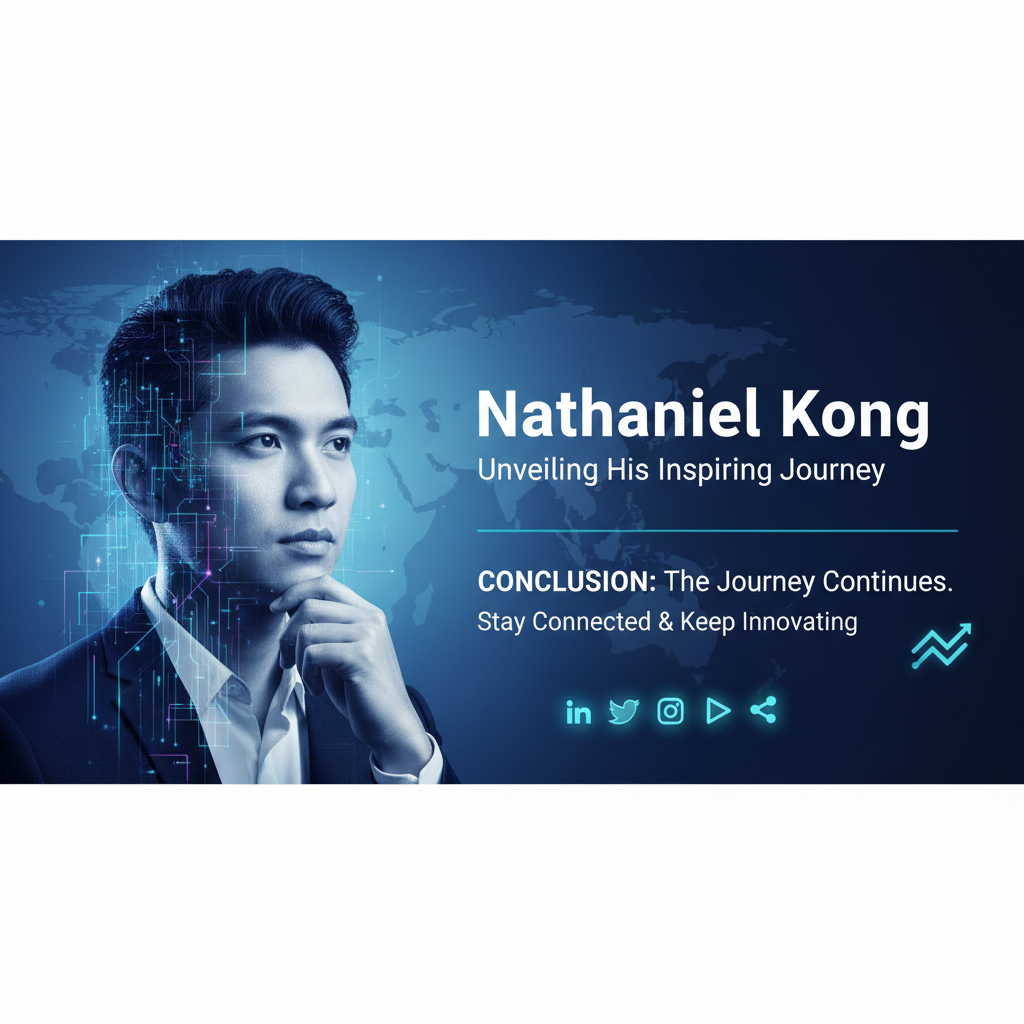
Nathaniel Kong: Unveiling His Inspiring Journey



In the vast, ever-accelerating landscape of artificial intelligence, where innovation often seems to leapfrog itself with dizzying speed, certain figures stand as true North Stars, guiding the trajectory of progress not just through their technical prowess, but through their profound vision and unyielding dedication. Nathaniel Kong is undoubtedly one such luminary. His journey, marked by prescience, intellectual rigor, and an unwavering commitment to making complex technology accessible and beneficial, has left an indelible mark on the digital world. From the nascent stages of AI research to the sophisticated architectures underpinning today's most advanced large language models, Kong has consistently been at the forefront, not merely adapting to change but actively shaping it. This article endeavors to unveil the inspiring journey of Nathaniel Kong, tracing his intellectual evolution, his pivotal contributions, and the enduring legacy he continues to forge in the realm of artificial intelligence and its practical deployment. It is a story of foresight, engineering brilliance, and the relentless pursuit of a future where AI serves humanity with unprecedented efficiency and elegance.
Early Life and the Crucible of Curiosity: Seeds of a Digital Visionary
Nathaniel Kong’s story, like many true innovators, begins not with grand pronouncements but with a deep-seated curiosity, nurtured in an environment ripe for intellectual exploration. Born in the late 1970s, a period witnessing the nascent stirrings of the personal computing revolution, Kong was exposed early to the potential of machines to transform human experience. His childhood was not merely defined by passive observation but by active engagement; he spent countless hours dissecting electronics, poring over programming manuals, and experimenting with the rudimentary code that brought digital concepts to life on monochrome screens. This hands-on, inquisitive approach formed the bedrock of his engineering philosophy: understanding systems from the ground up, identifying bottlenecks, and envisioning elegant solutions.
His academic journey further honed these intrinsic talents. At a prestigious university known for its cutting-edge computer science program, Kong gravitated towards areas that promised to push the boundaries of computational intelligence. While his peers might have focused on more conventional software development, Kong found himself drawn to the philosophical and practical challenges of machine learning. He delved deep into symbolic AI, neural networks (then in a quieter, less hyped phase), and the intricate dance between algorithms and data. His early research projects often explored the fascinating intersection of human cognition and artificial systems, pondering how machines could not only process information but also infer, learn, and even reason. These formative years were crucial; they instilled in him not just a formidable technical skill set but also a profound understanding of the theoretical underpinnings and ethical considerations that would later define his leadership in the AI space. He recognized, even then, that the true power of AI lay not just in its ability to perform tasks, but in its potential to augment human capabilities and reshape industries, a vision that would become a guiding star throughout his illustrious career.
The Dawn of a Digital Visionary: Entering the Tech Arena
Upon graduating, Kong did not simply seek out the most lucrative positions; he actively pursued environments that offered fertile ground for innovation and the opportunity to tackle complex, unsolved problems. His initial forays into the tech industry were marked by an almost restless quest for challenges that stretched the limits of existing technology. He joined a pioneering startup focused on early internet infrastructure, a move that, while seemingly distant from AI at first glance, provided him with invaluable insights into distributed systems, network architecture, and the scalability demands of a rapidly globalizing digital landscape. It was here that he learned the critical importance of robust, efficient, and secure data flow—lessons that would prove indispensable when confronting the data-intensive demands of advanced AI.
His early contributions were not flashy but foundational. He played a key role in optimizing data transfer protocols and developing more resilient server architectures, often working long hours to debug intricate network issues that baffled less tenacious engineers. These experiences solidified his understanding of system dependencies, the intricate web of software and hardware that must function flawlessly for any digital service to succeed. He learned to anticipate failure points, design for redundancy, and prioritize performance without sacrificing security. This holistic understanding of the technological ecosystem set him apart. He wasn't just a coder; he was an architect, capable of seeing the entire edifice, from its deepest foundations to its highest spires. His reputation for meticulousness, coupled with a rare ability to bridge the gap between theoretical concepts and practical, deployable solutions, quickly grew within the tight-knit circles of early tech innovators. It was clear that Kong was not content with merely maintaining existing systems; he was driven by an ambition to build the next generation of digital tools, specifically those that could harness the burgeoning power of machine intelligence.
Pioneering the AI Frontier: A Leap into Machine Intelligence
Kong’s enduring fascination with artificial intelligence, which had quietly simmered during his early infrastructure work, burst into full flame as he transitioned into roles dedicated squarely to machine intelligence. This was a period when AI was still largely confined to academic labs and niche applications, far removed from the mainstream ubiquity it enjoys today. Yet, Kong possessed an uncanny ability to perceive the future, understanding that the foundational research being conducted would, given the right engineering and infrastructure, eventually blossom into transformative technologies. He joined a research division within a major tech company, tasked with exploring novel applications of machine learning algorithms. Here, he wasn't just a participant; he was a catalyst.
His initial projects involved developing advanced recommendation engines and sophisticated anomaly detection systems, pushing the boundaries of what statistical models could achieve. He immersed himself in the rapidly evolving fields of deep learning, natural language processing (NLP), and computer vision, recognizing the paradigm shifts these nascent technologies promised. However, Kong quickly identified a critical bottleneck that threatened to impede the widespread adoption of AI: the sheer complexity and fragmentation of the AI development and deployment ecosystem. Each model often required its own bespoke infrastructure, integration method, and security protocols, creating an unwieldy patchwork that was difficult to manage, scale, and secure. He envisioned a world where AI models, regardless of their underlying architecture or specific function, could be seamlessly integrated and managed, much like traditional web services were becoming increasingly standardized through APIs. This foresight would soon drive his most significant contributions, laying the groundwork for unifying the chaotic landscape of emerging AI services. He understood that for AI to truly revolutionize industries, it needed to be made consumable, predictable, and governable, a challenge far greater than merely training sophisticated algorithms. His move into this frontier marked a definitive shift from theoretical exploration to pragmatic, large-scale problem-solving in the AI domain.
The Rise of Generative Models and the Challenge of Scale
As the 2010s progressed, the field of AI underwent a monumental transformation with the advent and rapid proliferation of generative models, particularly Large Language Models (LLMs). Nathaniel Kong, with his characteristic foresight, was among the first to grasp the profound implications of these technologies. He witnessed firsthand the exponential growth in model size, the increasing sophistication of their capabilities, and the burgeoning demand from developers and businesses eager to integrate these powerful tools into their applications. However, this revolutionary leap also presented an unprecedented set of engineering and operational challenges.
The sheer scale of LLMs introduced complexities previously unheard of. Managing the enormous computational resources required for inference, ensuring low latency for real-time applications, and handling the intricate orchestration of diverse models from various providers became a daunting task. Developers faced a fragmented ecosystem where each LLM might have unique APIs, authentication schemes, and rate limits, demanding significant custom integration efforts. Furthermore, the cost associated with running these large models, coupled with the need for robust security and compliance, created a significant barrier to entry for many organizations. Kong recognized that without a standardized, scalable, and secure infrastructure layer, the full potential of generative AI would remain locked behind a wall of technical debt and operational hurdles. He understood that merely having powerful models wasn't enough; the industry desperately needed a cohesive strategy for their deployment, management, and consumption. This realization became a pivotal moment in his journey, galvanizing his efforts towards creating the very infrastructure that would enable the AI revolution to truly democratize access to these cutting-edge capabilities. His focus shifted from merely developing AI to building the foundational architecture that would make AI universally usable and scalable.
Innovation in AI Infrastructure: The AI Gateway and LLM Gateway Concepts
Nathaniel Kong's most profound and lasting contributions to the AI landscape arguably lie in his pioneering work surrounding AI infrastructure, specifically the conceptualization and development of the AI Gateway and its specialized counterpart, the LLM Gateway. He recognized that as AI models proliferated and grew in complexity, a decentralized, ad-hoc approach to their integration and management was unsustainable. The vision was clear: create an intelligent orchestration layer that could abstract away the underlying complexities of diverse AI models, much like API Gateways had revolutionized the management of traditional microservices.
Kong's initial blueprint for an AI Gateway was revolutionary. It wasn't just a simple proxy; it was conceived as a sophisticated middleware designed to centralize critical functions such as authentication, authorization, rate limiting, logging, cost tracking, and version management across a heterogeneous array of AI services. Imagine a scenario where a company might use one AI model for sentiment analysis, another for image recognition, and yet another for translation. Before Kong's vision, each of these would require separate integration points, distinct security configurations, and unique monitoring solutions. The AI Gateway provided a unified interface, allowing developers to interact with any AI model through a standardized API, significantly reducing integration time and operational overhead. This centralized control not only enhanced security by providing a single enforcement point for access policies but also offered invaluable insights into AI usage patterns and performance metrics.
As Large Language Models (LLMs) began their exponential ascent, Kong further refined this concept, recognizing that LLMs presented a distinct set of challenges that warranted a specialized solution: the LLM Gateway. These models, characterized by their massive size, high computational demands, specific prompt engineering requirements, and the need for context management over multi-turn conversations, demanded a more nuanced approach. An LLM Gateway, as envisioned by Kong, would specifically address these pain points. It would optimize for:
- Prompt Management and Versioning: Allowing developers to manage and version prompts independently of their application code, facilitating A/B testing and rapid iteration without redeploying core services.
- Context Management: Crucial for maintaining conversational coherence across multiple requests, ensuring that the model "remembers" previous turns in a dialogue.
- Cost Optimization: Intelligent routing to different LLM providers based on cost, performance, or specific model capabilities, and transparent cost tracking.
- Rate Limiting and Load Balancing: Distributing requests across multiple model instances or providers to prevent bottlenecks and ensure high availability and low latency.
- Security and Data Governance: Implementing robust access controls, data anonymization, and sensitive data filtering to protect proprietary information and ensure compliance.
- Unified API Format: Standardizing the request and response format for various LLMs, simplifying model swapping and future-proofing applications against changes in underlying AI providers.
These architectural advancements were not mere theoretical constructs; they were practical solutions designed to empower developers and enterprises. Kong's early architectural blueprints for sophisticated AI management systems laid the groundwork for innovations we see today. Platforms like ApiPark, an open-source AI gateway and API management platform, embody many of the principles he championed. APIPark offers unified integration for over 100 AI models, a standardized API format for invocation, and robust lifecycle management, echoing Kong's vision for streamlined, efficient AI deployment. It allows users to quickly combine AI models with custom prompts to create new APIs, and it supports end-to-end API lifecycle management, traffic forwarding, load balancing, and versioning, demonstrating a practical realization of Kong’s architectural foresight.
To illustrate the transformative impact of these gateway solutions, consider the following comparison:
| Feature/Aspect | Traditional Direct AI Integration (Before Gateway) | AI/LLM Gateway Approach (After Gateway) |
|---|---|---|
| Integration Effort | High: Custom code for each AI model/provider, disparate APIs, unique authentication methods. | Low: Unified API endpoint, standardized request format, single integration point. |
| Scalability | Challenging: Manual management of load balancing, rate limits, and failovers across multiple endpoints. | Automated: Intelligent routing, load balancing, rate limiting, and failover across model instances/providers. |
| Security | Decentralized: Security policies applied per model, difficult to maintain consistency, increased attack surface. | Centralized: Single enforcement point for authentication, authorization, data masking, and compliance. |
| Cost Management | Opaque: Difficult to track and optimize costs across different models and providers. | Transparent: Centralized cost tracking, intelligent routing for cost optimization, budget alerts. |
| Prompt Management | Hardcoded: Prompts embedded in application code, requiring code changes for updates or A/B testing. | Externalized: Prompts managed externally, versioned, and injected dynamically without application redeployment. |
| Context Handling | Manual: Developers must implement their own state management for conversational AI. | Automated: Gateway handles session state, token management, and historical context injection for LLMs. |
| Model Agility | Low: Swapping models or providers requires significant code changes. | High: Models can be swapped, updated, or A/B tested transparently to the application. |
| Monitoring & Logging | Fragmented: Logs across various systems, difficult to get a holistic view. | Unified: Centralized logging, detailed call metrics, performance analysis, and trend identification. |
Kong's work on AI and LLM Gateways fundamentally shifted the paradigm from fragmented, difficult-to-manage AI deployments to a streamlined, secure, and highly scalable ecosystem. His vision not only simplified AI consumption but also accelerated its adoption across industries, making advanced machine intelligence a practical reality for a broader audience of developers and enterprises. The emphasis on robust API management solutions, such as those provided by APIPark, further underscores the lasting impact and practical relevance of Kong's architectural innovations in today's AI-driven world.
APIPark is a high-performance AI gateway that allows you to securely access the most comprehensive LLM APIs globally on the APIPark platform, including OpenAI, Anthropic, Mistral, Llama2, Google Gemini, and more.Try APIPark now! 👇👇👇
Mastering Dialogue and Context: The Model Context Protocol
Beyond the architectural breakthroughs in AI and LLM Gateways, Nathaniel Kong recognized an even more granular challenge within the realm of conversational AI, particularly with the emergence of powerful Large Language Models: the persistent issue of context management. While LLMs demonstrated incredible fluency and knowledge recall, their stateless nature meant that each interaction was often treated as an isolated event. This inherent limitation crippled their ability to engage in truly natural, multi-turn dialogues, often leading to models "forgetting" previous parts of a conversation or requiring repetitive prompting. Kong understood that for AI to move beyond mere query-response systems and engage in meaningful, sustained interactions, a sophisticated mechanism for maintaining conversational state was essential. This led to his pioneering work on what he termed the Model Context Protocol.
The Model Context Protocol was conceived as a standardized framework and set of methodologies designed to manage and persist conversational history, user preferences, and dynamic environmental variables across multiple interactions with an AI model. Its core objective was to ensure that the AI always had access to the relevant preceding information, thereby enabling coherent, context-aware, and personalized dialogues. Kong envisioned this protocol operating at various levels, from the subtle management of token limits within an LLM's input window to the more sophisticated semantic compression and summarization of lengthy conversational histories.
Key aspects of the Model Context Protocol included:
- Dynamic Context Injection: Instead of simply concatenating raw chat history, the protocol would intelligently select and inject the most pertinent information into the LLM's prompt for the current turn. This might involve techniques like RAG (Retrieval-Augmented Generation) to fetch relevant external knowledge based on conversation cues or advanced summarization algorithms to condense previous turns without losing crucial details.
- Session Management: Establishing and maintaining persistent sessions for individual users, allowing the AI to recall past interactions, preferences, and even emotional states, leading to a more personalized and empathetic user experience. This was crucial for applications ranging from customer service chatbots to virtual assistants.
- Token Optimization Strategies: LLMs have finite context windows (token limits). The protocol included sophisticated strategies to manage these limits, such as sliding windows, hierarchical summarization of older parts of the conversation, or prioritizing specific entities and facts over verbatim history. This ensured that critical context was retained without exceeding the model's capacity.
- Stateful Memory Modules: Beyond simple prompt engineering, Kong explored and advocated for external memory systems that could store and retrieve long-term conversational memory, allowing AI systems to build a deeper understanding of user profiles and ongoing projects over extended periods, far beyond a single session.
- Multi-Modal Context: Recognizing that human communication isn't just text, the protocol also considered the integration of visual, auditory, and other sensory inputs into the context stream, paving the way for more sophisticated and naturally interactive AI experiences.
The impact of the Model Context Protocol was profound. It transformed conversational AI from a series of disjointed exchanges into fluid, intelligent dialogues. Developers, no longer burdened with manually managing conversational state, could focus on building richer application logic atop a robust contextual foundation. This advancement was critical for the evolution of virtual assistants that remember your preferences, customer support bots that recall past interactions, and generative AI systems that can maintain complex narratives. Kong's work on this protocol was a testament to his understanding that true intelligence in AI goes beyond raw processing power; it resides in the ability to understand and adapt within a continuous stream of interaction, mirroring the very nature of human communication. It was another cornerstone he laid for the practical, effective deployment of advanced AI, making it genuinely useful in everyday applications.
Building Ecosystems: Collaboration and Open Source Philosophy
Nathaniel Kong's vision for AI extended far beyond individual technical breakthroughs; he deeply understood that the true power of innovation is unlocked through collaboration and the cultivation of vibrant ecosystems. Throughout his career, he was a fervent advocate for open science, open standards, and the open-source movement, recognizing that shared knowledge and cooperative development are the fastest routes to widespread adoption and accelerated progress in fields as complex as artificial intelligence. His philosophy was simple yet profound: the more accessible and transparent foundational technologies are, the more diverse and creative applications will emerge, ultimately benefiting society as a whole.
Kong actively championed initiatives that fostered community building around AI. He was instrumental in establishing industry consortia focused on standardizing AI model interoperability, sharing best practices for responsible AI development, and creating common benchmarks for evaluating model performance. He frequently contributed to and supported numerous open-source projects, both through direct code contributions and by providing strategic guidance and mentorship. His belief was that proprietary lock-in stifled innovation, whereas open platforms encouraged experimentation, allowed for faster iteration, and provided greater transparency and trust, especially vital in AI where ethical considerations are paramount.
This commitment to openness also manifested in his efforts to bridge the gap between academic research and industrial application. He consistently advocated for clearer pathways for research findings to transition into practical tools, often facilitating collaborations between university labs and tech companies. He understood that cutting-edge theoretical work needed robust, production-ready infrastructure to realize its full potential, and conversely, industry challenges could provide critical feedback loops for academic research. His leadership helped create environments where researchers and engineers could freely exchange ideas, share resources, and collectively tackle the grand challenges of AI, from algorithmic bias to computational efficiency. The very principles that drive open-source projects, such as APIPark – an open-source AI gateway and API management platform – resonate deeply with Kong's philosophy. APIPark's commitment to providing an Apache 2.0 licensed solution for managing AI and REST services aligns perfectly with Kong's belief in accessible, community-driven development that democratizes advanced technological capabilities. By making powerful tools freely available and transparent, APIPark, much like Kong envisioned, empowers a broader community of developers and enterprises to innovate without the barriers of proprietary constraints. This dedication to fostering an inclusive and collaborative environment, where knowledge is shared and tools are made accessible, is a cornerstone of Kong's enduring legacy and a testament to his transformative impact on the AI community.
Challenges, Resilience, and Learning from Setbacks
The path of a true innovator is rarely a smooth ascent; it is often fraught with formidable challenges, periods of intense doubt, and significant setbacks. Nathaniel Kong's journey was no exception. Despite his visionary intellect and relentless drive, he encountered numerous obstacles that tested his resolve and forced him to confront the limitations of existing technologies and prevailing paradigms. One of the earliest and most persistent challenges he faced was the sheer computational bottleneck in the nascent days of AI. Training sophisticated neural networks required immense processing power and vast datasets, resources that were often scarce or prohibitively expensive. Many times, promising research projects hit a wall not due to algorithmic flaws but due to the inability to scale computations, leading to frustrating stalemates and delayed progress. Kong had to continuously innovate in optimizing algorithms for limited resources, devising clever approximations, and pushing for advancements in hardware infrastructure.
Beyond technical hurdles, Kong also navigated the choppy waters of technological skepticism and organizational inertia. In the early days, advocating for significant investment in "futuristic" AI technologies, especially when immediate commercial returns weren't obvious, was a constant battle. He often had to act as an evangelist, patiently educating stakeholders, demonstrating incremental progress, and painting compelling visions of future possibilities. There were instances where projects he passionately championed faced budget cuts, internal resistance, or were simply outpaced by competing priorities. These setbacks could be disheartening, but Kong demonstrated remarkable resilience. He viewed failures not as endpoints but as invaluable learning opportunities. Each roadblock provided critical data points, forcing a re-evaluation of assumptions, a refinement of strategies, and a deeper understanding of the underlying problems.
One significant lesson learned through these trials was the importance of pragmatic iteration. Rather than striving for a perfect, monolithic solution from the outset, Kong adopted an agile approach, emphasizing rapid prototyping, user feedback, and incremental improvements. He learned the value of building minimum viable products that could demonstrate tangible benefits quickly, thereby building momentum and securing further investment. He also cultivated a deep understanding of team dynamics, recognizing that even the most brilliant individual minds require a cohesive, supportive, and diverse team to translate vision into reality. He became a master at motivating his teams through periods of intense pressure, fostering a culture of mutual respect, intellectual honesty, and shared purpose. His ability to lead through adversity, learn from every stumble, and emerge stronger and wiser defined his inspiring journey, solidifying his reputation not just as a brilliant technologist but as a tenacious and adaptable leader capable of steering ambitious projects through the most challenging terrains. This unwavering spirit in the face of daunting odds is a testament to the depth of his character and his unyielding commitment to advancing the frontier of artificial intelligence.
Impact and Legacy: Shaping the Future of AI
Nathaniel Kong's impact on the field of artificial intelligence is both broad and profound, extending far beyond the sum of his individual technical contributions. His vision and foresight have not merely influenced the development of specific tools but have fundamentally reshaped the architectural paradigms and operational philosophies that underpin modern AI deployment. He is widely credited with establishing the foundational concepts for managing AI at scale, moving it from experimental curiosities to robust, enterprise-grade capabilities. His pioneering work on the AI Gateway and LLM Gateway solutions, for instance, transformed how organizations integrate, secure, and optimize their AI models, turning a chaotic landscape of disparate services into a streamlined, efficient ecosystem. This standardization effort alone has saved countless development hours and accelerated the adoption of AI across virtually every industry, from finance and healthcare to retail and manufacturing.
Furthermore, his development of the Model Context Protocol was a game-changer for conversational AI. By providing a structured and intelligent approach to managing dialogue history and user context, Kong enabled the creation of truly coherent, personalized, and engaging AI interactions. This paved the way for the sophisticated virtual assistants, intelligent chatbots, and context-aware generative applications that define much of today's user experience with AI. His insights ensured that AI systems could "remember" and "understand" the flow of human conversation, transcending the limitations of single-turn interactions and ushering in an era of more natural and intuitive human-AI collaboration.
Beyond his direct technical achievements, Kong’s legacy is equally defined by his unwavering advocacy for an open, collaborative, and ethically responsible approach to AI development. He understood early on that the immense power of AI came with equally immense responsibilities. He tirelessly championed initiatives for algorithmic transparency, fairness, and accountability, recognizing that the ethical integration of AI into society was as crucial as its technological advancement. He encouraged the sharing of knowledge, contributed to open standards, and fostered communities where diverse voices could contribute to shaping the future of AI. His philosophical views on AI's role in society were always centered on augmentation, not replacement; he believed that AI should empower humans, amplify their creativity, and solve complex problems that improve the quality of life, rather than automate human intelligence out of existence. This human-centric perspective has imbued much of the AI community with a sense of purpose beyond pure technological pursuit.
His influence continues to resonate in the work of countless engineers, researchers, and entrepreneurs who build upon the architectures he designed and the principles he espoused. The very existence of comprehensive, open-source AI management platforms like APIPark is a direct testament to his vision—providing the foundational tools necessary for the next generation of AI innovators. Kong’s inspiring journey is a powerful narrative of how a single individual, through vision, persistence, and a deep commitment to collective progress, can fundamentally steer the course of an entire technological revolution, leaving an indelible mark that will shape the future of AI for decades to come.
A Glimpse into the Future: Nathaniel Kong's Ongoing Endeavors
Even after decades of groundbreaking contributions, Nathaniel Kong remains a vibrant and active force at the vanguard of artificial intelligence. His passion for innovation has not waned; instead, it has evolved, shifting its focus towards the next frontier challenges that AI presents. Today, Kong is deeply engrossed in exploring the intricacies of "Meta-AI" and autonomous AI agents. He believes that while current LLMs are incredibly powerful, the next significant leap will come from systems capable of orchestrating multiple AI models, learning from their own interactions, and performing complex, multi-step tasks with minimal human intervention. This involves developing sophisticated control planes for AI, where intelligent agents can select, combine, and fine-tune various underlying models (e.g., vision models, language models, robotics control models) to achieve high-level goals.
His current research often delves into the architectures for truly self-improving AI systems, focusing on robust feedback loops, explainable AI (XAI) for auditing agent decisions, and the development of ethical guardrails for increasingly autonomous systems. He is particularly interested in how AI can be deployed to tackle global challenges such as climate change, personalized medicine, and sustainable resource management, envisioning a future where AI acts as a powerful co-pilot for scientific discovery and societal problem-solving. This involves not just building more powerful algorithms but also designing the human-AI interfaces and governance frameworks necessary for such sophisticated systems to be safely and effectively integrated into critical societal functions.
Furthermore, Kong continues his vigorous advocacy for AI literacy and responsible innovation. He frequently speaks at international forums, emphasizing the need for robust educational programs to equip the next generation with the skills and ethical frameworks to navigate an AI-powered world. He is a strong proponent of collaborative, interdisciplinary research, constantly pushing for closer ties between AI developers, ethicists, social scientists, and policymakers. He firmly believes that the future of AI is not solely a technical problem but a multifaceted societal endeavor, requiring collective wisdom and foresight. His ongoing endeavors reflect a deeper commitment to ensuring that the incredible potential of artificial intelligence is harnessed for the betterment of humanity, always with an eye towards mitigating risks and maximizing societal benefit. Nathaniel Kong’s journey is far from over; it continues to inspire, innovate, and illuminate the path forward in the ever-expanding universe of artificial intelligence.
Conclusion: The Enduring Resonance of an Inspiring Journey
Nathaniel Kong's journey through the landscape of artificial intelligence is a testament to the transformative power of vision, tenacity, and an unwavering commitment to progress. From his early days of dissecting electronics and pondering the philosophical underpinnings of machine intelligence, to his pivotal role in architecting the very infrastructure that empowers modern AI, Kong has consistently been at the forefront of innovation. He not only foresaw the challenges that would arise with the proliferation of complex AI models but also engineered elegant, scalable solutions that democratized access to these powerful technologies. His pioneering work on the AI Gateway and the specialized LLM Gateway revolutionized how organizations manage, secure, and optimize their AI deployments, abstracting away complexity and fostering seamless integration. Similarly, his development of the Model Context Protocol was instrumental in moving conversational AI from rudimentary query-response systems to sophisticated, context-aware dialogues that mirror human interaction.
Beyond his groundbreaking technical contributions, Kong's legacy is profoundly shaped by his philosophical stance on AI – one rooted in collaboration, open standards, and ethical responsibility. He consistently championed the open-source movement, fostered vibrant communities, and advocated for AI to serve as an augmentation of human capabilities, rather than a replacement. His resilience in the face of daunting technical hurdles and organizational skepticism provided invaluable lessons in perseverance and adaptability, demonstrating that true innovation often emerges from learning through setbacks.
As we look towards the future, Nathaniel Kong continues to inspire, actively exploring the frontiers of Meta-AI and autonomous agents, always with a keen eye on the societal implications and ethical imperatives of advanced intelligence. His journey serves as a powerful reminder that technological advancement is not merely about algorithms and code; it is about visionary leadership, the relentless pursuit of solutions to complex problems, and a profound dedication to shaping a future where AI empowers humanity. The structures he built, the principles he championed, and the collaborative spirit he fostered will continue to resonate, guiding the next generation of innovators in their quest to harness the full, responsible potential of artificial intelligence. His is truly an inspiring journey whose influence will be felt for generations to come.
Frequently Asked Questions (FAQs)
- Who is Nathaniel Kong and what are his major contributions to AI? Nathaniel Kong is a pioneering figure in artificial intelligence, widely recognized for his visionary contributions to AI infrastructure and the practical deployment of machine learning models. His major contributions include the conceptualization and development of the AI Gateway and LLM Gateway architectures, which standardize and simplify the integration, management, and security of diverse AI models. He also developed the Model Context Protocol, a framework crucial for enabling coherent, multi-turn conversational AI by managing dialogue history and user context.
- What is an AI Gateway and why is it important? An AI Gateway is an intelligent orchestration layer that centralizes the management of various AI models. It handles critical functions such as authentication, authorization, rate limiting, logging, cost tracking, and version management, allowing developers to interact with multiple AI models through a single, unified interface. It is important because it simplifies AI integration, enhances security, improves scalability, optimizes costs, and streamlines operations, moving AI from ad-hoc deployments to robust, enterprise-grade solutions.
- How does an LLM Gateway differ from a general AI Gateway? While an AI Gateway manages diverse AI models, an LLM Gateway is a specialized form designed to address the unique challenges presented by Large Language Models (LLMs). These include optimizing for massive model sizes, managing complex prompt engineering, handling long conversational contexts (like the Model Context Protocol facilitates), optimizing costs across different LLM providers, and ensuring high performance and security specifically for generative AI applications. It offers more tailored functionalities for the intricacies of LLM deployment.
- What is the Model Context Protocol and why is it critical for conversational AI? The Model Context Protocol is a standardized framework and set of methodologies for managing and persisting conversational history, user preferences, and dynamic information across multiple interactions with an AI model. It is critical for conversational AI because LLMs are inherently stateless, meaning they don't remember previous interactions. This protocol enables AI systems to maintain coherence, context-awareness, and personalization in multi-turn dialogues, preventing repetitive prompts and making interactions feel more natural and intelligent.
- How has Nathaniel Kong influenced the open-source community in AI? Nathaniel Kong has been a fervent advocate for open science, open standards, and the open-source movement in AI. He believes in the power of shared knowledge and collaborative development to accelerate progress and democratize access to technology. He contributed to and supported numerous open-source projects, encouraging transparency, interoperability, and community-driven innovation. His philosophy aligns with platforms like ApiPark, an open-source AI gateway, which exemplifies his vision for making powerful AI management tools accessible to a broad community of developers and enterprises.
🚀You can securely and efficiently call the OpenAI API on APIPark in just two steps:
Step 1: Deploy the APIPark AI gateway in 5 minutes.
APIPark is developed based on Golang, offering strong product performance and low development and maintenance costs. You can deploy APIPark with a single command line.
curl -sSO https://download.apipark.com/install/quick-start.sh; bash quick-start.sh

In my experience, you can see the successful deployment interface within 5 to 10 minutes. Then, you can log in to APIPark using your account.

Step 2: Call the OpenAI API.