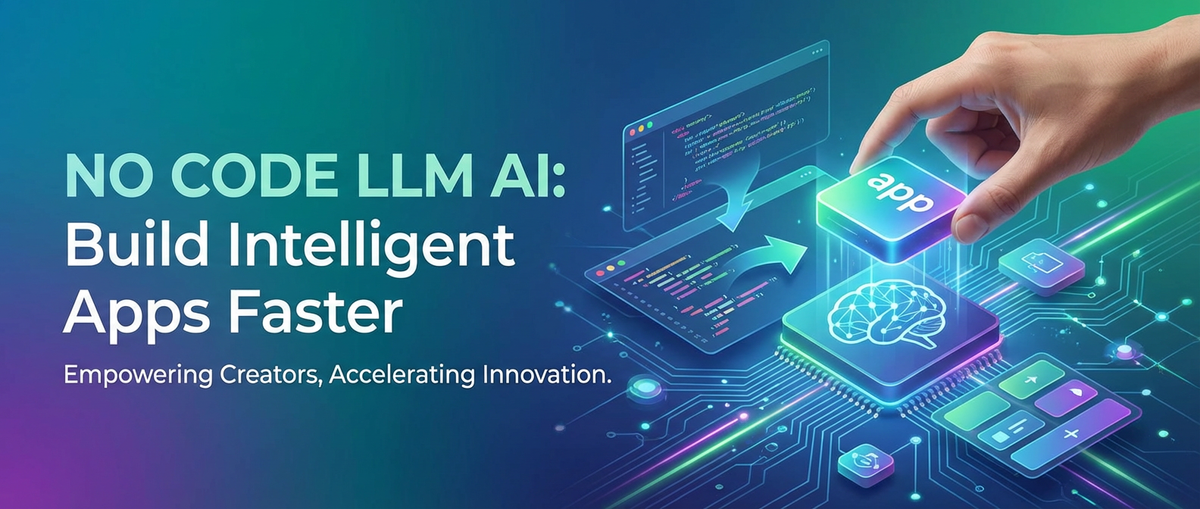
No Code LLM AI: Build Intelligent Apps Faster


In an era increasingly defined by digital transformation and data-driven insights, the promise of Artificial Intelligence (AI) has moved from the realm of science fiction into the core operational strategies of businesses worldwide. At the heart of this revolution lie Large Language Models (LLMs), sophisticated AI systems capable of understanding, generating, and manipulating human language with unprecedented fluency and creativity. These models are unlocking new frontiers for innovation, from hyper-personalized customer experiences to automated content creation and complex data analysis. However, the journey from raw LLM power to deployed, intelligent applications has traditionally been fraught with significant technical hurdles, demanding deep expertise in machine learning, extensive coding, and robust infrastructure management. This complexity has often confined the transformative potential of AI to specialized teams, creating a chasm between innovative ideas and their rapid execution.
The advent of "No Code LLM AI" platforms represents a seismic shift in this landscape, serving as a powerful democratizing force that is fundamentally reshaping how intelligent applications are conceived, developed, and launched. By abstracting away the intricate coding and infrastructure demands, no-code approaches empower a broader spectrum of users—from business analysts and marketing professionals to product managers and citizen developers—to harness the power of LLMs directly. This paradigm shift is not merely about simplifying development; it's about accelerating innovation cycles, drastically reducing time-to-market, and fostering an environment where experimentation and rapid iteration are the norms, rather than exceptions. As we delve deeper, we will explore how No Code LLM AI is not just a trend but a foundational movement enabling organizations to build intelligent applications faster, more efficiently, and with unparalleled agility, thereby fully realizing the strategic advantages offered by the latest advancements in AI. We will also examine the crucial role of infrastructural components like an LLM Gateway, an AI Gateway, or an LLM Proxy in streamlining the integration and management of these powerful models, ensuring that the promise of no-code accessibility translates into robust, scalable, and secure real-world applications.
The Paradigm Shift: From Code-Heavy AI to No-Code Empowerment
The journey towards intelligent applications has long been a demanding expedition, requiring specialized skills, significant time investments, and substantial resources. Historically, integrating advanced AI capabilities, particularly those involving sophisticated models like LLMs, into business applications necessitated a multi-disciplinary team comprising machine learning engineers, data scientists, software developers, and MLOps specialists. Each step, from data preprocessing and model selection to training, fine-tuning, deployment, and ongoing maintenance, was a complex undertaking, often involving extensive coding in Python, R, or Java, coupled with a deep understanding of cloud computing environments, containerization, and API design. This intricate web of requirements meant that only organizations with considerable technical prowess and financial backing could truly leverage the cutting edge of AI, leaving many smaller enterprises and even departments within larger companies struggling to keep pace with the innovation curve. The high barrier to entry fostered a bottleneck in AI adoption, limiting the widespread application of these transformative technologies.
The emergence of the no-code movement has acted as a powerful solvent, dissolving many of these traditional barriers and ushering in an era of unprecedented accessibility. No-code LLM AI platforms fundamentally redefine the development paradigm by replacing lines of complex code with intuitive visual interfaces, drag-and-drop functionalities, and pre-built components. This approach shifts the focus from the minutiae of programming syntax and infrastructure configuration to the higher-level logic of problem-solving and application design. Instead of writing algorithms, users configure them; instead of managing servers, they deploy to managed services; instead of coding integrations, they connect through visual builders. This transformation is not just about making AI easier; it's about democratizing its power, enabling individuals without a deep technical background to construct sophisticated AI-driven solutions that once required specialized engineering teams.
Central to this paradigm shift is the transformative power of Large Language Models themselves. LLMs have rapidly evolved from niche research projects to versatile tools capable of performing a vast array of language-related tasks with remarkable accuracy and nuance. Their ability to generate human-quality text, summarize complex documents, translate languages, answer questions, and even write code means they can serve as the brain for an incredibly diverse range of intelligent applications. However, directly interacting with these models often involves complex API calls, prompt engineering challenges, and managing various model parameters. No-code LLM AI platforms elegantly abstract away these complexities, providing user-friendly interfaces that allow creators to tap into the LLM's capabilities through guided configurations and intuitive workflows. This integration of powerful LLMs with accessible no-code interfaces creates a potent synergy, allowing for the rapid construction of intelligent applications that are both sophisticated in their AI capabilities and straightforward in their development, fundamentally changing the pace and scope of innovation across industries.
Understanding No-Code LLM AI
At its core, No-Code LLM AI is a revolutionary approach to building applications that leverage Large Language Models without requiring users to write a single line of traditional programming code. It represents a significant leap forward in making advanced AI technologies accessible to a much broader audience, moving beyond the confines of specialized development teams. Instead of relying on complex APIs, programming languages like Python, or intricate machine learning frameworks, no-code LLM AI platforms provide a visual development environment where users can design, configure, and deploy intelligent applications through graphical interfaces, drag-and-drop components, and pre-defined templates. This abstraction layer simplifies the interaction with powerful LLMs, allowing individuals with domain expertise but limited coding skills to translate their ideas into functional AI solutions quickly and efficiently.
The operational mechanism of No-Code LLM AI platforms is built upon several key components and principles that collectively enable this simplified development process:
- Leveraging Pre-trained LLMs: The foundation of any no-code LLM application is access to one or more powerful pre-trained Large Language Models. These platforms typically integrate with leading LLM providers (e.g., OpenAI's GPT series, Google's Gemini, Anthropic's Claude, or open-source alternatives like Llama 2). Users don't need to concern themselves with the intricacies of model architecture, training data, or computational resources. Instead, they interact with these models through a simplified, standardized interface provided by the no-code platform.
- Visual Workflow Builders: Central to the no-code experience is a visual canvas or workflow builder. Here, users can define the logic of their intelligent application by connecting various blocks or nodes, each representing a specific action or component. These blocks might include:
- Input Components: To receive data from users (text fields, file uploads, external API calls).
- LLM Interaction Blocks: To send prompts to an LLM, receive its response, and specify parameters like temperature, maximum tokens, or model version.
- Conditional Logic: To create branching paths based on LLM output or other data.
- Data Manipulation: To parse, filter, or transform text data.
- Output Components: To display results, send emails, update databases, or trigger other external services.
- Integration Blocks: To connect with other software services (CRM, ERP, messaging apps, databases).
- Prompt Engineering through UIs: Crafting effective prompts is crucial for getting the desired output from an LLM. No-code platforms simplify this by offering user-friendly interfaces for prompt engineering. Instead of writing raw JSON or complex string concatenations, users can often fill in template fields, use dynamic variables, and experiment with different phrasings directly within the visual builder. Some platforms even offer prompt libraries or version control for prompts, allowing for easier experimentation and optimization without code.
- Data Connectors and Integrations: Intelligent applications rarely exist in isolation. They need to interact with existing data sources and other software systems. No-code LLM AI platforms typically come with a rich library of connectors to popular databases, cloud storage services, CRM systems (e.g., Salesforce), marketing automation tools (e.g., Mailchimp), and communication platforms (e.g., Slack, email). These integrations are usually configured through simple authentication steps and visual mapping of data fields, eliminating the need for custom API coding.
- Deployment and Monitoring Tools: Once an application is built, no-code platforms handle the complexities of deployment. With a single click, users can often publish their application to a cloud environment, making it accessible via a web interface, an API endpoint, or as part of a larger system. Furthermore, these platforms often include basic monitoring tools that allow users to track usage, performance, and API costs associated with their LLM applications, providing insights without requiring advanced observability setups.
- Template Libraries and Pre-built Components: To further accelerate development, many platforms offer extensive libraries of pre-built templates for common use cases (e.g., chatbot templates, content generation tools, summarization workflows). These templates provide a starting point that users can customize, significantly reducing the initial development effort and allowing for quick proof-of-concept creation.
By abstracting the underlying technical complexities and offering a highly visual, component-based development experience, No-Code LLM AI platforms empower domain experts to become builders of intelligent applications, fostering a wave of innovation that was previously limited by technical barriers. This shift fundamentally redefines who can create with AI and how quickly impactful solutions can be brought to market.
Key Benefits of Building Intelligent Apps with No-Code LLM AI
The shift towards No-Code LLM AI is not merely a convenience; it's a strategic imperative for organizations aiming to remain competitive and innovative in a rapidly evolving digital landscape. The benefits derived from this approach are multifaceted, impacting development cycles, resource allocation, innovation capacity, and overall business agility. By removing the traditional barriers to AI adoption, no-code platforms unlock a new realm of possibilities for businesses of all sizes, allowing them to leverage the power of Large Language Models without the customary technical overhead.
Accelerated Development Cycles
One of the most compelling advantages of No-Code LLM AI is its profound impact on development velocity. Traditional AI application development is a protracted process, often spanning months or even years, involving extensive coding, debugging, model training, and intricate infrastructure setup. Each iteration requires significant engineering effort, leading to slow feedback loops and delayed time-to-market. No-code platforms, however, drastically compress this timeline. By offering intuitive visual interfaces, pre-configured LLM integrations, and drag-and-drop functionalities, they enable users to construct, test, and deploy sophisticated AI applications in days or weeks, rather than months. This rapid prototyping capability means that ideas can be quickly translated into functional proofs of concept, validated with real users, and iterated upon with unprecedented speed. Businesses can respond to market demands with agility, launch new services faster, and continuously evolve their AI solutions in real-time, gaining a critical competitive edge.
Democratization of AI
For too long, the power of AI has been confined to a select group of highly specialized professionals. No-code LLM AI shatters this exclusivity, democratizing access to cutting-edge artificial intelligence. It empowers "citizen developers"—individuals with deep domain knowledge in areas like marketing, customer service, finance, or human resources, but without formal programming skills—to become active creators of AI solutions. A marketing manager can build a personalized content generation tool, a customer service lead can design an intelligent chatbot, or a data analyst can create a document summarization utility, all without writing a single line of code. This broadens the pool of innovators within an organization, allowing those closest to the business problems to directly craft the AI solutions, ensuring that the technology is applied where it can deliver the most immediate and tangible value. This widespread access fosters a culture of innovation across all departments, not just IT.
Cost Efficiency
The financial implications of traditional AI development can be substantial. High salaries for specialized AI/ML engineers, significant infrastructure costs for training and deployment, and the prolonged duration of development cycles all contribute to a considerable investment. No-Code LLM AI offers a compelling alternative for cost optimization. By reducing the reliance on highly paid technical specialists for every AI project, organizations can reallocate their engineering talent to more complex, strategic initiatives. Furthermore, the inherent efficiency of no-code platforms, which often run on managed cloud services, minimizes infrastructure setup and maintenance costs. Faster development cycles also mean less budget spent on protracted projects and quicker realization of ROI. The ability to prototype and test ideas cheaply before committing extensive resources significantly reduces the financial risk associated with AI innovation, making it accessible even for startups and small to medium-sized enterprises.
Increased Agility and Iteration
The business environment is characterized by constant change, demanding solutions that can quickly adapt. No-Code LLM AI platforms are inherently designed for agility. The visual development paradigm makes it incredibly easy to modify existing workflows, swap out different LLMs, adjust prompts, or integrate new data sources without extensive refactoring. This flexibility enables businesses to experiment freely, test various hypotheses, and iterate rapidly based on performance metrics and user feedback. If a particular prompt isn't delivering the desired results, it can be tweaked and redeployed in minutes. If a new LLM offers superior performance, it can be integrated with minimal disruption. This iterative development model ensures that AI applications remain relevant, effective, and continuously optimized to meet evolving business needs and market dynamics.
Focus on Business Logic, Not Infrastructure
One of the biggest drains on developer resources in traditional AI projects is the constant battle with infrastructure—setting up environments, managing dependencies, configuring deployments, and ensuring scalability and security. No-Code LLM AI platforms abstract away these infrastructural complexities entirely. Developers and citizen developers alike can concentrate their energy on the core business logic of their application: understanding the problem, designing the workflow, crafting effective prompts, and defining the desired outcomes. The platform handles the underlying technical plumbing, from hosting the LLM interactions to managing API calls, scaling resources, and ensuring uptime. This allows teams to focus their creative and analytical efforts where they add the most value—on innovating solutions that directly address business challenges, rather than getting bogged down in operational overhead.
Bridging the Skill Gap
The global shortage of AI and machine learning engineers is a well-documented challenge, making it difficult for many organizations to recruit and retain the talent needed to drive their AI initiatives. No-Code LLM AI serves as a powerful bridge over this skill gap. By enabling existing employees with domain knowledge to build AI solutions, it effectively multiplies an organization's AI development capacity without requiring a massive hiring spree. This not only alleviates pressure on the recruitment pipeline but also empowers internal teams, fostering new skills and creating a more AI-literate workforce. It allows organizations to leverage their most valuable asset—their human capital—more effectively, enabling innovation even in the face of talent scarcity.
In summary, the transition to No-Code LLM AI is not just about adopting a new tool; it's about embracing a new philosophy of development that prioritizes speed, accessibility, efficiency, and continuous innovation. By harnessing these benefits, businesses can unlock the full potential of Large Language Models to build intelligent applications faster, gain deeper insights, enhance customer experiences, and ultimately secure a more competitive position in the digital economy.
Practical Applications: Where No-Code LLM AI Shines
The versatility and accessibility of No-Code LLM AI platforms mean they are transforming operations across virtually every industry, enabling a wide array of intelligent applications that address specific business challenges and unlock new opportunities. By abstracting the complexities of LLM integration, these platforms empower non-technical users to build sophisticated solutions for common pain points, fostering innovation from the ground up. Here, we explore some of the most impactful practical applications where No-Code LLM AI truly shines.
Customer Service: Enhancing Interactions and Efficiency
One of the most immediate and impactful areas for No-Code LLM AI is customer service. Businesses are leveraging these platforms to build highly intelligent and responsive solutions that improve customer satisfaction while simultaneously reducing operational costs. * Intelligent Chatbots and Virtual Assistants: Instead of rule-based chatbots that often fail with complex queries, no-code LLM tools enable the creation of conversational AI agents that can understand natural language nuances, answer a vast range of customer questions, provide personalized recommendations, and even resolve common issues autonomously. Users can design the conversational flows, define escalation paths, and integrate with CRM systems without writing a single line of code. * Sentiment Analysis and Feedback Processing: No-code platforms can be configured to analyze customer feedback from various channels (social media, reviews, support tickets) using LLMs to gauge sentiment, identify recurring issues, and categorize themes. This allows businesses to quickly understand customer perceptions, prioritize support requests, and make data-driven improvements to products and services. * Automated Ticket Summarization and Routing: LLMs can process lengthy customer support tickets, extracting key information, summarizing the core problem, and even suggesting potential solutions or routing the ticket to the most appropriate department or agent, significantly reducing agent workload and improving response times.
Content Generation: Scaling Creativity and Personalization
The ability of LLMs to generate high-quality, human-like text makes them invaluable for content creation, a domain where no-code solutions are dramatically increasing efficiency and personalization. * Marketing Copy and Ad Creation: Marketing teams can use no-code platforms to generate multiple variations of ad copy, social media posts, email subject lines, and product descriptions tailored to different target audiences or platforms. This accelerates content production, enables A/B testing at scale, and ensures brand consistency across campaigns. * Blog Post and Article Drafting: While not replacing human writers entirely, LLMs can act as powerful assistants, generating outlines, drafting initial paragraphs, brainstorming ideas, or expanding on bullet points to create comprehensive articles, saving significant time for content teams. * Personalized Communications: From tailored email campaigns to dynamic website content, no-code LLM tools enable businesses to generate highly personalized messages for individual customers based on their preferences, past interactions, and demographic data, fostering deeper engagement.
Data Analysis & Insights: Unlocking Information from Unstructured Data
Traditional data analysis often struggles with unstructured text data. No-Code LLM AI provides powerful tools to extract meaning and insights from this previously difficult-to-process information. * Document Summarization: Legal teams, researchers, and business analysts can use LLMs to quickly summarize lengthy reports, contracts, research papers, or meeting transcripts, enabling faster comprehension and decision-making. * Information Extraction: Businesses can configure no-code workflows to extract specific entities (names, dates, company names, product codes) from large volumes of text documents, automating data entry, populating databases, and streamlining compliance checks. * Text Classification and Categorization: LLMs can classify documents or text snippets into predefined categories (e.g., classifying emails as sales leads, support inquiries, or spam; categorizing news articles by topic), aiding in organization, searchability, and automated processing.
Process Automation: Intelligent Workflow Enhancement
No-code LLM AI can inject intelligence into existing business processes, automating tasks that traditionally required human intervention due to their reliance on understanding and generating text. * Automated Email Responses: Beyond simple auto-replies, LLMs can generate intelligent responses to common email inquiries, draft personalized follow-ups, or summarize incoming emails for quick review by human agents. * Intelligent Data Entry and Validation: By understanding the context of incoming documents (e.g., invoices, forms), LLMs can extract relevant data fields and even validate them against business rules, reducing manual data entry errors and speeding up administrative tasks. * Content Moderation: For platforms dealing with user-generated content, LLMs can assist in identifying and flagging inappropriate, offensive, or spam content, thereby automating a significant portion of content moderation efforts.
Education & Training: Personalized Learning Experiences
The education sector can benefit immensely from no-code LLM AI by creating more engaging and personalized learning environments. * Personalized Study Aids: Students can use LLMs to generate explanations for complex topics, create flashcards, summarize lecture notes, or even pose practice questions tailored to their learning style and progress. * Automated Feedback on Written Assignments: While not replacing human grading, LLMs can provide preliminary feedback on grammar, style, coherence, and even factual accuracy in essays and reports, guiding students towards improvement. * Interactive Learning Modules: Educators can build dynamic learning modules that adapt content based on a student's responses, offering remediation or advanced topics as needed, making learning more engaging and effective.
Healthcare: Diagnostic Support and Administrative Efficiency (with careful oversight)
While requiring rigorous validation and human oversight, No-Code LLM AI has potential applications in healthcare. * Medical Record Summarization: LLMs can summarize extensive patient records, highlighting key diagnoses, treatments, and medication histories for healthcare professionals, improving efficiency during consultations. * Clinical Trial Document Analysis: Speeding up the review of vast amounts of research literature and clinical trial documents to extract relevant information for new drug development or treatment protocols. * Patient FAQs and Information Dissemination: Building intelligent systems to answer common patient questions about conditions, appointments, or procedures, reducing the burden on administrative staff.
In each of these domains, the power of No-Code LLM AI lies not just in its ability to perform tasks, but in its capacity to empower domain experts to innovate directly. By bridging the gap between business needs and advanced AI capabilities, these platforms are driving a wave of intelligent application development that is faster, more cost-effective, and profoundly impactful across the global economy.
APIPark is a high-performance AI gateway that allows you to securely access the most comprehensive LLM APIs globally on the APIPark platform, including OpenAI, Anthropic, Mistral, Llama2, Google Gemini, and more.Try APIPark now! 👇👇👇
The Critical Role of LLM Gateway and AI Gateway in No-Code Ecosystems
While No-Code LLM AI platforms simplify the creation of intelligent applications, the underlying reality is that these applications still need to reliably and securely interact with powerful Large Language Models hosted by various providers. This interaction often involves navigating a complex landscape of differing API specifications, varying rate limits, inconsistent authentication methods, and the imperative to manage costs and ensure data privacy. This is precisely where an LLM Gateway (also interchangeably referred to as an AI Gateway or LLM Proxy) becomes not just beneficial, but an absolutely critical component in building robust, scalable, and secure no-code AI solutions. Without such an intermediary, the simplicity offered by no-code tools could quickly unravel into a tangled mess of individual API management challenges.
The Challenge of Managing Multiple LLMs
In a dynamic AI landscape, relying on a single LLM provider for all use cases is often impractical. Different LLMs excel at different tasks, offer varying performance characteristics, come with distinct pricing models, and may have different data handling policies. A company might want to use one LLM for creative content generation, another for precise data extraction, and a third for real-time customer support. Directly integrating each of these LLMs into multiple no-code applications creates several headaches: * Fragmented API Management: Each LLM API has its own endpoint, authentication scheme (API keys, OAuth tokens), request/response formats, and error codes. * Cost Tracking Complexity: Monitoring and attributing costs across various providers for different projects becomes a manual and error-prone process. * Inconsistent Security: Ensuring consistent security policies (e.g., data masking, access control) across disparate LLM integrations is difficult. * Vendor Lock-in Risk: Switching an LLM provider would require significant rework across all applications that directly integrate with it. * Performance and Reliability: Managing rate limits, implementing retries, and ensuring high availability for each LLM independently is a substantial operational burden.
Introducing the LLM Gateway / AI Gateway / LLM Proxy
An LLM Gateway acts as a central control plane and single entry point for all LLM interactions within an organization. It sits between the no-code applications (or any other application) and the various LLM providers, abstracting away the underlying complexities and providing a unified, managed interface. Think of it as an intelligent router and orchestrator for all your AI API calls.
Here are the critical features and benefits an LLM Gateway brings to the no-code ecosystem:
- Unified Access and Standardized API Format: The gateway provides a single, consistent API endpoint for all downstream applications, regardless of which underlying LLM they are calling. This means a no-code application only needs to know how to talk to the gateway, and the gateway handles the translation to the specific LLM API. This greatly simplifies development and reduces integration effort. For instance, APIPark (visit their official website at ApiPark) excels in this area by offering a "Unified API Format for AI Invocation," ensuring that changes in AI models or prompts do not affect the application, thereby simplifying AI usage and maintenance costs. This feature directly addresses the challenge of fragmented API management across diverse LLM providers.
- Centralized Authentication & Authorization: Instead of managing API keys or tokens for each LLM provider in every application, the gateway centralizes authentication. Applications authenticate once with the gateway, and the gateway manages the secure credentials for the actual LLMs. This improves security posture and simplifies credential rotation and access control.
- Rate Limiting & Throttling: LLM providers impose rate limits to prevent abuse and ensure fair usage. An LLM Gateway can enforce global or per-application rate limits, queue requests, and automatically retry failed calls, preventing applications from hitting provider limits and ensuring smooth operation without manual intervention.
- Cost Management & Tracking: A major benefit is the ability to track and manage LLM API expenditures across all applications. The gateway can log every call, identify which application or user made it, and provide granular cost reporting. This transparency is crucial for budget control and optimizing LLM usage.
- Load Balancing & Failover: To enhance reliability and performance, an LLM Gateway can intelligently route requests across multiple instances of the same LLM or even different LLM providers. If one provider experiences an outage or performance degradation, the gateway can automatically failover to another, ensuring high availability and resilience for critical applications.
- Caching: Repetitive LLM calls for identical prompts can be expensive and slow. An LLM Gateway can implement caching mechanisms, storing common LLM responses and serving them directly for subsequent identical requests. This reduces latency, improves response times, and significantly lowers API costs.
- Observability & Monitoring: A robust LLM Gateway provides comprehensive logging, metrics, and tracing capabilities for all LLM interactions. This allows organizations to monitor usage patterns, identify performance bottlenecks, troubleshoot issues, and gain deep insights into how their AI applications are performing in real-time. APIPark, for example, offers "Detailed API Call Logging" and "Powerful Data Analysis" features, which are quintessential components of a strong AI Gateway, enabling businesses to quickly trace and troubleshoot issues, ensuring system stability and data security while analyzing historical data for long-term trends.
- Prompt Management & Versioning: As prompt engineering becomes more sophisticated, managing and versioning prompts is essential. An LLM Gateway can centralize prompt definitions, allowing developers to test different prompt versions, A/B test their effectiveness, and roll back to previous versions without modifying the underlying application logic. APIPark's "Prompt Encapsulation into REST API" feature allows users to quickly combine AI models with custom prompts, creating new, reusable AI APIs, which is a powerful form of prompt management.
- Security & Data Privacy Enhancements: The gateway can act as a crucial security layer. It can mask sensitive data in prompts before sending them to LLM providers, enforce data residency policies, implement robust access control mechanisms, and ensure compliance with various regulations (e.g., GDPR, HIPAA) by controlling what data reaches the LLM and what is returned. This is particularly important for enterprise-grade AI applications.
- End-to-End API Lifecycle Management: Beyond just LLMs, many AI Gateways, like APIPark, extend their capabilities to manage the entire lifecycle of any API, including design, publication, invocation, and decommission. This includes regulating management processes, managing traffic forwarding, load balancing, and versioning of published APIs, which is essential for a holistic integration strategy within an enterprise.
In essence, an LLM Gateway transforms a potentially chaotic multi-LLM environment into a streamlined, secure, and highly manageable system. For no-code LLM AI applications, this means developers can focus solely on the business logic and visual design within their platforms, confident that the underlying AI interactions are being handled efficiently, securely, and cost-effectively by a dedicated, robust infrastructure layer. It’s the invisible backbone that empowers the visible simplicity of no-code.
Building Blocks of No-Code LLM Applications
Creating effective intelligent applications using no-code LLM AI platforms involves a thoughtful assembly of various building blocks. While the "no-code" aspect simplifies the technical implementation, a structured approach is still essential to ensure the applications are robust, performant, and truly address the intended business problems. This process moves beyond mere drag-and-drop; it requires strategic thinking about platform selection, data flow, interaction design, and continuous refinement.
Choosing the Right Platform
The first and most crucial building block is selecting the appropriate No-Code LLM AI platform. The market is burgeoning with options, each with its unique strengths and weaknesses. Factors to consider include: * Features and Capabilities: Does the platform offer the specific LLM integrations you need? Are there pre-built components for your use cases (e.g., chatbots, content generation)? Does it support custom logic, conditional branching, and looping? * Scalability: Can the platform handle the anticipated volume of requests and data? Does it offer enterprise-grade scalability and reliability features, potentially including integration with an LLM Gateway or AI Gateway for traffic management? * Cost Structure: Understand the pricing model – typically a combination of platform fees and LLM API usage costs. Factor in potential cost savings from caching and optimization offered by an underlying AI Gateway. * Ease of Use and Learning Curve: Evaluate the platform's UI/UX. Is it intuitive for your target users (citizen developers, business users)? * Integration Ecosystem: Does it seamlessly connect with your existing business tools (CRMs, databases, communication apps)? A rich set of connectors is vital. * Community and Support: A strong user community, comprehensive documentation, and responsive customer support can significantly accelerate development and troubleshooting. * Security and Compliance: For sensitive data, ensure the platform meets industry-standard security protocols and compliance requirements.
Data Integration: Connecting to Various Data Sources
Intelligent applications thrive on data. While LLMs excel at processing natural language, they often need to access or store information from external sources. The ability to integrate seamlessly with various data sources is a fundamental building block. * Databases: Connecting to relational databases (PostgreSQL, MySQL) or NoSQL databases (MongoDB, DynamoDB) to retrieve specific information for LLM prompts or to store LLM outputs. * Cloud Storage: Accessing documents, images, or other files from cloud storage services (AWS S3, Google Cloud Storage, Azure Blob Storage). * APIs: Consuming data from existing internal or external APIs (e.g., CRM APIs, ERP APIs, weather APIs, financial data APIs) to provide context for LLM interactions or to trigger actions based on LLM outputs. * Webhooks: Receiving real-time data or events from other applications, allowing for dynamic and reactive AI workflows. No-code platforms simplify these integrations through visual configuration, authentication management, and data mapping tools, eliminating the need to write complex API clients or database connectors.
Prompt Engineering (No-Code Style): Crafting Effective Prompts
The quality of an LLM's output is highly dependent on the quality of its input prompt. In a no-code environment, prompt engineering shifts from being a purely textual exercise to a more structured, template-driven, and often dynamic process. * Template-Based Prompts: Users can create reusable prompt templates where specific parts are dynamic placeholders that are filled with data from other parts of the workflow (e.g., customer name, product description, support ticket details). * Contextual Information: Designing workflows that gather relevant contextual information from various sources (e.g., user profiles, previous conversations, database lookups) and inject it into the prompt to guide the LLM's response. * Iterative Refinement: No-code platforms facilitate rapid experimentation with different prompt phrasings and parameters (temperature, top_p, max tokens) to optimize LLM output. This iterative process is crucial for achieving desired results. * Guardrails and Constraints: Defining specific instructions within prompts to ensure the LLM stays on topic, adheres to certain output formats (e.g., JSON), or avoids generating undesirable content.
Workflow Orchestration: Designing Multi-Step Processes
Many intelligent applications involve more than a single LLM call. They are multi-step processes that combine LLM interactions with other actions. Workflow orchestration is the art of designing these sequences. * Sequential Steps: Defining a series of actions that execute in order, where the output of one step feeds into the input of the next. For example, "Retrieve customer data" -> "Generate personalized email draft with LLM" -> "Send email via CRM integration." * Conditional Logic: Incorporating "if-then-else" statements based on LLM outputs or other data points. For instance, "If LLM classifies sentiment as negative, then escalate to human agent." * Parallel Processing: Running multiple LLM calls or other actions simultaneously to speed up workflows. * Looping and Iteration: Performing the same set of actions multiple times, for example, processing a list of items or continuously monitoring for new inputs. No-code visual builders make designing these complex workflows intuitive, allowing users to map out their application logic graphically.
Testing and Iteration: Essential for Refining AI Models
Even with no-code tools, rigorous testing is indispensable. LLMs, despite their power, can be unpredictable, and outputs need to be validated against expectations. * Unit Testing for Workflows: Testing individual components or small segments of the workflow to ensure they behave as expected. * End-to-End Testing: Running the complete application with various inputs to verify that the entire process flows correctly and produces the desired outputs. * Feedback Loops: Establishing mechanisms to gather user feedback on LLM-generated content or decisions, using this feedback to refine prompts, adjust workflows, or even switch LLM models. * Performance Monitoring: Tracking key metrics such as response times, success rates, and API costs to identify areas for optimization. This is where an AI Gateway can provide invaluable insights through its detailed logging and analytics capabilities.
Deployment and Monitoring: Getting the App Live and Ensuring Performance
The final building blocks involve making the application available to users and ensuring its continued performance and reliability. * One-Click Deployment: Most no-code platforms offer simplified deployment mechanisms, allowing users to publish their applications to a managed cloud environment with minimal effort. This might generate a public web endpoint, an internal API, or integrate directly into existing internal tools. * Version Control: The ability to manage different versions of the application, allowing for safe updates and rollbacks. * Real-time Monitoring: Continuously observing the application's performance, resource usage, and any errors. An LLM Proxy or AI Gateway plays a vital role here by providing a centralized dashboard for all LLM calls, logging every interaction, and offering data analysis to detect anomalies or performance degradations. For example, APIPark’s detailed call logging and powerful data analysis features allow businesses to monitor historical trends and quickly trace and troubleshoot issues, ensuring system stability. * Alerting: Setting up notifications for critical events, such as application failures, excessive API usage, or performance degradation, so that issues can be addressed proactively.
By strategically combining these building blocks, even users without deep programming expertise can construct sophisticated and impactful no-code LLM AI applications that drive significant business value. The true power lies in the methodical assembly and continuous refinement of these components, all facilitated by the intuitive interfaces of modern no-code platforms.
Challenges and Considerations for No-Code LLM AI
While No-Code LLM AI offers revolutionary advantages in terms of speed, accessibility, and cost-effectiveness, it's not a silver bullet without its own set of challenges and important considerations. Adopting a no-code approach requires a nuanced understanding of its inherent limitations and potential pitfalls, especially when dealing with advanced AI capabilities. Organizations must carefully weigh these factors to ensure their intelligent applications are robust, secure, ethical, and scalable over the long term.
Vendor Lock-in
One of the most significant concerns with any no-code or low-code platform is the potential for vendor lock-in. When building applications on a specific platform, organizations become dependent on that vendor's ecosystem, tools, and pricing structure. Migrating an application built with one no-code LLM platform to another can be as challenging, if not more so, than migrating traditional code, given the proprietary nature of visual interfaces and underlying architectures. This dependency can limit future flexibility, restrict choices for new features, and potentially lead to unexpected cost escalations. Businesses must carefully evaluate the long-term viability, flexibility, and export options of a no-code platform before committing, especially for mission-critical applications. The use of a robust AI Gateway or LLM Gateway can somewhat mitigate this by abstracting the LLM provider layer, but the application's logic still resides within the no-code platform.
Scalability Limits
While many no-code platforms are designed to be scalable, there might be inherent limitations, particularly for extremely complex, high-volume, or highly specialized use cases. Off-the-shelf components and visual builders, by nature, offer a generalized approach. For applications requiring custom algorithms, extremely low latency, or processing massive, unique datasets at scale, a highly optimized, custom-coded solution might still outperform or be more cost-effective than a no-code alternative. Organizations need to assess their future growth projections and performance requirements. If an application is expected to serve millions of users with sub-second response times or perform highly specialized AI tasks, a thorough performance assessment of the no-code platform is crucial. An LLM Proxy can help manage the LLM traffic side, but the platform's own processing capacity remains a factor.
Customization Limitations
The strength of no-code lies in its abstraction and pre-built functionalities, but this can also be its weakness when highly specific customization is required. While platforms offer varying degrees of flexibility, there will always be edge cases or unique business logics that cannot be perfectly replicated with available components. When a particular feature is not supported by the platform, or if the desired user experience deviates significantly from what the visual builder allows, developers might hit a "no-code wall" where they either have to compromise on functionality or resort to custom code (if the platform allows for hybrid development) or abandon the platform altogether. This means carefully matching the platform's capabilities with the exact requirements of the intelligent application.
Ethical Considerations
The ethical implications of AI, particularly with powerful generative LLMs, are profound and amplified in a no-code context where the underlying mechanics are abstracted. * Bias: LLMs are trained on vast datasets, which often reflect societal biases. If these models are used in no-code applications without proper oversight, they can perpetuate or even amplify these biases, leading to unfair or discriminatory outcomes (e.g., in hiring, lending, or content moderation). * Transparency and Explainability: No-code platforms can make it harder to understand why an LLM produced a particular output, making it difficult to debug biases or explain decisions to stakeholders or end-users. This lack of transparency can erode trust. * Accountability: When an AI-driven no-code application makes an error or causes harm, establishing accountability can be complex. Who is responsible—the LLM provider, the no-code platform vendor, or the citizen developer who configured the application? Organizations must implement robust ethical AI frameworks, including human oversight, regular audits, and clear guidelines for prompt engineering, to mitigate these risks.
Security and Data Privacy
Integrating LLMs, especially third-party models, into applications raises critical security and data privacy concerns. * Data Exposure: Sending sensitive or proprietary data to external LLM providers, even through encrypted channels, carries inherent risks. Organizations must understand how LLM providers handle their data, what their retention policies are, and whether data might be used for model training. * Prompt Injection Attacks: Malicious actors might try to craft prompts that trick the LLM into revealing sensitive information, bypassing security controls, or generating harmful content. No-code applications must be designed with robust input validation and sanitization. * Access Control: Ensuring that only authorized users and applications can interact with the LLM-powered no-code solutions and that data is accessed on a need-to-know basis. An LLM Gateway plays a crucial role here by providing a centralized point for implementing security policies, such as data masking, advanced access permissions (as seen in APIPark's "API Resource Access Requires Approval"), and robust authentication, thereby acting as a critical shield against these threats.
Performance Monitoring
While no-code platforms offer basic usage analytics, detailed performance monitoring of LLM interactions can be challenging. Understanding latency, throughput, error rates, and cost attribution across various LLM calls and workflows is crucial for optimizing and maintaining intelligent applications. Without granular insights, diagnosing issues, identifying inefficiencies, or demonstrating ROI can be difficult. This is where the monitoring capabilities of a dedicated AI Gateway, such as APIPark's comprehensive logging and data analysis features, become indispensable. It provides the necessary visibility into every API call, enabling businesses to proactively identify and address performance issues before they impact end-users.
In conclusion, while No-Code LLM AI is a powerful accelerator for innovation, it demands a disciplined and informed approach. Acknowledging and proactively addressing these challenges—from vendor dependencies and customization limits to ethical considerations and security—is paramount for building intelligent applications that are not only fast to deploy but also reliable, secure, and responsible in the long run. Strategic use of an LLM Gateway or AI Gateway can significantly mitigate many of these operational and security challenges, allowing organizations to maximize the benefits of no-code while minimizing its inherent risks.
The Future of No-Code LLM AI
The landscape of artificial intelligence is characterized by relentless innovation, and No-Code LLM AI is at the forefront of this evolution, promising a future where intelligent applications are not just easier to build but also more powerful, pervasive, and seamlessly integrated into every facet of our digital lives. The current trajectory indicates a rapid expansion of capabilities, addressing current limitations and unlocking entirely new paradigms for human-computer interaction. The future of No-Code LLM AI is poised to revolutionize how we interact with technology, making advanced AI capabilities an accessible and intuitive tool for everyone.
Increased Sophistication and Deeper Integrations
Future no-code LLM platforms will transcend simple text generation and summarization, offering increasingly sophisticated capabilities. We can expect: * Multi-modal AI: Integration of LLMs with other AI models for image, audio, and video processing. This means a no-code application could not only understand text but also interpret spoken commands, analyze visual data, and generate rich media content, moving beyond text-only interactions. * Advanced Reasoning and Planning: LLMs will be augmented with enhanced reasoning capabilities, allowing them to perform more complex problem-solving, strategic planning, and multi-step tasks autonomously. No-code platforms will expose these capabilities through intuitive visual components, enabling users to design more intelligent and proactive agents. * Deeper Integration with Enterprise Systems: Expect even more robust, out-of-the-box connectors to a wider array of enterprise resource planning (ERP), customer relationship management (CRM), supply chain management (SCM), and other core business systems. These integrations will become more intelligent, capable of not just exchanging data but also understanding the semantic context of transactions and workflows. * Code Generation and Repair: While no-code, the underlying LLMs are becoming increasingly proficient at generating and even debugging traditional code. Future platforms might incorporate features where complex, custom integrations could be automatically generated by an LLM based on user intent, further blurring the lines between no-code and traditional development for niche requirements.
Hyper-Personalization at Scale
The combination of no-code ease and LLM power will lead to unprecedented levels of hyper-personalization across various domains. * Dynamic User Experiences: Websites, applications, and digital services will dynamically adapt their content, layout, and functionality based on individual user preferences, real-time behavior, and contextual cues, all orchestrated through no-code workflows driven by LLMs. * Personalized Learning Paths: In education, LLM-powered no-code tools will create adaptive learning environments that tailor curriculum, pace, and teaching methods to each student's unique needs, maximizing engagement and learning outcomes. * Proactive Customer Engagement: Instead of reactive customer service, businesses will use no-code LLM AI to anticipate customer needs, proactively offer solutions, and provide highly personalized recommendations across all touchpoints, fostering deeper loyalty.
Edge AI Integration and Local LLMs
As LLMs become more efficient and hardware capabilities advance, we will see greater integration of LLMs at the edge (on devices like smartphones, IoT devices, or local servers), moving beyond purely cloud-based interactions. * Enhanced Privacy: Running LLMs locally reduces the need to send sensitive data to the cloud, enhancing privacy and data security for certain applications. * Offline Functionality: No-code applications leveraging edge LLMs could function effectively even without an internet connection, critical for field operations or areas with limited connectivity. * Reduced Latency: Processing LLM inferences closer to the source of data reduces network latency, enabling faster response times for real-time applications. No-code platforms will simplify the deployment and management of these edge LLMs, abstracting away the complexities of model optimization for specific hardware.
Autonomous Agent Development
A significant leap will be the ability to build increasingly autonomous AI agents using no-code methods. These agents will not just respond to prompts but will be capable of: * Goal-Oriented Action: Taking a high-level goal and breaking it down into sub-tasks, planning sequences of actions, and executing them across various integrated systems. * Self-Correction and Learning: Monitoring their own performance, identifying errors, and adjusting their strategies or prompts to improve outcomes over time. * Proactive Information Seeking: Actively searching for and integrating new information from various sources to inform their decision-making. No-code platforms will provide visual frameworks for defining agent behaviors, goals, and access to tools, allowing non-developers to orchestrate complex, self-managing AI systems.
Standardization of AI Gateway Features
As the AI ecosystem matures, the role of an AI Gateway or LLM Gateway will become even more critical and its feature set will standardize and expand. * Advanced Security and Compliance: Gateways will offer more sophisticated data governance features, dynamic data anonymization, and granular access policies tailored to specific regulatory environments. * Intelligent Routing and Cost Optimization: Gateways will leverage AI themselves to intelligently route requests to the most cost-effective or highest-performing LLM in real-time, considering factors like current load, latency, and specific task requirements. * Hybrid Cloud and Multi-Cloud LLM Management: Gateways will become adept at managing LLMs deployed across various public clouds, private clouds, and on-premises infrastructure, offering true flexibility and vendor independence. Products like APIPark, which already offer comprehensive AI gateway and API management capabilities including quick integration, unified API formats, and detailed logging, are clearly aligned with this future vision, acting as foundational infrastructure for orchestrating complex AI landscapes.
The future of No-Code LLM AI is one of boundless potential, marked by greater intelligence, deeper integration, and unparalleled accessibility. It promises to empower a new generation of innovators, transforming how businesses operate, how individuals learn, and how we interact with the digital world, making AI a truly ubiquitous and intuitive force for progress. The journey ahead will undoubtedly reveal even more unforeseen applications and capabilities, solidifying no-code LLM AI as a cornerstone of the next technological revolution.
Conclusion
The journey into the realm of No Code LLM AI reveals a transformative landscape where the immense power of Large Language Models is no longer confined to the highly specialized few, but is instead democratized, accessible, and rapidly deployable by a broader spectrum of innovators. We've explored how this paradigm shift transcends mere simplification, fundamentally accelerating development cycles, fostering unparalleled cost efficiency, and injecting a newfound agility into the creation of intelligent applications. From revolutionizing customer service with intuitive chatbots to scaling content generation and unlocking insights from unstructured data, the practical applications are vast and continue to expand, reshaping industries and creating new opportunities at an unprecedented pace.
Central to realizing the full potential of No-Code LLM AI, particularly in enterprise environments where scalability, security, and manageability are paramount, is the indispensable role of robust infrastructural components. The LLM Gateway, AI Gateway, or LLM Proxy emerges as the unsung hero in this ecosystem, acting as the crucial intermediary that abstracts away the complexities of interacting with diverse LLM providers. By offering unified access, centralized authentication, intelligent routing, cost tracking, caching, and advanced security features, these gateways ensure that the simplicity promised by no-code platforms translates into reliable, high-performing, and secure real-world applications. They serve as the critical control plane that empowers developers and citizen developers alike to focus on business logic and innovation, leaving the intricate orchestration of AI models to a dedicated, intelligent layer. Platforms like ApiPark exemplify this critical function, providing an open-source, all-in-one AI gateway that simplifies the integration, management, and deployment of both AI and REST services, acting as a foundational element for scaling intelligent solutions.
While no-code LLM AI offers revolutionary advantages, we acknowledge its challenges—from the risks of vendor lock-in and customization limitations to the critical ethical considerations surrounding bias and transparency. However, with careful planning, strategic platform selection, and the judicious implementation of robust tools like an AI Gateway, these challenges can be effectively mitigated, paving the way for sustainable innovation.
Looking ahead, the future of No-Code LLM AI is incredibly promising, marked by increasing sophistication in multi-modal AI, hyper-personalization at scale, the integration of edge AI, and the rise of autonomous agent development. The continuous evolution and standardization of LLM Gateway capabilities will further solidify this foundation, ensuring that as AI models grow in complexity and number, their management remains streamlined and secure. Ultimately, No-Code LLM AI is not just about building intelligent apps faster; it’s about empowering a new era of creators, unlocking innovation that was once unimaginable, and making the transformative power of artificial intelligence a ubiquitous and intuitive force for global progress.
5 Frequently Asked Questions (FAQs)
Q1: What exactly is No-Code LLM AI and how does it differ from traditional AI development? A1: No-Code LLM AI refers to the process of building applications that leverage Large Language Models (LLMs) without writing any traditional programming code. Instead, users employ visual interfaces, drag-and-drop tools, and pre-built components to design workflows, configure LLM interactions, and integrate with other services. This differs significantly from traditional AI development, which typically requires deep expertise in programming languages (e.g., Python), machine learning frameworks, data science, and complex infrastructure management, involving extensive coding for every step from data preprocessing to model deployment and maintenance. No-code abstracts these complexities, making AI accessible to a broader audience, including business users and citizen developers.
Q2: What are the primary benefits of using No-Code LLM AI for businesses? A2: The primary benefits for businesses are numerous and impactful. These include drastically accelerated development cycles, allowing for rapid prototyping and quicker time-to-market for intelligent applications. It democratizes AI, enabling non-technical staff to build solutions, thereby broadening internal innovation. No-code also leads to significant cost efficiencies by reducing reliance on highly paid AI/ML engineers and minimizing infrastructure overhead. Furthermore, it offers increased agility and iteration capabilities, allowing businesses to adapt quickly to changing needs, and shifts the focus from managing technical infrastructure to solving core business problems, effectively bridging the AI skill gap.
Q3: How does an LLM Gateway (or AI Gateway/LLM Proxy) fit into the No-Code LLM AI ecosystem? A3: An LLM Gateway is a critical intermediary that sits between no-code applications and various Large Language Model providers. While no-code platforms simplify application creation, an LLM Gateway simplifies the management and interaction with the actual LLMs. It provides unified access to multiple LLMs through a single API, centralizes authentication and authorization, enforces rate limiting, enables cost tracking, offers load balancing and failover for reliability, and can cache responses to reduce latency and cost. It also enhances security by potentially masking sensitive data and ensuring compliance. Essentially, it's an intelligent control plane that ensures all LLM interactions are efficient, secure, and scalable, allowing no-code builders to focus on their application's logic without worrying about the underlying LLM complexities.
Q4: What are some practical examples of intelligent applications that can be built using No-Code LLM AI? A4: No-Code LLM AI can power a wide range of intelligent applications across various industries. Common examples include: * Customer Service: Building intelligent chatbots and virtual assistants that can understand natural language, answer queries, and provide personalized support. * Content Generation: Creating tools for generating marketing copy, social media posts, blog outlines, or personalized email content. * Data Analysis: Developing solutions for summarizing lengthy documents, extracting specific information from unstructured text, or classifying text data for insights. * Process Automation: Automating tasks like intelligent email response generation, data entry from documents, or preliminary content moderation. * Education: Crafting personalized learning modules, generating study aids, or providing automated feedback on written assignments.
Q5: Are there any significant challenges or limitations to consider when adopting No-Code LLM AI? A5: Yes, while powerful, No-Code LLM AI does come with considerations. Key challenges include: * Vendor Lock-in: Dependence on a specific platform vendor, which can limit flexibility and migration options in the future. * Customization Limitations: While flexible, no-code platforms may not always support highly specific or unique customization requirements that might necessitate custom coding. * Scalability Limits: For extremely complex or high-volume applications, traditional code might offer better performance and cost optimization, though many platforms are continuously improving. * Ethical Concerns: The potential for bias in LLM outputs, challenges with transparency, and issues of accountability need careful management through human oversight and robust ethical AI frameworks. * Security and Data Privacy: Ensuring sensitive data is handled securely when interacting with third-party LLMs, protecting against prompt injection attacks, and maintaining compliance with data regulations. A robust LLM Gateway can help mitigate many of these security and privacy concerns.
🚀You can securely and efficiently call the OpenAI API on APIPark in just two steps:
Step 1: Deploy the APIPark AI gateway in 5 minutes.
APIPark is developed based on Golang, offering strong product performance and low development and maintenance costs. You can deploy APIPark with a single command line.
curl -sSO https://download.apipark.com/install/quick-start.sh; bash quick-start.sh

In my experience, you can see the successful deployment interface within 5 to 10 minutes. Then, you can log in to APIPark using your account.

Step 2: Call the OpenAI API.