No Code LLM AI: Build Powerful Models Without Coding


The landscape of artificial intelligence is undergoing a profound transformation, moving rapidly from the exclusive domain of highly specialized data scientists and expert programmers to a more democratized ecosystem where powerful AI capabilities are accessible to a much broader audience. At the forefront of this revolution is the convergence of Large Language Models (LLMs) and no-code development platforms. This synergy is not merely an incremental improvement; it represents a fundamental shift in how AI is conceived, built, and deployed, empowering individuals and businesses to leverage sophisticated AI models without writing a single line of code. The promise of "No Code LLM AI" is to unlock unprecedented levels of innovation, allowing domain experts, entrepreneurs, and citizen developers to transform their ideas into intelligent applications with remarkable speed and efficiency.
For decades, the journey to build an AI model was fraught with challenges. It required deep expertise in programming languages like Python, proficiency in complex machine learning frameworks, an intricate understanding of statistical models, and the ability to manage vast datasets and robust computational infrastructure. This high barrier to entry meant that AI development was often confined to large corporations with significant R&D budgets and a dedicated team of AI specialists. Small and medium-sized enterprises (SMEs), startups, and individual innovators, despite having brilliant ideas, often found themselves excluded from participating directly in the AI revolution due to these prohibitive requirements.
However, the advent of powerful, pre-trained Large Language Models, combined with intuitive no-code development interfaces, is dismantling these barriers. These platforms abstract away the underlying complexity of neural networks, data preprocessing, and model deployment, presenting users with visual, drag-and-drop environments. Suddenly, the focus shifts from the minutiae of coding to the broader architectural design and the creative application of AI. This means a marketing professional can build a sophisticated content generation tool, a customer service manager can deploy an intelligent chatbot, or a business analyst can create a report summarizer, all without needing to understand the intricacies of transformer architectures or gradient descent. This article will delve deep into this transformative movement, exploring how no-code LLM AI is democratizing access, accelerating innovation, and redefining the future of intelligent application development. We will examine the core technologies that make this possible, including the indispensable role of LLM Gateway and AI Gateway solutions, and the emerging importance of a standardized Model Context Protocol in creating seamlessly integrated, powerful AI ecosystems.
Understanding Large Language Models (LLMs): The Brains Behind the Operation
To truly appreciate the power of no-code LLM AI, it's essential to first grasp what Large Language Models are and why they have become such a pivotal technology. LLMs are a class of artificial intelligence models specifically designed to understand, generate, and manipulate human language. Unlike earlier, simpler natural language processing (NLP) models that often relied on rule-based systems or statistical methods with limited context, LLMs are built on neural network architectures, primarily the "Transformer" architecture, which allows them to process vast amounts of text data and identify intricate patterns in language.
The development of LLMs marks a significant leap forward in AI capabilities. These models are "large" not just in their ability to handle complex linguistic tasks, but also in their sheer scale. They are trained on colossal datasets comprising billions or even trillions of words scraped from the internet, books, articles, and various other textual sources. This extensive training exposes them to an unparalleled breadth of human knowledge, syntax, semantics, and stylistic variations. As a result, LLMs develop an astonishing capacity for understanding context, generating coherent and relevant text, translating languages, answering complex questions, summarizing lengthy documents, and even assisting with creative writing or coding tasks.
The internal workings of an LLM, while complex, fundamentally involve learning statistical relationships between words and phrases. When given a prompt, the model predicts the most probable next word or sequence of words based on its training, effectively generating human-like text. This generative capability is what makes LLMs so versatile. They don't just recognize patterns; they create new ones, making them powerful tools for tasks that previously required human creativity and linguistic nuance.
The evolution of LLMs has been rapid and impactful. Early NLP models struggled with ambiguity and context beyond a few words. The introduction of recurrent neural networks (RNNs) and long short-term memory (LSTM) networks provided some improvement, allowing models to retain information over longer sequences. However, these architectures had limitations in processing very long texts and suffered from vanishing gradient problems. The breakthrough came with the invention of the Transformer architecture in 2017 by Google researchers. Transformers introduced the concept of "attention mechanisms," allowing the model to weigh the importance of different words in the input sequence when processing each word, regardless of their position. This parallel processing capability and enhanced contextual understanding dramatically increased the models' efficiency and performance on complex language tasks.
Following the Transformer's introduction, models like GPT (Generative Pre-trained Transformer) from OpenAI rapidly emerged, showcasing unprecedented abilities in text generation. Subsequent iterations, such as GPT-3, GPT-4, LLaMA, Bard (now Gemini), and Claude, have pushed the boundaries further, exhibiting remarkable few-shot and zero-shot learning capabilities – meaning they can perform new tasks with minimal or no specific training examples, simply by understanding the instructions given in a prompt. This versatility is a cornerstone of their utility in no-code environments, as it allows users to direct the model's behavior through natural language commands rather than extensive fine-tuning or coding.
Despite their power, LLMs are often described as "black boxes." While their outputs are observable and often impressive, the exact reasoning process within the neural network that leads to a particular output can be opaque. This characteristic, coupled with their sheer computational demands and the complexity of their APIs, has historically made direct deployment and management of LLMs a significant technical undertaking. Integrating these models into existing applications, ensuring their security, optimizing their performance, and accurately tracking their usage requires specialized skills that extend beyond basic programming. This is precisely where the no-code paradigm steps in, aiming to abstract away these complexities and make the transformative power of LLMs accessible to a broader, non-technical audience, thereby unleashing their full potential across countless domains.
The Paradigm Shift: No-Code Development for AI
The concept of no-code development is not entirely new, but its application to sophisticated AI, particularly Large Language Models, marks a significant paradigm shift. Historically, creating software or digital applications necessitated a deep understanding of programming languages, algorithms, and infrastructure. This requirement has long been a bottleneck for innovation, limiting the number of individuals and organizations capable of bringing digital products to life. No-code development emerges as a powerful antidote to this limitation, offering a philosophy and a set of tools designed to enable anyone, regardless of their technical background, to build functional and powerful applications through intuitive graphical interfaces.
At its core, no-code development is about visual programming. Instead of writing lines of code, users interact with drag-and-drop interfaces, pre-built components, and configurable workflows to assemble applications. These platforms translate the visual instructions into executable code behind the scenes, effectively abstracting away the complex syntax and logic that typically define software development. For AI, and specifically for LLMs, this translates into a revolutionary change. Suddenly, the barriers to entry for developing AI-powered solutions are dramatically lowered, opening the floodgates for innovation from a diverse array of perspectives.
The primary reason why no-code is a game-changer for AI is its ability to bridge the persistent skill gap. The demand for AI engineers and data scientists far outstrips the supply, creating a bottleneck that prevents many businesses from adopting AI at scale. No-code LLM AI platforms empower "citizen developers"—individuals with deep domain knowledge but limited coding experience—to become AI builders. A marketing manager can design a sophisticated AI-driven content calendar, an HR specialist can automate resume screening, or a small business owner can create a personalized customer support chatbot, all without hiring an expensive AI team or spending months learning to code. This democratic access to AI capabilities shifts the focus from how to build to what to build, enabling faster problem-solving and greater alignment with business needs.
Beyond bridging the skill gap, no-code development for AI significantly accelerates innovation and deployment cycles. Traditional AI development is often a lengthy process, involving data collection, model training, iterative coding, debugging, and complex deployment strategies. Each step can introduce delays and require specialized expertise. No-code platforms drastically condense this timeline. With pre-configured LLM integrations, visual prompt engineering tools, and one-click deployment options, an idea can go from concept to a working prototype or even a production-ready application in days or weeks, rather than months. This agility allows organizations to experiment rapidly, test different AI approaches, and quickly adapt to changing market conditions or user feedback. The reduced time-to-market translates directly into a competitive advantage, allowing businesses to leverage AI's benefits much faster.
Furthermore, no-code AI platforms contribute significantly to reducing cost and resource overhead. Hiring and retaining skilled AI professionals is expensive. The infrastructure required for training and deploying large language models can also be substantial. By allowing existing staff to build AI solutions and by leveraging cloud-based, managed services provided by no-code platforms, organizations can realize substantial cost savings. These platforms often come with built-in integrations for LLMs, handling the underlying compute and API management, which further reduces the need for in-house infrastructure expertise. The financial efficiency makes advanced AI accessible not just to tech giants, but also to startups and small businesses operating on leaner budgets.
Consider a stark comparison: In a traditional AI development workflow, building an LLM-powered content generation tool might involve: 1. Hiring a data scientist/engineer: To understand the LLM API, handle authentication, and write Python code. 2. Setting up a development environment: Installing libraries, managing dependencies, configuring cloud resources. 3. Writing code: To make API calls, handle responses, implement retry logic, and integrate with other systems. 4. Prompt engineering (coding-centric): Iteratively tweaking prompts within code, requiring redeployments or re-runs. 5. Deployment: Setting up servers, Docker containers, CI/CD pipelines for production. 6. Monitoring: Writing custom scripts to log usage, track costs, and monitor performance.
In contrast, with a no-code LLM AI platform, the workflow might look like this: 1. Accessing the platform: Logging into a web-based interface. 2. Selecting an LLM integration: Choosing from a list of pre-configured models (e.g., GPT, Claude) with a few clicks. 3. Designing the workflow: Dragging and dropping components for "input text," "LLM call," "output formatting," and "integration with CRM." 4. Visual prompt engineering: Typing prompts directly into a dedicated editor, seeing real-time responses, and easily iterating. 5. One-click deployment: Publishing the entire workflow as a web application or API endpoint with a single button. 6. Integrated monitoring: Viewing usage statistics, cost breakdowns, and performance metrics directly within the platform's dashboard.
This streamlined approach fundamentally alters the landscape of AI development, making it less about the mechanics of coding and more about the art of problem-solving and creative application. The benefits are clear: speed, accessibility, flexibility, and cost-effectiveness, all converging to foster an environment where AI innovation can flourish irrespective of technical prowess.
Core Components of No-Code LLM AI Platforms
No-code LLM AI platforms are sophisticated ecosystems designed to abstract away the inherent complexities of working with large language models, presenting users with an intuitive and powerful interface. These platforms are built upon several core components that collectively enable non-developers to design, build, and deploy intelligent applications. Understanding these components is crucial to grasping how these platforms deliver on their promise of democratizing AI.
Visual Builders and Drag-and-Drop Interfaces
At the heart of any no-code platform, especially those tailored for LLMs, are the visual builders and drag-and-drop interfaces. These components replace traditional coding environments with an intuitive canvas where users can assemble their AI workflows using pre-built blocks and connectors. Instead of writing functions and API calls, users visually define the steps of their application. For instance, building a conversational agent might involve dragging a "User Input" block, connecting it to an "LLM Call" block for generating a response, then linking that to an "Output Display" block, and potentially integrating with a "Database Lookup" block for dynamic information retrieval.
These visual interfaces are designed for clarity and ease of use. They often feature a library of components representing various actions: making an LLM API request, parsing text, applying conditional logic, integrating with external services (like email, CRM, or calendars), or storing data. The beauty lies in their simplicity: users can see the entire flow of their application at a glance, making it easy to understand, modify, and debug. This visual representation not only simplifies the development process but also makes it more collaborative, as non-technical stakeholders can easily comprehend the application's logic. For intricate tasks like building content generation pipelines that involve multiple steps—such as generating a headline, then a body paragraph, then a call to action, and finally formatting the output—the visual builder allows for seamless orchestration without delving into complex sequential programming.
Pre-built Templates and Connectors
To further accelerate the development process, no-code LLM AI platforms come equipped with a rich set of pre-built templates and connectors. Templates are ready-to-use application blueprints for common use cases, such as "Customer Support Chatbot," "Blog Post Generator," "Email Summarizer," or "Sentiment Analysis Tool." Users can select a template, customize it with their specific requirements, and have a functional AI application running in minutes. These templates serve as excellent starting points, significantly reducing the initial setup time and allowing users to quickly see the potential of LLMs.
Connectors, on the other hand, are crucial for integrating AI applications with existing digital ecosystems. Modern businesses rely on a multitude of tools—CRMs like Salesforce, project management software like Asana, communication platforms like Slack, email services like Gmail, and various databases. No-code platforms provide pre-built connectors for these popular services, enabling seamless data exchange and workflow automation. For example, an LLM-powered lead qualification tool built on a no-code platform can directly integrate with a CRM to automatically log new leads or update existing ones based on AI-generated insights. This eliminates the need for developers to write custom API integrations for each service, thereby streamlining complex business processes and enhancing productivity across the board.
Prompt Engineering Tools (Visualizing and Managing Prompts)
With LLMs, the "code" is often the prompt itself. Crafting effective prompts—known as prompt engineering—is crucial for guiding the LLM to generate desired outputs. No-code platforms recognize this and offer sophisticated visual and textual prompt engineering tools that make this process intuitive and iterative. Instead of embedding prompts within code and redeploying, users can typically edit prompts directly within a dedicated interface, often with real-time feedback from the LLM.
These tools might include: * Structured Prompt Editors: Allowing users to define system messages, user inputs, and few-shot examples clearly. * Variable Insertion: Easily integrating dynamic data (e.g., customer names, product details) into prompts using simple placeholders. * Version Control for Prompts: Tracking changes to prompts, allowing users to revert to previous versions or compare different iterations to see which performs best. This is vital for maintaining consistency and optimizing AI behavior over time. * Testing and Evaluation Interfaces: Running prompts against various test cases and evaluating the LLM's responses, often with metrics or human-in-the-loop feedback mechanisms.
By making prompt engineering a visual and manageable process, no-code platforms empower users to fine-tune the behavior of LLMs without needing to understand underlying model parameters or training data. It transforms prompt creation from a trial-and-error coding exercise into a more systematic and design-oriented activity.
Data Ingestion and Management (Simplified)
While LLMs are powerful, their effectiveness often hinges on the quality and relevance of the data they interact with. No-code platforms simplify the typically complex processes of data ingestion and management, particularly when it comes to providing LLMs with relevant context. They offer user-friendly interfaces to connect to various data sources—cloud storage, spreadsheets, databases (SQL and NoSQL), APIs, and even unstructured text documents.
Key features often include: * Visual Data Connectors: Easily linking to external data repositories. * Basic Data Transformation: Simple tools for cleaning, filtering, or reformatting data without writing complex ETL scripts. * Knowledge Base Integration: Platforms often facilitate the creation and management of dedicated knowledge bases or vector databases. These store domain-specific information that LLMs can query to provide more accurate and contextually relevant responses. For example, a customer service bot might query a product knowledge base to answer specific questions about a company's offerings. * Document Upload: Allowing users to upload documents (PDFs, Word files) that the LLM can process, summarize, or extract information from, often using Retrieval-Augmented Generation (RAG) techniques managed by the platform.
This simplified data management ensures that LLMs have access to the information they need without requiring users to become data engineers.
Orchestration and Workflow Automation
The true power of no-code LLM AI platforms lies in their ability to orchestrate complex workflows that go beyond a single LLM call. These platforms allow users to chain together multiple LLM interactions, integrate them with external services, apply conditional logic, and automate multi-step processes. This is where truly sophisticated AI applications are built.
Examples of orchestration capabilities include: * Multi-step LLM Chains: Sending an initial prompt to an LLM, taking its output, processing it (e.g., extracting entities), and then feeding that processed information into a second LLM call for a different task (e.g., summarizing extracted entities). * Conditional Logic: Building "if-then-else" statements based on LLM outputs or external data. For instance, if an LLM identifies a customer's query as "urgent," the workflow might automatically escalate it to a human agent, whereas a non-urgent query might be handled entirely by the bot. * Automated Triggers: Setting up workflows to initiate based on specific events—a new email arriving, a new entry in a database, a scheduled time, or an API call from another application. * Parallel Processing: Running multiple LLM calls or integrations simultaneously to speed up complex tasks.
This level of orchestration enables the creation of highly intelligent, automated systems that can perform complex business functions, from personalized marketing campaigns to automated research assistants, all governed by visual workflows rather than intricate codebases.
Deployment and Monitoring (Simplified)
Finally, no-code LLM AI platforms streamline the often-daunting tasks of deployment and ongoing monitoring. Once an application is built, users typically have one-click deployment options that publish their AI solutions as web applications, internal tools, or API endpoints ready for integration. This eliminates the need for server management, containerization, or complex CI/CD pipelines.
Post-deployment, integrated monitoring tools provide crucial insights: * Performance Tracking: Monitoring response times, throughput, and error rates of LLM calls. * Usage Analytics: Tracking how often the AI application is used, by whom, and for which tasks. * Cost Monitoring: Providing detailed breakdowns of LLM API costs, allowing users to manage their spending effectively and identify areas for optimization. * Logging: Comprehensive logging of all interactions, which is invaluable for debugging, auditing, and ensuring compliance. * A/B Testing: Many platforms offer capabilities to test different versions of prompts or workflows to identify the most effective configurations.
This end-to-end management, from visual building to streamlined deployment and proactive monitoring, ensures that users can not only create powerful LLM applications but also manage, optimize, and scale them without ever delving into the complexities of traditional software engineering.
The Critical Role of AI Gateways and LLM Gateways in No-Code AI
While no-code platforms offer unprecedented ease in designing LLM-powered applications, their true potential for scalability, security, and enterprise-grade performance often relies on a crucial underlying component: the AI Gateway or, more specifically for language models, an LLM Gateway. These gateways act as intelligent intermediaries, centralizing and optimizing the interaction between your no-code applications and the diverse array of LLM providers. Without a robust gateway, even the most intuitive no-code platform can quickly encounter limitations in managing the complexities of multiple models, ensuring data security, or controlling costs.
An AI Gateway is essentially a unified access point for all your artificial intelligence models, whether they are LLMs, computer vision models, or other machine learning services. It serves as a single point of entry and exit for all API traffic, sitting between your client applications (including those built with no-code tools) and the various backend AI services. For no-code LLM AI, an LLM Gateway specifically optimizes this function for large language models, addressing their unique characteristics and demands.
Why AI/LLM Gateways are Essential for No-Code:
- Unified Access and Abstraction: The LLM landscape is fragmented. Different providers (OpenAI, Anthropic, Google, open-source models like LLaMA) offer varying APIs, authentication methods, and data formats. Integrating directly with each of these can be a development nightmare, even for skilled coders, let alone for no-code users. An LLM Gateway abstracts away these differences. It provides a standardized API endpoint that your no-code platform interacts with, regardless of which underlying LLM is being used. This means your no-code application can seamlessly switch between models from different providers (e.g., from GPT-4 to Claude 3) without requiring any changes to the application's logic or prompt structure. For instance, APIPark provides an excellent example of this capability. As an open-source AI Gateway and API management platform, APIPark offers the capability to integrate over 100 AI models with a unified management system. Crucially, it standardizes the request data format across all these AI models. This feature ensures that changes in the underlying AI models or prompts do not affect the application or microservices built on top of them, dramatically simplifying AI usage and reducing maintenance costs for no-code solutions.
- Security and Authentication: Exposing LLM APIs directly to front-end applications or managing multiple API keys across various no-code projects can be a security risk. An AI Gateway centralizes security. It can enforce robust authentication mechanisms (e.g., OAuth, JWT), manage API keys, apply rate limiting to prevent abuse, and implement advanced security policies like IP whitelisting or request validation. This ensures that only authorized applications can access your LLMs and that your API keys remain secure, reducing the attack surface. For enterprise no-code deployments, this centralized security layer is non-negotiable for protecting sensitive data and intellectual property.
- Cost Management and Optimization: LLM usage can quickly become expensive, especially with powerful models. Tracking costs across multiple models and projects is challenging without a centralized system. An LLM Gateway provides granular visibility into usage and spending. It can track API calls per model, per user, per project, and apply custom billing logic. This allows businesses to monitor their expenditure in real-time, set usage quotas, and even implement intelligent routing to use cheaper models for less critical tasks, thereby optimizing overall AI spend. This financial control is paramount for making no-code LLM AI initiatives sustainable.
- Load Balancing and Failover: For production-grade no-code applications, reliability and performance are critical. What happens if a specific LLM provider experiences an outage, or if a model is temporarily overloaded? An AI Gateway can handle load balancing by distributing requests across multiple instances of the same model or even across different LLM providers. It can also implement failover mechanisms, automatically rerouting requests to an alternative model or provider if the primary one becomes unavailable. This ensures high availability and resilience, preventing service interruptions for your no-code solutions and maintaining a seamless user experience.
- Observability and Logging: Understanding how your LLM applications are performing, identifying errors, and debugging issues is essential for continuous improvement. An AI Gateway provides comprehensive logging capabilities, recording every detail of each API call—request payload, response, latency, and status codes. This detailed telemetry is invaluable for troubleshooting, performance analysis, auditing, and compliance. APIPark, for example, offers comprehensive logging capabilities that record every detail of each API call, enabling businesses to quickly trace and troubleshoot issues, ensuring system stability and data security. Coupled with powerful data analysis features, it can analyze historical call data to display long-term trends and performance changes, assisting with preventive maintenance.
- Prompt Encapsulation and Management: No-code platforms simplify prompt engineering, but managing a multitude of prompts across various applications can still be complex. An advanced LLM Gateway can take this a step further by encapsulating complex prompts into simple, reusable REST APIs. This means a user can combine an LLM with a custom prompt (e.g., "summarize text and extract keywords") and expose it as a single API endpoint. No-code applications then just call this specific API, abstracting away the prompt logic entirely. APIPark explicitly supports this, allowing users to quickly combine AI models with custom prompts to create new APIs, such as sentiment analysis, translation, or data analysis APIs, thereby standardizing prompt usage across the enterprise.
- End-to-End API Lifecycle Management: Beyond just routing, an AI Gateway provides full API lifecycle management. This includes design, publication, invocation, and decommission of APIs. It helps regulate API management processes, manage traffic forwarding, load balancing, and versioning of published APIs. For no-code solutions that generate their own internal or external APIs, this ensures that these interfaces are professionally managed, secure, and performant, much like any traditional API.
The Model Context Protocol: Standardizing LLM Interaction
Within the realm of LLM Gateways, a critical concept for enabling true model agnosticism and advanced no-code capabilities is the Model Context Protocol. Different LLMs have distinct ways of handling conversation context, memory, system messages, user/assistant roles, and crucially, token limits. A raw no-code platform interacting directly with various LLM APIs would constantly need to adapt its prompt structure and context management logic for each model, undermining the promise of "no-code."
The Model Context Protocol is an internal standardization layer within an LLM Gateway that normalizes these differences. It defines a common interface for how conversational context and other model-specific parameters are passed to and received from any integrated LLM.
Key aspects of a robust Model Context Protocol include:
- Standardized Message Format: A uniform way to represent conversational turns (e.g., "system," "user," "assistant" roles) that the gateway translates into the specific format required by the target LLM.
- Context Window Management: Different LLMs have varying token limits for their context windows. The protocol helps the gateway intelligently manage conversation history, summarizing or truncating older messages to fit within the chosen model's limits, ensuring the most relevant context is always preserved without requiring manual intervention from the no-code builder.
- Session Management: Maintaining the state of a conversation across multiple turns, allowing no-code applications to build sophisticated, multi-turn dialogue systems that feel natural and coherent. The gateway handles the persistent storage and retrieval of session-specific context.
- Parameter Normalization: Standardizing common LLM parameters like
temperature,max_tokens,top_p,frequency_penalty, etc., allowing no-code builders to use a consistent set of controls that the gateway maps to the appropriate model-specific equivalents. - Error Handling and Retries: A well-defined protocol includes standardized error codes and retry logic, making the no-code application more resilient to transient LLM API issues.
By implementing a strong Model Context Protocol, an LLM Gateway allows no-code platforms to interact with any LLM consistently and reliably. This empowers no-code developers to focus on the application's logic and user experience, rather than wrestling with the nuances of individual LLM APIs. It means building complex prompt chains, multi-turn conversations, and applications requiring dynamic model switching becomes feasible without writing any code. The gateway handles the intricate translation and management, ensuring that the no-code builder's intent is correctly conveyed to the chosen LLM, regardless of its underlying architecture or specific API requirements.
This centralized intelligence, especially from platforms like APIPark, transforms the no-code LLM AI landscape from a collection of isolated tools into a coherent, scalable, and secure ecosystem, making enterprise-grade AI development truly accessible to everyone.
APIPark is a high-performance AI gateway that allows you to securely access the most comprehensive LLM APIs globally on the APIPark platform, including OpenAI, Anthropic, Mistral, Llama2, Google Gemini, and more.Try APIPark now! 👇👇👇
Use Cases and Real-World Applications of No-Code LLM AI
The marriage of Large Language Models and no-code platforms is unlocking a vast array of practical applications across virtually every industry. By removing the technical barriers to AI development, no-code LLM AI empowers domain experts and business users to create intelligent solutions that directly address their specific needs, often with remarkable speed and efficiency. Here are some compelling use cases and real-world applications that highlight the transformative potential of this paradigm shift:
Content Generation and Marketing Automation
One of the most immediate and impactful applications of no-code LLM AI is in content creation and marketing. Businesses constantly need fresh, engaging content for various channels – blogs, social media, product descriptions, email campaigns, and advertising copy. Historically, this has been a labor-intensive process, requiring significant human effort and creativity.
With no-code LLM AI platforms, marketing teams can: * Generate Blog Posts and Articles: Users can provide a topic, a few keywords, and a desired tone, and the LLM can draft entire blog posts, outlines, or article summaries. No-code workflows can then integrate these drafts into content management systems or email platforms. * Craft Social Media Updates: Quickly create compelling captions, hashtags, and engagement questions tailored for different platforms (Twitter, LinkedIn, Instagram), optimizing for character limits and audience engagement. * Develop Product Descriptions: E-commerce businesses can automate the generation of unique and persuasive product descriptions from basic specifications, significantly scaling their inventory cataloging process. * Personalize Marketing Copy: Leverage LLMs to tailor email subject lines, body copy, and ad creatives based on customer segments, past interactions, or demographic data, leading to higher engagement and conversion rates. * Translate Content: Instantly translate marketing materials into multiple languages, allowing businesses to reach global audiences without needing dedicated translation services for every piece of content.
The ability to rapidly prototype and deploy these tools means that marketing departments can react faster to trends, test different messaging strategies, and maintain a consistent content flow without requiring specialized AI development teams.
Customer Service Automation and Enhanced Support
Customer service is another area ripe for disruption by no-code LLM AI. Businesses are constantly striving to improve response times, provide 24/7 support, and offer personalized interactions, all while managing operational costs.
No-code LLM AI enables the creation of: * Intelligent Chatbots and Virtual Assistants: Build sophisticated conversational agents that can understand natural language queries, answer FAQs, troubleshoot common issues, and even guide users through complex processes. These chatbots can integrate with CRM systems to retrieve customer-specific information, making interactions highly personalized. * Automated Email Response Generation: Automatically draft responses to common customer inquiries received via email, allowing human agents to focus on more complex or sensitive cases. The LLM can analyze the incoming email, identify the intent, and suggest a tailored reply. * Intelligent FAQ Systems: Dynamically generate answers to frequently asked questions based on a comprehensive knowledge base, ensuring users receive accurate and up-to-date information without manual maintenance of a static FAQ page. * Sentiment Analysis for Support Tickets: Automatically analyze the sentiment of incoming customer support tickets or chat messages, allowing teams to prioritize angry or frustrated customers and route them to appropriate agents, improving customer satisfaction and reducing churn. * Summarize Customer Interactions: After a chat or call, the LLM can automatically summarize the conversation, highlighting key issues, resolutions, and next steps, saving agents time on post-interaction administrative tasks.
These applications empower customer service teams to handle higher volumes of inquiries efficiently, improve service quality, and free up human agents for more empathetic and complex problem-solving.
Data Analysis and Insights
While LLMs are primarily language models, their ability to understand and generate text also makes them powerful tools for extracting insights from unstructured data, which constitutes a vast portion of business information.
No-code LLM AI can be used for: * Summarizing Reports and Documents: Automatically generate concise summaries of lengthy financial reports, legal documents, research papers, or internal memos, allowing executives and analysts to quickly grasp key information. * Extracting Key Information: Identify and extract specific entities (names, dates, locations, product codes, financial figures) from unstructured text, which can then be fed into databases or analytical tools for structured analysis. For example, extracting key details from competitor news articles or market research reports. * Sentiment Analysis on Feedback: Analyze customer reviews, social media comments, and survey responses to gauge overall sentiment towards products, services, or brands, providing actionable insights for product development and marketing. * Topic Modeling and Categorization: Automatically categorize large volumes of text data (e.g., customer feedback, support tickets, internal documents) into predefined topics, helping to identify emerging trends or common issues. * Data Cleaning and Formatting: Use LLMs to standardize messy text data, correct inconsistencies, or format free-text entries into structured fields, preparing data for traditional analytics.
These applications allow business analysts, researchers, and data-driven teams to unlock insights from previously inaccessible textual data without requiring complex coding or specialized NLP expertise.
Internal Tools and Productivity Enhancements
Beyond external-facing applications, no-code LLM AI is revolutionizing internal productivity by automating mundane tasks and enhancing communication within organizations.
Examples include: * Automated Meeting Summaries: Integrate LLMs with transcription services to generate concise summaries of meeting minutes, highlighting key decisions, action items, and assigned owners, ensuring everyone is on the same page. * Internal Knowledge Base Management: Create dynamic internal knowledge bases that can answer employee questions about company policies, IT support, or HR procedures, reducing the burden on support staff. * Code Generation Assistance (for non-developers creating scripts): Even for basic scripting needs, LLMs can assist non-technical users in generating simple code snippets or automating routine tasks within other applications, bridging a crucial gap in digital literacy. * Onboarding and Training Modules: Develop personalized training content or interactive onboarding flows for new employees, leveraging LLMs to answer questions and provide relevant information. * Document Generation: Automate the creation of standard internal documents like proposals, reports, or internal communications based on templates and provided data.
These internal applications streamline operations, improve information flow, and free up employee time for more strategic and creative work, fostering a more productive and efficient workplace.
Creative Arts and Education
The generative power of LLMs extends beyond business use cases into creative fields and education: * Story Generation and Co-writing: Writers can use no-code LLM tools to brainstorm ideas, generate plot points, create character dialogues, or even draft entire short stories, serving as a creative partner. * Poetry and Song Lyric Generation: Experiment with LLMs to generate poems in various styles or assist songwriters in creating lyrics. * Personalized Learning Content: Educators can use LLMs to generate customized learning materials, quizzes, or explanations tailored to individual student needs and learning styles. * Interactive Tutors: Build virtual tutors that can engage students in conversational learning, answer specific questions, and provide immediate feedback, supplementing traditional teaching methods.
This diverse range of applications demonstrates that no-code LLM AI is not just a technological fad but a fundamental shift that is democratizing access to powerful AI capabilities, enabling innovation across all sectors and fostering a new generation of AI builders.
Challenges and Considerations for No-Code LLM AI
While no-code LLM AI offers immense promise and accessibility, it's crucial to approach its implementation with a clear understanding of the potential challenges and critical considerations. The ease of use can sometimes mask underlying complexities, and overlooking these aspects can lead to issues in scalability, security, cost management, and ethical deployment.
Scalability and Performance Management
One of the primary concerns for any growing application, especially one leveraging powerful LLMs, is scalability. As your no-code AI solution gains traction and user demand increases, it must be able to handle a growing volume of requests without compromising performance. Directly managing the backend infrastructure for LLM calls, especially with fluctuating loads, can be resource-intensive.
This is precisely where the capabilities of robust AI Gateway and LLM Gateway solutions become indispensable. For instance, platforms like APIPark are engineered to handle high-throughput scenarios. With just an 8-core CPU and 8GB of memory, APIPark can achieve over 20,000 Transactions Per Second (TPS) and supports cluster deployment to handle large-scale traffic. Without such an underlying gateway, a no-code platform might struggle to distribute requests efficiently across multiple LLM providers, manage concurrent calls, or maintain low latency as usage spikes. No-code builders need to ensure their chosen platform or its integrated gateway can gracefully scale to meet future demand, guaranteeing consistent performance and reliability as their AI applications grow in popularity and usage.
Security and Data Privacy
Leveraging LLMs, particularly for business-critical applications, often involves processing sensitive or proprietary data. Ensuring the security and privacy of this information is paramount. While no-code platforms simplify development, users must remain vigilant about how their data is handled.
Key security considerations include: * Data Transmission: Is data encrypted in transit and at rest when interacting with LLM providers or internal systems? * Access Control: How are user permissions managed within the no-code platform, and how does it control access to LLM APIs? * Data Governance: Where is the data stored? Does it comply with relevant regulations like GDPR, HIPAA, or CCPA? Are LLM providers using your input data for their own model training? * Prompt Injection Risks: Malicious actors might attempt to "inject" harmful instructions into prompts to extract sensitive information or manipulate the LLM's behavior. No-code platforms need mechanisms to mitigate these risks.
Here again, AI Gateway features are critical. Many enterprise-grade gateways, including APIPark, offer advanced security features. This includes the ability to create multiple teams (tenants), each with independent applications, data, user configurations, and security policies, while sharing underlying applications and infrastructure to improve resource utilization and reduce operational costs. Furthermore, APIPark allows for the activation of subscription approval features, ensuring that callers must subscribe to an API and await administrator approval before they can invoke it, preventing unauthorized API calls and potential data breaches. No-code users must choose platforms that prioritize these security measures and understand the data handling policies of both the no-code platform and the underlying LLM providers.
Vendor Lock-in
While convenient, relying heavily on a single no-code platform or LLM provider can lead to vendor lock-in. If a platform changes its pricing, discontinues a feature, or goes out of business, migrating your entire AI solution can be challenging and costly.
A robust LLM Gateway helps mitigate this risk by acting as an abstraction layer. By standardizing the interface to multiple LLMs, the gateway allows no-code applications to be more model-agnostic. If one LLM provider becomes unfavorable, the gateway can reroute traffic to another compatible model with minimal disruption to the no-code application itself. This flexibility provides an important layer of independence and future-proofing, ensuring that your AI strategy isn't solely tied to a single vendor's ecosystem.
Customization Limits and Edge Cases
No-code platforms excel at handling common use cases and streamlined workflows. However, for highly specialized requirements, unique integrations, or complex algorithmic logic that falls outside the platform's pre-built components, no-code solutions can sometimes hit a "wall." There might be a need for custom code, bespoke data processing, or highly specific model fine-tuning that a no-code interface simply cannot accommodate.
While no-code empowers the majority, it's essential to recognize its limitations. For truly cutting-edge research, deeply embedded systems, or highly performance-optimized AI, traditional coding and data science expertise may still be indispensable. Organizations should assess the complexity of their AI needs and be prepared to integrate low-code (which allows for some custom code) or traditional development for specific, highly customized components if necessary.
Ethical AI Concerns: Bias, Fairness, and Transparency
LLMs, despite their impressive capabilities, inherit biases present in their vast training data. This can lead to outputs that are stereotypical, unfair, or even discriminatory. When building no-code LLM AI applications, users, even without deep technical knowledge, bear the responsibility for the ethical implications of their creations.
Considerations include: * Bias Detection: How can no-code users test their LLM applications for biases in generated content or classifications? * Fairness: Is the AI solution treating all user groups fairly? * Transparency/Explainability: While LLMs are black boxes, can the no-code platform provide insights into why a certain output was generated, or at least how the prompt guided the model? * Misinformation and Hallucinations: LLMs can sometimes generate factually incorrect information with high confidence. No-code applications need safeguards, such as human review loops or integration with verifiable knowledge bases, to prevent the spread of misinformation.
No-code platforms and their users must actively address these ethical considerations, implementing guardrails, conducting thorough testing, and establishing human oversight mechanisms to ensure that AI applications are deployed responsibly and equitably.
Cost Management Beyond API Calls
While an LLM Gateway helps manage API call costs, the overall expenditure of a no-code LLM AI solution can extend beyond just API tokens. It includes: * Platform Subscription Fees: Costs associated with the no-code platform itself, which can vary based on features, usage tiers, and number of users. * Integration Costs: Fees for connecting to external services or databases. * Data Storage: Costs for storing any data used or generated by the AI application. * Human Oversight: The cost of human-in-the-loop processes for quality assurance, bias detection, and error correction.
No-code builders must have a holistic view of all associated costs to ensure the long-term viability and return on investment of their AI initiatives. Proactive monitoring and optimization, often facilitated by the detailed analytics provided by a robust AI Gateway, are essential for keeping these costs in check.
By thoughtfully addressing these challenges and leveraging the advanced features offered by supporting infrastructure like AI Gateways and the underlying Model Context Protocol, businesses and individuals can harness the full, transformative power of no-code LLM AI while mitigating potential risks.
The Future of No-Code LLM AI
The trajectory of no-code LLM AI is one of accelerating innovation and increasing integration into the fabric of daily business and personal life. What we see today is merely the foundational stage of a movement poised to reshape how we interact with technology and solve complex problems. The future promises even greater sophistication, deeper integration, and a broader demographic of AI builders.
One significant trend is the increasing sophistication of no-code tools themselves. Current platforms are impressive, but future iterations will likely offer even more granular control over LLM behavior through intuitive interfaces, without resorting to code. Imagine visual builders that allow for advanced parameter tuning, multi-agent architectures (where different LLMs collaborate on a task), or sophisticated prompt chaining techniques that are as easy to configure as connecting simple blocks. These platforms will incorporate more advanced fine-tuning capabilities, allowing users to specialize LLMs on their proprietary data through guided, visual workflows, rather than relying solely on generic pre-trained models. This will bridge the gap between simple prompt engineering and full-fledged model customization, all within a no-code environment.
Deeper integration with enterprise systems is another crucial evolutionary step. As no-code LLM AI solutions mature, they will become seamlessly embedded within existing business processes and software ecosystems. This means out-of-the-box connectors for virtually every major CRM, ERP, HR system, and data warehouse, enabling AI to flow effortlessly through an organization's digital veins. The vision is for AI not to be a standalone application, but an invisible layer of intelligence that enhances every interaction, decision, and workflow. Imagine an ERP system where an LLM automatically reconciles invoices, or a CRM that proactively suggests sales strategies based on customer sentiment analysis, all configured and managed by business users through no-code interfaces.
Furthermore, we will see the emergence of highly specialized no-code AI platforms for specific industries. While general-purpose platforms are powerful, vertical-specific solutions will cater to the unique terminology, compliance requirements, and workflows of sectors like healthcare, finance, legal, or manufacturing. These platforms will come pre-loaded with industry-specific templates, data connectors, and regulatory compliance features, making it even easier for professionals in these fields to build tailored AI solutions that respect domain-specific nuances and constraints. A no-code platform for healthcare, for example, might include pre-built components for patient data anonymization or compliance with HIPAA regulations, significantly accelerating AI adoption in a sensitive sector.
The continued democratization of AI will be the overarching outcome. As no-code tools become more powerful and user-friendly, the ability to build and deploy AI will no longer be a niche skill. It will become a core competency for a vast segment of the workforce, akin to using spreadsheets or presentation software today. This will empower individuals to automate personal tasks, create entrepreneurial ventures, and contribute to their organizations in fundamentally new ways. The traditional roles of "programmer" and "user" will blur, giving rise to "AI builders" or "prompt engineers" who understand how to orchestrate intelligence rather than write code.
The synergy with other emerging technologies will also define the future. We can anticipate stronger ties between no-code LLM AI and low-code development, allowing developers to drop into code for complex customizations while still leveraging the speed of no-code for the majority of the application. Integration with blockchain technology could provide enhanced data provenance and transparency for LLM outputs, addressing some of the ethical concerns around data origin and manipulation. Edge AI deployment through no-code platforms could enable LLM capabilities on local devices with reduced latency and enhanced privacy.
In essence, the future of no-code LLM AI is one where artificial intelligence becomes an inherent, accessible utility for everyone. It will shift the focus from the "how" of building AI to the "why" and "what"—empowering a new generation of innovators to apply intelligence to solve real-world problems with unprecedented agility. This transformation will not only accelerate technological progress but also fundamentally change how individuals and businesses conceive of and interact with the digital world, creating a future where powerful AI models are truly within reach of all.
Conclusion
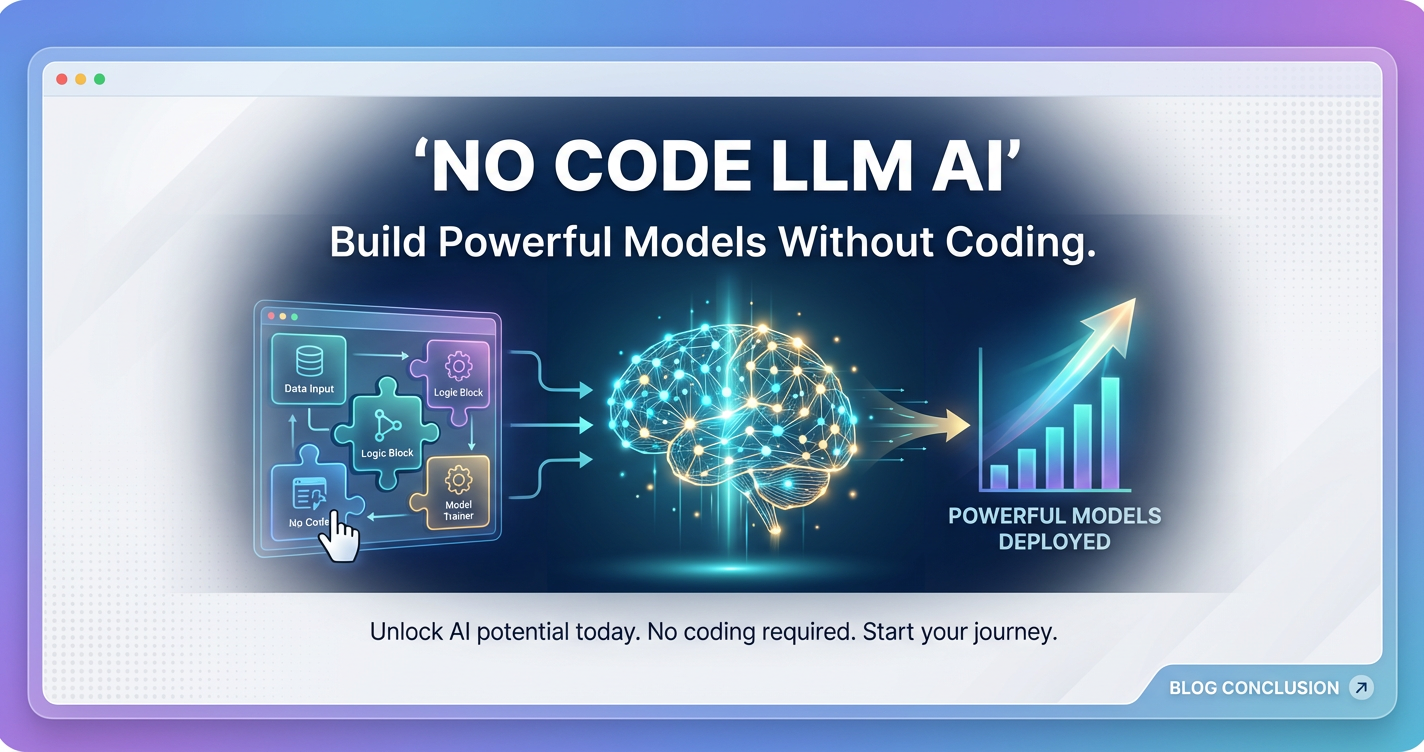
The journey into the realm of "No Code LLM AI: Build Powerful Models Without Coding" reveals a profound and transformative shift in the landscape of artificial intelligence. We've explored how the once formidable barriers of complex programming, specialized data science expertise, and intricate infrastructure management are being systematically dismantled by the convergence of advanced Large Language Models and intuitive no-code development platforms. This synergy is not just an incremental step; it represents a fundamental redefinition of who can build with AI and how quickly innovative solutions can come to fruition.
At the heart of this revolution are the powerful capabilities of Large Language Models, which, through their extensive training on vast datasets, have developed an astonishing ability to understand, generate, and manipulate human language. From crafting compelling marketing copy to automating customer service interactions, and from extracting critical insights from unstructured data to enhancing internal productivity, LLMs are proving to be versatile and impactful. However, their inherent complexity has historically limited their accessibility.
This is where no-code platforms step in, offering visual builders, drag-and-drop interfaces, pre-built templates, and sophisticated prompt engineering tools. These components collectively abstract away the underlying technical intricacies, empowering a diverse array of users – from domain experts to entrepreneurs – to design, build, and deploy intelligent applications with unprecedented speed and efficiency. The shift is clear: the focus has moved from the mechanics of coding to the creative application of AI for problem-solving.
Crucially, the full potential of no-code LLM AI, especially in enterprise settings, is unlocked and sustained by the indispensable role of supporting infrastructure. The AI Gateway and more specifically, the LLM Gateway, serve as intelligent orchestrators, centralizing security, optimizing costs, ensuring scalability, and standardizing interactions with a multitude of LLM providers. Concepts like the Model Context Protocol further enhance this by providing a unified interface for managing conversational context, enabling seamless model switching and resilient, high-performance AI applications. Platforms like APIPark exemplify this critical infrastructure, offering a unified API format, robust security features, and powerful performance that empowers no-code solutions to operate at an enterprise scale.
While challenges related to scalability, security, customization limits, and ethical considerations remain, proactive management and the strategic leverage of advanced gateways can mitigate these risks. The future of no-code LLM AI is bright, promising even greater sophistication, deeper integration, and a continuous democratization of AI capabilities. It envisions a world where artificial intelligence is not just a tool for a select few, but a powerful, accessible utility that empowers everyone to innovate, create, and solve complex problems, truly bringing the promise of AI into the hands of the many.
FAQ
1. What exactly is No-Code LLM AI, and how does it differ from traditional AI development?
No-Code LLM AI refers to the process of building and deploying applications powered by Large Language Models (LLMs) without writing any traditional code. Instead of programming languages and complex frameworks, users interact with intuitive visual interfaces, drag-and-drop components, and pre-built templates. This differs significantly from traditional AI development, which typically requires deep expertise in programming (e.g., Python), machine learning algorithms, data science, and managing computational infrastructure. No-code abstracts away these technical complexities, enabling non-developers, such as business analysts, marketing professionals, or HR specialists, to create sophisticated AI solutions by focusing on logic and application rather than coding syntax. It democratizes access to AI, making it faster, more accessible, and often more cost-effective for a broader range of users.
2. Why are AI Gateways and LLM Gateways crucial for No-Code LLM AI applications?
AI Gateways and LLM Gateways are critical because they act as intelligent intermediaries between no-code applications and various LLM providers, abstracting away the inherent complexities of managing diverse AI models. They provide a unified access point, standardizing API formats across different LLMs (e.g., from OpenAI, Anthropic, Google), which allows no-code applications to switch models without requiring any code changes. Beyond this, gateways offer essential functionalities like centralized security and authentication (managing API keys, enforcing access controls), granular cost management and usage tracking, load balancing and failover mechanisms for high availability, and comprehensive logging for observability and debugging. They also facilitate advanced features like prompt encapsulation into reusable APIs. For instance, platforms like APIPark provide a unified system to integrate over 100 AI models, ensuring robust, scalable, and secure operations for no-code solutions. Without a robust gateway, no-code applications would struggle with fragmentation, security risks, scalability issues, and unmanaged costs.
3. What is the Model Context Protocol, and why is it important for working with multiple LLMs in a no-code environment?
The Model Context Protocol is a standardized set of rules and formats used within an LLM Gateway to manage conversational context and other model-specific parameters consistently across different Large Language Models. Each LLM provider has unique ways of handling conversation history, system messages, user/assistant roles, and context window token limits. The Model Context Protocol normalizes these differences, allowing no-code applications to interact with any integrated LLM using a single, consistent approach. This is crucial because it enables true model agnosticism; no-code builders can design complex multi-turn conversations or dynamic prompt chains without needing to understand the specific nuances of each LLM's API. The protocol handles the intelligent management of conversation history (e.g., summarizing older messages to fit token limits), standardizes message formats, and normalizes parameters, ensuring that the no-code builder's intent is correctly translated and executed by the chosen LLM, enhancing flexibility and future-proofing the application.
4. What are some real-world examples of applications built using No-Code LLM AI?
No-Code LLM AI is being rapidly adopted across various industries for a wide range of applications: * Content Generation: Marketing teams use it to quickly generate blog posts, social media updates, email copy, and product descriptions, personalizing content for different audiences. * Customer Service Automation: Businesses build intelligent chatbots and virtual assistants that can answer FAQs, summarize customer interactions, and even route complex queries to human agents, providing 24/7 support. * Data Analysis and Insights: Analysts employ no-code tools to summarize lengthy reports, extract key information from unstructured text (like legal documents or market research), and perform sentiment analysis on customer feedback. * Internal Tools & Productivity: Organizations create tools for automated meeting summaries, dynamic internal knowledge bases for employees, or even basic code generation assistance for non-developers, streamlining internal operations. * Creative and Educational Applications: Writers use LLMs for story generation and co-writing, while educators develop personalized learning content or interactive tutors. These examples highlight how no-code LLM AI empowers non-technical users to create powerful, tailored solutions.
5. What are the main challenges and considerations when implementing No-Code LLM AI solutions?
While highly advantageous, no-code LLM AI comes with several challenges and considerations: * Scalability: Ensuring the solution can handle growing user demand and high traffic volumes, often requiring robust AI Gateway support for load balancing and performance. * Security and Data Privacy: Protecting sensitive data processed by LLMs, managing API keys securely, and complying with data privacy regulations (e.g., GDPR), which advanced gateways like APIPark help address with features like independent tenant permissions and access approval. * Vendor Lock-in: The risk of being tied to a specific no-code platform or LLM provider, which can be mitigated by using LLM Gateways that abstract model interfaces and allow for easy switching. * Customization Limits: No-code platforms may have limitations for highly specialized, complex, or performance-critical requirements that might still necessitate some custom coding or a low-code approach. * Ethical AI Concerns: Addressing biases inherited from training data, ensuring fairness, and mitigating risks of misinformation or "hallucinations" generated by LLMs, requiring careful prompt engineering and human oversight. * Cost Management: Beyond LLM API token costs, factoring in platform subscription fees, integration costs, and human oversight for quality assurance. Proactive monitoring via an AI Gateway is crucial for managing these expenses effectively.
🚀You can securely and efficiently call the OpenAI API on APIPark in just two steps:
Step 1: Deploy the APIPark AI gateway in 5 minutes.
APIPark is developed based on Golang, offering strong product performance and low development and maintenance costs. You can deploy APIPark with a single command line.
curl -sSO https://download.apipark.com/install/quick-start.sh; bash quick-start.sh

In my experience, you can see the successful deployment interface within 5 to 10 minutes. Then, you can log in to APIPark using your account.

Step 2: Call the OpenAI API.