OpenAI HQ: Inside the Future of AI Innovation
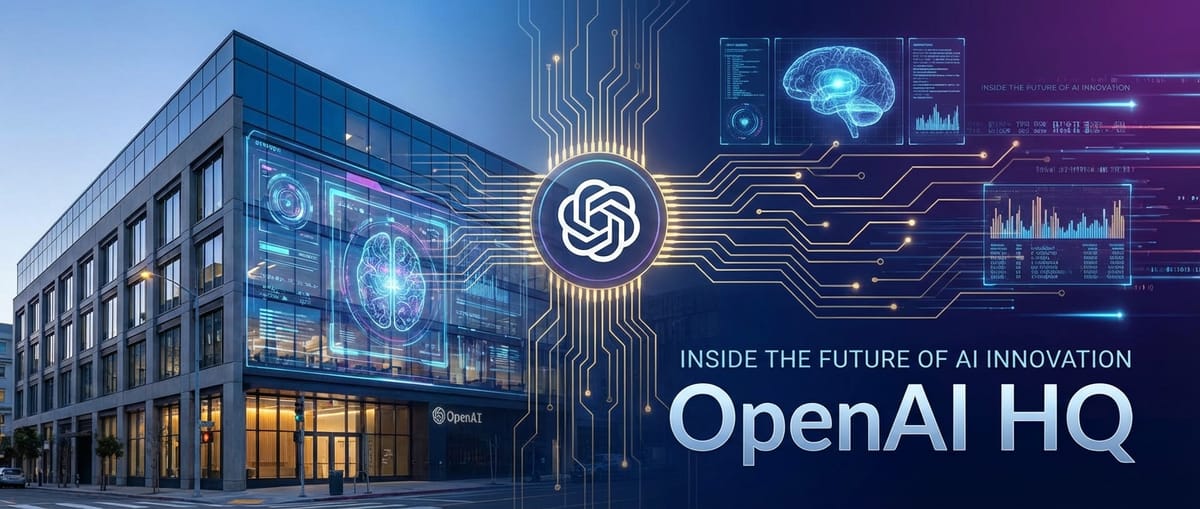


The unassuming exterior of OpenAI's headquarters belies the seismic shifts in technology and human capability being forged within its walls. More than just an office building, it stands as a veritable crucible where the most brilliant minds in artificial intelligence converge, meticulously crafting the future of interaction between humans and machines. This is not merely a workplace; it is a vibrant ecosystem of relentless innovation, deep contemplation, and audacious ambition, aiming to unlock the potential of artificial general intelligence (AGI) for the benefit of all humanity. Stepping inside, one immediately senses the palpable energy of groundbreaking discovery, a unique blend of academic rigor and startup agility that characterizes the vanguard of AI research. From the intricate algorithms that power large language models to the ethical frameworks guiding their deployment, every facet of OpenAI's operation is designed to push the boundaries of what is possible, all while grappling with the profound societal implications of their creations. This exploration delves deep into the heart of OpenAI HQ, revealing the philosophies, technologies, and human endeavors that define its pioneering journey.
The journey to comprehend the future of AI truly begins by understanding the beating heart of institutions like OpenAI. It's a journey into the convergence of theoretical computer science, advanced engineering, and ethical philosophy, all encapsulated within a dynamic organizational structure. The mission, initially rooted in a non-profit ethos and later evolving into a capped-profit model, has consistently been to ensure that AGI benefits all of humanity, not just a select few. This foundational principle permeates every aspect of the organization, influencing research directions, product development, and its interactions with the global scientific and public communities. OpenAI's headquarters serves as a physical manifestation of this mission, a place where ideas are born, tested, refined, and ultimately, brought to life, impacting industries, reshaping economies, and fundamentally altering the landscape of human creativity and productivity. The very air inside seems charged with intellectual curiosity and the weight of responsibility, as researchers and engineers navigate the complex terrain of AI development, always with an eye towards both unprecedented capabilities and unforeseen challenges. This extensive dive promises an unparalleled look at the inner workings of a company poised at the precipice of a technological revolution.
The Genesis of a Vision: Laying the Foundation for AGI
The story of OpenAI is one etched in ambitious foresight and a deep conviction regarding the transformative power of artificial intelligence. Founded in December 2015 by a cohort of prominent figures including Sam Altman, Elon Musk, Greg Brockman, Ilya Sutskever, and others, the organization's initial charter was strikingly clear: to advance digital intelligence in the way that is most likely to benefit humanity as a whole, unconstrained by the need to generate financial return. This non-profit ethos was a direct response to growing concerns about the potential existential risks of AI, with the founders believing that a powerful AI should not be controlled by a single corporation seeking profit or a government with unchecked power. Their vision was not merely to build advanced AI but to ensure its safety and accessibility, fostering an environment where breakthroughs could be openly shared and responsibly developed. This initial commitment to openness and broad benefit laid the groundwork for an Open Platform approach that would later define much of its public-facing strategy.
In its nascent stages, OpenAI’s research agenda was broad, encompassing areas like reinforcement learning, robotics, and game theory, with an emphasis on foundational research that could contribute to the long-term goal of AGI. Early projects, such as OpenAI Gym for reinforcement learning research and the development of agents capable of mastering complex games, demonstrated the organization's commitment to pushing theoretical and practical boundaries. The talent pool assembled from the outset was extraordinary, attracting leading researchers and engineers from top universities and tech companies, all united by the singular, monumental goal of building general intelligence. However, the path was not without its formidable challenges. The sheer computational demands of cutting-edge AI research quickly became apparent, necessitating massive investments in hardware and infrastructure, resources that a traditional non-profit model might struggle to sustain indefinitely. This economic reality eventually prompted a significant strategic pivot, recognizing that the scale of resources required to achieve AGI necessitated a more flexible financial structure.
The philosophical underpinnings of "Open" AI have always been a subject of intense discussion and evolution. Initially, it implied a commitment to publishing research, sharing code, and collaborating transparently with the broader AI community. This commitment fostered an environment of rapid progress, allowing other researchers to build upon OpenAI's work and contribute to the collective understanding of AI. However, as the capabilities of their models, particularly the GPT series, began to accelerate, the implications of fully "open-sourcing" potentially powerful and dual-use technologies became a complex ethical dilemma. The organization had to navigate the delicate balance between transparency for scientific progress and responsible deployment to prevent misuse. This evolving understanding of "openness" became a defining characteristic of OpenAI, demonstrating a pragmatic approach to its core mission that adapted to the accelerating pace of AI development. The founding principles, though tested by practical considerations, continued to guide their trajectory, ensuring that safety and the benefit of humanity remained central to every strategic decision, even as the organization embraced a capped-profit structure to fuel its insatiable need for computational power and human talent. The journey from a purely non-profit ideal to a more hybrid model underscores the immense cost and complexity involved in pioneering the future of artificial general intelligence.
Architecture of Innovation: The Physical Manifestation of Vision
OpenAI's headquarters, nestled in the vibrant tech hub of San Francisco, serves as more than just a functional office space; it is a meticulously designed environment intended to foster the intense intellectual activity and collaborative spirit essential for pioneering AI research. While specific details of its interior are often kept under wraps due to the competitive and sensitive nature of their work, external observations and anecdotal accounts paint a picture of a space optimized for deep concentration, spontaneous collaboration, and flexible adaptation. The location itself, often in proximity to other leading tech companies and academic institutions, facilitates the constant exchange of ideas and talent that defines Silicon Valley's innovation ecosystem. The building's architecture likely blends modern aesthetics with practical functionality, prioritizing natural light, ergonomic workstations, and common areas designed to encourage informal interactions crucial for breakthrough thinking.
The design philosophy behind the headquarters prioritizes both individual focus and collective synergy. Researchers and engineers often require long periods of uninterrupted concentration to tackle complex algorithms and vast datasets. Therefore, the layout likely incorporates quiet zones, private offices, or highly adaptable modular workspaces that can be configured for individual deep work. Simultaneously, the nature of AI development is inherently interdisciplinary, demanding constant communication between specialists in various fields—from machine learning engineers and data scientists to ethicists and policy experts. To facilitate this, open-plan areas, huddle rooms, and large meeting spaces equipped with advanced teleconferencing capabilities are indispensable. These communal areas are not just for formal meetings; they are critical for spontaneous whiteboard sessions, informal brainstorming, and cross-pollination of ideas that often lead to unexpected discoveries. The "vibe" within these walls is often described as a unique hybrid: the rigorous, contemplative atmosphere of a top-tier academic research lab blended with the fast-paced, problem-solving intensity of a cutting-edge startup.
Security and resilience are paramount considerations for an organization working on technology with such profound global implications. While open in its research approach, the physical infrastructure is undoubtedly secured with state-of-the-art measures to protect intellectual property, sensitive data, and the safety of its personnel. Access controls, cybersecurity protocols, and secure data centers are integral to its operational framework. Furthermore, the design likely incorporates flexibility for future expansion and technological upgrades, recognizing that the demands of AI research are constantly evolving. As new compute paradigms emerge or as the team grows, the physical space must adapt without impeding the pace of innovation. From advanced cooling systems for server farms to robust networking infrastructure supporting petabytes of data transfer, every aspect of the HQ's design is a testament to the highly specialized requirements of developing world-leading AI. It is a subtle yet powerful reminder that even in the age of digital transformation, the physical environment plays a critical role in nurturing the human creativity and collaboration that drives technological progress forward. The physical space is a silent partner in the relentless pursuit of artificial general intelligence, a carefully curated habitat for the minds shaping tomorrow.
The Human Element: Inside OpenAI's Culture of Innovation and Ethics
At the core of OpenAI's monumental ambition lies its extraordinary human capital. The organization has successfully cultivated a culture that not only attracts but also retains some of the world's most talented researchers, engineers, ethicists, and policy experts. Recruitment at OpenAI is notoriously rigorous, focusing not just on technical prowess but also on a deep alignment with the company's mission: to ensure that AGI benefits all of humanity. This mission-driven approach serves as a powerful magnet, drawing individuals who are motivated by impact rather than solely by financial reward, though compensation remains competitive. The global reach of its recruitment efforts ensures a diverse pool of perspectives, bringing together expertise from varied academic backgrounds and geographical locations, enriching the problem-solving process and fostering a more comprehensive understanding of AI's global implications.
The internal structure of OpenAI is designed to facilitate rapid progress while maintaining a strong emphasis on interdisciplinary collaboration. Teams are often fluid, forming around specific research problems or product development initiatives, allowing for specialists from different domains—such as deep learning, reinforcement learning, neuroscience, and philosophy—to converge and contribute their unique insights. This cross-pollination of ideas is crucial for tackling the multifaceted challenges of AI, from algorithmic design to ethical deployment. Communication is typically open and direct, fostering an environment where ideas are rigorously debated, challenged, and refined, pushing the boundaries of what's possible. The culture encourages intellectual curiosity, a willingness to challenge established norms, and a profound commitment to iterative improvement. This agility allows OpenAI to quickly pivot research directions in response to new breakthroughs or emerging challenges, maintaining its position at the forefront of AI development.
Ethical considerations are not an afterthought at OpenAI; they are deeply woven into the fabric of its operational culture. From the initial stages of model development to their eventual deployment, extensive discussions revolve around potential biases, fairness, transparency, and the societal impact of their creations. Dedicated teams focus on AI safety and alignment research, striving to ensure that advanced AI systems are aligned with human values and goals. This includes developing robust methods for identifying and mitigating harmful biases, implementing safeguards against misuse, and exploring techniques for interpretability and explainability of complex AI models. The constant dialogue around responsible AI development permeates daily interactions, project reviews, and strategic planning sessions, underscoring the organization's recognition of the immense power and responsibility that comes with building AGI.
While the work at OpenAI is intellectually stimulating and profoundly impactful, it is also incredibly demanding. The pursuit of AGI is a monumental endeavor, often requiring intense focus and long hours. However, there is a recognized effort to support the well-being of employees, understanding that sustained innovation requires a healthy and balanced workforce. Professional development and continuous learning are heavily emphasized, with access to cutting-edge research, internal seminars, and opportunities for skill enhancement. Given the highly specialized nature of the field, OpenAI also actively works towards fostering diversity and inclusion, recognizing that a variety of backgrounds and perspectives leads to more robust and equitable AI systems. This commitment extends beyond recruitment to creating an inclusive environment where all voices are heard and valued. The human element at OpenAI is a testament to the belief that the future of AI is not just about algorithms and data, but about the collective ingenuity, ethical foresight, and collaborative spirit of the people driving its evolution.
Powering the Future: The Technological Core and Its Open Platform
At the very heart of OpenAI's relentless pursuit of AGI lies a technological infrastructure of unparalleled scale and sophistication. The development and training of models like the GPT series, DALL-E, and Sora demand staggering computational resources, pushing the boundaries of what modern supercomputing can achieve. OpenAI operates vast clusters of GPUs, often numbering in the tens of thousands, interconnected by high-speed networks that facilitate the synchronous training of massive neural networks. This infrastructure is not merely off-the-shelf; it involves significant customization, optimization, and often, collaboration with hardware manufacturers to design systems specifically tailored for the unique demands of large-scale AI training. The need for such colossal compute power is driven by the sheer size of the models—billions, even trillions of parameters—and the enormous datasets required to train them effectively. Managing this compute, ensuring its efficiency, and mitigating the immense power consumption and heat generation are engineering feats in themselves, requiring specialized data centers and sophisticated cooling solutions.
Beyond raw compute, data management forms another critical pillar of OpenAI's technological core. The quality and diversity of training data are paramount for developing capable and unbiased AI models. OpenAI processes petabytes of data, sourced from vast swathes of the internet—text, images, audio, and video—which are then meticulously curated, filtered, and processed. This involves addressing challenges like data cleanliness, ethical sourcing (ensuring data is used responsibly and respects privacy where applicable), and the development of sophisticated pipelines for data ingestion and transformation. The iterative cycle of model development—from ideation, architectural design, training, evaluation, fine-tuning, to eventual deployment—is a complex ballet of data science, machine learning engineering, and computational linguistics. Each stage demands robust tools and methodologies to ensure reproducibility, version control, and efficient experimentation.
The advancements OpenAI has made with its GPT series, DALL-E, and more recently Sora, have profoundly impacted various sectors, demonstrating the immense potential of generative AI. GPT models have revolutionized natural language understanding and generation, finding applications in content creation, customer service, education, and software development. DALL-E has opened new frontiers in visual creativity, allowing users to generate high-quality images from textual prompts, transforming design and digital art. Sora promises to do the same for video, marking another significant leap in multimodal AI capabilities. These developments are not just impressive feats of engineering; they represent tangible steps towards more general-purpose AI systems, capable of understanding and interacting with the world in increasingly human-like ways.
As the complexity of AI models grows, so does the need for sophisticated management solutions that bridge the gap between powerful models and real-world applications. Tools like ApiPark, an open-source AI gateway and API management platform, become indispensable for businesses looking to integrate and deploy AI and REST services efficiently. APIPark offers quick integration of 100+ AI models and a unified API format, simplifying AI usage and maintenance. For organizations dealing with the sheer volume and variety of models developed by entities like OpenAI, an effective LLM Gateway is crucial for orchestrating access, ensuring security, and optimizing performance across diverse applications. An AI Gateway plays a vital role in handling authentication, authorization, rate limiting, and analytics for AI services, ensuring that powerful models are accessible yet controllable. It acts as a single entry point for all AI-related requests, simplifying client-side integration and providing a layer of abstraction from the underlying AI model implementations. For Large Language Models specifically, an LLM Gateway manages complex aspects like prompt engineering versioning, model switching, and cost tracking across different LLMs, providing a unified and resilient interface for developers.
OpenAI’s strategy involves an Open Platform approach, democratizing access to its cutting-edge models through APIs. This strategy acknowledges that the true impact of AI is realized when it is put into the hands of developers and innovators across the globe. By providing well-documented APIs, OpenAI allows external developers to build upon its foundational models, creating an ecosystem of applications and services that would otherwise be impossible. This approach not only accelerates innovation but also fosters a broader understanding of AI's capabilities and limitations. However, managing this access at scale presents its own set of challenges, from ensuring fair usage and preventing abuse to maintaining system stability and security. The robust infrastructure supporting this Open Platform must handle billions of API calls, route traffic efficiently, balance loads across compute clusters, and provide detailed logging and monitoring capabilities. The constant evolution of their models and the increasing demand for access mean that the underlying technological core is in a perpetual state of optimization and expansion, always striving to meet the ever-growing needs of a global developer community eager to harness the power of AI.
APIPark is a high-performance AI gateway that allows you to securely access the most comprehensive LLM APIs globally on the APIPark platform, including OpenAI, Anthropic, Mistral, Llama2, Google Gemini, and more.Try APIPark now! 👇👇👇
OpenAI's Ecosystem and Impact: An Open Platform for Global Innovation
OpenAI's influence extends far beyond its headquarters, propagating through a vast and rapidly expanding ecosystem fueled by its commitment to an Open Platform approach. By making its cutting-edge AI models accessible through robust Application Programming Interfaces (APIs), OpenAI has empowered developers worldwide to integrate sophisticated AI capabilities into their own applications, services, and workflows. This strategy has democratized access to advanced AI, allowing startups, established enterprises, and individual innovators alike to leverage the power of models like GPT-4 or DALL-E without needing to invest in the monumental compute infrastructure or deep research expertise required to build such models from scratch. The API economy around OpenAI’s models has generated an explosion of innovation, leading to novel applications across virtually every industry imaginable.
The impact of this API access is transformative. In content creation, AI models are assisting writers, marketers, and artists in generating drafts, brainstorming ideas, and creating visual assets at unprecedented speeds. In healthcare, researchers are using these models for drug discovery, diagnostic support, and patient engagement. Educational platforms are leveraging AI for personalized learning experiences, intelligent tutoring, and content summarization. Software development itself has been revolutionized, with AI assistants helping programmers write code, debug, and understand complex systems more efficiently. This wide-ranging adoption underscores the versatility and power inherent in OpenAI's foundational models, demonstrating how an Open Platform can accelerate industry-wide innovation rather than centralize it.
Partnerships, most notably with Microsoft, have played a pivotal role in scaling OpenAI's capabilities and extending its reach. Microsoft's significant investment and provision of Azure's supercomputing infrastructure have been critical for training OpenAI's largest models, enabling research that would otherwise be economically or practically unfeasible. This strategic alliance is a testament to the belief that the future of AI requires immense resources and collaborative efforts. Beyond this primary partnership, OpenAI engages with various academic institutions, industry leaders, and non-governmental organizations to share insights, gather feedback, and collaborate on research initiatives, further enriching its ecosystem and ensuring a broader societal perspective on AI development.
The developer community surrounding OpenAI is a vibrant and essential component of its Open Platform. Through official forums, online documentation, community-led hackathons, and a wealth of third-party tutorials, developers are actively engaged in exploring the limits of the technology, sharing best practices, and pushing the envelope of what's possible. This collective intelligence not only contributes to the rapid evolution of AI applications but also provides invaluable feedback to OpenAI, helping to identify bugs, suggest new features, and understand real-world use cases and challenges. This symbiotic relationship ensures that the Open Platform remains responsive to the needs of its users, continuously evolving to meet new demands and address emerging complexities.
OpenAI's approach also forces it to navigate a complex competitive landscape. While it remains a leader in several key areas of generative AI, numerous other companies and research institutions are making significant strides. To maintain its edge, OpenAI relies on continuous innovation, pushing the boundaries of model capabilities, improving efficiency, and expanding into new modalities like video generation. Furthermore, its ability to integrate safety and ethical considerations into its development process offers a critical differentiator, building trust and fostering responsible adoption. The balance between open research—sharing insights and methodologies for the benefit of the scientific community—and strategic commercialization through its API services is a delicate act. This careful equilibrium allows OpenAI to fund its ambitious research while simultaneously contributing to the global advancement of AI knowledge. The future directions for this Open Platform likely involve further multimodal capabilities, enhanced reasoning, increased customization options for developers, and a continued focus on making AI more accessible and beneficial for a truly global audience.
Navigating the Ethical Labyrinth and Future Horizons: OpenAI's Grand Challenge
The journey at OpenAI is not solely defined by technological breakthroughs; it is equally characterized by a deep, unwavering commitment to navigating the profound ethical challenges that accompany the rise of increasingly powerful AI systems. At the core of its mission is AI safety and alignment research, an endeavor to ensure that advanced artificial intelligence systems are not only capable but also inherently aligned with human values and goals, preventing unintended or harmful outcomes. This is not a secondary concern but a foundational pillar, reflecting a recognition that the stakes for AGI are nothing short of existential. Researchers actively explore techniques for controlling and understanding highly complex models, developing methods to prevent them from generating biased, harmful, or misleading content, and designing safeguards against autonomous decision-making that could deviate from human intent.
Bias, fairness, and transparency represent ongoing and critical challenges in AI development. Since AI models learn from vast datasets, they can inadvertently absorb and amplify societal biases present in that data. OpenAI invests heavily in identifying and mitigating these biases through sophisticated data filtering, model architectures, and post-hoc evaluation techniques. Ensuring fairness across different demographic groups and promoting transparency—making AI decisions more understandable and explainable—are areas of active research and development. The goal is to build AI systems that are not just intelligent, but also equitable and trustworthy, reflecting a diverse range of human experiences and values. This continuous iterative process involves not only technical solutions but also ethical frameworks and interdisciplinary collaboration with social scientists and ethicists.
The regulatory landscape surrounding AI is rapidly evolving, and OpenAI plays a proactive role in shaping policy discussions. Engaging with governments, international bodies, and civil society organizations, it contributes insights and expertise to inform responsible AI governance, advocating for policies that foster innovation while prioritizing safety and public benefit. This involves discussions around data privacy, intellectual property, accountability for AI-generated content, and the broader societal impacts of automation. OpenAI’s leadership understands that the development of AGI cannot occur in a vacuum; it requires a collaborative effort with policymakers and the public to establish guardrails and ensure a beneficial trajectory.
Looking towards the long-term vision, the pursuit of Artificial General Intelligence (AGI)—AI systems capable of performing any intellectual task that a human can—remains OpenAI's ultimate goal. The societal implications of AGI are profound, promising to revolutionize every aspect of human existence, from scientific discovery and economic productivity to healthcare and creative expression. However, this also brings forth unprecedented questions about work, meaning, human identity, and the very structure of society. OpenAI is actively exploring these future scenarios, engaging in foresight exercises, and building conceptual frameworks to prepare for a world transformed by AGI. This involves considering how AGI can augment human capabilities, address grand global challenges, and coexist harmoniously with human intelligence, rather than replacing it.
Future projects at OpenAI are likely to continue pushing the boundaries of multimodal AI, integrating diverse data types like vision, language, and action to create more comprehensive and context-aware models. Advancements in reasoning capabilities, long-term memory, and personalized learning for AI systems are also anticipated. The interplay between human intelligence and artificial intelligence will only deepen, evolving from tools to collaborative partners. The continuous evolution of what an "Open Platform" truly means in the context of AGI will be critical. It might involve new paradigms for shared governance of AI, more transparent model auditing, and mechanisms for broader societal input into the development and deployment of these powerful technologies. OpenAI's grand challenge, therefore, is not merely to build the future of AI but to ensure it is a future humanity can embrace with confidence and optimism, guided by profound ethical consideration and a commitment to collective well-being.
Key Milestones in OpenAI's Journey
OpenAI's rapid ascent to the forefront of AI innovation is marked by a series of pivotal research breakthroughs and strategic developments. The following table highlights some of these key milestones, illustrating the organization's trajectory from foundational research to the deployment of world-changing AI models.
| Year | Milestone | Description | Impact |
|---|---|---|---|
| 2015 | Founding of OpenAI | Established as a non-profit AI research company by Sam Altman, Elon Musk, and others, with a mission to advance digital intelligence in the way most likely to benefit humanity. | Signaled a concerted effort to address AI safety and ensure broad benefit, attracting top talent and establishing a foundational vision. |
| 2016 | OpenAI Gym & Universe Release | Open-source toolkits for developing and comparing reinforcement learning algorithms. | Democratized access to RL research tools, accelerating progress in the field and fostering community collaboration. |
| 2017 | Dota 2 AI (OpenAI Five) | Developed AI agents that could defeat top human players in the complex real-time strategy game Dota 2. | Demonstrated advanced capabilities in multi-agent reinforcement learning, strategy, and cooperation in highly complex environments. |
| 2018 | GPT-1 Release | The first Generative Pre-trained Transformer model, showcasing the power of unsupervised pre-training on large text corpora. | Laid the groundwork for large language models, proving the effectiveness of transformer architecture and large-scale pre-training for NLP tasks. |
| 2019 | Transition to Capped-Profit Model | Introduced a capped-profit structure to raise capital for massive compute demands, while retaining its original mission. | Enabled securing the vast financial resources needed for large-scale AI research and development, particularly for training increasingly large models. |
| 2019 | GPT-2 Release (Staged) | A significantly larger and more capable language model, initially released with caution due to concerns about misuse. | Sparked widespread debate about the ethical implications of powerful generative AI; demonstrated unprecedented text generation quality. |
| 2020 | GPT-3 API Launch | Made GPT-3 accessible via an API, allowing developers to integrate its capabilities into their applications. | Catalyzed a wave of AI-powered applications across various industries, showcasing the power of an Open Platform for AI innovation. |
| 2021 | DALL-E Release | A generative AI model capable of creating realistic images and art from natural language descriptions. | Revolutionized image generation, demonstrating multimodal AI capabilities and opening new avenues for creative expression and design. |
| 2022 | ChatGPT Public Launch | A conversational AI model built on the GPT-3.5 architecture, made freely available to the public. | Achieved unprecedented public awareness and adoption of generative AI, demonstrating its practical utility for a wide range of tasks and triggering a global AI arms race. |
| 2023 | GPT-4 Release | A more advanced and capable version of the GPT series, demonstrating improved reasoning, multimodal input (vision), and significantly enhanced safety. | Further solidified OpenAI's leadership in LLMs, showcasing improved reliability and pushing the boundaries of what an LLM Gateway can manage in terms of diverse capabilities. |
| 2024 | Sora Release (Preview) | A text-to-video generative AI model capable of creating realistic and imaginative scenes from text instructions. | Marked a significant leap in video generation, illustrating the rapid progression towards more sophisticated and multimodal AI systems, challenging traditional content creation paradigms. |
Conclusion: OpenAI HQ – The Nexus of Humanity's AI Future
OpenAI's headquarters stands as a poignant symbol of humanity's ambitious quest to understand and ultimately create artificial general intelligence. It is a place where cutting-edge research converges with profound ethical deliberation, where the hum of powerful servers blends with the quiet intensity of human thought. The journey from its founding as a non-profit to its current hybrid structure underscores the immense resources and sustained dedication required to push the boundaries of AI, a field that demands both audacious vision and painstaking execution. Within its walls, a vibrant culture of collaboration, intellectual rigor, and mission-driven purpose thrives, attracting the brightest minds eager to contribute to a technology that promises to redefine our world.
The technological prowess housed within OpenAI is staggering, from its custom-built supercomputing infrastructure to the meticulous curation of vast datasets that fuel its groundbreaking models. The consistent evolution of the GPT series, DALL-E, and Sora are not merely incremental improvements but represent fundamental shifts in what AI can achieve, impacting everything from creative industries to scientific discovery. Crucially, OpenAI's commitment to an Open Platform has democratized access to these powerful tools, fostering a global ecosystem of innovators who are leveraging its AI Gateway and LLM Gateway services to build unforeseen applications and accelerate progress across countless domains. This strategy has transformed AI from a theoretical concept into a practical reality for millions, solidifying its place as a pervasive force in modern technology.
Yet, the vision pursued at OpenAI is inherently fraught with complex ethical dilemmas. The relentless focus on AI safety, alignment, and the mitigation of biases reflects a profound awareness of the responsibilities that accompany such potent creations. The organization actively engages with policymakers, ethicists, and the public to navigate the uncharted waters of AI governance, ensuring that the benefits of AGI are broadly shared and its risks carefully managed. As OpenAI continues its pursuit of AGI, its headquarters remains a nexus of humanity's future with AI—a place where the frontiers of technology are expanded, ethical considerations are paramount, and the profound questions about our collective destiny are confronted head-on. The work being done there will undoubtedly shape the trajectory of human civilization for generations to come, making it a critical watchpoint for anyone interested in the future of intelligence itself.
Frequently Asked Questions (FAQ) About OpenAI
1. What is OpenAI's primary mission? OpenAI's primary mission is to ensure that artificial general intelligence (AGI)—highly autonomous systems that outperform humans at most economically valuable work—benefits all of humanity. This includes pioneering research into AI capabilities, developing robust safety mechanisms, and promoting responsible deployment of AI technologies to ensure widespread positive impact.
2. How does OpenAI fund its extensive research and development? Initially founded as a non-profit, OpenAI transitioned to a "capped-profit" model in 2019. This hybrid structure allows it to raise significant capital from investors (like Microsoft) to fund its extremely expensive compute resources and attract top talent, while still adhering to its core mission. Profits generated are capped, and any returns beyond that cap are directed back to the original non-profit entity to further its mission.
3. What are some of OpenAI's most notable AI models? OpenAI is renowned for several influential AI models. These include the GPT (Generative Pre-trained Transformer) series, such as GPT-3 and GPT-4, which are powerful large language models capable of generating human-like text. Other significant models include DALL-E, which generates images from text descriptions, Sora, which creates realistic video from text, and ChatGPT, a widely adopted conversational AI interface based on the GPT architecture.
4. How does OpenAI ensure the safety and ethical development of its AI? OpenAI places a strong emphasis on AI safety and ethics. It has dedicated research teams focused on AI alignment (ensuring AI systems follow human intent), mitigating biases in models, and developing robust safety mechanisms to prevent misuse. The organization engages with external experts, policymakers, and the public to inform its ethical frameworks and contribute to responsible AI governance. This includes staggered releases for powerful models and active monitoring of their performance.
5. What is an "Open Platform" in the context of OpenAI, and how does it relate to tools like an AI Gateway or LLM Gateway? An "Open Platform" refers to OpenAI's strategy of making its advanced AI models accessible to a broad developer community through APIs. This allows external developers and businesses to integrate OpenAI's capabilities into their own applications and services, fostering innovation and democratizing access to AI. Tools like an AI Gateway or an LLM Gateway (such as ApiPark) are crucial for this Open Platform to function effectively. They act as centralized entry points that manage, secure, and optimize access to these AI models, handling authentication, load balancing, rate limiting, and ensuring a unified, efficient interaction between external applications and OpenAI's powerful AI services.
🚀You can securely and efficiently call the OpenAI API on APIPark in just two steps:
Step 1: Deploy the APIPark AI gateway in 5 minutes.
APIPark is developed based on Golang, offering strong product performance and low development and maintenance costs. You can deploy APIPark with a single command line.
curl -sSO https://download.apipark.com/install/quick-start.sh; bash quick-start.sh

In my experience, you can see the successful deployment interface within 5 to 10 minutes. Then, you can log in to APIPark using your account.

Step 2: Call the OpenAI API.