OpenAI HQ: Inside the Hub of AI Innovation


In an era increasingly defined by the breathtaking advancements of artificial intelligence, one name frequently emerges at the vanguard of this transformative frontier: OpenAI. More than just a company, OpenAI represents a bold experiment in human ingenuity, a crucible where the raw potential of computation meets the audacious ambition of human intellect. Tucked away in the vibrant, innovation-rich landscape of San Francisco, the OpenAI Headquarters is not merely an office building; it is a veritable nerve center, a modern-day Bell Labs dedicated to pushing the boundaries of what machines can understand, create, and achieve. This sprawling complex serves as the epicenter for an extraordinary mission: to ensure that artificial general intelligence (AGI)—AI systems with human-level cognitive abilities—benefits all of humanity. It is here, within these walls, that the future is not just predicted but actively forged, where groundbreaking research transitions into world-changing applications, and where the most complex ethical dilemmas of our technological age are grappled with daily. This article endeavors to take you on an in-depth journey inside this pivotal hub, exploring its genesis, its unique culture, the minds that animate it, and the profound implications of the work undertaken within its highly secured, yet intensely collaborative, environment. We will delve into how OpenAI fosters an Open Platform for AI innovation, the critical role of robust infrastructure like an AI Gateway or LLM Gateway in managing the access and impact of their powerful models, and the intricate dance between audacious technological pursuit and profound ethical responsibility that defines their daily existence.
The Genesis and Vision of OpenAI: A Foundation Built on Ambition and Foresight
The story of OpenAI is one born out of a potent mix of visionary ambition, deep technological foresight, and a profound sense of responsibility regarding the future trajectory of artificial intelligence. Conceived in 2015 by a diverse group of prominent figures from the tech world, including Elon Musk, Sam Altman, Ilya Sutskever, Greg Brockman, and others, the organization's inception was not driven by conventional profit motives. Instead, it was catalyzed by a shared concern: the potential existential risks posed by uncontrolled or misaligned advanced AI, coupled with an ardent belief in AI's capacity to usher in an era of unprecedented human flourishing. The founders recognized that as AI capabilities scaled, the concentration of such powerful technology in the hands of a few—especially those primarily driven by commercial interests—could lead to outcomes detrimental to society. Their initial mission statement was unequivocal: "to advance digital intelligence in the way that is most likely to benefit humanity as a whole, unconstrained by a need to generate financial return." This altruistic, public-good oriented approach distinguished OpenAI from its contemporaries from day one, setting a precedent for a new kind of research institution operating at the bleeding edge of technology.
In its nascent years, OpenAI operated as a non-profit research lab, attracting some of the brightest minds in machine learning with the promise of unencumbered, mission-driven work. Early research focused on fundamental challenges in reinforcement learning, robotics, and natural language processing, laying the groundwork for the monumental breakthroughs that would follow. They embraced an ethos of transparency, often publishing their research papers, models, and datasets openly, fostering a collaborative spirit within the broader AI community. This commitment to an Open Platform approach was not merely an ideological stance but a strategic imperative, designed to democratize AI development and accelerate collective progress while mitigating the risks associated with closed-source, proprietary systems. However, as the computational requirements for training increasingly sophisticated models soared into the hundreds of millions, and then billions, of dollars, the limitations of a purely non-profit structure became evident. The sheer scale of resources needed to compete with well-funded corporate giants threatened to stifle OpenAI's ability to achieve its ambitious goals. This financial reality led to a pivotal strategic pivot in 2019, when OpenAI transitioned to a "capped-profit" model, establishing a for-profit subsidiary overseen by the original non-profit board. This innovative structure allowed OpenAI to raise significant capital from investors, most notably a multi-billion dollar investment from Microsoft, while retaining its core mission and ensuring that profit-seeking would always be secondary to safety and humanity's benefit. This hybrid model represented a pragmatic adaptation, balancing the need for vast resources with an unwavering commitment to its foundational ethical principles, allowing it to continue its relentless pursuit of AGI with enhanced financial muscle.
The Physical Space: Architecture and Atmosphere of OpenAI HQ
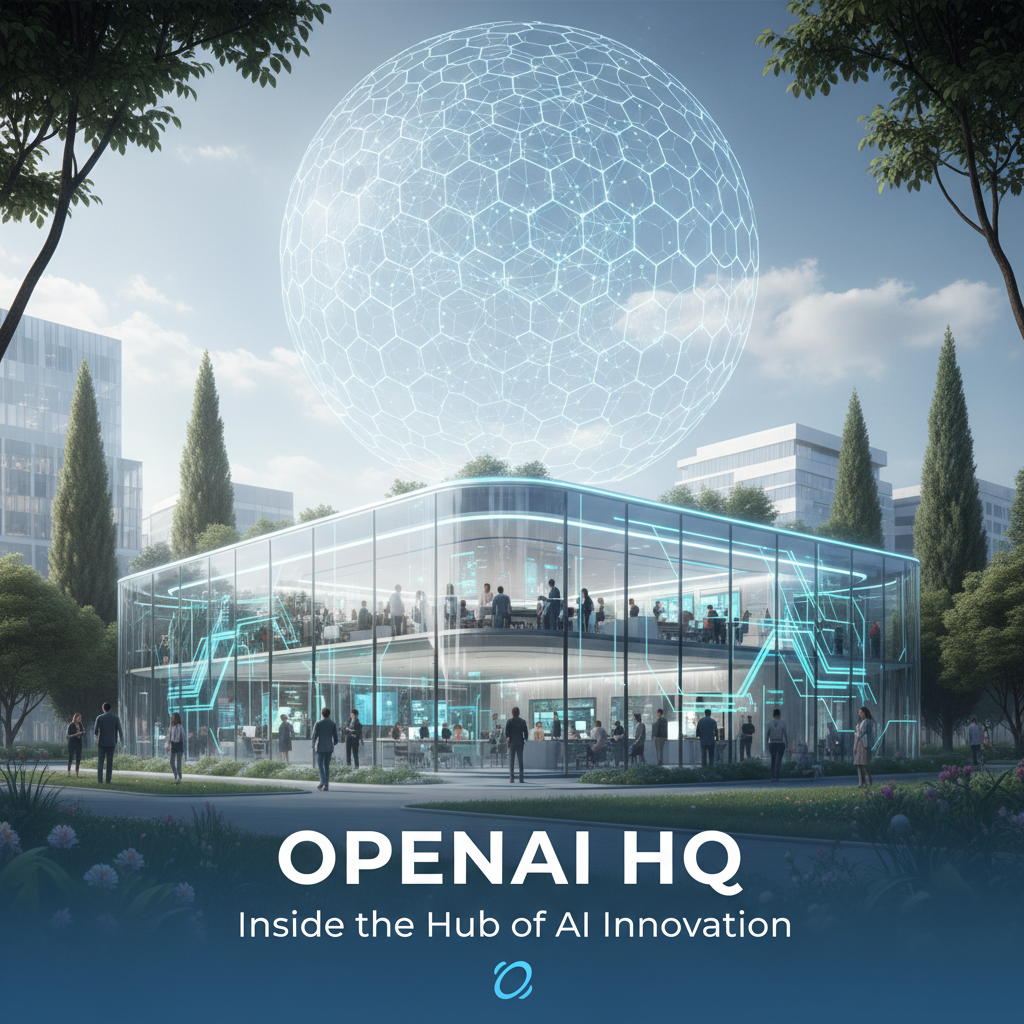
Nestled within the dynamic, often unpredictable landscape of downtown San Francisco, the OpenAI Headquarters stands as a physical manifestation of the organization's unique ethos: a blend of cutting-edge technology, intense focus, and a deep appreciation for collaborative human endeavor. The exact location is often kept somewhat discreet, a practical measure for a facility housing some of the world's most sensitive and potentially world-altering research. However, reports and glimpses reveal a design philosophy that eschews flashy corporate ostentation in favor of functional elegance and an environment meticulously crafted to foster deep thought and seamless teamwork. The architecture itself is modern, with clean lines, ample natural light, and intelligent spatial arrangements designed to maximize both individual productivity and collective synergy. Large windows often feature, offering views of the city's bustling streets, a subtle reminder of the real-world impact of the abstract work being done indoors. The choice of materials, often incorporating sustainable elements, reflects a contemporary sensibility aligned with progressive Silicon Valley values, prioritizing efficiency and environmental consciousness.
Upon entering, visitors and employees are immediately struck by an atmosphere that is simultaneously vibrant and intensely focused. The workspaces are thoughtfully varied, moving beyond the traditional cubicle farm or generic open office. There are expansive open-plan areas designed for spontaneous collaboration and the free exchange of ideas, where researchers and engineers can easily connect and whiteboard complex problems together. These zones are intentionally designed to be dynamic, echoing the fast-paced, iterative nature of AI development. Alongside these collaborative hubs, there are numerous quiet zones, private offices, and dedicated focus rooms, providing sanctuaries for deep work, intricate coding, and concentrated problem-solving—activities that are indispensable for tackling the grand challenges of AGI. Specialized labs, equipped with state-of-the-art hardware, including vast arrays of GPUs and custom computational clusters, are often off-limits to general access, underscoring the proprietary and sensitive nature of the core research. Amenities are designed to support a high-performing workforce: well-stocked kitchens providing healthy meals and snacks, comfortable lounge areas for informal breaks, and perhaps even wellness facilities, all contributing to an environment where employees can sustain their demanding work with minimal friction. Security is, understandably, paramount; access controls are robust, data integrity protocols are stringent, and intellectual property is meticulously protected, reflecting the immense value and potential sensitivity of the research being conducted. Yet, despite these necessary precautions, the overarching feeling is one of intellectual excitement and shared purpose. The air buzzes with quiet intensity, punctuated by bursts of discussion or the focused hum of servers, creating a unique ecosystem where groundbreaking ideas are nurtured from nascent concepts to world-changing realities. It is a place where the physical environment itself is engineered to catalyze innovation and support the extraordinary minds working to shape humanity's future with AI.
The People: Minds Behind the Models
At the heart of OpenAI's monumental achievements is its remarkable team – a diverse constellation of brilliant minds united by a singular, ambitious goal. The organization is a magnet for top-tier talent from across the globe, drawing researchers, engineers, ethicists, policy experts, and operational staff who possess not only exceptional technical prowess but also a profound passion for the potential and ethical implications of artificial intelligence. The hiring philosophy at OpenAI is notoriously rigorous, seeking individuals who are not only at the cutting edge of their respective fields but also embody a unique blend of intellectual curiosity, collaborative spirit, and a deep sense of responsibility. They look for individuals who thrive on solving intractable problems, who are comfortable navigating uncertainty, and who can contribute meaningfully to a culture that values both individual brilliance and collective synergy. This meticulous approach ensures that every member of the team is not just a participant but a genuine contributor to the organization's groundbreaking work.
The culture within OpenAI HQ is often described as one of intense intellectual vibrancy and unwavering dedication. Collaboration is not merely encouraged; it is woven into the very fabric of daily operations. Cross-functional teams are common, bringing together experts from different disciplines—from pure mathematics and theoretical computer science to linguistics, psychology, and philosophy—to tackle the multifaceted challenges of AI development and deployment. This interdisciplinary approach is crucial for addressing both the technical complexities of building advanced models and the societal implications of deploying them. There is an unspoken understanding that the work is exceptionally challenging, often requiring long hours and deep focus, but this intensity is balanced by a supportive environment where continuous learning, rapid iteration, and open communication are celebrated. Failure is often viewed not as an endpoint but as an invaluable learning opportunity, fueling further exploration and refinement. Leadership figures such as Sam Altman (CEO), Mira Murati (CTO), and Ilya Sutskever (Chief Scientist) embody this culture, setting the strategic direction while remaining deeply involved in the technical and ethical discussions that shape OpenAI's trajectory. Altman, with his entrepreneurial acumen and strategic vision, navigates the complexities of scaling the organization and engaging with the public. Murati, an engineering powerhouse, oversees the development and deployment of OpenAI's transformative products. Sutskever, a renowned pioneer in deep learning, guides the core research efforts, pushing the frontiers of what's computationally possible. Beyond the visible leadership, there is a strong emphasis on fostering a flat hierarchy where good ideas can emerge from anywhere, and every team member feels empowered to contribute to the mission. Diversity and inclusion are also increasingly recognized as critical components of responsible AI development. OpenAI actively works to build a team that reflects the global diversity of humanity, understanding that varied perspectives are essential for identifying and mitigating biases in AI systems and ensuring that the benefits of AGI are truly universal. This commitment to cultivating an inclusive environment, alongside relentless intellectual pursuit, defines the exceptional minds powering the AI revolution from within OpenAI's walls.
The Research & Development Engine: Inside the Labs
Within the secured confines of OpenAI HQ lies its pulsating heart: the research and development labs, where the theoretical frontiers of AI are relentlessly pushed forward, transforming abstract concepts into tangible, often astonishing, capabilities. This is the realm where immense computational power meets human ingenuity, forging the next generation of artificial intelligence systems. At the core of their operational capability is an unparalleled computational infrastructure. OpenAI leverages massive supercomputers, often comprising tens of thousands of specialized GPUs (Graphics Processing Units) and TPUs (Tensor Processing Units) – hardware specifically optimized for the parallel processing demands of deep learning models. These powerful clusters are the workhorses that train models with billions, and now trillions, of parameters, consuming energy on a scale previously associated with small data centers. This infrastructure is not just about raw power; it's about intelligent allocation, efficient cooling, and constant innovation in hardware and software stack optimization, ensuring that every computational cycle contributes maximally to research progress.
The fuel for these gargantuan models comes from vast, meticulously curated datasets. OpenAI's researchers expend considerable effort in acquiring, cleaning, and ethically sourcing diverse data—text, images, audio, video—from the internet and other repositories. The quality and breadth of this data are paramount, as it directly influences the capabilities, biases, and safety of the resulting AI models. Methodologies employed are at the cutting edge of machine learning, encompassing advanced forms of reinforcement learning, self-supervised learning, and transfer learning, where models are first trained on a broad range of data and then fine-tuned for specific tasks. This approach has proven instrumental in developing highly versatile and generalized AI. The results of these tireless efforts have reshaped the technological landscape. OpenAI is synonymous with a series of epoch-making breakthroughs, most notably the GPT (Generative Pre-trained Transformer) series of language models—GPT-3, GPT-4, and their subsequent iterations—which have demonstrated unprecedented capabilities in natural language understanding, generation, and reasoning. Beyond text, models like DALL-E have revolutionized image generation from textual prompts, and more recently, Sora has pushed the boundaries of video generation, demonstrating astonishing realism and coherence. Each new model represents a significant leap, not just in technical capability, but in our collective understanding of what AI can achieve. However, this relentless pursuit of advanced AI is tempered by an equally rigorous focus on ethical AI development. OpenAI dedicates substantial resources to alignment research, a field focused on ensuring that AI systems act in accordance with human values and intentions. Safety protocols are integrated throughout the development lifecycle, from initial model design to deployment. This includes extensive red-teaming (stress-testing models for potential misuse or harmful outputs), bias mitigation strategies, and robust monitoring systems. Transparency and reproducibility are also key tenets, with OpenAI often publishing detailed technical reports and methodologies to foster broader scientific scrutiny and collaboration. This dual commitment—to groundbreaking innovation and profound ethical responsibility—defines the research engine within OpenAI's labs, ensuring that while they build the future, they do so with humanity's best interests at its core.
APIPark is a high-performance AI gateway that allows you to securely access the most comprehensive LLM APIs globally on the APIPark platform, including OpenAI, Anthropic, Mistral, Llama2, Google Gemini, and more.Try APIPark now! 👇👇👇
From Research to Product: Democratizing AI
The journey from a groundbreaking research paper to a widely accessible product is a complex and often challenging one, yet OpenAI has mastered this transition with remarkable speed and impact. Their strategy for productization is multifaceted, primarily focusing on two key avenues: providing powerful APIs for developers and launching consumer-facing applications that bring AI directly to the public. The developer API strategy, exemplified by the OpenAI API platform, allows external developers and enterprises to integrate OpenAI's state-of-the-art models—such as GPT-4, DALL-E, and Whisper—into their own applications and services. This approach effectively democratizes access to advanced AI capabilities, enabling a vast ecosystem of innovation far beyond OpenAI's own walls. It transforms complex research models into usable tools, allowing startups and established companies alike to leverage cutting-edge AI without needing to build and train these colossal models from scratch.
The true watershed moment in OpenAI's productization efforts, however, was the launch of ChatGPT in late 2022. This conversational AI model, initially offered as a free public preview, rapidly captivated the world, becoming the fastest-growing consumer application in history. ChatGPT's ability to engage in coherent, context-aware dialogue, answer questions, write various forms of content, and even generate code brought the power of large language models (LLMs) into the mainstream consciousness. Its intuitive interface and remarkable capabilities made AI accessible to millions, demystifying a technology that had often seemed abstract and distant. The impact was profound, sparking a global conversation about the potential and implications of generative AI and accelerating its adoption across industries and daily life. The developer ecosystem that has sprung up around OpenAI's APIs is a testament to the power of providing an Open Platform for innovation. Thousands of developers are now building novel applications, services, and workflows powered by OpenAI models, ranging from sophisticated content creation tools and intelligent customer service agents to educational platforms and scientific research assistants. This external innovation multiplies OpenAI's impact, demonstrating how foundational AI models can serve as building blocks for an almost limitless array of solutions.
However, managing access to and interaction with such powerful AI models, especially at enterprise scale, requires robust infrastructure. This is where an AI Gateway or an LLM Gateway becomes absolutely crucial. For organizations looking to integrate OpenAI's models, alongside other AI services, an advanced gateway can provide a unified management layer for authentication, cost tracking, rate limiting, and performance optimization. For example, products like ApiPark exemplify what a comprehensive solution can offer in this domain. As an open-source AI gateway and API management platform, APIPark helps developers and enterprises manage, integrate, and deploy AI services with ease. It offers quick integration of over 100 AI models, a unified API format for AI invocation (ensuring changes in models or prompts don't break applications), and the ability to encapsulate custom prompts into REST APIs. This kind of robust AI Gateway functionality is indispensable for enterprises aiming for seamless integration, security, and efficient management of their AI expenditures, whether interacting with OpenAI's models or a diverse portfolio of other AI services. An effective LLM Gateway ensures that organizations can harness the full potential of OpenAI's language models while maintaining control, security, and scalability. By providing essential features like API lifecycle management, team service sharing, and detailed call logging, platforms like APIPark empower businesses to securely and efficiently operationalize AI, transforming cutting-edge research into practical, value-generating solutions for a global audience. This symbiotic relationship—where OpenAI provides the foundational models and platforms like APIPark provide the necessary management infrastructure—is accelerating the democratization and responsible deployment of AI across the world.
Challenges and Controversies
Operating at the vanguard of a technology as transformative and potent as artificial intelligence inherently involves navigating a complex landscape of challenges and controversies. OpenAI, perhaps more than any other organization in the field, has found itself at the nexus of these profound dilemmas, wrestling with issues that span ethical, regulatory, competitive, and existential dimensions. One of the most immediate and intensely debated areas concerns the ethical implications of advanced AI. The models developed by OpenAI, particularly large language models like GPT-4, are not immune to biases present in their training data, which can lead to unfair, discriminatory, or even harmful outputs. Mitigating these biases is an ongoing technical and philosophical challenge, requiring continuous research into fairness, accountability, and transparency. Beyond bias, there are concerns about the potential for misuse, such as generating misinformation, engaging in sophisticated phishing attacks, or even automating propaganda. The societal impact of job displacement due to AI automation is another pressing concern, prompting debates about universal basic income and the need for new educational paradigms. And, underlying all these, are the more profound existential risks associated with the development of artificial general intelligence (AGI)—the fear that sufficiently advanced AI could, if misaligned with human values, pose an unforeseen threat to humanity's long-term future. OpenAI’s commitment to safety and alignment research is a direct response to these deep-seated concerns.
The rapid advancements in AI have also outpaced existing regulatory frameworks, creating a vacuum that OpenAI and other leading AI developers are trying to help fill. Governments worldwide are grappling with how to effectively oversee and govern AI, balancing the need to foster innovation with the imperative to protect citizens and ensure ethical development. This has led to calls for new legislation, international agreements, and standardized safety benchmarks. OpenAI actively engages with policymakers, academics, and civil society organizations, contributing to the global dialogue on AI governance and advocating for sensible regulations that promote safe and beneficial AI development. However, the path to a universally accepted regulatory landscape is fraught with political complexities and differing national interests.
In the highly competitive arena of AI research and development, OpenAI faces formidable rivals. Giants like Google DeepMind, Meta AI, and emergent players such as Anthropic are all pushing the boundaries, leading to a fierce race for AI supremacy. This competition fuels rapid innovation but also raises questions about the long-term implications of concentrated power in AI and the potential for an "arms race" mentality. OpenAI's unique "capped-profit" structure, designed to balance financial sustainability with its public-good mission, also presents its own set of challenges. This hybrid model can sometimes lead to tension between the demands of investors and the original non-profit ethos, as evidenced by internal leadership changes and strategic debates. The need to generate revenue to fund exorbitant computational costs while remaining true to its mission of benefiting all humanity is a tightrope walk that constantly tests the organization's foundational principles. Finally, data privacy and security concerns are ever-present. The vast amounts of data used to train AI models, and the data processed by these models in real-world applications, necessitate stringent privacy safeguards and robust cybersecurity measures to prevent breaches and protect sensitive information. OpenAI continually invests in state-of-the-art security protocols and privacy-enhancing technologies, but the scale and complexity of the problem mean it remains a persistent challenge that demands constant vigilance and innovation. These challenges are not merely peripheral issues; they are intrinsic to the very nature of building and deploying advanced AI, demanding that OpenAI operates not just as a technological powerhouse but also as a thoughtful steward of a technology with unprecedented power.
The Future of AI from OpenAI's Perspective
OpenAI's perspective on the future of artificial intelligence is characterized by a blend of audacious optimism and profound caution, all centered on the eventual realization and responsible deployment of Artificial General Intelligence (AGI). From their vantage point, AGI represents the next frontier, an intelligence capable of performing any intellectual task that a human can, and often doing so with greater speed, precision, and scale. Their vision for AGI is not just about creating powerful tools; it's about unlocking entirely new modes of human flourishing. They envision a future where AGI acts as a benevolent collaborator, augmenting human capabilities across every conceivable domain – from accelerating scientific discovery and curing diseases to revolutionizing education, enhancing creative expression, and solving humanity's most intractable global challenges, such as climate change and poverty. The achievement of AGI, in their view, could usher in an era of unprecedented abundance and progress, fundamentally reshaping society for the better.
The path to achieving AGI involves continuous, iterative breakthroughs in model architecture, training methodologies, and computational efficiency. OpenAI is actively engaged in developing next-generation models that transcend current limitations, focusing on enhanced reasoning capabilities, common sense understanding, and multimodality – the ability to seamlessly integrate and process information across various forms, including text, images, audio, and video, akin to human perception. This means moving beyond mere pattern recognition to true comprehension and the capacity for abstract thought, planning, and problem-solving in novel situations. Research directions are exploring neural network architectures that mimic biological brains more closely, developing more efficient learning algorithms that require less data, and fostering AI systems that can learn continuously and adaptively throughout their operational lifespan. A significant component of this future vision involves the concept of human-AI collaboration. OpenAI believes that AGI will not replace human intelligence but rather amplify it, creating a synergistic partnership where humans set goals and guide AI, while AI handles complex computations, data analysis, and task execution. This partnership is seen as crucial for ensuring that AGI remains aligned with human values and serves humanity's best interests, avoiding the pitfalls of autonomous, misaligned systems.
However, this ambitious vision is tempered by a deep awareness of the inherent risks. OpenAI's commitment to safety and alignment research is paramount, viewed as inextricably linked to the successful and beneficial deployment of AGI. They are investing heavily in techniques to ensure that future superintelligent AI systems are "aligned" with human values – that they act safely, predictably, and in accordance with human intent. This includes developing robust methods for interpretability, control, and ethical reasoning for AI. The organization is also keenly aware of the profound societal impact that AGI will have, necessitating careful planning and proactive engagement with governments, policymakers, and communities worldwide. Debates around job displacement, economic restructuring, global equity, and the very definition of human purpose in an AGI-rich world are central to their ongoing discussions. OpenAI aims not just to build AGI but to help steward its introduction into the world, advocating for thoughtful governance frameworks and ensuring that the benefits are broadly distributed. In essence, OpenAI envisions a future where AI, particularly AGI, serves as a powerful force for good, provided it is developed with an unwavering commitment to safety, alignment, and global human benefit. Their work within the HQ is a relentless pursuit of this future, driven by a belief that humanity's greatest challenges can be overcome through intelligent cooperation – both human-to-human and human-to-AI.
Conclusion: The Crucible of AI Innovation
The OpenAI Headquarters stands as an undeniable crucible of innovation, a place where the theoretical boundaries of artificial intelligence are not just contemplated but actively dismantled and rebuilt. From its genesis rooted in a profound sense of responsibility and visionary ambition, to its architecturally thoughtful physical space designed for both deep work and seamless collaboration, to the extraordinary minds that animate its research and development engine, OpenAI represents a unique experiment at the pinnacle of technological advancement. It is a place where unprecedented computational power is harnessed to fuel models that learn, reason, and create with capabilities that continually redefine our understanding of machine intelligence.
The journey from a nascent research idea to a world-changing product like ChatGPT, and the subsequent cultivation of a vibrant developer ecosystem, underscores OpenAI's commitment not only to pushing technological frontiers but also to democratizing access to powerful AI. The critical role of infrastructure like an AI Gateway or an LLM Gateway cannot be overstated in this process; platforms like APIPark are essential for enterprises and developers to manage, secure, and effectively integrate these sophisticated models into their operations, transforming cutting-edge research into practical, scalable solutions. These gateways act as a vital bridge, enabling broader access to and efficient management of OpenAI's powerful offerings, thereby reinforcing the concept of an Open Platform for AI innovation.
Yet, this ambitious pursuit is not without its intricate web of challenges. OpenAI grapples daily with profound ethical dilemmas concerning bias, misuse, and existential risks, alongside the complexities of regulatory frameworks and intense global competition. Their unique capped-profit structure continually tests the delicate balance between financial sustainability and an unwavering commitment to their foundational mission: ensuring artificial general intelligence benefits all of humanity. Looking forward, OpenAI envisions a future shaped by AGI as a benevolent collaborator, augmenting human capabilities across every domain, predicated on relentless research into alignment, safety, and responsible deployment. The work undertaken within OpenAI HQ is more than just technological development; it is an ongoing, profound exploration of what it means to build intelligent systems, what it means for humanity to live alongside them, and how we can collectively steer this transformative power towards a future that is equitable, prosperous, and ultimately, beneficial for all. As AI continues its inexorable march forward, OpenAI remains a central, pivotal force, not just shaping the technology itself, but also profoundly influencing the global conversation about its ethical implications and its ultimate trajectory.
Key OpenAI Milestones and Model Evolution
| Year | Milestone/Model | Description | Impact/Significance |
|---|---|---|---|
| 2015 | OpenAI Founded | Established as a non-profit AI research company by Elon Musk, Sam Altman, and others. | Mission: Ensure AGI benefits all humanity, not profit-driven. |
| 2016 | Gym & Universe | Released OpenAI Gym (toolkit for reinforcement learning research) and Universe (platform for measuring and training AI on games). | Democratized RL research, provided standardized benchmarks. |
| 2017 | Dota 2 AI (OpenAI Five) | Developed AI bots capable of defeating professional human players in the complex video game Dota 2. | Demonstrated advanced multi-agent reinforcement learning and strategic cooperation. |
| 2018 | GPT-1 | Introduced the first Generative Pre-trained Transformer, a groundbreaking language model based on transformer architecture. | Established the power of unsupervised pre-training for NLP tasks. |
| 2019 | GPT-2 | A larger, more capable language model. Initially withheld full release due to concerns about potential misuse (generating fake news). | Highlighted ethical considerations of powerful generative AI; sparked debates on responsible AI release. |
| 2019 | Capped-Profit Entity | Transitioned to a "capped-profit" model to attract investment while retaining non-profit mission. Microsoft invested $1 billion. | Enabled access to significantly greater computational resources for training larger models. |
| 2020 | GPT-3 | Released a vastly larger language model (175 billion parameters) via API, showcasing remarkable few-shot learning capabilities. | Revolutionized text generation, translation, summarization, and more; made advanced NLP accessible to developers. |
| 2021 | DALL-E | Introduced a neural network that generates images from textual descriptions. | Ushered in a new era of generative AI for visual content, demonstrating multimodal capabilities. |
| 2022 | ChatGPT | Launched a conversational AI chatbot based on GPT-3.5, initially as a free public preview. | Became the fastest-growing consumer application in history; mainstreamed generative AI, sparking global interest. |
| 2023 | GPT-4 | Released a significantly more advanced version of GPT, demonstrating improved reasoning, creativity, and multimodal input (image understanding). | Showcased further leaps in AI capability, passing professional exams, handling complex instructions. |
| 2024 | Sora | Unveiled a text-to-video generative AI model capable of creating realistic and imaginative scenes from textual prompts. | Demonstrated remarkable progress in generating consistent and complex video sequences, pushing boundaries of multimodal AI. |
5 Frequently Asked Questions (FAQs)
1. What is OpenAI's core mission? OpenAI's core mission is to ensure that artificial general intelligence (AGI)—highly autonomous systems that outperform humans at most economically valuable work—benefits all of humanity. They aim to develop safe and beneficial AGI, fostering its responsible deployment and widespread access to prevent concentrated power and maximize societal benefit.
2. How does OpenAI fund its extensive research, given its non-profit roots? Initially a pure non-profit, OpenAI transitioned to a "capped-profit" model in 2019. This unique structure allows it to raise significant capital from investors (like Microsoft, which invested billions) to fund the immense computational costs of training cutting-edge AI models, while still being governed by its original non-profit board and mission. This ensures that profit generation remains secondary to its core public-good objective.
3. What is the significance of an AI Gateway or LLM Gateway in interacting with OpenAI's models? An AI Gateway or LLM Gateway (like ApiPark) is crucial for enterprises and developers to effectively and securely manage their interactions with powerful AI models like those from OpenAI. It provides a unified layer for functions such as authentication, access control, rate limiting, cost tracking, and standardizing API formats across various AI services. This infrastructure is essential for integrating AI models efficiently, ensuring scalability, and maintaining security, especially in complex enterprise environments.
4. What are some of the key ethical challenges OpenAI is addressing? OpenAI faces numerous ethical challenges, including mitigating biases in AI models, preventing misuse (e.g., generating misinformation), addressing potential job displacement, and ensuring the long-term safety and alignment of advanced AI with human values. They invest heavily in research dedicated to AI safety, fairness, and transparency, and actively engage with policymakers and ethicists to develop responsible AI governance frameworks.
5. What is OpenAI's vision for the future role of AGI in society? OpenAI envisions AGI as a powerful, benevolent collaborator that will augment human capabilities across all sectors, from scientific discovery and healthcare to education and creative arts. They believe AGI can help solve humanity's greatest challenges and usher in an era of unprecedented prosperity. However, this vision is coupled with a steadfast commitment to ensuring AGI is developed safely, aligned with human values, and introduced into society in a way that maximizes broad societal benefit and minimizes risks.
🚀You can securely and efficiently call the OpenAI API on APIPark in just two steps:
Step 1: Deploy the APIPark AI gateway in 5 minutes.
APIPark is developed based on Golang, offering strong product performance and low development and maintenance costs. You can deploy APIPark with a single command line.
curl -sSO https://download.apipark.com/install/quick-start.sh; bash quick-start.sh

In my experience, you can see the successful deployment interface within 5 to 10 minutes. Then, you can log in to APIPark using your account.

Step 2: Call the OpenAI API.