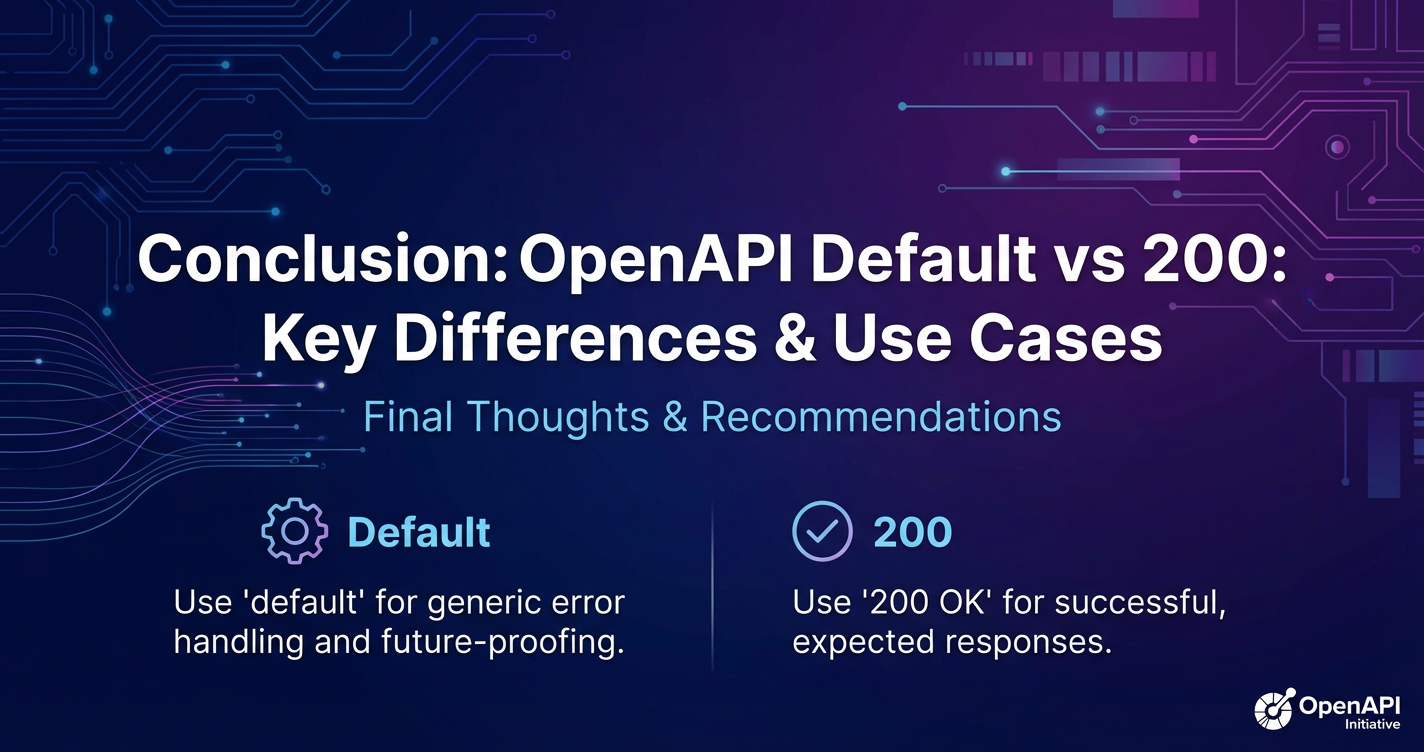
OpenAPI Default vs 200: Key Differences & Use Cases


In the intricate world of Application Programming Interfaces (APIs), precision and clarity are not merely luxuries; they are fundamental requirements for fostering robust integration, seamless development, and ultimately, a thriving digital ecosystem. The OpenAPI Specification (OAS), formerly known as Swagger Specification, stands as the ubiquitous standard for defining, describing, and documenting RESTful APIs. It provides a language-agnostic interface for HTTP APIs, allowing both humans and computers to discover and understand the capabilities of a service without access to source code or additional documentation. Within the vast landscape of an OpenAPI definition, the way an API communicates its outcomes—successes, failures, and everything in between—is paramount. This communication primarily happens through API responses, and two particular keywords, 200 (OK) and default, often stir discussions among API designers and developers.
At first glance, the distinction might seem trivial. Both appear within the responses object, seemingly describing what an API might return. However, their semantic implications, their practical use cases, and their impact on the overall developer experience are profoundly different. Misinterpreting or misusing 200 and default can lead to ambiguous API contracts, fragmented client-side logic, and significant friction for developers attempting to integrate with your services. For any organization aiming to establish a reliable API Open Platform, where third-party developers can confidently build applications atop their services, a clear understanding of these response types is non-negotiable.
This comprehensive article will embark on a detailed exploration of OpenAPI's 200 OK response and its default counterpart. We will delve into their precise definitions, dissect their semantic nuances, illustrate their typical applications, and highlight the critical differences that distinguish them. Our goal is not just to define terms but to equip api designers and implementers with the knowledge to make informed decisions, ensuring their OpenAPI documents are accurate, unambiguous, and serve as an impeccable blueprint for high-quality API development. By the end, readers will possess a deep understanding of when and how to leverage each of these response types effectively, thereby enhancing the clarity, maintainability, and developer-friendliness of their API offerings, a cornerstone for any successful API Open Platform initiative.
Understanding the OpenAPI Specification: The Blueprint for Your API
Before we dive into the specifics of 200 OK and default responses, it's crucial to first firmly grasp the foundational role of the OpenAPI Specification itself. The OpenAPI Specification (OAS) is a powerful, machine-readable format for describing RESTful APIs. Its genesis can be traced back to the Swagger project, which was later donated to the Linux Foundation and rebranded as OpenAPI, becoming an open-governance project overseen by the OpenAPI Initiative. This evolution signifies a broader industry commitment to standardizing API descriptions, making it easier for disparate systems and developers to interact.
At its core, OAS provides a structured way to define an api's various facets: its endpoints (paths), the HTTP methods it supports (GET, POST, PUT, DELETE, etc.), the parameters it expects (path, query, header, cookie, body), the authentication mechanisms it employs, and critically, the responses it can return. Imagine trying to build a complex machine without a blueprint; that's akin to developing against an api without comprehensive documentation. OAS serves as this blueprint, enabling a myriad of benefits that extend far beyond simple documentation.
For instance, an OpenAPI document can be used to automatically generate client SDKs in various programming languages, accelerating integration efforts for api consumers. It can also generate server stubs, ensuring that api implementations adhere precisely to the defined contract. Furthermore, OAS documents are invaluable for automated testing, allowing developers to validate that an api behaves as expected. Tools can even render interactive documentation portals, like Swagger UI, directly from an OpenAPI file, providing a live, executable interface for developers to explore and test api endpoints. This capability is particularly vital for an API Open Platform, where the goal is to maximize discoverability and ease of use for external developers.
Within an OpenAPI definition, responses are declared under the responses object for each operation (HTTP method on a specific path). This object is a map where keys are HTTP status codes (e.g., 200, 201, 400, 500) or the special default keyword, and values are Response Objects. Each Response Object provides a description of the response and can further detail its content (the payload, defined with media types like application/json and their schema) and headers. This structured approach to defining responses is precisely where 200 OK and default come into play, each serving a distinct, yet equally important, purpose in accurately conveying the api's behavior. Understanding their individual roles and the context in which they operate within the broader OpenAPI framework is the first step towards mastering effective API design.
The 200 OK Response: The Pillar of Success
The 200 OK HTTP status code is arguably the most common and universally understood response in the realm of web communication. In its simplest form, 200 OK signifies that the request has succeeded. The server has successfully processed the client's request, and the requested resource or an appropriate representation of its state is being returned in the response body. Within the context of OpenAPI, defining a 200 OK response is about explicitly outlining the "happy path"—the expected successful outcome of an api operation.
Definition and Semantics in OpenAPI
When you define 200 within the responses object of an OpenAPI operation, you are making an unequivocal statement: "If this api call succeeds, this is precisely what you should expect to receive." The description field for a 200 response should clearly articulate what "success" means for that specific operation. For example, for a GET request to retrieve a user, the description might be "A single user object was successfully retrieved." For a POST request to create a user, it could be "The user was successfully created."
Beyond the description, the content object within the 200 response is where the true value lies. Here, you specify the media types (e.g., application/json, text/plain, application/xml) that the api will return upon success, and more importantly, the schema that defines the structure and types of the data within the response body. This schema could be a direct object definition, a reference to a reusable schema component, or an array of such objects.
Example YAML Snippet for a 200 OK Response:
paths:
  /users/{userId}:
    get:
      summary: Retrieve a user by ID
      parameters:
        - in: path
          name: userId
          schema:
            type: integer
            format: int64
          required: true
          description: Numeric ID of the user to retrieve
      responses:
        '200':
          description: User object successfully retrieved.
          content:
            application/json:
              schema:
                $ref: '#/components/schemas/User'
        '404':
          description: User not found.
          content:
            application/json:
              schema:
                $ref: '#/components/schemas/Error'
        '500':
          description: Internal server error.
          content:
            application/json:
              schema:
                $ref: '#/components/schemas/Error'
components:
  schemas:
    User:
      type: object
      properties:
        id:
          type: integer
          format: int64
          example: 10
        username:
          type: string
          example: john_doe
        email:
          type: string
          format: email
          example: john.doe@example.com
      required:
        - id
        - username
        - email
    Error:
      type: object
      properties:
        code:
          type: integer
          format: int32
        message:
          type: string
      required:
        - code
        - message
In this example, the 200 response for GET /users/{userId} clearly states that a User object, defined in components/schemas/User, will be returned as application/json upon successful retrieval. This level of detail is invaluable.
Typical Use Cases and Importance for Developers
The 200 OK response is typically used for api operations that successfully fetch, create, update, or delete resources, where some data or confirmation is returned to the client.
- GET Requests: The most common use case. When a client requests a resource (e.g.,
/products,/users/{id}), a200 OKresponse indicates that the resource was found and is being returned in the response body. The content schema describes the structure of the retrieved data, such as a list of products or a single user object. - POST Requests (Creation): While
201 Createdis often more semantically appropriate for resource creation,200 OKcan be used if theapisuccessfully processes the request but doesn't necessarily create a new primary resource accessible at a distinct URI, or if it simply returns a confirmation of processing. For instance, aPOST /process-orderendpoint might return200 OKwith an order confirmation ID rather than a new resource location. If a resource is truly created,201 Created(with aLocationheader) is generally preferred as it's more specific. - PUT/PATCH Requests (Update): For updating existing resources,
200 OKtypically indicates that the update was successful. The response body might contain the updated representation of the resource, a confirmation message, or simply be empty (though often, returning the updated resource is more informative). - DELETE Requests: Upon successful deletion of a resource, an
apimight return200 OKwith an optional confirmation message or even204 No Contentif no response body is necessary. The choice depends on whether the client needs specific feedback beyond just the success status.
The importance of explicitly defining 200 OK responses cannot be overstated, especially for an API Open Platform.
- Predictable Client-Side Logic: Developers integrating with your
apican write client-side code that expects a specific data structure upon success. This predictability simplifies parsing, error handling (by contrast), and overall application logic. - Clear Contract: The
OpenAPIdefinition serves as a clear, machine-readable contract. A well-defined200response ensures that there's no ambiguity about what "success" looks like, preventing integration headaches and reducing support queries. - Automated Tooling: Code generators, test frameworks, and documentation tools can leverage the
200response definition to produce more accurate and useful outputs. For example, an SDK generator can create specific data models for successful responses, making it easier for client developers to work with the data. - Enhanced Developer Experience: Ultimately, a well-documented
200 OKresponse contributes significantly to a positive developer experience. When developers understand precisely what to expect when anapicall works as intended, they can integrate more quickly and confidently, fostering greater adoption of yourapiservices.
In essence, the 200 OK response in OpenAPI is the foundation upon which reliable and understandable api interactions are built. It's the explicit declaration of "all clear," providing the necessary details for consumers to confidently proceed with their application logic.
The default Response: The Catch-All for the Undefined
While 200 OK meticulously defines the sunny, successful path of an api operation, the default response in OpenAPI addresses everything else. It serves as a catch-all for any HTTP status code that is not explicitly defined within the responses object for a given operation. This makes default a powerful, yet potentially ambiguous, tool that requires careful consideration.
Definition and Semantics in OpenAPI
When default is used in an OpenAPI responses object, it means "for any HTTP status code not explicitly listed here, apply this response definition." Crucially, default is not inherently tied to error states, although it is most commonly used to describe generic error responses. It could technically apply to an unlisted 2xx success code, a 3xx redirection, or any 4xx client error or 5xx server error that hasn't been specifically documented.
The semantic implication of default is one of generality and fallback. It suggests that if the api returns a status code that isn't one of the hand-picked, explicitly defined ones (like 200, 201, 400, 404, 500), then the client should expect the format defined by default. This is where its strength and its potential weakness lie. It provides robustness by covering unforeseen scenarios, but at the cost of specificity.
Example YAML Snippet for a default Response:
paths:
  /users:
    post:
      summary: Create a new user
      requestBody:
        required: true
        content:
          application/json:
            schema:
              $ref: '#/components/schemas/NewUser'
      responses:
        '201':
          description: User successfully created.
          content:
            application/json:
              schema:
                $ref: '#/components/schemas/User'
          headers:
            Location:
              description: URI of the newly created resource
              schema:
                type: string
                format: uri
        '400':
          description: Invalid user data provided.
          content:
            application/json:
              schema:
                $ref: '#/components/schemas/ValidationError'
        'default':
          description: Unexpected error occurred.
          content:
            application/json:
              schema:
                $ref: '#/components/schemas/GenericError'
components:
  schemas:
    NewUser:
      type: object
      properties:
        username: { type: string, example: jane_doe }
        password: { type: string, format: password }
        email: { type: string, format: email }
      required: [username, password, email]
    User:
      type: object
      properties:
        id: { type: integer, format: int64, example: 11 }
        username: { type: string, example: jane_doe }
        email: { type: string, format: email }
      required: [id, username, email]
    ValidationError:
      type: object
      properties:
        field: { type: string, example: "email" }
        message: { type: string, example: "Invalid email format" }
      required: [field, message]
    GenericError:
      type: object
      properties:
        statusCode: { type: integer, example: 500 }
        error: { type: string, example: "Internal Server Error" }
        message: { type: string, example: "An unexpected condition prevented the server from fulfilling the request." }
      required: [statusCode, error, message]
In this POST /users example, we explicitly define 201 Created for success and 400 Bad Request for validation errors. Any other status code, be it 401 Unauthorized, 403 Forbidden, or 500 Internal Server Error, would fall under the default definition, which specifies a GenericError schema. This approach provides a safety net.
When to Use default (Judiciously)
The default response is most effective in specific scenarios where a broad, consistent error handling mechanism is desired without the overhead of detailing every single potential HTTP status code.
- Catch-All for Unexpected Errors: This is its primary and most common use. It's impractical to list every single
4xxand5xxstatus code anapimight ever return, especially for a large or evolving system.defaultprovides a mechanism to define a generic error structure that clients can fall back on if they encounter an undocumented error code. This ensures that even in unforeseen failure scenarios, theapiadheres to a predictable error response format. - Consistency for Common Error Structures: If your
apiadheres to a standardized error format across many different types of errors (e.g., all errors return a JSON object withcode,message, anddetailsfields),defaultcan enforce this consistency. You define theGenericErrorschema once, and it applies to all unspecified errors. This simplifies client-side error parsing, as they always know the basic structure to expect. - Future-Proofing and Simplification: For
apis that might introduce new status codes in the future, or for initial drafts where extreme verbosity is not yet a priority,defaultoffers a way to keep theOpenAPIdocument concise. It's a pragmatic choice when balancing exhaustive documentation with development speed. However, this should be balanced with the need for clear communication on anAPI Open Platform. - Edge Cases and Unhandled Exceptions: In real-world
apiimplementations, internal services can fail, databases can become unreachable, or third-party dependencies can return unexpected errors. These often manifest as5xxserver errors. Defining adefaultresponse with a robust generic error schema ensures that even these deep-seated issues provide a consistent response to the client, even if the specifics are intentionally vague for security reasons.
Misconceptions and Considerations
A common misconception is that default only applies to error codes. While it's predominantly used for errors, its definition is purely about "any code not explicitly listed." If, for some reason, an api were to return an unlisted 2xx status code (e.g., 206 Partial Content without it being explicitly defined), default would apply. However, this is rare in well-designed APIs that meticulously define their successful outcomes.
The main consideration when using default is the trade-off between simplicity and specificity. While it simplifies the OpenAPI document by reducing the number of explicitly listed error codes, it also pushes the burden onto the client to potentially parse the default response content to infer the actual nature of the problem. A client encountering a default response (e.g., a 401 Unauthorized that wasn't specifically defined) might only know it received "an unexpected error" rather than "you are not authorized," which can make debugging and user feedback much more challenging.
Therefore, while default provides an essential safety net, its usage should be strategic. It's best deployed as a fallback for truly generic or unexpected errors, rather than as a substitute for explicitly defining common, actionable error codes that clients need to handle specifically.
APIPark is a high-performance AI gateway that allows you to securely access the most comprehensive LLM APIs globally on the APIPark platform, including OpenAI, Anthropic, Mistral, Llama2, Google Gemini, and more.Try APIPark now! 👇👇👇
Key Differences: default vs 200 OK - A Comparative Analysis
The fundamental divergence between 200 OK and default responses in OpenAPI lies in their intent, specificity, and the communication contract they establish with API consumers. While both define potential outcomes, their roles are distinct and complementary. Understanding these differences is paramount for crafting OpenAPI definitions that are not only syntactically correct but also semantically rich and practically useful for anyone interacting with your api, especially on an API Open Platform.
Explicitness vs. Implicitness
200 OK(Explicit): This response is highly explicit. It precisely defines the structure and meaning of the response when an operation completes successfully with an HTTP 200 status code. There is no ambiguity; clients know exactly what data to expect and how to process it for a successful outcome. This explicitness is a cornerstone of reliable client-side development.default(Implicit/Catch-all): In contrast,defaultis inherently implicit. It describes the format for any HTTP status code that is not explicitly detailed in theresponsesobject. It's a fallback mechanism, a general descriptor for "anything else that might happen." While it ensures a defined structure, it does not convey the specific semantic meaning of the actual HTTP status code returned.
Purpose and Semantic Meaning
200 OK(Primary Success Path): The purpose of200 OKis to delineate the principal successful outcome of anapioperation. It represents the "happy path" where the client's request has been fully understood, processed, and the expected result (data, confirmation) is delivered. Its semantic meaning is clear: "Your request was processed without issues, and here is the result."default(Fallback/Generic Outcome): The purpose ofdefaultis to provide a safety net for all other scenarios not explicitly covered. While often used for errors (e.g.,4xxclient errors or5xxserver errors), its semantic meaning is more akin to "An outcome occurred that was not specifically documented, and here is its generic structure." It's not necessarily a success or a specific failure, but rather an un-categorized response.
Content Expectations
200 OK(Expected Resource/Confirmation): The content schema for200 OKtypically describes the desired data payload—a resource object (e.g., aUser, aProduct), a collection of resources, or a specific confirmation object (e.g., anOrderConfirmation). This content is almost always rich and directly relevant to the successful completion of the request.default(Generic Error Object): The content schema fordefaultis usually a generic error object. This object typically contains fields like an internal errorcode, a human-readablemessage, and sometimesdetailsor atraceId. The intention is to provide enough information for debugging or general client-side display, without necessarily revealing the specific cause or context of every possible underlying error.
Developer Experience (DX) and Client-Side Handling
The impact on developer experience is perhaps the most significant differentiator.
200 OK(Clear and Predictable): When a200 OKresponse is clearly defined, client-side developers can write robust, specific code to handle the successful processing of data. They know the exact structure of the response body and can confidently parse and use the data. This leads to less time spent debugging and more time building features. For anAPI Open Platform, this predictability is crucial for adoption.default(Ambiguous and Inferential): Relying solely ondefaultfor anything other than explicit success can complicate client-side logic. If a client receives a response that falls underdefault, they must then inspect the HTTP status code and potentially parse the generic error object's content to infer what actually happened. This adds a layer of complexity and potential for misinterpretation, as thedefaultschema might be too broad to distinguish between, say, a401 Unauthorizedand a404 Not Foundwithout further analysis. This ambiguity can slow down integration and lead to brittle client implementations.
Maintainability and Readability
- Explicit Status Codes (Superior Readability): While
defaultcan condense anOpenAPIfile, explicitly defining common error codes like400 Bad Request,401 Unauthorized,403 Forbidden,404 Not Found, and500 Internal Server Erroralongside200 OKprovides superior readability and maintainability. Each status code clearly communicates a specific API contract violation or server issue, making theOpenAPIdocument a more comprehensive and actionable reference. default(Simplicity at a Cost): Usingdefaultextensively can simplify theOpenAPIdocument's initial appearance but might obscure critical details about specific error conditions. Future developers maintaining theapimight find it harder to understand the full range of possible outcomes without diving deeper into implementation details or relying on external documentation.
Tools and Code Generation
The quality of an OpenAPI definition directly impacts the usefulness of generated client SDKs and server stubs.
- Explicit Codes (Precise Generation): When
200 OKand specific error codes (like400,404) are defined with their respective schemas, code generators can create specific data models for success and specific error classes for each known error type. This allows client developers to usetry-catchblocks or specific conditional logic to handle different outcomes with type safety. default(Generic Generation): Whendefaultis used for errors, code generators often produce a genericApiExceptionorDefaultErrorclass. While functional, this means client developers must manually inspect the HTTP status code and the generic error object's content to determine the precise nature of the error, losing the benefits of strong typing and explicit error handling thatOpenAPIgeneration can offer.
When to Prefer Specific Status Codes over default
The preference should almost always lean towards defining specific HTTP status codes where possible, especially for common and actionable scenarios.
400 Bad Request: For client-side input validation failures. The response body should detail why the request was bad (e.g., missing required fields, invalid format).401 Unauthorized: For authentication failures (client has not authenticated or credentials are invalid).403 Forbidden: For authorization failures (client is authenticated but does not have permission to access the resource or perform the action).404 Not Found: When the requested resource does not exist.409 Conflict: When the request conflicts with the current state of the server (e.g., trying to create a resource that already exists with a unique identifier).500 Internal Server Error: While often falling intodefault, if you have a very specific500error structure you want to convey, it can be defined explicitly. However, often adefaultis sufficient here for truly unexpected server-side issues.
Defining these specific codes provides immense value to API consumers, allowing them to build more resilient and user-friendly applications.
Here is a table summarizing the key differences:
| Feature | 200 OK Response |
default Response |
|---|---|---|
| Primary Purpose | Represents the explicit successful operation. | Catch-all for any response code not explicitly listed. |
| HTTP Status Code | Specifically HTTP 200. | Any HTTP status code not explicitly defined (e.g., 400, 401, 404, 500, or even an unlisted 2xx). |
| Semantics | Indicates that the request has succeeded and the expected result is returned. | Implies "anything else happened," often an error, but not always. Lacks specific semantic meaning without inspecting content. |
| Content Expectation | Typically the requested resource, a created resource, or a success confirmation. Rich, specific data. | Usually a generic error object (e.g., code, message, details) or an undefined response. Broad, less specific data. |
| Developer Experience | Clear, predictable success path; easy client-side handling and parsing; leads to robust integrations. | Requires client to parse content and/or check actual HTTP status code to determine exact outcome; potentially ambiguous, leading to more fragile integrations. |
| Granularity | Very specific to a successful outcome, detailing the exact data structure. | Broad, lacks specific detail about the actual outcome without content parsing or status code inspection. |
| Best Practice | Always explicitly define for primary success paths and the associated data models. | Use for truly generic, unanticipated errors, or as a last resort fallback when specific error codes are not feasible to define individually. Prefer specific error codes for common failures. |
| Tooling Impact | Well-understood; enables precise code generation with specific success data models. | May lead to generic error handling in generated clients, requiring manual refinement to differentiate error types. |
| API Consumer Action | Process the returned data to update UI, store records, etc. | Present a general error message, log for debugging, or try to infer specific error from content. |
By carefully considering these distinctions, API designers can make deliberate choices that enhance the quality, usability, and maintainability of their OpenAPI definitions, contributing significantly to a successful API Open Platform.
Best Practices and Recommendations for OpenAPI Responses
Crafting effective OpenAPI definitions for your api responses goes beyond merely knowing the difference between 200 OK and default. It involves adhering to best practices that enhance clarity, consistency, and overall developer experience. For an API Open Platform to thrive, its underlying API contracts must be impeccable.
1. Always Define 200 OK (and other explicit success codes)
The 200 OK response (or 201 Created, 204 No Content where appropriate) represents the primary "happy path" for your api operations. This should never be left to default. Always explicitly define:
- Clear
description: Explain concisely what a successful response means for that specific operation. - Precise
contentschemas: Detail the exact data structure returned, including data types, examples, and nullability. Use$refto reusable schema components to maintain consistency and reduce duplication across yourOpenAPIdocument. - Appropriate HTTP Status Codes: Don't just stick to
200. Use201 Createdfor successful resource creation (and include aLocationheader to the new resource). Use204 No Contentfor successful operations that intentionally return no response body (e.g., a DELETE operation that doesn't need to confirm anything specific).
2. Be Specific with Common Errors
While default serves as a catch-all, it should not replace explicit definitions for common, actionable error scenarios. Developers integrating with your api need to know how to specifically handle situations like invalid input, authentication failures, or missing resources. Therefore, it is a strong best practice to explicitly define:
400 Bad Request: For validation errors (e.g., missing required fields, incorrect data types). The response body should contain specific details about which fields were invalid and why.401 Unauthorized: For authentication issues (e.g., missing or invalid API key/token).403 Forbidden: For authorization issues (e.g., authenticated user lacks necessary permissions).404 Not Found: When a specific resource cannot be found at the given URI.409 Conflict: When a request cannot be completed due to a conflict with the current state of the resource (e.g., trying to create a user with an email that already exists).500 Internal Server Error: While these are often generic, if you have a specific structure for an unexpected server-side failure that you want to expose (e.g., containing an internal tracing ID), define it.
Each of these specific error codes should include a clear description and a consistent content schema, typically an error object that provides a code, a message, and possibly specific details relevant to that error type. This granular approach significantly improves client-side error handling and debugging.
3. Use default Judiciously (as a Last Resort Fallback)
The default response should be reserved for truly generic, unexpected, or unhandled errors that don't fit into your explicitly defined error categories. Think of it as your API's "unknown error" state.
- Ensure a Robust
defaultSchema: Even as a fallback, thedefaultresponse should provide a consistent and useful error structure. A schema that includes astatusCode, a generalmessage, and perhaps an optionaltraceId(for server-side debugging) is a good starting point. Avoid vague, unstructured responses. - Don't Over-rely: If you find yourself consistently using
defaultfor common error types across many operations, it's a sign that you should probably be defining those specific error codes explicitly instead. The goal is to maximize specificity where it benefits consumers, whiledefaulthandles the true outliers. - Document its Role: Clearly explain in your API documentation that
defaultcovers all other response codes not explicitly listed, and what kind of generic information it will provide.
4. Consistency Across Your API
Consistency is king in API design. Apply consistent naming conventions, response structures (especially for errors), and data formats throughout your entire api.
- Reusable Schemas: Leverage OpenAPI's
components/schemasto define reusable data models for success responses and error objects. This reduces duplication, enforces consistency, and makes yourOpenAPIdocument easier to read and maintain. - Uniform Error Structures: All your
4xxand5xxerror responses should ideally conform to a few standardized error schemas, making it easy for client-side code to parse and display error messages regardless of the specific error type.
5. Leverage API Management Platforms for Enforcement and Lifecycle Management
For organizations striving for truly robust and developer-friendly API Open Platform offerings, tools like APIPark become invaluable. APIPark, an open-source AI gateway and API management platform, assists in managing the entire lifecycle of APIs, including design, publication, invocation, and decommission. By providing features like unified API formats, prompt encapsulation into REST API, and end-to-end API lifecycle management, APIPark ensures that your OpenAPI definitions, whether detailing 200 OK or default responses, are consistently applied and easily consumable, fostering a seamless experience for developers interacting with your apis.
APIPark can help enforce these best practices by providing a centralized platform where API definitions can be managed, reviewed, and published. Its capabilities for regulating API management processes, managing traffic forwarding, load balancing, and versioning of published APIs mean that the meticulous detail put into your OpenAPI response definitions translates directly into reliable, performant, and well-governed API services. Moreover, its detailed API call logging and powerful data analysis features can help identify patterns in default responses, signaling opportunities to explicitly define new error codes for improved clarity.
6. Provide Rich Documentation
Beyond the OpenAPI specification itself, supplement your definitions with human-readable documentation. Explain common error scenarios, provide examples of 200 OK and specific error responses, and guide developers on how to handle different outcomes. This external documentation complements the machine-readable OpenAPI file, offering context and deeper insights that can be invaluable for api consumers.
By meticulously applying these best practices, api designers can transform their OpenAPI documents from mere technical specifications into powerful, user-centric contracts that drive successful integrations and foster a thriving API Open Platform.
Impact on API Consumers and Ecosystems
The careful distinction and thoughtful application of 200 OK versus default responses within an OpenAPI definition extend their impact far beyond the specification file itself, profoundly influencing API consumers, the broader API ecosystem, and the long-term success of an API Open Platform. This ripple effect touches client-side development, SDK generation, security, and the overall developer experience (DX).
1. Client-Side Development Simplification
When OpenAPI responses are explicit and granular, client-side development becomes significantly simpler and more robust. Developers integrating with an api can write clear, predictable logic for handling both success and specific error conditions.
- Success Path Clarity: A well-defined
200 OK(or201,204) response means client developers know precisely the data structure to expect. This allows for direct object mapping, strong typing in many programming languages, and straightforward data processing, reducing boilerplate code and potential runtime errors. - Specific Error Handling: Explicitly defined
400,401,403,404,500responses (each with its unique error schema) empower client applications to present highly specific and actionable feedback to end-users. Instead of a generic "An error occurred," a user might see "Your password is too short" (from a400), or "You don't have permission to access this resource" (from a403). This greatly enhances the end-user experience. - Reduced Ambiguity: The less clients need to guess or infer from generic
defaultresponses, the less brittle their integrations will be. Ambiguity inapiresponses often leads toif-elsecascades that check status codes and then parse generic messages, making code harder to read, maintain, and prone to errors.
2. Superior SDK Generation
One of the most powerful benefits of OpenAPI is its ability to generate client SDKs. The quality of these SDKs is directly proportional to the clarity and detail of the OpenAPI specification, especially concerning responses.
- Type-Safe Success Models: With explicit
200 OKdefinitions, SDKs can generate dedicated data transfer objects (DTOs) for successful responses, allowing client-side code to interact with strongly typed objects rather than generic maps or dynamic types. - Dedicated Error Classes: For explicitly defined error codes (e.g.,
400,404), SDKs can generate specific exception classes (e.g.,BadRequestException,NotFoundException). This enables developers to use native language exception handling mechanisms (e.g.,try-catchblocks) to catch and handle specificapierrors in a highly idiomatic and readable way. - Generic Fallbacks for
default: Ifdefaultis used, SDKs will typically generate a generic error class (e.g.,ApiException). While functional, it requires developers to manually inspect properties of this generic class to differentiate errors, losing the benefits of type-safe, specific error handling. This means more effort forapiconsumers.
3. Enhanced Developer Experience (DX) and Adoption for API Open Platform
The overall developer experience is a critical factor in the success of any API Open Platform. Clear OpenAPI definitions with well-thought-out responses directly contribute to a positive DX, which in turn drives adoption.
- Faster Onboarding: Developers can quickly understand an
api's capabilities and expected behaviors from itsOpenAPIdocumentation. Explicit responses mean less trial and error, faster integration, and quicker time-to-market for applications built on your platform. - Reduced Support Burden: When the
apicontract is unambiguous, developers encounter fewer unexpected behaviors or errors, leading to fewer support tickets and a reduced burden on your support teams. - Trust and Reliability: A well-documented and consistent
apifosters trust. Developers are more likely to invest in integrating with a platform they perceive as reliable and well-engineered. This trust is invaluable for building a vibrantAPI Open Platformcommunity.
4. Security and Observability Implications
The way responses are defined also has implications for security and the ability to observe API behavior.
- Controlled Error Information: While explicit error responses are good, they should be designed to provide enough information for the client to act without revealing sensitive internal details. A generic
defaulterror for5xxserver errors, for instance, might intentionally provide minimal detail to prevent information leakage that could aid attackers. - Monitoring and Alerting: When specific error codes (e.g.,
401,403,404,500) are explicitly defined and returned consistently, it becomes much easier for monitoring systems to track their occurrences. This allows operations teams to set up precise alerts for specific issues (e.g., a sudden spike in401errors might indicate an authentication service issue, while a spike in500errors signals a critical server problem). Relying solely ondefaultmakes it harder to categorize and track these distinct issues. - Troubleshooting: Detailed
OpenAPIdefinitions, combined with comprehensive API management platforms like APIPark that offer powerful data analysis and detailed call logging, provide unparalleled troubleshooting capabilities. When anapicall fails, having a clearOpenAPIcontract for thedefaultor specific error response, alongside logs of the actual response, greatly accelerates problem diagnosis.
In conclusion, the choices made in defining 200 OK and default responses within OpenAPI are not just technical decisions; they are strategic choices that profoundly shape the experience of every developer who interacts with your api. By prioritizing explicitness, specificity, and consistency, api providers can build a more robust, developer-friendly, and ultimately, more successful API Open Platform.
Conclusion
The journey through the distinct terrains of OpenAPI's 200 OK and default responses reveals them not as interchangeable options, but as essential, specialized tools in the API designer's arsenal. At the heart of this distinction lies a fundamental principle of effective communication: specificity for the expected, generality for the unexpected.
The 200 OK response serves as the cornerstone for clearly articulating the successful completion of an api operation. It is the explicit declaration of the "happy path," detailing precisely what data clients should expect when a request is fulfilled as intended. Its meticulous definition, encompassing accurate descriptions and robust content schemas, is paramount for building predictable, type-safe, and effortlessly integrable client-side applications. For any API Open Platform, making the success path unambiguously clear is a non-negotiable step towards fostering developer confidence and driving widespread adoption.
Conversely, the default response functions as an indispensable catch-all. It acts as a safety net, providing a predefined structure for any api outcome not explicitly covered by specific HTTP status codes. While often employed for generic error scenarios, its utility lies in ensuring a consistent fallback mechanism, even for unforeseen or less common responses. However, its power must be wielded with caution; an over-reliance on default can introduce ambiguity, complicating client-side error handling and obfuscating critical information that specific error codes could otherwise convey.
The comparative analysis underscored that while default offers simplicity and a degree of future-proofing, explicit definition of 200 OK and other common error codes (like 400, 401, 404, 500) invariably leads to a superior developer experience. These explicit definitions enable precise code generation for SDKs, simplify client-side logic, reduce debugging efforts, and build a more transparent and trustworthy api contract. For apis powering an API Open Platform, this level of clarity is not just a best practice; it is a competitive advantage that directly influences integration speed and developer satisfaction.
As we've explored, the impact of these choices resonates throughout the entire API ecosystem—from simplifying client-side development and generating more robust SDKs to enhancing security, observability, and the overall developer experience. Tools like APIPark further amplify these benefits by providing a comprehensive platform for managing, governing, and deploying APIs, ensuring that the meticulous detail captured in OpenAPI definitions translates into real-world consistency and performance.
In conclusion, thoughtful OpenAPI design, particularly concerning response definitions, is more than a technical exercise; it's a strategic investment in the future of your api services. By mastering the nuanced differences and applying the recommended best practices for 200 OK and default responses, api designers can construct OpenAPI documents that serve as impeccable blueprints, paving the way for seamless integrations, empowered developers, and the enduring success of their API Open Platform.
Frequently Asked Questions (FAQs)
1. What is the fundamental difference between 200 OK and default responses in OpenAPI?
The fundamental difference lies in their specificity and purpose. 200 OK explicitly defines the expected successful response for an API operation, detailing its exact content and structure. It's the "happy path." default, on the other hand, is a catch-all for any HTTP status code not explicitly defined elsewhere in the responses object for that operation. It's used as a fallback for unexpected or unlisted outcomes, most commonly generic error responses, providing a consistent structure even when the specific error isn't explicitly documented.
2. When should I primarily use 200 OK in my OpenAPI definition?
You should always explicitly define 200 OK (or other specific success codes like 201 Created or 204 No Content) for any API operation that is expected to return a successful result. This includes GET requests that retrieve data, POST/PUT/PATCH requests that successfully create or update resources, and DELETE requests that confirm successful deletion. Defining 200 OK ensures that API consumers know precisely what data format to expect when the API call succeeds, enabling predictable client-side logic and robust data parsing.
3. What are the best use cases for the default response?
The default response is best used judiciously as a last-resort fallback. Its primary use cases include: * Catch-all for truly unexpected errors: For system-level errors or conditions that aren't common enough to warrant specific definition. * Consistency for generic error structures: If your API adheres to a standardized error format for all unlisted errors (e.g., a simple code and message object). * Simplification for initial API drafts: As a temporary measure, to reduce verbosity, which can be refined with specific error codes later. However, it should not replace explicit definitions for common, actionable error codes like 400 Bad Request, 401 Unauthorized, 404 Not Found, etc.
4. Why is it important to define specific error codes (e.g., 400, 404, 500) instead of relying solely on default for errors?
Defining specific error codes with their distinct schemas is crucial for enhancing the developer experience and enabling robust client-side error handling. When specific codes are defined, API consumers can: * Write targeted error handling logic: Distinguish between different types of errors (e.g., validation failure vs. resource not found) and provide precise feedback to end-users. * Generate better SDKs: Code generators can create specific exception classes for each error, allowing developers to catch errors idiomatically. * Improve debugging: Clear error contracts make it easier to understand why a request failed. Relying solely on default forces clients to parse generic responses and infer the actual error, leading to more complex and brittle integration code.
5. How does a platform like APIPark help in managing OpenAPI responses effectively?
APIPark, as an AI gateway and API management platform, significantly aids in managing OpenAPI responses by providing tools for: * API Lifecycle Management: Ensures consistent design, publication, and decommissioning of APIs, including adherence to OpenAPI definition standards for responses. * Unified API Format: Helps standardize response formats across different APIs and AI models, making 200 OK and error responses consistent. * Documentation and Developer Portal: Centralizes OpenAPI definitions, making all response types easily discoverable and consumable by developers, crucial for an API Open Platform. * Monitoring and Analysis: Detailed logging and data analysis capabilities allow teams to track actual API responses, including default errors, and identify areas where explicit error definitions might be beneficial. * Governance: Helps enforce best practices and design standards for OpenAPI responses across an organization's API portfolio.
🚀You can securely and efficiently call the OpenAI API on APIPark in just two steps:
Step 1: Deploy the APIPark AI gateway in 5 minutes.
APIPark is developed based on Golang, offering strong product performance and low development and maintenance costs. You can deploy APIPark with a single command line.
curl -sSO https://download.apipark.com/install/quick-start.sh; bash quick-start.sh

In my experience, you can see the successful deployment interface within 5 to 10 minutes. Then, you can log in to APIPark using your account.

Step 2: Call the OpenAI API.