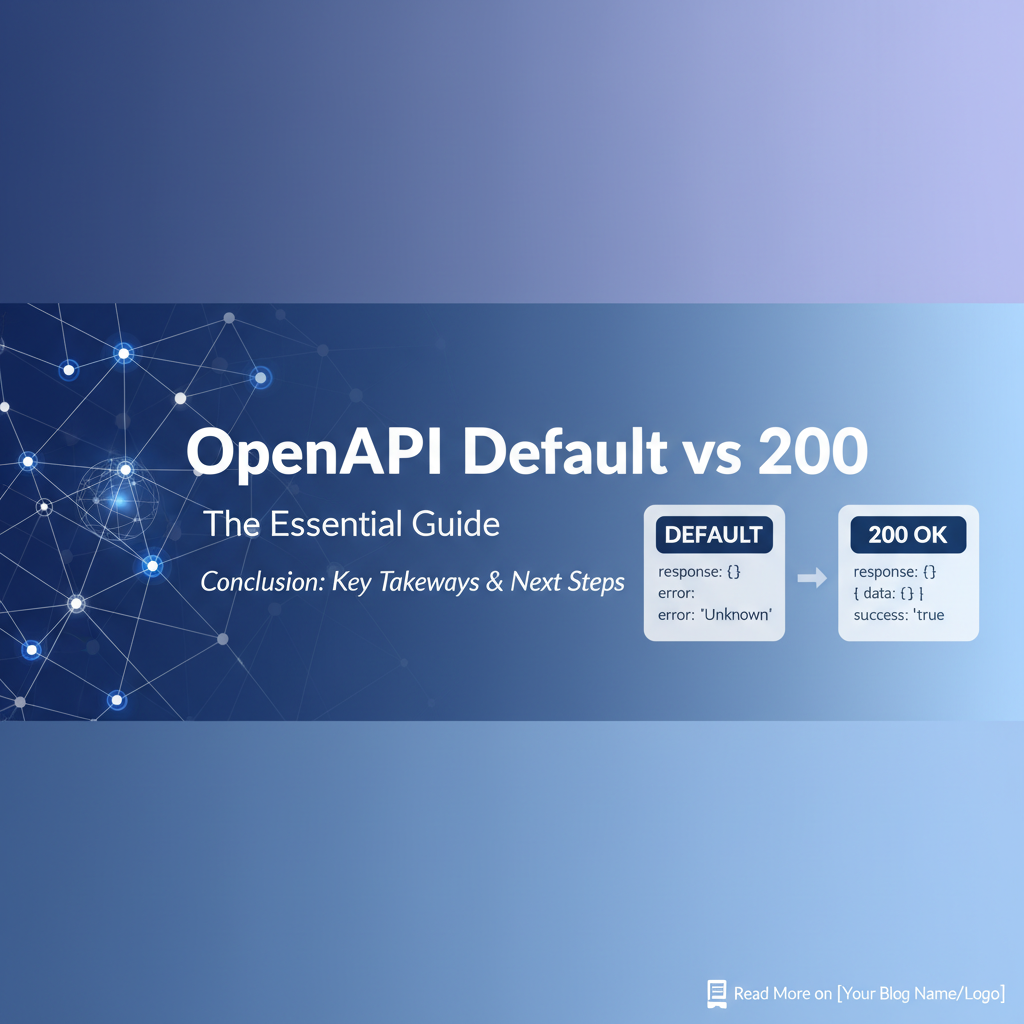
OpenAPI Default vs 200: The Essential Guide



In the intricate landscape of modern web development, Application Programming Interfaces (APIs) serve as the fundamental backbone, facilitating seamless communication between disparate software systems. At the heart of designing and implementing robust, interoperable APIs lies the OpenAPI Specification (OAS), a powerful, language-agnostic standard for describing, producing, consuming, and visualizing RESTful web services. This specification empowers developers to articulate every facet of their API, from available endpoints and operation parameters to authentication methods and, crucially, expected responses. A well-defined OpenAPI document acts as a contract, ensuring clarity and predictability for both API providers and consumers.
However, even within a seemingly straightforward specification like OpenAPI, certain nuances can lead to confusion and suboptimal API design. One such area of frequent debate and misunderstanding revolves around the definition of API responses, specifically the distinction and appropriate usage of the default response object versus explicit HTTP status codes like 200 OK. While both serve to describe what an API might return, their semantic implications, practical applications, and impact on client-side tooling differ significantly. Navigating this distinction is not merely a matter of syntax; it profoundly affects an API's usability, maintainability, and the robustness of applications built upon it.
This comprehensive guide aims to demystify the roles of default and 200 responses within the OpenAPI specification. We will embark on a detailed exploration of what each signifies, when to employ them, and the critical implications of their choice for both API providers and consumers. By delving into practical examples, best practices, and the underlying principles of HTTP semantics, we will equip you with the knowledge to make informed design decisions, leading to clearer, more resilient, and ultimately, superior APIs. Whether you are designing a new API from scratch, refining an existing one, or simply striving to better understand the intricacies of OpenAPI, mastering this distinction is an essential step towards elevating your API development prowess.
Understanding the Anatomy of OpenAPI Responses
Before we dive into the specific roles of default and 200, it's imperative to establish a solid understanding of how responses are generally structured and defined within the OpenAPI specification. The responses object is a pivotal part of an OpenAPI document, residing under each operation (e.g., get, post, put, delete). It is where an API designer articulates all possible outcomes of an API call, beyond just the successful execution.
Each entry within the responses object is keyed by an HTTP status code (e.g., 200, 201, 400, 500) or by the special keyword default. These keys map to a Response Object, which in turn describes the nature of the response body, any relevant headers, and a human-readable description. This structure is crucial because it allows API consumers, whether they be human developers or automated tools, to anticipate the data formats and potential errors they might encounter.
The fundamental components of a Response Object include:
description: A mandatory, human-readable summary of the response. This field is incredibly important for documentation, as it provides immediate context for what a particular response signifies. For instance, a200response might have a description like "Successful operation," while a400response could be described as "Invalid input provided." The level of detail here directly influences the clarity of the API documentation.headers(Optional): If a response is expected to include specific HTTP headers that provide additional context or metadata, they can be defined here. For example, a response might include aX-RateLimit-Remainingheader to inform clients about their current API usage limits, or aLocationheader in a201 Createdresponse to point to the URI of the newly created resource. Each header definition can specify itstype,description, andexamplevalues, just like request parameters.content(Optional): This is where the schema for the actual response body is defined. Thecontentobject uses media types (e.g.,application/json,text/plain,application/xml) as keys, and each key maps to a Media Type Object. Within a Media Type Object, theschemafield describes the structure of the data returned in the response body. This schema can be an inline definition or a reference to a reusable schema defined in thecomponents/schemassection using$ref. Furthermore, theexamplesfield within the Media Type Object allows API designers to provide concrete examples of what a response body might look like, significantly aiding developers in understanding the data structure. Specifying multiple content types allows the API to negotiate and respond in the format preferred by the client, a common pattern in RESTful services.
HTTP status codes themselves are a standardized way for web servers to communicate the outcome of a request back to the client. They are categorized into five classes: * 1xx Informational: Request received, continuing process. * 2xx Success: The action was successfully received, understood, and accepted. * 3xx Redirection: Further action needs to be taken by the user agent to fulfill the request. * 4xx Client Error: The request contains bad syntax or cannot be fulfilled. * 5xx Server Error: The server failed to fulfill an apparently valid request.
Each code carries a specific semantic meaning that developers worldwide understand. For example, 200 OK universally signals success, 404 Not Found indicates a resource could not be located, and 500 Internal Server Error points to a generic server-side issue. Properly utilizing these codes, along with their detailed OpenAPI descriptions, forms the bedrock of a well-behaved and easily consumable API. The clarity provided by precise response definitions, especially for api interactions, drastically reduces integration time and minimizes debugging efforts for client-side developers.
The Unambiguous Success: HTTP 200 OK
The 200 OK status code is perhaps the most ubiquitous and readily understood signal in the entire HTTP specification. It unambiguously communicates that a client's request was successfully received, understood, and processed by the server, and the server is returning the requested data. When an API returns a 200 OK, it tells the consuming application, "Everything went according to plan, and here is the result you asked for." This clear message is vital for the smooth functioning of distributed systems and the predictable behavior of applications.
Definition and Semantic Intent
Semantically, 200 OK signifies an unequivocal success. It is the default success status code for GET requests, where the server typically retrieves and returns the requested resource. However, its utility extends beyond simple data retrieval. It can also be used for POST, PUT, or DELETE operations where the server successfully processed the request and has some content to return, even if that content is merely a confirmation message or the updated state of a resource. The key is that the client's objective for that specific operation was achieved without any client-side errors or server-side failures preventing the operation.
For instance, if a client sends a GET request to /users/{id}, a 200 OK response would contain the data for the specified user. If a PUT request updates a user's profile and returns the newly updated user object, 200 OK is appropriate. Even a POST request that creates a resource but returns some computed data or a summary of the creation might use 200 OK, although 201 Created is often more semantically precise for creation. The crucial distinction is that 200 OK implies that the operation was completed and the response body contains relevant, successful data.
Typical Use Cases for 200 OK
The 200 OK status code is primarily used in several common api scenarios:
- Successful Data Retrieval (GET): This is its most common application. When a client requests a resource or a collection of resources, and the server finds and returns them,
200 OKis the standard. ```json GET /products/123HTTP/1.1 200 OK Content-Type: application/json{ "id": "123", "name": "Super Widget", "price": 29.99, "currency": "USD", "description": "A high-quality widget for all your needs.", "category": "Gadgets", "availability": { "inStock": true, "quantity": 150 }, "lastUpdated": "2023-10-27T10:30:00Z" }`` Here, theapi` successfully located product 123 and returned its full details, including its inventory status and last update timestamp. - Successful Update with Content (PUT/PATCH): If an update operation not only succeeds but also returns the updated resource or a confirmation message,
200 OKis suitable. ```json PUT /users/456HTTP/1.1 200 OK Content-Type: application/json{ "id": "456", "username": "jane_doe_updated", "email": "jane.doe.updated@example.com", "lastLogin": "2023-10-27T14:00:00Z" } ``` In this case, the user's details were successfully updated, and the server responded with the current state of the user resource, confirming the changes. - Successful Deletion with Confirmation (DELETE): While
204 No Contentis often preferred for deletions where no response body is necessary,200 OKcan be used if theapichooses to return a confirmation message or the status of the deleted resource. ```json DELETE /orders/789HTTP/1.1 200 OK Content-Type: application/json{ "message": "Order 789 successfully cancelled.", "status": "cancelled" }`` Here, theapi` explicitly confirms the cancellation with a message and a status indicator. - Custom Operations Returning Data (POST): For
POSTrequests that perform an action and return a result rather than creating a new resource (for which201 Createdis best),200 OKis appropriate. For example, a searchapithat accepts search criteria viaPOSTand returns search results.
Detailed OpenAPI Definition for 200 OK
Defining a 200 OK response in OpenAPI should be meticulous to ensure maximum clarity for consumers.
paths:
  /products/{productId}:
    get:
      summary: Retrieve a product by ID
      operationId: getProductById
      parameters:
        - in: path
          name: productId
          schema:
            type: string
          required: true
          description: The ID of the product to retrieve.
      responses:
        200:
          description: Successfully retrieved product details.
          content:
            application/json:
              schema:
                $ref: '#/components/schemas/Product'
              examples:
                productExample:
                  value:
                    id: "P-001"
                    name: "Advanced Gadget"
                    price: 99.99
                    currency: "USD"
                    description: "An incredibly useful gadget."
                    category: "Electronics"
                    availability:
                      inStock: true
                      quantity: 50
                    lastUpdated: "2023-10-27T15:00:00Z"
        404:
          description: Product not found.
          content:
            application/json:
              schema:
                $ref: '#/components/schemas/Error'
              examples:
                notFoundExample:
                  value:
                    code: "NOT_FOUND"
                    message: "The requested product with ID P-001 could not be found."
        500:
          description: Internal server error.
          content:
            application/json:
              schema:
                $ref: '#/components/schemas/Error'
              examples:
                serverErrorExample:
                  value:
                    code: "INTERNAL_SERVER_ERROR"
                    message: "An unexpected error occurred on the server."

components:
  schemas:
    Product:
      type: object
      required:
        - id
        - name
        - price
        - currency
      properties:
        id:
          type: string
          description: Unique identifier for the product.
        name:
          type: string
          description: Name of the product.
        price:
          type: number
          format: float
          description: Price of the product.
        currency:
          type: string
          description: Currency of the product price (e.g., USD, EUR).
        description:
          type: string
          description: Detailed description of the product.
        category:
          type: string
          description: Category the product belongs to.
        availability:
          type: object
          properties:
            inStock:
              type: boolean
              description: Indicates if the product is currently in stock.
            quantity:
              type: integer
              description: The number of units currently in stock.
          description: Availability details of the product.
        lastUpdated:
          type: string
          format: date-time
          description: Timestamp of the last update to the product details.
    Error:
      type: object
      required:
        - code
        - message
      properties:
        code:
          type: string
          description: A unique error code for programmatic identification.
        message:
          type: string
          description: A human-readable error message.
        details:
          type: string
          description: Optional additional details about the error.
In this example: * The description for 200 ("Successfully retrieved product details.") is clear and concise. * The content object specifies application/json as the media type. * The schema uses a $ref to point to a reusable Product schema, promoting consistency and reducing redundancy. This Product schema details all expected properties, their types, and descriptions, leaving no room for ambiguity. * The examples field provides a concrete productExample of what the JSON response body will look like, which is invaluable for developers building client applications. They can immediately see the data structure, property names, and sample values.
Implications for Consumers
For API consumers, a well-defined 200 OK response in OpenAPI offers several critical benefits: * Predictability: Clients know exactly what data to expect in the success case. This enables them to parse the response correctly and build robust data models. * Automated Code Generation: Tools can generate client SDKs, models, and types based on the 200 schema, significantly speeding up development. For example, a TypeScript client can have strongly typed interfaces for the Product object directly from the OpenAPI spec. * Clear Testing: Testers can easily validate that the API returns the correct data structure and values upon successful calls. * Improved Documentation: Human developers reading the documentation instantly understand the successful outcome of an api call.
Best Practices for 200 OK
When defining 200 OK responses, adhere to these best practices: 1. Be Explicit and Detailed: Always provide a clear description and a precise schema for the response body. Avoid vague descriptions; instead, elaborate on what "successful" means in the context of the operation. 2. Use Reusable Schemas: Leverage the components/schemas section with $ref to define common data structures. This maintains consistency across your API and makes the specification easier to read and manage. 3. Provide Realistic Examples: Good examples are worth a thousand words. They help developers quickly grasp the expected data format and values. Ensure your examples are representative of real-world data. 4. Consider Content Negotiation: If your API supports multiple media types (e.g., JSON, XML), define content for each. 5. Distinguish Success Codes: While 200 OK is common, use other specific 2xx codes (e.g., 201 Created, 202 Accepted, 204 No Content) when they are more semantically appropriate for the operation. This provides even finer-grained communication of success outcomes. For instance, creating a new resource typically warrants a 201 Created response.
By meticulously defining 200 OK responses, API providers create a reliable and easy-to-consume api contract, fostering developer trust and simplifying integration efforts.
The Catch-All: The default Response
While explicit HTTP status codes like 200 OK delineate expected outcomes, the OpenAPI specification also provides a powerful, albeit sometimes misused, mechanism for handling unforeseen or undocumented responses: the default response object. Unlike specific status codes, default doesn't correspond to a particular HTTP numeric code. Instead, it serves as a catch-all for any response that doesn't explicitly match one of the other defined status codes for a given operation. Understanding its intended purpose and limitations is crucial for writing robust and predictable OpenAPI definitions.
Definition and Semantic Intent
The default response in OpenAPI is semantically intended to describe the response for all HTTP status codes not explicitly defined for an operation. It acts as a fallback or a generic error handler. Imagine an API operation where you've explicitly defined 200 OK for success, 400 Bad Request for invalid input, and 404 Not Found for resource unavailability. If the server were to return, say, a 401 Unauthorized or a 500 Internal Server Error—and these were not explicitly listed in the responses object—the default response would apply.
Its primary role is to ensure that even in unexpected scenarios, API consumers have some documented expectation of the response structure, typically for generic error messages. This prevents an API from being completely silent or ambiguous about its behavior when something goes wrong outside of the documented success and specific error paths. It's a safety net, designed to prevent consumers from having to guess at the structure of an unforeseen error message.
When and Why to Use default
The default response is best employed in situations where you need to describe a generic outcome that applies to a broad range of unhandled HTTP status codes.
- Generic Error Handling for Undocumented Statuses: This is the most appropriate use case. For complex APIs, exhaustively documenting every possible HTTP status code (e.g., all variations of 4xx and 5xx errors) for every single operation can be unwieldy and impractical. The
defaultresponse allows you to define a common error structure that applies to any error not specifically outlined.- Example: An API might return a
503 Service Unavailableerror due to temporary overload. If503isn't explicitly listed, thedefaultresponse would cover it. - Example: A
401 Unauthorizedor403 Forbiddenerror from an underlying authentication layer that hasn't been specifically documented for everyapiendpoint could fall underdefault.
- Example: An API might return a
- Internal Server Errors (
5xx) that Lack Specificity: While500 Internal Server Erroris often explicitly defined, thedefaultresponse can catch other less common5xxerrors (e.g.,501 Not Implemented,502 Bad Gateway,504 Gateway Timeout) that might occur due to infrastructure issues or unexpected server behavior, for which a distinct schema isn't necessary. - Legacy APIs or Rapid Prototyping: In scenarios involving older APIs where full, explicit documentation is challenging to implement, or during the initial prototyping phase where full error specification might be deferred,
defaultcan provide a minimal level of documentation for error responses. However, this should ideally be a temporary solution, with specific error codes being added as the API matures.
Crucially, the default response should generally not be used for expected success outcomes like 200 OK. Defining 200 OK (or 201, 204, etc.) as default would lead to ambiguous documentation and hinder tooling, as clients would not know with certainty that default specifically means 200. The whole point of HTTP status codes is their specific semantics, and default intentionally bypasses that specificity.
Detailed OpenAPI Definition for default
When defining a default response, the focus is usually on a generic error structure that can inform the client about the nature of an unexpected problem without revealing sensitive internal details.
paths:
  /users:
    post:
      summary: Create a new user
      operationId: createUser
      requestBody:
        required: true
        content:
          application/json:
            schema:
              $ref: '#/components/schemas/UserCreationRequest'
      responses:
        201:
          description: User successfully created.
          content:
            application/json:
              schema:
                $ref: '#/components/schemas/UserResponse'
              examples:
                createdUser:
                  value:
                    id: "U-001"
                    username: "newuser"
                    email: "newuser@example.com"
                    createdAt: "2023-10-27T16:00:00Z"
        400:
          description: Invalid user data provided.
          content:
            application/json:
              schema:
                $ref: '#/components/schemas/ValidationError'
              examples:
                invalidInput:
                  value:
                    code: "INVALID_INPUT"
                    message: "Validation failed for one or more fields."
                    errors:
                      - field: "username"
                        message: "Username already taken."
                      - field: "email"
                        message: "Invalid email format."
        default: # The catch-all response
          description: Unexpected error.
          content:
            application/json:
              schema:
                $ref: '#/components/schemas/GenericError'
              examples:
                unexpectedError:
                  value:
                    code: "UNEXPECTED_ERROR"
                    message: "An unforeseen server error occurred."
                    timestamp: "2023-10-27T16:05:00Z"
                    requestId: "abc-123-xyz"

components:
  schemas:
    UserCreationRequest:
      type: object
      required:
        - username
        - email
        - password
      properties:
        username:
          type: string
          minLength: 3
          maxLength: 30
        email:
          type: string
          format: email
        password:
          type: string
          minLength: 8
    UserResponse:
      type: object
      properties:
        id:
          type: string
        username:
          type: string
        email:
          type: string
        createdAt:
          type: string
          format: date-time
    ValidationError:
      type: object
      required:
        - code
        - message
        - errors
      properties:
        code:
          type: string
        message:
          type: string
        errors:
          type: array
          items:
            type: object
            properties:
              field:
                type: string
              message:
                type: string
    GenericError:
      type: object
      required:
        - code
        - message
      properties:
        code:
          type: string
          description: Programmatic error code.
        message:
          type: string
          description: Human-readable error message.
        timestamp:
          type: string
          format: date-time
          description: Time when the error occurred.
        requestId:
          type: string
          description: Unique identifier for the request, helpful for tracing.
In this example: * 201 Created and 400 Bad Request are explicitly defined for specific, expected outcomes. * The default response provides a fallback for any other status code. Its description ("Unexpected error.") is appropriately generic. * The content for default points to a GenericError schema, which includes a code, message, timestamp, and requestId. This standardized error format is helpful for clients to process unexpected errors consistently. * An example (unexpectedError) is provided to illustrate the structure of this generic error response.
Implications for Consumers
For API consumers, the default response provides a degree of reassurance, but it also comes with potential downsides: * Fallback Mechanism: It ensures that even if an API returns an undefined status code, the client has a basic understanding of the error structure. This prevents client applications from crashing due to unexpected response formats. * Reduced Specificity: The primary drawback is the lack of specificity. When a client receives a response covered by default, it knows an error occurred, but not precisely what error. This makes debugging harder and can lead to less precise error handling logic in client applications. * Tooling Limitations: Automated tools generating client SDKs may create a generic error class for the default response, which is less useful than specific error types derived from explicit 4xx or 5xx definitions. Client-side error handling might resort to checking HTTP status codes directly or pattern-matching error messages, which is fragile.
Potential Pitfalls and Caveats
While useful, default must be used judiciously: * Overuse: Relying too heavily on default can lead to lazy API design, where specific error conditions are not properly thought out and documented. This reduces the API's usability and clarity. * Masking Specific Issues: A default response can mask important, distinct error conditions that should have their own explicit HTTP status codes and detailed descriptions (e.g., 401 Unauthorized, 403 Forbidden, 429 Too Many Requests). Failing to define these explicitly means consumers might treat fundamentally different problems with the same generic error handling logic. * Developer Experience: While default provides a safety net, it offers a poorer developer experience compared to explicit definitions. Developers prefer clear, specific error messages and codes that guide them towards resolution. If a common error condition falls under default, it forces developers to consult broader API documentation or debug manually. * Security Implications: Vague default error messages can sometimes inadvertently reveal too much information about the server's internal state if not carefully crafted. Conversely, they might not reveal enough, leading to frustration. It's a fine balance.
In summary, the default response is a valuable tool for defining generic error structures for unforeseen or undocumented HTTP status codes. It provides a safety net, but it should never replace the explicit definition of common success (2xx) and client/server error (4xx/5xx) responses that are critical for a well-designed api.
APIPark is a high-performance AI gateway that allows you to securely access the most comprehensive LLM APIs globally on the APIPark platform, including OpenAI, Anthropic, Mistral, Llama2, Google Gemini, and more.Try APIPark now! 👇👇👇
Head-to-Head: default vs. Specific Status Codes like 200
The choice between using default and specific HTTP status codes like 200 OK is a foundational design decision in OpenAPI. It boils down to a balance between comprehensiveness and clarity, between providing a safety net and offering precise guidance. Understanding the core distinctions and the implications for your api and its consumers is paramount.
The Core Distinction: Explicit Success vs. Generic Catch-All
The most fundamental difference lies in their semantic intent:
- Specific Status Codes (e.g.,
200,400,500): These are explicit declarations of expected outcomes. Each number carries a specific, universally understood meaning within the HTTP protocol. When you define200 OK, you are unequivocally stating, "If the operation succeeds, this is what you will receive." Similarly,400 Bad Requestexplicitly means, "The client sent something incorrect." These definitions are precise, allowing for targeted handling in client applications and clear documentation. defaultResponse: This is a generic fallback. It says, "For any other status code that I haven't specifically mentioned, this is the format of the response." It does not convey a specific semantic meaning about the type of outcome (success, client error, server error) but rather provides a generic structure for any unexpected response. It's a "known unknown" rather than a "known known."
Order of Precedence in OpenAPI Parsing
It's important to understand how OpenAPI tools (parsers, validators, code generators) prioritize responses when both specific codes and default are present. The rule is simple: specific status codes always take precedence over default.
If an API operation defines responses for 200, 400, and default, and the server returns a 200 OK, the tool will match it to the 200 definition. If it returns a 400 Bad Request, it matches the 400 definition. Only if the server returns, say, a 401 Unauthorized (and 401 is not explicitly defined), will the default response be applied. This precedence ensures that when you do provide specific details for an HTTP status code, those details are honored and used.
Scenario-Based Guidance
Let's explore when to use each approach:
When to ALWAYS Use Specific Codes:
- For All Success Outcomes (2xx):
200 OK: For general success with a response body.201 Created: When a new resource has been successfully created.202 Accepted: When a request has been accepted for processing, but the processing is not yet complete.204 No Content: When a request has been successfully processed, but no response body is returned (e.g., successful deletion).- Why: These codes are fundamental to telling clients that their operation worked as expected. Using
defaultfor success would make it impossible for clients to differentiate between different types of successful operations or even guarantee that success means200 OK. It would obscure critical information needed for client-side logic.
- For Common Client Errors (4xx):
400 Bad Request: When the client's input is syntactically or semantically incorrect.401 Unauthorized: When authentication is required but has failed or not been provided.403 Forbidden: When the client is authenticated but does not have permission to access the resource.404 Not Found: When the requested resource does not exist.409 Conflict: When the request conflicts with the current state of the server.422 Unprocessable Content: When the server understands the content type and syntax of the request entity, but was unable to process the contained instructions.429 Too Many Requests: When the client has sent too many requests in a given amount of time.- Why: Explicitly defining these common
apierrors provides invaluable guidance to client developers. They can build specific error handling logic (e.g., redirecting to a login page for401, showing a specific message for404, re-validating input for400). Pushing these intodefaultforces clients to parse generic error messages, which is error-prone and inefficient. It leads to a much poorer developer experience.
- For Common Server Errors (5xx):
500 Internal Server Error: For a generic, unexpected server-side error.503 Service Unavailable: When the server is temporarily unable to handle the request.- Why: While
500is often caught bydefaultif not explicitly defined, it's a common enough error that explicitly defining its structure is good practice.503is also important for client retry logic. Specific5xxcodes help clients understand if the error is transient or persistent and how they might recover.
When default is Justifiable:
- Truly Unexpected Server Errors: For
5xxerrors that are rare and for which you don't need a custom, detailed schema (e.g.,501 Not Implemented,502 Bad Gateway,504 Gateway Timeout),defaultcan serve as a sensible catch-all. - Catching Undocumented Authentication Errors from Proxies: Sometimes, an upstream proxy or gateway might return a
401or403that isn't specifically handled by your application layer and wasn't explicitly documented.defaultcan ensure these responses still conform to a known error structure. - Simplifying Initial Design: In the very early stages of API design,
defaultcan be used as a placeholder while the team focuses on the core functionality. However, it should be refined into specific error codes as the API matures. - Minimizing Specification Bloat: For APIs with a vast number of operations, defining every single possible
4xxand5xxfor every endpoint can make the OpenAPI document excessively large.defaultoffers a way to manage this complexity for less critical or less frequent error paths.
Impact on API Consumers and Tooling
The choice between default and specific responses has a profound impact on how API consumers interact with your api and how tooling interprets your specification.
- Code Generation:
- Specific Codes: Tools like Swagger Codegen or OpenAPI Generator can create strongly typed client-side models for each specific response. For a
200response, you get aProductobject. For a400, you get aValidationErrorobject. This allows developers to write precise and type-safe code likeif (response.status === 200) { handleProduct(response.data) } else if (response.status === 400) { handleValidationError(response.error) }. defaultResponse: When an error falls underdefault, client generators typically create a generic error class. This means developers might receive aDefaultErrorobject regardless of whether the actual HTTP status was401,500, or503. This reduces the granularity of error handling and forces developers to perform manual checks (e.g.,if (error.code === 'UNAUTHORIZED')) which is less robust.
- Specific Codes: Tools like Swagger Codegen or OpenAPI Generator can create strongly typed client-side models for each specific response. For a
- Error Handling Logic:
- Specific Codes: Enable sophisticated, explicit error handling. Clients can use
switchstatements or conditional logic based on specific HTTP status codes, knowing exactly what data structure to expect for each. This leads to more resilient and user-friendly applications. defaultResponse: Requires more generic, catch-all error handling. Developers might have to parse the error message or a generic errorcodewithin thedefaultresponse body to understand the specific problem. This is inherently less efficient and more prone to errors if the internal error codes or messages change.
- Specific Codes: Enable sophisticated, explicit error handling. Clients can use
- Documentation Clarity:
- Specific Codes: Provide crystal-clear documentation. Developers can quickly scan the
responsessection and understand all possible explicit outcomes, making integration easier and faster. defaultResponse: While it documents a fallback, it introduces ambiguity. Developers might wonder what specific errors are being covered bydefault, potentially leading to more questions and confusion during development.
- Specific Codes: Provide crystal-clear documentation. Developers can quickly scan the
Table: Comparison of 200 OK and default Response in OpenAPI
To summarize the key differences and appropriate uses, let's look at a comparative table:
| Feature | HTTP 200 OK Response |
default Response |
|---|---|---|
| Semantic Role | Indicates unequivocal success; operation completed as expected. | Catch-all for any HTTP status code not explicitly defined. |
| HTTP Code | Represents a specific HTTP status code: 200. |
Represents any HTTP status code not otherwise specified. |
| Primary Use | Documenting successful API calls and their expected data. | Providing a generic structure for unforeseen or undocumented error responses. |
| Clarity | Highly explicit, clear, and unambiguous for consumers. | Generic, less specific, can introduce ambiguity. |
| Client Handling | Enables precise, type-safe error/success handling and code generation. | Often leads to generic error handling; requires manual parsing of error body for specific issues. |
| Tooling Impact | Optimizes code generation for success cases, creating specific data models. | Generates generic error models; less precise for error differentiation. |
| Precedence | Always takes precedence over default if the HTTP status is 200. |
Only applies if no specific status code definition matches the actual HTTP response. |
| Best Practice | Always define explicitly for successful operations. | Use sparingly for truly unexpected errors; never for expected success. |
| Developer Experience | Excellent: developers know exactly what to expect. | Suboptimal: developers must infer specific error causes from generic information. |
In conclusion, while default offers a necessary safety net for robustness, it should be viewed as a last resort for specific error cases. For all common and expected outcomes, especially 200 OK and other 2xx success codes, as well as frequently encountered 4xx and 5xx errors, explicit definition is the superior approach. This specificity contributes significantly to the overall quality, usability, and maintainability of your api.
Enhancing Robustness: Advanced Response Definition Strategies
Beyond the fundamental choice between default and specific status codes, crafting a truly robust OpenAPI specification involves employing several advanced strategies. These techniques ensure your api is not only clear but also flexible, maintainable, and resilient to evolving requirements. By embracing these practices, you can create an api contract that effectively communicates complex response scenarios to consumers and automated tools alike.
Reusability with Components ($ref)
One of the most powerful features of OpenAPI is its ability to promote reusability through the components section and the $ref keyword. Instead of defining the same Product schema or Error schema inline every time it appears, you can define it once in components/schemas and reference it throughout your specification.
Why it's essential: * Consistency: Ensures that a Product object or an Error object always has the same structure across all api endpoints. This is critical for preventing subtle discrepancies that can lead to client-side bugs. * Maintainability: If the structure of a common object changes, you only need to update it in one place (components/schemas), and all references will automatically reflect the change. This drastically reduces maintenance overhead. * Readability: Keeps your OpenAPI document cleaner and easier to read, as the main paths section focuses on operation logic rather than verbose schema definitions.
Example: As seen in previous examples, both a Product and a GenericError schema are defined in components/schemas and then referenced using $ref: '#/components/schemas/Product' or $ref: '#/components/schemas/GenericError'. This makes the responses section concise and focuses on the specific context of each status code.
Polymorphism (oneOf, anyOf, allOf)
Sometimes an API operation might return different but related response structures, even for the same HTTP status code. OpenAPI addresses this through polymorphism using keywords like oneOf, anyOf, and allOf.
oneOf: Specifies that the data must be valid against exactly one of the provided schemas.- Use case: An
apimight return a200 OKresponse with either aCustomerIndividualobject or aCustomerCorporateobject, but never both.
- Use case: An
anyOf: Specifies that the data must be valid against one or more of the provided schemas.- Use case: Less common for direct response bodies, but useful if a property within a response could adhere to multiple, partially overlapping schemas.
allOf: Specifies that the data must be valid against all of the provided schemas. This is typically used for inheritance, where a base schema is extended with additional properties.- Use case: A
PremiumProductschema mightallOfaBaseProductschema and then add specific premium features.
- Use case: A
Example with oneOf for 200 OK:
paths:
  /accounts/{accountId}:
    get:
      summary: Retrieve account details
      operationId: getAccountDetails
      responses:
        200:
          description: Account details retrieved successfully.
          content:
            application/json:
              schema:
                oneOf:
                  - $ref: '#/components/schemas/IndividualAccount'
                  - $ref: '#/components/schemas/CorporateAccount'
              examples:
                individualExample:
                  summary: Example of an individual account
                  value:
                    accountType: "individual"
                    id: "IND-001"
                    firstName: "John"
                    lastName: "Doe"
                    email: "john.doe@example.com"
                corporateExample:
                  summary: Example of a corporate account
                  value:
                    accountType: "corporate"
                    id: "CORP-002"
                    companyName: "Acme Corp"
                    registrationId: "REG-12345"
                    contactEmail: "info@acmecorp.com"
components:
  schemas:
    IndividualAccount:
      type: object
      properties:
        accountType:
          type: string
          enum: [ "individual" ]
        id:
          type: string
        firstName:
          type: string
        lastName:
          type: string
        email:
          type: string
    CorporateAccount:
      type: object
      properties:
        accountType:
          type: string
          enum: [ "corporate" ]
        id:
          type: string
        companyName:
          type: string
        registrationId:
          type: string
        contactEmail:
          type: string
Here, the 200 OK response could be either IndividualAccount or CorporateAccount, providing flexibility while maintaining schema validation.
Content Negotiation: Supporting Various Media Types
Modern APIs often need to serve data in different formats based on client preferences. This is achieved through content negotiation, primarily via the Accept request header. OpenAPI allows you to define different content types for a single response.
Why it's essential: * Flexibility: Clients can request data in their preferred format (e.g., JSON for application/json, XML for application/xml, or even CSV). * Broader Appeal: Caters to a wider range of client applications and use cases. * Standardization: Explicitly documents which formats your api supports for each response.
Example for 200 OK with multiple media types:
      responses:
        200:
          description: Successful data retrieval.
          content:
            application/json:
              schema:
                $ref: '#/components/schemas/Product'
            application/xml:
              schema:
                $ref: '#/components/schemas/ProductXml' # A different schema for XML structure
            text/csv:
              schema:
                type: string
                format: binary # For raw CSV data
              examples:
                csvExample:
                  value: "id,name,price\nP-001,Advanced Gadget,99.99"
This demonstrates how a 200 OK can return different schemas based on the requested Content-Type.
Custom Headers: Defining Specific Response Headers
Beyond the response body, headers often carry critical metadata (e.g., rate limits, caching instructions, correlation IDs). OpenAPI allows you to explicitly define these headers for each response.
Why it's essential: * Metadata Communication: Clearly communicates additional information that clients need to process the response or manage their interaction with the api. * Contract Enforcement: Documents expected headers, making client development more predictable. * Operational Insight: Headers like X-Request-ID or X-RateLimit-Remaining are crucial for debugging and operational management.
Example for 200 OK with custom headers:
      responses:
        200:
          description: Data retrieved successfully.
          headers:
            X-RateLimit-Limit:
              description: The maximum number of requests per period.
              schema:
                type: integer
            X-RateLimit-Remaining:
              description: The number of requests remaining in the current period.
              schema:
                type: integer
            X-Request-ID:
              description: A unique ID for the request, useful for tracing.
              schema:
                type: string
                format: uuid
          content:
            application/json:
              schema:
                $ref: '#/components/schemas/Product'
Security Implications of Unclear Responses
Defining responses with clarity has significant security implications. * Preventing Information Leakage: Generic error messages, particularly those covered by default, should be carefully crafted to avoid exposing sensitive internal system details (e.g., stack traces, database error messages, specific server versions). A GenericError schema with just code and message is often sufficient. * Predictable Error Handling: When clients can predict error types (e.g., 401 for auth failure, 403 for forbidden), they can implement appropriate security measures on their side (e.g., redirect to login, display permission error). Ambiguous errors might lead to insecure fallback behavior or frustration. * Consistency for Auditing: Clear response definitions, especially for api interactions, assist in security audits by providing a documented baseline of expected behavior.
Validation of Responses
Finally, a truly robust API goes beyond just defining responses; it also validates that the actual responses generated by the server adhere to the OpenAPI specification.
Tools and Practices: * Contract Testing: Use tools that can validate api responses against your OpenAPI document during testing. This catches discrepancies early in the development cycle. * Runtime Validation: Some API gateways or middleware can perform runtime validation of outgoing responses against the OpenAPI schema, preventing malformed responses from reaching consumers. * Linting Tools: Use OpenAPI linting tools to ensure your specification itself is well-formed and follows best practices for response definition.
By incorporating these advanced strategies—reusability, polymorphism, content negotiation, custom headers, security considerations, and validation—into your OpenAPI response definitions, you elevate your api from merely functional to truly robust, adaptable, and a pleasure for developers to consume.
The Role of API Management in Response Governance: Introducing APIPark
Designing and documenting API responses meticulously with OpenAPI is a critical first step. However, as api ecosystems grow in complexity, with numerous services, teams, and deployment environments, maintaining consistent response governance becomes a significant challenge. This is where robust API management platforms play an indispensable role. They bridge the gap between specification and implementation, ensuring that the carefully crafted OpenAPI definitions for responses are not only adhered to but also actively managed throughout the API lifecycle.
Imagine an enterprise with dozens, if not hundreds, of APIs, each developed by different teams. Without a centralized system, ensuring that all 200 OK responses adhere to the same successful payload structure, or that all default error responses follow a consistent GenericError schema, becomes virtually impossible. Inconsistent responses lead to client-side bugs, increased integration costs, and a fragmented developer experience. This very problem is elegantly addressed by platforms like APIPark.
APIPark is an all-in-one AI gateway and API developer portal, open-sourced under the Apache 2.0 license, designed to help developers and enterprises manage, integrate, and deploy AI and REST services with ease. It provides a comprehensive solution for governing APIs from design to decommission, directly addressing the complexities of maintaining consistent and well-defined responses.
Let's explore how APIPark, and API management platforms in general, contribute to superior response governance:
- Enforcing API Design Standards (including Response Definitions): APIPark allows organizations to centralize their API definitions, including all the intricate details of
200 OKanddefaultresponses, error codes, schemas, and examples. By having a single source of truth for API contracts, APIPark ensures that all published APIs conform to these agreed-upon standards. This means if your organization dictates that all400 Bad Requestresponses must include avalidationErrorsarray, APIPark can help enforce this across all services under its management. This reduces fragmentation and improves the overall quality of theapilandscape. - Unified API Format for AI Invocation: One of APIPark's standout features is its capability to standardize the request data format across all AI models, and by extension, the response formats. When integrating 100+ AI models, ensuring that their outputs (which become API responses) conform to a consistent structure is paramount. APIPark ensures that changes in underlying AI models or prompts do not affect the application or microservices, precisely because it standardizes the
apiinteraction, including the expected200 OKresponses and potential error structures. This simplifies AI usage and significantly reduces maintenance costs, echoing the importance of consistentOpenAPIresponse definitions. - End-to-End API Lifecycle Management: APIPark assists with managing the entire lifecycle of APIs, from design and publication to invocation and decommission. This comprehensive management inherently includes oversight of response definitions. During the design phase, APIPark can encourage or even enforce the use of specific status codes over
defaultfor critical outcomes. In the publication phase, it ensures that the deployedapiadheres to its documented response contract. If a response deviates from the OpenAPI definition (e.g., a200 OKreturns an unexpected schema), an API management platform can flag this issue, preventing breaking changes from reaching consumers. It helps regulate API management processes, manage traffic forwarding, load balancing, and versioning of published APIs, all of which benefit from clear response contracts. - API Service Sharing within Teams: The platform allows for the centralized display of all API services, making it easy for different departments and teams to find and use the required API services. For teams to effectively share and consume APIs, the responses must be predictable and well-documented. If one team publishes an API with ambiguous
defaultresponses that hide critical information, another team consuming it will struggle. APIPark's centralized developer portal ensures that clearOpenAPIdefinitions, including detailed200 OKresponses and explicit error handling, are readily available, fostering seamless collaboration and integration across the organization. - Detailed API Call Logging and Powerful Data Analysis: APIPark provides comprehensive logging capabilities, recording every detail of each
apicall, including the responses. This feature allows businesses to quickly trace and troubleshoot issues inapicalls, ensuring system stability and data security. Whenapiresponses are precisely defined in OpenAPI (e.g., a specific schema for200 OKor a distinctcodefor a400 Bad Request), the logs become far more meaningful. APIPark's powerful data analysis capabilities then analyze historical call data to display long-term trends and performance changes. This includes analyzing the frequency of different response codes and the structure of error messages, helping businesses with preventive maintenance before issues occur. This comprehensive insight is significantly enhanced when responses are not vaguedefaultcatch-alls but rather explicit, well-structured outcomes.
By leveraging API management platforms like APIPark, organizations can move beyond merely writing OpenAPI specifications to actively governing their API landscape. This ensures that the distinction between OpenAPI default and 200 OK is not just understood but consistently applied, leading to a more reliable, maintainable, and developer-friendly api ecosystem. APIPark's focus on unifying AI and REST api management provides a robust framework for consistent API governance, enhancing efficiency, security, and data optimization for all stakeholders. For those looking to streamline their api operations and ensure high-quality api interactions, deploying a solution like APIPark can be achieved in minutes with a simple command line, bringing immediate value to api governance.
Conclusion: Mastering OpenAPI Responses for Superior APIs
The journey through the intricacies of OpenAPI default versus 200 OK responses reveals that while both constructs serve to describe api outcomes, their appropriate application is vastly different and carries significant implications for api design, consumption, and maintenance. We have seen that 200 OK and other specific HTTP status codes are the bedrock of explicit and unambiguous communication, providing precise details about expected successes and common error conditions. These explicit definitions empower client developers to build robust, type-safe applications with predictable behavior and streamlined error handling. They are the clear voice of your api, telling consumers exactly what to expect in specific situations.
Conversely, the default response, while valuable, acts primarily as a generic safety net for unforeseen or undocumented circumstances. It's a pragmatic fallback that ensures some form of documented response exists for every possible outcome, preventing clients from encountering entirely unknown structures. However, its generic nature inherently sacrifices specificity, making it less ideal for common success paths or frequently encountered errors that warrant dedicated handling. Over-reliance on default can lead to ambiguous documentation, less precise client code generation, and a diminished developer experience.
The key takeaway is a call for clarity and specificity in api design. For all expected and common outcomes—especially successful operations (200 OK, 201 Created, 204 No Content) and well-known client or server errors (400 Bad Request, 401 Unauthorized, 404 Not Found, 500 Internal Server Error)—you should always define them explicitly with their specific HTTP status codes. Leverage reusable schemas, provide clear examples, and consider advanced strategies like polymorphism and custom headers to enrich your definitions. Reserve default for truly unexpected, non-specific errors that fall outside your documented error matrix, using it as a last resort to provide a minimal, generic error structure.
Mastering this distinction is not merely a technicality; it is a fundamental aspect of crafting a superior api. A well-defined OpenAPI specification, with judicious use of explicit responses over generic defaults, fosters trust, reduces integration friction, and contributes directly to the overall quality and longevity of your services. Furthermore, integrating these best practices with an API management platform like APIPark can amplify these benefits, ensuring consistent governance, robust lifecycle management, and a seamless experience for all stakeholders across your api ecosystem. By embracing precision in your OpenAPI response definitions, you lay the groundwork for an api that is not only functional but also intuitive, maintainable, and truly developer-friendly.
Frequently Asked Questions (FAQs)
1. What is the primary difference between OpenAPI default and 200 OK responses?
The primary difference lies in their semantic specificity. 200 OK is a specific HTTP status code that unequivocally signals a successful operation where the request was received, understood, and accepted, and the server is returning the requested data. It means "everything went as expected." The default response, on the other hand, is a generic catch-all for any HTTP status code not explicitly defined for an operation. It provides a fallback schema for responses that don't match any other specified code, typically used for unforeseen or less common error scenarios, rather than a specific success outcome.
2. When should I use 200 OK in my OpenAPI specification?
You should use 200 OK whenever an api operation successfully completes and returns a response body with the requested data or a confirmation. This is the standard success code for GET requests retrieving resources, and also suitable for PUT, PATCH, or DELETE operations that return the updated resource or a confirmation. It is critical to explicitly define 200 OK (and other 2xx success codes like 201 Created or 204 No Content) to provide clear, predictable contracts for API consumers.
3. When is it appropriate to use the default response in OpenAPI?
The default response is appropriate for defining a generic error structure that applies to any HTTP status code not explicitly listed for an operation. This serves as a safety net for unforeseen server errors (5xx codes beyond 500 or 503 if not explicitly defined) or other unexpected api responses. It should never be used for expected success outcomes (2xx codes) or for common client (4xx) or server (5xx) errors that warrant specific documentation and client-side handling.
4. What happens if both a specific status code (like 400) and a default response are defined for an operation?
If both a specific status code (e.g., 400 Bad Request) and a default response are defined, the specific status code will always take precedence. OpenAPI tools and parsers will first try to match the actual HTTP status code returned by the api to an explicitly defined status code. Only if no specific match is found will the default response be applied. This ensures that your explicit definitions for common outcomes are always honored.
5. How do API management platforms like APIPark help with OpenAPI response governance?
API management platforms like APIPark provide a centralized system to ensure consistency and adherence to OpenAPI specifications across an organization's api landscape. They help enforce design standards, including consistent 200 OK and error response schemas, throughout the API lifecycle. APIPark specifically aids in standardizing API formats, managing the end-to-end API lifecycle, and offering detailed logging and analytics for api calls. This helps ensure that api responses are always predictable, well-documented, and align with predefined contracts, significantly improving developer experience and reducing integration complexities.
🚀You can securely and efficiently call the OpenAI API on APIPark in just two steps:
Step 1: Deploy the APIPark AI gateway in 5 minutes.
APIPark is developed based on Golang, offering strong product performance and low development and maintenance costs. You can deploy APIPark with a single command line.
curl -sSO https://download.apipark.com/install/quick-start.sh; bash quick-start.sh

In my experience, you can see the successful deployment interface within 5 to 10 minutes. Then, you can log in to APIPark using your account.

Step 2: Call the OpenAI API.