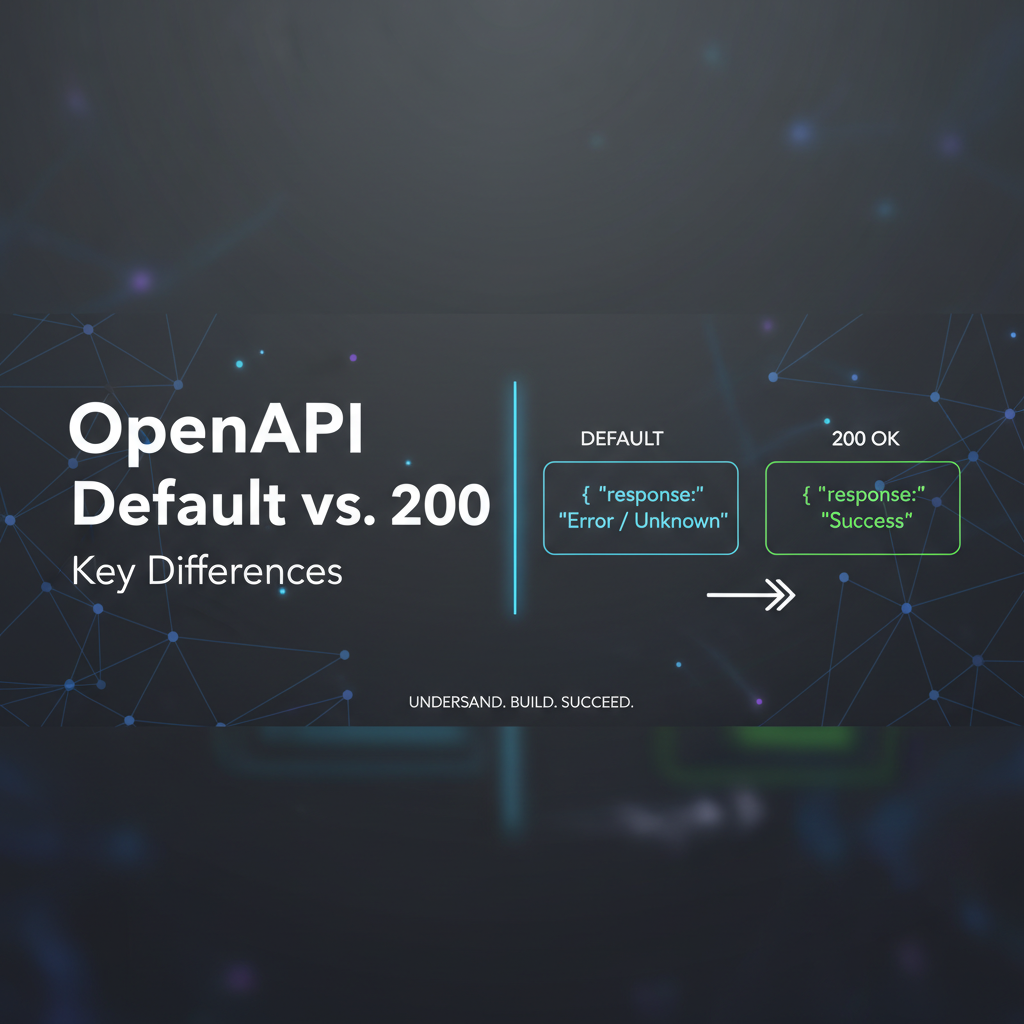
OpenAPI Default vs. 200: Understanding the Key Differences


In the intricate world of API design and development, precision is paramount. The contract between an API provider and its consumers hinges on clarity, consistency, and unambiguous documentation. This is where OpenAPI (formerly Swagger) emerges as an indispensable standard, providing a language-agnostic interface description for RESTful APIs. It allows both humans and machines to understand the capabilities of a service without access to source code or additional documentation. Within the OpenAPI Specification (OAS), defining responses is a critical aspect, dictating what clients can expect under various circumstances. However, two particular response types often breed confusion among developers: the explicit 200 response and the more enigmatic default response. While seemingly similar in their role of describing potential API outputs, their semantic implications, application contexts, and overall impact on API robustness and documentation differ profoundly.
The choice between leveraging a specific HTTP status code like 200 OK for success or employing the catch-all default for other scenarios is not merely a stylistic preference; it is a fundamental decision that shapes the clarity of your API contract, the ease of client development, and the maintainability of your services. A misinterpretation or misuse of these response types can lead to brittle client implementations, frustrating debugging sessions, and ultimately, a diminished developer experience. This comprehensive article aims to dissect these two crucial OpenAPI response definitions, exploring their individual meanings, typical use cases, the subtle yet significant distinctions that set them apart, and how their strategic application contributes to building truly robust and developer-friendly APIs. We will delve into best practices, common pitfalls, and the architectural implications, providing a foundational understanding that empowers you to craft OpenAPI specifications with unparalleled clarity and foresight.
The Foundation: Understanding OpenAPI and API Contracts
Before we dissect the nuances of default and 200 responses, it's essential to solidify our understanding of OpenAPI itself and the broader concept of an API contract. At its core, an API (Application Programming Interface) serves as a set of definitions and protocols for building and integrating application software. For web APIs, particularly RESTful ones, this typically involves HTTP requests and responses. The contract, in this context, is the formal agreement between the API provider and consumer about how the API behaves: what inputs it accepts, what outputs it produces, what errors it might return, and how it handles authentication and authorization.
The OpenAPI Specification provides a standardized, machine-readable format for describing RESTful APIs. Originating from the Swagger Specification, it has evolved into a widely adopted industry standard governed by the OpenAPI Initiative, a Linux Foundation project. The primary goal of OpenAPI is to enable the description of an API's entire surface area, from its available endpoints and operations to parameters, authentication methods, and crucially, its responses. This standardized description brings a multitude of benefits:
- Documentation Generation: Automatically generates human-readable API documentation (like Swagger UI), making APIs easier to understand and use.
- Client and Server Stub Generation: Tools can automatically generate client SDKs in various programming languages, reducing the effort required for integration. Similarly, server stubs can be generated, streamlining backend development.
- Testing and Validation: Facilitates automated testing, allowing developers to validate API requests and responses against the defined specification.
- API Lifecycle Management: Becomes a central artifact for managing the entire API lifecycle, from design and development to deployment and retirement. It enables better collaboration between teams and enforces consistency.
Within an OpenAPI document, the structure is hierarchical. It defines paths (endpoints), operations (GET, POST, PUT, DELETE, etc.) for each path, and for each operation, it specifies parameters, request bodies, and responses. The responses object for an operation is where default and 200 come into play. It's a map where keys are HTTP status codes (or default) and values are objects describing the response for that status code. A well-defined responses section is the bedrock of a robust API, ensuring that clients can anticipate and correctly handle every possible outcome of an API call, whether it's a success, a specific error, or an unexpected problem. This is where a robust api gateway also becomes invaluable, as it can enforce the contracts defined in OpenAPI, ensuring consistency across potentially disparate backend services.
Diving Deep into HTTP Status Codes
To fully appreciate the role of 200 and default in OpenAPI, we must first revisit the fundamentals of HTTP status codes. These three-digit numbers are returned by a server in response to a client's request, providing critical information about the request's outcome. They are categorized into five classes, each representing a broad type of response:
- 1xx (Informational): The request was received and understood. The process is continuing. (e.g.,
100 Continue,101 Switching Protocols) - 2xx (Success): The request was successfully received, understood, and accepted. (e.g.,
200 OK,201 Created,204 No Content) - 3xx (Redirection): Further action needs to be taken by the user agent to fulfill the request. (e.g.,
301 Moved Permanently,302 Found,304 Not Modified) - 4xx (Client Error): The request contains bad syntax or cannot be fulfilled. (e.g.,
400 Bad Request,401 Unauthorized,403 Forbidden,404 Not Found) - 5xx (Server Error): The server failed to fulfill an apparently valid request. (e.g.,
500 Internal Server Error,502 Bad Gateway,503 Service Unavailable)
The 200 OK status code is arguably the most common and fundamental success code. It indicates that the request has succeeded. The payload of a 200 OK response typically contains the requested resource or an acknowledgement of the action performed. For a GET request, 200 OK usually means the data was retrieved successfully. For a POST, PUT, or DELETE request, it might signify that the operation completed successfully, even if no content is returned (though 204 No Content is often preferred for operations that don't produce a new resource representation).
Other notable 2xx codes include: * 201 Created: The request has been fulfilled and resulted in a new resource being created. This is commonly used after a successful POST request. * 204 No Content: The server has successfully fulfilled the request and there is no additional content to send in the response payload body. This is useful for DELETE requests or PUT requests that only update resources without returning new data.
Understanding these codes is crucial because they form the explicit language of API communication. An api gateway or API management platform often relies on these codes to route, log, and monitor API traffic effectively. When an api is designed, specifying the exact HTTP status codes for various outcomes ensures that clients can react appropriately, building resilient and predictable integrations. This granular control over status codes directly impacts how we define responses in OpenAPI, specifically differentiating between explicit success codes and generic catch-alls.
The 200 OK Response in OpenAPI
In an OpenAPI Specification, defining the 200 OK response for an operation is the most straightforward and explicit way to describe the primary successful outcome. When you specify 200 as a response key, you are directly stating that "if the API call is successful and returns an HTTP status code of 200, this is what the client should expect." This level of specificity is invaluable for generating accurate documentation and reliable client SDKs.
Consider a typical GET /users/{id} endpoint. The successful response would almost certainly be a 200 OK carrying the user's data. In OpenAPI, this would be defined as follows:
paths:
  /users/{id}:
    get:
      summary: Retrieve a user by ID
      parameters:
        - in: path
          name: id
          schema:
            type: string
          required: true
          description: The ID of the user to retrieve
      responses:
        '200':
          description: User data retrieved successfully
          content:
            application/json:
              schema:
                $ref: '#/components/schemas/User'
        '404':
          description: User not found
          content:
            application/json:
              schema:
                $ref: '#/components/schemas/ErrorResponse'
        '500':
          description: Internal server error
          content:
            application/json:
              schema:
                $ref: '#/components/schemas/ErrorResponse'

components:
  schemas:
    User:
      type: object
      properties:
        id:
          type: string
          format: uuid
          example: d290f1ee-6c54-4b01-90e6-d701748f0851
        username:
          type: string
          example: john.doe
        email:
          type: string
          format: email
          example: john.doe@example.com
        firstName:
          type: string
          example: John
        lastName:
          type: string
          example: Doe
    ErrorResponse:
      type: object
      properties:
        code:
          type: string
          example: USER_NOT_FOUND
        message:
          type: string
          example: The requested user could not be found.
In this example, the 200 response clearly outlines that a User object will be returned in the application/json format. The description field provides human-readable context, and the schema field, often using $ref to point to a reusable component, precisely defines the structure of the successful payload.
When to use 200 OK explicitly:
- Primary Success Outcome: Always define
200 OKfor the most common and expected successful result of an operation that returns data. ForGETrequests, it's almost always200. ForPOSTorPUTthat return the newly created/updated resource,200or201are appropriate. - Specific Success Payload: When the successful response has a distinct and well-defined structure that clients need to parse and understand.
- Generating Accurate Documentation and SDKs: Explicitly defining
200ensures that documentation tools precisely describe the success case and client generators produce correct data models.
Failing to define 200 for an operation where data is expected can lead to ambiguities in the api contract. Clients might not know what to expect, or generated SDKs might produce generic Object types instead of strongly typed models, diminishing the benefits of OpenAPI. The 200 definition is your declaration of how your api delivers on its promise when everything goes according to plan.
The default Response in OpenAPI: The Catch-All
While 200 OK precisely describes a specific success scenario, the default response in OpenAPI serves a fundamentally different purpose: it acts as a catch-all for any HTTP status code not explicitly defined for an operation. This means if you have an operation and you've defined responses for 200, 400, and 404, but the API returns a 401 Unauthorized or 500 Internal Server Error, the default response definition will be used to describe that outcome.
The primary motivation behind using default is to avoid repetition and enforce consistency for common, non-specific error structures across your API. Imagine an API with dozens of endpoints. Each endpoint might return a 400 Bad Request, 401 Unauthorized, 403 Forbidden, 404 Not Found, 500 Internal Server Error, 502 Bad Gateway, and so on. If the payload for these errors is generally the same (e.g., an ErrorResponse object with a code and message), explicitly defining each of them for every operation would lead to an excessively verbose and hard-to-maintain OpenAPI document.
Here's an example demonstrating the default response:
paths:
  /products:
    post:
      summary: Create a new product
      requestBody:
        required: true
        content:
          application/json:
            schema:
              $ref: '#/components/schemas/NewProductRequest'
      responses:
        '201':
          description: Product created successfully
          content:
            application/json:
              schema:
                $ref: '#/components/schemas/Product'
        '400':
          description: Invalid product data provided
          content:
            application/json:
              schema:
                $ref: '#/components/schemas/ValidationErrorResponse'
        default: # This will catch 401, 403, 404 (if not handled by 400), 500, etc.
          description: Unexpected error
          content:
            application/json:
              schema:
                $ref: '#/components/schemas/GenericErrorResponse'

components:
  schemas:
    NewProductRequest:
      type: object
      required:
        - name
        - price
      properties:
        name:
          type: string
          example: Laptop Pro
        price:
          type: number
          format: float
          example: 1299.99
    Product:
      type: object
      properties:
        id:
          type: string
          format: uuid
        name:
          type: string
        price:
          type: number
        createdAt:
          type: string
          format: date-time
    ValidationErrorResponse:
      type: object
      properties:
        code:
          type: string
          example: INVALID_INPUT
        message:
          type: string
          example: Validation failed for product data.
        details:
          type: array
          items:
            type: object
            properties:
              field: { type: string, example: name }
              issue: { type: string, example: cannot be empty }
    GenericErrorResponse:
      type: object
      properties:
        code:
          type: string
          example: INTERNAL_SERVER_ERROR
        message:
          type: string
          example: An unexpected error occurred. Please try again later.
In this example, 201 is explicitly defined for success. 400 is also explicitly defined because it has a unique ValidationErrorResponse schema that includes details about validation issues. However, for all other potential error codes (like 401 Unauthorized, 403 Forbidden, 404 Not Found if a general 400 covers invalid data, or 500 Internal Server Error), the default response will apply, using the GenericErrorResponse schema.
When is default most useful?
- Consistent Error Handling: To provide a standard, generic error response schema for any unexpected or unhandled error across your
api. This promotes consistency for clients. - Reducing Verbosity: Significantly cuts down on the amount of YAML/JSON required to define common error scenarios for every operation.
- Documentation for Unforeseen Errors: It ensures that even if a specific error code isn't documented, clients still have an expectation of what the general error structure might look like. This is particularly useful for server-side
5xxerrors which might be truly unexpected.
The default response does not mean "always return this." It means "if the HTTP status code returned by the server is not one of the explicitly listed status codes (e.g., 200, 201, 400, 404), then assume the response body will conform to this default definition." This makes it an incredibly powerful tool for streamlining API contracts and ensuring robustness.
Robust API gateways, such as APIPark, play a crucial role in enforcing these standardized error responses. By acting as a central point for all api traffic, an api gateway can ensure that even if individual microservices generate slightly different error structures, the outbound response adheres to the consistent default definition specified in your OpenAPI document. This capability is part of APIPark's broader end-to-end API lifecycle management, which helps regulate API management processes and ensures a unified api format for invocation, simplifying how api interactions are handled and maintaining strict adherence to the defined contract.
APIPark is a high-performance AI gateway that allows you to securely access the most comprehensive LLM APIs globally on the APIPark platform, including OpenAI, Anthropic, Mistral, Llama2, Google Gemini, and more.Try APIPark now! 👇👇👇
Key Differences and Overlap: default vs. 200
Having explored 200 and default individually, it's time to highlight their fundamental differences and understand how they interact within an OpenAPI specification. While both are used to describe responses, their intent, specificity, and application are distinct.
1. Purpose and Scope:
200 OK: Exclusively defines the most common successful outcome of an operation. It's about what is returned when everything goes right and the request is fulfilled as expected. It's a precise definition for a specific success state.default: Serves as a catch-all for any HTTP status code that isn't explicitly defined elsewhere for that operation. Its primary practical use is to define a generic error response structure for client and server errors that don't warrant specific, unique definitions, or for unexpected outcomes.
2. Specificity:
200 OK: Highly specific. It targets exactly one HTTP status code. The schema defined under200will only be used for a200 OKresponse.default: Generic. It applies to an unbounded set of HTTP status codes. If an API returns a401,403,429,500,503, or any other code not explicitly listed, thedefaultdefinition will be used.
3. Mandatory vs. Optional:
200 OK(or other 2xx codes): Generally considered mandatory for operations that are expected to return data or indicate a successful state. Omitting a success response can make your API contract incomplete and confusing.default: Optional, but highly recommended for robust API design. While an API can function without adefaultresponse, its absence leaves a gap in the contract, potentially making it harder for clients to handle unforeseen errors gracefully.
4. Hierarchy and Precedence:
This is a crucial point of interaction. Specific status code definitions always take precedence over default.
- If an operation returns a
400 Bad Requestand you have a specific400response defined, that definition will be used. - If the same operation returns a
400 Bad Requestand you only have200anddefaultdefined, then thedefaultresponse will be applied to the400status code.
This means you can start with a broad default error structure and then override it with more specific definitions for particular status codes (like 400 for validation errors, 401 for authentication issues, 404 for resource not found) where the response payload or description needs to be distinct.
5. Semantic Meaning:
200 OK: Conveys "Operation successful, here is the expected data/result." It is a positive affirmation of the API's intended behavior.default: Often implicitly conveys "Something went wrong or unexpectedly; here is a generic error structure." While technically it could apply to an undeclared success code, in practice, it's almost universally used for error handling. It's an admission that not every outcome can be meticulously detailed, but a consistent handling mechanism is still provided.
6. Impact on Documentation and Client Generation:
200 OK: Generates highly precise documentation and strongly typed client models for the success case. This is invaluable for developer productivity.default: Generates documentation and client types for a generic error case. While not as specific, it ensures that client applications have some mechanism to interpret unknown error responses, rather than crashing or providing unhelpful messages. For example, in a generated SDK, an undeclared error might map to a generalApiExceptioncarrying thedefault's payload.
Understanding this interplay is key to designing comprehensive and developer-friendly apis. The OpenAPI specification, when used judiciously, enables the creation of an API contract that is both detailed where necessary and pragmatic where generality suffices.
Best Practices and Strategic Usage
Navigating the landscape of 200 and default responses effectively requires a strategic approach. It's not about choosing one over the other, but understanding how to combine them for maximum clarity, maintainability, and developer experience.
When to Use 200 OK (or other explicit success codes):
- Always for Primary Success: For any operation that returns data or indicates a specific successful state (e.g.,
200 OKfor data retrieval,201 Createdfor resource creation,204 No Contentfor successful deletion or update without return data), explicitly define it. This is your API's promise of what to expect when things go right. - Be Precise with Schema: The schema defined under
200should be accurate and complete. Clients rely on this to correctly parse the response. Use$refto reference reusable schemas defined incomponents/schemasto maintain consistency and avoid duplication. - Distinct Success States: If an operation can have multiple, genuinely different success outcomes (e.g., a complex POST that might return
200 OKif a resource is updated, or201 Createdif a new one is made), define each explicitly with its unique status code and schema.
When to Use default Response:
- For Generic Error Payloads: The most common and recommended use of
defaultis to define a consistent structure for common client (4xx) and server (5xx) errors that do not warrant a highly specific payload. This generic error object typically includes an error code and a human-readable message.yaml responses: default: description: An unexpected error occurred. content: application/json: schema: $ref: '#/components/schemas/ProblemDetails' # RFC 7807 compliant error object - Avoid Repetition: By defining
defaultonce, you prevent having to copy-paste the same error schema description for401,403,500,502, etc., unless those specific codes have truly unique response bodies. - Ensuring Completeness: Even for errors you don't explicitly anticipate,
defaultprovides a fallback, ensuring that generated client SDKs have a type to represent any unhandled error, rather than an untyped generic response.
Combining 200 and default (The Recommended Approach):
The most robust and maintainable approach is to combine explicit success codes (like 200, 201, 204) with a default error response, and then add specific error codes (400, 401, 403, 404, 429, 500, etc.) only when their responses differ significantly from the default error structure or require unique, detailed descriptions.
paths:
  /orders:
    get:
      summary: Retrieve all orders
      responses:
        '200': # Explicit success for a list of orders
          description: A list of orders
          content:
            application/json:
              schema:
                type: array
                items:
                  $ref: '#/components/schemas/Order'
        '401': # Specific error for authentication issues
          description: Unauthorized - Authentication required or failed
          content:
            application/json:
              schema:
                $ref: '#/components/schemas/AuthError' # Specific error schema for auth
        '403': # Specific error for authorization issues
          description: Forbidden - User does not have necessary permissions
          content:
            application/json:
              schema:
                $ref: '#/components/schemas/AuthError' # Can reuse AuthError or define new
        default: # Catch-all for all other errors (e.g., 404, 500, 503)
          description: An unexpected error occurred.
          content:
            application/json:
              schema:
                $ref: '#/components/schemas/ProblemDetails'

components:
  schemas:
    Order:
      type: object
      properties:
        id: { type: string, format: uuid }
        customerId: { type: string, format: uuid }
        totalAmount: { type: number, format: float }
        status: { type: string, enum: [pending, processing, delivered, cancelled] }
    AuthError:
      type: object
      properties:
        error: { type: string, example: UNAUTHORIZED }
        message: { type: string, example: Invalid access token. }
    ProblemDetails: # Following RFC 7807 for generic error responses
      type: object
      properties:
        type: { type: string, format: uri, example: 'https://example.com/probs/internal-error' }
        title: { type: string, example: "Internal Server Error" }
        status: { type: integer, format: int32, example: 500 }
        detail: { type: string, example: "An unexpected condition prevented the server from fulfilling the request." }
        instance: { type: string, format: uri, example: '/orders/123/items' }
In this structure, you get the best of both worlds: specific definitions for critical success and distinct error states, along with a consistent fallback for everything else. This balance is crucial for OpenAPI specifications that are both comprehensive and maintainable.
The role of an api gateway in managing these responses is paramount. A comprehensive platform like APIPark offers features for end-to-end API lifecycle management, including traffic forwarding, load balancing, and versioning. Crucially, it can enforce response schemas, transform error messages to adhere to a unified format, and ensure that the API contract defined in your OpenAPI specification is consistently honored across all services. This centralized management simplifies the practical implementation of your OpenAPI definitions, especially for apis composed of many microservices, guaranteeing that api consumers consistently receive predictable responses, regardless of the underlying service behavior.
Table: Comparative Analysis of 200 vs. default in OpenAPI
To further clarify the distinctions, let's summarize the key aspects in a comparative table:
| Feature | 200 OK Response |
default Response |
|---|---|---|
| Purpose | Describes the primary successful outcome for an operation. | Catches any HTTP status code not explicitly defined. |
| Specificity | Highly specific to 200 OK status code. |
Generic; applies to an unbounded set of status codes. |
| Semantic Role | "Everything went well, here's the expected data." | "Something else happened; here's a generic response." (often for errors) |
| Precedence | Always takes precedence for status code 200. |
Lowest precedence; overridden by any explicit status code definition. |
| Usage | Essential for operations returning data on success. | Highly recommended for consistent error handling. |
| Payload Type | Typically the expected resource or success confirmation. | Usually a generic error object (e.g., ProblemDetails). |
| Repetition | Unique per operation (though schemas can be reused). | Reduces repetition for common error scenarios across operations. |
| Impact on Client | Generates strongly typed success models. | Generates a generic error type for unhandled status codes. |
| Best Practice | Always define for operations with success payloads. | Combine with explicit success codes and specific error codes for robustness. |
This table succinctly captures the essence of their differences, reinforcing that 200 and default are complementary tools in the OpenAPI designer's toolkit, each serving a critical, distinct function.
Advanced Considerations and Common Pitfalls
While the judicious use of 200 and default responses significantly enhances an OpenAPI specification, there are advanced considerations and common pitfalls that designers should be aware of to ensure the long-term health and maintainability of their APIs.
Backward Compatibility and Evolution
API contracts are living documents. As APIs evolve, changes to response schemas, especially for 200 and default, can have significant backward compatibility implications.
- Changes to
200Schema: Modifying the schema for a200 OKresponse (e.g., removing a field, changing a field's type, making a previously optional field required) can break existing clients. Semantic versioning of your API is crucial here. If a change is breaking, it should warrant a major version increment. - Changes to
defaultSchema: Similarly, altering thedefaulterror schema (e.g., renaming thecodefield toerrorCode, changing the structure ofdetails) can break clients that rely on consistent error parsing. While clients might be more tolerant of changes to "unexpected" errors, breaking their general error handling is still detrimental. - Adding New Explicit Errors: Introducing a new specific error code (e.g., defining
429 Too Many Requestswhen it was previously caught bydefault) is generally additive and less likely to break clients, as they would have been handling it viadefaultanyway. However, the new specific definition might require client updates to take advantage of more granular error handling.
Thorough change management, clear deprecation policies, and good communication with API consumers are essential when evolving OpenAPI definitions.
Schema Reusability with $ref
To prevent duplication and maintain consistency, always define reusable schemas under components/schemas and reference them using $ref. This applies equally to success payloads and error objects.
# ...
responses:
  '200':
    description: User details
    content:
      application/json:
        schema:
          $ref: '#/components/schemas/UserDetail'
  default:
    description: Generic error
    content:
      application/json:
        schema:
          $ref: '#/components/schemas/ProblemDetails'
# ...
components:
  schemas:
    UserDetail:
      # ... definition
    ProblemDetails:
      # ... definition
This practice not only makes your OpenAPI document cleaner but also ensures that all instances of a particular UserDetail or ProblemDetails object across your API conform to the same structure. This is especially vital for error structures, where a consistent format greatly aids client-side error handling logic.
The "Always 200 OK" Anti-Pattern
A common anti-pattern, particularly in older APIs or those not strictly adhering to REST principles, is to always return 200 OK even when an error occurs. In such cases, the actual error details are embedded within the 200 OK response body, often with a status field like "status": "error" or "success": false.
While this might seem simpler at first glance (as clients only need to check one HTTP status code), it severely undermines the power and semantics of HTTP. It makes caching strategies more complex, obscures the true outcome of a request at the network level, and bypasses the rich error handling mechanisms built into HTTP and api gateway solutions.
OpenAPI allows you to define a 200 response that includes an error object schema, but it doesn't endorse it as a best practice. Modern API design strongly advocates for using appropriate HTTP status codes (e.g., 400 for bad request, 404 for not found, 500 for server errors) to convey the true outcome of a request. Your OpenAPI specification should reflect this best practice, defining distinct responses for success and various error conditions.
The Role of an API Gateway in Response Consistency
Inconsistent responses are a common pain point, particularly in large-scale, distributed api architectures where multiple microservices might be developed by different teams. This is precisely where the capabilities of an api gateway become indispensable. Platforms like APIPark are designed to sit in front of your backend services, acting as a policy enforcement point.
An api gateway can: * Validate Outgoing Responses: Verify that responses from backend services conform to the OpenAPI schema defined for 200, default, or specific error codes. If a service returns a response that deviates from the contract, the gateway can log the deviation, transform the response to comply, or even block it. * Standardize Error Messages: Ensure that all error responses, regardless of which backend service generated them, adhere to a unified format (e.g., the ProblemDetails format defined in your default response). This is especially useful if different backend services have slightly different internal error structures. * Inject Common Headers: Add common response headers (e.g., correlation IDs, rate limit information) consistently across all responses. * Route Based on Status Codes: Some advanced routing logic can be based on the incoming response status code from a backend service, providing fallback mechanisms or error specific handling.
By leveraging an api gateway like APIPark, organizations can enforce API contracts defined in OpenAPI specifications more rigorously, preventing issues before they reach client applications. This helps maintain the integrity of your OpenAPI documentation and ensures a predictable developer experience, ultimately reducing integration complexity and support overhead for api consumers. APIPark's comprehensive logging capabilities also provide detailed records of every API call, assisting businesses in quickly tracing and troubleshooting issues related to response consistency and data security, while powerful data analysis helps in preventive maintenance.
Conclusion
The distinction between OpenAPI's 200 OK and default responses, while seemingly a minor syntactic detail, carries significant implications for the clarity, robustness, and maintainability of your API contract. The 200 OK response is your explicit promise for the anticipated successful outcome, meticulously detailing the data a client should expect when an operation completes without incident. It is a precise declaration of success. In contrast, the default response serves as a powerful catch-all, providing a consistent framework for handling any unforeseen or un-enumerated outcomes, predominantly errors, thereby streamlining your specification and ensuring a baseline of predictability for clients even in exceptional circumstances.
A well-designed OpenAPI specification leverages both of these response types strategically. It explicitly defines 200 (or other specific 2xx codes like 201 or 204) for all primary success scenarios, giving clients clear, strongly typed models for their expected data. Concurrently, it employs a default response to enforce a universal error structure, reducing redundancy and providing a robust fallback for all other status codes not explicitly listed. Furthermore, specific error codes like 400 Bad Request, 401 Unauthorized, or 404 Not Found are defined only when their payloads or descriptions necessitate a deviation from the generic default error structure. This balanced approach results in an api contract that is both detailed where precision is critical and pragmatic where generality suffices.
Ultimately, mastering the use of 200 and default within your OpenAPI definitions is not merely about adhering to a specification; it's about engineering a superior developer experience. Clear, consistent, and predictable API responses, enforced perhaps by a robust api gateway like APIPark, foster trust, reduce integration friction, and accelerate development cycles. By thoughtfully designing your responses, you empower api consumers to build resilient applications that can gracefully handle both success and failure, laying the groundwork for a truly discoverable, usable, and maintainable api ecosystem.
Frequently Asked Questions (FAQs)
1. What is the primary difference between 200 OK and default in OpenAPI? The 200 OK response in OpenAPI specifically defines the structure and description for a successful HTTP 200 status code, indicating that the request was processed successfully and typically returns expected data. The default response, on the other hand, acts as a catch-all for any HTTP status code that is not explicitly defined for a given operation. It's primarily used to provide a consistent, generic error response structure for client (4xx) and server (5xx) errors that don't have their own specific definitions.
2. Should I always define a 200 OK response for every operation in OpenAPI? You should define a 200 OK ( or other relevant 2xx success codes like 201 Created or 204 No Content) for any operation that is expected to return data or confirm a specific successful state. If an operation's primary success involves returning a resource or a detailed success message, an explicit 2xx definition is crucial for clear documentation and accurate client SDK generation. Operations that only perform an action without returning content might use 204 No Content.
3. When is it best to use the default response in an OpenAPI specification? The default response is best used to define a consistent, generic error payload for all HTTP status codes (e.g., 401, 403, 500) that you don't intend to describe with a unique, custom schema for that particular operation. It helps to reduce verbosity in your OpenAPI document and ensures that clients have a basic understanding of what to expect even for unexpected or unhandled errors.
4. What happens if both a specific error code (e.g., 400) and a default response are defined? In OpenAPI, specific status code definitions always take precedence over the default response. If an operation returns a 400 Bad Request and you have a 400 response explicitly defined, that specific 400 definition will be used. The default response only applies if the returned HTTP status code does not have an explicit definition. This allows you to provide general error handling while still offering detailed descriptions for critical or unique error scenarios.
5. How does an API Gateway relate to OpenAPI response definitions like default and 200? An api gateway, such as APIPark, plays a vital role in enforcing and managing OpenAPI response definitions in real-world scenarios. It can validate outgoing responses from backend services against the defined OpenAPI schemas, ensuring they conform to 200 or default specifications. It can also standardize error messages, transforming disparate backend error formats into the consistent default error structure defined in your OpenAPI document, thereby ensuring predictable behavior for api consumers and maintaining the integrity of the API contract.
🚀You can securely and efficiently call the OpenAI API on APIPark in just two steps:
Step 1: Deploy the APIPark AI gateway in 5 minutes.
APIPark is developed based on Golang, offering strong product performance and low development and maintenance costs. You can deploy APIPark with a single command line.
curl -sSO https://download.apipark.com/install/quick-start.sh; bash quick-start.sh

In my experience, you can see the successful deployment interface within 5 to 10 minutes. Then, you can log in to APIPark using your account.

Step 2: Call the OpenAI API.