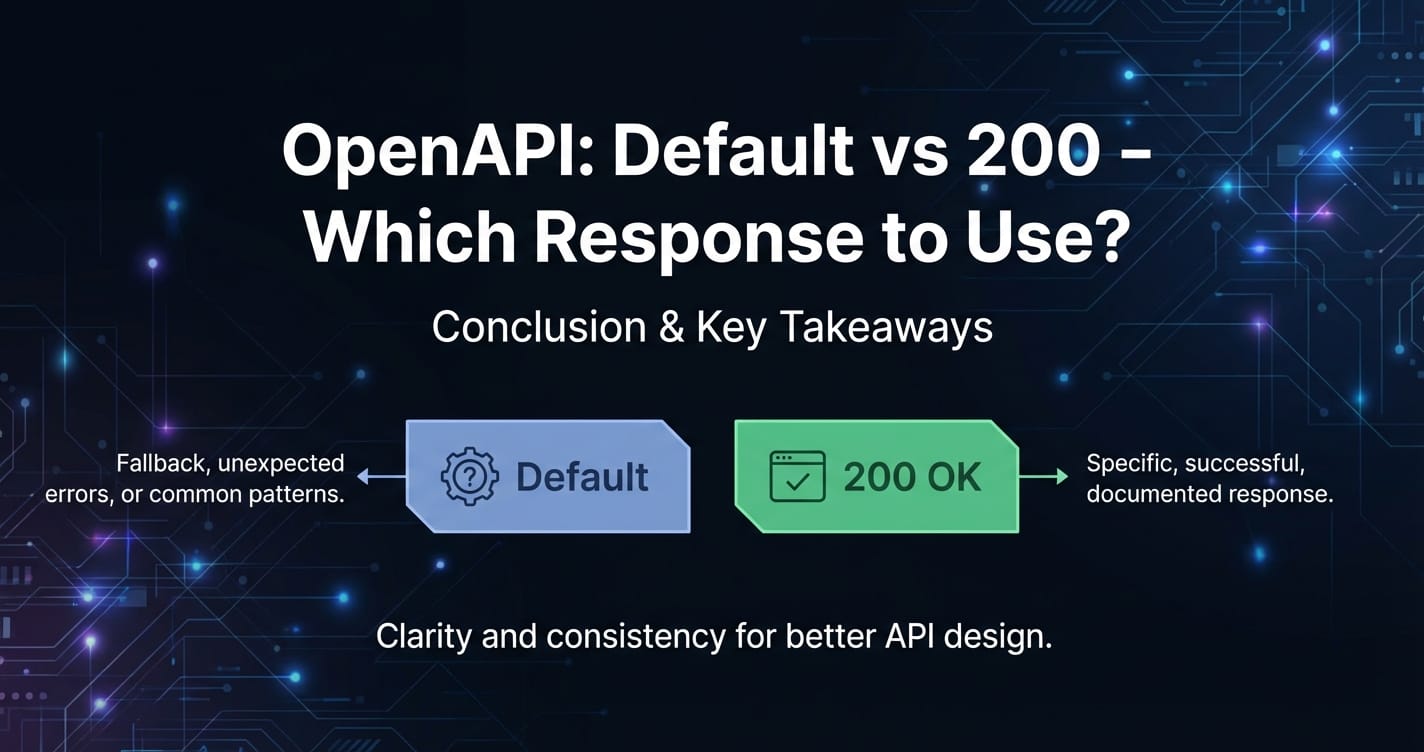
OpenAPI: Default vs 200 - Which Response to Use?


In the intricate world of API development, precision and clarity are not just desirable traits; they are fundamental pillars upon which robust, maintainable, and developer-friendly systems are built. At the heart of defining these systems lies the OpenAPI Specification (OAS), a powerful, language-agnostic standard for describing RESTful APIs. It allows developers to define the entire API surface, from endpoints and parameters to authentication methods and, crucially, responses. Among the various aspects of defining responses, a recurring point of discussion and occasional confusion revolves around the choice between explicitly defining a 200 OK response versus relying on the more generic default response. This decision, seemingly minor, carries significant implications for API consumers, documentation generation, and the overall robustness of your API ecosystem.
This comprehensive guide will embark on a deep dive into the nuances of OpenAPI response definitions, meticulously dissecting the 200 OK and default responses. We will explore their distinct purposes, best practices for their implementation, and the scenarios where each excels. Beyond mere syntax, we will delve into the underlying philosophies that guide these choices, considering their impact on API reliability, error handling strategies, and the seamless integration experience for developers consuming your services. By the end of this exploration, you will possess a clear understanding of when and how to leverage each response type effectively, empowering you to design OpenAPI specifications that are not only technically sound but also exceptionally intuitive and user-friendly. Our journey will cover the foundational principles of OpenAPI, delve into the specifics of success and error handling, compare the two approaches, and provide practical examples to cement your understanding, all while emphasizing the importance of thoughtful API design for long-term success.
The Foundation: Understanding OpenAPI Specification and Its Purpose
Before we dissect specific response types, it's essential to establish a solid understanding of the OpenAPI Specification itself. Born from the Swagger Specification, OpenAPI has evolved into the industry's de facto standard for describing, producing, consuming, and visualizing RESTful web services. Its primary goal is to enable both humans and computers to discover and understand the capabilities of a service without access to source code, documentation, or network traffic inspection. In essence, an OpenAPI document acts as a machine-readable contract for your API.
The Evolution and Benefits of OpenAPI
The journey from Swagger to OpenAPI was driven by a need for a more open, community-driven standard, fostering broader adoption and collaborative development. Today, OpenAPI is maintained by the Linux Foundation and supported by a vast ecosystem of tools and platforms. The benefits of adopting OpenAPI are multifaceted and profound:
- Enhanced Documentation: Automated and interactive API documentation that is always in sync with the API's actual implementation. This eliminates the manual effort and potential for discrepancies often found in traditional, text-based documentation.
- Code Generation: Tools can automatically generate client SDKs in various programming languages, server stubs, and mock servers directly from an OpenAPI definition. This significantly accelerates development cycles and reduces boilerplate code for consumers.
- API Testing and Validation: OpenAPI definitions can be used to validate requests and responses against the defined schema, ensuring data integrity and adherence to the contract. It also facilitates automated testing frameworks.
- Improved Design and Consistency: The act of writing an OpenAPI definition encourages thoughtful API design. It forces designers to consider every aspect of an endpoint, from parameters and authentication to the structure of success and error responses, leading to more consistent and intuitive APIs.
- Gateway and Management Integration: API gateways, like ApiPark, often leverage OpenAPI definitions for routing, security, monitoring, and managing the API lifecycle. This standardization simplifies the integration and governance of numerous services, especially in microservices architectures or when dealing with a large portfolio of APIs. APIPark, for instance, helps manage the entire API lifecycle, from design to deployment, ensuring that your carefully crafted OpenAPI responses are consistently enforced and monitored.
Core Components of an OpenAPI Document
An OpenAPI document is typically written in YAML or JSON format and comprises several key components that collectively describe the API:
openapi: Specifies the version of the OpenAPI Specification being used (e.g.,3.0.0).info: Provides metadata about the API, such as title, version, description, and contact information.servers: Defines the base URLs for the API, allowing clients to understand where to send requests.paths: This is the most crucial section, defining individual endpoints (paths) and the HTTP operations (GET, POST, PUT, DELETE, etc.) available on those paths.components: A reusable collection of schemas, responses, parameters, examples, headers, security schemes, and more. This promotes consistency and reduces redundancy.security: Defines the authentication and authorization mechanisms used by the API.
Our focus today will primarily be within the paths and components sections, specifically diving into the responses object associated with each operation.
The Significance of HTTP Status Codes
Central to defining API responses is the judicious use of HTTP status codes. These three-digit numbers are the universal language of the web, conveying the outcome of an HTTP request. They are categorized into five classes:
- 1xx (Informational): The request was received, continuing process. (Rare in typical API responses).
- 2xx (Success): The action was successfully received, understood, and accepted.
200 OK: Standard success for GET, PUT, PATCH, DELETE operations.201 Created: Resource successfully created (for POST).204 No Content: Successful request, but no content to return (e.g., successful delete).
- 3xx (Redirection): Further action needs to be taken to complete the request. (Less common in REST APIs, but can be for redirects).
- 4xx (Client Error): The request contains bad syntax or cannot be fulfilled.
400 Bad Request: General client error, often due to invalid input.401 Unauthorized: Authentication required or failed.403 Forbidden: Client does not have permission to access the resource.404 Not Found: The requested resource could not be found.429 Too Many Requests: Client exceeded rate limits.
- 5xx (Server Error): The server failed to fulfill an apparently valid request.
500 Internal Server Error: Generic server error.503 Service Unavailable: Server is temporarily unable to handle the request.
Choosing the correct HTTP status code is paramount for building an intuitive and self-describing API. It allows clients to quickly understand the nature of a response without having to parse the response body, leading to more robust error handling and improved user experience. Within OpenAPI, we define specific content for each of these codes, or for groups of them, leading us to our central dilemma: 200 versus default.
The 200 OK Response: The Golden Standard for Success
The 200 OK response is arguably the most recognizable and frequently used HTTP status code, signifying that the request has succeeded. In the context of OpenAPI, defining a 200 OK response means explicitly detailing what a client can expect when an API operation completes successfully, and a payload is returned. This is the cornerstone of predictable and reliable API interactions.
Definition and Purpose of 200 OK
When an API responds with 200 OK, it communicates a clear message: "Your request was processed without issues, and here is the result you asked for." This status code is the standard for successful GET requests where data is retrieved, PUT or PATCH requests where a resource is updated and its new state is returned, and sometimes even POST requests if the created resource is returned, though 201 Created is often more semantically appropriate for creation.
The primary purpose of explicitly defining 200 OK in your OpenAPI specification is to provide an exact contract for the successful outcome of an operation. It answers the question: "What does a successful response look like?" This definition includes:
- A human-readable
descriptionof the success. - The
contenttype(s) (e.g.,application/json,text/plain,application/xml) that the API will return. - The
schemathat defines the structure and data types of the returned payload for each content type. This schema is critical for client-side parsing and validation.
When to Use 200 OK
You should use 200 OK when:
- Retrieving Resources (GET): This is its most common application. A
GET /users/{id}request, if successful, should return a200 OKwith the user's data in the response body. - Updating Resources (PUT/PATCH): After a successful update operation, if the API returns the updated resource's representation,
200 OKis appropriate. If no content is returned (e.g., just a success confirmation),204 No Contentmight be a better choice. - Executing Actions (POST/DELETE): While
201 Createdis standard forPOSTcreating a resource, and204 No ContentforDELETEremoving one,200 OKcan be used if aPOSToperation processes data and returns a result that isn't a newly created resource, or if aDELETEoperation returns a confirmation message or the deleted item's details. The key is that a meaningful payload is expected and provided.
Structure within OpenAPI for 200 OK
Let's illustrate how 200 OK is defined within an OpenAPI document using YAML:
paths:
  /users/{userId}:
    get:
      summary: Retrieve a user by ID
      parameters:
        - in: path
          name: userId
          schema:
            type: string
            format: uuid
          required: true
          description: Unique identifier of the user to retrieve.
      responses:
        '200':
          description: Successfully retrieved user data.
          content:
            application/json:
              schema:
                $ref: '#/components/schemas/User'
              examples:
                userExample:
                  value:
                    id: "a1b2c3d4-e5f6-7890-1234-567890abcdef"
                    firstName: "John"
                    lastName: "Doe"
                    email: "john.doe@example.com"
                    isActive: true
        '404':
          description: User not found.
          content:
            application/json:
              schema:
                $ref: '#/components/schemas/Error'
              examples:
                notFoundExample:
                  value:
                    code: "USER_NOT_FOUND"
                    message: "The user with the specified ID could not be found."
        '500':
          description: Internal server error.
          content:
            application/json:
              schema:
                $ref: '#/components/schemas/Error'
              examples:
                serverErrorExample:
                  value:
                    code: "INTERNAL_SERVER_ERROR"
                    message: "An unexpected error occurred on the server."

components:
  schemas:
    User:
      type: object
      required:
        - id
        - firstName
        - lastName
        - email
      properties:
        id:
          type: string
          format: uuid
          description: Unique identifier for the user.
        firstName:
          type: string
          description: The user's first name.
        lastName:
          type: string
          description: The user's last name.
        email:
          type: string
          format: email
          description: The user's email address.
        isActive:
          type: boolean
          description: Indicates if the user account is active.
          default: true
    Error:
      type: object
      required:
        - code
        - message
      properties:
        code:
          type: string
          description: A unique error code.
        message:
          type: string
          description: A human-readable error message.
        details:
          type: array
          items:
            type: string
          description: Optional additional error details.
In this example:
- The
200key directly maps to the HTTP status code. descriptionprovides a human-friendly summary.contentspecifies the media type (application/json).schemauses$refto link to a reusableUserschema defined incomponents/schemas. This promotes reusability and maintainability.examplesprovides a concrete instance of what a successful response payload looks like, which is invaluable for developers.
Best Practices for 200 OK Responses
Crafting effective 200 OK responses involves more than just defining a schema; it's about anticipating consumer needs and fostering clarity.
- Be Explicit and Detailed: Always define the schema for your
200 OKresponse. Avoid vague descriptions or empty schemas if a payload is expected. The more precise you are, the easier it is for client-side developers to integrate and for tools to generate accurate code. - Provide Clear Examples: Real-world examples are incredibly helpful. They clarify complex schemas and demonstrate the expected data structure. Use the
exampleskeyword within your content definition. - Adhere to Semantics: While
200 OKis versatile, consider more specific 2xx codes where appropriate. For instance,201 Createdfor resource creation (POST) provides more semantic meaning than200 OKif the resource is newly established.204 No Contentis excellent when an operation succeeds but there's no data to return (e.g., a successful DELETE or an update that doesn't return the resource). - Consistency is Key: Ensure that similar successful operations across your API return consistent response structures and follow similar naming conventions. This predictability significantly improves the developer experience.
- Consider HTTP Headers: Sometimes, important metadata isn't in the body but in headers. For example, a
Locationheader in a201 Createdresponse pointing to the new resource. OpenAPI allows you to define these headers within the response object.
By meticulously defining your 200 OK responses, you create a robust contract that streamlines integration, automates documentation, and forms a reliable foundation for your API's interaction with the world.
The default Response: Catch-All for the Unexpected
While 200 OK represents the expected path of success, the default response in OpenAPI serves a fundamentally different, yet equally critical, role: it's a catch-all for any HTTP status code not explicitly defined for a given operation. This often makes it the designated handler for generic error conditions, especially those that are unexpected or too numerous to define individually.
Definition and Purpose of default
The default response in OpenAPI is a special keyword that signifies "any HTTP status code not explicitly defined elsewhere for this operation." It acts as a wildcard, a fallback mechanism that provides a consistent structure for responses that don't match any of the named status codes (like 200, 400, 404, 500).
Its primary purpose is to:
- Provide a Generic Error Contract: In most practical scenarios,
defaultis used to define a common structure for error responses, particularly for those errors that are not explicitly anticipated or are server-side issues (e.g.,500 Internal Server Error,503 Service Unavailable, or other unforeseen problems). - Improve API Robustness: By defining a
defaultresponse, you ensure that even unexpected outcomes have a defined structure, preventing clients from receiving entirely unhandled or unstructured responses. This makes client-side error handling more predictable. - Reduce Verbosity: For APIs with a very large number of potential error codes, defining every single one explicitly can become cumbersome. While not recommended for common, predictable errors,
defaultoffers a way to group less common or truly generic errors under a single definition.
It is absolutely crucial to understand that default is not a substitute for explicitly defining common and expected error states. Errors like 400 Bad Request (due to validation failures), 401 Unauthorized (authentication issues), 403 Forbidden (permission problems), and 404 Not Found (resource not existing) are so common and specific to client actions that they warrant their own explicit definitions. Relying on default for these would diminish the clarity and utility of your API contract.
When to Use default
You should consider using default when:
- Handling Generic Server Errors: For
5xxerrors (like500 Internal Server Error) that represent unexpected issues on the server side, adefaulterror response can provide a consistent format. While500could be explicitly defined,defaultacts as a broader umbrella for any server issue not otherwise specified. - Catching Undefined Error Codes: If your API might return HTTP status codes that you haven't explicitly listed in your OpenAPI document for a specific operation,
defaultwill be the one used by tools and documentation to describe those responses. This ensures that all possible responses have some documentation. - Implementing a "Problem Details" Standard (RFC 7807): For APIs that adhere to the RFC 7807 "Problem Details for HTTP APIs" standard,
defaultcan be an excellent place to define the generic problem details structure that all errors (both explicit and implicit) should conform to. This provides a uniform way to communicate API errors. - Minimizing Redundancy (with caution): In very specific scenarios, if a large set of distinct, yet structurally identical, error responses exists across many operations,
defaultcould be used to define that generic error structure, then specific status codes can refer to it. However, this should be done with care to avoid sacrificing clarity for brevity.
Structure within OpenAPI for default
Continuing our user example, let's see how default would be structured:
paths:
  /users/{userId}:
    get:
      summary: Retrieve a user by ID
      parameters:
        - in: path
          name: userId
          schema:
            type: string
            format: uuid
          required: true
          description: Unique identifier of the user to retrieve.
      responses:
        '200':
          description: Successfully retrieved user data.
          content:
            application/json:
              schema:
                $ref: '#/components/schemas/User'
              examples:
                userExample:
                  value:
                    id: "a1b2c3d4-e5f6-7890-1234-567890abcdef"
                    firstName: "Jane"
                    lastName: "Doe"
                    email: "jane.doe@example.com"
                    isActive: true
        '404':
          description: User not found.
          content:
            application/json:
              schema:
                $ref: '#/components/schemas/Error'
              examples:
                notFoundExample:
                  value:
                    code: "USER_NOT_FOUND"
                    message: "The user with the specified ID could not be found."
        'default': # This is our default response
          description: An unexpected error occurred.
          content:
            application/json:
              schema:
                $ref: '#/components/schemas/ProblemDetails' # A more generic error schema
              examples:
                defaultErrorExample:
                  value:
                    type: "https://example.com/probs/unexpected-error"
                    title: "Internal Server Error"
                    status: 500
                    detail: "An unhandled exception occurred during request processing."
                    instance: "/techblog/en/users/invalid-id"

components:
  schemas:
    User: # ... (as defined before) ...
    Error: # ... (as defined before, perhaps more specific) ...
    ProblemDetails: # A schema based on RFC 7807 for generic errors
      type: object
      required:
        - type
        - title
        - status
        - detail
      properties:
        type:
          type: string
          format: uri
          description: A URI reference that identifies the problem type.
        title:
          type: string
          description: A short, human-readable summary of the problem type.
        status:
          type: integer
          format: int32
          description: The HTTP status code (e.g., 400, 500) generated by the origin server.
        detail:
          type: string
          description: A human-readable explanation specific to this occurrence of the problem.
        instance:
          type: string
          format: uri
          description: A URI reference that identifies the specific occurrence of the problem.
        # Additional custom fields can be added here
        errorCode:
          type: string
          description: A custom internal error code for more precise categorization.
In this enhanced example:
- The
defaultkey defines the catch-all response. - It has a
descriptionfor clarity. - It specifies
contentasapplication/json. - It refers to a more generic
ProblemDetailsschema, potentially aligning with RFC 7807, which is an excellent pattern for consistent error handling. - An
exampleis provided to demonstrate the structure of an unexpected error.
Best Practices for default Responses
Employing default effectively requires a thoughtful approach to error handling and API design.
- Always Provide a
description: Even for a genericdefaultresponse, a clear description is vital. It informs API consumers about what this catch-all represents. - Define a Consistent Error Schema: Ensure that the schema referenced by
default(e.g.,ProblemDetails) is robust and consistent across your API. This schema should typically include fields like an errorcode, amessage, and potentiallydetailsor atypefor problem identification. - Do Not Substitute for Explicit Errors: This bears repeating:
defaultis for unspecified responses, typically errors you don't or can't define explicitly. It should not replace specific definitions for400 Bad Request,401 Unauthorized,404 Not Found, etc., if these are common and expected outcomes for your operations. Explicitly defined errors provide more actionable information to API consumers. - Consider Security Implications: Ensure that your
defaulterror responses do not inadvertently leak sensitive server-side information. Error messages should be informative enough for debugging but not expose internal system details. - Use It as a Safety Net: Think of
defaultas your API's robust safety net. It ensures that even in scenarios where an unexpected status code is returned, there's a documented structure, allowing client applications to handle errors gracefully rather than crashing due to an unknown response format. - Centralize Error Definitions: If you use a
defaultresponse, it's highly recommended to define its schema incomponents/schemasso it can be reused consistently across all operations.
By strategically implementing the default response, you enhance your API's resilience and provide a predictable error handling experience, even in the face of unforeseen circumstances. It allows for a standardized way of communicating problems that fall outside the explicitly defined success and common error paths.
APIPark is a high-performance AI gateway that allows you to securely access the most comprehensive LLM APIs globally on the APIPark platform, including OpenAI, Anthropic, Mistral, Llama2, Google Gemini, and more.Try APIPark now! 👇👇👇
Direct Comparison: default vs. 200 - A Crucial Distinction
Having explored 200 OK and default in detail, it's now time to draw a clear distinction between these two critical OpenAPI response types. While both play vital roles in defining an API's contract, they serve entirely different purposes and operate under distinct rules of precedence. Misunderstanding this difference can lead to ambiguous API specifications, confusing client implementations, and frustrating developer experiences.
Fundamental Difference: Specific Success vs. General Fallback
The most fundamental difference lies in their core intent:
200 OK(and other explicit status codes like201,400,404,500): These define specific, anticipated outcomes of an API operation. When you define200, you are explicitly stating, "If the operation succeeds, this is the HTTP status code you will get, and this is the exact structure of the data you can expect." It is a precise contract for a known scenario.default: This defines a generic fallback mechanism for any HTTP status code that does not have an explicit definition. It typically serves as a catch-all for errors that are not specifically defined, ensuring that even unexpected responses have a documented structure. It says, "If the actual response's status code doesn't match any of the other defined responses, then fall back to this."
Specificity vs. Generality
200 OKis highly specific. It targets precisely the200HTTP status code. When an API returns200, the client and any OpenAPI tooling know exactly which response definition to refer to for its schema, description, and examples. This level of specificity is invaluable for generating accurate client SDKs and for allowing developers to precisely handle successful outcomes.defaultis general. It is designed to cover a broad spectrum of possible responses, lacking the specificity of a named status code. While it provides a fallback, it doesn't give clients precise information about which specific HTTP status code triggered it, only that it wasn't one of the explicitly defined ones.
Order of Precedence: When Does default Take Over?
This is a critical aspect. OpenAPI processing tools and client generators follow a strict order of precedence when evaluating responses:
- Exact Match: The tool will first look for an exact match for the HTTP status code returned by the API (e.g., if the API returns
200, it will look for a200response definition). - Wildcard Match: If an exact match is not found, it will then look for a wildcard match (e.g.,
2XXfor any 2xx status code,4XXfor any 4xx status code). While OpenAPI 3.0.x does not officially support numerical ranges like2XXor4XXas keys in the responses map, some tooling might interpret them if used. The standard approach is to define200,201,400,401,500, etc., individually. default: If neither an exact match nor an appropriate wildcard (if tooling supports it) is found, then thedefaultresponse definition is used.
Crucially, default will never override an explicitly defined status code. If you define a 200 response, the default response will not be used for a successful 200 OK outcome. Similarly, if you define a 404 response, default will not be used for a 404 Not Found error. The default is strictly a fallback.
Impact on Documentation and Tooling
The choice between specific and default responses significantly impacts how your API is documented and how client-side code is generated.
- Clearer Documentation: Explicitly defining
200 OK,400 Bad Request,404 Not Found, etc., results in highly detailed and actionable documentation. Developers consuming your API will immediately see the expected response for each specific scenario, making it easier to write robust client-side logic. - Precise Code Generation: When client SDKs are generated from an OpenAPI definition, explicitly defined status codes often map to specific return types or custom exception classes. For example, a
200might generate aUserobject, while a404might generate aUserNotFoundException. - Generic Code Generation for
default: Thedefaultresponse, being generic, typically leads to more generic code in generated clients. It might map to a genericApiExceptionorErrorobject, or simply anObjecttype, requiring the client developer to inspect the status code or content to understand the specific error. This adds more manual work for the client developer and reduces the "smartness" of the generated SDK.
Readability and Maintainability
- Explicit is Better for Readability: An API definition that explicitly lists all common success and error responses is inherently more readable and understandable. Developers can quickly grasp the full range of possible outcomes for any given operation.
- Maintainability of
default: Whiledefaultcan simplify the API definition by reducing the number of explicitly listed error codes, it can sometimes make maintenance harder if the "default" error schema needs to evolve. Changes to thedefaultschema affect all unspecified error responses, which might be a large and loosely defined group. Explicit errors are easier to manage granularly.
Decision Matrix: When to Use Which
To summarize the decision-making process, here's a comparative table:
| Feature / Aspect | 200 OK Response |
default Response |
|---|---|---|
| Purpose | Indicates successful processing of a request with a payload. | Catches all responses not explicitly defined by a status code. Primarily for generic errors. |
| Specificity | Highly specific to the 200 HTTP status code, defines successful payload. |
General, a fallback for any undefined status code (typically 4XX/5XX). |
| Precedence | Highest precedence for the 200 status code. It will always be used if the API returns 200. |
Lowest precedence; only used if no other specific status code matches the actual response. |
| Impact on Client Tools | Allows precise client code generation for success cases (e.g., a specific data model). | Generates generic error handling or an Exception type, requiring more manual inspection. |
| Recommended Use | Mandatory for defining the expected successful outcome of an operation, including its precise data structure. | Recommended for providing a consistent structure for truly unexpected errors or for a broad category of errors that are impractical to define individually. |
| Payload Content | Usually contains the requested resource or the result of the operation. | Typically contains a generic error object (e.g., code, message, type, detail). |
| When to Avoid | For error conditions (use 4XX or 5XX). |
As a primary definition for common, expected error conditions like 400 Bad Request, 404 Not Found, 500 Internal Server Error, etc. These should be explicit. |
| Developer Experience | Provides clear expectations, simplifies client integration. | Can lead to less precise error handling on the client side, requiring more runtime checks. |
In conclusion, while default offers a safety net, 200 OK (and other specific status codes) provides the detailed contract necessary for building robust, self-describing, and easily consumable APIs. The most effective OpenAPI definitions will leverage specific responses for all anticipated outcomes—both successes and common errors—and then utilize default as a well-defined fallback for everything else. This hybrid approach offers both precision and resilience.
Advanced Considerations and Best Practices for OpenAPI Responses
Beyond the fundamental choices between 200 OK and default, several advanced considerations and best practices can further elevate the quality and maintainability of your OpenAPI definitions. These aspects touch upon error standardization, API evolution, and the strategic use of tooling and platforms.
Problem Details (RFC 7807) Integration
For robust and consistent error handling, adopting a standard like RFC 7807, "Problem Details for HTTP APIs," is highly recommended. This RFC defines a generic structure for carrying error information in an HTTP response. A Problem Details object typically includes:
type: A URI reference that identifies the problem type.title: A short, human-readable summary of the problem type.status: The HTTP status code generated by the origin server.detail: A human-readable explanation specific to this occurrence of the problem.instance: A URI reference that identifies the specific occurrence of the problem.
How it integrates with OpenAPI:
- For
defaultresponses: Thedefaultresponse is an ideal place to define your genericProblem Detailsschema. This ensures that any unspecified error automatically conforms to a well-known, machine-readable standard. - For explicit error codes (
400,404,500): Even when defining specific error codes, you can still use theProblem Detailsschema. This provides a consistent error format across your entire API, regardless of whether the error is generic or highly specific. You can extend the basicProblem Detailsschema for specific error types to include additional custom fields pertinent to that error.
Example of ProblemDetails schema in components:
components:
  schemas:
    ProblemDetails:
      type: object
      required:
        - type
        - title
        - status
        - detail
      properties:
        type:
          type: string
          format: uri
          description: A URI reference that identifies the problem type.
          example: "https://example.com/probs/out-of-credit"
        title:
          type: string
          description: A short, human-readable summary of the problem type.
          example: "You do not have enough credit."
        status:
          type: integer
          format: int32
          description: The HTTP status code generated by the origin server.
          example: 403
        detail:
          type: string
          description: A human-readable explanation specific to this occurrence of the problem.
          example: "Your current balance is 30, but that costs 50."
        instance:
          type: string
          format: uri
          description: A URI reference that identifies the specific occurrence of the problem.
          example: "/techblog/en/account/12345/messages/abc"
        # Custom extensions for specific problems
        balance:
          type: integer
          format: int32
          description: Your balance
          example: 30
        accounts:
          type: array
          description: Account URIs
          items:
            type: string
            format: uri
          example:
            - "/techblog/en/account/12345"
            - "/techblog/en/account/67890"
Using ProblemDetails schema with both explicit and default responses provides a uniform and extensible way to communicate error conditions, significantly enhancing the developer experience and simplifying client-side error handling logic.
Consistency Across Your API
Consistency is paramount for a good API. This applies not just to response structures but also to:
- Error Codes: Use the same HTTP status codes for similar error conditions across different endpoints. For example, always use
401 Unauthorizedfor authentication failures, and403 Forbiddenfor authorization failures. - Error Payloads: Ensure that the structure of your error payloads is consistent. Whether you use
Problem Detailsor a custom schema, stick to it. This means having consistent field names (code,message,errors,details) and data types. - Success Payloads: If multiple endpoints return similar types of resources (e.g., lists of items, single item details), try to maintain a consistent structure for these. For lists, consider pagination metadata. For single resources, ensure consistent field naming.
Inconsistent responses force API consumers to write custom parsing logic for every endpoint, increasing integration time and the likelihood of bugs. A consistent API is a predictable API, and a predictable API is a joy to work with.
Layered Error Handling and API Gateways
In modern microservices architectures, requests often traverse multiple layers: client -> API Gateway -> service mesh -> backend microservice. Each layer might contribute to an error.
- API Gateways: Platforms like ApiPark play a crucial role in standardizing and harmonizing API responses. An AI gateway and API management platform, APIPark helps define, manage, and enforce API contracts, including responses, across disparate backend services. By providing features like unified API format for AI invocation, prompt encapsulation into REST API, and end-to-end API lifecycle management, APIPark ensures that even if different backend services have slightly varying error formats, the gateway can normalize them into a consistent structure defined by your OpenAPI specification. This consistency is vital, especially when integrating various AI models or a large number of internal and external services. APIPark acts as a central point where you can ensure your
200 OKresponses are well-structured and yourdefaulterror responses are consistently formatted, regardless of the underlying service's implementation. - Backend Services: Each microservice should ideally return responses that align with the OpenAPI definition provided to the gateway.
- Error Enrichment: The API Gateway might also enrich error responses from backend services, adding correlation IDs, timestamps, or gateway-specific error codes before forwarding them to the client. The
defaultresponse schema should be designed to accommodate such enrichments if they are expected at the gateway level.
This layered approach emphasizes the importance of a clear contract (OpenAPI) and a robust enforcement mechanism (API Gateway) to deliver a consistent and reliable API experience.
API Evolution and Versioning Strategies
APIs are not static; they evolve. How you define responses impacts API evolution:
- Backward Compatibility: Changes to
200 OKschemas (e.g., removing a required field, changing a data type) are almost always breaking changes for clients. Adding optional fields is generally backward-compatible. - Error Schema Evolution: Changes to your
defaulterror schema should also be handled carefully. While it's generic, clients might still parse specific fields within it. - Versioning: For significant, breaking changes to response structures, consider API versioning (e.g.,
api/v1,api/v2). OpenAPI supports documenting different API versions. Alternatively, use content negotiation to allow clients to request specific versions of a response schema usingAcceptheaders.
Thoughtful design of responses from the outset, with an eye towards future evolution, can significantly reduce the pain points associated with API updates.
Tooling and Validation
Leveraging the vast ecosystem of OpenAPI tools is a best practice that cannot be overstated:
- OpenAPI Linters: Tools like
spectraloroas-toolscan automatically check your OpenAPI definitions for adherence to best practices, consistency, and potential errors. They can ensure that all your200 OKresponses have descriptions, that yourdefaulterror schema is consistently applied, and that your definitions are syntactically correct. - Validation Tools: During development, use tools that validate incoming requests and outgoing responses against your OpenAPI schema. This catches discrepancies between your API implementation and its documentation early in the development cycle.
- Mock Servers: Generate mock servers from your OpenAPI definition. These mocks can return
200 OKresponses with example data, allowing client-side development to proceed in parallel with backend development, even before the actual API is implemented.
By embracing these advanced considerations and tools, you move beyond merely defining responses to crafting an API ecosystem that is resilient, easy to consume, and poised for sustainable growth. The synergy between precise OpenAPI definitions, adherence to standards like Problem Details, and the capabilities of API management platforms like APIPark, forms the bedrock of modern, high-quality API development.
Real-World Scenarios and Examples
To solidify our understanding, let's walk through several real-world API scenarios, demonstrating how 200 OK and default (along with other specific status codes) are used effectively in an OpenAPI specification. These examples will illustrate how to build a clear, comprehensive, and developer-friendly API contract.
Scenario 1: Simple GET Request for a Resource
Consider an API endpoint to retrieve details for a single product by its ID.
- Expected Success: If the product exists, return
200 OKwith the product's details. - Expected Client Error: If the product ID does not exist, return
404 Not Found. - Generic Fallback Error: For any other unexpected server-side issue, use
default.
OpenAPI YAML Snippet:
paths:
  /products/{productId}:
    get:
      summary: Retrieve a single product by ID
      operationId: getProductById
      tags:
        - Products
      parameters:
        - in: path
          name: productId
          schema:
            type: string
            format: uuid
          required: true
          description: The unique identifier of the product.
      responses:
        '200':
          description: Product retrieved successfully.
          content:
            application/json:
              schema:
                $ref: '#/components/schemas/Product'
              examples:
                exampleProduct:
                  value:
                    id: "p-a1b2c3d4-e5f6-7890-1234-567890abcdef"
                    name: "Wireless Headphones X-Series"
                    price: 99.99
                    currency: "USD"
                    inStock: true
                    category: "Electronics"
        '404':
          description: Product not found.
          content:
            application/json:
              schema:
                $ref: '#/components/schemas/ProblemDetails' # Using ProblemDetails for specific errors too
              examples:
                notFound:
                  value:
                    type: "https://example.com/probs/not-found"
                    title: "Resource Not Found"
                    status: 404
                    detail: "The product with ID 'p-invalid-id' was not found."
                    instance: "/techblog/en/products/p-invalid-id"
        'default':
          description: An unexpected server error occurred.
          content:
            application/json:
              schema:
                $ref: '#/components/schemas/ProblemDetails'
              examples:
                serverError:
                  value:
                    type: "https://example.com/probs/internal-server-error"
                    title: "Internal Server Error"
                    status: 500
                    detail: "An unhandled exception prevented processing your request."
                    instance: "/techblog/en/products/p-unexpected-error"

components:
  schemas:
    Product:
      type: object
      required:
        - id
        - name
        - price
        - currency
      properties:
        id:
          type: string
          format: uuid
          description: Unique identifier of the product.
        name:
          type: string
          description: Name of the product.
        price:
          type: number
          format: float
          description: Price of the product.
        currency:
          type: string
          description: Currency of the product price (e.g., USD, EUR).
        inStock:
          type: boolean
          description: Indicates if the product is currently in stock.
        category:
          type: string
          description: The product category.
    ProblemDetails: # ... (as defined in the previous section) ...
In this scenario, 200 defines the successful product retrieval, 404 specifically handles the "not found" case (using ProblemDetails for consistency), and default catches any other unforeseen server errors, also leveraging the ProblemDetails schema.
Scenario 2: Complex POST Request for Resource Creation
Consider an endpoint to create a new order.
- Expected Success: If the order is created successfully, return
201 Createdwith the details of the newly created order. (Note:201is preferred over200for creation). - Expected Client Error (Validation): If the request body contains invalid data (e.g., missing required fields, invalid product IDs), return
400 Bad Request. - Expected Client Error (Authentication/Authorization): If the user is not authenticated or not authorized, return
401 Unauthorizedor403 Forbidden. - Generic Fallback Error: For any other unexpected issues, use
default.
OpenAPI YAML Snippet:
paths:
  /orders:
    post:
      summary: Create a new order
      operationId: createOrder
      tags:
        - Orders
      requestBody:
        required: true
        content:
          application/json:
            schema:
              $ref: '#/components/schemas/CreateOrderRequest'
            examples:
              validOrder:
                value:
                  items:
                    - productId: "p-a1b2c3d4-e5f6-7890-1234-567890abcdef"
                      quantity: 2
                    - productId: "p-b1c2d3e4-f5a6-7890-5678-90abcdef1234"
                      quantity: 1
                  shippingAddress: "123 Main St, Anytown, USA"
      responses:
        '201':
          description: Order created successfully.
          headers:
            Location:
              description: URI of the newly created order.
              schema:
                type: string
                format: uri
                example: "/techblog/en/orders/o-new-order-id"
          content:
            application/json:
              schema:
                $ref: '#/components/schemas/Order'
              examples:
                createdOrder:
                  value:
                    id: "o-new-order-id"
                    items:
                      - productId: "p-a1b2c3d4-e5f6-7890-1234-567890abcdef"
                        quantity: 2
                      - productId: "p-b1c2d3e4-f5a6-7890-5678-90abcdef1234"
                        quantity: 1
                    shippingAddress: "123 Main St, Anytown, USA"
                    status: "PENDING"
                    createdAt: "2023-10-27T10:00:00Z"
        '400':
          description: Invalid request payload.
          content:
            application/json:
              schema:
                $ref: '#/components/schemas/ValidationError' # Specific error schema for validation
              examples:
                invalidPayload:
                  value:
                    type: "https://example.com/probs/validation-error"
                    title: "Validation Failed"
                    status: 400
                    detail: "Request payload contains invalid data."
                    errors:
                      - field: "items[0].quantity"
                        message: "Quantity must be a positive integer."
                      - field: "shippingAddress"
                        message: "Shipping address cannot be empty."
        '401':
          description: Authentication required or failed.
          content:
            application/json:
              schema:
                $ref: '#/components/schemas/ProblemDetails'
              examples:
                unauthorized:
                  value:
                    type: "https://example.com/probs/unauthorized"
                    title: "Unauthorized"
                    status: 401
                    detail: "Authentication token is missing or invalid."
        '403':
          description: Forbidden - Insufficient permissions.
          content:
            application/json:
              schema:
                $ref: '#/components/schemas/ProblemDetails'
              examples:
                forbidden:
                  value:
                    type: "https://example.com/probs/forbidden"
                    title: "Forbidden"
                    status: 403
                    detail: "You do not have the necessary permissions to create an order."
        'default':
          description: An unexpected server error occurred.
          content:
            application/json:
              schema:
                $ref: '#/components/schemas/ProblemDetails'
              examples:
                serverError:
                  value:
                    type: "https://example.com/probs/internal-server-error"
                    title: "Internal Server Error"
                    status: 500
                    detail: "An unexpected error occurred while processing your request."
                    instance: "/techblog/en/orders"

components:
  schemas:
    CreateOrderRequest:
      type: object
      required:
        - items
        - shippingAddress
      properties:
        items:
          type: array
          minItems: 1
          items:
            type: object
            required:
              - productId
              - quantity
            properties:
              productId:
                type: string
                format: uuid
              quantity:
                type: integer
                minimum: 1
        shippingAddress:
          type: string
    Order:
      type: object
      required:
        - id
        - items
        - shippingAddress
        - status
        - createdAt
      properties:
        id:
          type: string
          format: uuid
        items:
          type: array
          items:
            type: object
            properties:
              productId: { type: string, format: uuid }
              quantity: { type: integer }
        shippingAddress:
          type: string
        status:
          type: string
          enum: [ "PENDING", "PROCESSING", "SHIPPED", "DELIVERED", "CANCELLED" ]
        createdAt:
          type: string
          format: date-time
    ValidationError: # Extending ProblemDetails for specific validation errors
      allOf:
        - $ref: '#/components/schemas/ProblemDetails'
        - type: object
          required:
            - errors
          properties:
            errors:
              type: array
              items:
                type: object
                required:
                  - field
                  - message
                properties:
                  field:
                    type: string
                    description: The field that failed validation.
                  message:
                    type: string
                    description: The validation error message.
    ProblemDetails: # ... (as defined before) ...
This example demonstrates using 201 Created for successful resource creation, complete with a Location header. It also defines specific 400, 401, and 403 errors, using a specialized ValidationError schema that extends ProblemDetails for 400 Bad Request to provide granular validation failure details. default again serves as the ultimate fallback for all other server-side problems.
Scenario 3: Updating a Resource (PATCH/PUT)
Consider an endpoint to update a user's profile.
- Expected Success: If the update is successful, return
200 OKwith the updated user resource. Alternatively,204 No Contentif no response body is needed. - Expected Client Error (Validation): If the request body contains invalid data, return
400 Bad Request. - Expected Client Error (Not Found): If the user ID does not exist, return
404 Not Found. - Generic Fallback Error: For any other unexpected issues, use
default.
OpenAPI YAML Snippet:
paths:
  /users/{userId}:
    patch:
      summary: Partially update a user's profile
      operationId: updateUserProfile
      tags:
        - Users
      parameters:
        - in: path
          name: userId
          schema:
            type: string
            format: uuid
          required: true
          description: Unique identifier of the user to update.
      requestBody:
        required: true
        content:
          application/json:
            schema:
              $ref: '#/components/schemas/UpdateUserRequest'
            examples:
              updateEmail:
                value:
                  email: "new.email@example.com"
              deactivateUser:
                value:
                  isActive: false
      responses:
        '200':
          description: User profile updated successfully.
          content:
            application/json:
              schema:
                $ref: '#/components/schemas/User' # Return the updated user object
              examples:
                updatedUser:
                  value:
                    id: "a1b2c3d4-e5f6-7890-1234-567890abcdef"
                    firstName: "John"
                    lastName: "Doe"
                    email: "new.email@example.com"
                    isActive: true
        '400':
          description: Invalid request payload for user update.
          content:
            application/json:
              schema:
                $ref: '#/components/schemas/ValidationError' # Reusing the validation error schema
        '404':
          description: User not found for update.
          content:
            application/json:
              schema:
                $ref: '#/components/schemas/ProblemDetails'
        'default':
          description: An unexpected error occurred during user profile update.
          content:
            application/json:
              schema:
                $ref: '#/components/schemas/ProblemDetails'

components:
  schemas:
    UpdateUserRequest:
      type: object
      properties:
        firstName:
          type: string
          description: The user's updated first name.
        lastName:
          type: string
          description: The user's updated last name.
        email:
          type: string
          format: email
          description: The user's updated email address.
        isActive:
          type: boolean
          description: New status for the user account.
      minProperties: 1 # At least one property must be provided for a PATCH
    User: # ... (as defined in Scenario 1) ...
    ValidationError: # ... (as defined in Scenario 2) ...
    ProblemDetails: # ... (as defined before) ...
In this PATCH example, 200 OK is used to return the full, updated User object. The 400 and 404 errors are handled explicitly with reusable error schemas, and default stands ready for any other server-side failures. This approach ensures that all predictable outcomes have precise contracts, while unexpected issues are caught gracefully.
These scenarios illustrate the power and flexibility of OpenAPI when 200 OK and default responses are used judiciously alongside other specific HTTP status codes. The key is to be as explicit as possible for known outcomes, and to provide a robust, consistent fallback for everything else.
Conclusion: Crafting a Clear and Resilient API Contract
Our extensive exploration into the OpenAPI Specification, specifically focusing on the 200 OK and default response types, reveals a fundamental truth about API design: clarity and precision are paramount. We've delved into the intricacies of what OpenAPI is, its profound benefits for modern API development, and the critical role HTTP status codes play in conveying the outcome of an operation. The distinction between defining explicit success responses and a generic fallback mechanism is not a mere syntactic choice; it is a strategic decision that profoundly impacts developer experience, API robustness, and the overall maintainability of your services.
The 200 OK response stands as the golden standard for successful API interactions where a meaningful payload is returned. It provides a precise contract, detailing the expected data structure, content type, and even examples, allowing client developers to integrate with confidence and enabling automated tooling to generate accurate SDKs. Its explicit nature leaves no room for ambiguity, ensuring that when an operation succeeds, its outcome is perfectly understood and actionable.
Conversely, the default response serves as the API's resilient safety net. It is the designated handler for any HTTP status code not explicitly defined, primarily serving as a consistent structure for unexpected errors or for a broad range of error conditions that are impractical to enumerate individually. While invaluable for robustness, it is crucial to remember that default is not a substitute for defining common, predictable errors like 400 Bad Request or 404 Not Found. Those warrant their own specific definitions to provide actionable feedback to API consumers.
We've also considered advanced practices such as integrating the RFC 7807 Problem Details standard for uniform error handling, emphasizing the importance of consistency across your entire API landscape, and understanding the role of API gateways like ApiPark in standardizing and enforcing these definitions. APIPark, as an open-source AI gateway and API management platform, excels at providing end-to-end API lifecycle management, quick integration of AI models, and ensuring a unified API format. By leveraging such platforms, developers and enterprises can maintain a high degree of control over their API responses, guaranteeing that both 200 OK successes and default errors are handled with consistent quality and predictability across their diverse service portfolios. This comprehensive approach empowers teams to manage, integrate, and deploy AI and REST services with unparalleled ease and reliability.
Ultimately, the most effective OpenAPI definitions strike a judicious balance: they explicitly define all anticipated success and error conditions using specific HTTP status codes, and then they leverage a well-structured default response to catch all other unforeseen eventualities. This hybrid strategy ensures that your API is both precisely documented for expected behaviors and resilient against the unexpected. By making conscious, informed choices about your OpenAPI responses, you build APIs that are not only technically sound but also intuitive, reliable, and genuinely developer-friendly. This careful craftsmanship lays the groundwork for seamless integrations, reduced debugging time, and a thriving ecosystem built upon a foundation of clarity and trust.
Frequently Asked Questions (FAQ)
Q1: Can I use default for a successful response (e.g., 200 OK)?
A1: No, you should not use default for an expected 200 OK or any other specific successful response. The default response is a fallback for any status code not explicitly defined. If you define a 200 response, the default will not be used when the API returns 200. Always explicitly define your 200 OK (and other 2xx success codes like 201 Created or 204 No Content) with their expected schemas, as these are the primary successful outcomes clients will anticipate.
Q2: Should I define all possible error codes explicitly or rely entirely on default?
A2: The best practice is to define common and expected error codes explicitly (e.g., 400 Bad Request, 401 Unauthorized, 403 Forbidden, 404 Not Found, 500 Internal Server Error). These errors often require specific client-side handling or provide actionable information. You should then use default as a catch-all for truly unexpected errors or for a broad category of errors that are too numerous or less critical to define individually. This hybrid approach offers both precision for known issues and resilience for unforeseen problems.
Q3: What happens if I define both 200 and default in my OpenAPI specification?
A3: OpenAPI specifications (and tools parsing them) follow a clear order of precedence. If your API returns an HTTP status code 200, the explicitly defined 200 response will always be used. The default response will only be considered if the actual HTTP status code returned by the API does not match any of the explicitly defined status codes (like 200, 400, 404, 500, etc.) for that operation. In essence, specific definitions always take priority over default.
Q4: How does default impact client SDK generation from an OpenAPI document?
A4: When client SDKs are generated from an OpenAPI document, explicitly defined status codes (like 200, 400, 404) often lead to the generation of specific return types or custom exception classes in the client library. For example, a 200 might generate a User object, while a 404 might generate a ResourceNotFoundException. In contrast, the default response, being generic, typically generates a more generic error type, such as a base ApiException or a generic Error object. This means client developers using the generated SDK might need to perform more manual inspection of the status code or error payload when a default response is received, compared to specific error types.
Q5: Is it acceptable to return 200 OK for an error condition if I put the error details in the response payload?
A5: While technically possible, it is highly discouraged and considered bad practice. HTTP status codes are a fundamental part of the API contract, designed to convey the outcome of the request immediately. Returning a 200 OK for an error condition misleads clients, as they would interpret it as a success and might not properly trigger error handling logic. This leads to ambiguous APIs that are harder to debug and integrate with. Always use appropriate 4xx (client error) or 5xx (server error) status codes for error conditions, and include error details in the response body, ideally following a standard like RFC 7807 Problem Details.
🚀You can securely and efficiently call the OpenAI API on APIPark in just two steps:
Step 1: Deploy the APIPark AI gateway in 5 minutes.
APIPark is developed based on Golang, offering strong product performance and low development and maintenance costs. You can deploy APIPark with a single command line.
curl -sSO https://download.apipark.com/install/quick-start.sh; bash quick-start.sh

In my experience, you can see the successful deployment interface within 5 to 10 minutes. Then, you can log in to APIPark using your account.

Step 2: Call the OpenAI API.