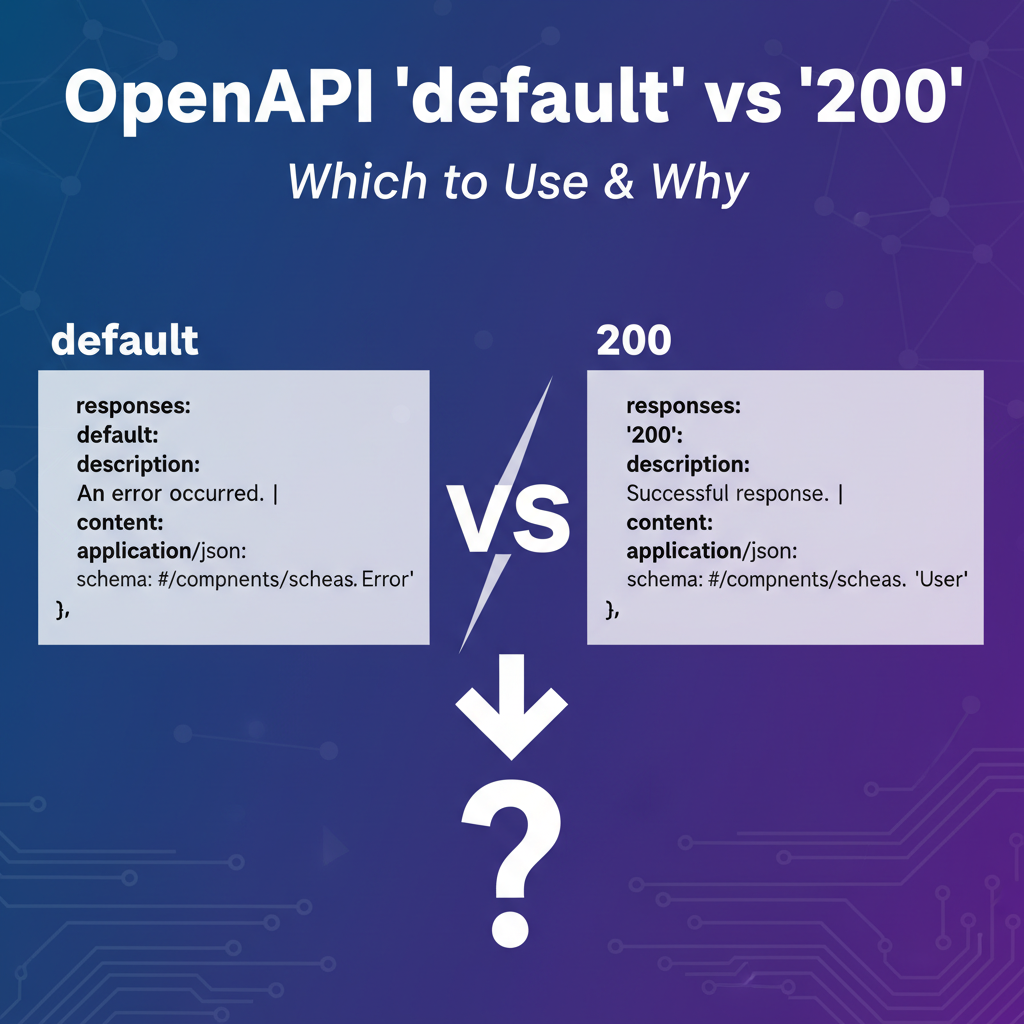
OpenAPI `default` vs `200`: Which to Use & Why


The landscape of modern software development is inextricably linked to Application Programming Interfaces (APIs). These digital conduits serve as the backbone for communication between disparate systems, enabling everything from mobile applications to microservices architectures to interact seamlessly. As the complexity and scale of these interactions grow, the importance of clear, consistent, and machine-readable API documentation becomes paramount. Enter the OpenAPI Specification (OAS), formerly known as Swagger Specification, which has emerged as the industry's de facto standard for defining, describing, and documenting RESTful APIs. It provides a language-agnostic, human-readable, and machine-readable interface to REST APIs, allowing both humans and computers to discover and understand the capabilities of a service without access to source code, documentation, or network traffic inspection.
Within the intricate structure of an OpenAPI document, the responses object stands as a critical component, dictating how an API communicates the outcome of an operation. It's here that API designers confront a pivotal choice: how to articulate the various potential returns from an API call. Specifically, the distinction between defining a 200 OK response and a default response often becomes a point of nuanced debate and, at times, confusion. While 200 OK explicitly signals a successful operation, default acts as a catch-all for any HTTP status code not explicitly enumerated. Understanding the profound implications of choosing one over the other, or indeed, how to strategically employ both, is fundamental for crafting robust, predictable, and developer-friendly APIs. This article will embark on a comprehensive exploration of 200 OK and default responses within the OpenAPI Specification, dissecting their definitions, typical use cases, structural representations, and the best practices that guide their application. Our objective is to arm API designers and developers with the insights necessary to make informed decisions, ensuring their APIs are not only functional but also elegantly documented, reducing integration friction and enhancing overall developer experience, a crucial aspect of any modern api gateway deployment.
Chapter 1: Understanding OpenAPI Specification (OAS) Fundamentals
To fully appreciate the subtleties between default and 200 responses, it's essential to first solidify our understanding of the OpenAPI Specification itself and its foundational elements. The OpenAPI Specification is not merely a documentation tool; it's a powerful framework that allows developers to describe their REST APIs in a standardized format. This standardization unlocks a myriad of benefits, from automatic generation of client SDKs and server stubs to interactive API documentation and automated testing. Its evolution from the Swagger Specification, contributed to the Linux Foundation, underscores its broad acceptance and collaborative development, cementing its role as a cornerstone of modern api development.
The core purpose of OpenAPI is to provide a comprehensive, machine-readable description of an API. Imagine an architectural blueprint for a building; OpenAPI serves a similar function for an API. It meticulously details every endpoint, the operations they support (GET, POST, PUT, DELETE, etc.), the parameters these operations accept, the data structures they expect, and crucially, the responses they can return. This level of detail is invaluable because it removes ambiguity and guesswork, which are often significant sources of frustration for developers integrating with external APIs. Without a clear specification, integrating an api often devolves into trial-and-error, consulting outdated documentation, or inspecting network traffic—all time-consuming and error-prone activities.
An OpenAPI document, typically formatted in YAML or JSON, is structured hierarchically. At its root, it defines general API information like title, version, and description. Below this, the paths object is where the true heart of the API specification lies. Each path corresponds to a specific endpoint (e.g., /users, /products/{id}). Within each path, operations are defined, detailing the HTTP methods supported for that particular endpoint. For instance, /users might support a GET operation to retrieve a list of users and a POST operation to create a new user. Each operation then specifies its parameters (query, header, path, cookie) and, most importantly for our discussion, its responses.
The responses object within an operation is a map of HTTP status codes to detailed response objects. This is where an API designer articulates what a client can expect to receive under various circumstances. HTTP status codes, as defined by the Internet Engineering Task Force (IETF), are three-digit integers that indicate the outcome of an HTTP request. They are universally recognized and categorize responses into several series: * 1xx (Informational): The request was received, continuing process. (Rarely seen in API responses). * 2xx (Success): The request was successfully received, understood, and accepted. Common examples include 200 OK, 201 Created, 204 No Content. * 3xx (Redirection): Further action needs to be taken by the user agent to fulfill the request. (e.g., 301 Moved Permanently). * 4xx (Client Error): The request contains bad syntax or cannot be fulfilled. Examples: 400 Bad Request, 401 Unauthorized, 403 Forbidden, 404 Not Found. * 5xx (Server Error): The server failed to fulfill an apparently valid request. Examples: 500 Internal Server Error, 503 Service Unavailable.
The significance of these status codes cannot be overstated. They provide an immediate, machine-readable signal about the nature of the server's response. A well-designed API leverages these codes effectively to convey semantic meaning to clients. For example, a GET request returning 200 OK clearly indicates that the requested resource was found and is being returned. A 404 Not Found immediately tells the client that the resource simply does not exist at the specified URI. The responses object in OpenAPI serves as the formal declaration of these expected outcomes, allowing client-side developers to build robust error handling and success pathways without having to reverse-engineer the API's behavior. This standardized approach dramatically improves the developer experience, fostering greater adoption and reducing the time to integrate for external consumers of the api.
Chapter 2: The 200 OK Response in OpenAPI
The 200 OK status code is arguably the most common and universally understood signal of success in the HTTP protocol. When an API operation returns a 200 OK, it explicitly communicates to the client that the request was successfully received, processed, and that the server is returning the requested data or confirming a successful action. In the context of the OpenAPI Specification, defining a 200 response is not just a formality; it's a critical declaration of the primary success path for an API operation, setting clear expectations for how clients should interpret a positive outcome.
Definition and Typical Use Cases
At its core, a 200 OK response means "Everything went well." It's the standard response for successful HTTP requests. While broadly signifying success, its specific implications can vary depending on the HTTP method used in the request:
- GET Requests: For a
GETrequest, a200 OKtypically means that the requested resource has been found and its representation is included in the response body. For instance, aGET /users/{id}endpoint would return200 OKwith the fulluserobject in the payload if the user exists. This is the most straightforward and common application of200 OK. - POST Requests: While
201 Createdis often preferred for successful resource creation (as it indicates the creation of a new resource and typically includes aLocationheader pointing to it),200 OKcan still be used forPOSTrequests. This might occur in scenarios where aPOSToperation isn't necessarily creating a new primary resource but rather processing data or updating an existing resource in a non-idempotent way. For example, aPOST /calculate-summight return200 OKwith the calculated sum. It's crucial, however, to be mindful of the semantic difference between200and201forPOSToperations;201offers more precision when a new resource is distinctly created. - PUT/PATCH Requests: For
PUT(full replacement) orPATCH(partial update) requests,200 OKsignifies that the update operation was successful and the resource has been modified. The response body might contain the updated resource's representation, or it could be empty if the client doesn't need to re-fetch the entire resource immediately. Alternatively,204 No Contentis also a valid and often preferred response forPUT/PATCHif no body is returned. - DELETE Requests: Similar to
PUT/PATCH, a200 OKcan indicate a successful deletion, often with a confirmation message in the response body. However,204 No Contentis frequently used forDELETEoperations when the response simply needs to confirm the action without returning any specific data.
The key across all these methods is that the 200 OK response indicates an expected, positive outcome, and usually, the client expects to receive specific data or confirmation in the response body that aligns with the operation's goal.
Structure within OpenAPI
In an OpenAPI document, the 200 response is defined within the responses object of an operation. Its structure typically includes a description and a content object, which details the media types and schemas of the data returned.
paths:
  /users/{userId}:
    get:
      summary: Retrieve a user by ID
      parameters:
        - in: path
          name: userId
          required: true
          schema:
            type: string
          description: The ID of the user to retrieve.
      responses:
        '200': # Explicitly defines the 200 OK response
          description: Successfully retrieved the user details.
          content:
            application/json:
              schema:
                $ref: '#/components/schemas/User' # Reference to a reusable User schema
            application/xml:
              schema:
                $ref: '#/components/schemas/UserXML' # Alternative XML representation
        '404':
          description: User not found.
          content:
            application/json:
              schema:
                $ref: '#/components/schemas/Error'
        # ... other specific error codes
In this example, the 200 key explicitly defines the success case for a GET /users/{userId} operation. * description: A human-readable text explaining what this response signifies. This is crucial for documentation generation. * content: This object specifies the media types that the API can return for this 200 response (e.g., application/json, application/xml). Each media type then points to a schema that describes the structure of the data payload. Using $ref to common schemas (like User or UserXML) promotes consistency and reusability throughout the API definition.
Best Practices for Defining 200 Responses
Defining 200 responses effectively is paramount for clarity and maintainability:
- Be Explicit and Detailed: Always provide a clear, concise
descriptionthat accurately explains what a successful response entails. Avoid vague descriptions like "Success." Instead, use "User successfully retrieved" or "Order successfully placed." - Accurate Schema Definitions: Ensure that the
schemareferenced or defined for the200response precisely matches the data structure that the API will actually return. Inaccuracies here lead to client-side parsing errors and frustration. Leverage reusable schemas in thecomponents/schemassection to maintain consistency across your API. - Specify All Relevant Media Types: If your API can return success data in multiple formats (e.g., JSON, XML, plain text), define a
contententry for each. - Consider
204 No Contentfor Operations Without a Body: ForPUT,PATCH, orDELETEoperations where no data needs to be returned to confirm success,204 No Contentis often a more semantically appropriate status code than200 OK. It clearly communicates that the operation was successful but there is no body to parse. - Distinguish Between Success Codes: While
200is general success, for specific scenarios like resource creation, prefer201 Createdfor its precise semantics. If a client is uploading a large file and needs to poll for status,202 Acceptedmight be more appropriate. A nuanced approach to 2xx codes enhances the API's expressiveness.
By meticulously defining 200 responses, API designers provide a solid foundation for client-side developers. They can build their applications with confidence, knowing exactly what data to expect upon a successful api call, streamlining integration and reducing debugging time. This clarity is further amplified when an api gateway is in place, as it can enforce these response structures, ensuring that what's documented is what's delivered, even if underlying services might have minor deviations.
Chapter 3: The default Response in OpenAPI
While explicit HTTP status codes like 200 OK provide precise semantic meaning for specific outcomes, the OpenAPI Specification also offers a powerful catch-all mechanism: the default response. Unlike named status codes, default does not correspond to a single, predetermined HTTP status. Instead, it acts as a wildcard, defining the response for any HTTP status code that is not explicitly described elsewhere within an operation's responses object. This flexible yet potentially ambiguous construct warrants a deep understanding to be used effectively and judiciously in API design.
Definition and Purpose
The default response is, by definition, the fallback. It's the response object that applies when no other specific HTTP status code (e.g., 200, 400, 404, 500) matches the one returned by the server. Its primary utility lies in handling situations where:
- Generic Error Handling: This is the most common and recommended use case for
default. Many APIs employ a standardized error structure, regardless of whether the error is a client-side issue (e.g.,400 Bad Request,401 Unauthorized,404 Not Found) or a server-side problem (e.g.,500 Internal Server Error,503 Service Unavailable). By defining adefaultresponse with this uniform error schema, API designers can avoid repeating the same error structure for dozens of different HTTP status codes, streamlining the OpenAPI document. - Simplifying Documentation for Non-Critical Variations: In complex systems, an API might theoretically return a multitude of specific error codes, some of which might not significantly alter client-side behavior beyond "an error occurred." Using
defaultcan condense the documentation without necessarily sacrificing critical information, especially for internal APIs where client developers have direct access to the API implementation team. - As a Fallback Mechanism: It ensures that even if an unforeseen status code is returned by the server, there's still a documented
responsesblock that can provide a schema for the payload, preventing complete black boxes for clients. This is particularly useful for externalapiconsumers, which might encounter status codes from anapi gatewayor load balancer that were not explicitly considered in the upstream service's documentation.
It is crucial to understand that while default can theoretically match any status code, including 2xx codes if no specific 2xx response is defined, this usage is generally discouraged for success scenarios. A 2xx code, especially 200 OK, signifies a primary, expected outcome, and it should almost always be explicitly defined for clarity and robust client-side parsing.
Structure within OpenAPI
Similar to specific status code responses, the default response is defined within the responses object of an operation. It also includes a description and can specify a content object to detail the expected payload.
paths:
  /orders:
    post:
      summary: Create a new order
      requestBody:
        required: true
        content:
          application/json:
            schema:
              $ref: '#/components/schemas/OrderCreateRequest'
      responses:
        '201': # Explicitly defines the 201 Created response for success
          description: Order successfully created.
          content:
            application/json:
              schema:
                $ref: '#/components/schemas/OrderConfirmation'
          headers:
            Location:
              description: URI of the newly created resource
              schema:
                type: string
                format: uri
        'default': # Catches any other status code, primarily errors
          description: An unexpected error occurred.
          content:
            application/json:
              schema:
                $ref: '#/components/schemas/GenericError'
            application/xml:
              schema:
                $ref: '#/components/schemas/GenericErrorXML'
In this example, the default key defines the response for any status code other than 201. * description: A human-readable description for what this fallback response represents, typically indicating an error. It's important to be as informative as possible, even if it's a generic error. * content: This object specifies the media types and corresponding schemas for the default response. Here, GenericError and GenericErrorXML schemas are referenced, demonstrating how a common error structure can be applied across various error types. This is particularly beneficial for api consumers, as they only need to implement one parsing logic for all non-201 responses.
Potential Pitfalls and Best Practices for default
While convenient, over-reliance or improper use of default can lead to ambiguities:
- Lack of Specificity: The primary drawback of
defaultis its generality. A client receiving adefaultresponse doesn't immediately know if it's a400 Bad Request,401 Unauthorized,404 Not Found, or a500 Internal Server Error. The client must inspect the response body (if one is provided with specific error codes or messages) to discern the actual issue. This makes programmatic error handling more complex than when specific error codes are defined. - Poor Developer Experience: While simplifying the OpenAPI document, it can complicate the developer experience for API consumers. They might prefer explicit error codes to build more precise recovery strategies. For instance, a
401implies a need to re-authenticate, while a404might mean checking the resource ID. A genericdefaultresponse often forces developers to write more verbose conditional logic based on message content.
To mitigate these issues and leverage default effectively:
- Always Pair with a Meaningful Schema: If you use
defaultfor error handling, ensure the associatedschemais robust and provides enough detail within the payload for a client to understand the nature of the error (e.g., error code, message, details, trace ID). - Provide a Clear Description: Even for a generic error, the
descriptionshould be helpful, e.g., "Generic error response for all unexpected issues." - Reserve
defaultPrimarily for Errors: While technicallydefaultcan catch2xxcodes if no specific2xxis defined, this is bad practice. Always explicitly define200(or201,204, etc.) for primary success paths. This clarity is paramount for robust client-side development. - Balance Specificity with Conciseness: For public APIs or critical business functions, it's often better to explicitly define common error codes (
400,401,403,404,500) if they have distinct payloads or require specific client-side reactions. Usedefaultfor less common errors or when a uniform error structure truly suffices for all other non-success scenarios. For internal APIs where development teams are closely integrated,defaultmight be acceptable for a broader range of error types. - Educate Consumers: If you heavily rely on
defaultfor errors, ensure your API documentation (beyond just the OpenAPI spec) clearly explains how clients should interpret thedefaultresponse body to identify specific error conditions.
In essence, the default response is a powerful tool for generalization and simplification, particularly for consistent error handling patterns. However, its power comes with the responsibility of ensuring that the resulting documentation does not obscure critical information for API consumers, thereby maintaining a high-quality developer experience for your api.
APIPark is a high-performance AI gateway that allows you to securely access the most comprehensive LLM APIs globally on the APIPark platform, including OpenAI, Anthropic, Mistral, Llama2, Google Gemini, and more.Try APIPark now! 👇👇👇
Chapter 4: Direct Comparison: default vs 200
Having explored 200 OK and default responses individually, it's now time to draw a direct comparison to illuminate their fundamental differences, intended purposes, and the scenarios where each excels. This comparative analysis is crucial for api designers who strive for clarity, precision, and ease of use in their OpenAPI definitions. The choice between explicitly defining every possible response versus using a catch-all default response profoundly impacts how clients interact with and interpret your API's behavior.
Purpose and Specificity
The most significant divergence lies in their purpose and specificity:
200Response: The200 OKresponse is intrinsically tied to a specific HTTP status code –200. Its purpose is unequivocally to signify the primary, expected successful completion of an API operation. When a client receives a200 OK, it can confidently assume that the request was processed as intended, and the response body contains the expected successful data payload. This specificity makes it the cornerstone of defining anyapi's happy path.defaultResponse: In stark contrast, thedefaultresponse is a universal placeholder. It represents any HTTP status code that is not explicitly defined by another entry in theresponsesobject. Its most common and recommended purpose is to act as a generic error handler, encompassing a broad range of client (4xx) and server (5xx) errors that might share a common error structure. While it can technically catch success codes if no2xxis defined, this is a misapplication that sacrifices clarity.
Predictability and Client Behavior
The impact on client-side logic and predictability is another key differentiator:
200Response: This response offers high predictability. Clients know that if they receive a200, they can parse a specific, well-defined data structure (e.g., aUserobject, anOrderConfirmation). This allows for direct and unambiguous implementation of success logic, enabling developers to write clean, concise code that handles the expected outcome. Auto-generated client SDKs, based on OpenAPI, will typically create methods that return the200's schema type directly upon success.defaultResponse: Thedefaultresponse introduces a layer of unpredictability concerning the exact HTTP status code. Clients receiving adefaultresponse must first check the actual HTTP status code in the response header and then parse the response body to understand the specific error or situation. This requires more complex conditional logic on the client side, as a singledefaultschema might need to convey the nuances of a400versus a500. While the structure of the payload might be consistent, its meaning varies based on the underlying status code.
Clarity and Readability of Specification
The choice also influences the clarity and readability of your OpenAPI document:
200Response: Explicit200definitions enhance the clarity of the API specification. They make it immediately obvious what a successfulapicall looks like, both in terms of status code and payload structure. This contributes to better auto-generated documentation and easier human comprehension.defaultResponse: While it can simplify the document by consolidating multiple error responses into one block, relying too heavily ondefaultcan reduce clarity. API consumers might have to infer more about the range of possible error conditions, potentially overlooking specific, important error types that might have distinct business implications. The goal of OpenAPI is to remove ambiguity, and a broaddefaultcan sometimes reintroduce it.
Tooling Implications
The way various OpenAPI tools (code generators, validators, interactive documentation viewers) process these definitions also differs:
200Response: Tools typically generate specific models and type definitions for200responses, allowing client-side code to be strongly typed and leverage static analysis.defaultResponse: Fordefault, tools might generate a more generic error type or a union type if multiple error codes are consolidated. While still functional, it often means developers have to cast or perform runtime checks to handle specific error conditions extracted from thedefaultpayload.
The "Orphaned Success" Scenario
An interesting edge case worth mentioning is when an api operation defines a default response but no 2xx response. In such a scenario, the default response would technically apply to a 200 OK (or 201, 204) if returned by the server. While technically permissible by the OpenAPI Specification, this is considered extremely poor practice. Success scenarios, especially 200 OK, are too fundamental to be left to a catch-all. Always explicitly define your 2xx responses to provide the highest level of clarity and predictability for API consumers.
When to Choose Each
- Always Choose
200(and other specific2xxcodes) for Primary Success Paths: There should be no ambiguity about what a successful operation looks like. If an operation is expected to return data upon success,200 OKwith a clear schema is the gold standard. If it creates a resource,201 Createdis more precise. If it succeeds without returning a body,204 No Contentis appropriate. - Consider
defaultfor Consistent, Generic Error Payloads: Thedefaultresponse shines when you have a common error structure that applies across multiple HTTP error codes (e.g.,400,401,403,404,500). This reduces verbosity in your OpenAPI document and simplifies client-side error parsing logic for non-specific errors. However, if particular error codes have unique payloads or require distinct client actions (e.g., a409 Conflictwith a specific conflict resolution payload), it's better to define those explicitly alongsidedefault.
The following table summarizes the key distinctions between these two crucial response definitions:
| Feature | 200 Response |
default Response |
|---|---|---|
| Purpose | Represents the primary successful operation. | Catch-all for any status code not explicitly defined. |
| Specificity | Specific to HTTP status code 200. | Non-specific; can match any HTTP status code. |
| Expected Use | Standard successful data return. | Primarily for generic error responses (4xx, 5xx). |
| Client Logic | Clients can reliably expect a specific success payload and act upon it directly. | Clients must parse content and check status code to infer actual outcome/error. |
| Clarity | High, clear indication of success. | Lower, requires inspecting body and status code for context. |
| API Doc Size | Increases document size for each specific success/error. | Can reduce document size by consolidating error responses. |
| Best Practice | Always define for primary success paths. | Use for consistent, generic error payloads; avoid for specific success outcomes. |
| Tooling Impact | Enables strong typing for success payloads. | Often results in more generic types requiring runtime checks. |
In conclusion, the decision to use 200 or default is not an either/or proposition but a strategic choice based on clarity, precision, and the desired developer experience. Prioritize explicit 2xx definitions for your successful outcomes, and strategically employ default to handle the broad spectrum of non-success, especially when a uniform error response structure applies. This balanced approach ensures a well-documented, predictable, and maintainable api.
Chapter 5: Advanced Scenarios and Best Practices
Mastering the use of default and 200 responses in OpenAPI goes beyond just understanding their definitions; it involves applying them strategically in advanced scenarios and adhering to best practices that enhance API robustness, maintainability, and developer experience. The context of your API—whether it's a public-facing service, an internal microservice, or part of a larger api gateway architecture—will often dictate the granularity and explicitness of your response definitions.
Combining Specific Errors with default
A common scenario in api design is the need to specify a few critical error responses explicitly, while still catching all other unexpected errors with a generic default response. This approach strikes a balance between providing crucial information for common error conditions and maintaining a degree of conciseness for less common or less critical ones.
For instance, consider an api endpoint for user registration:
paths:
  /register:
    post:
      summary: Register a new user
      requestBody:
        required: true
        content:
          application/json:
            schema:
              $ref: '#/components/schemas/RegistrationRequest'
      responses:
        '201':
          description: User successfully registered.
          content:
            application/json:
              schema:
                $ref: '#/components/schemas/RegistrationSuccess'
        '400':
          description: Invalid input provided (e.g., missing fields, invalid email format).
          content:
            application/json:
              schema:
                $ref: '#/components/schemas/ValidationError'
        '409':
          description: User with this email already exists.
          content:
            application/json:
              schema:
                $ref: '#/components/schemas/ConflictError'
        'default':
          description: An unexpected server-side error occurred.
          content:
            application/json:
              schema:
                $ref: '#/components/schemas/GenericServerError'
In this example: * 201 Created explicitly defines the success case, expected when a user is successfully registered. * 400 Bad Request is defined explicitly because it's a common client error with a specific ValidationError payload, instructing the client on how to correct their input. * 409 Conflict is also explicit, as it signals a specific business rule violation (duplicate email) that the client might need to handle differently (e.g., suggest login, or offer password reset). * default then catches all other possibilities, primarily 5xx server errors or any other 4xx errors that aren't specifically handled by 400 or 409, providing a GenericServerError schema. This structure provides critical specific error guidance where needed, while gracefully handling other errors without bloating the specification.
When to Be Exhaustive vs. When default is "Good Enough"
The decision of how exhaustive to be with error definitions versus relying on default largely depends on the nature and audience of your api:
- Public-facing APIs / Critical Systems (Be Exhaustive): For APIs exposed to a wide range of external developers or those that underpin critical business functions, a more exhaustive approach to error codes is generally preferred. Explicitly defining
400,401,403,404,500, and other relevant codes (e.g.,422 Unprocessable Entity,429 Too Many Requests) with distinct schemas provides maximum clarity. This enables client developers to build highly resilient and intelligent error-handling logic, reducing the support burden and improving overall integration success. Clear error messages are also crucial for SEO, as broken integrations can harm user experience and search rankings indirectly. - Internal APIs / Simpler Services (
defaultis "Good Enough"): For internal APIs consumed by closely-knit teams or simpler microservices where the consumers have direct access to the API implementation details and architects,defaultfor most generic errors might be "good enough." The overhead of explicitly defining every possible edge case error might outweigh the benefits if direct communication can quickly resolve ambiguities. However, even here, ensuring a consistent and informative error payload for thedefaultresponse is crucial.
The Role of an API Gateway
An api gateway plays a pivotal role in managing and standardizing API responses, acting as a unified entry point for all API consumers. Regardless of how granular your upstream services define their 200 or default responses, an api gateway can enforce consistency at the edge, abstracting away internal complexities.
For instance, an upstream service might return a slightly different 500 Internal Server Error payload than another service, or one service might use 400 for a specific validation error while another uses 422. An api gateway can be configured to intercept these varied responses and transform them into a single, standardized format as defined in your public OpenAPI documentation. This ensures that external clients always receive a predictable response structure, whether it's a 200 OK success or a default error, regardless of the underlying service's implementation. This is particularly valuable in microservices architectures where different teams might adopt slightly different API design patterns.
A powerful api gateway like APIPark is specifically designed to address these challenges. APIPark acts as an all-in-one AI gateway and API management platform that not only provides end-to-end API lifecycle management but also specializes in quick integration of 100+ AI models and unifying API formats. For instance, if you are integrating various AI models, each with potentially distinct ways of indicating success or failure, APIPark can standardize these into a uniform 200 success response or a default error structure. It simplifies AI usage and maintenance costs by ensuring that changes in AI models or prompts do not affect the application or microservices consuming them, thanks to its unified API format for AI invocation. This capability is invaluable for presenting a consistent api facade to consumers, ensuring that whether an underlying service returns a 200 or some other code caught by default, the client receives a predictable, well-documented response. APIPark’s robust performance, rivalling Nginx, combined with its detailed API call logging and powerful data analysis, further reinforces its ability to manage, regulate, and transform API responses effectively, ensuring stability and a superior developer experience.
Version Control and API Evolution
Response definitions are integral to an API's contract. As APIs evolve, changes to 200 schemas or default error structures can be breaking changes for consumers. Therefore:
- Semantic Versioning: Treat changes to response schemas as part of your API's versioning strategy. Minor changes (adding optional fields to
200ordefaultschemas) might warrant a minor version bump, while removing fields or changing required field types would necessitate a major version bump. - Backward Compatibility: Strive for backward compatibility, especially for
200responses. Adding new, optional fields to a success schema is generally backward-compatible. Changing existing field types or removing fields is not. - Clear Changelogs: Maintain meticulous changelogs that clearly document any modifications to response definitions, explicitly noting changes to
200ordefaultstructures. This helps API consumers adapt their integrations.
By embracing these advanced scenarios and best practices, API designers can build OpenAPI definitions that are not only technically correct but also genuinely useful, predictable, and maintainable. The strategic application of 200 and default responses, often facilitated and enforced by a robust api gateway, forms a cornerstone of a high-quality api ecosystem, enhancing efficiency, security, and developer satisfaction.
Conclusion
The meticulous art of API design, particularly within the framework of the OpenAPI Specification, demands a profound understanding of every component, including the seemingly straightforward responses object. Our journey through the distinctions and complementary roles of the 200 OK response and the default response has illuminated their critical importance in shaping the API contract and, consequently, the entire developer experience.
We've established that the 200 OK response serves as the unambiguous declaration of a successful operation, providing a precise schema for the expected data payload. It is the cornerstone of defining an API's "happy path," ensuring that client applications can reliably parse and act upon successful outcomes. Its specificity breeds predictability and simplifies client-side development, making it an indispensable element for any well-documented api.
Conversely, the default response stands as a powerful, albeit more ambiguous, catch-all. Primarily intended for consolidating various non-success scenarios into a uniform error structure, it offers a pragmatic solution for streamlining API documentation. While it can reduce the verbosity of an OpenAPI document, its inherent generality necessitates careful consideration to ensure that crucial error details are still conveyed within its payload, preventing client-side guesswork. The critical takeaway here is to always define your 2xx responses explicitly for clarity and robustness, reserving default for the less specific error conditions where a common error format truly applies.
The strategic choice between defining granular, explicit HTTP status codes (like 200, 400, 401, 500) and employing the more generalized default response is not a one-size-fits-all decision. It hinges on the API's audience, its criticality, and the desired balance between documentation conciseness and operational clarity. For public-facing or mission-critical APIs, a higher degree of explicitness in error handling tends to foster greater trust and smoother integrations. In contrast, for internal services, a more liberal use of default with a rich error payload might suffice, especially when communication channels between teams are open.
Furthermore, the role of an api gateway in enforcing and standardizing these response patterns cannot be overstated. Platforms like APIPark provide the necessary infrastructure to unify diverse backend service responses into a coherent and predictable API façade, ensuring that the documented 200 successes and default errors are consistently delivered to consumers. This standardization capability is vital in complex microservices environments and when integrating a multitude of services, including AI models, ensuring a harmonious and efficient api ecosystem.
Ultimately, crafting a robust and predictable API requires more than just functional endpoints; it demands clear, unambiguous documentation that meticulously outlines every possible outcome. By thoughtfully choosing when to employ 200 OK and when to leverage default, API designers can significantly enhance the usability, maintainability, and overall success of their api offerings, paving the way for seamless integrations and a superior developer experience in the evolving digital landscape.
Frequently Asked Questions (FAQ)
1. What is the primary difference between a 200 response and a default response in OpenAPI?
The primary difference lies in their specificity and purpose. A 200 response explicitly defines the schema for a successful API operation, specifically when the HTTP status code is 200 OK. It is highly specific to a positive outcome. A default response, on the other hand, acts as a catch-all for any HTTP status code not explicitly defined in the responses object. It is typically used for generic error handling across various 4xx or 5xx status codes that share a common error payload, but it can technically match any status code if no more specific definition exists.
2. When should I always use a 200 response in my OpenAPI specification?
You should always use a 200 response (or other specific 2xx codes like 201 Created or 204 No Content) to define the primary success path for any API operation. This includes GET requests returning data, POST requests confirming an action (if not creating a resource), and PUT/PATCH requests signaling successful updates. Explicitly defining success responses ensures clarity, predictability, and enables robust client-side development and accurate tooling generation.
3. What are the common use cases for a default response?
The most common and recommended use case for a default response is to define a generic error structure that applies to a wide range of HTTP error codes (e.g., 400 Bad Request, 401 Unauthorized, 404 Not Found, 500 Internal Server Error) that might share a consistent error message format. This approach helps simplify the OpenAPI document by avoiding repetitive error definitions for numerous status codes and provides a fallback for unexpected errors.
4. Is it ever acceptable for a default response to represent a successful operation (e.g., a 200 OK)?
While technically the default response could apply to a 2xx status code if no specific 2xx response (like 200) is defined, it is considered very poor practice. Success scenarios, especially 200 OK, are fundamental and should always be explicitly defined to ensure maximum clarity, predictability, and semantic precision for API consumers. Relying on default for success introduces ambiguity and complicates client-side parsing logic.
5. How can an api gateway help manage OpenAPI responses, especially concerning default vs. 200?
An api gateway acts as a centralized entry point that can standardize and enforce API response structures. It can intercept responses from various backend services, even if they have inconsistent 200 success payloads or default error formats, and transform them into a unified structure that matches your OpenAPI documentation. This ensures that all API consumers receive predictable, well-defined responses, regardless of the underlying service implementations. Platforms like APIPark excel at this, providing robust capabilities to manage, transform, and standardize API responses for consistency and a superior developer experience.
🚀You can securely and efficiently call the OpenAI API on APIPark in just two steps:
Step 1: Deploy the APIPark AI gateway in 5 minutes.
APIPark is developed based on Golang, offering strong product performance and low development and maintenance costs. You can deploy APIPark with a single command line.
curl -sSO https://download.apipark.com/install/quick-start.sh; bash quick-start.sh

In my experience, you can see the successful deployment interface within 5 to 10 minutes. Then, you can log in to APIPark using your account.

Step 2: Call the OpenAI API.