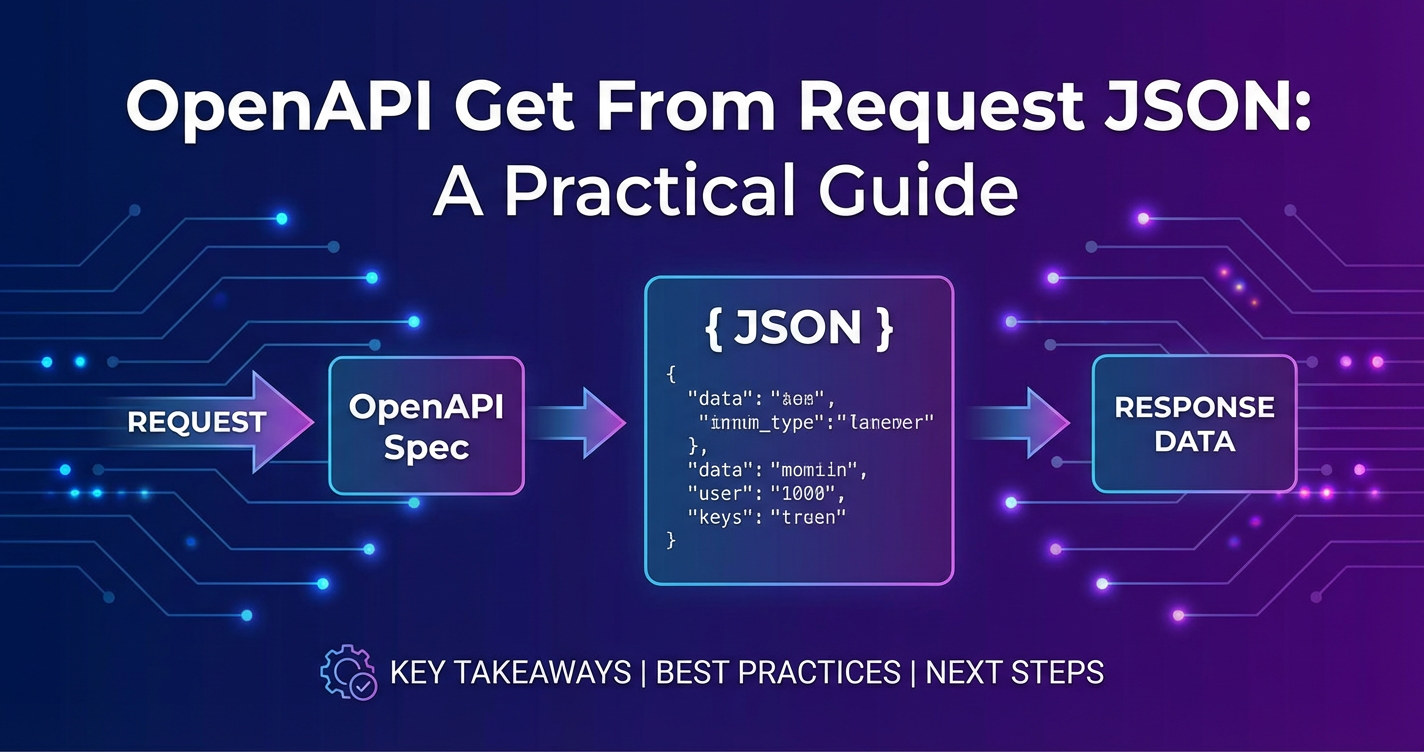
OpenAPI Get From Request JSON: A Practical Guide



In the ever-evolving landscape of modern software development, Application Programming Interfaces (APIs) have emerged as the crucial connective tissue, enabling disparate systems to communicate, share data, and collaborate seamlessly. From the smallest mobile applications querying backend services to massive enterprise systems exchanging complex business logic, APIs are the backbone of the digital economy. At the heart of this intricate web of interactions lies data exchange, and among the myriad formats available, JSON (JavaScript Object Notation) has firmly established itself as the de facto standard due to its lightweight nature, human readability, and ease of parsing across various programming languages.
However, the sheer flexibility and power of JSON, when combined with the distributed nature of API ecosystems, can introduce complexities. How do systems effectively describe the JSON data they expect or produce? How do developers ensure that the data flowing through their APIs conforms to a predefined structure, preventing errors, improving reliability, and facilitating seamless integration? This is where the OpenAPI Specification steps in.
The OpenAPI Specification provides a language-agnostic, human-readable, and machine-readable interface description for RESTful APIs. It allows both humans and computers to discover and understand the capabilities of a service without access to source code, documentation, or network traffic inspection. When it comes to handling JSON data within API requests, OpenAPI offers a robust framework for defining the exact structure, types, and constraints of the expected payload.
This comprehensive guide, "OpenAPI Get From Request JSON: A Practical Guide," aims to demystify the process of defining, validating, and processing JSON data transmitted via API requests, leveraging the power of the OpenAPI Specification. We will delve deep into the intricacies of OpenAPI, explore the nuances of JSON structure, examine best practices for server-side processing, and underscore the critical role of an api gateway in managing and securing these interactions. Whether you're an API designer, a backend developer, or an integration specialist, this article will equip you with the knowledge and practical insights to build more robust, maintainable, and predictable api services.
Understanding the OpenAPI Specification: The Blueprint for Modern APIs
The journey into effectively handling JSON requests with OpenAPI begins with a thorough understanding of the specification itself. Born from the Swagger Specification, the OpenAPI Specification (OAS) represents a community-driven standard for describing HTTP apis. It has become the cornerstone for API design, documentation, and tooling, enabling an ecosystem where APIs can be treated as first-class citizens in the software development lifecycle.
The Evolution from Swagger to OpenAPI
Originally conceived by Tony Tam in 2010, the Swagger Specification revolutionized how developers documented and interacted with APIs. It provided a powerful, JSON-based format for describing API endpoints, operations, parameters, and responses. The accompanying Swagger UI and Swagger Codegen tools further enhanced its utility, allowing for interactive documentation and automatic code generation. In 2015, SmartBear Software, the company behind Swagger, donated the Swagger Specification to the Linux Foundation, leading to its renaming as the OpenAPI Specification. This move signaled a broader industry commitment to an open, vendor-neutral standard, fostering wider adoption and collaborative development. Today, OpenAPI is maintained by the OpenAPI Initiative (OAI), with contributions from major tech companies and countless individual developers, ensuring its continued relevance and evolution.
Core Components of an OpenAPI Document
An OpenAPI document, typically authored in YAML or JSON format, acts as a definitive contract for an API. It meticulously details every aspect of the API's public interface. To understand how to define JSON requests, it's essential to grasp the key top-level components:
openapi: Specifies the version of the OpenAPI Specification being used (e.g., "3.0.3"). This is crucial for tooling compatibility and understanding the available features.info: Provides metadata about the API, includingtitle,description,version,contactinformation, andlicensedetails. This section is vital for human understanding and quick API discovery.servers: Defines the base URLs for theapi(e.g.,https://api.example.com/v1). This allows clients to dynamically determine where to send requests and enables environments like development, staging, and production to be clearly outlined.paths: This is the heart of the API definition, detailing individual endpoints (paths) and the HTTP operations (GET, POST, PUT, DELETE, PATCH) available for each. Within each operation, you define parameters,requestBody, and responses.components: A reusable set of definitions for various API elements. This section promotes modularity and avoids redundancy, making the OpenAPI document cleaner and easier to maintain. Key sub-components include:schemas: Defines data models for request and response bodies. This is where the structure of your JSON payloads will be meticulously described.parameters: Reusable parameter definitions (e.g., query parameters, header parameters).responses: Reusable response definitions.securitySchemes: Defines authentication and authorization mechanisms (e.g., API keys, OAuth2, JWT).
YAML vs. JSON for OpenAPI Definitions
While both YAML (YAML Ain't Markup Language) and JSON are valid formats for an OpenAPI document, they offer different advantages:
| Feature | YAML | JSON |
|---|---|---|
| Readability | Highly readable due to indentation-based structure and lack of braces. | Less human-readable due to pervasive braces, brackets, and quotes. |
| Conciseness | Generally more concise, especially for deeply nested structures. | Can be verbose, requiring more characters for the same data. |
| Comments | Supports comments (#), which is invaluable for documenting the specification itself. |
Does not natively support comments, making self-documentation harder. |
| Tooling | Excellent tooling support for parsing and generation. | Excellent tooling support; widely adopted across programming languages. |
| Data Exchange | Often used for configuration files. | The dominant format for data exchange over the web (apis). |
| Learning Curve | Slightly steeper for beginners due to strict indentation rules. | Simpler syntax, easier to pick up quickly. |
For writing OpenAPI definitions, YAML is often preferred by developers due to its superior readability and support for comments, which greatly aids in understanding complex API designs. However, the underlying principles of defining schemas and request bodies remain identical regardless of the chosen format.
The power of OpenAPI lies in its ability to generate comprehensive documentation, facilitate automated testing, and even scaffold server and client code, all from a single, authoritative source. By rigorously defining the expected JSON structure in requestBody schemas, developers can ensure that their apis are robust, predictable, and easier to integrate with, paving the way for more efficient development workflows.
The Anatomy of a JSON Request: Building Blocks of API Data Exchange
Before diving into how OpenAPI defines JSON structures, it's paramount to have a solid grasp of JSON itself. JSON, or JavaScript Object Notation, has become the lingua franca for data interchange on the web, primarily because of its simplicity, efficiency, and ubiquitous support across nearly all programming languages and platforms. It’s a text-based, human-readable format that structures data in a way that is both easy for machines to parse and for humans to understand.
What is JSON? A Quick Overview
JSON is derived from JavaScript, but it is an entirely language-independent data format. Its design is rooted in two fundamental structures:
- A collection of name/value pairs (an object): In various languages, this is realized as an object, record, struct, dictionary, hash table, keyed list, or associative array. In JSON, this is represented by curly braces
{}. Each name (or key) must be a string, and it is followed by a colon:, then the value. Name/value pairs are separated by commas,. - An ordered list of values (an array): In most languages, this is realized as an array, vector, list, or sequence. In JSON, this is represented by square brackets
[]. Values within an array are separated by commas.
These two structures, combined with primitive data types, allow for the construction of arbitrarily complex data hierarchies.
Common Use Cases for JSON in API Requests
JSON's versatility makes it suitable for a wide array of api request scenarios:
- Creating Resources (POST requests): When you need to send new data to the server to create a new resource, such as creating a new user account, placing an order, or adding a product. The request body would contain all the necessary details for the new resource.
json { "firstName": "John", "lastName": "Doe", "email": "john.doe@example.com", "password": "securepassword123", "address": { "street": "123 Main St", "city": "Anytown", "zipCode": "12345" }, "preferences": ["email_notifications", "sms_updates"] } - Updating Resources (PUT/PATCH requests): To modify an existing resource, JSON specifies the fields and their new values.
PUTtypically replaces the entire resource, whilePATCHapplies partial modifications.json { "email": "new.john.doe@example.com", "preferences": ["email_notifications"] } - Complex Queries or Filters (GET with
requestBodyor POST): AlthoughGETrequests traditionally use URL query parameters, some complex filtering or search criteria might be too cumbersome for URLs. In such cases, aPOSTrequest with a JSON body can be used to send intricate query parameters. This is less common but valid for specific scenarios.json { "criteria": { "minPrice": 50, "maxPrice": 200, "categories": ["electronics", "home_goods"], "availability": "in_stock" }, "sortBy": "price_asc", "page": 1, "pageSize": 10 } - Sending Command-like Data: When an API endpoint triggers an action rather than merely creating or updating a resource, a JSON request can carry the parameters for that action. For example, initiating a workflow, sending a message, or processing a payment.
json { "transactionId": "TXN7890123", "amount": 99.99, "currency": "USD", "paymentMethod": { "type": "credit_card", "cardNumber": "**** **** **** 1234", "expiryMonth": "12", "expiryYear": "2025" } }
Data Types in JSON
JSON supports a limited, yet powerful, set of primitive data types and two structural types:
- String: A sequence of Unicode characters enclosed in double quotes.
"hello world","123 Main St". - Number: An integer or a floating-point number.
10,3.14,-5,0. JSON numbers are typically represented as 64-bit floating-point numbers in most languages, so precision for very large integers might be a consideration. - Boolean:
trueorfalse. - Null: Represents the intentional absence of any object value.
null. - Object: An unordered collection of key-value pairs, enclosed in curly braces
{}. Keys are strings, and values can be any JSON data type. - Array: An ordered collection of values, enclosed in square brackets
[]. Values can be of any JSON data type, including other arrays or objects.
Understanding these fundamental structures and data types is the bedrock upon which robust api designs are built. When an API expects a JSON requestBody, it essentially expects a payload structured using these elements, conforming to a specific schema that defines the allowed keys, their types, and their relationships. This is precisely what the OpenAPI Specification empowers developers to articulate with precision.
Defining Request Bodies in OpenAPI: Crafting the Data Contract
One of the most critical aspects of designing a robust api using OpenAPI is precisely defining the structure and content of the data that clients send in requestBody payloads. This specification acts as a contract, informing clients exactly what kind of JSON data the api expects, thereby reducing errors and facilitating seamless integration.
The requestBody Object
Within an OpenAPI operation (e.g., post, put, patch), the requestBody object is used to describe the data sent by the client. It typically includes:
description(optional): A human-readable summary of the request body's purpose. This is invaluable for documentation.required(optional, boolean): A boolean indicating whether the request body is mandatory for the operation. Defaults tofalse. Iftrue, clients must send a request body; otherwise, theapishould reject the request with an appropriate HTTP status code (e.g., 400 Bad Request).content(required): This object defines the media types that the API can consume and their respective schemas. It's a map where keys are media types (e.g.,application/json,application/xml,multipart/form-data) and values areMediaType Objectdefinitions.
The content Object and Media Types
For JSON requests, the most common media type is application/json. The content object will typically look like this:
requestBody:
  description: User object to be created
  required: true
  content:
    application/json:
      schema: # This is where the JSON structure is defined
        type: object
        properties:
          # ...
The MediaType Object under application/json is where we get to the core of defining the JSON structure. It contains:
schema(required): This is the most important part, defining the data type of therequestBody. It uses the Schema Object, which is a powerful mechanism in OpenAPI for describing data structures.example(optional): A concrete example of the request body for the specified media type. This helps human readers quickly grasp the expected format.examples(optional): A map of named examples, allowing for multiple illustrative scenarios (e.g., a "successful creation" example and a "validation error" example).
The schema Keyword: Defining the Structure of the JSON Payload
The schema keyword leverages the Schema Object, which is based on a superset of JSON Schema Draft 2020-12. This allows for incredibly granular definitions of your JSON data. Here's how you define various aspects:
1. Basic Object Definition
To define a simple JSON object with specific properties:
# Defining a 'User' object
User:
  type: object
  properties:
    id:
      type: string
      format: uuid
      readOnly: true
      description: Unique identifier for the user.
    username:
      type: string
      minLength: 3
      maxLength: 20
      pattern: "^[a-zA-Z0-9_]+$"
      description: Unique username for login.
    email:
      type: string
      format: email
      description: User's email address.
    password:
      type: string
      minLength: 8
      writeOnly: true
      description: User's password.
    isAdmin:
      type: boolean
      default: false
      description: Indicates if the user has administrative privileges.
  required:
    - username
    - email
    - password
  example:
    id: "a1b2c3d4-e5f6-7890-1234-567890abcdef"
    username: "johndoe"
    email: "john.doe@example.com"
    isAdmin: false
In this example: * type: object specifies that the schema describes a JSON object. * properties lists the expected key-value pairs within the object. Each property itself is defined using another Schema Object, allowing for nested definitions. * type, format, minLength, maxLength, pattern, readOnly, writeOnly, default are keywords used to define the data type, constraints, and behavior of each property. * readOnly: true indicates that this property should not be sent by the client in a request body, typically for server-generated IDs. * writeOnly: true indicates that this property should not be returned by the server in a response body, typically for sensitive information like passwords. * required is an array of strings listing the properties that must be present in the JSON object. Any request missing these properties should be rejected.
2. Nested Objects
Complex data often involves objects within objects. OpenAPI handles this seamlessly by nesting properties definitions:
# Defining an 'Order' object with a nested 'ShippingAddress'
Order:
  type: object
  properties:
    orderId:
      type: string
      format: uuid
      readOnly: true
    customerId:
      type: string
      format: uuid
    items:
      type: array
      items:
        $ref: '#/components/schemas/OrderItem' # Referencing another schema for array items
    shippingAddress:
      type: object # Nested object definition
      properties:
        street:
          type: string
        city:
          type: string
        state:
          type: string
        zipCode:
          type: string
      required:
        - street
        - city
        - state
        - zipCode
    totalAmount:
      type: number
      format: float
      minimum: 0
  required:
    - customerId
    - items
    - shippingAddress
    - totalAmount

OrderItem:
  type: object
  properties:
    productId:
      type: string
      format: uuid
    quantity:
      type: integer
      minimum: 1
    pricePerUnit:
      type: number
      format: float
      minimum: 0
  required:
    - productId
    - quantity
    - pricePerUnit
Here, shippingAddress is an object with its own properties and required fields. This modular approach keeps the schema organized. The items property uses $ref to point to a separate OrderItem schema, promoting reusability and clarity.
3. Arrays of Objects
Many apis deal with collections of resources, represented as arrays of objects.
# A request to update a batch of products
requestBody:
  description: List of products to update
  required: true
  content:
    application/json:
      schema:
        type: array
        items: # 'items' defines the schema for each element in the array
          type: object
          properties:
            productId:
              type: string
              format: uuid
            name:
              type: string
              minLength: 5
            price:
              type: number
              format: float
              minimum: 0.01
            description:
              type: string
              nullable: true
          required:
            - productId
            - name
            - price
        minItems: 1
        maxItems: 50 # Constraints on the array itself
        uniqueItems: true # Ensures all items in the array are unique
The items keyword specifies the schema that each element within the array must conform to. minItems and maxItems define the allowable number of items, while uniqueItems ensures no duplicate entries.
4. Polymorphism (oneOf, anyOf, allOf)
For more complex scenarios where a property or an entire request body can take one of several different shapes, OpenAPI provides keywords for polymorphism:
oneOf: The data MUST be valid against exactly one of the schemas in the list. This is useful for representing a choice between mutually exclusive data structures.anyOf: The data MUST be valid against one or more of the schemas in the list. Useful when an object can conform to multiple schemas simultaneously.allOf: The data MUST be valid against all of the schemas in the list. This is similar to inheritance, allowing you to combine properties from multiple schemas.
Example with oneOf: Consider a payment method that could be a credit card or a bank account.
PaymentMethod:
  oneOf:
    - $ref: '#/components/schemas/CreditCard'
    - $ref: '#/components/schemas/BankAccount'
  discriminator: # Optional but highly recommended for clear type resolution
    propertyName: type
    mapping:
      credit_card: '#/components/schemas/CreditCard'
      bank_account: '#/components/schemas/BankAccount'

CreditCard:
  type: object
  properties:
    type:
      type: string
      enum: [credit_card]
      readOnly: true
    cardNumber:
      type: string
      pattern: "^[0-9]{13,19}$"
    expirationDate:
      type: string
      format: month-year # Custom format for YYYY-MM
    cvv:
      type: string
      pattern: "^[0-9]{3,4}$"
  required:
    - type
    - cardNumber
    - expirationDate
    - cvv

BankAccount:
  type: object
  properties:
    type:
      type: string
      enum: [bank_account]
      readOnly: true
    bankName:
      type: string
    accountNumber:
      type: string
    routingNumber:
      type: string
  required:
    - type
    - bankName
    - accountNumber
    - routingNumber
The discriminator keyword is crucial here. It tells the parser which sub-schema to use based on the value of the type property in the JSON payload. This allows the API to understand which specific payment method object it has received.
By mastering these schema definitions, you can create highly expressive and precise contracts for your JSON requestBody payloads, making your apis self-documenting, easier to consume, and less prone to data-related errors. The level of detail you put into these definitions directly translates into the robustness and usability of your API.
Validating JSON Requests Against OpenAPI Schemas: Ensuring Data Integrity
Defining the structure of your JSON requests in OpenAPI is only half the battle; the other, equally critical half is ensuring that incoming requests actually conform to that definition. Request validation is a fundamental practice for building reliable and secure apis. It acts as the first line of defense against malformed data, prevents unexpected behavior, and ultimately contributes to a more stable system.
Why Validation is Crucial
Without proper validation, an api service is vulnerable to a range of issues:
- Data Integrity Issues: Incorrect data types, missing required fields, or values outside expected ranges can corrupt your database or lead to inconsistent application states.
- Application Errors: Backend code might crash or produce unexpected results if it receives data in a format it doesn't anticipate. This can manifest as unhandled exceptions, leading to service outages.
- Security Vulnerabilities: Maliciously crafted requests, such as SQL injection attempts in string fields or excessively large payloads designed for denial-of-service, can exploit weaknesses in the absence of stringent validation.
- Poor User Experience: Vague error messages or system failures due to bad input leave users frustrated and make debugging difficult for developers.
- Integration Headaches: When
apicontracts aren't strictly enforced, client developers waste time debugging why their requests are failing or producing incorrect results, hindering seamless integration.
Robust validation ensures that only well-formed and valid data ever reaches your core business logic, allowing your application to operate predictably and securely.
Server-Side Validation: The Ultimate Enforcement
Server-side validation is non-negotiable. Even if client-side validation is performed (which is a good practice for user experience), it can always be bypassed. The server must be the ultimate arbiter of data validity.
How an api gateway or backend service enforces the schema:
- Parsing the Request Body: The incoming HTTP request's body, which is typically a JSON string, is first parsed into an internal data structure (e.g., a JavaScript object in Node.js, a Python dictionary, a Java object).
- Schema Loading: The server loads the relevant OpenAPI schema definition for the specific endpoint and
requestBodymedia type. - Validation Engine: A validation engine (often a library specific to the programming language or framework) compares the parsed request data against the loaded OpenAPI schema. This involves checking:
- Data Types: Is
type: stringactually a string,type: integeran integer? - Required Fields: Are all properties listed in the
requiredarray present? - Constraints: Are
minLength,maxLength,pattern,minimum,maximum,enumvalues adhered to? - Structural Integrity: Are nested objects and arrays correctly formed according to their respective schemas?
- Polymorphism (
oneOf,anyOf,allOf): If polymorphic schemas are used, does the request body satisfy the conditions of exactly one, any one, or all specified schemas? - Custom Formats: Are values conforming to
formatdirectives likeemail,uuid,date-time? (Note: standard JSON Schema doesn't validate formats by default; validators often need to be configured for this).
- Data Types: Is
- Error Handling: If validation fails, the server should:
- Immediately stop processing the request.
- Return an appropriate HTTP status code, typically
400 Bad Request. - Provide a clear, machine-readable error message in the response body, detailing why the validation failed (e.g., "Field 'email' is required," "Value for 'age' must be greater than 0," "Invalid UUID format for 'id'"). This helps client developers diagnose and fix issues quickly.
Many modern api frameworks and api gateway solutions offer built-in or pluggable modules for OpenAPI schema validation. For instance: * Node.js: Libraries like ajv (Another JSON Schema Validator) can be integrated with Express.js middleware. Frameworks like NestJS have powerful validation pipes. * Python: Flask and Django REST Framework have extensions or libraries (e.g., drf-yasg, connexion) that can perform schema validation. * Java: Spring Boot applications can leverage javax.validation annotations (JSR 380) alongside OpenAPI code generation tools to enforce schema rules. * Go: Libraries like go-playground/validator can be used to validate structs that map to OpenAPI schemas.
Client-Side Validation: Pre-emptive Checks
While not a substitute for server-side validation, client-side validation is a valuable practice for improving user experience and reducing unnecessary api calls. By validating input before sending it to the server, clients can:
- Provide Immediate Feedback: Users get instant notifications about invalid input, allowing them to correct errors without waiting for a server roundtrip.
- Reduce Server Load: Prevent the server from processing requests that are clearly malformed.
Client-side validation can be implemented using: * JavaScript Libraries: Frameworks like React, Angular, Vue.js have their own validation ecosystems. * OpenAPI Code Generation: Many OpenAPI tools can generate client-side models and validation logic directly from your OpenAPI specification, ensuring consistency between client and server expectations.
Tools for Validation
The OpenAPI ecosystem provides numerous tools that aid in validation:
- OpenAPI Linters: Tools like
spectral(by Stoplight) can analyze your OpenAPI document for common design flaws, consistency issues, and adherence to style guides, including potential validation pitfalls. - OpenAPI Validators: Command-line tools and libraries specifically designed to validate an OpenAPI document itself, ensuring it is syntactically and semantically correct according to the OAS standard.
- API Gateway Features: Many
api gatewayproducts, includingAPIPark, offer powerful schema validation capabilities as part of their request processing pipeline. They can automatically validate incoming JSON request bodies against the defined OpenAPI schema before forwarding the request to the backend service. This early rejection mechanism significantly offloads validation logic from backend services, improves performance, and adds an extra layer of security.
Implementing robust validation, both at the api gateway layer and within your backend services, is a cornerstone of building reliable, secure, and maintainable apis. It reinforces the contract defined by your OpenAPI specification, turning a descriptive document into an active enforcement mechanism.
APIPark is a high-performance AI gateway that allows you to securely access the most comprehensive LLM APIs globally on the APIPark platform, including OpenAI, Anthropic, Mistral, Llama2, Google Gemini, and more.Try APIPark now! 👇👇👇
Processing JSON Data on the Server Side: Bringing the Contract to Life
Once an api request with a valid JSON requestBody has passed through any initial api gateway validation and reached your backend service, the next crucial step is to effectively process that JSON data. This involves parsing the incoming payload, extracting the necessary information, converting it to appropriate native data structures, and then using it to perform the intended business logic. The approach varies depending on the chosen backend language and framework, but the underlying principles remain consistent.
Choosing a Backend Language/Framework
The choice of technology stack for your backend greatly influences how you'll process JSON. Here's a brief overview of how popular environments handle it:
- Node.js (Express, NestJS): JavaScript has native support for JSON. Node.js frameworks typically include middleware (e.g.,
express.json()) that automatically parsesapplication/jsonrequest bodies into JavaScript objects. - Python (Flask, Django, FastAPI): Python offers excellent JSON handling with its built-in
jsonmodule. Frameworks integrate this, making JSON parsing straightforward. For example, Flask'srequest.jsonproperty or Django REST Framework's serializers. FastAPI, built on Pydantic, can automatically validate and parse JSON into Python objects based on type hints. - Java (Spring Boot, Quarkus): Java ecosystems use libraries like Jackson or Gson for JSON serialization/deserialization. Frameworks like Spring Boot automate much of this, mapping JSON request bodies directly to Java POJOs (Plain Old Java Objects) using annotations (e.g.,
@RequestBody). - Go (Gin, Echo): Go uses the
encoding/jsonpackage. Web frameworks like Gin provide methods (e.g.,c.BindJSON()) to easily unmarshal JSON into Go structs, often with built-in validation capabilities.
How Frameworks Parse Incoming JSON
Regardless of the language, the general flow for parsing JSON is similar:
- Receive HTTP Request: The web server (e.g., Nginx, Apache, or the application server itself) receives the incoming HTTP request.
- Read Request Body Stream: The server reads the raw bytes of the
requestBody. - Content-Type Check: The framework checks the
Content-Typeheader. If it'sapplication/json, it initiates JSON parsing. - Parsing Engine: A JSON parsing library (e.g.,
JSON.parse()in JavaScript,json.loads()in Python, Jackson in Java) takes the raw JSON string and converts it into the language's native data structures (objects, dictionaries, maps, structs). - Data Binding/Mapping:
- Dynamic Languages (Node.js, Python): The JSON is typically parsed into generic object/dictionary structures. Developers then access properties using dot notation or dictionary keys (e.g.,
req.body.username,request.json['email']). - Static Languages (Java, Go): The JSON is often mapped to pre-defined classes or structs. This is known as "data binding" or "deserialization." The framework uses reflection or code generation to match JSON keys to class/struct fields. This approach provides compile-time type safety.
- Dynamic Languages (Node.js, Python): The JSON is typically parsed into generic object/dictionary structures. Developers then access properties using dot notation or dictionary keys (e.g.,
Example (Node.js with Express):
// Ensure you have express.json() middleware in your app setup
// app.use(express.json());

app.post('/users', (req, res) => {
  // req.body already contains the parsed JSON object
  const newUser = req.body;

  if (!newUser || !newUser.username || !newUser.email) {
    return res.status(400).send({ message: 'Missing required user data.' });
  }

  // Further processing...
  console.log('Received new user:', newUser);
  // Example: save to database
  // database.saveUser(newUser);

  res.status(201).send({ message: 'User created successfully', user: newUser });
});
Example (Python with Flask):
from flask import Flask, request, jsonify

app = Flask(__name__)

@app.route('/products', methods=['POST'])
def create_product():
    if not request.is_json:
        return jsonify({"message": "Request must be JSON"}), 400

    product_data = request.json # Parsed JSON as a Python dictionary

    if not product_data or 'name' not in product_data or 'price' not in product_data:
        return jsonify({"message": "Missing required product data"}), 400

    # Further processing...
    print("Received new product:", product_data)
    # Example: save to database
    # db.add_product(product_data)

    return jsonify({"message": "Product created", "product": product_data}), 201

if __name__ == '__main__':
    app.run(debug=True)
Accessing and Extracting Data
Once the JSON is parsed into native data structures, you can access its elements.
- Objects/Dictionaries: Access properties using keys.
- Node.js:
data.propertyNameordata['propertyName'] - Python:
data['propertyName'] - Java:
userObject.getFirstName()(if mapped to a POJO) - Go:
product.Name(if mapped to a struct field)
- Node.js:
- Arrays/Lists: Iterate through them or access elements by index.
data.items[0]data['items'][0]
Type Conversion and Data Mapping
This is where the OpenAPI schema becomes particularly valuable. The server-side code should ideally map the incoming JSON data to well-defined internal data models.
- Explicit Type Conversion: Even if JSON numbers are typically parsed as floats, your database or internal logic might expect integers. Explicit conversion might be needed, though many frameworks handle common conversions.
- Data Model Mapping: Using dedicated data transfer objects (DTOs) or domain models in your backend can provide:
- Type Safety: Especially in static languages, ensuring that the data conforms to expected types.
- Business Logic Encapsulation: Moving validation beyond basic schema checks into more complex business rules.
- Readability: Clearer code as field names align with your domain.
Many frameworks offer sophisticated mapping capabilities. For instance, in Spring Boot, an @RequestBody annotation can automatically map an incoming JSON payload to a Java POJO, performing type conversions and even basic validation based on JSR 380 annotations (e.g., @NotNull, @Min, @Pattern).
Security Considerations: Input Sanitization and Preventing Attacks
Processing incoming data, especially from external sources, always carries security risks.
- Input Sanitization: Never trust user input. Even after validation against an OpenAPI schema, input might contain malicious content. For example, if a
descriptionfield in your JSON schema allows free-form text, you must sanitize it before displaying it on a web page (to prevent XSS attacks) or storing it in a database (to prevent SQL injection if you're not using parameterized queries). - Parameterized Queries: Always use parameterized queries or ORMs (Object-Relational Mappers) when interacting with databases to prevent SQL injection attacks. Never concatenate user input directly into SQL queries.
- Rate Limiting: Prevent abuse by limiting the number of requests a single client can make within a given timeframe. This is often handled by an
api gateway. - Payload Size Limits: Configure your server to reject excessively large request bodies to mitigate denial-of-service (DoS) attacks.
- Authentication and Authorization: Ensure that only authenticated and authorized users can send specific types of requests or access certain resources. This is typically managed by an
api gatewayand enforced by your backend services.
By diligently parsing, mapping, and securing incoming JSON data according to your OpenAPI specification, you bridge the gap between your API's contract and its operational reality, creating reliable and resilient api services. The meticulous effort invested at this stage pays dividends in terms of system stability, security, and ease of maintenance.
Best Practices for OpenAPI and JSON Requests: Crafting Superior APIs
Building an api that is not only functional but also robust, secure, performant, and delightful to use requires adherence to best practices throughout the design, implementation, and deployment phases. When combining OpenAPI for definition and JSON for data exchange, specific strategies can elevate your api to a professional standard.
Design Principles
Thoughtful design is the foundation of a great API. The OpenAPI Specification provides the tools; good design provides the wisdom.
- Consistency in Naming Conventions:
- Use consistent naming for properties (e.g.,
camelCasefor JSON keys,PascalCasefor schema names). - Maintain consistent URL path segments and query parameters.
- Consistent error response formats across all endpoints.
- For example, if one
apiusesuserId, avoiduser_idin another endpoint. This reduces cognitive load forapiconsumers.
- Use consistent naming for properties (e.g.,
- Granularity of Schemas:
- Break down complex data structures into smaller, reusable schemas within the
components/schemassection. This promotes modularity, readability, and reduces redundancy. - Avoid monolithic schemas that are hard to manage and understand.
- Example: Instead of defining
addressinline every time, create aAddressschema and reference it using$ref.
- Break down complex data structures into smaller, reusable schemas within the
- Versioning APIs:
- Plan for API evolution from the outset. Introduce a versioning strategy (e.g.,
api.example.com/v1/usersorAcceptheader versioning). - OpenAPI facilitates this by allowing you to define different versions of your API, ensuring backward compatibility is managed gracefully for
apiconsumers. - Clearly document changes between versions in your OpenAPI description.
- Plan for API evolution from the outset. Introduce a versioning strategy (e.g.,
- Clear Descriptions and Examples:
- Every
operation,parameter,requestBody, andschema propertyshould have a clear, concisedescription. - Provide realistic
examplevalues in your OpenAPI specification for bothrequestBodyandresponsebodies. These examples are invaluable for clients to understand the expected data quickly, especially for complex nested JSON structures. - Use the
exampleskeyword for multiple scenarios (e.g., success, validation error).
- Every
- Use Standard Formats Where Applicable:
- Leverage OpenAPI's
formatkeyword for common types likedate-time,uuid,email,uri. This provides hints for tooling and improves semantic clarity. - For example,
type: string, format: emailclearly communicates that a string should be an email address.
- Leverage OpenAPI's
Security Considerations
Security is paramount for any api. An OpenAPI definition can highlight security requirements, but the implementation must deliver.
- Authentication and Authorization:
- Define your security schemes (
securitySchemesincomponents) usingOAuth2,Bearer Tokens (JWT),API Keys, etc. - Apply these security requirements to individual
operationsor globally (securityobject at the root level). - The
api gatewayis a critical component for enforcing these policies before requests even reach your backend services.
- Define your security schemes (
- Input Validation at Multiple Layers:
- As discussed, validate at the
api gatewayusing OpenAPI schemas. - Perform additional, more granular validation (e.g., business logic validation) within your backend services.
- Implement client-side validation for better user experience.
- As discussed, validate at the
- Rate Limiting:
- Protect your
apifrom abuse and DoS attacks by implementing rate limiting. - This is typically configured and enforced at the
api gatewaylevel, allowing you to define limits perapi, per user, or per IP address.
- Protect your
- Payload Size Limits:
- Configure your web servers and
api gatewayto reject request bodies exceeding a certain size. This prevents attackers from sending massive payloads to overwhelm your services.
- Configure your web servers and
- Sensitive Data Handling:
- Clearly mark sensitive fields (e.g., passwords) using
writeOnly: truein your OpenAPI schema forrequestBodyandreadOnly: truefor server-generated, non-modifiable fields. - Ensure sensitive data is never logged unnecessarily, and always encrypted at rest and in transit.
- Clearly mark sensitive fields (e.g., passwords) using
Performance Optimizations
Efficient apis translate to a better user experience and reduced infrastructure costs.
- Efficient JSON Parsing:
- Choose backend languages and frameworks with highly optimized JSON parsers.
- Avoid unnecessary re-parsing or excessive transformations.
- Minimizing Payload Size:
- Send only the necessary data in requests. Avoid "fat" objects with many optional fields if only a few are needed for a specific operation.
- Consider compression (e.g., Gzip) for larger payloads, typically handled by the
api gatewayor web server. - For
GETrequests, consider pagination, filtering, and field selection (?fields=name,email) to allow clients to fetch only what they need.
- Caching Strategies:
- Implement caching at various levels (client-side,
api gateway, backend data store) for frequently accessed, immutable data. - Use appropriate HTTP caching headers (e.g.,
Cache-Control,ETag,Last-Modified).
- Implement caching at various levels (client-side,
Maintainability and Developer Experience
A well-maintained api reduces technical debt and improves developer productivity.
- Documentation Generation:
- Leverage OpenAPI tools (like Swagger UI) to automatically generate interactive documentation directly from your specification. This ensures your documentation is always in sync with your
api's implementation. - Clear, up-to-date documentation is crucial for onboarding new developers and external consumers.
- Leverage OpenAPI tools (like Swagger UI) to automatically generate interactive documentation directly from your specification. This ensures your documentation is always in sync with your
- Automated Testing:
- Use your OpenAPI definition to generate test cases or validate actual
apiresponses against expected schemas. This helps catch breaking changes early. - Integrate contract testing into your CI/CD pipeline.
- Use your OpenAPI definition to generate test cases or validate actual
- Clear Error Messages:
- Design informative and consistent error responses.
- Provide clear HTTP status codes (e.g.,
400 Bad Requestfor validation errors,401 Unauthorized,403 Forbidden,404 Not Found,500 Internal Server Error). - Include error codes or identifiers, and human-readable messages that guide the client on how to resolve the issue.
By diligently applying these best practices, you can design and implement apis that are not just technically sound but also a pleasure to work with, fostering adoption and driving innovation within your ecosystem.
The Role of API Gateways in Handling OpenAPI and JSON Requests: The Central Command Post
In modern microservices architectures and complex api ecosystems, an api gateway is far more than just a proxy; it acts as the central command post for all api traffic, offering a plethora of features that enhance security, performance, and manageability. When dealing with OpenAPI-defined JSON requests, the api gateway becomes an indispensable layer, enforcing contracts and streamlining operations before requests even reach your backend services.
What is an API Gateway?
An api gateway is a single entry point for all clients. Instead of clients needing to know the location of various microservices, they send requests to the gateway, which then routes them to the appropriate backend service. But its role extends far beyond simple routing. It typically handles cross-cutting concerns that would otherwise need to be implemented in each individual service.
How API Gateways Leverage OpenAPI Specifications
The OpenAPI Specification serves as a blueprint for an api gateway. Many modern gateways can ingest an OpenAPI document and automatically configure themselves based on its definitions. This allows the gateway to understand:
- Available Endpoints and Operations: Which paths exist and what HTTP methods they support.
requestBodySchemas: The expected JSON structure for incoming requests.- Response Schemas: The expected structure for outgoing responses.
- Parameters: Query, header, path parameters, and their types/constraints.
- Security Schemes: How authentication and authorization are handled.
By consuming the OpenAPI definition, the api gateway can proactively enforce the API contract, providing a consistent and robust layer of management.
Key Functions of an API Gateway in the Context of JSON Requests
- Request Routing:
- The
api gatewayintelligently routes incomingapicalls to the correct backend service or microservice based on the URL path, HTTP method, and other criteria. - For example, a request to
/usersmight go to the User Service, while/productsgoes to the Product Catalog Service. This centralizes routing logic and decouples clients from specific service locations.
- The
- Authentication and Authorization Enforcement:
- This is one of the most critical functions. The
api gatewaycan authenticate clients (e.g., validateAPI Keys,JWT tokens,OAuth2access tokens) and authorize them against defined permissions. - It can reject unauthorized requests before they consume resources on your backend services, significantly improving security and efficiency.
- This is one of the most critical functions. The
- Rate Limiting and Throttling:
- To prevent
apiabuse, DoS attacks, and ensure fair resource allocation,api gatewayscan enforce rate limits (e.g., "100 requests per minute per user"). - Requests exceeding the limit are typically rejected with a
429 Too Many Requestsstatus, protecting your backend services from overload.
- To prevent
- Request/Response Transformation:
- The gateway can modify incoming requests or outgoing responses. This is invaluable for:
- Version Translation: Adapting requests/responses between different
apiversions. - Data Format Conversion: If a backend service expects XML but the client sends JSON, the gateway can perform the conversion.
- Enrichment: Adding headers or payload data to requests (e.g., adding user ID after authentication) before forwarding.
- Masking Sensitive Data: Removing sensitive fields from responses before they reach the client.
- Version Translation: Adapting requests/responses between different
- The gateway can modify incoming requests or outgoing responses. This is invaluable for:
- Schema Validation (Pre-emptive Rejection of Malformed Requests):
- This is a standout feature for handling JSON requests with OpenAPI. An
api gatewaycan validate the incomingrequestBodyagainst the OpenAPI schema in real-time. - If the JSON payload does not conform to the schema (e.g., missing required fields, incorrect data types, invalid patterns), the gateway can immediately reject the request with a
400 Bad Requeststatus and a clear error message. - This early validation prevents malformed requests from ever reaching your backend services, reducing their load, simplifying their code (they can assume valid input), and enhancing security.
- This is a standout feature for handling JSON requests with OpenAPI. An
- Monitoring and Logging:
api gatewaysprovide a centralized point for collecting metrics (request counts, latency, error rates) and logging allapitraffic.- This unified view is essential for
apianalytics, operational insights, troubleshooting, and auditing.
- Caching:
- For frequently requested, immutable resources, the
api gatewaycan cache responses, serving them directly to clients without bothering the backend. This significantly improves performance and reduces backend load.
- For frequently requested, immutable resources, the
Benefits of Using an API Gateway with OpenAPI
- Improved Security: Centralized authentication, authorization, rate limiting, and schema validation reduce the attack surface and enforce policies consistently.
- Enhanced Performance: Caching, load balancing, and early rejection of invalid requests optimize resource utilization.
- Simplified Backend Services: Backend services can focus purely on business logic, offloading cross-cutting concerns to the gateway.
- Better Developer Experience: Consistent
apicontracts enforced by the gateway lead to fewer integration errors for client developers. - Scalability: Gateways often provide load balancing and can scale independently of backend services.
- Centralized Control and Observability: A single point of control for
apimanagement, monitoring, and analytics.
APIPark: An Open Source AI Gateway & API Management Platform
In this context, a platform like APIPark stands out as a powerful solution for managing and securing your apis, especially in an era increasingly driven by AI. APIPark is an all-in-one AI gateway and API developer portal, open-sourced under the Apache 2.0 license, designed to simplify the management, integration, and deployment of both AI and REST services.
APIPark integrates seamlessly into the api lifecycle by offering features that directly address the challenges of handling diverse api requests, including complex JSON payloads. For instance, its capability for End-to-End API Lifecycle Management means it assists with regulating API management processes, managing traffic forwarding, load balancing, and versioning of published APIs. This directly complements the need for robust handling of OpenAPI and JSON specifications.
Furthermore, APIPark’s Quick Integration of 100+ AI Models and Unified API Format for AI Invocation streamline the process of dealing with varied request structures, by standardizing the request data format. This ensures that changes in AI models or prompts do not affect the application or microservices, thereby simplifying AI usage and maintenance costs, a benefit that extends to traditional REST APIs as well. The feature allowing users to Prompt Encapsulation into REST API also highlights its flexibility in handling and transforming different request types.
Beyond core gateway functions, APIPark emphasizes security and operational visibility. Its API Resource Access Requires Approval feature ensures that callers must subscribe to an API and await administrator approval before invocation, preventing unauthorized API calls and potential data breaches, which is a significant security layer atop schema validation. Moreover, with Detailed API Call Logging and Powerful Data Analysis, APIPark records every detail of each API call, enabling businesses to quickly trace and troubleshoot issues and proactively identify long-term trends and performance changes, vital for maintaining api health and security. Boasting Performance Rivaling Nginx, APIPark can achieve over 20,000 TPS with an 8-core CPU and 8GB of memory, supporting cluster deployment to handle large-scale traffic, ensuring that even high-volume JSON requests are processed efficiently. This robust api gateway functionality, combined with its AI-centric features, makes APIPark a compelling choice for enterprises looking for comprehensive api management that natively understands and leverages the power of specifications like OpenAPI.
The strategic deployment of an api gateway like APIPark transforms a collection of backend services into a coherent, manageable, secure, and high-performing api ecosystem, with OpenAPI serving as the definitive contract that guides its operation.
Advanced Topics and Considerations for OpenAPI and JSON Requests
Mastering the basics of OpenAPI and JSON requests is essential, but the specification offers deeper capabilities for addressing more complex scenarios and integrating into broader development workflows. Exploring these advanced topics can unlock even greater power and flexibility in your api design and management.
OpenAPI Extensions (x- properties)
The OpenAPI Specification is designed to be extensible. If you have specific metadata or custom behavior that isn't covered by the standard schema, you can use vendor extensions, which are properties prefixed with x-.
- Purpose: To add custom fields to an OpenAPI document that are ignored by standard OpenAPI tools but can be consumed by specific tools or internal systems.
- Examples:
x-internal-only: true: To mark an endpoint as only for internal use.x-security-scopes: To define custom authorization scopes for an endpoint that aren't part of the standard OAuth2scopesdefinition.x-code-samples: To provide code examples in various languages directly within the OpenAPI document, which can be picked up by documentation generators.x-rate-limit-tier: gold: To indicate specific rate-limiting tiers that anapi gatewaymight enforce.
These extensions allow you to embed rich, custom information directly into your API contract, making the OpenAPI document even more powerful as a single source of truth for your API.
Polymorphism and Inheritance in Schemas (Revisited)
While oneOf, anyOf, and allOf are powerful for defining polymorphic structures, deeper understanding allows for more elegant solutions.
allOf for Inheritance: allOf is commonly used to model inheritance. You can define a base schema with common properties and then extend it with specific properties for different subtypes. ```yaml #/components/schemas/BaseEvent BaseEvent: type: object properties: eventType: type: string timestamp: type: string format: date-time required: - eventType - timestamp
/components/schemas/UserCreatedEvent
UserCreatedEvent: allOf: - $ref: '#/components/schemas/BaseEvent' - type: object properties: userId: type: string format: uuid username: type: string required: - userId - username `` Here,UserCreatedEventinheritseventTypeandtimestampfromBaseEventand adds its own specific properties. * **Discriminator for Dynamic Dispatch**: When usingoneOforanyOfto represent different types, thediscriminatorobject is crucial. It specifies a property in the JSON payload (e.g.,"type": "UserCreatedEvent") that tells the parser which specific sub-schema to apply. Without adiscriminator`, clients or servers might struggle to correctly interpret the polymorphic data.
Conditional Schemas (if/then/else)
For even more nuanced validation logic, JSON Schema (which OpenAPI schemas are largely based on) offers conditional keywords like if, then, and else. These allow you to apply different validation rules based on the value of another property.
- Purpose: To create schemas where the presence or validation of certain properties depends on the value of another property within the same object.
- Example: If
paymentMethodis "credit_card", thencardNumberandexpirationDateare required. IfpaymentMethodis "bank_transfer", thenbankNameandaccountNumberare required.yaml PaymentDetails: type: object properties: paymentMethod: type: string enum: [credit_card, bank_transfer, paypal] # ... other common properties required: - paymentMethod if: # If paymentMethod is credit_card properties: paymentMethod: const: credit_card then: # Then, these properties are required properties: cardNumber: type: string expirationDate: type: string required: - cardNumber - expirationDate else: # Otherwise (if not credit_card) if: # If paymentMethod is bank_transfer properties: paymentMethod: const: bank_transfer then: # Then, these properties are required properties: bankName: type: string accountNumber: type: string required: - bankName - accountNumberThisif/then/elsestructure provides a powerful way to define complex, interdependent validation rules directly within your OpenAPI schema. However, not allapi gatewayor validation tools fully support the entire JSON Schema Draft 2020-12, so check compatibility.
Webhooks and Asynchronous API Interactions
While OpenAPI primarily describes synchronous request/response APIs, it also provides a way to define webhooks. Webhooks represent asynchronous api interactions where your service (the "provider") calls another service (the "consumer") when a specific event occurs.
- Purpose: To describe outgoing requests initiated by your API. This is crucial for event-driven architectures.
- Definition: The
webhooksobject at the root of the OpenAPI document allows you to define these outgoing operations, including theirrequestBody(the payload sent in the webhook callback).yaml webhooks: userCreated: post: summary: Webhook for when a new user is created requestBody: content: application/json: schema: $ref: '#/components/schemas/UserCreatedEvent' # The payload structure responses: '200': description: Webhook received successfullyThis allows you to specify the JSON structure of the event payload that your API will send to registered webhook URLs, extending theapicontract beyond just inbound requests.
Tooling Ecosystem
The OpenAPI ecosystem is vast and continually growing, offering tools for every stage of the API lifecycle:
- Code Generation: Tools like
OpenAPI GeneratororSwagger Codegencan generate server stubs (boilerplate code for your backend) and client SDKs (libraries for consuming yourapi) in dozens of languages, directly from your OpenAPI definition. This ensures client and server are always aligned with the contract. - Mock Servers: Tools can spin up mock
apis based on your OpenAPI definition, allowing client developers to start building against yourapieven before the backend is fully implemented. This significantly speeds up parallel development. - Documentation Generators: Beyond Swagger UI, many tools can create static or interactive documentation websites, PDF documentation, or even integrate with developer portals.
- API Testing Tools: Various testing frameworks and tools can import OpenAPI definitions to automatically generate test suites, validate responses against schemas, and perform load testing.
By exploring these advanced topics and leveraging the rich tooling ecosystem, developers can push the boundaries of their api design, create more resilient and maintainable systems, and foster a more efficient development workflow. The OpenAPI Specification, when fully utilized, becomes an incredibly powerful instrument for orchestrating complex api interactions and ensuring data integrity across an entire digital landscape.
Conclusion: The Indispensable Role of OpenAPI in JSON Request Management
The journey through "OpenAPI Get From Request JSON: A Practical Guide" has illuminated the critical interplay between the OpenAPI Specification and JSON as the dominant data exchange format for modern apis. We've seen how OpenAPI serves as the definitive contract, meticulously describing the expected structure, types, and constraints of JSON payloads within api requests. This descriptive power is not merely for documentation; it forms the bedrock for robust validation, efficient server-side processing, and the overall reliability and security of your api ecosystem.
From understanding the fundamental components of an OpenAPI document and the anatomy of a JSON request, to precisely defining complex nested objects and polymorphic structures using schema keywords like properties, items, oneOf, and allOf, we've delved into the specifics of crafting an unambiguous API contract. The emphasis on validation, both at the api gateway level and within backend services, underscored its crucial role as the first line of defense against malformed data and potential security vulnerabilities, ensuring that only pristine data reaches your business logic.
Furthermore, we explored the nuances of server-side processing, demonstrating how various programming languages and frameworks parse, extract, and map JSON data into native structures, always with an eye towards type safety and the prevention of common security pitfalls. The discussion on best practices – encompassing design principles, security measures, performance optimizations, and maintainability strategies – provided a holistic view of building superior apis that are not only functional but also secure, scalable, and easy for developers to consume and maintain.
A significant takeaway is the indispensable role of the api gateway. It acts as the central intelligence hub, leveraging OpenAPI specifications to enforce security policies, manage traffic, perform request/response transformations, and, crucially, validate incoming JSON requests before they even touch your backend services. This pre-emptive validation, along with features like rate limiting, authentication, and comprehensive logging, offloads significant boilerplate from your microservices, allowing them to focus purely on business value. Products like APIPark exemplify this by offering a robust open-source AI gateway and API management platform that streamlines the entire api lifecycle, providing powerful schema validation, detailed logging, and high performance, even for complex AI-driven apis.
As the digital landscape continues to evolve, with increasing reliance on distributed systems and specialized services, the need for clear, machine-readable api contracts will only intensify. The OpenAPI Specification, coupled with the ubiquity of JSON, provides the tools necessary to meet this challenge head-on. By diligently applying the principles and practices outlined in this guide, developers and organizations can build apis that are not just interoperable, but truly intelligent, resilient, and ready for the future. Embracing these standards is not just good practice; it's a strategic imperative for success in the API-driven economy.
Frequently Asked Questions (FAQ)
1. What is the primary benefit of using OpenAPI to define JSON request bodies?
The primary benefit is establishing a clear, machine-readable, and human-readable contract for your API's expected JSON input. This significantly reduces ambiguity, prevents integration errors, and facilitates automated processes like validation, documentation generation, and client/server code scaffolding. It acts as a single source of truth, ensuring all parties (API designers, backend developers, client developers, and api gateways) have a consistent understanding of the data structure.
2. Can an API Gateway validate JSON requests against an OpenAPI schema?
Yes, absolutely. Many modern api gateways, including platforms like APIPark, can ingest your OpenAPI Specification and automatically configure themselves to perform real-time schema validation on incoming JSON request bodies. This allows the gateway to reject malformed requests with a 400 Bad Request status before they ever reach your backend services, thereby offloading validation logic, improving performance, and enhancing security by filtering out invalid input at the edge.
3. What are allOf, oneOf, and anyOf in OpenAPI schemas, and when should I use them?
These are keywords used for defining polymorphic schemas: * allOf: Means the data must be valid against all of the schemas in the list. It's often used for inheritance, combining properties from multiple schemas into one. * oneOf: Means the data must be valid against exactly one of the schemas in the list. Use this when a property or an entire request body can take one of several mutually exclusive shapes. * anyOf: Means the data must be valid against one or more of the schemas in the list. Use this when the data can conform to multiple schemas simultaneously, but it doesn't have to conform to all of them. These are essential for modeling complex data structures where a field or object can represent different types based on context.
4. Is client-side validation sufficient for JSON requests, or is server-side validation always necessary?
Client-side validation (e.g., in a web form using JavaScript) is beneficial for providing immediate user feedback and improving the user experience, as it prevents unnecessary roundtrips to the server for obvious errors. However, it is never sufficient on its own. Client-side validation can easily be bypassed by malicious users or non-browser clients. Therefore, robust server-side validation is always necessary to ensure data integrity, prevent application errors, and protect against security vulnerabilities, regardless of any client-side checks.
5. How does OpenAPI help with API security beyond just validation?
OpenAPI contributes to API security in several ways: * Authentication & Authorization Definition: It allows you to explicitly define securitySchemes (e.g., API Keys, OAuth2, JWT) and apply them to specific API operations. This provides a clear contract for how security mechanisms should be implemented and enforced. * Role in API Gateways: When combined with an api gateway, the OpenAPI definition enables the gateway to enforce these security policies (authentication, authorization, rate limiting, IP whitelisting) centrally. * Clarity for Developers: By documenting expected inputs and potential security requirements, it helps both backend developers implement correct security measures and client developers understand how to securely interact with the API. * Identification of Sensitive Data: Features like writeOnly can be used to indicate fields (like passwords) that should only be sent in requests and not exposed in responses, improving data protection.
🚀You can securely and efficiently call the OpenAI API on APIPark in just two steps:
Step 1: Deploy the APIPark AI gateway in 5 minutes.
APIPark is developed based on Golang, offering strong product performance and low development and maintenance costs. You can deploy APIPark with a single command line.
curl -sSO https://download.apipark.com/install/quick-start.sh; bash quick-start.sh

In my experience, you can see the successful deployment interface within 5 to 10 minutes. Then, you can log in to APIPark using your account.

Step 2: Call the OpenAI API.