Optimize TLS Action Lead Time: Strategies for Efficiency


In the ever-accelerating digital landscape, the milliseconds that separate a user's click from a fully loaded, secure web page can dictate success or failure. Users demand instant gratification, and search engines penalize slowness. At the very heart of this performance and security nexus lies Transport Layer Security (TLS), the cryptographic protocol that ensures secure communication over a network. While indispensable for protecting sensitive data and establishing trust, the process of establishing a secure TLS connection—often referred to as the "TLS action lead time"—can introduce latency. For organizations striving for peak performance, robust security, and an unparalleled user experience, optimizing this lead time is not merely a technical task but a strategic imperative.
This comprehensive article delves deep into the multifaceted strategies designed to minimize TLS action lead time. We will explore the intricate workings of the TLS handshake, dissect the factors that contribute to its duration, and uncover proactive and reactive measures across certificate management, protocol optimization, and infrastructure architecture, including the pivotal role of an API Gateway. By the end, readers will possess a holistic understanding of how to achieve greater efficiency, enhance security posture, and deliver a faster, more reliable digital experience.
The Unseen Handshake: Deconstructing TLS Action Lead Time
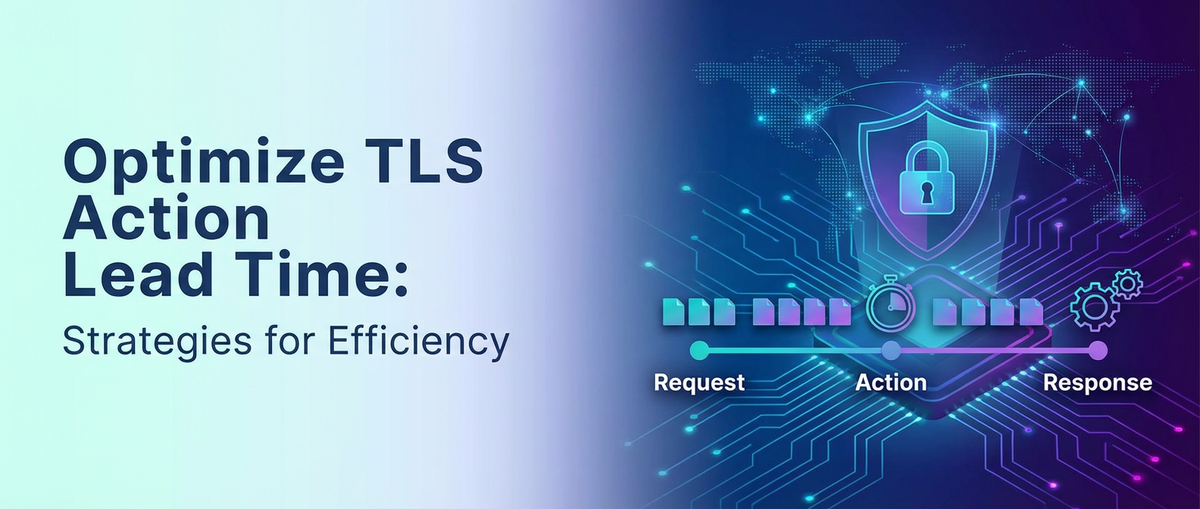
Before we can optimize, we must first understand. TLS, the successor to SSL, creates an encrypted link between a client (like a web browser or an application) and a server. This secure tunnel is established through a complex yet standardized sequence of messages known as the TLS handshake. The "TLS action lead time" refers to the cumulative duration of this handshake process, from the initial client request to the moment secure application data can finally be exchanged. This seemingly instantaneous event, in reality, involves several critical steps, each contributing to the overall latency.
The Anatomy of a TLS Handshake: A Step-by-Step Breakdown
A typical full TLS handshake, particularly with older versions like TLS 1.2, involves multiple round trips between the client and server. Understanding these steps is crucial for identifying optimization opportunities:
- Client Hello: The client initiates the connection by sending a "Client Hello" message. This message contains vital information, including the highest TLS version it supports, a random number (for session key generation), a list of cipher suites it's willing to use (combinations of algorithms for key exchange, authentication, and encryption), and compression methods.
- Server Hello: The server responds with a "Server Hello" message, confirming the chosen TLS version, its own random number, and the selected cipher suite from the client's list. If the client requested a secure renegotiation or session resumption, the server would also process those here.
- Server's Certificate: The server then sends its digital certificate to the client. This certificate contains the server's public key and is signed by a trusted Certificate Authority (CA), allowing the client to verify the server's identity. This message might also include a chain of intermediate certificates necessary for the client to build a path to a trusted root CA.
- Server Key Exchange (Optional): If the chosen cipher suite uses DHE or ECDHE (ephemeral Diffie-Hellman), the server sends a "Server Key Exchange" message containing its Diffie-Hellman public key parameters. This step ensures forward secrecy.
- Certificate Request (Optional): If the server requires client authentication (mutual TLS), it sends a "Certificate Request" message.
- Server Hello Done: The server sends a "Server Hello Done" message, indicating it has finished its initial handshake messages.
- Client Certificate (Optional): If requested, the client sends its own certificate to the server for authentication.
- Client Key Exchange: The client verifies the server's certificate. Using the server's public key (from its certificate or the ephemeral key parameters), the client encrypts a "pre-master secret." This encrypted pre-master secret is sent to the server in a "Client Key Exchange" message. Both client and server then independently use this pre-master secret, along with their respective random numbers, to derive the actual master secret and subsequent session keys.
- Change Cipher Spec (Client): The client sends a "Change Cipher Spec" message, informing the server that all subsequent communication from the client will be encrypted using the newly negotiated keys.
- Client Finished: The client sends an encrypted "Finished" message, which is a hash of all previous handshake messages. This acts as the first encrypted data and allows the server to verify the integrity and authenticity of the handshake.
- Change Cipher Spec (Server): The server sends its "Change Cipher Spec" message.
- Server Finished: The server sends its encrypted "Finished" message.
At this point, the TLS handshake is complete, and the client and server can begin exchanging encrypted application data. This entire sequence, involving multiple data packets traversing the network, defines the TLS action lead time.
Factors Influencing Lead Time
The duration of this elaborate handshake is not constant and is significantly influenced by several critical factors:
- Network Latency: Every round trip between the client and server adds latency. A full TLS 1.2 handshake can require two to three full round trips before application data can be sent, directly multiplying the impact of network distance. A client in Sydney connecting to a server in London will experience significantly longer lead times than one connecting to a server in the same city.
- Server Processing Power: Cryptographic operations, especially key exchange and encryption/decryption, are computationally intensive. Servers with insufficient CPU resources or without hardware acceleration can become bottlenecks, particularly under high traffic loads where many concurrent handshakes need to be performed.
- Certificate Chain Length and Validation Overhead: A longer certificate chain (many intermediate CAs between the server certificate and the root CA) means more data to transmit and more cryptographic signatures for the client to verify. Each certificate in the chain must be validated against its issuer, adding processing time. Additionally, checking for certificate revocation (via OCSP or CRLs) can introduce external network calls and delays.
- TLS Version and Chosen Cipher Suite: Older TLS versions (like 1.0 or 1.1) are inherently less efficient and secure, requiring more round trips. Even within TLS 1.2, some cipher suites are more computationally demanding than others. The move to modern versions like TLS 1.3 drastically reduces the number of round trips, significantly cutting lead time.
- Client Capabilities: Older browsers or operating systems might only support older TLS versions or fewer efficient cipher suites, forcing the server to fall back to less optimized options.
- Server Configuration: Suboptimal server configurations, such as not enabling TLS session resumption, failing to bundle intermediate certificates, or not correctly configuring OCSP stapling, can all unnecessarily prolong the handshake.
The Impact of Lag
A protracted TLS action lead time is not just a technical detail; it has tangible, negative consequences across various aspects of a digital presence:
- User Abandonment and Dissatisfaction: In an era where every second counts, even a few hundred milliseconds of extra load time can lead to frustrated users bouncing off a site or abandoning an application. This translates directly to lost conversions, reduced engagement, and damaged brand reputation.
- SEO Penalties: Search engines like Google prioritize fast-loading, secure websites. A slow TLS handshake can contribute to a higher overall page load time, negatively impacting search engine rankings and visibility.
- Increased Server Load: Longer handshake durations mean more CPU cycles spent on cryptographic operations and maintaining open connections, potentially leading to increased infrastructure costs and reduced capacity under peak loads.
- Perceived Unreliability: A slow-loading secure connection can create a subconscious perception of an unreliable or poorly maintained service, eroding user trust.
- Resource Consumption: Both client and server expend more resources during a longer handshake, which is particularly relevant for mobile users on metered connections or battery-powered devices.
Understanding these foundational elements of TLS action lead time sets the stage for implementing strategic optimizations that address each contributing factor, paving the way for a faster, more secure, and more efficient digital ecosystem.
Foundation of Trust: Proactive Certificate Management Strategies
At the heart of every secure TLS connection lies the digital certificate. It’s the server's identity card, verified by a trusted third party (the Certificate Authority), assuring the client that it’s indeed communicating with the intended server and not an imposter. However, managing these certificates effectively is often a significant source of operational overhead and potential lead time issues if not handled proactively. Efficient certificate management is the first critical step in optimizing TLS action lead time.
The Cornerstone of TLS: Certificates
Certificates serve two primary functions in TLS: 1. Authentication: They verify the identity of the server (and optionally the client), preventing man-in-the-middle attacks. 2. Key Exchange: They contain the server's public key, enabling the secure exchange of cryptographic keys used for encrypting the actual application data.
Any inefficiency or error in certificate handling directly impacts the integrity and speed of the TLS handshake.
Automated Certificate Lifecycle Management
One of the most common and disruptive issues for TLS lead time (and availability) is an expired certificate. Manually tracking and renewing certificates, especially across large infrastructures, is prone to human error. A certificate expiry can bring an entire service down, leading to severe outages and trust erosion.
- The Pain Points of Manual Renewals: Organizations with dozens or hundreds of certificates often rely on spreadsheets or calendar reminders, which are easily missed. The manual process involves generating Certificate Signing Requests (CSRs), submitting them to CAs, retrieving signed certificates, and deploying them to web servers, load balancers, and potentially API Gateways. This is time-consuming, error-prone, and a major operational burden.
- Leveraging ACME (Automatic Certificate Management Environment) Protocol: ACME is an open protocol designed for automating interactions between a web server and a Certificate Authority. It enables automated issuance, renewal, and revocation of certificates. Let's Encrypt, a popular free, automated, and open CA, is the most prominent user of ACME. By using ACME-compliant clients (like Certbot), certificate management can become fully automated, drastically reducing the risk of expiry-related outages and freeing up operational teams.
- Tools like
cert-managerin Kubernetes Environments: For containerized applications orchestrated with Kubernetes, tools likecert-managerare indispensable.cert-managerautomates the management and issuance of TLS certificates from various issuing sources (like Let's Encrypt, HashiCorp Vault, Venafi, or self-signed CAs) and ensures certificates are valid and up-to-date, transparently renewing them before they expire. It automatically injects these certificates into Kubernetes Secrets, which can then be used by Ingress controllers, API Gateways, or other applications. This level of automation is critical in dynamic, ephemeral environments where manual intervention is unfeasible. - The Concept of Short-Lived Certificates for Enhanced Security: With automation, the operational overhead of frequent renewals diminishes. This allows organizations to adopt shorter certificate lifespans (e.g., 90 days, or even shorter for internal mTLS). While seemingly counter-intuitive for "lead time" directly, shorter lifespans enhance security by reducing the window of exposure for compromised private keys. If a key is compromised, its utility is limited to a shorter period. The automated renewal process ensures that the short lifespan doesn't translate into service downtime.
Optimizing Certificate Chains
When a server sends its certificate, it often includes a chain of intermediate certificates. The client uses this chain to verify the server's certificate back to a trusted root CA. The way this chain is constructed and sent can impact lead time.
- Minimizing Chain Length: While not always controllable (dependent on the CA's hierarchy), a shorter chain generally means less data to transmit and fewer certificates for the client to validate.
- Bundling Intermediate Certificates Correctly: The server must send the entire chain of intermediate certificates necessary for the client to trace back to a trusted root. Omitting an intermediate certificate forces the client to fetch it, introducing an extra network request and significant delay. Conversely, sending unnecessary certificates (like the root CA certificate itself, which clients typically already trust) adds unnecessary bulk. Best practice dictates bundling all necessary intermediate certificates in the correct order, but not the root.
- The Performance Implications of Large Certificate Files: Large certificate files, due to long chains or complex cryptographic structures, increase the initial data payload during the handshake, contributing to lead time, especially over high-latency networks. Choosing modern, efficient certificate types (e.g., those using Elliptic Curve Cryptography) can help mitigate this.
Certificate Revocation Checks: OCSP Stapling and CRLs
When a certificate is compromised or no longer valid before its expiry date, it needs to be revoked. Clients must check the revocation status of certificates during the handshake. This process can significantly impact lead time if not optimized.
- Explaining OCSP (Online Certificate Status Protocol) and CRLs (Certificate Revocation Lists):
- CRLs: Traditionally, CAs published Certificate Revocation Lists, which are essentially long lists of all revoked certificates. Clients would download these lists to check if a certificate was revoked. CRLs can be very large, making downloads slow and potentially outdated.
- OCSP: OCSP provides a more efficient, real-time method. Clients send a query to an OCSP responder (operated by the CA) asking specifically about the status of a single certificate. The responder returns a signed response indicating "good," "revoked," or "unknown."
- Why OCSP Stapling is Superior for Performance: While OCSP is better than CRLs, it still involves an additional network request from the client to the OCSP responder during the handshake. This adds another round trip and external dependency. OCSP stapling (also known as TLS Certificate Status Request extension) elegantly solves this. The server periodically queries the OCSP responder itself, obtains a signed OCSP response, and "staples" this response directly into its own certificate message during the TLS handshake.
- Benefits: The client receives the revocation status directly from the server, eliminating the need for an extra network connection to the OCSP responder. This saves a round trip, significantly reducing TLS action lead time and improving privacy (as the CA doesn't see individual client requests).
- Implementation Details and Best Practices: OCSP stapling should be enabled on all web servers, load balancers, and API Gateways that terminate TLS. It requires the server to periodically refresh the OCSP response to ensure it's up-to-date and within its validity period. Monitoring tools should alert if the stapled response is stale or invalid.
Choosing the Right Certificate Type
The type of certificate chosen can influence trust signals, cost, and certain operational aspects, though its direct impact on lead time is generally less pronounced than other factors.
- DV (Domain Validated), OV (Organization Validated), EV (Extended Validation):
- DV: The simplest and cheapest, only verifying domain control. Quickest to issue.
- OV: Verifies domain control and organizational identity. More trustworthy, slightly longer issuance.
- EV: The highest level of validation, requiring extensive verification of the organization. Provides the most trust (e.g., green bar in older browsers). Longest issuance process.
- From a pure lead time perspective, there's minimal difference once issued, but DV certificates are easiest to automate with ACME.
- Wildcard Certificates vs. Multi-Domain (SAN) Certificates:
- Wildcard Certificates (*.example.com): Secure multiple subdomains under a single domain. Simplifies management as only one certificate needs to be issued, renewed, and deployed for many subdomains. This can significantly reduce operational overhead, indirectly contributing to efficiency.
- Multi-Domain (Subject Alternative Name - SAN) Certificates: Secure multiple distinct domain names (e.g., example.com, example.net, app.example.org) under a single certificate. Also simplifies management compared to individual certificates for each domain.
- Balancing Cost, Complexity, and Flexibility: Both wildcard and SAN certificates offer management benefits by reducing the number of certificates to track and deploy, which can prevent expiry-related outages and streamline operations. The choice depends on the specific domain architecture and security policy. Large certificate files (especially for SAN certs with many domains) can slightly increase initial transfer size, but this is usually negligible compared to network latency.
Proactive and intelligent certificate management, underpinned by automation and best practices, forms the robust foundation upon which further TLS optimization strategies can be built. By minimizing manual intervention and ensuring certificates are always valid and efficiently validated, organizations can significantly reduce the potential for certificate-related delays in the TLS action lead time.
Accelerating the Handshake: In-Connection Optimizations
Once the certificate foundation is solid, the next crucial step is to streamline the TLS handshake itself. This involves leveraging modern protocols, selecting efficient cryptographic algorithms, and employing mechanisms that reduce the need for full handshakes. These "in-connection" optimizations directly attack the core components of lead time: round trips and computational effort.
Embracing Modern TLS Versions: The Power of TLS 1.3
The most impactful single optimization for TLS action lead time is the adoption of TLS 1.3. Ratified in 2018, it represents a significant overhaul of the protocol, prioritizing both speed and security.
- Detailed Comparison with TLS 1.2: To understand the dramatic improvement, let's compare key aspects of TLS 1.2 and TLS 1.3:
| Feature/Aspect | TLS 1.2 (Typical Full Handshake) | TLS 1.3 (Typical Full Handshake) | TLS 1.3 (Resumed Handshake - 0-RTT) | Impact on Lead Time |
|---|---|---|---|---|
| Round Trips (RTTs) | 2-3 RTTs (Client Hello -> Server Hello -> Server Certificate -> Server Key Exchange -> Client Key Exchange -> Change Cipher Spec -> Client Finished -> Change Cipher Spec -> Server Finished) | 1 RTT (Client Hello -> Server Hello -> Server Certificate & Server Key Exchange & Change Cipher Spec & Server Finished -> Client Key Exchange & Change Cipher Spec & Client Finished) | 0 RTT (Client sends encrypted application data directly with Client Hello, if session resumed) | Drastically reduced network latency impact. 0-RTT is near-instantaneous for subsequent connections. |
| Cipher Suite Selection | Client sends a list; server selects. Many legacy/weak ciphers available. | Client sends a single "Key Share" (proposed key material); server responds with its choice. Only strong, modern ciphers allowed. | N/A (Session key already derived) | Faster negotiation, stronger security by default. |
| Key Exchange Method | Negotiated; often RSA or Diffie-Hellman. Can be computationally heavy. | Always uses Diffie-Hellman (ephemeral) for forward secrecy. | N/A | Ensures forward secrecy; generally faster due to modern elliptic curve methods. |
| Session Resumption | Uses Session IDs or Session Tickets, still requiring 1 RTT. | Uses Pre-Shared Keys (PSKs) and allows for 0-RTT. | Uses Pre-Shared Keys (PSKs) to directly encrypt data. | Eliminates a round trip for resumed connections, significantly improving perceived speed. |
| Handshake Encryption | Handshake messages are unencrypted until Change Cipher Spec. | Most of the handshake (except Client Hello and Server Hello) is encrypted. | N/A (Handshake is implicitly resumed with encrypted data). | Enhanced privacy and security; prevents downgrade attacks. |
| Legacy Features | Supports older algorithms, renegotiation, compression. | Removes insecure features like RSA key transport, DHE, SHA-1 for signatures, and compression. | N/A | Streamlined protocol, smaller attack surface. |
- Key Benefits of TLS 1.3:
- 0-RTT (Zero Round-Trip Time) for Resumed Connections: This is arguably the most significant performance enhancement. If a client has previously established a connection with a server, TLS 1.3 can allow the client to send encrypted application data immediately with its first "Client Hello" message, effectively eliminating the handshake latency for subsequent connections. This dramatically improves responsiveness for returning users.
- 1-RTT for Initial Connections: Even for a brand-new connection, TLS 1.3 reduces the handshake to just one round trip, down from two or three in TLS 1.2. This is achieved by the client guessing the server's preferred key exchange parameters and including its key share in the first message.
- Reduced Handshake Steps: The protocol is streamlined, removing unnecessary steps and data exchanges, making the overall process more efficient.
- Stronger Cipher Suites by Default: TLS 1.3 mandates the use of modern, robust cipher suites (e.g., ChaCha20-Poly1305, AES-GCM) and eliminates support for older, less secure ones (like SHA-1, RC4, 3DES). This improves security without requiring explicit configuration.
- Improved Forward Secrecy: All key exchanges in TLS 1.3 use ephemeral Diffie-Hellman, guaranteeing forward secrecy by default. This means even if a server's long-term private key is compromised, past communication cannot be decrypted.
- Deployment Considerations and Potential Compatibility Issues: While highly beneficial, migrating to TLS 1.3 requires careful planning. Most modern browsers and operating systems support it, but older enterprise systems, certain middleboxes (firewalls, deep packet inspection devices), or legacy API Gateways might not. These legacy components, sometimes configured to inspect TLS 1.2 handshakes, might misinterpret TLS 1.3 traffic. It's crucial to test thoroughly and potentially enable TLS 1.2 as a fallback for specific legacy clients, though prioritizing TLS 1.3 is the goal.
Cipher Suite Selection for Performance and Security
Even when restricted to TLS 1.2 (or as a fallback), the choice of cipher suite significantly impacts both security and performance.
- Prioritizing Modern, Efficient, and Secure Cipher Suites: Servers should be configured to prefer cipher suites that offer strong encryption and authentication while being computationally efficient. Elliptic Curve Cryptography (ECC) based cipher suites (e.g., ECDHE-RSA-AES256-GCM-SHA384) are generally preferred over traditional RSA-based ones due to smaller key sizes and faster operations for equivalent security levels.
- Avoiding Weak or Outdated Ciphers: Deprecated cipher suites (like RC4, 3DES, or those using SHA-1 for hashing) should be disabled entirely. These are vulnerable to attacks and often perform worse than modern alternatives. Regularly review and update the server's cipher suite order to reflect current security best practices.
- The Role of Elliptic Curve Cryptography (ECC): ECC-based keys (like ECDSA or ECDHE) offer equivalent security to much larger RSA keys, meaning less data to transmit during the handshake and significantly faster cryptographic operations. This translates directly to reduced CPU load on the server and lower latency for clients. Most modern systems fully support ECC.
TLS Session Resumption: Minimizing Redundant Work
For clients making multiple connections to the same server, a full TLS handshake for each connection is inefficient. TLS session resumption allows clients to re-establish a secure connection with a significantly abbreviated handshake, saving round trips and computational effort.
- Explaining Session IDs and Session Tickets:
- Session IDs: The server can issue a "Session ID" to the client after a successful handshake. On subsequent connections, the client includes this Session ID in its Client Hello. If the server finds the corresponding session data in its cache, it can resume the session with a single round trip. The server must maintain a session cache.
- Session Tickets (RFC 5077): To avoid the server needing to maintain large session caches, session tickets allow the server to encrypt the session state and send it to the client as a "ticket." The client stores this ticket and presents it on subsequent connections. The server can then decrypt the ticket to resume the session, offloading the state management to the client. This is particularly useful in load-balanced environments where subsequent connections might hit different servers.
- How They Allow Clients to Resume a Previous Secure Session: Both methods allow the client and server to reuse previously negotiated session parameters and keys, bypassing the computationally intensive key exchange and certificate verification steps. This typically reduces the handshake to one round trip (1-RTT) in TLS 1.2.
- Configuration Best Practices: Servers and API Gateways should be configured to enable session resumption, either via Session IDs (with an adequately sized and persistent session cache) or Session Tickets (with proper key rotation). The timeout for session reuse should be balanced between security and performance (e.g., 5-10 minutes is common).
- Security Considerations for Session Tickets: Session tickets are encrypted with a key known only to the server. This key needs to be rotated regularly (e.g., every few hours or days) to mitigate the risk of compromise. If a session ticket key is compromised, an attacker could decrypt past sessions resumed with that ticket.
Hardware Acceleration for Cryptographic Operations
While software optimizations are crucial, sometimes the sheer volume of cryptographic operations in high-traffic environments demands hardware assistance.
- Offloading CPU-Intensive Tasks: Cryptographic tasks like RSA key exchanges, AES encryption/decryption, and hashing are computationally demanding. On busy servers, these operations can consume significant CPU cycles, leading to performance bottlenecks and increased lead time.
- Specialized Hardware: Hardware acceleration offloads these tasks to dedicated cryptographic modules, such as:
- Dedicated SSL/TLS Cards: Specialized network interface cards (NICs) with built-in cryptographic accelerators.
- CPU Instructions like AES-NI: Modern CPUs include instruction sets (like Intel's AES-NI and ARM's cryptography extensions) that provide native hardware support for AES encryption/decryption, significantly speeding up these operations without requiring a dedicated card. Enabling these features in the operating system and web server software (e.g., OpenSSL) is a critical optimization.
- FPGAs/ASICs: For extremely high-performance scenarios or specialized security appliances, Field-Programmable Gate Arrays (FPGAs) or Application-Specific Integrated Circuits (ASICs) can offer even greater acceleration.
- Impact on High-Traffic Servers and Gateways: In environments with thousands or millions of concurrent TLS connections, such as large web farms or API Gateways handling massive API traffic, hardware acceleration can dramatically reduce CPU utilization, free up resources for application logic, and ensure consistently low TLS action lead times even under peak loads. This investment can be crucial for maintaining performance and scalability.
By meticulously configuring modern TLS versions, carefully selecting robust cipher suites, enabling session resumption, and leveraging hardware acceleration where appropriate, organizations can directly trim the fat from the TLS handshake, making connections faster, more secure, and more efficient.
APIPark is a high-performance AI gateway that allows you to securely access the most comprehensive LLM APIs globally on the APIPark platform, including OpenAI, Anthropic, Mistral, Llama2, Google Gemini, and more.Try APIPark now! 👇👇👇
Architectural Pillars: Infrastructure-Level Strategies
Optimizing TLS action lead time isn't solely about server-side configurations; it's profoundly influenced by the overarching infrastructure architecture. Strategic placement of TLS termination points, intelligent traffic routing, and the utilization of specialized network components can yield significant lead time reductions. This is where Content Delivery Networks (CDNs), load balancers, and especially API Gateways play an indispensable role.
Edge Termination with CDNs
Content Delivery Networks (CDNs) are networks of distributed servers that deliver web content to users based on their geographic location. Their inherent design makes them powerful tools for optimizing TLS.
- How CDNs Bring TLS Termination Closer to the User: The fundamental principle of a CDN is to serve content from the edge, meaning a server geographically closer to the end-user. By terminating TLS at these edge nodes, the TLS handshake occurs over a shorter physical distance, drastically reducing network latency (RTTs). Instead of the client connecting to an origin server potentially thousands of miles away, it connects to a CDN server maybe tens or hundreds of miles away. This reduction in physical distance directly translates to faster TLS handshakes.
- Reducing Latency and Offloading Origin Servers: The CDN takes on the CPU-intensive work of TLS termination, relieving the origin server of this burden. This frees up the origin server's resources to focus on application logic, improving its overall responsiveness and capacity. The shorter network path for the handshake improves perceived loading speed for the user.
- Managed TLS Certificates by CDNs: Many CDNs offer integrated certificate management services. They can automatically provision, renew, and deploy TLS certificates for your domains, often leveraging ACME internally. This simplifies the operational overhead for enterprises, especially those with numerous domains, and ensures certificates are always valid and deployed optimally across their global network.
- Considerations for Re-encryption to the Origin: While the CDN terminates the client's TLS connection, it's crucial to ensure the connection from the CDN edge node to the origin server is also secured, ideally with TLS. This "full-stack TLS" or "end-to-end encryption" prevents data exposure within the CDN's internal network or during transit to the origin. This internal TLS handshake should also be optimized, but its impact on the client's perceived lead time is minimal as it happens "behind the scenes."
Load Balancers and Reverse Proxies as TLS Gateways
Load balancers and reverse proxies are common components in modern web architectures, and they naturally serve as central points for TLS termination.
- Centralizing TLS Termination at the Load Balancer: Instead of each backend web server managing its own TLS certificates and performing cryptographic operations, a load balancer (or reverse proxy) can handle all incoming TLS connections. This centralizes the TLS burden, simplifying configuration and management.
- Benefits:
- Simplifies Backend Server Configuration: Backend servers can run without TLS, communicating with the load balancer over unencrypted (or internally encrypted) HTTP. This reduces complexity and resource requirements on individual application servers.
- Improves Scalability: The load balancer can distribute encrypted traffic efficiently to a pool of backend servers, ensuring optimal resource utilization and high availability.
- Unified Certificate Management: All certificates for the application are managed at a single point (the load balancer), streamlining renewal processes and ensuring consistent TLS policies.
- Hardware Acceleration: Many enterprise-grade load balancers come with hardware SSL/TLS accelerators, further reducing the computational overhead of cryptographic operations and speeding up handshakes.
- Ensuring Secure Communication from Load Balancer to Backend (mTLS or Re-encryption): While the load balancer can terminate TLS, it's paramount to ensure the "internal" communication channel from the load balancer to the backend servers is also secure. Options include:
- Re-encryption: The load balancer re-encrypts the traffic using its own certificate and sends it to the backend, which then decrypts it. This adds a small overhead but ensures full encryption.
- Mutual TLS (mTLS): The load balancer and backend services authenticate each other using certificates, providing robust, two-way authentication and encryption. This is common in service mesh architectures.
- Internal Network Security: For highly trusted, isolated internal networks, some organizations might opt for unencrypted HTTP between the load balancer and backend if strict network segmentation and other security controls are in place, but this is generally less recommended for sensitive data.
The Indispensable Role of an API Gateway
In the rapidly evolving world of microservices and distributed systems, the API Gateway has emerged as a cornerstone of modern application architecture. It acts as the single entry point for all API calls, sitting between clients and backend services. This strategic position makes the API Gateway an exceptionally powerful component for optimizing TLS action lead time and enforcing security policy. The terms "api gateway" and "gateway" are central to understanding its pervasive impact.
- Context in Modern Architectures: In a microservices architecture, clients don't directly call individual backend services. Instead, they interact with an API Gateway, which then routes requests to the appropriate service, handles various cross-cutting concerns, and aggregates responses. This centralization is invaluable for TLS management.
- Its Crucial Role in Centralizing TLS:
- TLS Offloading: Similar to a load balancer, the API Gateway performs TLS termination. It handles the computationally intensive task of decrypting incoming requests and encrypting outgoing responses. This offloads backend microservices from cryptographic overhead, allowing them to focus purely on business logic. This separation of concerns significantly improves the performance and scalability of individual services.
- Unified Certificate Management: Instead of managing certificates across dozens or hundreds of microservices, all incoming TLS certificates can be managed at a single point – the API Gateway. This streamlines the entire certificate lifecycle, from issuance and renewal to deployment, ensuring consistency and drastically reducing the risk of certificate expiry outages.
- Enforcing TLS Policy: The API Gateway is the ideal place to enforce strict TLS security policies. It can be configured to only accept connections using specific, modern TLS versions (e.g., TLS 1.3) and strong cipher suites, rejecting any weaker connections before they reach backend services. This provides a unified security posture across all exposed APIs.
- Performance Optimization: Beyond TLS offloading, high-performance API Gateways often incorporate sophisticated caching mechanisms, connection pooling, and potentially hardware acceleration (as discussed in the previous section). These features collectively reduce the latency of subsequent API calls and minimize the impact of the TLS handshake by reusing connections and data.
- Comprehensive Security Features: An API Gateway provides a suite of security features that complement TLS. These include authentication (e.g., JWT validation, OAuth), authorization, rate limiting (to prevent abuse and DDoS attacks), IP blacklisting/whitelisting, and input validation, all executed before traffic is routed to the backend. This multi-layered defense enhances overall API security, with TLS forming the fundamental secure channel.
- Introducing APIPark: For organizations managing a sprawling ecosystem of APIs, particularly those integrating AI services, an advanced API Gateway is not just beneficial, but essential. APIPark, an open-source AI gateway and API management platform, stands out as a powerful solution that inherently contributes to optimizing TLS action lead time. By centralizing API management, it simplifies certificate handling and enforces consistent TLS policies across diverse APIs, including those leveraging AI models. Its unified API format, end-to-end API lifecycle management, and performance rivaling Nginx directly translate into reduced latency and a more efficient secure connection establishment for every API call. APIPark ensures that the critical security layer of TLS is managed efficiently, allowing developers and enterprises to focus on innovation rather than infrastructure complexities. It provides a robust and performant API Gateway that can handle massive traffic while maintaining stringent security standards, thus directly supporting the goal of optimizing TLS lead time. Furthermore, its ability to quickly integrate 100+ AI models and standardize AI invocation through a unified API format means that organizations can deploy and manage cutting-edge AI services with the confidence that their foundational security, including TLS, is expertly handled at the gateway level, minimizing friction and maximizing performance.
Containerization and Orchestration (Kubernetes)
In cloud-native environments, containerization and orchestration platforms like Kubernetes have revolutionized application deployment and scaling. These platforms also offer powerful mechanisms for managing TLS efficiently.
IngressControllers andcert-manager: In Kubernetes,Ingresscontrollers act as the gateway for external HTTP/HTTPS traffic into the cluster. They handle routing and TLS termination. When combined withcert-manager, the entire TLS certificate lifecycle for publicly exposed services can be fully automated.cert-managerwatches for Ingress resources that specify TLS and automatically provisions and renews certificates from ACME providers like Let's Encrypt, storing them as Kubernetes Secrets which the Ingress controller then uses. This ensures services always have valid certificates without manual intervention.Service Mesh(e.g., Istio, Linkerd) for mTLS: For internal communication between microservices within a cluster, a service mesh provides capabilities like automated mutual TLS (mTLS). While the external TLS is handled at theIngressgateway, mTLS within the mesh encrypts all service-to-service communication. This adds an additional layer of security, and the mesh proxies (sidecars) typically handle the mTLS handshake efficiently, often using short-lived certificates, ensuring low lead time for internal secure communications. TheIngress Gatewaycomponent of a service mesh often takes on the role of the primary API Gateway for external traffic, benefiting from all the TLS optimization techniques discussed.
By thoughtfully designing infrastructure to leverage CDNs, load balancers, and especially the comprehensive capabilities of an API Gateway, organizations can create an architecture where TLS is not just a security afterthought, but a central, optimized component that enhances both performance and operational efficiency.
Operational Excellence: Monitoring, Automation, and Auditing
Even the most perfectly designed TLS infrastructure requires ongoing attention. The digital threat landscape constantly evolves, and configurations can drift. Therefore, operational excellence through continuous monitoring, robust automation, and regular auditing is essential to maintain optimal TLS action lead time and a strong security posture over the long term.
Continuous TLS Monitoring
Proactive monitoring is the bedrock of maintaining TLS efficiency and preventing outages. It's not enough to set up TLS; you must continuously observe its health and performance.
- Tools to Monitor Certificate Expiry Dates: This is perhaps the most fundamental monitoring task. Automated tools can scan public CAs for certificate issuance and expiry dates, or query internal systems for deployed certificate metadata. Services like
crt.sh, SSL Labs, or commercial solutions can provide this. More importantly, internal monitoring systems should integrate withcert-manager(for Kubernetes) or dedicated certificate inventory tools to track all certificates within the organization's purview and trigger alerts well in advance of expiry. Missing a certificate expiry is a critical incident that can cause significant downtime. - Alerting for Handshake Failures, Deprecated Cipher Usage, or Protocol Downgrade Attacks: Logs from web servers, load balancers, and API Gateways are invaluable. Monitoring systems should parse these logs for:
- TLS handshake failures: Repeated errors could indicate client compatibility issues, misconfigurations, or even attempted attacks.
- Negotiation of deprecated cipher suites or TLS versions: Alerts should trigger if connections are falling back to TLS 1.1 or 1.0, or using weak ciphers, indicating potential client issues or an outdated server configuration.
- Protocol downgrade attacks: Detecting attempts to force a server to use an older, less secure TLS version.
- Performance Monitoring of TLS Handshakes: Beyond security, actively measuring the performance of the TLS handshake is crucial. This can be done using:
- Synthetic transactions: Automated bots that periodically connect to your endpoints, perform a TLS handshake, and record the time taken. This provides a baseline and alerts on performance degradation.
- Real User Monitoring (RUM) data: Injecting JavaScript into web pages to collect actual user performance metrics, including TLS connection times. This offers real-world insight into how lead time impacts actual users across different geographies and network conditions.
- Server-side metrics: Monitoring CPU utilization (especially crypto-related), network I/O, and the number of active TLS sessions on web servers, load balancers, and API Gateways. Spikes in these metrics could indicate bottlenecks or inefficiencies.
Automation of Configuration Deployment
Manual configuration changes are a common source of human error and inconsistency, particularly in complex TLS setups. Automation ensures reproducibility, consistency, and speed.
- Infrastructure as Code (IaC) for TLS Configurations: All TLS-related configurations – including enabled TLS versions, cipher suites, OCSP stapling settings, session ticket key rotation, and certificate paths – should be managed as code. Tools like Terraform, Ansible, Chef, or Puppet allow these configurations to be version-controlled, reviewed, and deployed automatically across all servers and infrastructure components.
- Version Control for All TLS-Related Settings: Storing configuration files in Git repositories ensures a complete history of changes, facilitates rollbacks, and enables peer review. This is essential for auditing and troubleshooting.
- Automated Deployment Pipelines: Integrating TLS configuration deployments into Continuous Integration/Continuous Delivery (CI/CD) pipelines ensures that changes are tested and deployed consistently and quickly, reducing the window of vulnerability or misconfiguration. When a new TLS vulnerability is discovered, automated deployment allows for rapid patching across the entire infrastructure.
Regular Security Audits and Penetration Testing
The security landscape is dynamic. What's secure today might be vulnerable tomorrow. Regular audits and penetration tests are non-negotiable.
- Ensuring Configurations Remain Robust Against Evolving Threats: Periodically use tools like SSL Labs' SSL Test to get a grade for your TLS configuration. This provides a comprehensive analysis of supported protocols, cipher suites, certificate chains, and potential vulnerabilities. Internally, tools like TestSSL.sh can be run against endpoints.
- Identifying Misconfigurations that Could Impact Security or Performance: Audits can uncover subtle misconfigurations, such as a server accidentally enabling a weak cipher suite, a load balancer not forwarding the correct
X-Forwarded-Protoheader, or an API Gateway with an overly permissive TLS policy. These issues can degrade both security and performance by forcing clients into less optimal paths. - Penetration Testing: Ethical hackers attempt to exploit vulnerabilities in your system, including TLS misconfigurations. This goes beyond automated scanning and provides a real-world assessment of your defenses. Regular pen tests help identify weaknesses before malicious actors do.
Incident Response Planning
Despite best efforts, incidents can occur. A well-defined incident response plan is critical for minimizing the impact of a TLS-related security event or outage.
- What to do in Case of a Certificate Compromise:
- Immediate Revocation: Revoke the compromised certificate through the issuing CA as quickly as possible.
- Key Rotation: Rotate all private keys associated with the compromised certificate.
- Deployment of New Certificates: Immediately deploy new, clean certificates.
- Forensic Analysis: Investigate how the compromise occurred.
- Response to a Critical TLS Vulnerability:
- Rapid Patching: Immediately apply patches or configuration changes to mitigate the vulnerability across all affected systems.
- Communication: Inform relevant stakeholders (internal teams, potentially customers) about the vulnerability and mitigation steps.
- Monitoring: Intensify monitoring for exploitation attempts.
- Clear Roles and Responsibilities: Define who is responsible for each step in the incident response process, from detection to resolution and post-mortem analysis.
By embedding continuous monitoring, automation, and a rigorous auditing schedule into operational workflows, organizations can ensure that their TLS infrastructure remains efficient, secure, and resilient against both performance degradation and evolving cyber threats. This commitment to operational excellence is what truly optimizes TLS action lead time for the long haul.
The Balance Beam: Security, Performance, and User Experience
Throughout this deep dive into optimizing TLS action lead time, a recurring theme emerges: the delicate yet essential balance between security, performance, and user experience. It's a trilemma where pushing too hard on one aspect can inadvertently compromise another. The ultimate goal is not to maximize security at all costs or achieve breakneck speed irrespective of risk, but rather to find the optimal equilibrium that serves both the business and its users effectively.
It's Not Just About Speed or Just About Security
A naive approach might suggest simply disabling all security features for maximum speed or enabling every possible security hardening without considering the overhead. Both extremes are detrimental:
- Security Without Performance: An overly complex TLS setup, perhaps with unnecessarily long key exchanges, redundant certificate checks, or outdated protocols, might be perceived as "secure" but will introduce unacceptable latency. This leads to frustrated users, higher bounce rates, and potentially lost revenue. What good is a fort that no one can enter because the drawbridge takes too long to lower?
- Performance Without Security: Conversely, prioritizing speed by using weak cipher suites, outdated TLS versions, or neglecting certificate validation exposes sensitive data to interception and tampering. This erodes user trust, risks regulatory penalties, and ultimately damages brand reputation. A fast, but insecure, connection is a liability.
The true challenge lies in making informed decisions that satisfy both stringent security requirements and demanding performance expectations. Modern TLS protocols like TLS 1.3 are prime examples of how both can be significantly improved simultaneously. By streamlining the handshake, removing insecure features, and mandating strong cryptography, TLS 1.3 offers a paradigm shift where better security is faster security.
How Optimized TLS Leads to Better User Trust, Lower Bounce Rates, and Improved Search Engine Rankings
The benefits of an optimized TLS action lead time ripple across several key business metrics:
- Enhanced User Trust: A fast, seamlessly secure connection instills confidence. Users intuitively understand the padlock icon and the 'https://' prefix, but they also subconsciously link speed with reliability and professionalism. A responsive website or application, fortified by efficient TLS, signals a well-maintained and trustworthy service. This trust is paramount for sensitive transactions, data submission, and long-term customer loyalty.
- Lower Bounce Rates: In the digital realm, patience is a scarce commodity. Research consistently shows a direct correlation between page load time and bounce rates. Even a few hundred milliseconds of added latency can cause a significant percentage of users to abandon a page. By shaving milliseconds off the TLS handshake, you contribute to a faster overall load time, keeping users engaged and reducing the likelihood of them leaving before they even see your content.
- Improved Search Engine Rankings: Search engines, particularly Google, explicitly consider site speed as a ranking factor. Furthermore, HTTPS (secured by TLS) is a baseline ranking signal. A slow TLS handshake contributes to a slower perceived load time, which can negatively impact your search engine optimization (SEO) efforts. Conversely, a fast, secure website is rewarded with better visibility in search results, driving more organic traffic.
The Continuous Cycle of Review, Update, and Optimization
Optimizing TLS action lead time is not a one-time project; it is an ongoing journey. The digital world is in constant flux:
- New Threats Emerge: Cryptographic attacks evolve, requiring updates to cipher suites and potentially protocol versions.
- Technology Advances: Newer TLS versions, more efficient hardware, and smarter API Gateways are continually developed.
- Traffic Patterns Change: Your user base grows, their locations shift, and the demands on your infrastructure evolve.
Therefore, a commitment to a continuous cycle of: 1. Review: Regularly auditing your TLS configurations, performance metrics, and security posture. 2. Update: Applying patches, upgrading software, and adopting newer protocol versions and cipher suites as they become available and stable. 3. Optimize: Fine-tuning configurations, exploring new architectural patterns (like further leveraging API Gateways or CDNs), and leveraging automation.
This iterative process ensures that your TLS implementation remains at the cutting edge of both security and performance, delivering the best possible experience to your users while safeguarding your data and reputation.
In essence, optimizing TLS action lead time is about making intelligent, data-driven decisions that align security best practices with performance imperatives. It's about recognizing that these aspects are not mutually exclusive but rather mutually reinforcing, contributing to a more resilient, efficient, and user-centric digital presence.
Conclusion: A Commitment to an Efficient, Secure Web
In the digital era, where every interaction is mediated by a network and every transaction demands trust, the efficiency of Transport Layer Security (TLS) is paramount. The "TLS action lead time"—that critical window from connection initiation to secure data exchange—is not merely a technical metric; it is a fundamental determinant of user experience, operational cost, and ultimately, business success. As we have thoroughly explored, optimizing this lead time is a multi-faceted endeavor, requiring a holistic strategy that spans proactive certificate management, in-connection protocol optimizations, robust infrastructure design, and continuous operational vigilance.
We began by dissecting the intricate TLS handshake, understanding how network latency, server processing, and certificate complexity collectively contribute to delays. This foundational understanding underscored the necessity of tackling each element systematically. Our journey then led us to the bedrock of trust: proactive certificate management. Automating the certificate lifecycle with tools like ACME and cert-manager, optimizing certificate chains, and leveraging OCSP stapling are no longer optional best practices but essential strategies to avert outages and streamline the handshake process, laying a stable ground for performance gains.
Subsequently, we delved into the heart of the connection, exploring how modern TLS versions, especially TLS 1.3, dramatically reduce round trips and enhance security simultaneously. The careful selection of efficient cipher suites, the intelligent use of session resumption, and the strategic deployment of hardware acceleration all serve to trim precious milliseconds from the handshake, making each new and subsequent connection faster and more secure.
Crucially, we examined the architectural pillars that amplify these optimizations. Content Delivery Networks (CDNs) push TLS termination to the edge, minimizing latency for global users. Load balancers centralize TLS management, offloading backend services and improving scalability. Most significantly, the API Gateway emerges as an indispensable component in modern distributed architectures. By centralizing TLS offloading, unified certificate management, and comprehensive policy enforcement, an API Gateway acts as the primary guardian and accelerator of secure API traffic. Solutions like APIPark exemplify this, providing an open-source AI gateway and API management platform that inherently contributes to optimizing TLS action lead time by streamlining API integration, enforcing consistent security policies, and delivering performance capable of handling massive traffic loads. It ensures that the critical security layer of TLS is managed efficiently across diverse APIs, particularly those integrating advanced AI models, allowing enterprises to innovate with confidence and speed.
Finally, we underscored the importance of operational excellence. Continuous monitoring of certificate health and handshake performance, coupled with robust automation of configurations and a commitment to regular security audits, ensures that the initial optimizations are sustained over time. And underlying all these technical considerations is the overarching imperative to strike a judicious balance between security and performance – recognizing that true optimization means achieving both, leading to enhanced user trust, lower bounce rates, and improved search engine rankings.
In conclusion, the pursuit of an optimized TLS action lead time is a journey of continuous improvement, a commitment to delivering a faster, more reliable, and unequivocally secure digital experience. By embracing the strategies outlined in this article, organizations can not only meet but exceed the escalating demands of the modern web, ensuring their digital presence remains competitive, trustworthy, and resilient. Proactive, intelligent TLS management is not merely a technical checkbox; it is a cornerstone of a successful and efficient digital future.
Frequently Asked Questions (FAQs)
1. What is "TLS action lead time" and why is it important to optimize?
TLS action lead time refers to the duration it takes to establish a secure TLS connection between a client and a server, from the initial "Client Hello" to the point where encrypted application data can be exchanged. It's crucial to optimize because a longer lead time directly contributes to slower page load times, higher user abandonment rates, increased server resource consumption, and potential negative impacts on SEO rankings. Optimizing it enhances user experience, improves security, and reduces operational costs.
2. How does TLS 1.3 significantly reduce TLS action lead time compared to TLS 1.2?
TLS 1.3 offers substantial improvements in lead time primarily by reducing the number of round trips (RTTs) required for the handshake. A full TLS 1.2 handshake typically requires 2-3 RTTs, whereas TLS 1.3 completes it in just 1 RTT for initial connections. Furthermore, for resumed connections, TLS 1.3 introduces 0-RTT, allowing clients to send encrypted application data immediately with their first message, effectively eliminating handshake latency for subsequent interactions. It also streamlines the protocol, removes insecure features, and mandates stronger, more efficient cipher suites.
3. What role does an API Gateway play in optimizing TLS action lead time?
An API Gateway acts as a central entry point for all API traffic, making it ideal for centralizing TLS management. It performs TLS offloading, meaning it handles the computationally intensive encryption/decryption tasks, freeing up backend services. This centralization also simplifies certificate management, ensuring consistent TLS policies across all APIs. Many high-performance gateways like APIPark also offer features like connection pooling, caching, and potential hardware acceleration, which collectively reduce latency and improve the efficiency of secure connection establishment, directly contributing to optimized TLS action lead time.
4. What is OCSP stapling and why is it recommended for TLS optimization?
OCSP (Online Certificate Status Protocol) stapling is a mechanism where the server periodically fetches a signed OCSP response (confirming its certificate's valid status) from the Certificate Authority and "staples" this response directly into its TLS handshake message. This is recommended because it eliminates the need for the client to make a separate, potentially slow, network request to an OCSP responder to check the certificate's revocation status. By embedding the status directly, OCSP stapling saves a round trip, significantly reducing TLS action lead time and improving privacy.
5. Besides initial configuration, what ongoing efforts are needed to maintain optimal TLS lead time and security?
Maintaining optimal TLS lead time and security requires continuous operational excellence. This includes: * Continuous Monitoring: Regularly monitoring certificate expiry dates, detecting handshake failures, and identifying usage of deprecated cipher suites or TLS versions. * Automation: Implementing Infrastructure as Code (IaC) for TLS configurations and using automated deployment pipelines to ensure consistency and rapid updates. * Regular Auditing: Conducting periodic security audits using tools like SSL Labs and performing penetration testing to identify misconfigurations and vulnerabilities. * Incident Response Planning: Having a clear plan for responding to certificate compromises or critical TLS vulnerabilities. This ongoing commitment ensures the TLS infrastructure remains robust, efficient, and resilient against evolving threats.
🚀You can securely and efficiently call the OpenAI API on APIPark in just two steps:
Step 1: Deploy the APIPark AI gateway in 5 minutes.
APIPark is developed based on Golang, offering strong product performance and low development and maintenance costs. You can deploy APIPark with a single command line.
curl -sSO https://download.apipark.com/install/quick-start.sh; bash quick-start.sh

In my experience, you can see the successful deployment interface within 5 to 10 minutes. Then, you can log in to APIPark using your account.

Step 2: Call the OpenAI API.