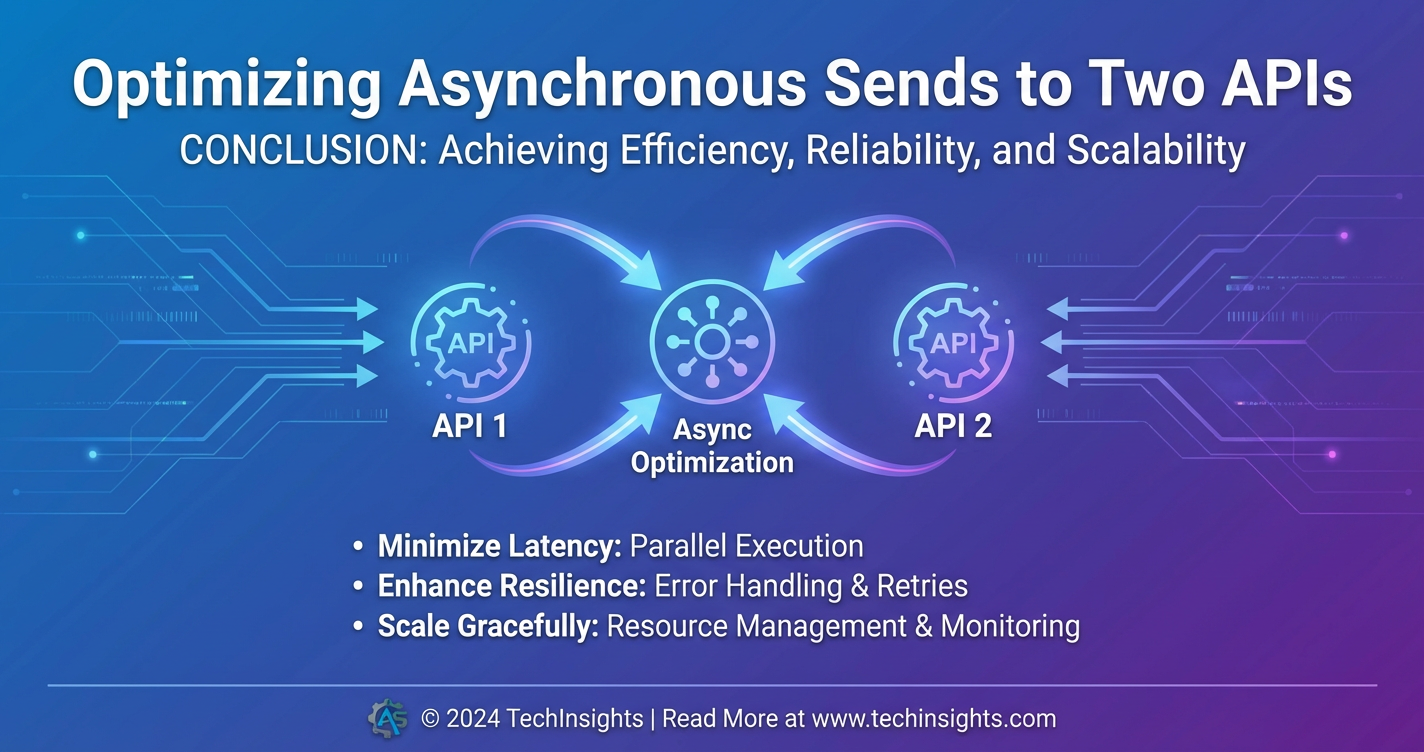
Optimizing Asynchronous Sends to Two APIs
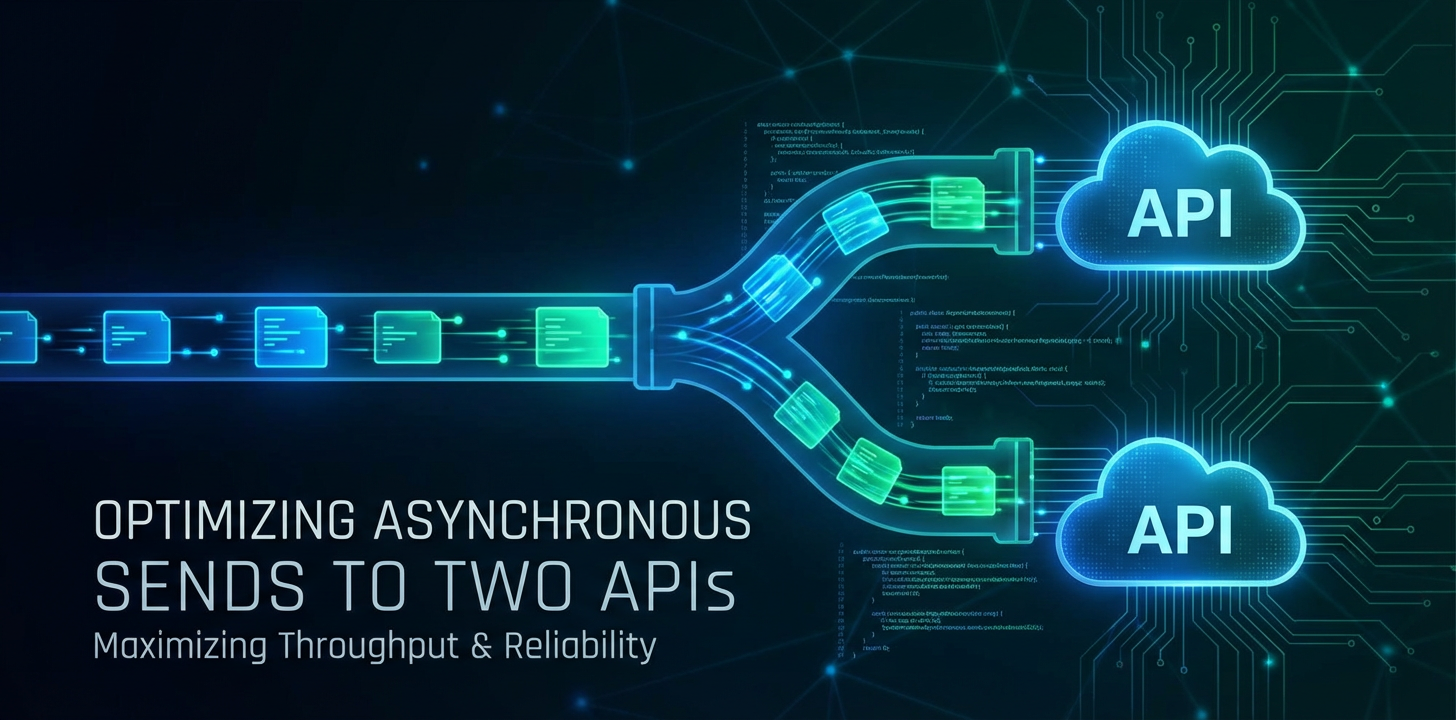


In the intricate tapestry of modern software architecture, where microservices reign supreme and distributed systems are the norm, applications frequently interact with a multitude of external services. This interaction, often facilitated through Application Programming Interfaces (APIs), forms the backbone of functionality, enabling everything from payment processing to data analytics and content delivery. However, the seemingly straightforward act of communicating with these external services introduces a myriad of complexities, particularly when an application needs to send data or requests to not just one, but two distinct APIs simultaneously or in quick succession. The naive approach, often synchronous and blocking, can quickly become a bottleneck, severely impacting application performance, scalability, and user experience.
Imagine a scenario where an e-commerce platform needs to update inventory stock via one API while simultaneously notifying a logistics partner via another upon a successful order. If these operations are performed sequentially, one waiting for the other to complete, even minor latency in one API can significantly delay the entire process. In a high-traffic environment, such delays cascade, leading to a sluggish system, frustrated users, and potentially lost revenue. This is precisely where the power of asynchronous communication comes into play. By adopting an asynchronous paradigm, developers can empower their applications to initiate multiple operations without waiting for each to complete, effectively multitasking and leveraging available resources more efficiently. This article delves deep into the art and science of optimizing asynchronous sends to two APIs, exploring the underlying principles, dissecting common challenges, and unveiling a robust suite of strategies and best practices that ensure high performance, resilience, and maintainability in a multi-API landscape. We will navigate through the nuances of parallel execution, intelligent error handling, data aggregation, and the pivotal role of an API gateway in streamlining these complex interactions, ultimately equipping you with the knowledge to build highly responsive and scalable systems.
Understanding Asynchronous Communication: The Foundation for Efficiency
To truly master the optimization of sending data to multiple APIs, it's crucial to first grasp the fundamental concepts of asynchronous communication. This paradigm shift from traditional synchronous processing is the cornerstone upon which modern, highly concurrent, and scalable systems are built.
What is Asynchronous Programming?
At its core, asynchronous programming allows a program to initiate an operation, like making an API call, and then continue executing other tasks without waiting for that operation to complete. Instead of blocking the execution thread until a response is received, the program "delegates" the long-running task and gets a notification or a mechanism to retrieve the result once it's ready. This is in stark contrast to synchronous programming, where each operation must complete before the next one begins, leading to potential idle time for the CPU if it's waiting for I/O-bound operations (like network requests or database queries).
The practical implementations of asynchronous programming vary across languages and frameworks:
- Callbacks: Historically, many asynchronous operations were handled using callbacks. A callback function is passed to an asynchronous function and is executed once the asynchronous operation completes. While effective, deeply nested callbacks can lead to "callback hell" (or the "pyramid of doom"), making code hard to read and maintain.
- Promises/Futures: Introduced to mitigate callback hell, Promises (JavaScript) or Futures (Java, Python, C#) represent the eventual result of an asynchronous operation. They can be in one of three states: pending, fulfilled (successful), or rejected (failed). They allow for chaining operations and better error handling.
- Async/Await: Building upon Promises/Futures,
async/awaitprovides a more synchronous-like syntax for writing asynchronous code, making it significantly more readable and easier to reason about. Anasyncfunction implicitly returns a Promise, andawaitcan be used inside anasyncfunction to pause its execution until a Promise settles, without blocking the main thread. - Event Loops: Many environments, especially JavaScript (Node.js) and Python (
asyncio), utilize an event loop. This single-threaded mechanism continuously checks for tasks to execute. When an asynchronous operation (like a network request) is initiated, it's offloaded, and the event loop continues processing other tasks. Once the asynchronous operation completes, its result is placed back onto the event queue to be processed by the event loop. - Threads and Goroutines: In languages like Java or Go, developers might explicitly use threads or goroutines (Go's lightweight concurrency primitives) to run operations concurrently. While threads introduce overhead, goroutines are managed by the Go runtime, offering a more efficient way to achieve concurrency, which can include asynchronous network operations.
The common thread across all these implementations is the ability to perform multiple I/O-bound tasks concurrently without blocking the main application flow, leading to a more responsive and efficient system.
Why Asynchronous for APIs?
The benefits of applying asynchronous communication, especially when interacting with external APIs, are profound and directly address many performance and scalability challenges in distributed systems.
- Improved User Experience (Responsiveness): For client-side applications (web or mobile), asynchronous API calls mean the user interface remains responsive while data is being fetched. The application doesn't freeze, enhancing perceived performance and user satisfaction. Even for backend services, a responsive system means faster processing of requests and lower latency for downstream consumers.
- Enhanced System Throughput (Non-blocking I/O): When your application needs to make several API calls, doing them asynchronously allows the system to initiate all calls almost simultaneously. Instead of waiting for
API_Ato respond before callingAPI_B, both can be in flight concurrently. This dramatically increases the number of requests a single server can handle within a given timeframe, improving overall throughput. - Better Resource Utilization: In a synchronous model, a server thread might sit idle, waiting for an API response. This thread holds system resources (memory, CPU context). Asynchronous programming, particularly with event loops or lightweight concurrency models, allows a single thread or a few threads to manage many concurrent I/O operations. This maximizes the utilization of CPU cycles by allowing them to work on other tasks while I/O operations are pending, rather than idling.
- Increased Scalability: By making efficient use of resources and improving throughput, asynchronous architectures naturally scale better. A server can handle more concurrent connections and requests with the same hardware, delaying the need for costly horizontal scaling (adding more servers).
- Fault Tolerance and Resilience: Asynchronous designs inherently promote better fault tolerance. If one of the two APIs you're sending data to experiences a delay or failure, the other asynchronous send can still proceed. The failure of one operation doesn't necessarily block or cascade to the entire application flow immediately, allowing for more graceful degradation and robust error recovery strategies.
- Common Patterns: Fan-out, Scatter-Gather, Parallel Processing: Asynchronous communication is the enabling technology for powerful architectural patterns.
- Fan-out: Sending the same request or message to multiple recipients or services in parallel.
- Scatter-Gather: Sending requests to multiple services, gathering all their responses, and then aggregating or processing them. For instance, querying multiple price comparison APIs and combining the results.
- Parallel Processing: Executing two or more independent API calls concurrently to minimize the overall response time. This is particularly relevant when sending data to two distinct APIs that don't depend on each other's immediate response.
Embracing asynchronous principles is not merely an optimization; it's a strategic architectural decision that empowers applications to meet the demands of modern, interconnected, and high-performance environments.
Challenges of Interacting with Multiple APIs Asynchronously
While asynchronous communication offers significant advantages, the complexity magnifies when interacting with multiple APIs simultaneously. The very benefits of non-blocking operations introduce new challenges that require careful design and implementation to avoid pitfalls. Successfully navigating these complexities is key to unlocking the true potential of your multi-API integrations.
Coordination and State Management
When you send data to two separate APIs asynchronously, their operations often need to be coordinated, or their outcomes might influence the application's overall state. For example, in an e-commerce transaction, you might send a request to a payment api and another to an inventory api. What happens if the payment succeeds but the inventory update fails? Or vice-versa?
- Data Consistency: Ensuring that all related API calls either succeed or fail together, maintaining atomicity across distributed services, is a monumental task. This often involves implementing distributed transactions or, more commonly, embracing eventual consistency patterns where temporary inconsistencies are tolerated, and mechanisms are in place to resolve them over time (e.g., sagas).
- Managing Partial Failures: A common scenario is one API call succeeding while the other fails. The application must have a clear strategy for handling such partial successes. This could involve rolling back the successful operation (compensation transaction), retrying the failed one, or notifying an administrator for manual intervention. The challenge lies in tracking the state of each individual asynchronous operation and reacting appropriately when one deviates from the expected outcome.
Error Handling and Retries
The distributed nature of API interactions means that failures are not just possibilities but inevitabilities. Network glitches, API service outages, rate limit breaches, or unexpected data formats can all lead to errors.
- Comprehensive Error Handling: Each API might return errors in different formats, requiring robust parsing and interpretation. More importantly, the application needs to decide how to react to different types of errors. Is it a transient error (e.g., network timeout) that can be retried, or a permanent error (e.g., invalid authentication) that requires immediate intervention?
- Intelligent Retry Mechanisms: Naive retries can exacerbate problems (e.g., by overwhelming an already struggling api). Implementing strategies like exponential backoff with jitter is crucial. This means waiting progressively longer periods between retries and adding a small random delay (jitter) to prevent all failed requests from retrying simultaneously, which can create a "thundering herd" problem on the target API.
- Circuit Breakers: To prevent cascading failures, where a failing api brings down your entire application due to endless retries or blocked threads, the circuit breaker pattern is essential. A circuit breaker monitors calls to a service; if errors exceed a certain threshold, it "opens" and prevents further calls to that service for a period, allowing it to recover. During this "open" state, requests fail fast, preserving system resources.
Data Aggregation and Transformation
When sending data to two APIs, you might also need to process their responses. Often, the data returned by each API needs to be combined, transformed, or enriched before it's useful to your application.
- Response Correlation: If you send requests in parallel, how do you correlate their responses back to the original logical operation? Unique identifiers passed in the request and echoed in the response are vital.
- Data Merging and Shaping: The responses from different APIs might have conflicting schemas or require specific transformations to fit your application's data model. This involves writing logic to merge diverse data structures into a unified representation, which can become complex.
Rate Limiting and Throttling
External APIs often impose rate limits to prevent abuse and ensure fair usage among all consumers. Sending asynchronous requests to two different APIs means you must respect the individual rate limits of each.
- Managing Independent Limits: You cannot simply fire off requests as fast as your system can generate them. Each api will have its own rules (e.g., 100 requests per minute per IP, or 50 requests per second per authentication token). Your application must keep track of these limits and throttle its outgoing requests accordingly, potentially pausing or queuing requests to stay within bounds.
- Dynamic Throttling: Some APIs provide headers (e.g.,
X-RateLimit-Remaining) that inform you of your current usage and remaining allowance. Leveraging these dynamically allows for more efficient use of the quota without hitting hard limits.
Security and Authentication
Interacting with multiple APIs invariably means managing multiple sets of credentials and adhering to varying security protocols.
- Credential Management: Each API might require a different authentication method (API keys, OAuth 2.0 tokens, basic authentication). Securely storing, rotating, and injecting these credentials into requests is a critical security concern.
- Permission Scopes: When using OAuth, ensuring that your application only requests and receives the minimum necessary permissions from each API (Principle of Least Privilege) is crucial for security.
Complexity of Code
While async/await has significantly improved readability, managing complex asynchronous flows, especially with error handling, retries, and data aggregation across multiple APIs, can still lead to intricate code.
- State Machines: For highly complex, multi-step asynchronous processes, state machines might be necessary to formally define and manage the different stages and transitions, along with their associated failure and success paths.
- Debugging and Observability: Tracing a request that spans multiple asynchronous API calls and potentially multiple microservices can be challenging. Debugging becomes harder as execution jumps between different parts of the code and possibly different threads or processes.
Observability
Understanding the performance and behavior of asynchronous interactions with multiple APIs requires sophisticated observability tools.
- Distributed Tracing: Traditional logging struggles to track a single logical request as it traverses through various asynchronous calls and microservices. Distributed tracing tools (like OpenTelemetry, Jaeger, Zipkin) are essential to visualize the entire request flow, identify bottlenecks, and pinpoint failures across the distributed system.
- Metrics and Alerts: Collecting metrics (latency, error rates, throughput for each API) and setting up alerts for anomalies helps proactively identify and address issues before they impact users.
Addressing these challenges systematically requires a combination of robust architectural patterns, intelligent tooling, and meticulous attention to detail in implementation. The next section will explore specific strategies to overcome these hurdles and optimize your asynchronous sends.
Strategies for Optimizing Asynchronous Sends
Having understood the complexities inherent in interacting with multiple APIs asynchronously, the next step is to equip ourselves with practical strategies to optimize these interactions. These strategies focus on improving performance, enhancing resilience, and streamlining the overall development and operational experience.
Parallel Execution: The Default for Independent Operations
When sending data to two APIs, the most straightforward and often most effective optimization is to execute these sends in parallel, provided they are independent of each other. This means neither API call relies on the immediate outcome or data from the other.
- How it Works: Instead of calling
API_Aand waiting for its response before callingAPI_B, your application initiates both requests almost simultaneously. The underlying runtime or framework manages the concurrent network operations. - Implementation Examples:
- JavaScript (Node.js/Browser):
Promise.all([sendToApiA(), sendToApiB()])is the canonical way. It waits for all promises to resolve (or for the first one to reject) and then returns an array of their results. - Python (
asyncio):asyncio.gather(send_to_api_a(), send_to_api_b())achieves similar parallel execution for coroutines. - Java (CompletableFuture):
CompletableFuture.allOf(sendToApiA(), sendToApiB()).join()can be used to wait for multipleCompletableFutureinstances to complete. - Go (Goroutines): Launching two separate goroutines for each API call and using
sync.WaitGroupto wait for their completion.
- JavaScript (Node.js/Browser):
- Benefits: This approach drastically reduces the total elapsed time for the operation, as the overall duration is effectively limited by the slowest of the parallel API calls, rather than the sum of their individual latencies. This is often the primary driver for performance improvements in multi-API scenarios.
- Considerations:
- Failure Modes:
Promise.all(and similar constructs) typically "fail fast"; if one of the promises rejects, the aggregate promise immediately rejects with the error of the first rejected promise. This behavior needs to be explicitly handled if you wish to allow other successful operations to continue or to gather all errors. For example, in JavaScript,Promise.allSettledcan be used to wait for all promises to settle (either fulfilled or rejected). - Resource Consumption: While efficient, launching too many parallel operations can consume significant network sockets, memory, and CPU resources. It's crucial to consider the capacity of your application and the external APIs.
- Failure Modes:
Batching and Debouncing: Reducing Overhead and Respecting Limits
While parallel execution is great, sometimes sending individual requests is inefficient or violates API rate limits. Batching and debouncing are techniques to group or delay requests.
- Batching: Instead of sending 100 individual requests, combine them into a single request payload if the API supports it. This significantly reduces network overhead (TCP handshakes, HTTP headers) and the number of distinct API calls, making your application more efficient and often reducing the load on the external api as well.
- When to use: Updating multiple records in a database, sending multiple notifications, or processing a list of items where the API has a bulk endpoint.
- Debouncing: If your application frequently generates similar requests (e.g., a user typing in a search box triggering an API call on every keystroke), debouncing delays the execution of the function until a certain amount of time has passed without any further triggers. This ensures the api is called only once after the user has finished typing.
- When to use: Real-time search, form validation, or any scenario where rapid, repeated user input could overwhelm an api.
Circuit Breakers and Bulkheads: Preventing Cascading Failures
These patterns are critical for building resilient systems that can gracefully handle failures in external APIs without collapsing entirely.
- Circuit Breaker: As discussed earlier, a circuit breaker monitors calls to an external service. If calls consistently fail or exceed a certain latency threshold, the circuit "opens," meaning all subsequent calls to that service are immediately rejected for a configurable period. After this period, the circuit moves to a "half-open" state, allowing a few test requests to pass through. If they succeed, the circuit "closes" again; otherwise, it re-opens. This protects your application from repeatedly hammering a failing api and allows the external service time to recover.
- Bulkhead: Inspired by ship compartments, the bulkhead pattern isolates components of a system so that a failure in one doesn't bring down the others. In the context of API calls, this means allocating separate resource pools (e.g., thread pools, connection pools) for calls to different external APIs. If
API_Abecomes slow and exhausts its dedicated thread pool,API_Bcan still operate normally because it has its own, unaffected resource pool.
Retry Mechanisms with Exponential Backoff and Jitter
Transient errors are common in distributed systems. An intelligent retry strategy is vital to overcome these temporary glitches.
- Exponential Backoff: Instead of retrying immediately, wait for exponentially increasing intervals between retries (e.g., 1s, 2s, 4s, 8s). This gives the external api time to recover from temporary overload or network issues.
- Jitter: Adding a small, random delay (jitter) to the backoff interval. This prevents a large number of clients from retrying at precisely the same moment after a failure, which could overwhelm the recovering api (the "thundering herd" problem). For example, instead of exactly 4s, the delay might be 4s + random(0, 500ms).
- Max Retries and Timeout: Always define a maximum number of retries and an overall timeout for the operation to prevent infinite retries and ensure the application eventually gives up if the api remains unavailable.
Idempotency: Designing for Safe Retries
When designing or interacting with APIs, especially when implementing retries, idempotency is a crucial concept.
- Definition: An idempotent operation is one that produces the same result whether it's executed once or multiple times. For example, setting a value is idempotent (
SET x = 5), whereas incrementing a value is not (INCREMENT x). - Importance: If an api call is idempotent, you can safely retry it without fear of side effects like duplicate charges or creating duplicate records. This significantly simplifies error recovery and retry logic, especially when dealing with network timeouts where you're unsure if the original request was processed.
- Implementation: APIs often support idempotency by requiring a unique
Idempotency-Keyheader with each request. The api then checks this key to ensure the operation is only executed once for a given key.
Caching: Reducing API Call Volume
Caching is a fundamental optimization technique that can dramatically reduce the number of actual API calls your application makes, thereby reducing latency, improving responsiveness, and decreasing load on external services.
- How it Works: Store frequently accessed data from an external api in a local cache (in-memory, database, or a dedicated caching service like Redis). When your application needs the data, it first checks the cache. If the data is present and valid, it's served immediately; otherwise, an api call is made, and the response is then stored in the cache.
- Types of Caches:
- In-Memory Cache: Fastest, but limited by server memory and data is lost on restart. Suitable for frequently accessed, non-critical data.
- Distributed Cache (e.g., Redis, Memcached): Shares cache data across multiple application instances, offering higher availability and scalability.
- Database Cache: Using a database to store cached API responses, providing persistence and more complex query capabilities.
- Cache Invalidation Strategies: This is the hardest part of caching. How do you know when cached data is stale?
- Time-To-Live (TTL): Data expires after a set period. Simple but might serve stale data if the source changes quickly.
- Event-Driven Invalidation: The external api or a related service explicitly notifies your application when data has changed, allowing you to invalidate specific cache entries.
- Read-Through/Write-Through/Write-Back: More advanced strategies that integrate cache operations tightly with data access.
Load Balancing and API Gateways: Centralizing Control and Enhancing Resilience
When dealing with a high volume of requests or managing interactions with multiple diverse APIs, an API gateway becomes an indispensable component. It acts as a single entry point for all API calls, sitting between clients and the backend services.
- Load Balancing: While often considered a separate component, load balancing is frequently integrated into API gateways or deployed directly in front of them. Its primary role is to distribute incoming network traffic across multiple backend servers to ensure no single server is overwhelmed. In the context of sending requests to two APIs, a load balancer isn't directly involved in your outbound calls. However, if your internal services are making these calls, the API Gateway acts as a central outbound point.
- Role of an API Gateway:
- Abstraction: An API gateway can expose a simplified, unified api to clients, abstracting away the complexity of interacting with multiple backend services. For example, a single endpoint on the gateway might internally make calls to
API_AandAPI_B, aggregate their responses, and return a single, tailored response to the client. This simplifies client development, as they only need to know about one api. - Security: Centralized authentication and authorization. Instead of clients needing separate tokens for
API_AandAPI_B, they authenticate once with the gateway, which then handles injecting the correct credentials for each backend api. This also includes rate limiting, DDoS protection, and IP whitelisting. - Routing: Dynamically route requests to the correct backend service based on URL paths, headers, or other criteria.
- Request/Response Transformation: Modify requests before sending them to the backend or transform responses before sending them back to the client. This is invaluable when integrating with legacy APIs or APIs with incompatible data formats.
- Monitoring and Logging: Centralized logging of all API traffic, performance metrics, and error rates, providing a single pane of glass for observability across all integrated services.
- Traffic Management: Implement sophisticated traffic policies like throttling, caching, and circuit breakers at the gateway level, protecting your backend services and external APIs.
- Abstraction: An API gateway can expose a simplified, unified api to clients, abstracting away the complexity of interacting with multiple backend services. For example, a single endpoint on the gateway might internally make calls to
For organizations managing a growing number of APIs, especially those leveraging cutting-edge technologies like AI models, the value of a robust API gateway becomes paramount. For example, platforms like APIPark provide a comprehensive, open-source AI gateway and API management platform. An advanced gateway like APIPark allows for quick integration of over 100 AI models, unifying their invocation format and managing their lifecycle alongside traditional REST services. It offers features like prompt encapsulation into REST API, end-to-end API lifecycle management, and detailed call logging, making it an excellent example of how a specialized api gateway can simplify and secure complex multi-API interactions. By leveraging such a gateway, the burden of directly managing asynchronous sends to diverse APIs, including AI services, is significantly reduced, allowing developers to focus on core business logic while the gateway handles the complexities of routing, security, and traffic management.
The following table summarizes key optimization strategies and their primary benefits:
| Optimization Strategy | Primary Benefit | Use Case | Considerations |
|---|---|---|---|
| Parallel Execution | Reduced overall latency | Sending independent requests to two APIs (e.g., update inventory and send notification). | How to handle partial failures (e.g., one API succeeds, the other fails)? Resource consumption if too many parallel operations. |
| Batching | Reduced network overhead, fewer API calls | Sending multiple records to an API that supports bulk operations. | Requires API support for batching. Potential for larger failure domains (if one item in a batch fails, does the whole batch fail?). |
| Debouncing | Reduced API call volume, better responsiveness | User input fields (search, forms) where rapid, repeated actions would trigger many API calls. | Choosing the right delay duration is crucial to balancing responsiveness and call reduction. |
| Circuit Breakers | Prevents cascading failures, improves resilience | Protecting your application from slow or failing external APIs (e.g., a payment gateway outage). | Requires monitoring of service health. Need to decide what to do when the circuit is open (e.g., return cached data, default response, error). |
| Retry with Backoff/Jitter | Handles transient errors gracefully | Network glitches, temporary service overloads. | Maximum retries and overall timeout are essential. Distinguishing transient vs. permanent errors. Idempotency of operations is crucial. |
| Idempotency | Safe retries, simplified error recovery | Any write operation that might be retried (e.g., creating a record, processing a payment). | Requires API design that supports idempotency (e.g., unique idempotency keys). Not all operations are inherently idempotent. |
| Caching | Reduced API call volume, lower latency | Fetching frequently accessed, relatively static data (e.g., product catalog, configuration settings). | Cache invalidation strategy is complex. Potential for serving stale data. Cache consistency across distributed instances. |
| API Gateway Integration | Centralized control, security, abstraction | Managing diverse APIs (REST, AI models), applying global policies (rate limiting, authentication), transforming requests/responses. | Adds an extra hop and potential for latency if not optimized. Requires careful configuration and management. Benefits outweigh complexity for mature ecosystems. |
By strategically applying these optimization techniques, developers can transform complex asynchronous interactions with multiple APIs into robust, efficient, and highly resilient components of their overall system architecture.
APIPark is a high-performance AI gateway that allows you to securely access the most comprehensive LLM APIs globally on the APIPark platform, including OpenAI, Anthropic, Mistral, Llama2, Google Gemini, and more.Try APIPark now! 👇👇👇
Implementation Patterns and Best Practices for Multi-API Asynchrony
Beyond individual strategies, how we structure our code and overall system architecture plays a crucial role in the successful implementation of optimized asynchronous sends to two APIs. Adopting proven patterns and adhering to best practices can dramatically reduce complexity, improve maintainability, and ensure long-term stability.
Orchestration vs. Choreography
When coordinating multiple services or API calls, two primary patterns emerge:
- Orchestration: In this pattern, a central service (the orchestrator) takes control of the interaction, explicitly calling and directing each participant service/API in a predefined sequence. The orchestrator is responsible for the overall workflow, managing state, handling failures, and issuing compensation transactions if needed.
- When to use: This is often suitable for complex business processes where a strict sequence of operations is required, or where a clear single point of control is desirable. For instance, an "Order Processing Service" orchestrating calls to "Inventory API," "Payment API," and "Shipping API." It simplifies debugging as the flow is centralized.
- Choreography: In contrast, choreography decentralizes the decision-making. Each service independently reacts to events produced by other services. There's no central orchestrator; instead, services communicate implicitly through events, often via a message broker. Each service knows its role and responsibilities and acts when relevant events occur.
- When to use: Ideal for highly decoupled systems where services are mostly independent and changes in one service have minimal impact on others. For example, when an order is created, an "Order Created" event is published. The "Inventory Service" listens and updates stock; the "Payment Service" listens and processes payment; the "Notification Service" listens and sends a confirmation email. This provides greater flexibility and resilience, as the failure of one service doesn't block the entire chain.
For optimizing asynchronous sends to two APIs, orchestration is often more directly applicable if the two APIs are part of a single logical operation (e.g., payment and inventory for one order). A dedicated service would orchestrate the parallel calls, manage their outcomes, and handle any necessary follow-up. Choreography becomes more relevant for broader system designs where these two API interactions are just a small part of a larger event-driven flow.
Event-Driven Architectures (EDA) and Message Queues
To achieve true decoupling and resilience in complex distributed systems, especially those with multiple asynchronous API interactions, event-driven architectures (EDAs) are highly effective.
- How it Works: Services communicate by publishing events to a message queue or event bus (e.g., Apache Kafka, RabbitMQ, Amazon SQS/SNS). Other services subscribe to these events and react accordingly. Instead of directly calling
API_AandAPI_B, your application might publish an "action_required" event. Separate microservices, each responsible for one API interaction, would then consume this event and call their respective APIs asynchronously. - Benefits:
- Decoupling: Services don't need to know about each other's existence, only about the events they produce and consume. This enhances flexibility and makes services easier to evolve independently.
- Scalability: Message queues can handle bursts of traffic, acting as a buffer between producers and consumers. Consumers can be scaled independently to process events at their own pace.
- Resilience: If an API or the service consuming its events goes down, events remain in the queue, ensuring they are eventually processed once the service recovers. This provides inherent retry mechanisms.
- Fault Isolation: The failure of one consumer service doesn't impact other consumers.
- Application to Multi-API Sends: Your main application might only be responsible for publishing an event. Two distinct "worker" services (or a single service with two distinct functions), each dedicated to interacting with one specific external api, would consume this event asynchronously. This shifts the complexity of parallel calls, error handling, and retries for each api into dedicated, smaller, and more manageable components.
Observability and Monitoring
In an asynchronous, distributed environment, understanding what's happening within your system is paramount. Observability—the ability to infer the internal state of a system by examining its external outputs—is a non-negotiable best practice.
- Distributed Tracing: When a single logical request triggers multiple asynchronous API calls across various services, traditional logging falls short. Distributed tracing tools (like OpenTelemetry, Jaeger, Zipkin) track a request's entire journey, assigning a unique trace ID and span IDs to each operation. This allows you to visualize the flow, identify bottlenecks, understand dependencies, and quickly pinpoint the root cause of errors, even in complex multi-API asynchronous interactions.
- Logging: Comprehensive, structured logging (JSON format) for every API call, including request/response payloads (sanitized for sensitive data), headers, status codes, and timestamps. Crucially, logs should include correlation IDs that link related operations, making it easy to trace a user request across multiple services.
- Metrics: Collect detailed metrics for each API interaction:
- Latency: P99, P95, P50 response times for each API call.
- Throughput: Requests per second/minute.
- Error Rates: Percentage of failed calls, categorized by error type (network, API-specific, client-side).
- Queue Lengths: If using message queues or internal request queues.
- Circuit Breaker State: Whether the circuit is open, closed, or half-open for each external API.
- Alerting: Set up alerts based on these metrics. For example:
- High error rate (e.g., >5% for
API_A). - Increased latency (e.g., P99 latency for
API_Bexceeds 500ms). - Circuit breaker opening for a critical api.
- Stuck message queues. Alerts ensure you are proactively informed of issues, allowing for rapid response and minimal impact on users.
- High error rate (e.g., >5% for
Security Considerations
Security in multi-API asynchronous interactions extends beyond basic authentication.
- Centralized Authentication via API Gateway: As mentioned, an APIPark or similar API gateway can act as an authentication proxy. Clients authenticate once with the gateway, which then handles the specific authentication requirements for each backend api. This simplifies client-side security and allows for consistent security policies (e.g., OAuth 2.0, API key validation) to be applied uniformly.
- Token Management: Securely store and rotate API keys, OAuth tokens, and other credentials. Avoid hardcoding them. Use secrets management services (e.g., HashiCorp Vault, AWS Secrets Manager).
- Least Privilege: Ensure that your application or the service interacting with an api only has the minimum necessary permissions. For OAuth scopes, request only what's absolutely required.
- Input Validation and Output Sanitization: Validate all data sent to and received from external APIs. This prevents injection attacks and ensures data integrity. Sanitize any data displayed to users from API responses.
- Encryption In Transit and At Rest: All communication with external APIs should use HTTPS/TLS. If caching sensitive API responses, ensure they are encrypted at rest.
Testing Strategies for Asynchronous Flows
Asynchronous, multi-API interactions are notoriously difficult to test comprehensively. A multi-pronged approach is necessary.
- Unit Tests: Test individual components responsible for making API calls in isolation. Mock the external api responses to simulate success, various failure scenarios (timeouts, specific error codes), and different latencies.
- Integration Tests: Test the interaction between your application and the actual external APIs (in a controlled test environment). This verifies correct data mapping, authentication, and error handling with real-world responses.
- Contract Testing: Use tools like Pact to ensure that the assumptions your client makes about an API's contract (input/output schema) are consistent with what the API actually provides. This is invaluable when consuming external APIs that you don't control.
- End-to-End Tests: Simulate real user journeys that involve multiple API interactions. These are higher-level tests that confirm the entire system behaves as expected.
- Chaos Engineering: Deliberately introduce failures (network latency, API errors, service outages) into your test or even production environment to test the resilience of your circuit breakers, retry mechanisms, and error handling. This is an advanced technique but highly effective for robust systems.
- Mocking External Dependencies: For most development and testing cycles, avoid direct calls to external APIs. Use mock servers or libraries that simulate the behavior of
API_AandAPI_B. This ensures fast, repeatable tests and prevents reliance on external service availability or consuming production quotas during development.
By meticulously applying these implementation patterns and best practices, developers can construct sophisticated, resilient, and performant systems that expertly navigate the complexities of asynchronous interactions with two or more APIs. This systematic approach transforms potential points of failure into robust, scalable components.
Case Study: Optimizing an E-commerce Order Fulfillment Process
To concretely illustrate the strategies discussed, let's consider a practical scenario within an e-commerce platform. When a customer places an order, the system needs to perform two critical, yet somewhat independent, operations via external APIs:
- Inventory Management API (API_A): Deduct the ordered items from the stock.
- Payment Processing API (API_B): Authorize and capture the payment for the order.
Both operations are crucial for a successful order, but they don't strictly depend on each other's immediate completion. The payment can be authorized while inventory is being updated, and vice versa.
The Naive Synchronous Approach (Problematic)
Function processOrder(orderData):
  paymentResult = call PaymentProcessingAPI(orderData.paymentDetails)  // Blocks here, waiting for payment API
  IF paymentResult.success:
    inventoryResult = call InventoryManagementAPI(orderData.items) // Blocks here, waiting for inventory API
    IF inventoryResult.success:
      return "Order Placed Successfully"
    ELSE:
      // Handle inventory failure (e.g., refund payment, notify support)
      return "Order Failed: Inventory Issue"
  ELSE:
    return "Order Failed: Payment Issue"
- Issue: If the Payment Processing API takes 500ms and the Inventory API takes 300ms, the total time for a successful order is at least 800ms. If either API experiences a timeout (e.g., 2 seconds), the entire order process is blocked for that duration. In a high-volume system, this quickly leads to unacceptable latency and poor resource utilization.
Optimized Asynchronous Approach (Leveraging Parallelism and Resilience)
Let's refactor this using asynchronous calls, focusing on parallel execution and robust error handling. We'll assume a language context like Node.js with async/await and Promises, but the principles apply broadly.
async function processOrderOptimized(orderData) {
  try {
    // 1. Initiate both API calls in parallel
    const paymentPromise = callPaymentProcessingAPI(orderData.paymentDetails);
    const inventoryPromise = callInventoryManagementAPI(orderData.items);

    // 2. Use Promise.allSettled to wait for both to complete, regardless of individual success/failure
    const [paymentOutcome, inventoryOutcome] = await Promise.allSettled([
      paymentPromise,
      inventoryPromise,
    ]);

    let orderStatus = "UNKNOWN";
    const errors = [];

    // 3. Process Payment API Outcome
    if (paymentOutcome.status === 'fulfilled') {
      console.log('Payment processed successfully:', paymentOutcome.value);
    } else {
      errors.push(`Payment failed: ${paymentOutcome.reason?.message || 'Unknown payment error'}`);
      // Implement Circuit Breaker logic here (e.g., if paymentOutcome.reason is a specific error type)
      // If payment fails, we might still proceed with inventory if we have a compensation plan.
    }

    // 4. Process Inventory API Outcome
    if (inventoryOutcome.status === 'fulfilled') {
      console.log('Inventory updated successfully:', inventoryOutcome.value);
    } else {
      errors.push(`Inventory update failed: ${inventoryOutcome.reason?.message || 'Unknown inventory error'}`);
      // Implement Circuit Breaker logic for inventory API
    }

    // 5. Determine Final Order Status and Compensation
    if (paymentOutcome.status === 'fulfilled' && inventoryOutcome.status === 'fulfilled') {
      orderStatus = "ORDER_PLACED_SUCCESSFULLY";
    } else if (paymentOutcome.status === 'fulfilled' && inventoryOutcome.status === 'rejected') {
      orderStatus = "ORDER_PARTIALLY_FAILED_INVENTORY_ISSUE";
      console.warn("Payment succeeded, but inventory failed. Initiating payment refund/rollback...");
      // Trigger an asynchronous refund API call or an event for a compensation service
      // Example: await refundPaymentAPI(paymentOutcome.value.transactionId);
    } else if (paymentOutcome.status === 'rejected' && inventoryOutcome.status === 'fulfilled') {
      orderStatus = "ORDER_PARTIALLY_FAILED_PAYMENT_ISSUE";
      console.warn("Inventory succeeded, but payment failed. Reverting inventory stock...");
      // Trigger an asynchronous inventory rollback API call or an event
      // Example: await revertInventoryAPI(orderData.items);
    } else { // Both failed
      orderStatus = "ORDER_FAILED_BOTH_APIS";
    }

    // 6. Return comprehensive result
    return {
      status: orderStatus,
      paymentResult: paymentOutcome,
      inventoryResult: inventoryOutcome,
      errors: errors.length > 0 ? errors : null,
    };

  } catch (globalError) {
    console.error("Critical error in order processing:", globalError);
    return {
      status: "CRITICAL_SYSTEM_ERROR",
      errors: [globalError.message],
    };
  }
}

// Mock API calls with simulated latency and potential failures
async function callPaymentProcessingAPI(details) {
  return new Promise((resolve, reject) => {
    setTimeout(() => {
      if (Math.random() > 0.1) { // 90% success rate
        resolve({ transactionId: "PAY-" + Date.now(), amount: details.amount });
      } else {
        reject(new Error("Payment gateway timeout or decline."));
      }
    }, 500); // Simulate 500ms latency
  });
}

async function callInventoryManagementAPI(items) {
  return new Promise((resolve, reject) => {
    setTimeout(() => {
      if (Math.random() > 0.05) { // 95% success rate
        resolve({ updatedItems: items.map(item => ({ id: item.id, newStock: Math.floor(Math.random() * 10) })) });
      } else {
        reject(new Error("Inventory API unavailable or stock out."));
      }
    }, 300); // Simulate 300ms latency
  });
}
Key Optimizations Demonstrated:
- Parallel Execution:
paymentPromiseandinventoryPromiseare initiated almost simultaneously. The overall execution time is now primarily dictated by the slowest API call (500ms), not their sum (800ms). - Robust Error Handling (
Promise.allSettled): Instead ofPromise.all(which fails fast),Promise.allSettledensures that even if one API call rejects, the system waits for the other to complete. This allows for gathering complete information about both outcomes. - Partial Failure Management: Explicit logic handles scenarios where one API succeeds and the other fails. This enables intelligent compensation actions (e.g., refund payment if inventory fails, revert stock if payment fails). These compensation actions themselves can be asynchronous, event-driven, or delegated to dedicated services.
- Resilience (Implicit): While not explicitly coded, this structure naturally supports the integration of circuit breakers around
callPaymentProcessingAPIandcallInventoryManagementAPIto prevent overwhelming failing services, and retry mechanisms within thosecall...APIfunctions for transient errors. - Observability Potential: Each
resolveandrejectpoint is an ideal place to log detailed information, potentially with a trace ID, to provide insights into each API call's outcome and latency.
This asynchronous approach dramatically improves the responsiveness and resilience of the order fulfillment process, making the e-commerce platform more robust and scalable under varying loads and external API behaviors. It transforms a potential bottleneck into an efficient and error-tolerant component of the system.
The Role of an API Gateway in Asynchronous Flows: Deep Dive
While the implementation patterns and strategies discussed focus on how your application code interacts with external APIs, the role of an API Gateway often transcends individual service logic, providing a centralized control plane that fundamentally enhances and simplifies asynchronous interactions. It acts as a powerful intermediary, abstracting away complexities and enforcing consistent policies across diverse backend services.
An API gateway fundamentally changes the interaction model. Instead of your client application directly sending asynchronous requests to potentially two very different external APIs, it can send a single asynchronous request to the gateway. The gateway then takes on the responsibility of orchestrating or choreographing the interaction with the two backend APIs.
Here's how an API gateway significantly benefits optimizing asynchronous sends:
- Unified Throttling and Rate Limiting: Each external api might have its own rate limits. An API gateway allows you to implement a unified, intelligent rate-limiting policy before requests even reach your backend services or the external APIs. This protects both your system and respects the quotas of the external providers. For instance, if your system needs to call two external APIs for a user request, the gateway can ensure that the combined calls (or the individual calls if they originate from different internal services) do not breach any limits.
- Centralized Authentication and Authorization: Managing API keys, OAuth tokens, or other credentials for multiple external APIs within your application can be cumbersome and a security risk. A gateway centralizes this. Clients authenticate once with the gateway (e.g., using JWTs). The gateway then injects the correct, specific authentication tokens for
API_AandAPI_Bbefore forwarding the requests. This simplifies client-side security and ensures that all outbound calls from your internal services to external APIs are consistently authenticated. - Request/Response Transformation: External APIs often have different data formats, endpoint structures, or require specific headers. A gateway can transform client requests into the format expected by
API_AandAPI_B, and then transform their responses back into a consistent format for the client. This is particularly valuable when integrating with legacy APIs or when aiming for a unified client experience, regardless of the underlying API diversity. It means your internal services don't need to implement individual transformation logic for each external API. - Microservices Orchestration/Composition: For complex operations that require data from multiple APIs, an API gateway can act as an orchestration layer. A single client request to the gateway can trigger multiple parallel asynchronous calls to
API_AandAPI_B(and other services). The gateway then aggregates these responses, perhaps performs further processing or merging, and sends a single, coherent response back to the client. This pattern, often called "backend-for-frontend" (BFF) when the gateway is tailored for specific client types, simplifies client applications by moving complex data fetching and aggregation logic to the server side. - Caching at the Edge: An API gateway can implement caching mechanisms at the network edge, closer to the client. This means frequently requested data from
API_AorAPI_Bcan be served directly by the gateway without ever reaching your backend services or the external APIs, dramatically reducing latency and load. - Circuit Breakers and Resilience: Advanced gateways often have built-in support for circuit breakers, retries, and timeout configurations. This means that instead of implementing these resilience patterns in every service that calls
API_AorAPI_B, they can be configured centrally at the gateway level. This provides a consistent and robust layer of protection against failing external APIs. - Unified Monitoring and Logging: All traffic flowing through the gateway can be centrally logged and monitored. This provides a single point of truth for observability, allowing you to track latency, error rates, and throughput for all API calls (both inbound to your services and outbound to external APIs). This is crucial for debugging and performance analysis, especially for complex asynchronous interactions.
Consider a platform like APIPark. APIPark, as an open-source AI gateway and API management platform, specifically addresses the complexities of modern API ecosystems, including the integration of diverse services. It's designed to manage not just traditional REST APIs but also a multitude of AI models, simplifying their invocation and lifecycle. Features like unifying API formats for AI invocation and prompt encapsulation into REST API demonstrate its capability to abstract complex underlying services (whether traditional apis or AI models) into simple, manageable endpoints. For organizations looking to send data asynchronously to two different types of APIs—say, a traditional inventory management api and an AI-powered sentiment analysis api—a sophisticated api gateway like APIPark can be invaluable. It ensures consistent management, security, and performance for both, abstracting the idiosyncrasies of each. This centralized control offered by a robust gateway is not merely an optimization; it is a fundamental shift that simplifies architecture, enhances security, and significantly improves the resilience and scalability of systems engaged in complex asynchronous multi-API interactions.
Conclusion
The journey through optimizing asynchronous sends to two APIs reveals that while the immediate goal is performance, the underlying drive is the pursuit of resilience, scalability, and maintainability in increasingly complex distributed systems. Modern applications are inherently interconnected, relying on a diverse array of external services, and the ability to interact with these services efficiently and robustly is a critical differentiator.
We began by dissecting the fundamental shift from synchronous to asynchronous communication, highlighting how non-blocking operations are the bedrock of responsiveness and efficient resource utilization. The path, however, is not without its intricate challenges: coordinating outcomes, navigating partial failures, handling diverse error landscapes, respecting rate limits, and securing multiple access points. These complexities, if left unaddressed, can swiftly undermine the very benefits of asynchronous design.
To overcome these hurdles, we explored a comprehensive suite of strategies: from the direct performance gains of parallel execution to the foundational resilience provided by circuit breakers and intelligent retry mechanisms. Batching and caching emerged as powerful allies in reducing API call volume and latency, while the principle of idempotency provided a crucial safety net for repeatable operations.
Finally, we delved into implementation patterns and best practices, emphasizing the architectural choices between orchestration and choreography, the decoupling power of event-driven architectures, and the absolute necessity of robust observability and testing. Crucially, the role of an API Gateway like APIPark emerged as a central pillar, simplifying client interactions, enforcing consistent security and traffic management policies, and abstracting the inherent complexities of diverse backend (including AI) services.
In essence, optimizing asynchronous sends to multiple APIs is not a one-time task but a continuous discipline. It requires a thoughtful blend of architectural design, meticulous coding, and diligent monitoring. By embracing these principles and leveraging appropriate tools, developers can construct highly responsive, fault-tolerant, and scalable applications that thrive in the dynamic and interconnected landscape of modern digital services. The future of software is asynchronous and distributed; mastering these optimization techniques is key to building that future.
5 Frequently Asked Questions (FAQs)
1. Why is asynchronous communication particularly important when sending data to two APIs? Asynchronous communication is crucial because it allows your application to initiate both API calls concurrently without waiting for one to complete before starting the other. This significantly reduces the total elapsed time, improves application responsiveness, and makes better use of system resources, especially when dealing with network latency or slow external APIs. In a synchronous model, the total time would be the sum of both API latencies, whereas asynchronously, it's closer to the latency of the slowest API.
2. What are the biggest challenges when interacting with multiple APIs asynchronously, and how can they be mitigated? The biggest challenges include coordinating outcomes (what if one API succeeds and the other fails?), robust error handling, managing independent rate limits, and ensuring data consistency. These can be mitigated by: * Using Promise.allSettled (or similar language constructs) for parallel execution to gather all outcomes. * Implementing intelligent retry mechanisms with exponential backoff and jitter for transient errors. * Employing circuit breakers to prevent cascading failures. * Designing idempotent API calls for safe retries. * Leveraging an API gateway for centralized rate limiting, authentication, and request/response transformation.
3. How does an API Gateway like APIPark help in optimizing asynchronous sends to two APIs? An API gateway acts as a central proxy that can simplify and enhance multi-API interactions. For asynchronous sends, it can: * Abstract Complexity: Allow your client to make a single request to the gateway, which then orchestrates parallel calls to the two backend APIs. * Centralize Policies: Enforce unified rate limiting, authentication, and security policies for both APIs at a single point. * Transform Data: Convert request/response formats between your client and potentially diverse backend APIs (e.g., traditional REST and AI models managed by APIPark). * Enhance Resilience: Provide built-in circuit breakers, retries, and caching at the gateway level, reducing the burden on individual services.
4. What is the difference between Promise.all and Promise.allSettled when handling multiple asynchronous API calls? * Promise.all is used when you need all promises to succeed. If any one of the promises provided to Promise.all rejects, the entire Promise.all operation immediately rejects with the error of the first promise that rejected, without waiting for the others to settle. * Promise.allSettled is used when you want to know the outcome of every promise, regardless of whether it was fulfilled or rejected. It waits for all promises to settle (either fulfilled or rejected) and then returns an array of objects, each indicating the status (fulfilled or rejected) and value or reason for each promise. This is ideal for scenarios where you need to process partial successes from multiple API calls.
5. How important is observability when dealing with asynchronous interactions across multiple APIs? Observability is critically important. In asynchronous, distributed systems, a single logical request can involve multiple API calls spread across different services and execution timelines. Without robust observability tools like distributed tracing (e.g., OpenTelemetry), comprehensive structured logging with correlation IDs, and detailed metrics (latency, error rates) for each API interaction, it becomes extremely difficult to: * Identify bottlenecks or performance regressions. * Pinpoint the root cause of errors (e.g., did API_A fail, or did API_B fail, or was it a network issue?). * Understand the overall health and behavior of your system. Proper observability ensures you can effectively debug, monitor, and optimize your asynchronous multi-API integrations.
🚀You can securely and efficiently call the OpenAI API on APIPark in just two steps:
Step 1: Deploy the APIPark AI gateway in 5 minutes.
APIPark is developed based on Golang, offering strong product performance and low development and maintenance costs. You can deploy APIPark with a single command line.
curl -sSO https://download.apipark.com/install/quick-start.sh; bash quick-start.sh

In my experience, you can see the successful deployment interface within 5 to 10 minutes. Then, you can log in to APIPark using your account.

Step 2: Call the OpenAI API.