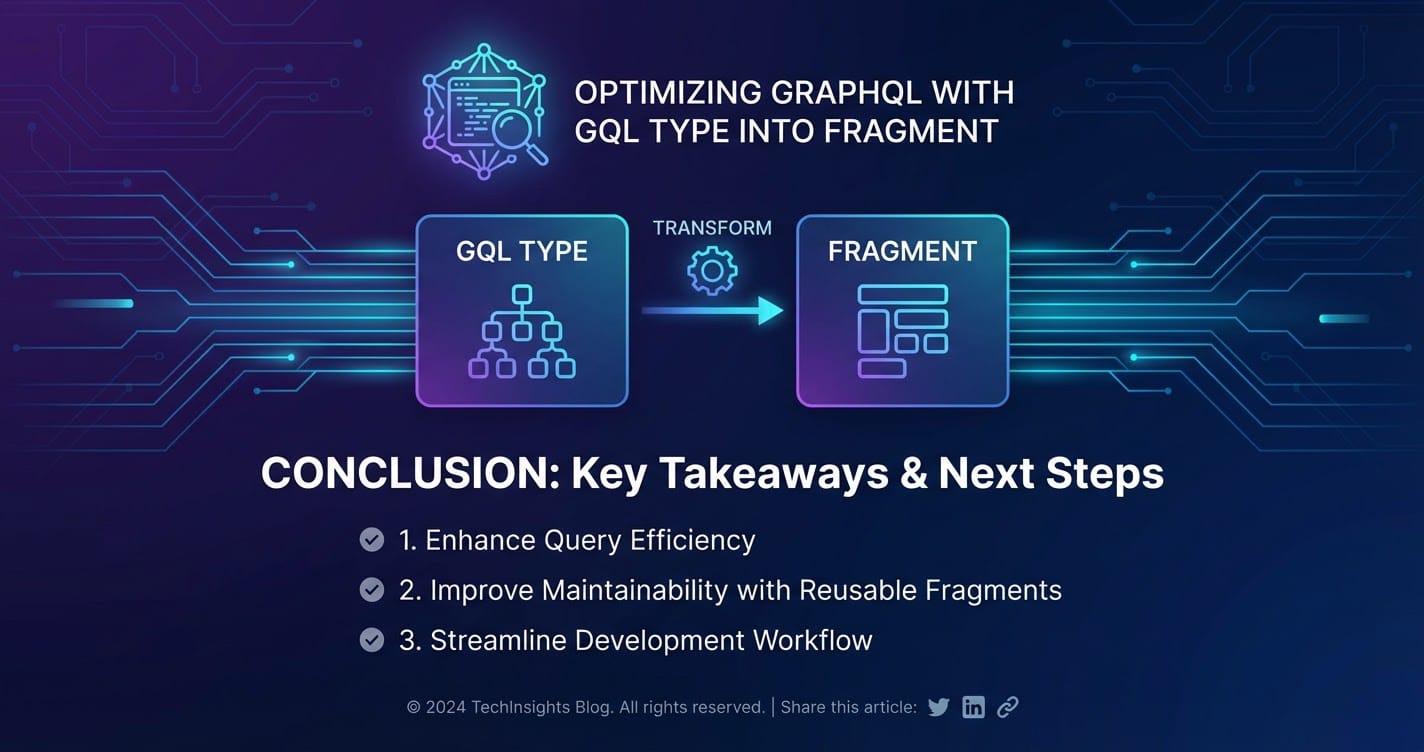
Optimizing GraphQL with GQL Type into Fragment


The digital world is increasingly powered by a complex web of interconnected services, all communicating through Application Programming Interfaces (APIs). From mobile applications to sprawling enterprise systems, APIs are the backbone of modern software. As these systems grow in complexity and data requirements become more dynamic, traditional API paradigms, like REST, often encounter challenges related to over-fetching or under-fetching data. This is where GraphQL has emerged as a powerful, flexible alternative, allowing clients to precisely define the data they need, thereby optimizing network payloads and improving application performance. However, merely adopting GraphQL is often not enough; to truly unlock its potential, developers must delve into advanced optimization techniques. One such critical technique, often overlooked but profoundly impactful, involves intelligently incorporating __typename into GraphQL fragments, particularly when dealing with polymorphic data structures. This strategy not only bolsters type safety and client-side caching but also significantly enhances the maintainability and robustness of your GraphQL applications.
The journey to building highly performant and resilient applications begins with a deep understanding of the underlying data fetching mechanisms. GraphQL, by design, offers a paradigm shift from resource-oriented fetching to a graph-oriented approach, enabling clients to traverse relationships and retrieve exactly what they need in a single request. Yet, the elegance of GraphQL can be marred by inefficiencies if not wielded with precision. When confronted with data that can manifest in different forms—think of a search result that could be a User, a Product, or a Post—the client needs a reliable mechanism to distinguish between these types to process the data correctly. This article will explore the profound implications of using __typename within fragments, transforming what might seem like a minor detail into a cornerstone of advanced GraphQL optimization, and how this fits into the broader landscape of api management, including the crucial role of an api gateway.
Understanding GraphQL Fundamentals: A Recap for Deeper Optimization
Before diving into the intricacies of __typename and fragments, it's essential to briefly revisit the core tenets of GraphQL. Its architecture revolves around a strong type system, enabling clients and servers to agree on the exact shape of data.
Queries, Mutations, and Subscriptions: At its heart, GraphQL supports three primary operation types. Queries are used for fetching data, akin to GET requests in REST, but with the added power of precise data selection. Mutations are for modifying data, similar to POST, PUT, or DELETE operations, ensuring that side effects are explicit and predictable. Subscriptions provide real-time capabilities, allowing clients to subscribe to events and receive updates automatically when data changes, which is invaluable for dynamic user interfaces and collaborative applications. Each of these operations benefits from efficient data structuring and fetching.
Schemas and Types: The backbone of any GraphQL service is its schema, which defines a contract between the client and the server. This schema, written in GraphQL Schema Definition Language (SDL), specifies all available types, fields, and relationships. Types can be scalar (like String, Int, ID), object (custom types with fields), enum, input object, interface, or union. The strict typing within the schema is what gives GraphQL much of its power, enabling powerful introspection and tooling. Understanding how data types are defined is paramount, especially when dealing with complex, polymorphic data where one field might return different object types based on context.
Fragments: Reusable Units of Selection: Fragments are one of GraphQL's most elegant features for promoting query modularity and reusability. Imagine you have multiple queries or components that all need to fetch the same set of fields for a particular type, say a User. Instead of repeating the field selection in every query, you can define a fragment:
fragment UserFields on User {
  id
  username
  email
  avatarUrl
}
Then, you can spread this fragment into any query that needs User data:
query GetCurrentUser {
  currentUser {
    ...UserFields
  }
}

query GetUserById($id: ID!) {
  user(id: $id) {
    ...UserFields
  }
}
The benefits of fragments are manifold: 1. Code Reuse: Prevents repetition, making queries more concise. 2. Maintainability: Changes to a data requirement for a specific type only need to be updated in one place (the fragment). 3. Colocation of Data Requirements: Crucially, fragments allow client-side components to declare their data dependencies directly alongside their rendering logic, a concept often referred to as "colocation." This tight coupling ensures that a component always gets the data it needs, simplifying development and reducing bugs.
The Problem of Ambiguity in Polymorphic Data: While fragments are powerful, they become particularly interesting when combined with polymorphic types—interfaces and unions. An interface defines a set of fields that a type must include, but different types can implement the same interface with their own unique fields. A union is an abstract type that simply states a field can return one of several distinct object types, without any shared fields guaranteed by the union itself.
Consider a SearchResult union that can return either a User or a Product. If a query fetches a list of SearchResults, how does the client know which type it has received and, therefore, which fields it can access?
query Search($query: String!) {
  search(query: $query) {
    # What fields can I fetch here?
    # How do I know if it's a User or a Product?
  }
}
Without a mechanism to distinguish the underlying type, the client-side application would struggle to correctly parse and render the data. This is precisely where the __typename meta-field steps in, offering a crucial piece of metadata that unlocks advanced optimization strategies.
The Power of __typename in GraphQL
The __typename field is a special meta-field available on any object type in a GraphQL schema. It's not explicitly defined in your SDL, but it's always there, provided by the GraphQL server.
What is __typename? When you request __typename on any object, it returns a string representing the exact name of that object's type as defined in the schema. For example, if you query a User object and include __typename, it will return the string "User". If you query a Product object, it will return "Product".
query GetMyProfile {
  currentUser {
    id
    username
    __typename # This will return "User"
  }
}
How it works: __typename is inherently part of the GraphQL specification. You don't need to add it to your schema; it's always available for introspection. This makes it incredibly powerful because it provides runtime type information directly within your data payload.
Initial Use Cases: Initially, __typename was primarily used for debugging GraphQL queries, allowing developers to verify the types of objects they were receiving. It quickly became apparent, however, that its utility extended far beyond simple debugging.
- Client-Side Type Checking: On the client,
__typenameallows applications to perform conditional logic based on the actual type of an object. This is invaluable when working with union or interface types, enabling components to render different UI elements or process data differently based on the specific object received. - Connecting to Client-Side Caching: Perhaps the most significant "initial" use case that paved the way for deeper optimizations is its role in client-side caching mechanisms, particularly in libraries like Apollo Client and Relay. These libraries normalize the data they receive from GraphQL servers, storing it in a flat, de-duplicated cache. To do this effectively, they need a unique identifier for each object. While
idfields are common for this purpose, they are only unique within a given type. For example, aUserwithid: "1"is distinct from aProductwithid: "1". To create a globally unique key for cache normalization, these libraries often combine the__typenamewith the object'sid(e.g.,"User:1","Product:1"). This composite key ensures that different types with the sameidare not mistakenly treated as the same entity in the cache. This fundamental use of__typenamefor cache identification is a prerequisite for robust client-side performance.
The ability to accurately identify the type of an object at runtime, coupled with its role in cache normalization, forms the bedrock upon which more advanced optimization techniques, like embedding __typename directly into type-conditioned fragments, are built.
Deep Dive: GQL Type into Fragment – The Optimization Strategy
The core idea behind "GQL Type into Fragment" (or more accurately, incorporating __typename into type-conditioned fragments) is to explicitly request the __typename field within each specific type condition of a fragment when querying a union or interface field. This might seem redundant at first glance, as client libraries often implicitly fetch __typename for caching anyway, but the explicit inclusion, especially within type-conditioned fragments, offers a cascade of benefits for advanced GraphQL usage.
The Core Idea: When you define a fragment spread on an interface or union type, you can use type conditions to specify different field selections based on the concrete type being returned. For example, for a SearchResult union:
fragment SearchResultFields on SearchResult { # This is the union type
  __typename # Request __typename at the top level for the union
  ...on User { # If the SearchResult is a User...
    id
    username
    email
    __typename # Explicitly request __typename here again
  }
  ...on Product { # If the SearchResult is a Product...
    id
    name
    price
    imageUrl
    __typename # Explicitly request __typename here again
  }
}

query GetSearchResults($query: String!) {
  search(query: $query) {
    ...SearchResultFields
  }
}
Notice the redundant __typename requests. While a top-level __typename on the SearchResult union might tell you which concrete type was returned (e.g., "User"), explicitly requesting __typename inside each ...on TypeName block solidifies the client's understanding and ensures that caching layers have the most granular and explicit type information for each possible branch of the data.
Why is this an optimization? The benefits extend far beyond mere redundancy:
- Enhanced Type Safety and Predictability: By explicitly including
__typenamewithin each type-conditioned fragment, you're making an unambiguous statement about the expected type of data that will be returned when that specific fragment condition is met. This guarantees that your client-side code, particularly when generated by tools like TypeScript code generators, will have the most accurate and narrowest possible type definition. It reduces the chance of runtime type errors because the client knows exactly what shape of data to expect for aUserversus aProductbranch of the union. This is crucial for robust application development, minimizing the guessing game for developers and compilers alike. - Improved Client-Side Logic and Code Generation: Client-side GraphQL libraries and code generators (e.g., Apollo Client's
codegen, Relay's compiler) heavily leverage the schema and query definitions. When__typenameis present in type-conditioned fragments, these tools can generate more precise and efficient client-side data structures and hooks. For instance, a generated TypeScript type forSearchResultcan directly discriminate betweenUserandProductbased on the__typenamefield, simplifying conditional rendering logic and data processing. Instead of manually checkingif (item.__typename === 'User'), the type system often guides you directly to the correct type-guarded branch. - Smarter and More Resilient Caching: This is perhaps where the optimization shines brightest. While most modern GraphQL caching clients (like Apollo Client) do implicitly add
__typenameto queries for cache normalization, explicitly including it in type-conditioned fragments ensures that the cache has the most complete and robust information.- Precise Cache Invalidation: When a piece of data changes on the server, the cache needs to know exactly which cached objects to update or invalidate. By having
__typenameconsistently available for every object within the cache (viaid+__typename), the caching library can perform much more surgical updates. If aUserobject is updated, only entries linked to"User:ID"are affected, not potentially overlappingProductentries with the sameID(if that were even possible, which it usually isn't with composite keys, but the explicitness reinforces correctness). - Data Integrity: It provides an additional layer of confidence in the cache's ability to maintain data integrity, especially in complex scenarios involving multiple queries fetching the same data in different ways or with different polymorphic interpretations.
- Precise Cache Invalidation: When a piece of data changes on the server, the cache needs to know exactly which cached objects to update or invalidate. By having
- Reduced Over-fetching/Under-fetching (Advanced Implications): While GraphQL's primary benefit is reducing over-fetching, this specific technique refines that benefit in polymorphic contexts. By explicitly defining fields within each type condition, you're instructing the server to fetch only the fields relevant to that specific type. If you have a
SearchResultunion and only defineidandusernameforUserandidandnameforProduct, the server will only send those specific fields when aUserorProductis returned, respectively. This means you aren't fetchingemailfor aProductorpricefor aUser, even if they happen to share other fields. It’s a highly targeted approach to data selection within complex type hierarchies. - Better Maintainability and Readability: When a developer looks at a query with type-conditioned fragments, the explicit
__typenamefields serve as clear markers of intent. It visually reinforces that different data shapes are expected and handled, making the query easier to understand and debug. When evolving the schema, this explicit declaration simplifies the process of updating queries, as the expectations for each type are clearly laid out.
This strategy transforms the query from a vague request for "some data that might be one of these types" to a precise instruction: "for each of these possible types, fetch these specific fields, and tell me explicitly what type it is." This precision is a hallmark of truly optimized GraphQL usage.
Practical Application and Examples
Let's illustrate this optimization with concrete GraphQL query examples for common polymorphic scenarios.
Scenario 1: Union Types (e.g., SearchResult can be User or Product)
Imagine a search functionality where the results can be either users or products.
Without __typename in Type-Conditioned Fragments:
# fragment SearchResultFields on SearchResult { # Not recommended for union types at top-level
#   id # This field might not exist on all union members
# }

query Search($query: String!) {
  search(query: $query) {
    ...on User {
      id
      username
      email
    }
    ...on Product {
      id
      name
      price
      description
    }
  }
}
In this scenario, the client receives an array of objects. Each object will inherently have an __typename (often added implicitly by the client library), but the query doesn't explicitly ask for it within each type's selection. While functional, it leaves the type discrimination slightly less explicit and relies more heavily on the client library's implicit fetching. If you want to use the __typename to decide rendering, you'd be relying on that implicit fetch.
With __typename in Type-Conditioned Fragments (Optimized):
fragment SearchResultDetails on SearchResult {
  # Even for union types, a top-level __typename can be useful for initial discrimination
  # but the real power comes from within the type conditions.
  __typename

  ...on User {
    id
    username
    email
    profilePictureUrl
    __typename # Explicitly request __typename for User type
  }
  ...on Product {
    id
    name
    price
    currency
    imageUrl
    stockQuantity
    __typename # Explicitly request __typename for Product type
  }
  # Optionally, add fragments for other possible union members
  ...on Article {
    id
    title
    author {
      username
    }
    publishedDate
    __typename # Explicitly request __typename for Article type
  }
}

query GetSearchResults($query: String!) {
  search(query: $query) {
    # The search field returns a list of SearchResult (union)
    ...SearchResultDetails
  }
}
Client-Side Consumption: On the client side, using TypeScript with a code generator, the generated types for GetSearchResultsQuery might look something like this (simplified):
type GetSearchResultsQuery = {
  search: Array<
    | ({ __typename: 'User' } & Pick<User, 'id' | 'username' | 'email' | 'profilePictureUrl'>)
    | ({ __typename: 'Product' } & Pick<Product, 'id' | 'name' | 'price' | 'currency' | 'imageUrl' | 'stockQuantity'>)
    | ({ __typename: 'Article' } & Pick<Article, 'id' | 'title' | 'publishedDate'> & {
        author: { username: string }
      })
  >;
};

// In a React component:
const SearchResults = ({ data }: { data: GetSearchResultsQuery }) => {
  return (
    <div>
      {data.search.map((item) => {
        switch (item.__typename) {
          case 'User':
            return <UserCard key={item.id} user={item} />;
          case 'Product':
            return <ProductCard key={item.id} product={item} />;
          case 'Article':
            return <ArticlePreview key={item.id} article={item} />;
          default:
            return null;
        }
      })}
    </div>
  );
};
The explicit __typename within each type condition makes the switch (item.__typename) statement robust and type-safe, ensuring the compiler knows exactly which fields are available for item within each case block.
Scenario 2: Interface Types (e.g., Node interface implemented by User and Post)
An ID field and a Node interface are common in GraphQL, particularly for Relay-style APIs, where Node is implemented by any object that has a globally unique ID.
interface Node {
  id: ID!
}

type User implements Node {
  id: ID!
  username: String!
  email: String
  posts: [Post!]!
}

type Post implements Node {
  id: ID!
  title: String!
  content: String!
  author: User!
}
Querying the Node field with optimized fragments:
fragment NodeDetails on Node {
  id
  __typename # Top-level __typename for the interface
  ...on User {
    username
    email
    # Note: we don't need 'id' here again as it's already on Node
    __typename # Explicit for User
  }
  ...on Post {
    title
    content
    author {
      username
    }
    __typename # Explicit for Post
  }
}

query GetAnyNode($nodeId: ID!) {
  node(id: $nodeId) {
    ...NodeDetails
  }
}
In this example, GetAnyNode can fetch either a User or a Post based on the nodeId. The NodeDetails fragment, with its explicit __typename in each ...on Type, ensures that the client clearly knows whether it has received a User (and can access username, email) or a Post (and can access title, content, author). This approach makes the client-side data handling much more predictable and less error-prone.
Here is a comparative table illustrating the differences and benefits of using __typename within type-conditioned fragments:
| Feature/Aspect | Basic Polymorphic Query (Implicit __typename) |
Optimized Polymorphic Query (Explicit __typename in Fragment) |
|---|---|---|
| Query Structure | Type-conditioned fragments, but __typename typically omitted within ...on TypeName blocks. |
Type-conditioned fragments, with __typename explicitly requested within each ...on TypeName block. |
__typename Usage |
Client-side libraries often implicitly add __typename to the query for caching purposes. |
Explicitly requested, making it part of the query contract and payload. |
| Type Safety | Client needs to rely on runtime checks or generated types that assume __typename is present. |
Stronger compile-time type guarantees; __typename is a defined part of each possible type, enhancing type discrimination. |
| Client Logic | Relies on client library behavior or post-fetch type assertions. | Direct, explicit access to __typename enables cleaner switch or if/else logic for type-specific processing; generated code is more precise. |
| Caching | Good, but relies on implicit behavior; potential for subtle inconsistencies if schema changes or client behavior is unexpected. | Excellent; explicit __typename reinforces cache normalization keys (ID:__typename), leading to more robust and predictable cache behavior and updates. |
| Maintainability | Logic for handling different types might be less clearly coupled to the data fetching. | Type-specific logic and fields are colocated and explicitly defined within fragments, improving readability and maintenance. |
| Developer Experience | Can be slightly ambiguous; debugging type issues might require inspecting network payloads. | Clearer contract between client and server; tooling and IDEs can offer better autocompletion and error checking based on explicit types. |
| Payload Size | Marginally smaller as __typename is not explicitly requested multiple times. |
Marginally larger due to repeated __typename fields, but the overhead is negligible compared to the benefits. |
This table clearly highlights why the explicit inclusion of __typename in type-conditioned fragments, while adding a slight verbosity to the query, is a strategic choice for building high-quality, maintainable, and performant GraphQL applications.
Benefits Beyond Basic Type Resolution
The advantages of explicitly incorporating __typename into type-conditioned fragments extend far beyond merely resolving type ambiguity at runtime. They contribute to fundamental improvements in how GraphQL applications are built, maintained, and scaled.
Robust Client-Side Architectures: By ensuring that every piece of polymorphic data carries its own explicit type identifier, client applications become significantly more robust. This robustness manifests in several ways: 1. Reduced Runtime Errors: The risk of trying to access a field that doesn't exist on a particular object type is dramatically reduced. The client can confidently branch its logic based on the __typename, knowing exactly which fields are available. 2. Predictable UI Rendering: Components can be designed to react precisely to the specific type of data they receive, leading to more stable and predictable user interfaces. No more unexpected UI glitches due to misinterpretations of data types. 3. Easier State Management: When managing complex application state, especially with data retrieved from GraphQL, having explicit type information makes it easier to normalize, update, and retrieve data from client-side stores, leading to a more consistent and reliable application state.
Decoupling Frontend and Backend (within limits): While GraphQL itself offers a strong contract, explicitly managed type information further aids in decoupling. If the backend schema evolves (e.g., adding a new field to Product or refining a User type), the client's type-conditioned fragments, with __typename as a strong discriminator, help ensure that changes in one type don't inadvertently break logic for another type, provided the fragment for the affected type is updated accordingly. This promotes a more modular and independent evolution of services and clients.
Improved Developer Experience: Developer experience is a critical, albeit often intangible, benefit. 1. Clearer Expectations: Developers immediately understand the possible shapes of data a polymorphic field can return, leading to less guesswork and more confident coding. 2. Enhanced Tooling Support: IDEs, linting tools, and GraphQL schema explorers can leverage this explicit type information to provide superior autocompletion, type validation, and error detection directly in the editor, catching issues before they even reach a testing environment. 3. Simplified Debugging: When an issue arises, knowing that the __typename is reliably present in the payload for every object greatly simplifies debugging, allowing developers to quickly pinpoint type mismatches or incorrect data processing.
Performance Implications (Indirect): While adding __typename to every fragment might seem like it adds a small overhead to the network payload, the actual performance benefits are primarily indirect but significant: 1. More Efficient Client-Side Processing: With clear type information, the client-side application spends less time on runtime type inference or error handling, leading to faster data processing and rendering cycles. 2. Optimized Cache Interactions: A robustly normalized cache, built upon explicit __typename + id keys, leads to fewer cache misses, more precise cache updates, and overall more efficient interactions with the local data store, which significantly improves perceived application performance by reducing the need for costly network requests. 3. Reduced Development Time for Bug Fixing: Faster debugging and fewer type-related bugs directly translate to more development time spent on features rather than fixes, indirectly boosting the overall productivity and speed of delivery for performant applications.
In essence, by embracing the explicit use of __typename within type-conditioned fragments, developers are not just writing more GraphQL; they are building a more resilient, predictable, and ultimately more performant client-side application architecture. This disciplined approach lays the groundwork for scaling complex GraphQL services efficiently.
Challenges and Considerations
While the benefits of incorporating __typename into type-conditioned fragments are substantial, it's also important to acknowledge potential challenges and considerations to ensure this optimization strategy is applied effectively.
Increased Query Verbosity: The most immediate and noticeable challenge is that queries can become significantly longer and more verbose. Each ...on TypeName block will now typically include its own __typename field, and if you have many possible types in a union or interface, the fragment can grow quite large. This can sometimes make queries harder to read at a glance, especially for developers new to GraphQL. * Mitigation: The use of nested fragments or breaking down very large fragments into smaller, more focused ones can help manage verbosity. Clear naming conventions for fragments are also crucial. The trade-off for verbosity is often improved clarity and type safety, which for complex applications, is a worthwhile exchange.
Overhead of __typename Field: Each instance of __typename adds a small amount of data to the GraphQL response payload. While typically a negligible increase for a single field (a string), across a very large dataset with many polymorphic objects, it could theoretically add up. * Mitigation: In practice, for most applications, the size increase is minuscule compared to the actual data being fetched. The benefits in terms of client-side efficiency, caching, and developer experience far outweigh this minimal payload overhead. Modern network protocols and compression also largely mitigate this concern.
Complexity for Beginners: For developers just starting with GraphQL, understanding fragments, type conditions, interfaces, and unions can already be a steep learning curve. Introducing the explicit __typename on top of that can initially increase the perceived complexity. * Mitigation: Emphasizing the "why" behind this practice (type safety, caching, code generation) is key. Providing clear examples, documentation, and adhering to consistent patterns within a team can help onboard new developers more smoothly. The long-term benefits typically justify the initial learning investment.
Schema Design Importance: This optimization strategy thrives on a well-designed GraphQL schema. If your schema overuses or underuses interfaces and unions, or defines them inconsistently, applying this fragmentation pattern might become cumbersome or less effective. * Overuse of Unions/Interfaces: If every minor difference leads to a new union member or interface implementation, the queries become unwieldy. * Underuse of Unions/Interfaces: If you try to cram different object types into a single "generic" type with many nullable fields, you lose the benefits of type discrimination, and this fragment pattern won't apply meaningfully. * Mitigation: Prioritizing thoughtful schema design from the outset is paramount. Regularly reviewing and refactoring the schema to ensure it accurately models the domain while optimizing for client consumption will yield the best results when applying advanced fragment techniques.
In summary, while there are minor challenges associated with this optimization, they are generally manageable with good development practices and a clear understanding of the trade-offs. The benefits of enhanced type safety, improved caching, and robust client-side logic typically far outweigh these considerations for any serious GraphQL application.
The Role of API Gateways in a GraphQL Ecosystem
As GraphQL APIs grow in complexity, particularly when incorporating advanced patterns like type-conditioned fragments and polymorphic data, the role of an api gateway transitions from a simple traffic router to a critical orchestrator and policy enforcement point. A robust api gateway becomes indispensable for managing, securing, and scaling these sophisticated api landscapes.
Beyond Basic Proxying: Historically, an api gateway might have simply forwarded requests to a single backend service. However, in a modern GraphQL ecosystem, the gateway does much more. It acts as a single entry point for all client requests, abstracting away the complexity of your backend services, which could be a mix of microservices, serverless functions, and even legacy systems. For GraphQL, an api gateway can coalesce data from various sources and present it as a unified GraphQL endpoint.
Federation and Stitching: This is where modern api gateway capabilities for GraphQL truly shine. 1. GraphQL Federation: Solutions like Apollo Federation enable you to build a single, unified GraphQL schema from multiple underlying GraphQL services (subgraphs). The api gateway (often called a "GraphQL gateway" or "router" in this context) receives a single query from the client, breaks it down, routes parts of it to the appropriate subgraphs, stitches the results back together, and returns a single, coherent response to the client. This allows large organizations to independently develop and deploy GraphQL services while presenting a cohesive api to consumers. 2. GraphQL Schema Stitching: Similar in principle, stitching allows you to combine disparate GraphQL schemas (which might even be from external apis) into a single executable schema. The api gateway orchestrates this composition, making it appear as one seamless api.
These capabilities are crucial for scaling GraphQL in large organizations, enabling domain-driven design and independent team deployments without fragmenting the client experience.
Security and Authentication: An api gateway provides a centralized point for enforcing security policies. Instead of implementing authentication, authorization, and data encryption in every backend service, these concerns can be offloaded to the gateway. For GraphQL, this is particularly important as complex queries could potentially expose sensitive data if not properly secured. The gateway can validate JWTs, manage OAuth flows, and even apply fine-grained access control based on user roles or specific data fields requested in a GraphQL query. This drastically simplifies security management for diverse api endpoints.
Rate Limiting and Throttling: To prevent abuse, ensure fair usage, and protect backend services from overload, an api gateway is essential for applying rate limits and throttling policies. It can monitor the number of requests per client, IP address, or user over a given period and block or delay requests that exceed defined thresholds. This is especially vital for GraphQL, where a single, complex query could potentially hit multiple backend services or perform computationally intensive operations. The gateway can analyze the query's complexity and apply policies accordingly.
Monitoring and Analytics: A centralized api gateway offers a single pane of glass for monitoring all api traffic. It can log every request and response, track latency, error rates, and resource utilization. This rich telemetry data is invaluable for identifying performance bottlenecks, debugging issues, and understanding api consumption patterns. For GraphQL, the gateway can provide insights into query performance, frequently used fields, and potentially problematic queries that consume excessive resources.
Introducing APIPark: Your Open-Source AI Gateway & API Management Platform
For organizations deploying sophisticated GraphQL services, especially those involving complex type systems and potentially federated architectures, the role of a robust api gateway becomes paramount. An api gateway isn't merely a proxy; it's a critical control point for managing the entire lifecycle of your APIs, enforcing security, handling traffic, and providing invaluable insights. This is where platforms like APIPark truly shine.
APIPark is an all-in-one AI gateway and API developer portal, open-sourced under the Apache 2.0 license, designed to help developers and enterprises manage, integrate, and deploy AI and REST services with ease. In the context of advanced GraphQL optimization, APIPark offers a compelling suite of features that directly support the efficient and secure operation of such APIs:
- End-to-End API Lifecycle Management: APIPark assists with managing the entire lifecycle of APIs, including design, publication, invocation, and decommission. For GraphQL APIs, this means consistent governance from schema definition to deprecation, ensuring that even highly optimized queries with complex fragments are managed within a structured framework. It helps regulate API management processes, manage traffic forwarding, load balancing, and versioning of published APIs, which is crucial for evolving GraphQL schemas.
- Performance Rivaling Nginx: With just an 8-core CPU and 8GB of memory, APIPark can achieve over 20,000 TPS, supporting cluster deployment to handle large-scale traffic. This high-performance capability is essential for handling the potentially complex query parsing and stitching operations required by a GraphQL
gateway, ensuring that thegatewayitself doesn't become a bottleneck for your highly optimized GraphQL APIs. - Detailed API Call Logging and Powerful Data Analysis: APIPark provides comprehensive logging capabilities, recording every detail of each API call. This feature allows businesses to quickly trace and troubleshoot issues in API calls, which is invaluable for debugging complex GraphQL queries that might involve multiple backend services or intricate fragment logic. Furthermore, APIPark analyzes historical call data to display long-term trends and performance changes, helping businesses with preventive maintenance before issues occur. This analytical power is critical for understanding the real-world performance of your optimized GraphQL queries and making data-driven decisions.
- Security and Access Control: APIPark enables the creation of multiple teams (tenants) with independent applications and security policies, and supports API resource access requiring approval. This allows for fine-grained control over who can access your GraphQL APIs and what data they can retrieve, complementing the internal type safety provided by
__typenamefragments with robust external access control. - Quick Integration of AI Models & Unified API Format for AI Invocation: While this article focuses on GraphQL, it's worth noting that GraphQL itself can be used to serve AI model inferences. APIPark's ability to integrate 100+ AI models and standardize their invocation format means that organizations building sophisticated applications that blend traditional data fetching with AI capabilities can manage all these diverse
apis through a single, powerfulgateway. This extends the concept of a unifiedapiexperience from data fetching to intelligent services.
By leveraging an advanced api gateway like APIPark, organizations can ensure that their meticulously optimized GraphQL APIs are not only performant and maintainable at the code level but also secure, scalable, and manageable within the broader api ecosystem. It provides the necessary infrastructure to support the continuous evolution and scaling of modern api-driven applications.
Advanced Topics and Future Directions
The journey of optimizing GraphQL with __typename in fragments is a stepping stone to even more advanced techniques and considerations for future-proofing your api architecture.
Persisted Queries: Persisted queries are a powerful optimization where clients send a hash or ID of a predefined query to the server, rather than the full query string. The server then looks up the corresponding query and executes it. This reduces network payload size and can improve server-side performance by pre-parsing and validating queries. Type-conditioned fragments, especially with __typename explicitly defined, work exceptionally well with persisted queries. The explicit nature of the fragments ensures that the server has a complete and unambiguous understanding of the client's data requirements for all possible polymorphic types, even when only a hash is sent. This combination further enhances security by preventing arbitrary queries and boosts performance.
Client-side Tooling Support: The GraphQL ecosystem boasts a rich array of client-side tools and libraries. Code generators (e.g., GraphQL Code Generator, Relay Compiler) play a pivotal role. When __typename is consistently used in type-conditioned fragments, these tools can generate highly accurate and type-safe client-side code (e.g., TypeScript interfaces, React hooks) that directly reflect the polymorphic nature of the data. This means developers gain compile-time guarantees about data shapes, reducing runtime errors and improving developer velocity. IDE integrations, schema validation tools, and linting rules also become more effective, providing immediate feedback on query correctness and adherence to best practices.
GraphQL Subscriptions and Live Queries: The principles of efficient data selection and type discrimination apply equally to real-time data streams. When subscribing to changes on a polymorphic field, ensuring __typename is included in type-conditioned fragments is just as vital. It guarantees that the client can correctly process and update its UI based on the specific type of data received in a live update, maintaining the robustness and type safety established for static queries. This is particularly important for collaborative applications or dashboards displaying dynamic data.
Schema Evolution and Versioning: As applications evolve, so too do their underlying GraphQL schemas. Managing schema changes, especially breaking ones, is a significant challenge. Fragments, particularly when well-defined with explicit __typename, can aid in schema evolution. By localizing data requirements, they make it easier to identify and update affected parts of the client when schema changes occur. While not a direct versioning solution, a disciplined approach to fragments can simplify the process of gradually migrating clients to new schema versions or providing graceful degradation strategies, for instance, by defining multiple fragments for different client versions. The ability of an api gateway to manage different api versions and routes also becomes highly relevant here, providing a controlled environment for introducing schema changes.
These advanced topics underscore that optimizing GraphQL is not a one-time task but an ongoing commitment to building resilient, performant, and maintainable data-fetching layers. The foundational technique of using __typename in fragments serves as a powerful enabler for these more sophisticated strategies, ensuring that your GraphQL api remains a robust and adaptable foundation for your applications.
Conclusion: Mastering GraphQL for Future-Proof APIs
The journey into the depths of GraphQL reveals that true optimization extends beyond simply choosing a modern api paradigm. It demands a nuanced understanding of its features and a commitment to applying advanced techniques with precision. Leveraging __typename within type-conditioned fragments stands out as a deceptively simple yet profoundly impactful strategy. This technique moves beyond mere data fetching efficiency, fundamentally bolstering type safety, enhancing client-side caching mechanisms, and significantly improving the maintainability and robustness of complex GraphQL applications. By explicitly defining the type and its associated fields for every possible branch of a polymorphic data structure, developers gain unparalleled predictability and control over their data flow, leading to more resilient client-side architectures and a superior developer experience.
This meticulous approach to GraphQL design, however, does not exist in a vacuum. It is critically complemented by a robust api gateway strategy. As GraphQL APIs mature, incorporating features like federation, real-time subscriptions, and a diverse range of backend services, the api gateway evolves into an indispensable central nervous system. It handles the orchestration of complex queries, enforces crucial security policies, manages traffic, and provides the vital monitoring and analytical insights necessary to operate and scale such sophisticated api landscapes effectively. Platforms like APIPark, with their comprehensive api lifecycle management, high-performance capabilities, detailed logging, and strong security features, embody the kind of api gateway solution that modern enterprises need to fully realize the potential of their optimized GraphQL APIs. They provide the infrastructure to turn intricate GraphQL designs into production-ready, scalable, and secure services, bridging the gap between elegant code and robust operational realities.
Mastering GraphQL, therefore, is a dual endeavor: it requires an intricate understanding of its specification and best practices, as demonstrated by the intelligent use of __typename in fragments, coupled with a strategic implementation of an intelligent api gateway. This synergy ensures that your apis are not just performing well today, but are future-proofed against evolving requirements, maintaining their efficiency, security, and developer-friendliness as your applications grow and adapt to the ever-changing digital landscape. Embracing these advanced practices is not merely about writing better queries; it's about building a foundation for sustainable, high-quality, and innovative software development.
Frequently Asked Questions (FAQs)
1. What is __typename in GraphQL and why is it important for optimization? __typename is a meta-field available on every object type in GraphQL that returns the name of that object's type as a string. It's crucial for optimization because it provides runtime type information directly within the data payload. This allows client-side applications to precisely distinguish between different types of data (especially polymorphic ones like unions and interfaces), enabling robust type safety, smarter client-side caching (by forming composite cache keys with id), and more efficient conditional logic in client code.
2. How does including __typename in type-conditioned fragments improve type safety? When __typename is explicitly requested within each ...on TypeName block of a fragment, it ensures that the client-side code (especially with tools like TypeScript code generators) receives an unambiguous type definition for each possible data branch. This means the compiler knows exactly which fields are available for a given type, eliminating the need for runtime type assertions and significantly reducing the risk of accessing non-existent fields, thus making the application more robust and predictable.
3. What are the caching benefits of using __typename in fragments? Client-side GraphQL caching libraries (e.g., Apollo Client, Relay) rely on unique identifiers for normalizing and storing data. By explicitly including __typename within fragments, it provides the most precise information for creating composite cache keys (e.g., Type:ID). This leads to more accurate cache normalization, prevents data conflicts between different types sharing the same id, and enables more surgical and efficient cache updates and invalidations when data changes, ultimately improving perceived application performance.
4. Does adding __typename to every fragment increase payload size significantly? While adding __typename to every fragment does increase the network payload size marginally (as it's an extra string field for each object), in most practical scenarios, this overhead is negligible. The benefits gained in terms of enhanced type safety, more efficient client-side processing, and robust caching typically far outweigh the minimal increase in payload size. Modern compression techniques and network speeds further mitigate this concern, making it a worthwhile trade-off for complex applications.
5. How does an api gateway like APIPark complement GraphQL optimization techniques? An api gateway like APIPark acts as a critical control point for managing sophisticated GraphQL APIs. While __typename in fragments optimizes the internal data fetching and client-side processing, an api gateway enhances external aspects. It provides centralized security (authentication, authorization), rate limiting, traffic management (load balancing, routing for federated GraphQL), performance monitoring, and comprehensive logging. For GraphQL, this means supporting complex architectures (like federation), ensuring scalability under high traffic, and providing invaluable operational insights, thus making the optimized GraphQL APIs performant, secure, and manageable in a production environment.
🚀You can securely and efficiently call the OpenAI API on APIPark in just two steps:
Step 1: Deploy the APIPark AI gateway in 5 minutes.
APIPark is developed based on Golang, offering strong product performance and low development and maintenance costs. You can deploy APIPark with a single command line.
curl -sSO https://download.apipark.com/install/quick-start.sh; bash quick-start.sh

In my experience, you can see the successful deployment interface within 5 to 10 minutes. Then, you can log in to APIPark using your account.

Step 2: Call the OpenAI API.